



Abstract
Endometrial vascular dystrophy is quite rare, and there is very little literature regarding this subject. We present the unusual case of a 38-year-old woman who experienced vaginal bleeding after menstruation for 3 months. Hysteroscopically, the uterine cavity was filled with tiny, curved blood vessels, the bottom of the cavity was obvious, and polyps were visible. No curved vessels or polyps were identified after curettage. The diagnosis was endometrial hemodystrophy with endometrial polyps. Endometrial vascular dystrophy is a hysteroscopically uncommon benign lesion of the endometrial vessels.
Keywords
Introduction
Endometrial vascular dystrophy is rare under hysteroscopy. Hamou 1 described endometrial vascular dystrophy as abnormal vessels that are very tortuous, dilated, and sometimes thrombosed. The authors reported two types of vascular dystrophy. The first was a uniformly distributed spiral-like vessel, and the second was a mesh of branching capillaries. In the literature, only 11 cases have been reported,2–4 and the pathogenesis is unknown. Here, we describe a case of endometrial vascular dystrophy with endometrial polyps.
Case Report
The case of a 38-year-old patient with two pregnancies and one vaginal birth is presented. The patient experienced minimal vaginal bleeding after menstruation without obvious cause for 3 months, lasting from 3 to 7 days. She had regular menstruation with a cycle of 28 to 30 days and a period of 5 to 7 days. There was no history of unusual diseases, and no history of surgery, or alcohol or drug abuse. There was also no genetic history. Speculum examination revealed a small amount of vaginal blood, smooth cervix, and a uterus of normal size. Sex hormone measurements were as follows: testosterone (T): 0.71 nmol/L, prolactin (PRL): 20.3 µg/L, progesterone (P): 41.75 nmol/L, estradiol (E2): 349.48 pmol/L, follicle-stimulating hormone (FSH): 4.51 IU/L, and luteinizing hormone (LH): 3.21 IU/mL. No abnormalities were found in routine blood examinations, or testing for coagulation function, and liver and kidney function. Ultrasonography revealed that the local endometrial echo was uniform. Hysteroscopy and curettage were performed on the 19th day of menstruation (Video), which revealed that the uterine cavity was filled with small, curved blood vessels (Figure 1), the bottom of the cavity was obvious, and polyps were visible (Figure 2). Curettage was performed, and no lesions were found in the uterine cavity after re-examination. Pathological findings (Figure 3) indicated secretory endometrium and endometrial polyps. The diagnosis was endometrial vascular dystrophy with endometrial polyps. The patient was then treated with a combined oral contraceptive (COC) for 6 months, and no abnormal uterine bleeding was observed.

Hysteroscopic image in a 38-year-old patient with vaginal bleeding showing that the uterine cavity is filled with small curved blood vessels.

Hysteroscopic image in a 38-year-old patient with vaginal bleeding. The area in the dashed box contains endometrial polyps.
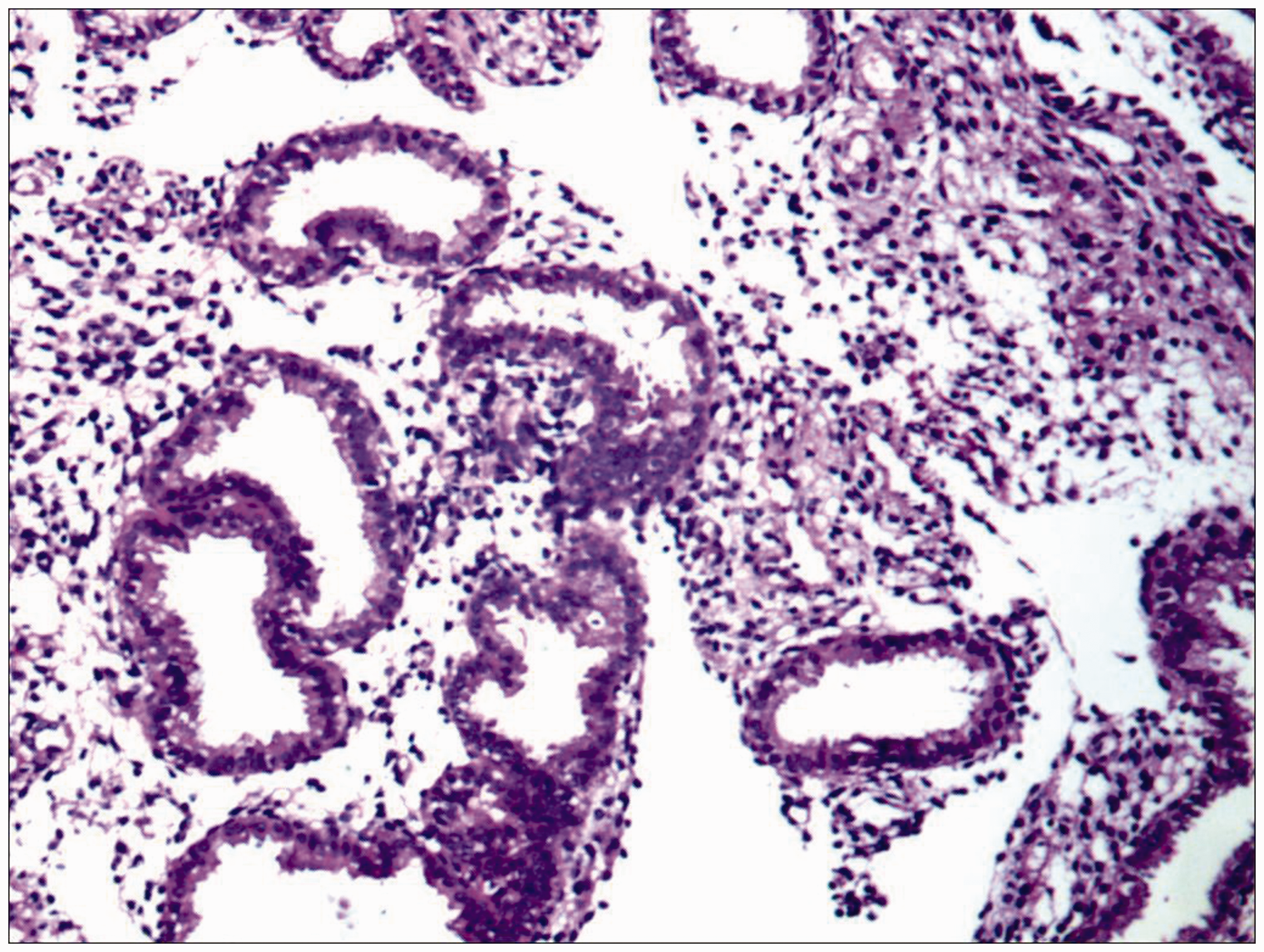
Pathological section from a 38-year-old patient with vaginal bleeding showing no blood-filled glands (hematoxylin and eosin (HE) ×100).
Approval for the study protocol was unnecessary because our institutional review board does not require approval for case reports. We obtained written informed consent for the treatment of the patient. All patient details were de-identified for the case report, and the report was written in accordance with the CARE guidelines. 5
Discussion
Hysteroscopically, the uniform distribution of curved blood vessels is not difficult to identify. Paoletti et al. 2 reported two cases, one in which the entire endometrial lining was covered by reddish, tortuous vessels arranged in parallel. In another case, the uterine fundus contained several reddish tortuous vessels arranged in parallel that merged with endometrial polyps. The pathological examination of the endometrium demonstrated secretory endometrium. Sopelana et al. 4 observed eight cases of endometrial vascular dystrophy, four of which were linked to the presence of an endometrial polyp. The authors used several stains to demonstrate the presence of red cells in the lumen of the glands. The authors felt that the structures were not blood vessels but glands in the secretory phase. Nevertheless, the authors could not explain how red cells entered the lumen of the gland. In our case, no blood-filled glands were found in any of the pathological sections (Figure 3). Lata et al. 3 reported one case of endometrial vascular dystrophy and concluded that this benign condition does not require intervention. The case we reported, with a diagnosis of endometrial vascular dystrophy with endometrial polyps, was the twelfth case reported to date and the sixth with endometrial polyps. Pathology revealed only secretory endometrium. Whether endometrial vascular dystrophy is related to progesterone and endometrial polyps requires further study.
Conclusion
Endometrial vascular dystrophy is very rare but is easily identifiable under hysteroscopy. Previous reports indicate that this condition is a benign lesion of the endometrial vessels. The etiology and underlying mechanism of endometrial vascular dystrophy are still unclear, and more cases and studies are needed.
Research Data
Research Data for Hysteroscopic presentation of endometrial vascular dystrophy: a case report
Research Data for Hysteroscopic presentation of endometrial vascular dystrophy: a case report by SuZhen Jiang and HongXia Gong in Journal of International Medical Research
Footnotes
Author Contributions
SuZhen Jiang collected and analyzed the data; drafted and revised the manuscript, and provided final approval. HongXia Gong read and checked the case report before submission and provided final approval.
Availability of data and material
Datasets supporting the conclusions of this article are included in the article.
Declaration of conflicting interests
The authors declare that there is no conflict of interest.
Funding
This research received no specific grant from any funding agency in the public, commercial, or not-for-profit sectors.

Supplemental material
Supplemental material for this article is available online.
References
Supplementary Material
Please find the following supplemental material available below.
For Open Access articles published under a Creative Commons License, all supplemental material carries the same license as the article it is associated with.
For non-Open Access articles published, all supplemental material carries a non-exclusive license, and permission requests for re-use of supplemental material or any part of supplemental material shall be sent directly to the copyright owner as specified in the copyright notice associated with the article.
