



Abstract
Background
Bisalbuminemia is a hereditary and/or acquired abnormality characterized by a double albumin (ALB) band on serum protein electrophoresis. However, there have been no epidemiological investigations of ALB variants in Chinese populations.
Methods
This retrospective study examined 71,963 unrelated subjects from five provinces in southern China. ALB variants were screened by cellulose acetate electrophoresis at pH 8.6 and ALB mutations were confirmed by polymerase chain reaction-DNA sequencing.
Results
The average incidence of inherited bisalbuminemia in the southern Chinese population was 0.0264% (19/71,963). Thirteen cases showed slow and six showed fast genetic variants on cellulose acetate electrophoresis. Four kinds of ALB variants were identified: proalbumin Lille (p.Arg23His), ALB Castel di Sangro (p.Lys560Glu), ALB Fukuoka-1 (p.Asp587Asn), and a novel ALB Wuxi (p.Lys562Glu). The gene frequency of ALB variants in the Wuxi region (0.126%, 13/10,297) was significantly higher than in other regions in southern China, and 90.9% (10/11) of cases of proalbumin Lille were also found in the Wuxi region.
Conclusions
This study provides the first report of the detailed prevalence and molecular characterization of ALB variants in southern China. Compared with other areas of China, Wuxi had a different pattern of ALB variants and a high prevalence of proalbumin Lille.
Keywords
Introduction
Bisalbuminemia or alloalbuminemia is an inherited or acquired serum protein abnormality characterized by a double band of albumin (ALB) on serum protein electrophoresis. 1 ALB variants are encountered in some rare clinical conditions. For example, a variant in familial hyperthyroxinemia dysalbuminemia can modify the affinity of ALB for thyroxine (T4), inducing assay artifacts (falsely elevated T4L), which can lead to misdiagnosis and possibly to overtreatment.2,3 Conjugation of growth hormone with this ALB variant was associated with improved pharmacokinetics of growth hormone therapy. 4 A better understanding of ALB variants may thus lead to the development of potentially new therapeutic approaches.
Bisalbuminemia is generally detected during routine clinical electrophoresis or electrophoretic screening for population genetic studies. Interest in inherited bisalbuminemia has centered mainly on human genetics and anthropology studies. 5 Many ALB variants have been studied structurally as markers of neutral molecular evolution because of interests in their frequency, population distribution, and ligand-binding properties.
Bisalbuminemia can also occur during prolonged and high-dose antibiotic treatment, and the discovery of bisalbuminemia in a patient affected by pancreatitis was suspicious of the presence of an ascitic or pleural effusion and of a pancreatic pseudo-cyst with a fistula in the effusion.6–9
The ALB gene (ALB; MIM# 103600; GenBank genomic reference sequence NC_000004.10) is at position 4q11-13 near the centromere of chromosome 4, and spans 16,961 nucleotides from the putative ‘Cap’ site to the first poly(A) addition site. There are about 4000 possible effective point mutations in the ALB gene, of which about 800 would affect its electrophoretic mobility. 10 ALB variants exist in a proportion of 1:1 with normal ALB, and show either increased (fast-type variants) or decreased electrophoretic mobility (slow-type variants). Since 1971, the Italian Committee for Standardization of Electrophoretic Laboratory Methods has carried out an extensive survey of ALB variants with the aid of clinical laboratories throughout Italy, and about 70 discrete polymorphisms have been described worldwide (http: //www.albumin.org), generally named for the geographical region of origin.4,11 The genetic frequency of ALB variants appears to be low, but differs among population groups and geographic locations, with frequencies ranging from 1/3000 to 1/10,000 in most populations, including White and Japanese.12–14 Although several ALB variants, such as ALB B (p.Glu594Lys), have been found in different populations, many variants appear to be unique to a particular ethnic group. 13 Some of these variants are extremely rare, whereas others, such as ALB Naskapi (p.Lys396Glu) and Ortonovo (p.Glu529Lys), revealed an allele frequency ≥1% in certain Amerindian tribes and in a small village in Italy, respectively.4,11
The first case of bisalbuminemia in a Chinese individual was reported over three decades ago, 15 but only 33 Chinese genealogies of ALB variants have been described (Table 1)15–40. Most of these were primarily analyzed by cellulose acetate electrophoresis at pH 8.6, and only two cases of proalbumin Lille (p.Arg23His), in Henan and Taiwan, were identified by high-performance liquid chromatography and/or polymerase chain reaction (PCR) DNA sequencing.23,25 To date, there has been no systematic epidemiological investigation of inherited bisalbuminemia in China. Here, we conducted a large-scale epidemiological study of ALB variants in seven different populations in southern China, and reviewed the literature for existing information on ALB variants in China.
Reports of bisalbuminemia in Chinese individuals from 1976 to 2008.

M, mobility; S, slow-type; F, fast-type; RM, estimation of relative mobilities of albumin variants 46 ; Ref, reference; *located in Wu region; /, no data available; Wu refers to a region in the Jiangnan area (south of the Yangtze River), covering the present Jiangsu Province, Shanghai, and Zhejiang Province.
Materials and methods
Population samples
This was a retrospective study of unrelated subjects from seven regions of southern China who underwent electrophoretic screening for ALB and hemoglobin variants (hemoglobin screening data have been partially published) from March 2009 to June 2012.41–43 All subjects received routine health check-ups and screening for the presence of ALB variants in local hospitals. The seven regions included Wuxi area of Jiangsu Province, Meizhou area of Guangdong Province, Chaozhou area of Guangdong Province, Shaoguan area of Guangdong Province, Ganzhou area of Jiangxi Province, Baise area of Guangxi Province, and Kunming area of Yunan Province.
All studies were approved by the Ethics Committees of Meixian People’s Hospital (Meizhou, Guangdong Province), Chaozhou Central Hospital Affiliated to Southern Medical University, Wuxi No. 2 People’s Hospital, Hospital Affiliated to Youjiang Medical University for Nationalities, Affiliated Hospital of Gannan Medical College, Yuebei People’s Hospital, and the First People’s Hospital of Yunan Province. Information sheets with nationality, sex, age, dialect, native or not, and written consent forms were available in Chinese to ensure that participants had a comprehensive understanding of the study objectives, and informed consent was signed or thumb-printed by the participants. The study was reported in accordance with the relevant STROBE guidelines. 44 All subjects were de-identified so that the identity of any individual could not be ascertained.
Electrophoretic screening
Simultaneous screening of ALB and hemoglobin variants was carried out by cellulose acetate electrophoresis of whole blood samples at pH 8.6. Two milliliters of EDTA-K2 blood was drawn from each subject for routine blood tests and the discarded blood was then immediately stored at 4°C for further analysis. Forty microliters of whole blood was mixed with 20 μL 1% saponin for 30 minutes, the hemolysate was analyzed by cellulose acetate electrophoresis at pH 8.6, and the cellulose membranes were stained by Ponceau S (Qiyun Biotechnology, Guangzhou, China).
Blood serum was isolated from the subjects with ALB variants and the variants were further analyzed by semi-automated agar gel electrophoresis (pH 8.6) using SPIFE 3000 (Helena Laboratories Corp., Beaumont, TX, USA). The electrophoretic variants were classified as fast or slow.11,14
Clinical biochemistry analysis
Lipid parameters were analyzed using a 7180 clinical chemistry autoanalyzer (Hitachi, Japan). The measured parameters included total cholesterol, triglyceride, high-density cholesterol, low-density cholesterol, ALB, glucose, urea, creatine, apolipoprotein A, and apolipoprotein B. All reagents were obtained from Hitachi. Serum ALB levels were measured using the same machine by the bromocresol green method, according to the manufacturer’s instructions.
DNA analysis
Genomic DNA was extracted from peripheral blood leukocytes of samples with ALB variants using a genomic DNA mini-preparation kit (Qiagen China Shanghai Co., Ltd., Shanghai, China), according to the manufacturer’s instructions. Fourteen pairs of primers, 45 encompassing the 14 coding exons and the intron–exon junctions of the human ALB gene (MIM# 103600; GenBank genomic reference sequence NC_000004.10), were used to amplify these regions of the ALB gene using an MJ Mini Personal Thermal Cycler (Bio-Rad, Hercules, CA, USA). 45 The PCR reaction was carried out in 50 μL containing 100 ng genomic DNA, 25 pmol of forward and reverse primers, 200 μM each dNTP, 5 μL of 10× buffer, and 2.5 U Taq polymerase (TaKaRa, Dalian, China). The reaction was carried out with an initial denaturation step of 95°C for 3 minutes followed by 35 cycles of 95°C for 1 minute, 55°C for 30 s, and 72°C for 1 minute, with a final extension at 72°C for 10 minutes. DNA sequencing was performed using an ABI 3700 automated sequencer (Applied Biosystems, Carlsbad, CA, USA) with the same primers.
Statistical analysis
Statistical analysis was conducted using SPSS for Windows, Version 16.0 (SPSS Inc., Chicago, IL, USA). The prevalence of ALB variant alleles was calculated from the standard Hardy–Weinberg formula. Data from different regions were compared by Pearson’s χ2 test. P < 0.05 was considered statistically different.
Results
This retrospective study included 71,963 unrelated subjects from seven regions in southern China. The locations of the regions and ethnic populations are shown in Figure 1. There were 10,297 subjects from Wuxi (6231 men and 4066 women), 15,299 from Meizhou (7632 men and 7667 women), 11,450 from Chaozhou (5125 men and 6325 women), 9731 from Shaoguan (5100 men and 4631 women), 15,701 from Ganzhou (8421 men and 7280 women), 6218 from Baise (3232 men and 2986 women), and 2357 from Kunming (1352 men and 1005 women).

Geographic locations of seven regions in China. (a) Wuxi area of Jiangsu Province (10,297 subjects). (b) Meizhou area of Guangdong Province (15,299 subjects). (c) Chaozhou area of Guangdong Province (11,450 subjects). (d) Shaoguan area of Guangdong Province (9731 subjects). (e) Ganzhou area of Jiangxi Province (15,701 subjects). (f) Baise area of Guangxi Province (6218 subjects). (g) Kunming area of Yunan Province (2357 subjects).
Nineteen cases of bisalbuminemia and two types of electrophoretic behavior (slow and fast) were observed among the 71,963 unrelated subjects. The average incidence of inherited bisalbuminemia in the southern Chinese population was 0.0264% (19/71,963). A schematic diagram of the electrophoretogram is shown in Figure 2a and the electrophoretic results of ALB variants are shown in Figure 2b. A total of 73.68% (14/19) ALB variants were slow-type and the others were classified as fast-type (26.32%, 5/19) (Figure 2). The routine laboratory results and past medical history parameters are summarized in Table 2. All subjects with bisalbuminemia had normal serum ALB levels. All the variants were silent and did not affect the function or stability of the protein, resulting in no clinical effects. The gene frequencies of ALB variants were 0.126% (13/10,297), 0.042% (1/2357), 0.016% (1/6218), 0.013% (2/15,701), 0.009% (1/11,450), and 0.007% (1/15,229) in the Wuxi, Kunming, Baise, Ganzhou, Chaozhou, and Meizhou areas, respectively. No ALB variants were found in the Shaoguan region of Guangdong Province. All the alleles were in Hardy–Weinberg equilibrium. The prevalence of ALB variants was significantly higher in the Wuxi region compared with the other regions (P < 0.05).

Schematic diagram and results of cellulose acetate electrophoresis (pH 8.5) of albumin (ALB) variants. (a) Schematic diagram of electrophoretogram. (b) Electrophoretic results of electrophoresis of ALB variants.
Routine laboratory findings in 19 cases with albumin variants.

*No data available; /, no specific medical history; M, male; F, female; Glu, glucose (reference range 3.90–6.10 mmol/L); Urea (reference range 3.1–8.8 mmol/L); Cr, creatinine (reference range 41–81 µmol/L); Chol, cholesterol (reference range 3.11–5.18 mmol/L); TG, triglyceride (reference range 0.35–1.70 mmol/L); HDL, high-density lipoprotein (reference range 1.16–1.42 mmol/L); LDL-C, low-density lipoprotein C (reference range 2.70–3.10 mmol/L); ALB, albumin (reference range 40.0–55.0 g/L); DM2, diabetes mellitus type 2.
Four types of ALB variants were identified by PCR-DNA sequencing (Figure 3) and the mutations of these variants are summarized in Table 3. Eighteen of the identified mutations were located in exon 1 (E-1) or exon 13 (E-13). We did not obtain an adequate DNA sample for molecular analysis for one case from Chaozhou. We also detected a novel ALB variant resulting from a mutation (c.1684A>G) in the ALB gene. This variant was first identified in a 27-year-old local woman in the Wuxi region of Jiangsu Province, and was subsequently detected in most screening regions, including Wuxi, Kunming, Baise, and Ganzhou. This novel ALB variant was designated ALB Wuxi (p.Lys562Glu), according to the nomenclature of ALB variants. There was no significant difference in the incidence of the ALB Wuxi variant among the seven screening regions, suggesting that ALB Wuxi (p.Lys562Glu) was well-distributed among southern Chinese Han and Zhuang ethnic groups.

DNA sequences of four albumin variants. (a) Proalbumin Lille (c.68G > A). (b) Wuxi (c.1684A > G). (c) Fukuoka-1 (c.1759G > A). (d) Castel di Sangro (c.1678A > G).
Epidemiological information and molecular findings in 19 cases with albumin variants.
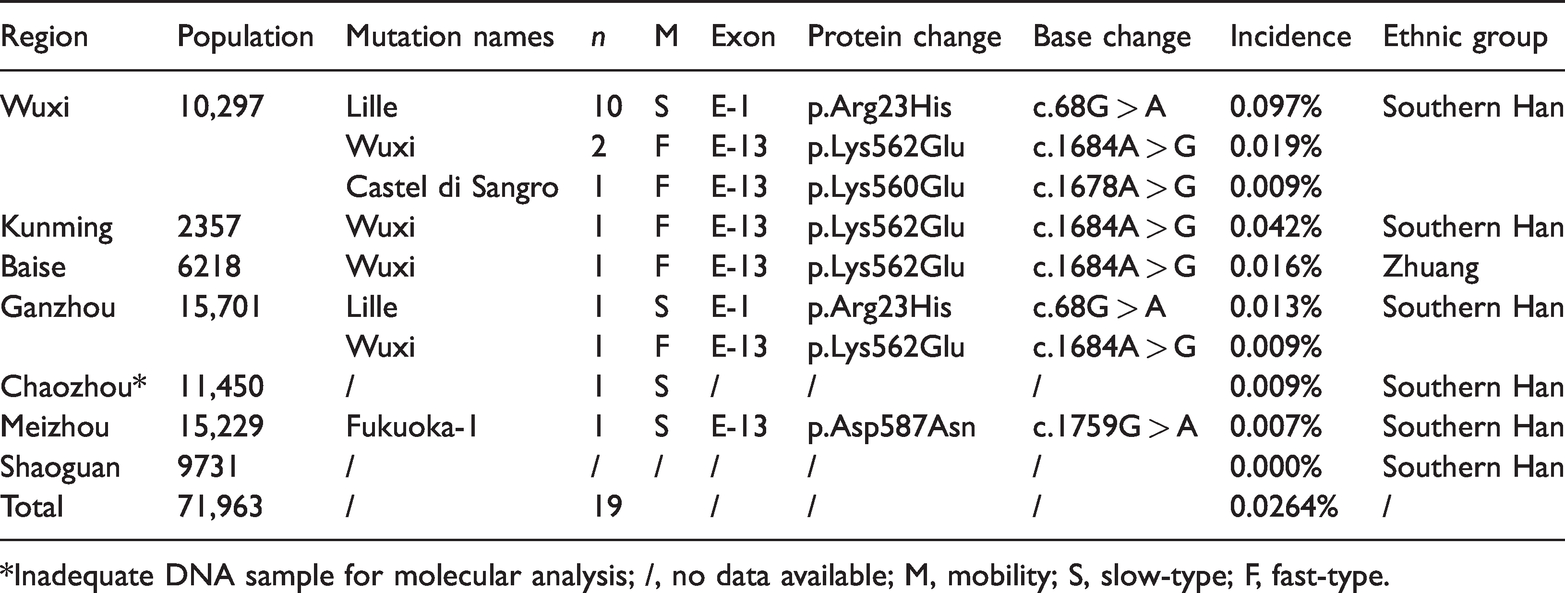
*Inadequate DNA sample for molecular analysis; /, no data available; M, mobility; S, slow-type; F, fast-type.
Notably, we detected 10 cases of proalbumin Lille/Wu Yang (p.Arg23His) in the Wuxi region. 23 Consistent with previous studies, this variant had a slower mobility than normal ALB on electrophoresis at pH 8.6.23,25 Although proalbumin Lille has been reported in many previous studies, the relatively high incidence (around 1%) in the Wuxi region was unusual. Only one case of ALB Fukuoka-1(p.Asp587Asn) and one case of ALB Castel di Sangro (p.Lys560Glu) were detected in the current screening study.
Discussion
Some clinical cases of ALB variants have been reported in China (Table 1); however, the current study reports the first large-scale screening for ALB variants in southern China, included individuals from the two most populous ethnic groups in China, Han and Zhuang. The results indicated a very low prevalence of inherited bisalbuminemia in southern Chinese, with an average gene frequency of ALB variants of 0.0264% (19/71,963). This was similar to the 0.015% (3/20,000) reported in a Japanese blood-donor group and 0.022% (11/50,000) in American groups, but lower than the cumulative frequency (0.29%, 45/15,581) in the Radiation Effects Research Foundation Biochemical Genetics Study at Hiroshima and Nagasaki.11,14,25 Consistent with the data for all previous cases of alloalbuminemia in China (Table 1), in which the slow-type accounted for 93.75% of all cases (30/32), most variants in the current study were also slow-type (73.68%, 14/19).
Four kinds of ALB variants, including proalbumin Lille (p.Arg23His), ALB Fukuoka-1 (p.Asp587Asn), ALB Castel di Sangro (p.Lys560Glu), and ALB Wuxi (p.Lys562Glu), were identified in the present study. PCR sequencing revealed that exons 13 and 1 of the ALB gene were mutation hot spots in Chinese subjects. Most cases of proalbumin Lille (p.Arg23His), the main slow-type variant, were found in the Wuxi region of Jiangsu Province, with a gene frequency of 1%. Proalbumin Lille has been identified in Chinese individuals in Wuyang County, Henan Province, and Taipei, Taiwan.23,25 Previous reports of bisalbuminemia in Chinese from 1976 to 2008 (Table 1) found that 30% (11/33) of cases of slow-type ALB variants were located in the Wu region (Table 1). Wu is a region in the Jiangnan area (south of the Yangtze River), covering Suzhou (Soochow) in Jiangsu Province, Shanghai, and Zhejiang Province of China. The two largest cities in the Wu region are Shanghai and Hangzhou. Most natives of these regions speak Wu dialects. Combined with our epidemiological results, we concluded that proalbumin Lille probably originated from the Wu region and then spread throughout other regions and other ethnic populations in China. However, proalbumin Lille (p.Arg23His) has now been identified in White and Japanese people, as well as Chinese individuals (proalbumin Taipei), suggesting that it might be an independent mutation or a mark of the migration of people in the Wu region of China.
The prevalence of ALB Wuxi (p.Lys562Glu) was generally low (0.007%, 5/71,963) in our study, but had the widest geographical distribution and was found in Han and Zhuang ethnic groups. Fast-type ALB variants were rarely found based on a clinical diagnosis, and we considered that this might be due to the sensitivities of different detection methods. 6 We detected ALB variants by cellulose acetate electrophoresis in this study, which has a lower sensitivity for detecting bisalbuminemia than capillary electrophoresis, which might therefore detect more interfering molecules in the ALB-migration zone. 8 Both ALB Fukuoka-1 (p.Asp587Asn) and ALB Castel di Sangro (p.Lys560Glu) were shown to be rare in southern Chinese populations.
This study had some limitations. There are 56 ethnic groups in China, each with specific characteristics, but the current study only included individuals from the Zhuang and Han ethnic groups. In addition, China includes 34 provinces, autonomous regions, municipalities, and special administrative regions, but our albumin screening only covered seven areas of four provinces. Further studies are therefore needed to extend the current findings to other ethnic groups and regions.
In conclusion, this study detected the detailed prevalence and molecular characterization of ALB variants in southern China. Compared with other areas of China, Wuxi had a different pattern of ALB variants with a high prevalence of proalbumin Lille.
Footnotes
Declaration of conflicting interest
The authors declare that there is no conflict of interest.
Funding
The authors disclosed receipt of the following financial support for the research, authorship, and publication of this article: This study was partially supported by key scientific research projects of Guangdong Provincial Department of Education [grant number 2018A030307074]; Natural Science Foundation of Guangdong Province [grant number 2018A030307074]; Key Clinical Department Project of Guangdong Province (Laboratory Medicine); and the Natural Science Foundation of Guangdong Province [contract/grant number 2016A030307035]. The funders had no role in the study design and data analysis, decision to publish, or submission of the manuscript.
