



Abstract
Objective
To investigate whether overbite affects smile esthetics.
Methods
This study involved 106 patients with complete pretreatment records. Lateral cephalometric tracings were used to measure hard tissue variables. Frontal smile and upper occlusal photographs were used to measure nine smile esthetic variables: arc ratio, number of teeth, upper incisor exposure, upper midline, buccal corridor ratio, smile index, archform index, lower teeth exposure, and interlabial gap. The patients were classified into three groups according to their overbites (B1: 0–4 mm, B2: >4 mm, and B3: <0 mm). Analysis of variance was performed to compare 14 cephalometric measurements and the 9 smile esthetic variables. Multiple linear regression analysis was performed to determine the influencing cephalometric factors.
Results
Only upper incisor exposure was significantly different among the groups. In the multiple linear regression analysis, upper incisor exposure was positively associated with the distance from the upper incisor to the palatal plane in Group B2. No significant correlations were observed between cephalometric measurements and smile variables in Groups B1 and B3.
Conclusions
Smile variables were not significantly different among patients with various overbite malocclusions with the exception of upper incisor exposure. Overbite malocclusions do not appear to influence smile esthetics in adult patients.
Keywords
Introduction
A smile is an essential human facial expression that represents pleasure, happiness, and amusement. A person with an attractive smile may be rewarded. 1 Smile esthetics has received increasing attention from orthodontists in recent years. Orthodontic patients have become highly demanding in terms of both their profile and smile. Therefore, dentofacial and smile esthetics have become pertinent concerns for patients seeking orthodontic therapy. 2 , 3
Numerous factors contribute to smile esthetics, including the dentition and the soft tissues surrounding the mouth (e.g., smile lines, tooth–lip relationship, smile arc, and balanced facial ratios and symmetry).4–6 Several studies have examined smile esthetics in orthodontics. For example, the tooth–lip relationship can be investigated using quantified measurements. 7 Furthermore, smiles have been subjectively assessed and rated for attractiveness. 8 , 9
Because a smile is viewed in all three spatial dimensions, both horizontal and vertical factors must be analyzed. Grover et al. 10 revealed that smile esthetics are significantly different in individuals with varying horizontal and vertical growth patterns than in individuals with average growth. Cheng and Cheng 11 mentioned that overjet (OJ) affects smile esthetics. However, the influence of various dental overbites (OBs) on smile esthetics has rarely been discussed. Therefore, this study was conducted to determine whether different dental OB malocclusions affect smile esthetics in adults.
Materials and methods
This retrospective study was approved by the ethics committee of the institutional review board of Taipei Medical University (Approval No. 201503035). The reporting of this study conforms to the STROBE statement. 12 The participants were patients in the orthodontics department of a teaching hospital who were in the retention phase of treatment from 2011 to 2013. All patients provided written informed consent.
The inclusion criteria for this study were (1) and age of >18 years at pretreatment; (2) completion of orthodontic treatment; (3) availability of complete diagnostic pretreatment records, namely study casts, intraoral and extraoral photographs, lateral cephalometric films, and panoramic films; and (4) <3-mm space discrepancies on both arches (including crowding and spacing). The participants were categorized into three groups: Group B1 (OB of 0–4 mm), Group B2 (OB of >4 mm), and Group B3 (OB of <0 mm).
Cephalometric analysis
One well-trained examiner traced and analyzed all the lateral cephalometric films obtained before treatment using Viewbox 3.1.1.14 (dHAL Software Kifissia, Greece) (Figure 1). Skeletal, dental, and vertical dimensional variables were measured (Figure 2). A reliability test was performed by retracing and redigitizing 30 lateral cephalograms randomly selected from previously analyzed films at a 4-week interval. Measurement errors were computed using Dahlberg’s formula as follows:
13

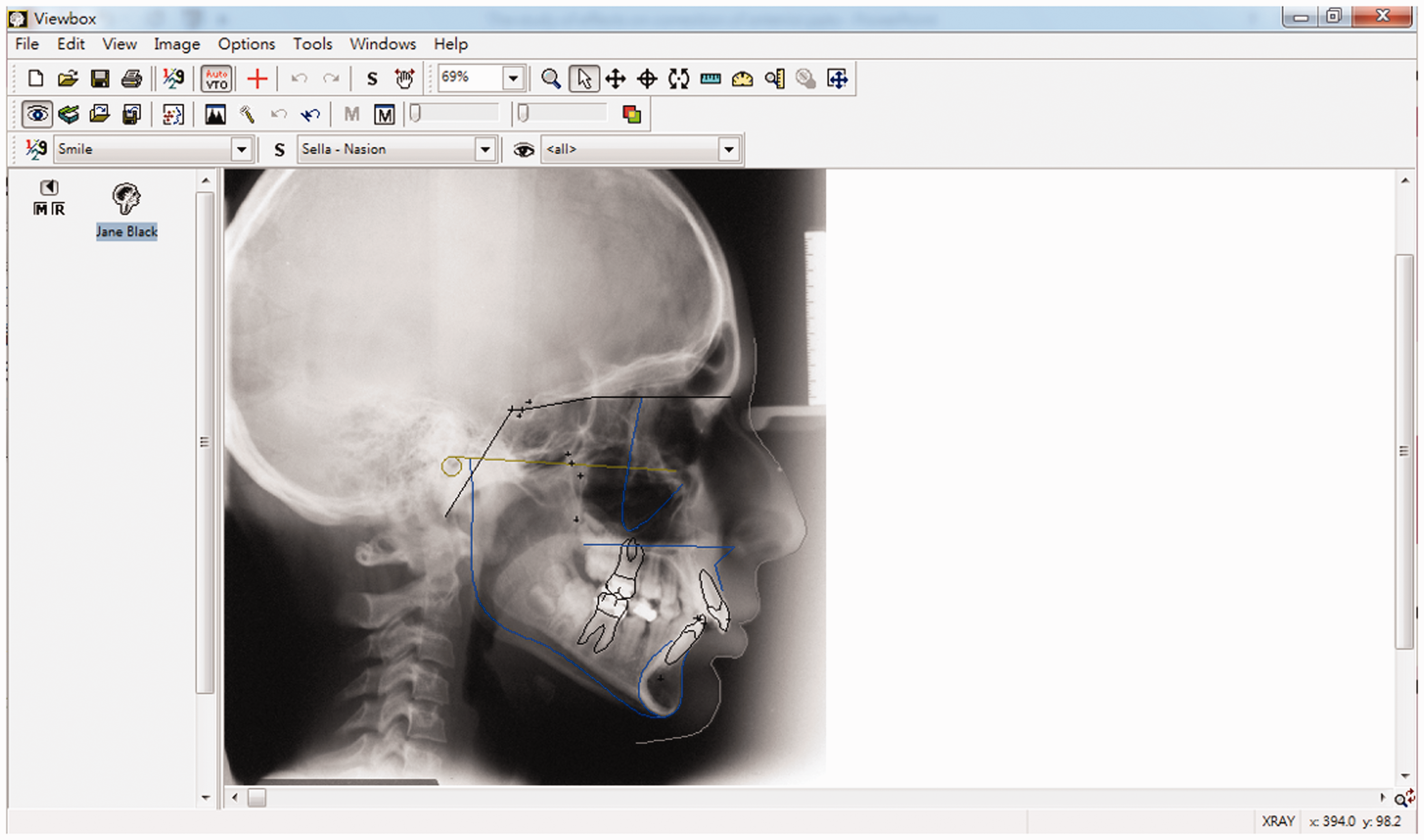
Digital lateral cephalograms traced and analyzed using Viewbox.

Cephalometric landmarks and skeletal, dental, and soft tissue variables used in this study.
Smile analysis
An experienced clinical assistant captured pretreatment photographs using a tripod-mounted camera (F4.5 in AV mode, ISO 1600 with ring flash, Canon EOS 550D; Canon, Tokyo, Japan). A distance of 1.5 m was set between the camera and the patient. The tripod was adjusted according to the patient’s height. To obtain a natural head position, the patient was instructed to look at himself or herself in a mirror that had been placed in front of the camera. The mirror was then removed. The patient was instructed to say “seven” or “cheese” as the picture was taken. The patient was asked to practice smiling three times with their head in a natural position before the photograph was taken. 14
Smile variables have been analyzed in several studies, and the values obtained from these studies were used as references in the present study. 1 , 4 , 5 , 11 To increase reliability and reduce error likelihood, all smile variables except tooth number and upper midline are expressed as percentages because of differences among the participants (Table 1). An examiner used a software program called the linear digitizer tool (Adobe Creative Suite; Adobe Systems Inc., San Jose, CA, USA) to calculate nine smile variables (Figure 3, Table 1) to the nearest 0.01 mm. Student’s t test was performed to ensure reproducibility of the evaluation process by repeatedly measuring 30 randomly chosen images (10 from each group) at a 4-week interval. The results revealed strong agreement between any two sets of measurements (P < 0.05).
Definitions of smile esthetic variables.


Smile measurements. (a) Arc ratio. (b) Upper incisor exposure. (c) Upper midline. (d) Buccal corridor ratio. (e) Smile index. (f) Archform index. (g) Lower teeth exposure. (h) Interlabial gap.
Statistical analyses
Statistical analyses were performed using SPSS Statistics for Windows, Version 17.0 (SPSS Inc., Chicago, IL, USA). Analysis of variance was conducted to compare cephalometric and smile esthetic variables among the three groups. The Student–Newman–Keuls method was used for post hoc testing, with the level of significance set to P < 0.05.
Multiple linear regression models were used to identify significant cephalometric measurements among all smile measurements in the three malocclusion groups.
Results
In total, 106 patients (74 women; mean age, 25.42 ± 5.1 years; range, 19–48 years) met the inclusion criteria and were divided into three groups: Group B1 (n = 45 [32 women]; OB, 0–4 mm; mean age, 25.32 ± 4.6 years), Group B2 (n = 36 [24 women]; OB, >4 mm; mean age, 26.07 ± 5.1 years), and Group B3 (n = 25 [18 women]; OB, <0 mm; mean age, 24.53 ± 3.5 years).
In the reliability test for the cephalometric and smile analyses, the absence of a significant difference (P < 0.05) demonstrated nearly consistent agreement between the first and second measurements of the smile variables.
Descriptive statistics of the cephalometric variables and statistical comparisons of the three groups are shown in Table 2. Analysis of variance revealed significant differences in the following measurements among the groups: mandibular plane angle to anterior cranial base (SN-GoGn), Frankfort horizontal plane to mandibular plane angle (FMA), distance from upper incisor to palatal plane (U1-PP) (mm), OJ, OB, proportion of upper facial height to lower facial height, and proportion of posterior facial height to anterior facial height. An analysis of measurement errors revealed mean differences of 0.75° and 0.63 mm in the angular and linear measurements, respectively.
Significant differences in various cephalometric measurements among Groups B1, B2, and B3.

SE, standard error; SNA, sella–nasion–point A angle; SNB, sella–nasion–point B angle; SN-GoGn, mandibular plane angle to anterior cranial base; FMA, Frankfort horizontal plane to mandibular plane angle; U1-NA (º), upper incisor inclination to nasion–point A; U1-NA (mm), distance from upper incisor to NA line; L1-NB (º), lower incisor inclination to nasion–point B; L1-NB (mm), distance from lower incisor to NB line; U1-L1, angle between upper and lower incisor inclination; U1-PP, distance from upper incisor to palatal plane; IMPA, incisor mandibular plane angle; OJ, overjet; OB, overbite; UFH/LFH, proportion of upper facial height to lower facial height; PFH/AFH, proportion of posterior facial height to anterior facial height.
*P < 0.05, **P < 0.01, ***P < 0.001.
In the smile analysis, only upper incisor exposure was significantly different among the three groups (Table 3), with Group B2 having the largest upper incisor exposure.
Comparison of smile measurements between various vertical overbite malocclusions in analysis of variance.

Data are presented as mean ± standard error.
*P < 0.05.
The multiple linear regression analysis revealed that upper incisor exposure was positively associated with U1-PP (mm) in Group B2 (Table 4). No significant correlation was observed between the cephalometric and smile variables in Groups B1 and B3.
Multiple linear regression analysis of significant correlations between smile variables and cephalometric measurements in Group B2.

SE, standard error; U1-PP, distance from upper incisor to palatal plane.
*P < 0.05.
Discussion
Both the horizontal and vertical relationships of the anterior teeth must be considered in smile esthetics. A relevant study demonstrated that differences in OJ might be the main cause of differences in smile attractiveness. 11 In the present study, we examined whether differences in OB have similar effects on smile esthetics.
Smile assessments of patients with various vertical skeletal patterns have been performed, but few studies have focused on esthetics in terms of vertical dental malocclusions. 10 , 15 The patients recruited in our study were categorized into three groups to analyze the effects of different dental OBs. Cephalometric and smile measurements were analyzed to quantitatively assess the relationships among smile esthetic variables. Because dental malocclusions and skeletal patterns are not always coincident, we used various dental OBs instead of the mandibular plane angle to divide our patients into groups. Although we mainly focused on dental effects, we found a correlation between skeletal patterns and vertical OBs. Table 2 shows that different OBs were closely related to vertical skeletal patterns; significant differences were observed among the three groups. The mandibular plane angle was smallest in Group B2 and largest in Group B3.
In the smile analysis, only upper incisor exposure was significantly different among the groups. Furthermore, a previous study showed that horizontal discrepancies significantly influenced multiple factors of smile esthetics. 11 Thus, smile esthetics is more strongly influenced by horizontal than vertical discrepancies. A possible reason is that when a person smiles, the lip retracts more in the anteroposterior than vertical direction, and this lip retraction is highly related to the horizontal relationship of the anterior dentition. Thus, favorable smile changes are likely to be greater in individuals with a large OJ than in those with a deep OB. This can be clarified when explaining treatment outcomes to patients, and this finding can help both clinicians and patients better understand the differences between the two malocclusions.
The smile analysis in the present study revealed that upper incisor exposure was significantly different between Groups B1 and B2 and between Groups B2 and B3, whereas differences among the three groups were not significant. The smile index showed no significant differences in the current study, but Grover et al. 10 and Demir and Baysal 15 concluded that the smile index is lower in groups with increased vertical dimension. Because we focused on the dental effects, the SN-GoGn and FMA measurements of our patients were close to the normal values. Because the vertical dimension and upper incisor exposure as well as the smile index were closely related, neither measurement showed significant differences in patients with nearly normal vertical skeletal patterns. Thus, vertical dental discrepancies have less influence on smile esthetics than do vertical skeletal factors. Further studies are required to confirm whether a more severe open bite malocclusion affects smile esthetics.
The smile arc is one of the most important esthetic factors to consider. 16 The arc ratio showed no significant difference among the three groups in the present study. This could have been related to factors attributing to a consonant smile arc, such as the inclination of the upper incisors. In addition, one study showed that the smile arcs were flatter in orthodontically treated patients than in untreated patients. 17 As shown in Table 2, there was no significant difference in the upper incisor inclination to nasion–point A. Additionally, the participants in our study were pretreatment patients with natural dentitions. Both of these reasons could explain why the arc ratio showed no significant difference among the groups.
The cephalometric analysis results showed that U1-PP differed significantly between Groups B1 and B2 and between Groups B2 and B3. Group B2 had the largest U1-PP among the three groups based on the upper incisor exposure in the smile analysis. However, Grover et al. 10 demonstrated that patients with a vertical facial growth pattern exhibited significantly higher upper incisor exposure than did patients with an average growth pattern. We cannot compare our results with theirs because skeletal effects were not considered in our study. A possible reason for the increased U1-PP in Group B2 could be that this group mostly comprised patients with deep OBs, and the supraeruption of the upper incisors could have been the cause of the increased U1-PP. Multiple linear regression analysis confirmed this finding by revealing a significant correlation between upper incisor exposure and U1-PP.
Smile analysis is usually complicated and puzzling because a smile is never static. Static frontal facial photographs have been used in many studies of smile esthetics mainly because such images are readily available in daily orthodontic practice; however, several factors must be considered in the dynamic phase. 18 One limitation of smile analysis is the difficulty in obtaining a natural smile. Because the teeth are malaligned before treatment, participants tend to feel shy about smiling. 19 Another major difficulty in evaluating smile esthetics during facial animation using our approach is that we could not accurately capture a repeatable and stable smile even after multiple attempts. 20
This study confirmed that the degree of vertical OB has less influence on smile esthetics than does a horizontal OJ, and this finding is concordant with the results reported by Parrini et al. 16 Identifying the independent roles of factors related to OJ and OB might be valuable to determine the combined effect of OJ and OB on smile esthetics.
Conclusion
No significant differences were observed among various dental OB malocclusions based on the smile variables investigated with the exception of upper incisor exposure. OB malocclusions did not appear to influence smile esthetics in adult patients. Additionally, dental OBs play a less fundamental role than does anterior dental OJ in terms of smile esthetics. The reason for this should be further investigated with more participants who have severe malocclusions.
Footnotes
Author’s contributions
All of the authors contributed to the research performed in the present study.
Johnson Hsin-Chung Cheng, the supervisor of the study and corresponding author, conceptualized and wrote the manuscript.
Tracy Yi-Hsuan Lee organized the data and wrote the manuscript.
Pei-Chin Cheng and Daniel De-Shing Chen helped to prepare the original draft.
All of the authors provided feedback on the revisions of the manuscript. All authors read and approved the final manuscript.
Availability of data and materials
The data sets used and analyzed in the current study can be provided by the corresponding author on reasonable request.
Highlights
We investigated smile diversity in various dental overbite malocclusions. We analyzed the relationships between cephalometric variables and smile variables. Most of the smile variables were not significantly different among the malocclusions. One smile characteristic was related to cephalometric variables for various malocclusions. Smile esthetics are less affected by anterior vertical discrepancy than by horizontal discrepancy in anterior teeth malocclusions. The reason for this should be investigated with more participants who have more severe malocclusions.
Declaration of conflicting interest
The authors declare that there is no conflict of interest.
Funding
This research received no specific grant from any funding agency in the public, commercial, or not-for-profit sectors.
