



Abstract
Objective
Endometrial thickness is a prognostic factor for successful pregnancy. This meta-analysis aimed to examine the role of sildenafil citrate on infertile women with a thin endometrium.
Methods
Two investigators independently searched the literature on sildenafil citrate and infertile women with a thin endometrium from PubMed, EMBASE, and the Cochrane Controlled Trials Register Database from inception to January 2019.
Results
Nine studies involving 1452 patients were included for analysis in our study. We found that endometrial thickness in patients who received sildenafil citrate was significantly higher than that in the control group (placebo or no treatment) (weighted mean difference: 1.22; 95% confidence interval [CI]: 1.07–1.38). The radial artery resistance index was significantly lower (weighted mean difference: −0.12; 95% CI: −0.17 to −0.06), and the clinical pregnancy rate (risk ratio: 1.31; 95% CI: 1.11–1.53) and biochemical pregnancy rate (risk ratio: 1.45; 95% CI: 1.11–1.89) were significantly higher in the sildenafil citrate group compared with the control group.
Conclusion
Sildenafil citrate is effective in improving endometrial thickness, the clinical pregnancy rate, and the biochemical pregnancy rate in women who have a thin endometrium. This treatment is a potential therapeutic intervention for a thin endometrium.
Keywords
Introduction
Assisted reproductive technology has been used with increasing frequency as a useful procedure in women suffering from infertility. The three prerequisite factors for successful implantation are an embryo with implantation competency, the endometrium is in a receptive state, and synchronized development of the embryo and endometrium. 1 Assessment of the endometrium is an essential component in assisted reproduction. Endometrial thickness is a prognostic factor for success in assisted reproduction. Poor endometrial receptivity is a major cause of failure of embryo implantation, and is critical for a successful pregnancy. 2 Endometrial receptivity is thought to be critical for successful pregnancy. 3 A thin endometrium is defined as <7 mm on the day of ovulation or on the day of human chorionic gonadotrophin (HCG) injection in fresh in vitro fertilization (IVF) cycles, or when using progesterone in frozen–thawed embryo transfer cycles. 4 Endometrial thickness and pattern are independent factors that affect pregnancy outcomes, and a thin endometrium is an independent negative prognostic factor for pregnancy, with or without ovarian stimulation.5–7
Sildenafil citrate (Viagra®) has been used worldwide as a vasoactive agent for male erectile dysfunction since 1998. This selective phosphodiesterase type 5 enzyme inhibitor is able to potentiate the effects of nitric oxide (NO) on smooth muscle relaxation and vasodilation by triggering the cyclic guanosine monophosphate (cGMP) pathway in the erectile tissue of the penis. 8 Recent studies have shown that constitutive NO synthase and some mRNAs are responsible for the same effect on the rat and human endometrium.9,10 Sildenafil citrate improves uterine blood flow and leads to estrogen-induced proliferation of the endometrium. 11 Sildenafil citrate can be applied to patients with a thin endometrium, and it is effective for improving endometrial growth and pregnancy outcomes.12,13 However, sildenafil citrate has also been shown not to have an effect on the endometrium. 14 Therefore, we performed a systematic review on the efficacy of sildenafil citrate for treating a thin endometrium.
Materials and methods
The review protocol was registered in PROSPERO (CRD42020159401). Randomized, controlled trials (RCTs) that compared sildenafil citrate treatment versus controls were included in this meta-analysis. This meta-analysis was reported under the guidance of the Preferred Reporting Items for Systematic Reviews and Meta-Analysis (PRISMA) statement. 15
Search strategy and identification of literature
This meta-analysis did not involve recruiting patients, and therefore, institutional review board approval was not required. We searched PubMed, EMBASE, and the Cochrane Central Register of Controlled Trials (CENTRAL) from their inception to January 2019. The references of included studies were also searched. The searching syntax included the following Medical Subject Headings and text words, which varied individually according to different databases: citrate, sildenafil, Viagra, endometrium, endometria, endometrial, thin endometrium, poor endometrial development, and poor endometrial growth. We combined the search terms “sildenafil citrate”, “citrate, sildenafil”, “viagra”, “acetildenafil”, “sildenafil nitrate”, “endometrium”, “thin endometrium”, and “poor endometrial development” to identify eligible studies that conformed to our meta-analysis criteria. Additionally, the reference lists of all eligible studies were searched to identify any additional studies. All of the references were managed by Endnote X8.0 (Clarivate Analytics, Philadelphia, PA, USA).
Study selection and outcome measures
Articles that met the following inclusion criteria were included in this meta-analysis: (1) the target population was infertile women undergoing IVF-embryo transfer (ET), intracytoplasmic sperm injection, frozen–thawed embryo transfer (FET), or induction of ovulation; (2) patients with a history of a poor endometrial response or thin endometrium; and (3) for the intervention, sildenafil citrate was used compared with placebo or no treatment. The exclusion criteria were as follows: (1) uterine anomalies; (2) hydrosalpinx diagnosed by ultrasonography; (3) male factors; (4) pelvic tuberculosis and endometriosis; (5) chromosomal diseases and genetic diseases in the husband and wife; (6) case reports and reviews; (7) animal experiments; (8) there was no full text or no control study; (9) documents not published in English; and (10) repeated published literature.
The outcome measures were endometrial thickness, clinical pregnancy rate, biochemical pregnancy rate, endometrial pattern, and the radial artery resistance index (RI). Endometrial thickness was measured as the maximum distance between the two interfaces of the endometrial–myometrial junction, in the midsagittal plane of the uterus by B ultrasound radiography. 16 The endometrial pattern by B ultrasound radiography was classified according to the morphology of the endometrium as follows: pattern A (triple-line type characterized by a hypoechoic endometrium with well-defined hyper-echoic outer walls and a central echogenic line); pattern B (isoechoic endometrium with poorly defined outer walls and central echogenic line); and pattern C (homogeneous hyperechoic endometrium). 5 The clinical pregnancy rate was determined by ultrasonographic documentation of at least one fetus with a heartbeat at 6 to 7 weeks of gestation. 17 Biochemical pregnancy was defined as a human chorionic gonadotropin serum level of > 10 mIU/mL. 18
Data extraction
Data extraction and evaluation of literature quality were conducted independently by two investigators (X.L. and T.L.). A Microsoft Excel ((Microsoft Corporation, Redmond, WA, USA) database was used to record all available information, including baseline details (age, body mass index, etiology of infertility, and hormone concentrations) and outcomes (endometrial thickness, uterine radial arteries [RI], clinical pregnancy rate, biochemical pregnancy rate, and endometrial pattern). For quality assessment of the included studies, RCTs and observational studies were respectively assessed by using the Cochrane handbook for systematic reviews of interventions (version 5.1.0). 19 Any disagreement was resolved by another investigator (M.Q.Z.).
Statistical analysis
Dichotomous outcomes were estimated by the pooled risk ratio (RR) with 95% confidence intervals (95% CIs). Continuous outcomes were estimated by the pooled weighted mean difference (WMD) or standardized mean difference with 95% CIs. Heterogeneity in the studies was tested using the Cochran chi-square test and I2, in which I2 > 50% suggested significant heterogeneity. When I2 was >50%, a random-effects model was chosen to pool the results, while a fixed-effects model was used when I2 was <50%. Sensitivity analysis was conducted to further identify the possible origins of heterogeneity. An identified study that contributed to significant heterogeneity was removed and a repeated meta-analysis of the remaining studies was performed for adjustments. The robustness of our meta-analysis was confirmed when no substantial variation between the adjusted results and primary results was identified. 20
Publication bias was detected using funnel plots, the Harbord test, Peters test, and Egger’s test. For binary variables, the Harbord and Peters tests were recommended, while Egger’s test was recommended for enumeration data. 21 P < 0.05 was considered as statistical significance (two-sided). All statistical analyses were conducted by using STATA, version 12.0 (Stata Corporation, College Station, TX, USA).
Results
Study selection and quality assessment
In the search strategy, 334 citations were obtained from the online databases from 1 January 2006 to 30 October 2019. After removal of duplicates, 264 records remained. Subsequently, 173 records were excluded by viewing the title and abstract. Among the remaining 45 records, 36 citations were removed for various reasons. Finally, nine full-text studies12,14,22–28 were suitable for this meta-analysis (Figure 1). The characteristics, quality evaluation, and demographics of the included studies are shown in Table 1 and Figure 2 (risk of bias summary).

Preferred Reporting Items for Systematic Reviews and Meta-Analysis flow diagram.
Characteristics of the included studies.
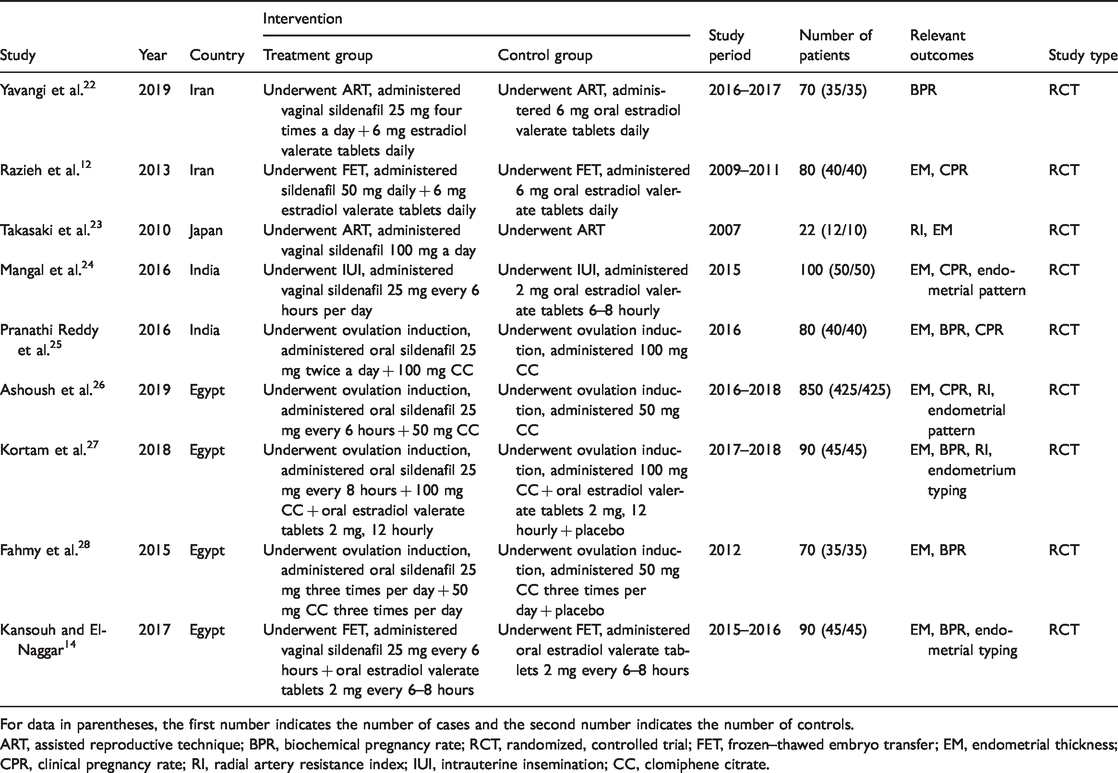
For data in parentheses, the first number indicates the number of cases and the second number indicates the number of controls.
ART, assisted reproductive technique; BPR, biochemical pregnancy rate; RCT, randomized, controlled trial; FET, frozen–thawed embryo transfer; EM, endometrial thickness; CPR, clinical pregnancy rate; RI, radial artery resistance index; IUI, intrauterine insemination; CC, clomiphene citrate.

(a) Risk of bias summary. (b) Risk of bias graph.
Endometrial thickness
Eight trials12,14,23–28 reported endometrial thickness and a total of 1382 participants were included in these eight trials. The I2 statistic for heterogeneity between studies was 74.2%, with a P value for the χ2 test of <0.01 (P = 0.0003), which suggested substantial between-study heterogeneity. Therefore, we performed sensitivity analysis to further identify the possible origins of heterogeneity. We found that the study by Mangal and Mehirishi 24 had a significant effect on heterogeneity (Figure 3). After excluding this study, the heterogeneity was significantly diminished (I2 = 0%, P = 0.743, Figure 4). In pooled results from seven studies, the fixed-effect model showed that endometrial thickness in the sildenafil citrate group was significantly higher than that in the control group (WMD: 1.22; 95% CI: 1.07–1.38; P < 0.001). A funnel plot showed a symmetrical pattern among studies, with no publication bias (Figure 5). This was confirmed by Egger’s test (P = 0.251).

Sensitivity of all of the outcomes of endometrial thickness. CI, confidence interval.

Results of a meta-analysis for the effects of endometrial thickness. WMD, weighted mean difference; CI, confidence interval.

Publication bias of endometrial thickness. WMD, weighted mean difference; se, standard deviation.
RI
Changes in the RI following sildenafil citrate were examined in three studies23,26,27 and 962 participants were included in the three trials. Following the intervention, the random-effect model showed that the RI was significantly lower in the sildenafil citrate group compared with the control group (WMD: −0.12; 95% CI: −0.17 to −0.06; P < 0.0001, I2 = 64%, Figure 6). A funnel plot showed a symmetrical pattern among studies and Egger’s test showed no sign of publication bias (P = 0.646).

Results of a meta-analysis for the effects of the radial artery resistance index. WMD, weighted mean difference; CI, confidence interval.
Clinical pregnancy rate
There were four studies12,24–26 (1110 patients) that reported the clinical pregnancy rate. The fixed-effect model was used for the meta-analysis. The clinical pregnancy rate was significantly higher in the sildenafil citrate group than in the placebo or no treatment group (RR: 1.31; 95% CI: 1.11–1.53; P = 0.001), while no significant heterogeneity was found (I2 = 0%) (Figure 7). A funnel plot and Egger’s test showed no sign of publication bias (P = 0.063).
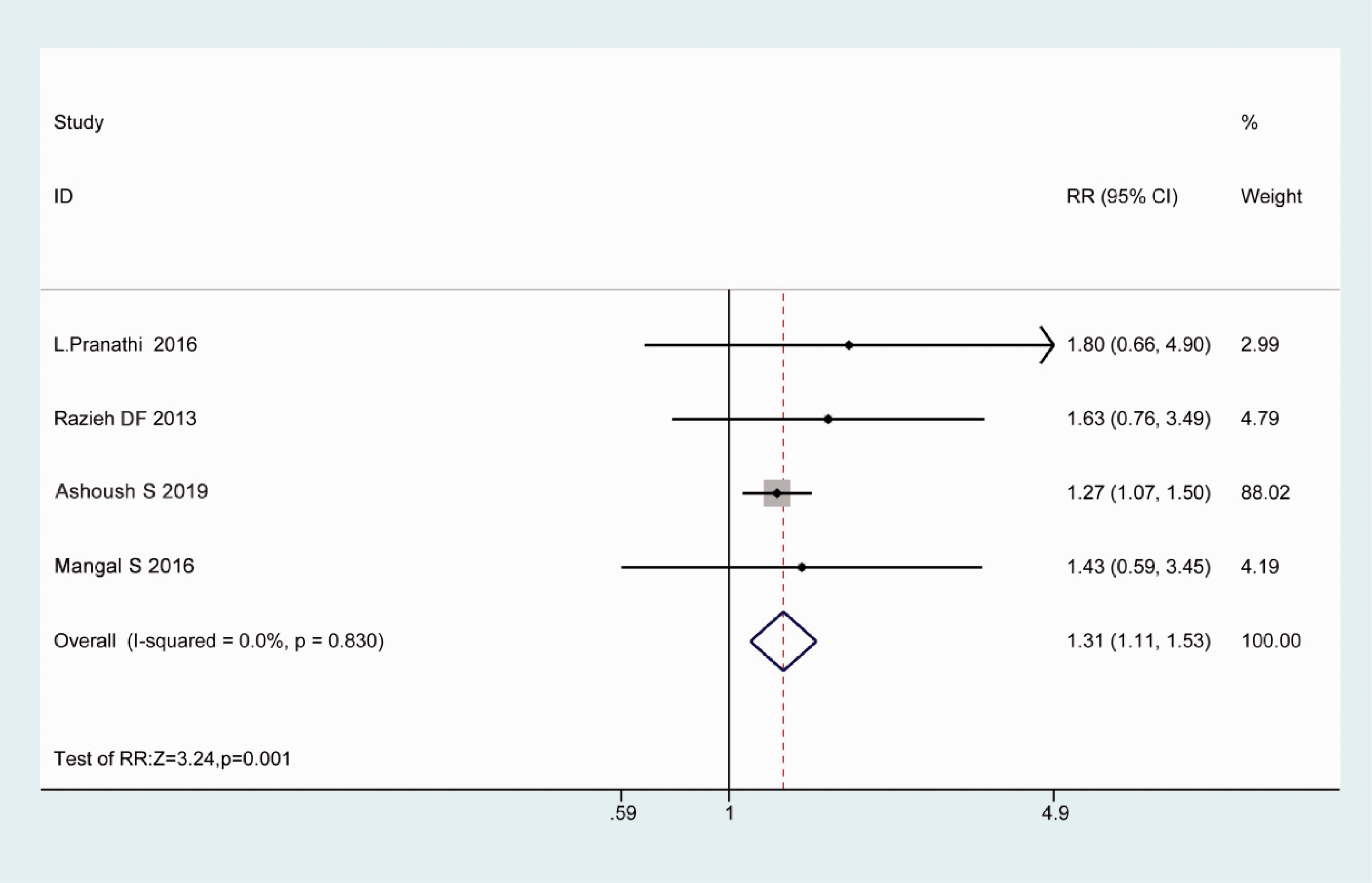
Results of a meta-analysis for the effects of the clinical pregnancy rate. RR, risk ratio; CI, confidence interval.
Biochemical pregnancy rate
Five studies14,22,25,27,28 with 400 participants compared the biochemical pregnancy rate between the sildenafil citrate and control (no intervention or other active intervention) groups. The biochemical pregnancy rate was significantly higher in the citrate sildenafil group compared with the control group (RR: 1.45; 95% CI: 1.11–1.89; P = 0.006), while no significant heterogeneity was found (I2 = 0%) (Figure 8). A funnel plot and Egger’s test showed no sign of publication bias (P = 0.577).
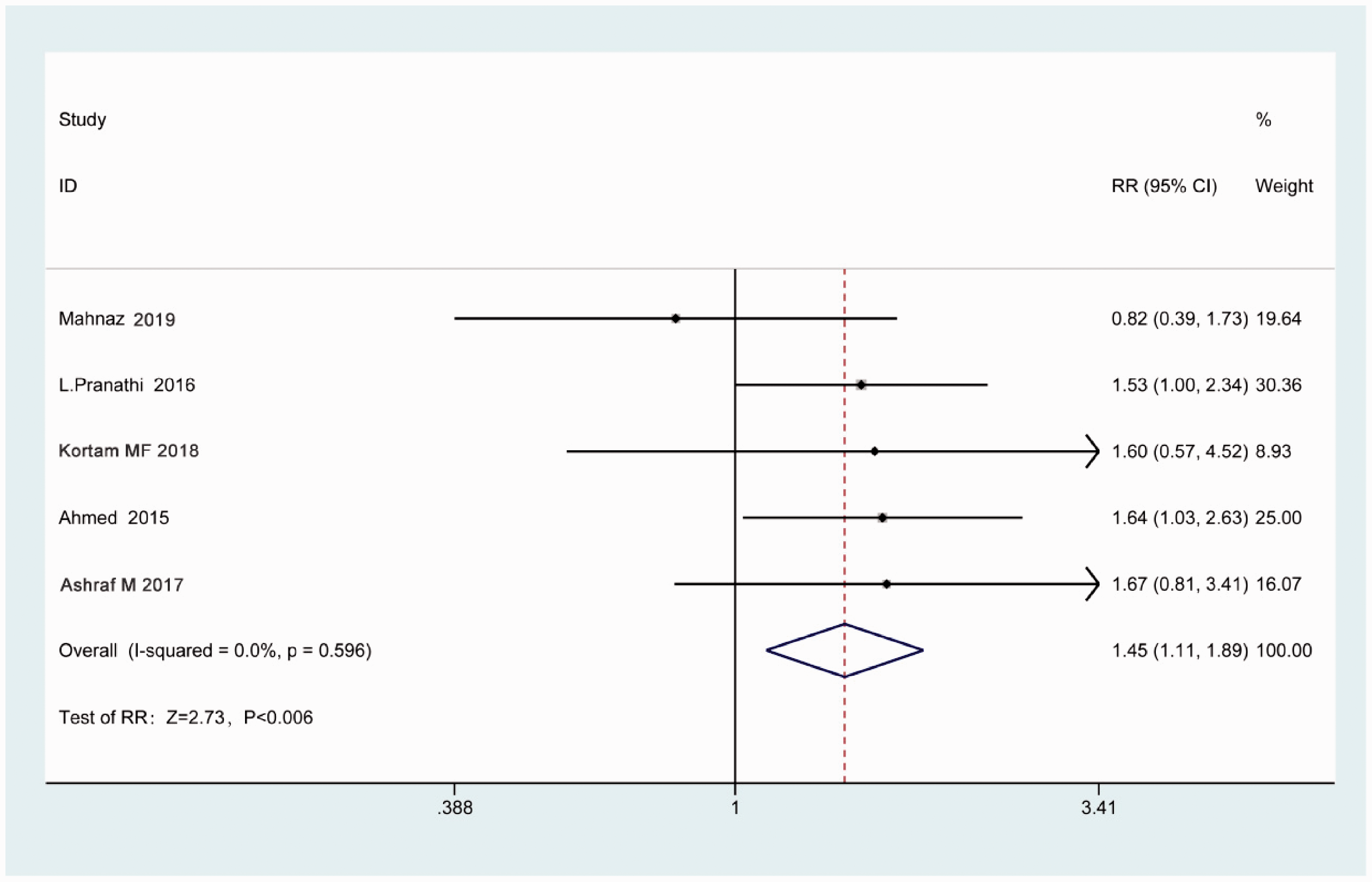
Results of a meta-analysis for the effects of the biochemical pregnancy rate. RR, risk ratio; CI, confidence interval.
Endometrial pattern
Four trials reported the endometrial pattern.14,24,26,27 A total of 1130 participants were included in the four trials. The random-effects model showed a significantly high proportion of pattern B in the sildenafil citrate group compared with the control group (RR: 1.34, 95% CI: 1.23–1.45; P = 0.001), while heterogeneity was moderate (I2 = 61%). We performed sensitivity analysis and found that the study by Kansouh and El-Naggar 14 had an effect on heterogeneity. After excluding this study, the heterogeneity was significantly diminished (Figure 9, I2 = 8%). A funnel plot and Egger’s test showed no sign of publication bias (P = 0.697).

Results of a meta-analysis for the effects of the endometrial pattern. RR, risk ratio; CI, confidence interval.
Discussion
This meta-analysis included the latest studies from 2008 to 2019 and compared the efficacy of sildenafil citrate for patients with a thin endometrium with controls. Our study contained nine publications with 1452 (727 cases vs 725 controls) patients and reflected the newest results for treatment of sildenafil citrate. Most of the included studies were relatively high quality according to the result of quality evaluation of the literature. The current meta-analysis indicates that infertile women with a thin endometrium benefit from use of sildenafil citrate. This conclusion from our meta-analysis is promising because it suggests a potential therapeutic intervention for a thin endometrium.
Good endometrial receptivity is an important condition for a successful pregnancy. 29 Sildenafil citrate is a specific phosphodiesterase type 5 inhibitor, which augments the vasodilatory effects of NO on vascular smooth muscle by preventing degradation of cGMP. Animal studies have shown that NO release leads to relaxation of vascular smooth muscle through a cGMP-mediated pathway. 30 Isoforms of endothelial NO synthase and inducible NO synthase have been identified in the vascular endothelium of human endometrium and the myometrium. 9 However, successful implantation depends on the ability of the blastocyst to penetrate the endometrium and to create a source of blood that requires certain genes. These genes include plasminogen activator inhibitor, tumor suppressor factor (p53), and vascular endothelial growth factor for production of proteins that are required for digestion of the endometrial cell matrix, regulation of cell growth, and induction of angiogenesis. Sildenafil enhances angiogenesis by increasing the expression of p53 and VEGF. Estrogen-induced endometrial proliferation is in large part dependent on blood flow to the basal endometrium. 31 , 32 Malinova et al. 33 showed that vaginal administration of sildenafil citrate and serophene in infertile women increased uterine blood flow and endometrial thickness, and could be used as an effective treatment method for induction of ovulation. Another study showed that vaginal administration of sildenafil, in addition to a 70% increase in embryo transfer in women, also caused pregnancy in infertile women. 34 Taken together, the above-mentioned studies suggest that sildenafil citrate is important for endometrial receptivity and maternal–fetal immunotolerance.
The incidence of a thin endometrium in ovarian stimulation cycles can be as high as 38% to 66%. The incidence of a thin endometrium in IVF is between 1% and 2.5% in most studies. 4 Several trials have reported whether use of sildenafil citrate benefits infertile women with a thin endometrium. Razieh et al. 12 showed that citrate sildenafil effectively increases endometrial thickness and improved the triple line pattern. Yavangi et al. 21 carried out a clinical RCT and found that there were no significant differences in the number of transferred embryos, number of previous pregnancies, number of abortions, number of cycles, number of retrieved eggs, and number of fertilized eggs between the control and sildenafil citrate groups. Takasaki et al. 23 showed that patients had an improved RI (< 0.81) and endometrial thickness (> 8 mm) after sildenafil citrate treatment. A thin endometrium may result from impedance of high blood flow of uterine radial arteries, 26 and vaginal administration of sildenafil citrate improves endometrial growth and pregnancy rates in patients with a thin endometrium.
In this meta-analysis, we observed an effect of sildenafil citrate in improving endometrial thickness, receptivity, and pregnancy outcome. Frattarelli et al. 35 reported that adjuvant therapy did not significantly improve ultrasonographic endometrial thickness, while it did improve pregnancy outcome. Our results are slightly different compared with previous studies. 35 The conclusion of our study may be more reliable than other related studies because more studies were included in our meta-analysis and there were more strict inclusion criteria on the study design or type of patients.
Among all RCTs included in our analysis, most involved patients with a thin endometrium (n = 8) and suggested substantial efficiency of sildenafil citrate treatment after pooled analysis. Only three studies reported the effect of sildenafil on the RI. The number of well-designed studies regarding the effect of sildenafil citrate on a thin endometrium is insufficient. Additionally, we are not able to attribute the effect of sildenafil citrate on an increased pregnancy rate or biochemical pregnancy rate in women with refractory endometrium exclusively to increased endometrial thickness or a decreased RI. Therefore, more RCTs are still required to clarify the therapeutic effect of sildenafil citrate on a thin endometrium. Additionally, in the nine included studies, some combined the use of sildenafil citrate with estrogen, while a few used only sildenafil. This is because endometrial preparation schemes are adopted and partially modified in different hospitals and countries. However, Babayev et al. 36 showed that baseline endometrial thickness or changes in endometrial thickness in response to estrogen have no significant relationship with clinical pregnancy outcome in frozen embryo transfer cycles. Sildenafil citrate increases blood flow and improves endometrial receptivity. Therefore, we disregarded the effect of estrogen on the outcome in our included studies. However, whether estrogen combined with sildenafil citrate can enhance endometrial receptivity requires further research.
We acknowledge some potential limitations in this study that should be considered. First, treatment slightly varied, and although the inclusion criterion for each study was sildenafil citrate, there were differences in the timing, dosage, and route of administration of the drug. Second, sildenafil citrate combined with different drugs may have caused some bias of the results, such as combination use of sildenafil citrate and ovulation-stimulating drugs, and the effect of sildenafil could have been more pronounced. Third, most of the included studies lacked the results of follow-up, such as the miscarriage rate and live birth rate.
To the best of our knowledge, this meta-analysis is the first to evaluate the effect of sildenafil citrate on pregnancy outcomes. Our study shows that use of sildenafil citrate significantly increases endometrial thickness, the clinical pregnancy rate, and the biochemical pregnancy rate, changes the endometrial pattern, and improves the RI in patients who suffer from a thin endometrium. Although a few studies showed that intrauterine perfusion of granulocyte colony-stimulating factor, 37 human chorionic gonadotropin, 38 or peripheral blood mononuclear cells 39 improved endometrial parameters and increased implantation rates, their use is invasive and expensive. In contrast, sildenafil citrate is easy to use and inexpensive, and is easily accepted by patients. Therefore, sildenafil citrate is more useful for clinical applications. We consider that our results are reliable as shown by sensitivity analysis. In conclusion, sildenafil citrate plays a beneficial role in treatment of a thin endometrium, but its role in a thin endometrium remains unclear because there are insufficient data. Additionally, little data on the rate of live birth were extracted from the included studies, which may have impaired the reliability of this analysis.
Footnotes
Acknowledgements
The authors acknowledge the physicians, nurses, and scientific staff of the Department of Reproductive Medicine, Nanjing Maternity and Child Health Care Hospital.
Declaration of conflicting interest
The authors declare there is no conflict of interest.
Funding
This work was supported by the National Natural Science Foundation of China (grant numbers 81871210, 81971386, 81771536, and 81471457) and the Natural Science Foundation of Jiangsu Province (grant number BK20171126).
