




Abstract
Background
Inflammatory bowel disease (IBD) represents a series of digestive system abnormalities and parenteral manifestations. Stem cell therapy has been regarded as a promising treatment for IBD.
Methods
We searched Web of Science Core Collection for publications of interest from 1991 to 2019. Publication performance was analyzed using several bibliometric parameters, including Statplanet to reveal the geographic distribution of the publications, VOSviewer to identify the research landscape of hot topics, and CiteSpace to show keywords with the strongest citation bursts.
Results
A total of 1230 publications were identified, of which 674 articles were analyzed further. The United States was the most productive country and Spanish researchers published the highest quality articles. At a journal level, Gastroenterology published the greatest number of articles, while articles from Gut had the highest citation number. Results from the research landscape analysis of hot topics and the top 20 terms with the strongest citation bursts indicated that animal experiments, immunocytes, intestinal epithelial cells, cytokine expression, and clinical efficacy were the main focuses of research.
Conclusion
Stem cell therapy for IBD is currently receiving increasing attention by researchers, with focuses on animal experiments, immunocytes, intestinal epithelial cells, cytokine expression, and clinical efficacy.
Keywords
Introduction
The spectrum of inflammatory bowel disease (IBD) is largely represented by Crohn’s disease (CD) and ulcerative colitis (UC). The diagnosis of IBD describes a chronic inflammatory gastrointestinal condition, potentially leading to a series of digestive system abnormalities and parenteral manifestations. IBDs were initially presumed to result from a dysregulated immune response to the intestinal microflora, influenced by environmental factors and genetic susceptibility.1–3 IBD has become a worldwide concern, with a prevalence surpassing 0.3% among western populations. 4 Despite focused research, IBD remains a challenge for clinicians, with many yet undefined etiologic, pathogenic, and treatment-related factors. 2 Traditional treatment modalities for IBD include 5-aminosalicylate, corticosteroids, and immunosuppressant drugs. 5 The therapeutic effects of stem cell transplantation, as a promising therapy for various diseases, have also been studied intensively in relation to IBD. The properties underlying the therapeutic actions of stem cells include their unique self-renewal capacity, which enables their unlimited proliferation and differentiation. 6 Mesenchymal stem cells (MSCs), also known as mesenchymal stromal cells, are multipotent stem cells that possess both infinite regeneration capacity and also immunosuppressive properties.7–9 Recent meta-analysis studies indicated both encouraging results and substantial challenges for MSC therapy in IBD,10,11 and stem cell therapy is likely to remain a research hotspot for years to come.
Knowledge of the current research landscape is necessary to understand progress in this field of research and to guide future studies. Bibliometrics was developed to allow the quantitative analysis of publications and citations. Bibliometric studies can describe research trends, present publication performances, and predict future research hotspots for a topic, thus helping researchers to understand important past research and to determine valuable future research directions. Increasing numbers of bibliometric studies are being published in various medical fields, including in relation to pneumonia, cardiovascular diseases, infectious diseases, and surgery.
As a long-term research hotspot and a potentially curative treatment for many difficult diseases, stem cell research has been the subject of bibliometric studies. However, to the best of our knowledge, there is currently no bibliometric analysis of stem cell therapy for IBD. The current study thus aimed to fill this gap by analyzing the bibliometric profile of stem cell therapy for the treatment of IBD, covering the years from 1991 to 2019. In this study, we present the bibliometric findings covering publication and citation trends for the past 19 years, as well as the publication performances of different countries, the top cited publications, and the overall focus trends.
Methods
The Web of Science Core Collection (WoSCC) comprises several databases that should not be used together for document retrieval.12,13 We searched the Science Citation Index Expanded and Conference Proceedings Citation Index-Science using the following search strategy to identify publications from 1991–2019, on “topic” including title, abstract, author’s keywords and KeyWords Plus®: (“stem cell” OR “stem cells” OR “progenitor cell” OR “progenitor cells” OR “stromal cell” OR “stromal cells”) AND ((“Crohn’s” OR “Crohn”) OR (“ulcerative colitis” OR “idiopathic proctocolitis” OR “colitis gravis”) OR (“inflammatory bowel”)). This resulted in the identification of 1986 publications. The full record and annual citation number of each document were download into Microsoft Excel 2016.
KeyWords Plus® provides algorithm-generated key words that appear in the references but not necessarily in the article. Terms in KeyWords Plus® could be irrelevant to the topic of a publication, and it is therefore inappropriate to use the above number of publications for analysis. Fu and Ho 14 first proposed using only the title, abstract, and author key words to filter out documents of interest. In this study, 1230 of the 1986 identified documents were included as relevant to stem cell therapy for IBD.
This study analyzed the bibliometric information for number of publications in any single year, document type, journal, and publication geography.
In the WoSCC database, the corresponding author is named as the reprint author, and we therefore designated the first person in the author list as the corresponding author. The first author was considered as the first person in the author list. For single-author publications, the author was regarded as both the first and corresponding author. For publications in which the first person in the author list was also the corresponding author, this author was considered as both the first and corresponding author.
To analyze the bibliometric geography, it was necessary to know the home country for each study. We introduced several parameters, including TP (number of articles with at least one author from a certain country), IP (number of articles with authors from a single country), CP (number of articles with authors from multiple countries), FP (number of articles with first authors from a certain country), and RP (number of articles with corresponding author from a certain country). Articles published by Taiwanese authors were included under the country category “China”, and articles from Scotland, Wales, and Northern Ireland were reclassified under the country category “United Kingdom”. Notably, publications with multiple corresponding authors from different institutions were presumed to be collaborative studies from multiple centers, so all institutions were counted. We analyzed the countries in which these institutions were located and summarized the results in a color-coded map, generated using Statplanet (Statsilk, Sydney, Australia), to present a comprehensive view of the geographic distribution of publications of interest from 1991 to 2019.
We analyzed the citation life of the documents using five citation indicators, as used in previous studies:15,16 C0, number of times each publication was cited in the publication year; C2019, number of times each publication was cited in 2019; TC2019, number of times each publication was cited since its publication to 2019; TP, sum of a group of publications; and, CPP2019, being TC2019/TP.
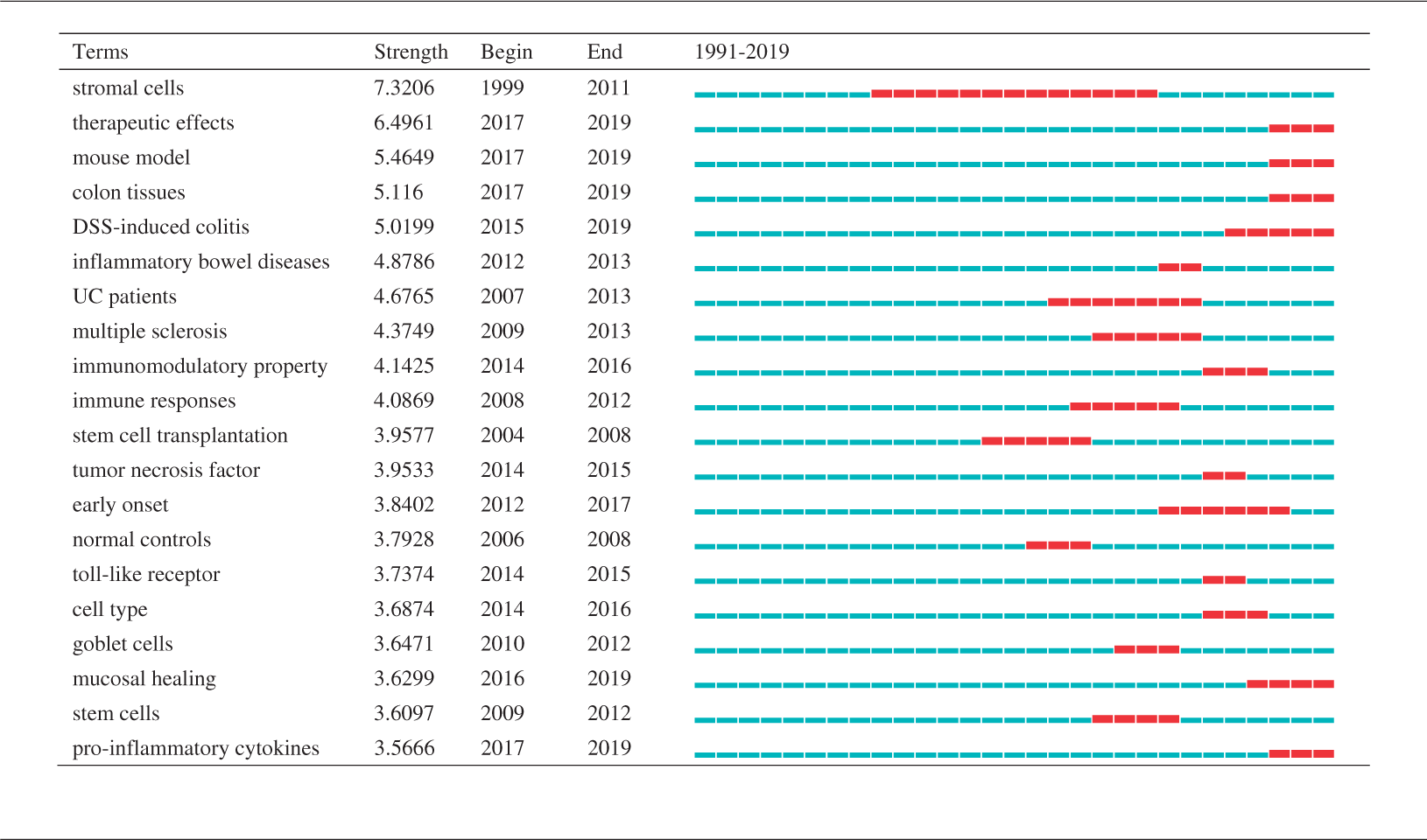
We also used VOSviewer (www.vosviewer.com) to visualize the research network based on the abstract and title of each of the topic-related articles published in the most recent 10 years. The threshold was set to include words that occurred at least 20 times. We displayed all 168 items, which were automatically divided into four clusters by the built in algorithm. CiteSpace (http://cluster.cis.drexel.edu/∼cchen/citespace/) was then used to identify research trends by analyzing the top 20 terms with the strongest citation bursts from 1991 to 2019. Citation bursts indicated a sudden and increasingly rapid rise in citation counts, with the start and end of the citation surge marked by a red ring on the resultant image.
Results
Number of publications and citations per publication by year
Figure 1 shows the number of publications and citations per publication in each year from 1991 to 2019. The annual number of publications followed a general upward trend. Annual publications exceeded 150 for the first time in 2019. Interestingly, citations per publication continued to rise as publication numbers increased dramatically since 2009, indicating that this field has attracted increasing attention in recent years.

Annual publication numbers and citations per publication by year
Document type of publications related to stem cell therapy for IBD
Publications related to stem cell therapy for IBD included six document types: 674 articles, 239 reviews, 31 editorial materials, 19 letters, 239 meeting abstracts, and three news items (Table 1). Articles and reviews were the predominant publication types, with CPP2019 values of 34.4 and 44.6, respectively. Reviews provided comprehensive summaries of what was known and were often cited more frequently than articles. However, articles were more significant in presenting research findings. In this study, the 674 identified articles were selected for further analysis.
Document types of publications related to stem cell therapy for inflammatory bowel disease

TP: sum of group of publications; TC2019: number of times each publication cited since its publication to 2019; CPP2019: ratio of TC2019 to TP.
Top 10 most productive journals
The top 10 most productive journals are summarized in Table 2. Articles on this topic were published in 292 journals. Gastroenterology published the greatest number of articles (n = 27, 4.0%), followed by Inflammatory Bowel Diseases (n = 21, 3.1%). Articles published in Gut had the highest quality, and were cited an average of 110.1 times.
Top 10 most productive journals

IF2019: impact factor in 2019; TP: sum of a group of publications; TC2019: number of times each publication cited since its publication to 2019; CPP2019: ratio of TC2019 to TP.
Global publication landscape
A color-coded map presenting a comprehensive view of the geographic distributions of the publications from 1991 to 2019 is shown in Figure 2. The detailed publication performances of the top 15 countries are shown in Table 3. A total of 46 countries have published articles related to stem cell therapy for IBD. The United States was the most productive country, accounting for more than 30% of the total number of articles, with the People’s Republic of China ranked second. Other countries that published more than 30 articles included the United Kingdom, Japan, Germany, Spain, and Italy. Spain and the Netherlands produced the most high quality research articles, with each article from these countries being cited on average 70.7 and 61.3 times, respectively.
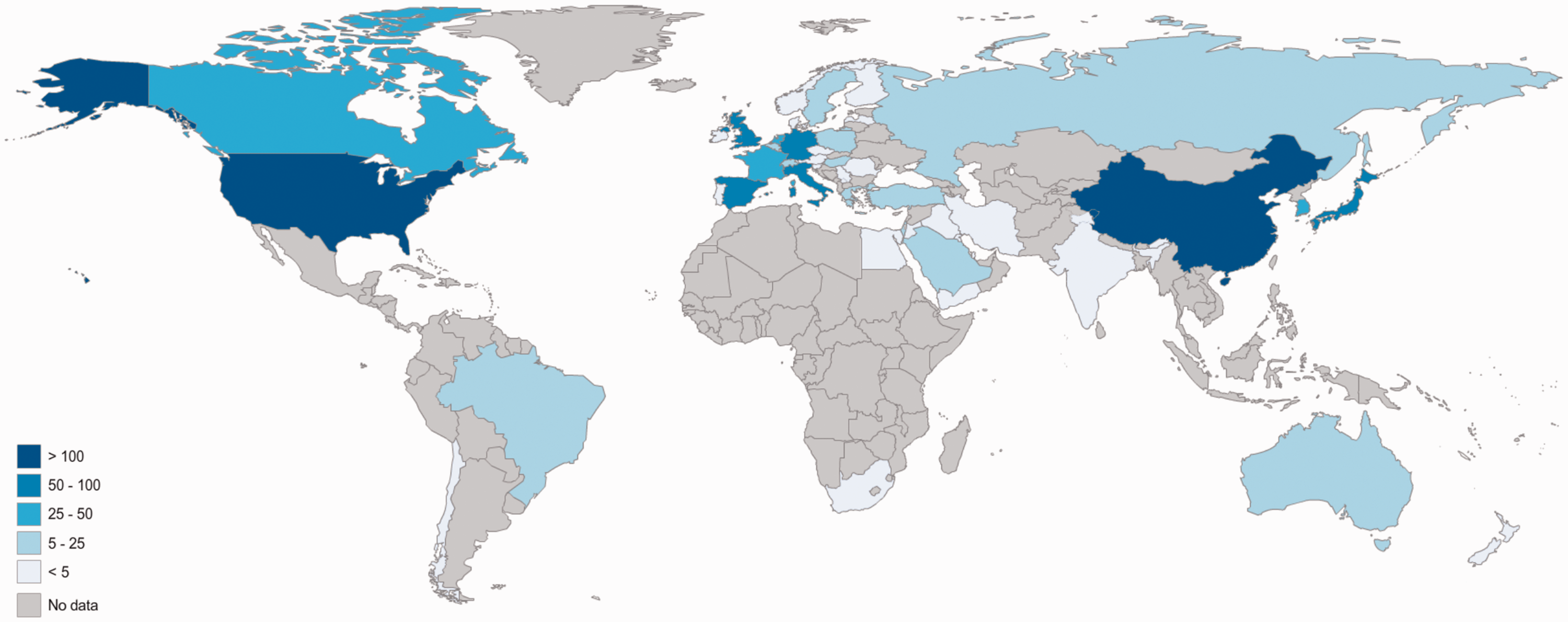
Global publication landscape
Top 15 most productive countries

TP: sum of group of publications; IP: independent publication; CP: collaborative publication; FP: first-author publication; RP: reprint-author publication; R: rank; TC2019: number of times each publication cited since its publication to 2019; CPP2019: ratio of TC2019 to TP.
Top 10 most highly cited articles from 1991 and in 2019
The 10 most cited articles from 1991 to 2019 are shown in Table 4. The most cited article was published by Kontoyiannis et al. 17 and reported on the defective function of tumor necrosis factor AU-rich elements in the development of IBD. Its citations accumulated quickly in the first few years after its publication, but manifested an overall downward trend from 2010 onwards. Interestingly, only three articles, including the most cited one, were published before the 21st century, and citations of these articles gradually declined. Information from classic papers was thus absorbed into the body of current knowledge, resulting in a decline in the annual number of citations.
Top 10 highly cited articles since 1991

TC2019: number of times each publication was cited since its publication to 2019.
The 10 most cited articles in 2019 are shown in Table 5. None of these articles was published before 2009 and the most recent was published in 2017. The most cited article was published by Panés et al. 18 and reported on the safety and efficacy of allogeneic adipose-derived stem cells (Cx601) for the treatment of refractory complex perianal fistulas. Although this article has had a short citation life, its citations increased dramatically, suggesting that it represents a growing momentum in this field.
Top 10 highly cited articles in 2019

C2019: number of times each publication was cited in 2019.
Visualized landscape of research hotspots and top 20 terms with strongest citation bursts
The topic-related research hotspots, categorized into four groups, are shown in Figure 3. The green group mainly comprises research hotspots involving animal experiments and the construction of animal models; the red group represents research hotspots on cell and inflammatory cytokine expression; the yellow group mainly consists of research hotspots on treatment and clinical efficacy; and the blue group includes research hotspots on patient characteristics. The top 20 terms with the strongest citation bursts are listed in

Visualized landscape of research hotspots. Green group: mainly research hotspots involving animal experiments and construction of animal models; red group: research hotspots on cell and inflammatory cytokine expression; yellow group: mainly research hotspots on treatment and clinical efficacy; blue group: research hotspots on patient characteristics
Top 20 terms with strongest citation bursts

Discussion
IBD is usually diagnosed at an early age and can substantially reduce patient quality of life. Although the incidence rate of IBD seems to have stabilized or even decreased in western countries since 1990, its prevalence has continued to increase worldwide, exceeding 0.3% in many developed countries. 4 According to a report by Kaplan in 2015, more than 1 million people in the Americas and 2.5 million people in Europe were living with IBD. 19 The lack of epidemiologic IBD data from developing nations suggests that the situation could be even worse, given an increase in incidence associated with recent industrialization.20,21
General information
The burden of IBD has urged clinicians to investigate new treatment modalities, including stem cell therapy. This novel and promising treatment has received increasing attention in recent decades, with only one publication per year for the first 3 years since 1991, annual publication numbers reaching double digits in 2002, and over 150 publications in 2019. CPPyear often drops with increasing publication numbers;15,22 however, the current study found that citations per publication continued to rise in the past decade, indicating that stem cell therapy for IBD is receiving increasingly more attention.
Geographical publication performances
In terms of publication performances of individual countries and institutions, the 15 most productive countries included nine in Europe (United Kingdom, Germany, Spain, Italy, The Netherlands, France, Switzerland, Belgium, Russia), three in Asia (China, Japan, South Korea), and two in North America (United States, Canada), along with Australia. IBD is estimated to have a high prevalence in developed countries and stem cell therapy remains a developing technique; it is therefore not surprising that the list is dominated by developed countries. American authors had the highest number of publications on stem cell research for IBD (n = 208, 30.9%), which was more than for the second and third countries combined. This was also shown to be the case in other medical fields, including stem cells in general, dengue, gynecology, and obstetrics.15,23,24 The United States also dominated in terms of first-author publications and reprint-author publications. Articles published by Spanish authors had the highest CPP2019 (70.7), followed by the Netherlands and the United States. Despite a large number of articles from China, they ranked last but one in terms of CPP2019, suggesting that Chinese authors need to publish more high quality studies. In addition to publication numbers and citations, we also calculated the number of international collaborative articles, given the increasing importance of international cooperation in today’s research. The United States participated in the most international collaborative studies, followed by Germany.
Research hotspots
Analysis of research hotspots and citation bursts identified animal models, biological behavior of cells, cytokine expression, and the clinical efficacy of stem cell therapy as research hotspots.
Animal experiments have been used increasingly to evaluate the efficacy and safety of MSC-based treatments. 25 Although most preclinical in vivo data obtained from animal models have demonstrated the consistent efficacy of MSCs, clinical trials have provided conflicting results. This may be because the etiology and progression of human IBD are multifactorial, resulting in difficulties in building a suitable and reproducible animal model to symptomatically and morphologically reflect human IBD. 26 In addition, immune differences between MSCs from humans and mice limit the translation of results from murine models to clinical situations.27,28 Ethical issues also influence the clinical application of novel treatment modalities such as stem cell therapy. Its potential benefits and risks have been discussed in relation to IBD, and it has been suggested that IBD patients should not typically receive stem cell therapy because IBD does not significantly reduce life expectancy and because multiple alternative effective treatments are available. 29 Furthermore, whether stem cell therapy can achieve similar efficacy in IBD patients as in animal models is still controversial, and extreme care should thus be exercised in selecting patients for treatment and clinical trials. More efforts involving animal experiments are required to improve our understanding of the efficacy, safety, and mechanism of stem cell therapy, to allow it to be applied in suitable patients, with the expectation of a good prognosis.
The biological behavior of cells was also identified as a research hotspot, with immunocytes and intestinal epithelial cells being intensively studied.
Several investigators have reported that MSCs can inhibit cytokine secretion and the proliferation of T cells, B cells, natural killer cells, and dendritic cells in vitro.30–32 Gonzalez-Rey et al. 33 confirmed that this inhibition was partially dependent on cell-to-cell contact between MSCs and peripheral blood mononuclear cells, resulting in reduced secretion of inflammatory cytokines and increased production of the cytokine IL-10. Another study showed that commonly used medications for IBD did not affect the functional capabilities of MSCs. 34 The regenerative properties and immunoregulatory capacity of MSCs make them an attractive treatment option for use with standard CD therapy.
It is important to understand the role of intestinal epithelial cells in the pathogenesis of IBD, and how stem cell therapy can alter their function. There is widespread agreement that disruption of normal intestinal barrier function is particularly relevant to the development of IBD. 35 This disruption impairs the defensive barrier maintained by rapidly proliferating epithelial cells thus making the intestine more susceptible to pathogens and other alimentary factors. Paneth cells, for example, are indispensable protective intestinal cells that produce antimicrobials, including the human α-defensins HD5 and HD6, 36 and a decrease in the production of α-defensins by Paneth cells weakened the antimicrobial defenses of the ileal mucosa and was associated with IBD, especially ileal CD.36,37 Other evidence also showed inadequate expression of defensins in colonic CD. 38 The mucus layer can protect the host from microbes in the lumen, and was found to be thinner, more variable, and partly denuded in patients with UC.39,40 Transplantation of intestinal epithelial stem cells is usually achieved by mucosal biopsies or by differentiation of autologous pluripotent stem cells,35,41 which are expected to differentiate into all types of intestinal epithelial cells to heal the damaged mucosa. In vitro studies confirmed that intestinal epithelial stem cells may constitute complementary treatment options for patients with mucosal damage.42,43
Cytokine expression has also drawn much attention. Abnormal cytokine expression levels may be related to genetic variations. Recent methodological advances in genetic analysis have greatly expanded our understanding of the genetic background of IBD, 44 with the identification of more than 240 genetic risk loci for IBD. For example, NOD2, ATG16L1, and IRGM, which encode innate immunity proteins, play important roles in the development of IBD.45,46 CDH1 encodes E-cadherin, which facilitates cell adherent junctions, while PTPN22 encodes protein tyrosine phosphatase, nonreceptor type 22, which is important for intestinal barrier integrity. 47 The risk gene IL23R could activate the transcription of proinflammatory cytokines and promote the differentiation of proinflammatory Th17 cells. 48 However, animal models have shown that microbial colonization is a prerequisite, even under conditions of high permeability and genetic domination. 49 Stem cell therapy heals the damaged intestinal barrier caused by a combination of genetic and external risk factors.
Limitations
This study had some limitations. First, the bibliometric information was only retrieved from WoSCC. Although Web of Science is believed to contain only important and influential journals because of its strict screening mechanism, 50 a few papers on this topic may have been published in journals not included in Web of Science. Second, number of citations does not fully reflect the quality of a publication; for example, number of views could also be a good indicator of the influence of a publication, given that papers with a high number of views are important in educational settings. 16
Conclusion
To the best of our knowledge, this study provides the first bibliometric analysis of publications on stem cell therapy for IBD. The past 10 years have witnessed a surge in research in this field, with most research articles published by authors in developed Western and developing East Asian countries. The United States was the most productive country, but articles by Spanish researchers had the highest average citation numbers. Further analysis showed that research attention was mainly focused on animal experiments, immunocytes, intestinal epithelial cells, cytokine expression, and clinical efficacy.
Footnotes
Acknowledgement
The author would like to thank Professor Yuh-Shan Ho for supporting this work.
Declaration of conflicting interest
The authors declare that there is no conflict of interest.
Funding
This research received no specific grant from any funding agency in the public, commercial, or not-for-profit sectors.
