




Abstract
Objective
To determine the contributions from the six Arabian Gulf Cooperation Council (GCC) countries to the national scientific literature on depressive disorders.
Methods
This literature review identified all of the published studies on all major depressive disorders as cited on the PubMed® and APA PsycInfo® databases from inception to 31 December 2016 from the six GGC countries. Data were extracted using a standardized form. The study compared the volume of research production between the countries by calculating an index that allowed for the country population size.
Results
A total of 28 studies met the inclusion criteria. Saudi Arabia headed the list of publications (10 articles) followed by the United Arab Emirates (n = 6), Kuwait (n = 5), Qatar (n = 3); and Bahrain and Oman produced two articles each. Only six out of the 28 (21.4%) studies included a random sample or adopted good sampling strategies. The majority of studies (24 of 28; 85.7%) were cross-sectional in design. Only one study clearly stated the use of the DSM-4 criteria for diagnosis.
Conclusion
The scientific literature published by the GCC countries on depressive disorders is scant and lacking scientific depth. These findings should be considered as a wake-up call for public health researchers, mental health workers and policymakers.
Introduction
The Arabian Gulf Cooperation Council (GCC) is composed of six states: Saudi Arabia, Kuwait, Bahrain, Qatar, United Arab Emirates and Oman (in order from north to south). 1 All of these countries are oil-producing countries and their populations have witnessed tremendous changes in their life styles over the last few decades with the production of oil and an associated shift from a rural community to an urban modern one. They live side-by-side geographically and share similar cultural, religious, political, social and economical backgrounds. They also share similar demography as they host millions of expatriates from countries around the globe. 1
The GCC countries are listed by the World Health Organization (WHO) as part of the Eastern Mediterranean Region (EMR) countries. 2 However, unlike the EMR countries that vary in several socioeconomic factors and diseases, the GCC countries have many similarities in health systems and patterns of diseases, 2 which make them homogenous when it comes to direct comparisons of each country to any of the remaining five countries. One of the main objectives of the GCC is to formulate similar regulations in the various fields including social and health affairs (article-3.D), 1 as the GCC states have similar chronic noncommunicable diseases patterns and more or less similar health systems and health problems. 1
Similar to other countries in the world, the EMR countries are witnessing an increase in noncommunicable illnesses including mental illness. For example, according to a recent study that quantified the burden of mental disorders in the EMR over the period 1990–2013, mental disorders accounted for 5.6% of the total disease burden in the EMR region and that the burden of mental disorders increased from 1726 disability-adjusted life years (DALYs)/100 000 in 1990 to 1912 DALYs/100 000 in 2013 (10.8% increase in EMR versus 5.5% increase globally). 2 Nearly all EMR countries had a higher mental disorder burden compared with the global level. 2 Overall, the burden of mental disorders was greater in young and middle-aged adults (25 to 49; with the peak in the 35–39 years age group) and more often observed among females. 2 Among the various mental disorder groups, depressive disorders accounted for most of the DALYs (44.6%) followed by anxiety disorders (19.0%). 2 Interestingly, the increase was more often observed in the high-income countries that include the GCC countries. 2
Despite this magnitude of mental health problems, researchers have referred to the disparity between the burden of the observed mental disorders and the published research from the EMR and stressed the need for more empirical research directed toward the prevention and treatment of the increasing number of affected patients. 3 In this regard, the EMR states were urged to identify their research priorities, mobilize resources, develop human and infrastructure capacities, adopt a prioritized national mental health research agenda and institutionalize the use of research findings. 3 This gap between the burden of mental health disorders and the published research from all of the Arab countries, including those that belong to the EMR, was indirectly assessed in a previous literature review that aimed to ascertain the total number of citations for each Arab country in the PubMed® database and to correlate it to the citations under the psychiatry and psychology category. 4 The literature review found a very limited number of mental health research citations (n = 338) that were affiliated to all of the Arab countries over a 15-year period (1987–2002). 4 Interestingly, two of the GCC countries, Saudi Arabia and Kuwait, published 37% of the Arab world’s mental health publications. 4
In general, there is a paucity of ongoing research on mental disorders from the GCC states and this gap extends to include common mental health research like depressive disorders. 5 Scientific research on common mental health problems will definitely help the attending health workers and the policy makers in defining the gaps in research and subsequently outlining future plans to handle the expected growth in the numbers of patients with all of the mental health disorders, particularly depressive disorders that may be strongly related and/or influenced by local sociocultural backgrounds, the regional political instability in the neighbouring countries, increased life expectancy and increasing prevalence rates of common noncommunicable illnesses, such as type 2 diabetes mellitus.5–9
According to the WHO, depression can affect one in 10 of the world’s population and was ranked as the third cause of disability in 2004 and is expected to move to first place by 2030. 9 The WHO has already predicted that 350 million people globally will be affected by depressive disorders and this alarming figure is a wakeup call for all of the public health workers, policy makers, researchers and healthcare providers to anticipate and address its burden as a real threat to the mental health of individuals and particularly the young across the world.3,9 There is no reason to believe that any country is immune from having the burden of this common noncommunicable illness. 9
Several previous publications have addressed the burden of depressive disorders and the implications on the health of the Arab countries 8 and the EMR populations 2 to which the GCC region belongs geographically. 4 In 2014, an extensive study reported on the burden of diseases and injuries in the Arab countries for 1990, 2005 and 2010, using data from the Global Burden of Diseases, Injuries, and Risk Factors Study 2010. 8 The study included the six GCC countries as part of the 22 Arab countries and found that major depressive disorder was ranked first as a cause of years lived with disability in 1990, 2005 and 2010. 8 Similar findings were recently reported from the EMR. 2 Another study found that the most dynamic fields of research on mental disorders in Arab countries was substance abuse and depression as they accounted for 26% of the total mental health publications from the region. 4 A recent review that included 55 studies found that there were only six suitable studies on depression from the GCC as the majority of publications (n = 16, 28%) targeted mixed samples of patients. 5 However, the review highlighted the importance of future research that aims to fill the identified gaps in the current published work from the GCC countries. 5 The authors also advised that research should aim for practice and policy development in the region and take in consideration the local sociocultural context with all of its associated problems. 5 The authors’ calls for more high quality research agreed with the WHO recommendations that were declared during World Mental Health Day 2012. 9 They also agreed with the 2015 EMR’s call for carrying out more high quality priority research that will inform policy and service development of mental health programmes across the EMR region. 10
The current scoping review aimed to identify all of the published studies on all major depressive disorders that were cited on the PubMed® and APA PsycInfo® databases in order to determine the contributions from the six GGC countries to the international scientific literature on depressive disorders. This was undertaken in order to identify the gaps in the published literature on depressive disorders from the GCC countries. The current review also aimed to offer some recommendations to direct future regional research on this important health topic that will hopefully inform and prioritize the future development of services offered to patients with depressive disorders in the GCC countries. The findings might also provide information to mental health practitioners that provide services for Arabic people globally.
Materials and methods
Search strategy
The electronic databases PubMed® and APA PsycInfo® were searched from inception to 31 December 2016 to identify relevant studies using a combination of key words including depression, depressive disorders and major depressive disorder. The term depressive disorder was defined according to the WHO ICD-10 Classification of Mental and Behavioural Disorders and/or the DSM-4 criteria accordingly. 11 The following search string was developed with the assistance of the librarian to search the PubMed® database: (“Depressive Disorder”[Mesh] OR “Depressive Disorder, Major”[Mesh] OR “Depression”[Mesh]) AND (“Saudi Arabia”[Mesh] OR “United Arab Emirates”[Mesh] OR “Oman”[Mesh] OR “Qatar”[Mesh] OR “Bahrain”[Mesh] OR “Kuwait”[Mesh] OR “Middle East”[Mesh]). Another string was used to search the APA PsycInfo® database: (“Eastern Mediterranean” OR “Middle East” OR “Saudi Arabia” OR Kuwait OR Oman OR Bahrain OR “United Arab Emirates” OR Qatar) AND (DE “Depression (Emotion)”) OR (DE “Major Depression”). Studies undertaken in one of the six GCC countries and/or in Arab, EMR or Middle Eastern countries were also considered for inclusion. However, the review focused on those articles that were conducted on adults in primarily public or primary care settings, particularly those that targeted the preventive, epidemiological and public health policy aspects.
Inclusion/exclusion criteria
Inclusion criteria were as follows: (i) all articles that were published on the electronic databases PubMed® and APA PsycInfo® up to the 31 December 2016; (ii) studies that were conducted on depression, depressive disorders and/or major depressive disorder in one of the six GCC countries and/or in Arabs, EMR or Middle Eastern countries; (iii) studies that were conducted on adults in a primarily public or primary care setting, particularly those studies that targeted the policies of prevention, epidemiology and public health. Exclusion criteria were as follows: (i) studies that were conducted on children or adolescents or very old subjects (>74 years); 12 (ii) substance abuse, anxiety disorders: including general anxiety disorders (social anxiety disorders, phobias) and other mental disorders like obsessive compulsive and personal disorders; (iii) animal studies, basic sciences studies, studies on the pharmaceutical management aspects and/or that targeted inpatients in a tertiary care hospital setting; (iv) duplicate studies.
Screening strategy
he initial database search produced article titles that were screened for eligibility according to the inclusion/exclusion criteria, duplication and irrelevance on each database separately starting with PubMed® and then APA PsycInfo®. All of the irrelevant titles, duplicate studies and those that did not meet the inclusion criteria were excluded. The titles and abstracts of those articles that were considered eligible for inclusion were then screened again for eligibility and this resulted in a selection of articles to be read in full. Following further screening of the full-text articles, those studies that did not fit the scope and/or the inclusion criteria were excluded.
The study compared the volume of research production between the countries by calculating an index that allowed for the country population size by multiplying the number of published articles x 1 000 000 ÷ total population number of each country. Similar to a previous study on diabetic foot research in Arab countries, 13 this ratio was used as an index of the research publication on depressive disorders per million in the different countries to limit the bias that may occur on using the total crude number of studies for comparisons between the various countries in view of the wide range in population numbers in GCC countries (31 540 000 in Saudi Arabia, Kuwait 3 892 000, Bahrain 1 377 000, Qatar 2 235 000, UAE 9 157 000 and Oman 4 490 000). 14
Data extraction
The final list of articles that met the inclusion/exclusion criteria was used for data extraction and analysis. A structured extraction table was designed. The extracted data was tabulated under the following categories: last name of the first author and year of publication, country name, design/setting (including epidemiological, cohort, cross-sectional, clinical trials, systematic reviews), theme of the publication (including location of the study e.g. community or hospital-based), study population, main objectives, main results, conclusions and any comments including limitations, strengths and weaknesses. Another table was designed to correlate the numbers of articles and the population number in millions of each country. The index was used to review the research volume among the six GCC countries.
Results
As of 31 December 2016, a total of 56 articles were published on depressive disorders on the PubMed® and APA PsycInfo® databases by researchers from GCC countries and were considered eligible according to the inclusion criteria (Figure 1). After reviewing the full articles for eligibility and exclusion of any duplicates, only 28 studies were found to be eligible for inclusion in this literature review.15–42 Numerically, Saudi Arabia headed the list of publications having published 10 articles followed by the United Arab Emirates with six, Kuwait with five, Qatar with three, and Bahrain and Oman with two articles each (Table 1). However, this order was different when the absolute numbers of articles were correlated with the total population numbers for each country (Table 2). In this regard, the publication index per million for the studies published on depressive disorders was the lowest in Saudi Arabia (0.32). The publication index per million was similarly low in Oman (0.45). Saudi Arabia and Oman scored indices below the cumulative index for all six GCC countries (0.53). In contrast, Bahrain recorded the highest index (1.45) followed by Qatar (1.34) and Kuwait (1.28). The UAE scored an index of (0.66), which was low but slightly higher the cumulative index for all six GCC countries (0.53). The higher indices were reported in the less populated countries like Bahrain, Qatar and Kuwait.

Flow diagram of eligible studies showing the number of citations identified, retrieved, screened and included in the final review.

UAE, United Arab Emirates.
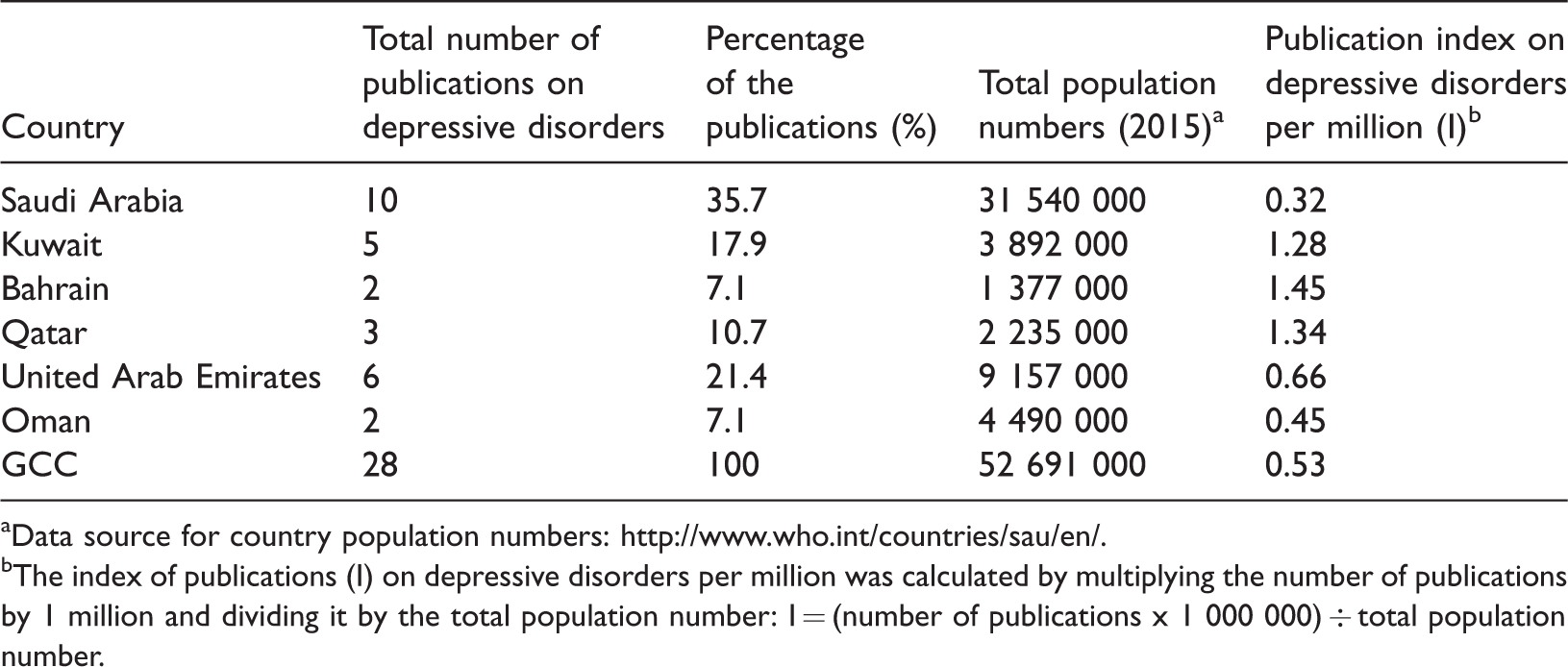
aData source for country population numbers: http://www.who.int/countries/sau/en/.
bThe index of publications (I) on depressive disorders per million was calculated by multiplying the number of publications by 1 million and dividing it by the total population number: I = (number of publications x 1 000 000) ÷ total population number.
Chronologically, researchers from Saudi Arabia were relatively ahead of their colleagues in the GCC region as the first study included in this review was published in 1988 (Figure 2). 24 The UAE followed in 1997. 40 The remaining studies included publications from the other countries conducted during the last decade (Table 1) Overall, the majority of the publications were published after 2000.

Number of publications on depressive disorders per year of publication that were cited on the PubMed® and APA PsycInfo® databases from inception to 31 December 2016 in each of the six Arabian Gulf Cooperation Council countries. UAE, United Arab Emirates.
On reviewing the designs of the studies (Table 1), only six out of the 28 (21.4%) included a random sample or adopted good sampling strategies.16,19,25,28,30,33 The majority (24 of 28; 85.7%) were cross-sectional studies.15–24,26–28,30–40 Approximately half of the studies (13 of 28; 46.4%) were designed to be conducted in community and/or primary health care settings. 15 , 18 , 19 , 22 , 24 , 25 , 28 ,30–34, 37 Of the remaining studies, six were limited to well-defined populations or cohorts of outpatients such as university students, 16 , 17 , 20 , 26 , 41 , 42 four were undertaken on patients with diabetes mellitus and two on postpartum females. 18 ,30–32, 36 , 40 Two studies aimed to compare patients with depressive disorders in Kuwait and the UAE with other nationalities, namely the USA 27 and South Korea, 35 respectively. One study was a mail survey that aimed to compare the findings from 8538 students in 17 Muslim countries and included students from the GCC. 29 The largest sample size in the studies was 2320 patients and the study was conducted in a primary health care setting. 28 Different instruments, tools and methodologies were used by different authors. According to the inclusion criteria, only one study clearly stated the use of the DSM-4 criteria for diagnosis. 21
Discussion
This current literature review identified a large gap in the contributions of the six countries of the GCC to the international scientific literature on depressive disorders (Table 1). This gap was observed despite the high prevalence rates of mental disorders in general and the associated increasing burden of the DALYs/100 000 in the EMR. 4 The current study also identified the opportunities for future research on depression in the GCC countries, which have witnessed a rapid shift to more modernization and globalization over the last few decades. This literature review also demonstrates that the rates of published scientific research on depressive disorders, as recorded on two of the world’s most popular research sites, namely the PubMed® and APA PsycInfo® databases, were disappointingly scant in quantity and poor in quality.
The under productivity of researchers from the GCC countries is noticed despite several ongoing calls by the WHO for giving mental health problems more attention by all countries across the world. 9 The results of the current literature review that focuses on depressive disorder were similar to the results of a recent scoping review study that demonstrated the paucity of research on depression as the authors only found six studies on depression from the GCC countries out of the 55 publications they reviewed. 5 The current literature review observed that research on depressive disorders in the GCC countries involved heterogeneous populations, used different methodologies, used a variety of research tools to diagnose depressive disorders and included small sample sizes, which prevented direct comparisons of the findings. Most of the studies that have been included in the current literature review had limitations and/or weaknesses as described briefly in the notes column of Table 1. Interestingly, only six out of the 28 studies (21.4%) included in this review included a random sample and/or adopted good sampling strategies.16,19,25,28,30,33 This may reflect the difference in study design (controlled/cohort studies versus cross-sectional studies) rather than a lack of scientific literature published by the GCC countries. This may also explain the lack of clinical trials in the field of depression in GCC countries. The inclusion criteria of this current literature review have taken in consideration the community setting of the studies with the aim of limiting its scope to those studies that were conducted in a community or primary care setting and to avoid those studies on inpatients or those that were purely hospital-based studies. As a consequence, only 13 of 28 studies (46.4%) strictly met this condition and were designed to be conducted in a community and/or a primary health care setting. However, some of the included studies were conducted at the community level but were limited to well-defined populations or cohorts of outpatients such as university students, patients with diabetes mellitus and postpartum females which makes their results are less generalizable. 16 , 18 , 32 The choice of selecting the studied samples from hospitals and university students may be attributed to the feasibility of recruiting a representative sample for conducting research related to mental health problems in the GCC countries where there are sociocultural concerns that are linked to people’s experience of mental disorders in general and depression in particular. However, these groups may not be representative of the general population as they only represent a selected group of young individuals from the targeted general population. The various sociocultural and religious aspects of the local culture in the GCC countries have already been addressed by several authors.5,15,27,35,43,44 For example, the results of a study from Saudi Arabia showed that 75% of the studied population believed that depression will not occur if ‘one is close to God’. 15 In the current literature review, two studies aimed to compare patients with depressive disorders across different cultures by studying subjects from Kuwait and UAE and comparing them with other nationalities, namely subjects from the USA 27 and South Korea, 35 respectively. One mail survey study compared the subcultural differences by reporting their findings from investigating the sex differences in depression among 8538 students in 17 Muslim countries, which included students from the GCC. 29
This current literature review had several limitations. First, its framework was that of a thematic or scoping review rather than a comprehensive systematic review. However, in view of the paucity of the published literature from the GCC region 5 and the EMR on the various mental health problems including depressive disorders; 4 a scoping review such as the current review may be the best option as it usually intends to map the key concepts underpinning a research area and the main sources regardless of where the research sits on the ‘evidence hierarchy’.5,45,46 Therefore, the current review has met these expectations. Secondly, the use of a new indicator for comparing the contributions of each country with other GCC countries could be seen as a limitation as it is not well known globally similar, for example, to the Nature index. 47 However, the index used in the current study has already been used in a previous publication on diabetic foot disorders in Arab countries and served its purpose in assessing the scientific contributions in a thematic literature review. 13 Thirdly, the current literature review was limited to searching only two important databases, the PubMed® and APA PsycInfo® databases, with no attempt being made to review the grey literature. Perhaps widening the searched data sources by increasing the number of the databases might be a worthwhile strategy in future studies. Nonetheless, the current review highlighted the literature coming out of an area with peculiar sociocultural backgrounds to the international scientific literature.4,5,13,47
The observations and results of the current literature review support the need for better designed, larger, national and community-based studies on depressive disorders in all of the GCC countries to overcome the current deficiencies in the quantity and quality of the available literature. Future studies should take into consideration the effects of local influences of the peculiar regional factors including the sociocultural context on the combined results. Future studies will hopefully assess the epidemiology of depressive disorders in depth and inform policy makers and health care providers on appropriate actions to be implemented based on the best scientific evidence. With the growing numbers of individuals with depressive disorders, the priority should be given to dealing with high risk groups, such as females, particularly pregnant and postpartum women, and young adults, particularly the students attending health colleges and medical residents. In addition, special attention should be given to the growing numbers of patients with diabetes mellitus in the Gulf region that are more likely to have associated depressive disorders.18,31,37 To enhance the early detection rates of depression, it may be advisable to encourage all adults to use the screening tools for depression and/or other mental illnesses routinely as this may help primary physicians in the early detection of the disease and subsequent referrals to psychiatrists. Early referral will eventually lead to reduced complications, improved treatment outcomes and give an overview of the burden of the disease. 48 Furthermore, researchers, psychiatrists and mental health promotion providers should look at the impact of the sociocultural context in the GCC region and educate the community about the importance of gaining valuable mental health knowledge linked to the symptoms of depression or other mental illnesses so that they can seek help from a qualified physician first; and not from a spiritual healer as it is commonly practiced currently. Access to mental health care should be provided without the fear of negative views from other members of their community or the placing of some kind of stigma upon them. 5 Finally, a national and interdisciplinary approach should be adopted to assess the magnitude of the problem of depressive disorders within the general population in order to eliminate the increasing functional impairment, which can lead to declining work productivity among patients suffering from mental health illnesses that impact the overall social and economic aspects.49,50
In conclusion, there is no reason to believe that any country including the GCC countries is immune from having the burden of depressive disorders as it is already known that depression can affect one in 10 of the world’s population and was ranked as the third cause of disability in 2004 and is expected to move to the first place by 2030. 9 Despite of this, the available scientific literature published by the GCC countries is scant and lacking scientific depth. The findings of the current literature review on depressive disorders in the GCC countries should be considered as a wake-up call for the public health researchers, mental health workers, health care providers and policy makers in the GCC region to start dealing with the burden of poor mental health as it is a real threat to their communities particularly the younger ones. The first step on the long road to managing depressive disorders will be the launching of better designed, community-based and national studies. Such research will benefit the populations in the Arabian Gulf region, perhaps people with similar cultural sociocultural backgrounds around the globe and will guide the health care providers who deal with multi-cultural patients with mental health issues.
Footnotes
Acknowledgement
The author would like to thank Dr Michelle C Carlson and the Welch Medical Library informationist Mrs Donna Hesson from Johns Hopkins University for their kind guidance and expert assistance of the author in designing the methods and search strings used in this study and reviewing the article.
Declaration of conflicting interest
The author declares that there are no conflicts of interest.
Funding
This research received no specific grant from any funding agency in the public, commercial, or not-for-profit sectors.
