




Abstract
The Sprouty-related Ena/vasodilator-stimulated phosphoprotein homology-1 (EVH-1) domain (SPRED) family of proteins was discovered in 2001. These Sprouty-related tyrosine kinase-binding proteins negatively regulate a variety of growth factor-induced Ras/ERK signaling pathways. In recent years, SPRED proteins have been found to regulate vital activities such as cell development, movement, and proliferation, and to participate in pathophysiological processes such as tumor metastasis, hematopoietic regulation, and allergic reactions. The findings of these studies have important implications regarding the involvement of SPRED proteins in disease. Early studies of SPRED proteins focused mainly on various tumors, cardiovascular diseases, and organ development. However, in recent years, great progress has been made in elucidating the role of SPRED proteins in neuropsychiatric, inflammatory, endocrine, and ophthalmic diseases. This article provides a review of the experimental studies performed in recent years on the SPRED proteins and their role in the pathogenesis of certain diseases.
Introduction
The Sprouty-related, Ena/vasodilator-stimulated phosphoprotein homology 1 (EVH-1) domain-containing (SPRED) protein family, which was first discovered in 2001, are a group of proteins phosphorylated by tyrosine kinase in response to certain growth factors. 1 These proteins can bind to cell membranes to activate signaling cascades. There are four SPRED family members in mammals, namely SPRED1, SPRED2, SPRED3, and EVE-3. SPRED1 is mainly expressed in the adult brain and embryonic tissues, with lower expression in certain other tissues; SPRED2 is widely expressed in adult tissues, while rarely expressed in embryonic tissues; SPRED3 and EVE-3 are expressed in brain tissue and liver tissue respectively.2–4 In recent years, there has been growing evidence that SPRED proteins regulate vital activities such as cell development, movement, and proliferation, and that they participate in physiological and pathological processes such as tumor metastasis, hematopoietic regulation, and inflammatory reactions. The findings of these studies suggest promising avenues for future research.
Structure and function of the SPRED proteins
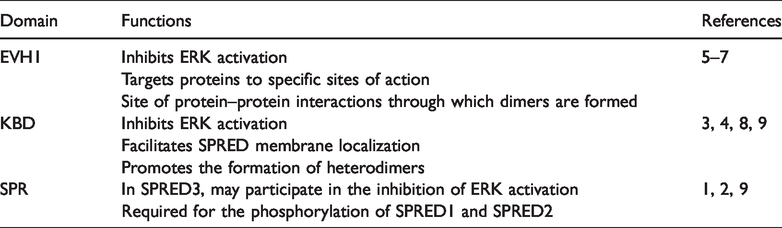
The SPRED proteins are mainly composed of three domains: the N-terminal EVH1 domain, the central c-Kit-binding domain (KBD), and the C-terminal Sprouty-related domain (SPR). SPRED3 lacks the central KBD domain and EVE3 consists of only the EVH1 domain (Figure 1).1–3 These three domains have different functions (Table 1). When the EVH1 region is deleted, SPRED proteins can no longer inhibit ERK activation. However, some studies have shown that Spred2 protein can still inhibit the differentiation of mouse hematopoietic stem cells after the loss of the EVH1 region, which suggests that the EVH1 domain exerts different regulatory mechanisms in different cells. 5 The EVH1 domain binds specifically to proline-rich sequences, targeting proteins to specific sites of action in processes such as cytoskeletal remodeling, skeletal regulation, synaptic transmission, and cell proliferation and differentiation. 6 , 7 The EVH1 domain is also the protein region within which SPRED protein-protein interactions form dimers, and certain functions of the SPRED proteins are dependent on these protein interactions. The SPR domain has different functions in different SPRED proteins. SPRED1 and EVE-3 proteins with an SPR deletion can still inhibit ERK activation, while a similarly mutated SPRED2 cannot. 3 , 8 The SPR domain is also involved in the localization of SPRED proteins to the membrane, as deletion of this domain results in SPRED localization in the cytoplasm instead. 4 In SPRED1 and SPRED2, the SPR domain also promotes the formation of heterodimers that can trigger different stimuli in a spatial and temporal manner to exert specific inhibitory functions. 9 SPRED3 can also inhibit the activation of ERK, but its inhibitory effect is less than that of SPRED1 and SPRED2. This suggests that the KBD domain, which is absent from SPRED3, may be involved in the inhibition of ERK activation but that it is not the only region involved in inhibition of activation. 2 , 9 The KBD domain is also considered essential for the phosphorylation of SPRED1 and SPRED2, and its presence enhances SPRED function.1,2

Structure of the SPRED proteins.
Structure and functions of the SPRED proteins.
Role of the SPRED protein family in signaling pathways
The MAPK pathway is a key pathway regulating cellular function. 10 The Ras protein belongs to a superfamily of small GTPases. The Ras/Raf/MEK/ERK pathway, which is the first intracellular effector of Ras, is a classical MAPK pathway. After stimulation of cell surface receptors, intracellular proteins such as SHC, GRB2, and SHP2 are activated and recruit cytoplasmic SOS, which promotes the exchange of GTP and GDP in the RAS protein. After activation of RAS by phosphorylation, RAS-GTP-RAF1 kinase is recruited to the plasma membrane and activated Raf-1 phosphorylates and thereby activates MEK1 and MEK2, which in turn phosphorylates and activates ERK1/2. SPRED is an inhibitor of the Ras/MAPK signaling pathway, and SPRED1 specifically enhances the interaction between activated RAS and RAF, producing a SPRED1-RAS-RAF complex that blocks RAF kinase activation of RAF, thereby inhibiting activation of downstream pathways. However, in the process of regulation, it does not block the activation of RAS or the membrane translocation of RAF. 1 In addition to interacting with RAS to regulate the Ras/MAPK pathway, SPRED proteins can also form protein–protein dimers with other proteins or receptors for pathway regulation through the various SPRED domains. For example, SPRED2 uses the EVH1 domain to bind to the late endosome protein, NBR1 (neighbor of BRCA1), which inactivates the activated FGFR and affects the Ras/MAPK pathway.11,12 Caveolin-1 interacts with the SPR domain of SPRED1 and coordinates the inhibition of ERK activation. 13 SPRED1 recruits neurofibromin to RAS via the EVH1-GRD interaction to inhibit the Ras-ERK pathway. 14 , 15 . The presence of these dimers enriches the manner in which SPRED proteins regulate the Ras/MAPK pathway (Figure 2). Besides the Ras/MAPK signaling pathway, there have been no reports of SPRED proteins regulating other signaling pathways.

The role of the SPRED protein family in the Ras/ERK signaling pathway. Stimulation of receptor tyrosine kinase by growth factors or cytokines leads to the activation of ERK1 and ERK2. ERK phosphorylates cytoplasmic and nuclear target proteins, which regulates target genes further downstream.
Associations between SPRED proteins and disease
SPRED proteins have been implicated in the pathogenesis of many diseases (Table 2), and understanding their role in these diseases may provide strategies for the future development of therapeutics.
SPRED protein expression in different diseases.

LPS, Lipopolysaccharide; EPC, endothelial progenitor cells.
SPRED proteins are important tumor suppressors
The pathogenesis and progression of tumors are complex processes involving multiple factors, and SPRED proteins are closely involved in these processes. Epithelial-mesenchymal transition (EMT) is a necessary initial step in tumor cell invasion and metastasis. SPRED2 can inhibit activation of the Ras/Raf/ERK signaling pathway and the process of EMT. 32 , 33 Further, inhibiting the activation of the Ras/Raf/ERK signaling pathway can also reduce the secretion of matrix metalloproteinases and inhibit the migration and invasion of tumor cells. 70 Autophagy is closely implicated in the occurrence and treatment of tumor cells. SPRED2 interacts with the microtubule-associated protein 1 light chain 3 (LC3) through the LC3-interacting region in the SPR domain, thereby increasing the maturation of autophages and enhancing the autophagy of cancer cells. 71 , 72 The SPRED proteins are also closely involved in tumor cell proliferation, vascular proliferation, and immune evasion; hence, the SPRED protein family are considered to contain important tumor suppressors.
SPRED proteins may provide new therapeutic targets for HCC
Hepatocellular carcinoma (HCC) is currently one of the most common malignant tumors in the world, and the abnormal regulation of the SPRED protein family is one of the significant changes noted in HCC. 73 For example, the expression of SPRED1 and SPRED2 was found to decrease in 68% of HCC cases, and the overexpression of these SPRED proteins inhibited the proliferation of HCC cells in vitro and in vivo. 16 In addition, the expression level of SPRED proteins in HCC tissues is inversely correlated with the incidence of tumor invasion and metastasis; overexpression of SPRED proteins leads to significant reductions in actin stress fiber formation and cell migration, as SPRED can inhibit the activation of RAF1, which, in turn, inhibits Rho/ROCK, which regulates these cellular processes. 17 The overexpression of SPRED1, however, can inhibit the secretion of MMP2 and MMP9 in HCC cells. 18
In addition to regulating HCC through the Ras/MAPK pathway, SPRED proteins also regulate other pathways. An in vitro study of SPRED2 in HCC found that the overexpression of Spred2 enhanced the activation of caspase-3, inhibited the expression of anti-apoptotic protein Mcl-1, and induced the apoptosis of SMMC-7721 cells. 19 Therefore, SPRED proteins could be used not only as prognostic factors in HCC but also as new therapeutic targets.
SPRED proteins are associated with the onset and prognosis of leukemia
Deregulation of hematopoietic stem cell self-renewal can lead to hematopoietic malignancies, and SPRED proteins can negatively regulate hematopoiesis via the Ras-ERK pathway. For example, SPRED1 negatively regulates hematopoiesis by inhibiting the activation of ERK induced by hematopoietic growth factors such as IL-3 and cytokines including SCF. 74 , 75 In the mouse, Spred2 negatively regulates the SCF receptor, c-Kit, and inhibits the activation of MAP kinase, thereby inhibiting the formation of blood cells in the mouse aorta-gonad-mesonephros (AGM) region. 58
RNA and protein levels of SPRED1 are significantly decreased in most acute myeloid leukemia (AML) patients, which is attributed to hypermethylation of the SPRED1 gene. 20 , 21 Further, 2% of AML patients with SPRED1 germline mutations co-express with lesions known to activate the Ras/MAPK pathway, which indicates that the decreased expression level of SPRED1 and activation of the Ras/MAPK pathway play an important role in the pathogenesis of AML. 22 , 23 In acute lymphoblastic leukemia (ALL), deletion of the SPRED1 gene is closely related to a poor survival rate and recurrence of the disease. 24 Overexpression of SPRED2 in a chronic myeloid leukemia (CML) cell line, K562, inhibits the Ras/ERK signal pathway, indirectly inhibiting the expression of SPHK1 and MCL1 downstream and further affecting cell proliferation and apoptosis. 25 SPRED2 can also regulate the erythrocyte differentiation of CML cells induced by imatinib through this pathway. 26 Thus, SPRED proteins are closely associated with the pathogenesis and prognosis of leukemia.
SPRED1 is a tumor suppressor in mucosal melanoma
Activation of the MAPK pathway has been found in over 80% of melanoma patients, while the expression of SPRED1 and SPRED2 has been shown to be down-regulated in a melanoma cell line (451Lu). 27 In a Spred1/2 double-knockout model, MEK inhibition is alleviated, thus protecting melanoma cells from apoptosis induced by DNA damage. Sequencing of hundreds of cancer-associated genes in 43 human mucosal melanomas has revealed that the SPRED1 gene is inactivated in 37% of tumors. Further, research findings indicate an association between SPRED1 deletion and activation of the KIT mutation in mucosal melanoma. 28
Other tumors
In breast cancer (BC), the expression of SPRED1 is down-regulated, which promotes the proliferation of BC. 29 The mechanism underlying this may be that estrogen/miR-196a/SPRED1 signaling is involved in the regulation of BC proliferation via MAPK signaling. In prostate cancer, low expression of SPRED2 leads to increased levels of phosphorylated ERK, which promotes the proliferation and migration induced by various growth factors, thereby leading to carcinogenesis. 30 , 31 In addition to BC and prostate cancer, SPRED proteins have also been associated with colon cancer, 32 , 33 renal clear cell carcinoma, 34 lung tumors, 35 and esophageal cancer. 36 , 37 These findings indicate that SPRED proteins are important tumor suppressors that inhibit carcinogenesis and metastasis by inhibiting the Ras/Raf/ERK pathway.
SPRED proteins are associated with the occurrence and outcome of cardiovascular and cerebrovascular diseases
Angiogenesis, vascular repair, and maintenance of vascular integrity are important factors in cardiovascular and cerebrovascular diseases, and SPRED proteins can specifically regulate these processes. 12 Arrhythmia is one of the most common cardiovascular diseases. Spred2 knockout mice show cardiomyocyte hypertrophy, cardiac fibrosis, impaired electrical excitability, and severe arrhythmias, and the mechanism underlying these changes may be that loss of Spred2 function leads to loss of Spred2-mediated interaction with the adaptors, p62 and NBR1. Destruction of the autophagic flux caused by this loss of interaction causes severe dysregulation of receptor tyrosine kinase (RTK) inactivation and degradation, resulting in excessive activation of the ERK/MAPK pathway. This, in turn, causes cardiac hypertrophy and fibrosis, while the combination of cardiac fibrosis, disrupted spontaneous ion channel recycling, and non-degrading mitochondria result in slower cardiac conduction and greater sensitivity to arrhythmias. Atherosclerosis is one of the early pathological processes in the development of coronary heart disease and heart failure. Early inhibition of SPRED1 expression can promote endothelial cell proliferation, migration, and neovascularization, and delay the pathogenesis and progression of atherosclerosis, thereby offering an important avenue for preventing coronary heart disease. 38 In an animal model with myocardial infraction, exercise training can increase serum epoxyeicosatrienoic acid (EET) levels, which promotes the overexpression of miR126 and down-regulates its target gene, Spred1, via the AKT/GSK3β signaling pathway. 39 This finding may point toward one of the mechanisms underlying exercise-induced angiogenesis around ischemic areas in infarcted hearts. The protective effects of cardiac protection and intermittent exercise are superior to those of continuous exercise. The application of Yiqi Huoxue recipe, a traditional Chinese medicine, also down-regulates the expression of SPRED1, which promotes myocardial tissue neovascularization in the marginal zone of myocardial infarction. 40
The promotion of angiogenesis is considered an effective treatment approach for repairing and remodeling tissue after ischemic stroke. Downregulation of miR-126 expression in young stroke patients induces SPRED1 to inhibit MAPK signaling pathways, thereby promoting angiogenesis. 41 , 42 However, in patients with transient cerebral ischemia (TIA), abnormal expression of miR-126 and SPRED1 has been observed in the peripheral blood after TIA, in which the level of miR-126 was positively correlated with infarction size and reperfusion. Aberrant down-regulation of miR-126 and up-regulation of SPRED1 indicate an increased risk of secondary cerebral infarction after TIA. 43 , 44 Therefore, SPRED proteins are involved in regulating cardiovascular and cerebrovascular diseases through their participation in angiogenesis and vascular repair.
SPRED proteins play an important role in lung disease
SPRED proteins are widely expressed in the lung tissue and are key factors in lung development and disease. For example, the mRNA expression levels of SPRED1 and SPRED2 are significantly decreased in nitrophenol-induced hypoplastic lung tissue. 45 The decreased expression of SPRED in the pseudo-gland stage of lung development may disrupt FGFR-mediated lung branch morphogenesis by interfering with epithelial–mesenchymal interactions. 46 In zebrafish, miR-126 promotes pulmonary vascular integrity by reducing the expression of SPRED1, which is a negative regulator of the VEGF pathway.
Pulmonary arterial hypertension (PAH) is characterized by severe motor intolerance, and right ventricle failure is the most important factor in PAH morbidity and mortality. 47 Further, the capillary density of the pulmonary vasculature and the right ventricle is decreased in PAH, and sparse capillary networks are associated with the dysregulation of angiogenin and SPRED1. Therefore, vascular remodeling is a feasible treatment approach to PAH and related right ventricle failure. In PAH animal experiments, right ventricular function can improved through the epigenetic down-regulation of Spred1, which activates the MAPK signaling pathway, and increases right ventricular angiogenesis and capillary density.48–50 The decreased expression of miR126 in vascular endothelial progenitor cells (EPCs) in chronic obstructive pulmonary disease (COPD) leads to DNA damage. This mediates the increased expression of ataxia telangiectasis mutation (ATM) protein and SPRED1, markers of the characteristic systemic vascular abnormalities of COPD. 51
Asthma is a chronic disease characterized by airway hyperresponsiveness (AHR), airway inflammation, and airway remodeling. In Spred1 knockout mice, ERK signaling is specifically activated and inflammatory factors such as IL-13 and IL-5 are overexpressed in eosinophils, which results in these mice showing obvious allergen-induced AHR, eosinophil proliferation, and mucus production. 52 In asthmatic children and mice, studies have shown that Spred2 is down-regulated and this promotes allergen-induced airway inflammation and hyperresponsiveness. 52 SPRED2 is also closely associated with ischemia-reperfusion injury (IRI) after lung transplant (LT). Inflammatory changes during lung IRI after LT are associated with activation of the extracellular signal-regulated kinase 1/2 (ERK1/2) signaling pathway. The SPRED2/RAF pathway strongly affects pulmonary IRI, resulting in ERK 1/2 activation and neutrophil infiltration. When activation of ERK 1/2 is suppressed, the severity of pulmonary IRI is improved. 53 , 54 These findings suggest that negative regulation of SPRED2 plays an important role in protecting the lung during IRI after LT.
SPRED2 protein may provide a therapeutic target for inflammation
The development of inflammatory diseases is closely associated with the activity of immune cells and cytokines. Studies have shown that the Ras/Raf/ERK pathway affects not only epithelial cells, but also immune cells such as T cells, macrophages, and endothelial cells. 55 This pathway also regulates the secretion of a variety of cytokines by inflammatory cells, such as IL-17, IL-21, and TNFα, thereby participating in the pathogenesis of inflammatory diseases. SPRED2 may be considered a new therapeutic target for the treatment of ulcerative colitis, as this protein regulates colonic epithelial cell proliferation and inflammation by down-regulating the activation of ERK. Further, in a pneumonia model, Spred2 controls the development of influenza A virus (H1N1)- and lipopolysaccharide-induced pulmonary inflammation through negative regulation of the ERK/MAPK pathway, which makes SPRED2 a potential therapeutic target in pulmonary inflammation. 56 , 57 In addition to the above inflammatory diseases, SPRED proteins have been found to negatively regulate the ERK/MAPK pathway and reduce the level of inflammatory response and chemokines, thereby playing the role of organ protection in hepatitis, 58 acute and chronic liver injury,59,60 acute lung injury, 61 and septic peritonitis. 62
SPRED proteins are key factors in neuropsychiatric diseases
The expression of SPRED proteins is closely associated with physiological processes such as neurodevelopment, 76 nerve repair, 77 and neuronal prolongation 78 and are, therefore, frequently implicated in the pathogenesis of neuropsychiatric diseases. Obsessive-compulsive disorder (OCD) is a common neuropsychiatric disease. Dysfunction of the cortico-striatal-thalamic-cortical circuit and synaptic transmission disorders are related to the pathogenesis of OCD. 63 OCD-like behavior is observed in Spred2-deficient mice, which may be the result of increased TrkB/ERK/MAPK signal transduction. This, in turn, leads to increased synaptic transmission in the cortico-striatal synapses and imbalanced presynaptic and postsynaptic protein expression in the amygdala. Huntington’s disease (HD) is a fully autosomal dominant genetic disease. 64 Cognitive impairment and mental disorder are the main clinical symptoms of Huntington’s disease. The palmitoyl transferase, huntingtin interacting protein 14 (HIP14), palmitoylates proteins involved in HD neurotransmission, neuronal development, signal transduction, and transcriptional regulation. The methylation of HIP14 may be necessary for the correct intimal targeting of its other substrates, SPRED1 and SPRED3, and regulation of cytoskeleton remodeling and neuronal retraction by affecting the RhoA/ROCK pathway of SPRED1. In drug addiction, SPRED1 assists in miR-212 activation of Raf to amplify the cAMP-CREB signaling pathway. 65
Other diseases
The SPRED proteins also regulate bone cell development, lens growth and differentiation, macular degeneration, retinal vascular growth, insulin resistance, and other physiological processes. Dysregulation of these proteins, therefore, plays a role in the pathogenesis of diseases of the bone, endocrine system, and eye among others. For example, promoter activity and protein expression of SPRED2 can be detected in cartilage cells, indicating that SPRED2 may be involved in the development of cartilage cells and bones. 66 Indeed, further experiments showed that SPRED2 is an important regulator of bone morphogenesis by inhibiting the MAPK pathway induced by FGF, and the loss of SPRED2 can cause dwarfism by activating the MAPK pathway in chondrocytes. In addition, exosomes secreted by endothelial progenitor cells (EPC-Exos) can down-regulate SPRED1, increase RAF and ERK1/2 phosphorylation, and stimulate angiogenesis to accelerate bone regeneration during distraction osteogenesis. 67 In diabetes, early hyperglycemia is often associated with endothelial dysfunction, and microvascular spasms can occur as the disease progresses, eventually leading to diabetes-mediated ischemic cardiovascular disease. Similarly, in diabetes, the proliferative and migration abilities of EPCs are weakened, and apoptosis is increased. The mechanism for this may be that hyperglycemia reduces the expression of miR-126, promotes the expression of SPRED1, and inhibits the Ras/ERK/VEGF and PI3K/Akt/eNOS pathways involved in the processes of EPC proliferation, migration, and apoptosis. 68 Furthermore, SPRED2 negatively regulates high-fat diet-induced obesity, adipose tissue inflammation, metabolic abnormalities, and insulin resistance by inhibiting the ERK/MAPK pathway in macrophages. 69 In summary, SPRED has significant potential as a therapeutic target in certain endocrine diseases.
Conclusions and Perspectives
SPRED proteins participate in physiological processes such as angiogenesis, cytokine secretion, nerve repair, and bone cell development by inhibiting the Ras/MAPK signaling pathway. These proteins also play an important role in the pathogenesis of tumors, cardiovascular diseases, and inflammatory diseases. Therefore, SPRED proteins are potential targets for treating these diseases. However, only a few studies to date have reported the use of drugs regulating the expression of SPRED proteins to treat disease. For example, Shuang Dan Ming Mu capsule can effectively inhibit neovascularization in rats with diabetic retinopathy by up-regulating SPRED1 expression in the retina and inhibiting VEGF expression. 79 No drugs targeted toward the SPRED proteins have yet been reported. We believe that the development of such drugs will be the focus of future studies. There are still many important avenues of research to explore concerning the SPRED proteins.
Footnotes
Declaration of conflicting interest
The authors declare that there is no conflict of interest.
Funding
This study was supported by the National Natural Science Foundation of China (Grant No. 81860848) and the Jiangxi University of Traditional Chinese Medicine 1050 Youth Talent Project (Grant No. 5142001001).
