




Abstract
Objective
To investigate the effects of serum from healthy individuals obtained following moxibustion at the “Jiudianfeng” point on melanocytes in vitro.
Methods
Ten healthy adults (five male and five female) were treated by moxibustion at the “Jiudianfeng” point for 30 minutes once daily for 3 months. The effects of treatment with serum obtained following moxibustion on melanocyte proliferation, melanin content, tyrosinase activity, cell cycle progression, and c-kit mRNA and protein expression were assessed in vitro before and after moxibustion for 1, 2, and 3 months.
Results
Exposure to sera from healthy adults following moxibustion therapy promoted melanocyte proliferation, melanin synthesis, tyrosinase activity, and c-kit mRNA and protein expression in vitro. Melanin synthesis and tyrosinase activity increased in the first 2 months following moxibustion and a synchronous decline was observed during the third month. Serum also promoted melanocyte entry into the G1 phase of the cell cycle.
Conclusions
Serum treatment following moxibustion at the “Jiudianfeng” point promoted melanocyte proliferation and melanin synthesis. Further exploration of this intriguing phenomenon is essential.
Introduction
Vitiligo is a refractory and therapeutically challenging condition that causes loss of skin color and occurs in 1% to 4% of the population worldwide.1,2 The pathogenesis underlying the disease remains unclear. Several therapeutic options are available for treating vitiligo, but none are uniformly effective.3,4 Hence, novel therapeutic interventions for vitiligo are urgently needed.
The expression of c-kit in melanocytes is closely related to the pathogenesis of vitiligo. The stem cell factor (SCF)/c-kit signal transduction pathway plays a crucial role in melanin metabolism.5–7 In the classical SCF signaling cascade, SCF binds to c-kit receptors resulting in their dimerization, which in turn activates tyrosine kinase activity and mediates self-phosphorylation. 8 Activated c-kit receptors subsequently phosphorylate a variety of substrates9–11 and mediate a protein kinase cascade, leading to the phosphorylation and activation of extracellular signal regulation (ERK) MAPKs, ERK1 and ERK2. 12 Activated MAPK translocates from the cytoplasm to the nucleus, where it phosphorylates multiple transcription factors. 13 Phosphorylated cAMP-response element binding protein stimulates the transcription of microphthalmia-associated transcription factor (MITF) and increases the expression of MITF protein, thus enhancing the proliferation of melanocytes and/or stimulating melanin biosynthesis. 14 Tyrosinase is the key regulatory enzyme for melanin production. 15 As a molecular switch, MITF regulates the rate of melanin production by controlling important molecules such as tyrosinase, TYRP1 and TYRP2. 16 Whether moxibustion promotes the expression of SCF/c-kit signaling pathway members through the effects of active substances produced in the serum, mediating a therapeutic effect in vitiligo, has yet to be determined.
Moxibustion therapy has gained increasing attention from researchers working on traditional Chinese medicine (TCM). It has long been speculated that the body produces active substances during moxibustion at the “Jiudianfeng” point, the “extraordinary” point for vitiligo, and that these substances modified key factors regulating melanin metabolism, thus restoring color to white spots. These active substances may be present not only in local skin tissues but also in the serum. Therefore, serum can promote color restoration of white spots at other sites in the body. We assessed whether serum obtained following moxibustion at the “Jiudianfeng” point in 10 healthy volunteers affected the proliferation, melanin synthesis, tyrosinase activity, cell cycle progression, and c-kit mRNA and protein expression of human melanocytes cultured in vitro. In designing our study we referred to a novel pharmacological experimental method to assess the effects of serum in TCM proposed by Iwama et al. 17 An experimental in vitro system involving the addition of sera from mice treated orally with Shosaikoto was compared with direct addition of Shosaikoto to the medium. Both systems promoted increased the mitogenic activity of lipopolysaccharide but maintained constant cell viability. We used pooled sera to avoid variance or detection errors, as the mean values of pooled serum samples were much closer to one another than the mean values of single serum samples. 18 According to the results of Iwama, 17 Yang Guang 18 and others, the effects of mixed sera are similar to those of a single serum. In addition, our use of pooled sera was based on ethical considerations, in that completing our experiments required less blood from each of the healthy subjects. We reasoned that if moxibustion at the “Jiudianfeng” point had a therapeutic effect on vitiligo patients, moxibustion at the same point in healthy people should also affect relevant indicators of melanin production. In future studies, we aim to further study the effect of moxibustion at the “Jiudianfeng” point in patients with vitiligo.
Materials and methods
The study protocol was approved by the Ethics Committee of the Beijing Hospital of Traditional Chinese Medicine, Capital Medical University, Beijing (2015BL-066-02). All participants provided written informed consent.
Moxibustion procedure
Ten healthy volunteers (aged 25–35 years; five male and five female) provided informed consent and underwent moxibustion at the “Jiudianfeng” point once daily. The “Jiudianfeng” point, one of the “extraordinary” points, is located on the palm side of the distal middle finger knuckle, slightly in front of the midpoint of the knuckle, with a total of two points on the left and right hands (Figure 1). The moxa stick was ignited, held 3 cm from the skin, and the points were broiled for approximately 30 minutes per treatment. Moxibustion treatment lasted 3 months. We collected 10 mL of venous blood from the anterior cubital vein prior to moxibustion as well as 1, 2 and 3 months following moxibustion. Blood samples were allowed to sit for 1 hour before centrifugation at 1800 × g for 10 minutes. The sera from four groups were pooled as follows: (i) prior to moxibustion, (ii) after moxibustion for 1 month, (iii) after moxibustion for 2 months, and (iv) after moxibustion for 3 months. Sera were stored at −80°C.

Location of the “Jiudianfeng” acupoint.
All procedures involving human participants were performed in accordance with the ethical standards of institutional and/or national research committees and with the principles set out in the 1964 Helsinki Declaration and its later amendments or comparable ethical standards (ethical approval number: 2015BL-066-02).
Cell culture
Primary normal human epidermal melanocytes were purchased from PromoCell (C-12452, PromoCell, Heidelberg, Germany). Cells were cultured in phorbol myristate acetate-free Melanocyte Growth Medium M2 supplemented with 100 U/mL penicillin (C-24010, Gibco, Karlsruhe, Germany). Cells were incubated in a 5% CO2 incubator at 37°C. Upon reaching 90% confluence, the cells were subcultured at a 1:3 ratio and used between the third and sixth passages.
Serum
The serum used in the present study was derived from 10 healthy volunteers. We collected samples prior to moxibustion as a control as well as 1, 2 and 3 months post-moxibustion (T1, T2 and T3). After blood sampling, sera from 10 healthy adults receiving different treatments were pooled separately for each time point and used for subsequent experiments.
Reagents
Cell Counting Kit 8 (CCK-8) was purchased from Dojindo Inc. (Shanghai, China). Total RNA Purification Kits and Reverse Transcription Kits were obtained from Promega (Madison, WI, USA). SYBR Premix Ex Taq was purchased from TaKaRa (Dalian, China). The cell cycle analysis kit was obtained from BD Biosciences (San Jose, CA, USA). The primary antibody against c-kit was obtained from Cell Signaling Technology (Danvers, MA, USA) and the primary antibody against β-actin was obtained from Santa Cruz Biotechnology (Dallas, TX, USA). The tyrosinase activity and melanin content assay kits were purchased from Genmed Scientifics Inc. (Shanghai, China).
Cell viability assay
Cell proliferation was assessed using the CCK-8 assay according to the manufacturer’s protocols. Melanocytes were seeded at a density of 6 × 10³ cells/well in 96-well culture plates. The cell cultures were supplemented with either 5%, 10%, or 15% serum after 24 hours and cell viability was assessed 24 hours later. Subsequently, the cells were incubated with 10 µL of CCK-8 solution in 100 µL of medium for 2 hours at 37°C. The optical density at 450 nm was measured using a microplate reader (Spectra Max 190; Molecular Devices, San Jose, CA, USA). Each experiment was repeated three times.
Measurement of melanin content
Melanocytes were seeded in six-well plates at a density of 3 × 10⁵ cells/well. After 20 hours, the cells were stimulated with 5% serum for a further 24 hours. The cells were harvested by trypsinization and washed with phosphate-buffered saline (PBS, Hyclone, Logan, UT, USA). Melanin content was quantitated using the Genmed cell melanin content colorimetric quantitative detection kit (Genmed Scientifics). According to the kit instructions, we used trypsin (0.25%, Beijing Solibao Technology Co., Beijing, China) to digest the cells and then collected the treated melanocytes with reagent A. The cells were centrifuged in a 15-mL pre-cooled tube at 300 × g for 5 minutes and the supernatant was carefully discarded. Reagent B (500 µL) was added and the mixture was transferred to a new 1.5-mL microcentrifuge tube and vortexed for 15 seconds. Finally, the sample was incubated on ice for 30 minutes and then centrifuged at 4°C, 16,000 × g for 5 minutes. The supernatant was carefully removed into a new 1.5-mL microcentrifuge tube to test protein concentration. Simultaneously, 500 µL of Reagent C was to the cell pellet and centrifuged at 4°C, 16,000 × g for 5 minutes. The supernatant was discarded, and 500 µL of Reagent D was added to the pellet. After protein quantitation, 500 µL of Reagent E was added to each sample and incubated at 60°C for 30 minutes in the dark. Absorbance at 360 nm was measured using a spectrophotometer (Spectra Max 190; Molecular Devices).
Assessment of tyrosinase activity
Tyrosinase is the predominant enzyme involved in two melanin synthesis processes. Tyrosinase activity was assessed by quantitating levels of Levodopa. 19 Melanocytes were treated as described above. Briefly, cells were seeded in six-well plates at a density of 3 × 10⁵ cells/well. After 20 hours, cells were stimulated with 5% serum for 24 hours and then harvested by trypsin digestion. We used a Genmed tyrosinase activity colorimetric quantitative assay kit (Genmed scientifics) to evaluate tyrosinase activity. This kit is based on the substrate tyrosine, which is converted by tyrosinase to produce dihydroxyphenylalanine. According to the manufacturer’s instructions, melanin cells treated with Reagent A were collected and centrifuged in 15 mL pre-chilled tubes at 300 × g for 5 minutes. The supernatant was carefully discarded. Reagent B (500 µL) was added, and the mixture was moved to a new 1.5-ml microcentrifuge tube, vortexed for 15 seconds, and incubated on ice for 30 minutes. The samples were centrifuged at 4°C, 16,000 × g for 5 minutes and the supernatants were moved carefully into new 1.5-mL microcentrifuge tubes to test protein concentrations. After protein quantitation, 850 µL of Reagent C and 100 µL of Reagent D were added to a new cuvette and oxygenated for 2 minutes. Test proteins (50 µg) were added to each cuvette, mixed well and incubated at 25°C for 60 minutes. Absorbance was measured at 475 nm using an enzyme-linked immunosorbent assay.
Cell cycle analysis
The distribution of cell cycle stages among melanocytes was assessed using a kit (BD Biosciences). Approximately, 3 × 10⁵ cells were seeded in 35-mm plates 20 hours before stimulation with different concentrations of serum. Prior to treatment, the cells were synchronized at the same point in the cell cycle (G0 phase) by overnight starvation in 0.5% serum. Subsequently, cells were harvested, washed with PBS, treated with solution A (trypsin buffer) at room temperature for 10 minutes in the dark, then sequentially treated with solution B (trypsin inhibitor and RNase buffer) and solution C (propidium iodide). Flow cytometric analysis was carried out on a FACSCalibur (Becton Dickinson) to estimate cellular DNA content.
Real-time polymerase chain reaction
The mRNA expression of c-kit in melanocytes following different treatments was assessed by real-time quantitative polymerase chain reaction (RT-qPCR, ABI ViiATM 7; Thermo Scientific, Waltham, MA, USA). Total RNA was extracted using the Eastep Super Total RNA purification kit (Promega) according to the manufacturer’s protocol. RNA was quantitated using a NanoDrop 2000 spectrophotometer (Thermo Fisher Scientific). Complementary DNA was synthesized using a reverse transcription system. qPCR was performed using SYBR Green Premix Ex Taq and a Step-One Plus Real-Time PCR Detection System (Thermo Fisher Scientific). β-actin served as an internal control. All primers were synthesized by Invitrogen (Carlsbad, CA, USA) as follows: human c-kit, forward 5′-
Western blotting
Melanocytes were washed with PBS and lysed with ice-cold radio-immunoprecipitation assay buffer supplemented with a protein inhibitor cocktail and phenylmethanesulfonylfluoride (Sigma-Aldrich, MO, USA) 24 hours post-treatment. Total protein concentrations were estimated using the Bradford assay. For each sample, 20 µg protein/lane were separated on a 12% sodium dodecyl sulfate-polyacrylamide gel and transferred by the electrophoretic wet method (120V, 120 minutes) to polyvinylidene difluoride membranes (Millipore, Burlington, MA, USA). The transfer buffer contained Tris, glycine and 20% methanol. Subsequently, the membranes were incubated with blocking buffer (Tris-buffered saline containing 0.1% Tween-20 and 5% nonfat milk) for 1 hour at room temperature and immunoblotted with primary rabbit anti-c-kit polyclonal antibody (1:1000) at 4°C overnight. Subsequently, the membranes were incubated with horseradish peroxidase-conjugated secondary antibodies for 1 hour at room temperature. The blots were developed using an enhanced chemiluminescence assay kit (Pierce, IL, USA), and immunoreactive band intensities were quantitated using ImageJ software (National Institutes of Health, Bethesda, MD, USA).
Immunohistochemistry
Melanocytes were seeded on coverslips and processed as previously described. 20 Samples were fixed with 4% paraformaldehyde for 15 minutes, washed twice with PBS and permeabilized with 0.1% Triton X-100. Subsequently, 0.25% Triton X-100 was added to rupture cell membranes for 15 minutes and the cells were washed three times for 5 minutes with PBS. Sections were blocked with 20% non-immune goat serum for 30 minutes at 37°C, then incubated with anti-c-kit primary antibody (1:500, Cell Signaling Technology) at 4°C. The next day, liquid was discarded from the six-well plate and the sections were washed three times with PBS. Secondary antibody was added in the dark. After incubation for 30 minutes, the secondary antibody solution was discarded. The sections were washed twice with PBS, and then stained with a diaminobenzidine chromogen substrate solution (Santa Cruz Biotechnology). Finally, staining was examined in five randomly selected regions using an inverted microscope (Zeiss, Oberkochen, Germany) at 10× magnification.
Statistical analysis
Data were presented as means ± standard deviations (SDs). Differences between groups were assessed using two-way and one-way analysis of variance using GraphPad Prism (version 5.01; GraphPad Software Inc., La Jolla, CA, USA). Values of P < 0.05 were considered statistically significant (P < 0.05: *, P < 0.01: **).
Results
Serum stimulation enhanced the viability of melanocytes
To explore whether serum stimulation enhanced the viability of melanocytes, the effects of different concentrations of serum (5%, 10%, and 15%) on cell viability 24 hours post-stimulation were examined. Exposure to sera obtained following moxibustion therapy enhanced the viability of melanocytes. As shown in Figure 2, we first assessed the optimal serum concentration and found that 5% serum had a stronger effect on melanocyte viability. Thus, we used 5% serum in all subsequent experiments. Our results demonstrated that 5% serum obtained following 2 months of moxibustion therapy optimally stimulated melanocytes and enhanced their viability.

Effects of serum stimulation on cell viability. A. Melanocytes were treated with 5%, 10%, and 15% serum for 24 hours and cell viability was assessed. B. Melanocytes were treated with 5% serum for 24 hours. Cell viability was assessed using a CCK-8 assay following stimulation with serum obtained prior to treatment and after 1, 2, and 3 months of moxibustion therapy. The results are the average of three independent experiments. Data are expressed as means ± SDs. P < 0.05 (*) or P < 0.01 (**) indicate statistical significance.
Serum stimulation increased melanin production in melanocytes
The effect of serum stimulation on melanin production was measured. As shown in Figure 3, melanin content increased in cells stimulated with serum obtained after moxibustion compared with cells stimulated with serum obtained prior to moxibustion. Stimulation of melanocytes with serum obtained 1 and 2 months post-moxibustion therapy resulted in significantly augmented melanin content (P < 0.05 and P < 0.01, respectively).

Effects of serum stimulation on melanin synthesis in melanocytes. Melanocytes were stimulated with 5% serum for 24 hours. Melanin synthesis was assessed following stimulation with serum obtained prior to treatment and after 1, 2, and 3 months of moxibustion therapy. Melanin content was assessed using the melanin content assay kit. The results are the average of three independent experiments. Data are expressed as means ± SDs. P < 0.05 (*) or P < 0.01 (**) indicate statistical significance.
Serum stimulation enhanced tyrosinase activity
Stimulation with serum obtained after moxibustion therapy enhanced both cell viability and melanin production. We next determined whether the effects of serum stimulation were associated with changes in the activity of the melanogenesis-related protein, tyrosinase. As illustrated in Figure 4, cells treated with serum obtained after 1 month (P < 0.05) and 2 months of moxibustion therapy (P < 0.01) showed significantly enhanced tyrosinase activity compared with control cells. These results suggested that upregulation of tyrosinase activity may be associated with increased melanin production.

Effects of serum stimulation on cellular tyrosinase activity. Melanocytes were stimulated with 5% serum for 24 hours. Tyrosinase activity was assessed following stimulation with serum obtained prior to treatment and after 1, 2, and 3 months of moxibustion therapy. Tyrosinase activity was assessed using the tyrosinase activity assay kit. The results are representative of three independent experiments. P < 0.05 (*) or P < 0.01 (**) indicate statistical significance.
Serum stimulation may accelerate melanocyte cell cycle progression
Progression through the cell cycle was evaluated using flow cytometry. Melanocytes were treated as described above. Briefly, cells were stimulated with serum obtained prior to therapy and after 1, 2, and 3 months of moxibustion therapy. Melanocytes were stimulated with 5% serum for 24 hours. As shown in Figure 5, stimulation with serum obtained after 2 months of moxibustion therapy led to an increased proportion of cells in the G1 phase (P < 0.05). No apparent differences were observed between control cells and cells stimulated with serum obtained after 1 and 3 months of moxibustion therapy. These results suggested that the effects of serum stimulation might be mediated via a prolonged G1 period with enhanced synthesis of DNA, further promoting cellular proliferation.

Effects of serum stimulation on cell cycle progression. Cell cycle stages of melanocytes after serum stimulation are shown. The cells were treated with serum obtained prior to treatment and after 1, 2, and 3 months of moxibustion therapy. The histogram shows percentages of cells at different stages of the cell cycle. The control and treatment groups differed significantly (P < 0.05, *).
Serum stimulation enhanced c-kit mRNA and protein expression
c-kit is a critical receptor tyrosine kinase. RT-qPCR, western blotting, and immunohistochemical analyses were performed to determine whether the effects of serum stimulation were related to regulation of c-kit expression. As shown in Figure 6, RT-qPCR showed that c-kit mRNA expression was higher in cells stimulated with serum obtained after moxibustion therapy than in cells stimulated with serum obtained before therapy. This effect was especially pronounced in cells stimulated with serum obtained after moxibustion treatment for 2 months. In addition, western blotting showed that stimulation with serum obtained following moxibustion therapy increased c-kit protein expression. Immunohistochemical analysis also showed that stimulation with serum obtained after moxibustion therapy increased the expression of c-kit in melanocytes, with maximum enhancement observed using serum obtained after 2 months of moxibustion therapy. These results indicated that the effects of serum stimulation after moxibustion therapy on melanocytes might be attributed to enhancement of tyrosinase activity and changes in expression of c-kit mRNA and protein.
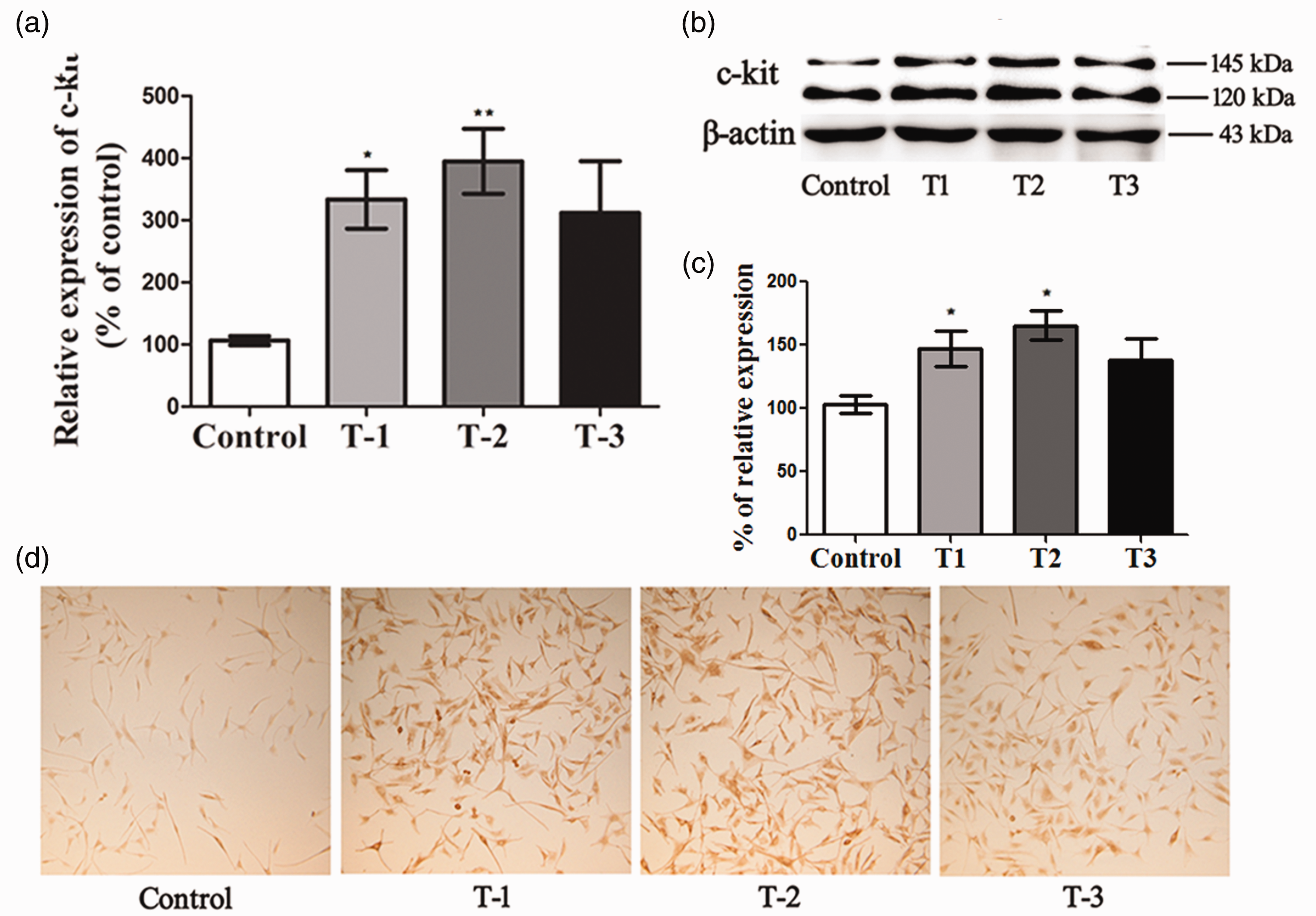
Effects of serum stimulation on expression of c-kit mRNA and protein. Melanocytes were stimulated with 5% serum for 24 hours. Serum was obtained prior to treatment and after 1, 2, and 3 months of moxibustion therapy. A. c-kit mRNA expression was assessed using RT-qPCR. The data are shown as relative values compared with the control group. B. c-kit expression was assessed by western blotting. β-actin was used as an internal control. C. Western blot quantitative densitometry analysis D. Detection of c-kit using immunohistochemical analysis. Similar results were obtained from three independent experiments, and a significant difference was shown at the P < 0.05 (*) or P < 0.01 (**) levels between the control and treated groups.
Discussion
The present study showed that stimulation with 5% serum obtained after 1 and 2 months of moxibustion at the “Jiudianfeng” point enhanced the viability and melanin content of human melanocytes in vitro. The “Jiudianfeng” point is one of the “extraordinary” points, specific acupoints with distinct effects on certain diseases identified by ancient physicians in clinical practice. The “Jiudianfeng” point is associated with specific therapeutic effects on vitiligo. The results of our study support the idea that moxibustion at the “Jiudianfeng” point can promote recovery from vitiligo. Several questions arose from our work and require further investigation. For instance, how does moxibustion at the end of the middle finger increase the viability of melanocytes? Moreover, does moxibustion at the other parts of the end of the finger or at other sites in the body exert a similar effect?
The effectiveness of moxibustion therapy, based on the idea that thermal energy can exert a systemic therapeutic effect on diseases with cold properties, has been demonstrated by TCM records going back more than 2000 years as well as by modern TCM clinical practice. 21 Moxibustion was suggested to play an important role for vitiligo therapy in ancient TCM literature. During the early period of the Eastern Han Dynasty, the classic TCM text “Huang Di Nei Jing” discussed the theories of “white means cold” and “the white majority indicates that the syndrome is cold.” 22 Thus, whitening of skin was believed to be a manifestation of coldness. The medical monograph “52 disease prescription,” unearthed from a Han Dynasty tomb, records the use of moxibustion to treat “white place” disease. 23 Sun Simiao, a Tang Dynasty physician who wrote the book Qian Jin Yi Fang more than 1300 years ago, discovered a specific site in the middle finger to target with moxibustion for vitiligo therapy. 24 This site is called the “Jiudianfeng” point and is one of several “extraordinary” points exhibiting specific effects on certain diseases that were discovered by ancient Chinese doctors in clinical practice. The “Jiudianfeng” point is recorded in several ancient medical texts as an important site for the treatment of vitiligo.
In a pivotal study of the classical TCM literature, an explorative clinical trial was conducted to assess the therapeutic effect of moxibustion in vitiligo. 25 Six patients were treated with moxibustion with a moxa stick at the “Jiudianfeng” and “Ashi” points. The Ashi point is the depigmented skin spot. Patients were instructed to undergo moxibustion once daily at the appropriate points. The moxa stick was ignited and placed 3 cm from the skin, and each point was broiled for approximately 30 minutes per treatment. The treatment period was 6 months (24 weeks). An interesting phenomenon was noted wherein multiple lesions, not selected as targets (Ashi), also underwent repigmentation.
Our results showed that melanocyte tyrosinase activity was upregulated following stimulation with serum obtained after 2 months of moxibustion. Melanocyte proliferation and melanin synthesis increased simultaneously, thereby suggesting that these phenomena might be related to increased tyrosinase activity. Thus, serum obtained after moxibustion at the “Jiudianfeng” point could enhance melanocyte proliferation, melanin content and tyrosinase activity. Tyrosinase is a key enzyme in melanin synthesis and its activity is closely associated with changes in melanocyte activity and cell proliferation.26,27 Thus, our results are consistent with others views in the literature suggesting that moxibustion may promote melanocyte proliferation and the formation of melanin by activating tyrosinase. Whether the proliferation of melanocytes is causally related to increased tyrosinase activity requires further experimentation.
The SCF/c-kit signal transduction pathway plays a crucial role in melanocyte survival, differentiation, proliferation, migration, and melanin synthesis. 28 c-kit is the receptor for SCF. In the epidermis of the skin, only melanocytes express the c-kit receptor. When SCF interacts with this receptor, it can activate the SCF/c-kit signal transduction pathway. Thus, tyrosinase activity, melanin synthesis, and skin pigmentation are enhanced. 29 Moreover, the present study showed that c-kit mRNA and protein expression was upregulated after moxibustion, in concert with enhanced tyrosinase activity, melanocyte proliferation, and melanin synthesis. Therefore, we speculate that moxibustion at the “Jiudianfeng” point might increase melanocyte proliferation and melanin synthesis by promoting SCF/c-kit signaling.
Our results suggested that serum obtained after 2 months of moxibustion therapy affected the proportion of melanocytes in G1 phase in vitro. During the G1 phase of the cell cycle, cells undergo DNA replication. G1 phase is also known as the pre-synthesis phase with respect to RNA and ribosome synthesis and is characterized by active metabolism, rapid synthesis of RNA and protein, and a significant increase in cell volume. The G1 period is also significant because it prepares the material and energy for DNA replication in the S phase. 30 Studies have shown that moxibustion increased cell proliferation because of an increased proportion of G1 phase cells. 31 In our study, melanocyte viability was significantly increased following stimulation with serum obtained after 1, 2 or 3 months of moxibustion therapy, whereas increases in the proportions of melanocytes in the G1 phase were more subtle, occurring only after stimulation with serum obtained after 2 months of moxibustion therapy. After 3 months of moxibustion therapy, the effect of serum on G1 phase cells disappeared.
The 10 healthy subjects participating in this study had no abnormal pigmentation diseases such as vitiligo or chloasma before or after the study period. Thus, we expect that melanocyte function in these subjects was normal over the observation period. Interestingly, melanin synthesis and tyrosinase activity increased following stimulation with serum obtained during the first 2 months after moxibustion, and a synchronous decline was observed in the 3rd month. This indicated that the effect of serum obtained after moxibustion on melanocytes and melanin synthesis was weaker after 3 months of moxibustion therapy; the underlying causes of this phenomenon have yet to be elucidated. Speculations of “bidirectional adjustment” in TCM therapy 32 have often been made in modern TCM research. That is, abnormal increases may be reduced in magnitude and decreases can be elevated. This phenomenon can also be understood as the body’s natural regulation of abnormal indicators toward normal values. The hypothesis of bidirectional regulation is evidence of the safety of moxibustion therapy in the view of TCM, but needs to be further confirmed by future studies. In this study, melanocyte function and melanin metabolism were normal for all 10 healthy participants. If melanocyte function was continuously enhanced, melanogenesis would be increased, turning the skin black. Inhibition of this function is obviously a protective mechanism for healthy individuals, reflecting the safety of moxibustion treatment. For moxibustion conducted at the “Jiudianfeng” point in patients with vitiligo, it remains to be confirmed in future studies whether the effects of serum on melanocyte proliferation and melanin synthesis increase continuously.
The present study preliminarily showed that serum obtained after moxibustion at the “Jiudianfeng” point could enhance melanocyte proliferation, melanin synthesis, tyrosinase activity, and c-kit mRNA and protein expression in vitro. Serum stimulation also increased the proportion of melanocytes in the G1 phase. Why does serum obtained after moxibustion have these effects? It seems that some serum components change after moxibustion and that these active substances act on multiple targets. Whether the altered components are hormones, cytokines, signaling molecules, or others requires in-depth exploration.
Taken together, our data show that serum obtained after moxibustion at the “Jiudianfeng” point could promote melanocyte proliferation and melanin synthesis. Further exploration of this intriguing phenomenon will required.
Footnotes
Acknowledgements
We thank the 10 healthy individuals for their participation in this study.
Declaration of conflicting interest
The authors declare that there is no conflict of interest.
Funding
This work was supported by the National Natural Science Foundation of China (grant number 81473686).
