




Abstract
Objective
To examine publication rates of the full texts of abstracts presented at the 2010 World Congress on Pain (WCP) of the International Association for the Study of Pain.
Methods
Poster presentations published in the abstract booklet of the 13th WCP in 2010 were examined. The post-congress status of each abstract was investigated by searching titles, first author, and co-authors, in order, using local search engines. The year of publication, country, index, impact factor (IF) of the publishing journal, and name and title consistencies between the abstract and published text were recorded.
Results
A total 1907 poster presentations were investigated. Of these, 525 (27.5%) were published in scientific journals. The most poster presentations (402, 37%) were from the United States. The most published presentations appeared in scientific journals in 2011. Science Citation Index (SCI), SCI Expanded, and Emerging Sources Citation Index published 491 abstracts as full texts. The mean IF of journals in which articles were published was 3.90 ± 3.64.
Conclusions
As with scientific journals, a communication process should be established with authors during assessment of poster presentations at congresses regarding critical progression and rectification of deficiencies, which will increase the likelihood of presentation abstracts being published.
Keywords
Introduction
Scientific research serves as a guide for clinicians, assists in revealing new methods of patient care, and sheds light on studies to be performed in the future. Researchers make use of congresses, symposia, and seminars to share problems and the results of their studies with colleagues. These results are presented in verbal or poster form at congresses and scientific meetings. Numerous congresses are held in the field of medicine, at which thousands of posters are presented. However, many of these presentations are never published in scientific journals.1,2 This may be owing to the evaluation process for abstracts. Abstracts sent to congresses are not reviewed in the same way as those submitted to scientific journals. When an abstract is submitted for presentation at a meeting, the reviewers provide no criticism of the manuscript. No corrections are requested, and no correspondence of the kind that occurs with scientific journals is entered into. Presentation abstracts are accepted or rejected in the form in which they are sent, which reduces the likelihood of their being subsequently published. Publication of congress presentations in scientific journals reflects the scientific and academic quality of the congress. 3 Although the publication rate of abstracts varies between 11% and 78% in different fields, approximately half (48%) of abstracts presented at meetings are published in scientific journals. 4 The publication rates of presentations at congresses from many fields of medicine continue to be investigated, but the number of such studies carried out in the field of pain is limited.
The World Congress on Pain (WCP) is held regularly once every 2 years by the International Association for the Study of Pain. Participants from across the world share their work in the form of verbal and poster presentations. All presentations are assessed by the Scientific Program Committee, and the procedures reported are checked to ensure that they are in line with the Declaration of Helsinki. The purpose of the current study was to determine the publication rate for poster abstracts at the 2010 WCP, one of the most important congresses worldwide in the field of pain, and to analyze the characteristics of abstracts that are published in peer-reviewed journals.
Methods
Poster presentations published in the congress booklet of the WCP in 2010 (Montreal, Quebec, Canada) were examined. All presentations were identified in the previous congresses section on the website of the 13th WCP. 5 Several databases were scanned, including Clinical Key/Elsevier, EBSCO, MD Consult, Science Direct, Scopus, EMBASE, Medscape, and Scholar Google, to determine whether these abstracts had subsequently appeared in the form of complete papers in a peer-reviewed journal. During this procedure, the name of the first author, followed by those of the co-authors and the abstract title were used as search terms, in sequence. When the search returned no results, key words associated with the title of a particular abstract were entered as search terms. In the event that a search yielded a match, the results were assessed on the basis of the title, co-authors, and summary to confirm that the published paper was the same as the abstract presented at the congress. Once this had been confirmed, data including the name of the journal, index in which it was listed, year of publication, country of origin of the study, type of study, and citations received were recorded. Variations in terms of the author names, sequence of listed authors, titles, and content were regarded as scientific inconsistencies.
Distribution of abstracts by country, publication rate, and index.
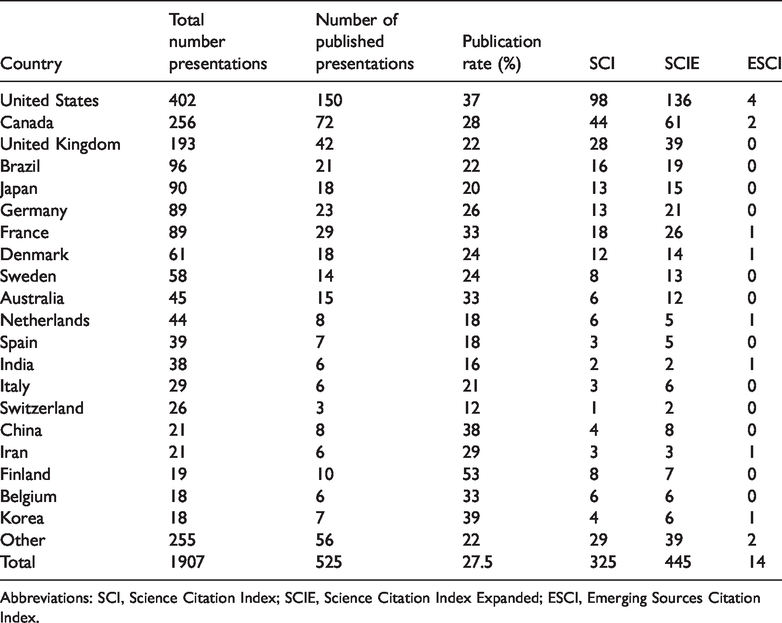
Abbreviations: SCI, Science Citation Index; SCIE, Science Citation Index Expanded; ESCI, Emerging Sources Citation Index.
Results
A total 1907 abstracts presented at the 2010 WCP were examined. Of these, 525 (27.5%) were subsequently published in a scientific journal. The largest number of poster presentations was from the United States (n = 402, 37%), followed by Canada (n = 256, 28%), and the United Kingdom (n = 193, 22%). In addition to North American and European countries, a considerable number of presentation abstracts were from Asian countries including Japan (n = 90), India (n = 38), China (n = 21), and Korea (n = 18). Poster presentations from Finland had the highest rate of publication (53%), followed by those from Korea (39%) and China (38%) (Table 1). Among the total poster presentations, the largest number of studies published in scientific journals was in 2011 (Table 2); 31.8% of all published manuscripts (n = 167) were published in 2011, followed in order by 2012, 2010, and 2013. Ninety-seven items were submitted to the congress as a poster presentation following publication in 2010, representing 18.5% of all research accepted. The number of poster presentations published in any journal in 2009 and prior to 2009 and submitted to congresses was 39 (7.4%). The number of accepted manuscripts decreased progressively after 2014 (Table 2).
Abstract publications, by year.

Investigation of the journals in which published posters appeared revealed 491 publications listed with Science Citation Index (SCI), SCI Expanded, Emerging Sources Citation Index. Thirty-four manuscripts did not appear in any index. Five hundred published manuscripts were cited, and 25 received no citations. The mean number of citations was 46.12 ± 54.99 (range: 0–513), and the total number of citations for all published manuscripts was 23,106 (Table 3). Differences between the author list on posters and the author list after publication were found for only 16 studies.
Number of citations, cited abstracts, and journal impact factor.
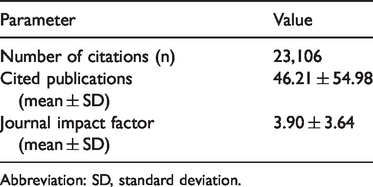
Abbreviation: SD, standard deviation.
In terms of study content, the number of prospective studies exceeded the number of other study designs. A total 427 studies were prospective, 42 were retrospective, and 10 were meta-analyses. Published studies appeared in 78 journals, with the largest number published in Pain (n = 65); this was followed by the European Journal of Pain (n = 28), Journal of Pain (n = 26), Molecular Pain (n = 19), and Pain Medicine (n = 18) (Table 4). Published studies also appeared in high-impact journals, such as The Lancet. The mean impact factor of manuscripts accepted for publication was 3.90 ± 3.64 (range: 0–47.83) (Table 3).
Journals and type of study for published abstracts.

Discussion
The principal aim of abstracts presented at congresses is to share the authors’ activities with colleagues, to elicit criticism from the broader scientific community, and eventual publication in peer-reviewed journals. Congresses make substantial contributions to the dissemination of medical knowledge. It is important to evaluate the scientific validity of presentations submitted to congresses, to determine the rates of subsequent publication in peer-reviewed journals, to compare previous similar data, and to analyze emerging trends. 6
A publication rate of 27.5% was determined for poster presentations at the 2010 WCP. Other studies in the literature have reported publication rates ranging from 4.7% to 53.6% for abstracts presented at other anesthesia congresses (Table 5).7–12 Tyagi et al. 8 investigated the publication rates of abstracts at congresses held by the Indian Society of Anaesthesiologists (ISACON) in India in 2009 and the American Society of Anesthesiologists (ASA) in the same year; publication rates were 5% and 22%, respectively. The low publication rate of posters presented at ISACON was attributed to the assessment process for accepted posters. Tyagi et al. 8 also identified numerous deficiencies in the methods sections of abstracts submitted to ISACON. In addition, the authors only reviewed the 4-year period after this congress and suggested that the publication rate might have been higher had a longer period been studied. Although the period for publication of poster presentations is approximately 1.5 to 3 years, the time within which authors submit their manuscript to journals varies. An 8-year period was used in the present study, with a higher rate of publication observed during the first few years following the congress.
Rate of publication for abstracts from previous anesthesia congresses.

Chong et al. 7 examined approximately 6000 abstracts from ASA congresses held between 2001 and 2004. Over the 4-year study period, the authors identified 1052 randomized controlled studies, with approximately half published in peer-reviewed journals. Chong et al. emphasized that to be published in a peer-reviewed journal, posters must be well-designed. In addition, higher acceptance rates were observed for studies with positive findings compared with studies reporting negative results; it was suggested that journals should avoid bias according to findings. 7 The current study did not investigate the content of published poster presentations in detail, but the fact that more prospectively designed studies were accepted supports the views of Chong et al.
The reason for selecting the 2010 congress in this study was to allow sufficient time for the publication of presentation abstracts. According to studies similar to the present research, the mean period for manuscript publication is 14 to 18 months after a scientific meeting.13,14 Donegan et al. 6 determined that 63% of poster abstracts were published in the first 2 years after presentation but that the publication rate decreased over time. In the current study, a high publication rate of presentation abstracts was also found in the first 2 years, with a progressive decline observed after the third year.
The quality of scientific texts depends on the impact factor of the journal and the number of citations received. A higher number of citations shows that a study has been a source of inspiration for other researchers. The poster presentations accepted for publication in our study received more than 23,000 citations; this can be considered to illustrate that the published abstracts were of sufficiently high quality to guide numerous new studies. A very high publication rate of presentation abstracts reflects a very large contribution to science. In addition, considering the variety of journals in which the presentations were published, the 2010 WCP clearly also contributed to other branches of science. Castillo et al. 9 determined that anesthesiology represented the subject matter in 79.8% of presentations at the 1992 Congress of the Anesthesiology and Resuscitation Spanish Association that were subsequently published in peer-reviewed journals. According to the current study findings, the number of studies published in journals from other scientific fields will also increase with time. 9
The mean number of citations was 46 per published poster presentation, and the number of citations received can be anticipated to increase over time. Although the rate of publication of presentation abstracts was not high, owing to the number of citations received, the scientific quality can be considered high as the studies served to guide other studies.
Congresses have three principal aims: educational, social, and economic. The first of these is intended to permit researchers to enable their assistants to gain experience in presentation techniques. Congresses also provide environments for participants to discuss problems and share information with professional colleagues. Finally, professional associations provide financial support for scientific activities by holding congresses.4,15 Some participants attending a congress may submit an abstract so as to secure financial support to attend the meeting. These individuals may not subsequently submit their study to a journal for publication, which would lower the abstract publication rate.
The main limitation of this study was that although the databases searched are very broad, there may be studies in local databases that were not accessible. This means that total publication rate of presentation abstracts could not be precisely determined. However, it is unlikely that such papers would have substantially altered the overall proportion of published manuscripts. Another limitation of the study was that searches were conducted only in English language. If the databases had also been searched in other languages, a higher abstract publication rate may have been found. Another limitation was that the time for abstracts to be published after the congress was not examined; this is because it has been previously reported that most abstracts are published in the first 3 years after presentation, and the rate of publication decreases over time.13–16
In conclusion, when compared with other anesthesia congresses, the publication rate of abstracts presented at the 2010 WCP was found to be average. If the qualitative characteristics of congress presentations are taken into consideration in addition to quantitative features, the publication rate of presentation abstracts will likely increase. Future studies of the publication rates of abstract presented at more recent meetings are needed to compare the rates of publication and evaluate the development of the congress.
Footnotes
Consent
As the present study does not involve any human participants, obtaining informed consent was not required.
Declaration of conflicting interest
The authors declare that there is no conflict of interest.
Ethics
The present study did not require confirmation by the ethics committee as it contains publicly available data only and does not involve any human participants.
Funding
This research received no specific grant from any funding agency in the public, commercial, or not-for-profit sectors.
