



Abstract
Objectives
To evaluate the association between serum iron levels and cervical cancer risk in Chinese populations.
Methods
A literature search was conducted using the PubMed, WanFang, and SinoMed databases up to April 30, 2019. Pooled standard mean differences (SMD) and 95% confidence intervals (CI) were analyzed using R software with a random-effects model.
Results
Data from nine studies comprising 454 cervical cancer patients and 880 controls were used in the analysis. Our results demonstrated that serum iron levels in cervical cancer patients were significantly lower than those in controls in Chinese populations (summary SMD = −1.24, 95%CI = −1.37 to −1.10; I2 = 93.4%). No publications bias was detected. Sensitivity analysis indicated that no single study had a significant effect on the overall SMD.
Conclusions
Our findings show that serum iron levels are lower in patients with cervical cancer than in control individuals. However, further high-quality studies are necessary to clarify the role of serum iron levels in cervical cancer risk.
Introduction
Cervical cancer is among the most common malignancies in women and a leading cause of death among women worldwide.1–3 According to a previous study, there were 527,600 new cases of cervical cancer in women worldwide in 2012, with 265,700 deaths. 4 In 2015 there were approximately 98,900 new cases of cervical cancer in China, 5 and the prevention of this disease has subsequently become a public health priority. Recently, Zhang et al. 6 performed a meta-analysis to examine the association between serum copper levels and cervical cancer risk. The results from that study indicated that serum copper levels were higher in cervical cancer patients than in control individuals. Furthermore, Xie et al. 7 conducted a meta-analysis of the association between serum zinc levels and cervical cancer risk, and found that serum zinc levels were significantly lower in cervical cancer patients compared with controls. Zinc, copper, and iron are all trace elements, and to our knowledge, no meta-analysis to date has evaluated the association between serum iron levels and cervical cancer risk. We therefore performed the current meta-analysis to clarify whether a relationship exists between serum iron levels and risk of cervical cancer. Our results may support preventative efforts in the treatment of this disease.
Materials and methods
This study was conducted according to the Preferred Reporting Items for Systematic Reviews and Meta-Analyses (PRISMA) statement. 8
Literature search
We considered all studies related to serum iron levels and cervical cancer risk published prior to April 30, 2019 for inclusion in our study. The literature search was conducted by two independent authors (SC and LYS) using the PubMed, WanFang, and SinoMed databases and the following combination terms: (‘iron concentration’ OR ‘iron level’ OR ‘iron’ OR ‘Fe’ OR ‘trace element’) AND ‘cervical’ AND (‘cancer’ OR ‘tumor’ OR ‘carcinoma’). Additional studies were identified by manually searching the references cited in eligible articles. Disagreements between the two authors were resolved by a third author (SJL). Ethics review committee approval was not required for this meta-analysis.
Inclusion and exclusion criteria
Studies that met all of the following criteria were included: (1) observational study or randomized controlled trial (RCT) to investigate the association between serum iron levels and cervical cancer risk; (2) values, means, and standard deviations (SDs) of serum iron levels available for cases and controls; and (3) studies conducted in humans. Studies were excluded if they met the following criteria: (1) reviews, case reports, comments, conference abstracts, letters, or laboratory studies; (2) insufficient data available to estimate the association between serum iron levels and cervical cancer risk.
Data extraction
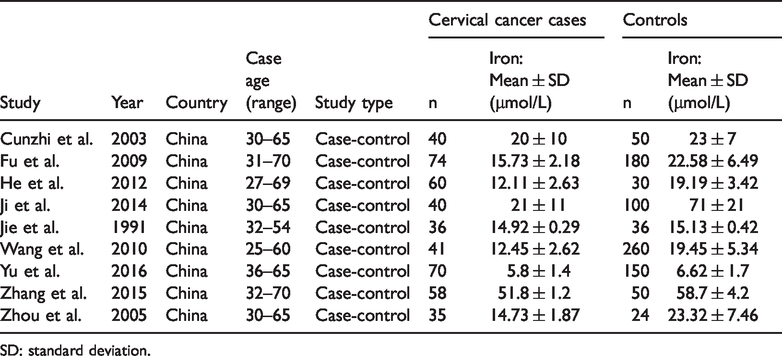
Detailed information on the data extracted by the two independent authors (SC and LYS) are provided in Table 1.
Characteristics of included studies.
SD: standard deviation.
Statistical analysis
The overall and subgroup associations between serum iron levels and cervical cancer risk were assessed using standard mean differences (SMD) and the corresponding 95% confidence intervals (CI) with a random-effects model. 9 Heterogeneity among studies was detected using an I2 statistic, according to the Q-test. 10 I2 > 50% indicated significant between-study heterogeneity. 11 Sensitivity analysis was performed to determine whether a single study could affect the overall result. Egger’s test 12 and Begg’s test 13 were used to detect publication bias. Our meta-analysis was performed using R (www.r-project.org), and values of p < 0.05 were considered significant.
Results
Research characteristics
In total, 237 published manuscripts (106 from PubMed, 61 from WanFang, and 70 from SinoMed) that evaluated the association between serum iron levels and cervical cancer and met the inclusion and exclusion criteria were identified. The flowchart in Figure 1 shows the reasons for inclusion or exclusion. The final analysis was conducted using data from 9 studies14–22 comprising 454 cervical cancer patients and 880 controls. All eligible articles had been published between 1991 and 2016. The included studies were of case-control design and were conducted in Chinese patient populations. The characteristics of each study are presented in Table 1.
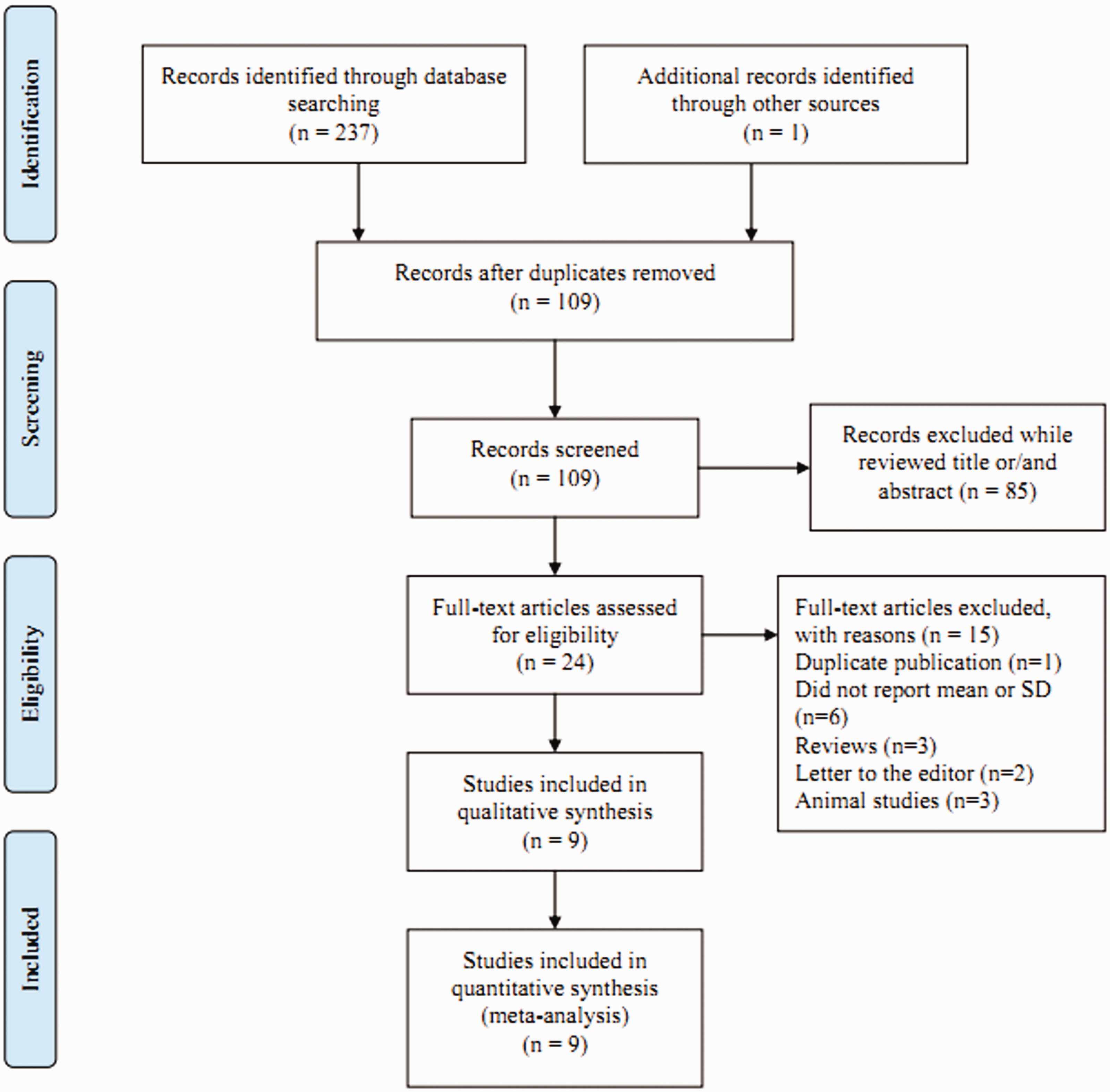
Flow diagram of the literature search.

Forest plot of standard mean difference (SMD) with corresponding 95% confidence interval (CI) of studies on serum iron levels and cervical cancer risk.
Meta-analysis
Our results demonstrated that serum iron levels in cervical cancer patients were significantly lower than those in controls in Chinese populations (summary SMD =−1.24, 95%CI = −1.37 to −1.10, Z test =18.23, P < 0.001; I2 = 93.4%, Pfor heterogeneity < 0.001) (Figure 2). Sensitivity analysis showed that no individual study had a significant impact on the overall results, indicating the reliability and stability of the meta-analysis. Publication bias was not detected using either Begg's test or Egger's test.
Discussion
We conducted the present meta-analysis to explore the relationship between serum iron levels and risk of cervical cancer. Our findings, based on nine studies involving 454 patients with cervical cancer and 880 control individuals, indicate that serum iron levels in cervical cancer are significantly lower than those in controls in Chinese populations.
In the overall analysis, the P value for the heterogeneity test was < 0.001, indicating that significant between-study heterogeneity existed in the pooled result. Sensitivity analysis was carried out to explore whether a single study could affect the overall result. However, none of the individual studies were found to have an influence on the overall result. Publication bias was also assessed by Egger’s test and Begg’s test, and the results showed that no publication bias existed in our study. Taken together, the results of these analyses indicate that our meta-analysis was reliable and robust, despite the high between-study heterogeneity identified.
We searched the PubMed, WanFang, and SinoMed databases to identify eligible studies that assessed the association of serum iron levels with cervical cancer risk. Of note, all studies that met our inclusion and exclusion criteria were conducted in China. However, from another perspective, all included studies were in Chinese populations with a relatively consistent genetic and lifestyle background, thus excluding any effect related to geographic location.
Trace elements are essential for the normal functioning of various metabolic processes in the body. Recent studies have shown that trace elements play an important role in the development and progression of malignant tumors. 23 Iron participates in the synthesis of hemoglobin, myoglobin, cytochrome oxidase, and peroxidase, and iron-containing enzymes proliferate rapidly in hepatocytes to increase iron requirements. 24 Furthermore, vaginal bleeding in cervical cancer may lead to a loss of iron and subsequent reduction in serum iron levels in this patient population.
Our study had some limitations. First, only nine studies were included in our meta-analysis. Only published papers were included, meaning that relevant unpublished studies or meeting abstracts may have been omitted. Second, between-study heterogeneity was present in the overall analysis. Hence, further studies are required to explore this high level of heterogeneity. Finally, all included studies were conducted in China, meaning that our results are applicable primarily to Chinese populations. Further studies are thus needed to confirm the association between serum iron levels and cervical cancer risk in other populations.
Conclusions
The results of this study show that serum iron levels are lower in cervical cancer patients compared with controls, indicating that higher serum iron levels may have a protective effect in cervical cancer. However, given the limitations of our meta-analysis, further high-quality studies are needed to clarify the role of serum iron levels in cervical cancer risk.
