



Abstract
Objectives
Ageing is often associated with deteriorating mental and physical health and the need for long-term care, creating a fear of ageing. We investigated what people fear most in terms of disabling chronic diseases and their concerns regarding having long-term illnesses.
Methods
Data were obtained from an online survey of 518 respondents aged 40 years and older residing in Malaysia, which was based on a convenience sample collected in May 2015 to January 2016. Data were analyzed using chi-squared tests and multinomial logistic regression.
Results
Of the most dreaded diseases, heart disease and cancer are life-threatening; however, dementia, diabetes, and hypertension persist and have a disabling effect for a long time. While there were variations in the diseases feared most across sex, ethnicity, and place of residence, the biggest worry for all respondents with regard to having a long-term illness was that they would become a burden to their family, a concern that superseded fear of dying.
Conclusions
We found our survey respondents had a fear of chronic diseases and placing a burden on others. Thus, there is a need to provide motivation for people to adopt a healthy lifestyle, to remain healthy.
Introduction
As much as people wish to stay youthful and no matter to what lengths they will go to remain young, some degree of depressing thoughts about ageing linger in the minds of most people. Mental and physical decline, losing loved ones, not being able to financially support oneself or loved ones, and becoming a burden or dependent on family members and friends are some of the reasons people fear getting old. The perceptions, experiences, and interpretations of an individual’s own ageing process contribute to the development of a fear of ageing. 1 The ageing self as a concept of an individual's ageing process can be explained in relation to their social cultural background, social experiences, and socioeconomic conditions.2–3 Ageing is a process that is related to but distinct from each individual's concept of physical self, social self, personal identity, 1 personal experience, attitude towards ageing, and age stereotypes.4–6 The experience of the passing of time is fundamental to the human condition, and how one perceives living well throughout old age is highly subjective.7,8
Ageing is often associated with poor health and particularly the onset and progression of chronic illness such as cancer, Alzheimer's disease, diabetes, arthritis, and heart disease. Ageing can entail multiple losses, including the loss of work (through retirement) and physical functioning. 9 There have been considerable studies on psychosocial gerontology examining how individuals retain and reshape their self concept as they age. However, the concepts of the ageing self and one's personal sense of ageing as well as how much importance one places on the signs of ageing, its attributes, and the inevitability of physical decline that comes with ageing are relatively new.10–13
According to a 2015 World Health Organization (WHO) 14 fact sheet, cancer is the disease feared most by the majority of people. There were approximately 14 million new cases of cancer and 8.2 million cancer-related deaths in 2012. Cognitive impairment and dementia is another health concern expressed by older individuals. Attitudes towards this illness, such as fears of memory loss, losing independence, and burdening family members and society are deeply embedded in people's cultural biographies and life experiences.15–17 Alzheimer's disease, the most prevalent type of dementia, 18 is known not only for its negative effect on the quality of life of patients and caregivers but also for the stigma surrounding it, which is attributable to a lack of understanding of the disease.19–23 The World Alzheimer Report (2015) estimates that 46.8 million people currently live with dementia worldwide. More than 9.9 million new cases are recorded annually and these numbers are projected to increase to 74.7 million by 2030 and 131.5 million by 2050; people living in Asia will account for nearly half of these cases.
The 2015 WHO fact sheet 14 also reported that cardiovascular disease (CVD) remains the leading cause of death globally. An estimated 17.5 million people died from CVDs in 2012, which represents 31% of deaths globally. At the same time, the number of people with diabetes rose from 108 million in 1980 to 422 million in 2014. Approximately 1.5 million deaths in 2012 were directly associated with diabetic conditions. Older people with diabetes have considerable functional impairments that lead to reduced health status and reduced health-related mental and physical quality of life.24,25. There is also a general perception that musculoskeletal conditions such as low back pain and osteoarthritis are “old person's diseases” and that the burden of disease is an inevitable consequence of ageing that entails physical impairment and having to live with pain.26–29
Aside from being life-threatening, chronic illnesses tend to persist and have disabling effects that require long-term care, the consequences of which may include of relatives and friends, causing burnout among caregivers, financial distress, and job modifications.30–33
Negative attitudes towards older adults are predicted by personal anxieties about ageing and death, as reported by Depaola et al. (2003). 34 Death anxiety can form a basic fear underlying certain psychological conditions and is a uniquely human dilemma that can consciously or unconsciously impact a person’s everyday life domains and functioning. 35 Anxiety about death can be influenced by how individuals are able to see themselves from a true perspective; this in turn affects one’s ability to see dying in a positive or negative light. 36 Studies show that fear of death is positively related to low self-esteem, feeling that one has little purpose in life, and poor mental well-being; a fear of death is negatively related to happiness.37–39 Young people generally have negative perceptions of elderly adults and tend to view ageing as a negative process that involves depression, stress, regrets, weight gain, becoming less active, and mid-life crisis.40,41 In contrast, older people have either a positive or a negative view of ageing. Generally older adults view ageing as being accompanied by both losses (physical and social) and by gains, such as more freedom and time for new interests and social activities.42–44
This research aimed to investigate how Malaysians generally view ageing and the fears and attitudes relating to disease and long-term illness that are perceived as being part of the ageing process. In particular, we were interested to find what are the most feared disabling diseases and long-term illnesses. Alongside people’s fears lie their expectations and their needs for support, which give rise to social and policy implications.
Materials and methods
This paper is based on data collected from a convenience sample of 518 respondents aged 40 years and above, using an online self-administered survey conducted in Malaysia (excluding non-Malaysians) in May 2015 to January 2016. Convenience sampling was used owing to the lack of a sampling frame. However, efforts were made to include different segments of the population so as to have a good representation of the population in the country. Under simple random sampling, a sample size of around 500 respondents would produce a margin of error of around 4.5% for estimating proportion (assuming P = 0.5). Together with obtaining information on sociodemographic background, respondents were asked about their most feared disabling diseases in later life, their fears regarding having long-term illness, and their opinions on various dimensions of ageing. Close-ended questions were used that contained a list of possible responses. Descriptive statistics were generated to explore the distribution of respondents across the variables of interest. Chi-squared tests and multinomial logistic regression were performed to test for significant associations between the dependent and independent variables.
Results
Respondents’ demographic and employment profiles
Respondents’ demographic profile.

Respondents’ employment status.

Fears of deteriorating health and contracting diseases
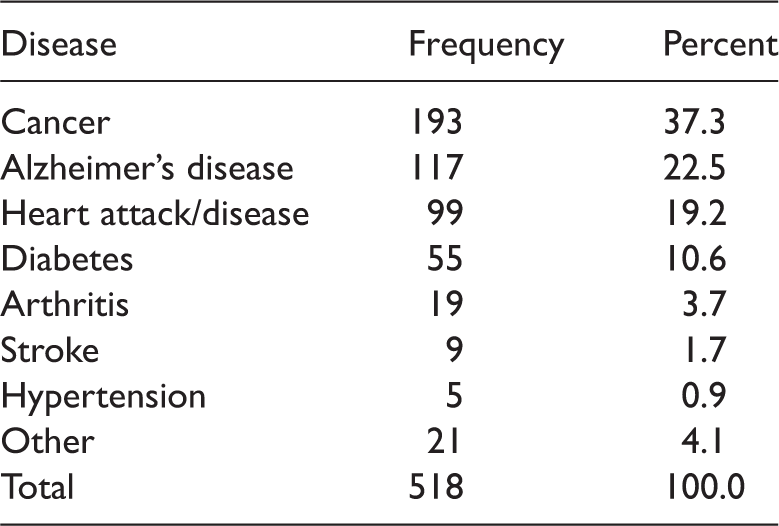
Most feared disabling disease later in life.
Associations between most feared disabling disease and selected variables.

Note: Reported as frequency (percent).
Multinomial logistic regression of most feared disabling diseases.

Abbreviations: AOR, adjusted odds ratio; CI, confidence interval.
Fears regarding having long-term illness
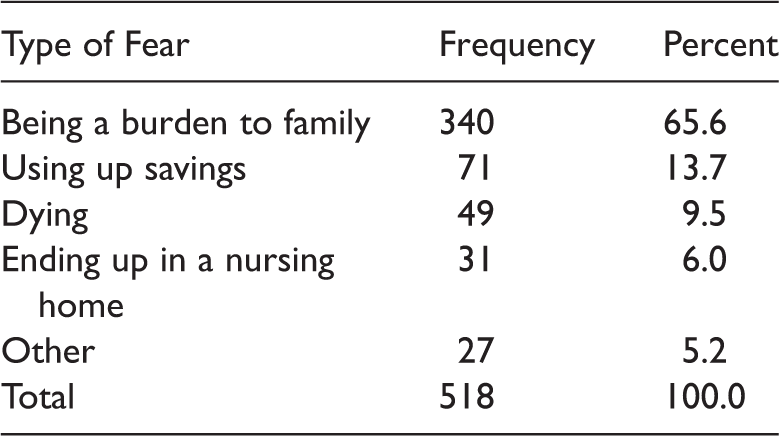
Fears regarding having a long-term illness.
Fear of having a long-term illness, by socioeconomic variable.

Note: Reported as frequency (percent).
Discussion
The population of Malaysia is ageing rapidly, and the country will be a super-aged nation around 2035 when the proportion of people aged 60 years and over exceeds 15% of the total population. Population ageing poses great challenges to existing models of caregiving and social support. Ageing is inevitably associated with a deterioration in health and the increased need for physical, financial, and emotional support, which affect the well-being of the individuals themselves and that of their families. In this study, we focused on the perceptions of people towards ageing, in terms of their fears of contracting a disabling chronic disease requiring long-term care. Among our findings, we found that the fear of burdening family even superseded the fear of dying.
A study using data of the 2004 Malaysian Population and Family Survey 45 showed that arthritis is the most common noncommunicable disease among older Malaysians (45.3%), followed by high blood pressure or hypertension (35.8%), diabetes (14.1%), asthma (13.2%), and coronary heart disease (8.0%). However, in this study, arthritis was only ranked fifth in terms of the most feared disease, and hypertension was hardly mentioned as a dreaded illness. Instead, the most feared disabling diseases reported were cancer, followed by Alzheimer's disease, heart attack or heart disease, and diabetes. Cancer and heart disease are feared because of the severe pain that is usually involved and the fact that patients tend to die within a relatively short period. By contrast, Alzheimer disease and diabetes tend to persist, with accompanying disability, for a much longer time. WHO reports and previous studies show that these are common illnesses associated with people going through the ageing process, especially Alzheimer's disease and arthritis.15,24,26,27
Significant differences were found with respect to the fear of contracting these diseases according to sex, place of residence, and ethnicity. These differences could be attributable to personal life experiences and exposure within respondents’ own social circles. Men and Malays were more likely to fear heart attack or disease over diseases. Urban respondents were more likely to fear heart attack or disease over Alzheimer's disease compared with cancer or diabetes. With regard to coping with a long-term illness, respondents expressed more concern and fear over becoming a burden to family, followed by the fear of exhausting their savings and fear of dying. This finding is consistent with those of Lynn and Adamson (2002), Chappell and Reid (2002), and Almberg et al. (1997).28,30,31 These fears arise from the fact that having a chronic disease or long-term illness requires long-term care, which leads to the need for caregiving and adds a financial burden. The fear of chronic disease and the realization that the debilitating effects of these diseases can place a heavy burden on families and caregivers should provide sufficient motivation for people to adopt a healthy lifestyle and to remain healthy. In addition, health education and awareness campaigns should be regularly carried out to promote healthy living, especially with respect to food consumption, stress management, and physical activity. There is also a need to dispel the myths of some traditional beliefs with regard to health and health care later in life.
Conclusions
Much as people wish to stay youthful and healthy, there is always lingering fear about old age and especially of diseases that may come with age. The fear of chronic diseases is often accompanied by the knowledge that the debilitating effects of these diseases can be psychologically distressing and can place a heavy burden on families and caregivers. These fears, as well as greater awareness of the causes and consequences of chronic diseases, could motivate people to adopt a healthy lifestyle and to remain healthy. Health education should be stepped up and be accorded top priority in education and health care systems.
Footnotes
Acknowledgements
This research was internally funded by Social Security Research Centre (SSRC), University of Malaya.
Declaration of conflicting interests
The authors declare that there is no conflict of interest.
Funding
This research received no specific grant from any funding agency in the public, commercial, or not-for-profit sectors.