




Abstract
Objective
To investigate the association between potentially functional MDM2 oncogene, E3 ubiquitin protein ligase (MDM2) T309G polymorphism and susceptibility to oesophageal or gastric cancer.
Methods
Two investigators independently searched the PubMed and Chinese National Knowledge Infrastructure databases for studies published before September 2013.
Results
Pooled results showed that the variant homozygous 309GG genotype (versus TT) was significantly associated with increased risk of both oesophageal (odds ratio [OR] 0.77; 95% confidence interval [CI] 0.65, 0.90) and gastric cancer (OR 0.52; 95% CI 0.38, 0.72). Subgroup analysis revealed a 309GG-associated increased risk for both cancer types in Asian populations, particularly among Chinese and Japanese ethnicity. When stratified for Helicobacter pylori infection and histological type of gastric cancer, the 309GG-related risk was higher in H. pylori-positive patients (T versus G: OR 0.37; 95% CI 0.22, 0.63) and the association was stronger with intestinal (TT + TG versus GG: OR 0.68; 95% CI 0.54, 0.87) rather than diffuse gastric-cancer type.
Conclusions
The MDM2 T309G polymorphism may be significantly associated with increased susceptibility to oesophageal or gastric cancer, particularly among Eastern Asian populations.
Introduction
Gastric and oesophageal cancer represent the second and sixth, respectively, most frequent causes of cancer-related deaths worldwide. 1 Oesophageal cancer is a relatively common upper digestive tract cancer, with distinct geographical distribution characteristics relating to its development. China is a high-incidence area for oesophageal cancer and contributes more than 50% of the world’s newly diagnosed oesophageal cancer cases.2,3 More than 50% of the world’s new gastric cancer cases occur in Asian countries and China alone contributes 42% of newly diagnosed patients with stomach cancer worldwide. 4 It would be beneficial, therefore, to identify risk factors for use in screening high-risk subjects, in order to facilitate prompt detection of these two malignancies.
The tumour suppressor gene, tumour protein p53 (P53), which encodes cellular tumour antigen p53, is well known for its activities in cell-cycle regulation, cellular transcription control and apoptosis. 5 A central node in the P53 pathway is the E3 ubiquitin-protein ligase Mdm2 protein, which is a key negative regulator of P53. MDM2 and P53 form an oscillating autofeedback loop, which is tightly controlled to allow the appropriate response to environmental stresses in order to suppress cancer growth. 6 The Mdm2 protein, an E3 ubiquitin ligase, negatively regulates the stability and activity of p53 protein, by binding to p53, leading to its degradation. It is likely that damaged cells escape from the cell-cycle checkpoint control and become carcinogenic, by the attenuation of p53 function, when MDM2 is overexpressed. A single nucleotide polymorphism (SNP) of the MDM2 gene (T309G) was found in the P53-responsive intronic promoter region, and it was revealed that the G allele could increase the affinity for binding the transcription factor Sp1, subsequently leading to elevated Mdm2 protein levels. 6
A number of studies have been conducted to investigate the relationship between MDM2 SNP309 and the risk of developing oesophageal or gastric cancer;7–21 the results of such studies remain inconclusive, however. Thus, the present meta-analysis was conducted to provide a quantitative summary of the association between gastro-oesophageal cancer and polymorphism T309G in the MDM2 gene, particularly among patients with Eastern Asian ethnicity.
Materials and methods
Literature search strategy
Relevant published studies were identified by searching electronic databases as follows: PubMed (1950–September 2013) and Chinese National Knowledge Infrastructure (1979–September 2013). The following key words were used: (‘MDM2’ OR ‘murine double minute 2’) AND (‘esophageal’ OR ‘gastric’ OR ‘stomach’ OR ‘gastrointestinal’) AND (‘carcinoma’ OR ‘cancer’ OR ‘tumor’ OR ‘tumour’ OR ‘neoplasm’ OR ‘adenocarcinoma’). The search was performed independently by two investigators (W.S. and P.H.), without any language restrictions. In addition, references cited in the selected articles and published reviews were manually searched, to identify any additional relevant studies.
Inclusion and exclusion criteria
Human case–control studies that presented original data relating to the MDM2 oncogene T309G polymorphism and risk of oesophageal or gastric cancer were included. The exclusion criteria were as follows: no usable data reported; duplicate data; no controls.
Data extraction
Two investigators (W.S. and P.H.) independently extracted data from original publications. Discrepancies were resolved by group discussion (among all five coauthors). The information sought from each included study comprised the following: first author’s name; cancer type; publication year; study design; country of origin; ethnicity of the population; source of controls; total number of cases and controls; genotype frequencies of cases and controls. The quality of all included studies was assessed according to a previously published scale for quality assessment. 22
Statistical analyses
Meta-analysis was conducted using RevMan software, version 5.2 (Cochrane Collaboration, Oxford, UK) and STATA® software, version 12.0 (StataCorp LP, College Station, TX, USA); the results are presented as odds ratios (OR) and 95% confidence intervals (CI). Between-study heterogeneity was evaluated with the χ2-test-based Q-statistic, which determined if statistically significant heterogeneity was present. A P-value >0.10 for the Q-test indicated a lack of heterogeneity among the studies. The fixed-effects model was applied to the meta-analysis when heterogeneity between studies was absent. 23 If statistically significant heterogeneity existed between studies, the random-effects model was used. 24 Stratification analyses were carried out according to the presence of Helicobacter pylori infection, Lauren’s histological classification 25 and cancer location. Potential publication bias was assessed using the Begg rank correlation test and Egger weighted regression test.26,27 A P-value <0.05 was considered to represent statistically significant publication bias.
Results
Study characteristics
The literature search identified 286 original articles concerning the association between MDM2 SNP309 and the risk of oesophageal or gastric cancer (Figure 1). Data for analysis were available from 15 case–control studies, comprising a total of 5438 cases and 6657 controls (Table 1): four studies regarding oesophageal cancer; nine regarding gastric cancer; two for both oesophageal and gastric cancer (data from these were treated independently).7–21 Eligible articles consisted of eight population-based case–control studies (PCC) and seven hospital-based case–control studies (HCC); 14 were conducted among Asian populations (11 in China; one in Iran; one in Japan; one in Korea). All studies included in the meta-analysis were of high quality according to the previously published standards-based grading scale.
22
Flow diagram and outcomes of the process to select studies relating to MDM2 oncogene, E3 ubiquitin protein ligase (MDM2) T309G single nucleotide polymorphism and the risk of oesophageal or gastric cancer. Characteristics of 15 primary studies used in a meta-analysis investigating the association between MDM2 oncogene, E3 ubiquitin protein ligase (MDM2) T309G single nucleotide polymorphism and risk of oesophageal or gastric cancer. EGC, oesophageal and gastric cancer; HCC, hospital-based case–control study; PCC, population-based case–control study.

Quantitative data synthesis
The combined results based on all studies showed that the variant homozygous 309GG genotype was significantly associated with increased overall risk of gastro-oesophageal cancer, compared with wild-type homozygous 309TT genotype (OR 0.62; 95% CI 0.49, 0.79; P < 0.0001; Table 2). The combined result for TT + TG versus GG (OR 0.67; 95% CI 0.55, 0.80; Figure 2) was consistent with that for TT versus GG. The results for TT versus GG genotype remained statistically significant when studies were stratified by tumour location (OR 0.77; 95% CI 0.65, 0.90 for oesophageal cancer [Table 2], OR 0.52; 95% CI 0.38, 0.72 for gastric cancer [Table 2 and Figure 3] and OR 0.52; 95% CI 0.42, 0.64 for gastric cardia cancer [Table 3]), and by source of controls (OR 0.47; 95% CI 0.29, 0.78 for HCC and OR 0.71; 95% CI 0.54, 0.93 for PCC [Table 2 and Figure 3]).
Forest plot showing overall meta-analysis for MDM2 oncogene, E3 ubiquitin protein ligase (MDM2) T309G single nucleotide polymorphism (TT + TG versus GG: odds ratio 0.67; 95% confidence interval 0.55, 0.80) and the risk of oesophageal or gastric cancer. The size of the black square corresponding to each study is proportional to the sample size. Horizontal line shows corresponding 95% confidence interval of the odds ratio. Forest plot of gastric cancer susceptibility associated with MDM2 oncogene, E3 ubiquitin protein ligase (MDM2) T309G single nucleotide polymorphism (TT versus GG: odds ratio 0.41; 95% confidence interval 0.22, 0.78 for hospital-based studies and odds ratio 0.61; 95% confidence interval 0.44, 0.85 for population-based studies) Meta-analysis of the association between MDM2 oncogene, E3 ubiquitin protein ligase (MDM2) T390G single nucleotide polymorphism and risk of oesophageal or gastric cancer. CI, Confidence interval; EGC, oesophageal and gastric cancer; F, Fixed-effects model; HCC, hospital-based case–control study; PCC, population-based case–control study; OR, Odds ratio; R, Random-effects model. NS, no statistically significant difference (P ≥ 0.05). Meta-analyses of the MDM2 oncogene, E3 ubiquitin protein ligase (MDM2) T390G polymorphism and risk of gastric cancer. CI, Confidence interval; F, Fixed-effects model; OR, Odds ratio; R, Random-effects model. NS, no statistically significant difference (P ≥ 0.05).


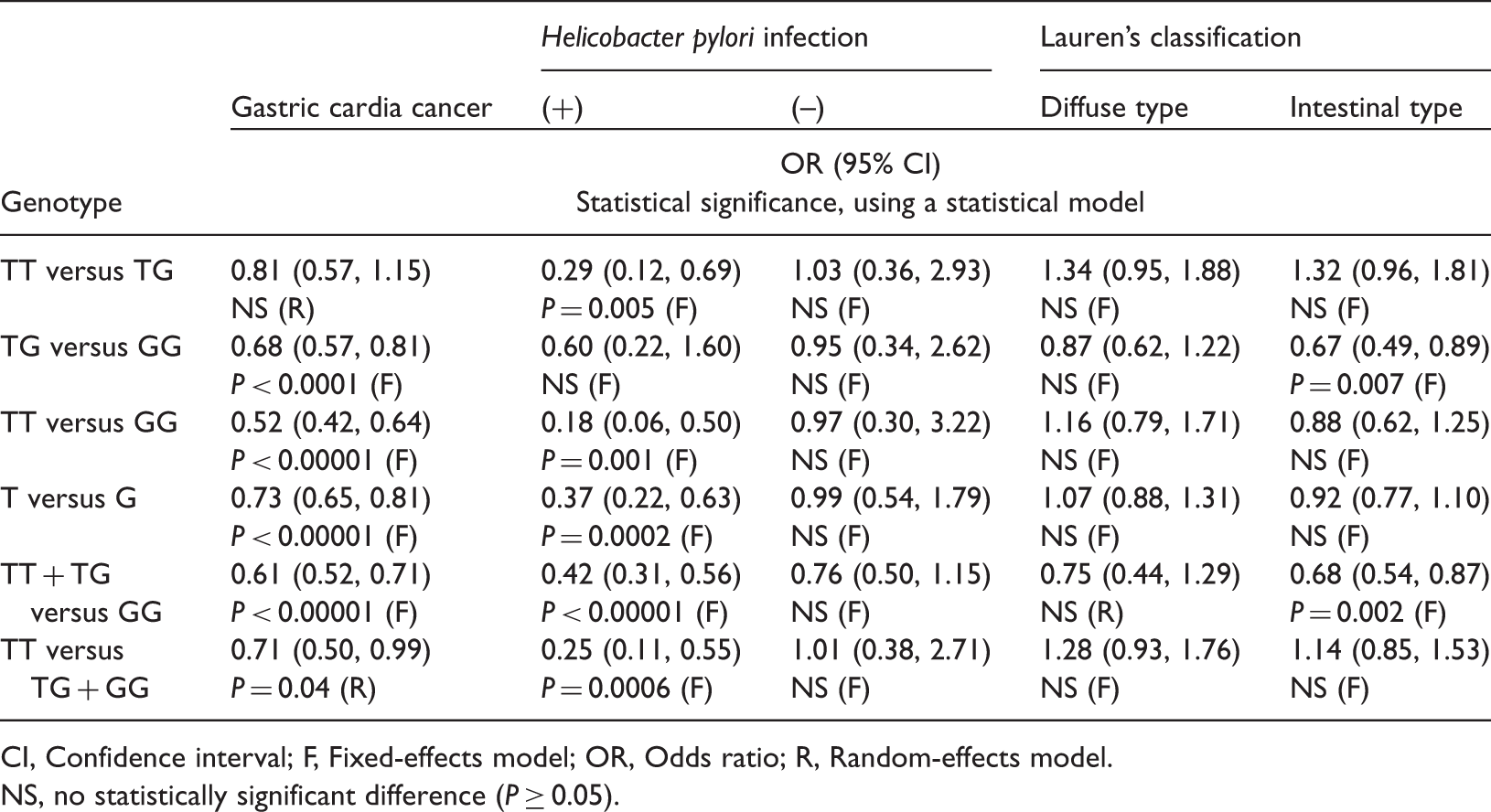
In the ethnicity subgroup analysis, G allele carriers of Asian ethnicity were found to have significantly increased risk of both oesophageal and gastric cancer (T versus G: OR 0.85; 95% CI 0.78, 0.93 for oesophageal cancer and OR 0.79; 95% CI 0.70, 0.89 for gastric cancer [Table 2]). For gastric cancer alone, significantly increased risk was observed in patients of Chinese ethnicity, but not in patients of Japanese or Korean ethnicity. No data were available for Japanese or Korean patients in terms of increased risk of oesophageal cancer alone (Table 2). In the gastric cancer subgroup, stratification analyses according to H. pylori infection and Lauren’s classification demonstrated that the MDM2 309GG-associated risk was more pronounced among H. pylori-positive patients (T versus G: OR 0.37; 95% CI 0.22, 0.63) and the association was stronger with the intestinal (OR 0.68; 95% CI 0.54, 0.87 for TT + TG versus GG), compared with the diffuse, histologic gastric-cancer type (Table 3).
No evidence of publication bias was observed (All P > 0.05; Begg’s rank correlation test and Egger’s weighted regression test).
Discussion
In research, Mdm2 has been identified as a p53-interacting protein that represses p53 transcriptional activity. 28 In a mouse model, modest deviations of Mdm2 protein levels from the equilibrium state were shown to render the p53 pathway chaotic.29,30 In vitro tests revealed that expression levels of MDM2 were much higher in SNP309 GG genotype cell lines compared with TT genotype cell lines (on average, eightfold higher mRNA and fourfold higher protein levels).6,31 Similarly, for MDM2 309GG genotype patients with cancer, significantly increased expression of MDM2 at the mRNA and protein levels was observed. 32
To the authors’ knowledge, the present study is the first published meta-analysis regarding an MDM2 gene polymorphism and the risk of oesophageal cancer. Through quantitative analysis, the present study demonstrates that the G allele of MDM2 SNP309 is significantly associated with increased risks of both oesophageal and gastric cancer. Given the multiple cellular and physiological functions of the MDM2 gene and the protein product, it is biologically plausible that this SNP site may modulate gastro-oesophageal cancer risk. Results of the present study are consistent with several published in vitro and in vivo molecular, histological and epidemiological studies.6,32
The incidence of both oesophageal and gastric cancer is high among Eastern Asian populations, especially in people of Chinese ethnicity. 4 Consequently, subgroup analysis was performed by ethnicity in the present study. The association between MDM2 SNP309 and gastro-oesophageal cancer risk was significant among Asian populations but was not significant in the one study that involved other populations. 8 Potential differences in genetic predisposition and environmental exposures in different countries might, at least in part, contribute to the diversity of results. In addition to MDM2 SNP309, many other gene variations were found to be associated with increased risk of different cancers in Asian populations, suggesting that genetic background might play an important role in carcinogenesis.33–35
The influence of factors such as histological type and H. pylori infection may be important in assessing the risk of gastro-oesophageal cancer, in addition to source of controls, cancer location and ethnicity. The present analysis found the risk effect of MDM2 309GG was particularly important among patients with intestinal-type gastric cancer who were also positive for H. pylori infection. Consistently, the different histological types of gastric cancer (such as intestinal and diffuse types) have been shown to exhibit different characteristics in aetiology and epidemiology.36,37 It has been reported that H. pylori infection might induce DNA damage, and thus initiate and promote carcinogenesis. 38 Another study reported that the Mdm2 protein level was increased when H. pylori infection was present. 39 This observation implies that there may be a potential interaction between the MDM2 gene and H. pylori infection. The subgroup analyses in the present study, however, were based on relatively small samples compared with the overall combined analysis, and should therefore be interpreted cautiously.
The present meta-analysis is potentially open to some limitations. First, a more precise analysis could be carried out if adjusted estimates were available in all studies. Secondly, although no publication bias was observed, selection bias could have occurred because some unpublished studies were not included in the present study. Thirdly, as with most systematic reviews, the results of the present study should be interpreted with caution because of heterogeneity among the original studies. Fourth, due to the limited number of studies that were suitable for inclusion in the present meta-analysis, more precise evidence on the association between MDM2 SNP309 and cancer susceptibility for populations other than Asian could not be evaluated properly. To minimize the possibility of bias, a detailed systematic review protocol, comprehensive search strategy and repeatable method for appraisal and data extraction were performed throughout the whole process of the present study.
In conclusion, the present study suggests that the MDM2 309GG genotype may be significantly associated with increased risk of oesophageal and gastric cancer among Asians, especially in those of Chinese ethnicity. The association was not robust in some subgroup analyses, therefore additional population-based research is required to validate further the present study results. These additional studies should comprise larger sample sizes that include more varied populations with more detailed stratification, particularly regarding histological cancer type and H. pylori infection.
Footnotes
Declaration of conflicting interest
The authors declare that there are no conflicts of interest.
Funding
This research received no specific grant from any funding agency in the public, commercial, or not-for-profit sectors.