




Abstract
Objective
To identify the factors that influenced the risk of injury-related disability caused by the Wenchuan earthquake.
Methods
A chi-squared automatic interaction detection (CHAID) classification tree analysis was used to retrospectively analyse clinical data from patients who underwent surgical treatment for earthquake-related injuries in the first 5 days after the earthquake. The CHAID classification tree explored the relationships between the development of disability and potential influencing factors including sex, age, time interval between injury and treatment, wound type, preoperative and postoperative haemoglobin levels, and operation time.
Results
A total of 334 patients underwent surgery; of these, 113 (33.8%) were discharged with varying degrees of permanent disability. The CHAID classification tree showed that children (≤17 years old), a long time interval between injury and treatment, an open wound and a low preoperative haemoglobin level were significant risk factors for disability.
Conclusion
The results of this study can help to stratify patients according to their medical needs and to help allocate the available resources efficiently to ensure the best outcomes for injured patients during future earthquakes.
Keywords
Introduction
An earthquake is a natural disaster with strong destructive power that can cause a tremendous amount of personal injuries and property loss due to its unpredictability. On 12 May 2008, an earthquake, graded 8.0 on the Richter Scale, occurred with an epicentre located at the township of Wenchuan, Sichuan Province, China. The death toll and those declared missing exceeded 80,000 and about 400,000 individuals were injured. 1
The epidemiology of mortality and injury means that earthquakes can be differentiated from other natural hazards, 2 such as hurricanes and flood emergencies. Floods and hurricanes typically cause many deaths due to drowning but few serious medical or surgical injuries. By comparison, earthquakes not only cause many deaths initially, but also many severe injuries including fracture cases, head injuries, thoracic injuries and abdominal injuries,3–5 requiring complex surgical and resuscitative medical care. Many injuries will be severe enough to lead to long-term functional impairment and disability. Examples include spinal cord injuries, fractures that develop complications such as infection or alignment problems, and crush injuries of the extremities requiring amputation. 6 Physical disability is an enormous psychological and financial burden on the population in terms of resources.
Various clinical factors may be related to injury-related disability. For example, an injured person with an open wound may have serious internal and external bleeding. In addition, since the protection of the skin has been penetrated, the wound is easily contaminated and may become infected. If the contaminated wound is not cleaned in a timely and effective manner, this in turn may lead to long-term disability. 7 Therefore, appropriate medical and surgical treatment for these injuries is vital to minimize future functional impairment and disability. 8
It remains unclear what the important factors are that may affect the risk of injury-related disability following an earthquake. To understand the significance of the potential factors and to determine their relationships with injury-related disability, this current study used a chi-squared automatic interaction detection (CHAID) classification tree analysis to evaluate the factors identified following the Wenchuan earthquake. In this way, injured patients who are at a high risk of injury-related disability can be readily identified in order to aid in the provision of adequate surgical resources and to develop guidelines for the effective treatment of injured patients during future earthquakes.
Patients and methods
Patient population
The West China Hospital of Sichuan University, Chengdu, China, the largest hospital in China, is only 80 miles (130 km) south-east of the epicentre of the Wenchuan earthquake. Therefore, it naturally assumed the role of a first-line major rescue centre and received the most seriously wounded patients.
This study was a retrospective review of patients injured in the Wenchuan earthquake, triaged to the Department of Emergency Medicine, West China Hospital, who underwent surgical treatment during the first 5 days after the earthquake between 14:28 hours on 12 May 2008 and 23:59 hours on 16 May 2008 and were subsequently discharged. The exclusion criteria were: (i) patients without complete medical records; (ii) patients treated in the emergency room and released; (iii) patients who underwent surgery during the study period for reasons not related to the earthquake. This study was approved by the Institutional Review Board of West China Hospital. Written informed consent was obtained from all participants.
Routine blood tests, coagulation profiles and necessary imaging procedures were undertaken before surgery. Packed red blood cells were transfused perioperatively when the patient’s haemoglobin levels were <80.0 g/l. Fresh frozen plasma and platelets were also transfused according to clinical need.
All of the following data were retrieved from each patient’s medical records: sex, age, admission time, injured site, wound type, preoperative haemoglobin level, postoperative haemoglobin level, blood transfusion data, surgery performed, operation time, discharge time and surgical outcome (recovery and disability). Any of the following conditions were considered to be a disability: (i) paraplegia; (ii) limb loss; (iii) joint injury with subsequent postoperative significant movement disturbance; (iv) any postoperative visually apparent movement disturbance.
Statistical analyses
Descriptive statistical analysis was used to summarize demographic characteristics and data on the injured site, wound type and surgical outcome. All statistical analyses were performed using the SPSS® statistical package, version 15.0 (SPSS Inc., Chicago, IL, USA) for Windows®. A CHAID model was used to analyse the relationships between disability and potential influencing factors. CHAID is a type of classification tree technique that is currently used in data mining and machine learning.9,10 The analysis proceeds in a stepwise fashion in which the most significant predictor (the largest χ2) is used to partition the entire sample into two or more mutually exclusive subgroups. As in the first step, the cases in a given subgroup are further partitioned by the next most significant predictor of the original outcome. The analysis continues in this manner until there are no more significant predictors. 11 A P-value ≤ 0.05 was considered statistically significant.
Results
During the first 5 days after the earthquake, 334 patients were admitted to hospital and underwent surgical treatment for earthquake-related injuries. Of the 334 patients, 166 (49.7%) were male. The mean age of the patient population was 38.1 (range 1–87) years. A total of 228 (68.3%) patients suffered from open wounds and 106 (31.7%) patients had closed wounds. Of the 334 patients, 221 patients (66.2%) were discharged without disability, and 113 patients (33.8%) were discharged with varying degrees of permanent disability.
Figure 1 presents the proportion of patients according to the major site of injury. The most common major site of injury was the lower limbs, followed by the upper limbs, spine, head, abdomen, face and neck, pelvis and chest.
Proportion of patients (n = 334) who were admitted and underwent surgical treatment for earthquake-related injuries following the Wenchuan earthquake categorized according to the major site of injury.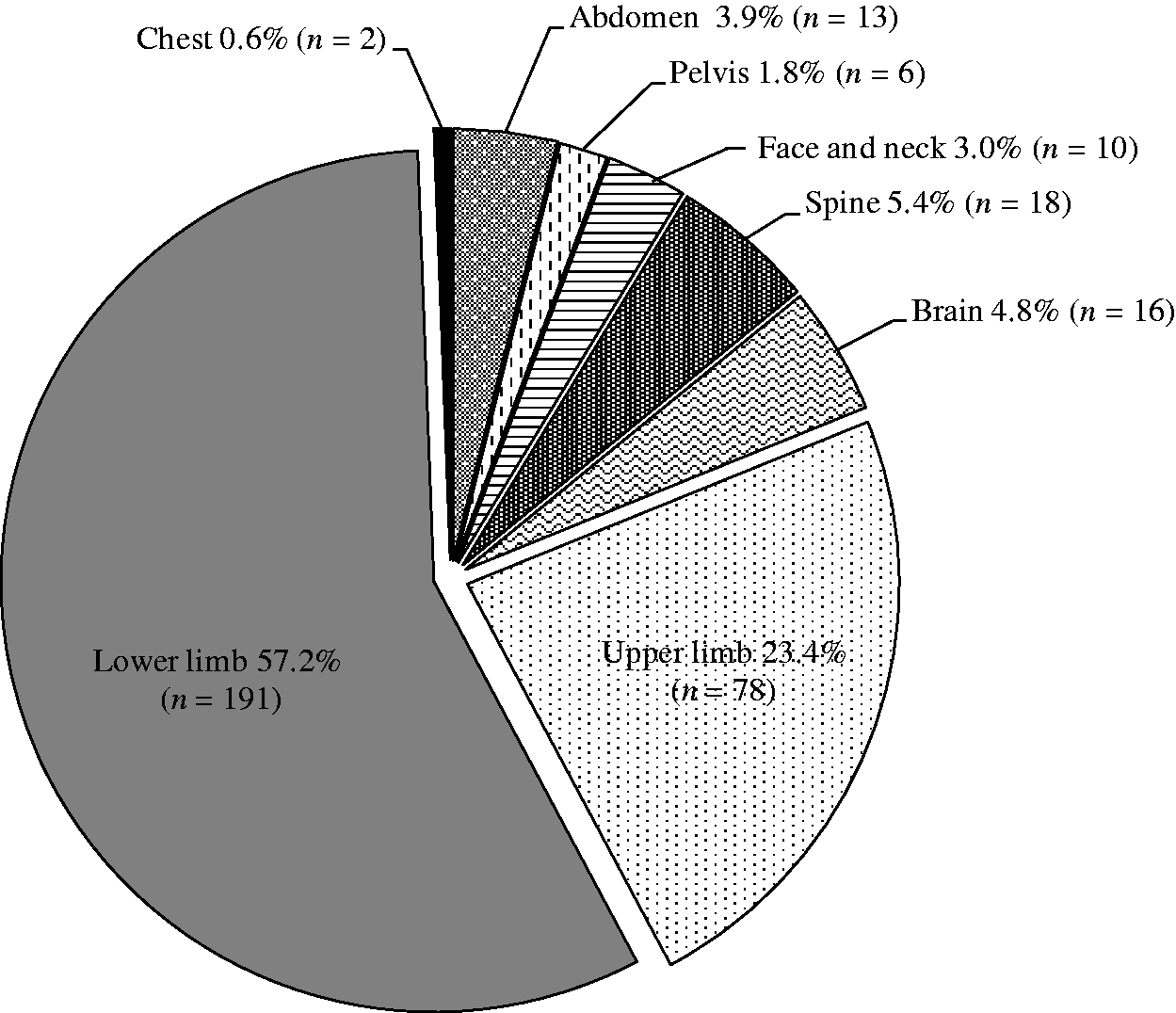
The CHAID classification tree analysis showed that all participants were initially split based on the wound type; hence, wound type was the most important influencing factor with regard to the subsequent development of disability (Figure 2). Patients with an open wound were at a higher risk of disability than those patients with closed wounds. Preoperative haemoglobin level was another important influencing factor, particularly when the haemoglobin level was very low. When preoperative haemoglobin was <86.0 g/l (node 3), 68.6% of the patients developed disability. The time interval between injury and treatment was also an important variable for the development of disability. When the time interval was <21.6 h (node 10), few patients (4.8%) became disabled, but if the time interval was >54.7 h (node 12), nearly half of the patients (48.6%) became disabled. The CHAID classification tree also showed that children (≤17 years) were more likely to suffer from disability than adults. As nodes 8 and 9 showed, when the preoperative haemoglobin level was between 86.0 g/l and 107.0 g/l, the rate of the disability in children was nearly twice as high as in adults (59.1% versus 33.3%, respectively).
A chi-squared automatic interaction detection classification tree analysis to identify the factors related to the development of long-term disability in patients (n = 334) who were admitted and underwent surgical treatment for earthquake-related injuries following the Wenchuan earthquake.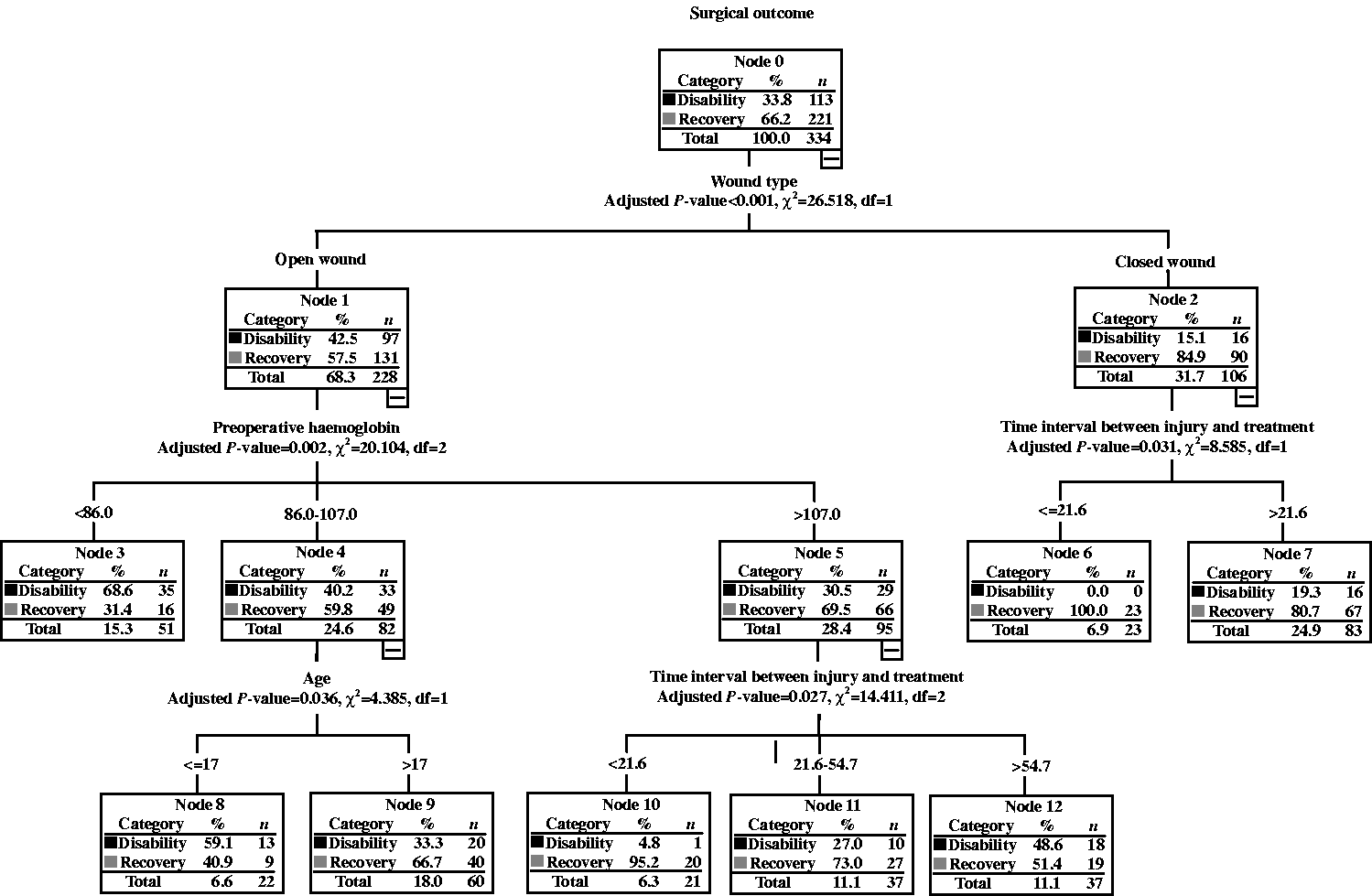
Discussion
The CHAID classification tree analysis undertaken in this current study demonstrated that patients with open wounds were at a relatively high risk of disability: (i) when their preoperative haemoglobin level was very low (<86.0 g/l); (ii) when the haemoglobin level of was low (86.0 g/l – 107.0 g/l) in children (≤17 years); and (iii) when their haemoglobin level was not low (>107.0 g/l), but when the time interval between injury and treatment was long (>54.7 h).
The warning period for onset of an earthquake is limited, so it is hard to completely avoid injuries and loss of life. 12 Although some injuries can be successfully treated by surgical procedures, poor results, especially disabilities, are often reported after earthquakes.13–16 However, it remains unclear what the important factors are that may affect the risk of developing injury-related disability. Identification of these influencing factors is needed to improve the management of earthquake-related injuries and reduce disabilities. This is of particular concern in developing countries, especially in Asia where most earthquakes strike densely populated areas. 17
A devastating earthquake may cause massive destruction of roads and basic facilities, so victims often fail to have access to timely and effective medical attention, which may further exacerbate their injuries. In this present study, the interval between injury time and treatment time were closely related to clinical outcome. When the time interval was >2 days, the rate of disability was much higher than when the time interval was <1 day. This indicates that treatment delay is associated with a higher risk of disability. Therefore, timely emergency treatment of the critically injured patient is essential to reduce disabilities. 18
Wound type was identified as the most important influencing factor for predicting disability in this present study. Injured patients with open wounds were more likely to become disabled than those with closed wounds. The reason may be that the injured patient with an open wound has the potential for the development of serious bacterial wound infections and tissue necrosis, which would contribute to the disability. 19 In the Department of Laboratory Medicine of West China Hospital, Gram-negative bacilli were cultured from 71.3% and Gram-positive bacilli were cultured from 18.9% of the open wounds. 20 This indicates that injured patients should first be treated with preliminary wound debridement in the earthquake field, and then sent to hospital for further treatment. This strategy may help to prevent future disability.
In this present study, patients with a lower preoperative haemoglobin level were at a higher risk of disability, especially for patients with an open wound and a haemoglobin level <86.0 g/l. This indicates that injuries related to internal and external bleeding have an important influence on patient recovery. Excessive bleeding has in some cases been reported to result in death or permanent disability. 21 The reason might also be that excessive bleeding might weaken the immune system, which may exacerbate wound infection. 22 Another reason is that lower haemoglobin levels decrease the oxygen-carrying capacity of the blood, reducing tissue oxygenation. In this hypoxic state, patients might suffer from tissue necrosis leading to permanent disability. 23 Therefore, control of bleeding is necessary for proper wound management.
These current results also suggest that children were more likely to develop disability after an earthquake, which was consistent with a previous study. 24 Because of their limited ability to react to emergencies and their weaker physical resistance, children were easily buried underneath collapsible debris, which exacerbated their injuries, making them too severe and complex to fully recover from. It has been reported that very young children have a relatively lower resilience to injury and a lower ability to take proactive actions to cope with post-disaster conditions. 25 For this vulnerable population, timely treatment and special medical care should be provided. In terms of injury prevention measures, this may reflect the fact that at the time of an earthquake, children usually do not have enough knowledge to seek safe places to shelter. Future education for school-age children regarding basic safety behaviour during an earthquake may reduce the likelihood of disability within this group.
In conclusion, the present study used a CHAID classification tree analysis to comprehensively explore the influencing factors for the development of disability among patients injured in an earthquake, and it identified those patient groups that are at a high risk of developing permanent disability. In terms of available medical resources and the likelihood of providing timely treatment for large numbers of injured patients, this study can help to stratify patients according to their medical needs, and to help allocate resources in a manner ensuring the greatest health benefit for the greatest number of injured patients.
Footnotes
Declaration of conflicting interest
The authors declare that there are no conflicts of interest.
Funding
This research received no specific grant from any funding agency in the public, commercial or not-for-profit sectors.