



Abstract
At the U.S. Department of Commerce, the National Oceanic and Atmospheric Administration's (NOAA) Climate and Adaptation Partnerships (CAP) Program and the National Institute of Standards and Technology's (NIST) Community Resilience Program (CRP) collaborate on a portfolio of research projects, across national and regional scales that explore small- and medium-sized business (SMB) disruption and resilience to complex climate events. Some of the most significant costs associated with the impact of weather and climate disasters stem from disruptions experienced by SMBs, but the full extent of immediate and downstream impacts on communities can only be fully understood over time. The NOAA-NIST portfolio of projects uses social science framing to bridge federal research priorities that typically orient around specific hazards and risks, with sector-specific (i.e. SMBs) climate change resilience needs. This approach lends itself to a deeper understanding of complex climate events by focusing on cascading and compound events, including both acute and chronic exposures, as well as the broader social structures that formulate a variety of socio-economic stressors and that can exacerbate both vulnerability to impacts and recovery potential over time. In this commentary, we describe the development of the research portfolio and highlight the importance of the complex event framework and cross-agency cooperation in the federal approach to understanding and addressing climate change. This approach moves beyond considerations relevant to discrete risk types or events, to uncover the social and sectoral spaces in which conditions for impacts and recovery are formed and realized across multiple geographies and over time. Understanding the formulation of complex events, and in this demonstrative case how SMB operators across communities learn about and implement resilience measures, is key for effective and equitable climate services and building community resilience.
Introduction
Federal interagency coordination and investments around risks of, resilience to, and recovery from extreme weather events and climate change often organize around discreet hazards or risk types (e.g. floods, hurricanes, and droughts). Take for example the report “Opportunities for Expanding and Improving Climate Information and Services for the Public,” which serves as a response to Executive Order 14008 “Tackling the Climate Crisis at Home and Abroad” section 211d. In this report, the first recommendation is to “Focus climate services on the challenges that pose the greatest risks and opportunities to society” (OSTP, NOAA, FEMA 2021, 11). The documented risks include drought, flooding, coastal resilience, extreme heat, and wildfires. These concentrations led to the creation of affiliated Interagency Working Groups that would coordinate directly around improved understanding and response to these risks. A risk-based framing is a useful organizing approach to align warning and assessment services, and improve related forecasts and predictions intended to communicate hazard characteristics to affected populations. However, the ways in which a community experiences and is impacted by exposure to these risks is complex, and as research shows, can result from multiple hazards (i.e. compound, interacting, interconnected, and cascading risks) stemming from physical, biological, and human drivers, and is often exacerbated by human choice (e.g. building in a floodplain) and social and economic systems (Pescaroli and Alexander 2018). Complex events do not only shape disruptions, but also the potential for recovery as decision-making and actions—both financial and nonfinancial—may be bounded due to the unexpected emergence of complex events and path dependence incurred through past decision-making and circumstance (Helgeson et al. 2021b). Therefore, developing effective climate services and building resilience also requires deeper inquiry into how complex events are formulated, and specifically how risks are distributed over time, among whom, across what geographies, and what resources are available to respond to them (e.g. Bodin, Nohrstedt, and Orach 2022).
In this commentary, we document how two federal programs: (1) The National Oceanic and Atmospheric's (NOAA) Climate Adaptation Partnerships (CAP) Program, formerly the Regional Integrated Sciences and Assessments Program and (2) the National Institute of Standards and Technology's (NIST) Community Resilience Program (CRP), work together to support an ongoing and iterative research portfolio that uses a sectoral lens and a complex event framework to identify how disruptions and resilience can be understood across risk types, geographies, and time. By looking at small- and medium-sized business (SMB) disruption and resilience as an example, we argue that complex event inquiry driven by social science methods is an important addition to how the nation addresses climate change. This narrative demonstrates how these federal programs collaborate not only to leverage expertise and funding to support iterative, targeted, reactive, and applied research, but also to align regional-level and national-level research priorities with the goal of informing broader and corresponding climate services.
Mutual interests in SMBs: a partnership between two unique U.S. federal research programs
In 2020–21, there were 42 total weather and climate disasters affecting the U.S. with losses exceeding $1 billion each (NOAA National Centers for Environmental Information 2021). SMBs are a major component of the U.S. economy, and in 2019 made up 99.9% of business in the U.S. economy, employed 59 million people, and generated 44% of the economic activities (SBA 2019). For SMBs in particular, the impacts of these disasters are often amplified by persistent social stressors that may cause inequitable risk distribution across demographics and community sectors (Fairlie 2020; Helgeson et al. 2022). Yet, no program in the U.S. Federal Government is charged to systematically track how SMBs are impacted by extreme weather and climate change and how this relates to the contexts of SMBs as institutions striving towards community resilience both through the anticipation of and the actual occurrence of a complex event. There are resilience programs at relevant Federal agencies, including but not limited to the Economic Development Agency, the Small Business Administration (SBA), and the Minority Business Development Agency (MBDA); but, these programs focus primarily on reacting to the impacts of specific events on the SMBs and supporting economic development nationally, often providing resources ex-post, including direct provision of loans and technical assistance to individual SMB operators. Especially nascent in our understanding is who supports SMBs and in what form (e.g. formal or informal) support is provided across the stages of accessing, learning about, and implementing resilience measures.
In the U.S. Department of Commerce (DOC), two programs with aligning missions seeking to understand community-level impacts of climate change, across sectors, and use that information to support community-level resilience and adaptation initiatives saw an opportunity to engage on the topic of SMBs. The programs sought to demonstrate how, by considering SMB disruption, resilience, and recovery, from the perspective of operators, they might also be able to demonstrate how a complex event framework could support federal initiatives for addressing climate change adaptation. The DOC's mission and strategic goals are to support equitable economic growth, address the climate crisis, and expand knowledge of how best to address them through data and analysis (U.S. DOC 2022) As programs in the DOC focused on research with potential for informing decision-making, specifically in the context of climate adaptation and resilience capacity, disruptions to SMBs due to extreme weather events and climate change have resonance across the department. SMB disruptions have implications for the local and national economy, and are critical to community wellbeing, worker health, and safety, as well as trade and logistics that go beyond borders.
Although separate programs in different agencies, NOAA's CAP and NIST's CRP drew on their extensive experiences and investments in community-level knowledge of the variety of impacts of extreme weather and climate change to jointly pursue a portfolio of projects that would both create new knowledge of SMB disruption and resilience, but would also offer alternative approaches for considering complex events in the federal approach to climate science and services. CAP is an applied research and engagement program that expands society’s regional capacity to adapt to climate impacts in the U.S. The program supports sustained, collaborative relationships between decision-makers and scientists that help communities build lasting and equitable climate resilience. Currently, the program has twelve, regionally focused, place-based, and interdisciplinary teams engaged in a variety of co-developed activities with communities that touch on a wide variety of sectoral and topical issues. CAP values long-term engagement and trust in the regions where teams are based, acting as boundary organizations (Kirchhoff, Esselman, and Brown 2015) to support the relationships and efforts that lead to impactful climate action. CRP conducts research relevant to developing science-based tools and metrics to support and measure resilience at the community scale and support economic evaluation of alternative solutions to improve resilience. The program engages community resilience stakeholders for input and feedback on products, such as guidance, tools, and metrics, for planning and implementing resilience measures. CRP works closely with NIST's Applied Economics Office to develop survey instruments and other guidance to develop economics-based tools to help community stakeholders track and value potential resilience-enhancing policies and projects.
Researchers and program managers in CAP and CRP questioned how SMBs vulnerable to climate change would fare under complex event situations; in particular, are there characteristics or circumstances that may indicate which business operators would fare better and why? As social and interdisciplinary scientists, disciplinary minorities in heavily physical science agencies, choosing a resonate sector like SMBs was imperative to demonstrating why an approach of starting from the sectoral risks, and not the climatic risks or the areas of its geographic impact, is a worthwhile venture. Additionally, the experiences of SMBs offer a clear opportunity to demonstrate how complex disasters are experienced, and the importance of longitudinal research in developing understandings not only of impacts, but also possible solutions, including instances where actions taken to adapt to changing climate could coincide with broader interests of SMBs. CAP and CRP aligned their common interests and leveraged their strengths to ask a set of coordinated questions and collaborate on a set of research projects to meet an explicit need for understanding SMBs resilience to complex events where critical gaps exist.
Considerations for developing a portfolio of longitudinal research on SMB disruption and resilience to complex climate events
Within the risk-based framing, estimates of extreme weather events and climate change impacts are most often associated with singular acute events, like a hurricane, or ongoing persistent events, like a drought or sea level rise. Economic functions are typically reported at a high-level, related to these types of events, and as direct losses. Capturing indirect and longer-term impacts is difficult, particularly those that are amplified through complex events. The portfolio was developed to consider three primary issues defined in the social science literature related to SMB disruption, resilience, and recovery as guidelines for projects: (1) the importance of cascading and compounding events as well as distributed risks for shaping vulnerability and resilience knowledge and actions, (2) the need for assessing recovery from a long-term and holistic perspective, and (3) the role community relationships and social structures play in how SMBs operators access resources, and fare before and after a disaster.
First, frameworks that assess each hazard event or risk type singularly and do not accommodate complexity caused by multiple disasters with cascading and compounding impacts and pre-existing social stressors, yield unidimensional understanding of barriers to resilience. As a result, accompanying policy recommendations take a siloed view and miss key interconnections (Schweizer 2021). Furthermore, while such knowledge offers a big-picture understanding of overall loss, it does not differentiate how these impacts are experienced within communities, or what happens during the often long community recovery process (Xiao et al. 2022). Patterns of inequality between and within communities point to distributed risks, variable access to resources and funding, and vulnerabilities leading to increased damage costs (Cutter, Boruff, and Lynn Shirley 2003; Runyan 2006). Few studies have looked specifically at the impacts of complex climate and weather disasters on long-term recovery with a longitudinal methodology which takes into account the inequitable distributions of risk and resilience across communities and populations; although there are notable exceptions (e.g. Helgeson, Hamideh, and Sutley 2021c; van de Lindt et al. 2020). We strove to ensure that projects within this portfolio looked at SMB disruptions in areas prone to recurrent disasters and there was appropriate research and community support to provide an opportunity for long-term assessment and retrospective. Additionally, we wanted to frame projects in a way that socio-economic factors could be thoroughly considered in our understanding of differences in how those disruptions and subsequent recovery were experienced.
Second, a focus on recovery is often too short-term for gaining insight into the multiple social conditions that impact resilience capacity. Studies that look at short-term business outcomes following a disaster event (i.e. less than 1.5 years post-event) tend to frame the research around recovery. But they often do not garner data relevant to assessing the full picture of disaster impact and interruption over time, as well as the extent to which preparedness and other SMB characteristics truly influence the larger community's path toward longitudinal recovery (Marshall and Schrank 2014; Webb, Tierney, and Dahlhamer 2000). Business characteristics often are included but are rarely holistically covered in a single data collection instrument. These tend to include the size of a business, owner/operator characteristics, sector; pre-event conditions of the business and the regional economy; attachment to place, and business age. (For a more complete review of the collection and use of control variables in SMB research, see Helgeson et al. 2020a, 2021b). Previous research shows that the significance of attributes or variables can change through time for business reopening and recovery (e.g. Lam et al. 2009; Lee 2019). Businesses can close and reopen multiple times during their recovery trajectory (e.g. Marshall and Schrank 2014; Webb, Tierney, and Dahlhamer 2000), which can affect the validity of data collected and modeled to help provide policy-relevant recommendations. There is increasing awareness of the need for longitudinal business studies that are couched within the context of household and community resilience (e.g. Watson et al. 2020). We ensured that we were able to track SMBs over time as well as learn about how past events influence future actions. We also wanted to understand how people came to know about and have the motivation or means to pursue resilience approaches and what mechanisms helped or hindered their implementation.
Third, community relations and the social structure in which SMB operators are embedded, not only influence decision-making under uncertainty, but also shape the extent to which losses are incurred (and/ or reduced). These relationships and social structures perpetuate vulnerabilities that limit the decision sets available to SMB operators seeking to manage current and future disruptive events, especially when they are complex in nature (Marshall et al. 2015; Torres, Marshall, and Sydnor 2019). A better understanding of the needs and decision processes of this stakeholder group can help improve their resilience as well as that of the community as a whole, as businesses, especially locally owned small businesses, are integral parts of their communities (e.g. Davis Pierel, Helgeson, and Dow 2021; Grimm 2014; Xiao and Van Zandt 2012). Assessment of SMB disaster resilience and recovery that specifically addresses the benefits of a wider context including long-term adaptation and pre-disaster planning is needed to develop innovative programming, locally and nationally, for SMB operators. We prioritized activities that would draw out information on social and economic networks and the ways they relate to SMB disruption, resilience, and recovery over time.
With these considerations in mind, a portfolio of research projects emerged which leveraged the strengths and existing infrastructures of both programs. These projects work cohesively and iteratively to address the issues above, across both national and local scales, in order to contribute to the applied research needs for SMBs, while also demonstrating how a complex event framework can generate useful and usable data for building national resilience to climate change over the long term. The three primary activities of the portfolio are listed here, and described in detail below:
Regional Comparative Case Studies National Longitudinal Survey Regional Research on Complex Disruption
Additionally, project researchers from across all three activity areas participate in a Community of Practice (CoP) in which peer-to-peer learning and opportunities to communicate with relevant agencies and organizations, offers a space to share priorities, methodologies, and interests to further refine projects to be impactful at both local and federal scales (Figure 1).
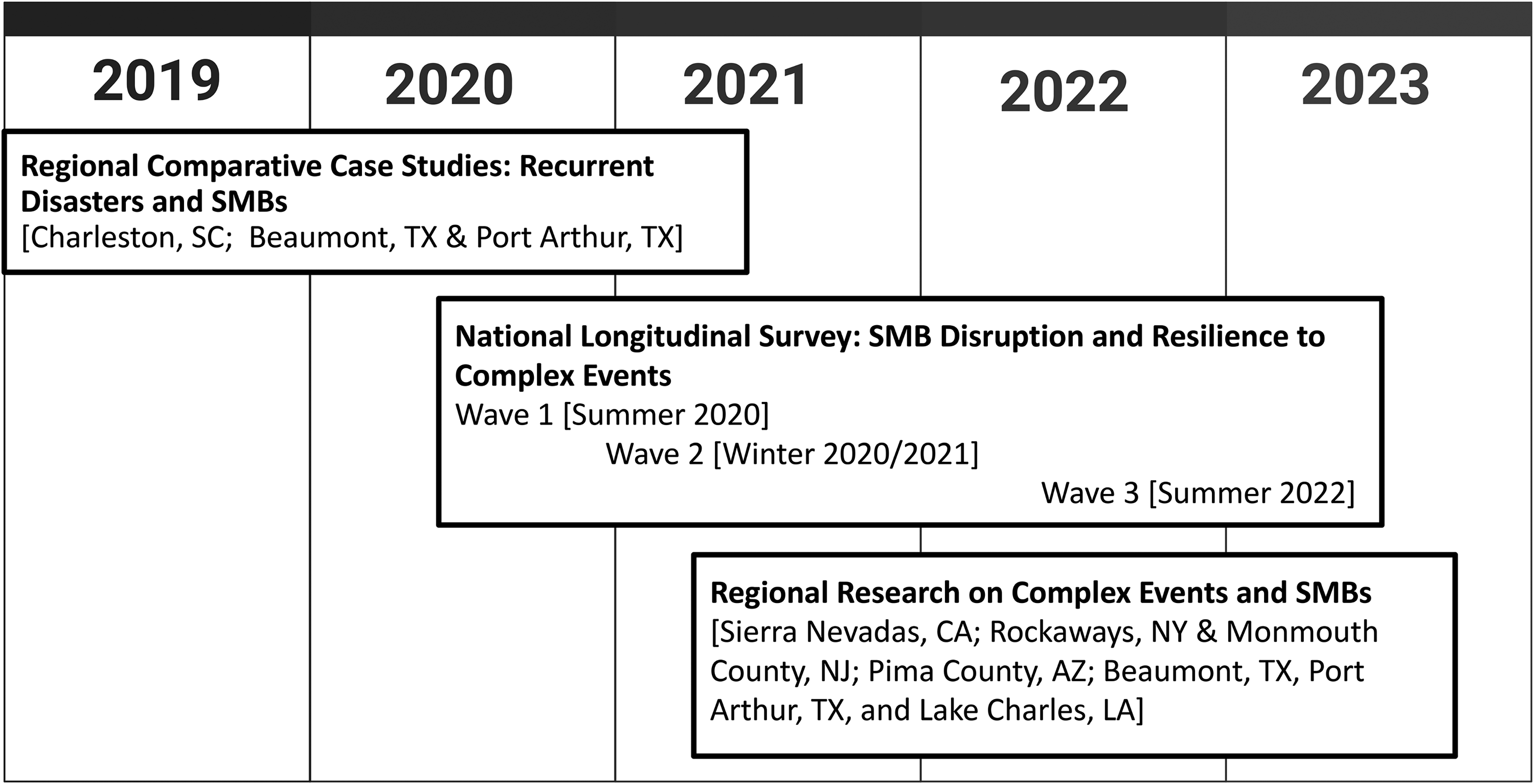
Timeline of small- and medium-sized business (SMB) portfolio projects.
Regional comparative case studies
The first portfolio activity (2019–2021) aimed to demonstrate the types of outcomes a sectoral research agenda could generate for understanding the impacts of climate change, in areas with recurring events. The programs supported two case studies that generated comparable data across sites vulnerable to the same type of complex risks, particularly those from cascading and compounding events (i.e. flooding and hurricane impacts in coastal areas), following Hurricane Irma in the greater Charleston, SC area (Helgeson, Pierel, and Dow 2020c) and Hurricane Harvey in Port Arthur and Beaumont, TX (Meyer, Semien, and Helgeson 2021). CRP and CAP researchers from the Carolinas Integrated Science and Assessments (CISA) team and the Southern Climate Impacts Planning Program (SCIPP) team collaborated on survey design, bringing nationally oriented inquiry together with regionally and locally relevant questions. The survey instrument was altered slightly to address place-based and event-based differences (Rathje et al. 2020).
The case studies found that, among SMBs, past experiences with natural hazards and disasters lead to better preparation for a variety of other disasters (Davis Pierel, Helgeson, and Dow 2021; Helgeson, Pierel, and Dow 2020c). And similarly, pre-event mitigation and planning leads to more successful recovery (Helgeson, Pierel, and Dow 2020c; Meyer, Semien, and Helgeson 2021). On a more local level with implications nationally, the project in Port Arthur and Beaumont, TX found that minority-run organizations experience both more damages on average than those operated by non-minorities, and they also recover to a lesser degree (Meyer, Semien, and Helgeson 2021). The Charleston, SC project demonstrated that community networks provide important support for resilience and recovery for SMBs (Davis Pierel, Helgeson, and Dow 2021).
National longitudinal survey
In the midst of the regional comparative case study effort, the COVID-19 pandemic brought active place-based research across the projects to a halt and preempted the start of other planned case studies. However, the impacts of the pandemic on SMBs became national news, as businesses and customers were deeply affected, some found novel ways to keep operations afloat, and SBA provided financial support in new and rapid ways. With the start of hurricane season approaching, a second portfolio activity was developed to understand how the impacts of extreme weather events and climate change would compound with the impacts of the pandemic, and whether or not resilience efforts from either type of disaster would have positive effects in more complex disaster settings. To capture this ephemeral data on SMB disruption and complex events at the national level, a federally administered survey was developed to look at the experiences of SMBs across the U.S. The survey built on the sectoral focus on the case studies, and their methods including survey design, initial findings, and lessons learned. Additionally, to further refine the survey and ensure its relevance to those that might use its outcomes, CRP and CAP held discussions with other agencies and organizations including SBA, MBDA, the Chamber of Commerce Foundation, as well as other NOAA programs (including the Weather-Ready Nation and Sea Grant). The survey was designed in three waves to capture the longitudinal impacts, resilience capacity, and recovery trajectory of SMBs over a two-to-three-year period. The first survey (1300+ responses) was released in the summer of 2020 (Helgeson et al. 2020a, 2020b). The second in the winter of 2020/21 (Helgeson et al. 2021a) in two parts (2500+ respondents) with original respondents from wave one in one cohort and a slightly different survey version captured survey data from a refreshment sample of new respondents. The third wave began in the summer of 2022 and includes the use of new methods for understanding SMBs’ resilience to complex events, including concept mapping and more in-depth qualitative methods for a smaller subset of the original sample frame (Helgeson et al. 2021a).
The federal effort aims to capture information over time including past impacts of climate and weather disasters, resilience efforts, impacts of COVID-19, access to resilience and recovery resources, and the current state of the business. One primary question we addressed was the extent to which learning and preparing for past extreme weather or climatic events informs the actions of a business surviving COVID-19, and whether SMB operators feel that COVID-19 was going to derail their resilience plans for any natural hazards in the future. Additionally, the effort captured information on resilience innovation in COVID-19 that might be useful in a future extreme weather or climatic event situation. The surveys captured differences across regions, risk types, as well as different types of business operators (e.g. women, minorities, and veterans).
Early outcomes from the first round of data collection demonstrate that business operators from historically underrepresented groups (i.e. minority, women, and veteran-owned businesses) see largely amplified negative impacts from COVID-19 that far outweigh the compound impact of both an extreme weather or climatic event and COVID-19 felt by businesses operated by non-historically underrepresented (Helgeson et al. 2022). When compounded, hit by an extreme weather or climatic event in addition to COVID-19, a minority-owned business is 67% more likely to stop operations altogether than their majority counterparts and will experience an 18% decline in revenue (ibid). These results point to pre-existing inequalities heavily influencing both resilience capacity and recovery options. Furthermore, these results demonstrate that the distribution of risk is experienced across risk types. Through a sectoral approach, we are able to consider the extent to which complex events shape how any singular type or risk is experienced. The outcome of this knowledge is that some forms of resilience building should be considered that do not focus solely on the specific risk type, but instead focus on the social and economic conditions that create inequities across those various risks.
Regional research on complex disruptions
The third activity, a set of four place-based collaborative research projects (ongoing at the time of publication), aims to complement the national survey by bridging national-level patterns with local-level realities. National-level data collected in the first two waves pointed to broad trends in SMB actions, but place-based projects can point to larger patterns of community resilience, and the associated “why.” To do so, these projects supplement existing CAP initiatives, building on their sustained presence in a region as boundary organizations and the long-term trusted relationships between CAP regional teams and local SMB partners. The projects focus on four primary and overlapping themes related to SMBs; (1) equity and diversity in access to resources, (2) acute and chronic impacts of complex disasters, (3) adaptation and resilience measures over a variety of time scales, organization types, and geographies, and (4) patterns and opportunities for learning and planning for resilience.
These projects aim to produce relevant and usable research to support SMBs in evaluating options for risk reduction and resilience to complex events within their local economies. This information is vital to tailor resources for SMB operators that truly support their efforts to build resilience in ways that are relevant and implementable given the complexities and range of potential risks and impacts they face. Partners include policy-makers, commerce and business development organizations, disaster recovery and climate adaptation-focused entities, and SMB operators and representative organizations. For example, one project in the Sierra Nevada region, led by the California-Nevada Applications Program (CNAP), is partnering with the Sierra Business Council to identify the key resilience capabilities and conditions that enable SMB recovery under the compound events of recurrent wildfires, smoke, and COVID-19. 1
Early outcomes from the four projects, shared through the CoP, point to continuous struggles SMB operators have to find the resources—time, money, and expertise—to invest in resilience efforts. Additionally, findings suggest that resilience efforts are often not tied to risks of exposure to climate change specifically, but instead often connect to the general operations and economic wellbeing of the business itself and can include anything from the health and safety of employees and a rainy day fund to electronic records and enhanced cyber security.
Concluding thoughts
The uncertain realities and diffuse nature of risks and vulnerabilities faced by SMB operators navigating recovery from complex disasters across geographies and despite discreet risk types is a strong demonstration case for why and how a sectoral approach to understanding complex events over long-time frames are important to understanding risks of climate change and creating effective climate services. There is no doubt that there is a need to understand the impacts and potential responses to particular extreme weather and climatic risks and events. Yet as these events become increasingly complex in nature, there is also a need to understand how disruptions relate to each other over time and interact across weather and climate event risk types, other disruptions types (e.g. pandemics), and social stressors. This type of work can improve knowledge for prediction and forecasting, emergency response, and developing plans for adaptation; ultimately providing a critical bridge between applied research and governance. In tandem with the complex event framework, there is a need to think about how different sectors, demographic groups, and other non-geographically bound groups might share some impacts of climate change, despite differences in the risk type or location. This work provides critical insights into how impacts are created and experienced.
To this end, the NOAA-NIST SMB portfolio demonstrates how the federal research enterprise may conduct and include applied sector-specific research that relies on social science, and points to the importance of a complex event framework. The issues faced by SMB operators remain a critical one that is especially well suited for such a portfolio approach. The work presented here and similar efforts can improve analysis important to policy development designed to link resilience to extreme weather and climate change, as well as generalized resilience planning to improve socioeconomic success for SMBs. As the projects in this portfolio move into the final stages of research, analysis, and dissemination, it will be crucial to show how outcomes contribute to national priorities related to the contributions of climate readiness to economic growth as well as local and sub-sector resilience planning.
Finally, this portfolio is particularly unique in that it leverages the strengths of federal agencies to go beyond the capacity of either agency in isolation and to help inform potential policies in agencies that specialize in SMB assistance, but do not have the same research capacity or climate expertise. Throughout the ongoing process of developing, managing, and participating in this portfolio of projects, engagement with agencies and organizations at the local and federal levels broadens and deepens the scope of knowledge to design and communicate applied research. Moving forward, there is a need for this type of partnership among agencies, community stakeholders, and local organizations, across a variety of sectors impacted by climate change, to support a complex event framework that can address existing shortcomings in current technical support for equitable and long-lasting community resilience planning and action.
Footnotes
Acknowledgements
We would like to thank Claudia Nierenberg for her support and helpful feedback on this commentary, the CAP researchers for their ongoing participation in this portfolio of work, as well as the two reviewers and editors of this special issue for their constructive comments and suggestions. The scientific results and conclusions, as well as any views or opinions expressed herein, are those of the authors and do not necessarily reflect the views of NOAA, NIST, or the Department of Commerce.
Declaration of conflicting interests
The author(s) declared no potential conflicts of interest with respect to the research, authorship, and/or publication of this article.
Funding
The author(s) received no financial support for the research, authorship, and/or publication of this article.