




Abstract
Owls hold significant utilitarian and aesthetic values for humans, ranging from pest control to ecotourism. However, cultural beliefs rooted in negative perceptions and emotions have led to conflicts and threats to many owl species. In South America, research on the relationship between owls and people is limited. This study aims to identify the variables involved in the construction of social knowledge, perceptions, and emotions toward owls. Face-to-face questionnaires were administered to residents in southern Ecuador. The data were analyzed using decision trees, a novel approach in ethnobiology. The results indicate that participants exhibited accurate knowledge of owl diet and habitat, with a majority having previous owl sightings and familiarity with their vocalizations. These factors, along with the sources informing their knowledge (such as school and family), contribute to the development of neutral perceptions and emotions toward these birds. The majority of participants recognize the importance of owls for the environment and support their conservation, with these two variables playing a crucial role in shaping positive emotions. Additionally, perceptions and emotions are primarily influenced by the region of residence. The presented data provide valuable insights into the significance of social perceptions and emotions in designing strategies to mitigate intentional owl mortality and persecution resulting from misconceptions and misperceptions.
Introduction
Owls (Order Strigiformes) are mostly nocturnal raptors grouped into two families: Tytonidae, with 18 species, and Strigidae, with 228 species (Clements et al. 2022). Owls are key elements in ecosystems, since they are top predators that prey upon a wide range of small invertebrates to midsized vertebrates (König and Weick 2008). Owls have utilitarian values in traditional medicine (Austin 1948, Gore and Won 1971) and witchcraft (Cocker and Mikkola 2001, Nyirenda et al. 2017). Further, examples of successful use of owls as rodent pest controllers exist (Figueroa and Alvarado 2012, Molares and Gurovich 2018), and as icons for education and environmental awareness campaigns (Molares and Gurovich 2018). In terms of aesthetics and culture, owls are popular among birdwatchers and are often key elements in recreation and ecotourism programs that promote their observation (Chelsie 2012). They are also recurrent elements in popular culture including films (Nijman and Nekaris 2017, Megias et al. 2017). Historically, they have had symbolic values for several cultures and societies worldwide (Marcot and Johnson 2003, König, Weick and Becking 2008, Morris 2009).
Despite their ecological and cultural importance, owls face a number of anthropogenic threats (Lewis and Maslin 2015). The most relevant causes of population declines are natural habitat degradation and loss, pollution and poisoning by pesticides, illegal wildlife trade, and collisions with infrastructure—for example, vehicles, windows, power lines, and barbwire (Restrepo and Enriquez 2014, Enríquez 2015). There is yet another complex threat that few other bird groups face: cultural beliefs. Owls exert fascination and fear among humans in different cultures worldwide, generating a great amount of superstitions associated with bad omens or luck (Enríquez and Rangel-Salazar 2004, Figueroa and Alvarado 2012, Nyirenda et al. 2017). This has led to persecution, repudiation, and intentional killings (König, Weick and Becking 2008, Molares and Gurovich 2018). Paradoxically, scientific evidence establishes that, unless directly disturbed or attacked, these birds are not a danger for people (Enríquez and Rangel-Salazar 2004, Winkler 2016).
Studies on the relationship between humans and owls are scarce, especially in the Neotropical region where the greatest diversity of Strigiformes is concentrated (Rangel-Salazar and Enríquez 2017). Research on population perceptions in Central Asian nations indicates that people hold positive perceptions of owls such as wise, helpful, or symbols of good luck (Mikkola 2020), while in Central Africa, there exists ambivalence toward these birds, as a portion of the population regards them as divinely created beings with the right to exist, while another faction perceives them as detrimental creatures that bring about misfortune and should be eradicated (Nyirenda et al. 2017). In Colombia and Costa Rica, a wide knowledge regarding owls’ species, habitat and diet exists, as well as similar positive perceptions such as beneficial or good omen (Enríquez and Rangel-Salazar 2004, Restrepo and Enriquez 2014), whereas in Chile and Argentina perceptions vary between negative and positive extremes including bad omen, diabolic, beneficial, or wise (Raimilla and Rau 2017, Molares and Gurovich 2018). Current knowledge about owls in Ecuador provides a few anecdotal observations on human perceptions, but there are no further data and no systematic research on this topic published to date (Freile et al. 2017).
Studies aforementioned use mainly descriptive statistics, such as Chi-square test, paired test, and bibliographical analysis to determine peoples’ knowledge and perceptions. These analyses have been crucial in identifying the effect of age and sex on both knowledge of owls and the way they are perceived. Nonetheless, they have limitations in fully understanding the complex interactions among variables that ultimately shape whether these perceptions are positive, negative, or even neutral.
Understanding social values, attitudes, and perceptions toward different species and the associated variables is crucial for targeted conservation and education programs (Restrepo and Enriquez 2014, Aldana-Mejía et al. 2016, Cortés-Avizanda et al. 2022), as well as political agendas oriented to this field of knowledge (Cross et al. 2013). This understanding helps identify the specific species and groups of people that should be prioritized in these initiatives. Furthermore, by identifying the factors that trigger positive attitudes toward biodiversity conservation (Cortés-Avizanda et al. 2018), we can develop effective strategies to promote conservation efforts. Previous studies have yielded substantial evidence demonstrating that perceptions of owls are influenced by inherited beliefs and enduring myths, displaying notable cultural variations across countries and regions (Benavides 2013, Vásquez–Dávila 2014). Therefore, it is essential to identify and comprehend the diverse variables that interact within distinct cultural context. Additionally, research on human emotions toward wildlife, although limited, is pertinent as emotional experiences can motivate conservation attitudes, particularly toward bird species, and may impact wildlife management techniques (Castillo-Huitrón et al. 2020).
This paper aims to investigate the factors that influence knowledge, perceptions, and emotions, pertaining to owls. Specifically, employing the decision trees analysis, we examine and document the factual knowledge, perceptions, and emotional responses of both urban and rural inhabitants in southern Ecuador. Subsequently, we aim to identify the key factors that contribute to positive, neutral, and negative perceptions and emotions. Our findings shed light on the influential role of various demographic variables in shaping these perceptions and emotions.
Study Area
Data were collected in the southern region of Ecuador, covering six cantons in the provinces of El Oro, Loja, and Zamora Chinchipe, which correspond to the three natural regions of continental Ecuador: Coast, Andes, and Amazon, respectively (Figure 1). A canton is an administrative division within a province, functioning as a smaller region with its own local government. This geographical variation makes this region appealing for contrasting the perceptions of people living in diverse places within the same region.
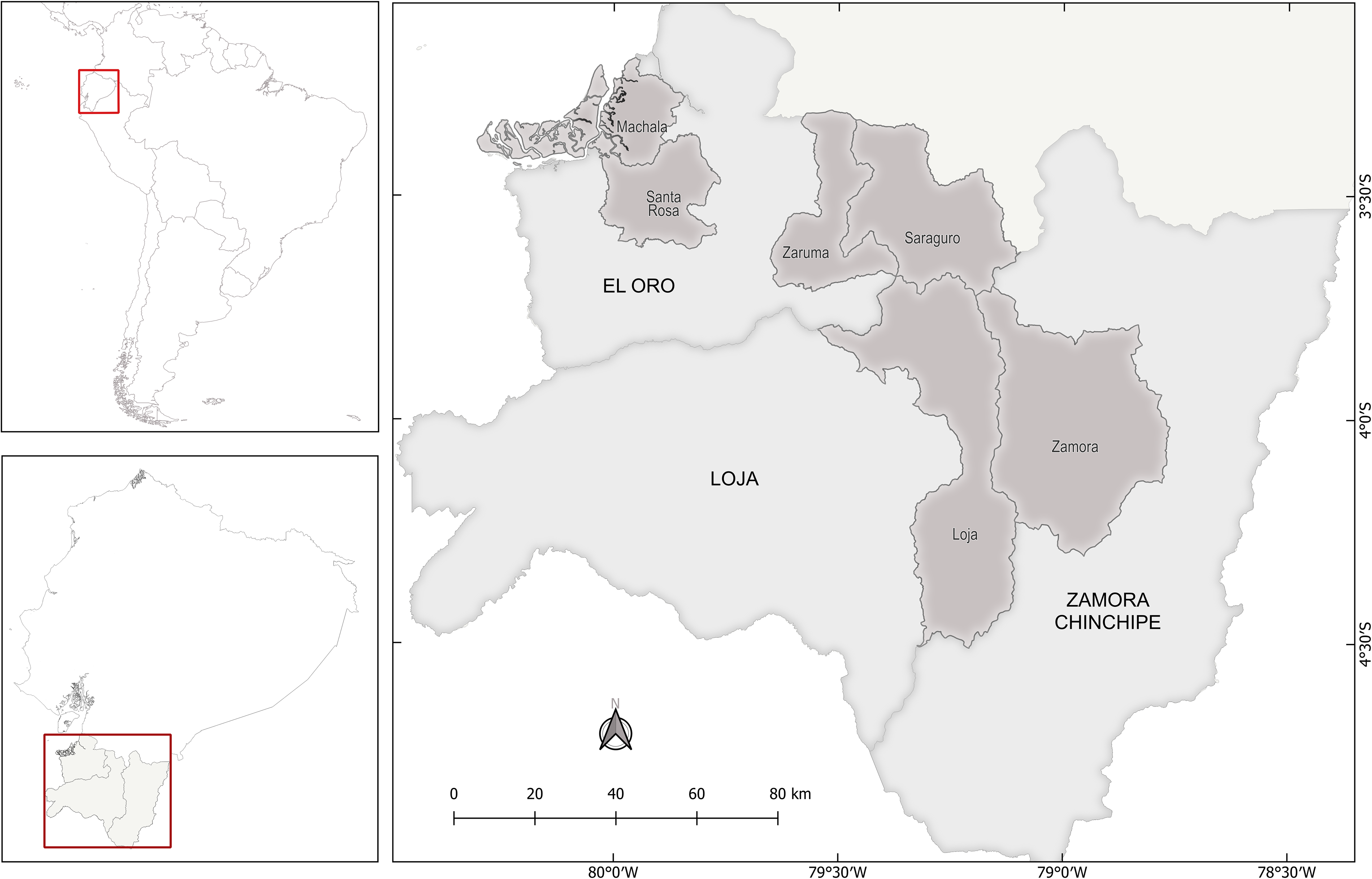
Provincial boundaries of the southern region of Ecuador. The cantons where data were collected for each province are shown in gray.
Southern Ecuador exhibits a complex climatic regime influenced by various factors such as latitude, longitude, solar radiation, atmospheric currents, land cover, and, notably, the Andes relief effect (Maldonado 2002). In this region, the Andes mountains have relatively lower altitudes (up to 3798 m) compared to the northern Andes of Ecuador. This unique topography allows for the infiltration and dispersion of both humid and dry air from the Pacific Ocean, as well as the circulation of moist air from the Amazon basin. As a result, numerous microclimates and significant temperature disparities are formed (Ordóñez-Delgado, Ramón-Vivanco and Ortiz-Chalan 2019). Our research focuses on three cantons within the province of El Oro: Machala, Santa Rosa, and Zaruma, as shown in Figure 1. Machala, characterized by altitudes ranging from 0 to 28 m asl, experiences precipitation levels between 250 and 1250 mm, with an average temperature of 24 °C. The population of Machala is approximately 289,141, primarily residing in urban areas (96%) (GAD Municipal de Machala 2019). The Canton of Santa Rosa features an altitude of 130 m asl, precipitation levels ranging from 500 to 1250 mm, and an average temperature of 24 °C. Santa Rosa has a population of around 82,171, with 77% residing in urban areas and 23% in rural areas (GAD Municipal de Santa-Rosa 2019). Zaruma, the third canton in our study, is characterized by altitudes ranging from 600 to 3771 m asl. It experiences precipitation levels between 500 and 2000 mm, with an average temperature of 22 °C. Zaruma has a population of approximately 24,389, with 41% living in urban areas and 59% in rural areas (GAD Municipal de Zaruma 2018). All three cantons are located on the southwest flank of the province. The province of El Oro is known for its extensive commerce, cattle ranching, industrial activities, and large-scale agricultural practices, particularly in banana and shrimp production. The inhabitants of this region consider themselves mestizos (GAD Provincial de El Oro 2021).
Right in the Andes, our study area encompasses the province of Loja, specifically the cantons of Loja and Saraguro. In Loja, the landscape is characterized by altitudes ranging from 1200 to 3800 m asl, mild temperatures averaging around 15 °C, and a rainfall pattern that is evenly distributed throughout the year, typically ranging from 500 to 2000 mm. However, there is a higher concentration of precipitation between January and April (Maldonado 2002). Notably, Loja plays a vital role in regional trade, serving as a crucial link between the coastal regions, the Amazon, and even northern Peru. The province thrives in agricultural and livestock production, which are among its most significant economic activities. Loja is home to a population of approximately 274,112 inhabitants, with 84% residing in urban areas and the remaining 16% in rural areas. The residents of this region identify themselves as mestizos (GAD Municipal de Loja 2021). Moving on to Saraguro, the canton is characterized by altitudes ranging from 1000 to 3800 m asl, average temperatures fluctuating between 7 and 22 °C, and a rainfall regime that follows a similar pattern of uniform distribution throughout the year, ranging from 500 to 2000 mm. Saraguro houses a population of around 33,507, with 30% living in urban areas and 70% in rural areas (GAD Municipal de Saraguro 2020). The Saraguro ethnic group constitutes the majority of the population in the Saraguro canton (Instituto Nacional de Estadísticas y Censos 2010).
In the southeastern flank, the study area includes the province of Zamora Chinchipe, specifically the canton of Zamora, where the landscape is dominated by an altitude of 815–2800 m., and the average temperature is 22°C (Maldonado 2002). Its production is predominantly agricultural, and it is one of the least populated provinces in the country. Zamora has 30,391 inhabitants with a predominantly rural population (50.3%) (GAD Provincial de Zamora Chinchipe 2019). In the urban area of this canton, the population is predominantly mestizo, whereas in the rural localities, the indigenous population (including Shuar and Saraguro) varies from 3% to 29% (Instituto Nacional de Estadísticas y Censos 2010).
Methods
Data were obtained through a structured questionnaire that drew upon prior studies by Enríquez and Rangel-Salazar (2004), Marcot and Johnson (2003) and Mikkola (2020), which was adapted to incorporate additional variables, including emotions and cultural expressions. The questionnaire was validated through a pilot study between January 2016 and November 2018 in the city of Loja. The final questionnaire was divided in five sections designed to gather demographic data, factual knowledge, perceptions, emotions, and cultural knowledge. With the aim of conducting an in-depth analysis of perceptions, a qualitative manuscript will be produced in parallel to analyze cultural knowledge, so the questions included in that section have been omitted from this paper. A total of 18 single- and multiple-choice checklist questions were used (Table 1). The questionnaire was entered into the Kobotoolbox application (www.kobotoolbox.org), with the aim of facilitating data collection by means of electronic devices and internet connection. The questionnaire was administered between February 2019 and January 2020.
Questionnaire Used to Collect Data on Owls’ Perceptions, Knowledge, and Emotions.
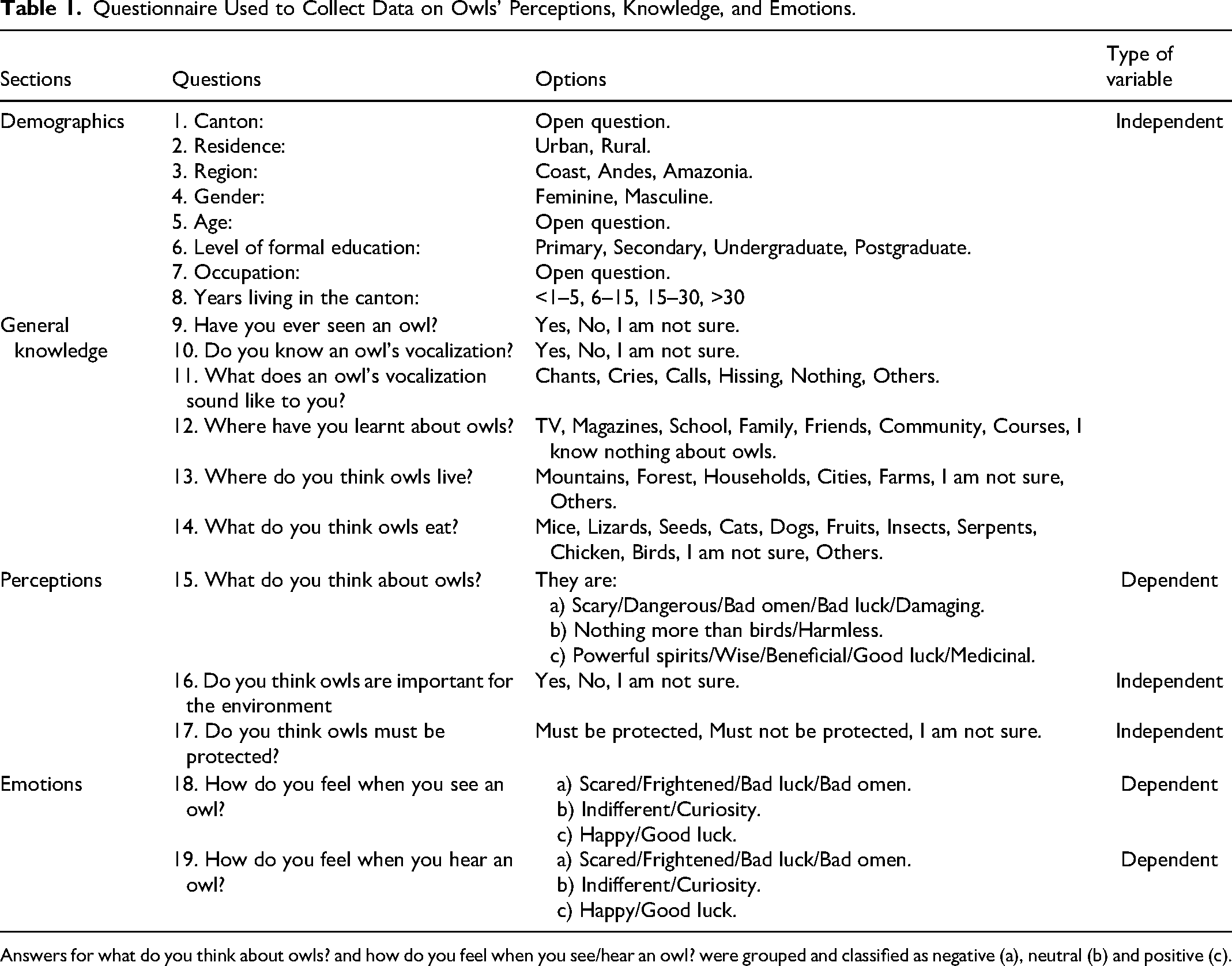
Answers for what do you think about owls? and how do you feel when you see/hear an owl? were grouped and classified as negative (a), neutral (b) and positive (c).
To enhance clarity, we distinguish between the auditory and visual identification of owls, given that humans, being diurnal creatures, typically rely on their vocalizations to detect their presence at night, making visual sightings less common (König, Weick and Becking 2008). Owls, indeed, pose a challenge for researchers due to their nocturnal behavior and cryptic traits (Goyette et al. 2011).
A minimum sample size of 384 individuals per canton was estimated in order to support inferences for the entire population. Sample size was calculated by applying the infinite population formula at a 99% confidence level and 5% error. However, the final sample size was determined in the field, having surveyed more individuals than necessary for our objectives, thus improving the representativeness of the sample and reducing sampling error. The sample size included 2173 people of different socioeconomic and demographic characteristics (Table 2), comprising 1141 respondents in El Oro, 634 in Loja, and 398 in Zamora Chinchipe. It should be noted that the population size is statistically representative for each of the provinces and for the population living in the urban and rural sector. Respondent's main demographic characteristics are available in Table 2. Please refer to Supplemental Tables, S1, S2 and S3 which provide additional data combining demographic details such as occupation, education level, and years living in the region. These tables are organized by gender, province, residence, and age.
Demographic Characteristics of Population Sampled.
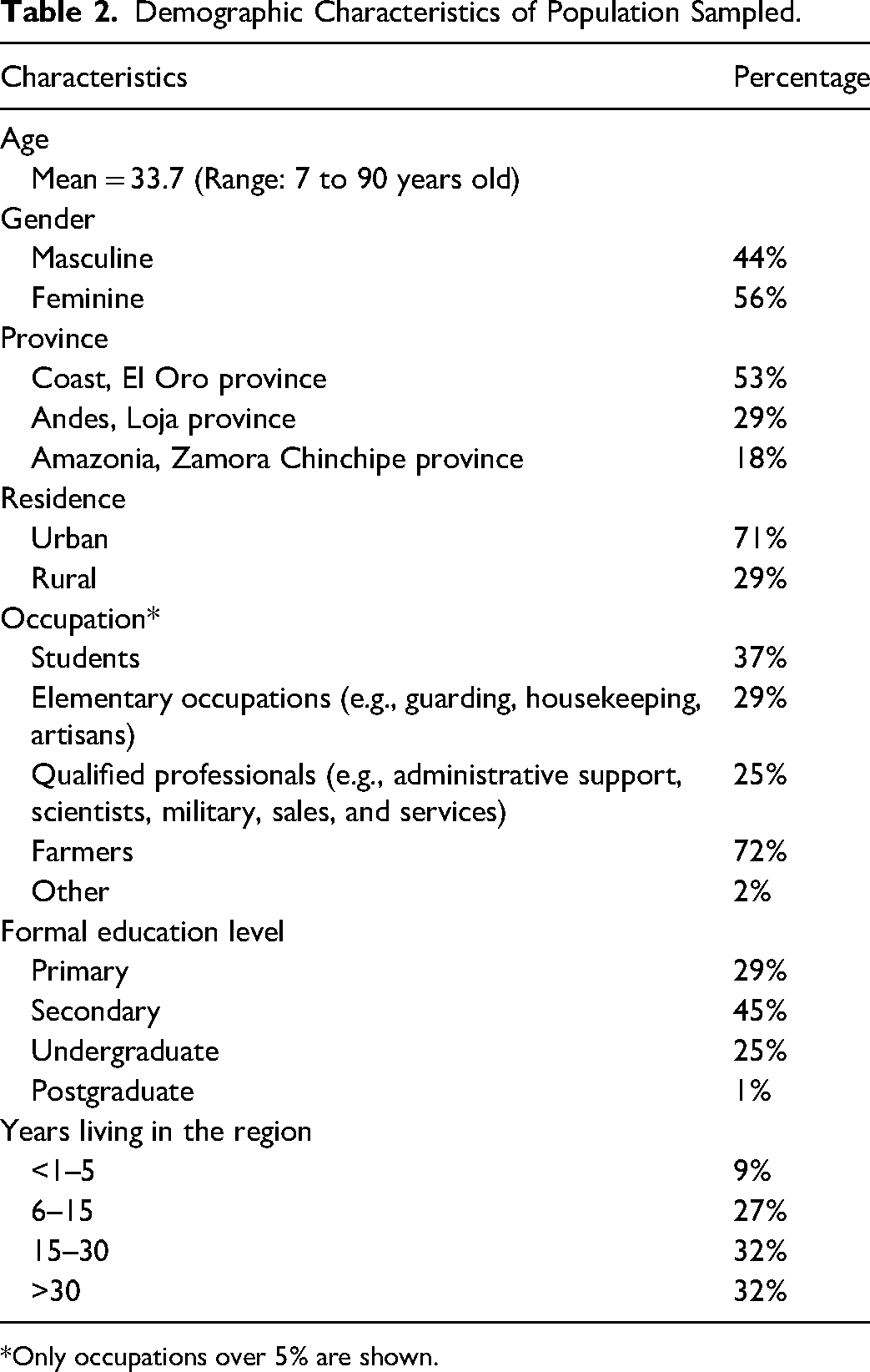
Only occupations over 5% are shown.
Through convenience sampling, members of the research team asked people passing through squares, markets, churches, and bus stations about their availability and time to participate in the study. In rural areas, the same sampling strategy was used but this time by knocking on household doors. In addition, participants from primary and secondary schools were included with the aim of increasing age range in the sample. In order to ensure representativeness of the younger sample, one primary and one secondary school were included in each region, resulting in a total of six schools (Table S4). For these later groups, a verbal permit was required which was requested and issued by school principals. Following the Ecuadorian law, Ethics Committee or Institutional Review Board approval was not required for this study. This is only required when people are researched for medical purposes or for obtaining ancestral knowledge. The research presented here looks at people's factual knowledge, perceptions, and emotions, which are not a subject for an Ethics Committee.
Participant's factual knowledge, emotions, and perceptions of owls were analyzed descriptively, to later identify the dependent and independent variables that interact in shaping participants’ perceptions and emotions (Table 1). Perception questions 16 and 17, “Do you believe owls play a significant role in the environment?” and “Do you think it is necessary to protect owls?,” were selected as independent variables based on previous research indicating that individuals’ understanding of wildlife's ecological importance has substantial emotional implications (Castillo-Huitrón et al. 2020) and influences positive attitudes (Härtel, Randler and Baur 2023). These questions exhibit conceptual coherence and align with the overall objective of the study, as well as the underlying theory concerning attitudes and perceptions toward wildlife. This was relevant in that only variables that proved to be significant were incorporated into later analyses, as follows. An exploratory data analysis was then carried out relating the independent variables to each of the dependent variables, thus identifying the percentage of each response option within each variable that expressed a particular perception or emotion. For clarification purposes, the multiple-choice variables (questions 11–14) were not incorporated in the exploratory analysis nor in the model because it required replicating each record with more than one response to obtain the response options independently.
We used decision tree models in order to identify the patterns that determine, from independent variables, the type of perceptions toward owls. The recursive partitioning algorithm of RPART package (Therneau, Atkinson and Ripley 2019) of R Studio software (R Core Team 2022) was used to build the decision tree model. This algorithm belongs to the family of classification trees and was selected for its ability to work with a large volume of information, identify independent variables that are able to explain the variability of the response variables, and ease of interpretation (Therneau, Atkinson and Ripley 2019). The algorithm works by repeated partitioning of the data into several subspaces, starting from the variable with the strongest association with the response variable, aiming for the results in each final subspace to have as little heterogeneity as possible. In order to avoid problems of overfitting, a pruning process was applied which created a tree with few divisions for an easier interpretation.
In order to identify patterns that significantly improve the overall quality of the model, the CARET package (Kuhn 2008) of R Studio software (R Core Team 2022) was used, the database was configured to calculate the optimal “max tree depth” from cross-validation with 10 subfolders and take up to 12 different tree depths data to automatically refine the model. The max tree depth is the length of the longest path from the root of the tree to a leaf. Once the optimal max tree depth was identified, the classification tree was constructed, variables of importance were identified, a confusion matrix was performed, and the kappa index was calculated to determine the agreement between the observed (dependent variable on database) and estimated values (type of emotion or perception of each record by applying the generated model). The kappa index determines the degree of agreement above chance between observed and estimated values. The kappa values were interpreted according to the scale proposed by Landis and Koch (1977): no agreement (0.00), insignificant (0.00–0.20), discrete (0.21–0.40), moderate (0.41–0.60), substantial (0.61–0.80), and almost perfect (0.81–1.00).
This type of analysis is not common in the field of ethnozoology, in particular in the analysis of the relationship between variables that shape perceptions. However, the findings indicate that this type of analysis proves highly valuable in identifying distinct patterns that characterize specific types of perceptions or emotions. For this analysis, the emotions and perceptions are categorized as negative, neutral, or positive, which may initially sacrifice the specific details of individual emotions or perceptions, such as fear or happiness, but being a large and representative sample, it facilitates the generation of robust models that exhibit clearly defined patterns for each category, enhancing the overall reliability of the findings.
Results
Public Knowledge and Perceptions of Owls
The majority of participants had seen an owl before (79%) and were familiar with their vocalizations (65%). For this latter group, owls’ vocalizations sound like nothing in particular, while for other types of participants they sound like hissing, calls, and cries (Table 3). Interestingly, regardless of the sounds participants selected, the result is consistently neutral perceptions and emotions (Table 3). Likewise, participants display a notable understanding of the habitat and diet of owls, highlighting that owls primarily feed on mice and insects, and reside in forested areas and mountains (Table 3). Similar to vocalizations, the perceptions and emotions triggered by this knowledge are neutral, with slight exceptions that exhibit negativity when they select misconceptions that owls live in households or eat cats. Furthermore, participants indicated they had learnt about owls from the family and school, with information sources consistently eliciting neutral perceptions and emotions.
Participant's Knowledge, Perception, and Emotional Responses to Owls.
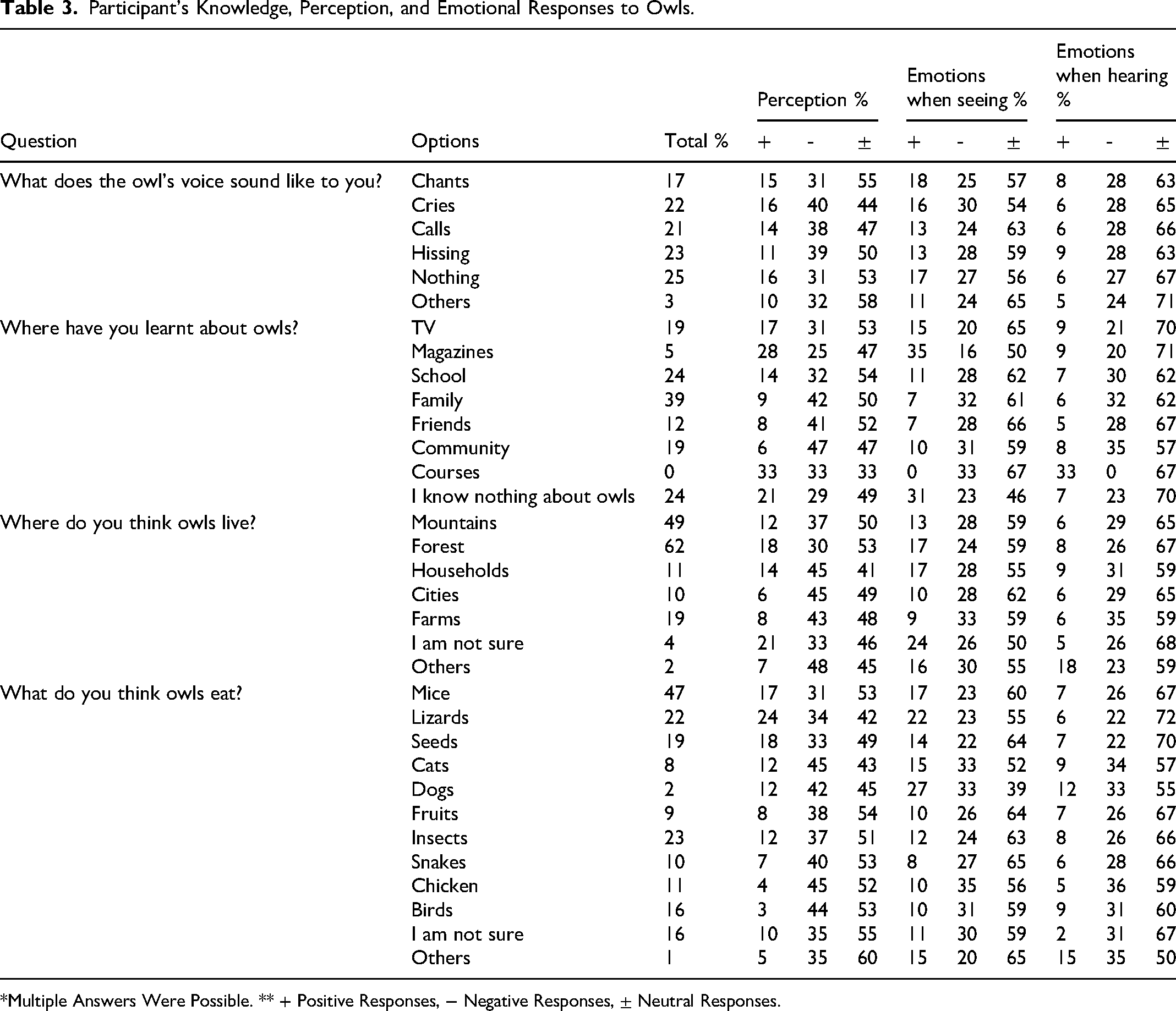
*Multiple Answers Were Possible. ** + Positive Responses, − Negative Responses, ± Neutral Responses.
Regarding participants’ perceptions, 50% tended to select neutral perceptions, 35% selected negative perceptions, and only 15% selected positive perceptions. In addition, 63% of participants perceive owls to be important for the environment, and 83% agreed that owls must be protected. The selection of these perceptions varied according to the demographic characteristics of the sample. The responses indicate that negative perceptions of owls tend to decrease among individuals residing in urban areas, specifically those living in the Amazon. This trend is also observed among males, younger individuals, those with higher education levels, students or those with professional education, recent residents of the region, individuals unfamiliar with owl vocalizations or sightings, those who recognize the importance of owls for the environment, and those who believe they should be protected. Notably, the reduction in negative perceptions is particularly evident in cases involving higher education levels, as well as when individuals acknowledge the importance of owls for the environment and advocate for their protection (Figure S1).
These results were consistent with the decision tree analysis (Figure 2), whereby the algorithm created a tree with 10 patterns that determine the perception toward owls, with region being the main variable generating such patterns. In the Coast and Andean region, the perceptions selected tended to be neutral or negative, while in the Amazon region the tendency was to select neutral or positive perceptions. The kappa coefficient was 0.26 using this model, which indicates a discrete matching between the observed and estimated data. The optimal max depth in this case was 9.
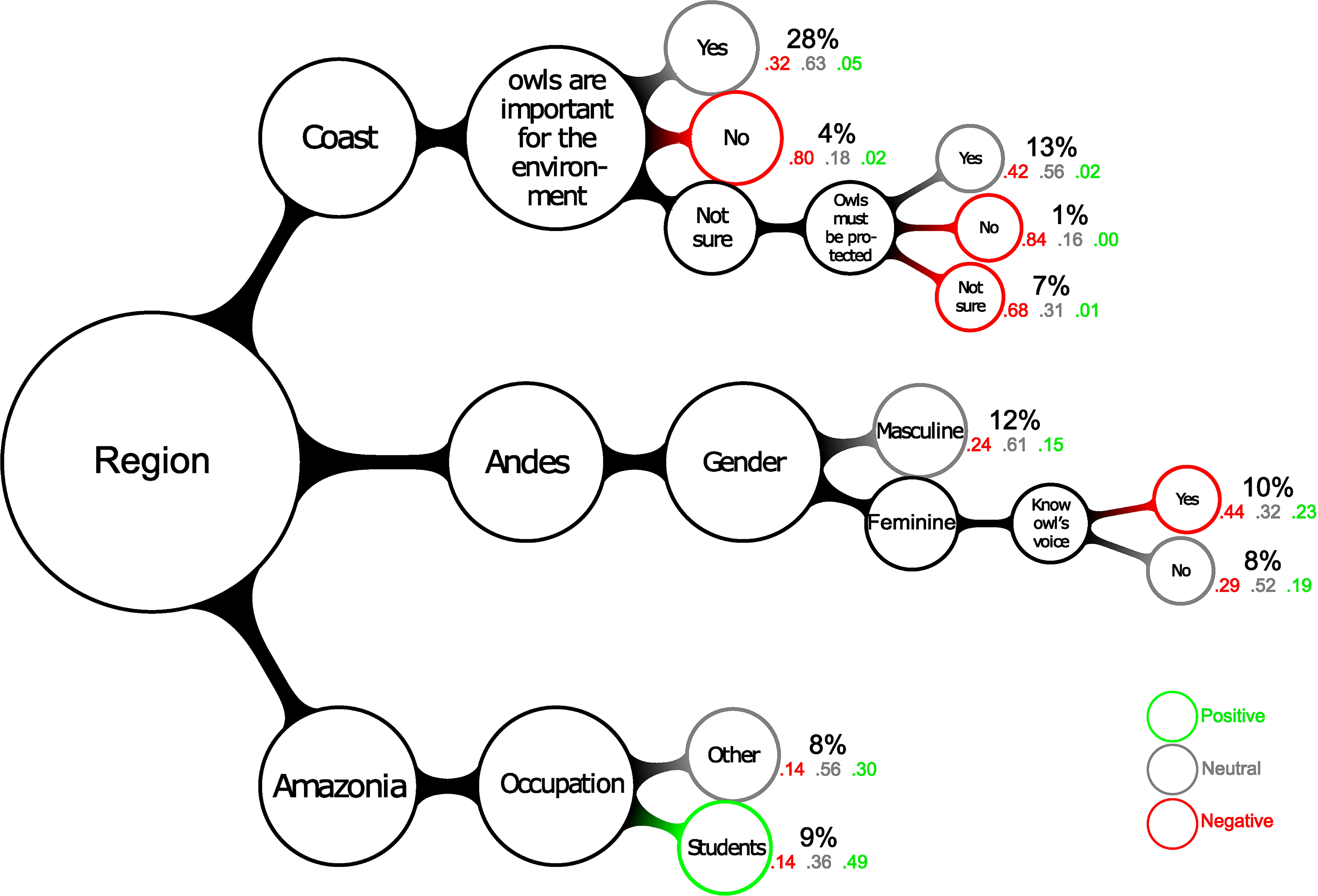
Decision tree that identifies the variables intervening in the selection of perceptions toward owls in southern Ecuador. The three decimal numbers under each branch refer to the proportion of values in each of the classes in the following order: negative (red), neutral (gray), and positive (green). The percentage above the decimal numbers identifies the percentage of values in the entire database that were classified in that branch.
Participants who tended to select neutral perceptions live in the Coastal region and believe that owls are important for the environment (63% of the 28% of the database) or are not sure about it, but do consider that they must be protected (56% of the 13% of the database). Male participants who live in the Andean region (61% of the 12% of the database), as well as female participants who do not know owls’ vocalizations (52% of the 8% of the database), and participants who live in the Amazon region and have occupations other than students (56% of the 8% of the database) also tended to select neutral perceptions. As for positive perceptions, these were selected mainly by participants who are students and live in the Amazon region (49% of the 9% of the database), whereas negative perceptions were selected mainly by participants who live in the Coastal region and believe that owls are not important for the environment (80% of the 4% of the database), or are not sure about it, but do consider that they must not be protected (84% of the 1% of the database), or are not sure about their protection (68% of the 7% of the database). Female participants who know owls’ vocalizations (44% of the 10% of the database) also tended to select negative perceptions.
Public Emotions When Seeing Owls
A large proportion of participants (48%) selected positive emotions when seeing owls, while 31% selected negative emotions, and 21% selected neutral emotions. The relationship between the independent variables and emotions upon seeing an owl exhibits a pattern akin to the observed trend in negative perceptions of owls. Correspondingly, negative emotions diminish among individuals residing in urban areas, specifically those in the Amazon, males, younger individuals, those with higher education levels, students or individuals with professional training, individuals recognizing the importance of owls for the environment, those advocating for their protection, and those holding a positive perception of owls. This decline is particularly notable with higher levels of education and the conviction that owls play a crucial role in the environment and should be safeguarded. Additionally, it is noteworthy to highlight the predominantly positive emotions expressed by respondents from the Amazon upon encountering an owl (Figure S2).
In identifying the variables that define the emotions selected by study participants when they see an owl, the decision tree analysis defined eight patterns determined by the following variables: owls’ perception, residence region, importance for the environment, years living in the region, and occupation (Figure 3). The kappa coefficient was 0.32, which indicates a discrete matching between the observed and estimated data. This means that the matching degree between the observed and predicted values is more modest than the percentage of hits. The optimal max depth was 5.
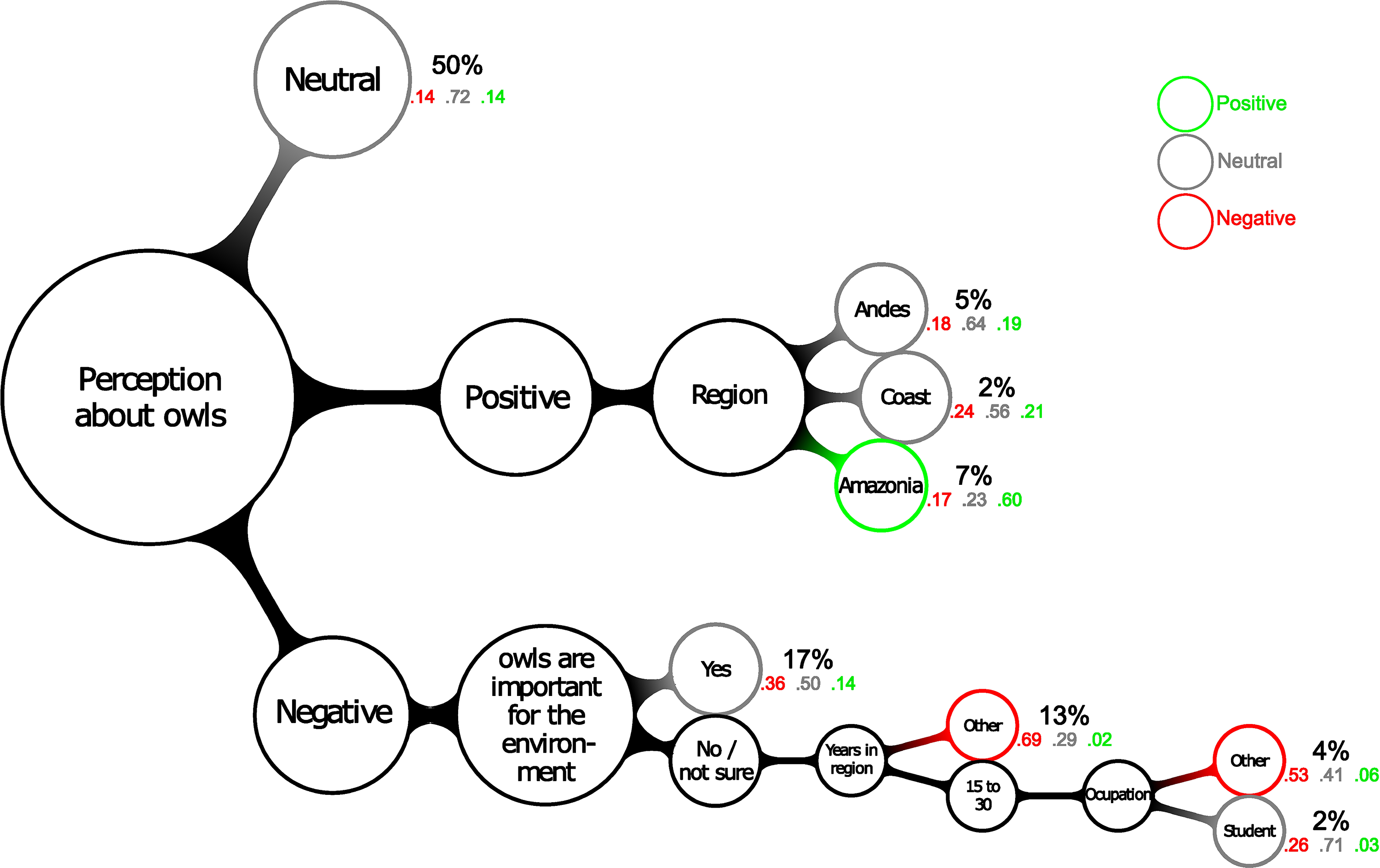
Decision tree that identifies the variables involved in the selection of the emotions people experience when they see an owl in southern Ecuador. The three decimal numbers under each branch refer to the proportion of values in each of the classes in the following order: negative, neutral, and positive. The percentage above the decimal numbers identifies the percentage of values in the entire database that were classified in that branch.
The primary variable of the emotions expressed by participants upon encountering owls is their perception of these birds. Participants who held neutral perceptions (72% of the 50% in the database), those who held positive perceptions and resided in either the Andean region (56% of the 2% in the database) or the Coastal region (64% of the 2% in the database), as well as those who held negative perceptions but considered owls to be important for the environment (50% of the 17% in the database), and those who held negative perceptions, believed owls to be unimportant for the environment, and had resided in the region for 15–30 years (71% of the 2% in the database), tended to select neutral emotions. Positive emotions were selected among those participants who held neutral perceptions and live in the Amazon region (60% of the 7% of the database). Finally, among participants who displayed a tendency to associate negative emotions with the sight of owls, a notable proportion (69% of the 13% in the database) believed that these birds are unimportant for the environment and had resided in the region for a duration other than 15–30 years. Similarly, participants (53% of the 4% in the database), who held negative perceptions regarding owls, believed they were insignificant for the environment, had resided in the region for 15–30 years, and were not students, also tended to exhibit negative emotional responses.
Public Emotions When Hearing Owls
A large proportion of the participants (45%) selected positive emotions when they heard an owl, 33% selected negative emotions, and 22% selected neutral emotions. The association between the independent variables and the emotions experienced upon hearing an owl follows a similar pattern to that observed in the emotions evoked by seeing an owl. Upon examining the graph depicting the correlation between the emotions expressed when hearing an owl and those expressed when seeing an owl, it becomes evident that over 80% of individuals who initially experienced negative or neutral emotions upon seeing an owl maintained the same emotional responses upon hearing its vocalizations. However, the same consistency is not observed with positive emotions. In this case, only 40% of those who felt positive emotions upon seeing an owl maintained the same emotional response. The relationships with the remaining variables exhibit similar tendencies to the emotions reported when seeing an owl, although in certain instances, the magnitudes differ to some extent (Figure S3).
The decision tree analysis defined five patterns involving the following variables: How do you feel when you see an owl and region (Figure 4). The kappa coefficient was 0.72 which indicates a substantial matching between the observed and estimated values. The optimal max depth was 4.
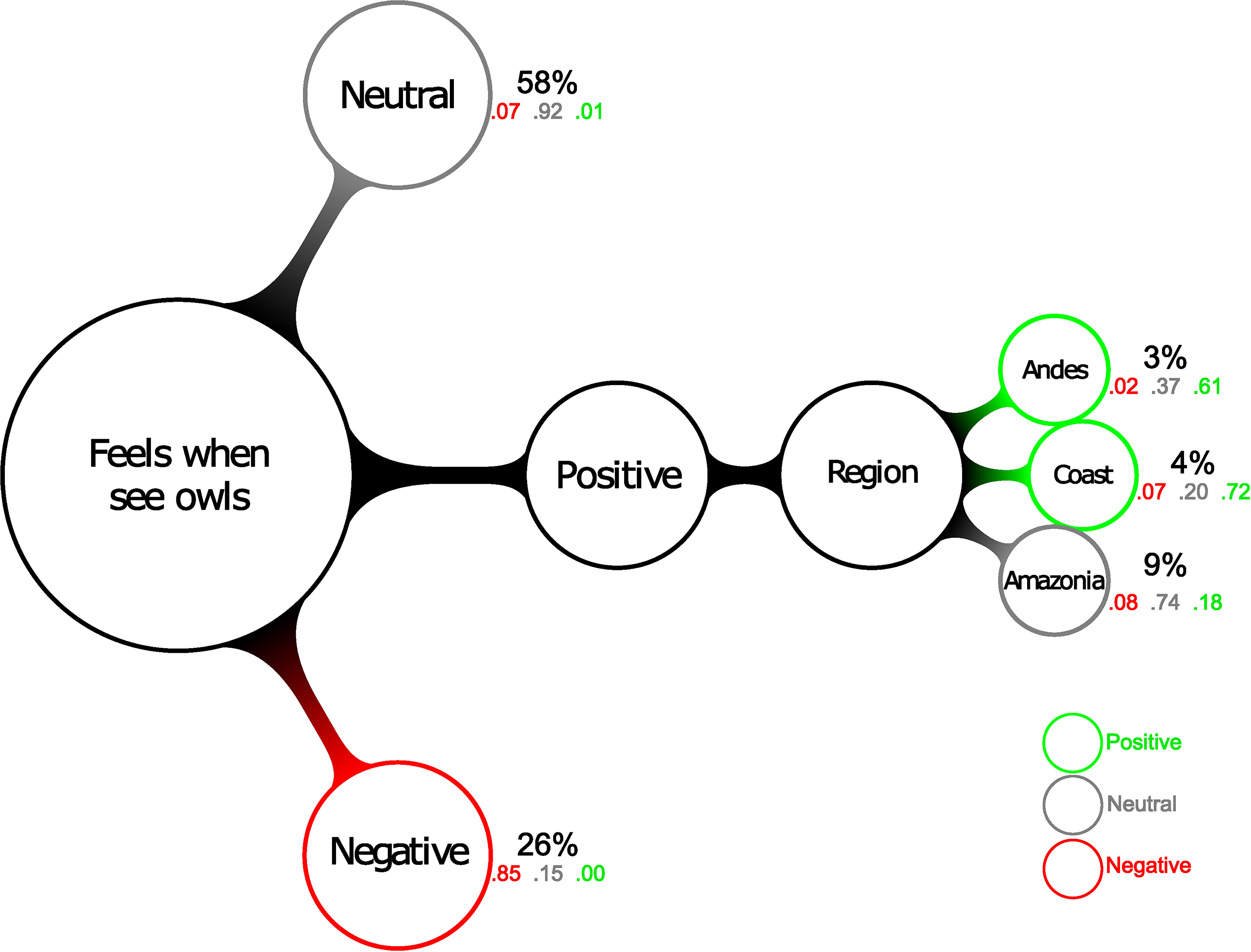
Decision tree that identifies the variables involved in the selection of the emotions people experience when they hear owls in southern Ecuador. The three decimal numbers under each branch refer to the proportion of values in each of the classes in the following order: negative, neutral, and positive. The percentage under the decimal numbers identifies the percentage of values in the entire database that were classified in that branch.
In contrast to the observations regarding the emotions elicited by seeing an owl, respondents who reported positive emotions upon encountering an owl and residing in the Amazon region express predominantly a neutral emotion upon hearing its vocalizations. Participants who selected neutral emotions when seeing an owl tended to select neutral emotions when hearing an owl (98% of the 58% of the database). Participants who selected positive emotions when seeing an owl, live in the Amazon region, and have selected neutral perceptions toward these birds also tended to select neutral emotions when hearing an owl. Positive emotions were selected mainly by those participants who selected positive emotions when seeing an owl and live in the Coastal (72% of the 4% of the database) or in the Andean regions (61% of the 3% of the database). Finally, participants who selected negative emotions when seeing an owl also tended to select negative emotions when hearing these birds (85% of the 26% of the database).
Discussion
In Ecuador, conflicts between wildlife and people have significant information gaps (Iñiguez-Gallardo, Guerrero and Ordóñez-Delgado 2021), which are more pronounced when it comes to understanding the implications of perceptions and emotions for effective wildlife conservation. It is also worth noting that owls, particularly tropical species, are among the least known bird orders (Rangel-Salazar and Enríquez 2017). While no declared conflicts between people and owls were observed, a subset of society holds negative perceptions, which has the potential to lead to conflicts that can be resolved by understanding the social knowledge, perceptions, and emotions toward this group of birds. This might help to develop strategies oriented to halt intentional owl mortality and persecution derived from misconceptions and perceptions.
Castillo-Huitrón et al. (2020) highlights that the lack of accurate information, among both urban and rural communities, about various species and their role in providing ecosystem services has significant emotional implications that trigger feelings of danger and disgust, particularly toward species that are perceived as unattractive. This is of particular importance in that owls generate aversion to people because of their appearance—that is, their “anthropomorphic” face—, their ability to turn their neck about 270°, and their vocalizations (König, Weick and Becking 2008, Molares and Gurovich 2018). Our results complement these assertions in two ways.
Regarding the owl's knowledge and perceptions, most participants showed extensive knowledge about owl habitat and diet; however, this knowledge was not identified as a determinant of positive perceptions. Instead, we found the perception of owls’ importance to the environment and their protection played a key role. Participants who considered that owls are not important to the environment and should not be protected tended to develop negative perceptions, while those who agreed with the same statements tended to develop neutral perceptions.
Furthermore, participants who had prior encounters with owls exhibited a stronger tendency to select negative perceptions, thereby substantiating the notion that the visual presence of owls contributes to the formation of negative perceptions. Yet, the act of seeing the bird alone did not exclusively determine the choice of negative perceptions. The tree analysis unveiled a complex interplay among various variables (such as region, level of formal education, age, time of residence in the region, occupation, belief in the environmental significance of owls, and support for their protection), highlighting their interactive influence on shaping perceptions. These results challenge the notion that a greater social detachment from nature results in biophobia (Castillo-Huitrón et al. 2020), at least in our study area. Our data provide evidence that negative perceptions toward owls tend to diminish among individuals residing in urban areas, particularly those who recently relocated to the Amazon region, as well as among individuals who lack familiarity with owl vocalizations or sightings.
Each wild species involves its own variables, Cortés-Avizanda et al. (2022) identifies knowledge gaps, needs, age, and interests of social actors for emblematic and threatened species. Therefore, conflict resolution strategies involving owls must be meticulous in addressing this tangled web of variables. This is important as knowledge about wild species does not necessarily lead to positive perceptions, just as seeing or hearing an owl does not automatically generate negative perceptions as commonly proposed (e.g., Anderson 2000, Enríquez and Rangel-Salazar 2004, Guerrero-Martínez 2017, Raimilla and Rau 2017, García-Flores 2020). In fact, our results indicate that regardless of vocalizations, knowledge, and information sources, there is a tendency among participants to express neutral perceptions.
In terms of emotions, they are also influenced by a set of variables, with the person's perception of owls being the most prominent. Therefore, if the perception is neutral or positive, the emotions will align accordingly, although these emotions may vary across different demographic groups. For example, women, particularly those who know owls’ vocalizations tend to experience negative emotions more frequently. An extensive literature review by Castillo-Huitrón et al. (2020) highlights an evolutionary response that explains why women developed fear and disgust toward some wild species due to their household activities and their role in caring for children in safer environments. The authors continue their argument by stating that currently, cultural contexts influence the type of emotions expressed.
The cultural context is embedded in a geographical space, which in the case of our study, identifies the Amazon region as the place of residence of participants who tend to select positive emotions. Cultural models constitute the context in which emotional behavior takes place, and, as such, also guide and inform emotional responses (Boiger and Mesquita 2012). The varied ethnic composition of the studied Amazonian region, encompassing mestizos, Shuar, and Saraguro communities, may potentially impact the formation of these positive perceptions. However, due to the absence of ethnic information in our data, we encounter certain limitations in elucidating this influence. Consequently, we recognize the need for a study, preferably qualitative-narrative, to comprehensively address this aspect.
According to Molares and Gurovich (2018), contemporary collective memory, particularly in rural areas, retains ancestral beliefs from cultures that attributed symbolic significance to owls. Extensive evidence demonstrates that perceptions of owls are profoundly influenced by inherited beliefs and myths passed down through generations, exhibiting cultural variations across countries and regions (Benavides 2013, Vásquez–Dávila 2014). Drawing upon Boiger and Mesquita (2012), the above claims hold considerable weight, as emotions are also molded through ongoing social interactions. Our findings provide further support to this notion, as they indicate that individuals predominantly acquire knowledge about owls from their family and school environments, which serve as crucial settings for interpersonal interactions. Considering the context of southern Ecuador, it is plausible that a combination of historical beliefs and contemporary multiethnic interactions has influenced the development of distinct emotions, exhibiting regional variations. This likelihood arises as individuals from diverse cultures tend to respond differently to the same situation, thereby eliciting contrasting emotional reactions (Boiger and Mesquita 2012).
Building upon the same line of argument, it is reasonable to anticipate that although our data indicate a propensity for neutral emotions toward owls, other studies have documented instances of negative emotions toward the same species in Argentina (Molares and Gurovich 2018), Chile (Silva-Rodríguez, Ortega-Solís and Jiménez 2006, Benavides 2013, Raimilla and Rau 2017), Mexico (Anderson 2000, Fuente, Ruiz and Vásquez 2012, Guerrero-Martínez 2017, García-Flores 2020), Costa Rica (Enriquez and Mikkola 1997), El Salvador (Funes 2015), and Malawi (Enriquez and Mikkola 1997).
Moreover, akin to perceptions, the experience of specific emotions is influenced by the interplay of multiple variables. Consequently, being from the Amazon region does not automatically entail neutral or positive emotions toward owls. This is due to the fact that different cultural groups exhibit diverse perspectives on owls, even when coexisting in the same geographical area. Such varied perspectives have been documented within North America (Marcot 2007), Mexico (Anderson 2000, García-Flores 2020), Colombia (Restrepo and Enriquez 2014), Peru (Cancino 2019), Chile (Raimilla and Rau 2017), Finland (Mikkola 2000), Africa (Cocker and Mikkola 2001, Marcot 2007), and Pakistan (Rashid et al. 2021).
By conducting a decision tree analysis, we have successfully identified interesting patterns in participant's perceptions toward owls which can be grouped into negative, positive, and neutral tendencies. Focusing on negative perceptions, several factors demonstrate a significant correlation. Participants with lower levels of formal education, older age, longer-term residents in a region, occupations categorized as elementary and farming, as well as participants from del Coast, were associated with stronger tendency toward selecting negative perceptions. Turning to positive perceptions, distinct trends emerged among participants. Student participants residing in the Amazon region comprised the majority of those expressing positive perceptions. Participants who tended to select neutral perceptions were primarily from the Coastal region and held belief that owls are important for the environment. Male participants residing in the Andean region and female participants who were unfamiliar with owls’ vocalizations also displayed a propensity toward neural perceptions. Similarly, participants living in the Amazon region with occupations other than students tended to select neutral perceptions. These findings provide valuable insights in the specific demographics associated with perceptions toward owls, shedding lights on the complex interplay of participant characteristics in shaping attitudes.
Likewise, our results revealed several noteworthy patterns regarding the emotional responses toward owls. Negative emotions tended to be more prevalent among female participants and increased with age. Participants, who held negative perceptions about owls, believed they were unimportant for the environment, or should not be protected also displayed a tendency to select negative emotions. The level of formal education and occupational qualification exhibited a progressive decrease in selecting negative emotions. Positive emotions were more commonly reported by participants living in the Amazon region, whereas neutral emotions were selected mainly by those who considered owls to be important for the environment and those residing in the Amazon region with occupations other than student.
Building upon these findings, it becomes evident that participants’ perceptions and emotional responses toward owls are intricately shaped by social interactions and cultural factors (Nyirenda et al. 2017), which vary according to sociodemographic characteristics. This understanding holds considerable potential in guiding the development of conservation strategies and efforts to promote positive attitudes toward owls.
To date, there are no known studies that have employed decision trees to delineate variables linked to knowledge, perceptions, and emotions concerning wild animals, specifically owls. Decision trees have predominantly found utility in fields such as medicine, computer science, land cover classification (Phiri et al. 2020), and disease pattern detection (Nithya and Ilango 2019). However, it is noteworthy that decision trees have demonstrated their worth by facilitating the assessment of perceptions regarding climate change adaptation and mitigation measures (Iñiguez-Gallardo and Tzanopoulos 2023).
Unlike previous studies that primarily relied on frequency counts of different perception types (e.g., Khadka 2016, Sureshmarimuthu et al. 2021), our approach has proven invaluable in unraveling the complex interplay of variables that influence the selection of perceptions and emotions toward owls. While prior research has identified correlations between age, education level, income, and positive owl perceptions (Enríquez and Rangel-Salazar 2004, Belaire et al. 2015, Rashid et al. 2021), our decision tree analysis revealed additional influential factors including the geographic region and place of residence, as well as their familiarity with owl sightings and vocalizations. These findings emphasize the multifaceted nature of perceptions and emotions toward wildlife, underscoring the need to consider a broad range of variables when examining human attitudes toward owls. This poses new challenges for conservation and education campaigns, highlighting the need to avoid generalizing conservation efforts for these birds across countries or regions. By understanding the interplay between variables and their influence on the selection of specific perceptions and emotions, educational content can be tailored to suit the demographic profile of the target audience, thus increasing the likelihood of success in an owls’ conservation campaign.
Conclusions
The present study offers an alternative, unconventional way of analyzing data in the field of ethnobiology that has proven effective in indicating that perceptions of owls are shaped by a complex web of interactions between variables. These aspects are of relevance when generating conservation proposals, as they offer clear lines of work to be developed in the future at local and regional levels.
Supplemental Material
sj-docx-1-ebi-10.1177_02780771241250129 - Supplemental material for Perceptions, Knowledge, and Emotions About Owls in Southern Ecuador
Supplemental material, sj-docx-1-ebi-10.1177_02780771241250129 for Perceptions, Knowledge, and Emotions About Owls in Southern Ecuador by Verónica Iñiguez-Gallardo, Fabián Reyes-Bueno, Ivonne González-Coronel, Juan Freile, and Leonardo Ordóñez-Delgado in Journal of Ethnobiology
Footnotes
Acknowledgments
Thanks to Paula Enríquez, Juan Sebastián Restrepo and Heimo Mikkola for their help adapting the first version of perceptions and knowledge questionnaires. The authors thank to Denisse Freire, Diana Encarnación, Diego Ojeda, Iván Paladines, and Maricela for their help in data collection.
Declaration of Conflicting Interests
The author(s) declared no potential conflicts of interest with respect to the research, authorship, and/or publication of this article.
Funding
The author(s) disclosed receipt of the following financial support for the research, authorship, and/or publication of this article: This work was supported by the Fulbright DDRA, Division of Social and Economic Sciences, (grant number P022A180024-001, 1823229).
Supplemental Material
Supplemental material for this article is available online.
References
Supplementary Material
Please find the following supplemental material available below.
For Open Access articles published under a Creative Commons License, all supplemental material carries the same license as the article it is associated with.
For non-Open Access articles published, all supplemental material carries a non-exclusive license, and permission requests for re-use of supplemental material or any part of supplemental material shall be sent directly to the copyright owner as specified in the copyright notice associated with the article.
