




Abstract
Five hundred years of desire for cotton has reshaped landscapes, built global economic commodity chains, and devalued human life in the name of producing cheap clothing. Since 2001, cotton monocultures in South India have also reorganized genetic codes, continuing centuries of work to maintain the socioecological possibility of extractive agricultural production. This paper combines ethnographic and ethnobiological research in Telangana, India, to center cotton's role in organizing socioecological life for an agrarian world including farmers, farmworkers, plants, soils, buyers, weeds, and animals. Mutually exclusive systems of genetically modified Bt and organic cotton production offer a range of possible organizations of labor, aspiration, reciprocity, and labor. While historically situated in plantation inequalities, cotton production can also make unexpected room for socioecological relationships outside extractive monoculture.
Introduction
In four independent cases over the last 5,500 years, plants in the Gossypium genus entered a social and biological coevolutionary partnership with humans that slowly transformed these tropical shrubs into cultivated crops whose mature bolls overflow with long, tough, white fibers. As it intersected with human systems of power, the resulting human-cotton relationship shaped landscapes, built global commodity chains, facilitated multispecies entanglements, and devalued human life in the pursuit of profit through cheap clothing. The genus Gossypium includes over 50 wild cotton species that live in diverse arid regions from central America to Northern Africa, South Asia, and Australia. Each produces a fuzzy lint on their seeds ranging from brown to green to white. Twisting, ribbon-like hairs that evolved 5 to 10 million years ago in a Malvaceae species were the latest in a line of plant defenses: they may have helped the seeds float over greater distances when carried by birds or picked up by the wind, or the fibers may have protected the seeds against moisture that led them to germinate prematurely (Wendel and Grover 2015). By this point in its evolutionary history the plant was already part of an evolutionary arms race, pumping toxic gossypol, for which the genus is named, to dissuade insects and herbivores from eating seeds, shoots, stems, leaves, and flowers.
Initially grown on diversified farms to provide fiber, cotton's durability and tradability as cloth allowed it to take part in expansive networks of trade by the first millennium. This trade reorganized life for both humans and Gossypium species. In the first millennium CE, cotton transformed arid regions across central Asia as farmers developed irrigation networks to provide regular water (Brite 2016; Brite and Marston 2013), building infrastructure along the way for grains, legumes, fruits and apples across the region (Brite 2021; Spengler 2019). Unsure of what they were seeing, and taking inspiration from the “vegetable lamb of Tartary” described in the writings of Herodotus and John Mandeville, some medieval Europeans imagined cotton as a tree with lambs for branches (Lee 1887). While that misconception survives in the German and Scandinavian Baumwolle (tree-wool), European languages near the sea routes of the Mediterranean take their vocabulary from the Arabic qatn, while those connected by overland trade to contemporary Iran draw from the Persian pambeh. Looking east, Southeast Asian languages often draw from the Hindi kapaas, reflecting an Indian trade history. Simultaneously, humans also transformed the plant to fit these new infrastructures in a manifestation of plant-anthropo-genesis. Asian and African G. arboreum and G. herbaceum are shrub-like and salt-tolerant, ideal candidates for marginal lands and irrigated deserts. Farmers seeking to grow them in northern climates selected qualities that encouraged the plants to mature fast enough to grow from seed to fruiting plant in 9 months and avoid winter freezes. In this way, arid soils were made to bloom while a tropical perennial shrub became an annual crop grown at chilly altitudes and latitudes.
By 1600, European rulers combined new economic models of colonialism and capitalism into extractive empires (Beckert 2014; Moore 2015). In the British empire, agricultural reorganizations propelled urban industrial manufacturing in the colonial core. To England's west, sugar organized a new capitalist economy through racial hierarchies of work and divisions of production labor while inventing a taste for sweetness (Mintz 1985). In South Asia and China, British desire for tea's caffeinated warmth reorganized forests around tea monocultures, white and male overseers, and Asian and female laborers (Besky 2020; Jegathesan 2019; Liu 2020; Sen 2017). From an ethnobiological vantage, concerned with diverse ways of knowing and being with nonhuman life, these imperial hierarchies reveal a necropolitical taxonomy in which some members of the ecosystem may live and others must die: the lives of humans, plants, animals, and microorganisms are all cheapened in service of producing, and thus protecting, crops desired by empire.
Better suited to industrial mills than Asian cottons, American G. hirsutum had the fiber length and tensile strength necessary to make clothing with Manchester machines. But growing it in India demanded large investments in labor, infrastructure, and capital, which smallholding Indian farmers hesitated to give. Indian G. arboreum and G. herbaceum have deeper roots to weather droughts and salty soils, while G. hirsutum produces comparatively less insecticidal gossypol to repel pests. Ultimately, mechanical decisions about fiber strength related to Manchester mills rather than environmental decisions related to tap roots or pest predation in Indian fields directed Indian cotton production as managed by British breeders and brokers (Hazareesingh 2016). Farmers themselves embraced the necropolitics of imperial cotton plantations during the green revolution to spray pesticides and apply fertilizer treatments aimed at producing and protecting cotton (Cullather 2013; Gupta 1998; Vasavi 1999) at the expense of other life on their farms. By the mid-1990s, indiscriminate pesticide use gave rise to pesticide-resistant bollworms. By 1998, Indian cotton farmers were spraying 30,000–35,000 metric tons of pesticide (Kranthi 2012), accounting for nearly half of all pesticides sprayed in the country (Shetty 2004). Conventional breeding tools were not enough to keep pace with the bollworms in these intensive monocultures, and so Indian breeders turned to the new tools of private biotechnology (Aga 2021) to remake cotton itself as insecticidal. In the pursuit of cheap fibers to clothe and profit from a global laboring class, humans redesigned cotton's genetic code to fit the landscapes of monoculture, undervalued labor, public water infrastructure, and soil erosion. Amid a contemporary agrobiopolitics (Hetherington 2020) describing how some humans and some crops thrive together, both organic and genetically modified (GM) cotton regimes drive toward a commodified monoculture that surveils workers and extracts labor while providing means for creative efforts by humans, plants, and animals to live on the farm. In exploring the worlds made possible by relationships between cotton and people through a case study based on long-term fieldwork in Telangana, India, this paper seeks to denaturalize this hierarchy of agricultural life and illuminate moments of creativity and resistance on the farm.
Ethnobiology and the Plantation
Cotton capitalism has been violent and extractive for centuries of colonization, enslavement, sharecropping, technification, and global trade (Baptist 2014; Beckert 2014; Johnson 2013; Williams 2021). Contemporary farmers growing cotton in Telangana, India, are not colonial overseers. A single farming household does not effect the scale or kinds of reduction in life or manipulation of labor seen in Indonesian palm oil zones (Li and Semedi 2021) or South Asian tea regions (Besky 2014; Jegathesan 2019; Sen 2017). Where Li and Semedi (2021) have shown how those plantations resemble company towns with their relationships of labor, debt, and extraction, small Indian cotton farmers diversify their crops to at least some extent, often own or effectively own their land, and thus foster different relationships between plants, people, knowledge, capital, and land (Flachs and Stone 2019). Despite this clear differentiation from the imperial plantation, many underlying characteristics persist: Farms are ecologically and economically tied to the production of a single species at local and global scales, while labor is organized according to a racial and gendered hierarchy that devalues the work of women and colonized people.
The imperial plantation form grew out of the hierarchical valuation of early industrial capitalism (Mintz 1985; Moore 2010) to favor extractive monocultures-for-export managed through cheapened labor. By combining colonial labor and environmental histories in agriculture, Ferdinand (2022) shows how this logic embraced the white male overseer who could turn key crops into profit while rejecting the possibility of living with different kinds of human, plant, or animal life on these farms. In intensifying monocultures through subsidized fertilizers, water, and pesticides, green revolution crops, and later GM crops, reproduced monoculture export as the key purpose of agriculture (Dowd-Uribe 2023). Because each system requires a calculation of value whereby export commodities are dear and other life is cheap, even small, somewhat diversified Indian cotton farms reproduce this underlying plantation capitalist logic, a hidden pattern that Dowd-Uribe (2023) calls an implied transition to monoculture.
Ethnobiologists helped to sustain these hierarchies of value, categorizing useful economic plants for export and cataloging ways of knowing to service the goals of imperial extraction (Hunn 2007). Backlash against this work has led to ethnobiology theory and practice that ethically documents a commons of life and knowledge while attributing forms of rights and protection to Indigenous knowledge keepers (McAlvay et al. 2021; Wolverton 2013). In this vein, plantation agriculture is not an objective reality but a particular way of knowing and valuing life from the perspective of an extractive empire. In combination, Telangana small farmers and cotton (along with rice and, to a lesser extent, maize) have reshaped the landscape. As with medieval Chinese imperial plantations of cotton and sugar (Anderson 2014), Telangana plantation crops are produced on small and sometimes diversified farms. While empires extracted surplus commodity crops from these farms (Anderson 2014; Chaudhuri 1985), the monoculture plantation form accelerated dramatically with European colonization and capitalism. European political and economic decisions came to stratify life and extract surplus from a gendered, racial, and species hierarchy determining which plants and whose work have value (McKittrick 2011; Mintz 1985). Understanding small cotton farms through the history of the plantation is a way to ask how this specialization and extraction causes violence of different kinds even when managed by millions of individual smallholding households.
Writers interested in socioecological relationships rooted in agrarian capitalism (Carney 2021; Haraway 2015; Mitman, Haraway and Tsing 2019; Wolford 2021) have called the contemporary moment the “plantationocene” to examine life under extractive, racialized monoculture (Li 2017). Beyond a vision of ecology and labor bound to European colonial capitalism, plantationocene scholarship offers a theoretical vantage to understand how and why plantations have ordered sociopolitical relations, shaped the global economy, and reinforced colonial notions of productivity in people and space (Ofstehage 2021; Wolford 2021) that persist in environmentalist pushes toward fortress conservation (Büscher and Fletcher 2019; Ferdinand 2022). Plantations instill both the ecological violence of monocultures as well as the sociopolitical violence of unfair trade agreements and attempts to sever generational ties to place that foster love and care, racism, and sexism.
While plantationocene scholars draw attention to the violent racial capitalism that is paramount in an ongoing history of cotton agriculture, this literature has important limitations. Davis et al. (2019) criticize plantationocene scholarship for obscuring racial politics and sidelining scholarship of the plantation from critical geography and Black feminist studies. Curley and Smith (2023) further stress that -cene narratives' pretension to global and universal stories fractures, claims, and colonizes time itself. Cotton in particular is inseparable from racial violence and colonization across time, an ongoing and issue and not a historical touchstone. Like sugar (Mintz 1985) it is prized for a refining whiteness perceived as pure and clean, alienated from the conditions of violence, labor, or enslavement that produce it (Luna, Hernandez and Sawadogo 2021; Williams 2021). The United States dominated global trade in cotton only by violently cheapening the work and knowledge of enslaved African and African-American people (Beckert 2014), including technological developments like the cotton gin that further intensified enslaved labor. While plantations limit the kinds of nonhuman life possible in agrarian spaces, that ecological violence is rooted in racial violence, the devaluing and dehumanization of Black and Indigenous people (Baptist 2014; Davis et al. 2019; McKittrick 2013). Contemporary Indian racial politics are not necessarily grounded in white supremacy, although the British colonial legacy has had a profound influence on caste discrimination, anti-Blackness, and colorism (Patel 2016). Agricultural labor and production remains gendered, in that women are paid less and face harassment in fields; classed, in that landless and poorer workers provide cheap labor for larger farmers; and caste-based, in that historically marginalized caste communities in rural areas are more often called upon to work on the farms of historically land-owning castes than vice versa (Agrawal and Sivaramakrishnan 2000; Flachs 2019a; Kapadia 1996; Ramamurthy 2017).
As Jegathesan (2021) points out, Black feminist scholars have been addressing the violence of plantations for decades in ways that have important contributions for South Asian agrarian studies. Writing against a regional focus that would separate the issues of Sri Lankan farmworkers and peasants from the struggles of workers and enslaved people in the African diaspora over the last 500 years, Jegathesan re-interprets plantation worker plots as spaces of interspecies cohabitation and mutual safety within and beyond the plantation (Jegathesan 2021, 5). Here, families rest, grow vegetables and flowers, pet rabbits, and share space with a friendly guard dog even if the tea plantation that surrounds and employs them perpetuates caste and gendered inequality and denies political and land tenure rights. Even as technologies of surveillance and forced labor persist beyond the plantations in which they were developed (Benjamin 2019; Davis et al. 2019; Moulton and Popke 2017), communities create spaces of persistence to produce new kinds of home and care. A critical ethnobiology of plantation agriculture asks how this past and ongoing violence shapes future trajectories. McKittrick (2013), in particular, calls for plantation futures that connect the violence of plantation capitalism with the ongoing anti-Black violence of urban impoverishment and incarceration in the Americas—as well as the ways people survive this violence.
Carney (2021), Haraway (2016), and Tsing (2015) similarly stress that there remains room to grow with life amongst plantation or capitalist ruins, while Jegathesan (2021), Davis et al. (2019), Ferdinand (2022), and McKittrick (2013) show that this creative care-giving and relationship-building was always a means to create alternative futures while living on plantations. Amid monocultures and disenfranchisement are side plots, home gardens, surreptitious hunting to supplement food insecurity enacted by plantation overseers, and the crops planted in a regime “hostile to life that could not be commodified” (Davis et al. 2019, 9). African and African-American people living under American enslavement used traditional knowledge systems to exercise a modicum of power on rice plantations (Carney 2002), and planted compact food forests to enact an agrobiodiverse, resilient, and sovereign food system with African roots (Carney 2021). Migrant Tamil teaworker families sustain networks of mutual support and care in Sri Lanka even as war and economic change disrupt their lives (Jegathesan 2019).
Contemporary Telangana cotton farms differ in important ways from colonial capitalist plantations, Tamil teaworker gardens, or the plots of enslaved people in the United States. Telangana cotton farmers own or rent their land, use family and hired labor to manage it, and sell through a range of local brokered markets with a state-enforced floor on their prices. This is a far cry from the rampant extraction of enslavement or colonial crop exports. Because they own and rent their own land, they have spaces devoted to commercial and household production, and do not grow homegardens solely through marginal land and time calculations as the authors above describe. In fact, Indian cotton farmers who chase capital accumulation, devalue female work, and grow monocultures still intercrop their farms (Flachs 2015).
Yet there are important similarities through the plantation form because of the nexus of human, plant, insect, and microbe interactions found in commercial cotton farming as it has developed through a political ecology rooted in the markets and infrastructure of colonial plantations. While Indian cotton farmers have made important gains through land reforms and policies to support diversified agricultural work, they must sell in a market that values cotton and renders other work and plant life marginal. Thus the plantation logic wherein labor or agrobiodiversity are cheap to make cotton profitable persists on small Telangana farms. Even as the Indian smallholder system offers profound differences in labor and land power, the larger underlying logic of global capitalist agriculture holds that cotton must persist and so other life must make way. Cotton fetches a potentially high price when compared to rice and maize, the other key commercial crops in this landscape, and so cotton remains a way for Telangana cotton farmers to aspire to a future sustainability in which children can lead more comfortable lives while maintaining a grip on the family's land in perpetuity. This is especially true for organic cotton farmers, for whom yields can be a secondary concern (Flachs 2022). Both cotton farming systems are forms of plant-anthropo-genesis, illuminating what kinds of life may exist within these cotton worlds and how that existence is valued.
Cotton Worlds: Bt Capitalism, Organic Diversification, and Space Outside Extraction
Ethnobiologists bridge multispecies and political ecology analyses of agriculture by asking how humans and nonhumans come together to forge agrarian worlds. In her review of scholarship decentering humans in agriculture, Galvin (2018) discusses the range of agricultural experiences extending to relationships, practice, and knowledge beyond simply farming (Kantor 2020), emphasizing how agriculture encompasses morality, ecology, race, gender, infrastructure, capital, and the political economy. Recent scholarship on the spread of GM crops describes how humans seek to sustain inherently fragile monocultures of soy (Hetherington 2020; Leguizamón 2020), maize (Fitting 2011; Wise 2019), or cotton (Flachs 2019a; Luna and Dowd-Uribe 2020) by modifying the genetic code of the plants to better fit the socioenvironmental conditions of productivist agriculture (Buttel 1993): reductions in labor, management knowledge, biodiversity, and diversification in favor of maximizing investments, yields, and profits. What worlds do the plants and people co-create?
Below, I combine ethnographic and ethnobiological research in Telangana, India 2012–2018, to explore how cotton took a leading role in organizing socioecological life for an agrarian world including farmers, farmworkers, plants, soils, buyers, weeds, and animals. These data are based on surveys of agricultural work, farm inputs, and on-farm biodiversity conducted as part of anthropological field research with over 500 farmers growing cotton in three key agricultural districts (Warangal, Medak, and Asifabad, renamed during the Telangana district restructure after 2016), chosen because of the prevalence of intensive cotton agriculture and rural development programs implementing alternative agriculture projects. Mutually exclusive systems of GM Bt and organic cotton production offer a range of possible organizations of labor, ecology, aspirations, and reciprocity. While historically situated in plantation inequalities, cotton production can also make unexpected room for socioecological relationships outside extractive monoculture.
Bt cotton, modified to produce its own pesticide, can reduce pesticide sprays and thus reduce chemical exposures while promoting biodiversity. This is especially true when it is grown in combination with integrated pest management (IPM) practices stressing field diversification and nonchemical pest controls (Tabashnik et al. 2021; Trapero et al. 2016). Yet when farmers across India began sowing this crop en masse after 2008, they adopted a plantation rather than IPM logic. Cycles of pesticide increase were stalled for a time, but have since returned and exceeded their pre-GM levels (Flachs 2017a) because the fundamental social and ecological conditions of extractive agriculture have not changed.
Bt Cotton and Enforced Monoculture
Plantations demand a violent reduction in service of extraction and production. Four elements of this process stand out for Telangana farmers growing Bt cotton: Agrobiodiversity, farm labor, management knowledge and practice, and aspiration. Most obviously, Bt cotton is grown in monocultures. While the farmers whom I spoke with tended to manage relatively small holdings between 2 and 10 acres, the landscape as a whole is a cumulative cotton monoculture. Most farmers sow cotton in increasingly dense stands that have increased plant populations dramatically over the past decade. Since 2008, the vast majority of the cotton sown in India is GM to poison Lepidopteran insects, a major cotton pest. Outside of specific university seed-breeding efforts or partnerships between certified organic seed sellers, farmers cannot find non-Bt, non-G. hirsutum seeds at the agricultural supply shops where they select from the hundreds of available commercial brands.
GM G. hirsutum is botanically ill-suited to monocropping in South Asia, even as it is physically well-suited to industrial spinning machines. It requires specific disbursements of water and is vulnerable to a wide range of insect pests. Tap-rooted G. arboreum is comparatively resilient against pests and variable monsoon rainfall exacerbated by climate change. Although the cry toxins produced by Bt cotton resist bollworms, Bt cotton remains affected by insects who suck plant liquids and spread disease, particularly whiteflies (Bemisia tabaci) or jassids (Amrasca biguttula). Since 2015, farmers have been reporting increasing Bt resistance to pink bollworms (Mohan et al. 2016; Najork et al. 2021). As a result, agricultural institutions are promoting high-density planting systems of cotton that dramatically increase plant populations in a given field to reap one harvest after five or six months and then uproot and burn those plants (Venugopalan et al. 2014).
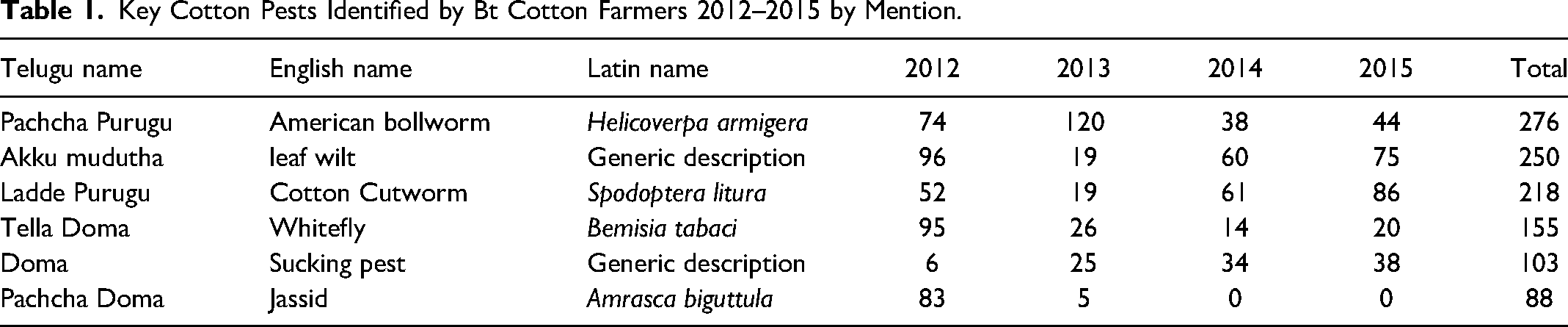
Dense stands of cotton encourage insect attention. Pesticide sprays targeting sucking pests increased dramatically across India since 2008, when Bt cotton became widely planted across the country. Since 2014, more pesticides are sprayed annually on India's cotton crop than were sprayed before the introduction of this pest-resistant technology in 2002 (Flachs 2017a; Kranthi and Stone 2020). Between 2012 and 2016, I collected information about the pesticide applications that farmers applied in their fields, including the number of times farmers sprayed, the density of their planting, and the key pests that they noticed. By 2014, a clear majority of farmers had switched to higher-density planting, a move that did not result in noticeably higher yields but introduced a chain of reactions across other species. Such fields precluded oxen-plowing, incentivized herbicides, and intensified a larger national debate about the release of glyphosate-resistant cotton (Stone and Flachs 2018). Farmers reported spraying pesticides, including persistent organophosphates chlorpyrifos and monocrotophos, between five and six times a season, using a combination of motorized misters and hand-cranked sprayers. Meanwhile, farmers named the American bollworm (Helicoverpa armigera) and the cotton cutworm (Spodoptera litura) as their top pests across 1,049 farmer spraying decisions between 2012 and 2015, along with leaf-damaging viruses and the whiteflies (Bemisia tabaci) and jassids (Amrasca biguttula) who spread them (Table 1). Although farmers in this region mentioned fewer key pests in their fields as the study continued, Indian farmers in aggregate continued to increase the sprays they applied - perhaps signaling that these sucking pests are easier to control at present.
Key Cotton Pests Identified by Bt Cotton Farmers 2012–2015 by Mention.
Cotton monocultures exclude other forms of life, casting insects as pests deserving of collective violence. To spray is to keep not only one's own plants healthy, but also to prevent an outbreak that might spread to others. As farmers aggressively compare yields, bemoan insects, and balance costs, spraying becomes one more competitive arena in which to perform successful caretaking amid a toxic combination of socioeconomic distress and insecticide (Kannuri and Jadhav 2018). In a context defined by seeking good yields above other visions of success, insects experience a special degree of targeted hatred. Distinct from the complex, intimate relations of care and violence that Govindrajan (2018) describes among people and animals in the central Himalayas, insects on cotton fields find only violence. Importantly, farmers employ creative solutions for other pests, including scarecrows to frighten monkeys and birds, thorny branches to dissuade browsing herbivores, or ceremonial offerings for snakes. Insects, as threats to monoculture, have no such local solution. Instead, insect management knowledge is commodified information located solely at the pesticide shop. In this way, broad spectrum insecticides erode local farmer knowledge while reinforcing the need for profit growth, the ethnobiological logic of a plantation in which cotton is valued above all other life.
Other plant life in cotton spaces is, as a rule, weeded out by humans, oxen, or chemical force. This labor is gendered and classed. Household members will often purchase and sow seeds, apply agricultural inputs, and store and transport their harvests. Hired workers typically weed, pluck, and sometimes spray pesticides. Because their labor is paid less, women are more often hired for that work, while spraying and plowing tend to be male jobs. High-density cotton fields are ill-suited to oxen plowing, and so farmers must either hire extra weeding labor, usually done by women, or apply broad-spectrum herbicides like glyphosate to manage weeds. By design, broad spectrum herbicides kill other plant life, but they also disrupt the microbial ecologies found in soils and animal guts (Van Bruggen et al. 2018). Such death is a form of collateral damage in service of the plantation's driving purpose: Growing cotton.
Fields at low densities often contain range of other crops on field margins and in the particular spots where cotton plants fail to germinate (Telugu: poguntalu), a way of ensuring that no managed crop land is wasted. As a result of this, Warangal cotton farmers grew an average of 17 economically useful semi-managed plants belonging to 100 different plant species and 39 different plant species in their cotton fields (Flachs 2015). Across farmers, most of the non-crop plants grown in fields are vegetables intended for home consumption, but also include some medicines or ornamentals. Against the logic of plantation monoculture, these plants provide some refuge for insects affected by Bt cotton's insecticidal genes and soils exhausted by cotton monocultures, but they are also covered with pesticides when farmers spray them. At the increasing densities demanded by high-density cotton (Venugopalan et al. 2014), planting in poguntalu spaces becomes impossible.
Just as enslaved people in the United States (Carney 2021) and plantation workers around the world (Das and Das 2005; Watson and Eyzaguirre 2002) create vibrant gardens reflecting their taste, creativity, and biodiverse skill, so too do Telangana cotton farmers grow diverse varieties of vegetables, medicines, ornamentals, and ceremonial plants including G. arboreum, which has cotton threads practitioners deem superior for ritual use (Gold 2003; Sethi 2019). Where cotton monoculture's labor, pesticides, fertilizer, weeding, and seeds are all purchased, plants arrive in homegardens from relatives and friends. Cows provide manure while pesticides are not used on these homegarden plants because gardeners do not wish to ingest extra poisons on their own food and because insects are seen as an expected, if unloved, part of this ecosystem. Poguntalu planting provides one kind of space for disrupting cotton monocultures, one diminished by high-density planting. Homegardens provide another, continuing a historical trajectory in which the plantation was a dominant force for agricultural capitalism but never completely dominated the agrarian world of multispecies entanglements.
Organic Cotton and Enforced Diversity
Organic cotton agriculture exists within a different system of agrobiodiversity, farm labor, management knowledge and practice, and aspiration. Where the aspiration for yields drives a logic of reduction, external inputs, and dense monocultures, organic cotton is grown at lower plant populations, with companion species, as part of a diversified farm landscape. To be clear, as Guthman (2004) and others (Campbell and Rosin 2011; Sen 2017; Seufert, Ramankutty and Mayerhofer 2017) have shown, organic or fair trade growers can also implement monocultures. Nor is Bt cotton inherently incompatible with agrobiodiverse farming when sown as part of IPM systems that promote diverse agricultures. Rather, because of development program initiatives, regulations, and international markets, Telangana organic cotton farming is an ecosystem endeavor.
Organic farmers discussed here are recruited as entire villages to streamline educational programs, resource distribution, village meetings, regulatory compliance checks, and procurement. Following a plantation logic, farmers are carefully monitored by off-farm managers for compliance with the organic requirements that provide added value, and risk losing sales if they violate those rules. Such surveillance is both necessary to cotton's long supply chains and a source of exasperation for farmers and managers who work to make the labor of organic cotton visible to consumers elsewhere. As Luna, Hernandez and Sawadogo (2021) argue, this focus on growing a “clean” product can unwittingly reproduce racialized notions of purity and whiteness across the supply chain. As in Telangana (Flachs and Panuganti 2020), Burkinabè organic cotton farmers perceive that white people seek out their cotton because it is clean, pure, and expensive even as the farmwork requires more difficult or “dirty” labor in a historical context where whiteness is racialized as purity and Blackness as dirty (Williams 2021).
Further, the agrobiodiversity resulting from this work is neither an accident nor an inherent feature of organic cotton agronomy, but a specific direction from project managers. Farms are de-densified and biodiverse through intercropping, but the restrictions on herbicides and pesticides, as well as the squeeze on paid labor, result in fields and surrounding landscapes that are less specialized than those planted by GM cotton farmers. Telangana organic cotton farms are intercropped by design and farmers manage an average of 27 plants in their fields, more than twice that of some Bt cotton farmers (Flachs 2016). Rather than steadily densifying cotton plants, organic farmers are encouraged to deal with pests through intercropping crops like pigeon pea (Cajanus cajans) or trap plants like castor (Ricinus communis) that attract Lepidopterans, the most serious pests identified by farmers.
The rapid expansion of Bt seeds across India, accounting for over 95% of all seeds planted after 2010, has also resulted in a national shortage of non-Bt seeds and breeding programs providing them. So, organic managers must account for and then provide seeds themselves through a combination of overstock from private breeders, experimental seeds from public breeders taking time away from the GM cotton research that targets the vast majority of farmers, or by saving and breeding their own seeds. To accumulate and distribute these key agricultural and financial resources, organic groups that I worked with relied on local cooperative institutions. Seeds, for example, often reach farmers through the efforts of women's Self-Help Groups, locally organized finance and resource distribution groups that sustain plural interests among members (Desai and Olofsgård 2019). In providing seeds, organic programs also build bridges to state resources that help to dispense vegetable and grain seeds, equipment, financing, and document crop damage. These social institutions then counter plantation ecologies across multiple farms, even as they provide a layer of managerial oversight to ensure organic compliance.
Where dozens of smallholder Bt cotton fields can form effective monocultures broken by rice, pulses, and maize, organic cotton fields are disrupted by a range of mandated intercropping strategies that promote seed saving and local networks of seed exchange: 159 out of 183 (87%) millet fields managed by organic cotton farmers whom I spoke with 2013–2017 were sown with saved and locally exchanged seeds, for instance. Since 2018, Telangana has joined other state governments in buying millets from smallholding farmers and redistributing them through state-operated food programs (Niyogi 2020). In this way, states and organic farming programs promote farm diversification by creating a market for millets while maintaining a steady income stream through cotton. Saving seeds requires a range of ethnobiological practice: Locally sourced bamboo woven baskets (or converted nylon bags), neem leaves to dissuade insects and rodents, cow dung to encase and protect seeds and seal containers, and a detailed knowledge of how to select and dry seeds for preservation. Both organic and Bt cotton farmers maintain this knowledge in their non-cotton farming, but organic farmers must actively use it in their commercial farm spaces to keep up with organic best practices for intercropping, nitrogen fixing, and luring insects away from economic plants.
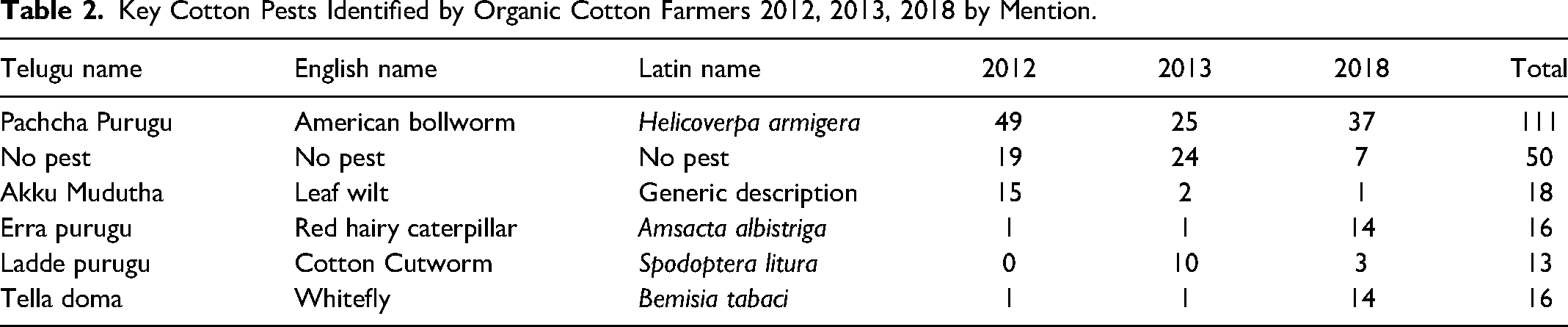
Insect pests remain a significant challenge for organic cotton farmers, whose yields are significantly below those of Bt cotton farmers in all communities where I conducted research (Table 2). Like the Bt cotton farmers, organic cotton farmers named the American bollworm as the most damaging pest. Unlike the Bt cotton farmers, organic cotton farmers frequently answered that pest attacks were not a major issue for them. This does not indicate that pests are absent in these fields—they are omnipresent. However, farmers are forced to coexist with them and accept that they will suffer yield loss from insect attacks with the knowledge that this loss is offset by other aspects of the farm system. Where a plantation necropolitics creates a hierarchy of life in which all non-commercial life is subordinated to the cash crop, systems including but not limited to this kind of Telangana organic cotton farming allow other kinds of life to flourish.
Key Cotton Pests Identified by Organic Cotton Farmers 2012, 2013, 2018 by Mention.
Farmers’ common solution on GM cotton fields is to purchase a pesticide or bring damaged plants to agricultural shops where they can buy appropriate plant management tools. Because chemical sprays are banned on organic farms, farmers are asked to make their own using a variable combination of neem leaves, garlic, cow manure, cow urine, and chilies. Such farmers, especially young women, also avoid consuming the pesticides that accumulate in Bt cotton field landscapes (Luna 2020; Venkata et al. 2016). In practice, many farmers did not make herbal mixtures themselves. Not everyone wishes to be a chemist. The mixture itself is complicated to make, requires a large plastic drum, and has a stiff, pungent smell. Both organic farmers and project managers explained that it was simpler for a few key experts to concoct these pesticides and then distribute them to others through regular meetings and check-ins with partner farmers. Yet, as with the seed distributions, this distribution system provides an institutionalized platform for regular discussions and cooperative decision-making against the individual consumer model of Bt cotton.
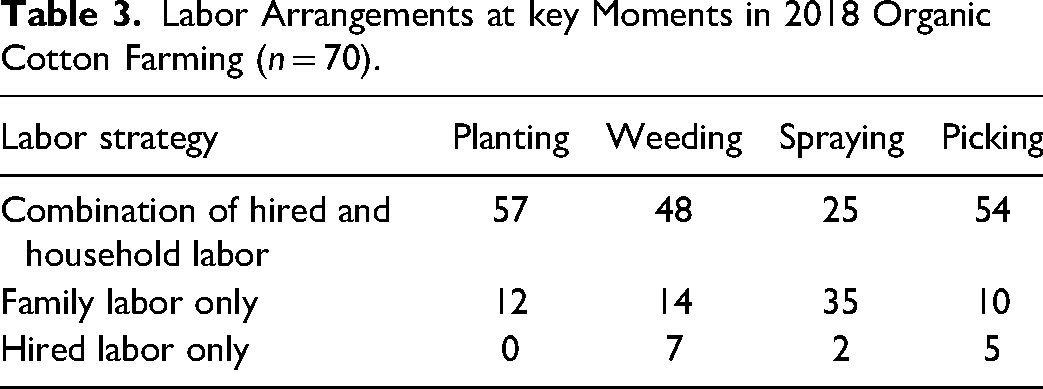
Even in 2017 and 2018, long after most Telangana farmers were densifying their cotton so that they could harvest and then burn fields after 4–6 months in response to a pink bollworm outbreak, the vast majority of Telangana organic cotton farmers (85%) planted low-density cotton farms amenable to bullock plowing. A combination of family and hired labor is critical here as on non-organic cotton farms, but the margins are thinner on organic farms where yields, investments, and overall profits from cotton tend to be lower. As such, labor exchanges, labor fees, equipment sharing, and the timely distribution of organic pesticides are critical. Because organic agriculture demands regular meetings, farmers and project managers have an opportunity to organize these meetings or demand resources that they need. This space also provides another moment where households can be surveilled or brought back into line. Often farmers will police each other, but regular meetings are moments where project managers or particularly involved farmers correct and monitor farmer's work to ensure their continued compliance with organic rules. Household labor and labor exchanges take a larger role on these farms, in part because organic cotton requires specialized skills and thus organic farmers typically work on other organic farmers’ fields, and in part because farmers reaping lower yields cannot afford to make large investments in labor from people outside the community (Table 3).
Labor Arrangements at key Moments in 2018 Organic Cotton Farming (n = 70).
Fundamentally, organic cotton also organizes ecological and social life around Gossypium hirsutum to extract that resource and send it to consumers based primarily in Europe, North America, Japan, and urban India. The effort of extra sprays, seed breeding, and documentation all goes toward protecting cotton—not its yield but its integrity as a value-added, pure product uncontaminated by banned pesticides or transgenes. Yet these organic cotton social and ecological systems must function more collectively and accept lower yields. Because agricultural trainings are tied to village-organized Self Help Groups, participating farmers have guaranteed monthly meetings where they meet and talk to each other, compare problems, distribute monetary and infrastructural support, and receive encouragement to work with organic project managers. These institutions of distribution enforce a more collective and less individualistic mode of work than the agrarian capitalism of Bt cotton fields.
In shifting the work of agriculture, organic cotton reorients how farmers view themselves as problem solvers. Just as Galvin (2014, 2021) shows that organic farmers in Uttarakhand came to see themselves as soil caretakers, organic cotton shifts farmer work and identity away from consumption, namely buying the right seeds and inputs to care for them, and toward a more holistic management of plant, soil, and microbial relationships. Where many Bt cotton farmers have adopted the scripts of agribusiness, namely productivist farming and aspirational investing (Flachs 2019b), as their motivating logic, organic cotton agriculture asks that farmers value their efforts ecologically. “Organic kharchu takkuwa, arogyam ekkuwa,” explained an organic project manager in 2018: Organic's costs are lower while our wellbeing is increased. “You go out in the villages near me, and you see that children are getting cancer, you can see that everyone has health problems, you can smell the fertilizer and pesticides in the air. And what was the point? Now even in Bt cotton the insects are intensifying.” Even more important than the costs, argued an organic farmer in 2014, “are the benefits to health and to environment that you get by not using any chemicals. There's no risk of poisoning yourself, or animals, or your neighbors. Cow manure provides many micronutrients and lasting strength to the soil. It even passes on ayurvedic health effects for the land and the food we grow here as well.” Counter to the plantation necropolitics, cotton here is only one of many important relationships, a byproduct of working toward healthy landscapes and sustained meetings.
The farmers and project workers quoted above are unusually enthusiastic members of their groups, and have received special benefits and access to resources for modeling organic agricultural work (Flachs 2017b). While project managers document and trace organic farmers’ work, they also lean on these “show farmers” to report and correct work—another way in which the surveillance of plantations manifests even in organic farms. Their farms are subsidized directly, and they help to subsidize the efforts of others. Rather than see this as an individual failure, it could also be seen as a collective success made possible by the particular demands of caring for an organic cotton landscape. Their work has a rippling benefit for less engaged farmers and the larger ecosystem. The streams and ponds where villagers fish are also sites where farmers wash out fertilizer bags and rinse pesticide sprayers. Despite product warnings and corporate murals, it is simply too hot and uncomfortable for most farmers to wear protective clothing when spraying pesticides. This has led many farmers with no other option than to accept this risk against failing to spray and inviting insects to their and neighbor fields. “If we tie masks,” explained one Bt cotton farmer, “we’ll get overheated and they’ll chafe. In the past, the pesticides used to burn when they would fall on our skin, but now it doesn’t bother me anymore.” Pesticides, the leading tool for cotton farmer suicide (Deshpande and Arora 2010), are stored in the home, where leaky bottles drip on floors, seats, and tables. Kannuri and Jadhav (2018) explain how the twin pressures of agrichemical exposure and socioeconomic pressure to excel combine to create “toxic landscapes” across Telangana cotton fields. These social and ecological stresses are generated through Bt cotton's particular plantation entanglements—not because Bt cotton is inherently harmful but because plantations are inherently harmful to anything that isn't cotton. Stability, a reduction in chemical toxicity, and increased social support, all work through organic cotton farming to counter a landscape shaped by a combination of psychological, cultural, economic, and ecological pressures in Bt cotton farming.
Conclusion
Cotton is a particularly fraught crop because of its botanical and historical legacy as a tool for colonialism, capitalism, and enslavement. Critical perspectives on extractive agriculture call scholars to see such farming as a continuation of the work and environmental reorganization of plantations, especially the ways in which life is simplified, labor surveilled, relationships severed, and survival persistent (Davis et al. 2019; Jegathesan 2021; McKittrick 2013). In this ethnobiology of cotton agriculture, which attends to how systems of knowledge are co-produced with plants and landscapes, cotton-capitalist relations shape who lives, dies, and is monitored. On both Bt and organic cotton farms, farmers make space for other kinds of botanical relationships that promote diversification in plants, economies, and relationships. Bt cotton farmers maintain a range of agroecological knowledge through gap-filling and employ a language of care and protection for the cotton in their fields, even if that care involves deferring to experts, using toxic chemicals, simplifying the allowable life in cotton fields, and employing predominately female labor because those workers are paid less. Organic cotton agriculture is also premised on an extractive model where cotton is produced under a condition of purity and then sent to elite consumers far away. However, it offers stronger networks of socioeconomic stability and greater opportunities for nonhuman life to flourish. Where cotton and its yields organize a range of socioecological life in communities growing Bt cotton, organic cotton growing communities employ a number of diversified economic and ecological strategies to decenter cotton and make room for other living things.
Asking what is at stake in linking the past of plantations to their contemporary influence, McKittrick (2013) argues that plantation logics of surveillance, violence, and economic accumulation normalize inequality in colonized space. Thus it is difficult for contemporary cotton farmers to imagine farm life without thin margins, underpaid workers disproportionately female and from historically marginalized castes, or a space hostile to all non-cotton life. Organic agriculture offers a model that sees monocultures as aberrant and undesirable rather than natural, but it still depends on foreign capital, careful monitoring, and long supply chains. To see plantation futures, McKittrick demands that we first acknowledge the unsurviving victims of the plantation, including in India the farmers who fall victim to a socioecological toxicity to commit suicide as well as the diversified landscapes, farm ecologies, and knowledge systems that have given way to cotton monocultures. Simultaneously, researchers must also celebrate the moments of persistence and creative struggle against this violence (McInnis 2019), as with Jegathesan's (2021) exploration of tea worker gardens or Ferdinand's (2022) discussion of Maroon gardens.
Organic cotton agriculture and home gardens disrupt parts of this hierarchy because they begin to decenter cotton and embrace socioecological relationships apart from extractive agriculture. This impact is magnified through institutions supporting labor and agrobiodiversity as common public goods. Where the Telangana cotton plantation afterlife manifests in neoliberal individualism demanding that farmers invest, simplify, and succeed or fail alone, collective institutions of seed or work exchange help to reimagine plantations as commons (Heynen 2021) in that they move toward local governance over production and treat the wellbeing of the landscape as a shared resource. How organic farms are surveilled and for whose benefit will remain a central question. As Montenegro de Wit (2021) argues, diversifying simplified landscapes depends as well on delivering sovereignty and building local control across gender, class, and marginalized groups. In doing so, such systems may de-naturalize extractive agriculture and build alternative socioecological relationships that center creative and persistent diversities of labor, knowledge, and life now pushed to the periphery.
Footnotes
Declaration of Conflicting Interests
The author declared no potential conflicts of interest with respect to the research, authorship, and/or publication of this article.
Funding
The author disclosed receipt of the following financial support for the research, authorship, and/or publication of this article: This work was supported by the US Department of Education (Jacob K. Javits Fellowship).