



Abstract
The identification of plants according to the Linnaean system of taxonomy is a cornerstone of ethnobotany, allowing the discipline to be a comparative science. To accomplish plant identification, ethnobotanists have long relied on the collection of voucher specimens and their deposition in herbaria. Here we critically analyze the role of botanical collecting in ethnobotany and bring attention to a range of issues that can complicate, and sometimes hamper, the practice. In lieu of traditional herbarium specimens, the collection of photographic vouchers and their deposition in digital repositories is proposed as an alternative method for ethnobotanical research. The ever-improving quality and ubiquity of smartphone cameras, photographic citizen science applications like Pl@ntnet and iNaturalist, and deep learning techniques of automated photo identification are discussed as elements that are contributing to a slow revolution in the role of digital data in the field sciences. Guidelines for when plant herbarium specimens versus photographic vouchers should be considered required are laid out. Although botanical collecting will doubtless and with good reason remain a foundational practice in ethnobotany, we present the use of photographic vouchers as a valid, scientifically rigorous and, in some situations, preferred method of identification.
Introduction
Ethnobotany, the interdisciplinary domain of research devoted to studying the relationships between people and plants, relies heavily on accurate plant identification. Borrowing from taxonomic botany, plant specimen collection, voucher preparation and deposition in public herbaria is considered the gold standard for reliability in the field of ethnobotany (Nesbitt 2014). Numerous manuals or field guides detail how to collect, prepare, store and identify plant specimens (Alexiades and Sheldon 1996; Cabalzar 2017; Martin 2004). The collection of a “voucher specimen facilitates the identification of plants and animals encountered during research and permits colleagues to review the results of the study” (Martin 1995, quoting Robert Bye). Herbarium specimens are, ideally, a representative dried sample of a plant including stems, leaves, roots, flowers, fruits, and other parts characteristic of the taxon mounted on sheets of paper. The codification of this practice has significantly contributed to the creation and continuation of the discipline, as it has allowed ethnobotanists to constitute a precisely documented corpus of ethnobotanical knowledge. It is moreover necessary for publication in some high impact journals, notably the Journal of Ethnopharmacology. Ethnopharmacological standards advise that “Full botanical documentation is achieved by collecting voucher specimens and depositing them both in an international accessible herbarium (like the National Herbarium of a country)—and for local access—also in regional herbaria” (Heinrich et al. 2009; Weckerle et al. 2018). The author guidelines for the journal Economic Botany state: “Except in exceptional circumstances, vouchers specimens must accompany plant identification.” The primary needs satisfied by the practice of botanical collecting in ethnobotany are (1) comparability, using the Linnean system of taxonomy as a basis to understand plant practices across highly diverse ecological, cultural and linguistic contexts, and (2) verifiability of study results, allowing other ethnobotanists, botanists and taxonomists to check and verify, or question and correct, botanical identifications resulting from ethnobotanical research (Culley 2013).
The integral role played by this practice is self-evident, however, our diverse field experiences in ethnobotanical research have revealed various issues and challenges with plant collection in different contexts. Collecting specimens is sometimes unwelcome by the peoples with whom we work, logistical and legal elements may render it impossible, or local herbarium curators might be fed up with loads of sterile and common specimens. And of course, when dealing with protected or endangered species, collection must be avoided in interest of the species’ conservation. Recognizing these and other hindrances to botanical collecting forces us to confront the question of how an ethnobotanist can meet the highest standards of data reproducibility and precision when collecting is not welcome or possible. In light of recent informatic and technological innovations, this paper proposes the adoption of photographic voucher specimens and their deposition in digital repositories as an alternative method in ethnobotany, one which benefits from a higher degree of efficiency, flexibility and data accessibility than traditional botanical collecting. We discuss the conditions under which photographic versus botanical collecting should be considered necessary or advisable, and lay out some preliminary guidelines, with the hope that these will be refined as the method of photographic vouchers becomes more widely accepted and applied.
Brief History of Botanical Collecting and Plant Identification
The scientific system of plant naming and classification, as defined and regulated by the International Code of Nomenclature (ICN; Turland et al. 2018), has its roots in the European project of global imperialism. An integral element of colonization efforts was the search for valuable plants and the associated knowledge of their use, which were appropriated from local communities in the sites of conquest and colonization (Boumediene 2016). Specimens of plants, alongside living and dried material and seeds were sent back from voyages of exploration and established colonies to European monarchs, scientists and botanical gardens (Boumediene 2016; Kury 2017). Beginning as a haphazard and opportunistic process which yielded uneven results, both in regard to the utility and survivability of plants and their identifications, the process of botanical prospecting was slowly codified and brought under the domain of trained botanists. Originating in Italy in the 16th century, the practice of collecting botanical specimens was slowly accepted as a normative practice in the emerging science of botany (Davis 1995; Nesbitt 2014). At the same time, the extraordinary influx of new plants and plant specimens to Europe forced botanists to abandon the Greco-Arab system of medicinal plant classification and devise new approaches to describing and classifying plants (Irving 2018a). It was in this context of colonial expansion and global prospecting that Carolus Linnaeus devised his system of binomial names and classificatory hierarchy, a project made possible by the colonial network of plant collectors who sent Linnaeus specimens. The 1753 publication of his masterwork Species Plantarum and the nearly 6,000 species it described were entirely based on botanical specimens deposited in European collections (Irving 2018b). Although it was precipitated by centuries of botanical collecting and a slow growth of comparative methods, this was the pivotal moment that indelibly linked scientific names with physical voucher specimens.
Since then, the process of plant naming has become further refined, rooted in tradition, and regulated by the international taxonomic authority ICN. The ICN requirement that new species be described based on voucher specimens has been adopted by nearly all other biological fields, ranging from zoology to cytology and palynology (Keeley and Edwards 2018). The process of botanical collecting, which significantly predates the Linnaean system of classification, has repeatedly demonstrated its efficacy, as the physical reference points of individual specimens can be easily integrated into changing systems of botanical conceptualization and classification. Technological innovations over recent decades have also revealed a wide suite of new uses for botanical specimens (Nualart et al. 2017), of which genetic barcoding has been the most revolutionary to plant classification (Heberling and Isaac 2017). There is every reason to expect that future technological and taxonomic developments will continue to call on voucher specimens as the point of reference for the naming and classification of individual taxa.
The field of ethnobotany, which emerged out of colonial plant prospecting alongside the system of Linnaean classification, has a strong rootedness on the practice of botanical collecting. The earliest ethnobotanists (colonial plant collectors) were preparing vouchers long before the binomial classificatory system was invented, and it is partly thanks to their efforts that we have some botanically verifiable knowledge about the historical use of plants. Any historical sources describing plants and their cultural value which relied only on names without voucher specimens are unverifiable and open to interpretation. However, much contemporary ethnobotanical research is focused on other questions than the documentary ones which dominated the field's early development. Hunn's (2007) influential conception of the field as evolving through four phases argued that ethnobiology has moved from a documentary and utilitarian origin through a phase of cognitive ethnobiology, then a focus on ethnoecology and finally into a phase of emphasis on the rights of indigenous peoples over their knowledge and lands. This has been followed by a fifth phase of engaged interdisciplinary ethnobiology (Nabhan, Wyndham and Lepofsky 2016), and most recently by the proposition of a sixth phase (McAlvay et al. 2021) focused on decolonizing the field. Arguably, the majority of ethnobotanical research today falls within one of these latter phases, all of which are concerned with engaged, collaborative and actionable research that valorizes local and indigenous communities. In light of these general trends, we argue here that the continued exclusive reliance on botanical collecting as a foundational method is both increasingly out of step with contemporary needs, and sometimes unnecessary, given the suite of emerging technologies that enable accurate plant identification without physical vouchers.
Issues with Plant Collection
Botanical collecting is a delicate process that can be challenging to implement (Funk et al. 2017 and references therein) alongside the many other methods often employed by ethnobotanists. Here we outline some of the issues and challenges that may at times complicate or prevent traditional plant collection and identification.
Logistics
The moment a plant is collected is perhaps the most fulfilling, and certainly the easiest, part of the process. Transporting the material, especially in remote areas where travel may be by foot, by animal or by boat, rapidly becomes a logistical challenge, even more so if alcohol and containers for bulky plant parts are included. Keeping the samples away from moisture during the drying process is perhaps the greatest challenge, one which becomes complicated or nearly impossible if collection takes place a great distance from a plant dryer (provisional or professional) or during the rainy season in tropical climates. Although alcohol can be used to effectively preserve specimens in humid and wet conditions, it significantly decreases the success of DNA extraction (Särkinen et al. 2012), thus impacting the utility of such specimens for this highly important analytic technique. All of these challenges are, of course, those that naturally accompany any botanist making a collection. An additional difficulty for ethnobotanical research is that plant collection plays an accompanying role to the process of documenting information on plant uses, names, beliefs, etc., meaning that a great deal of an ethnobotanist's time, energy and effort in the field is often directed away from this work and devoted to the collecting process.
Another complicating element in ethnobotanical collecting is that a surprisingly high percentage of specimens are often sterile material (i.e. lacking reproductive structures), which may render them unidentifiable beyond genus level (Alexiades and Sheldon 1996; Terashima 1994). This is because it is local knowledge holders themselves rather than researchers who indicate which plants to collect, and some useful plants may not be flowering or fruiting while the study is being conducted. This problem is less often encountered by botanists, who are able to choose to collect only fertile, and thus likely identifiable, material. This problem can of course be rectified by increasing time in the field, although even in long studies the flowering season may be missed. Whether the effort of collecting and transporting loads of sterile material is a worthwhile use of time is worth asking, especially when high quality photos, which take almost no space or time to procure and transport, and are much easier to protect from destructive elements, can potentially provide the same level of identifiability as physical vouchers.
Conservation
Most ethnobiological research deals with fairly common plants, but endangered species may also be known and used by local communities and thus become the focus of ethnobiological documentation and identification. Ethnobotanical manuals are clear: “No matter where you collect, be careful not to diminish populations of rare plants” (Martin 2004, 30). While exemptions for collection and transport of specimens of threatened species covered by international agreements and national legislation are made for the purpose of research (IUCN 1989), ethnobiologists should follow IUCN recommendations not to collect specimens of species with very small populations, and to only collect samples from small populations if strictly necessary and if the collection will have a positive impact on the survival of the species (IUCN 1989). Biodiversity conservation acts and regulations at the national level set the rules for the collection of botanical specimens of threatened species. For example, the Australian guidelines discourage collection of rare plants with very small populations (Western Australia Herbarium 2008) and the British Columbia guidelines to plant collection state “do not collect species that are rare or endangered” (1996, 3). Moreover, the collection of protected plants and/or collecting in protected areas might also be illegal unless additional permissions are obtained from regulatory authorities. While collection may be possible at the national level in some cases, samples of CITES-listed taxa, including herbarium specimens, cannot be exported without exemption permits, which are difficult and time-consuming to obtain. Even when collection of rare plants is legally possible, photography and other methods of documentation are generally encouraged, for example in the United States (The Plant Conservation Roundtable 1986) and British Columbia (British Columbia Ministry of Forests 1996).
Administration
Recent decades have seen a marked increase in legal protections for plants and other biological resources on both international and national levels (Heinrich and Hesketh 2019). Some of these legal frameworks, including CITES and endangered species acts, are designed to conserve species with threatened wild populations. Others, including national policies inspired by the Nagoya Protocol on Access to Genetic Resources and the Fair and Equitable Sharing of Benefits Arising from their Utilization (ABS), a supplement to the Convention on Biological Diversity adopted in 2010, are rather designed to give owners of biodiversity and associated knowledge input into how their resources and the benefits arising from them are used. Both sets of policy are welcome changes compared to the unregulated landscape that dominated research and plant exchange for centuries, resulting in the destruction of plant populations and the theft of biological resources, often with the result of enriching wealthy nations and furthering colonial aims (Voeks and Greene 2018). Nonetheless, the limitations put in place on the transport of biological materials and the increasingly challenging process of plant collection permitting have undoubtedly also created challenges for ethnobiological research (Kiefer et al. 2015). In France, for instance, all ethnobiological research with indigenous groups, even with the strong support of the latter, has been rendered impossible for the last six years by new legislation protecting biological knowledge and resources.
These policies have contributed to an increasing tendency to deposit plant specimens solely in their countries of origin. The growing reliance on national and local herbaria located outside of traditional centers of botanical power (often former colonial nations) contributes to decolonizing the field by fostering local control of biocultural resources and supporting capacity-building and collaborative research. Unfortunately, many local and national herbaria are significantly understaffed and underfunded. There may be long lag times for the identification of specimens, and deposition can have a backlog of years. Ethnobotanists depositing sterile and common specimens in regional herbaria undoubtedly increase backlogs and workflow pressures. Some herbaria, seeking to make the best use of limited time and resources, may even refuse to deposit common species or sterile material (Western Australia Herbarium 2008), and many curators prefer to avoid such deposits (pers. com. S. Gonzalez/CAY; M.J.G. Hopkins/INPA).
Accessibility
The challenges outlined in the previous section mean that botanical specimens deposited in herbaria often exist within a space of limited accessibility. The underlying goal of a herbarium specimen is to determine a taxonomic identity, which is often accomplished by ethnobotanists working in tandem with botanist colleagues and herbarium staff, calling upon expert knowledge, dichotomous keys and other herbarium specimens. Unfortunately, misidentification of voucher specimens in ethnobotanical research can be significant, as demonstrated by a study which reexamined old ethnobotanical voucher collections and found that “As many as 10.0% of voucher specimens (on average 9.2% per collection) were originally erroneously identified” (Łuczaj 2010). Lack of access to deposited voucher collections makes it difficult to verify the identity of plants in published studies. Such specimens exist in a conceptual space, i.e., in the context of a publication it would be generally assumed that if needed, the specimens can be located and checked; however, in reality this may not be possible due to access issues. Even the ethnobotanist who made the collection, if they do not reside in the study location, may lack the funding and time necessary to travel to the place of deposition to re-consult the original specimens or verify that they are accessible to other researchers.
This problem is aggravated by histories of extractive collecting, which have concentrated most herbarium specimens in a small number of collections in the Global North, out of reach of the scientific community in the countries where they were collected and thus unavailable for comparison and analysis. The COVID-19 crisis, which made travel increasingly challenging and uncertain, highlighted the problem of collections access. Although herbaria across the world have begun and sometimes completed programs of digitizing their collections and making them accessible online, these programs are unevenly distributed, particularly regarding regional and local herbaria (Nelson and Ellis 2019). The use of photographic vouchers can expand the circle of access beyond that of the research team and their herbarium partners. With instantaneous access to online photo voucher collections, botanists from around the world can weigh in and contribute their own knowledge and expertise to plant identification.
Cultural Sensitivity
One of the greatest challenges presented to an ethnobotanist is the need to overcome the ontological divide that often separates researchers from the local knowledge holders with whom they work. Although in the positivist ontology of science, plants are generally regarded as non-sentient beings incapable of abstract thought or the experience of pain, for many local and indigenous communities, plants are sentient beings capable of powers of perception and agency (Viveiros de Castro 1992), with whom local communities may have kinship relations (Miller 2019). Recognizing these perspectives reveals that the act of collecting plants may be offensive, or even viewed as dangerous, by local peoples. In ongoing research with Hmong plant healers, called kws tshuaj, we have learned that the healing potential of medicine plants is attributed to plant spirits, and that cutting such plants without precautions may provoke them, resulting in illness or misfortune for the healer or their family. The fact that such concerns may not be voiced to researchers may be more a consequence of power relations and histories of extraction than true indications of their absence. Researchers’ own worldviews may also include non-positivist perspectives on plant sentience, and they may regard botanical collecting in relation to certain plants to be inappropriate.
Local communities often designate and protect sacred natural sites (SNS), where access and behavior are often banned, limited or strictly regulated by taboos and customary institutions (Verschuuren et al. 2010). Worldwide, one of the most common forms of SNS are sacred groves and forests (Garg 2013), which can play important roles in the conservation of local biodiversity (Dudley et al. 2012). In SNS where non-guardians can enter, one of the most common taboos is a ban on cutting or harming trees or plants (Ormsby 2013; Plieninger et al. 2020), which may prevent botanical collecting. Some researchers working in such sites already avoid specimen collection in order to respect local beliefs (e.g. Deil, Culmsee and Berriane 2005).
Methodological Constraints: Home Gardens, Markets and Agrobiodiversity
Home gardens are key spaces for human–plant relationships, which often shelter culinary, ornamental, spiritual and cultural plants. However, ethnobotanical research in such spaces is often challenging: “In a homegarden with a hundred species on a hot summer day, with a curious gardener looking over our shoulders, making a full collection is almost impossible” (Vogl, Vogl-Lukasser and Puri 2004: 299). Ethnobotanists respond to this problem in various ways. Some collect only one voucher specimen for each species (Moreno-Black, Somnasang and Thamathawan 1996), others photograph extensively and collect opportunistically (Panyadee et al. 2018) or collect only unknown species (Poot-Pool et al. 2015). Collecting may be complicated by the presence of many horticultural varieties, making it difficult to know where to draw the line between taxa when making a collection. Nevertheless, home garden plants are often well-known agricultural and horticultural species which do not present significant challenges to identification. In recognition of this fact, some home garden surveys do not collect specimens (WinklerPrins and Oliveira 2010). However, a lack of specimens is problematic because it leaves no possibility of verifying study results. Photo vouchers can provide an ideal field method to ensure documentation and verifiability of results in high-diversity and high-intensity settings such as those of home gardens (Castagnetti, Bhatta and Greene 2021).
Surveys of agrobiodiversity are subject to many of the same challenges as those that apply to home garden surveys. Identification challenges encountered in this line of research may be fairly minimal at the species level but considerable in relation to land races and other forms of infraspecies diversity, or for agricultural hybrid complexes (i.e. Musa, Citrus or Capsicum). Collecting vouchers of land races may not reveal significant differences, such as in habit or phenology, which are more clearly captured in photographs or verbal descriptions of farmers. The large and fleshy nature of many cultivated fruits makes them difficult to preserve as herbarium specimens, however, key distinctions between varieties may only be visible in fruit. All of these challenges, alongside the recognition that most agricultural species can be easily identified (agronomic plants are often heavily researched), means that some agrobiodiversity surveys already collect photos rather than botanical specimens (de Grenade, Nabhan and Olvera 2016). Consistent use of photo vouchers may provide an ideal method for research documenting agrobiodiversity, especially at the infraspecific level.
Market surveys may include potted plants, freshly harvested green material, or dried material. Each of these forms presents different problems for botanical collecting: potted plants may be unavailable for collecting, green plants may need to be purchased, fruits may be too bulky to press, and dried material may be of insufficient quality (Figure 1). The crowded public setting of markets further complicates thorough collecting. Ideally, when specimens cannot be prepared at the market, ethnobotanists make contact with harvesters and accompany them to collecting grounds (van Andel et al. 2007). However, where this is not possible, other methods may need to be adopted. Dried and processed material can be collected for DNA barcoding (Veldman et al. 2020). Botanical specimens can also be collected opportunistically and accompanied by thorough photo vouchers (Kasper-Pakosz, Pietras and Łuczaj 2016). Photo vouchers represent one tool in the complex arsenal of methods necessary to successfully perform ethnobotanical market surveys (Nguyen 2005).
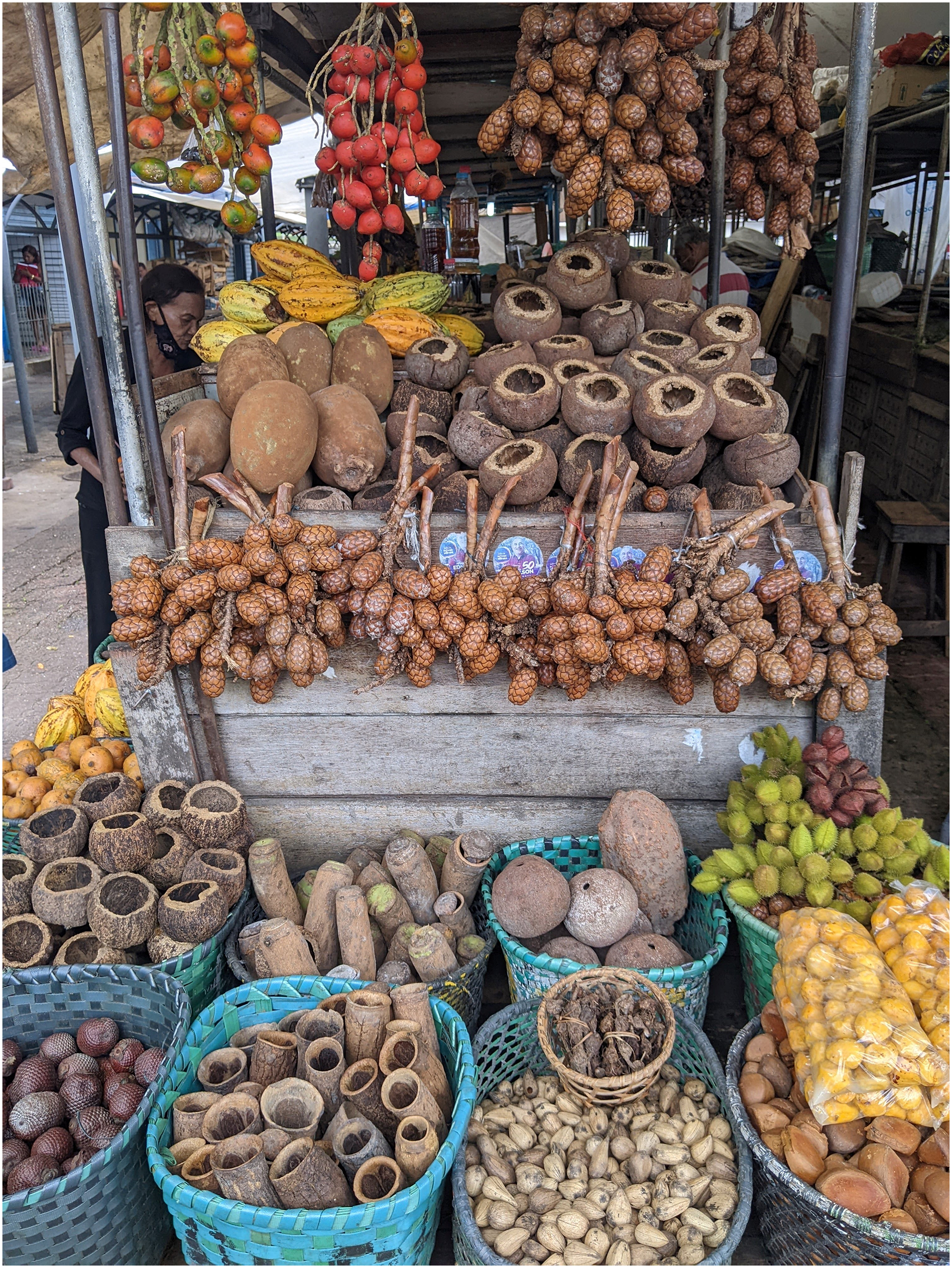
The Ver-o-Peso market in Belem, Brazil, showing a variety of difficult to collect plant materials.
Proposing an Alternative: Photo Vouchers in Ethnobotany
Photo vouchers use photographs rather than botanical specimens to document the presence and identity of a plant in a given locality (Funk et al. 2017). They comprise one or more photographs which, just as in herbarium specimens, show all taxonomic features necessary for unambiguous botanical identification (Funk et al. 2017). Based on our experiments with this method, we recommend at a minimum: (1) close-up photos of flowers, fruit, and inflorescences/infructescences (when present) from multiple angles, (2) photos of stems and leaves showing branching structure (ideally with one leaf turned to show both surfaces), and (3) an overall plant photo showing habit and surrounding habitat. Photos should include an item for scale (field ruler, pencil, coin, etc.), and the normal data accompanying herbarium specimens (scientific name, collector, date, location, notes, etc.) should accompany and be stored with them as metadata or in another stable format (Figure 2).
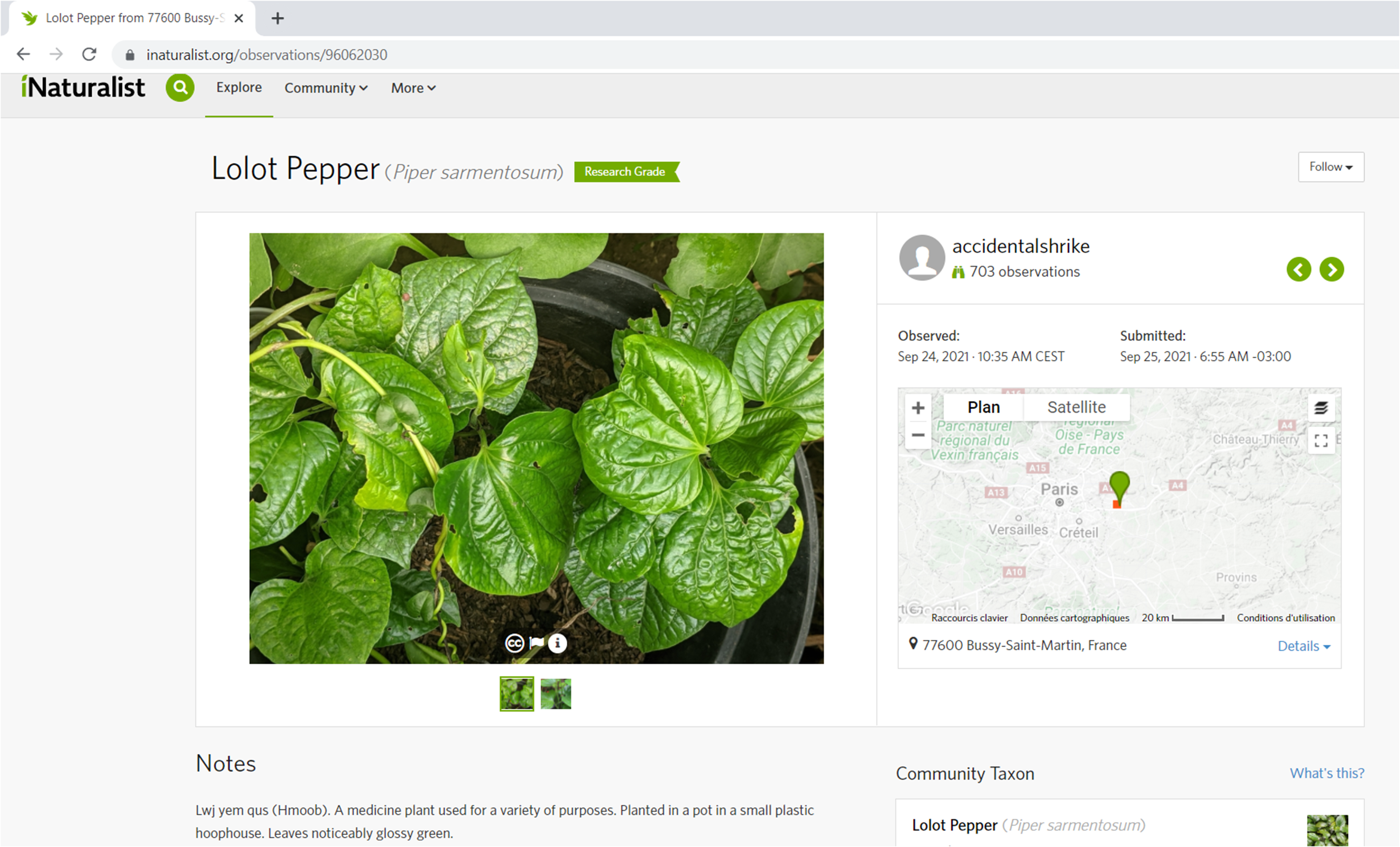
A photo voucher of Piper sarmentosum Roxb. showing URL, voucher code (in URL), identification, date, location, community verification (research grade), and associated notes.
As described in the previous sections, there are many situations where botanical collecting is not an easy and straightforward method to apply. Nonetheless botanical specimens will undoubtedly remain the premier method for determining plant identification, even when issues of access are taken into account. The fundamental advantages of botanical specimens are that they provide physical source material which can be analyzed using DNA barcoding and many other analytic techniques, and that they allow the study of certain morphological characters, particularly those at a small scale like pilosity or details of floral structure, which may be hidden in two-dimensional photographs (Gómez-Bellver et al. 2019). Undoubtedly the best scenario for ensuring plant identification would be thorough and complementary use of herbarium specimens and photo vouchers side by side. Nonetheless the decision on whether to employ botanical specimens, photo vouchers or a combination of the two should be made on a case-by-case basis, as there are countless nuances to research projects, including timelines, funding, field site qualities, equipment availability, logistical considerations, and research team makeup, which will influence the utility of one method or the other.
We recommend that for most highly exploratory ethnobotanical research, meaning projects that work with poorly known floras or with peoples for whom little or no published research exists, herbarium vouchers remain a basic requirement (e.g. Odonne et al. 2013). This is because the identifiability of photographs is by necessity built upon botanical research using specimens, so where there is an absence of published, botanical specimen-verified literature, the use of photographs becomes risky (because the taxa in question might be poorly understood or not fully described). When dealing with poorly known floras, the potential for encountering undescribed species or subspecies is much greater, and until now botanical specimens remain required for the description of new botanical taxa. Ethnobotanical research can also play an important role in sampling undersampled floras, and by doing so assist in expanding botanical knowledge alongside accomplishing ethnobotanical research goals (Odonne, Ogeron and Davy 2017).
The photo voucher method elaborated here is most useful when working with peoples, floras and study locations for which there is already significant published research. Its other prime utility is in providing a standardized method of identification and verification when other circumstances prevent or hamper botanical collecting. For home garden, market and agrobiodiversity studies, considering the utility of photos and the easy identifiability of the majority of plants, we recommend that the requirement for collecting botanical specimens be lifted. For most studies falling within these categories, photo vouchers provide an efficient and appropriate method of identification and verification, and we feel that the decision of whether to use them or botanical specimens should be left up to researchers. For ethnobotanical research with well-known floras, such as in urban areas or much of Europe, the decision of which method to employ should be determined in relation to study structure and goals. However, whenever ethnobotanical research is conducted in SNS, with sacred or magical species, or with endangered species or other protected taxa, photo vouchers should be considered the highly preferred method, with botanical specimens being collected only under rare and carefully managed circumstances.
Utility of Photographs and Automated Identification
Digital photography has revolutionized accessibility, turning photography from a highly technical art into an effortless and universally accessible medium. The ever-improving quality of smartphone cameras makes it increasingly easy to produce high quality photos, which is creating new possibilities for the collection and analysis of field data. A study in the Philippines analyzed the utility of photographs versus herbarium specimens for plant identification: “We identified 72.6% of the photographic sets with high confidence and 27.4% with low confidence or only to genus. In no case was a confident identification altered by subsequent examination of the dried specimen. The failure to identify photographic sets to species was due to the lack of a key feature in 67.8% of the cases and due to a poorly understood taxonomy in 32.2%” (LaFrankie Jr. and Chua 2015). The two reasons for the failure to identify photo vouchers also apply to botanical specimens, explaining why the authors found no advantages to using botanical specimens over photo vouchers for plant identification. Photographs are already used as an ethnobotanical field method (e.g. Odonne et al. 2021), and have been found to be more effective than herbarium specimens in eliciting recognition in study participants (Thomas, Vandebroek and Van Damme 2007).
Photo vouchers are controversial but acceptable in zoology even for describing new species (Donegan 2008; Krell and Marshall 2017) and new occurrence data (Day et al. 2012; Kosterin et al. 2012). In botany they are also increasingly common (Hickman, Yates and Hopper 2017). Two herbaria specialized in succulent plants already include photo vouchers systematically in their collections and give them a catalogue number and specimen label (Gómez-Bellver et al. 2019). The International Code of Nomenclature for Cultivated Plants (ICNCP), the equivalent of ICN for cultivated plants, accepts an image as a nomenclatural standard when essential characteristics are best recognized in drawings or photographs rather than in dried specimens (Gómez-Bellver et al. 2019). Gómez-Bellver et al. (2019) list documentation of large species, succulent and/or spiny plants, toxic plants, withered plants and plants that once pressed and dried lose morphological traits as major advantages of photography as type material. A study investigating the accuracy of different techniques of plant identification when botanical specimens cannot be collected found photo vouchers to be the most effective method (Kiefer et al. 2015).
A widespread, large-scale effort to digitize herbarium specimens and make them publicly accessible is currently underway (Canteiro et al. 2019; Pignal and Pérez 2013; Willis et al. 2017). This process is being accompanied by experiments to develop deep learning techniques for the automated identification of plant photographs (Sun et al. 2017; Unger, Merhof and Renner 2016; Wäldchen et al. 2018; White, Feiner and Kopylec 2006). A system of this kind has been set up at the Smithsonian Institute National Museum of Natural History (Agarwal et al. 2006), and the development of machine learning for plant identification was recently called for in the Science Strategy for 2021–2025 of the Royal Botanic Gardens, Kew (Kew 2021, 45). Nonetheless, a recent assessment of the accuracy of human versus machine learning techniques of plant identification of Amazonian flora found humans far outperforming machine learning models (Joly et al. 2019), further indicating the difficulties of photo vouchers and automated identification for poorly known floras. Beyond botany, the success of photo-based techniques of human facial recognition (Kaur et al. 2020) has indicated the potential of these techniques to go beyond species level to identify individuals. Photographs are already being employed for identification and monitoring of individuals within zoology, for instance with elephants (Kulits et al. 2021), cheetahs (Kelly 2001), chimpanzees (Loos and Ernst 2013), cetaceans (Fearnbach et al. 2012), sea turtles (Reisser et al. 2008) and small birds (Ferreira et al. 2020).
Online Platforms and Crowd-Sourced e-Identification
The digital revolution and the consequent growth of online social networks have given a radical boost to the long tradition of citizen science, where non-professionals contribute to scientific data collection and research. Online platforms and later, smartphone-based applications of those platforms, have provided an incredible accessibility and interactability for citizen scientist networks (e.g. WEB sakana-zukan, a Japanese fish platform operating since 2002; Miyazaki et al. 2014). These platforms fall into one of two categories, those that rely on photographs for data validation (photo vouchers), and those that do not require photographs (trusting observers with identification) and thus use other approaches to data validation. Examples of the latter include eBird, a global ornithological database with hundreds of thousands of observers and millions of observations (Sullivan et al. 2014), and FauneFrance, which collects data on a huge range of taxa throughout the French territories (Zucca 2019).
The premier photo-based online citizen science database is iNaturalist (https://www.inaturalist.org/), a global all-taxa platform where observers upload date-stamped and geo-located photo observations from smartphones. These photos are instantaneously run through a powerful automated identification tool, which suggests possible identifications. Observers can examine and compare their photos with suggestions or other taxa they manually search for before selecting an identification (at any taxonomic level they prefer). Once observations are uploaded, they are immediately accessible for other users to review and verify by confirming the original identification, refining it, or disagreeing and offering an alternative identification. Observations that fulfill a set of criteria, including having multiple users agree on the identification, are classed as ‘research-grade’; others remain at ‘needs ID’ or ‘casual’ (Horn et al. 2018).
This powerful data proofing and verification process has made iNaturalist useful for research purposes. A study using iNaturalist with trained volunteers to survey amphibians found that 82% of observations could be verified to species level and 100% of research-grade observations were correct (Wittmann, Girman and Crocker 2019). iNaturalist observations have led to the discovery of new insect taxa (Winterton 2020), and significantly contribute to mapping of threatened and endangered species (Mesaglio and Callaghan 2021). Another series of other platforms focus specifically on plants, including the most well-known, Pl@ntNet (https://plantnet.org/), as well as CONECTe (https://conecte.es/index.php/es/) for Spain (Reyes-García et al. 2021), PlantSnap (https://www.plantsnap.com/; Otter, Mayer and Tomaszewski 2021) and LeafSnap (http://leafsnap.com/; Bonnet and Frame 2015). Since 2011, the LifeCLEF project has brought together tens of research teams to regularly test and improve automated plant photo identification techniques using large datasets drawn from Pl@ntNet (Bonnet et al. 2016; Goëau, Bonnet and Joly 2017).
These photo voucher platforms, particularly iNaturalist and Pl@ntNet, are already being employed in botanical research. Research-grade iNaturalist observations have been incorporated into Global Biodiversity Information Facility (GBIF) since at least 2015 (Gardiner and Bachman 2016). Other uses include vegetation mapping (Uyeda, Stow and Richart 2020), for the development of the atlas of Russian flora (Seregin 2021), for invasive species distribution modeling (with Pl@ntNet, Botella et al. 2018; Le Bourgeois and Soubeyran 2012) and for the extraction of plant trait data (Schiller et al. 2021). iNaturalist is also becoming popular in schools and training programs (Echeverria et al. 2021; Vanderplank et al. 2020).
e-Deposition
Although the use of photo vouchers is becoming more common in research, their deposition in permanent repositories is still fairly underdeveloped. Affouard et al. (2021) lay out a process for using iNaturalist Projects to curate photo vouchers in specific data sets. Heberling and Isaac (2018), in advocating for the use of photo vouchers alongside botanical specimens, go one step further by describing how photo vouchers organized in iNaturalist Projects can be associated with physical herbarium specimens by the use of QR codes printed on herbarium specimen labels. We are in the process of experimenting with iNaturalist Projects to store collections of photo vouchers for home garden surveys in the Hmong diaspora (Figure 3), and surveys of toxic plants in nurseries in French Guiana. However, there is still no standard method for the deposition of photo vouchers that can integrate all platforms as well as researchers’ offline photos (Gómez-Bellver et al. 2019), and the need for such a system is rapidly growing.
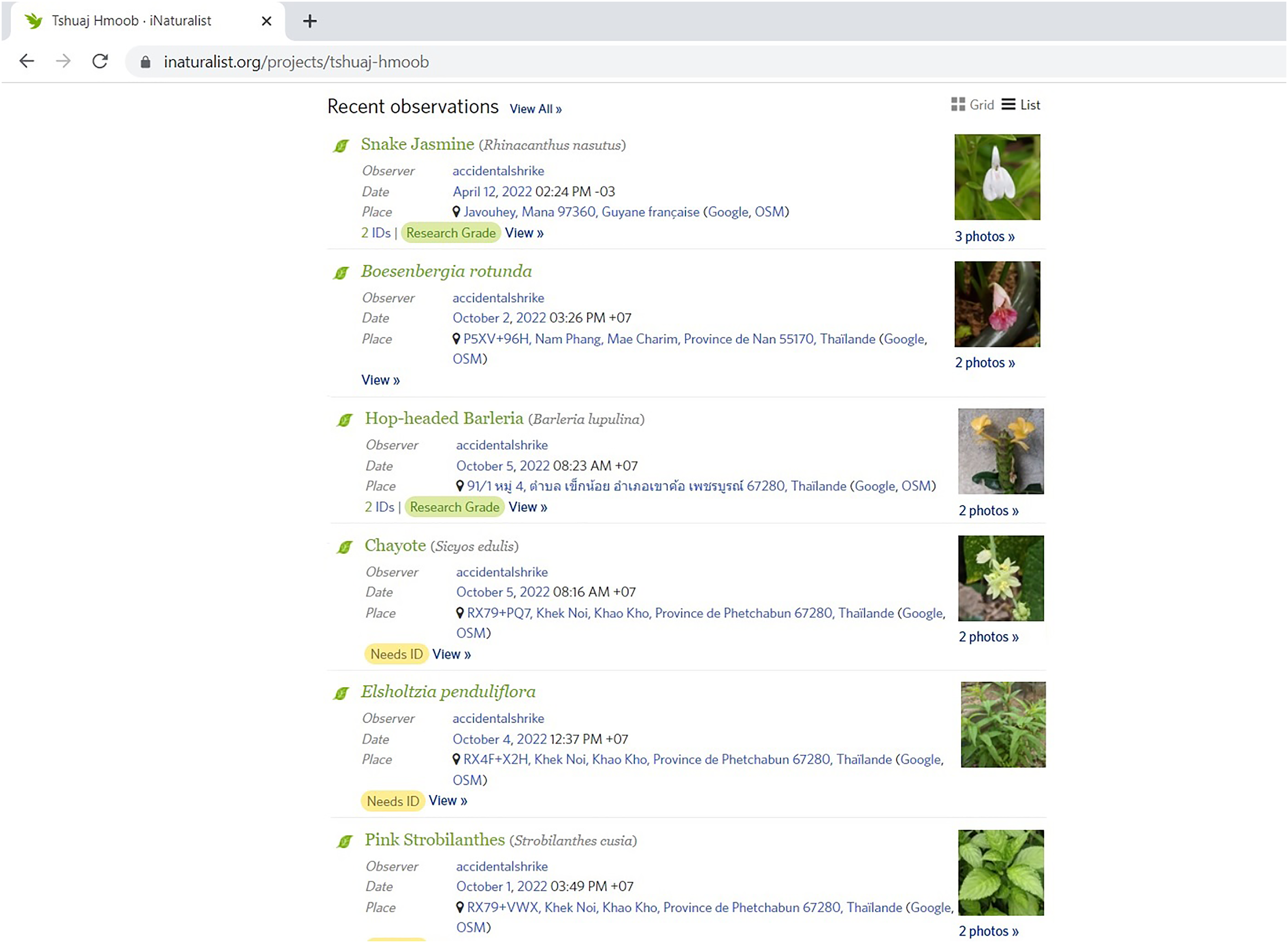
A screenshot of the iNaturalist project ‘Tshuaj Hmoob’, which compiles photo vouchers for a project on Hmong ethnobotany.
To be ready for deposition, each photo voucher should be identified by a unique code similar to a botanical specimen number. These photo voucher codes can then be referenced in tables in publications, alongside or in lieu of specimen numbers. Observations in iNaturalist automatically receive such a code, and projects can be used to export these codes along with other metadata (location, date, etc.). Additional data, including description, local names, and use, can be entered in a Description field for each observation. If photo vouchers are not managed through a platform like iNaturalist or Pl@ntnet, they should be assembled in photosets (.rar, .zip, etc.), which can then be made available either as supplementary data provided by scientific journals, or hosted on public digital free repositories such as Dataverse (https://dataverse.harvard.edu/).
Conclusion
Botanical specimens undoubtedly remain the ideal method for identifying plants. However, the host of challenges associated with botanical collecting clearly calls for the development of other complementary methods, and we argue here that photo vouchers provide an efficient and effective alternative. Photo vouchers have several key advantages over botanical specimens:
They can be collected in situations when botanical specimens cannot. They are highly efficient in terms of space, time, and effort. They are easy to share and can greatly increase access to data. They can increase efficiency of identification by employing machine learning and crowd-sourcing techniques.
When questions around the deposition of photo vouchers and their integration with existing herbarium collections are solved, this method has the potential to both streamline certain kinds of data collection and greatly augment botanical and ethnobotanical research. Eugene Hunn is quoted in Martin's (2004) ethnobotany methods manual explaining that the value of botanical specimens in ethnobiology is to serve as the link between two bodies of knowledge, local and academic, as well as the link between two academic disciplines, ethnography and botany. This critical linking function is maintained by the use of photo vouchers, and it is for this reason that we promote their use as a new method in the field of ethnobotany.
The question of access is key (Canteiro et al. 2019). The collection and deposition of botanical specimens in herbariums historically emerges out of the colonial process and continues to feed imbalances in the power of information access between the Global North and Global South. In the interest of democratizing ethnobotanical data as part of the ongoing struggle to decolonize the field, we argue that photo vouchers offer an approach ideally suited to integrate the painstaking hands-on work of traditional botany with the ever-more-rapid development of technologies of observation and exchange. As more and more botanical collections are decentralized rather than concentrated in the Global North, photo vouchers offer an important tool to verify published data across administrative and national borders. They also offer an excellent possibility for easy diffusion of results to study participants, as well as a method of collaborative research, as highlighted in recent ethnobotanical studies using photo vouchers created by Nahuatl (Amith 2013) and Taruma and Wapichan local partners (Holt 2021).
Ethnobotanists have a long tradition of close collaboration with taxonomic botanists, the expert knowledge holders who often ensure the accuracy of our results. Photo vouchers can increase the accessibility of ethnobotanical datasets far beyond a small team of herbarium curators to the global community of botanical experts. At the same time, the final word on whether to employ photo vouchers or botanical specimens in a given study may best rest with the expert botanists of the region in question, who are well-equipped to assess the degree of existing knowledge about the flora to be sampled. We hope that the use of photo vouchers will begin to be accepted as a valid method in ethnobotany, as it is already becoming accepted in other disciplines, and that its scope and utility will be further elucidated as it enters into active use in the field.
Footnotes
Acknowledgements
Thank you to three anonymous reviewers and Dr Olwen Grace for their constructive comments on this manuscript.
Declaration of Conflicting Interests
The author(s) declared no potential conflicts of interest with respect to the research, authorship, and/or publication of this article.
Funding
This work was funded by an “Investissement d’Avenir” grant managed by the Agence Nationale de la Recherche (Labex CEBA: ANR-10-LABX-25-01) and by the Prime80-DiaspoREs projects from the CNRS “Mission pour l’Interdisciplinarité et les Initiatives Transverses” (MITI).