




Abstract
Culture constitutes a core condition for human experiences, and it was often assumed that higher collectivism/lower individualism are typical for Asian as compared to European cultures. Evidence, however, was ambiguous. In the present study (N = 79), we studied whether collectivism in preferences is seen in terms of a relatively higher level of shared tastes. We employed beholder indices/taste typicality to compute private taste from aesthetic evaluations for different classes of visual images of Japanese and European participants. Collectivism for each participant was measured through a standard scale based on participants’ opinions towards their peer group. No difference in collectivism measure between the two populations was found. However, congruence in personal taste meaningfully differed between cultures, showing higher shared taste in Japanese participants for artistic stimuli. These effects reached beyond comparisons by individual collectivistic tendencies. While these findings require replication with larger samples, they point towards meaningful differences in group norm adherence between cultures.
Data and Code Availability
Introduction
For most of us, life is, in some manner, composed of (cultural) group memberships and interactions with others, which often come with specific, often implicit rules, expectations, or values. For example, cultural belongingness might determine how we construct our emotions and evaluate our psychological states and environment (Barrett, 2013). Different levels of conformity or collectivism have been argued to play a central role in cultural groups and culturally determined attitudes, behaviors, and rules.
Collectivism and Individualism
Initially proposed by Hofstede (Hofstede & Bond, 1984; Lonner et al., 1980), the concept of collectivism has inspired research over decades; initially, in organizational research, the term describes the beliefs and behavioral tendencies of the individual toward the group. High collectivism is supposed to be associated with a strong orientation of one's beliefs and actions towards one's reference group. Later, these were generalized as country-level cultural markers, differentiating countries into groups with higher or lower average expressions of collectivism, leading to research concerned with group differences in collectivism and/or individualism (e.g., Lu et al., 2021; Smith et al., 1998; Tower et al., 1997), and the development of models on a conceptual level (e.g., Conway et al., 2001; Green et al., 2005; Kashima et al., 1995; Matsumoto et al., 1996; Triandis, 2001; Vandello & Cohen, 1999; Yamaguchi et al., 1995; Yamawaki, 2012). However, the main hypothesis that high collectivism is associated mainly with Asian cultures, as opposed to individualism associated with Western cultures, is under debate. Moreover, contrary to the theory's prominence, a meta-analysis only found small effects (Oyserman et al., 2002). Also, conceptual difficulties emerged. Earley and Gibson (1998; see Matsumoto & Yoo, 2006; Voronov & Singer, 2002) summarized several questionable aspects of the published research, such as confusions and generalizations of measurement levels between society, group, and individuum, an overly diverse sets of measurement tools as well as an overly deterministic perspective.
Aesthetic Perception as a Function of Individuum and Culture
Perceiving and appreciating art is commonly conceptualized as a highly idiosyncratic act (Vessel & Rubin, 2010; Wallisch & Whritner, 2017). However, our personal tastes and preferences are not independent of our environment and learning history (Hönekopp, 2006; Leder et al., 2004, 2016; Schabmann et al., 2016). Hence, individuals potentially differ in the extent to which group norms of aesthetic appreciation influence their own aesthetic experience.
Based on this hypothesis, the coherence of aesthetic judgments might differ between countries as a function of their collectivistic tendencies if these differences in group orientation exist in the first place.
Suppose norms of aesthetic appreciation are perceived as more binding. In that case, the role of individual taste should be smaller compared to less collectivistic countries, in which group norms are less influential on personal evaluative processes. Further, quantifying differences in the coherence of aesthetic judgment is likely less biased by socially expected answering behavior, as it might be in self-report questionnaires.
However, differences in personal taste can be expected between cultures and as an interaction with the perceived stimulus. Prior studies have shown that different stimulus categories show different amounts of congruence in aesthetic ratings between the individual and the group. For example, Honekopp (2006) showed across multiple experiments that ∼50% of aesthetic perceptions of faces were explained by personal taste, while Leder et al. (2016) showed that abstract art ratings depended on personal taste by around 70%, showing high idiosyncrasy in this stimulus class. The finding that the importance of personal taste varies between stimulus classes was further replicated for several other domains (Bronstad & Russell, 2007; Chen et al., 2022; Kramer et al., 2018; Martinez et al., 2020; Specker et al., 2020a; Vessel et al., 2018).
These differences between stimulus classes are likely products of adaptive biological processes and cultural imprints. Artworks are culturally determined products. Across long historical periods, humans express themselves in craftwork and art and make them tangible across generations. The way artworks are constructed, the style in which paintings are painted, and the context considered appropriate (Leder et al., 2004; Leder & Nadal, 2014; Pelowski et al., 2019) can all be elements of cultural identity. These differences in appreciation manifest in different cultural domains like art (Chamorro-Premuzic et al., 2010; Chan et al., 1980; Feist & Brady, 2004; Furnham & Walker, 2001; Mastandrea et al., 2021; Wang & Ishizaki, 2002), and landscapes (Buijs et al., 2009; Jacques, 2021; Yang & Brown, 1992).
Apart from the cultural imprint, studies also found regularities in individual differences, such as art expertise (Reiter, 2009), associated with higher personal taste within aesthetic judgments. Further, people with typical tastes (relative to the group average) in the visual domain also tend to have typical tastes in the auditory domain (Chen et al., 2022). Furthermore, twin studies suggested that genetics plays a small but significant role in individuals’ visual taste typicality (Bignardi et al., 2024).
Measurement of Shared and Personal Taste
Different approaches to quantify personal taste in aesthetic appreciation have been developed. The present project focused on two of them (beholder indices and taste typicality 1 ). Beholder indices (Hoenekopp, 2006), 2 quantify in percent how much of the variance in ratings is based on a person's private taste. The remaining share is to be accounted as shared taste with the group. If the computation of beholder indices in a group would result in bi1 = .60, 40% of the rating would be interpreted as the group's shared taste. These proportions are not computed on the person's level but on the group level, as they require the individual's and group's ratings. To compute the indices, two measurement sessions are required to record the individual's agreement with the group and itself. The computation requires the variance components of the interaction terms between the individual and the presented stimulus and the components of the stimulus alone. Taste typicality (Chen et al., 2022) is computed on the individual level. The computation requires within-subject z-scores across stimuli and does not require a second assessment. The individual z-scores are correlated with the averaged z-scores of the remainder of the sample. The correlation coefficient is the taste typicality score for the given participant.
Present Study
Following the assumption that aesthetic appreciation is influenced by cultural background, the present study used this mechanism to investigate differences in group coherent behavior (collectivism) between cultures (here, Japan and Austria), which are assumed to differ in this dimension.
Compared to self-report assessment, the benefit of using this indirect metric of group norm adherence lay in the absence of direct confrontation with collectivism-related statements, potentially triggering socially expected answering behavior.
Following prior research, we expected I) differences in an established self-report scale on collectivism (Yamaguchi et al., 1995) (Austria > Japan), II) differences in personal taste shares in aesthetic judgments (Austria > Japan), and III) variation of personal taste shares between stimulus classes.
Method
Participants
Based on earlier findings by Leder et al. (2016), reporting d = 1.61 for a comparable research question and accompanying recommendations by Perugini et al. (2014) regarding safeguard power computation, we based our power analysis on d = .65 to buffer against the exploratory nature of the intercultural advances (alpha = .05, power = .80, two-sided). A minimum sample size of N = 78 was computed (Faul et al., 2009; Lenhard & Lenhard, 2017). The sample consists of 79 participants (51.89% Japanese) with a mean age of 23.68 years (SD = 4.39). 58.22% identified best as female, the rest as male, none of the participants identified with a different category. All Japanese participants identified best as Asian, all European participants as European.
Measures
Collectivism. The 14-item scale by Yamaguchi et al. (1995) was used. It was designed to evaluate one's regular behavior and thoughts towards groups and group-situations (“I sacrifice self-interest for my group”, 1 = not at all, 7 = absolutely). Ten items indicate a more collectivistic tendency with higher agreement, four items indicate the opposite and were reversed prior to data analysis (α = .81).
Art interest. The Vienna Art Interest and Art Knowledge scale was applied (Specker et al., 2020b). Only the subscale regarding art interest (not the parts specifically regarding knowledge of western art) was used to exclude culture-dependent biases. It consists of eleven items, measured on a scale from 1 to 7 (α = .91). Seven items evaluate the agreement to certain statements (“I enjoyed visiting art class in school”, 1 = not at all, 7 = absolutely). Four items ask the participants about the frequency of certain art related behavior (“How often do you visit art museums or art galleries on average?”, 1 = less than once a year, 7 = once a week or more).
Stimuli. A set of 160 pictures has been chosen for the study. For each of four stimulus categories (abstract paintings, landscape paintings, faces and aversive photographs 3 ), 40 pictures. Apart from the aversive pictures, half of the stimuli were of Asian origin, the other half of western origin. The abstract art was searched online by LR and HL. It was tried to match the appearance as closely as artworks were available. The Japanese landscape art was searched on a specialized website (https://ukiyo-e.org/). After retrieval, LR and HL searched for matching western landscape art, to the extent of available artworks. The pictures of the western faces were retrieved from the Chicago Face Database (CFD, Ma et al., 2015), and those of the Japanese faces were originally photographed in the lab setting by HK. We selected photos with indicated Asian or Caucasian origin and neutral facial expression. The aversive stimuli were sourced from the International Affective Picture System (IAPS, Lang et al., 2008). The pictures were rated for liking (abstract, landscape, and aversive, 1 = don’t like it at all, 7 = like it very much) or attractiveness (faces, 1 = not at all attractive, 7 = very attractive) by the participants. All pictures have been scaled to the same pixel dimensions as in Hoenekopp (2006) and Leder et al. (2016). Reliabilities ranged from α = .95 (abstract art) to α = .97 (landscape art and faces). Mean retest reliability between T1 and T2 was r = .724 Table 1.
Example Stimuli by Category and Cultural Origin.
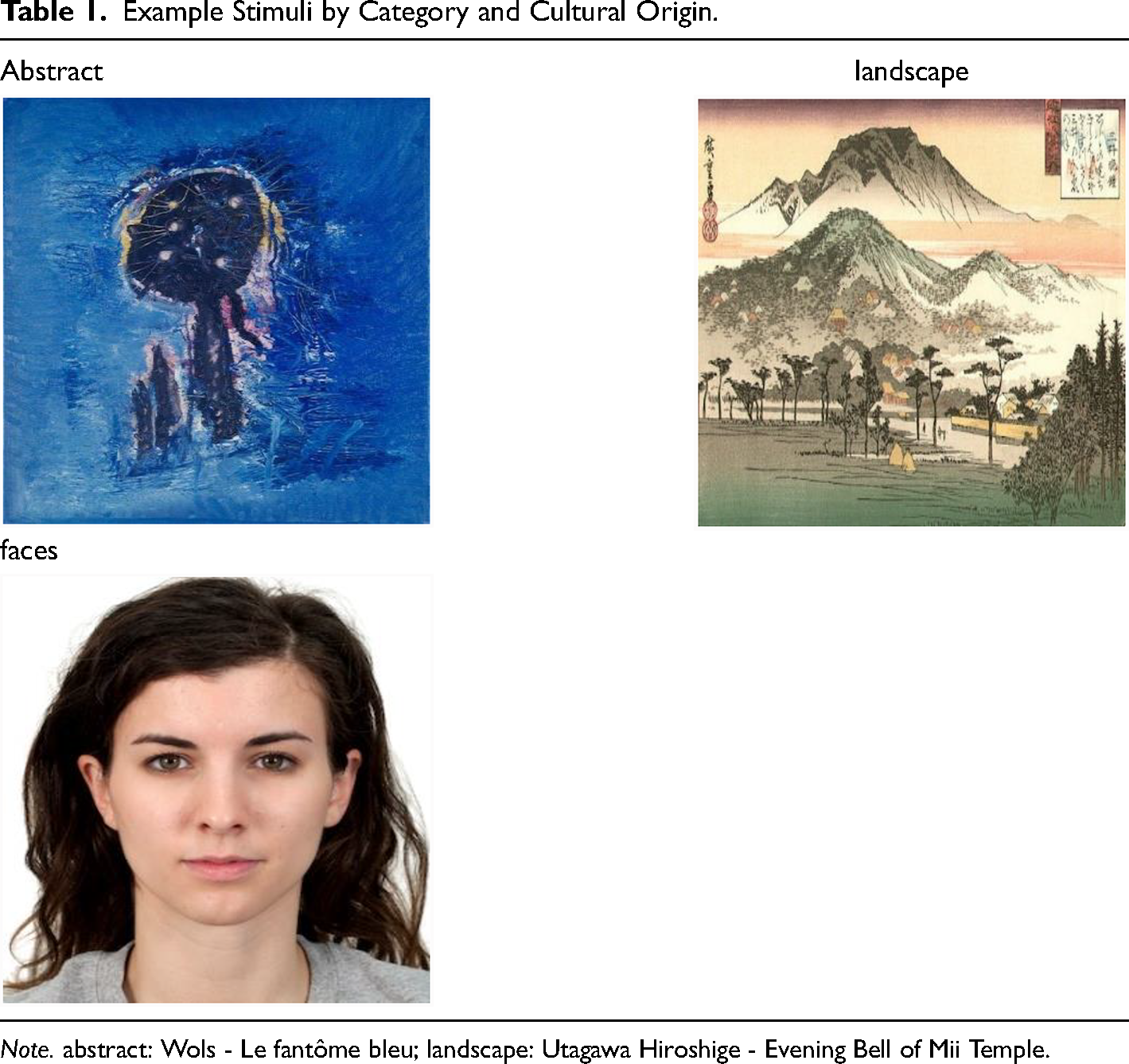
Note. abstract: Wols - Le fantôme bleu; landscape: Utagawa Hiroshige - Evening Bell of Mii Temple.
Translation. All scales and instructions have been translated from German to English by LR. All scales are available in English, Japanese, and German in the supplemental material. The scale for collectivism was previously translated to German by Yanagida (2009). The questionnaires and experimental instructions have been translated and reviewed by a Japanese native speaker with psychological training on post-graduate level from English to Japanese. HK counter-checked the translation.
Design and Procedure
Originally planned as laboratory study at the University of Vienna, Austria and Keīo University, Japan, the design was transferred to an online study (Labvanced, Goeke et al., 2017), due to infection control regulations in January through April 2021. In order to compute beholder indices (Hoenekopp, 2006), two sessions are needed, as they require variance measures within the rater across time. After the subjects’ agreement on participation and written explanation of the procedure, the stimuli were presented in a balanced block-wise manner by class and a randomized order within. First, the respective block was presented to the participants with 2 s for each picture to avoid order effects. Afterwards, the stimuli have been presented again to be rated. To account for the online design and buffer against technical irregularities, participants have been instructed to answer fast and based on their immediate feelings, but without a specific time limit. After the rating phase, the next block started with passive presentation in the same manner, until all blocks were rated. Session one further included the questionnaires and demographic questions. Sessions one and two were planned to be five to seven days apart. Due to the reduced controllability, the link for session two has been issued five days after the completion of the first and a reminder has been sent out three days after. No financial or other compensation was offered to the participants, all individuals indicated to be above the age of 18 years, before beginning the study. Participants have been included in the analysis, if both sessions have been successfully completed. After completed data collection in Europe, the aversive stimuli have been excluded from the study in Japan, due to their unpleasantness. The results regarding this stimulus category are only based on European participants.
Data Analysis
Self-Report Data
The data on self-reported collectivism between Japan and Europe were compared using Welch's t-test. Further, personal taste/taste typicality was compared by median collectivism. The influence of Art interest was assessed, using random-intercept multi-level modeling with random intercepts for participants and the interaction of stimulus class and culture and the main effect of art interest as fixed effects (using T1 data).
Personal Taste Scores
The beholder index
4
(bi1, Hoenekopp, 2006) quantifies the percentage of variance in an aesthetic rating, which is accountable to private taste. The remainder corresponds to shared taste. The score is computed on the group level through variance components across the two measurements as it accounts for the agreement between individuum and group as well as for the agreement between individuum and itself. The computation requires the variance components of the interaction terms between the individuum and the presented stimulus and the components of the stimulus alone. Hence, a bi1 = .60 indicates that 60% of the group's ratings were based on private taste while 40% were based on the shared taste between the individuals. The formula for the score was:
Taste typicality 5 (Chen et al., 2022) is computed on the individual level and does not require a second assessment. The computation requires within-subject z-scores across stimuli. Individual z-scores are correlated with the averaged z-scores of the remainder of the sample. The correlation coefficient represents the taste typicality score for the given participant. We computed the score in both measurements to assess, if the results replicated over time.
Since taste typicality assesses the congruence with the group while beholder indices quantify the amount of private taste, we computed shared taste scores (1- bi1) to make the results more comparable. All computations are documented in the supplemental material.
Results
Differences in Collectivism: Self-Report Data
While Japanese participants showed slightly higher mean scores (M = 2.94, SD = 0.48), than the European sample (M = 2.75, SD = 0.49), the respective Welch's t-test was not significant (t(76.303) = -1.687, p = .095, d = −.39, 95% CI of d [−.83; .07]). Thus, contrary to prior assumptions, no significant difference in collectivism was found between the Japanese and European participants Figure 1.
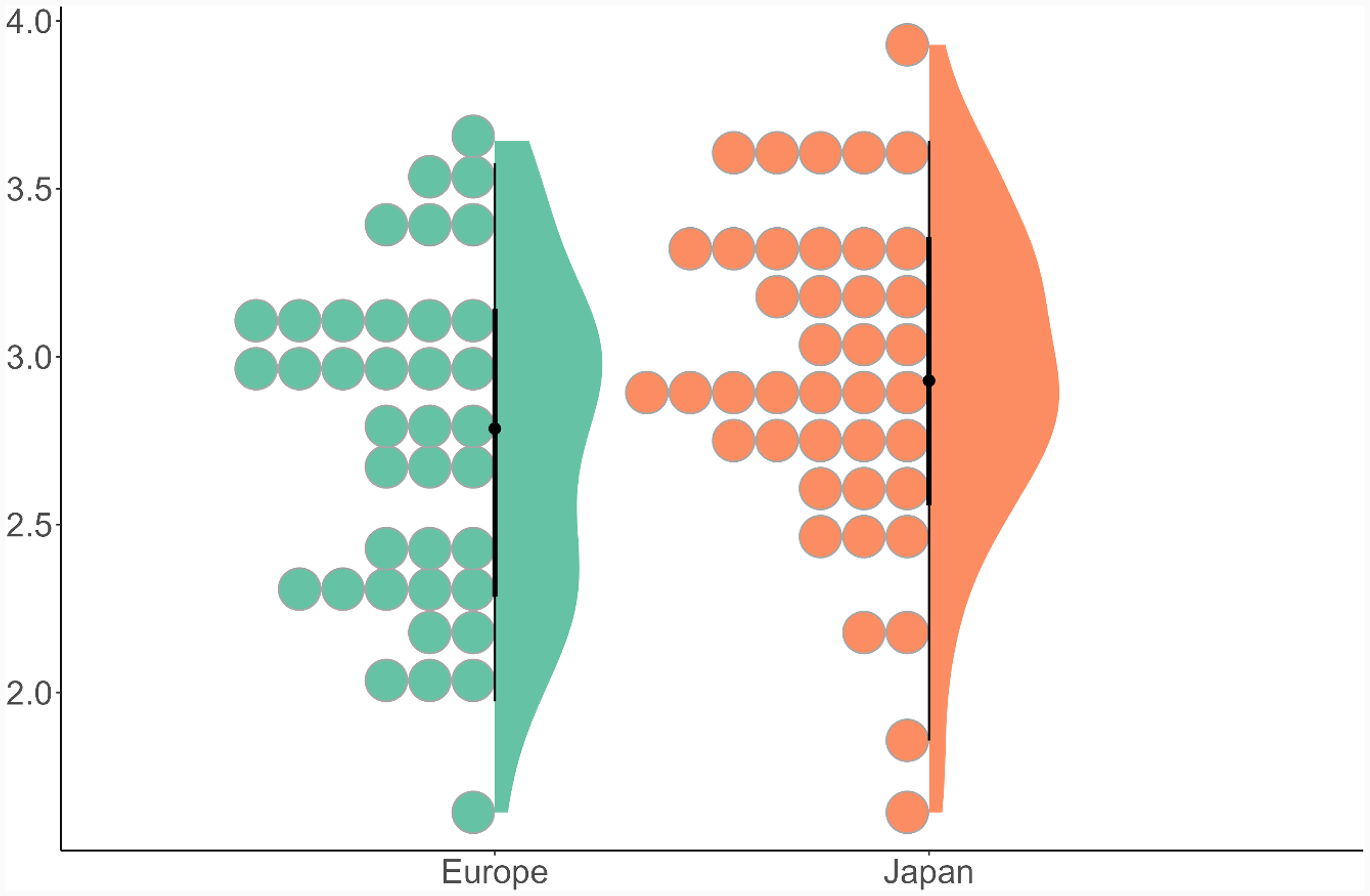
Mean collectivism by culture.
Note that the sample size likely influences the absence of a significant finding, as we target a meaningfully larger effect based on the prominence of the collectivism paradigm.
Differences in Collectivism: Beholder Indices and Typicality
Even though the self-report data did not indicate significant differences between samples, we conducted comparisons between cultures for personal taste shares and taste typicality. Further, we replicated the analysis for taste typicality in the second measurement, as this score doesn’t require repeated measure design, unlike beholder indices. As evident in Figure 2, beholder indices and both computations of taste typicality produced identical patterns. In all three scenarios, shared taste/typicality was lowest for landscape art (within country) and highest for faces with abstract art in between categories. Further, Japanese participants consistently showed higher shared taste/typicality in artistic stimuli and European participants for faces.
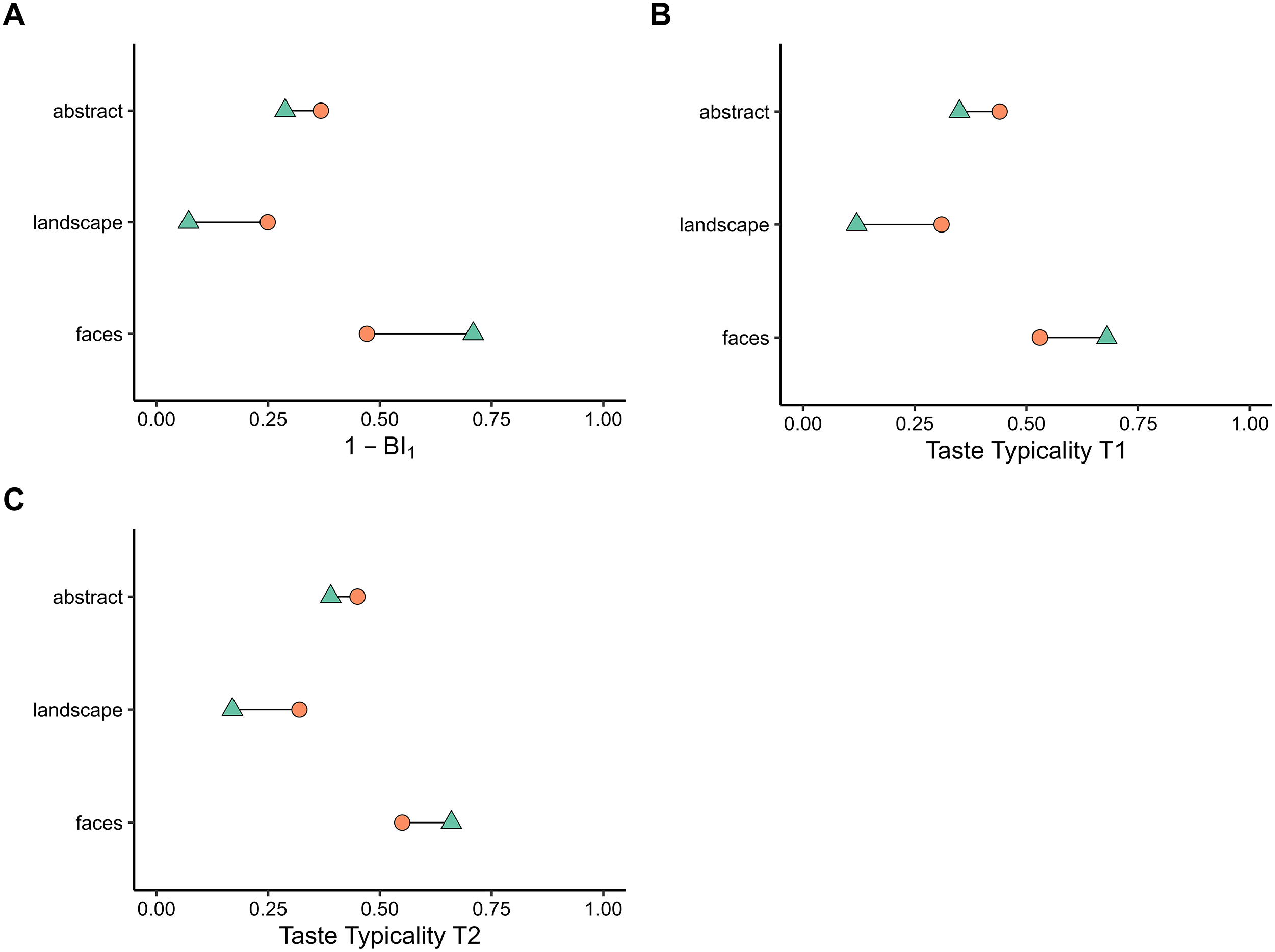
Beholder indices and taste typicality (T1 and T2) by culture.
Japanese and European participants differed in their beholder indices by 8% for abstract art, 17.7% for landscape art, and 23.8% for faces. In the first assessment, mean typicality scores differed significantly between cultures in all categories (abstract: p = .014, d = -0.61, 95% CI [-1.09, −0.13]; landscape: p < .001, d = -0.97, 95% CI [-1.45, −0.49]; faces: p < .001, d = 1.22, 95% CI [0.63, 1.80]) with medium to large effects (Jané et al., 2024). Similar results were replicated in the second assessment (abstract: p = .112, d = -0.37, 95% CI [-0.82, 0.09]; landscape: p < .001, d = -1.00, 95% CI [-1.48, −0.52]; faces: p < .001, d = 0.81, 95% CI [0.33, 1.27]), except a non-significant difference for abstract art.
Individual Differences in Collectivism: Beholder Indices and Typicality
The same analysis was repeated by median collectivism, grouping participants in higher or lower individual expressions of collectivism. As evident from Figure 3, the pattern remained consistent, yet the difference was considerably smaller than by culture.
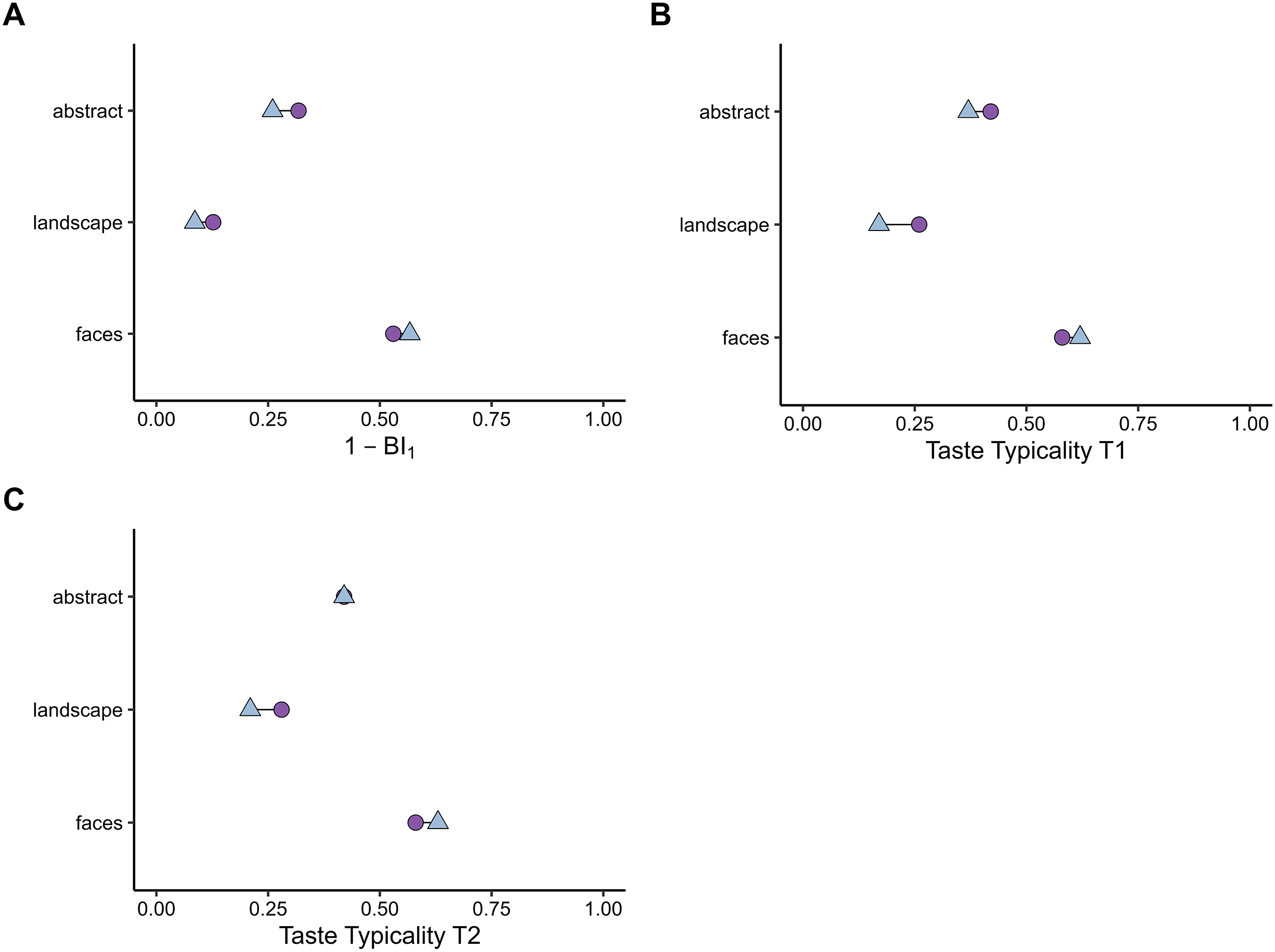
Beholder indices and taste typicality (T1 and T2) by collectivism.
In private taste, groups differed by 5.8% in abstract art, 4.1% in landscape art, and 3.7% in faces. None of the typicality ratings differed significantly between groups. Neither in the first assessment (abstract: p = .196, d = -0.31, 95% CI [-0.77, 0.03]; landscape: p = .060, d = -0.46, 95% CI [-0.93, 0.02]; faces: p = .342, d = 0.22, 95% CI [-0.24, 0.69]), nor in the second (abstract: p = .830, d = -0.05, 95% CI [-0.51, 0.40]; landscape: p = .073, d = -0.41, 95% CI [-0.87, 0.04]; faces: p = .200, d = 0.30, 95% CI [-0.16, 0.75]). These results indicate differences between stimulus classes but highlight that differences in individual collectivism were not associated with significant differences in taste typicality.
Art Interest as a Covariate of Taste Typicality Between Cultures
The multi-level analysis with random intercepts for participants showed no significant influence of individual art interest (p = .401, β = −.05). The overall model explained a large share of variance in taste typicality (R2marginal = .506) with some variance explained by individual differences (R2conditional = .609, ICC = .21) beyond the fixed effects. Stimulus type and culture reached significance as main effects, and the interaction of typicality in face ratings and culture was significant (p < .001, β = −.50), indicating significantly lower taste typicality for faces for Japanese participants. The full regression table is available in the supplemental material.
Discussion
Summary
The current study tested whether collectivism is a function of cultural origin, operationalized by comparing Asian (Japan) and European (Austria) participants; we aimed to measure whether differences in the level of collectivism are seen in (lower) shares of personal taste in aesthetic judgments. We collected data from Japan and Austria, with the former stereotypically known as a country with a higher group orientation. Europe was chosen as a possibly more individualized culture.
Contrary to earlier findings, we did not observe a statistically meaningful difference in self-reported collectivism between the groups. However, we observed robust differences in private taste/taste typicality between cultures for different stimulus groups. Hence, differences in the congruence of aesthetic judgments can be observed between cultures. Specifically, Japanese participants showed less private taste/more taste typicality in abstract and landscape art. European participants showed more congruent ratings for face stimuli. Moreover, we did not observe that art interest was a significant covariate of taste typicality.
Private Taste Shares as Function of Stimulus Class
Prior work has shown that personal taste shares in aesthetic judgments vary between stimulus categories. Ratings of abstract art contain higher shares of personal taste compared to faces (Leder et al., 2016). Landscape art is even more based on personal taste than abstract art (Reiter, 2009). Both of these findings have been replicated in the current study. The assessment of all three stimulus categories in one study offers a novel contribution to understanding the interplay of individual differences and different classes of aesthetic objects.
Beholder Indices and Taste Typicality
We applied two common ways of quantifying the amount of personal taste within the rating of a given stimulus (beholder indices and taste typicality). 6 Both scores converged at highly similar interpretations. Nevertheless, taste typicality scores hold two benefits, which we would like to highlight for future studies. First, while beholder indices require a repeated measure assessment, taste typicality can be computed on cross-sectional data, which allows more economical and broader data collection. Second, beholder indices produce group-level percentages, while taste typicality scores are computed individually. Hence, they can be used for statistical comparison and the computation of effect sizes, delivering more complete answers to given research questions.
Collectivism: Individual or Cultural Difference?
We aimed to assess collectivism from different angles, using self-report and behavior (aesthetic judgment). While the difference in the self-report scale between Japanese and European participants did not reach significance, this was likely attributable to the smaller-than-expected observed effect (d = 0.39). Given the prominence of Japan as a country of high collectivism, a stronger effect would have been expected (Oyserman et al., 2002).
On the other hand, aesthetic judgment was more sensitive to the cultural differences between Japan and Europe, leading to large differences in taste typicality (e.g., d = -0.97 for landscape art). These differences showed that Japanese participants were more congruent in their aesthetic judgments than European participants, even though the difference on the self-report scale was small and non-significant.
Last, we tested whether individual differences in collectivism, disregarding the culture, would produce similar differences in private taste/taste typicality. This analysis led to meaningfully smaller effects. Triangulating these findings indicates differences in behavioral congruency between Japan and Europe, disregarding the self-reported expression of collectivistic beliefs and tendencies.
Limitations and Future Directions
The main limitation of the current study is its considerably small sample size. Future studies, which potentially focus on taste typicality (Chen et al., 2022) and hence do not require a repeated measure design, should aim to replicate and extend the present findings. However, the present study was built on a conservative sample size estimation, using an established procedure against effect inflation (Perugini et al., 2014). Given that the collectivism effect was much smaller than anticipated, future studies should aim for sufficient power at small effects. Further—while Japan is the most commonly studied country in collectivism (Oyserman et al., 2002)—the present study only collected data from two cultures. This inherently limits the generalizability of the present findings and offers interesting extensions for future research. Further, to better understand the formation of aesthetic evaluations, including physiological (Pelowski et al., 2018) and subjective (Leder et al., 2004) data could be meaningful on the intercultural level.
Conclusion
Based on the given findings, we have shown two key findings. On the one end, collectivism was not a function of country differences on the self-report level (and the effect size was small). Rather, it could serve as an informative trait variable on the individual level. Nevertheless, culture strongly predicted differences in personal taste and taste typicality. We conclude that behavioral measures might be a sensitive alternative to assess intercultural differences. However, more conceptual work is needed to conclusively identify the processes between these differences.
Footnotes
Declaration of Conflicting Interests
The authors declared no potential conflicts of interest with respect to the research, authorship, and/or publication of this article.
Ethics
All procedures of the described experiments were in accordance with the Declaration of Helsinki on ethical research practices.
Funding
The authors received no financial support for the research, authorship, and/or publication of this article.
