




Abstract
While art, nature, and social interactions are key elements of a healthy culture and lifestyle, how nature and social factors in paintings impact the viewer experience still remains unclear. This study aimed to explore how the number of depicted people, the presence of interpersonal touch, and the setting (indoor vs. outdoor) affect art preference. A total of 420 paintings were rated (online survey) on their liking across 300 participants. Across participants, paintings without people were significantly liked over paintings with people, which was especially prominent in depictions of outdoor settings. Furthermore, while people liked paintings without touch, this was only the case for paintings of outdoor depictions. The study also explored how these preferences were modulated by individual differences. The findings underscore the relevance and importance of social aspects in art and how this interacts with the viewer's individuality.
Keywords
Introduction
Previous works have explored the predictors of painting preference by examining painting style (Augustin et al., 2008; Fairhall & Ishai, 2008) and low-level visual features such as self-similarity, color, spatial, and luminance statistics (Altmann et al., 2021; Graham & Redies, 2010). However, relatively less attention has been given to the roles of painting content on preference (e.g., Di Dio et al., 2016; Wypijewski, 1997). This is despite the fact that content appears alongside style in major models of aesthetic experiences (e.g., Leder et al., 2004) and often takes precedence over style in various perception and decision-making processes with art stimuli (Augustin et al., 2008; Augustin et al., 2011; Murphy & Shuwairi, 2019). From an art historical perspective, a painting's content can be understood to represent the meaning and recognizable elements in the artwork, and, therefore plays an integral role in the viewer's experience of it (Pepperell, 2011). For these reasons, the study of painting content not only comments on existing knowledge in empirical aesthetics and art history but also provides an important framework for how people engage with paintings.
The present work specifically focuses on the role of social content. It builds on previous research in human vision, which reported the perceptual uniqueness of social stimuli. For example, studies in neuroscience have reported on the fusiform face area (FFA) and the extrastriate body area (EBA), which uniquely respond to the vision of human faces and bodies respectively (Calder & Young, 2005). It is also understood that social information receives preferential visual attention, via the mirror neuron system (Spunt & Lieberman, 2013; Su et al., 2016). In addressing social content in painting, the work also complements existing research on empirical aesthetics that explored the aesthetic processes underlying the perception and judgment of social content using eye-tracking (Massaro et al., 2012), fMRI (Di Dio et al., 2016), image-sorting (Murphy & Shuwairi, 2019), and behavioral ratings (e.g., Fekete et al., 2022).
Three types of social content were considered based on prior research and theoretical relevance: interpersonal touch, the presence and number of people, and indoor/outdoor settings. As a visual representation of social content, interpersonal touch is a significant form of social interaction. Previous research has reported positive responses to viewing interpersonal touch (Ellingsen et al., 2016; von Mohr et al., 2017). For instance, viewing touch has been shown to increase perceived pleasantness (Masson et al., 2018), and participants exposed to images with interpersonal touch exhibited heightened socio-affective outcomes (Schirmer & McGlone, 2019). However, these studies did not explicitly measure the effect of viewing interpersonal touch on preference. As the aesthetic impact of touch depiction in paintings is novel, interpersonal touch was examined in the present research.
Previous studies using painting stimuli have often distinguished between paintings featuring humans and those without (e.g., Cupchik et al., 2009; Di Dio et al., 2016). On a few occasions, research has also explored the difference between depictions of a single person and multiple people (Murphy & Shuwairi, 2019). However, there is no consensus regarding a general preference for human content in paintings, with mixed results arising at least partially from differences in stimulus sampling methods. For example, while Di Dio et al. (2016) reported that participants preferred paintings without humans (i.e., natural landscapes) over paintings of humans (often mixed between indoor and outdoor settings), nature as pictorial content was not separately controlled. Given prior research on the aesthetic appreciation of nature (discussed below), exploring preferences for human content in paintings would benefit from manipulating nature as an additional independent variable.
As such, the manipulation of indoor vs. outdoor settings as painting content may methodologically enhance the generalizability of the human content preference effect. Additionally, because indoor environments often feature human-made artifacts, suggesting human presence and social intimacy (as opposed to outdoor environments, where nature is prevalent), the distinction between indoor and outdoor settings also represents a form of social content manipulation. Observing existing research on this topic, studies have reported that people prefer outdoor photographs over indoor ones (Mullin et al., 2017; Ulrich, 1981), a pattern also observed in surveys of painting preference (Wypijewski, 1997).
As a secondary aim, the study explored potential individual differences in the effects of social content. Previous works have, for example, explored the degree of individual differences in abstract visual stimuli (Street et al., 2016; Vessel & Rubin, 2010). Works have also reported that the exploration of individual differences in addition to group-level preferences would reveal various subtleties in aesthetic judgments (Chen et al., 2022; Corradi et al., 2020; Jacobsen & Höfel, 2002; Pombo et al., 2024; Schloss et al., 2015). As a consequence, the present work explored the role of individual differences in addition to group-level preferences. Specifically, two types of individual difference measures were considered: one based on the ratings themselves (based on Q-mode factor analysis) and one based on self-reported psychometric measures (e.g., Big 5 personality). The inclusion of both approaches may be advantageous in interpreting the source of individual differences in preference with nuance (e.g., McManus et al., 2010).
In summary, the present work aims to explore the predictors of painting preference, with a particular focus on selected social content in paintings (i.e., people, interpersonal touch, and setting). The study also aimed to investigate individual differences underlying these content effects.
Methodology
Transparency Statement
The study material and data are deposited in a trusted public online repository (https://figshare.com/s/acd4a8e311dc99904471). All manipulations, measures, and exclusions are reported in the manuscript or its Supplementary Material. The study was not preregistered.
Participants
309 participants (118 male, 187 female, 4 other sex/gender, Mage = 31.45, SDage = 8.81) were recruited for the study. Of these participants, 240 were sampled through Prolific, an online participant recruitment platform. The rest took part in the study via advertisement through social media. Written and informed consent was obtained from all participants and the study was approved by the Psychology Research Ethics Committee at a UK-based university following guidelines and procedures established in the Declaration of Helsinki.
The participant number was larger than previous works of similar design, i.e., rating across various painting content (e.g., Di Dio et al., 2016; Hayn-Leichsenring et al., 2017; Massaro et al., 2012). The final sample size was determined by the following considerations: (1) the present study had a more complex design compared to the past works, considering up to three repeated-measures variables; (2) the existing works presented varying effect sizes of painting content effects, from small to moderately large effect sizes; (3) in line with precautions regarding the prevalence of statistically underpowered studies when parameters are uncertain or when study designs are not simple (Brysbaert, 2019), it was decided to recruit a sample size larger than previous works of similar research aims.
Selection of Painting Stimuli
The image pool consisted of 420 paintings, varying in content (sample figurative paintings can be seen in Figure 1). Please note that the list of paintings, coupled with summary statistics of participant ratings, is available as Supplementary Material.
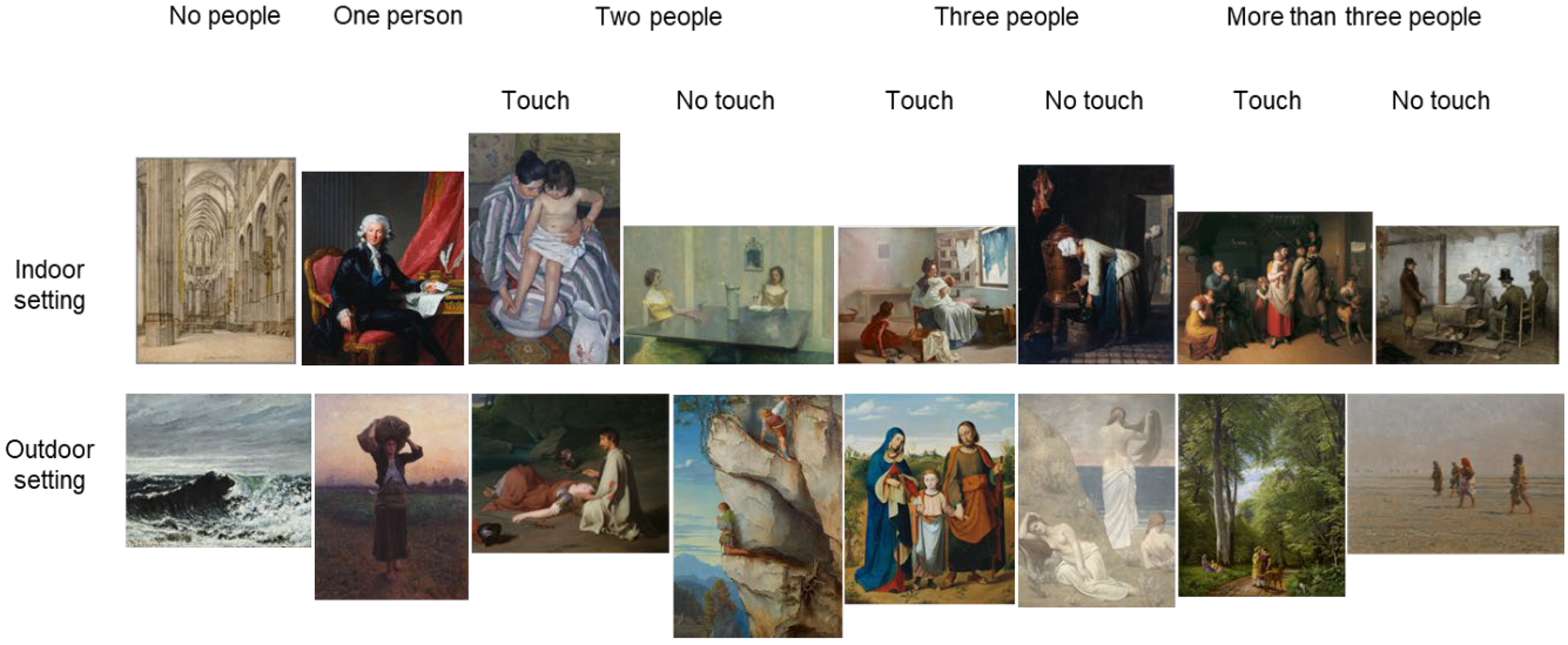
Sample paintings. The sources of the paintings (all public domain) are available as Supplementary Material.
84 paintings were purely abstract paintings (as opposed to figurative paintings), and they were included as part of the image set to diversify the stimuli content in the rating task as well as to provide commentary on past works that explored preference between figurative and abstract painting (e.g., Feist & Brady, 2004). These abstract paintings were selected from the stimuli set used by Sidhu et al. (2018) at random (via MATLAB).
336 images were figurative paintings. Of these images, 42 paintings had no depictions of people and consisted of paintings illustrating, for example, landscapes and animals. Of the 294 paintings with depictions of people, 42 paintings depicted a single person only. The remaining 252 figurative paintings with depictions of people were equally divided (i.e., 42 images each) into a factorial design of depicted number of people (3 levels: only 2 people vs. only 3 people vs. more than 3 people) × interpersonal touch (2 levels: touch vs. no-touch). Paintings that included human figures with overt fantastical or supernatural elements (e.g., ghosts & cartoons) were excluded from selection.
Touch was determined by the presence of at least one incident in a painting where a depicted person physically and explicitly (excluding implied touch) touches a body part of another depicted person with their hands. Also, all figurative paintings were kept as emotionally neutral as possible, so that they lacked scenes of extreme stimulation or violence (e.g., blood, mutilation, explicitly sexual activities, etc.). Lastly, all figurative painting image categories were equally divided between images of outdoor settings (e.g., scenes with nature as its prominent feature) and indoor settings (e.g., scenes within a building interior). Thus, each image category was represented by at least 21 paintings.
The figurative paintings were selected from JenAesthetics (Amirshahi et al., 2015) and from official webpages of, for example, Belvedere Museum Vienna, Los Angeles County Museum of Art, The Art Institute of Chicago, and Museo Reina Sofia. The image selection process was independently verified by two volunteers. The process of verification was done via a focus group, where the two volunteers examined each image to assess whether the categorization of each image met the criteria mentioned above. The focus group method was adopted because the two volunteers could exchange opinions in case one person accidentally missed a detail in examining an image. Where there were images that had disagreements between the volunteers or had ambiguity (where at least one person was uncertain), those images were eliminated and alternatives were sought. The process was repeated until all images were verified.
Regrouping and Resizing of Painting Stimuli for Rating
To prevent possible task-length-based fatigue, each participant was allocated to rating a subset of the grand pool of 420 images. Five pseudo-randomized stimuli subsets were created, and each participant was randomly allocated to one of the subsets.
Specifically, each subset included a set of 20 images common across all participants. The images common across participants consisted of one randomly chosen image from each of the 16 figurative painting categories and four randomly chosen images from the abstract painting category. Using the remaining 400 images, five sets of 80 images were created. Each of the 80 images consisted of four randomly chosen images from each of the 16 figurative painting categories and 16 randomly chosen images from the abstract painting category. Randomization was done through MATLAB.
All images were resized to cover 200,000 pixels while retaining their original aspect ratios.
Individual Differences Measures
The study included three sets of self-reported individual differences measures, largely representing social (e.g., extraversion, agreeableness, & loneliness; Gierveld & Tilburg, 2006; Soto & John, 2017), aesthetic (e.g., openness to experiences, aesthetic chills in daily life, & daily aesthetic activities; McManus & Furnham, 2006; Nusbaum & Silvia, 2011; Soto & John, 2017), and emotion (e.g., alexithymia; Bagby et al., 1994) measures, as well as demographics. 1 Unless noted, all questions were rated on a 7-point Likert-like scale. Detailed descriptions of the self-reported measures are available as Supplementary Material.
Procedure
The study was run through Qualtrics, an online surveying tool. Participants were discouraged from using tablets and phones. Following consent, each participant was randomly allocated to one of the five pre-selected image sets. The image rating section consisted of each participant rating 80 images on two scales, namely likeability (“How much do I like the painting?”) and familiarity (“How much am I familiar with the painting?”), each using a 0–100 slider. Following the image rating section of the survey, participants filled in a number of measures of individual differences. As the final task, participants were asked to re-rate five previously seen images. This last step was carried out for the purpose of assessing test-retest reliability. 2
Results
Manipulation Checks and Analytic Approach
Test-retest reliability was derived using the five image participants re-rated at the end of the survey. In general, there was good test-retest reliability across all participants (Mr = 0.85). Nine participants who had both exceptionally low consistency (r < 0.20) and large differences (d > |1|) in ratings across test and retest trials were considered unreliable data and were, thus, excluded from subsequent analyses. 3 The final number of participants across the five image sets was as follows: 59, 64, 60, 56, and 61. To assess whether there were systematic biases in ratings across the five image sets, the 20 images common across all image sets were analyzed. Based on by-item aggregated data per image set, ratings across the five sets were consistent, rs: 0.88–0.96, and not different from one another, F (4, 95) = 1.02, p = .403.
Unless mentioned otherwise, the present work adopted linear mixed models in deriving fixed effects. In adopting linear mixed models, all fixed effects were simultaneously controlled for by-stimulus and by-participant variations. All linear mixed models were set up similarly to past works in empirical aesthetics (e.g., Hur et al., 2020; Hur et al., 2022; Hur et al., 2024; Vartanian et al., 2019), through the lmer() function of the lme4 package (Bates et al., 2015; Judd et al., 2016) in R. p-values, via 95% confidence intervals, were obtained using the lmerTest package (Kuznetsova et al., 2017). Estimations on t-tests were based on the Satterthwaite approximation for degrees of freedom, and ANOVAs were based on Type II sums of squares.
For each model, all relevant experimental manipulations were set as the fixed effects and the participant and stimulus as random effects. In line with Barr et al. (2013), the random effects were initially set up to the maximum so that the baseline liking ratings varied across participants and stimuli (random intercept), and all fixed effects varied across participants and stimuli (random slopes). However, given observed convergence errors (due to model complexity and observation size), existing evidence of large individual differences in painting preference (Vessel et al., 2018), and the relatively large variance observed from the participant component compared to the stimulus component, the random slopes of all models focused on the participants and, for each model, the random effect structure was simplified until the model converged. The models predicting liking included familiarity rating as a covariate in addition to the fixed and random effects, such that the prediction of liking was controlled for familiarity. It should be noted that given the multiple sources of variances in linear mixed models, standardized effect sizes are not available. Where relevant, raw descriptive statistics are reported from which unstandardized effect sizes can be derived. All in-text descriptive statistics represent adjusted estimated means.
Social Content Preference
Table 1 describes the raw mean and standard deviation of ratings per image category across all participants. Since image categorization was not always factorial, three separate analyses were run to examine whether certain painting contents are preferred over others. All post hoc analyses were adjusted for multiple comparisons (Bonferroni). 4
Description of Mean (SD) Ratings per Image Category.
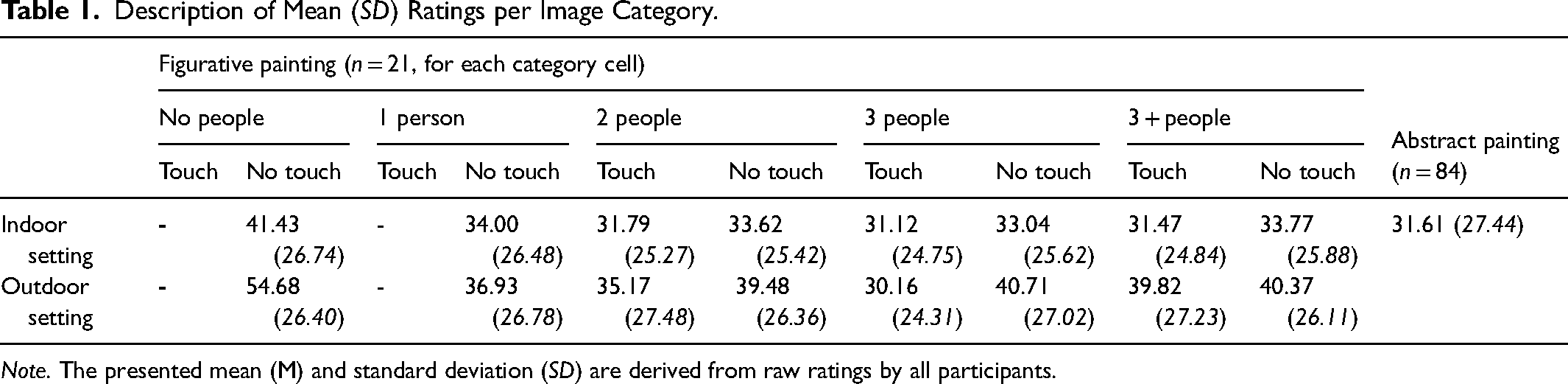
Note. The presented mean (M) and standard deviation (SD) are derived from raw ratings by all participants.
Preference for Figurative Content
Across participants, figurative paintings (M = 35.59, SE = 0.98) were preferred over abstract paintings (M = 31.05, SE = 1.36), F (1, 606.00) = 8.89, p = .003.
Preference for Setting (Outdoor/Indoor) and People Number
There was a main effect of People, F (4, 324.32) = 28.85, p < .001; paintings without people (M = 46.88, SE = 1.43) were rated higher than paintings with one person (M = 35.86, SE = 1.43), two people (M = 33.76, SE = 1.18), three people (M = 32.94, SE = 1.18), and more than three people (M = 34.82, SE = 1.18), ps < .001. The ratings of image categories with people (i.e., one person vs. two people vs. three people vs. more than three people) did not significantly differ from each other, ps > .05. There was also a main effect of Setting, with depictions of the outdoor (M = 39.88, SE = 1.04) being preferred over depictions of indoors (M = 33.83, SE = 1.10), F (1, 421.28) = 37.54, p < .001.
There was a significant interaction between People and Setting, F (4, 324.19) = 2.81, p = .026. The preference for outdoor settings (over indoor settings) was significant in paintings without any people (M = 53.11, SE = 1.82 vs. M = 40.65, SE = 1.86), p < .001. In contrast, the Setting effect did not exist for paintings with one (M = 38.33, SE = 1.82 vs. M = 33.39, SE = 1.86), two (M = 35.78, SE = 1.42 vs. M = 31.75, SE = 1.47), three people (M = 34.96, SE = 1.42 vs. M = 30.91, SE = 1.47), and more than three people (M = 37.21, SE = 1.42 vs. M = 32.43, SE = 1.47), ps > .05. In both indoor and outdoor paintings, paintings with no people were liked the most compared to paintings with people, ps < .05. For both indoor and outdoor paintings, the number of depicted people, among paintings with at least one depicted person, did not affect preference, ps > .05.
Given the lack of distinction across images with people, the analysis was re-run after grouping all the images with at least one person into a single level; the People variable was hence dichotomized regarding the presence of people (i.e., with People vs. no People). When this was done, the main and interaction effects were significant in the manner described above, with the main effects of People, F (1, 467.20) = 84.90, p < .001, Setting, F (1, 329.12) = 45.28, p < .001, and the interaction between People and Setting, F (1, 329.95) = 10.80, p = .001. The four post hoc comparisons for the interaction effect all revealed statistical significance, ps < .001. Note that the significant interaction indicated that, while outdoor paintings were preferred over indoor paintings regardless of whether people were depicted, the preference for outdoor paintings was stronger for paintings without people than for those with people. Similarly, while paintings without people were preferred over paintings with people regardless of the painting setting, this preference was especially strong for outdoor paintings compared to indoor paintings. Visualization of the interaction between People and Setting is provided in Figure 2.
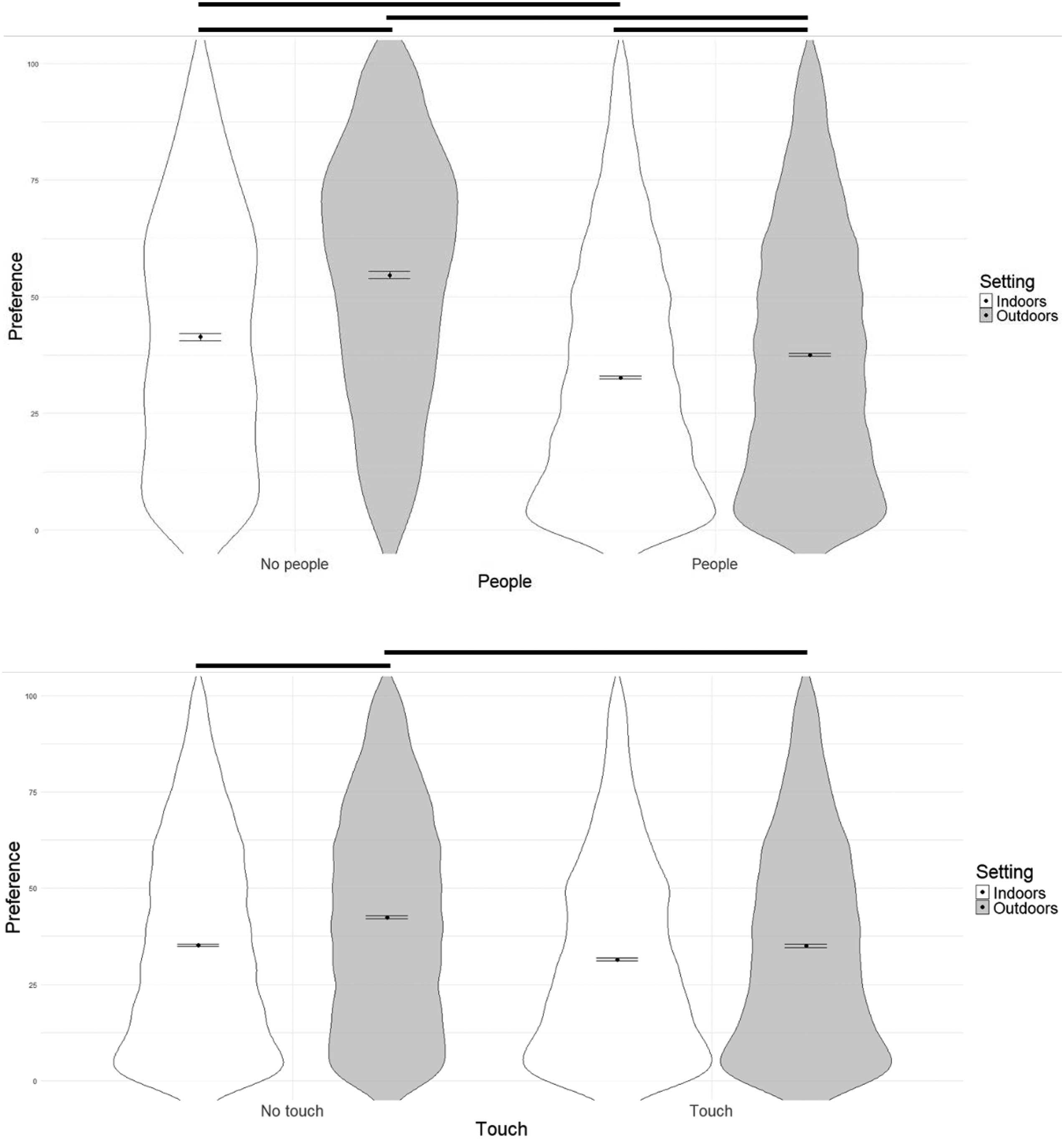
(Above) Violin plot (with mean and standard error) of raw preference rating by the number of depicted people and outdoor/indoor settings in paintings. 8 Lines represent significant contrasts in simple effects analyses (bold lines represent ps ≤ .001). (Below) Violin plot (with mean and standard error) of raw preference rating by outdoor/indoor settings, presence of interpersonal touch, and outdoor/indoor settings in paintings. Lines represent significant contrasts in simple effects analyses (bold lines represent ps ≤ .001).
Preference for Setting, People Number, and Touch
Only images with at least two depicted people were used in exploring the interaction between Setting, People, and Touch. There was a main effect of Touch, F (1, 281.77) = 22.63, p < .001; depictions with interpersonal touch (M = 31.74, SE = 1.08) were less preferred over depictions without touch (M = 35.76, SE = 1.06). As in the previous analysis, there was a main effect of Setting, F (1, 313.42) = 24.09, p < .001, where depictions of outdoor (M = 35.89, SE = 1.04) were preferred over depictions of indoor (M = 31.61, SE = 1.12).
There was a significant interaction between Setting and Touch, F (1, 241.51) = 8.72, p = .003. The interaction meant that the preference for outdoor settings over indoor settings was only significant in the no-touch condition, p < .001 (M = 39.09, SE = 1.19 vs. M = 32.43, SE = 1.24) and not significant in the touch condition, p = .427 (M = 32.70, SE = 1.19 vs. M = 30.78, SE = 1.13). The preference for no-touch over touch was significant in the outdoor condition, p < .001, but not significant in the indoor condition, p = .636. No other main or interaction effects were significant. Visualization of the interaction between Setting and Touch is provided in Figure 2.
Individual Differences in Social Content Preference
The existence of group-level content effect does not preclude individual differences. To examine this further possibility, two sets of individual differences analyses were conducted. First, a set of ratings-based individual differences variables were generated via Q-mode factor analysis. Then, these generated individual differences variables were individually inserted as moderating variables to the previously tested content effects. Lastly, to interpret these ratings-based individual differences variables, the variables were correlated with self-reported psychometric individual differences variables (see Table 2 for the full list of individual differences measures).
Pearson Correlation Between Self-Reported Individual Differences Measures and the Three ID Factors.
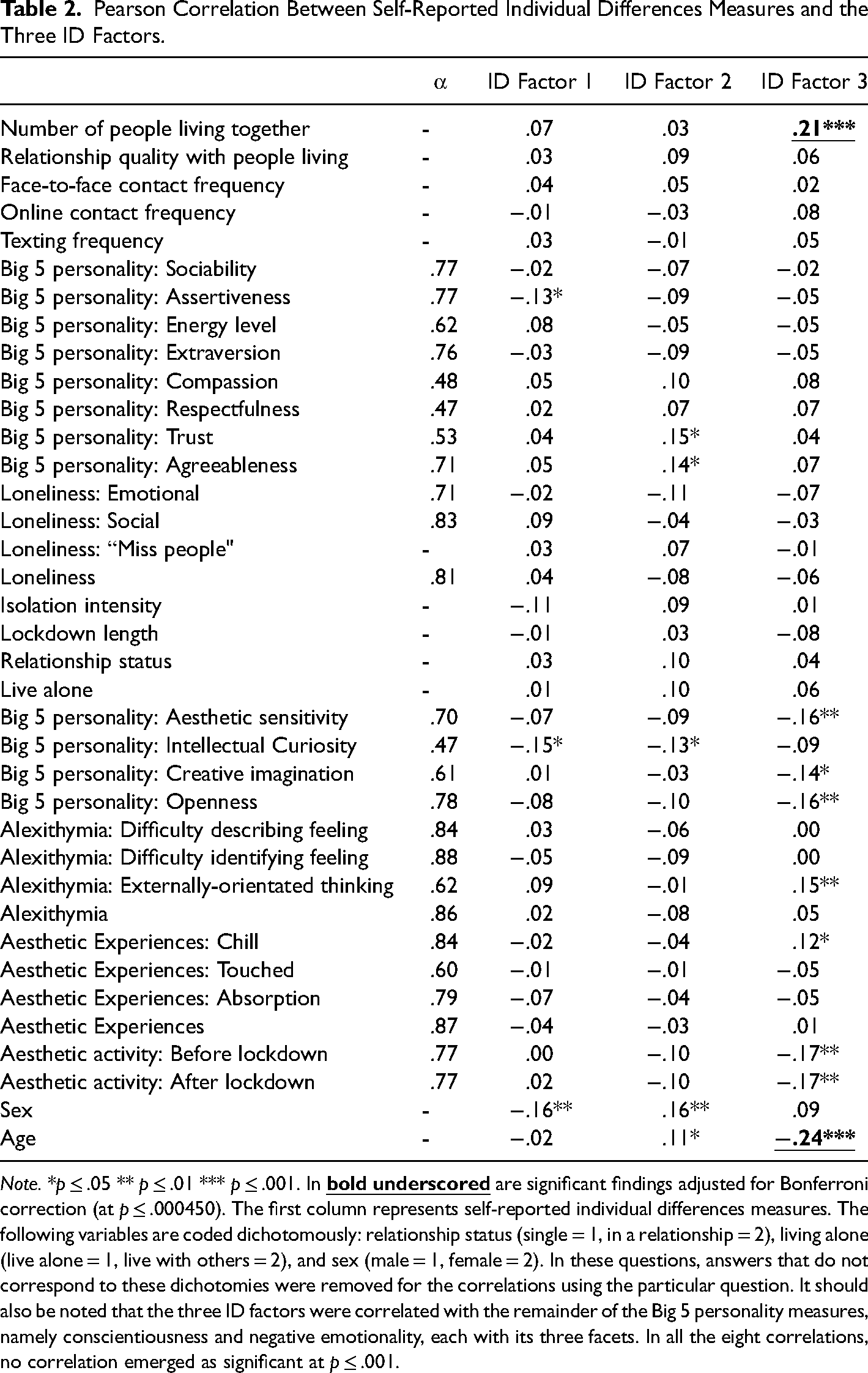
Note. *p ≤ .05 ** p ≤ .01 *** p ≤ .001. In
Q-Mode Factor Analysis & Generation of a Ratings-Based Individual Differences Measure
A Q-mode factor analysis was used to represent individual differences based on ratings, as was adopted in previous aesthetic research (McManus, 1980; McManus et al., 2010; Soranzo et al., 2018). In Q-mode factor analysis, the dataset is transposed so that the rows represent the items and the columns represent the participants. In a nutshell, a Q-mode factor analysis creates underlying factors of the participants. 5 As was done by McManus et al. (2010), the present Q-mode factor analysis used varimax rotation. The analysis was run via the fa() function of the psych package (Revelle, 2024) in R.
A Q-mode factor analysis was run on the liking rating of the 20 images that were common across all participants. A parallel analysis suggested the retention of a three-factor structure. The three factors explained 43.38% of the variance (the first five eigenvalues: 20.12, 15.78, 7.48, 6.03, & 5.61). Across all 300 participants, the factor scores for each participant on the three rotated factors (i.e., the degree to which an individual participant loads onto each factor) were used as three individual differences scales. These newly generated three individual differences scales are henceforth called ID factor 1, ID factor 2, and ID factor 3.
The Three ID Factors as Moderators
The three ID factors were added as interaction terms in the previously run linear mixed models. 6 The interaction effect of each ID factor was tested in separate models. To control for Type I error given the large number of individual differences analyses, the p-value threshold of significance for all subsequent analyses using ID factors was adjusted to .001. Below is a summary, outlining the key characteristics of the three ID factors. More detailed descriptions of the analyses are available as Supplementary Material.
ID factor 1 was associated with liking figurative paintings and disliking abstract paintings, with high levels indicating the liking of figurative over abstract paintings and low levels indicating the liking of abstract over figurative paintings. This factor was generally linked with the liking of all types of figurative paintings. ID factor 2, on the contrary, was associated with the general dislike of figurative paintings apart from paintings of outdoor settings with no people, which was liked with the increase of ID factor 2. ID factor 2 appeared rather neutral in terms of liking abstract painting. Lastly, ID factor 3 was related to liking abstract paintings and disliking figurative paintings, with high levels indicating the liking of abstract over figurative paintings and low levels indicating the liking of figurative over abstract paintings. Individuals with high levels of ID factor 3 seemed to dislike all types of figurative paintings apart from paintings without people; however, the increase of ID factor 3 did not particularly increase the liking of paintings without people.
Understanding the Three ID Factors
To understand the nature of the three ID factors, the three ID factors were correlated with 37 self-reported individual differences measures. Of the 111 correlations, only two (Bonferroni-adjusted) statistically significant correlations emerged. Those who scored high on ID factor 3 were characterized by living together with a large number of people, r = .21, and were younger, r = −.24.
These results indicate that while the ID factors capture individual differences in painting rating behavior, the variance derived from these measures is not entirely captured and is interpretable by the battery of social and aesthetic self-reported measures adopted in the present work. See Table 2 for a full correlation table denoting the relationship between the two types of individual differences measures.
Discussion
The present study explored the role of social content in paintings, specifically on whether there is a generalizable preference for a selection of social content (e.g., the number of people, interpersonal touch, and setting). As a secondary analysis, the study also examined individual differences. The results suggested the presence of preference for certain social content across participants. At the same time, individual differences (identified via Q-mode factor analysis) also modulated the extent and direction of these effects, even though these individual variations were not captured by self-report measures.
Some of the present work's outcomes reflect past findings. For example, the finding that people generally prefer paintings of the outdoors as opposed to paintings of the indoors echoes the findings by Mullin et al. (2017), who reported that photography of outdoor scenes is seen as more pleasant than that of indoor scenes. Works on painting preference had also reported a similar advantage in preference for outdoor scenes over indoor scenes (Wypijewski, 1997). Furthermore, the finding that people generally prefer figurative paintings over abstract paintings reflects the work by, for instance, Feist and Brady (2004). These findings provide supportive commentary on the evolution of human aesthetic preference, such that humans have evolved to find pleasure in objects that have coexisted with the larger part of human history, aka. the biophilia hypothesis (e.g., Ulrich, 1993).
The present work also examined the interaction between these content types in predicting painting preference, thereby manipulating potentially confounding social content (e.g., Di Dio et al., 2016). Thus, while it may be true that paintings of the outdoors are generally preferred over indoors, this was most pronounced when no people were portrayed in the scene (vs. when at least one person was present). Furthermore, examining paintings with multiple people, this outdoor scene preference was only present when there was no visible touch between the depicted people. The overall message seems to be, thus, that people appear to enjoy paintings with the least amount of social content whether it is the presence of people (Figure 2) or the presence of touch (Figure 2).
Why do people exhibit such a strong liking for natural scenes without humans and human interactions? An intuitive explanation might consider the biophilia hypothesis (Ulrich, 1993), the savannah hypothesis (Orians, 1986), and the attention restoration theory (Kaplan & Kaplan, 1989), which suggest that natural scenes attract viewers for reasons of cognitive restoration and evolutionary significance. The viewing of natural sceneries without distraction towards human figures would – in line with these theories – produce a certain aesthetic appeal.
At the same time, this explanation falls short if one assumes that humans are an integral constituent of nature and have been essential to human survival. Especially considering the literature concerning the attentional advantage that human faces and bodies have in the human vision system (e.g., Calder & Young, 2005), future studies could merit closer examination of the relationship between visual attention and aesthetic appeal in the context of social content in painting. These future works could further uncover the specific mechanism of the present findings, exploring, for example, the degree to which the present results stem from a possibility of active dislike of human figures/interactions, from an inherent positivity that barren natural scenes contain over human figures/interactions, or from the fact that the presence of human elements simply attenuates a natural scene's aesthetic positivity via attentional distraction. Lastly, it is also worth considering the specific circumstances of data collection, namely the COVID-19 lockdown, which may have influenced participants’ ratings. It is a possibility that the lockdowns made the participants more partial to natural scenes than they would normally be. Additional research may expand claims of generalizability of the current findings.
The present work also addressed the role of individual differences, hence acknowledging the fact that variations of preference may exist at the level of the subject as well as the object (e.g., Jacobsen & Höfel, 2002). Three rating-based preference styles emerged among the participants, particularly surrounding the preference for figurative over abstract art (and the other way around). And while individual differences regarding the preference for abstract paintings (over figurative paintings) have been reported before and have been linked with the openness personality trait (e.g., Chamorro-Premuzic et al., 2010; Feist & Brady, 2004; Furnham & Walker, 2001), the specific role of openness was absent in the present work since none of the rating-based individual differences factors correlated with openness. On the one hand, this could mean that the individual differences that emerge through one's ratings do not necessarily correspond with the individual differences measured through self-reported psychometric measures, which is something that reflects the findings by McManus et al. (2010). On the other hand, it may be that the design and analytical method of the present work, which adopted a larger set of painting stimuli compared to previous works and used linear mixed models, represents a more accurate and generalizable report of an underlying phenomenon.
Limitations and Implications
Some limitations can be considered. First of all, while the study manipulated a selection of social content in the context of painting, there can undoubtedly be other social content to be considered. It may especially be interesting to further elaborate on the type of touch, exploring positive vs. negative touch, and also different kinds of positive touches (e.g., sexually pleasant vs. non-sexually pleasant). Touch could further be explored by considering whether a touch is made on bare skin or skin covered with clothing, reflecting current developments in fashion psychology (e.g., Hur et al., 2023). These manipulations of painting content may also have a selective impact on specific aesthetic responses, going beyond the measure of simple liking, e.g., sublime (Hur et al., 2022). Secondly, while the present work focused on the role of social content in predicting painting preference, it should be acknowledged that style and visual features can never be detached from content. There can be various sources of artistic styles, such as an era's prevalent artistic style, an artist's personal style, and painting techniques (from the same artist). A content's interaction with these different types of styles and to a larger extent, an image's visual feature (e.g., image statistics) would present further answers to the present inquiry.
It is also worth noting that while the present work reported on the role of painting content in shaping painting preference, with an implied emphasis on the factors that contribute to liking a piece of painting, the reality is that the majority of the paintings were still rated, on average, as not being likable. In fact, 390 of the 420 paintings had a mean liking rating of lower than 50 (out of 100). This outcome may reflect previous works on art fatigue (Mikuni et al., 2022), a topic that merits further research in the context of online studies. That said, the present research also demonstrated a wide range of ratings. For example, when observing the maximum liking rating given to a painting, 399 paintings were still rated as at least 75, and each image had a substantial level of standard deviation in liking rating. 7 This likely indicates the presence of individual differences and, therefore, further justifies the paper's narrative to explore and report liking ratings from perspectives of both group-level data and individual differences.
Despite its limitations, the present study makes a significant contribution to empirical aesthetics by providing data on the direct evaluative consequences of social content and their interactions in paintings. Given that the field has produced relatively few studies focusing on the impact of social content itself in painting evaluation, this research lays the groundwork for future investigations. The study also offers methodological contributions in the context of painting evaluation by simultaneously considering, first, both group-level analyses and individual differences, and second, both rating-based and self-report-based measures of individual differences.
While more extensive research is necessary, some practical implications can already be drawn. For example, museum curators might be cautious about mixing paintings of different types within a single room or exhibition. As shown in this study, paintings with human figures/interactions may be evaluated less positively when viewed alongside paintings of natural scenes without human figures/interactions. Furthermore, given the pronounced individual differences in preferences for, for example, figurative versus abstract paintings, museum staff could consider tailoring exhibitions to specific target audiences by focusing on one style of painting, thereby creating a more cohesive and engaging experience for visitors.
Supplemental Material
sj-docx-2-art-10.1177_02762374251320823 - Supplemental material for The Beauty of Nature Without People: An Investigation of the Roles of People, Nature, and Interpersonal Touch in Painting Preference
Supplemental material, sj-docx-2-art-10.1177_02762374251320823 for The Beauty of Nature Without People: An Investigation of the Roles of People, Nature, and Interpersonal Touch in Painting Preference by Young-Jin Hur, Sonia Abad-Hernando, Ramiro Joly-Mascheroni, MacKenzie D. Trupp and Beatriz Calvo-Merino in Empirical Studies of the Arts
Supplemental Material
sj-csv-3-art-10.1177_02762374251320823 - Supplemental material for The Beauty of Nature Without People: An Investigation of the Roles of People, Nature, and Interpersonal Touch in Painting Preference
Supplemental material, sj-csv-3-art-10.1177_02762374251320823 for The Beauty of Nature Without People: An Investigation of the Roles of People, Nature, and Interpersonal Touch in Painting Preference by Young-Jin Hur, Sonia Abad-Hernando, Ramiro Joly-Mascheroni, MacKenzie D. Trupp and Beatriz Calvo-Merino in Empirical Studies of the Arts
Supplemental Material
sj-csv-4-art-10.1177_02762374251320823 - Supplemental material for The Beauty of Nature Without People: An Investigation of the Roles of People, Nature, and Interpersonal Touch in Painting Preference
Supplemental material, sj-csv-4-art-10.1177_02762374251320823 for The Beauty of Nature Without People: An Investigation of the Roles of People, Nature, and Interpersonal Touch in Painting Preference by Young-Jin Hur, Sonia Abad-Hernando, Ramiro Joly-Mascheroni, MacKenzie D. Trupp and Beatriz Calvo-Merino in Empirical Studies of the Arts
Supplemental Material
sj-docx-5-art-10.1177_02762374251320823 - Supplemental material for The Beauty of Nature Without People: An Investigation of the Roles of People, Nature, and Interpersonal Touch in Painting Preference
Supplemental material, sj-docx-5-art-10.1177_02762374251320823 for The Beauty of Nature Without People: An Investigation of the Roles of People, Nature, and Interpersonal Touch in Painting Preference by Young-Jin Hur, Sonia Abad-Hernando, Ramiro Joly-Mascheroni, MacKenzie D. Trupp and Beatriz Calvo-Merino in Empirical Studies of the Arts
Supplemental Material
sj-xlsx-6-art-10.1177_02762374251320823 - Supplemental material for The Beauty of Nature Without People: An Investigation of the Roles of People, Nature, and Interpersonal Touch in Painting Preference
Supplemental material, sj-xlsx-6-art-10.1177_02762374251320823 for The Beauty of Nature Without People: An Investigation of the Roles of People, Nature, and Interpersonal Touch in Painting Preference by Young-Jin Hur, Sonia Abad-Hernando, Ramiro Joly-Mascheroni, MacKenzie D. Trupp and Beatriz Calvo-Merino in Empirical Studies of the Arts
Footnotes
Declaration of Conflicting Interests
The authors declared no potential conflicts of interest with respect to the research, authorship, and/or publication of this article.
Funding
The authors disclosed receipt of the following financial support for the research, authorship, and/or publication of this article: This work was funded by City, University of London (now City St George’s, University of London).
ORCID iDs

Supplemental Material
Supplemental material for this article is available online.
Notes
Author Biographies
References
Supplementary Material
Please find the following supplemental material available below.
For Open Access articles published under a Creative Commons License, all supplemental material carries the same license as the article it is associated with.
For non-Open Access articles published, all supplemental material carries a non-exclusive license, and permission requests for re-use of supplemental material or any part of supplemental material shall be sent directly to the copyright owner as specified in the copyright notice associated with the article.
