




Abstract
Body dissatisfaction is likely to be particularly salient in aesthetically focused professions, including the performing arts. However, there is a paucity of research involving male theatre performers. This study addressed this omission by exploring how male musical theatre actors experience body image. Interviews were conducted with 7 male performers and analysed using reflexive thematic analysis. Findings illustrate the lasting influence that instructors and the training environment have upon the participants’ perceptions of their bodies, participants’ desire to appear masculine through greater muscularity, and the dissatisfaction that occurs when they perceive that their bodies do not conform to rigid notions of gender and body ideals. This study also provides insight into the nuanced experience of existing within a body of worth, often commodified and sold to audiences. These findings highlight the importance of facilitating a supportive training environment and opening up conversations about body dissatisfaction among male performers.
Body image is a multidimensional construct that reflects an individual's satisfaction with, and the degree of cognitive and behavioural importance that they assign to, their physical appearance (Cash & Pruzinsky, 2002; Skrzypek et al., 2001). Therefore, body image consists of both a perceptual component, regarding the image manifested in the mind, and an attitudinal component, regarding the feelings that an individual has towards such perceptions (Adams et al., 2005). The ways in which individuals subjectively experience their appearance impact upon their thoughts, feelings and subsequent behaviours (Cash, 2004). Body image disturbance describes any negative experiences related to body weight, shape, or physical appearance, and can occur as a distorted or inaccurate perception, and/or an attitudinal dissatisfaction with the body (Skrzypek et al., 2001). Both perceptual and evaluative disturbances in body image are prominent characteristics of eating disorders, body dysmorphia disorder, orthorexia, and steroid use (Gaudio et al., 2014; Smolak et al., 2005; Zeppegno, 2018). Research has predominantly focused on girls and women, as they are believed to be disproportionately affected by body image disturbances and associated disorders (Lavender et al., 2017). This is proposed to be an outcome of greater self-surveillance, caused in part by the sexual objectification of the female body, and socio-cultural pressures to conform to unrealistically slender body types within Western societies (Frith & Gleeson, 2004; Min et al., 2022). This focus has reinforced the limiting notion that the term ‘body image’ refers only to body weight and shape concerns pertaining to White females, and not to the idiosyncratic and diverse experiences of all human embodiment (Cash, 2004; Trujillo, 2017).
Although this focus remains dominant, research investigating men's experiences of body image has expanded rapidly since the 1980s (Grogan, 2021; Whitaker et al., 2021). It is suggested that men have come under increasing pressure to conform to Western cultural expectations, due to the increased exposure and sexualisation of an idealised male body image perpetuated within media (Karsay et al., 2018; Pope et al., 2001). Thus, an individual's attitude towards their body may be shaped by how well they believe their body fits into normative perceptions of beauty, and such standards are measured by what is represented and celebrated in the sphere of popular culture (Trujillo, 2017). Hegemonic masculinity also significantly impacts upon male body image through the imposition of bodily ideals, which emphasise muscularity, strength and leanness (Marshall et al., 2020). The concept of hegemonic masculinity privileges the “most honored way of being a man” (Connell & Messerschmidt, 2005, p. 832), while subordinating women, femininities, and other marginalised masculinities and sexualities (Messerschmidt, 2018). Hegemonic constructions of masculinity laud heterosexuality, dominance and emotional restraint, which are reinforced via social interactions and cultural narratives (Connell & Messerschmidt, 2005).
Ridgeway and Tylka (2005) administered open-ended questionnaires to U.S. male undergraduates, to develop an understanding of idealised male body types. Five categories emerged describing a desire for; an overall muscular body, overall lean body, tall height, V-shape (wide muscular shoulders, narrow hips), and toned abdominal region. Undesirable body characteristics included a desire not to be fat or too thin. The authors highlight how the body types described by participants subscribed to the body composition and shape represented in media, demonstrating the powerful influence of media portrayal in shaping cultural standards of attractiveness. These characteristics continue to be the body ideal for men (Frederick et al., 2022; Griffiths et al., 2018) and frequency of exposure to such body types has increased exponentially due to internet-based social media usage (Chatzopoulou et al., 2020). Research indicates a clear link between increased social media use and higher levels of body image dissatisfaction among both women and men (Huang et al., 2021; Saiphoo & Vahedi, 2019). Furthermore, the extent to which men identify as having hegemonically masculine personality traits, or the importance such traits are ascribed, impacts upon their attitudes towards pursuing greater muscularity (Burlew & Shurts, 2013; McCabe & Ricciardelli, 2004; Tiggemann et al., 2007). An increased drive for muscularity enhances the likelihood of men undertaking muscularity-increasing behaviours, which, when paired with body image disturbances, may increase the tendency to engage in excessive or compulsive exercise, anabolic steroid use, and the over-implementation of hyper-proteic diets or food integrators (Segura-García et al., 2010; White & Halliwell, 2010). However, not all behaviour is recognised to reach a diagnostic threshold. It is predicted that many men demonstrate subclinical body image disturbances and are not receiving the necessary support (Grieve et al., 2009).
Social comparison theory (SCT) (Festinger, 1954), provides a means of understanding how increased exposure to Westernised body ideals negatively affects body image concerns. SCT proposes that individuals engage in appearance-related social comparison, and viewing popular and attractive celebrities encourages individuals to evaluate their own appearance in an upward comparison, leading to greater dissatisfaction (Morrison et al., 2004). Hargreaves and Tiggemann (2004) examined the effects of exposure to images of idealised beauty standards on both adolescent girls’ and boys’ body image. Findings demonstrated that the relationship between media exposure, and greater bodily dissatisfaction was both stronger and more normative for girls than boys. However, those who scored high on appearance investment, were more likely to engage in appearance comparison regardless of gender. Appearance investment reflects the cognitive-behavioural investment in one's appearance and indicates that there are individual differences that can affect comparison tendency (Cash, 2011). Therefore, those more strongly invested in their appearance may be at greater risk of body image dissatisfaction.
With this in mind, it is plausible that those who work within aesthetically focused professions, in which body image investment is unavoidable, are at greater risk of body image disturbances. Dance is largely considered an aesthetic activity, and strong links between dancers and increased body surveillance, body dissatisfaction, and disordered eating behaviours have been identified (Arcelus et al., 2014; Silverii et al., 2022). However, most research has tended to focus on female classical dancers, who are considered more vulnerable to body image disturbances, due to the requirement to retain excessively thin physiques within the ballet subculture (Francisco et al., 2012; Tiggemann & Slater, 2001). How individuals experience body image in other sub-cultures of dance has received less attention, though extant research suggests that those who engage in athletically focused dance genres (e.g., contemporary, street, creative) and sensual dance (e.g., belly dance, pole) showed greater body appreciation (Langdon & Petracca, 2010; Pellizzer et al., 2016; Swami & Tovée, 2009; Tiggemann et al., 2014). Again, men's experiences are underrepresented in dance research. This may be because women form the majority of the dance population, as dance is still viewed as a predominantly female art form within the Western cultural paradigm (Christofidou, 2021; Risner, 2007). Risner (2009a) identified that men may be reluctant to engage in classical dance genres due to the perception of dance as a feminine activity as well as a narrow view of masculinity within the style. This is supported by Clegg et al. (2016), who proposed that genres such as commercialised street dance and hip-hop, have increased in popularity among men, because such styles embody characteristics and movement more commonly associated with hegemonic masculinity.
Musical theatre is one specialism where men play a more prominent part and one which requires performers to be competent in multiple dance genres, singing and acting. It has become globally popular over the last two decades, yet research regarding those who engage in the art form is scarce. Wanke et al. (2012, p.1) describe musical theatre performers as the “triathletes” of the performing arts, crediting their bodies as the “work tool” of their trade. In a study investigating the physical health and mental well-being of musical theatre students, it was identified that a large proportion of students were only “partially content” with their bodies (67.7%), with a considerable number engaging in dietary behaviours and stating that they “feel too fat” (32.4%), while 42.3% reported desiring greater muscularity (Wanke et al., 2012). The authors conclude that these findings are similar to those identified among ballet students. Gender differences were not determined in this study, so it is not possible to draw conclusions about the specific body satisfaction and expectations of male students, indicating a need for further qualitative investigation. However, it should also be acknowledged that being expected to adhere to an idealised body image is normative within the discipline of dance and is not necessarily associated with, or predictive of, poor mental health outcomes. Dancers are dedicated to maintaining their physical fitness and strength through rigorous training, and the outward appearance of their bodies is honed to develop and enhance their dance technique (Christofidou, 2021). As skilled dancers, it is likely that musical theatre actors will have a heightened awareness of their body image and physicality, and this forms part of their craft (Green, 2003). How they experience this enhanced awareness remains to be explored.
There is currently no qualitative research into male musical theatre performers’ experiences of body image. Extant research focuses solely on female theatre actors’ perspectives, although it also alludes in passing to male experiences. Following interviews with women from different occupational groups within the performance industry, it is proposed that male performers navigate the same restrictions as females, and that the patriarchal ideologies that structure the physical expectations of women on stage are also likely to structure those of men (Dean, 2008). Horn's (2020) autoethnography draws from her experience as a young theatre artist, navigating her body image in reflection of the industry's expectations. She describes how the implementation of physical exercise during training teaches young actors that their bodies must be modified to increase value. Kuric Kardelis (2023) conducted interviews to explore the socio-cultural meanings assigned to actors’ bodies and addresses how the increased sexualisation of the male body identified by Pope et al. (2001) contributes to increasing pressure on male actors to retain idealised body types. This echoes observations of how common casting practices within theatre have preferentially centralised White, heteronormative, attractive actors onstage (LeBesco, 2004), whereas larger male bodies have historically portrayed secondary characters, serving images of wealth, greed or ‘the funny guy’.
This study aims to qualitatively explore perceptions of body image among male performers who have trained in multi-faceted musical theatre colleges (dance, acting and singing). The research question which guides this study is: How do male performers experience body image, in reflection of their professional training, and current expectations within the performance industry?
Method
Participants
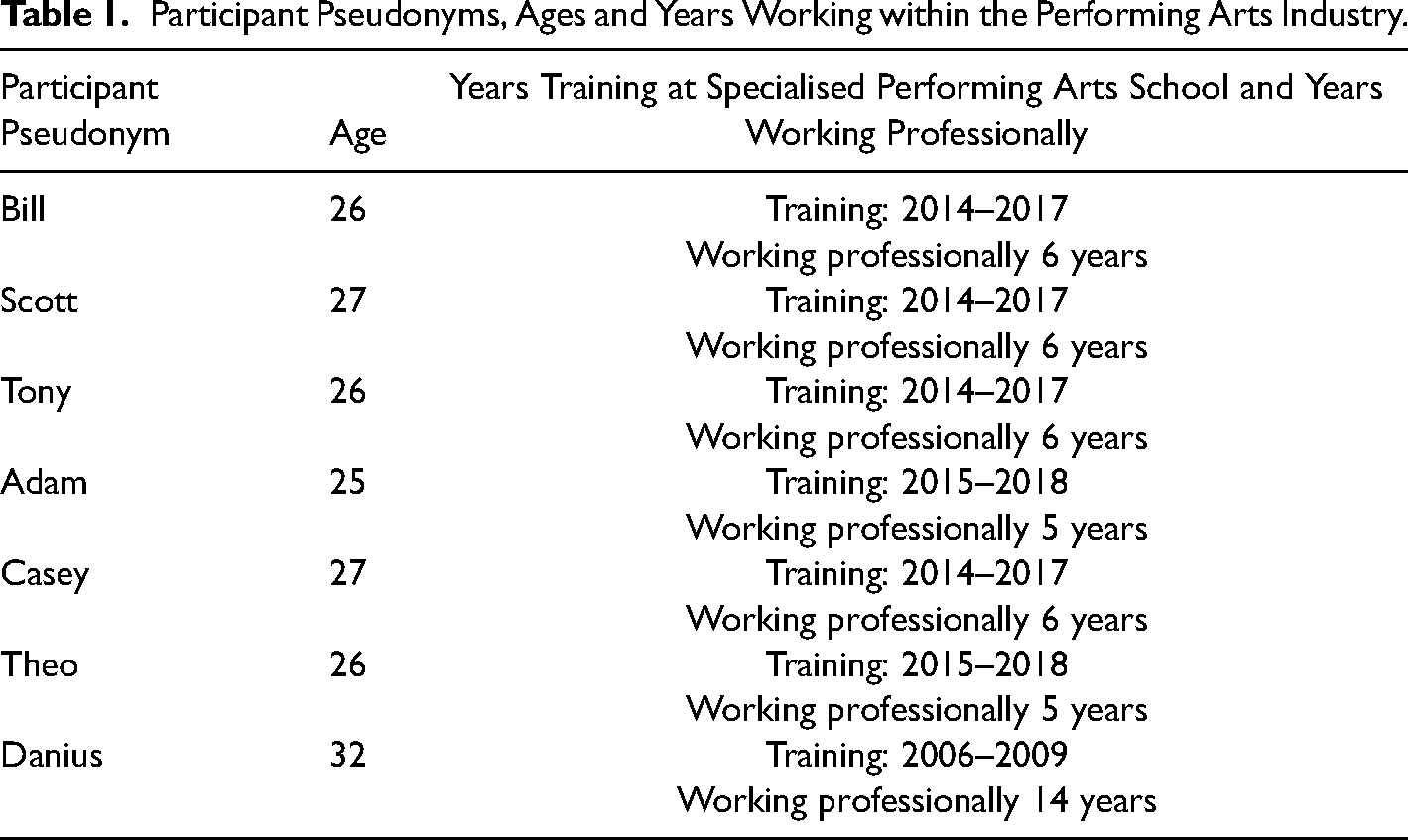
Following ethical approval from the School of Applied Sciences at London South Bank University (Ethics Code: ETH2324-0111), participants were recruited via a voluntary sampling method. Details of the study were placed on Instagram and interested participants contacted author MEC. All interviewees gave written informed consent to participate before being interviewed. Seven male musical theatre performers (mean age = 27 years, SD = 2.31) took part in the study. Participants had completed a minimum of 3 years training within a specialised performing arts school, developing skills in singing, acting, and dancing. All were actively working, either between or on employment contracts. Participants had worked a variety of professional roles including, cruise ship entertainment, London West End musicals, UK tours, holiday entertainment, pantomimes, and productions for smaller theatre companies. Table 1 shows the participants’ pseudonyms, ages and years of experience working within the performing arts industry. All names and identifying information have been changed to protect anonymity.
Participant Pseudonyms, Ages and Years Working within the Performing Arts Industry.
Data Collection
Data were collected using semi-structured interviews. An interview schedule was developed, which included nine open-ended questions. The questions were designed to encourage participants to reflect on their relationship with their body, within the context of their occupation as professional performers. Each question was presented with a series of prompts, which were incorporated by the researcher to facilitate a more detailed inquiry (Ahlin, 2019). Prompts also gave the interviewee greater opportunity to explore their thoughts and reflections, as communication between the researcher and interviewee could evolve beyond structured questions (Lune & Berg, 2017). The interview schedule included questions around participants’ motivations for pursuing a career in the performing arts, their experiences of training and how they make sense of and perceive their own bodies. MEC conducted the interviews, two of which were in-person and five via Microsoft Teams, in response to the participants’ preference. The interviews lasted between 91 and 141 min (mean: 119 min, SD = 19.90) and were digitally audio recorded with the participants’ consent. Upon completion of the interview, participants were given the opportunity to ask any questions and were given a debrief form with details of support services. Interviews were then transcribed verbatim, in preparation for analysis.
Data Analysis
The data were analysed using reflexive thematic analysis (RTA). Given the paucity of research exploring male body image within the performing arts, RTA was considered the most fitting analytic approach, as it may be applied to topics without prior theoretical assumptions, and from different epistemological standpoints (Braun & Clarke, 2006, 2021a). This allows for a detailed analysis of participants’ accounts unconstrained by preconceived expectations.
The analysis was conducted by MEC with each stage of the analysis discussed with EGL for corroboration or challenge, and to verify the integrity of the primary analyst's interpretation. The six-phase framework, outlined by Clarke and Braun (2013) was followed. As proposed, the stages were not linear, but rather recursively revisited throughout the analysis process. Familiarisation occurred through transcribing and re-reading the interviews. Initial coding was developed by succinctly labelling individual lines within the data, to identify key meaning and patterns. Codes were then collated into an Excel sheet, where they were organised into categories surrounding a central concept. The most prominent categories were organised to identify dominant themes, which were later broken down into smaller subthemes. Themes were extensively modified and reviewed in conjunction with EGL. A themes table was drawn, and supportive verbatim quotes that best represented each theme were pulled from the data. Poorly supported themes and subthemes were either rejected or collapsed. Finally, a thematic map of overarching and subthemes was developed (see Figure 1.).
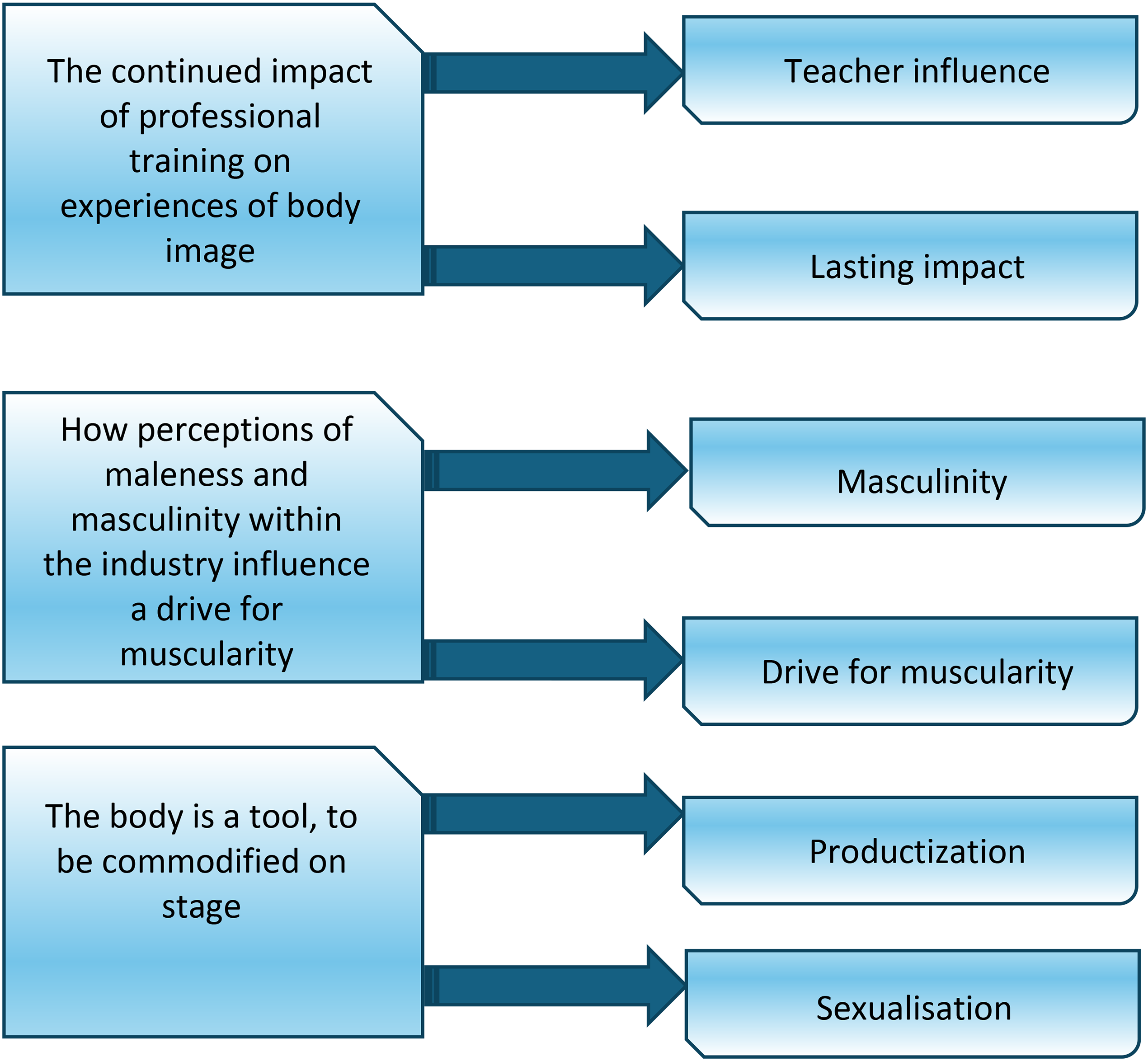
Thematic map.
The data were methodically explored and required both semantic and latent analysis. Semantic analysis required the researcher to search for and identify experiences explicitly articulated by the participants (Braun & Clarke, 2006). Latent analysis required a deeper exploration into the implicit ideas or assumptions underlying such experiences, thus producing interpretative analysis derived from the researcher (Braun & Clarke, 2021a). Therefore, a purely inductive approach cannot be claimed, as themes are susceptible to subjective interference by the researcher and may reflect their social and philosophical position (Braun & Clarke, 2021b). A critical-realist philosophical position was adopted by the researcher, who implemented a realist ontology, and a relativist epistemology. By adopting a relativist epistemology, the researcher accepts that an individual's understanding of the world is relative to who they are, which is influenced by their historical, social and cultural context (Willig, 2012). With a critical realist approach, the researcher assumes that there is an objective reality within the data, however, it is not a complete representation of reality, and needs to be interpreted to access what may be underlying or driving the studied phenomena. The phenomena expressed by the participants, and the interpretation made by the researcher is determinate of their own understanding, knowledge and experiences (Easton, 2010). Therefore, the researcher aimed to develop both an understanding of the participants’ subjective experience (i.e., how they experience body image), alongside an understanding of what may contextually affect such experiences (i.e., constructions of male gender and body image within the demands of working as professional performers).
To enhance the rigour and credibility of the research a thorough audit of the analysis was conducted (Yardley, 2008). Each stage of the analysis and decisions made were discussed with the second author (EGL) in order to validate the relationship between the participants’ accounts and the researchers’ interpretations. The researchers’ own worldviews and perspectives were also continually interrogated to ensure that the focus remained firmly on prioritising the participants’ experiences and sincerely representing their stories (Tracy, 2010). In the following section, the first author shares her personal relationship to the subject matter, acknowledging how her experiences and beliefs have shaped her interpretation of the data (Braun & Clarke, 2021b; Tracy, 2010).
Reflexivity
I (MEC) am a woman in my late-20s who previously trained for 4 years in professional dance and musical theatre. Upon graduation six years ago, I felt stripped of my confidence, motivation and identity. I had developed a belief that how I looked was more important than my abilities. I often felt during training that the young women were disadvantaged compared to the men. I believed men's natural athleticism and muscularity gave them an advantage, and thought they were less constrained by physical expectations within the performing industry. However, I also recognised that my assumptions may not reflect the lived reality of male musical theatre performers. I wanted to find out more about what it was like to be a man training for the performing arts.
While I share some characteristics with the participants with regards to age and training in musical theatre, I also differ in being a woman and choosing not to pursue a career in the performing arts. There are costs and benefits attached to “insider” and “outsider” statuses (Dwyer & Buckle, 2009). Being an insider might lend credibility to my position and make it easier for participants to accept and identify with me (Wilkinson & Kitzinger, 2013). However, this could lead to the assumption of shared knowledge, which might hinder the participants from fully expressing their experiences (Rubin & Rubin, 2011). My “insider” position could further hamper the extent to which my preconceptions may be bracketed and lead to a blurring of my own experiences with those of the participants. It is also possible that the male participants might not feel comfortable in discussing issues around body image with me as a female interviewer owing to perceptions that body image concerns primarily affect women (Olivardia et al., 1995).
For transparency, I shared with the participants ahead of the interview that I was trained in musical theatre. I engaged in reflexivity throughout the research process by keeping a reflexive journal where I noted my thoughts and feelings before and after each interview, as well as throughout the analysis (Ortlipp, 2008). Furthermore, I had to ensure that I was not searching for experiences similar to my own or attempting to confirm my preconceptions. Therefore, it was essential that the themes developed were thoroughly supported by the data and audited by the second author (EGL).
Results
Three overarching themes, with subsequent subthemes were developed: 1) The continued impact of professional training on experiences of body image, 2) How perceptions of maleness and masculinity within the industry influence a drive for muscularity, and 3) The body is a tool, to be commodified on stage. These are illustrated in the thematic map labelled Figure 1 and considered in detail below.
1)
All the participants trained for a minimum of three years in specialist performing arts schools and reflect on how this experience affected their body image. The subthemes identify the influence of teachers’ commentary, and how the environment and experiences during training continue to affect how participants perceive their own body image.
Teacher influence: “we can't have a big fat boy jumping around in ballet tights”
Tony describes how he ‘didn’t ever want to be chubby again’, after his dance teacher openly and humiliatingly criticised his body weight during class, declaring how “we can’t have a big fat boy jumping around in ballet tights”. Adam also speaks about the ‘poisonous and derogatory’ way his teachers would comment ‘all the time’ on the bodies of students during college with statements such as: ‘“You’re too skinny, you’re skinny”, I’m not sure if they said disgusting, they probably did, “Awful skinny boys. No one wants to see skinny boys; you need to be hitting the gym.”’ (Adam)
Despite not experiencing direct criticism from teachers, Danius and Theo reflect on the implicit expectation to achieve greater muscularity. Theo shares how his college principal remarked on his “healthier” look, after a period of increased muscle gain, and suggests the implied meaning behind this comment was that he looked ‘more like the ideal person…that should be in this industry’. This is also reflected by Danius, who felt a sense of accomplishment when his muscularity developed during training. Despite insisting that ‘there was no forcing’ of bodily expectation, he remarks how he was ‘on to a win here’, when he became ‘more broader, more muscly’.
Adam describes how his teachers were perceived as ‘prophets’ and ‘gods’, among the students, while Bill describes the opinion of his teacher as ‘the gospel’, suggesting they are omnipotent, to be trusted and obeyed. This explains Bill's willingness to accept his teacher's suggestion to shave his head, despite personal insecurities, and demonstrates the lack of autonomy students had over their own self-presentation: ‘I remember her saying shave it…and I was like, I can’t, like no, that scares me…then I literally went home I think that weekend, went to the barber's and shaved my head.’ (Bill) ‘They [teachers] can give you jobs…if you're not cool with them then your career's kind of fucked…I thought I would never work if I wasn't like bum-licking her, like if she didn't love me… there's just like a weird power play.’ (Adam)
Teachers would impose this notion by threatening to, or actually withholding performance opportunities based on the physical appearance of students. Tony describes how one teacher denied him a main role for the arbitrary reason that he ‘stand[s] weird’. Meanwhile, Casey recalls the threats made by teachers to encourage the men to exercise; equating greater muscularity with hard work and enforcing the idea that only the men who ‘look right’ will be allowed to perform: ‘I just always remember being told…if they didn't see [us] in the gym, then it would have a negative effect on how many dances you’re put in in the summer show, “show [us] that you're working hard, and you'll be in more numbers.”’ (Casey)
The participants’ accounts highlight the power-dynamics at play in the teacher-student relationship. It is the teachers who hold the ultimate power to shape not only the participants’ training, but also their bodies and feelings of belonging. There is a sense in which the participants feel compelled to conform to teacher expectations if they are to be given opportunities to achieve future success in the industry.
Lasting impact of training: ‘it's still affecting me as a person’
The participants all discussed how having mirrored walls in training / rehearsal studios had a lasting impact on their experiences of body image. Bill comments on how he is ‘very prone to looking in the mirror now’, after being ‘surrounded by mirrors’ during training. He describes an increased surveillance of body parts that he is ‘most self-conscious about’, indicating his ongoing dissatisfaction with areas that retain body fat: ‘My lower back…love handles…that's where I gain weight first of all. And also, I think it's the hardest place for me to lose weight. So, I think I always see it…it's not like my favourite part.’ (Bill) ‘It wouldn’t have been so prevalent if I wasn’t in that situation. So, if I wasn’t looking at myself every day, I wouldn’t notice it. Because you’re put in the situation where you have to look at yourself every day. You fixate on it, you know?’ (Tony)
Adam describes how teachers’ preferences for muscularity continue to disrupt his body image. He experiences what he describes as a ‘skinny complex’; a consistent, subconscious drive for greater muscularity, potentially suggesting a form of body dysmorphia. Despite his attempts to ‘unlearn toxic things about how people should look’, he continues to feel like it is ‘affecting me as a person’: ‘I don’t want to be a skinny, skinny boy in my head, which obviously comes from college and comes from the reiterating of that, from teachers and whatnot. So, I think it definitely subconsciously gets in your head.’ (Adam)
The participants describe long-lasting effects on the ways that they perceive and experience their bodies following training. They express concerns about being either too fat or too thin, and a “fixation” with a body that is not ideal.
In this theme the participants explored how their gender affects their body image within the performance industry. Sub-themes demonstrate how traditional gender roles influence bodily expectations among performers, how traditional attributes of hegemonic masculinity are encouraged, and the ways in which such expectations instigate sometimes dysfunctional exercise and dieting behaviours.
Masculinity: ‘I need to look more manly’
The participants explored how their desire for greater muscularity is enforced by industry expectations of hegemonic masculinity and the common practice of heteronormative partnering in dance. Scott reflects on how this is imposed early in dance schools and suggests that the expectation for ‘boys having to do the lifts’ can be ‘overwhelming’ for them. In relation to this, Casey reflects on messages he received from teaching staff that: ‘“If you want to do partner work…you have to be big and strong”, which I always find really funny because yes, you have to have a certain strength behind you, but at the same time it's not about that, it's about working with your partner…but you get told, you have to be strong. As a male dancer, you have to look strong’. (Casey)
Here, Casey suggests that the embodiment of masculine traits and the appearance of strength is more highly valued than actual physical strength and technique. Aesthetic expectations for men are encouraged alongside the physical requirements, and their strength is measured by their muscularity. This is also apparent in Danius's account of how his drive for muscularity stemmed from a desire to reassure women that he was a capable partner, ‘I wanted to make the girls trust me’. This indicates that performers tend to judge strength from visible muscularity: ‘If you're bigger, then the women would trust you more with the lifts and stuff…some of the girls were like, “Oh, I'm going to partner with someone else”. And I think for me, it was that kind of thing of all right, it's because I'm not that big…that they didn't really think I was strong enough.’ (Danius)
Danius considers that his smaller stature signalled that he was less technically competent as a performer. Similarly, Tony expresses a desire to ‘look more manly’ in order to further his career and it drives him to ‘be bigger’, describing manliness as ‘big, big and tall, but also big like broad, wide, muscular’. This is echoed by Adam, who suggests that ‘a lot of people [male performers] want to be bigger, feel like they have to be like a man’, which in this context is to be big and muscular. He later describes the bodily expectations for men, pairing heterosexuality alongside descriptions traditionally associated with masculinity, suggesting that looking ‘straight’ is desirable: ‘Strong, quite masculine and quite straight. Powerful but agile…just the six pack and the big arms.’ (Adam)
Conversely, Adam describes his decision to restrict his muscularity to better embody an effeminate male character in a show. This reinforces the notion that hegemonic masculinity is associated with greater muscularity, and performers are willing to adapt their bodies to fit in with normative representations of gender: ‘To access my femininity a bit more I don't want to be worrying about feeling heavy, I'd rather maintain where I am and be able to access the character and feel feminine, more feminine than I would if I put on a stone of muscle between now and then.’ (Adam)
Casey also describes how the heteronormative roles represented on stage, which perpetuate men as strong protectors of women, continue to reinforce bodily expectations: ‘They [men] have to have this physique of that strong build, those wide shoulders like something that a little petite girl can fall into, and then they've got them and that nothing bad is gonna happen. It's…that perfect shape…that V, that triangle, upside down triangle shape, nice, strong, wide shoulders, like big chest muscles and strong arms.’ (Casey)
Exaggerated differences between big, strong men and diminutive women are emphasised. Movement is also gendered, when Bill describes choreography that requires greater strength and athleticism to ‘travel’ and ‘jump’ as ‘more masculine’. This is mirrored by Adam's criticism of how his teachers would accentuate the relationship between masculinity and strength, by scrutinising effeminate movement and ‘reinforcing that men are men, and women are women and don’t be camp… and dance strong, dance like a man’. This is also acknowledged by Casey, who criticises the ‘toxic masculinity’ reinforced during training that shaped his ideas about how men should look and move: ‘Being told that like good guys dance like this. They look a certain way, that you have to be like this to be a male dancer, to be in this industry…basically being told that you can’t be gay in like, the biggest gay industry out there.’ (Casey)
Here, there is a conflation of gender and sexuality, which stifles the participants’ individuality and capacity to be their authentic selves. The participants describe binary and rigid notions of gender that are promoted through their training, and to which they must adhere if they are to fit in with expectations of how male musical theatre performers should look and achieve success in the industry.
Drive for muscularity: ‘I need to look bigger’
The participants were consistent in expressing a desire for greater muscularity, yet definition and slimness in the abdominal area. Those who perceived their bodies not to adhere to these standards expressed extreme dissatisfaction, which instigated unhealthy dieting or exercise behaviours. Danius describes how he ‘felt disgusted in myself’, after a photograph was taken during a partially naked scene on stage. He describes seeing ‘flaps’ ‘on my abdominal area’, and explains his compulsion to improve his physique to appease what he perceives as the audience's expectations: ‘If that's what they [audience] are seeing I need to change it…you just damage yourself more inside I think, if you see something like that or you think ‘oh no, never, never again.’ (Danius) ‘Comparison triggered it…when I got there [college] I thought oh shit I need to be better. I need to look bigger, so I don’t have to feel inadequate to anyone. So, I started going to the gym a lot more.’ (Adam)
Adam equates being bigger with being better, which in turn bolsters his confidence when he compares himself to others. He describes becoming ‘obsessed’ and ‘going to the gym all the time’. His behaviour was so frequent, he says ‘it just got into my identity’, whereby his behaviours became inseparable from him as a person. Tony's desire to ‘look more manly’, fuels his pursuit for greater muscularity and the appearance of hegemonic masculinity. He shares how he is required to eat ‘3,800 calories, a day’, ‘more than you could even imagine possible’, to develop muscle, which he finds particularly difficult due to ongoing ‘issues with food and eating’: ‘When I started going to the gym and wanted to gain weight, I couldn't gain weight because I couldn't feel full, and I would be sick. And I don't make myself sick, but it just comes up like, it just happens. Maybe I do. Maybe I don't, I don't know.’ (Tony)
Tony's uncertainty around whether or not he is intentionally purging food suggests a pattern of disordered eating, which indicates severe disturbances in his body image. Tony's urgency to ‘gain muscle’ caused an overreliance on a supplement called ‘ibutamoren’, that ‘makes you feel hungry’. He continues to take the supplements despite knowing that they are ‘not for human consumption’. Ibutamoren is an agonist of the ghrelin receptor, and a growth hormone. Human studies have shown it to increase muscle mass and bone mineral density, but it is still in preclinical stages and not yet approved for consumption by humans, indicating the significant risks young performers are willing to take for greater muscularity (Nass & Park, 2011): ‘So, I started taking these pills. And I wanted to be bigger because I… because I thought I would get more jobs if I looked a certain way. If I looked more like a man.’ (Tony)
Again, for Tony looking ‘like a man’ is equated with greater muscularity and enhanced professional success. Casey also discloses experiences of disordered eating when describing how he ‘went through a phase of not eating’, when he ‘didn’t want to be fat anymore’ as a teenager, and how these patterns of intentional starvation have continued into adulthood. After being told he had “put on quite a bit of weight” by the cast manager on his cruise ship, Casey describes how he ‘retreated back and went back down the stopping eating route’. Despite ‘really trying to bulk and get bigger’, Casey struggles to overcome this relationship with food, mirroring the discourse between his drive for muscularity and his fear of being overweight: ‘I know I need to eat more, but there's something inside of me that won’t let me eat enough.’ (Casey)
In this theme, the participants reflected on the experience of existing within a body of worth. Subthemes explore the participants’ experiences of feeling commodified as male performers, and how the industry mirrors society in the oversexualisation of the male form.
Productization: ‘you are effectively a product’
Participants recognised their bodies as essential and profitable elements of the performance industry. Bill describes how ‘you are effectively a product, you are trying to sell tickets’, which Theo echoes when he shares how ‘your body is the product that people are seeing’. Both suggest that their bodies are a form of commodity, to be sold to audience members. Tony recognised the productization of his body while training. He describes how the school's influence on how he looked made him recognisable as a product of their training: ‘I mean, you'd come out [of training] and people would say “You look like a [name of college] boy.”’ (Tony) ‘I really feel like it [college] stopped me completely in being my true self, trying to suppress like my personality. I had to turn it down a lot to kind of fit how [name of college] boys should be.’ (Adam)
Both Tony and Adam recount losing their individuality and authentic selves as the way they looked became a representation of the college rather than a reflection of themselves. This sense of ambiguity regarding his identity continues for Tony, who describes how he ‘would cater my body image to what I think will get me the job’, suggesting that in order to succeed as a performer, ‘you have to adapt’. This is shared by Casey, who attempts to be ‘more castable’ by keeping his ‘physique and look’ ‘adaptable, more of a chameleon’. For both, it appears they may be denying the full embodiment of their own identity, to accommodate a greater variety of roles within the industry.
For Bill, the notion that his body is a valuable asset to the industry plays into his commitment to maintaining his physicality. He describes a constant surveillance, keeping ‘a watch on my whole body’, committed to ‘maintaining strength’. This is most apparent during bouts of unemployment, where Bill remains steadfast in maintaining his fitness; determined to provide a useful body for the next show: ‘I'm never gonna go into a contract after being sat on the sofa for five weeks stuffing my face full of crap. Because you auditioned for that show at that period in time, and you also want to go in the best that you possibly can.’ (Bill) ‘It feels like I'm not what I am meant to be. So yeah, then [it] becomes an idea of, you could have done more, you could have done more, you should have done more. You haven't done enough.’ (Scott)
A feeling of an unstable identity pervades Scott's account. There is a sense of constantly striving yet falling short of what he is “meant to be”.
Sexualisation: ‘nothing sells better than sex’
Theo addresses the implicit messages he received about what ‘types’ of people belong in the performance industry. Male performers are men with ‘six packs’, ‘bigger arms or just muscles in general’. This image is not only perpetuated by performers, but also ‘drilled into society’, suggesting that they mirror each other. Bill also highlights such patterns, stating that shows provide the ‘aesthetic that people crave’: ‘Society, I guess deems that [aesthetic] as desirable…so like, therefore, musical theatre kind of follows it as well.’ (Bill) ‘People in the performing arts industry, tend to be of a higher standard of appeal. It's my most diplomatic ways of saying that they’re more attractive (…) so if you’re doing a show and you’ve got someone who's got a more appealing look, a more appealing body image, then it's going to be more appealing to people to come and watch.’ (Casey)
He describes how the industry capitalises on attractive performers by using traditional beauty standards to enhance experiences and sell products. Casey also addresses how the sexualisation of male performers can feed into a show's popularity, speculating that ‘strong men’ ‘dancing without their tops’ are commodified because ‘at the end of the day, sex sells’. Tony also describes how the expectation of partial nudity in shows is encouraged by the need to ‘appeal to’ and sell tickets to the general public, stating that ‘it's sex appeal…it sells’.
The need to satisfy audience expectations may also explain the stigmatization of fat or oversized performers. Scott suggests that the limited number of oversized dancers is due to the ‘big stigma’ that ‘being large equals unfit’, while Tony states how ‘you would never be a dancer if you were fat’. Bill remarks on how unlikely it would be to see oversized dancers in certain shows, stating how ‘you’re trying to make people believe this world’, therefore, ‘you’re not going to put a larger dancer on stage and try to make them sell sex’. Casey reiterates this by reinforcing how society is ‘very sexually driven’, and that change is only likely when ‘more body types’ become accepted.
However, Theo describes how the industry is ‘evolving’, and Bill recognises a ‘shift in the industry’, with more diverse body-types represented on stage. Bill describes an explosion of ‘new musical theatre’ and ‘diverse’ shows, where ‘you really don’t have to fit a bracket anymore’. Bill believes that the industry standards have changed because of the advocation for difference and diversity within society, reinforcing how the industry is adapting to please audience members: ‘We've had this shift in society with actually like everybody is beautiful. We shouldn't be idolising one thing, we should just celebrate whoever you are, whatever shape size, colour, ethnicity, whatever it might be.’ (Bill) ‘The industry is changing, but my head isn’t changing fast enough.’ (Tony)
Discussion
This study explored male musical theatre performers’ experiences of body image within the context of their training and careers in the performing arts industry. Findings showed the powerful and long-lasting influence that teachers had upon the participants’ feelings of body dissatisfaction. Participants recalled specific and often hurtful comments, which shaped their subsequent behaviours and the ways they viewed their bodies. The training environment, with its mirrored walls, also contributed towards a fixation with parts of the body which had previously been criticised or were not in keeping with expectations about how male musical theatre performers ‘should’ look. These expectations were to look ‘more manly’, which was equated with greater muscularity and driven by heteronormative representations of men on stage. The participants viewed their bodies as a tool used to sell tickets and satisfy audience expectations for attractiveness and sexuality. While there were indications that the industry is changing to embrace a wider diversity of acceptable bodies, there was a sense in which this was happening too late for the participants.
For performers, training within a specialised school is an essential stage in the transition from performing recreationally to performing professionally. It appears normative for teaching staff to make explicit commentary on the bodies and appearance of students, which the participants recounted as often uncensored and cruel. Male body types that reflected the dominant ideal (Ridgeway & Tylka, 2005) were favoured by staff, who gave preferential treatment to those with greater muscularity and low body fat. This restriction of performance opportunities based on the physical presentation of students corresponds to observations of preferences for particular ‘types’ of bodies in theatre, usually slim and attractive (Horn, 2020; LeBesco, 2004). It is therefore plausible to suggest that the critical and competitive nature of training, which emphasises physical looks, heightens male students’ appearance investment via social comparisons with peers who more closely match these bodily ideals (Festinger, 1954; Hargreaves & Tiggemann, 2004). This is reflected in the accounts of prolonged body image disturbances, and dissatisfaction, which participants attributed to their experiences during training. An analogous training environment is that of aesthetic sports (e.g., gymnastics, artistic swimming) where female athletes report experiences of body shaming, including negative comments about their bodies, body monitoring and public criticisms of the body (Willson & Kerr, 2022). The outcomes of these experiences are similar to those found in the current study, which included disordered eating, an increased preoccupation with the body and its perceived flaws, as well as enhanced social comparison. These findings also echo reports of bullying and body shaming of male and female students at UK ballet schools and the deleterious impact that this had upon former students’ mental and physical health (Daly & McAlinden, 2023). Important implications are highlighted here regarding the culture of performing arts schools where students may be subjected to harsh criticism and body shaming by instructors. While it could be argued that this training is realistic preparation for a tough industry, it is unlikely that an environment which demoralises and shames students will endow them with the resilience and self-esteem needed to thrive in the profession. There is a need for safer training environments that prioritise the wellbeing of students, as well as their technical ability.
The male performers in this study felt compelled to retain strong and muscular physiques in order to be able to engage in the heteronormative partnering work most commonly portrayed on stage. This portrayal of gender stereotypes instigated the participants’ drive for muscularity, as they reflected on the industry's preference for strong, masculine traits in both appearance and movement (Clegg et al., 2016). In line with research which indicates that the value individuals place on masculinity correlates with a desire to be muscular, those participants who sought to appear hegemonically masculine also engaged in a variety of muscularity-enhancing behaviours (McCabe & Ricciardelli, 2004; Tiggemann et al. 2007). The participants described repeated calls to ‘look’ and ‘dance like a man’, and pressure not to appear ‘camp’ or gay. However, an internal discord is experienced among some participants who believe that their drive to present hegemonic masculinity contradicts their effeminate or gay identity. This corresponds with research about men in dance, which indicates a heterocentric bias, and the imposition of rigid gender norms and narrow conceptualisations of masculinity within the art form (Risner, 2002, 2007, 2009b). It also directly echoes the words of a teacher instructing a young male dancer to perform movement with increased strength: “…you dance like a fag. We’ll need to show you how to dance like a man” (Williams, 2003, as cited in Risner 2009b, p. 64). Given that this research was conducted over 20 years ago, there appears to be limited progress in the heteronormative and gendered expectations imposed upon male performers. This is despite the performance industry being largely considered a safe and accepting space for gender and sexual identity expression. It appears that male performers feel compelled to, first and foremost, present masculine and heterosexual to achieve their professional goals. Further research could explore in greater detail how sexual and gender identity affects male body image within musical theatre, and how individuals navigate the relationship between hegemonic masculinity and muscularity. This is particularly interesting in light of the growth of ‘new age’ musicals which demonstrate greater advocacy and opportunities for LGBTQ + stories and performers.
Experiences of body image disturbances were reported by the participants, which often stemmed from perceptions that their bodies did not adhere to the muscular and lean ideals of musical theatre. This aligns with observations that body dissatisfaction is shaped by the extent to which individuals believe that their bodies fit in with prevailing cultural norms and structures (Trujillo, 2017). When their bodies did not conform to these rigid ideals, the participants struggled to see themselves as people ‘that should be in this industry’ and engaged in sometimes obsessional muscularity and weight-management behaviours to prove they were deserving of their place in the industry. Although these diet and exercise behaviours are akin to those seen in the general population, they are likely exacerbated by the participants’ professional status, and their belief that their performance success is mediated by their ability to conform to show specifications; a phenomenon which is particularly salient in the performing arts (Segura-Garcia et al., 2010; White and Halliwell, 2010). Although none of the participants were actively seeking support, many addressed the harm of excessive exercise or restrictive eating, yet appeared compelled to continue, suggesting that this behaviour is both normalised and expected within the industry. It has been evidenced that body dissatisfaction and disordered eating are highly stigmatised among men, which hampers their likelihood of seeking support (Griffiths et al., 2014; O’Gorman et al., 2020) There is a need to challenge this prevailing discourse and facilitate frank and explicit conversations among men about their relationship to exercise and dieting in order to promote greater help-seeking.
The participants reflected on experiencing their bodies as a commercial product of the performing arts. This mindset is introduced during training, as schools manipulate the physical appearance of students, leaving many feeling restricted in their self-expression. Some continue to feel fictitious in their sense of self as working professionals, attempting to keep their physicality adaptable for a variety of roles. This aligns with Horn's (2020) observations regarding the lack of bodily autonomy among actors, who are implicitly, and at times explicitly, told their bodies must be controlled or manipulated to be of value. The participants in this study were preoccupied with retaining a physique that could appease audience expectations, suggesting that a show's success is dependent upon having the right look. They considered that the ‘types’ of actors centred onstage have historically mirrored what is idealised in society and suggest that the oversexualisation of the male body reinforces expectations to retain muscular body types (Waling et al., 2018). It appears that men in the performing arts are subject to similar restrictions as women regarding the physical expectations of those on stage (Dean, 2008). Such findings also help to explain the stigmatisation of oversized performers, and why the participants expressed concerns about being overweight. Common casting practices have rarely centred a larger male body on stage, as fat people are commonly represented in Western culture and media as unhealthy, unattractive and clownish (Himes & Thompson, 2007; Horn, 2020). Therefore, performers feel pressured to retain a body type that enables greater and more mainstream performance opportunities. Despite their awareness of increased representation and acceptance of diverse body sizes within the industry, there was little evidence to suggest a positive effect upon the participants. Rather, they appeared to remark on these social movements as outsiders looking in, unaffected by their influence. Future research could aim to investigate the experience of musical theatre performers who identify as oversized, to give voice to their lived experience and perceptions of such changes within the performing industry.
Limitations of this study include the small and homogeneous sample. While this allowed for an in-depth exploration of these participants’ experiences, the findings may not broaden to the wider male musical theatre performer population. It is acknowledged that small qualitative studies do not make claims for generalisation (Willig, 2021), but it is possible to consider transferability and moving beyond the sample. As such, future research could build upon these initial findings and consider the issues raised in greater depth. For example, how sexual and gender identity affects male body image within the performing arts warrants further exploration. Furthermore, the interpretative findings of this study reflect the position and bias of the researchers. It has been demonstrated that men continue to feel restricted in speaking openly about topics pertaining to male body image, especially body image dissatisfaction (Hargreaves & Tiggemann, 2006; O’Gorman et al., 2020). The interviewer was a woman with previous experience of training for the performing arts. As such, while the shared experience of training may facilitate rapport, it is also possible that the male participants might feel less comfortable speaking about their body image concerns with a woman. There is mixed evidence regarding the impact of gender effects in interviews (Davis et al., 2010). Some studies suggest that men may feel embarrassed or ashamed discussing what are considered “feminine” issues, including body dissatisfaction, with a female interviewer (Olivardia et al., 1995). Therefore, some participants may have modified their responses due to self-presentational concerns. However, it has also been demonstrated that male participants are less likely to be open about their true feelings regarding sensitive topics with an interviewer of the same sex who may, in their opinion, be more critical of emotional displays (Arendell, 1997; Bottamini & Ste-Marie, 2006). In the current study, the participants spoke openly about their experiences of body image. Although they were not asked specifically about their attitudes towards speaking with a female interviewer, the participants expressed that it was “good to talk” (Bill) about their experiences as musical theatre performers, which suggests that they were not inhibited by the sex of the interviewer. Focus groups could be an alternative method for managing and encouraging future discussions around male performers’ body image, as participants may find validation in hearing similarities in the experiences of others (Renzetti & Lee, 1993).
This is the first qualitative study to explore how male musical theatre performers experience body image and provides meaningful insight into this specific group of individuals. Findings identify how expectations about how the male performer should look are introduced and maintained throughout their training and career development and bring attention to the nuanced pressures specific to this field of work. It provides insight into the experience of existing within a body of perceived value, where functionality and appearance are critical to success.
Footnotes
Acknowledgements
We are grateful to the theatre performers who gave their time to participate in this study and share their experiences.
Declaration of Conflicting Interests
The authors declared no potential conflicts of interest with respect to the research, authorship, and/or publication of this article.
Funding
The authors received no financial support for the research, authorship, and/or publication of this article.
