




Abstract
On 12 March 2022, I attended Dogs of Europe, a performance by Belarus Free Theatre (BFT) at London’s Barbican Theatre. Adapted from the novel by Belarusian writer Alhierd Bacharevič, the play imagines a dystopian future in which Russia’s imperial expansion swallows up swathes of eastern Europe to create a ‘Russian Reich’. The timing of the work is uncanny and unsettling – it unintentionally (but astutely) coincided with the horrifying Russian invasion of Ukraine. The novel and stage adaptation depict a Europe that has become a fragmented European League of States with little unifying purpose or moral compass (‘people in Europe no longer read’, as one character announces). My encounter with Dogs of Europe considers how the BFT uses performance techniques to offer an affecting and intimate geopolitics, with the aspiration of motivating audiences towards an activist stance.
Keywords
As the first act of Dogs of War comes to an end, instead of any curtain being lowered, the actor Aliaksei Naranovich strips naked and runs in large circles around the stage. He pants and sweats, while audiences choose to watch him or leave the auditorium for refreshment. As the second act begins, Naranovich continues running, this time getting dressed with items of clothes – hopping and staggering around as he transforms into the costume of a German official who will investigate the mysterious death of a Belarusian poet in a Berlin hotel in the second act. This ‘interval performance’ is never explained or referred to again – it is a vivid, visceral image in a highly charged political production (Figure 1).
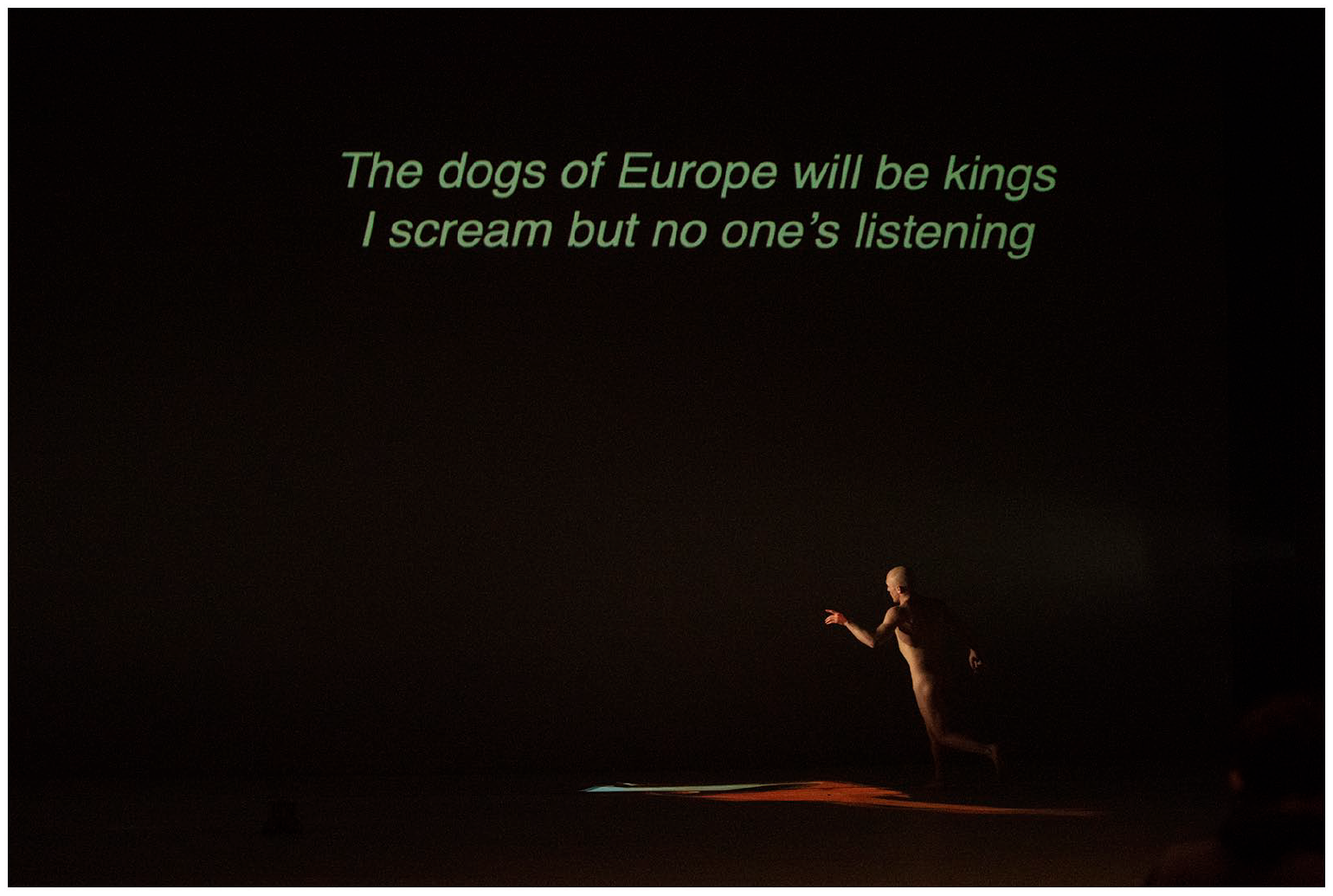
The interval-performance. Aliaksei Naranovich. Photo by Linda Nylind.
About Belarus Free Theatre (BFT)
In 2006, I founded Sputnik Theatre Company, an independent British troupe, dedicated to bringing contemporary Russian-language drama to the UK. While attending a theatre festival in Togliatti, Southern Russia, I met Natalia Kaliada and Nikolai Khalezin, co-founders of the BFT, who were touring several productions. I vividly recall Generation Jeans, written and performed by Nikolai Khalezin. On stage, the author-performer cut up pairs of jeans – which were banned in Belarus during the Soviet period and, thus, a much-coveted commodity. The actor turned them into flags, while telling an autobiographical story about his arrest during a 2004 peace protest in Belarus. While Khalezin’s home country (Belarus) became nominally democratic in the post-Soviet period, it gained an autocratic leader in 1994, Aleksandr Lukashenko, and the country is often subsequently characterised by mainstream politicians in the West as ‘the last dictatorship in Europe’. 1
Looking back, that company’s tour to Russia appears to belong to another era. Prior to 2021, the majority of the BFT ensemble continued to live and work in Belarus. I heard first-hand from Kaliada and Khalezin (co-founders of the company) about how their performances in Belarus were attended by the KGB, the Belarus security services. To outwit and outmanoeuvre state surveillance, the troupe became agile and highly inventive. Last-minute changes of performance locations became the norm for their productions – communicated to audiences with phone calls and text messaging. On one occasion, an even more inventive approach was taken. The BFT orchestrated a pretend wedding between two actors, organising a full-blown wedding ceremony in the countryside outside Minsk (capital of Belarus). When the KGB agent left after 15 minutes of the ‘wedding’, the actors removed their wedding costumes and resumed the act of theatre-making. While this anecdote is amusing (it was narrated to me with a laugh by BFT’s co-founders), it suggests how subversive the theatre company is – in the eyes of the Belarusian state.
BFT describes its theatrical work as a form of activism, advocating for ‘democracy, human rights and artistic freedoms’. 2 A key component of their work is using theatre to prompt public debate and engagement on issues such as human rights and social justice. For instance, after performances, it is common for Natalia Kaliada to come on stage to speak about the real-life human rights abuses or social justice issues, represented in the given production. Their performances set the stage for dialogue with audiences. Aesthetically, the troupe tends to eschew naturalistic storytelling, as well as documentary theatre techniques, 3 the latter being the most common form of political playwriting among post-Soviet playwrights. 4 The BFT works more in the style of the Theatre of Cruelty, 5 a term coined by the European avant-garde director Antonin Artaud working between the World Wars and used to call on European avant-garde directors to ‘break theatre’s subjection to the text and rediscover the idea of a kind of unique language somewhere between gesture and thought’. 6 By depicting sensory and non-naturalistic (or highly exaggerated) images, BFT aims to create performative scenes designed to sear themselves into the audience’s subconscious. Productions tend not to provide didactic messages. Rather, they engage the audience affectively with themes which will be later contextualised or used as an invitation for engagement by Kaliada in a post-show public forum.
Members of the BFT have had to live their convictions: many troupe members have been arrested for attending protests in Belarus, and some have been tortured. After the falsified 2010 Presidential elections in Belarus, when there was a proliferation of state-led arrests and even assassinations of oppositionist activists, the BFT founders judged it unsafe to remain in Belarus. Kaliada, Khalezin and a third co-founder, Vladimir Scherban, took refuge in London, initially with a long-term residency at London’s Young Vic Theatre. They continued creating guerrilla productions by rehearsing over Skype (and later Zoom) with their actors in Belarus, who were deemed to be less at risk. The 2020 rigged presidential elections in Belarus made political opposition yet more dangerous, forcing the dozen-plus members of the BFT’s permanent troupe to leave the country and find sanctuary in the UK and Europe. The only exception is their animation designer, Roman Liubyi, a Ukrainian who returned to his home country to fight the Russian invasion. Theatre and political life fuse in the company’s work – their productions express their own lived experiences, sometimes indirectly and sometimes directly, inviting audiences to ‘live in the skin of dictatorship’.
The Dogs of Europe in four images
A broad synopsis of the Dogs of Europe is challenging because of its non-linear narrative structure. Performers depict school children in 2019 writing messages for a time capsule. The plot then skips ahead to 2049, as the audience encounters representations of the mundane, yet brutal, reality of living in the ‘Russian Reich’ – a futuristic, neo-imperial Russian state which has swallowed up most of Russia’s borderlands. The endemic suspicion of others and randomised violence are frightening, sickening even. The performance’s second half is equally non-linear, dreamlike and enigmatic, albeit with a somewhat more decipherable throughline about a police agent investigating the death of a guest in a Berlin hotel – who may or may not be a disappeared Belarus poet. Poetry and writing have disappeared in this 2049 Europe. The conclusion is a metatheatrical sequence of book-burning, evoking so many acts of oppression by different tyrannical governments. The highly sensory but fragmented approach to play-making invites each audience member to gain experiential insight into life under dictatorship – to ‘live in the skin of dictatorship’; an experience which is incoherent, disjointed, perhaps feeling ‘unreal’, like a collective psychosis. The audience is also offered a futuristic Europe in moral decline, presented through a series of images which spectators must piece together to distil their own narrative and meaning. I offer four images that burn especially brightly.
One
On stage, Old Lampe berates two characters (and audience) about their love of ‘pictures’ (Figure 2). What are these pictures? It’s not entirely clear. They appear to represent anything superficial, perhaps invoking social media. Books are worthy of reverence. Yet the European League has stopped reading: books have been banned, obscuring historical truths and forging the route to collective amnesia.
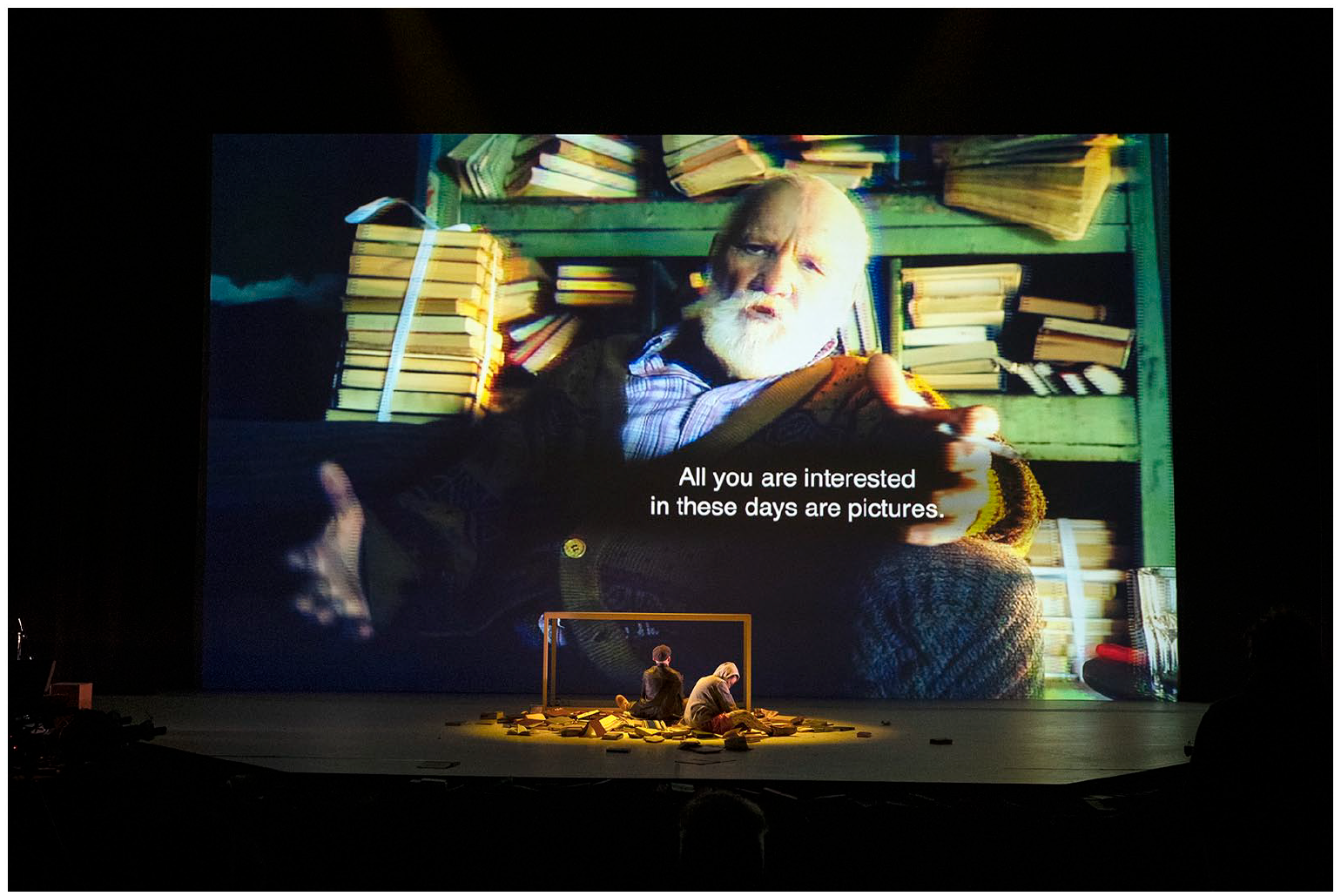
The anti-social media guru. Pictured – Valery Mazynsky as Old Lampe. Photo by Linda Nylind.
Dogs of Europe has two satirical targets. The first is the fictional ‘Russian Reich’ in 2049 – an imagined (but anxiously real) geography of Russia’s imperialist aspirations. Belarus and other neighbouring countries in Eastern Europe have been swallowed up by Russia. The work now reads as terrifyingly prophetic. A second satirical target is liberal European social values. The play’s notion of ‘images’ in the fictional European League denotes the instant gratification and narcissism of self-representation on mobile and computer screens. Old Lampe suggests that this obsession is a moral decline: individualism over collective good. The audience is presented with a challenging question around whether liberal democracies in the West are complicit with the rise of fascism in the East through a shared lack of engagement with historical truths, symbolised by the banning of books.
Two
The actor Pavel Haradnitski – naked except for footwear and a flesh-coloured belt strapping a lapel-mic to his body – rolls a ball of books across the stage (Figure 3). A disquieting image of vulnerability. His sturdy brown boots suggest he’s a labourer condemned to saving intellectual culture. The scene invokes the Greek figure of Sisyphus, the mythical man destined to push an enormous bolder up a hill only for it to roll back down, again and again. Unlike mythical Sisyphus, whose task was never-ending, this character is hoisted up onto the ball of books and strangled by other actors dressed in black costumes. Are they Fascists? Sisyphus dies, and something has been lost. There will be no happy ending here. This visceral, metatheatrical image of torture and murder invites the audience to reflect on their own role, or complacency, in allowing Europe’s moral and political decline – the West’s shared political apathy is directly tied to Russian dictatorship.
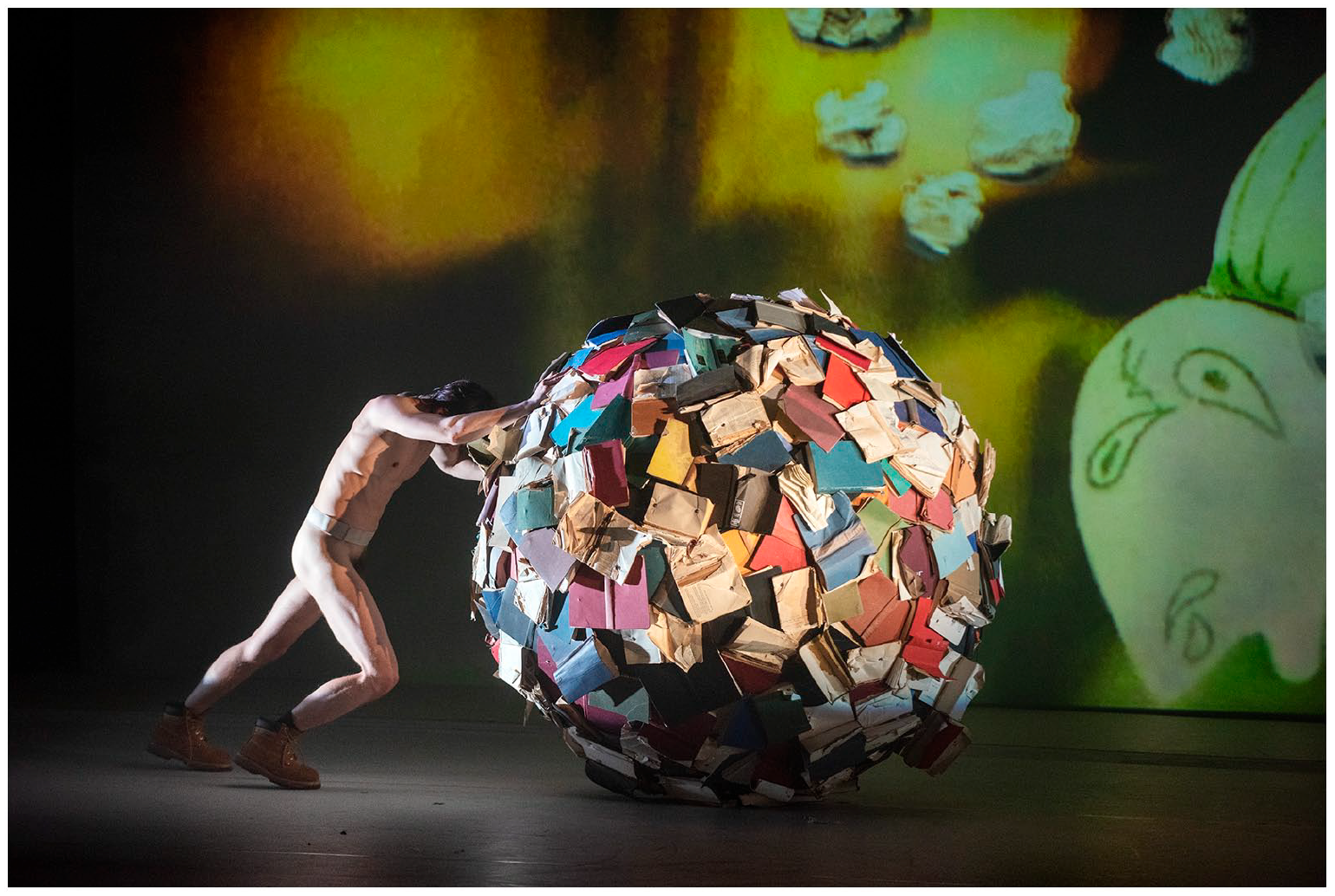
The book-man Sisyphus is not eternal. Pictured – Pavel Haradnitski. Photo by Linda Nylind.
Three
The final image of the play. A book is set on fire. The Fascists have reappeared: silent, neutral, ordinary (Figure 4). In fact, this time, these Torturers are no more than members of a troupe – stage hands. No acting required. The Revolution will be mundane – and fascistic. Book-burning evokes censorship, which is reinforced by a projection above the stage of the famous quotation by Heinrich Heine: ‘Where they burn books, in the end they will also burn human beings’. The novelist Alhierd Bacharevič and the BFT have lived experience of censorship. The former’s novel is banned in Belarus, while the BFT has been forced into exile and are banned from performing in their native country. The books appear to burn like an eternal flame, not reducing to ash. The flames of Fascism will continue to spread until confronted and extinguished.
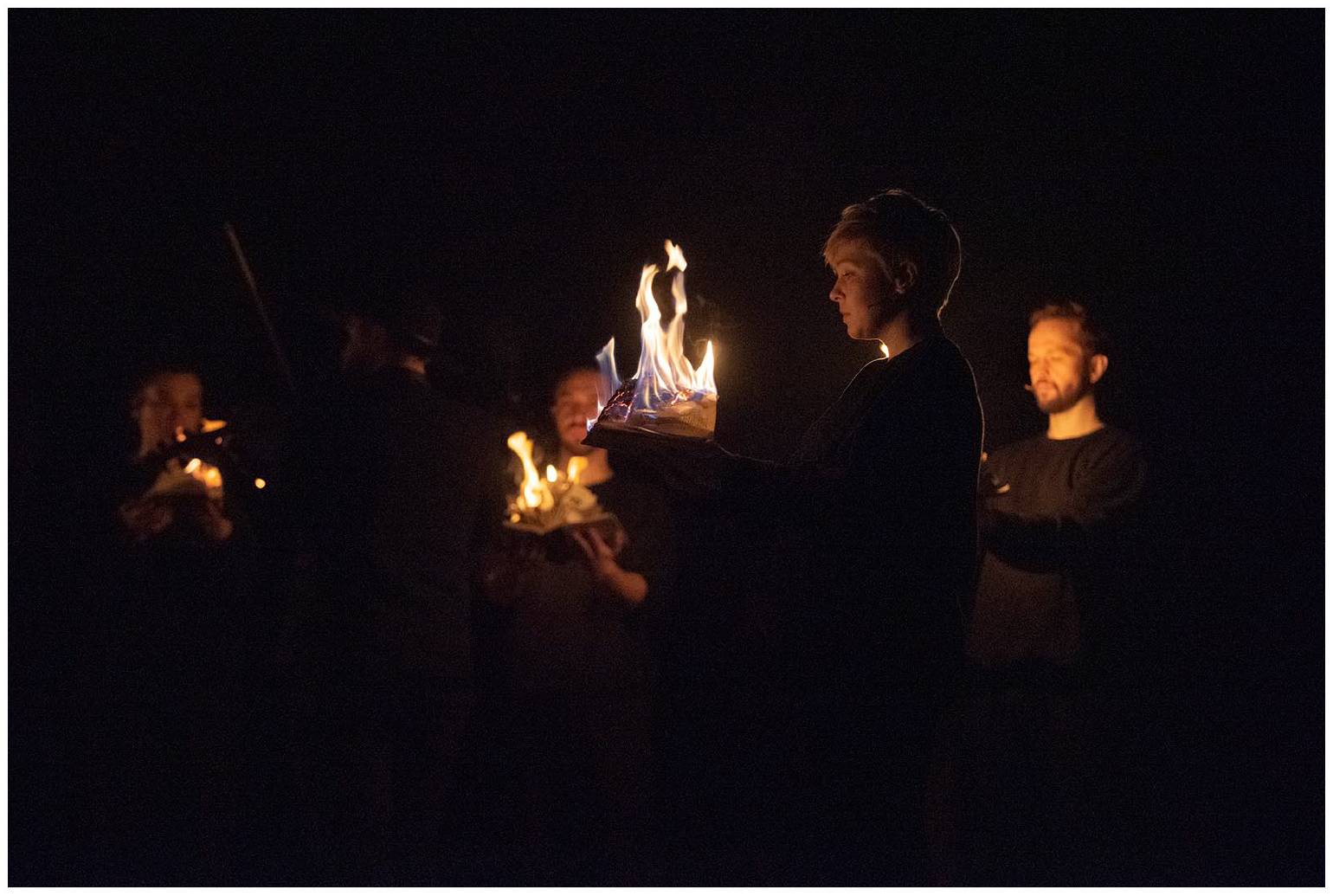
Book-burnings – a flame which spreads. Pictured, centre – Maryna Yakubovich. Photo by Linda Nylind.
Four
After the production ends, Natalia Kaliada (BFT co-founder) steps on stage to interrupt the applause: ‘I don’t like to interrupt a standing ovation, but. . . I will’ (Figure 5). She speaks after every performance – it’s the juncture where, for this troupe, art meets its audience, artistry meets activism. The nuances and pleasing ambiguities of art fall away in the post-show interaction, which is brief and directly follows on from the play. Kaliada, a charismatic and personable speaker with excellent English, offers contextual information and facts about the themes raised in the production. She explains about the tyranny in Belarus since 1994 and expresses solidarity with Ukraine. She calls on the audience to take action. In fact, this action starts immediately. She invites the audience to pick up the A4-sized photo of political prisoners in Belarus, which each audience member found on their seat upon arrival in the auditorium. Everybody does, and we hold them up in the air, while a photographer takes a photo of the audience to release on BFT’s Twitter account, to create a political message but equally importantly to offer solidarity to the families of those detained (often without reasonable cause or clear time limits). The moment is poignant. It also serves as a reminder that there is no ‘hard border’ between the fictional production and so-called ‘real’ world. Art creates memories and experiences; art creates temporary commmunities of (sometimes) likeminded people or allows those who disagree to come side-by-side. Art can support collective action and activism. Cultural production is one type of social encounter, and one domain where the social imaginery coheres into narratives and takes shape. BFT’s work is a vivid illustration of how art can be used as a calling card to invite audiences to hear inconvenient truths about challenging themes such as arbitrary detention and torture.
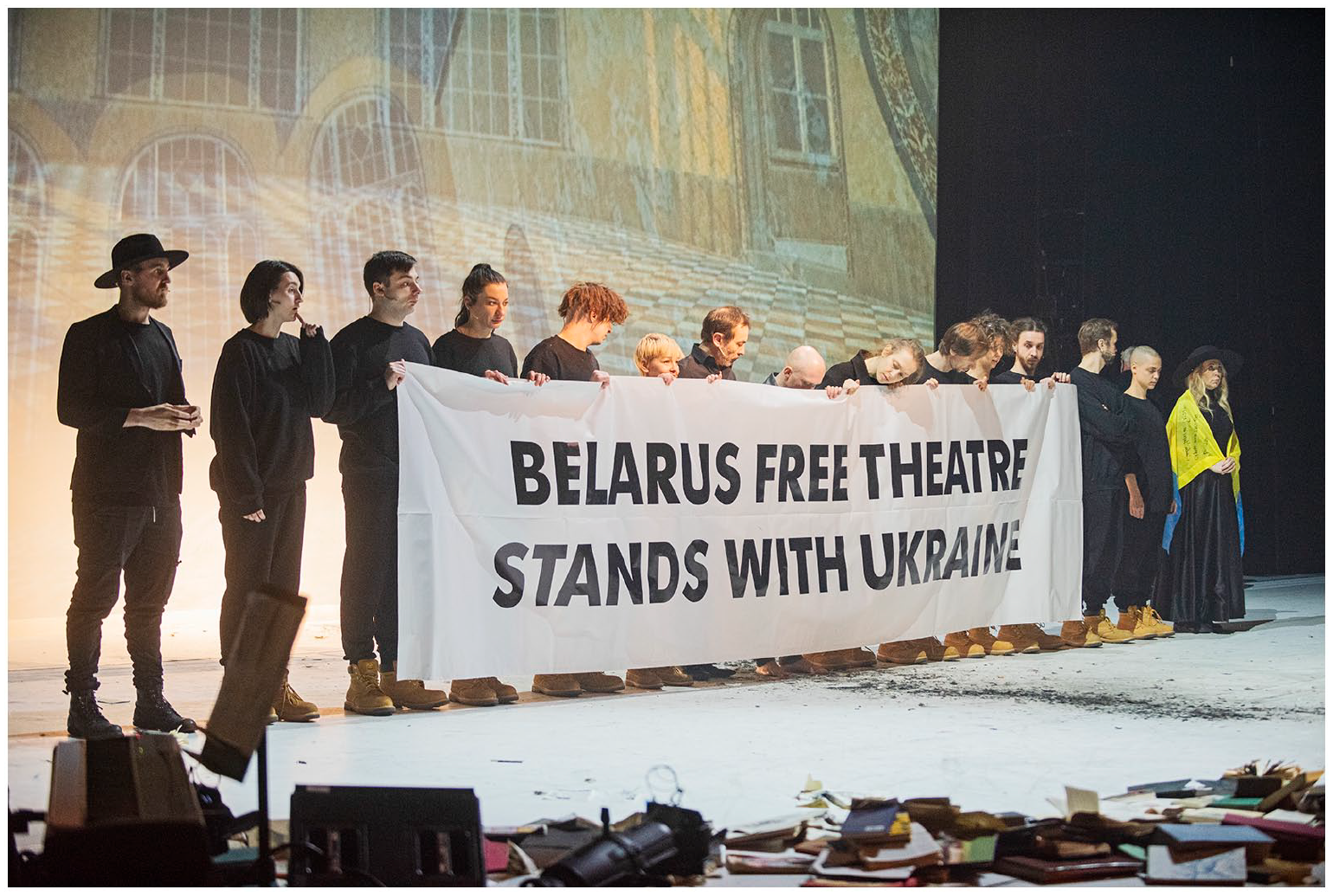
Theatres without curtains. Photo by Linda Nylind.
Concluding remarks
The BFT has found its own unique strategy for engaging audiences in dialogue on difficult political issues. Using vivid image-based theatre, this production looks to affect the audience without explanation or didacticism, to get people feeling the issues in part to stimulate and inform a post-performance forum. As the horrifying violence unleased by the Russian state in Ukraine continues, Dogs of Europe offers a savage dystopian satire with terrifying and prophetic resonance in the immediate present. As ever, the BFT’s objective is to entertain and inform. To engage and advocate. This approach is a useful reminder for cultural geographers that performance does not exist as a discrete space; on the contrary, it is a social activity with porous borders and the potential to create reverberations in the thinking and practice of audiences. Dogs of Europe invites audiences to reflect on Europe’s potential complicity in the political and cultural realities of contemporary Belarus, the authoritarian country at its eastern borders. Cultural geographers may do well to study diasporic theatre. Future research could consider the function that disaporic theatre fulfils in confirming and challenging host and diaspora identities; the target and real constituency of diasporic theatre’s audiences; and the reverberations of the performances in the thinking and practices of those audiences. By applying surveys and/or long-form interviews to the study of disaporic performances, cultural geographers could shed new light on a subject which has conventionally been explored mainly in performance studies, 7 leading to cross-disciplinary academic dialogue on topics such as migration, multilingualism, identity-formation and the ideologies of cultural production.
Footnotes
Funding
The author received no financial support for the research, authorship, and/or publication of this article.
