




Abstract
There is a high interest in art's change potential towards sustainability. Yet, there is still a lot unknown about this change potential, including from the perspective of artists themselves. The research questions, thus, are: Do artists who create climate-related art have goals and target audiences regarding their climate-related work? If so, which goals and audiences do they aim for, and why? 30 interviews with artists having been born or living in the United Kingdom, United States of America or Germany were conducted and analyzed. A framework of eco-social change was applied to the interview transcripts, and artists’ goals and audiences were analyzed through thematic analysis. The research finds that artists have a desire for societal impact and wider audiences, but some also have narrower audiences and smaller changes in mind. Moreover, some artists engage in an impact reflexivity about not only the potential but also the limits of their practice.
Introduction
The acceleration of global challenges such as the climate crisis has led to a high interest in the change potential of creative practices as the arts arguably offer meaningful types of engagement at the personal and collective level (Galafassi et al., 2018; Maggs & Robinson, 2020; Vervoort & all CreaTures, n.d.). The number of art projects and exhibitions that address sustainability and climate change has increased (Demos, 2016; Galafassi et al., 2018) and high-profile artists such as Olafur Eliasson have highlighted climate concerns in their artworks. Climate-related art can be understood as art that focuses on the climate crisis or that is related to it by the artist (following e.g., Roosen et al., 2017, and Galafassi et al., 2018).
For artists who address climate-related topics, a desired societal impact is often among their intentions (McGregor, 2019; Nurmis, 2016). Yet, its social impact may make art susceptible to the dangers of instrumentalization, for example, when art is faced with linear and prescriptive expectations (Maggs & Robinson, 2020). Hence, scholarly work based on artist statements suggests that they may not only want to be judged by their impact. They might not necessarily identify as activists (Nurmis, 2016), and their messages may not inevitably be obvious (Doyle, 2019). Building on 30 qualitative interviews with artists addressing climate change in their works, this paper addresses whether these artists have any goals and target audiences in mind regarding their climate-related work. If so, which goals and intended audiences do they aim for, and why?
This study applies and extends the CreaTures framework for eco-social change. This framework was developed by a team of creatives, researchers, funders, and policymakers to offer a rich understanding of creative practices and their change potential based on various interviews and literature reviews (Vervoort et al., 2024; Vervoort & all CreaTures, n.d.). We add insights into visual artists’ reported goals and audiences, and—what we term—their impact reflexivity, that is, they reflect not only on the potential but also upon the limits of their practices. Furthermore, this article contributes to an understanding of the concepts of autonomy, social engagement, and instrumentalization for the cases of artists who address climate-related topics.
Autonomy, Social Engagement, and Instrumentalization in the Arts
To better understand contemporary artists’ intended audiences and goals, we bring together different theoretical approaches on autonomy, social engagement, and instrumentalization. First, according to Bourdieu (1993), a field—such as the field of law, politics, or art—is a domain in society with its own logic and status markers. Bourdieu sees a relatively autonomous art field as governed by artistic criteria, in which recognition is bestowed based on artistic value (instead of values unrelated to the arts, such as economic value) by art institutions and cultural intermediaries that are specific to the art field. In contrast, he “considers commercial success […] to be alien—or heteronomous—to the logics of the artistic field” (Roose et al., 2018, p. 305). While often seen in economic terms, heteronomy can also mean art's social engagement—if social engagement is understood as a logic that is external to the art field (Roose et al., 2018). Modern art “pursues an autonomous art that avoids ‘polluting’ itself with concerns from other social systems” (Roose et al., 2018, p. 307). Autonomous art—art for art's sake then—is art that is independent of religious, political, or other values. It can be said that “the art worlds became much more interested in their own internal history, discourses and overall languages, than in their relationships with their environments” (Kagan, 2011, p. 67). If these insights are applied to the individual rather than the level of the field, a fully autonomous artist (if autonomy is understood as not fulfilling a social function) would therefore be less interested in their audiences or goals external to the work (Kagan, 2011). While such an artist without any regard for the public is an extreme case (and it can even be argued that “a work of art is never pure, never self-contained, never autonomous” because “a belief system is being reinforced”; Gablik 1991, p. 148), what can be concluded from autonomous cultural production is that it is aimed at a narrow (e.g., other cultural producers) rather than a large audience (Bourdieu, 1993).
Second, in contrast to modern art, contemporary art seems more open to engaging with themes from outside the art field (Roose et al., 2018). Thus, the arts appear to become more heteronomous in the sense of their social engagement role. Art historian Claire Bishop has coined the term “social turn” to describe “the recent surge of artistic interest in collectivity, collaboration, and direct engagement with specific social constituencies” (Bishop, 2006, p. 178). Next to art that uses social forms (e.g., socially engaged participatory art), art can also address social content (e.g., documentary art) (Roose et al., 2018). The link between art and social engagement is complex because, as Maggs and Robinson (2020) argue, one tries “to navigate the challenge of increasing its [art's] social impact without succumbing to the perils of instrumentalisation” (p. 39). A social function in the arts can be perilous in several circumstances: when art serves political, social, or scientific interests without being critical; when it is subjected to corporate manipulation (Demos, 2016); when art is merely seen as a panacea for social change; and when its value is only based on prescriptive, linear expectations (Maggs & Robinson, 2020).
Artists Who Address Climate Change: Goals and Target Audiences
Desired Impact
The debate around autonomous art and art with a social function often includes the term impact (e.g., see Maggs & Robinson, 2020). Generally, impact can be understood as lasting changes, and it can be intended or unintended, negative or positive. Here, the focus is on artists’ intended or desired impact (i.e., not their actual realized impact). Artists who address climate-related topics may aim for societal impact, which refers to lasting changes at the societal or community level. They can also strive for environmental impact by pursuing “a determined strategy to improve the natural realm as the very purpose of their art” (Brown, 2014, p. 218). The social and environmental are also merged at times, for instance into “eco-social” to illustrate their connectedness (Vervoort & all CreaTures, n.d.). 1
To study this link between creative practices and societal transformational (or eco-social) change, we draw upon—and extend—the nine dimensions tool, developed in the context of the Creative Practices for Transformational Futures (CreaTures) project (https://www.creaturesframework.org). 2 The nine dimensions of the tool have been identified, tested, and developed through the analysis of 140 creative projects and application to 20 artistic productions 3 and integrate insights from a wide variety of academic disciplines (sociology, anthropology, political science, sustainability science, psychology) about transformation, evaluation, and creative practices (Vervoort et al., 2024). The tool provides “building blocks for a theory of change to help work out what is intended, and in what dimensions change is hoped for” (Vervoort, Zamuruieva, Dolejšová, et al., n.d., Nine Dimensions section, para. 17). The nine dimensions are organized around three types of change: change of (1) meanings (through embodying, learning, and imagining), (2) connections (through caring, organizing, and inspiring action), and (3) power (through co-creating, empowering, and subverting). There is no order to these overall change types and dimensions, and they involve various interrelated emotional, cognitive, and action-oriented processes (Vervoort, Zamuruieva, Dolejšová, et al., n.d.).
Different groups can engage with the tool, yet it was developed to be used by creative practitioners (e.g., to explore ways how they work towards change, or to engage with research on processes that they already know about intuitively), researchers (e.g., using the dimensions to analyze data), policymakers (e.g., to better understand creative practices working towards change) and funders (e.g., to design calls) (Vervoort et al., 2024). The downsides of such a tool should be mentioned as well. A limitation may be the broad concept of change and the general concepts of the nine dimensions because their meaning can vary across different contexts. Some of the dimensions need further development, such as the subverting or empowering dimension (Vervoort, Zamuruieva, Wolstenholme, et al., n.d.). In addition, the framework contains some information about the challenges that artists may encounter when working towards change (e.g., some artists’ frustration with practices that were trying to disrupt systems in overly obvious or hostile ways, Vervoort et al., 2024). However, more information on the challenges or limits when artists work at the intersection of social engagement and art would add to the framework. It should also be noted that not every aspect of impact is measurable by one of the dimensions, perhaps especially for works that are experimental, complicated, ambiguous, or more personal.
Role of Aesthetics
When artists (but of course also critics, researchers, etc.) talk about art that is involved with socio-ecological themes, they may link it to aesthetics in different ways. One approach is that aesthetic considerations are seen as not important or subjugated to other goals. Artists and critics may employ other criteria when talking about the art. For example, Bishop (2006) mentioned the case of an artistic collective that considered aesthetic to be a dangerous expression and instead found creating dynamic relationships pivotal. Does such denigration, or at least a subjugation, of the aesthetic also apply to artists who address climate change and focus, for instance, on activist rather than aesthetic goals?
Instead of one subjugating the other, aesthetic and social criteria can share the stage. For example, in art discourse, an artistic and a social discourse can co-exist (Roose et al., 2018). Similarly, artists may put an emphasis on both the aesthetic and the social by highlighting a social topic and using art's unique capacities (Nurmis, 2016). They may also consider social change as part of the aesthetic. As Rancière argues, “the aesthetic doesn’t need to be sacrificed at the altar of social change, as it already inherently contains this ameliorative promise” (Bishop, 2006, p. 183). The aesthetic is about being able to think in terms of contradiction. This is also related to the concepts of autonomy and social engagement introduced above. One can believe in art's autonomy and its role in working towards a better world. The best practices 4 can “address this contradictory pull between autonomy and social intervention” (Bishop, 2006, p. 183). For example, the CreaTures framework has been described as being neither only about art for art's sake, nor only about instrumentalization, but rather as a “third type.” 5 While aesthetics are not a separate dimension within the framework, it is seen as part of the nine dimensions.
Target Audiences
Art can be aimed at (1) the art world, (2) broader audiences, (3) specific communities, (4) political, legal, or corporate actors. First, artists may (intend to) reach people who are directly engaging with the work by viewing it or participating in it. Moreover, it has often been stated that art displayed within cultural institutions might have less outreach or mass appeal (Hawkins & Kanngieser, 2017; Kagan, 2011). This is because the art world is rather distant from the general public through the conventions present within and requires cultural capital to understand them. While not reaching wider audiences, (climate-related) art can influence specific segments, such as cultural elites (Kagan, 2011), or people who are “already engaged” in the issue of climate (Bunting, 2010, as cited in Doyle, 2019, p. 46). Second, one of the most apparent intended audiences for artists working on sustainability and climate issues is a wider audience because climate change is an issue that needs a “collective efforts” (Julie’s Bicycle, 2009, as cited in Doyle, 2019, p. 47). For example, McGregor (2019) interviewed artists (who work on topics such as climate change), asked them: “Where/when/how have you found your role as an artist to be most effective?” (p. 65), and found: “To be effective, the message has to get out there, connect with multiple audiences” (p. 68). Galafassi et al. (2018) also mention climate-related art's potential to reach many people. This can be achieved by presenting the art in the public realm (McGregor, 2019). Sommer and Klöckner (2021) found that public climate-related artworks are more accessible and reach bigger audiences. They stress the importance of not merely exhibiting art within institutional walls. Wider audiences can also be reached through representation in “social and mainstream) media”: (CreaTures Framework, n.d.). Media thus functions as a change agent (Brohmann et al., 2020), and artists can act as public intellectuals, addressing a broader public instead of expert audiences, synthesizing and analyzing research, performing as a “social critic, advocate or activist” (Nisbet, 2014, p. 811). Third, artists may also aim to reach and involve communities in their work. This could mean that art projects strive to improve the conditions of a community. For instance, biogas units, which are part of the project Supergas (1997) by the collective Superflex, were made for communities in Tanzania (Demos, 2016). Artists may also engage with and involve communities as co-creators. For example, Joseph Beuys’ 7000 Oaks (1982) involved the planting of trees in Kassel, Germany, with the help of volunteers. Kagan (2011) observes about art and sustainability: “[…] artists intervene directly in ecological and social reality, engage with communities, and aim at setting transformations into motion. Such ambitions beg a more careful attention to the potentials and challenges facing artists aiming to contribute to social change, not only within their art worlds but also directly in specific social contexts” (p. 468). Similarly, Lesen et al. (2016) discuss participatory, community approaches. Here we may also think of concepts such as socially engaged art (i.e., communities become engaged through participation) (McGregor, 2019). Civil society, or more specifically local communities, can act as a change agent (Brohmann et al., 2020). Fourth, political, legal, or corporate actors may also be promising audiences for artists because they are change agents who can promote cultural change through policies, laws, and sustainable products. Artists can support the exchange of such change agents (Brohmann et al., 2020), and help stimulate changes in power. For example, some art projects are said to influence politics, including the politics of cultural institutions within the art field. Artists may also aim to investigate and change political, legal, and corporate conditions outside of the art context (Groys, 2014). An example is Forest Law (2014), a video and mixed media installation by Ursula Biemann and Paulo Tavares “that investigates the history of destructive oil extraction in the Ecuadoran Amazon, Indigenous resistance and environmental activism, and legal proposals for transformative justice” (Demos, 2017, p. 98). Such works are often driven by artists-activists who combine art and activism in instrumental ways (Duxbury et al., 2017; Nurmis, 2016). Given the recent rise of activism in civil society (e.g., Fridays for Future, Extinction Rebellion), are we seeing an activist intention among artists?
Data and Methods
Qualitative in-depth interviews were chosen for this research because they highlight the perspective of participants (Patton, 2002). The visual artists were selected based on the following criteria. First, they make visual artworks addressing climate-related topics “whose content and themes are centred on climate change or those works the artists themselves define as being related to climate change” (Galafassi et al., 2018, supplementary material, p. 2). Second, in this set of interviews, we selected artists born or living in central art markets. The contemporary art world is characterized by a “strong hierarchy […] between nations” (Quemin, 2015, p. 825), “the most recognized artists generally belong to a very small number of countries that are all Western and among which the United Kingdom and Germany, but even more so the USA, take the lion's share” (p. 849). Third, there were also pragmatic reasons, such as the language skills of the researcher, to interview artists from these regions. Fourth, we did an online search for artists who addressed climate change and appeared in news articles, documentaries, and on the radio. In addition, we approached artists who were part of exhibitions of the first Dutch art space with a permanent program on art, ecology, and climate change. This selection process also reveals one of the main limitations of this research: the focus is on artists from or living in selected central art markets, with only some of them having a connection to other areas, such as peripheral art markets or the Global South. It is also important to keep in mind that the results cannot be generalized, and that artists talk about their desired impacts, not their realized impacts.
The selection process resulted in 30 artists and artist duos for which 30 online interviews 6 were conducted between March 2021 and May 2022, lasting around 1 h on average. Ten artists/artist duos are from Germany (some living in other countries, such as Norway, South Korea, and France); nine are from the United States of America (some living in Ireland and Scotland), one artist is from Australia with previous residence in the US; and nine artists/artist duos are from the United Kingdom, one is from Zimbabwe with current residence in the UK (see the supplementary file for a list of the artists and the discussed works). Fifteen artists identify as a woman, 13 as a man, and for two artist duos the gender is unknown. 7 Most of the artists were trained in the arts, and their career phases range from emerging to mid-career and established, their social media followers from 67 to more than 90,000. Among the art forms were painting, photography, sculpture, installation, public art, participatory art, architecture, performance, and art at the intersection with research and science. Interviewees were provided with an Informed Consent Form. 8 At 30 interviews we reached saturation. Among the inquired topics were artists’ goals, audiences, location of their art, collaborations, and encountered challenges.
The data was analyzed through directed content and thematic analysis. In a directed content analysis, the research starts with codes based on existing theory or research (Hsieh & Shannon, 2005) and is therefore particularly fitting for the application of the change framework (using the description of the nine dimensions for a coding scheme). Thematic analysis allowed “identifying, analysing and reporting patterns (themes) within data” (Braun & Clarke, 2006, p. 79) and was especially helpful for the analysis of artists’ audiences, the role of aesthetics and their deliberations about their impact (what we will term impact reflexivity). Thematic analysis can be deductive or inductive, of which particularly the former was implemented.
Results
In 26 of 30 interviews, artists mentioned goals and stated audiences that they (intend to) reach, while the rest did not claim to work according to the logic of goal-oriented art with clear audiences in mind (at least immediately when asked). This is not surprising because the interviewed artists address climate-related topics, which may explain why most clearly reported goals (such as to change matters) and to reach audiences (in the art world and beyond) instead of engaging in a self-referentiality towards their internal discourses. Thus, they operate according to a social function, using social forms or addressing social content (Roose et al., 2018). Most artists mentioned social aspects and aesthetics during the interview. These general findings will be discussed in more detail below.
Importance of Aesthetics Along Social Criteria
A majority of artists talked about both aesthetic (or artistic) and social criteria, either by mentioning both during the interview or by making the combination explicit. For instance, they have a “duo” goal, achieving “a successful painting,” which is “an aesthetic decision,” and “making a difference” (Diane Burko), 9 they want to “marry [cause-related goals] to the pursuit of art” (Alisa Singer), or they work at the “interface between aesthetics and ethics, between art and activism” (Ackroyd & Harvey). It is a “thin line” (said, for instance, Michael Pinsky) or “tightrope walk” (e.g., Stefanie Zoche of Haubitz + Zoche) between social engagement and art (striking that balance was perceived to be a challenge as well). The issue of whether art was to be subjugated by social engagement was vocalized by many: “Can art make a contribution to areas such as social and environmental issues? […] And of course, it's a very thin line that you walk here. […] we want the artistic work not to be tied to a specific purpose” (Markus Heinsdorff). Thus, artists have goals external to their work (social engagement role), but they also usually value the art for itself.
For a few artists, artistic goals prevail over social engagement, while for others it was vice versa.
For instance, an artist said that he wants to provide direct access to the experience of a phenomenon first, and “the problem of climate change […] only came at the end” (Gerhard Lang). In contrast, other artists, at least for some of their artworks, said that they focused more on the message and social engagement. Even though societal goals appeared to take the lead here, the artists mentioned still being interested in “aesthetics” and “artistic ways.” Thus, no artist rejected the aesthetic in the sense of Bishop's encounter with artists who found the aesthetic to be a dangerous expression (Bishop, 2006).
Artists do not see their work only as a magic bullet for social change that is stripped of its aesthetic value. In the CreaTures framework, aesthetics are part of the three change types, particularly the changing meanings type, 10 which was indeed the category that was found very often in the interviews (see next section).
Eco-Social Change Goals: From Direct, Large, and Fast to Subtle, Small, and Slow
Many artists were vocal about aiming for impact and change. Twenty-four artists mentioned either (to) “impact”/”effect” (in the sense of their art's positive impact/effect on people and matters) or (to) “change” (in the sense of possible changes through art). 11 For instance, artists aimed to change people or policies. Often, they mentioned other factors at play to create change (e.g., collaborations, culture more generally, public programming, media, systemic changes, etc.). This is also reflected in the CreaTures framework, which makes clear that creative practices are helping and contributing to change, not necessarily that art is the sole driver (a perspective that is also found helpful by, for instance, Maggs, 2022). In each interview, statements about their goals could be related to at least one of the three types of change of the CreaTures framework, particularly the changing meanings and connection types of change goal (see Table 1), and, within those, especially aspects related to the learning, caring, organizing, and inspiring dimensions.
Number of Interviews in Which Artists Mentioned the Change-Related Goals
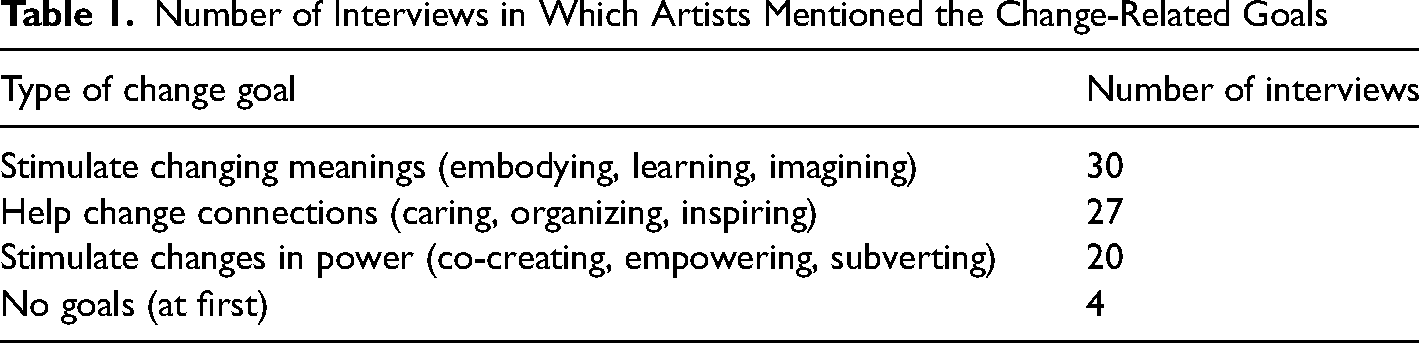
For example, artists hoped to change people's perceptions, understanding, and awareness. This can be seen as part of the learning dimension which refers to creative practices that allow questioning assumptions and worldviews, and the learning of new ways of doing, being, seeing (and is part of the changing meanings category). Artists also talked about goals related to making people care about, empathize with, and have respect for animals, plants, and people; fall in love with nature; demonstrate and make people see connections between humans and nature. These can be seen as part of the caring dimension (which belongs to the changing connections category). Another example is that some interviewed artists were aiming to change political (e.g., policy change) or social systems and perspectives (e.g., provoking a new nature philosophy or a different narrative) through their creative practices (but also through culture more generally) in pragmatic or symbolic ways. While the artists did not use the term “subvert,” it became clear that they wanted to change or question matters that were not working and were thus allocated to the subverting dimension, which is part of the changing power type. Nevertheless, this dimension was particularly difficult to apply to the interview transcripts because the difference of subverting to some of the other dimensions remained vague (e.g., to learning, caring, and inspiring).
While the nine dimensions and the overall three change types could be applied across the 30 interviews, it is interesting to see how artists compare to each other in their type of goals as it allows asserting if an artist makes use of a particular change type. Around two-thirds of the artists/artist duos covered all three types (with the same or with different kinds of art projects): They are meaning, connection, and power changers. The remaining artists could be placed in one or two change types. This is not surprising, as creative practices do not necessarily engage with all change types, let alone all nine dimensions (Vervoort, Zamuruieva, Dolejšová, et al., n.d.).
While artists who engage with climate change should not be expected to produce an explicit message necessarily, and art can be rather subtle instead (Doyle, 2019), artists can certainly choose to communicate a clear, direct message. For instance, while some artists decided not to use the word “climate” but “ecology” or “nature,” which is “giving you space to fill in all those edges and make it a more interesting piece” (Emma Hislop), others talked about making “direct” works, “so that there's no misunderstanding” (Justin Brice Guariglia). The scope of change that the interviewed artists mentioned to strive for also varied. Mary Mattingly, for instance, works on “provocative public art” that is “looking at New York City specific laws,” which led to the city's first public foodway, and Eve Mosher is interested in “big systems change.” Others mentioned smaller or slower changes that ultimately can result in real change. David Brooks, for example, said about his and Mark Dion's art project The great bird blind debate (2020): “One little bird sanctuary is just a drop in the bucket […]. But every drop in a bucket is still a drop in the bucket. So, we actually need all the drops in there.”
A conclusion drawn in the CreaTures framework is that change, according to most cultural producers, is more about shifting relations rather than transforming systems, incremental rather than urgent (Houston, n.d.). Yet, there are certainly artists in the CreaTures framework and also in the present sample who (strive to) transform systems and try for fast changes. The CreaTures framework also stated that there was room “for more development […] about how challenging/subversive transformative creative work should be, and about gentle versus more aggressive subversion” (Vervoort, Zamuruieva, Wolstenholme, et al., n.d., p. 8). We can contribute to the CreaTures framework by stating: Both direct and subtle ways, large and small, fast and slow changes are possible aims and equally important to include in change frameworks. There should be no expectations regarding the degree of gentleness versus aggressiveness. Not only because these concepts are highly subjective, but also because artists need the freedom to address the topic in whichever way, creating a diverse set of art practices (preventing instrumentalization). Some artists reflect upon the limits of art to create certain changes, however, which will be discussed next.
Impact Reflexivity: Potential and Limits of Art to Change Matters
The interviewed artists did not always only talk about the potential of their work, but many also reflected upon the limits of their practices, which we term impact reflexivity. During the interviews artists commonly reflected on (1) their doubts or uncertainty about the ability to create certain kinds of change/impact, (2) their decision to stick to certain goals or approaches they deem realistic or appropriate as artists, (3) reflections about negative impact, (4) financial considerations, (5) the pandemic, and (6) a reported limited audience reach. 12
First, not all interviewed artists were necessarily convinced or sure of their ability to create (certain kinds of) change or impact. For example, they did not consider themselves the most effective artist tackling the climate crisis because they felt others responded to it more directly, or they felt limited because they could not enforce their ideas. Thus, some artists experienced struggles and limitations of working in this area of climate change. 13 Still, by using the CreaTures framework it becomes clear that they are also aiming for other kinds of change, for instance imagining the future. The CreaTures framework is helpful here as it offers “possibility space for creative practices to pursue different change pathways” (Vervoort, Zamuruieva, Dolejšová, et al., n.d., Nine Dimensions section, para. 17).
Second, some artists talked about aiming for certain goals that they deem more realistic or appropriate as artists. For instance, they may not develop solutions or work on pre-supposed outcomes, but rather, they ask questions, show, and document. Such approaches might seem more in line with a status quo. However, they actually demonstrate that artists do not necessarily mean to intervene in systems or aim for specific climate action goals—as the CreaTures framework has also concluded (Houston, n.d.). Numerous artists, furthermore, stressed that they refrain from lecturing, preaching, finger-pointing, shouting, or being didactic in their works (even when identifying as activists) as this was not the role that they see for themselves as artists.
Third, impact reflexivity can also include thoughts about a negative environmental footprint and ethical questions. Artists referred not only to their personal footprint (e.g., flying) and the footprint of the artwork (e.g., materials, energy input) but also the wider impact of the art world (e.g., through travel, institutions) and actors outside the art world. Numerous artists mentioned that they want to reduce their personal and art's footprint, and that it is important that wider changes happen. Many artists also pondered financial questions related to realizing art projects. These results underline the necessity to embed sustainability in arts policy and practice (Demos 2016; Power 2021) and show that sustainability in connection to art can also be interpreted as financial viability of artists (Power, 2021). Fifth, because the interviews were conducted during the Corona pandemic, it is not surprising that words such as “lockdown,” “Corona,” “pandemic,” “Covid” appeared across numerous interviews, and that, in some interviews, artists reported facing challenges because of the pandemic. However, artists also talked about how they found ways to still create and show art, or how they took the pandemic up as a topic in their art. Sixth, artists, furthermore, raised some doubts about being able to reach their intended audiences. This will be further discussed in the next sections.
Audiences
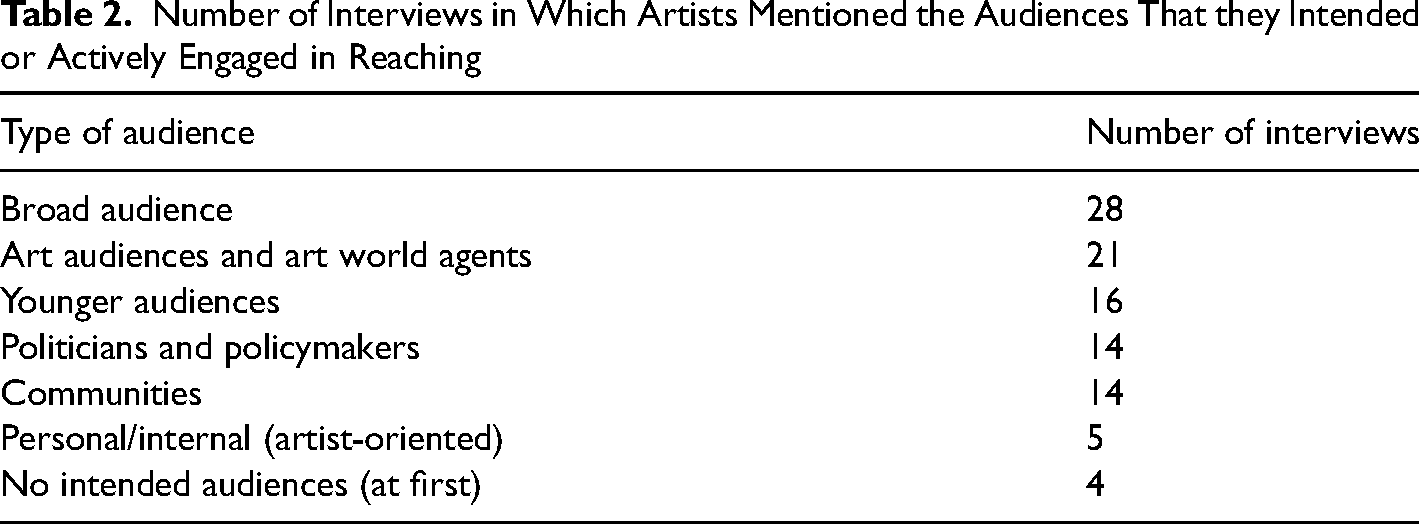
We identified six audience types (see Table 2): a broad audience, art audiences and art world agents, younger audiences, politicians and policymakers, communities, and a personal/internal artist focus. 14 For one-third of the interviewed artists, their target groups depended on different art projects and locations. These are artists who work with different mediums and in various contexts, which translate into different intended audiences.
Number of Interviews in Which Artists Mentioned the Audiences That they Intended or Actively Engaged in Reaching
A Broad Audience
In most interviews (28 of 30) artists said that they were aiming to reach or actively engaged in reaching a broad audience with (at least some of) their artworks and at times additional activities, such as public programming. Artists were categorized as aiming for this broad audience group when they talked about their audiences using words such as “everybody” (e.g., Mary Mattingly), “the general public” (e.g., Emma Hislop), “a wide audience” (e.g., Jason deCaires Taylor), “all/many/a lot of people” (e.g., Barbara Dombrowski) and when it was clear that their audience was broad rather than narrow. For instance, artist Diane Burko talked about the importance of “public engagement” and that her “audience has spread” (she addresses people from children to students to retirees), and Christine Tien Wang mentioned trying to “make art that is more accessible” instead of art “that is difficult to understand,” aiming “to hook all sorts of people” rather than only “elites” with “advanced degrees in art history.”
Artists have many different goals when addressing the broader public. They want people to learn about climate change, imagine futures, care, be inspired, etc., and to use the public's engagement to create further momentum for change (e.g., create more pressure for politicians to act). Artists felt that the topic of climate change needs many people engaged for it to be effectively addressed. Consequently, they found that art should not be restricted to specific circles (e.g., elites) but that they desired to reach wider audiences. This corresponds to the common belief that climate change is an issue that needs a collective effort, and therefore a broader audience is vital. This desire to reach a broad public is also in line with the findings of McGregor (2019) that artists consider their role effective when getting through to a wider audience.
Artists mentioned using the following approaches regarding how they reach the broad audience and their goals. Placing art in the public realm was a recurring method and reflects conclusions by Sommer and Klöckner (2021) about the importance of art in public spaces to include wider audiences instead of only a certain segment of the population. Several artists talked about communicating a direct message to make their art accessible to many people. Another approach is the artist acting as a public intellectual (Nisbet, 2014) by engaging in additional activities such as public programming, speech giving, and activism (around half of the artists said that they are activists or that at least some of their art projects are). Moreover, some artists who mentioned a broader public also talked about wide-spread media coverage, which shows that art-led initiatives can indeed reach wider audiences.
However, some artists raised doubts about being able to reach the broader public. This became clear in around one-third of the interviews in which artists pondered if they really do reach it, or in which they talked about the difficulties. The works in question are described by artists as harder to understand by the general public or limited in terms of reach. This exemplifies a divergence between artists’ intentions or desires and the realities they face. Artworks might not create the impact the artists hoped for (Nurmis, 2016). Moreover, art, especially complex art (requiring art expertise), and certain exhibitions of (visual) art can be rather distant from the general public (Kagan, 2011).
The Museum and Gallery Audience and Art World Agents
In 21 interviews, artists referred to the museum and gallery audience or people who are part of the art world (e.g., other artists, the elite, buyers of expensive art, niche specialists, art professionals). As the other audience types, this audience is hardly ever mentioned on its own. Numerous artists talked about the desire to also reach other people (e.g., to influence a broader audience) for the same or another type of work that they create.
Artists mentioned the audience that visits the cultural institution or event at which they had their work exhibited. This audience is physically present and directly experiences the art in a public setting such as a museum or gallery. It was often referred to be a specific clientele, for example because of their interest and ability to appreciate and understand the art. The direct engagement of the art audience with the piece, some in an embodied experience, is vital for these artists. For instance, part of David Brook's works requires the viewer to spend time exploring it. His work Permanent Field Observation (2018-) “only becomes a spectacle in your mind when you start to connect them [the separate sculptures]. And so, that interpretation moment happens in the viewer. It's not out there for anybody just to glance at real quick.”
Some artists also mentioned the cultural elite, specialists, and other artists as their audience. For instance, Michael Pinsky talked about the elite that needs to change to fight the climate crisis: Most of climate change is caused by a very small elite. […] and it's the same elite that fly to art fairs across the world. […] So, art is actually well-placed to make a difference if we can really start to hold up a mirror to some of these elite societies. A few artists focus on art circles because of the “relative potential for change in perspectives among the international cultural elites that do pay some attention to contemporary art” (Kagan, 2011, p. 364). They see them as change agents. This was mentioned in a few instances rather than as a common theme across the interviews, but it is nevertheless interesting to reveal here.
Younger Audiences
Younger audiences, such as children and students, that artists were aiming to reach or actively engage with 15 were mentioned in 16 interviews. 16 These younger audiences were usually part of the broad audience or communities they wished to engage with. Artists see their role as informing younger people and engaging them with the topic. For example, one artist said, “I also think it's great when it addresses children or school classes, and they somehow pick up the thread” (Barbara Dombrowski). Another talked about her desire to provide particularly young people with a different narrative than “everything is anyway too late” (Susanne Kriemann).
Younger audiences were also seen as change agents (whether in conjunction with the art work or not). For instance, exhibitions were seen “as a jumping off point” for other programs such as a youth activism panel (Diane Burko); an artist mentioned the importance of his works to “appeal to children” because he may have a “secret hope of having children do some better job than we have” (Alexis Rockman); children are excellent “meaning-makers” of artworks (David Brooks); and the most important role of the arts is seen to “inspire” people, as students and others can act as “multipliers” (Julius von Bismarck).
Politicians and Policymakers
In 14 of 30 interviews, artists mentioned wanting to influence, put pressure on, or work together with politicians and policymakers to make positive changes. Artists were categorized as aiming for this audience group when they talked about the people or systems they address or engage with (through their artistic work and culture more generally) using words such as “policy group” (e.g., Diane Burko), “politicians” (e.g., Ackroyd & Harvey), “policymakers” (e.g., Fadzai Mwakutuya), “political system/framework” (e.g., Marcus Coates), “council” (e.g., Janet Laurence) or when they described their approach as “operating politically” (e.g., David Buckland). “We have to keep putting pressure on the politicians,” said the artist duo Ackroyd & Harvey.
That artists mentioned political actors (more so than other actors, such as corporate systems) suggests that they consider politicians in particular as change agents in addressing the climate challenge. Similar to the broad audience section above, artists who address politicians often act as public intellectuals, such as activists and actionists. They organize and subvert. Artists aiming at this group talked about their art projects and about additional activities that they do, often with others. Therefore, the interviewed artists related this influence on politics not necessarily to their work alone. Multiple artists stressed the power of various movements and institutions coming together to create political change. The broad public is essential for many to create this pressure, as it goes via the public or a larger cultural shift.
Communities
In several interviews (14 of 30) artists mentioned communities as a group that they wanted to reach, and at times also include in the creation and maintenance of their work. Artists were categorized as aiming for the “communities” audience group when they talked about the people they address or engage with using words such as “community” (e.g., Marcus Coates), “local people” (e.g., David Buckland), or when they mentioned the location of their art in “community gardens” (e.g., Mary Mattingly). Communities differ from an artist's broad audience as they are a specific group, connected to the location of the artwork.
Overall, for these artists, community-based approaches are vital when aiming for constructive engagement with the topic as has been discussed by Lesen et al. (2016). Some artists mentioned reaching the local community in order to make positive change together in meaningful ways. The community is seen as a change agent, and the approach as bottom-up. For example, Eve Mosher said about her art project HighWaterLine (2007, 2012, 2014): [It] connects people based on nothing other than […] invisible topography. […], they’re all part of a connected community who have a shared vulnerability, who can all work together to advocate and they bring different experience and different knowledge to it. Such artists engage with communities to facilitate change in social contexts beyond their art worlds (Kagan, 2011). Others engage with the community by including their needs and insights in the art project. Jason deCaires Taylor, for example, tries to “work with the community to tell stories that are […] locally relevant.” Artists also aimed to reach the local community, and at times include it, because they see community members as using, maintaining, and further developing the artwork. This could mean, for instance, taking care of trees (which were part of several art projects).
Thus, organizing (the communities and support structures), co-creating the work, empowering voices and subverting broken systems, are all relevant dimensions of the CreaTures framework here. Particularly, collaborations are of high importance, certainly between the artist and the communities, but also with other actors who are involved in the planning, creation, and maintenance of the creative practice and the further steps that may be taken because of it.
Personal and Inward Facing: Focus on Artist, Artwork, Creation
In five interviews, artists described that (a part of) their works were more personal, reflective, autotelic, meditative, or meant for themselves. For example, Tania Kovats described the messaging of her works as “more internalized and […] personally holistic” (while some of her other works are “more outward facing” and an “external process”). She engages in what she called “personal ecologies.” Similarly, Marcus Coates described some of his work as “very reflective and personal” (in contrast to his other pieces that focus more on engaging and communicating with people and “trying to embed different ways of thinking into political or social systems”). This reflective, personal position, he said is “formed from my imagination and it's not really trying to convey a message to a huge public. It's not trying to influence policy or politics. […] if it touches one person's imagination that's enough in that sense.” Other artists also talked less elaborately about personal connections to the topic of climate change. This shows that artists who work on climate themes may operate more inward facing (at least for a part of their art). Nevertheless, they cannot be understood as autonomous artists, as there is still some relation to societal and environmental goals (though these artists may make less direct artworks), and because artists and artworks have some relation to society. Following Gablik (1991), artworks are never fully self-contained or autonomous.
Conclusion and Discussion
This research aimed to understand the intended impact and audiences of artists, and thus to better comprehend their perspectives on their change potential. In conclusion, in the art world and research, there is a high interest in art as a change agent toward sustainability. Based on the interviews it can be said that artists see their creative practices, additional activities, and the audiences they address as contributing to positive change. Generally, they share enthusiasm for the change potential of creative practices, but at times they also engage in an impact reflexivity, and in a discourse that is more self-referential.
When asked about their goals and intended audiences, in most of the 30 interviews, artists did indicate them right away. In some instances, they did not want or were not able to provide them, at least at first. The goals of the interviewed artists related to all of the three main categories of the nine dimensions tool, that is, to help change meanings, connections, and stimulate changes in power, particularly the first two. In addition, it is important to stress that numerous artists mentioned both socio-ecological change and aesthetic and artistic criteria. This underlines the importance of aesthetic aspects/idiomatic capacities of artistic practices (as stressed by Maggs & Robinson, 2020). The most recurring audiences mentioned by the artists were a broad audience, art audiences and art world agents, younger audiences, politicians, and communities because artists consider climate change a topic that needs to reach many people, that requires local and youth involvement, and political changes, amongst other reasons. When artists talked about audiences within the art context, this was mainly related to the fact that they exhibit at least some of their work in a cultural setting, which was usually seen to be visited by an art audience. Some artists explicitly stated having a more personal focus.
Therefore, while the mention of socio-ecological goals and wider audiences is in line with the artists’ social impact role, the indication of artistic/aesthetic aspects and narrower audiences shows a degree of self-referentiality, even when artists work on a social topic such as climate change. The diversity of goals and intended audiences, and some artists’ inability or unwillingness to clearly report them, underlines the unique role of the arts; its freedom to explore the topic in various ways. This will allow artists to address the contradictory pull between autonomy and a social role. Their value lies in intervening in dominant discourses, offering ambiguity and complexity—which are features praised by, for example, Bishop (2006) and Kagan (2011).
This research confirms various insights from the CreaTures framework. First, not all change types need to be necessarily covered by an artist as they may focus on helping to change meanings, connections or power. Second, art is not the sole driver of change, which is a helpful perspective to prevent art from being faced with unrealistic expectations for impact. Third, this research shows that aesthetic criteria are part of art aiming for eco-social change, which the CreaTures framework generally also acknowledges. Overall, the framework helped map artists’ desired impact.
Contributions of this research to the framework are the following. First, the CreaTures framework dimensions should not be restricted to a particular kind of art aiming for, for example, gentle or aggressive subversion. The interviewed artists reported a diversity of impact, from subtle and direct approaches to small and large, and slow and fast changes. The freedom to address the topic in various ways prevents art from being faced with the perils of instrumentalization. Second, the CreaTures framework could make clearer how the subversion dimension exactly differs from the other dimensions. Third, we also suggest adding a tenth dimension (which would purposefully not be named) allowing artists, funders, policymakers, or researchers to account for impact that may not be covered in the other nine dimensions. For example, it could be used for more personal or open-ended artworks. Fourth, the framework can benefit from more explicit discussions of the connection between social engagement and art. Given that many interviewed artists talked about aesthetic or artistic criteria as being equally important or mentioned them alongside social criteria, and in some cases, artists focused first and foremost on the art or the message and engagement, it is helpful to include a discussion of different perspectives (that may be invoked by artists) into the description of frameworks of change. Fifth, a contribution to the framework is also the insight that some artists engage in—what we termed—an impact reflexivity, that is, they reflect not only on the potential but also upon the limits of their practices. Some of the interviews with reflexivity statements could be further categorized with the help of the CreaTures framework logic (e.g., artists who said they were not able to create certain change, such as action, could be assigned to another type of change). Other kinds of reflexivity that we encountered may be added to the framework, such as some artists’ reflections on perceived limits of audience reach, particularly of the broader audience, or their thoughts on the (art) world's footprint and financial questions.
Future research could investigate the goals and intended audiences of additional artists in other central art markets next to the selected ones and in regions beyond those because climate-related art is being created across the globe. Furthermore, some parts of the world, such as the Global South, are particularly vulnerable to the effects of climate change because of global inequalities that further exacerbate them. Adding perspectives from artists and their collaborators located in such areas allows showing examples of resistance and adaptation, and of holding nations or corporate actors that are major contributors to climate change accountable. For example, the art projects by artist Tomás Saraceno with local communities in Argentina addressing topics of excessive lithium mining could be investigated; or the above-mentioned artists Ursula Biemann and Paulo Tavares who created the video essay Forest Law (2014) based on research in Ecuador addressing oil extraction and indigenous resistance. Moreover, future research could further concentrate on other perspectives on art's change potential, for example how audiences perceive such art.
Supplemental Material
sj-docx-1-art-10.1177_02762374241258632 - Supplemental material for Artists on Climate Change: Their Intended Impact and Audiences
Supplemental material, sj-docx-1-art-10.1177_02762374241258632 for Artists on Climate Change: Their Intended Impact and Audiences by Ulrike Hahn and Pauwke Berkers in Empirical Studies of the Arts
Footnotes
Declaration of Conflicting Interests
The authors declared no potential conflicts of interest with respect to the research, authorship, and/or publication of this article.
Ethical Approval
This study was approved by the Research Ethics Review Committee of the Erasmus School of History, Culture and Communication. Interviewees were provided with an Informed Consent Form.
Funding
The authors disclosed receipt of the following financial support for the research, authorship, and/or publication of this article: This work was supported by the Nederlandse Organisatie voor Wetenschappelijk Onderzoek (grant number PGW.19.010/8366).

Supplemental Material
Supplemental material for this article is available online.
Notes
Author Biographies
References
Supplementary Material
Please find the following supplemental material available below.
For Open Access articles published under a Creative Commons License, all supplemental material carries the same license as the article it is associated with.
For non-Open Access articles published, all supplemental material carries a non-exclusive license, and permission requests for re-use of supplemental material or any part of supplemental material shall be sent directly to the copyright owner as specified in the copyright notice associated with the article.
