




Abstract
This study examined whether creative thinking improves by utilizing an intervention program based on three types of ambiguous image-text interactions within artwork: (1) ambiguous text, (2) negation, and (3) semantically unrelated image-text. Participants (79) were divided into three groups: “ambiguous-negation-unrelated” group exposed to stimuli 1 + 2 + 3, “ambiguous-unrelated” group exposed to stimuli 1 + 3, and the control group unexposed to any intervention. The metaphor generation test (MGT) and Tel-Aviv creative test (TACT) were given pre- and post-intervention. The results showed the “ambiguous-negation-unrelated” intervention group scored higher on the TACT post-intervention, as compared to pre-intervention, a finding not observed among the “ambiguous-unrelated” and control groups. Furthermore, both art intervention groups generated more utterances overall (literal, conventional, and novel metaphors) in the MGT post-intervention, as compared to pre-intervention. These outcomes suggest this artwork intervention that utilized ambiguous image-text interactions and included theoretical discussion and reflective analysis can enhance divergent thinking.
Keywords
Introduction
Creative thinking is the ability to create contextually relevant and valuable original ideas (Runco, 2014; Runco & Jaeger, 2012; Sternberg et al., 2002). Several methods for scoring divergent thinking tests are proposed to assess or measure creative thinking: fluency (quantity of responses per given problem), flexibility (ability to switch between categories), elaboration (ability to expand on solutions/ideas), and originality (idea uniqueness) (Faust, 2012; Guilford, 1967; Reiter-Palmon et al., 2019). One theoretical model describes creative thinking as a two-stage process: a divergent stage in which varied associations and meanings are activated via bottom-up processes and a control stage in which top-down processes monitor and evaluate the first-stage ideas. Ultimately, the most appropriate original ideas are selected, and incompatible ideas are suppressed (Beaty et al., 2016; Dietrich & Haider, 2017).
Creative thinking can be stimulated through metaphor generation. Metaphors, which combine unrelated semantic categories, elicit various creative thought processes (Benedek et al., 2014; Levorato & Cacciari, 2002; Sylvia & Beaty, 2012), as they break conventional thinking patterns, and promote high-order, conceptual, and abstract thinking (Dietrich, 2004). Novel metaphor generation is a powerful form of linguistic innovation (Kenett et al., 2018), combining distantly related or weakly unrelated components into meaningful unique concepts (Faust, 2012; Faust & Mashal, 2007; Forceville, 2012; Kenett et al., 2018). As such, one can evaluate creativity via an instrument like the metaphor generation test (MGT), a task of generating novel metaphors for common emotions (e.g., feeling lonely is like…), that involves combining unrelated concepts based on similarities to produce original responses. Studies (Kasirer & Mashal, 2016; 2018) have shown that the more novel metaphors are generated on the MGT, the higher the score on part A (“alternate uses”) of the Tel-Aviv creativity test (TACT) (Milgram & Milgram, 1976), a shortened standard version of Torrance Tests of Creative Thinking (TTCT) (Torrance, 1974), suggesting a link between generating creative metaphors and divergent thinking (Menashe et al., 2020).
To successfully generate novel metaphors or engage in many other forms of creative thinking, tolerance of ambiguity is crucial: greater tolerance of ambiguity is associated with greater creativity (Merrotsy, 2013; Stoycheva, 2010). It enables access to, and perception of, complex stimuli, vague/contradictory information, and dialectic situations. It also enables considering several possibilities simultaneously and switching between topics, while remaining open to alternatives, thereby increasing the potential to generate novel ideas (Sternberg, 2003; Zenasni et al., 2008). Ambiguous words, for which both dominant salient and subordinate less salient meanings are accessed and maintained, are related to verbal creativity and ambiguity tolerance (Atchley et al., 1999), as are ambiguous visual stimuli (e.g., “duck-rabbit” optical illusion) (Wu et al., 2019).
Indeed, visual arts can evoke both ambiguity as well as metaphorical thinking, because art often leads to multiple interpretations (Eisner, 2004). Observing art involves bottom-up and top-down mechanisms (e.g., memory retrieval, mental imagery, generation of contextual associations) in a dynamic process of matching novel and stored information (Ishai, 2011; Leder et al., 2004). Further, interpreting art evokes analysis and synthesis of varied categories of knowledge because it is often metaphorical, ambiguous, and layered with meaning, all of which promote creative thinking (Alter, 2010; Marshall, 2014). Moreover, viewing artwork that integrates text and images that interact in an incongruent way has been found to enhance multiple interpretations and novel idea generation (Giora et al., 2009; Heruti et al., 2019). Studies of ambiguous image-text interactions, however, have yet to assess their specific link to creative thinking.
Meta-analytic studies indicate that intervention programs can enhance creative thinking across diverse fields of knowledge and populations (Rose & Lin, 1984; Scot et al., 2004a, 2004b; Tsai, 2014). Although often tested among children, some evidence suggests interventions can improve creativity in adults as well (Tsai, 2014). Surprisingly, only one study has explored the effects of art on creative thinking using an intervention program. Ulger's (2016) visual art intervention group evidenced significantly improved creative thinking compared to the controls, particularly in the creative subskill of elaboration, but found no significant effects in fluency, originality, or problem-solving. However, Ulger's (2016) art intervention content did not include ambiguous image-text interactions.
Therefore, the current study offers significant innovation as the first to examine a multimodal art intervention program assessing the impact of ambiguous image-text interactions on creative thinking. The intervention program was designed to encourage the generation of multiple meanings from different ambiguous image-text interactions in artwork: (1) ambiguous text (homographs) integrated within images (see Figure 1A), (2) negation (see Figure 1B), and (3) semantically unrelated texts and images (see Figure 1C).
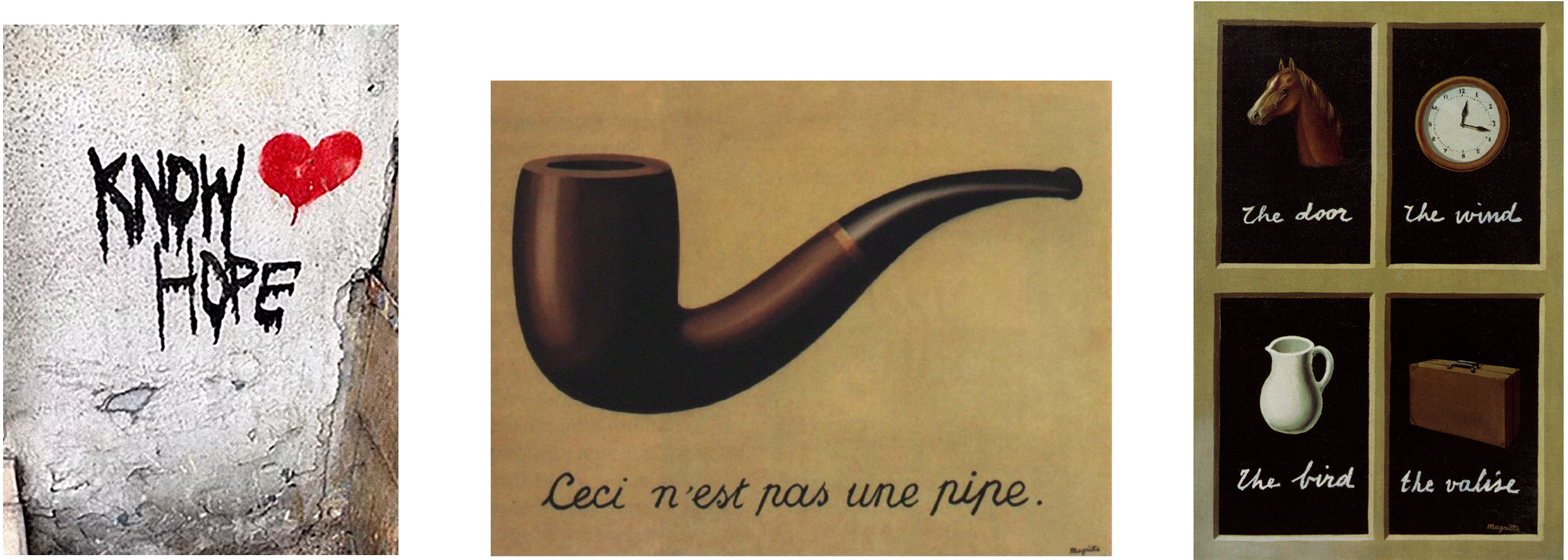
Examples of three image-text interaction stimuli used in the intervention: (A) Interaction between ambiguous wording and image (i.e., pronunciation of the text elicits two different meanings: “know hope” or “no hope”; this ambiguous text interacts with the image of a heart); (B) René Magritte (1929). The Treachery of Images -Negation-related image-text interaction (i.e., the French text “Ceci n'est pas une pipe” [“This is not a pipe”] interacts with the image of a pipe); (C) René Magritte (1935). The Key of Dreams - No semantic relation between words and images (i.e., beneath the image of the horse is the unrelated text “the door”). Copyright credit for Figures 1B, 1C - [2023] © C. Herscovici / Artists Rights Society (ARS), New York.
The first type of interventional stimuli (interaction) utilized in this study, art containing ambiguous text embedded within images, relates to the “graded salience” and the “suppression/retention” hypotheses (Giora, 2006). The interaction between vague text and imagery generates multiple interpretations: initially, a salient, dominant meaning is activated, followed by less-salient subordinate meanings. If context invites retention of the less-salient, subordinate meaning(s) alongside the dominant one, no suppression of alternative meanings occurs, and interpretation can expand further, shifting between meanings (Giora et al., 2017) (see Figure 1A).
The second type of stimuli, negation in art, also evokes the suppression/retention hypothesis with a focus on processing negation (Giora, 2006), as the presence of negation can facilitate multiple contextually motivated interpretations rather than a single contrastive response. For example, in Magritte's artwork (see Fig 1B), the textual negation “This is not a pipe” alongside a pipe image may elicit some contextually appropriate interpretations. The verbally negated concept (“pipe”) may not be unconditionally discarded in favor of a singular affirmative concept (“cigarette”) but rather retained in memory while eliciting additional alternative solutions or meanings, depending on the surrounding context and discourse. Thus, negating a concept may elicit multiple appropriate interpretations rather than just one (Giora et al., 2009; Foucault, 1983 [1973]).
The third type of stimuli, art containing semantically unrelated text and images (see Figure 1C), elicits interactions between unrelated concepts from both visual and verbal domains. Similar to the way in which processing metaphors elicits semantic integration between two seemingly unrelated concepts (Faust, 2012; Kasirer & Mashal, 2018; Kenett et al., 2018), processing text/image content without a semantic relationship stimulates different associations to fill the “gap” between unrelated ideas, resulting in creation of novel meanings and associations.
All three image-text interaction types facilitate active searching for understanding, shifting from one (familiar) meaning to other (novel) ones, resulting in the elaboration and construction of original interpretations. The study aimed to examine whether an intervention using image-text interactions within art would improve creative thinking and whether there would be differential effects of negation-related image-text interactions on creative thinking. Accordingly, participants were assigned to: (1) a group exposed to all three types of image-text interactions (“ambiguous-negation-unrelated” intervention group); (2) a group exposed only to ambiguous and semantically unrelated image-text interactions (“ambiguous-unrelated” intervention group); or (3) a control group receiving no intervention. As all three image-text interaction types are known to increase ambiguity tolerance and, in turn, creative thinking, two tests assessing creativity were used pre- and post-intervention: the metaphor generation test (MGT), in which participants are asked to explain common emotions using their own words in multiple innovative ways, and the Tel-Aviv creativity test (TACT), in which participants are asked to generate as many uses for objects as they can (TACT-A) and to describe as many things as possible that four drawings might represent (TACT-B). We hypothesized that the “ambiguous-negation-unrelated” and “ambiguous-unrelated” intervention groups would show increased creativity in divergent thinking (i.e., generating more novel metaphor utterances in the MGT and more responses in the TACT) compared to the control group. We also hypothesized that the “ambiguous-negation-unrelated” intervention group would show increased creativity in divergent thinking compared to the “ambiguous-unrelated” intervention group.
Method
Participants
The G*Power software was used to determine the study's sample size a priori. For primary analyses of a mixed-design ANOVA with repeated measures, an effect size of 0.25 (small-medium), α error = 0.05, and power = 0.95, the total sample size required was 54 participants. To increase power and sensitivity, a total of 79 participants participated. All were native Hebrew-speaking students (14 males; 65 females; age range = 20–58 years; Mage = 35.59, SDage = 11.88), were recruited through email and social media advertisements, and provided online informed consent to participate in the study. Fifty of the 79 participants were randomly assigned to one of the two intervention groups: 25 (31.6%) to the “ambiguous-negation-unrelated” group (equal time engaging in all three types of ambiguous image-text interactions) and 25 (31.6%) to the “ambiguous-unrelated” group (equal time engaging in two types of ambiguous image-text interactions, excluding negation; see Table 1). A separately recruited control group was formed from 29 participants (36.7%) who did not participate in any intervention (see “Intervention Procedure” below). No statistical differences were found between the three groups in the distribution of gender, age, or educational years [χ2(2) = 3.06, p = .217, F(2,76) = 1.51, p = .227, ηp2 = .04, and F(2,76) = .38, p = .682, ηp2 = .01, respectively].
The Participants’ Background Characteristics, by Group.
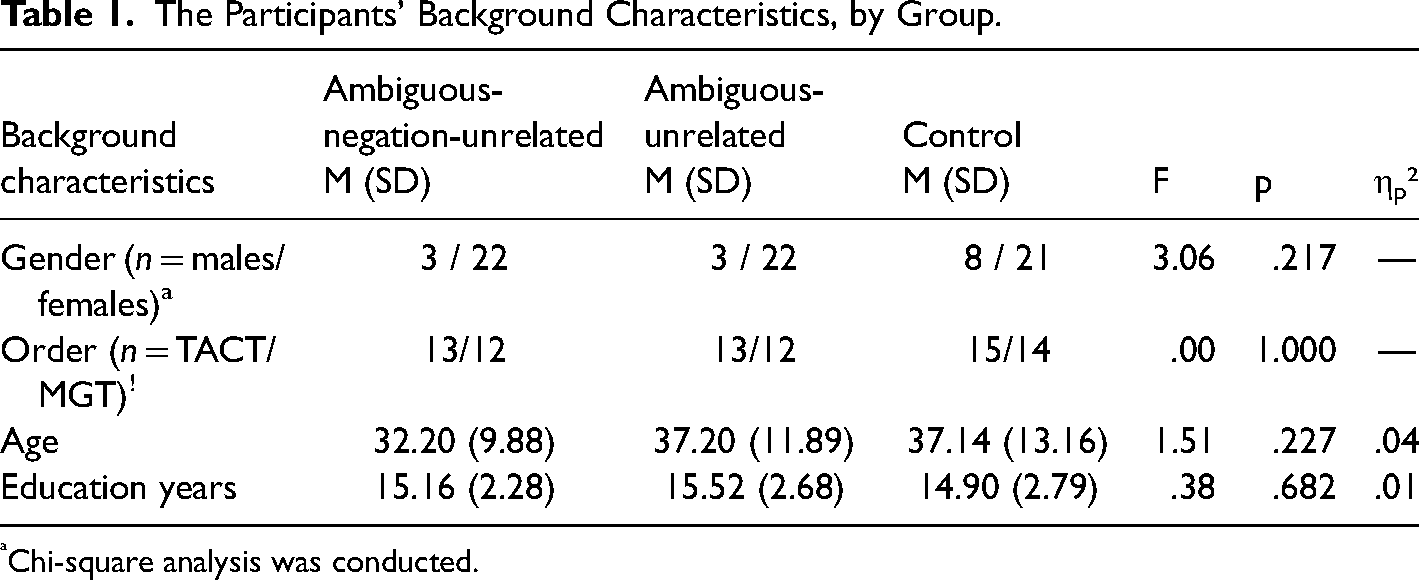
Chi-square analysis was conducted.
Materials
Creative thinking was assessed using the metaphor generation test (Kasirer & Mashal, 2014; 2018) and Tel-Aviv creativity test parts A and B (Milgram & Milgram, 1976).
Metaphor generation test (MGT)
To examine verbal creative thinking, particularly idea generation, participants’ ability to generate novel metaphors was measured via the MGT. Its 10 concepts, related to common emotions (e.g., “Feeling embarrassed is like…”), were selected from stimuli used by Levorato and Cacciari (2002) in their verbal creativity study. The MGT Hebrew version was validated by Kasirer and Mashal (2014). The participants were asked to explain (in writing) each concept in their own words, in as many ways and as originally and creatively as possible, without using the original prompts’ words or synonyms. Two judges (one BA student and one MA student) blind to the study aims coded the data independently, determining whether each expression produced was literal, conventional metaphoric, or novel metaphoric. A literal response was considered a simple description without figurative meaning (e.g., “Feeling successful is like a victory.”), a conventional metaphor was a familiar expression/idiom (e.g., “Feeling embarrassed is like having a red face.”), and a novel metaphor was an unfamiliar, creative metaphoric expression (e.g., “Feeling worthless is like a totally smashed lemon.”). For each participant, the number of generated literal utterances, conventional metaphors, and novel metaphors were counted.
To examine inter-judge reliability, Pearson correlations were calculated on the number of literal utterances, conventional metaphors, and novel metaphors coded by each judge for each participant and for each group, separately. Inter-judge reliability among the entire sample was extremely high, r = .95 (“ambiguous-negation-unrelated” intervention: r = .98, “ambiguous-unrelated” intervention: r = .86, control group: r = .99). When there was disagreement between judges, a third judge was asked to make the determination. Three variables were used for the analyses, namely, the total number of generated novel metaphors, conventional metaphors, and literal responses.
Tel-Aviv Creativity Test (TACT)
The Tel-Aviv creativity test (TACT) (Milgram & Milgram, 1976), based on the Torrance Tests of Creative Thinking (Torrance, 1974), assesses creative thinking. The shortened version of the Milgram and Milgram. (1976) measure (16 items)—the standard creativity test in Israel—was used. Subtest A (“alternate uses”) asks participants to generate as many uses as possible for four objects (newspaper, car tire, shoe, chair), while subtest B (“drawing meanings”) asks participants to describe as many things as possible that each of four drawings can represent, allowing visual orientation in any direction. The correlation between subtest A and B's total score was high, r(77) = .81, p < .001. The Cronbach's alpha coefficient for internal consistency reliability was 0.86 for subtest A and 0.90 for subtest B. Summed responses from both subtests were used in the analyses to measure conceptual fluency and divergent thinking.
Intervention Program
The intervention program aimed to enhance creative thinking via theoretical discussion on artwork with image-text interaction, practical training, and reflective analysis using three types of ambiguous image-text interactions (see Figure 1A, 1B, 1C).
Intervention sessions were performed online (remotely) due to COVID-19 restrictions via Zoom platform software 1 and a shared visual board using the Padlet 2 application. On the shared visual board, one can write, upload, and replace images, moving them repeatedly; therefore, the process of constructing alternative meanings utilized a dynamic collage technique involving both seeing (images) and reading/writing (text). This application enabled participants to practice engaging with ambiguous unconventional interactions between images and texts, working independently while also sharing and discussing their “products” with group members.
Intervention Materials
The intervention program's ambiguous image-text interactions were primarily from the artwork that included integrated Hebrew text, including artwork of Yair Garbuz (Untitled, 2006), Michal Na'aman (A Kid in Its Mother's Milk, 2013), and Michael Sgan-Cohen (The Light Is Seeing, 1998). Works from René Magritte were also presented (e.g., The Betrayal of the Images, 1927) as this artist is especially known for hybrid images and the use of unrelated/contrasting text alongside images. Additional materials included advertisements, newspaper articles, and illustrations from children's books.
Intervention Procedure
Approval for the research was obtained from the Mofet Institute's research ethics committee. Participants were divided randomly between the two intervention groups: Group 1 (“ambiguous-negation-unrelated” group) spent an equal time engaging with all three types of image-text interactions (ambiguous text embedded with images, negation embedded within images/text, and semantically unrelated images/text) while Group 2 (“ambiguous-unrelated” group) spent an equal time engaging with ambiguous text embedded within images and semantically unrelated texts and images. Group 3 was assembled as a control group unexposed to any intervention program.
Three intervention sessions were conducted with small groups (8–15 participants), were mediated by the first author, and took place once weekly (weekdays only) for 1.5 h.
Theoretical Discussion
Each intervention session included a theoretical discussion on image-text interactions integrated within the artwork in accordance with the group assignment. The mediator provided an explanation about processing multiple meanings and about ambiguity, based on described cognitive theories such as the “graded salience hypothesis” (Giora et al. 2009), in both intervention groups. The “suppression/retention hypothesis” (Giora , 2006)—with a focus on processing negation—was discussed in the “ambiguous-negation-unrelated” group but not in the “ambiguous-unrelated” group. These theories provided the theoretical framework of the discussions and provided the basis for the practical exercises of the intervention program.
Practical Exercises
Each intervention session included practical exercises following the theoretical discussion. Participants practiced two exercises, shifting between visual and verbal modes, moving from writing to a visual task, creating new image-text items, and generating new interpretations from ambiguous image-text interactions (e.g., participants were asked to find images describing, or associated with, a given text or to suggest wording about images, in order to generate novel, original ideas or metaphors). The mediator facilitated dialogue, proposing open-ended questions (Ulger, 2016) and encouraging sharing ideas, e.g., “Are there any details, like form, color, texture, or font that elicit additional associations/symbols/relations/interactions resulting in a novel interpretation?”.
Two additional exercises focused on processing negation (i.e., erasing text—see Appendix) were practiced in the “ambiguous-negation-unrelated” group but not in the “ambiguous-unrelated” group.
Reflection and Evaluation
Each intervention session included reflection on, and evaluation of, the participants’ “products” from the practical exercises that were generated on their visual boards. On the visual boards, participants could make changes, replace text/images, offer more options, and interpret reconstructed ideas. Each participant's personal board content was assimilated by the moderator to the general sharing board so all participants could see each other's work. Then, during the evaluation period, participants presented their set of creative responses to the group, who reflected upon and evaluated the multiple interpretations created. The mediator encouraged a reflection process using top-down processes of monitoring (Beaty et al., 2016; Dietrich & Haider, 2017) by asking how the participants generated their ideas. Subsequently, the group was encouraged to come up with as many interpretations as possible to each responses generated from the image-text association tasks (e.g., “How else could the unconventional connection between this image/text evoke a new interpretation?”). Participants thus analyzed their own creative process, reacted to the unconventional creations generated by others, and offered other possible interpretations.
Thus, building from each of the three types of image-text interactions, the interventions promoted divergent thinking and fluency of ideas, eliciting dynamic, flexible generation of ideas from discussing artwork, practicing interactions, and evaluating newly conceived ideas (for more details, see Appendix).
Study Procedure
Pre-intervention, participants were presented with five (of ten) concepts from the metaphor generation test (MGT) (Kasirer & Mashal, 2014; 2018) and the Tel-Aviv creativity test (TACT) (Milgram & Milgram, 1976) parts A and B via Google Forms®. After completing the intervention over approximately 2 weeks, participants were presented with the five remaining concepts from the MGT and completed the TACT-A and TACT-B again. The control group received the same instruments during the same time frame. Test administration order was counterbalanced between groups such that about half of each group completed the TACT first followed by the MGT, and the other half completed the MGT first followed by the TACT.
Results
Table 1 presents participant background characteristics and test order by group. We tested whether test administration order impacted the results, and no statistically significant differences were found between groups [χ2(2) = .00, p = 1.000].
We also conducted two one-way ANOVAs to examine whether the three groups differed in performance on the pre-intervention creativity tasks. No significant differences were found in the number of each type of utterance generated in the MGT, or in the number of responses in the TACT (parts A and B), between the three groups. Thus, the results indicated the three groups did not differ significantly at baseline for any dependent variable, F(2,76) = .07–1.18, ps = .932–.313.
Metaphor Generation Test
We examined differences in the number of utterances generated in the metaphor generation test. A 3 × 2 × 3 mixed ANOVA was conducted, with group (“ambiguous-negation-unrelated,” “ambiguous-unrelated,” control) as the between-subjects factor, and time (before intervention, after intervention) and type of utterance (literal utterance, conventional metaphor, novel metaphor) as the within-subject factors. The dependent variable was the number of utterances generated in the MGT (see Table 2). Mauchly's test was performed to examine the sphericity assumption, which was rejected. Therefore, we reported the adjusted degree of freedom (df), and the df was reported in decimal numbers.
Mean (and SD) of Number of Utterances Generated in the Metaphor Generation Test (MGT) by Group and Time.
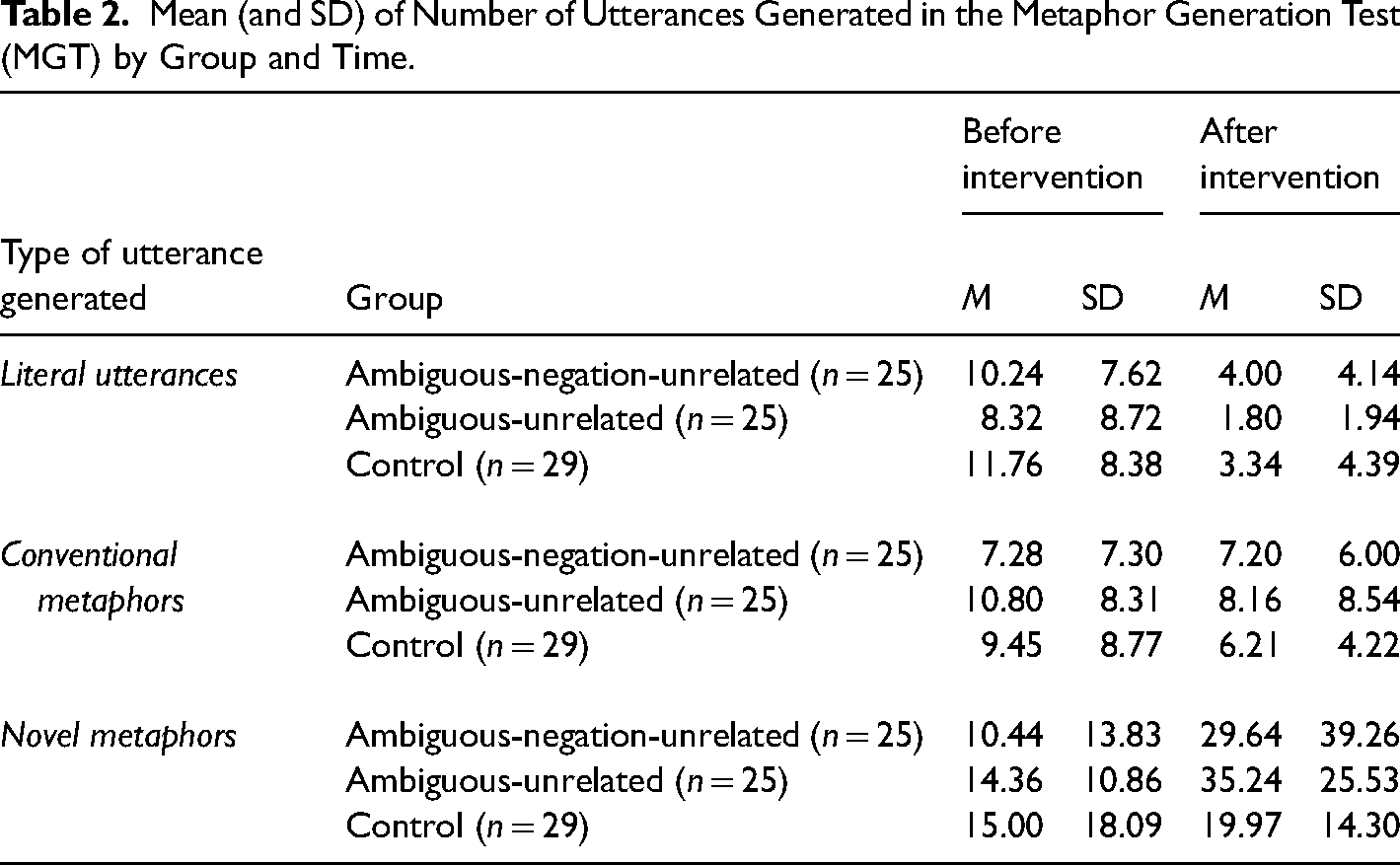
Main effects of group and time were not significant, F(2,76) = .62, p = .541, ηp2 = .02 and F(1,76) = 3.55, p = .063, ηp2 = .04, respectively. The main effect of type of utterance was significant, F(1.212,92.086) = 43.25, p < .001, ηp2 = .36. Pair-wise comparisons showed the number of novel metaphors generated was significantly higher compared to conventional metaphors and literal utterances (ps < .001). No significant difference was found between the number of conventional metaphors and literal utterances generated (p = .130).
The two-way interaction of group and time was significant, F(2,76) = 4.21, p = .018, ηp2 = .10. Bonferroni analyses comparing between the two timepoints for each study group indicated that while the two intervention groups increased in the total number of utterances generated post-intervention, compared to pre-intervention (p = .040 for the “ambiguous-negation-unrelated” intervention group and p = .025 for the “ambiguous-unrelated” intervention group), no significant difference between the two timepoints was found for the control group (p = .203).
In addition, the two-way interaction of time and type of utterance was significant, F(1.146,87.083) = 37.23, p < .001, ηp2 = .33. Bonferroni analyses comparing between the two timepoints for each type of utterance indicated that whereas the number of generated literal and conventional metaphors decreased after the intervention, compared to before the intervention (p < .001 and p = .038, respectively), the number of generated novel metaphors increased after the intervention compared to before the intervention (p < .001).
Finally, the two-way interaction of group and type of utterance and the three-way interaction of group, time, and type of utterance were not significant, F(4,152) = 1.57, p = .185, ηp2 = .04 and F(4,152) = 1.97, p = .103, ηp2 = .05, respectively (see Figure 2).
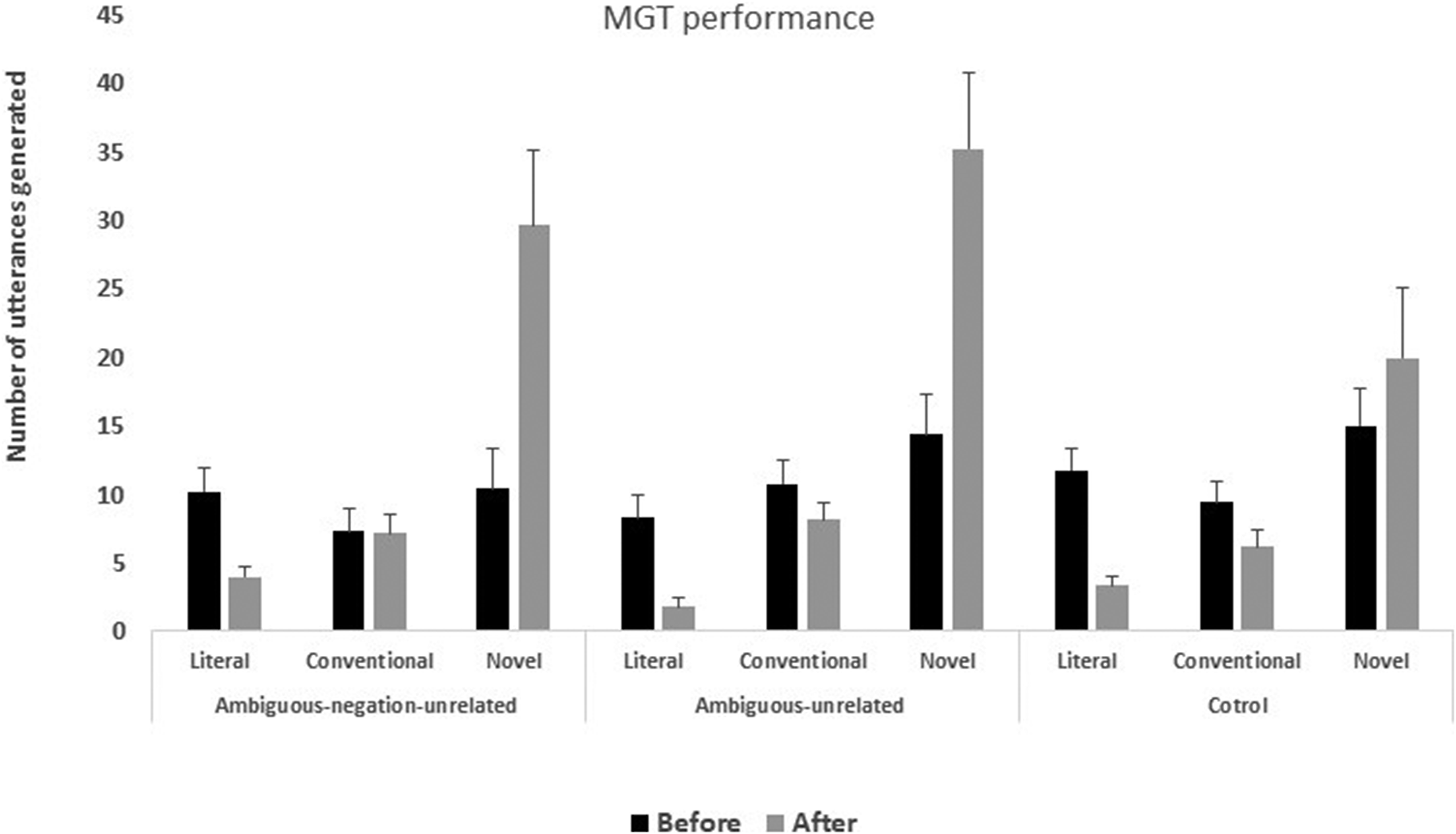
Differences in utterances generated on the metaphor generation test (MGT) by group and time.
Tel-Aviv Creativity Test
In order to examine differences in performance on the TACT (A, B), a 3 × 2 × 2 mix-ANOVA was conducted, with group as the between-subjects factor, and time and TACT subtest as within-subject factors (see Table 3). Main effects of group and time were not significant, F(2,76) = .49, p = .611, ηp2 = .01 and F(1,76) = .86, p = .358, ηp2 = .01, respectively. The main effect of the TACT subtest was significant, F(1,76) = 28.49, p < .001, ηp2 = .27.
Mean (and SD) of the Tel-Aviv Creative Test (TACT) Scores by Group and Time.
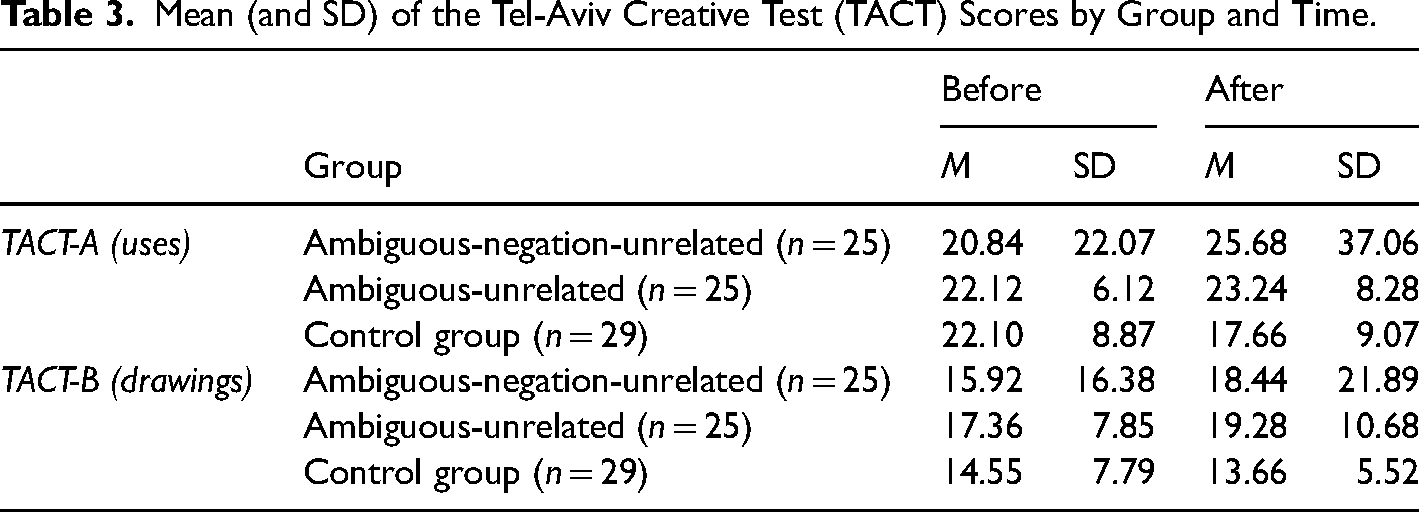
The two-way interaction of group and time was significant, F(2,76) = 4.36, p = .016, ηp2 = .10. Bonferroni analyses of the two timepoints for each study group indicated that whereas the “ambiguous-negation-unrelated” intervention group generated more responses post-intervention compared to pre-intervention (p = .025), no significant differences between the two timepoints were found for the “ambiguous-unrelated” intervention and control groups (p = .349 and p = .079). The two-way interactions of group and TACT subtest, and of time and TACT subtest, were not significant, F(2,76) = .26, p = .768, ηp2 = .01 and F(1,76) = .47, p = .496, ηp2 = .01, respectively. Finally, the three-way interaction of group, time, and TACT subtest was marginally significant, F(2,76) = 3.00, p = .056, ηp2 = .07 (see Figure 3).
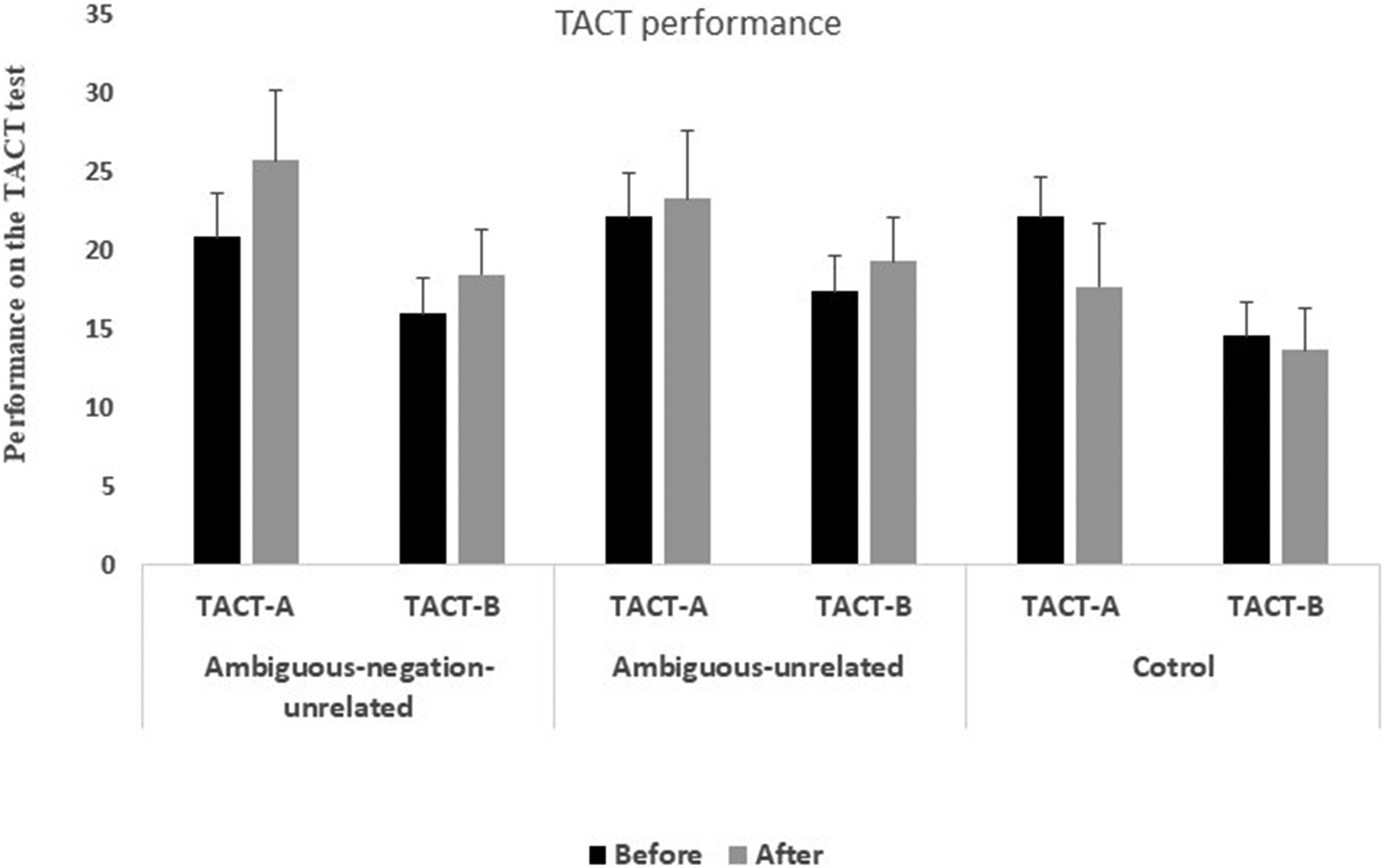
Differences in Tel Aviv creative test (TACT) performance by group, time, and subtest.
Discussion
This study examined the effect of ambiguous image-text interactions within artwork on creative thinking. The results of the TACT (Milgram & Milgram, 1976) administration showed that the “ambiguous-negation-unrelated” intervention group scored higher on both the TACT-A (alternate uses) and the TACT-B (drawing meanings) post-intervention as compared to pre-intervention, a finding that was not observed for the “ambiguous-unrelated” intervention and control groups. In addition, the “ambiguous-negation-unrelated” intervention group and the “ambiguous-unrelated” intervention group generated more overall utterances, i.e., more literal, conventional metaphoric, and novel metaphoric utterances in the MGT (Kasirer & Mashal, 2014, 2018), post-intervention as compared to pre-intervention, whereas no such a change was observed for the control group. Our results also indicated that participants generated more novel metaphors post-intervention compared to pre-intervention (across groups).
The findings show that the “ambiguous-negation-unrelated” intervention group increased performance on fluency of ideas by producing more alternate uses for objects and more meanings from drawings (TACT-A and TACT-B, respectively). Possibly, using ambiguous image-text interactions in artwork requires the viewer/reader to evoke multiple interpretations (Giora et al. 2009; Heruti et al., 2019) from vague, irregular stimuli which, in turn, increases the flow of ideas both verbally and figuratively. Consistent with our first hypothesis that more responses in the TACT would be generated by the intervention groups compared to the control group, this increased performance was not found among the control group (and not among the “ambiguous-unrelated” intervention group). It may be that an intervention that includes several and varied stimuli (ambiguous image-text, negation, and semantically unrelated image-text) affects the creative potential that requires divergent thinking and flow of ideas.
Our finding that ambiguous stimuli can improve creativity (flow of ideas) in the context of an art intervention program is consistent with previous studies linking ambiguity tolerance and creativity (Sternberg, 2003; Stoycheva, 2010; Zenasni et al., 2008). Engagement with different types of ambiguous image-text interactions within artwork (see Figure 1A, 1B, 1C) may have promote divergent thinking (i.e., more alternate uses and more meanings from drawings) by shifting thinking from familiar visual or verbal concepts to unfamiliar novel ones (Heruti et al., 2019). Indeed, our current results are consistent with studies showing that practicing art and exposure to art that includes ambiguity causes one to play with associations and ideas and to create multiple meanings through combining various domains of knowledge; such activities can stimulate divergent thinking and flow of ideas as components of creative thinking (Alter, 2010; Eisner, 2004).
The results from the metaphor generation test (MGT) (Kasirer & Mashal, 2014, 2018) also showed increased generation of utterances (literal, conventional metaphors, and novel metaphors) among both intervention groups. This finding is inconsistent with our first hypothesis that more novel metaphors would be generated by both intervention groups compared to the control group. Both intervention groups practiced engaging with open-ended questions, participating in discourses of multiple interpretations; this may have intensified the flow of ideas, resulting in an increased number of utterances generated in the MGT post-intervention compared to pre-intervention. However, since the intervention program did not improve the generation of novel metaphors specifically, compared with the control group, longer practice time using multimodality flexibility may be required to isolate the main driving factor behind.
Notably, the processes upon which our study's intervention were based may have impacted the outcome of increased the flow of ideas. Exposure to artistic stimuli that increases the need for ambiguity tolerance and practicing strategies to interact with such stimuli without being directed to a single interpretation both involve bottom-up processes of increasing generation of contextual associations (Leder et al., 2004); this may have led to improved fluency of ideas (Sternberg, 2003; Ulger, 2016). Moreover, the multimodal approach utilized in the current study may also have had an impact on the outcome, as previous studies have identified a link between multimodality and creativity (Albers, 2006; Jewitt, 2008; Kress, 2003; Wissman & Costello, 2014). Expanding ways to represent concepts and shift paradigms in unexpected, novel, multimodal ways (Bock, 2016; Forceville, 2012; Nelson & Johnson, 2014) appears to increase creative thinking, especially flow of ideas. This study intervention (see Appendix), which used both verbal and visual content to diversify possible options, interpretations, and interactions, and also asked participants to search for images, integrate images with text, shift from literal to metaphoric meaning, present their ideas on the shared visual board, and reflect/expand upon the ideas of others, may all have contributed to the resulting increase in creativity in the forms of greater divergent thinking and flow of ideas.
Our second hypothesis, that the “ambiguous-negation-unrelated” intervention group (exposed to all three ambiguous image-text interaction types) would show increased creativity (in the MGT and the TACT) compared to the “ambiguous-unrelated” group (exposed to ambiguous image-text interactions and semantically unrelated texts and images), was confirmed for the TACT but not for the MGT. The results showed that more ideas were produced in the TACT for the “ambiguous-negation-unrelated” intervention group than the “ambiguous-unrelated” group post-intervention as compared to pre-intervention. Furthermore, our results showed that negation within art contributed to enhanced divergent thinking, as the group that used the three types of image-text interactions produced more concepts (TACT A and B alternate uses and meanings from drawings) than the group that was not exposed to negation (i.e., the “ambiguous-unrelated” intervention group). Apparently, exposure to different types of image-text interactions encouraged ambiguity tolerance and activation of multiple interpretations (rather than a single one), which in turn may have facilitated enhanced flow of ideas (Sternberg, 2003; Stoycheva, 2010; Zenasni et al., 2008; Wu et al., 2019). However, participants in the “ambiguous-negation-unrelated” intervention group did not generate more novel metaphors compared with the “ambiguous-unrelated” group. As generation of novel metaphors relies on the ability to integrate distantly-related or weakly associated concepts by combining the meanings of seemingly unrelated words into a new coherent expression (Faust & Mashal, 2007), the current findings seem indicate that use of negation may positively impact the flow of ideas (according to the suppression/retention hypothesis; Giora, 2006; Giora et al. 2009), rather than generation of original responses. Future research should examine negation stimuli in the context of a longer intervention program to better understand the impact of each stimulus type separately on creative thinking and on novel metaphor generation in particular.
The study's limitations include its conduct as an online remote workshop due to the COVID-19 pandemic, since it is unclear if the digital platform methodology influenced different results compared to face-to-face interaction. As there was no active control group, future research should also test whether unintended elements of participating in an intervention can impact the results. Further, the current study only examined adults, so it will be important in subsequent research to assess this intervention among children in order to better characterize the scope of the effect. Lastly, it is unclear if there is a long-lasting effect of the intervention (since pre- and post-testing occurred about 2 weeks apart), so future studies should examine the intervention's impact after a longer time period, perhaps three or more months.
Conclusions
Our study findings show for the first time that an art intervention program utilizing ambiguous image-text interactions increased creativity, as evidenced by increased divergent thinking and fluency of ideas. However, in addition to exposure to specific stimuli, the intervention program's utilization of theoretical discussion, interpretive practice, and reflective analysis may also have contributed to the resulting greater productivity in creative responses; nonetheless, these results appear to provide preliminary support for the development of curricula utilizing ambiguous image-text interactions to enhance divergent thinking. Finally, as our results also suggest that while use of negation enhances divergent thinking (when used with ambiguous and unrelated interactions), it does not seem to enhance generation of creative metaphors, but future studies should test the effect of each image-text interaction in isolation in order to determine this more definitively.
Footnotes
Declaration of Conflicting Interests
The authors declared no potential conflicts of interest with respect to the research, authorship, and/or publication of this article.
Funding
The authors received no financial support for the research, authorship, and/or publication of this article.
