



Abstract
In two studies, we compared whether making and viewing art improved affect and whether the affective benefits were due to participants’ experience of enjoyment and flow. In Study 1, participants engaged in an art-making and art-viewing activity separated by one week. In Study 2, participants were randomly assigned to an art-making or art-viewing activity. In both studies, we induced a negative mood in participants by having them watch a sad film clip. We measured positive and negative affects before and after the mood induction and after the activity. In Study 2, participants rated levels of enjoyment and flow experienced during the activity. Both making and viewing art reduced negative affect equally. However, making art improved positive affect more than viewing art, and making art was associated with greater enjoyment than viewing art. Actively making art is a potentially more powerful way to improve affect than passively viewing art.
In 2018 1 , over 67 million people worldwide visited an art museum (Association of Art Museum Directors, 2018), and there are many reasons why people do so. Works of art are intimately bound up with emotion, the painter Mark Rothko, for example, proclaimed that his abstract, color field paintings expressed the basic human emotions of tragedy, ecstasy, and doom (Rodman & Eliot, 1961, p. 93). Some people report having transformative emotional experiences when viewing art as well as powerful physical reactions such as crying, rapid heartbeat, and fainting (Elkins, 2001; Magherini, 1989; Pelowski, 2015; Winner, 2019). Given that viewing art can elicit an emotional and physical reaction in the viewer, can it also help us to improve our affect? The majority of studies on the affective benefits of the visual arts have examined the benefits of engaging in active activities (e.g., drawing and painting), and fewer studies have examined the benefits of receptive activities (e.g., viewing art and attending an art museum). In the study reported here, we examined whether viewing art can have similar affective benefits as making art.
Making art (e.g., drawing, painting) has been shown to improve affect when used as a way to distract rather than express negative thoughts and feelings (e.g., Diliberto-Macaluso & Stubblefield, 2015; Drake & Winner, 2012; Grossman & Drake, in press). In these studies, participants (without art expertise or interest) engage in a negative mood induction (i.e., watching a sad film or thinking of a personally upsetting memory) and then are randomly assigned to engage in a drawing activity for 10 min. Some studies compare drawing to nondrawing activities (e.g., writing or sitting quietly), others compare drawing to more passive arts activities (e.g., coloring), and still, others compare the effectiveness of different emotion regulation strategies while drawing (e.g., drawing to distract from negative affect and drawing to express negative affect). Drawing to distract improves affect more than writing (Drake et al., 2011) or the mere passage of time (as measured by sitting quietly, Drake & Winner, 2012) and does so after a single session of drawing as well as multiple sessions of drawing over several days (Drake et al., 2016) and one month (Drake, 2019). These benefits also extend to a variety of affective states: drawing to distract improves sadness (Drake & Winner, 2012) and reduces anger (Diliberto-Macaluso & Stubblefield, 2015; Genuth & Drake, 2021) and anxiety (Turturro & Drake, 2021) more than drawing to express. Whereas the majority of studies have examined whether drawing a representational image from observation (e.g., your shoes) or imagination (e.g., drawing a house) improves affect (Drake & Winner, 2012), drawing a nonrepresentational image such as a design has been shown to improve affect as well (e.g., Forkosh & Drake, 2017).
Does making art increase positive affect, decrease negative affect, or both? Across several studies, using drawing as a form of distraction improved positive affect more than drawing to express (e.g., Drake et al., 2016; Forkosh & Drake, 2017). The benefits of drawing on negative affect are somewhat less clear. While some studies have shown that drawing to distract decreases negative affect more than drawing to express (Drake et al., 2016; Forkosh & Drake, 2017), other studies have shown that both drawing to distract and drawing to express reduce negative affect (Drake, 2019; Drake & Winner, 2012; Genuth & Drake, 2021). The important point to note here is that drawing does improve affect, with the benefits stronger (as indicated by consistent improvements in positive affect) when drawing is used as a form of distraction rather than expression.
Why might viewing art regulate affect? We experience pleasure from appreciating aesthetic experiences like watching a sunset or viewing art (Mastandrea et al., 2019). Because viewing art is pleasurable, it is also rewarding. A neuroimaging study showed that viewing art images (paintings) was more rewarding (as indicated by activation in the ventral striatum) than viewing nonart images (photographs of the same content as the paintings; Lacey et al., 2011). Thus, just framing an image as art changes how we react to it. It has been suggested that activation of reward-related brain areas during an aesthetic experience might result in positive affect and pleasure (Mastandrea et al., 2019). As we come to understand a work of art (e.g., when a clarifying title is added), we also experience an increase in positive affect (Gerger & Leder, 2015; Leder et al. 2004; Mastandrea & Umiltà, 2016).
Far less research has examined the affective benefits of viewing art in a gallery setting. Yet some initial work shows that viewing art in a gallery setting reduces stress levels with these results applying more to males than females. For example, a brief visit to an art gallery during their lunch break reduced stress levels and cortisol levels in adults, and the fall in cortisol concentration was equivalent to what would normally take 5 h to occur (Clow & Fredhoi, 2006). However, reductions in cortisol were seen only in male participants who arrived at the gallery with elevated cortisol levels. Another study examined whether viewing landscapes or abstract paintings presented in an office setting reduced stress and anger (Kweon et al., 2008). Here, participants were randomly assigned to one of four rooms: an office with nature posters, an office with abstract posters, an office with nature and abstract posters, and an office with no posters. After completing two anger- and stress-inducing tasks, participants rated their anger and anxiety. Males experienced less anger in all three poster conditions than in the no-poster condition, and males experienced less stress in the mixed posters and nature conditions than in the no-poster condition. Viewing paintings had no effect on anger or anxiety levels in females.
Recent work has examined the benefits of viewing art in a digital setting, but the findings have been less clear. For example, one study asked participants about their experience viewing contemporary art in a hospital setting and found that patients reported improved affect and reduced stress (Karnik et al., 2014). However, patients were asked to retrospectively report on their experience of viewing art with no previewing data on their affect or stress levels collected. Other studies have found limited benefits for viewing art online. In qualitative interviews, patients with dementia and their caregivers reported improved affect after viewing art on a digital app but their well-being did not improve as assessed by standardized measures (Tyack et al., 2017). Another study found that while viewing art online reduced anxiety, negative affect, and feelings of loneliness, and also improved well-being, it did so just as much as viewing a cultural exhibit online (Trupp et al., 2022). Neither viewing an art or a cultural exhibit online improved positive affect.
Still, other researchers have compared the benefits of viewing art online when given instructions aimed at creating an immersive viewing experience. Cotter et al. (2022) asked participants to select a digital artwork and to engage in one of three ways of looking: mindful looking (being aware of the experience of looking), curious looking (generating questions about the artist or artwork), or a control condition with no instructions given. All conditions reported increases in well-being and affect after the viewing experience with no differences across the conditions. Ho et al. (2015) examined the benefits of viewing art in hospitals by comparing different ways of engaging with the work: reflecting on the artwork, drawing in response to the artwork, and no direction. Unlike the Cotter et al. study, no benefits were found across the conditions. While it seems that viewing art might have the potential for improving affect and well-being, the results have been far from conclusive.
Some initial work has compared the benefits of making versus viewing art in reducing negative affect. One study found that free drawing for 20 min (art-making) reduced negative affect and anxiety more than sorting and categorizing 60 famous art prints based on pictorial content (art-viewing; Bell & Robbins, 2007). However, this study assessed reductions in negative affect and anxiety but did not assess possible increases in positive affect. In addition, sorting art does not reflect our experience in a museum setting or when viewing art online. Thus, it is important that both positive and negative affect be assessed in studies comparing art-making and art-viewing.
It is possible that making art improves affect more than viewing art because it leads to states of flow. Tasks with optimal levels of challenge and skill level can lead to states of flow where an individual is engaged and absorbed in an activity for its own sake rather than for any extrinsic reason (Csikszentmihalyi, 2008; Csikszentmihalyi & Csikszentmihalyi, 2000). Previous research has found a positive association between flow and both positive affect (Collins et al., 2009) and life satisfaction (Sahoo & Sahu, 2009); and a negative association between flow and negative affect (Collins et al., 2009) and a depressed or anxious mood (Collier et al., 2020). Engaging in flow-inducing activities has been shown to improve positive affect. Undergraduates who engaged in a high-flow induction reported greater increases in positive affect and flow than those who engaged in a low-flow induction (Rogatko, 2009). Adolescents who experienced flow reported a greater hedonic balance (greater experience of positive than negative affect) than those that did not experience flow (Bassi et al., 2014).
In a recent model, it has been theorized that one of the ways that arts engagement may improve well-being is through immersion or states of flow (Tay et al., 2018). When we are engaged in an art activity our attention is captured and we experience states of flow (Cotter et al., 2022). Indeed, flow can be experienced through art-making activities such as coloring (Forkosh & Drake, 2017), drawing (e.g., Genuth & Drake, 2021), and art-making (Holt, 2018). Given both the positive association between affect improvement and flow and the findings consistently showing that making art improves affect (e.g., Drake et al., 2016; Forkosh & Drake, 2017), it seems plausible that making art might improve affect because it leads to states of flow.
In the studies reported here, we compared the effects of making and viewing art on positive and negative affect. We also examined the relationship between affect improvement and both enjoyment and flow. Study 1 was a within-subjects design in which participants engaged in an art-making and art-viewing activity separated by one week, counterbalanced by session. Study 2 was a between-subject design where participants were randomly assigned to an art-making or art-viewing activity and subsequently rated their enjoyment and flow. We hypothesized that both tasks would reduce negative affect (consistent with previous research) but that only making art would improve positive affect (because making art leads to states of flow). We also hypothesized that making art would be rated higher in enjoyment and flow and that levels of enjoyment and flow would be positively related to levels of positive affect increase and negative affect decrease.
In both studies, we asked participants to draw a nonrepresentational image and to view nonrepresentational (abstract) works. This was done so that participants would focus on the aesthetic properties of making and viewing art (color, form, line, composition, expression, and style) rather than the content. It also allowed us to keep the content of the activities (making or viewing a design) consistent between the two activities. Since the majority of studies have found no gender differences in the affective benefits of making and viewing art, we did not include gender in our analyses.
Data Analytic Plan
Using G*Power3 (Faul et al., 2007), for each study, we conducted a power analysis to determine the necessary sample size for detecting significance within a 95% confidence interval (Soper, 2012). We analyzed the data from Study 1 with a repeated measures ANOVA and used the following parameters in the power analysis: groups = 1; repeated measures = 4 (2 time points x 2 activities); f = 0.25; alpha (∞), two-tailed = 0.05; and power (β) = 0.80. Given these parameters, the minimum sample size for Study 1 was 24. We analyzed the data from Study 2 using a mixed design ANOVA and used the following parameters in the power analysis: groups = 2, repeated measures = 2, f = 0.25, alpha (∞), two-tailed = 0.05, and power (β) = 0.80. Given these parameters, the minimum sample size for Study 2 was 34 (or approximately 17 participants per condition).
Study 1
Method
Participants
We recruited 60 undergraduates and gave them research credit as part of a course requirement. One participant who drew a representational image (and thus did not follow instructions) was removed from the analysis. Our final sample consisted of 59 undergraduate students (35 women) ranging in age from 18 to 22 (Mage = 19.0, SDage = 0.9). The sample was 69.5% White, 16.9% Asian, 8.5% Hispanic or Latino, 3.4% Black or African American, and 1.7% Other. The age and racial and ethnic identity of the sample was representative of the college where the data were collected. The study was approved by the college's institutional review board, and all participants provided written informed consent.
Procedure
Participants completed two testing sessions, each lasting about 45 min, separated by one week. In one testing session, they viewed images, and in the other testing session, they drew, with the order counterbalanced. First, participants completed the Positive and Negative Affect Schedule (PANAS, Time 1), and then, they watched a mood induction film clip (City of Angels or Dangerous Minds, counterbalanced by session and activity). Participants completed the PANAS a second time (Time 2) and then carried out their assigned activity (making art or viewing art). After the activity, participants were given the PANAS a third time and were asked to indicate how they were feeling (Time 3). Finally, they were asked questions about much they enjoyed the activity. The same procedure was followed for the second testing session.
Measures
Positive and Negative Affect Schedule (PANAS). To assess affect, we administered the PANAS (Watson et al., 1988). The PANAS consists of 20 words (10 positive and 10 negative) that describe different feelings and emotions (e.g., interested, excited, distressed, and upset). Participants were asked to indicate, for each word, the extent to which they were feeling that emotion on a five-point scale from “very slightly or not at all” to “extremely.” The responses were summed for the positive and negative words separately to produce a global score for positive affect and negative affect. Cronbach's alpha for this measure at session 1 was as follows: Time 1 positive affect α = .90 and negative affect α = .71; Time 2 positive affect α = .87 and negative affect α = .84; Time 3 positive affect α = .93 and negative affect α = .79. Cronbach's alpha for this measure at session 2 was as follows: Time 1 positive affect α = .92 and negative affect α = .92; Time 2 positive affect α = .84 and negative affect α = .87; Time 3 positive affect α = .92 and negative affect α = .89.
Mood induction. To induce a negative mood, we showed participants a 3-min film clip from either City of Angels or Dangerous Minds. In order to avoid a carryover effect from viewing the film from the previous session, participants watched one film clip during the first session and the other film clip during the second session, counterbalanced by session and activity. In the City of Angels clip, a woman (Meg Ryan) dies in the arms of her lover (Nicolas Cage) after a bicycle accident. In the Dangerous Minds clip, a high school teacher (Michelle Pfeiffer) tells her class that one of their classmates has died. These two film clips have been found effective in inducing sadness. Schaefer et al. (2010) asked participants to rank order over 800 film clips and found City of Angels and Dangerous Mind to be the top two ranked film clips inducing sadness.
Viewing art activity. Participants watched a PowerPoint presentation of 60 abstract expressionist paintings by artists such as Hans Hofmann, Mark Rothko, and Cy Twombly on a 17-inch MacBook Pro for 10 min. Half of the paintings (30) were taken from Hawley-Dolan and Winner (2011) and the other half (30) were works by the same artists retrieved from online sources. Images were given a black border and signatures were removed. A complete list of abstract expression artists used is given in the Appendix. Participants were told the following: “Now I am going to have you view some images for 10 min. Please let the slides transition by themselves.” Each image was shown for 10 s. The order of the paintings shown was randomized for every participant.
Work by Smith and Smith (2001) found the median amount of time spent looking at famous works of art in a museum was 17 s with a mean time of 27.2 s. However, most people looked at a work of art for less than two seconds. A pilot test was therefore conducted to determine the presentation length of each slide. Ten pilot participants were presented with two slide shows: one where each slide was presented for 10 s and the other where each slide was presented for 17 s (order counterbalanced). After viewing both presentations, participants were asked which presentation they preferred. The majority of the pilot participants preferred the slides that were presented for 10 s each.
Making art activity. Participants were given an 8.5″ × 11″ piece of paper and a set of colored pencils and were told the following: “You will have 10 min to draw a design on this piece of paper with these colored pencils. This design has to be nonrepresentational. It will be made up of lines, shapes, and colors. You will use the full 10 min to draw.”
Enjoyment. After completing each activity, participants rated how much they enjoyed the activity on a 5-point scale from “really didn’t” to “really did.”
Results
Table 1 presents the mean positive and negative affect scores for each activity by time. To determine whether positive affect and negative affect differed at Time 1, a MANOVA with order (view/make, make/view) (2) as the between-subjects factor and Time 1 positive affect and Time 1 negative affect (before the mood induction) as the dependent variables (4) was performed. There was no effect of order for Time 1 positive affect or Time 1 negative affect (ps > .05) for each activity.
Means and Standard Deviations for Positive Affect and Negative Affect for Time 1, Time 2, and Time 3 for Each Activity.
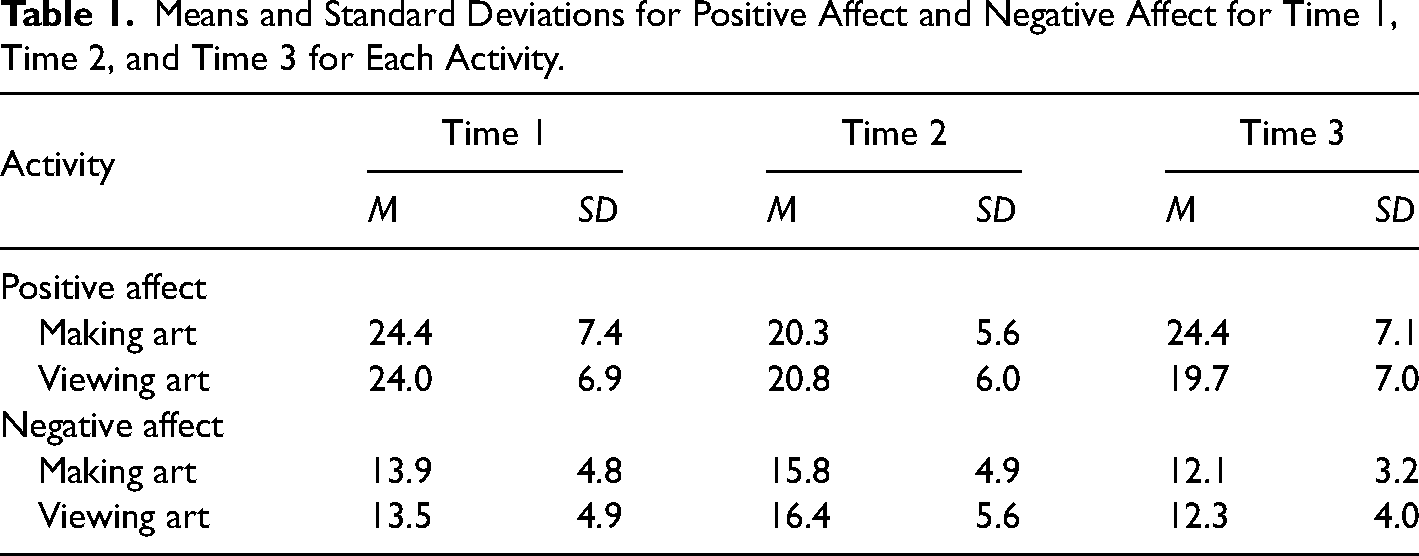
A paired sample t-test showed that both films were effective in inducing a negative mood. For the City of Angels film clip, positive affect decreased from before to after the mood induction, t (58) = −5.61, p < .001, d = −0.73, and negative affect increased from before to after the mood induction, t (58) = 4.01, p < .001, d = 0.52. For the Dangerous Minds film clip, positive affect also decreased from before to after the mood induction, t (58) = −4.97, p < 0.001, d = −0.65; and negative affect increased from before to after the mood induction, t (58) = 4.71, p < 0.001, d = 0.61.
Affect improvement
Positive Affect. To compare the effectiveness of making versus viewing art in increasing positive affect, we performed a repeated measures ANOVA with activity (2) as the within-subjects factor and time (after the mood induction and after the activity) (2) as the repeated measure. There was an effect of time, F (1, 58) = 5.97, MSE = 21.74, p = .018, and np2 = .09: positive affect increased from after the mood induction to after the activity. There was also an effect of activity, F (1, 58) = 12.14, MSE = 21.64, p < .001, and np2 = .17. Positive affect (collapsing across the two points) was higher when making than viewing art.
The effect of activity was modified by an interaction between time and activity, F (1, 58) = 36.19, MSE = 11.33, p < .001, and np2 = .38. A paired sample t-test was performed to assess the difference between the two activities. First, a positive affect change score was computed by subtracting Time 2 positive affect (after the mood induction) from Time 3 positive affect (after the activity). A larger number would indicate a greater increase in positive affect from before to after the activity. Second, a paired sample t-test compared the positive affect change scores for making versus viewing art. Making art improved positive affect (M = 4.1, SD = 5.5) significantly more than did viewing art (M = −1.2, SD = 6.0), t (58) = 6.02, p < .001,and d = 0.78.
Negative Affect. To compare the effectiveness of making versus viewing art in decreasing negative affect, we performed a repeated measures ANOVA with activity (2) as the within-subjects factor and time (after the mood induction and after the activity) (2) as the repeated measures. There was an effect of time, F (1, 58) = 73.84, MSE = 12.04, p < .001, np2 = .56: negative affect decreased from after the mood induction to after the activity. There was no effect of activity, F (1, 58) = 2.03, MSE = 6.08, p = .159, and np2 = .03; and no interaction between time and activity, F (1, 58) = 2.87, MSE = 3.59, p = .375, and np2 = .01.
Enjoyment
A paired sample t-test revealed no difference in enjoyment for making (M = 3.4, SD = 0.9) versus viewing art (M = 3.4, SD = 1.0), t (58) = 0.35, p = .729, and d = 0.05.
Discussion
Consistent with our hypothesis, we found that while both making and viewing art reduced negative affect, making art increased positive affect more than viewing art. In Study 2, we examined whether the benefits of making art on positive affect could be explained by the experience of flow participants feel when engaging in that activity. Unlike Study 1, in Study 2, we conducted a between-subjects design that allowed us to avoid any carryover effects that participants may have experienced from completing both activities.
Study 2
Method
Participants
Participants were 68 undergraduate students between the ages of 18 and 21. Five participants were excluded from the final sample—for four participants the PowerPoint presentation crashed during the testing session and one additional participant did not follow the drawing instructions. Thus, the final sample consisted of 63 undergraduates (34 women, Mage = 18.8, SDage = 0.8). Participants received research credit as part of an undergraduate course requirement. The sample was 55.6% White, 23.8% Asian, 9.5% Biracial, 6.3% Hispanic or Latino, 3.2% Black or African American, and 1.6% American Indian/Alaskan Native. The age and racial and ethnic identity of the sample was representative of the college where the data was collected. The study was approved by the college's institutional review board, and all participants provided written informed consent.
Procedure
Participants first completed the PANAS (Time 1). To induce a sad mood, we showed participants a clip from The Champ and then asked them to complete the PANAS a second time (Time 2). Next, we randomly assigned participants to the making art or viewing art condition. After the activity, participants completed the PANAS a final time (Time 3). Finally, participants completed the Flow State Scale and indicated their level of enjoyment.
Measures
Positive and Negative Affect Schedule (PANAS). To measure affect, we again administered the PANAS. Cronbach's alpha for this measure was as follows: Time 1 positive affect α = 0.75 and negative affect α = 0.78; Time 2 positive affect α = 0.83 and negative affect α = 0.78; Time 3 positive affect α = 0.92 and negative affect α = 0.75.
Mood induction. To induce a sad mood, we had participants watch a short 2-min film clip from The Champ. The clip has been rated as the saddest clip among a series of film clips at eliciting pure sadness (Gross & Levenson, 1995). In the clip, a young boy (Ricky Schroder) struggles to watch his father (Jon Voight), a boxer, die in front of him. In the clip, the young boy cries over his father's dead body, “Champ, wake up!”
Activity. Participants were randomly assigned to one of two activities: making art or viewing art. There was no difference in the gender distribution between conditions, X2(1, 63) = 0.168, p = .682. In the making art condition (n = 30), participants were given an 8.5″×11″ sheet of paper and a set of colored pencils. They were told: “You will have 10 min to draw a design on this piece of paper with these colored pencils. This design has to be nonrepresentational. It will be made up of lines, shapes, and colors. You will use the full 10 min to draw.” In the viewing art condition (n = 33), participants watched a 10-min PowerPoint presentation of a series of 60 abstract expressionist paintings on a 17-inch MacBook Pro laptop. Each painting was shown for 10 s. Participants were told: “Now I am going to have you view some images for 10 min. Please let the slides transition by themselves.”
Flow State Scale. To measure the level of flow participants experienced during the making or viewing art activity, we administered the Flow State Scale (Jackson & Marsh, 1996). Participants were presented with 36 statements (e.g., “I felt like I could control what I was doing,” “The way time passed seemed to be different from normal,” “The challenge and my skills were at an equally high level”) and were asked to rate how much they experienced each statement during the activity on a 5-point scale ranging from “never” to “always.” The Flow State Scale yields an overall flow score as well as nine subscales. Cronbach's alpha for this measure was as follows: overall flow (α = .84); and for the nine subscales, level of challenge (α = .69), action awareness (α = .88), clear goals (α = .90), unambiguous feedback (α = .91), concentration (α = .92), control (α = .88), loss of self-consciousness (α = .88), transformation time (α = .71), and autotelic experience (α = .89).
Enjoyment. Again, we asked participants to rate how much they enjoyed the activity on a five-point scale from “really didn’t” to “really did.”
Results
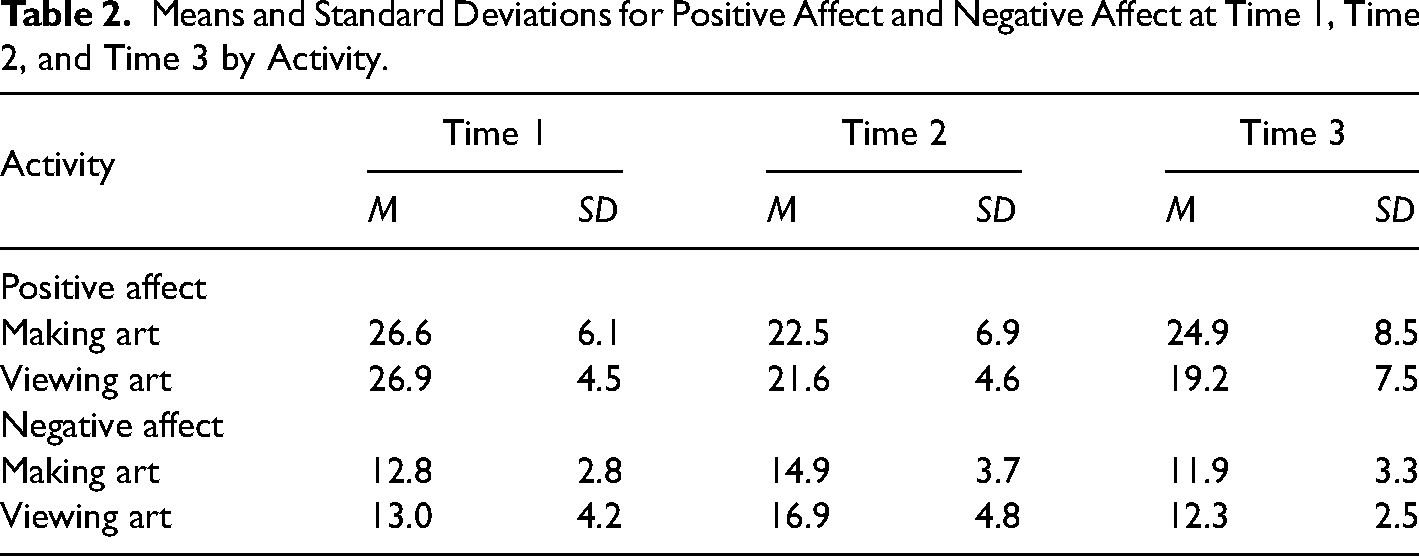
Table 2 presents the means and standard deviations for positive affect and negative affect scores by condition at Time 1, Time 2, and Time 3. To determine whether positive and negative affect differed at Time 1, a MANOVA with condition (make, view) (2) as the between-subjects factor and Time 1 positive affect and Time 1 negative affect (before the mood induction) as the dependent variables (2) was performed. There was no effect of condition for Time 1 positive affect or Time 1 negative affect (ps > .05). A paired sample t-test showed that the film clip was effective in inducing a negative mood. Positive affect decreased from before to after the mood induction, t (62) = −9.08, p < .001, and d = −1.14, and negative affect increased from before to after the mood induction, t (62) = 6.09, p < .001, and d = 0.77.
Means and Standard Deviations for Positive Affect and Negative Affect at Time 1, Time 2, and Time 3 by Activity.
Mood improvement
Positive Affect. To compare the effectiveness of making versus viewing art in increasing positive affect, we performed a mixed design ANOVA with time (after the mood induction and after the activity) (2) as the repeated measure and condition (2) as the between-subjects factor. There was no effect of time, F (1, 61) = 0.0, MSE = 22.52, p = .983, and np2 = 0.0. There was an effect of condition, F (1, 61) = 4.52, p = .038, and np2 = .07: positive affect (collapsing across the two points) was higher when making than viewing art.
More importantly, there was the interaction between time and condition, F (1, 61) = 7.92, p = .007, and np2 = .12. As in Study 1, a one-way ANOVA was performed to assess the difference between the two conditions. First, a positive affect change score was computed by subtracting Time 2 positive affect (after the mood induction) from Time 3 positive affect (after the activity). Next, a one-way ANOVA was performed with the condition as the between-subjects factor and the positive affect change score as the dependent variable. There was a significant difference between conditions, F (1, 61) = 7.92, p = .007, np2 = 0.12. Participants in the making art condition experienced a greater increase in positive affect after completing the activity (M = 2.4, SD = 6.5) than did those in the viewing art condition (M = −2.4, SD = 6.9). In fact, participants in the viewing condition actually experienced a decrease in positive affect after completing the activity.
Negative Affect. To compare the effectiveness of making versus viewing art in decreasing negative affect, we performed a mixed design ANOVA with time (after the mood induction and after the activity) (2) as the repeated measure and condition (2) as the between-subjects factor. There was an effect of time, F (1, 61) = 60.40, MSE = 7.48, p < .001, and np2 = .50: negative affect decreased from after the mood induction to after the activity. There was no effect of condition, F (1, 61) = 2.19, p = .144, and np2 = .04, and no interaction between time and condition, F (1, 61) = 2.48, p = .120, and np2 = .04.
Enjoyment and flow
Table 3 presents the means and standard deviations for enjoyment and overall flow. Enjoyment and overall flow were positively correlated, r (61) = .599 and p < .001. To assess whether enjoyment and flow differed by condition, we performed a multivariate ANOVA with condition as the between-subjects factor and overall flow and enjoyment as the dependent variables. Those in the making condition enjoyed the activity more than those in the viewing condition, F (1, 61) = 19.64, p < .001, and np2 = 0.24. Those in the making art condition experienced marginally more flow than those in the viewing art condition, F (1, 61) = 3.66, p = .06, and np2 = 0.06. Since the overall scale was not significantly different by condition, we did not analyze whether there were differences in the subscales by condition.
Means and Standard Deviations for Enjoyment and Flow.
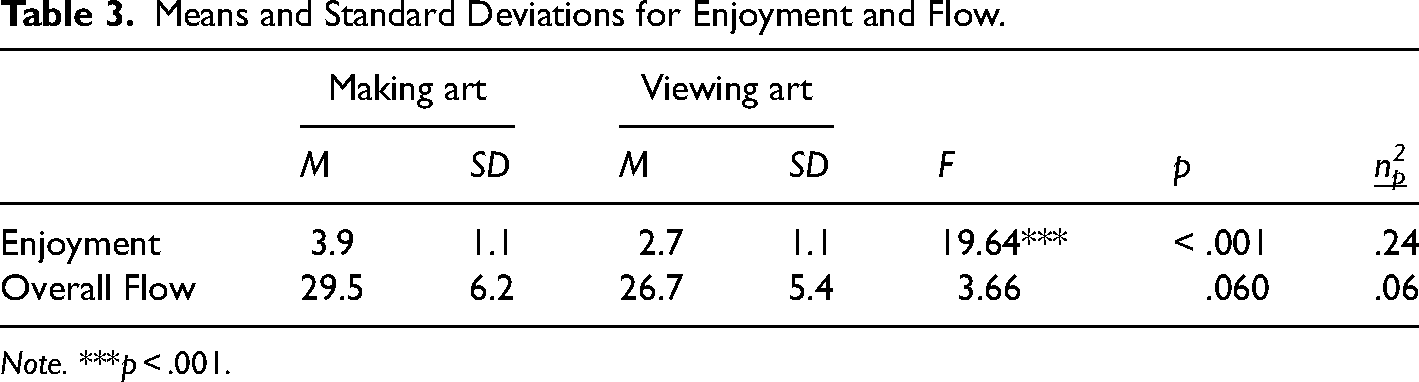
Note. ***p < .001.
We also examined the role of enjoyment and flow in participants’ affect improvement. First, we computed a positive affect change score by subtracting Time 2 positive affect (after the mood induction) from Time 3 positive affect (after the activity). We then performed a regression with enjoyment and flow as the independent variables and the positive affect change score as the dependent variable. The same procedure was followed for negative affect. To examine whether flow and enjoyment played a different role in affect improvement by condition, we ran these analyses separately for the making and viewing art conditions.
For the making art condition, overall flow (B = .715 and p < .001) and not enjoyment (B = −.033 and p = .850) predicted the positive affect change score; neither overall flow (B = .205 and p = .358) nor enjoyment (B = .243 and p = .276) predicted the negative affect change score.
For the viewing art condition, enjoyment (B = .384 and p = .073) and not overall flow (B = −.220 and p = .294) marginally predicted the positive affect change score. Enjoyment (B = .547 and p = .007) and not overall flow (B = −.085 and p = .652) significantly predicted the negative affect change score.
Discussion
Replicating Study 1, we found that both making and viewing art reduced negative affect but only making art elevated positive affect. Somewhat consistent with our hypothesis, making art resulted in greater enjoyment but not in greater overall flow. When we examined the role that flow and enjoyment play in improving affect, a different pattern of findings emerged by condition. For the making art condition, overall flow was associated with improvements in positive affect but for the viewing art condition, enjoyment was associated with improvements in both positive (albeit marginally) and negative affect.
General Discussion
Engaging in art-making by individuals not selected for artistic ability or interest has been shown to improve affect (Grossman & Drake, in press). Some evidence points to similar affective benefits when engaging in the receptive activity of viewing art (e.g., Clow & Fredhoi, 2006; Kweon et al., 2008). While making art has been shown to improve both positive and negative affect, studies on the benefits of viewing art have yielded mixed results, with some studies showing that viewing art online has the same affective benefits as viewing other online content (Trupp et al., 2022). In the study reported here, we compared the affective benefits (increases in positive affect and decreases in negative affect) of making versus viewing art and examined whether these benefits might be due to the experience of flow and/or enjoyment that comes from engaging in the activity.
First, consistent with our hypothesis and previous research, we found both making and viewing art reduced negative affect. We explain this finding in terms of the beneficial distracting effects of both activities: making and viewing art allow us to shift our attention away from any personal negative thoughts and feelings which we hold prior to the activity. However, consistent with our hypothesis, we found that positive affect increased more for making than viewing art. To our knowledge, this is the first such demonstration. We speculate that making art improves affect more than viewing because it is an immersive activity that leads to a state of flow (Cotter et al., 2022; Tay et al., 2018).
It is also possible that making art may improve affect more than viewing art because it is a cognitively demanding task. Making art involves envisioning, planning, abstraction, visual analysis, and motoric coordination (Kozbelt, 2001). Engaging in tasks higher in cognitive demand leads to greater improvements in affect than engaging in tasks lower in cognitive demand (Strick et al., 2009; van Dillen & Koole, 2007). Cognitively demanding tasks are effective because they allow us to both turn away from our negative affect and turn our attention toward an engaging task. By loading our working memory, these tasks prevent fewer mood-related thoughts (Erber & Tesser, 1992).
We hypothesized that those in the making art condition would experience more enjoyment and flow than the viewing art condition. This was only partially supported. Although those in the making art condition reported greater enjoyment, they reported only marginally greater states of flow than those in the viewing art condition. Interestingly, when we examined whether enjoyment and flow were associated with affect improvement, a different pattern of findings emerged by condition. For those in the making art condition, the overall flow was associated with improvements in positive affect. This is consistent with work showing a positive association between flow and positive affect (Collins et al., 2009) and the recent model developed by Tay et al. (2018) that suggests that one of the ways that arts engagement improves well-being is through immersion. For those in the viewing art condition, it was enjoyment (and not flow) that was associated with improvements in positive and negative affect. This is consistent with work showing that we experience pleasure (and enjoyment) from viewing aesthetic experiences (Mastandrea et al., 2019). Future work would benefit from exploring the role that flow and enjoyment play in affect improvement of these two activities. Of course, this was a sample of nonartists, and it would be interesting to examine whether flow and enjoyment play a different role for artists who have knowledge, experience, and interest in making and viewing art.
It is important to note that while we tried to equate the conditions on time (both activities were for 10 min) and content (both conditions either drew or viewed nonrepresentational images), the viewing art condition may have been less interesting than the making art condition and this may be reflected in the enjoyment ratings. Future research would benefit from not only equating the conditions on time and content, but also the quality of the experience. For example, having participants select an image online through a museum's digital collection or even viewing a painting in person. This would allow both the making and viewing of art conditions a sense of autonomy as they create or select their own images.
Another potential limitation of this work is the format of the viewing condition—participants viewed small images on a computer screen in a lab setting rather than viewing the life-size works in a museum setting. Of course, viewing art on a computer screen does not replicate the experience of viewing art in a museum or gallery setting. Since we conducted this study in a lab setting, we do know that participants were engaged in the task and not multitasking (looking at their smartphones). In addition, viewing art on a smartphone most likely is a better representation of how art is viewed online with art collections being made available digitally and museums (and artists) having large Instagram followings. When viewing art on a smartphone, tablet, or computer, we can look closely at the image and even zoom in, something we would not be able to do at a museum. An important avenue for future research would be to replicate this study in a more naturalistic setting.
To induce a negative mood, we asked participants to watch a short film clip and we selected three clips that were rated as the top in inducing sadness (Gross & Levenson, 1995; Schaefer et al., 2010). In Study 1, we showed two different clips (e.g., City of Angels and Dangerous Minds) that were counterbalanced by session and activity, in order to avoid carryover effects. It is likely that seeing a film clip a second time would be less effective in inducing sadness than seeing it for the first time. In fact, we found no difference between the two film clips inducing a negative mood. However, we did introduce a third film clip for Study 2 (e.g., The Champ) so that participants would see the same clip in both conditions. While the clip was effective in inducing sadness (reducing positive affect and increasing negative affect), we do not know if it was as effective as (or even more effective than) the clips used in Study 1, limiting conclusions that can be drawn between the two studies. Additionally, the study designs differed, with Study 1 being a within-subjects design and Study 2 being a between-subjects design, which may also limit the conclusions that can be drawn between the two studies. Future research should continue this line of research by limiting changes to the experimental design.
We asked participants to draw a nonrepresentational image because we wanted participants to focus less on the content of their work and more on the aesthetic properties of color, form, and line. Previous research has shown that drawing a design improves both positive affect (Forkosh & Drake, 2017) but it is unclear whether the benefits of drawing a nonrepresentational image are similar to those of drawing a representational image. When it comes to viewing art, nonartists prefer to view representational over nonrepresentational art (Feist & Brady, 2004). It is likely the case that the average viewer untutored in art or art history does not really know how to look at abstract art. Future research would benefit from running this study with works of art in a variety of artistic styles and comparing the benefits of both making and viewing representational and nonrepresentational art.
It would be interesting to see whether these results would be replicated with other art forms. For example, does listening to music have the same affective benefits as playing music? As noted above, the majority of studies on the visual arts have focused on the affective benefits of active rather than receptive activities but the opposite is true for music. Even though many studies have shown that music is effective in improving affect, these studies have almost exclusively focused on the receptive activity of listening to music. Perhaps, this is not surprising since playing a musical instrument requires lessons and skill mastery while listening to music requires no lessons at all and can be done anywhere and at any time.
With the COVID-19 pandemic, more and more art collections had been made available online with digital collections accessible via museum websites and Instagram. Thus, it is important to examine not only the affective benefits of active activities (making art) but also receptive activities (viewing art). Our findings demonstrate that while both types of activities may be beneficial for improving affect, the benefits are potentially stronger for making than viewing art. It may be that making art has an intrinsic property that results in improved positive affect. Perhaps making art allows us to shift our attention away more fully from our negative thoughts and feelings because we are focused on the process of drawing and not necessarily the content of the drawing we created.
Footnotes
Appendix
Names of Professional Artists
Karel Appel Gillian Ayres James Brooks Elaine de Kooning Sam Feinstein Sam Francis Helen Frankenthaler Philip Guston Hans Hofmann Franz Kline Morris Louis Joan Mitchell Kenzo Okada Ralph Rosenborg Mark Rothko Charles Seliger Theodoros Stamos Clyfford Still Mark Tobey Cy Twombly
Author Note
Jennifer E. Drake. This research was completed while Mariana Eizayaga and Sarah Wawrzynski were honor's thesis students at Boston College. They both contributed equally to this research. We have no known conflicts of interest to disclose.
Declaration of Conflicting Interests
The authors declared no potential conflicts of interest with respect to the research, authorship, and/or publication of this article.
Funding
The authors received no financial support for the research, authorship, and/or publication of this article.
