




Abstract
Art experts generally perceive, process, and appreciate artworks differently from non-experts. Here we explored whether animacy of the content and prestige of the context of artworks matter to experts. Results (n > 1,000) suggest that experts are indeed swayed by prestige cues when appreciating artworks. Furthermore, the higher their expertise, the less animacy matters, to the point even of a reversal among the highest echelons. There experts prefer inanimate (e.g., furniture) to animate stimuli. We consider several, mostly complementary explanations. One interpretation is that experts might have learned through prestige bias to reduce their preference for animacy, which would be consistent with a prestige bias runaway process. Other interpretations include processing perceptual (dis)fluency, cognitive mastering, and identity signaling. Irrespective of the precise roles of these compatible processes, the results might point to a more general expertise-dependent pattern. We close by discussing further research opportunities to further fine-tune possible explanations.
Keywords
As captured by the Latin maxim “de gustibus et coloribus non disputandum,” 1 little is considered more subjective than esthetic taste. Most people agree this especially applies to the domain of art (Leder, Gerger, Dressler, & Schabmann, 2012). Art appreciation seems to a large extent idiosyncratic (Vessel, Maurer, Denker, & Starr, 2018). Yet, research in empirical esthetics and the psychology of art has also shown that this does not preclude the existence of more general patterns and factors. One of these factors is art expertise. How it consistently affects the perception, processing, and appreciation of art has been a primary topic of interest. Here we want to contribute to this line of research by exploring expert art appreciation in relation to prestige context and animacy content of artworks as well as potentially interesting interactions between them. These explorations are inspired by evolutionary approaches to human behavior, art, and esthetics.
Psychological Research Into Art Appreciation and Expertise
Visual art is an ancient feature of human life that has gained attention in psychology over recent years (Leder et al., 2012). Psychologists are mostly interested in elucidating the cognitive, perceptual, and emotional processes involved in the appreciation of (visual) art (Bubić, Sušac, & Palmović, 2017). Multiple factors can account for art appreciation (Lindell & Mueller, 2011). Besides bottom-up influences, such as type of art (e.g., abstract vs. figurative), form, symmetry, and complexity, top-down factors also influence art appreciation. Lindell and Mueller (2011) state that one of those top-down factors is the expertise of the viewer. Indeed, art expertise allows individuals to develop art-specific cognitive processes which have significant influence on the perception and categorization of artworks (Winston & Cupchik, 1992). These expertise-dependent processes translate into differing preferences for artworks. Early work shows that expertise leads people to evaluate art more based on formal relations between pictorial elements and compositional features. In contrast, as expertise increases, they rely less on the degree to which an artwork is realistic (Hekkert & Van Wieringen, 1996). Later work highlights expertise-dependent physiological reactions. Leder, Gerger, Brieber, and Schwarz (2014) investigated activation of corrugator supercilii and zygamoticus of participants in response to contemporary artworks. They found that higher expertise leads to attenuated reactions to both negative and positive artworks, attenuated valence ratings, and higher appreciation for negative artworks. They suggest that these expertise-dependent phenomena are all related to increased higher-order cognitive processing as well as a weakened emotional impact of art. They also found that expertise correlates negatively with emotional response to artworks, even though it correlates positively with evaluating artworks as emotional. In a recent study, Gartus, Völker, and Leder (2020) found that, even though symmetric patterns are generally more appreciated, higher expertise leads to a less pronounced preference for symmetry and a higher appreciation of asymmetric abstract patterns.
In summary, psychological research has revealed that art expertise affects the perceptual, affective, and cognitive processing as well as the appreciation of artworks. In this investigation we ask whether prestige and animacy matter for experts.
Does Prestige Matter for Experts?
Prestige seems to play a major role in the domain of art. Reconstructing the exhibition history of half a million artists, Fraiberger, Sinatra, Resch, Riedl, and Barabási (2018) demonstrate that early-career access to prestigious central institutions offered life-long access to high-prestige venues and reduced dropout rate. By contrast, starting at the network periphery resulted in a high dropout rate, limiting access to such institutions. Fraiberger et al. (2018) argue that reputation and networks of influence play a key role in determining value and recognition of art because its quality is difficult to quantify in an objective fashion. If this is indeed the case, we may expect that someone who is active in the domain of art (i.e., an expert) regards the fact that an artwork belongs to a prestigious museum as an indirect marker of its artistic value, which, in turn may increase their appreciation of the artwork.
On the other hand, even though artistic quality and competence may generally be hard to grasp, it could be less hard for experts. Individuals with a lot of expertise may have to rely less on indirect markers of quality than less experienced individuals, as the former might be able to discern quality more directly thanks to their expertise. Especially at the highest echelons of expertise, we may expect individuals to have an exemplary understanding about which (kind of) artworks, artists, and qualities warrant prestigious recognition and appreciation. Thus, perhaps, in contrast to the less experienced, these individuals may not gullibly follow institutional markers of prestige when judging artworks. Therefore, we may as well expect that the more expertise an expert has, the less their appreciation of an artwork depends on markers of institutional prestige.
Does Animacy Matter for Experts?
It has been demonstrated that humans prioritize attention to animate objects (i.e., humans and other animals) relative to inanimate objects (e.g., furniture) (Altman, Khislavsky, Coverdale, & Gilger, 2016; New, Cosmides, & Tooby, 2007; Yang et al., 2012). In fact, detecting animacy is a highly conserved capacity shared among a wide range of animal taxa, at least through biological motion, but in higher taxa also through a capacity for static animate/inanimate distinction. This is the case because detecting animacy has been crucial to evolutionary fitness as it modulates interactions with predators or prey, or conspecific kin, mates or competitors (Gonçalves & Biro, 2018). Therefore, animacy bias is likely an ancestrally adaptive feature of human visual attention (New et al., 2007). But does this preferential attention to animacy translate into an esthetic preference for animacy?
Evolutionary psychologists have suggested that it does. Evolutionary esthetics, a subbranch of evolutionary psychology, holds that (Thornhill, 2003, p. 9): “Beauty experiences are unconsciously realized avenues to high fitness in human evolutionary history.” Applied to esthetic valuation of nonhuman animals, Thornhill (2003, p. 27) posits that “beauty here is hypothesized to be the perception of ancestral cues to available animal food and safety from predators” and reviews evidence in favor of an adaptive esthetic preference for animate cues in the environment. Furthermore, a few recent evolutionary esthetics studies have found evidence specifically of a positive association between adaptive visual attention prioritization and esthetic preference for natural stimuli. One study showed that natural landscape architecture elicits a sense of beauty and captured visual attention more easily than other types of architecture (Zhang, Tang, He, & Lai, 2018). Other studies revealed that the most feared snake species also tend to be perceived as beautiful, largely independent of cultural background (Landová et al., 2018). This was considered in accordance with “attentional prioritization of snakes as an evolutionary relevant threat” (Janovcová et al., 2019, p. 1). While it might seem counterintuitive that a life-threatening animal elicits a positive esthetic experience, this tentatively suggests that attention prioritization can be associated with a positive esthetic experience, regardless of whether the animal is prey or predator, a resource or a threat (see Renoult & Mendelson, 2019 for a similar argument regarding processing fluency and esthetic preference for animal signals irrespective of their message). Finally, across the globe and from the upper-paleolithic (i.e., parietal art and figurines) until the present, animals appear as a major theme in art and decoration, which might result in part from animacy bias and may indicate a general preference for animacy. Hence, evolutionary esthetics expect that preferential attention for animacy, all else being equal, is associated with an esthetic preference for animacy. But would this count for experts as well?
On the one hand, we may expect that expertise does not matter. After all, the attentional bias for animacy has been shown to be expertise-independent: New et al. (2007) found that participants were substantially faster and more accurate at detecting changes in animals even relative to changes in vehicles, which they had been trained for years to monitor for sudden life-or-death changes in trajectory. Thus, if esthetic preference tracks attentional bias for animacy, the former could be independent from expertise as well.
On the other hand, we know that beauty experiences also depend on learned models of what counts as beautiful (Skov & Nadal, 2020), and that training and education may have a strong impact on these models. Moreover, to make matters more complicated, the extent to which esthetic experiences are taken into account in art appreciation also varies and may in turn depend on learned models of what counts as art (Bullot & Reber, 2013). People may learn to disregard “easy beauty” or art that appeals naturally to human neuropsychology (which Pinker, 2002, called a “denial of human nature”). Whatever the precise underlying causes, such divergences—even reversals—have been found for art experts. We illustrate this briefly with two cases. The central role of symmetry in preference and beauty judgments has been well-established empirically and this has been theoretically linked to adaptive function and/or processing fluency (reviewed in Leder et al., 2019). However, it was found that, whereas non-experts indeed rate symmetrical visual stimuli as most beautiful, this is reversed among experts who rate asymmetric visual stimuli as most beautiful (Gartus et al., 2020; Leder et al., 2019). A similar reversal was found for facial beauty, a trait which also has been suggested to be fitness-relevant: while non-experts prefer artworks depicting beautiful faces to neutral faces, experts prefer portraits with neutral faces to those with beautiful faces (Verpooten & Dewitte, 2017). In the same vein, if nonexperts have an animacy preference, we may ask whether experts tend to diverge in this respect as well. We may expect that the more expertise someone has, the less strong their preference will be for artworks of animals versus artworks of inanimate objects.
Finally, we tentatively connect our questions concerning prestige and animacy. As has been previously suggested with regard to symmetry and facial beauty (Leder et al., 2019; Verpooten & Dewitte, 2017), learning (training, art history education, etc.) may account for expert divergences from ancestrally adaptive, non-expert esthetic preferences. And since the use of prestige as a marker of quality has been explicitly proposed as a learning strategy (Henrich & Gil-White, 2001; Jiménez & Mesoudi, 2019; Rendell et al., 2010), this allows us to speculate about whether prestige and animacy effects on expert appreciation would somehow be interconnected. Perhaps experts rely on prestige as a learning strategy in the domain of art, which, in turn, diverges their preferences from non-expert, ancestrally adaptive preferences. This would be consistent with empirical and theoretical work in cultural evolution which suggests that “prestige bias social learning” can decouple human behavior from genes (Boyd & Richerson, 1985; Richerson & Boyd, 2005). Thus, we might ask whether experts achieve divergence from non-expert ancestral adaptive preferences partly through the use of prestige. Hence, it follows that if we find that more experienced individuals tend to be swayed by prestige, we may expect that they also diverge from an animacy preference.
The Present Research
To explore our questions about the effects of prestige and animacy on expert art appreciation, we used a large sample of participants with an interest in art (recruited through an art museum) and assessed their expertise (art knowledge and interest). The large sample allowed us to explore whether meaningful differences appear among experts with variable levels of expertise.
We manipulated prestige between subjects. This way we avoided a potential effect of someone's reluctance to admit that they rely on prestige despite their expertise (cf. Verpooten & Dewitte, 2017). We selected the MoMA—Museum of Modern Art—in New York as prestige cue as it is a well-known and reputational museum of modern and contemporary art (Fraiberger et al., 2018). Thus, a random half of the participants were told that the visual stimuli they were rating were artworks belonging to the MoMA (prestige condition), the other half was not given such information (control condition). We manipulated animacy within subjects. Thus, participants were presented with visual stimuli, half of which were artworks depicting animals (e.g., a pig) and the other inanimate objects (e.g., a chair; see Figure 1).
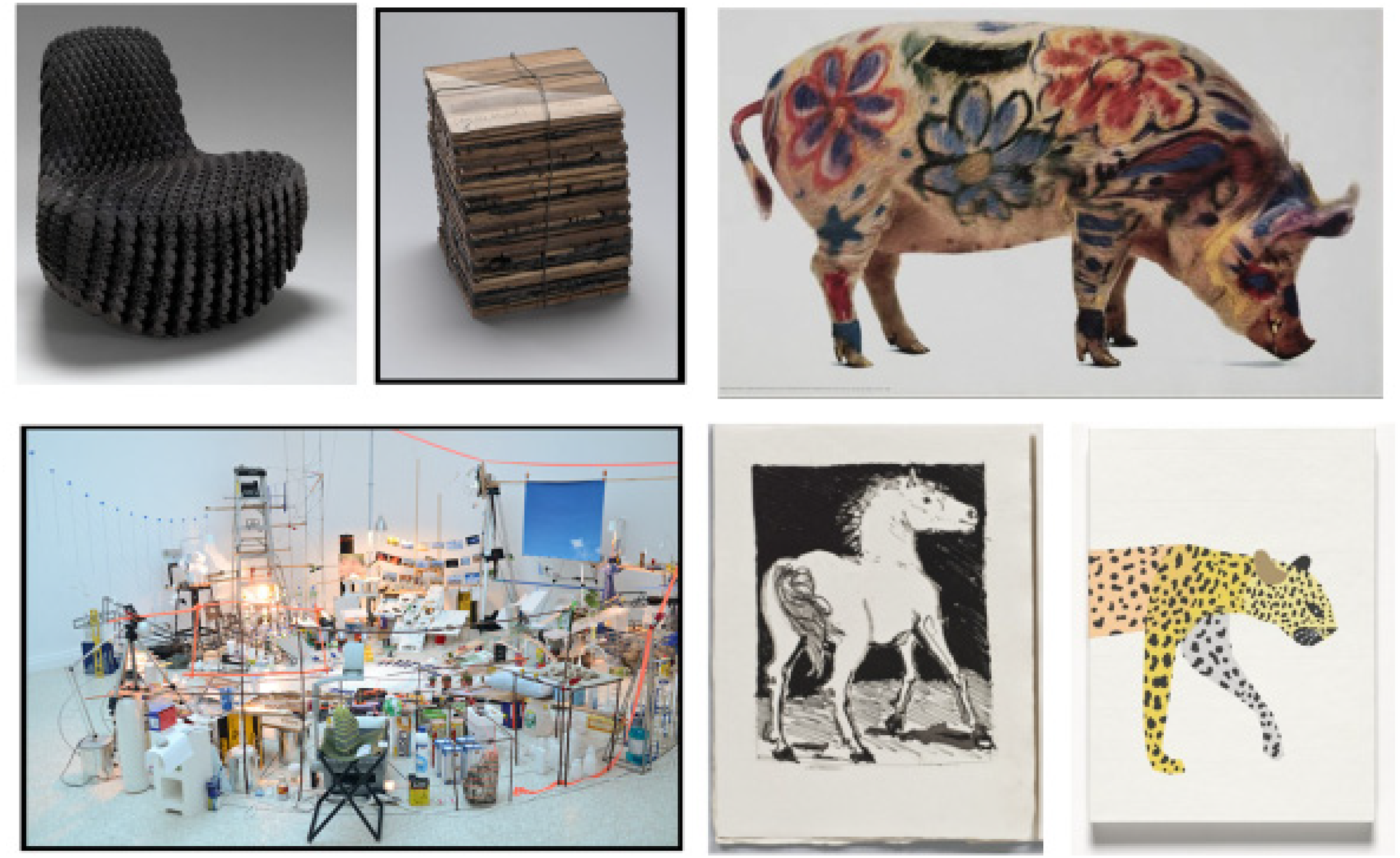
Examples of used stimuli. Artworks depicting inanimate objects (left) and animals (right). Retrieved from http://www.moma.org.
Methods
Participants
One thousand one hundred and four participants participated in the study. We recruited them online through European modern and contemporary art museum. Four participants with unrealistic values for age were excluded from further analyses, which did not influence the results. The sample's age ranged from 13 to 79 years old (M = 38.15, SD = 15.17), with 477 men and 623 women. The majority of the participants were students or functionaries. A minority (N = 107) reported to be professionally involved in art (art dealer, professional artist, art criticist).
Procedure and Questionnaire
The data was collected as part of master thesis studies. 2 The art museum shared a link to the online experiment through their Facebook page. Participants did not receive any rewards for their participation. Once participants received the hyperlink through mentioned sources, participants could fill it in online. After opening the hyperlink, participants were redirected to a Qualtrics survey divided into three sections: artwork appreciation, expertise, and demographic questions. After a brief introduction and explanation of the study, participants were randomly assigned to a prestige condition (with the MoMA label shown below each artwork to be rated) or to a control condition (without the MoMA label shown) of the survey. In the first part of the study, participants were asked to look at a series of 20 artworks, from which half were categorized as animate (static depictions of animate objects) and the other half was categorized as inanimate (static depictions of inanimate objects; Figure 1). In the subsequent screen, participants were asked to indicate their appreciation of the artwork on a seven-points Likert-scale with 1 as lowest possible appreciation and 7 as highest possible appreciation. This way, participants rated an equal amount of artworks representing animate and inanimate objects. The artworks were presented in randomized order and no additional information was provided. The artworks were selected to clearly either depict inanimate (e.g., a chair) or animate objects (e.g., a pig) and were all from professional modern or contemporary artists to avoid potential effects of low artistic quality (they were all from the permanent MoMA collection; Figure 1).
However, the attentional bias and potential esthetic preference for animacy may lead to a larger cultural success of artworks depicting animals versus those depicting inanimate objects (cf. Sperber & Hirschfeld, 2004). This implies that, on average, animate artworks may be more famous, and therefore more familiar, than inanimate artworks. And, as has been shown, previous exposure may affect art appreciation (Cutting, 2003). Therefore, we performed a post-test that checked famousness of the stimuli and controlled for it (see Appendix C). A separate sample of art experts was asked to estimate how well-known the visual art stimuli of our main analysis were to the general public. We transformed these ratings in a new variable “famousness” and integrated this variable, as a feature of the artworks used, in our main study, in our main analysis. Because the variable was linked to the artistic stimuli used, this factor was a within-subjects factor.
The second part of the online experiment measured the level of expertise of the participant, with the use of two short questionnaires. The first questionnaire was slightly modified from Leder et al. (2012), presenting six questions to assess “interest in art” (e.g., frequency of museum and/or exhibitions visits; see Appendix A) (cf. Specker et al., 2020). The art interest questionnaire statements were all scored from 1 to 7 according to the Likert-scale score. The second questionnaire was an “art knowledge” survey in the form of a multiple choice art quiz, with verbal and pictorial questions and four to six answer options aimed at assessing participants’ knowledge about classic, modern, and contemporary art as in Verpooten and Dewitte (2017; see Appendix A) (cf. Specker et al., 2020). The questions were scored as 0 if the participants gave the wrong answer and as 1 if the participant gave the correct answer. The last part of the online experiment surveyed demographic information of the participants: age, gender, highest education level, current work status, and relation to art in general.
Construction of the Measures
Different measures were computed for the statistical analyses. First, a sum across the six statement of the art interest questionnaire was computed for an “art interest score” (Cronbach's alpha was .81). In addition, a sum across the 10 questions scores of the art knowledge questionnaire was computed as an “art knowledge score” (Cronbach's alpha was .62). Expertise level was taken as a continuous variable and computed (averaged) based on the two expertise scores. Second, the appreciation of animate and inanimate art works was computed. The appreciation of the 10 animate art works was averaged to an “animate appreciation” variable for each participant. The same method was applied to the inanimate art works to reach an “inanimate appreciation” variable for each participant. Averaging these variables was warranted because consistency turned out to be acceptable for both sets (Cronbach's alpha of animate was .71 and inanimate was .77).
Results
Expertise
All statistical analyses of this study were conducted in R. A generalized linear mixed model (GLMM) with animacy (animate vs. inanimate) as a within-subjects factor and prestige (MoMA vs. control) as between-subjects factor, and expertise as continuous factor indicated an overall effect of expertise (F(1,1087) = 83.69, p < .005). This main effect (Figure 2) indicates that, in general, artworks were appreciated more with increasing expertise (β = .06 p = .002).
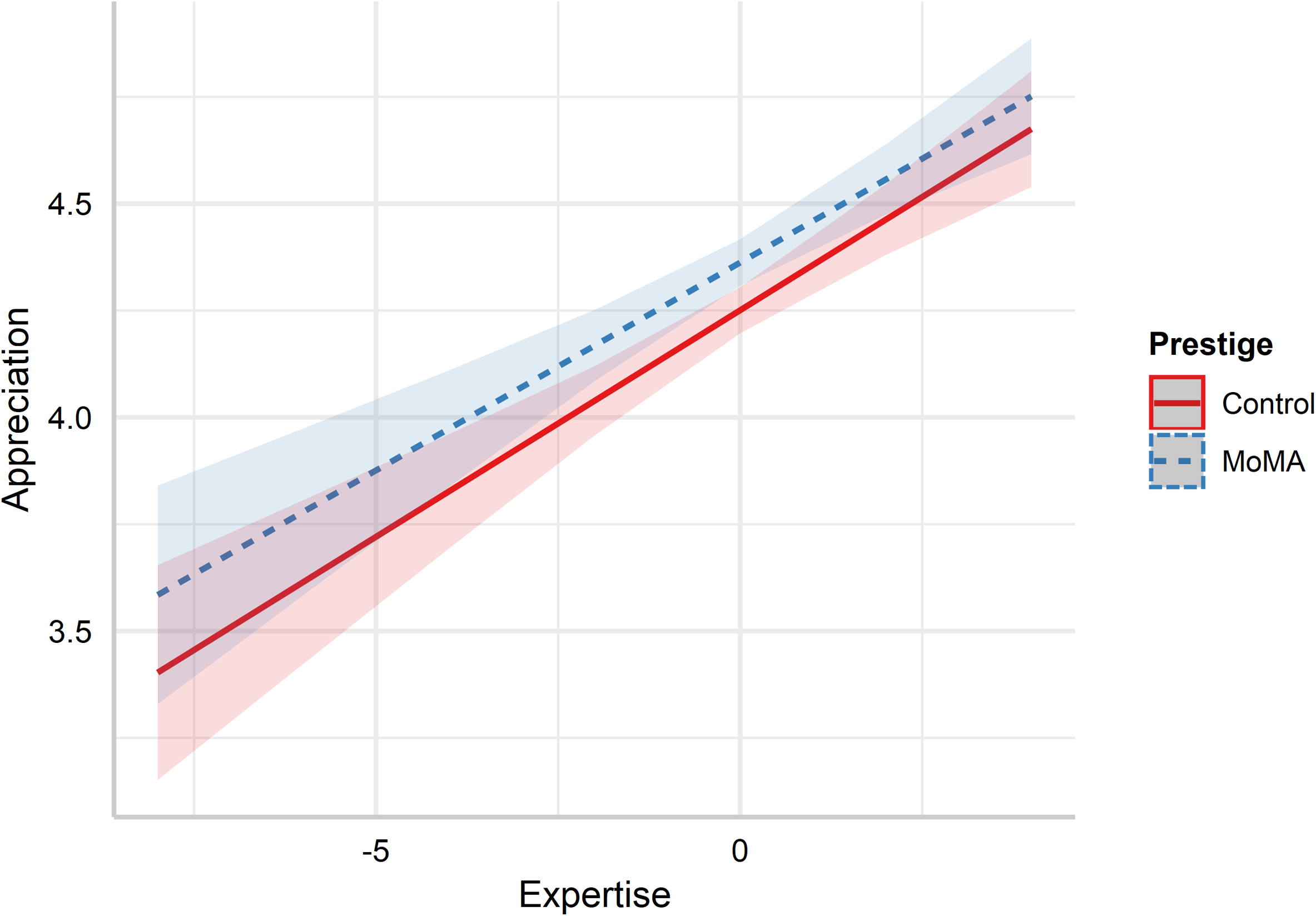
Appreciation of artworks as a function of expertise and prestige (generalized mixed model analysis). Shaded areas represent the 95% confidence interval.
Prestige
The GLMM with animacy (animate vs. inanimate) as a within-subjects factor and prestige (MoMA vs. control) as between-subjects factor, and expertise as continuous factor indicated an overall effect of prestige (F(1,1087) = 8.09, p < .005). This main effect (Figure 2) indicates that, in general, artworks were appreciated more when participants were merely told they belong to the MoMA (M = 4.37, SD = .76) than when no such information was given (M = 4.25, SD = .78) (β = .09, p = .04). No significant interaction was found between prestige and expertise (F1,1087 = .16, p = .69). No interactions between prestige and animacy (F1,1006 = .62, p = .43), or between prestige, expertise, and animacy (F1,1006 = 2.86, p = .09) emerged.
Animacy
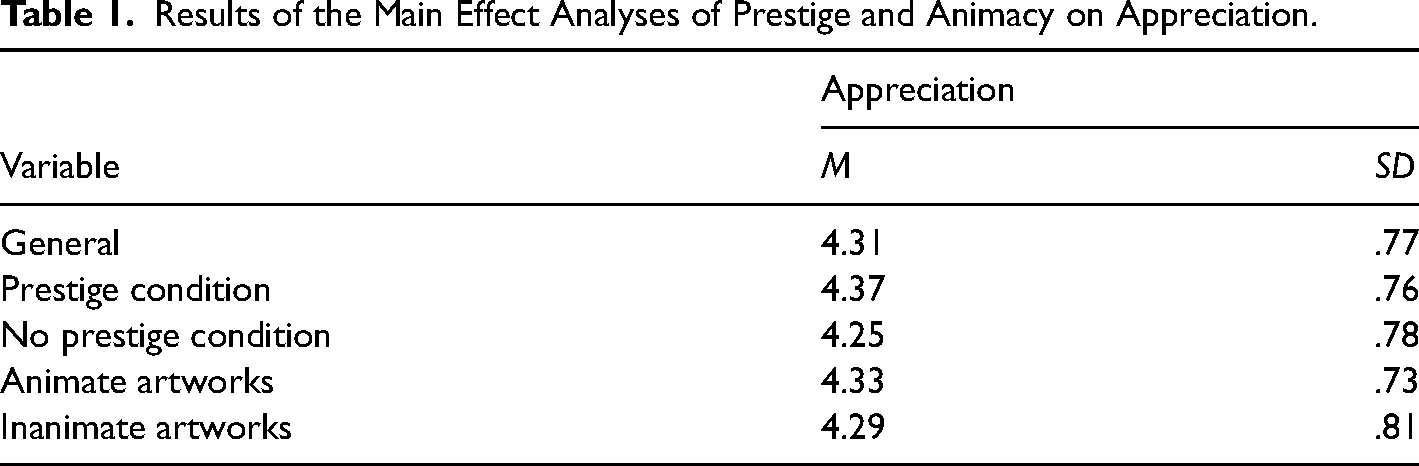
The GLMM with animacy (animate vs. inanimate) as a within-subjects factor and prestige (MoMA vs. control) as between-subjects factor, and expertise as continuous factor did not indicate an overall effect of animacy (F(1,1006) = 2.28, p = .13). That is, in general, animate (M = 4.33, SD = .73) and inanimate (M = 4.29, SD = .81) artworks were equally appreciated by the participants (β = −.05, p = .12). However, a significant interaction between expertise and animacy was found (Figure 3; F(1,1006) = 33.34, p < .0001). To investigate whether this interaction was due to a higher appreciation for animate artworks in lower expertise and/or a higher appreciation for inanimate artworks in higher expertise, a spotlight analysis (with −1SD and +1SD) using the “emmeans” R package (Lenth, 2020) was applied. The result of the spotlight analysis showed that the difference in appreciation between animate and inanimate artworks was significant in both lower (β = .17, p < .0001) and higher expertise (β = −.10, p = .003). This validated interaction between expertise and animacy indicated that participants with a lower expertise level had a higher appreciation for animate art works (M = 4.25, SD = .78) than for inanimate artworks (M = 4.09, SD = .84). In contrast, participants with a higher expertise level had a greater appreciation for inanimate art works (M = 4.44, SD = .75) than animate artworks (M = 4.37, SD = .69). Table 1 summarizes the means and standard deviations of the noncontinuous variables.
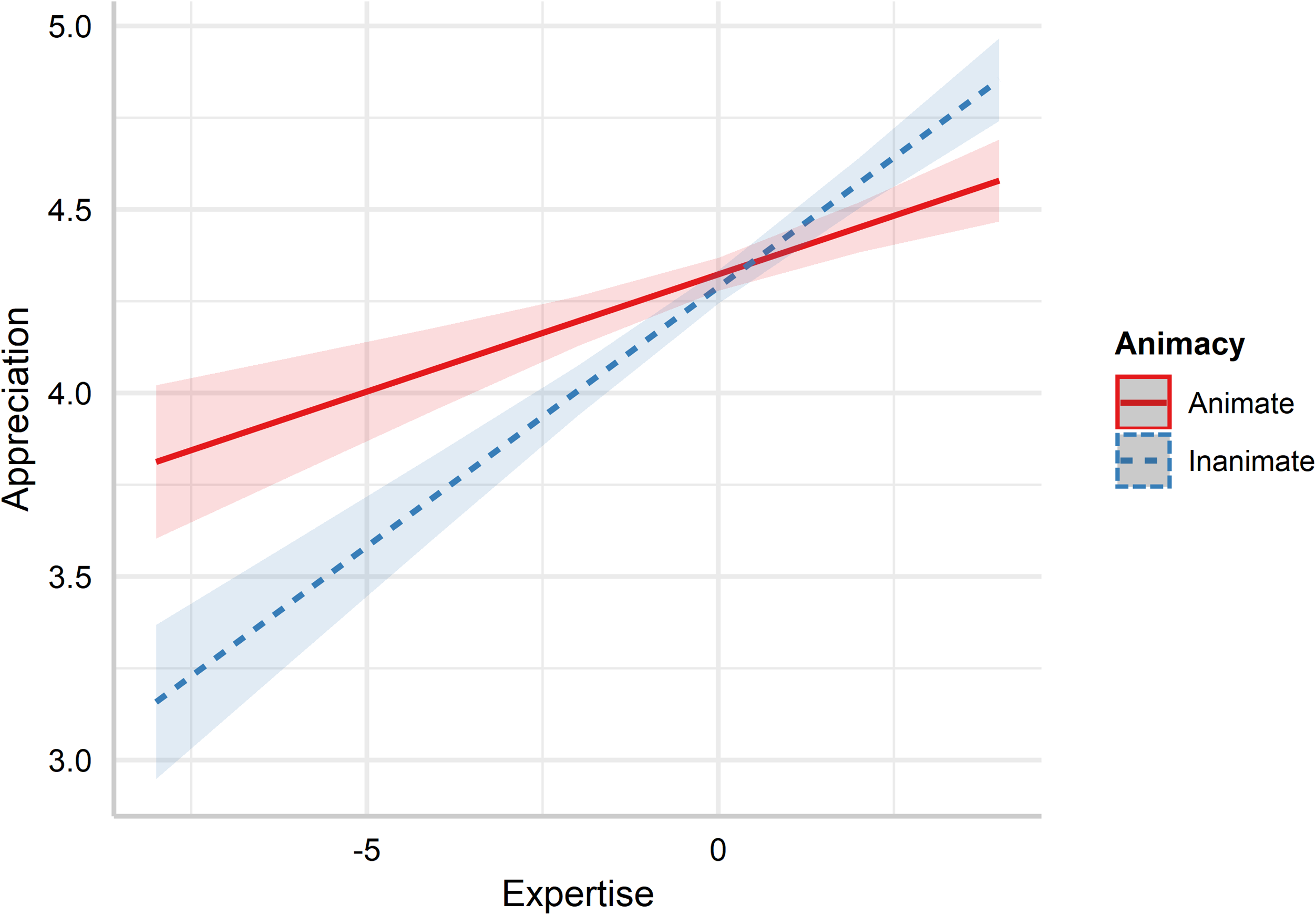
Appreciation of artworks as a function of expertise and animacy (generalized mixed model analysis). Shaded areas represent the 95% confidence interval.
Results of the Main Effect Analyses of Prestige and Animacy on Appreciation.
Control Variables
In order to verify whether the observed effects were not confounded by demographic variables (age, gender, education, job), correlation and covariance measures were computed. As can be seen in Appendix B (Table A2), none of these variables were strongly correlated to a relevant variable of the analyses.
Post-Test—Famousness
The goal of this post-test was to investigate whether the famousness of the artworks had a confounding influence on the results of the main study. As reported in Appendix C, results of the post-test analysis are similar to the results of the main analysis, except that a main effect of animacy appeared and that the main effect of prestige was no longer significant, but it remained very similar in size to the original analysis.
Discussion
Main Findings
In this investigation on a large sample of art experts, we first explored whether prestige associated with artworks matters and whether this might also depend on the level of their expertise. We indeed find that experts, when merely told that artworks belong to the prestigious MoMA in New York, increase their appreciation of these artworks in comparison to experts who are not given such information. More generally, this suggests that the mere presence of external factors, such as reputation of an institution, can affect their art appreciation. This is similar to previous findings on the influence of contextual factors (Kirk, Skov, Hulme, Christensen, & Zeki, 2009; Verpooten & Dewitte, 2017), and it is in line with the major role that prestige appears to play in the professional domain of art. Whenever quality is difficult to quantify objectively, people tend to rely comparatively more on reputation and recognition to make assessments (Fraiberger et al., 2018). Thus the experts might (intentionally or not) judge the artworks more favorably when they are associated with institutional prestige because they regard it as an indirect marker of hard-to-assess artistic quality.
However, we may also expect that more experienced experts may rely less on indirect markers of quality than less experienced experts, as they might be able to discern quality more directly thanks to their expertise. This would count especially for those at the highest echelons of expertise. Yet, this was not borne out by our data. Several explanations are possible. One possible explanation may be that prestige only becomes irrelevant to experts holding really high levels of expertise. This might be the case when a lot of uncertainty remains about quality even for more experienced individuals. And perhaps those that are beyond uncertainty were missing from our sample. As can be seen in Appendix D (Figure A3), the general expertise score (a Z-score with its mean around 0) might suggest a comparatively low frequency at the highest scores. Another possible interpretation is that, rather than missing from our sample, even the most experienced of experts continue to rely on prestige as indirect marker of quality. If art is highly subjective indeed and its quality elusive, reputation and recognition might continue to influence expert appreciation even at the highest echelons of expertise. This, at any rate, would be consistent with findings that previous prestige (or expert endorsement) is the main predictor of current prestige (Fraiberger et al., 2018; Ginsburgh & Van Ours, 2003). Put differently, prestige may become, quite circularly, a marker of itself (also see Turpin et al., 2019). We briefly come back to this possibility below.
We also explored whether animacy matters for experts. Here we find that the more expertise an expert has, the less their appreciation of art seems to be affected by depicted animacy. Additional analysis further revealed that experts with a comparatively low level of expertise prefer artworks depicting an animate (e.g., a pig) object over artworks depicting an inanimate object (e.g., a chair). However, among those with high levels of expertise, this animacy effect is not merely attenuated, but even reversed. They prefer artworks depicting inanimate objects over those depicting animate objects. This reversal among higher experts is reminiscent of previous findings. Leder et al. (2019) found that, whereas non-experts rate symmetrical visual stimuli as most beautiful, this is reversed among experts, who rate asymmetric visual stimuli as most beautiful. Moreover, Verpooten and Dewitte (2017) found that, while non-experts prefer artworks depicting beautiful faces over neutral faces, experts prefer portraits of neutral faces over those of beautiful faces. Are these apparent reversals indicative of a more general pattern, and, if so, what could it be?
Possible Explanations
Symmetry, facial beauty, and animacy all have been suggested to be fitness-relevant visual characteristics (Gonçalves & Biro, 2018; New et al., 2007; Scheib, Gangestad, & Thornhill, 1999; Thornhill & Møller, 1997), and they may also be more fluently processed, at least in the case of symmetry and facial beauty (Reber, Schwarz, & Winkielman, 2004; Renoult, Bovet, & Raymond, 2016). Thus, the question may be how and why experts diverge from nonexpert preference for these potentially more easily processed and/or fitness-relevant visual features. We will consider a few possibilities, at distinct but complementary levels of explanation (Bergman & Beehner, 2022; Tinbergen, 1963).
First, on the processing level, potential perceptual advantages of (visual) experts might give rise to more fluent processing of asymmetric patterns, neutral faces, and/or inanimate objects which therefore could be experienced as more positive. It might also be possible that experts have acquired a level of cognitive mastering that allows them to tap into a fluency counteracting esthetic pleasure mechanism (Belke, Leder, & Carbon, 2015).
Second, and here we seek to revisit our findings regarding prestige as well, experts might learn to diverge from general preferences for symmetry, facial beauty, and animacy through attending to relevant prestige cues. In cultural evolution research it is commonly assumed that individuals use prestige as an indirect marker of difficult to assess but learnable, better-than-average “information” (e.g., preferences, beliefs, and skills) (Henrich & Gil-White, 2001; Jiménez & Mesoudi, 2019). For instance, by copying the cultural repertoire of the locally most admired hunter, learners may acquire the hunting skills, preferences, and beliefs that have led to this hunter's success in the local environment. But in the original mathematical treatment of “prestige bias social learning” Boyd and Richerson (1985) envision that, through what they call a cultural runaway process, initially adaptive preferences can drift away in tandem with the traits to which they correspond. In that process, prestige, rather than reliably indicating the presence of an extrinsic “true” quality, becomes an arbitrary self-referential marker. And the initially adaptive preference may culturally evolve into a neutral or even maladaptive one. Boyd and Richerson (1985) do call upon this process to elucidate the cultural evolution of art, esthetics, and arbitrary symbols. The finding by Fraiberger et al. (2018) that prestige later in an artist's career is primarily predicted by access to prestigious institutions at the start of their career seems remarkably consistent with the cultural runaway model of prestige. And also our findings that experts, even at the highest echelons of expertise are swayed by prestige, coupled with their reduced preference for animacy seems in line with the runaway process (see Verpooten & Dewitte, 2017, for a similar conclusion regarding prestige and facial beauty). However, due to the focus on self-reported art appreciation rather than the underlying prestige bias social learning dynamics, our results only indirectly support the assumption of an ongoing prestige bias runaway process in the domain of art. Future research could test this more directly by capturing the relevant social learning dynamics in action. Experimental paradigms such as transmission chains, choose-to-transmit or choose-to-receive might serve this purpose (Jiménez & Mesoudi, 2019). Prestige bias implies coevolution between art preferences and artworks, presumably fairly unconstrained by pre-existing adaptive preferences. Therefore, an additional benefit of a social learning experiment would be that it could also capture how art itself may change in response to changes in art preferences (cf. Granito, Tehrani, Kendal, & Scott-Phillips, 2019). Such a dynamic might elucidate why a significant amount of the modern and contemporary art displayed by the most prestigious institutions in the world such as the MoMA, might not appeal to the general audience, as is sometimes lamented. Insights in this matter is expected to be relevant to both communication, marketing and public mediation of art institutions as well as society at large.
Third, according to signaling theory, a signal evolves if it benefits the sender by manipulating the behavior of an observer, irrespective of whether this manipulation is beneficial for the observer as well (Dawkins & Krebs, 1978). Since art can be seen as a signal sent by an artist to an audience, it has been argued that this logic applies to art in the broad sense as well (De Tiège, Verpooten, & Braeckman, 2021). Given its manipulative potential (perhaps most prominently observable in propaganda, advertisement, addictive videogames, and fiction series), it may make sense that expert observers learn to resist manipulation when this is perceived as costly (we see this in nonhuman animals as well: de Jager & Ellis, 2014). Prioritizing “easy beauty” (e.g., symmetry, facial beauty, and animacy) may be adaptive in (ancestral) real life, but the benefits do not necessarily extend to the domain of art. The classic story (told by the Roman poet Ovid, in his Metamorphoses) of Pygmalion, a sculptor who makes an ivory statue representing his ideal of womanhood and then falls in love with his own creation, may serve as an extreme example to illustrate this point (yet being attracted to one's own extra-corporal signals is apparently not so extraordinary that it wouldn’t occur in nonhuman animals as well: Ribeiro, Christy, Rissanen, & Kim, 2006). Thus, perhaps to avoid manipulation, experts may learn to cognitively resist easy beauty in the form of symmetrical patterns, facial beauty, and animacy. A requirement of cognitive effort seems consistent with the general finding of empirical esthetics that people with higher expertise recruit more top-down and higher-order cognitive processes when perceiving art (Gartus et al., 2020; Leder et al., 2012, 2014). It could indicate that they resist the manipulation through the exertion of cognitive control. Whether this is the case could be verified by interfering with cognitive inhibitory control, for example by speeding the rating task. If cognitive resistance plays a role, this might undo the reversed impact of animacy on their appreciation. Kelemen and Rosset (2009) demonstrated a similar idea in the field of lay physics. They showed that by interfering with cognitive control in such a way, people relapsed into the default (innate) tendency to regard nonteleological natural phenomena as teleological (e.g., “the sun radiates heat because warmth nurtures life”).
A final complementary explanation might be that people high in expertise may be signaling their identity through their appreciation of art. This would be related to the famous idea that elite esthetic preferences function as distinct signals to indicate where signalers fall in the social hierarchy and a way to differentiate themselves from the mainstream (Bourdieu, 1979; Veblen, 1899). This may cause exaggeration to accentuate distinctiveness and might help to explain as well the observed divergences from non-expert easy beauty preferences. This possibility could be further investigated, for instance, by manipulating public versus private context and by manipulating (e.g., merely emphasizing) perception of mainstream ratings of artworks.
Limitations
We used existing artworks as visual stimuli. While this made the experiment more realistic, it also has some significant downsides. The animate versus inanimate stimuli may allow covarying factors to explain the results. Our post-test controlled for potential effects of famousness, but, beyond this, there could be other factors as well. For example, inanimate art tends to express very different things from animate art. Future research could address this limitation by replicating the study with visual stimuli specifically created to covary exclusively in the animacy dimension.
Another limitation is that we only investigated visual art stimuli. Further research could also investigate the expertise-dependent effects on appreciation of relevant features of, for instance, music, literature, perfume, theater, or motion pictures. In fact, there are some findings in other “esthetic” domains that appear in line with our results, suggesting indeed a more general pattern. For instance, in a large survey with blind wine tastings, a negative correlation between price, and enjoyment was found for amateurs, while a non-negative relation (with positive trend) between price and enjoyment was found among experts (Goldstein et al., 2008). Assumed that price tag correlates with prestige in the wine domain, and that amateurs prefer more expensive wines less because they appeal less to ancestrally adaptive psychology (they may have less “easy tastes” as they may, e.g., generally be less sweet and more bitter), these findings are consistent with ours. Another similar finding is on brand logos. It was shown that fashion experts prefer subtle brand logos, while non-expert prefer conspicuous ones (Berger & Ward, 2010). Visual conspicuousness is quite literally more attractive (i.e., attention grabbing) to neuropsychology. Additionally, it could be investigated if this expertise-dependent difference in preferences also applies to non-esthetic domains, such as science. Results of such studies could be relevant for the ongoing debate on the role of content (i.e., mostly appeal to innate psychology) and context biases (such as prestige) in cultural evolution (Acerbi & Tehrani, 2018; Berl, Samarasinghe, Roberts, Jordan, & Gavin, 2021; Claidière & Sperber, 2007; Henrich & Boyd, 2002; Henrich & McElreath, 2003).
Finally, our study was presented online and it might be that a real-life setting such as an exposition in a museum could affect participants’ appreciation differently. Therefore, it could be interesting to reproduce the current study in a real-life setting and investigate the possible influence of such a context on the findings. An additional advantage of such a setting could be exposure to the original artworks rather than pictures of the artworks. Using a picture may have reduced the available information, which may have made it more difficult for people to judge the intrinsic (artistic) quality of the works. This feature may have boosted the reliance on prestige cues and animacy cues. Although research in art museums themselves may be hard when it comes to keeping the internal validity of the study high enough, such a study may be a good complement to further put the expectations to the test.
Conclusion
Empirical esthetics and psychology of art have made substantial progress toward unraveling the influence of expertise on perceptual, affective, cognitive, and physiological processes involved in the appreciation of art. Here we aimed to contribute to this strand of research by exploring whether prestige and animacy matter for experts. Our results suggested that they do: experts appear swayed by prestige associated with artworks, and the higher their expertise, the less animacy seems to matter, to the point even of a reversal among the highest echelons (i.e., a higher preference for inanimate stimuli). However, it should be noted that covarying factors explaining the results cannot be excluded at this point.
One interpretation of the findings is that experts have learned through prestige bias to reduce their preference for animacy. This would be consistent with Boyd and Richerson's (1985) prestige bias runaway process, which has been argued to drive preferences away from their adaptive origins. Moreover, processing perceptual (dis)fluency, cognitive mastering, and identity signaling are compatible with these findings as well. Further research could elucidate the respective roles of these largely complementary processes of expert art appreciation.
Footnotes
Appendix A
Items Used to Measure Art Interest and Knowledge (Translated From Dutch to English).
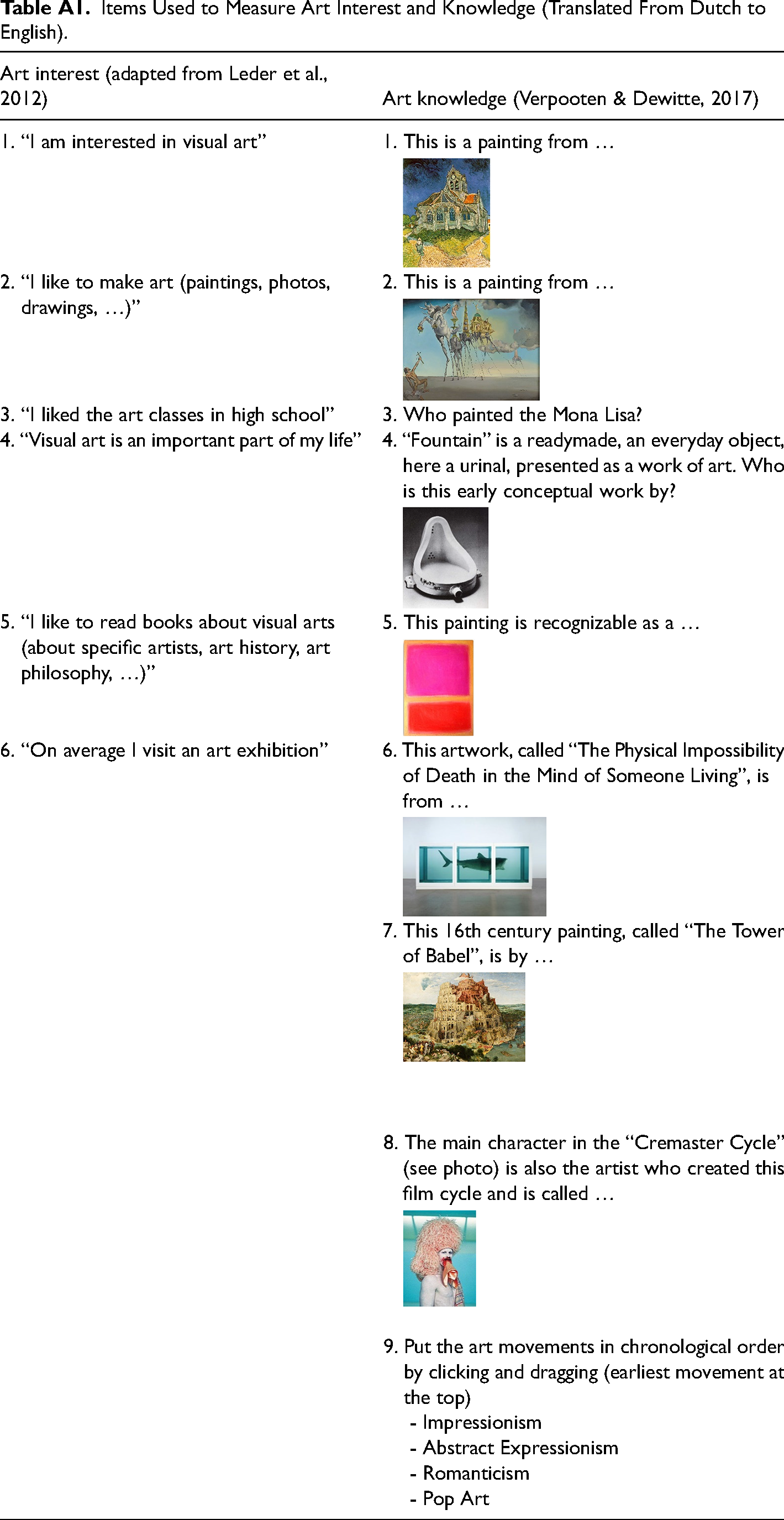
| Art interest (adapted from Leder et al., 2012) | Art knowledge (Verpooten & Dewitte, 2017) |
|---|---|
| 1. “I am interested in visual art” | 1. This is a painting from … |
| 2. “I like to make art (paintings, photos, drawings, …)” | 2. This is a painting from … |
| 3. “I liked the art classes in high school” | 3. Who painted the Mona Lisa? |
| 4. “Visual art is an important part of my life” | 4. “Fountain” is a readymade, an everyday object, here a urinal, presented as a work of art. Who is this early conceptual work by? |
| 5. “I like to read books about visual arts (about specific artists, art history, art philosophy, …)” | 5. This painting is recognizable as a … |
| 6. “On average I visit an art exhibition” | 6. This artwork, called “The Physical Impossibility of Death in the Mind of Someone Living”, is from … |
| 7. This 16th century painting, called “The Tower of Babel”, is by … |
|
|
8. The main character in the “Cremaster Cycle” (see photo) is also the artist who created this film cycle and is called … |
|
|
9. Put the art movements in chronological order by clicking and dragging (earliest movement at the top)
- Impressionism - Abstract Expressionism - Romanticism - Pop Art |
Appendix B
Covariance between expertise and the different control variables was computed by adding the control variables to the generalized linear mixed model. The results indicated that there was no interaction between expertise and age (F1,1079 = .09, p = .77), expertise and gender (F1,1079 = .02, p = .89), and expertise and job (F1,1079 = .65, p = .42), and only marginally significant interaction between expertise and education (F1,1079 = 3.05, p = .08). Altogether, those results indicate that the expertise effect found above are due to expertise itself and not to an indirect effect of control variables (see Table A2).
Appendix C
The goal of this post-test was to investigate whether the famousness of the artworks had an influence on the results of the main study. We collected new data to assess the famousness of the used work in our main study, and then used those data to explore the possibilities that some of the reported findings were due to differences in famousness.
Appendix D
Data Accessibility
The datasets are shared on the Figshare repository platform with a CC BY license. A link to this data on the Figshare repository is placed alongside this article.
Acknowledgments
We thank two reviewers for their valuable feedback and suggestions which helped to make the paper more succinct and balanced. In addition, we thank Anastasia Aerts, Lotte Feremans, and Andreas Pauls for the data they collected as part of their master's thesis studies as well as Peter Aerts from SMAK for advertising the link to the survey.
Declaration of Conflicting Interests
The authors declared no potential conflicts of interest with respect to the research, authorship, and/or publication of this article.
Funding
The authors received no financial support for the research, authorship, and/or publication of this article.
