




Abstract
The emotions that can be considered members of the set of Aesthetic Emotions (AEs) is controversial. The present study investigated the terms used by researchers in peer reviewed studies to exemplify AEs. 100 publications from 2000–2019 exemplifying AE terms were located to produced 111 AEs which were proposed as the basis of an AE lexicon. Awe, (being) moved and wonder were reliable members and without contradiction. One fifth were negatively valenced (e.g., anger, disgust), suggesting that the presence of negative AEs is generally accepted but not reliably. One quarter of the entries were also non-AEs and an additional 20 were exclusively so, producing a total of 131 terms. The lexicon is a concrete, dynamic set of examples against which to investigate extant definitions of AEs and to further develop theory. The robust presence of three terms suggests that calls to abandon the concept of AE may be premature.
Introduction
Aesthetic emotions, the emotions one feels when positively contemplating or engaging with an object or event, are central to many highly enriching, life affirming experiences; A sunset, a rainbow, a symphony, a poem, a painting, and experience of many other phenomena can evoke special (e.g., rapturous) feelings and states of mind that are qualitatively different to everyday, mundane experiences (Gabrielsson, 2011; Marković, 2012). Yet understanding aesthetic emotion has proved illusory. Above all, the concept has lacked specificity. Some propose emotions that appear to be conflicting, such as including both negative and positive emotions, while others exclude negative emotions. Some argue that aesthetic emotions can include all emotions, others only a small subset of emotions. These problems with specificity and arbitrariness have led arguments against there being a meaningful concept of aesthetic emotions altogether. For example, Skov and Nadal (2020) have called for the concept to be abandoned because it is so laden with inconsistencies and disagreement (see also Juslin, 2013). Despite these challenges, interest continues as evidenced by the persisting rise of research outputs on the matter. Figure 1 shows that compared to other search terms, in particular ‘emotion’ and ‘aesthetic’ separately, the proportional rise of interest in ‘aesthetic emotions’ particularly since 2014, is disarming. The rise is also visible in more recent years when compared to the related term ‘aesthetic experience’ (blue, solid line in Figure 1). The aim of the present study was to investigate a basic question – ‘What are the aesthetic emotions?’ – with a view to building a lexicon of aesthetic emotion terms. If no terms could be identified as consistently useful in exemplifying aesthetic emotions, it would further fuel calls to abandon the concept.
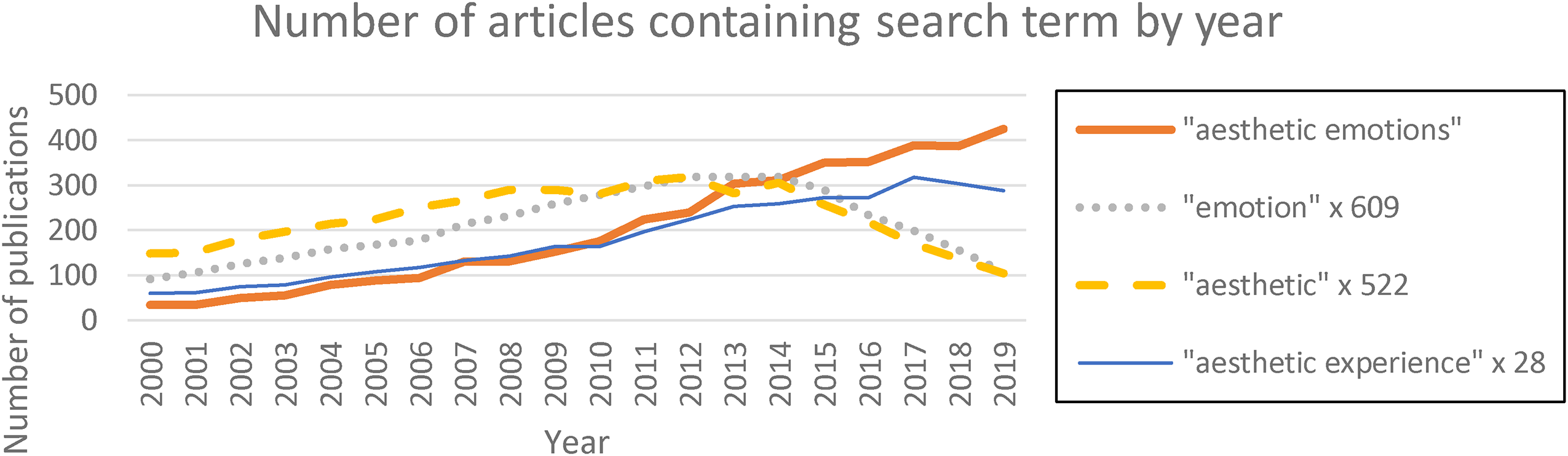
Number of articles by year from 2000–2019 containing search term ‘aesthetic emotions’, ‘emotion’, ‘aesthetic’, and ‘aesthetic experience'. Plots are shown to allow convenient visual comparison across the terms. This was achieved by dividing the count for a particular term by the total count for that term collapsed across years and multiplying by the total count for ‘aesthetic emotions’. Multiplication factor to recover the actual number of publications is given in the legend. For example, to obtain the actual number of articles in any year containing ‘emotion’, the y value in the graph is multiplied by 609. Searches were conducted using the online database http://scholar.google.com.
Empirical researchers have a rich though fairly recent history of mustering collections of emotion terms for the purposes of assessing responses to (usually) works of art. Silvia and Nusbaum (2011) developed a 10 item Aesthetic Experience Scale, which contained emotion based items: ‘feel like crying’, ‘feel touched’, and ‘feel a sense of awe and wonder’. Some scales are explicitly geared toward the more specifically emotional aspects of aesthetic experience, rather than aesthetic experience in general. The Geneva Emotion Scale (‘GEMS’, Zentner, Grandjean, & Scherer, 2008) consists of 45 emotion terms which are divided into nine subscales (labeled Wonder, Transcendence, Tenderness, Nostalgia, Peacefulness, Power, Joyful activation, Tension, and Sadness) and was designed to capture the emotional experiences as a result of listening to music. A brief version of the scale, the Geneva Music-Induced Affect Checklist (GeMIAC) consisting of 14 items, was later developed by Coutinho and Scherer (2017), with the items incorporated into a comprehensive aesthetic emotions scale, by Schindler et al. (2017), the 75 item Aesthetic Emotions Scale (called AESTHEMOS).
AESTHEMOS brings together a range of previously used scales and conceptual frameworks for assessing aesthetic emotions (discussed in further detail in the Method). The approach to developing these scales is to form lists of emotion words, and then determine which are reasonable aesthetic emotion candidates. Terms are then presented to participants for the purpose of rating some kind of aesthetic event or experience, the results of which are processed using statistical techniques to ascertain which terms are reliably selected, and which group of words are systematically related to each other, but distinct from other groups of words (such as the nine dimensions of GEMS).
These methods have facilitated notable progress in understanding and measuring aesthetic emotions. But psychometric scales for measuring aesthetic emotions have limitations. Researchers rarely ask participants to record an aesthetic emotion explicitly in terms of ‘aesthetic emotion’. Instead, an assumption is made that pre-selected emotion terms are indicative of aesthetic emotion at the construction stage of a measurement scale. This can pose a problem for scale validity, particularly if an emotion label can be interpreted as something other than aesthetic, such as a real life, ‘utilitarian’ emotion (Scherer, 2004). For example, if an individual is asked to rate how sad an artwork makes them feel, and they provide a high rating, the experience may be aesthetic in the conventional sense, but the art work may also have triggered some tragic, real life event that the individual would not experience as aesthetic in the sense that the researcher intended.
Since aesthetic emotion is fiendishly difficult to define even for the seasoned researcher, it would be risky to assume that a lay person could be asked to report an ‘aesthetic emotion’ unequivocally and with the intended concept. Consequently, researchers have applied techniques to ascertain if the lay person reports aspects of the emotional experience that are likely to be aesthetic emotions, without explicit reference to the ambiguous label (‘aesthetic emotion’). This is not to say that direct interrogation of aesthetic emotion is impossible (see for example Jacobsen, Buchta, Köhler, & Schröger, 2004), but that the research community has generally steered clear of such an approach.
Theoretical Underpinning for a Novel Approach Based on Concept Formation Theory and Usage of Words Purported to be Aesthetic Emotions
There is room, if not need, for alternative approaches to understand what the set of aesthetic emotions are, should such a set exist. The alternative approach taken here is to investigate the terms used by experts in aesthetic emotions, namely the terms used by researchers themselves. The approach builds on theories of concept formation which involve the systematic organization of feature similarities and temporal contiguities of exemplars (Gilead, Trope, & Liberman, 2020; Morton & Preston, 2021; Zeithamova et al., 2019), the latter being particularly relevant here. The development and modification of concepts is important to cognitive processing because they allow inferences to be made about novel and ambiguous stimuli in an efficient manner (Zeithamova et al., 2019). Concept formation is a balance of bottom up processing through multiple experiences, while functioning strategically, dynamically and adaptively in a top-down manner when an individual needs to make inferences about the environment.
The role of examplars in concept formation has been demonstrated by several researchers. Mack, Love, and Preston (2018) observed that multiple episodes must be experienced in the process of concept formation. Westera, Gupta, Boleda, and Padó (2021) demonstrated that concept categories can be formed through exposure to vocabulary in a bottom-up manner, with high frequency of temporally and conceptually co-occuring words forming a stronger part of the mental network of the concept than terms less frequently associated (for further evidence, see Banks, Wingfield, & Connell, 2021; Mack et al., 2018).
In some literature, the impact of statistical pairing of exemplars of a concept and the concept itself is viewed as a bias because individuals have been shown to make generalizing assumptions that are grounded on availability of exemplars, even if contradicting evidence-based aspects of the concept. The bias is referred to as the availability heuristic (Tversky & Kahneman, 1973) and reflects people's reliance on the most easily accessible memories to form an estimate of significance or frequency of occurrence. Even with well formed concepts, the frequency and recency with which one comes across exemplars of a concept influences beliefs about the concept, more so than does evidence. For example, if one is shown a series of English words which are subliminally interspersed with the letter ‘k’, people are convinced that the English language is over-represented with words containing the letter k, in comparison to people who perceived the same word list without the interjection of the letter (Gabrielcik & Fazio, 1984).
The influence of exposure to emotion words have already been studied in this manner with Li, Masitah, and Hills (2020) proposing that “emotions that come to mind easily are likely to be those most frequently experienced” (p. 1783). Words used to exemplify aesthetic emotions in printed sources reinforce themselves because the reader will be exposed to those examples, making them highly accessible in memory, and so those terms are more likely to be considered members of an aesthetic emotion lexicon. This empirically driven approach to identifying membership of aesthetic emotions is not tied to the moot theoretical constraints often imposed on them, discussed above. Availability of explicitly presented aesthetic emotions in printed sources could provide a foundation for the commencement of an aesthetic emotion lexicon. If someone is frequently told that ‘awe’ is an aesthetic emotion, more frequently than other words, then the individual is more likely to include that word in a list of aesthetic emotion words (Schwarz et al., 1991). The availability of examples, in the present case emotion words cast as aesthetic emotions, would therefore be a key factor in the development of knowledge about the concept of aesthetic emotions. This position provides the alternative theoretical rationale adopted for the present study.
The specific aim of the current study is to create an aesthetic emotion lexicon using examples given in the contemporary, extant literature.
Method
Instances of aesthetic emotions were located in the scholarly literature. No discipline of study or approach was excluded from the search to reduce the chance of systematic biases in terminology. Agreement as to what is an emotion is not universal, making it difficult to determine with reasonable certainty if an emotion reported as aesthetic is likely to be generally accepted. To manage this problem, counterexamples of aesthetic emotions were also collated. These counterexamples were emotions reported either (1) as aesthetic, but nevertheless explicitly referred to as not being aesthetic emotions (the lower, left sector in Figure 2), or (2) emotions that are not related to the aesthetic experience (the lower, right sector in Figure 2).
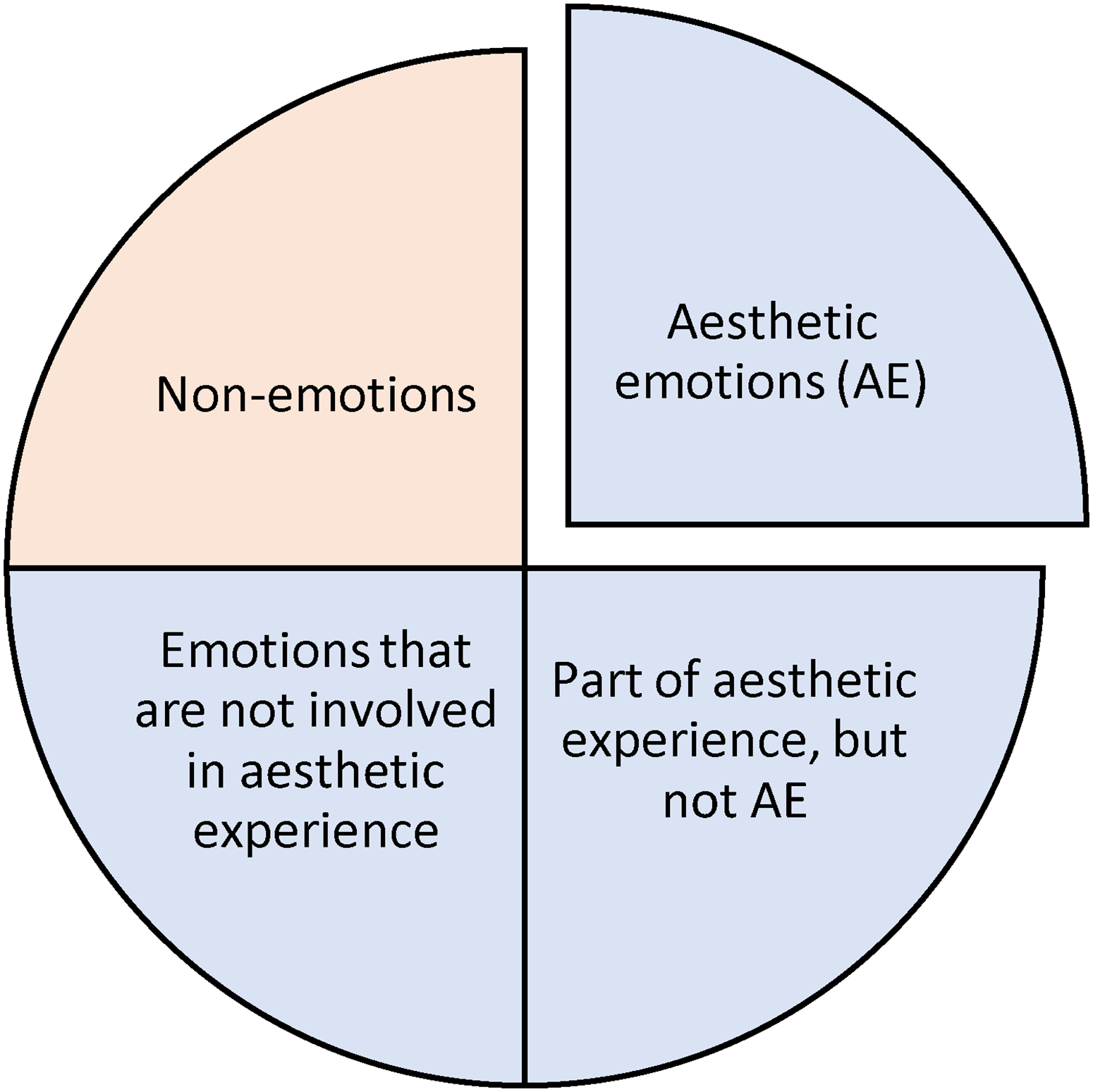
Schematic representation showing conceptual distinction between aesthetic emotions (top-right, displaced, blue sector), emotions that are not aesthetic (bottom two sectors) and everything else (top-left, red, non-emotions sector).
In addition, the terms were compared with a comprehensive list of explicitly stated aesthetic emotion concepts, which appear in Schindler et al. (2017). They developed a questionnaire called AESTHEMOS which consists of 75 items. The items are organized into 24 dimensions, each dimension having its own characterizing label. Schindler and colleagues conveniently arranged twenty-one representative terms of AESTHEMOS into four subscales. The four subscales and the sample representative terms were:
Prototypical aesthetic emotions—(1) feeling of beauty/liking, (2) fascination, (3) being moved, (4) awe, (5) enchantment/wonder (6) nostalgia/longing; Pleasing emotions—(7) joy, (8) humor, (9) vitality, (10) energy, and (11) relaxation; Epistemic emotions—(12) surprise, (13) interest, (14) intellectual challenge, and (15) insight; Negative emotions—(16) feeling of ugliness, (17) boredom, (18) confusion, (19) anger, (20) uneasiness, and (21) sadness.
The labels could themselves be treated as separate, unique aesthetic emotion terms when not duplicating the terms used in the listed items. Some of the 75 items were quite similar (for example, one item referring to “a feeling of beauty” and another “I found it beautiful”). Gathering of all possible emotion terms, followed by removal of duplicates, produced a list of 42 unique emotion terms, hence referred to as the AESTHEMOS terms. The appearance of these words in the lexicon are indicated in a separate, AESTHEMOS, column in Table 2.
The initial stage of the literature search identified research outputs that refered explicitly to “aesthetic emotions”. The following journal databases were searched—GoogleScholar, RILM, ProQuest databases, Psychology Databases and Web of Science —as well as citation and reference lists. Because of the accelerating interest in the topic (Figure 1), the search was limited to those published between 2000 and 2019. Only articles making explicit reference to ‘aesthetic emotion’ (including spelling variants ‘esthetic emotion’ and plural form) were retained. This left 4,004 outputs to be considered.
The next stage involved scanning outputs for mention of specific aesthetic emotions or mention of counterexamples (e.g., “emotion X is not an aesthetic emotion”). This reduced the list to 600 outputs. These remaining articles were examined for (1) specific mention of one or more aesthetic emotions, (2) uniqueness (duplicates articles were removed) and (3) accessibility (outputs were restricted to English language—note that language restrictions were not imposed on the first stage of the literature search to allow the possibility of in-text translations of terms into English). Finally the sources to were restricted to journal articles only, and the final list of sources were collated for the analysis. This left a total of 100 articles (Table 1) consisting of those that gave only examples of aesthetic emotions (97), only counterexamples of aesthetic emotions (3) (Ceia, 2011; Hanich, 2009; Plantinga, 2006) or both (31 of the 97). When results of the example aesthetic emotion terms are reported in the following sections, they will be referred to as ‘empirically determined aesthetic emotions’ or ‘examples or aesthetic emotions in the literature’ to indicate that they are based on the sampled literature meeting the inclusion criteria, rather than other possible categories, such as the AESTHEMOS terms. The domains covered by this empirical literature included Animal cognition, Architecture, Artificial Intelligence, Design-consumer behaviour-marketing, Film, Food, Literature, Music, Nature, Painting, Philosophy, Smell/Taste, Spirituality/Religion, Television, Tourism and Visual art. These domains emerged as a result of general, non-domain specific searches.
Literature Meeting Inclusion Criteria, Showing Sample Emotion Words and Counterexamples.

Results
Sample Data
As a precis of how the literature was analysed, a set of sample data are presented here showing how words/expressions (hence ‘terms’) were selected as aesthetic emotion examples, and as counterexamples.
Consider the following datum taken from Scherer (2004, p. 241) as a sample of text that contained counterexamples, those emotions not considered as involved with aesthetic experience (bottom left segment of in Figure 2): I present a first effort to … specifically distinguish… aesthetic emotions from what I suggest to call utilitarian emotions. The latter correspond to the types of emotions that are usually studied in emotion research – for example, anger, fear, joy, disgust, sadness, shame, guilt. (p. 241)
As a second worked example consider the datum taken from Brattico, Bogert, and Jacobsen (2013): … a full musical experience includes final outcomes such as aesthetic emotions (e.g., enjoyment or pleasure, often accompanied by bodily changes such as goose bumps on the skin, accelerated heartbeat, or tears in the eyes), aesthetic judgments (“this music is so beautiful”), and the formation of specific preferences and musical taste (“I love chamber music”). (Liu et al., 2017, p. 2)
First of all, explicit reference is made to aesthetic emotions, with five examples reported: enjoyment, pleasure, goose bumps, accelerated heartbeat, tears in the eyes. Second, instances of counterexamples are also explicitly stated, namely love and beauty. Some researchers, as we shall see, categorize ‘beauty’ related terms as aesthetic emotions. In the quote, however, beauty (beautiful) is presented as a category of aesthetic experience outcomes which is not explicitly presented as an aesthetic emotion—it is an aesthetic judgment presented as a category different to aesthetic emotion. Hence this instance of the term is coded as a counterexample. It is possible, therefore, that the same emotion word will be referred to as an aesthetic emotion in one journal article, and as a counterexample in another.
Aesthetic Emotion Words and Counterexamples
The aesthetic emotions reported at least once are shown in the Aesthetic Emotion lexicon table (Table 2), and frequency of those occurring more than once are displayed in Figure 3. Multiple, related terms were collapsed by word root to produce a simple linguistic lemma (e.g., ‘beautiful’ to indicate beauty, beautiful, feeling of beauty, etc.)
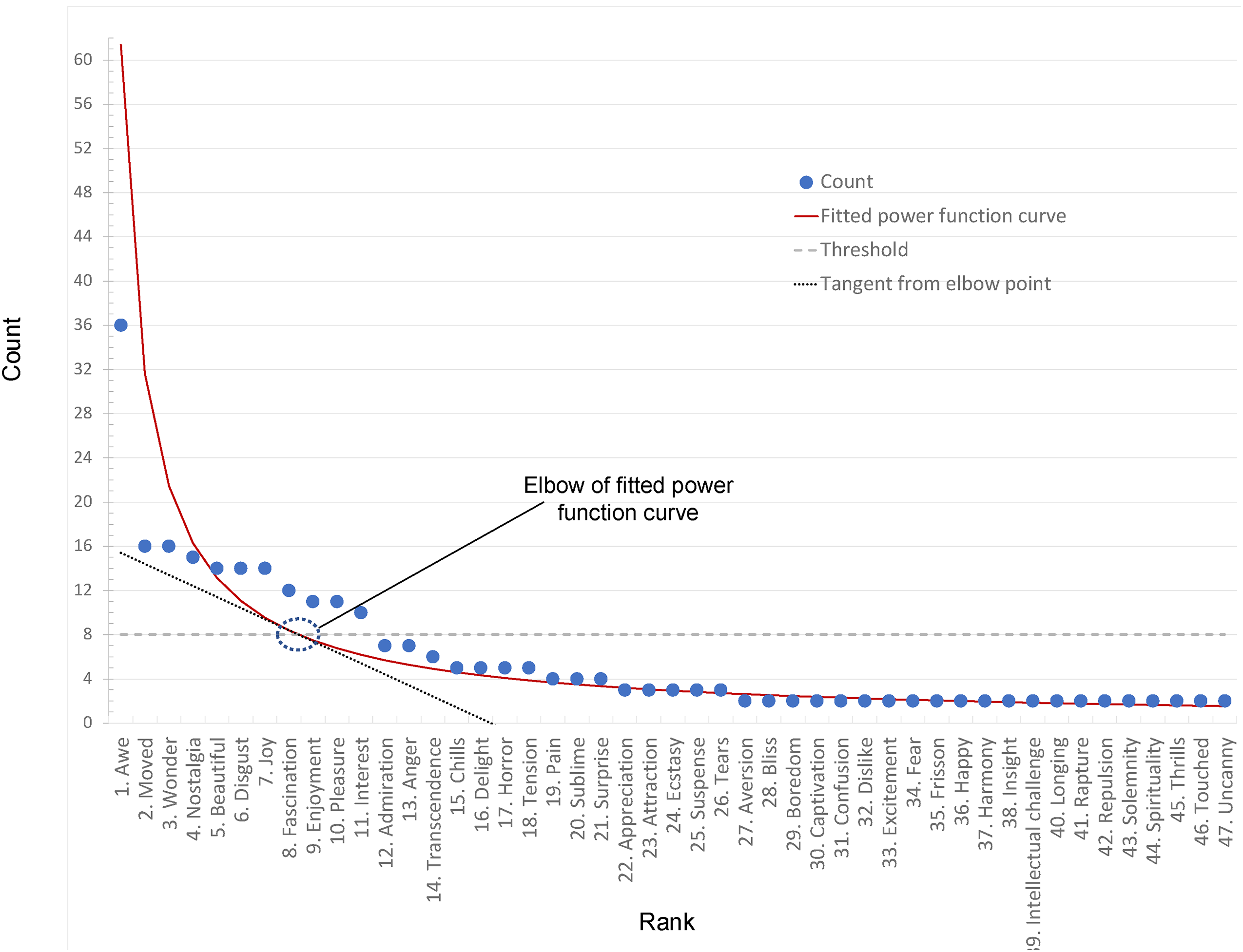
Ranked count of occurrence of aesthetic emotion term examples in the literature, with power curve fit and threshold. Power curve (red) was fitted to empirically identified aesthetic emotion word counts (blue dots) sorted from most frequent (rank = 1) to least frequent (first 47 ranks shown out of a total of 92), Only counts of greater than one are shown. Tied counts are arbitrarily ranked in alphabetical order. The plot also illustrates the elbow of the fitted curve from which threshold of reliable aesthetic emotion word count is determined. The dotted, angled line is the tangent which extends from the point on the power function that produces a gradient of −1 to identify the elbow of the fitted power function. Dashed vertical line at x ∼ 8 intersects with the point that produces a gradient of −1 on the power curve, indicating the count threshold above which to include words because they have a sufficiently high frequency (See text for details. See Table 2 for the detailed list of words and counts.).
Aesthetic Emotion Lexicon.
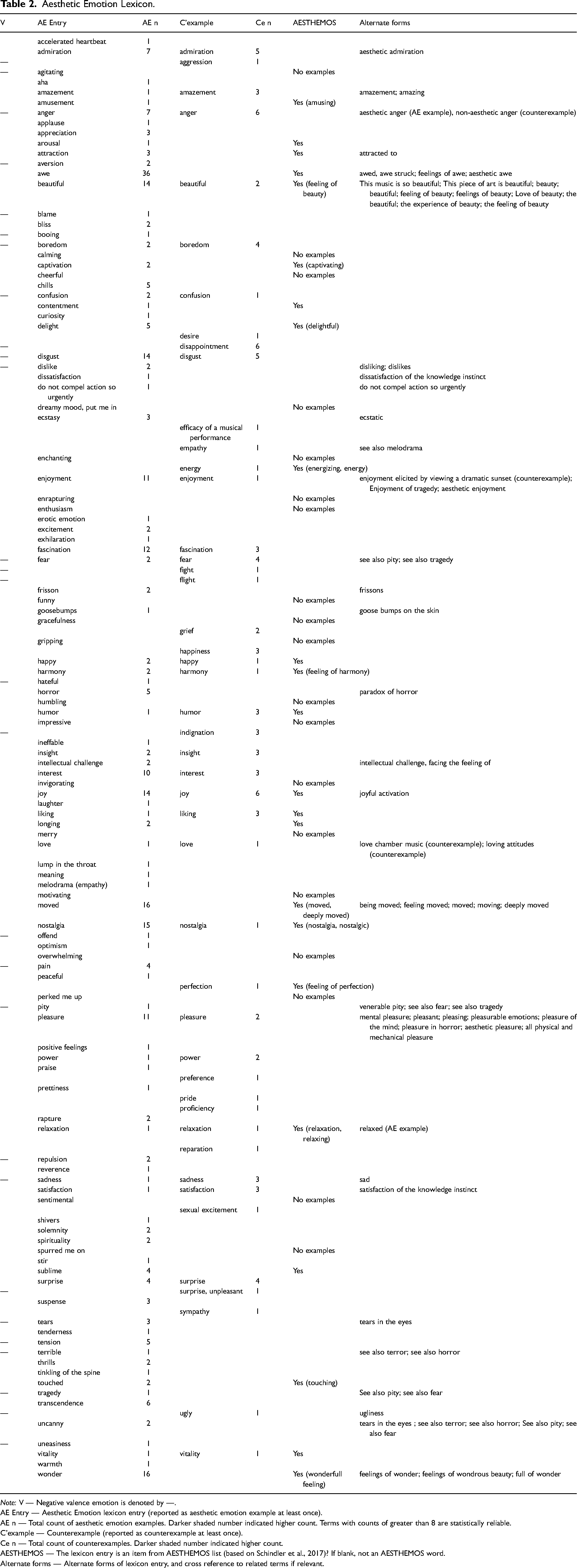
Note: V — Negative valence emotion is denoted by —.
AE Entry — Aesthetic Emotion lexicon entry (reported as aesthetic emotion example at least once).
AE n — Total count of aesthetic emotion examples. Darker shaded number indicated higher count. Terms with counts of greater than 8 are statistically reliable.
C’example — Counterexample (reported as counterexample at least once).
Ce n — Total count of counterexamples. Darker shaded number indicated higher count.
AESTHEMOS — The lexicon entry is an item from AESTHEMOS list (based on Schindler et al., 2017)? If blank, not an AESTHEMOS word.
Alternate forms — Alternate forms of lexicon entry, and cross reference to related terms if relevant.
The distribution of terms nested within the categories of Aesthetic Emotion examples, valence, counterexamples and AESTHEMOS membership is shown in Figure 4. Ninety-two emotion terms were identified as aesthetic emotion examples, with variant terms collapsed where appropriate (variants shown in rightmost column of Table 2). A further 39 words were added to the lexicon that were not found as examples given in the literature (a nested breakdown of the lexicon category counts is shown in Figure 4). These consisted of 21 terms from AESTHEMOS that were unique to AESTHEMOS, that is, not mentioned in any of the included literature: In Figure 4, this value can be arrived at by taking the tally of the four AEST summary counts from the bottom left row which has branches stemming from the ‘NOT examples of Aesthetic Emotion’ block of the second row (1 + 0 + 18 + 2). A further 18 terms were identified that were neither located in the literature as examples of aesthetic emotions, nor were they AESTHEMOS terms (same, left side, fourth row in the nested summary counts, but now tallying the ‘Not’ (AEST) block counts: 0 + 7 + 0 + 11). This produced an entire proposed lexicon consisting of 131 terms.
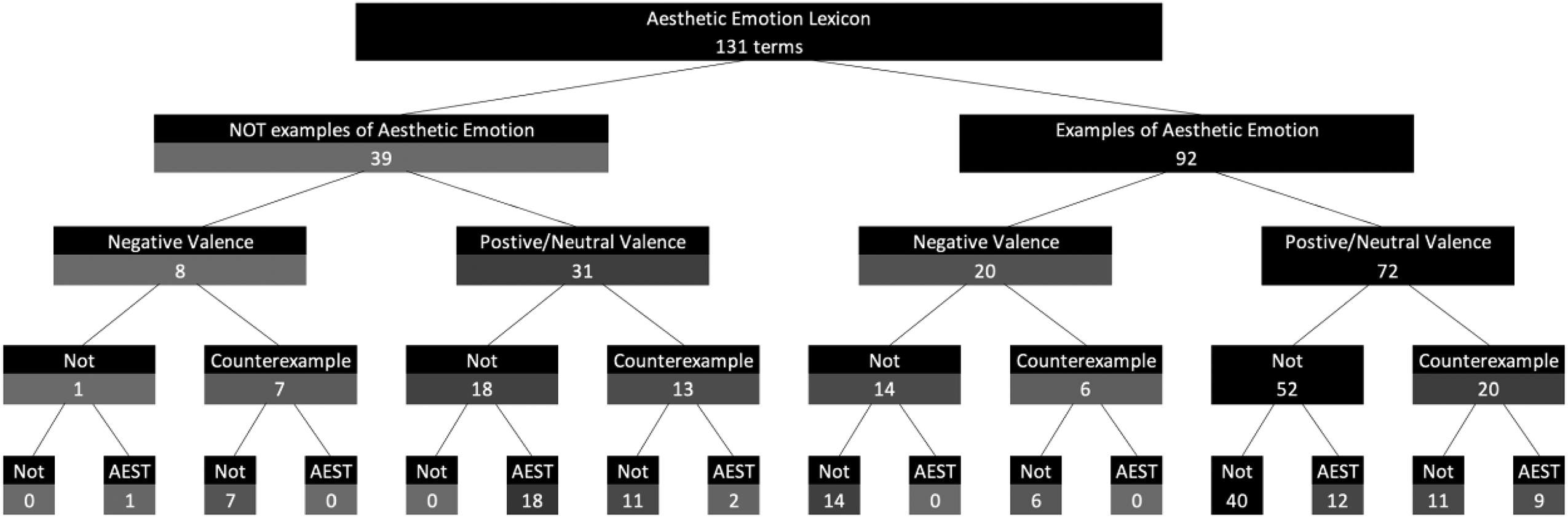
Summary word counts of aesthetic emotion lexicon by aesthetic emotion term example counts located in the literature (versus not), by valence (positive/neutral versus negative) counts, by counterexample (versus not) counts and by AESTHEMOS term (versus not) counts. Blocks labeled ‘Not’ indicate absence of the category in the adjacent block of that row. For example, in the fourth row of the flow chart, ‘Not’ refers to count of words that are not counterexamples. Darker shading of counts in each row of the flow chart indicates proportionally higher count for that row. AEST = AESTHEMOS terms. See body text for more information. See Table 2 for full list of terms.
Identifying the Most Reliable Member Terms of the Lexicon
Analysis was performed to see if any of the aesthetic emotion (AE) examples were represented reliably. The power function elbow threshold was calculated, based on the assumption that word frequencies are distributed according to Zipf's law (Moreno-Sánchez, Font-Clos, & Corral, 2016). The law exploits the observation in several forms of corpus (e.g., word frequency) analyses of the underlying statistical regularity of the frequency with which a list of words occur in a particular genre (be it a style of discourse, an entire language of a given historical time period or, here, in reporting of emotion words). Specifically, word frequency is inversely proportional to its rank (e.g., Corral, Boleda, & Ferrer-i-Cancho, 2015; Kanwal, Smith, Culbertson, & Kirby, 2017; Manaris et al., 2005; Piantadosi, 2014). That is, the second most frequently used word in a given script or corpus (i.e., ranked 2) will be systematically lower in frequency than the highest ranked word, and the third most frequent word will be systematically less frequent than the second highest ranked, and so on, such that the frequencies and ranks are related according to the product of rank and frequency, producing a relationship that is constant (Zipf, 1949). In other words, it is a power function relationship, where plotting the data with increasing rank number along the x-axis and increasing frequency along the y-axis, will produce a plot that for illustrative purposes may be thought of as resembling the shape of a curved letter ‘L’, with the vertical portion of the L tilted at the top toward the left. The ‘elbow’ of this curve is the point at which the tilted vertical line meets the horizontal portion of the L. This can be described and identified mathematically using the tools of calculus and also more intuitively through visual inspection (Schubert, Hargreaves, & North, 2019; Shi et al., 2021).
The rank-frequency sample gathered in the present study was used to estimate this curve, from which the reliability threshold count is identified as the elbow of the function (when the gradient = −1. For further details, see Schubert et al., 2019. We refer to this threshold as a reliability threshold. Schubert et al. refer to it as identifying 'statistically sufficient frequency'). The aesthetic emotion word count function elbow yielded a threshold count of ∼8, above which frequency of aesthetic emotion terms are considered reliable. The curve fit equation was
Where
The three most frequent aesthetic emotion terms were awe (AE count = 36), moved (16) and wonder (16). These three words were followed by nostalgia (15), but nostalgia also had an instance of being reported as a counterexample (AE count = 15; Counterexample count = 1 – see Table 2). The next most frequent aesthetic emotion terms empirically identified each also had one or more occurrences as counterexamples: joy (AE count = 14;Counterexample count = 6), disgust (14;5), beautiful (14;2), fascination (12;3), pleasure (11;2), enjoyment (11;1) and interest (10;3). Cell counts were low for counterexamples (Table 2), with the highest count for disappointment (6), followed by happiness, indignation (3 each), then grief (2).
Comparison with AESTHEMOS
A comparison of the empirically identified example aesthetic emotion terms extracted from the literature was made with AESTHEMOS terms. Eleven of the counterexamples overlapped with the 42 AESTHEMOS terms (tally of the fourth, eighth, twelfth and sixteenth blocks in row four in Figure 4: 0 + 2 + 0 + 9), and of these, two AESTHEMOS terms (‘energy’ and ‘perfection’) had no empirical AE instance, but only a counterexample (tally of block four and eight of row 4 in Figure 4: 0 + 2). Nineteen AESTHEMOS words were neither examples of empirically identified aesthetic emotion terms nor counterexamples (blocks 3 and 7 of row 4 in Figure 4), which are shown in Table 2: agitating; calming; cheerful; dreamy; enchanting; enrapturing; enthusiasm; funny; gracefulness; gripping; humbling; impressive; invigorating; merry; motivating; overwhelming; perked me up; sentimental; spurred me on. Adding these non-overlapping AESTHEMOS terms to the 92 unique aesthetic emotions extracted from the literature produced the 111 words for the lexicon, before the inclusion the 20 exclusive counterexample terms that led to the proposed lexicon of 131 terms. The complete, proposed lexicon is shown in Table 2.
Negative Emotion Terms
Fifteen terms that were aesthetic emotions (whether as examples from the literature or AESTHEMOS or both) were negative in valence, while 70 were positive/neutral (‘positive/neutral’ refers to emotions with positive valence, but also those that do not have a clearly positive or negative valence, or they can have either, such as nostalgia, but can generally be considered as overall positive: see Leunissen, Wildschut, Sedikides, & Routledge, 2021). The counterexamples consisted of 13 negative terms and 33 postive. Overall, 28 terms in the lexicon were of negative valence. One of these was exclusively in the AESTHEMOS list (agitating). Seven negative valence terms were exclusively counterexamples (aggression, disappointment, fight, flight, indignation, unpleasant surprise, ugly), while six appeared as both examples and counterexamples in the literature (anger, boredom, confusion, disgust, fear, sadness). Another 14 terms were given as examples of negatively valenced aesthetic emotions with no counterexamples (aversion, blame, booing, dislike, hateful, offend, pain, pity, repulsion, tears, tension, terrible, tragedy, uneasiness). Fifteen counterexamples were positive valenced, while thirteen counterexamples were negative. This ratio is close to 1 (1.154:1, positive:negative) and is notably different for empirically identified aesthetic emotion terms, where there are proportionally considerably more positive emotions (by a ratio of 3.6:1), with 72 positive emotion terms, compared to 20 negative. It is also worth noting that one emprically identified emotion word, disgust, had a reliable count (above threshold with 14 occurrences), but also accompanied by instances as counterexamples (5).
Discussion
Does Word Usage Support the Presence of an Aesthetic Emotions Concept?
A considerable degree of variety emerged among the examples of aesthetic emotions used in the research literature. Despite a substantial list of prospective emotion words for the aesthetic emotion lexicon, from a statistical perspective, most terms were not well represented because of low occurrence count, or because the examples were also reported as counterexamples. The presence of both examples and counterexamples of the same term is an important point. It means that some researchers have argued, impicitly or otherwise, that some purported aesthetic emotions are not aesthetic emotions. For example, ‘anger’ was exemplified as an aesthetic emotion seven times in the reviewed literature, but also proposed as an explicitly non-aesthetic emotion on six occasions. Such contradictory findings fuel the futility of pursuing aesthetic emotion as a viable concept (for a vocal proponent of this view, see Juslin, 2013). Contradictions between AESTHEMOS terms and those terms empirically identified as the counterexamples further reinforce the problem.
However, there are three words (awe, moved and wonder) used unambiguously and reliably to exemplify aesthetic emotions, and so through the prism of lexical usage alone, the concept of the aesthetic emotion cannot immediately be dismissed. The less clear results will therefore be discussed in terms of theoretical limits, negative emotions and lack of specificity/arbitrariness.
Theoretical Limits
The nexus between theory and usage may be one explanation for the contradicting results. Consider the fourth most frequently reported aesthetic emotion, which was nostalgia. From a theoretical perspective, if aesthetic experience is intrinsically satisfying, we would not expect nostalgia to be considered an aesthetic emotion. Several important theories of aesthetic experience assert that the individual finds intrinsic value in the aesthetic emotion inducing object or event. This intrinsic value has been characterized by philosophers—including Kant, Schopenhauer and Heidegger—in terms of the psychological state of the individual being disinterested, ‘letting be’, psychically distanced, experiencing will-less contemplation and similar concepts (Bullough, 1912; Kirwan, 2020; McMahon, 2018; Robinson, 2020; Torsen, 2016; Vandenabeele, 2020). Nostalgia, in contrast, is a focus on emotions drawn from past events, what Juslin (2013) refers to as ‘episodic memory’. From such theoretical positions, membership of the word into the aesthetic emotion set is nebulous, and highlights how two approaches—extant theoretical versus lexical usage—can reveal different outcomes. That is, even if a theory is proposed to explain why a term should not be treated as a member of the aesthetic emotion set, the brute force of usage will force its membership because of the insipid, effortless, psychologically-driven nature of concept formation (for an interesting discussion of this matter, see, Skov & Nadal, 2021). For Juslin, episodic memory is a mechanism of emotion evocation that is distinct from emotions that might be aesthetic emotions, or to use Juslin's related terminology, part of ‘aesthetic judgment’. This is an example of a theory that suggests nostalgia is not an aesthetic emotion (whether or not one is partial to the aesthetic emotion concept). But based on usage, nostalgia may be an aesthetic emotion. The disparity between practice and theory therefore needs to be better reconciled. By better understanding concept formation through usage (the focus of this paper), findings not fitting with earlier theory of aesthetic emotion may serve to improve future theorizing.
Negative Emotions
Around one in five (count 15:70, negative:positive) aesthetic emotions (the union of AESTHEMOS and empirically identified) were of negative valence, making the presence of negative emotions difficult to definitively dispute. Some research suggests, as inferred in the Introduction, that aesthetic emotions are by and large positively valanced and occur in response to a stimulus of beauty. Brielmann and Pelli (2018) observed that definitions of aesthetics are conventionally presented in positive terms connected with pleasure and beauty. Furthermore, in a study investigating aesthetic judgement in general (not aesthetic emotion in particular), Jacobsen et al. (2004) found that 92% of 311 participants labeled aesthetic objects with the positive expression ‘beautiful’. How can this be reconciled with the present findings?
Negative emotions have always lurked around the edges of the aesthetic emotion concept. In the eighteenth century, Burke (1806/1757) alluded to responses of terror to works of art and nature, and in the time of the classical Greeks Aristotle substantiated the value of pity and fear in response to great works of tragedy (Aristotle, 1951). The complexities and apparent contradictions of negative emotions occurring as frequently as they have in the present study might be explicable by changes in theory. And whether theory is the main driver of these changes in usage, or not, examining usage casts new light on the debate. We may well be in the midst of an ongoing historical shift in the lexicon, reflecting the evolving nature of language in general. That is, aesthetic emotions change dynamically over time, in line with other poorly defined concepts (Clark, 2016; Newberry, Ahern, Clark, & Plotkin, 2017). Consider Leder, Belke, Oeberst, and Augustin (2004) who nearly two decades ago noticed a shift from contemplation of beauty to the experience of pleasure as the new central tenet of aesthetics, noting that “[t]here is a marked tendency to abandon the old concepts of beauty as the sole criterion of good art and to replace it with a more general concept of pleasure and more cognitive concepts of interest and stimulation” (p. 490). The present study, focussing largely on the intervening two decades, suggests a further shift.
For example, disgust was reliably found to be a member of the aesthetic emotions set in the present study, even though that term is not in the AESTHEMOS list. Within the time span of the present review, researchers have added new negative emotions, championed by Silvia (Cooper & Silvia, 2009; Silvia, 2009; Silvia & Brown, 2007), which include disgust and anger. Silvia and colleagues provide a key example of theory developed through observation of real life events, including the assertion that defacing a work of art—because of its ‘disgust’ inducing reaction—is a kind of aesthetic engagement. As a result, disgust is gaining interest among researchers as a legitimate aesthetic emotion (for a discussion of how the meaning of disgust has shifted, see Keltner & Haidt, 2003). The present data indicate that some intensely negative, aversive emotions are a staple part of what seems to be, by definition, an otherwise desirable, positive experience. Therefore, since aesthetic experience can encompass a range of negative, as well as positive, emotions, the idea of ‘aesthetic pleasure’ proposed two decades ago by Leder et al. (2004) might now no longer be as acceptable as a central tenet of aesthetic emotions. The usage of terms that are part of aesthetic emotions is changing, and so based on the word usage approach adopted for this study researchers must chase the changes before altogether rejecting the concept that the terms appear to represent.
Ending Arbitrariness and Lack of Specificity
A challenge faced by an aesthetic emotion lexicon is the apparent arbitrariness of reassigning a regular emotion word to an aesthetic version of itself by adding the adjective ‘aesthetic’, as in ‘aesthetic anger’ (e.g., Marković, 2012), ‘aesthetic awe’ (Konečni, 2005), ‘aesthetic chills’ (Silvia & Nusbaum, 2011), and ‘aesthetic enjoyment’ (Brattico, Brattico, & Jacobsen, 2009). In contexts that are aesthetic (a symphony concert, an art gallery exhibition, reading a novel, etc.), if everyday emotions are experienced, but with descriptions more aptly described as ‘aesthetic happiness’ rather than just plain ‘happiness’, or ‘aesthetic sadness’ rather than just ‘sadness’, and so on, the formation of an aesthetic emotion lexicon would not be particularly meaningful.
However, the present approach, being based on the principle of usage, can be interpreted differently. Since a small set of emotions are regularly assigned with an explicit ‘aesthetic’ qualifier, then through usage alone, perhaps these emotions undergo a special, aesthetic characterization when entering the realm of aesthetic experience, and it does not necessarily follow that any emotion will be accepted as aesthetic through such a syntactic transformation. That is, several other terms, such as awe, wonder and being moved are intrinsically more apt to describe aesthetic emotion experiences with little need for the ‘aesthetic’ prefix. So, while membership of the lexicon may appear arbitrary, it may also be a result of the imperfect means of terminology usage and acceptance of said terms. While more engagement with, and development of, theory will help to resolve this dilemma, the presence of a lexicon helps to shift the perspective of the debate.
Despite mixed and contradictory results, through a conservative analysis three consistently used aesthetic emotions have been identified—awe, (being) moved and wonder. They occurred with statistically reliable frequency, and without contradiction through counterexamples. Furthermore, there is compelling unanimity of awe and being moved as members of the lexicon, since they have been part of aesthetic experience since at least the eighteenth century (Burke, 1806/1757) and are part of an aesthetic trinity proposed by Konečni (2005), marking some stability in the concept.
Limitations
This study takes word usage as the basis for identifying aesthetic emotions. Rigorous criteria were applied by limiting the inclusion to only peer reviewed journal publications as the data source. But this approach brings with it the disadvantage that the data set is reasonably small, as reflected by the overall low counts for counterexamples, and so further work needs to be done to collate aesthetic emotions through examples. Furthermore, restricting sources to publications by those who are instigating theory could produce results that are not in accordance with a more general population's usage of this poorly defined concept. Investigations of other scholarly sources, and even non-scholarly outputs may therefore prove fruitful because—even though their validity may be more questionable—the potentially larger collection of explicitly reported aesthetic emotions and counterexamples may allow further light to be shone on the question. Expanding the lexicon, but remaining cognisant of which terms are reliable, will also be an important challenge to minimize the presence of spurious terms.
A further, related constraint of the study is the limited statistical inference applicable to the data because of low sample sizes of word occurrences. However, it should be kept in mind that each word reported in the lexicon was drawn from journal articles, which are usualy vetted by two reviewers and an editor prior to publication, meaning that the quality of the data gathered cannot be treated as would randomly sampled data. The reliability and value of a single data point (use of a particular aesthetic emotion word) is higher than if data were collected from a less controlled source.
Conclusions
This study investigated which emotion words are used to describe aesthetic emotions through an analysis of examples in peer reviewed literature. A 111 word lexicon of aesthetic emotion words was proposed, with an additional 20 words that were exclusively reported only as counterexamples. Three emotion words are reliably indicative of aesthetic emotion, namely awe, (being) moved and wonder, which aligns reasonably well with Konecni's (2005) aesthetic trinity of awe, moved and thrills, casting some doubt, from a usage-based perspective, over arguments against the existence of aesthetic emotions. Negative emotion words are included, suggesting that we are in the midst of an ongoing historical shift in the lexicon, reflecting the evolving nature of language usage in general.
Despite the clear evidence for the presence of a small set of aesthetic emotions and the overlap of several emotion words (that are considered aesthetic by some researcher, but not by others) ensures the continuation of controversy over the topic. The problem of arbitrariness and lack of specificity was also identified in the present study with emotions reported as aesthetic through addition of ‘aesthetic’ as a qualifier word. The conclusion drawn about this practice is that, given the small number of occurrences of references in the lexicon preceded by the adjective ‘aesthetic’, they may be legitimate members of the lexicon because of their usage in that aesthetic context. That is, the number of adjective-appended emotions is not wide-spread, and so does not necessarily raise the problem of being arbitrary. Whether they have a special meaning is something that the present study was not designed to address.
Taking a usage-based approach to understanding aesthetic emotions, this study concludes that despite several problems with the concept, there are emotions that are consistently used to exemplify the aesthetic emotion concept. Given the interest the concept has raised in recent years, the development of a lexicon of aesthetic emotion terms promises to push the debate in a new and interesting direction.
Footnotes
Declaration of Conflicting Interests
The author(s) declared no potential conflicts of interest with respect to the research, authorship, and/or publication of this article.
Funding
The author(s) disclosed receipt of the following financial support for the research, authorship, and/or publication of this article: This work was supported by the Australian Research Council, (grant number FT120100053).
