



Abstract
This study investigated whether the content of children’s drawings of an event changes over three successive interviews about that event. It also assessed whether children recall more details verbally than they draw. Twenty-seven 3- to 6-year old children witnessed a live event which ended with one actor stealing a cuddly toy. They were interviewed about it 1 day, 2 weeks, and 6 months later. At each interview, children were asked to make a drawing of the event while narrating what happened. We analyzed the content of the drawings for seven features relevant to the event as well as inaccurate information. Children’s inclusion of “the perpetrator” and “the victim” decreased over time but the other features remained stable. Children verbally reported significantly more details than they drew. Our findings suggest that children provide less information in drawings than in verbal reports, but this information may be more reliable and stable compared to verbal reports over multiple interviews.
Drawing and Memory: What is the Content of Children’s Drawings and How Does it Differ From Their Verbal Reports?
In clinical and forensic contexts children may be expected to retrieve accurate information from their memory. In clinical settings, for example, clinicians often seek important details relevant to a child’s referral from parents and caregivers (Gardner, Gross, & Hayne, 2020). These important individuals may not have complete knowledge of a particular event or experience, or they may interpret it differently than the child (e.g., Macleod et al., 2017; Woolford, Patterson, Macleod, Hobbs,& Hayne, 2015). Further, in legal contexts, a child may be the sole witness to an event, and her/his testimony may have a direct impact on the outcome of a trial (Myers, Redlich, Goodman, Prizmich, & Imwinkelried, 1999). Although young children can provide accurate details when asked to narrate a past event, their reports are usually very brief (e.g., Baker-Ward, Gordon, Ornstein, Larus, & Clubb, 1993), suggesting they may need external help to retrieve information from their memory.
One method that has been found to facilitate children’s memory is drawing (Gardner et al., 2020). Drawing is an enjoyable activity for children which provides them with the skill to express themselves visually (Hetland & Winner, 2004; Rose, Jolley, & Charman, 2012). The process of drawing can facilitate memory retrieval in children (Gross & Hayne, 1998, 1999; Macleod, Gross, & Hayne, 2013, 2014; Otgaar, van Ansen, Pauw, & Horselenberg, 2016; Woolford et al., 2015) by acting as a memory aid (Jolley, 2010) and allowing them to elaborate upon events (Barlow, Jolley, & Hallam, 2011) or remember particular types of information which may be too exhaustive to report in conversation (Butler, Gross, & Hayne, 1995; Jolley, 2010). Although past literature has linked drawing as an art making form to memory (Pelowski, Markey, Forster, Gerger, & Leder, 2017; Pelowski, Markey, Goller, et al.,2018), and many studies have shown that drawings can facilitate verbal recall, so far no work has investigated the actual content of drawings children produce in successive interviews, beyond rating its quality.
Previous work examining children’s ability to draw from an aesthetics point of view has looked at representational drawing (Rose et al., 2012). Representational drawing refers to depicting various lifelike topics, which then allow one to recognize their actual referent. Such drawings can be created either by direct observation of an actual item or scene, or through one’s memory of such referents. One criticism of this approach is that analyses of children’s depictions involve adults’ interpretations of drawings rather that the child’s own interpretations (see Driessnack, 2006). In this context, an adult’s observation that a drawing is not representational enough may not reflect the child’s explanation of the drawing. Nonetheless, approaching drawings from an adult point of view in research with children may offer us a sound method of investigating the use of children’s drawings as memory aids.
Children’s representational drawing follows a specific developmental pattern (e.g., Golomb, 1992); during the preschool years children usually draw scribbles and abstract shapes. During the early school years, they begin to draw shapes which start to look like real-life objects, although their drawing ability keeps developing (Golomb, 1992). In this process, they start to draw more details and also keep improving in spatial alignment, proportion, depth, partial occlusion, and perspective (Golomb, 2004; Jolley, 2010).
Drawings have been used extensively in research and clinical settings to facilitate communication of thoughts and emotions (Driessnack, 2005), allowing children to communicate visually as well as verbally (Naumburg, 1966; Rollins, 2005). This suggests that what children depict may be as important as the drawing process. There are several possible reasons for the effectiveness of drawing as a retrieval technique. For instance, as children draw and describe their depiction, they may return to features already depicted and offer more information about them (Barlow et al., 2011). In this sense, drawing may act as a retrieval cue. The effectiveness of drawing as a memory aid has been supported even after long delays, with no adverse effects on accuracy levels (e.g., Gross & Hayne, 1999). This is impressive, given that in solely verbal interviews children’s accuracy levels tend to decrease over time (e.g., Gee & Pipe, 1995; Hammond & Fivush, 1991; Ornstein, Gordon & Larus, 1992; Pipe & Wilson, 1994). This may be the result of decay which can occur between the event and the interview and adversely affect children’s memories (Baker-Ward et al., 1993; Lamb, Sternberg, & Esplin, 2000). Such findings make implications about the effects of retention intervals in children’s verbal accounts. Yet no study has looked at whether the content of children’s drawings also deteriorates over time.
Previous work appraising drawings used to facilitate verbal reports has been strictly limited to analysis of representational quality: whether the drawings were “good” depictions of the target events, and whether this correlated with the amount of information reported verbally (Barlow et al., 2011; Butler et al., 1995; Gross & Hayne, 1998, 1999). But analysis of representational quality has two limitations: it does not tell us what relevant items children draw, and in studies children tend to draw at a lower representational level than would be expected from children of the same age group (Jolley, 2010). This is because children need to simultaneously respond to the interviewer, which may interfere with the drawing activity (Jolley, 2010). Analyzing drawings for content and comparing this to the verbal responses can tell us whether drawings offer the same amount of information as verbal reports, and whether individual features in drawings or verbal reports are more stable over time.
Our study used a live event to investigate if the content of 3- to 6-year old children’s drawings changes over different time delays, and whether children draw more details about an event than they report. Children saw an event in their schools involving a minor altercation between two adults over who would read a storybook to the children. The quarrel ended with one of the actors leaving and taking the other actor’s cuddly toy. We chose a mild argument which children watched inactively, as children may often be passive viewers of forensically relevant events such as domestic abuse (e.g., Underwood, 2003) instead of active participants (e.g., Salmon, Roncolato & Gleitzman, 2003). We tested 3- to 6-year olds, as the memory of very young children tends to deteriorate faster than older children’s and adults’ (Baker-Ward et al., 1993). To address our first question, we identified seven features we considered crucial for our forensic scenario (i.e., perpetrator, victim, stolen item, etc.). In addition, we examined whether children report more items verbally than in their drawings. Although our focus here is on the content of drawings, we tentatively predicted that children would report more details than they draw given the facilitative effect of drawings on verbal reports in previous work (e.g., Butler et al., 1995; Gross & Hayne, 1998, 1999). As in real-life situations there are usually delays between an eyewitness event and children’s questioning (Brown, Lewis, & Lamb, 2015), we explored young children’s recall for key forensic features of the event after delays of 1 day, 2 weeks, and 6 months, in line with previous work (e.g., Sutcliffe Cleveland & Morris, 2014). We also examined errors as these tend to increase over time (Brubacher, Peterson, La Rooy, Dickinson, & Poole, 2019; Pipe, Sutherland, Webster, Jones, & La Rooy, 2004). Our first hypothesis was that children would include fewer items in their drawings with the passage of time. Secondly, we hypothesized that children would report more details than what they include in their drawings.
Method
Participants
Twenty-seven 3- to 6-year-old children (M = 58.48 months, SD = 9.77 months) participated. Fifteen were 3- to 4-year olds (36–59 months) and 12 were 5- to 6-year olds (60–80 months). They were recruited from two private nursery schools and two public primary schools in the UK. There were 12 girls (M = 58.00 months, SD = 7.82 months) and 15 boys (M = 58.87 months, SD = 11.36 months), who were predominantly Caucasian. Of these, one missed the second interview and four did not return for a third interview 1 . All children were English speaking and attended English speaking nursery and primary schools. This study is part of a larger study on children’s memory comparing verbal recall in baseline, drawing, and dramatization conditions after an immediate, a 2-week, and a 6-month delay (Iordanou et al., under review). As a result, in this study we do not report any data from the verbal only condition which provides a baseline of verbal reporting; here, our focus in on what is contained in the drawings themselves.
Materials
Props
A stuffed teddy bear (Teddy), stuffed monkey (Monkey), and a children’s picture book (Tsoroni-Georgiadi, 2014) were used. Using a Greek picture book, translated in English by the experimenter, ensured children were unfamiliar with the story. The book was age-appropriate and concerned a baby elephant lost in the woods but reunited with his mother. Children were provided with an A4 sheet of paper, 10 colored pencils, and a regular pencil. Interacting with a plain white paper when drawing can act as a familiar medium of self-expression for children, and colored and grey pencils offer a sense of control, as children can draw and erase aspects of the drawing if they wish (Driessnack, 2006; Seiden, 2001).
Procedure
Design
We used a repeated measures design with delay (1 day [first interview] vs. 2 weeks [second interview] vs. 6 months [third interview]) and modality (drawing vs. verbal) as within-subjects factors. Age was entered as a covariate. Dependent variables were features (accurate and errors) included in verbal responses and in drawings.
Staged Event
A salient, staged event lasting less than 10 min was witnessed by children in their schools with their teacher present. A male actor, “John,” read the children the storybook. At the beginning of the event, he took the teddy bear and monkey toy out of his backpack, placed them in clear view either side of him and informed the children that “Teddy” and “Monkey” were also listening to the story. He then told them that a friend of his was also meant to be there and read the storybook with him, but as she was running late, he would start without her. After he read a few pages, Actor 2, “Claire,” suddenly entered the room and scolded Actor 1 for not waiting for her. She said furiously: “John, you started the story without me? Why did you do that? You were supposed to wait for me! I wanted to read the story! Oh, I'm leaving!.” She then reached for the door, at which point she turned back, took Monkey, looked at Actor 1, and said crossly “I'm taking Monkey with me!.” She then left the classroom.
Actor 1 seemed very surprised by this, but he finished reading the book. He reassured the children that Actor 2 and Monkey were fine, and that he would speak with Actor 2 later. To probe memory for touch (Pezdek & Roe, 1997), he informed them he had a special sticker for everyone, which he placed on their left hand after the story was over.
Memory Interviews
One day (M = 1.15 days, SD = 1.03 days), 2 weeks (M = 14.27 days, SD = 1.00 days), and 6 months after the event, children were individually interviewed in a quiet room in their school. The interviewer was not present when the event took place. Interviews were recorded and contained a free recall and a questions phase. Children were asked to draw what happened during the event while talking about it (see Butler et al., 1995). The free recall phase was conducted first. In line with previous work (Butler et al., 1995; Gross, Hayne, & Drury, 2009), the children were told: “I heard that yesterday/a while ago, something really special happened here in the nursery/school and you were given a sticker like this one (each child was shown a sticker like the one they had been given). I wasn’t here. Can you draw and tell me all about what happened? Draw me anything you can remember about the time when you got the sticker.” The questions phase followed and children were asked: (a) “draw and tell me who was there,” (b) “draw and tell me what the story was about,” (c) “draw and tell me if there were any cuddly toys,” (d) “draw and tell me where the man put your sticker.” Children were asked to answer these questions even if they had already given this information in free recall.
Although 3- to 6-year old children can naturally narrate while they draw (e.g., Butler et al., 1995; Gross & Hayne, 1998, 1999), our participants, particularly the younger children, sometimes required prompts. This was also done if children drew scribbles or nonrepresentational items, without describing what they were drawing. During each interview, the experimenter provided nondirective prompts to encourage the participants, such as: “please draw and tell me,” “what are you drawing now?,” “what is that thing you are drawing?,” “uh huh,” “really,” “and then what,” “tell me more,” “you are doing great,” “is there anything else you can remember/draw about the time when you got the sticker?.”
Coding and Scoring
Drawings
Representational Quality
To make comparisons with previous literature (e.g., Butler et al., 1995), and to provide a crude measure of the children’s drawing ability, two adult blind raters were given a description of the event and were asked to rank the representational quality of the drawings from 1 (worst; not recognizable of objects and people) to 7 (best; objects and people very recognizable). The level of agreement between the two raters was determined using intraclass correlations (ICC). The single measure ICC was 0.94, p < .000 indicating an excellent level of agreement. The first coder’s scores were used for analysis. Representational quality was not used in any further analyses.
Content of Drawings
The experimenter made notes of the items on each child’s drawing because 65% of the drawings had low representational quality (scores of 1 and 2 on the 7-point Likert scale), consistent with prior reports (Jolley, 2010). All depicted items (e.g., monkey, friend, sticker, etc.) were noted. As children assign meaning to their drawings (Bloom, 2004), scribbles, and nonrepresentational items which were described by the children as representing an item (e.g., a circle representing “little elephant”) were noted as that item.
We grouped items we deemed important for a forensic scenario in seven categories: “perpetrator” (Actor 2), “victim” (Actor 1), “taken monkey,” “teddy bear,” “book,” “sticker,” and “hand.” The first two categories involved people and the remaining involved items/objects since they refer to inanimate objects or a “part” of the human body (i.e., hand). We included the sticker and the hand in our analyses because they involved touch by a novel person. An “error” category included features that were drawn but were incorrectly labelled by children (e.g., a leopard from the story labelled tiger) and confabulations (i.e., representations of people or items that were not present; e.g., witch, potato).
Items were counted and collapsed across free recall and questions phases. If the same item was drawn multiple times, it was only credited once.
Reliability
A second blind coder assessed 100% of the drawings, which included the experimenter’s notes to help identify low representational features. The mean ICC score was calculated for all seven features across interviews. The mean single measure ICC score for all interviews combined was M = 0.93, SD = 0.07 (minimum ICC = 0.75, p = .001, maximum ICC = 1.00, p < .001, range = 0.25), indicating an excellent level of agreement. The mean single measure ICC score for errors for all interviews combined was M = 0.91, SD = 0.11 (minimum ICC = 0.78, p < .001, maximum ICC = 0.99, p < .001, range = 0.21), indicating an excellent level of agreement.
Verbal Interviews
All interviews were recorded and transcribed verbatim. The same categories used in the drawings were used for verbal information and the same coding protocol was followed. Children were only given credit the first time they reported a piece of information. Unspecified information referring to “a cuddly toy” was not coded. All verbal information given by the children that was inaccurate (e.g., “tiger” instead of “leopard”) was coded as “error.” As per the drawings, each item was counted and collapsed across free and questions recall.
Reliability
The experimenter and a second coder blind to the hypotheses of the study independently coded all transcripts; discrepancies were rectified through discussion. The mean single measure ICC score for all interviews combined was M = 0.94, SD = 0.05 (minimum ICC = 0.85, p = .001, maximum ICC = 1.00, p < .001, range = 0.15), indicating an excellent level of agreement. The mean single measure ICC score for errors for all interviews combined was M = 0.98, SD = 0.01 (minimum ICC = 0.96, p < .001, maximum ICC = .99, p < .001, range = .03), indicating an excellent level of agreement. The experimenter’s scores were used for analysis.
Results
Content of Drawings and Verbal Reports
First, we investigated how the presence of the key features in the drawings changed over the three interviews (first interview vs. second interview vs. third interview) (see Table 1). Friedman analyses revealed that there was a statistically significant difference in inclusion of the “victim,” χ2(2) = 6.50, p = .04, and “perpetrator,” χ2(2) = 8.40, p = .02, which both decreased. Post-hoc analyses with Wilcoxon signed-rank tests and a Bonferroni correction for three comparisons (p = .017) were conducted for each feature; none were significant (all ps > .017). There were no further significant differences in children’s drawings for the remaining features (all ps > .05).
Percent of Children who Included the Seven Features in Their Drawings and Verbal Reports 1 Day, 2 Weeks, and 6 Months After the Event.
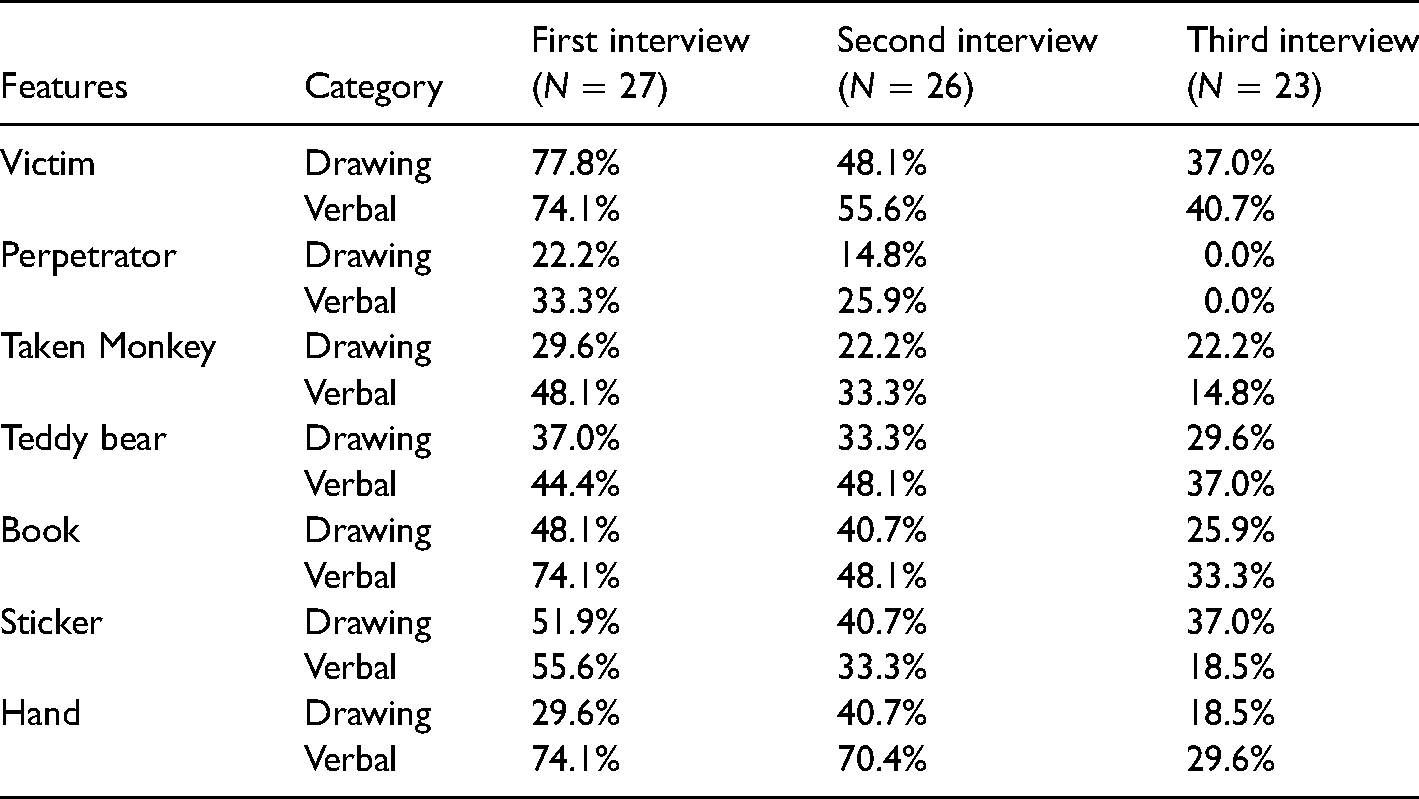
We also investigated how the presence of the same features changed in children’s verbal reports over the three interviews, using similar analyses. There was a statistically significant difference in inclusion of the perpetrator, χ2(2) = 11.40, p = .003, Monkey, χ2(2) = 8.17, p = .017, the book, χ2(2) = 8.67, p = .013, the sticker, χ2(2) = 12.67, p = .002, and the hand, χ2(2) = 14.73, p = .001, all of which decreased. Post-hoc analyses with Wilcoxon signed-rank tests and a Bonferroni correction for three comparisons (p = .017) were conducted for each feature. Children verbally recalled the perpetrator and the hand less in the third interview than the second (perpetrator: Z = −2.65, p = .008; hand: Z = −3.00, p = .005) and the first interview (perpetrator: Z = −2.83, p = .005; hand: Z = −3.00, p = .005). They further verbally reported Monkey, the book, and the sticker 2 less in the third interview than the first interview (Monkey: Z = −2.83, p = .005; storybook: Z = −2.83, p = .005; sticker: Z = −3.16, p = .002). There were no further significant differences in children’s verbal reports for the remaining features (all ps > .05).
Content of Drawings Versus Verbal Reports
Accurate Details
To investigate whether children report more features verbally versus visually, we ran separate 3(delay: first interview [1 day] vs. second interview [2 weeks] vs. third interview [6 months]) × 2(modality: drawing, verbal) repeated measures analysis of covariances on the key features. Age was entered as a covariate. A significant main effect of modality was found for the victim, F(1, 20) = 8.38, p = .01, η² p = 0.29, Teddy, F(1, 20) = 5.00, p = .04, η² p = 0.20, and Monkey, F(1, 20) = 6.81, p = .02, η² p = 0.25. Post-hoc tests (Bonferroni) showed that children talked significantly more about Teddy (p = .02) and Monkey (p = .04) than they drew. A similar analysis on the victim revealed no significant differences between children’s verbal reports and drawings (p > .05). There was a significant interaction between delay and modality for the hand, F(2,40) = 4.44, p = .02, η² p = 0.18. Post-hoc analyses (Bonferroni) showed that the children recalled fewer details about the hand 6 months after the event than 1 day (p = .014) and 2 weeks after (p = .004). There was a significant main effect of age for Teddy, F(1, 20) = 4.94, p = .04, η² p = 0.20, book, F(1, 20) = 8.63, p = .01, η² p = 0.30, and hand, F(1, 20) = 5.11, p = .04, η² p = 0.20, and a significant interaction between modality and age for victim, F(1, 20) = 7.92, p = .01, η² p = 0.28 and Monkey, F(1, 20) = 5.20, p = .03, η² p = 0.21. There were no further main effects or interactions (all Fs < 4.32, all ps > .05).
Errors
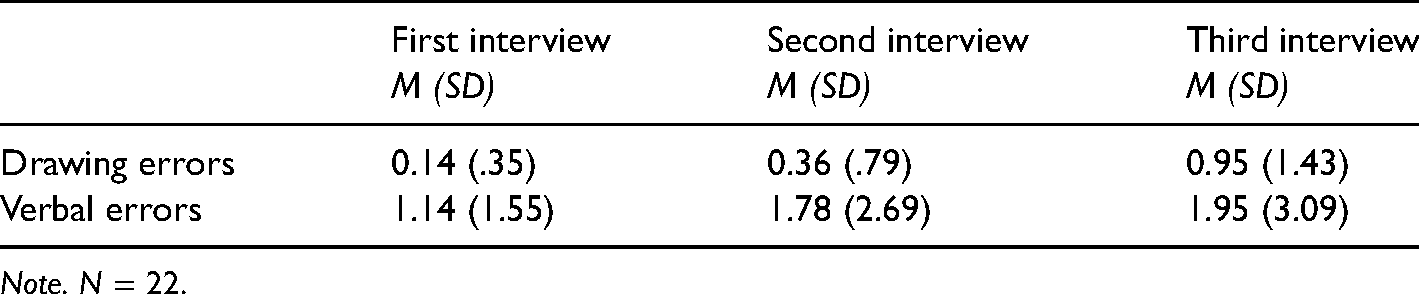
We ran a similar analysis on the total number of errors. A significant main effect of modality was found, F(1, 20) = 4.34, p = .05, η² p = 0.18. Post-hoc tests showed that children made significantly fewer errors in their drawings than in their verbal accounts (p = .001) (Table 2). There were no further main effects or interactions (all Fs < 2.78, all ps > .05).
Mean (and Standard Deviations) Number of Errors Included in Children’s Drawings (Drawing) and Verbal Reports (Verbal) Over Different Time Delays in Free Recall.
Note. N = 22.
Discussion
Our study investigated how the content of children’s drawings changes over three time delays (1 day, 2 weeks, and 6 months later) and whether children report more information verbally or pictorially, in a task where children drew during the interview. Overall, we found that children verbally reported more information than they drew. Depicted features in drawings remained relatively stable over time and, importantly, drawings also included fewer errors.
For drawings, of all seven features only “the perpetrator” and “the victim” declined; the remaining five features stayed stable over time. The stable features involved objects (teddy, monkey, storybook, sticker, hand). Our finding is consistent with work showing that drawing enhances memory for objects, compared to other recall categories such as people (e.g., Butler et al., 1995; Gross & Hayne, 1998). Consequently, drawing may have made it easier for the children to remember and include these items in their drawings over time. Prior work has focused upon verbal reports, thus, to our knowledge, our findings are the first to indicate that this effect is similar for the drawings themselves.
Children generally tended to include the things they reported verbally in their drawings but did not draw everything they verbally recalled (see Table 1). Particularly, they reported the victim, teddy, and monkey more often verbally, suggesting that the most salient or attractive features (i.e., main actor and cuddly toys) are better encoded or retrieved. Over time, what they talked about and what they included in the drawings converged. Children’s verbal reports appeared to decline faster than their drawings, which suggests that the drawings may provide less, but more stable information. This is in line with previous work which showed that young children’s encoding of information favors sensory versus semantic stimuli (Ackerman, 1981; Driessnack, 2006). Additionally, children recalled fewer details about the hand where the actor placed a sticker 6 months after the event than one day after. For ethical reasons, touch involved a positive outcome for children (getting a sticker). This finding suggests that after 6 months children may not recall information about (mild) touch compared to immediate interviews, or they may not talk about it because they do not encode contact with an adult as touch (Bruck, 2008). As touch pertains sexual and physical abuse cases, children’s memory of touch after delays could be investigated further in future research.
Finally, children included fewer errors in their drawings than they verbally reported. This could be due to a number of reasons. First, it may be that children only include in their drawings things they are confident they remember well. Another reason for this finding is that children included in their drawings errors they are able to depict, such as people and objects (e.g., “a tiger” instead of “a leopard”) as well as confabulated items (e.g., a witch as part of the story). In their verbal reports however, some children included inaccuracies they cannot easily depict, such as “I never received a sticker” or “no-one told us a story,” which involve mainly actions. Future research could investigate further the possibility of drawings including more accurate details than verbal reports and whether drawings and verbal reports are related to different types of inaccurate details (i.e., objects vs. actions).
This study has several limitations. Our sample is relatively small, as we focused on a drawing condition of a larger study; thus, caution is advised for generalizability and further extension is required. Our event involved a mild altercation between two actors which took place in the children’s schools and therefore is not entirely representative of a real-life forensic situation, however ethical factors made this necessary. Although research findings on the prevalence of positive versus negative events on children’s memory are not clear, there is consensus that novel events are accurately recalled irrespective of valance (Bray, Brewer, Cameron, & Nixon, 2018). Given that previous research employed fun interactive events in which children actively participated (e.g., visit to harbor, Macleod, Gross & Hayne, 2014), we chose a mild quarrel in which children were passive viewers, as such an event resembles situations such as domestic abuse or witnessing bullying in school. Interviews with the children took place in their schools, despite actual forensic interviews usually taking place in unfamiliar settings. Further, our interviews did not follow the phases of formal interview protocols with children, therefore caution is required regarding the application of our findings. The analysis also contains limitations: the second coder for the drawings was given copies of the children’s drawings with the notes made by the experimenter included. This was done because a child’s own interpretation is necessary for understanding it (Gross & Hayne, 1999). In addition, 65% of the drawings were nonrepresentational, which is consistent with previous reports on the quality of children’s drawings while recalling an event (see Jolley, 2010). Thus, it was deemed best for the second coder to view the drawings with the notes included, particularly in cases where unidentifiable or nonrepresentational items and scribbles were involved. Nonetheless, our findings show that drawings could be used as supplementary aids in eyewitness testimony as they contain few errors and remain relatively stable over time. Future research could investigate this further by also looking at developmental trajectories with respect to the content of drawings and how they relate to children’s verbal reports.
Overall, offering children the opportunity to engage with artistic methods, particularly drawing, may facilitate access to past experiences and events (Driessnack, 2005, 2006), and in clinical and legal contexts all details relevant to the event in question are crucial in the interview (Barlow et al., 2011). In our small-scale study, we found that children’s drawings include the features that are more salient to them and fewer errors compared to verbal reports. In line with memory research on children’s verbal reports (Baker-Ward et al., 1993; Lamb et al., 2000), our study also showed that the content of children’s drawings may decline over time. In addition, the details children offer verbally tend to decline faster. Thus, future research should further investigate the content of children’s drawings, as they may be more reliable and stable compared to verbal interviews.
Footnotes
Acknowledgments
The authors thank Brookdale Day Nursery, Lancaster, Scotforth St. Paul’s Church of England Primary School, Lancaster, Skerton St. Luke’s CE VA Primary School, Lancaster, and Appletree Nursery School, Lancaster. We also thank the parents, children, and staff of these schools. We thank Nicola Cook, Andrew Hammond, and Christopher Moran for coding the drawings and rating their representational quality. We thank Victoria Lister for coding the manuscripts. We also thank Claire Kelly and John Shaw for presenting a live event to the children. This research did not receive any specific grant from funding agencies in the public, commercial, or not-for-profit sectors.
Declaration of Conflicting Interests
The authors declared no potential conflicts of interest with respect to the research, authorship, and/or publication of this article.
Funding
The authors received no financial support for the research, authorship, and/or publication of this article.
