



Abstract
The present study investigated individual differences in relation to two neurobiological systems in people who engage in maladaptive daydreaming (MD). Data was collected from 242 self-identifying probable Maladaptive Daydreamers, who satisfied the cut off score of 40 or above on the Maladaptive Daydreaming Scale (MDS-16). They were asked to complete the Behavioural Activation and Behavourial Inhibition Scales (BAS/BIS) (BAI-20) and the Short International Personality Item Pool (IPIP – BFM-20). Participants were also asked to disclose any pre-existing mental health conditions. A significant positive relationship was found between MD and the trait of Neuroticism and negative relationships were found between the traits of Conscientiousness, Openness and MD. The BAS Reward Responsiveness subscale appeared to be most prevalent in those who engaged in MD. High levels of BIS also emerged as a significant predictor of MD. No association between MD and existing pre-diagnosed mental health conditions were found. Findings suggest that MD is associated with traits linked to avoidance, emotion regulation and motivational tendencies towards reward seeking. It is important for future studies to continue to explore aetiology from a psychophysiological basis to inform therapeutic interventions.
Keywords
Introduction
The concept of daydreaming has been a source of intrigue within the field of psychology for over a century with a wealth of research concluding that daydreaming is a common, ‘normal’ occurrence, occupying up to 50% of a person's waking thoughts (McMillan et al., 2013). Daydreaming has also been found to provide a release from the stresses and strains of everyday life through the disconnect experienced when the mind wanders off task; using daydreaming as a form of escapism to distance oneself from the subjective experience of reality (Bigelsen & Schupak, 2011; Vess & Maffly-Kipp, 2021). Studies have investigated the extent to which high levels of daydreaming may be considered ‘maladaptive’ due to causing distress and disruption to a person's external functionality and becoming an intensive, intentional preoccupation and a preferred substitute for real life social interactions (Soffer-Dudek & Somer, 2018; Somer, 2002).
Maladaptive Daydreaming (MD) has been shown to be a stable clinical condition (Musetti et al., 2023), characterized by persistent and recurrent absorption in vivid, detailed fantasies, that interferes with interpersonal, academic or vocational functioning (Somer, 2002). The concept of Maladaptive Daydreaming (MD) emerged largely through the anonymity afforded through internet forums and online chat rooms as this provided a platform for people to reach out and share their daydreaming experiences to try and make sense of secretive forms of intensive, intentional daydreaming consisting of the conscious creation of complex elaborate plots (Somer et al., 2016). Researchers have identified shared characteristics and physical behaviours associated with Maladaptive Daydreamers (MDers) with around 80% of people incorporating unconscious physical gestures whilst in MD, from face pulling and mouthing words to kinaesthetic movement such as pacing and rocking, enabling a hypnotic like state to maintain concentration whilst immersed in the daydream (Bigelsen et al., 2016; Bigelsen & Schupak, 2011;Somer, 2002; Somer et al., 2016). Somer (2018) identified four psychopathological behaviours associated with MD; dissociation, disturbance of attention, obsessive compulsiveness, and behavioural addiction. The reclusive nature of this internal behaviour has been shown to lead to withdrawal and disengagement from family and friends to seek the solitary conditions required to engage in MD (Sandor, Bugan, Nagy, Nagy et al., 2021) which often leads to a cycle of shame and regret magnified by a lack of awareness on how to curb the behaviour (Soffer-Dudek & Somer, 2018).
Despite its name, MD may have some adaptive values. In a preliminary study, Somer (2002) linked the development of MD with childhood adversity and how it could potentially be used as a strategy to deal with certain types of childhood emotional trauma caused by neglect, abuse or separation caused by familial divorce or the death of a loved one (Gemignani et al., 2025; Sandor, Bugan, Nagy, Nagy et al., 2021). Numerous studies have suggested that MD could be employed as a coping strategy for those diagnosed with dissociative disorder to distance themselves from dealing with childhood trauma and/or stress (Gemignani et al., 2025; Sandor, Bugan, Nagy, Nagy et al., 2021; Soffer-Dudek & Somer, 2018; Somer, 2002). However, other studies have found that most people with MD have no recorded childhood adversity with 78% of participants reporting carefree, happy childhoods (Bigelsen & Schupak, 2011). Musetti et al. (2022) suggested that MD could be used as an ‘illusory retreat’ for any kind of unprocessed trauma from a range of life experiences in a bid to regulate emotion. Importantly, aetiology remains unclear.
Network Theory has been adopted as an approach to understand aetiology in terms of the various interactions between symptoms found in conditions such as anxiety, substance abuse, autism and personality traits, together with biological and psychological mechanisms (Borsboom, 2017). The ‘network perspective’ has been used to study components of personality (Cramer et al., 2012); specifically, positive links were found between MD and emotional regulation difficulties such as loss of control and impulsiveness. Cramer et al. (2012) analysed two network models; an MD-only 3-part network (kinesthesia/music, yearning and impairment) and an expanded network (MD 3 –part plus emotional regulation factors), with the aim to uncover the strength of individual components and any associations that may contribute to the emergence of MD. Network Theory offers a useful approach when no central cause has been identified and allows a combination of factors and their associations to be explored (Borsboom, 2017). Other studies have suggested that an imbalance in neurological systems might explain the aetiology of MD. Schupak and Rosenthal (2009) referred to the 10-year case history of a 36-year-old female who described feeling distressed at the excessive amount of time spent daydreaming and concluded that a neurochemical imbalance may be a contributing factor.
Neurobiological Systems: Behavioural Inhibition System/Behavioural Activation
The behavioural inhibition system (BIS) and the behavioural activation system (BAS) form a dual pathways model that might provide a useful means by which to explore aetiology. These two neurobiological systems form part of Jeffrey Gray's Reinforcement Sensitivity Theory (RST; (Bijttebier et al., 2009; Gray, 1970), which provides a psychophysiological theory of personality by measuring an individual's temperament by the strength of each system and its effects on behaviour (Corr & Perkins, 2006). According to the neurobiological-based Reinforcement Sensitivity Theory (RST) (Corr, 2009; McNaughton & Gray, 2000), behavior and learning are shaped by two major motivations; (1) the drive to receive reward (BAS) and (2) the drive to avoid punishment (BIS). BAS is thought to comprise of three subsystems of Reward Responses, Drive, and Fun-Seeking and is related to appetitive motivation and activated by reward-related stimuli (Carver & White, 1994). BIS is assumed to be linked to anxiety and avoidance-related behaviours. Optimally, the BIS and BAS are balanced allowing relatively safe pursuit of reinforcing goals. However, when it is the stronger system, BIS is associated with an imbalance of negative affect and fear-related suppression of rewarding behavior. BIS and BAS are consistently associated with internalizing and externalizing disorders, respectively. For example, anger rumination is thought to be linked to internalizing disorders while anger expression demonstrates an association with externalizing disorders (Scaini et al., 2024).
In relation to the present focus on MD, the concept of nightmare proneness has been examined in terms of its associations with BIS/BAS. Specifically, studies have found higher levels of BIS, avoidant attachment, and trauma symptoms were significantly and independently associated with higher nightmare proneness (Jean-Richard-Dit-Bressel et al., 2021). High levels of BAS have also been linked to a propensity for substance misuse disorder (SUD) highlighting lower levels of self-regulation and the important role of individual differences in motivations around addictive behaviour (Jauk & Dieterich, 2019). To the best of our knowledge no studies have examined the role of BIS/BAS on MD. As personality has also been shown to be strongly entwined in the functionality of these two systems (with the role of BIS/BAS found to shape the development of personality from childhood; (Slobodskaya, 2007); it is imperative to consider associations between MD and personality.
Maladaptive Daydreaming and Personality
Personality has been defined in numerous ways and many researchers agree that personality comprises individual differences in a person's thoughts, feelings and behaviours (mcCrae & Costa, 1997). The Big 5 personality traits— Neuroticism, Extraversion, Openness, Agreeableness, and Conscientiousness–emerged from decades of research and have been celebrated for their cross-cultural applicability (McCrae & Costa, 1997b), ability to simplify an overwhelming number of traits (Hofstee, 1994; John, 1990; McCrae & Costa, 1987), and their ability to predict a wide range of health and clinical outcomes (e.g., Emmons, 1995; Kaufman et al., 2020). The Big5 trait of Extraversion refers to the tendency to be assertive and social, and to experience positive affect and seek excitement (Costa Jr & McCrae, 1992; McCrae & John, 1992). Agreeableness refers to the tendency to be altruistic, trusting, modest, and compliant (Costa Jr & McCrae, 1992; Costa Jr et al., 1991). Conscientiousness refers to the tendency to be persistent, organized and goal-directed, and to show self-control, and self-discipline (Costa et al., 1991; McCrae & John, 1992). Neuroticism refers to the tendency to be emotionally unstable, and to experience negative emotions such as anger, anxiety and depression (Costa Jr & McCrae, 1992; McCrae & John, 1992). Openness refers to the tendency to be creative, curious, sensitive to aesthetics, and open to new ideas and experiences (Costa Jr & McCrae, 1992; McCrae & John, 1992).
Associations have been found between the trait of neuroticism and MD whereby those high on the trait of neuroticism appear to demonstrate higher levels of MD. For example, a study by Suls and Marting (2005) reported that those high in the trait of neuroticism tend to show higher levels of rumination than those lower on this trait in addition to a heightened tendency to require more time to recover from a bad mood. Guilty dysphoric daydreaming was also found to be positively associated with neuroticism (Zhiyan & Singer, 1997). Further support for the role of neuroticism in MD comes from a recent study by Musetti et al. (2023) who reported that neuroticism, and defence styles mediated the relationship between traumatic life experiences and MD. When theorising about the associations typically found between the trait of neuroticism and MD, Triple Vulnerability Theory (Barlow, 2000) depicts the development of neuroticism with a combination of vulnerable biological and psychological factors, which can lead to a dysregulated emotional response to external stressors (Barlow et al., 2014) and might explain these associations. Sandor, Bugan, Nagy, Nagy et al. (2021) found a strong link with negative emotions with MDers showing difficulties in dealing with negative emotions or stress hence the safe retreatment into their MD where they can imagine a stable sense of self or indulge in parasocial relationships (Mandli et al., 2022).
Several studies into MD have also identified a strong link with the personality trait of narcissism (Brenner et al., 2021; Somer, 2002). Narcissism is a personality trait which forms part of the Dark Triad of personality along with Machiavellianism and psychopathy (Jones & Paulhus, 2002). The trait of narcissism has been commonly identified in studies relating substance and non-substance related addictive behaviour to alleviate issues related to self-esteem (Jauk & Dieterich, 2019). In general, grandiose narcissism tends to be associated with facets such as self-absorption, exhibitionism, callousness, immodesty, interpersonal dominance, manipulativeness, and a need for acclaim from others. In contrast, vulnerable narcissism tends to be associated with negative emotions, withdrawal, hypersensitivity, psychological distress, anxiety and feelings of inferiority often paired with an egocentric and distrustful approach to interpersonal relations (Kaufman et al., 2020)
In relation to MD, personality has been found to influence the content of daydreams (Brenner et al., 2021). Specifically, Somer (2002) identified MD themes including violence, idealised self, power, control, captivity, sexual arousal, rescue, and escape. MD themes that feature elements of violence, wish fulfilment, control and superiority have been linked to people who inhibit higher levels of grandiose narcissism (Brenner et al., 2021) whereas themes involving escape and violence have been linked to anhedonia (Brenner et al., 2021).
Maladaptive Daydreaming and Mental Health
Soffer-Dudek and Theodor-Katz (2022) argue that MD is a psychological disorder whereas people who have MD possess a clear distinction between what is fantasy and what is reality (Bigelsen & Schupak, 2011) and do not associate their daydreaming with a serious mental disorder. A number of studies have shown that mental health disorders such as stress, anxiety and depression were not associated with intentional mind wandering (Seli et al., 2019; as cited in Vess & Maffly-Kipp, 2021). A study by Vess and Maffly-Kipp (2021) noted a differentiation between intentional and unintentional mind wandering with a positive correlation found between unintentional mind wandering and self-alienation. However, others have argued that the concept of MD could be a form of intentional mind wandering with a strong element of intent (Soffer-Dudek & Theodor-Katz, 2022). Several studies have suggested that MD could be a comorbidity of other psychiatric disorders contributing to other psychopathological symptoms (Bigelsen et al., 2016; Theodor-Katz et al., 2022). Theodor-Katz et al. (2022) also found low levels of MD in people with attention deficit hyperactivity disorder (ADHD), however people who met the criterion for both MD and ADHD were found to have higher levels of depression, loneliness, and lowered self-esteem. H1: There will be a positive association between Maladaptive Daydreaming, Behavioural Activation and Behavioural Inhibition. H2: The trait of neuroticism will be positively associated with Maladaptive Daydreaming. H3: MD will not be associated with pre-existing mental health diagnoses
Method
Participants
A total number of 405 participants responded to an online advert inviting them to take part in the current study with 244 participants completing 90 percent or above of the online questionnaire.
After screening for Maladaptive Daydreaming as per the 16 item Maladaptive Daydreaming Scale a final sample of 242 participants 1 was used for the purpose of this study.
Questions pertaining to general demographic information were presented to participants including age, gender, marital status, ethnicity, education, and employment status. Participants were also asked to declare any existing pre-diagnosed mental health conditions. All participants were over the age of 18 with the majority falling within the 18–24 age bracket (45.5%) and over half under the age of 35 (76.1%). Most participants identified as female (78.5%), with a similar number of non-binary (7.9%) and male (7.4%) and other gender categories including transgender (6.2%). The most common geographical composition of the data sample was white/Caucasian (74%), never married (68.2%) in full time employment (73%). Most participants stated that they did have an existing mental health diagnosis but did not specify/preferred not to say (32.2%) or indicated a mood disorder (e.g., depression or bipolar, anxiety disorder) (10.3%). This nonclinical, random sample of participants participated on a self-voluntary basis as no incentives or payments were offered.
Materials
Maladaptive Daydreaming Scale (MDS-16)
The 16-item Maladaptive Daydreaming Scale (MDS-16; Abu-Rayya et al., 2019) has been found to be an accurate non-diagnostic psychometric tool used to screen self-identified individuals with and without MD. The MDS-16 has demonstrated reliability and validity with evidence of convergent validity (Sandor et al., 2020). The scale covers the four dimensions identified with MD: (1) yearning and immersed daydreaming (7 items); (2) distress and impairment (5 items); (3) kinesthesia (2 items); and (4) music (2 items), (Soffer-Dudek et al., 2021). The MDS-16 measure consists of 16 questions such as, “Some people feel distressed or concerned about the amount of time they spend daydreaming. How distressed do you currently feel about the amount of time you spend daydreaming?” and “When you first wake up in the morning, how strong has your urge been to immediately start daydreaming?” and rated on a 10-point Likert scale ranging from 0 to 100 (a mean score of 50 or higher indicates suspected clinical level MD; Somer et al., 2016;
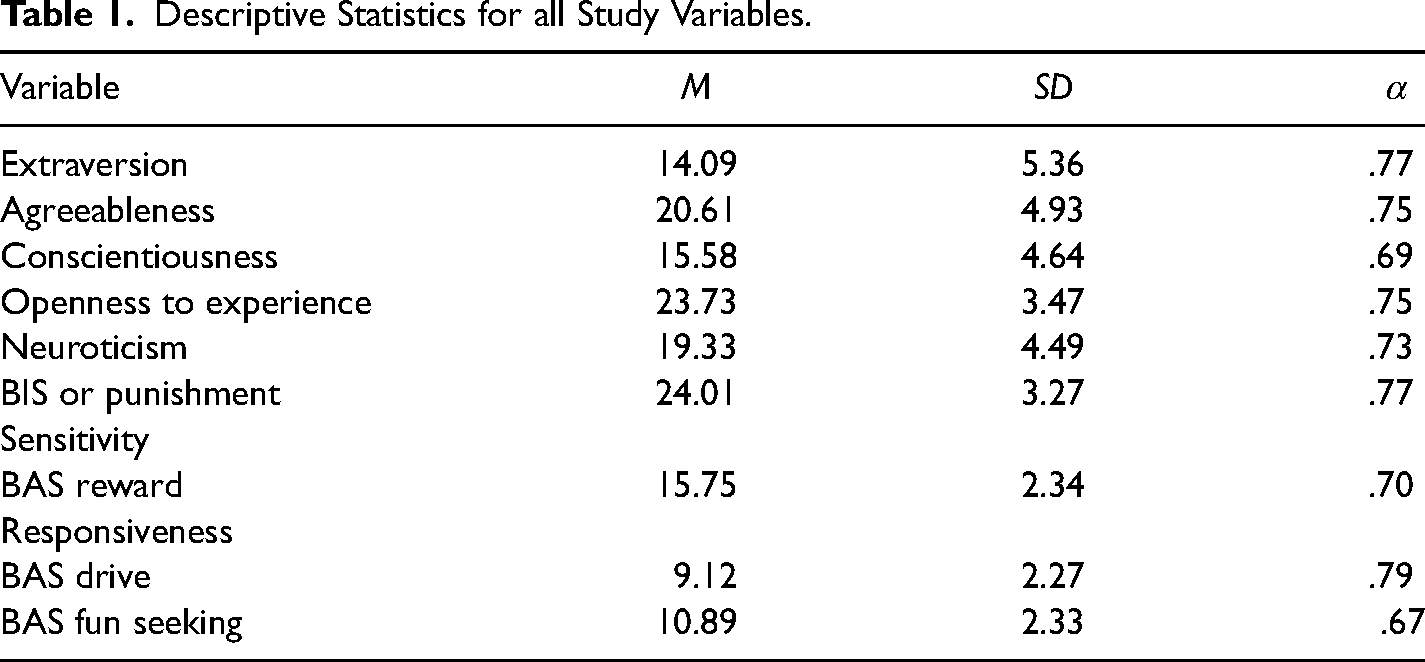
Descriptive Statistics for all Study Variables.
Behavioural Activation and Behavioural Inhibition Scales (BAI – 20; Carver & White, 1994)
This 20-item scale measures four primary scales including ‘BIS or punishment sensitivity scale’, ‘BAS reward responsiveness’, ‘BAS drive’ and ‘BAS fun seeking’. Responses are rated on a 4-point Likert scale
The short International Personality Item Pool (IPIP)-BFM-20
The 20-item questionnaire
Procedure
This study was conducted in accordance with the British Psychological Society's ethical guidelines and granted ethical approval by Edge Hill University's Department of Psychology. Participants were recruited via a mixture of opportunistic and snowball sampling via an online advert which included a URL to the questionnaire via Qualtrics software. Upon the request of the researcher, the online survey was shared to the International Consortium for Maladaptive Daydreaming Research (ICMDR) mailing list. Specific websites and online forums dedicated to Maladaptive Daydreaming were targeted including Facebook groups; ‘Their Stories; Maladaptive Daydreaming’ (857 members), ‘Back to Reality, Maladaptive Daydreamers Quitting Support Group’ (578 members), ‘Maladaptive Daydreaming’ (4.4 K members), ‘Maladaptive Daydreamers’ (2.9 K members), Reddit group; ‘Maladaptive Daydreaming community’ (80 K members) and the Wild Minds Network (18,008 K members). Upon clicking the link participants were directed to the online study where they were asked to complete a consent form before proceeding onto the questionnaire which consisted of a total of 56 questions. The order of the questions were randomised to control for order effects and completion time was approximately 25 min. It was made clear to participants that the measures were not being used for diagnostic purposes. Participants were asked to provide their consent for any findings to be submitted to the International Consortium for Maladaptive Daydreaming Research (ICMDR), an informal network of scientists interested in the study of maladaptive daydreaming.
Results
A total of 242 2 respondents satisfied the scoring criterion for MD indicating suspected clinical MD with an overall mean score of 67.34 (SD = 12.4). Data was screened for skewness and kurtosis which showed normal distribution and reliability analyses were conducted along with descriptive statistics for all study variables (see Table 1).
To explore the first hypothesis that MD will be positively associated with BAS and BIS a series of bivariate Pearson's correlations were conducted. A moderate correlation was found between MD and BAS reward responsiveness; r (238) = .21, p = .001 partially supporting Hypothesis 1. Non-significant correlations were found between MD and BAS drive, r (239) = .14, p > .05 and MD and BAS fun seeking, r (238) = .02, p > .05 which runs counter to the hypothesis that MD will be positively associated with BAS. A significant correlation was also found between MD and BIS, r (239) = .21, p < .001 supporting hypothesis 1.
To examine the second hypothesis that the trait of neuroticism would be positively associated with MD, Pearson's bivariate correlational analyses revealed a positive significant relationship; r (178) = .19, p < .05 supporting the second hypothesis. A negative non-significant correlation was found between MD and mental health diagnoses (H3), r (240) = .07, p = >.05 which suggests that MD can exist without any pre-existing mental health diagnosis and supports the third null hypothesis. 3
Although no specific predictions were made regarding the association between personality traits (with the exception of neuroticism, H2) and MD, a post hoc multiple linear regression was conducted with the five traits entered into the model as predictors. Aa significant model, F (5, 118) = 6.78, 4 p > .05 explaining 17% of the variance in MD was obtained (see Table 2). A negative relationship was found between MD and Conscientiousness, (β = −.18, < .05) and Openness to experience (β = −.12, p < .05), which suggests that individuals higher in these traits reported lower levels of MD. All other associations between the remaining traits of agreeableness and extraversion and MD were ns (all p's > .05; see Table 2).
Regression Model with Maladaptive Daydreaming as the Criterion Variable.
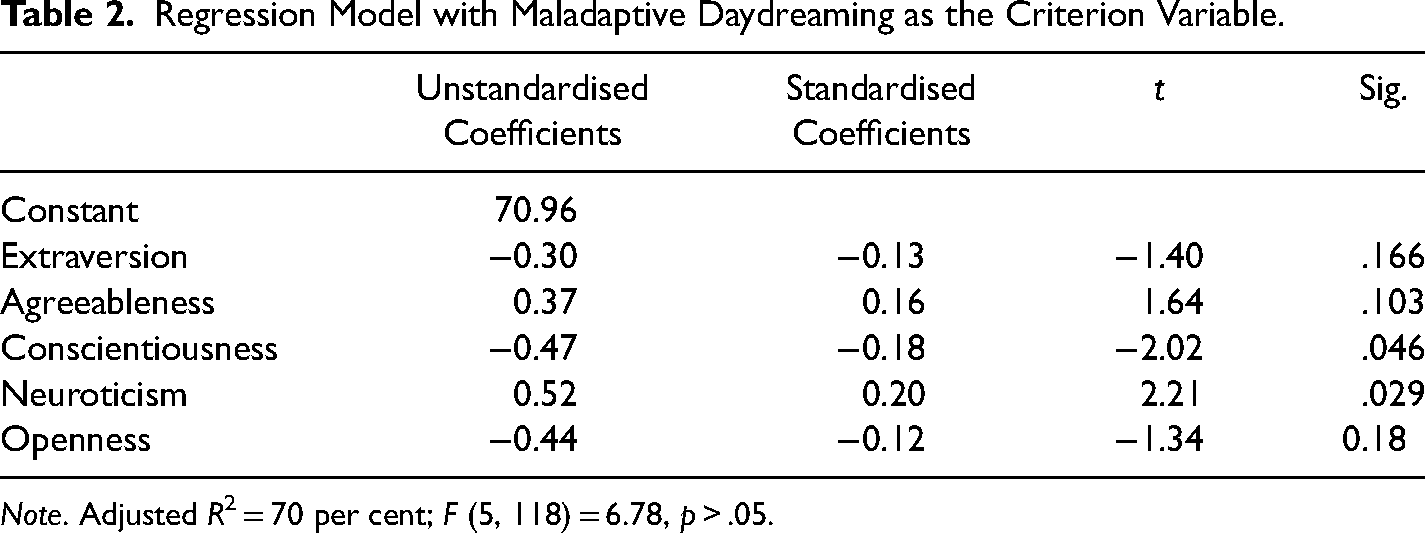
Note. Adjusted R2 = 70 per cent; F (5, 118) = 6.78, p > .05.
Discussion
Maladaptive Daydreaming (MD) is characterized by persistent and recurrent absorption in vivid, detailed fantasies and has been shown to have detrimental effects to a person's life such as attention deficit, missed responsibilities, impaired productivity, social isolation and anxiety (Bigelsen et al., 2016; Ferrante et al., 2022). The reclusive nature of this internal behaviour often leads to a cycle of shame and regret magnified by a lack of awareness on how to curb the behaviour (Soffer-Dudek & Somer, 2018). Although research has begun to explore aetiology and correlates of MD (e.g., Soffer-Dudek & Somer, 2018; Somer et al., 2025) further investigation is required into the neurobiological systems that may contribute towards the aetiology of MD in addition to an investigation into the associations between personality and these neurobiological systems (e.g., BIS/BAS). The present study examined the role of these neurobiological systems and the trait of Neuroticism on MD in an effort to contribute to an increased understanding of aetiology and individual differences. The results of this study found positive associations between MD and the personality traits of Neuroticism and negative associations between MD and Conscientiousness and Openness to experience. MD also related positively with BIS and BAS reward subscale with no significant associations found for BAS drive and BAS fun seeking subscales.
Maladaptive Daydreaming and BAS Reward Responsiveness
A significant association was found between MD and BAS reward responsiveness suggesting that individuals with higher motivational tendencies towards reward reported higher levels of MD. As part of its motivational force BAS seeks stimuli with the anticipation of receiving pleasurable fulfillment (Taubitz et al., 2015). This suggests that people with a dysregulation in BAS might use MD as an adaptive mechanism to satisfy the need for exciting stimuli. This explanation is in line with studies asserting that MD seems to be driven by the desire to leave the present moment and enjoy a more rewarding life in an alternative mental universe (Bigelsen et al., 2016). Studies exploring MD have repeatedly shown that those engaging in MD tend to report higher levels of everyday stress (Hennis et al., 2022) and unmet emotional needs (Flickinger, 2024); thus, it has been suggested that MD allows individuals to imagine risk free environments and create a safe space to explore and express their desires (Pietkiewicz et al., 2023).
No associations were found between the remaining BAS subscales of drive and fun seeking. These findings are interesting and highlight an important contribution to knowledge and the importance of measuring BIS/BAS subscales as opposed to a global measure of BAS. That is, our study suggests that BAS reward (i.e., anticipation to reward) appears to be important in the motivational basis of MD but not BAS drive (i.e., focus on persistent seeking of desired goals) or BAS fun seeking (tendency to pursue pleasure). As these latter two subscales are more concerned with goal focused behaviour and purist of pleasure current findings indicate that the motivational basis of MD is motivated by anticipated reward (BAS reward) as opposed to goal directed behaviour (BAS drive) and pleasure (BAS Fun seeking). It is important for future research to investigate whether these patterns can be replicated before firm conclusions can be made.
Maladaptive Daydreaming and BIS
The significant link found between BIS in relation to MD suggests that those with high BIS appear to be more likely to engage in MD. Given that BIS is associated with motivational tendencies to avoid negative outcomes current findings supports the notion that MD may be employed as a form of dissociation or avoidance of difficulties in daily life (Sandor, Bugan, Nagy, Nagy et al., 2021; Soffer-Dudek & Somer, 2018; Somer, 2002). Further support for the association found between BIS and MD comes from research into MD and attachment anxiety which has shown MD to be adopted as an alternative outlet for people who are struggling within their real-life interpersonal relationships due to an anxious attachment style (Blackwell et al., 2017). The dissociative nature of MD may be an ideal emotional regulator for those high on this trait who have been found to shy away from dealing with stressful events and traumatic experiences by detaching from reality (Furnham, 2012). Support for this line of explanation comes from the related area of parasocial relationships (one sided, non-reciprocal relations with media figures, fictional characteristics or idealized versions of real people), which has asserted a link with MD. Specifically, emotional dysregulation, unhappiness and unmet emotional needs appear to be linked to parasocial relationships and MD (Horton & Wohl, 1965; Flickinger, 2024).
At its core, BIS comprises the motivational tendency to avoid negative outcomes and consequences; thus, engaging in MD may free a person from potential rejection in their daily life and enable them to avoid difficult emotions (Flickinger, 2024; Sandor, Bugan, Nagy, Nagy et al., 2021). Indeed, researchers outside the field of MD have begun to postulate the specific mechanisms that might be underlying the BIS/BAS contribution to certain psychological difficulties (Bijttebier et al., 2009). A possible mediator may be the ability to regulate one's emotion (Tull et al. 2010). Difficulty in Emotion Regulation (DER) indicates individuals’ inability to effectively identify, understand and modulate emotional experiences in distressing situations (Gratz & Roemer, 2004). Therefore, MD could be considered as an internalising regulation strategy to combat psychological and emotional stress. Findings for the trait of neuroticism outlined below further support this theorising.
Maladaptive Daydreaming and Neuroticism
The trait of neuroticism was positively associated with MD suggesting that those high in neuroticism reported higher levels of MD. The trait of neuroticism is characterized by a high sensitivity to negative emotions, proneness to low self-esteem, and depression (McCrae & Costa, 1983). Present findings indicate that MDers might engage in MD due to difficulties with emotion regulation. In support, Sandor, Bugan, Nagy, Nagy et al. (2021
Interestingly, we also found negative associations between the trait of conscientiousness and openness to experience and MD. The trait of conscientiousness is characterized by diligence, low impulsivity, and organization and negatively associated with poor attentional control (McCrae & John, 2006) whereas the trait of openness to experience is characterized by imaginative daydreaming, artistic sensitivity, awareness and appreciation of emotional responses, and intellectual curiosity (McCrae & Costa, 1983). Negative relationships between these traits and MD is in line with previous research asserting that MDers appear to struggle with emotional regulation (Sandor, Bugan, Nagy, Nagy et al., 2021), lower productivity and seeking refuge in their MD (Somers et al., 2012). Further support for the present pattern of findings comes from a study by Zhiyan and Singer (1997) who found that positive constructive daydreaming was positively associated with openness to experience.
Taken together, the relationship found between the trait of neuroticism and MD suggests that MDers might engage in MD due to difficulties with emotional regulation
Maladaptive Daydreaming and Pre-Existing Mental Health Disorders
No association was found between MD and mental health diagnoses captured in the current sample which suggests that MD can exist without any pre-existing mental health diagnosis. . This is in line with previous research where MD is present in the absence of pre-diagnosed mental health disorders (Bigelsen et al., 2016; Schupak & Rosenthal, 2009). Further support comes from a recent study which found that higher levels of daily stress was a stronger predictor of MD than childhood trauma (Flickinger, 2024; see Somer et al., 2025 for a recent exception). However, like many studies into the etiology of MD, the current study data was collected via online surveys completed by people who self-diagnose as maladaptive daydreamers and may have no issue with distinguishing between reality and their fantasy, ruling out the potential presence of a serious mental illness such as Schizophrenia (Bigelsen et al., 2016). Therefore, it is possible that many MDers do not associate MD with a mental health disorder rendering some mental health comorbidities unknown to the participant. It is important for future researchers to explore this area.
Limitations and Future Directions
The self-reported nature of the current data is important to reflect on in terms of validity (McDonald, 2008). Previous research on daydreaming has a disproportionate reliance on the subjective account of the participant (Singer, 1974). It is important for future researchers to also incorporate ratings from knowledgeable informants, that is, people who know the person well (Vazire, 2010). Mixed methods research incorporating a range of assessment perspectives offers a useful means by which to overcome some of the shortcomings inherent in self-report (McDonald, 2008). Nevertheless, support for the present pattern of findings comes from the convergence with a number of recent studies across a range of fields (attachment researchers, BIS/BAS, personality) and indicate meaningful responses. Moreover, effect sizes reported are small to moderate (McGrath & Meyer, 2006) and our measures also yielded moderate to good reliability (Cronbach & Meehl, 1955).
For the current study, BIS was measured as a unitary scale as opposed to separating this variable into subscales. When divided into subscales, BIS-fear has been associated with high agreeableness and BIS-anxiety has been related to high neuroticism and low extraversion (Segarra et al., 2014). A key strength of the study was that the BIS/BAS scale utilised did permit an examination into BAS subscales (not BIS) and this added a level of nuance that makes an important contribution to knowledge as the role of BIS/BAS in MD has not previously been explored to the best of our knowledge. It is important for future research to examine whether this pattern of findings can be replicated and continue to explore aetiology by focusing on factors linked to motivational systems with neurobiological underpinnings (BIS/BAS).
Clinical Implications
Interventions targeting motivational drivers of behaviour (BIS/BAS) and identification of individuals who might be more susceptible to elevated levels of MD may be a useful and supportive approach.
Footnotes
Declaration of Conflicting Interests
The authors declared no potential conflicts of interest with respect to the research, authorship, and/or publication of this article.
Funding
The authors received no financial support for the research, authorship, and/or publication of this article.
