




Abstract
Objective:
Maladaptive daydreaming (MD) is an impairing condition characterized by addiction to narrative, emotional fantasizing, involving dissociative absorption. By compulsively withdrawing toward vivid imaginative scenarios, MD hinders attentional functioning and replaces social interactions. Previous Interview-based research showed clinical importance in differentiating MD from ADHD and the associated construct of mind-wandering. We aimed to create a self-report tool asking directly about the content and structure of distracting thoughts.
Method:
Two samples, namely, 346 undergraduate students and 381 adults from the general community, completed a novel measure, the Daydreaming Characteristics Questionnaire (DCQ), along with validated measures for ADHD, mind-wandering, MD, dissociation, and general distress.
Results:
Exploratory Factor Analyses on the DCQ, replicated across both samples, yielded two distinct factors (immersive daydreaming and daydream functionality) uniquely associated with MD.
Conclusion:
The DCQ represents characteristics of immersive daydreaming much more than general attentional deficiency and is thus useful in differentiating MD from ADHD/mind-wandering distractions.
. . .the state called “distraction”. . . has an equivocal sense. It designates certain states of the mind, apparently, very similar, yet at bottom totally contrary. We call “distracted” people. . .who pass incessantly from one idea to another, at the mercy of their most transient whims, or of any trifling events in their surroundings. It is a perceptual state of mobility and dispersion, which is the very reverse of attention. . . But the term “distraction” is also applied to cases entirely different from this. Thus, there are people who wholly absorbed by some idea, are also really “distracted” in regard to what takes place around them; they afford no hold to external events, and allow the latter to flit by without penetrating their minds. Such people appear incapable of attention for the very reason that they are very attentive.
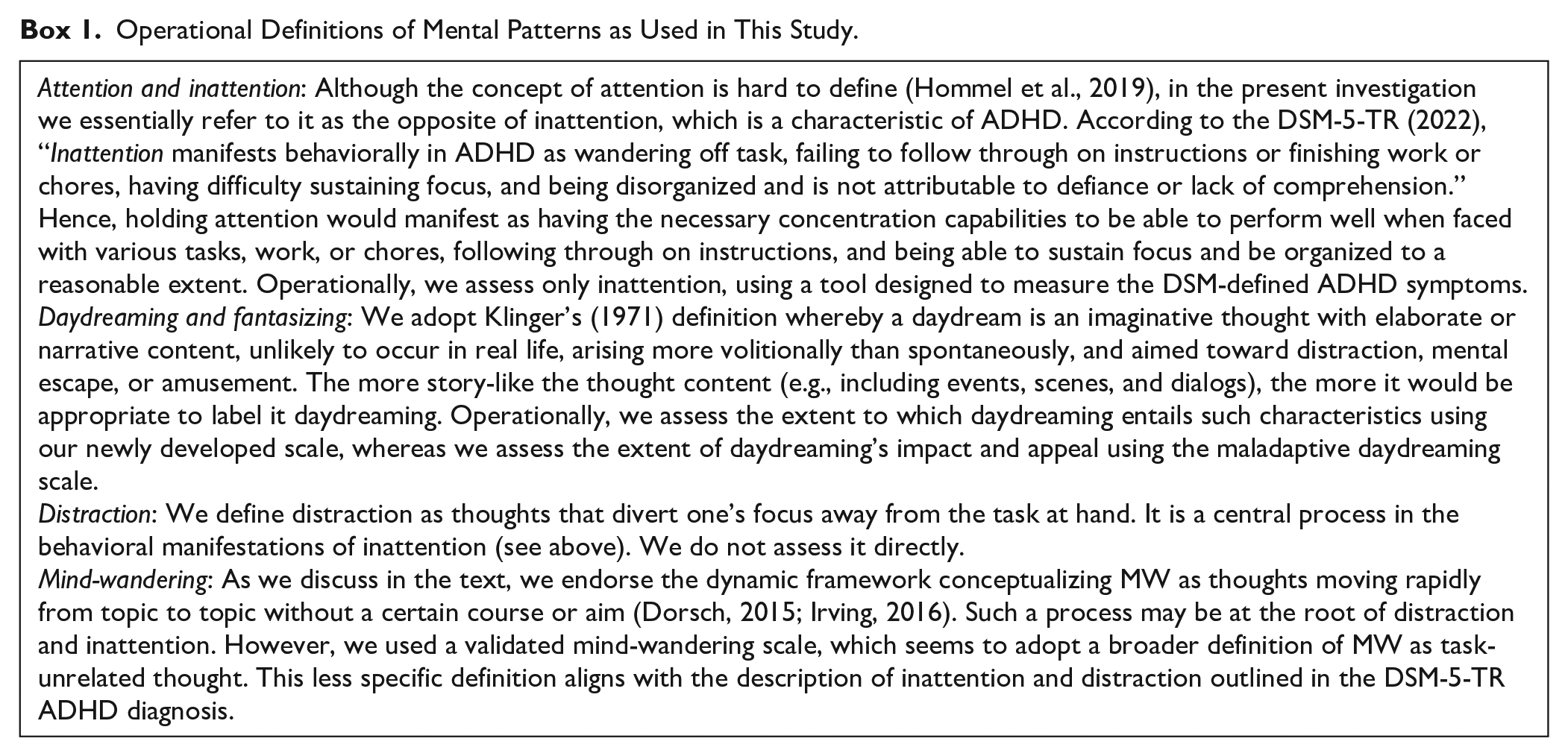
One of the elements that may contribute to the allocation of a mental state as indicating psychopathology is the classification of the unique nature of thoughts characterizing it, for example, negative thoughts toward oneself in depression; pervasive catastrophic thoughts in anxiety, and incoherent, scattered thoughts in psychosis (Christoff et al., 2016). Maladaptive daydreaming (MD) is a suggested syndrome characterized by excessive preoccupation with a unique thought pattern, namely, fanciful, absorptive daydreaming, resulting in significant distress and functional impairment (Somer, 2002). One of the negative outcomes of MD is attentional difficulties. 1 Problems with regulating and controlling attention are commonly associated with ADHD, yet MD and ADHD are separate entities (Theodor-Katz et al., 2022). As opposed to the persistent pattern of inattention and/or hyperactivity-impulsivity characterizing ADHD (American Psychiatric Association, 2022), MD involves an addiction to immersion in unrealistic, vivid daydreams at the expense of being attuned to one’s surroundings. Existing empirical self-report tools fail to differentiate MD from ADHD. The present study aimed to create a novel self-report scale which will differentiate daydreams from other thought patterns that may underlie distractibility. Such a distinction is important for understanding different etiologies for impaired attention. Additionally, further delineating the boundaries between MD and ADHD may contribute to recognition of MD as a clinical entity deserving consideration in psychiatric diagnostic manuals, establishing a differential diagnosis, and implementing appropriate interventions. Below, we will: (1) review the diagnostic nosology of ADHD and its relation to Mind Wandering (MW); (2) provide a theoretical conceptualization of daydreams and the blurred boundaries between them and MW; (3) demonstrate how and why MD and ADHD intersect.
Operational Definitions of Mental Patterns as Used in This Study.
Which Mental Pattern Underlies Attention Deficit?
Diagnostic criteria for ADHD according to the DSM-5-TR (American Psychiatric Association, 2022) do not specify the nature of the distracting thoughts in terms of content or structure. Instead, they provide somewhat vague examples of the outcomes of the distraction, for example, “often has difficulties sustaining attention on task,” “mind seems elsewhere.” Importantly, the question of “where” remains undetermined (Koutsoklenis & Honkasilta, 2023). In the past two decades, there has been a growing interest regarding the tendency to engage in internally generated content, that is, MW (Bozhilova, 2018; Callard et al., 2013; Christoff et al., 2016; Mills et al., 2018; Murray & Kraisch, 2020). MW is a thought pattern rooted in a competition between self-relevant internal priorities and task-relevant external priorities, with the former manifesting a higher incentive value (Smallwood, 2013). The dynamic view of MW argues that it is best defined as thoughts moving rapidly from topic to topic without a certain course or aim (Irving, 2016) with three hallmark characteristics relating to ADHD: (1) Spontaneous, non-deliberate thoughts interrupting other engagements. Indeed, this uncontrolled shift of attention inward was found to be more strongly associated with ADHD than a self-initiated shift to different unrelated thoughts (Seli et al., 2015). (2) Lack of awareness or decreased meta-cognition. ADHD is reported to be characterized by zoning out rather than tuning out (Smallwood et al., 2008). Indeed, a lack of meta-awareness mediated the relationship between ADHD and MW (Franklin et al., 2017), suggesting decreased meta-cognition and little sense of agency when the mind wanders. (3) Lack of guidance, that is, scattered thought contents. MW thoughts evolve without attentional conscious effort to keep track of the content and thus tend to be drifting rather than stable (Irving, 2016). To conclude, such a dynamic thought pattern is considered the prototypical distraction pattern characterizing ADHD (e.g., Mowlem et al., 2019).
Open Questions in the Mind-Wandering Field
Presently, however, the term MW is not consensual. Unlike the dynamic approach, the “family resemblance” paradigm conceptualizes MW as an umbrella term for heterogeneous thought constructs (Seli et al., 2018), including terms such as daydreaming, rumination, and off-task thoughts. Others formulate MW as internally generated thought (Schooler et al., 2011) or task-unrelated thoughts (Murray et al., 2020), meaning that it is defined by its lack of relationship to the ongoing task at hand. These theoretical terminologies and operative definitions have been claimed to be vague and even paradoxical since they consider contradicting structures of thought—such as wandering versus fixating, scattered versus coherent, reminiscing versus fantasizing—as the same mental activity (Christoff et al., 2016, 2018; Irving, 2016; Irving & Thompson, 2018; Mills et al., 2018). It has also been criticized as contributing to a theoretical fog in the MW research field (Christoff et al., 2018). In their editorial perspective on MW, daydreaming, and sluggish cognitive tempo, Becker and Barkley (2021) stated that the content and nature of internal self-generated distraction have yet to be explored.
Daydreaming: A Distinct Type of Internal Focus of Attention
Based on the broad definition of MW as internally generated thought, daydreaming, and MW could be easily, erroneously, addressed as synonyms. Conversely, according to Klinger (1971), a daydream is an imaginative thought with elaborate content, unlikely to occur in real life, arising more volitionally than spontaneously, and aimed toward distraction, mental escape, or amusement. Thus, it does not seem to follow the above-mentioned characteristics of MW; it is more deliberate, more aware, and more coherent or guided than MW. Dorsch (2015) further elaborated on the differences between MW and daydreaming by conceptualizing the term “focused daydream” as a case of withdrawal from the surrounding environment in favor of experiencing a structured narrative of imaginary events created purposely with a heightened mental agency. According to Dorsch, MW is described in contrast as segmented, quite spontaneous, with reduced agency and lack of unity. This theoretical framework forms clear boundaries between daydreaming and MW. To conclude, daydreaming may be defined as envisioning fantastical scenes and stories with an experience of attentional focus or immersion. Conversely, MW can be defined as engaging in a chain of random off-task thoughts, as the mind wanders from topic to topic.
Blurred Conceptual Boundaries in Previous Research
The seminal work of French psychologist Ribot (1890) cited in the beginning of this work, depicts the difference between distraction from engrossed fantasy as apparent in MD, and the more well-known distraction, whereby the person passes incessantly from one idea to another. Ribot’s early work theoretically establishes the differentiating boundaries between the two patterns of distractibility, both resulting in deficient attention. However, empirical or operational differentiation using self-report scales asking about distracting thought patterns is lacking. On the contrary, many existing scales exhibit fuzzy terminology as they use the word “daydreaming” without defining it, promoting scientific inaccuracies as each participant may understand it differently. Accordingly, several studies aiming to measure MW have used questionnaires originally designed to measure daydreaming (e.g., Franklin et al., 2017; Fredrick et al., 2020). Consequently, it remains unknown whether participants in those studies referred to the term daydreaming to indicate their general tendency to roam between different day-to-day thoughts, to ruminate about past disturbing events, to obsess or worry over future possible events, or to engage in episodes of immersive daydreaming. Similarly, in the field of MD, the central questionnaire in use focuses on the addictive properties of daydreaming and the resulting impairments but does not necessarily define daydreaming as an evolving fantasy. Thus, some individuals with ADHD score high on that scale, as they report their impairing MW as “daydreaming.”
Maladaptive Daydreaming and Distraction
Proliferating research on MD in recent years revealed a distinct addiction to daydreaming (Pietkiewicz et al., 2018; Somer & Herscu, 2017) characterized by a consuming desire to be immersed entirely in fantastical content accompanied by emotional, visual, and auditory properties, for hours at a time, often accompanied by kinesthetic stereotypies which reportedly help the person deepen their mental absorption. The daydreams are coherent with a general theme and particular narratives, typically unlikely to occur in real life. They may be inspired by actual events or implicate real people, but with an unrealistic twist in the plot (Brenner et al., 2021; West & Somer, 2020). By shifting attention from external reality and compulsively withdrawing toward imaginative scenarios, MD may substantially hinder attentional capabilities and consequently occupational or academic achievements (Bigelsen et al., 2016). It also impedes engagement in social activities to the point of replacing actual relationships (Somer & Herscu, 2017). A key characteristic of MD is dissociation; during immersion in their fantasized world, daydreamers may “lose time” if they are left alone to fantasize freely, or if they are in public, they retain a semi-detached awareness of their whereabouts, with a sort of “double consciousness” (Soffer-Dudek & Somer, 2022). Acting automatically in external reality with attention immersed internally is attributed to a dissociative mental pattern termed absorption and imaginative involvement (AII; Carlson & Putnam, 1993). AII may appear to an outside observer as “spaciness,” aloofness, or distractibility, but the subjective experience of the absorbed person may be a state of intense attunement to inner experience while acting on “auto-pilot” (Soffer-Dudek & Somer, 2022).
In addition to its dissociative and addictive properties, MD also differs from ADHD and MW in its higher controllability. People with MD seem to initiate and maintain their daydreams willingly. For example, they frequently repeat themes according to their emotional need, resume their last daydreaming episode from the exact point where they had previously stopped, avoid body gestures that might disclose their daydreaming activity while being in public, and make time in their schedule specifically for daydreaming (Bigelsen & Schupak, 2011; Somer, Somer & Jopp, 2016). These behaviors suggest that MD is, at least somewhat, an intentional mental action, which may often involve meta-awareness, control, and agency. In contrast, ADHD is strongly associated with “spontaneous MW,” that is, spontaneous thoughts that lack intentionality, purpose, and coherence (Seli et al., 2015) and are often described as missing meta-awareness or control (Smallwood & Schooler, 2014). Moreover, it is argued that MW cannot be considered as both roaming-free thoughts and an agentic, controlled action (Murray et al., 2022).
The Intersection Between MD and ADHD
MD and ADHD can be seen as two pathological ends of daydreaming and MW. Unsurprisingly, due to the negative effect of MD over one’s focus, MD is associated with ADHD. In one study, three-quarters of participants with MD also met the diagnostic criteria for ADHD (Somer, Soffer-Dudek, & Ross, 2017). The study suggested that MD and ADHD-Inattention presentation share some symptoms, for example, shifting attention toward the inner world and impaired ability to concentrate on external tasks such as watching a film all the way through to the end or listening to a lecture. Such a high rate of comorbidity raised the question of whether the conditions are truly separable. The authors maintained that MD is a unique condition that may invoke secondary attention difficulties but does not necessarily characterize every person struggling with ADHD. This was empirically supported when the co-occurrence of MD and ADHD was shown to be much lower in an ADHD sample (Theodor-Katz et al., 2022). Specifically, only a fifth of the ADHD participants met the proposed criteria for MD, supporting the idea that the conditions are not identical. Importantly, participants with both ADHD and MD, compared to ADHD-only participants, reported elevated depression, loneliness, and decreased self-image, underscoring the clinical significance of this distinction.
Qualitative reports on the difficulties of sustaining attention portray a different struggle in adults with MD (with or without a resulting ADHD diagnosis) and those with ADHD-only. For example, the behavioral symptom of having trouble watching a movie until the end, that is, sustained attention, is shared by many individuals with either condition, yet they explain it differently. From our clinical experience, people with ADHD tend to report sustained concentration difficulties due to a constant feeling of having to do something, or being restless as a result of remaining still, as they have an increasing urge to move; Conversely, people with MD attribute their difficulty to their tendency to shift their attention inwards toward a more luring, alternative narrative they can mentally produce, enabling higher control over content, often adapted to their interpersonal emotional needs. Thus, although both conditions may cause substantial difficulty in sustaining focus on an external stimulus, the reason for it is essentially different.
The Present Study
In the present study, we aimed to create an assessment tool that would ask directly about the properties (content, structure) of one’s dominant distracting thoughts, specifically identifying immersive, addictive fanciful daydreaming, which would associate with MD but not with ADHD or MW, to enable better differentiation between them. While the existing MDS-16 is highly accurate in identifying MD among the general population, it mainly focuses on the addictive and impairing properties of MD, and does not include aspects of content, structure, and some functional purposes of immersive daydreaming. People with highly impairing MW or rumination might refer to those thought patterns as “daydreaming” and receive moderate to high scores on the MDS-16. In the present study, we aimed to directly assess the mental pattern of fantasizing, to complement, rather than replace, the MDS-16. Specifically, we wished to measure the presence of plotted, coherent, and vivid fantasies, with unfolding narratives and a range of emotions within one episode, a higher ability to control daydreaming content as well as daydreaming initiation, the use of augmenting movements during daydreaming, embarrassment from daydreaming publicly, and using daydreaming as a coping mechanism for various functions. We hypothesized that these characteristics would contribute to differentiating MD from ADHD/MW not only for the sake of conceptual clarity but also for that of empirical clarity.
First, we aimed to test whether the scale would generate a latent structure which will reliably replicate across two different samples (H1). Second, we aimed to demonstrate that this scale will show a divergent pattern, correlating with MD but not with ADHD or MW (H2). We also hypothesized that the use of daydreaming as a coping mechanism will relate to general distress, suggesting a maladaptive nature for such a coping mechanism (H3). Finally, we hypothesized that our novel scale will have significant incremental predictive value over AII in predicting MD, attesting to the need for such a tool when attempting to differentiate MD from ADHD (H4).
Method
Participants and Procedure
Two separate samples of participants were recruited: an undergraduate student sample and a community sample. Participants enrolled in a study labeled “daydreams and attention” and completed a set of self-report online questionnaires. The student sample was recruited via the Ben-Gurion University online institutional experiments system in exchange for course credit. Two participants dropped out, leaving a total sample of 346 study completers. The community sample was recruited through an Israeli online survey platform in exchange for monetary compensation. Fifty-two individuals were excluded due to a significantly short time duration for questionnaire completion, and two failed an attention-check question. The final sample size was N = 381. Self-report MD data from the two samples was also used in a publication exploring the prevalence of MD (Soffer-Dudek & Theodor-Katz, 2022); That study included clinical interview data, not used here, and conversely, that study did not include all other self-report scales used in the present investigation (ADHD, MW, daydreaming characteristics, dissociation, and distress). The samples differed in demographic characteristics: the student sample consisted of mostly single (95.08%), young females (79.2%); Mage = 23.84, SDage = 2.26, range = 18 to 44; with 72.54% reporting a mid-high to high socioeconomic status. In contrast, the community sample was stratified and thus quite evenly split between males and females, with 56.43% females; participants were generally older, Mage = 39.44, SDage = 13.48, range = 18 to 64; 41.46% were single, 49.08% were married, and the rest divorced or separated. Socioeconomic status was predominantly low, with 50.63% reporting a low income, 24.4% an average income, and only 13.38% a high income. Education level also differed substantially from the student sample, with only 24.93% of the community sample reporting studying for an academic degree. The study was approved by Ben-Gurion University of the Negev’s Institutional Review Board, #10.02.2020.
Measures
Daydreaming Characteristics
The Daydreaming Characteristics Questionnaire (DCQ) developed in the present study was designed to assess aspects of immersive daydreaming and MD that would be especially relevant for differentiating them from ADHD and MW, with a focus on the distinct mental patterns of vivid fanciful daydreams, focusing on either content or structure. The development of the scale’s items was grounded in previous research documenting the unique characteristics of participants’ MD experiences (Nowacki & Pyszkowska, 2024; Somer et al., 2021; Somer, Somer & Jopp, 2016) and the first author’s own experience from many hours of interviews with people suffering from MD, conducted for previous studies. Through participants’ elaborations in structured clinical interviews, the author identified repeated and unique content and construct characteristics associated with MD, for example, an exciting emotional experience during a daydreaming episode, the tendency to deliberately initiate an episode, and the use of daydreaming for stress management. The full provisional scale as well as the final scale are all provided in the Supplemental Materials. The provisional version included one descriptive, categorical item asking directly about the dominant content typically impairing one’s focus (worrying, planning future tasks, fantasizing about imaginative events, gazing blankly, or “other”), and 18 continuous items rated on a 5-point Likert scale. Items encompass: emotional range, positive valence, negative valence, vividness, realism versus fantastical content, repetitive theme, and continuation of a plot or sequential narrative. For example, the item concerning a sequential narrative is: “There are people whose daydreams are like a continuous sequential drama, like a soap opera with many episodes or a book of many chapters. Are your daydreams continuous or have many episodes?” The scale ranges from 0 (None of my daydreams have a plot and they never have a sequential narrative) to 4 (Most of my daydreams have a plot or a sequential narrative). The scale also inquires about meta-awareness of the daydreaming state, active initiation of the daydream and control over its content, embarrassment over daydreaming in public, repetitively moving to augment daydreaming, and finally, six items assessing possible functions of daydreaming (relieving boredom, escapism from aversive reality, enjoyable temptation, difficulty resisting urge to daydream, daydreaming as source of encouragement, and reducing anxiety or fear). The DCQ was administered in Hebrew. 2 Internal consistency will be reported following the analyses and selection of final continuous items to be included.
Maladaptive Daydreaming
MD was assessed using the 16-item Maladaptive Daydreaming Scale (MDS-16), rated on an 11-point Likert scale (Somer, Lehrfel, Bigelsen, & Jopp, 2016; Somer, Soffer-Dudek, Ross, & Halpern, 2017). MDS-16 items represent four underlying dimensions of MD: 1. Yearning—an urge to daydream; 2. Impairment and distress from daydreaming; 3. Kinesthesia—unique movements accompanying daydreaming; and 4. Music used to trigger or maintain daydreaming (Abu-Rayya et al., 2019; Soffer-Dudek et al., 2020). The MDS-16 has an empirically derived cut-off score of 40, which indicates suspected MD (see https://fac0c99d-218c-46be-b5c9-06d8b9d5ddbf.usrfiles.com/ugd/fac0c9_0791d1bce773444d8a2ba10d9c2d35f1.pdf). In the present study the average MD scores were Mstudents = 13.52, Mcommunity = 10.79. In the student sample, 7.01% exceeded the cutoff, compared to only 4.20% in the community sample. Internal consistency was α = .92 in both samples. We used the MDS-16 Hebrew version (Jopp et al., 2018).
ADHD Symptoms
ADHD symptoms were assessed using the Adult ADHD Self-report Scale (ASRS), developed by the World Health Organization (WHO; Adler et al., 2006; Kessler et al., 2005). Each item describes a symptom rated on a 0 (never) to 4 (very often) scale. Scores can be calculated for inattention presentation (ADHD-I), or hyperactivity separately, or as a total ADHD score. We used the ADHD-I and total ADHD scores, as inattention type is the main diagnosis confounded with MD. The average ADHD-I scores were Mstudent = 1.59 and Mcommunity = 1.31. Although the ASRS was developed for the DSM-IV, its 18 items correspond with the 18 symptoms that did not significantly change from the DSM-IV to the DSM-5-TR and is thus a valid and appropriate tool to measure the clinical and subclinical manifestations of ADHD symptoms. According to part A of the scale, a score of 4 and over is highly consistent with ADHD symptoms and suggests further investigation. In the present study 19.4% of the student sample and 13.91% of the community sample reached a score of 4 or over. We used the Hebrew-validated version of the ASRS (Zohar & Konfortes, 2010). Internal consistency of total ADHD was α = .91 (student sample) and α = .89 (community sample) and for ADHD-I was α = .83 and .87, respectively.
Mind Wandering
MW was assessed using the 5-item Mind Wandering Questionnaire (MWQ; Mrazek et al., 2013). The MWQ assesses trait-level MW, with each item consisting of a 6-point Likert scale from 1 (almost never) to 6 (almost always). The optimal cutoff score indicating ADHD according to the MWQ is 24 (Biederman et al., 2019). The average MW sum scores in the present study were Mstudent = 17.75 and Mcommunity = 14.77. In the student sample, 12.71% exceeded the suggested cutoff, compared to 5.51% in the community sample. We used a Hebrew version created with the translation-back-translation method, implemented in previous studies from our group (e.g., Soffer-Dudek, 2019). Internal consistency was α = .86 (students) and α = .88 (community).
Dissociation
Dissociation was assessed using the 28-item revised version of the Dissociative Experiences Scale (DES-II; Carlson & Putnam, 1993). The DES-II comprises three dissociative subscales: depersonalization-derealization, amnesia, and “absorption and imaginative involvement” (AII). The DES-II measures the frequency of dissociative experiences on an 11-point scale (0%—never, 100%—always). We used only the general score of the DES-II and the AII score, as AII is highly associated with MD and involves reduced attentional control. A Hebrew-validated version was used in the present study (Somer et al., 2001). The DES-II possesses excellent reliability and validity (Carlson & Putnam, 1993). Cronbach’s alpha for a general score was α = .90 (students) and α = .92 (community), and for the AII scale α = .85 in both samples.
Psychological Distress
To assess general psychological distress, we used an abbreviated version of the original SCL-90, the 6-item Symptom Checklist (SCL-6; Rosen et al., 2000) Items are rated on a 5-point Likert scale ranging from “not at all” to “extremely,” measuring anxiety, depression, and psychoticism. The tool had undergone a translation–back–translation process in our lab. Cronbach’s alpha was α = .85 (students) and α = .92 (community).
Analytic Strategy
For our main analyses, we conducted exploratory factor analysis (EFA), establishing the factor structure of the DCQ in each sample. Since student samples do not necessarily represent a typified heterogeneous population, we performed an EFA analysis in both samples to explore replicability, rather than an EFA and a CFA. We chose an oblique rotation permitting inter-factor correlations and cross-loadings. We also explored the correlations between the extracted factors and the study’s variables in each sample. Correlation strength was interpreted according to Gignac and Szodorai (2016), with .10, .20, and .30 as small, typical, and large, respectively. Missing data rate exceeded 5% (Tabachnick & Fidell, 2007) only for the DCQ items in the student sample (6.56%). It seemed that participants who indicated that they do not experience recurring fanciful daydreams tended to skip the rest of the questions asking about such daydreams, probably assuming they were irrelevant. An independent samples t-test comparing participants who reported that they do not experience vivid daydreaming activity compared to participants who reported that they do demonstrated significant differences, indicating that data were indeed not missing at random (Little & Rubin, 2002; M 1 = 0.14, SD1 = 0.35, M2 = 0.05, SD2 = 0.22, t(329.46) = 3.0621, p = .002, Cohen’s d = 0.31). Thus, we used multiple imputations (MI) with five imputations as a data completion strategy for the student sample (Zygmont & Smith, 2014). MD and dissociation scores were skewed in both samples. A non-linear transformation of square root was carried out and successfully eliminated skewness (Student: MD = 0.16, DES = 0.61, AII = 0.45; Community: MD = 0.50, DES = 0.64, AII = 0.31).
Results
Descriptive reports of the most common thoughts distracting participants showed that the majority of the students (42.8%) and of the community sample (55.6%) reported their tendency to wander toward worrying issues or mental to-do lists. However, while approximately a third (36.7%) of the student sample reported being mostly distracted by daydreaming about imaginary events, only a small minority (6.6%) of the community sample indicated they were frequently distracted by daydreaming of fantasized scenarios. In turn, approximately one third (33.1%) of the community sample reported no specific type of distracting thought, over three times the corresponding figure from the student sample (10.4%). Mind blanking was slightly more frequently reported by the community sample (4.7%) than by the students (2.6%). The remaining students’ reports endorsed the “other” option (4.3%), and 3.2% did not answer.
Exploratory Factor Analyses
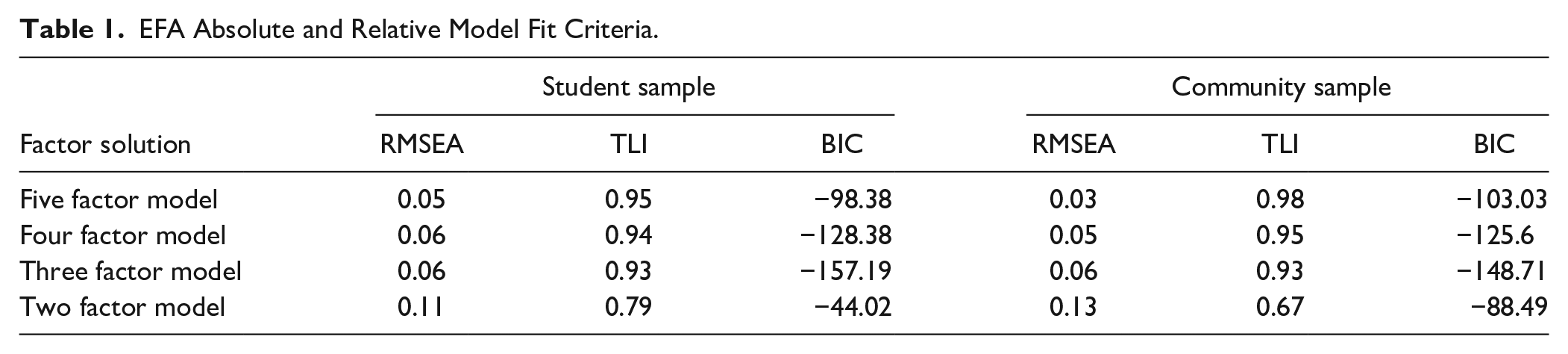
Both samples had a KMO measure of 0.78 indicating a fair and above adequacy score for an EFA (Lorenzo-Seva & Ferrando, 2021), and a significant Bartlett test of sphericity (Student: χ2 = 533.83, df = 153, p < .001, Community: χ2 = 2,143.40, df = 153, p < .001), further supporting the analyses (Zygmont & Smith, 2014). We conducted an EFA on the 18 provisional continuous items of the DCQ separately in each sample. For the student sample, we used pooled, imputed data. Three factor-extracting methods were applied and compared to determine the number of factors to retain: Parallel analysis, the Kaiser “eigenvalue greater than one” rule, and Cattell’s scree-plot test. According to the Parallel analysis and the scree-plot (see Figures 1 and 2 for each sample), the number of factors to extract was four. The Kaiser rule indicated only two factors, which seemed like a possible under-extraction, as the third factor was located just beneath the borderline. As Finch (2020) recommended, we aimed to balance between statistical fit on the one hand and a parsimonious model on the other. Accordingly, in both EFA’s we excluded the same five ambiguous items with insufficient loading on any factor (under 0.40) or because they were theoretically unsuitable to the factor on which they were loaded (a factor consisting of only two, seemingly unrelated, items). The removed items are reported in the Supplemental Materials. Since all methods mentioned above for determining the number of factors have some deficiencies (Ledesma & Valero-Mora, 2007), following the removal of the five items mentioned above, we compared the EFA models using absolute model fit criteria (Finch, 2020) to further explore the appropriate number of factors to retain. These criteria for the remaining 13 items showed similarly good fit for models of three to five factors whereas the two-factor model yielded poor absolute fit, in both samples. We also tested the relative model fit parameter BIC. As all three factors were replicated, results seemed to show a better fit for the three-factor model compared to the remaining models (see Table 1). Furthermore, the three-factor model demonstrated the clearest theoretical logic, rendering it the model of choice. Table 2 presents the results of the EFAs with the extracted three factors after removing ambiguous items. Estimates of reliability were calculated using Omega, thus taking missing data into consideration (Flora, 2020; Zhang & Yuan, 2016). As can be seen in Table 2, results replicated across the two different samples. In other words, H1 was supported, as the DCQ exhibited a stable latent structure. Specifically, the first factor (six items) taps onto the key characteristics of immersive daydreaming; vividness/tangibility, sequential narrative, imaginative fantasy/non-realism, repetitive theme, emotional range, and positive emotional valence. Accordingly, it was labeled Immersive Daydreaming (IDD). A second factor (three items) encapsulates the controllability aspect of daydreaming and awareness of one’s state; hence it was labeled Meta-awareness and Control (MAC). Finally, the third factor (four items) comprises items referring to the function of daydreaming in one’s life and was therefore titled Daydreaming Functionality (FUN). Interestingly, two of the original function items we hypothesized (namely, relieving anxiety and inspiration) were not explicitly loaded on the FUN factor but were rather part of the five excluded items. Thus, the final latent FUN trait representing a general tendency to utilize daydreaming was more limited than we initially planned. McDonald’s omega was calculated for the continuous items for each factor separately. It was ωIDD = .82, ωMAC = .79, and ωFUN = .66. for the student sample and ωIDD = .69 ωMAC = .49, and ωFUN = .53 for the community sample. In both samples the IDD reliability was consistently the highest, with acceptable to good values, whereas the MAC and FUN reliability was acceptable or good in the student sample but quite compromised in the community sample.
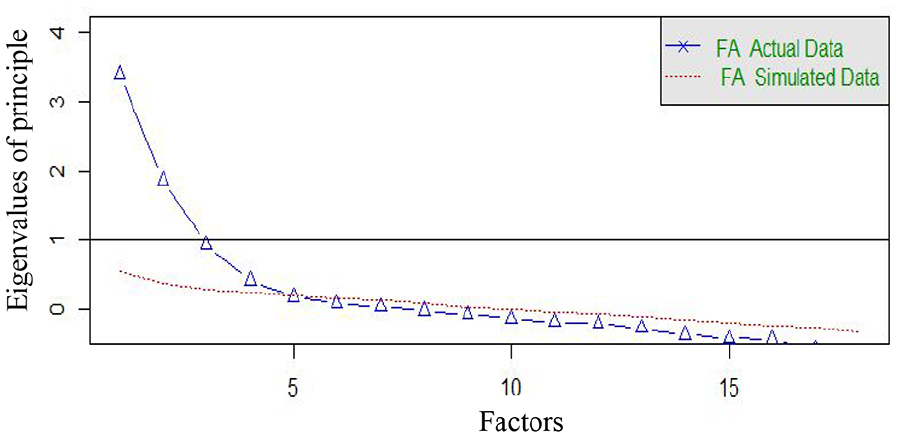
Student sample.
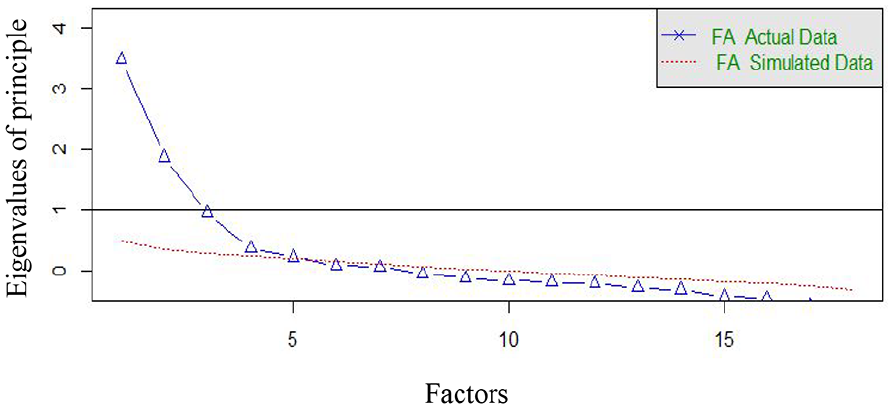
Community sample.
EFA Absolute and Relative Model Fit Criteria.
EFA Factor Loadings (Pattern Matrix), Using Principal Axis Factoring (PAF) With Oblique Rotation.
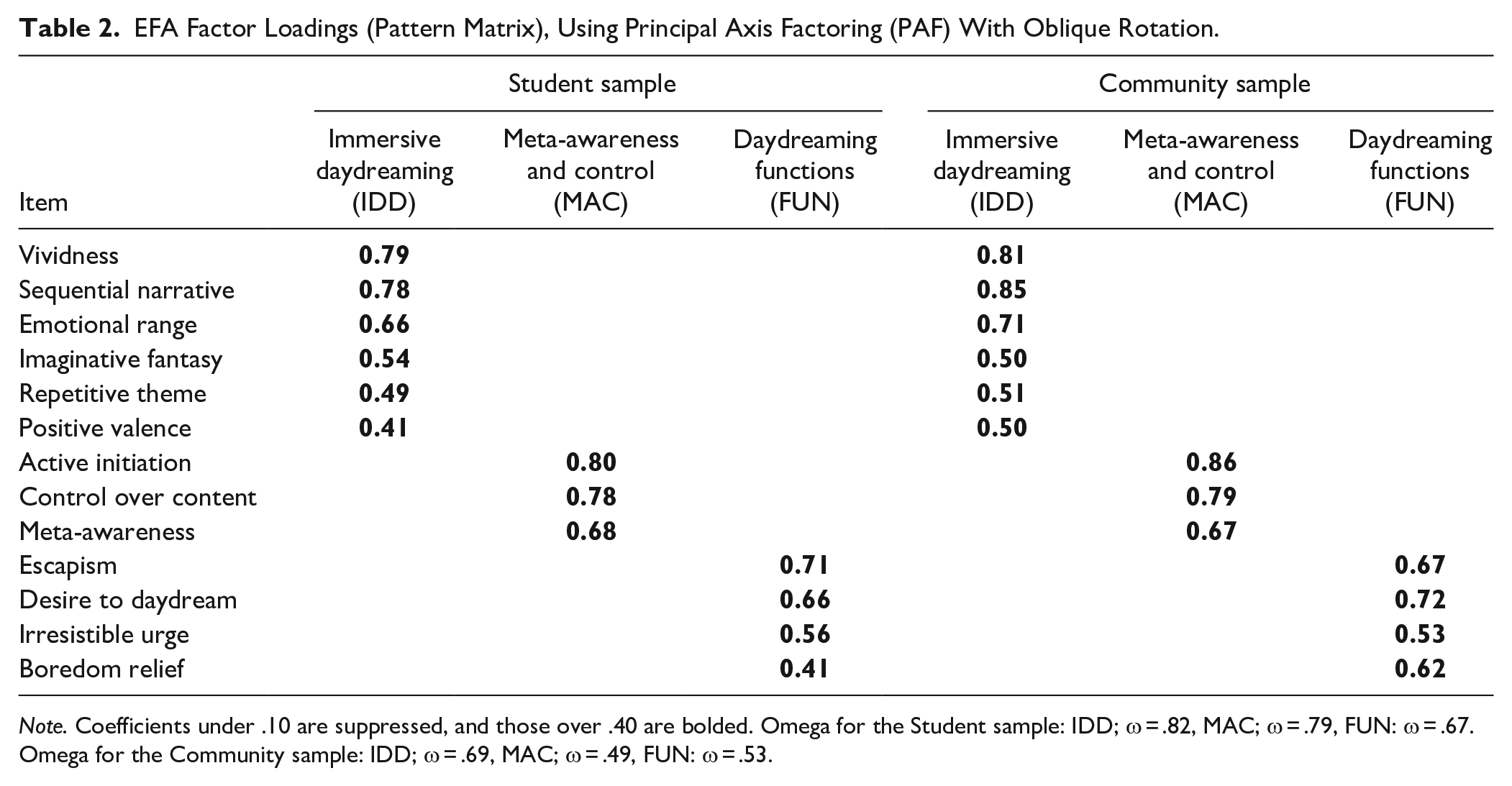
Note. Coefficients under .10 are suppressed, and those over .40 are bolded. Omega for the Student sample: IDD; ω = .82, MAC; ω = .79, FUN: ω = .67. Omega for the Community sample: IDD; ω = .69, MAC; ω = .49, FUN: ω = .53.
Correlation Coefficient Analyses
Next, we examined associations between the study variables: MD, ADHD, MW, AII, general distress, and the new extracted factors. In accordance with previous literature, the pre-existing measure of MD was significantly and positively correlated with ADHD total symptom level, ADHD-Inattention symptoms, and MW (r = .47, 95% CI [0.38, 0.55], p < .001, r = .42, 95% CI [0.32, 0.50], p < .001, and r = .33, 95% CI [0.22, 0.41], p < .001, respectively), supporting this study’s aim to differentiate them. In keeping with that aim, a differential pattern of correlations was observed when examining whether the extracted factors distinguished MD from MW and ADHD. Results show that IDD correlated strongly with MD (students: r = .36, 95% CI [0.26, 0.45], p < .001, community: r = .36, 95% CI [0.27, 0.44], p < .001) whereas its associations with ADHD (students: r = .11, 95% CI [0, 0.21], p < .05, community: r = .10, 95% CI [−0.00, 0.20], ns), ADHD-I (students: r = .07, 95% CI [−0.03, 0.18], ns, community: r = .07, 95% CI [−0.03, 0.18], ns), and MW (students: r = .07, 95% CI [−0.03, 0.17], p < ns, community: r = .09, 95% CI [−0.01, 0.20], ns) were nonsignificant or weak, suggesting that it taps into variance of a mental pattern that is mostly specific to MD rather than general attentional deficiency. Thus, the IDD factor supported H2. When examining the MAC factor, however, H2 was mostly unsupported. In the student sample, MAC was weakly inversely associated with ADHD-I (r = −.15, 95% CI [−0.26, −0.03], p < .05) and MW (r = −.13, 95% CI [−0.25, −0.01], p < .05), but did not reach significance with general ADHD or MD. Similarly, we did not find any significant inverse correlation patterns between MAC and ADHD or MW in the community sample. Finally, FUN partially supported H2, as it was significantly correlated with ADHD (r = .40, 95% CI [0.31, 0.49], p < .001), ADHD-I (r = .35, 95% CI [0.25, 0.44], p < .001), and MW (r = .31, 95% CI [0.20, 0.41], p < .001), but substantially more strongly (z = 5.208, p < .001) with MD (r = .64, 95% CI [0.57, 0.70], p < .001) in the student sample. These patterns were replicated in the community sample: whereas FUN was related to both ADHD-I and MW (r = .32, 95% CI [0.23, 0.41], p < .001, r = .30, 95% CI [0.21, 0.39], p < .001), its relationship with MD was significantly more robust (r = .64, p < .001; z = 6.859, p < .001). In accordance with H3, across both samples, FUN was strongly and significantly correlated with psychological distress, whereas IDD was only weakly related to it and MAC was unrelated. As presented in Tables 3 and 4, in both samples, the IDD and MAC factors were uncorrelated, yet each of them positively and significantly correlated with the FUN factor, suggesting that using distraction for psychological benefits may be associated with various types of distress and mental patterns.
Zero-order Correlations Between Latent Factors and Other Study Variables in the Student Sample, Controlling for Age and Gender.
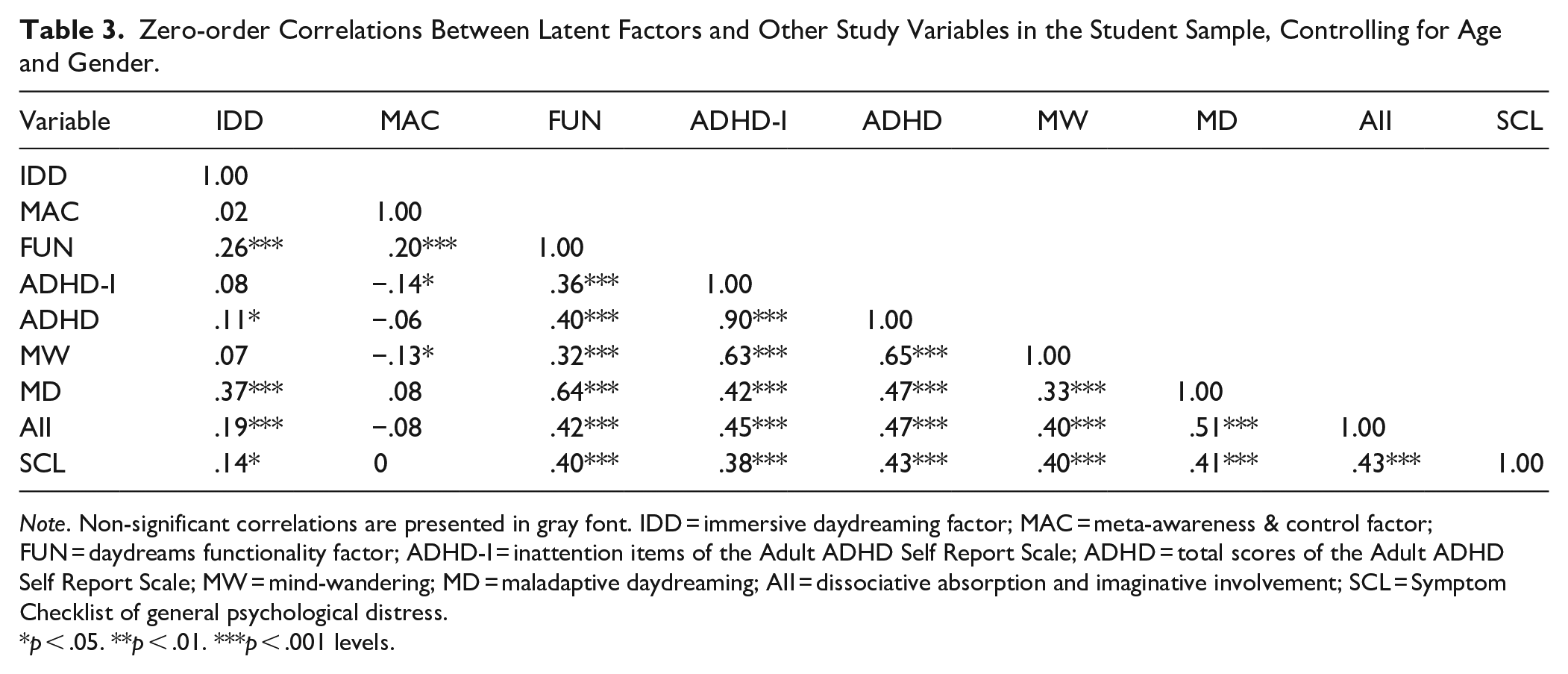
Note. Non-significant correlations are presented in gray font. IDD = immersive daydreaming factor; MAC = meta-awareness & control factor; FUN = daydreams functionality factor; ADHD-I = inattention items of the Adult ADHD Self Report Scale; ADHD = total scores of the Adult ADHD Self Report Scale; MW = mind-wandering; MD = maladaptive daydreaming; AII = dissociative absorption and imaginative involvement; SCL = Symptom Checklist of general psychological distress.
p < .05. **p < .01. ***p < .001 levels.
Zero-order Correlations Between Latent Factors and Other Study Variables in the Community Sample, Controlling for Age and Gender.
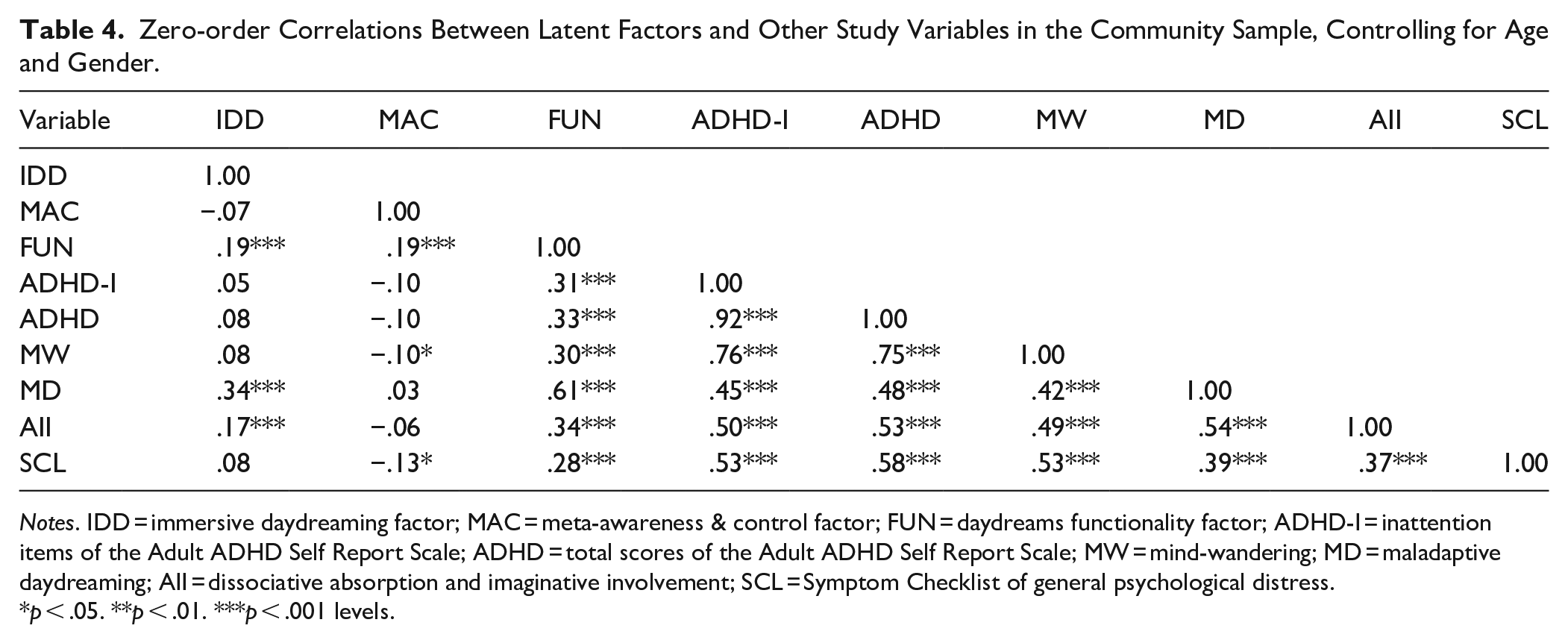
Notes. IDD = immersive daydreaming factor; MAC = meta-awareness & control factor; FUN = daydreams functionality factor; ADHD-I = inattention items of the Adult ADHD Self Report Scale; ADHD = total scores of the Adult ADHD Self Report Scale; MW = mind-wandering; MD = maladaptive daydreaming; AII = dissociative absorption and imaginative involvement; SCL = Symptom Checklist of general psychological distress.
p < .05. **p < .01. ***p < .001 levels.
Because IDD was the only factor with consistently stable and acceptable psychometrics, and the only factor that fully supported the aim that prompted the development of the scale (H2—clear divergent associations between distraction types), we decided to use only these items for the final DCQ, and for examining H4. Hence, we examined whether IDD had significant incremental predictive value over and above AII in predicting MD. Indeed, a linear regression model revealed that adding IDD as a predictor of MD alongside AII improved the model significantly (see Tables 5 and 6), implying that the mental pattern captured by IDD is not identical to AII. To conclude, the final version of the scale comprises the six continuous items of the IDD factor, focusing on immersive daydreaming, and the descriptive item probing on dominant distractions.
Multiple Regression Predicting Maladaptive Daydreaming Based on the Student Sample.

Note. Full model statistics: R2adj = .33, D1(1, 4) = 32.71, p < .01. ANOVA test; ∆R2 = .08, F = 34.33, df = 1, p = .004. AII = dissociative absorption and imaginative involvement; IDD = immersive daydreaming factor; SE = standard errors; CIl, CIu = lower and upper bounds within a 95% confidence interval.
Multiple Regression Predicting Maladaptive Daydreaming Based on the Community Sample.

Note. Full model statistics: R2adj = .38, F1(2, 378) = 118.8, p < .001. ANOVA test; ∆R2 = .06, F = 38.51, df = 1, p < .001. AII = dissociative absorption and imaginative involvement; IDD = immersive daydreaming factor; SE = standard errors; CIl, CIu = lower and upper bounds within a 95% confidence interval.
Discussion
We developed a novel questionnaire, the DCQ, aimed at gauging unique daydreaming characteristics not shared with MW and not assessed by the existing MDS-16. Results of two EFAs in two different types of samples were identical, revealing three distinct latent constructs, but only one of which, namely, IDD, had stable good psychometric properties. Moreover, it was the only factor that showed a clear divergent pattern, which we had aimed for. Specifically, in line with our hypothesis, IDD was differentially associated with MD through variance not shared with MW or ADHD. This lends support to the claim that immersive daydreaming and MW should not be referred to interchangeably, even if to an external bystander both might seem like the person is distracted or “spaced out.” Scales assessing internally generated thought should make an effort to define the construct they wish to evaluate or ask specific questions precisely addressing the thought type, rather than using generic terms like “daydreaming,” “mind-wandering,” or “in a fog,” assuming that this would mean the same thing to different respondents. The results also point toward a difference between IDD and the preexisting dissociative AII scale. IDD had an incremental value over AII in predicting MD, suggesting that daydreaming is a mental activity with specific content and structure properties other than the inclination to become detached or absorbed. Our novel self-report assessment tool focusing on the mental pattern of daydreaming distinguished from MW may advance the field of MD research. Specifically, we discovered that IDD is uniquely characterized by positive feelings but not necessarily by negative ones. Although negative emotions may appear in MD fantasies, negative feelings are not unique to IDD, and thus that item was excluded from the final scale. Indeed, negative emotion is also related to MW (Killingsworth & Gilbert, 2010), and to other specific types of off-task thoughts, such as rumination, worries, obsessions, and painful memories, which means it is less differentiating. Hence, distractions with significant positive emotions may be an important marker of MD, contributing to differential diagnosis when faced with a distracted client. IDD was also characterized by having a range of different emotions within a single daydreaming episode, in keeping with the fantastical narrative. Experiencing unfolding positive emotions has relatively straightforward theoretical logic; it is in congruence with MD as a coping strategy providing short-term comfort through volitionally absorbing in a reinforcing altered reality (Soffer-Dudek & Somer, 2022).
As the correlations of IDD with MW and ADHD inattention symptoms were either weak or non-significant, it seems that prototypical ADHD and MD differ in etiological components undermining attention. Indeed, most cases of ADHD do not involve a reported addiction to story-like fantasy, and not all MD cases are compatible with an ADHD diagnosis (Theodor-Katz et al., 2022). Importantly, the difficulty in preserving one stream of thought in ADHD, manifested often by MW, is only one dimension of ADHD; other dimensions in which executive functions are impaired, for example, difficulties in task switching or response inhibition (Gonen-Yaacovi, 2016) are less common in typical MD reports, supporting the idea that MD and ADHD are separate constructs.
We also found that while MD, ADHD, and MW all relate to functions of relieving boredom, distress, and to difficulty in resisting the urge to fantasize, this association is significantly more robust for people with elevated MD levels. Although we did not include the FUN factor in the final DCQ, due to its compromised psychometric properties, and only partial ability to discern MD from ADHD and MW, some aspects of these associations are worth mentioning. FUN was more strongly associated with MD than IDD. This supports previous work suggesting that some people have the ability for immersive daydreaming that is not necessarily pathological as it is in MD (West & Somer, 2020). Other than immersive daydreaming, MD is also characterized by using daydreams for various psychological functions, which probably relates more to the impairment element of MD. Importantly, those aspects are less efficient at differentiating between the disorders, as some people with ADHD probably use distraction as a relief from boredom, for example. Thus, our new tool focuses on the mental pattern which is more differentiating. It should be used in addition to, rather than instead of, the MDS-16. Additionally, the stronger association of FUN with MD compared to MW and ADHD may point toward a possible difference in the extent to which these functions are a pivotal element underlying internal distractions. Previous studies identified MD as a compensating and regulating behavior derived from unmet needs, specifically, insecure separation and feelings of emptiness manifested in boredom (Brenner et al., 2021). MD has also been associated with vulnerable narcissism, a mental trait marked by an extreme sensitivity to others’ opinions and a desperate need for approval (Ghinassi et al., 2023). Future studies could examine whether the excessive use of fanciful, vivid daydreams to regulate boredom, distress, and unsatisfied or addictive urges may be a secondary function that emanates from deeper emotional needs for acceptance, support, and fulfillment that may perhaps not necessarily play a central role in ADHD.
The controllability aspect of MD and ADHD remained enigmatic, as a clear association between MAC and the two conditions was not detected. This might indicate that MD is not necessarily characterized by an increase or decrease in mental control. The possible absence of a specific controllability pattern characterizing MD might be due to the dual nature of MD. Considering its highly addictive nature (Pietkiewicz et al., 2018; Somer & Herscu, 2017), the ability to retain control over the scope of time spent daydreaming may be limited. MD participants typically report to volitionally initiate them while simultaneously failing to control their frequency and duration. Moreover, meta-awareness and control in MD may not be fixed but rather may fluctuate over time during a specific daydreaming episode. Specifically, awareness and controllability might decrease the more absorbed a person becomes during a specific episode. Alternatively, daydreaming in different settings could be differentially controlled (e.g., home vs. work). Because trait assessments of self-reported MAC do not differentially associate with MD, we excluded MAC from the final DCQ. 3 Perhaps Future studies collecting qualitative data could elucidate the nature of controllability in MD, as well as examine possible moderating variables and use longitudinal designs to shed light on temporal dynamics.
Lastly, descriptive data suggested that distraction through daydreaming was significantly more common among the student sample comprising a younger population. Indeed, the current samples have shown a higher incidence of suspected MD among young adults in a separate publication (Soffer-Dudek & Theodor-Katz, 2022). This should be replicated in additional samples, and age-related factors (e.g., social media use, depicting an ideal life) should be examined as possible mediators.
In conclusion, narrative, emotionally dynamic, vivid daydreams serve as the dominant distraction pattern unique to MD. In cases of impaired attention, when scores on both the MDS-16 and ADHD scales are high, the DCQ may aid in differential diagnosis. Future studies should use it in clinical populations and establish a cutoff. Correctly diagnosing MD is clinically useful, as targeted interventions for MD help reduce symptoms (Herscu et al., 2023). Moreover, ADHD with MD is characterized by higher loneliness and depression compared to ADHD without MD (Theodor-Katz et al., 2022). Such clinical significance is amplified when considering that individuals suspected of having MD were more than twice as likely to have attempted suicide in the past year, even after controlling for general psychopathology and a host of other risk factors (Soffer-Dudek & Oh, 2024).
Some limitations of this study should be considered. The present study was conducted on two large samples. However, we did not employ an iterative approach involving item revision followed by further testing. Implementing a broader iteration process would assist in further developing the DCQ and could potentially improve its reliability. Second, study participants did not undergo a clinical diagnostic assessment for ADHD or MD. Future research should be carried out with clinical populations to evaluate the DCQ’s performance. Lastly, MW was assessed using the MWQ which considers MW as a broad term encompassing any thoughts unrelated to the task at hand. This inclusive perspective is contrasted with the dynamic perspective of MW which we endorse theoretically. Future studies may benefit from using MW measures that capture the unique dynamic aspect of MW. Still, the insignificant correlation of IDD and MW in this study supports the idea that immersive daydreams and MW should not qualify as equivalent constructs.
Despite its shortcomings, this study also harbors several strengths; the samples’ characteristics differed substantially, yet the exploratory findings were replicated. This study provides further evidence for the existence of at least two different types of distraction in terms of attentional scatteredness versus coherent fantasy. This also resonates with contemporary literature in the field of MW striving to better define the boundaries of MW (Andrews-Hanna, et al., 2017; Irving, 2021). Untangling MD and ADHD further supports the notion that MD deserves recognition. MD is primarily characterized by difficulty in staying present in reality, with a withdrawal toward an internal fantasized world. The resulting impaired attention is one of several secondary outcomes. Hence, MD should be considered a separate disorder from the current ADHD diagnosis.
Supplemental Material
sj-docx-1-jad-10.1177_10870547251319081 – Supplemental material for Where Is My Mind? The Daydreaming Characteristics Questionnaire, a New Tool to Differentiate Absorptive Daydreaming From Mind-Wandering
Supplemental material, sj-docx-1-jad-10.1177_10870547251319081 for Where Is My Mind? The Daydreaming Characteristics Questionnaire, a New Tool to Differentiate Absorptive Daydreaming From Mind-Wandering by Nitzan Theodor-Katz and Nirit Soffer-Dudek in Journal of Attention Disorders
Footnotes
Author Note
This study is based in part on the first author’s doctoral studies, under the supervision of the second author.
Declaration of Conflicting Interests
The author(s) declared no potential conflicts of interest with respect to the research, authorship, and/or publication of this article.
Funding
The author(s) received no financial support for the research, authorship, and/or publication of this article.

Supplemental Material
Supplemental material for this article is available online.
Notes
Author Biographies
References
Supplementary Material
Please find the following supplemental material available below.
For Open Access articles published under a Creative Commons License, all supplemental material carries the same license as the article it is associated with.
For non-Open Access articles published, all supplemental material carries a non-exclusive license, and permission requests for re-use of supplemental material or any part of supplemental material shall be sent directly to the copyright owner as specified in the copyright notice associated with the article.
