



Abstract
Can the pretend and fanciful impinge upon reality? Over two studies (of which the second was pre-registered) we examine to what degree there is a ‘cognitive quarantine’ between the real and the imagined. We examine the permeability between real and fictive identities (using the ‘identity fusion’ construct), and establish a novel ‘cognitive porousness’ scale. We outline several theoretically relevant factors, such as emotional intensity, unpleasantness, and enjoyment which we expected to influence permeability. We also examined the Euclidean distance between one's real and one's fictive personality and moral identity. We find one's identity is influenced by the trait permeability of the participant, as well as the moral overlap between the participant and their character. This research demonstrates the tractability of examining adult pretence from a quantitative and cognitive perspective.
Introduction
Humans are uniquely capable of imagining impossible and fantastic realities and operating within them in consistent and coherent ways. Most often the study of pretence and imagination is limited to children (Fein, 1981; Göncü & Perone, 2005; Nielsen, 2012; Pellegrini & Smith, 1998; Piaget, 2013), but recently scholars have argued that adults engage in imaginative pretend play more than has been previously recognized (Kapitany et al., 2022; Lillard et al., 2011; Weisberg, 2015). The cognitive foundations of pretend play were laid out by Nichols and Stich (2000), and here we apply a core concept of pretend play to adults. Specifically, we address their concept of cognitive quarantine - the ability for a pretender to recognize that the imagined events do not influence the real world and that the real world need not influence the imagined (Leslie, 1987) - and demonstrate that this quarantine is, in fact, porous. We term the influence of the imagined on the real (and the real on the imagined) cognitive permeation. We demonstrate over two studies that self-reported scores on a general permeation scale strongly and uniquely predict the degree to which novel, idiosyncratic, fictional characters influence our own personal identities.
According to Nichols & Stich (2000) four conditions must be met in order for play-behaviour to qualify as imaginative pretence: there must be an agreed upon premise, inference from the premise, subsequent embellishment, and finally, action. The classic example is that of the banana and the telephone. In this scenario, the premise is that a piece of fruit is actually a phone; the inference is that, if the banana is a phone, then it is capable of making and receiving calls; the embellishment is open-ended inasmuch as the pretender can decide to call their mother, order a pizza, or act as-if they are receiving a call from Nobel Prize Committee in Stockholm; the action may be relatively minimal: the banana is placed against the head, and a series of otherwise unjustified speech-acts are executed. The cognitive quarantine in this scenario is the awareness that, however much one would like it to be so, we will not actually be awarded a Nobel Prize. Cognitive quarantine describes our capacity for understanding that the content of pretence will not influence the real world, nor does the pretending need to hold to real-world conditions (there is no Nobel Prize for Psychology).
If we accept that imaginative pretence has a premise, inference, embellishment, and action, then we might also regard the classic Trolley Problem as such an act. One of the most famous examples of this was proposed by Foot (1967) and modified by Thomson (1984) in which individuals are asked to imagine themselves standing on a footbridge watching a runaway trolley thunder towards a group of five workers. Also on that footbridge is a large man who is leaning over the railing and watching the trolley; the individual is then informed that if they were to shove this man over the railing that it would stop the trolley. This action would kill the large man but save the five workers. Here, an individual is asked to accept the premise that they are on a footbridge with a large man overlooking a handful of oblivious workers who are certain to die. The inference (often made explicit) is that without sacrificing the large man (whose body has unique trolley-stopping properties) then the workers will certainly die. Participants are asked to commit to an action (which, often, is simply a speech act). While embellishment is not usually a requirement of the vignette, the unlikely outcome of a single large man's body to stop a runaway trolley is an embellishment upon the premise; meanwhile, participants seem to automatically respond to thought experiments with embellishment by making changes or adding features to these cases (Hansen et al., 2022). Though minimal, participating in such thought-experiments do constitute a form of imaginative play. Academic moral dilemmas - of which the Trolley problem is arguably the most famous - represent a unique and arousing category of thought-problems that allow us to examine the ways in which engaging in something imagined (such as the act of killing) can influence, and be influenced by, the real.
One form of pretence common among adults is when adults engage in Table-Top Role-Playing Games (TTRPG), a practice wherein individuals (often referred to as a ‘player’) assume the role of a player-character - one which they invented, chose, or were assigned - who must navigate a co-constructed, collaborative, imagined world (Bowman, 2018; Bowman & Lieberoth, 2018). Kapitany et al. (2022) describes the practice by which social groups co-construct fictional worlds within which inference and embellishment are made, and in which the action is the act of role-play as ‘pretensive shared reality’. Many common examples of role-play with a pretensive shared reality (sometimes referred to as ‘Bounded Imagination’) can be found in the genre of TTRPGs, of which the most famous example is Dungeons & Dragons (D&D).
Of particular interest is how effectively players can cognitively quarantine their own personal identities from the identities and actions of the player-character they operate. A key attraction of TTRPGs is that players can express agency in scenarios unlike the real-world (Deterding, 2017; Nguyen, 2020). Consider a fantastical scenario in which one experiences a prophecy that an infant, in later life, will rise up and cause a genocide, and that having received this prophecy, one must decide the infant's fate. Or more simply: is sacrificing a baby justified if it saves many other lives. Such a scenario is similar to the famous moral dilemma in which an individual in a warzone must choose whether to smother a crying baby in order to avoid detection by the enemy (Cushman & Greene, 2012), or more colloquially, if you can time-travel is it your responsibility to kill Hitler as a baby? Such experiences are impossible in everyday life, but not so in a pretensive shared reality. How effective, then, is the cognitive quarantine between the ordinary player (who has an aversion to both killing babies, and to genocides) and the player-character (who may not); what effect does operating a player-character in such moral dilemmas have on the player's own beliefs, and the degree to which they feel the player-character is an extension of themselves?
Our personal identities are constituted by our own values and beliefs, as well as our social identities and the values, beliefs, and behaviours of the groups we associate with (Amiot et al., 2007; Gómez et al., 2011). A personal identity (i.e., a sense of self) is enduring mode of self-regard, in which specifics values and beliefs - depending upon circumstances - are made salient by circumstance or affiliation, which - when salient - guide subsequent behavior, and feedback into one's own cognitions (Burke & Stets, 2022). In TRPG, players create fictional player-characters who may have differing sets of moral principles, values, beliefs, and social groups. While someone may endorse deontological principles in the real world (killing is always wrong), a pretensive decision may reflect teleological endorsements instead (killing is sometimes justified, or even, killing is fun; Greene et al., 2001). Players recognize that player-characters are fictional, that they do not exist, and cannot exert any effect upon the world (and are principally immune to influences from the real world), and yet qualitative studies report an affiliative kinship between player and player-character (Sidhu & Carter, 2021; Wright et al., 2020). A rich accounting of cognitive quarantine should hold that the player-character will have no influence upon the real-world of the player, and that the player should be free to operate a player-character in whatever manner they choose without repercussion 1 . However, such an account is too rich, and we assert that the cognitive quarantine is permeable.
One mode of identity construction is that of identity fusion (Gómez et al., 2011; Reese & Whitehouse, 2021; Swann & Jetten, 2018). Identity fusion is a ‘visceral sense of oneness with a group’ (Fredman et al., 2015; Whitehouse et al., 2017), and the target measure of this construct can be anything from people whom an individual knows personally, such as one's family members, to groups of individuals that the individual does not know personally, such as fellow citizens or co-religionists; a fusion target can even be a single individual such as ‘Donald Trump’ (Kapitány et al., 2020). Figure 1 illustrates one way to measure fusion; we have chosen fusion for the study of the imaginary, for its metaphorical congruence between the identity of the self, and that of one's character, and it's established and validated properties as a measure of ‘inclusion of other in self’ (Aron et al., 1992). Given that a player-character is (typically) a creation of the player we expect to be able to identify the phenomenon of permeation by examining how the identity of the player character impinges upon the identity of the player/participant via the fusion construct.
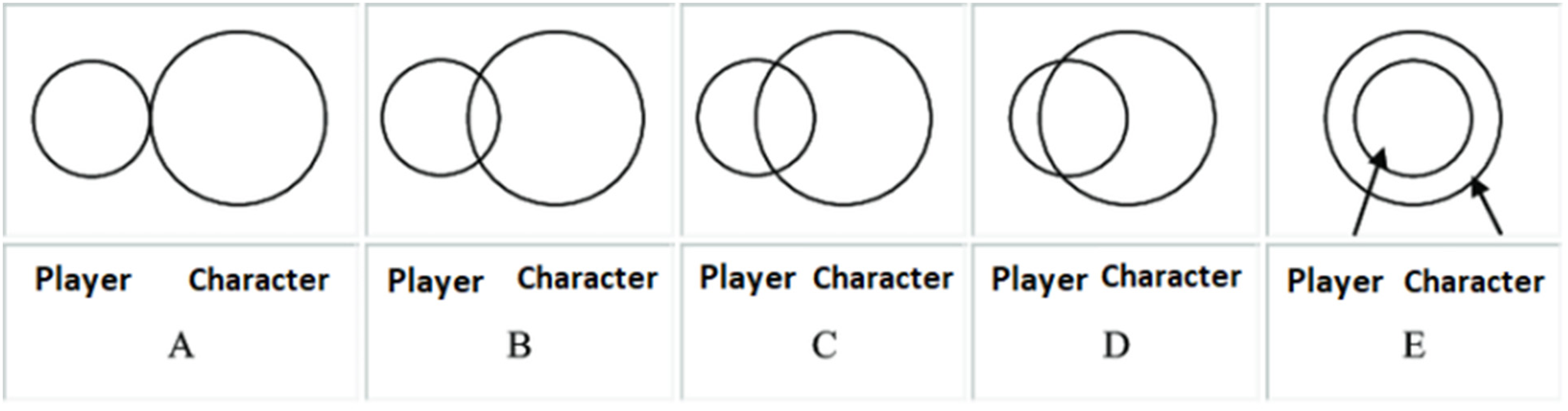
The pictorial fusion scale.
Having already established that scholarly moral dilemmas are arguably a form of pretend play, and that identity informs our beliefs, values, and behaviour, it is worth considering the larger context of moral reasoning and decision making. Moral philosophers and moral psychologists frequently use moral dilemmas to assess moral decision-making. In these cases, participants are presented with a conflicting situation in which they are required to entertain two courses of action and their subsequent outcomes, which both have moral implications. However, tension arises because these two courses of action are incompatible and only one can be endorsed (See: (Christensen & Gomila, 2012; Sinnott-Armstrong, 1988). As described previously, in the Large Man variant of the Trolley Problem, one must decide whether to 1) push (and kill) the large man to save the workers, or 2) refuse to do anything and allow the trolley to kill the workers. Importantly, we cannot carry out both actions and so we are forced to choose between two outcomes: 1) to endorse the characteristically utilitarian outcome by sacrificing one life to save more lives or 2) endorse a characteristically deontological outcome by refusing to sacrifice one life despite the outcome Thomson (Foot, 1967; Thomson, 1984).
Research has identified a series of moral principles in these cases that evoke strong emotional reactions and subsequently impact moral decisions. For example, if harming an individual is likely to cause serious bodily harm and/or is carried out via physical contact, this is theorised to generate greater emotional engagement (Christensen & Gomila, 2012; Greene et al., 2001). Importantly, the way that we respond to these cases is not only predicted by features of the dilemmas themselves but also our own states and traits. Affective empathy for example, has been negatively associated with endorsements of harm in these moral dilemmas (see Nasello & Triffaux, 2023 for a review) and particularly in moral dilemmas that evoke strong emotional reactions Bostyn et al., 2018; Conway et al., 2018; Conway & Gawronski, 2013; Hannikainen et al., 2018; Patil & Silani, 2014). How we respond to moral dilemmas is also connected to our moral identities and more specifically, the extent to which being a moral person is part of our core identity (Conway & Gawronski, 2013). Indeed, the moral roles that we identify impact our moral behaviours and responses in conflicting situations; are we the agents of moral actions (i.e., the villain versus the hero), or are we the patients of these moral actions (i.e., the victims or beneficiaries) (Goranson et al., 2022). As such, moral dilemmas provide us with a tool that can 1) evoke strong emotional reactions and 2) track central features of our values, traits, and identities.
In our study, participants will be experiencing moral dilemmas via a fictive character of their own creation. Unlike classic moral dilemmas where the participant is asked how they, personally, would react, we will be asking participants how their character will react. In principle, the cognitive quarantine between the self and the character ought to prevent the permeation of emotions from player-to-character, or character-to-player. However, we hypothesise that this is unlikely. We also note that, while some research into moral cognition treats a participants’ response to the dilemmas as an outcome variable, we do not; we use the vignette and the subsequent decision as merely a stimulus for facilitating a participants’ engagement with their character. How they chose to respond, and indeed, what they chose to respond to (within the vignette) is up to the participants free choice, as is characteristic of pretend play).
To return briefly to identity fusion, research has consistently shown that intense and negative emotional experiences shared with a group generate fusion with that group (Fredman et al., 2015; Gómez et al., 2011; Kapitány et al., 2020; Kavanagh et al., 2020; Reese & Whitehouse, 2021; Swann & Jetten, 2018). Thus, the properties of moral dilemmas - as an emotionally potent simple-form of pretend play that is tied to our intrinsic values, traits, and identities - are an ideal stimuli to determine whether imagine pretend events (with one's fictive character) can permeate and influence one's own (real) sense of identity.
Before we proceed to our hypotheses, we must acknowledge scholarship in adjacent fields. While this work is motivated by the theories and assumptions to social and cognitive psychology, scholars in anthropology and game-studies have long regarded with curiosity concepts analogous to ‘permeation’ and ‘quarantine’. The concept of ‘bleed’ is one such topic, and refers to “thoughts, feelings, physical state, and relationship, dynamics of the player affecting the character and vice versa” (p. 4. Bowman, 2013). Bleed is often regarded as ‘unpredictable’ (Bowman, 2018), but may be intentionally sought by players. Similarly, the term ‘magic circle’ can be used to describe the limits (physical, temporal, or otherwise) of that which is ‘real’ and that which is part of a game (Stenros, 2014), though the utility of this term is debated (see: Calleja, 2012; Consalvo, 2009). And though these terms, and in particular ‘bleed’, are thoroughly discussed in other fields, they may lack some degree of conceptual clarity (Hugaas, 2024). The discussion contained herein is grounded, motivated, and directed at the fields of social and cognitive psychology, and while these adjacent terms have been helpful in conceptualization, their nuances have not been incorporated into the a priori planning or writing of this work.
Hypotheses
We have two hypotheses:
Identity fusion (as measured by the verbal and pictorial fusion scale, Jiménez et al., 2016) between participant/player and their player-character will be positively predicted by the degree of self-reported cognitive permeation. Player/Participant self-rated (2a) enjoyment of, and (2b) engagement [32] with, the moral dilemmas will positively predict Cognitive Permeation
Note that measures without citations are either single-item questions, or novel measurements, and are described in the appropriate sections hereafter.
Study 1
We have chosen to examine this topic within the context of Dungeons & Dragons (D&D) for several reasons. First, Kapitany et al. (2022) have argued that games like D&D are well-calibrated to create a pretensive shared reality, a rich and enduring alternative reality, wherein the open-endedness is a feature, not a bug. Second, we are using the approach as it closely approximates the ordinary experience of tens of millions of individuals when they play such games. Thirdly, the infrastructure built around D&D - primarily the online portal www.dndbeyond.com - is well suited to the purpose of creating a coherent fictional player-character.
Study 1. Participants
Our final sample for study 1 included 80 participants (16 from an Undergraduate population - UG; 64 recruited from Prolific - P). An additional six individuals were excluded for response durations of less than 10 min (five undergraduates, one prolific respondent). The sample included 38 self-identified men, and 42 self-identified women (including one trans-woman). To ascertain gender identity we asked participants “What gender do you identify as” and provided an open responses box. All terms related to man/male and woman/female were coded as 1 and 0 respectively. Instances of trans-man or trans-woman were coded as man and woman respectively, and instances of ‘non binary’ or other categories that stood outside of binary categorization were treated as missing data (for the sake of statistical integrity). t-tests revealed no significant differences on any measure between these two groups, with the exception of age (MUG = 25.56, SDUG = 6.62; MP = 39.52; SDP = 11.89; t(45.34) = 6.27, p < .001). As a result, we have aggregated these two groups into a single population.
Prolific participants were paid £4 for an anticipated 30-min study. Participants were fully briefed (without deception) and provided informed consent via the survey software; this study received ethical approval from The Psychology Student Project Ethics Committee (SPEC) at Keele University (PSY-2021-338). Data was collected between early May and late June in 2022.
Study 1. Methods
The entire survey, including all questions and items, are available in Supplementary Material 1. The survey was administered remotely. Participants were recruited online and were free to complete the survey on their computer at a time of their choice, without direct interaction with a researcher.
Participants provided their age and gender, and an indication of how much experience they have had playing TTRPG's. They were then instructed to visit www.dndbeyond.com to create a fantasy role-playing character (we created instructional videos on how to interact with the site and character creation process; see Supplementary Material 1). Thereafter, participants reported their character's name and their ‘class’ (e.g., Wizard, Warrior, Paladin, Rogue, and so on). The name of the character was piped into subsequent questions so that in most vignettes the character was referred to by name.
Participants were then presented with a random subset of five moral dilemmas (from a pre-tested set of ten; see Supplementary Material 2). These dilemmas were closely modelled on classic moral dilemmas, but were expanded to include narrative details, and were framed in a fantasy/D&D context. The purpose of this was to heighten the salience that this was a pretensive act, and that participants were expected to describe how their character would respond rather than how they themselves would respond. Participants were instructed to describe the behaviour and beliefs of their character in these dilemmas. We strongly encourage the reader to review our dilemmas in the Supplementary Material 2 before proceeding, however we will provide an example below.
For each dilemma, the participant was required to describe, in detail, the response their character would make in that situation, as well as to rate on two three-point scales how much they were engaged by, and enjoyed, the scenario. After five vignettes, participants were asked to spend one-minute describing how their understanding of their character changed as a result of answering the vignettes (no analyses were conducted on this data, but are freely available to scholars at https://osf.io/qjk27/). Finally, participants responded to our novel 12-item Cognitive Permeation Scale (note: participants didn’t answer the ‘Social’ subset of question due to the solitary nature of our protocol; see Table 1) as well as the seven-item Identity Fusion Scale and the pictorial Identity Fusion scale (Figure 1; Gómez et al., 2011).
All Items in the ‘Cognitive Permeation’ Scale, Including the Anticipated Direction of Permeation, and the sub-Scale to Which They Belong. Participants Were Asked to What Extent They Agree with Each Statement.
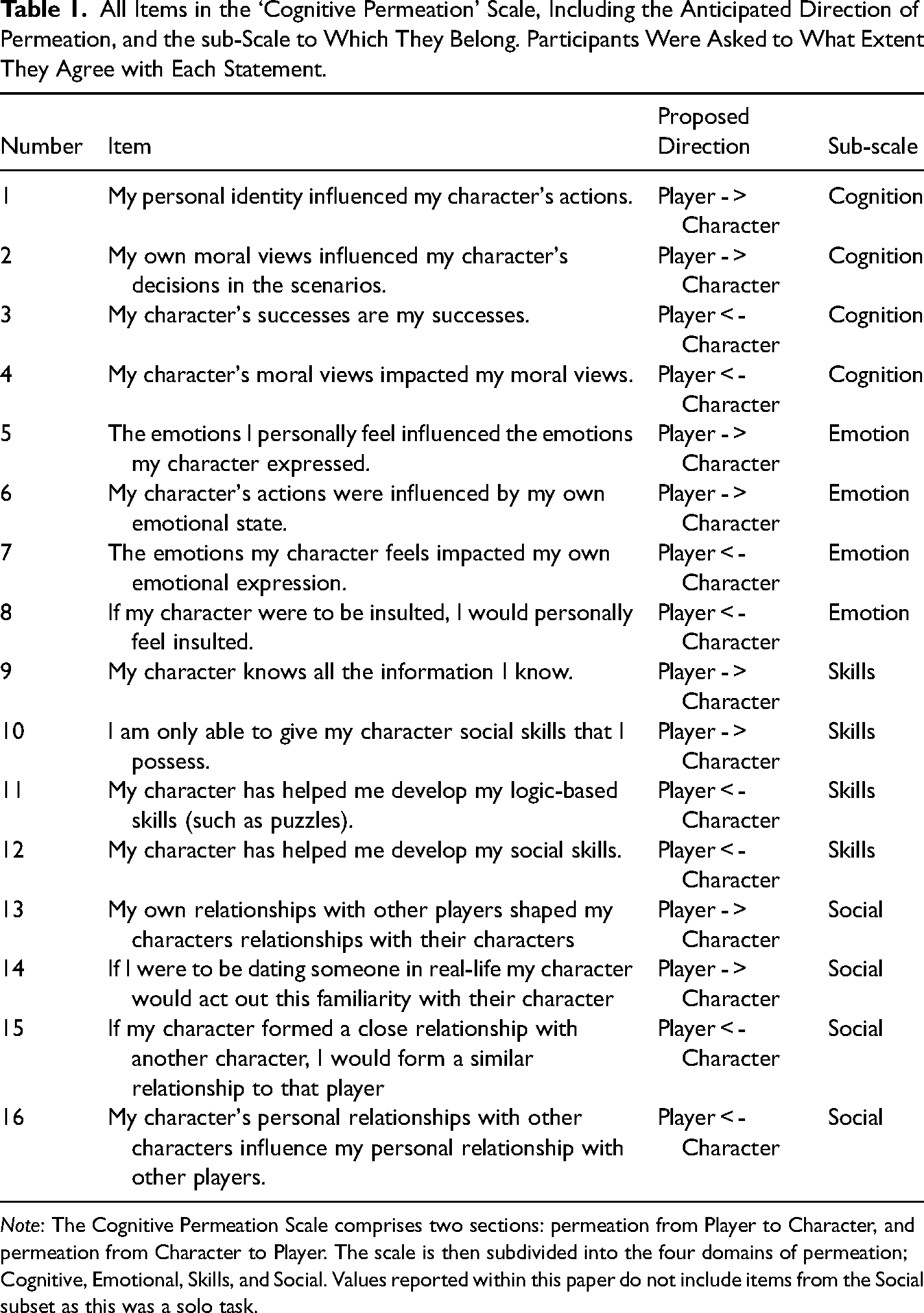
Note: The Cognitive Permeation Scale comprises two sections: permeation from Player to Character, and permeation from Character to Player. The scale is then subdivided into the four domains of permeation; Cognitive, Emotional, Skills, and Social. Values reported within this paper do not include items from the Social subset as this was a solo task.
Our moral dilemmas were all modeled on sacrificial moral dilemmas frequently used in moral psychology, but - in keeping with the tone and aesthetic of D&D, and to heighten the salience that these dilemmas were to be considered pretensive in nature, and that participants were not to consider how they themselves would react, but how their character would react - we adapted them to a fantasy setting. In order to encourage open-ended responses, and to prepare participants for the unusual set of questions, we provided an elaborated example of a vignette with a range of examples (see: Supplementary Material 1). It is important to note that participants were given the following instructions: On the following pages you will be presented with a series of moral dilemmas in the form of a loose narrative. We would like you to respond to the dilemmas from the point of view of [your character]. There are no right or wrong answers to these questions, there are simply things that [your character] would do in the stated situation. Please spend time considering each, and writing a few sentences about what kinds of action [your character] would take… You can do anything you like. Please feel free to write anything - however wild - if you think it would be consistent behavior for [your character]. We caution the reader that some of the vignettes are highly emotive and somewhat disturbing, containing themes related to murder, infanticide, slavery, and sexism, but here present one of the lower-arousal vignettes here for the purposes of illustration. You have been tasked by Sheela Nyig, your village elder, to fight a great and powerful Hag (a kind of grotesque witch) several days’ hike away. This Hag has been terrorising the area. You have been travelling in the wilderness for several days and have run out of food rations. You will need your strength for the fight ahead of you and there is no sign of a nearby village. From the undergrowth you hear the sounds of something moving towards you, and then a large beast emerges. Before you, you see an injured Owl bear (a large bear-like creature with the face of an owl) limping out of the undergrowth with an arrow in its side. It seems to be hurt, but not mortally wounded. Once it spots you it begins growling at you and backing away slowly whilst keeping you in its sights. You notice that hiding behind it are a couple of young Owlbear babies. You can tell from its actions that it is trying to keep its young safe and out of your line of sight.
Study 1. Results
Of our 80 participants, 25 had no prior experience with Table-Top Role-Playing games at all, and 28 had ‘below average’ or ‘well-below average’ experience; only 10 participants reported well-above or above average experience.
For each vignette participants were asked Did you enjoy this scenario, and, Did you find the scenario engaging. Participants responded with ‘Yes’ (2), ‘Not sure’ (1)’ and ‘No’ (0). We computed a sum-total score for enjoyment (M = 7.99, SD = 2.21) and engagement (M = 8.62, SD = 1.87).
The Cognitive Permeation scale was measured on seven-points (1 = Strongly Disagree, 4 = Neither Agree nor Disagree, 7 = Strongly Agree), and a mean score was computed. The three subscales (‘Cognitive’, ‘Emotional’, and ‘Skills’, but not ‘Social’) demonstrated acceptable psychometric properties in aggregate (α = .89; M = 4.53, SD = 1.04). We conducted an exploratory factor analysis to determine whether the scale was constituted by multiple factors (either by ‘direction’, or by sub-scale), and the goodness-of-fit metrics indicated a single factor was sufficiently complex. Thus, we treated the Cognitive Permeation scale as a single item. The seven-item Identity Fusion scale (range: 1–7) demonstrated acceptable psychometric properties (α = .88; M = 4.02, SD = 1.09), while the single-item pictorial fusion scale (range: 1–5) conformed to a normal distribution (M = 2.93, SD = 1.09). We present a correlation matrix between all items of interest in Table 2.
Regression Results for Both Measures of Identity Fusion.
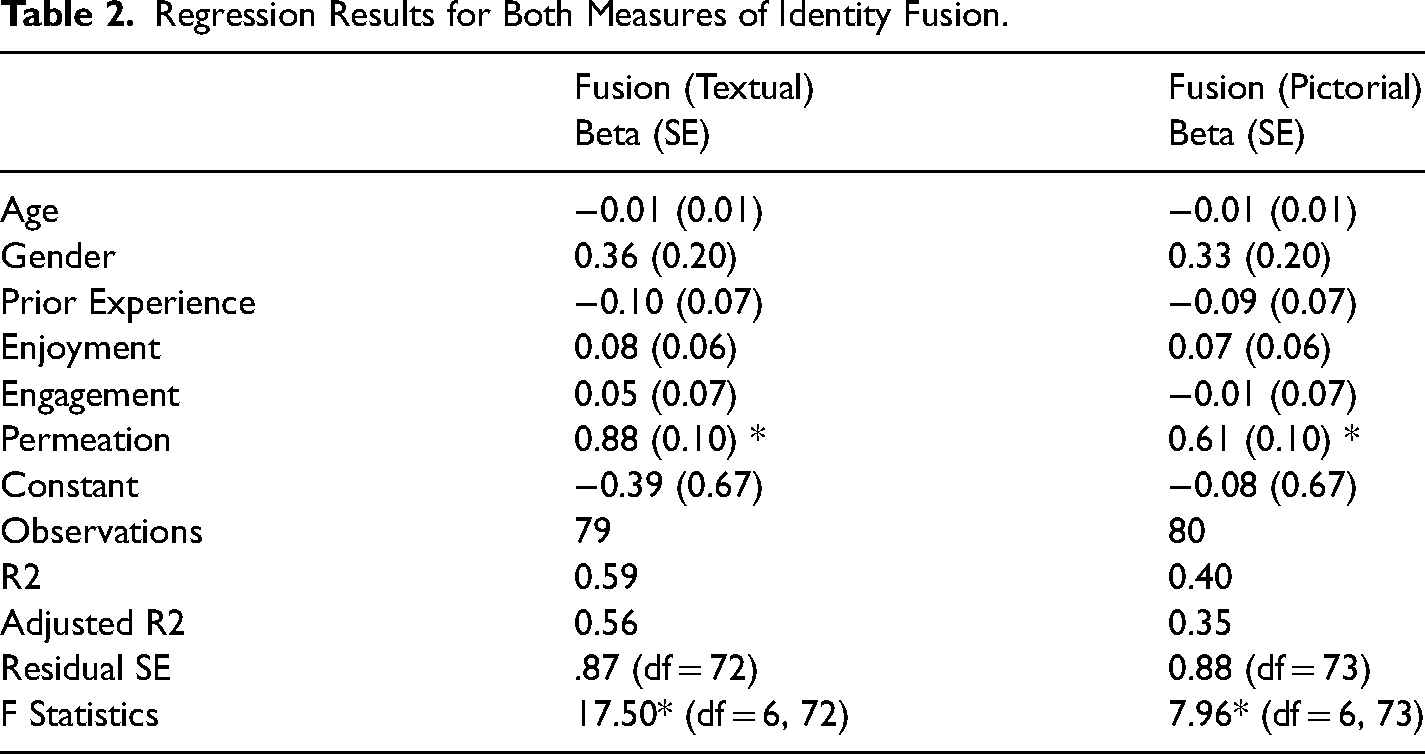
We conducted two regressions, one on each measure of Fusion (we acknowledge that these are not independent of each other. Both were included as the fusion scale has not been used on imaginary targets of this nature. We expected the pictorial measure to provide a better representation of ‘oneness’ of the relationship between player and character; Gómez et al., 2011); and the textual measure was used as it is more highly validated; Jiménez et al., 2016). Of all our predictors, only Cognitive Permeation significantly predicted fusion with one's character (p's < .001; see Table 3). See Figure 2 for graphical representation of relationship.
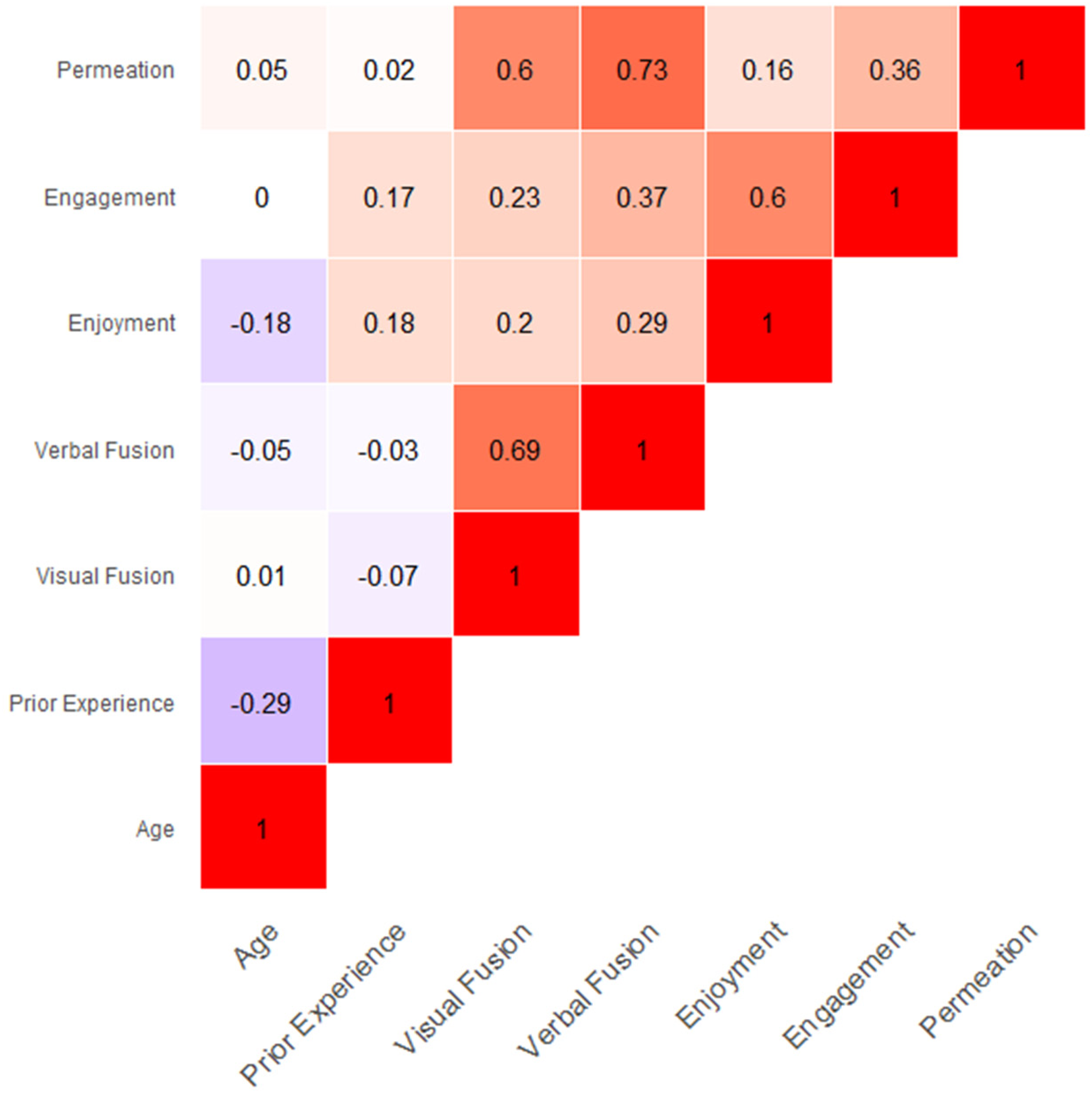
A correlation matrix of all core variables in study 1.
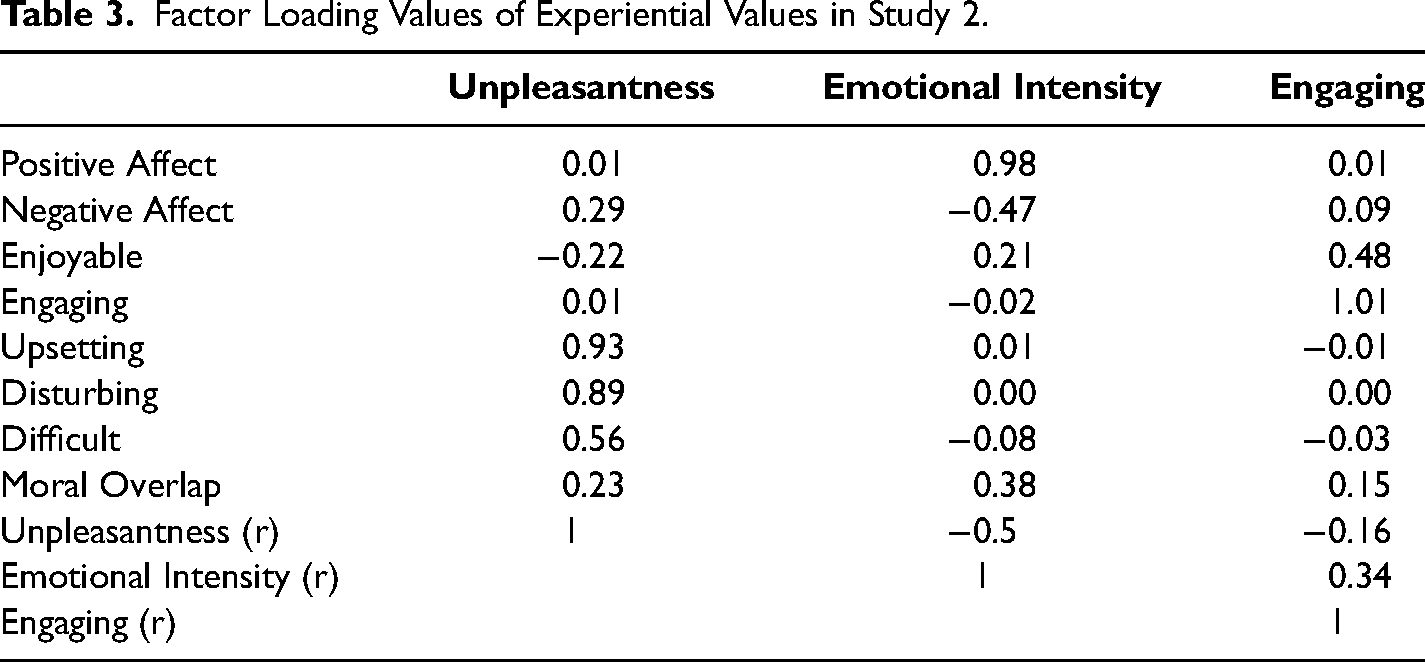
Factor Loading Values of Experiential Values in Study 2.
Per hypothesis 2, we analysed to what extent (if any) enjoyment, and engagement, with the scenarios predicted cognitive permeation. We found a significant model fit, R2 = .14, F(2, 77) = 5.93, p < .01. Enjoyment did not predict permeation, p = .48, but engagement did, b = .23 (SE = .07), p < .01. This was despite the fact that these two measures were correlated at r = .60.
Study 1. Discussion
In study 1 we were primarily interested in determining whether or not the cognitive quarantine, as described by Nichols and Stich (Nichols & Stich, 2000) is permeable. That is, would the imagined actions and beliefs of a fictive character influence the real world. We operationalized the ‘real world’ in this context to be the participant's sense of identity. A rich accounting of cognitive quarantine suggests that people are aware that pretend actions cannot influence the real world, and that the real world does not influence the pretend. We examined permeation of cognitive quarantine by asking participants to create a fictional character, and asking them to respond to narratively-rich and fantastically-themed moral dilemmas.
We examined two hypotheses. The first was that self-reported cognitive permeation would positively predict identity fusion between participants and their player-character. After controlling for age, prior experience, enjoyment, and engagement with scenarios, only permeation predicted fusion. And while the two fusion measures are not independent of each other, we found this relationship in both analyses, and in both cases the beta was strong (.609 for the pictorial measure, and .875 for the textual measure). Our second hypothesis examined the extent that enjoyment, and engagement, with the scenarios predicted permeation. We found that only engagement did so.
Our novel cognitive permeation scale interrogated the degree to which players quarantined their own cognitions from their character, and the supposed experience of their character from themselves. For example, many players reported it difficult to keep their own knowledge and emotions quarantined from their character - we designed high conflict and emotionally-salient moral dilemmas that involved high stakes decisions - but unlike classic vignettes and trolley-type moral dilemmas, we were not asking people to consider how they would act, but how their character would act. A rich reading of cognitive quarantine would suggest that while I, the player, may have issues with murdering a baby to prevent a genocide, my fictional character need not feel similarly. And yet, people reported their emotions permeated into their character, and emotions from their character permeated into them (qualitative participant responses are available in the dataset at https://osf.io/qjk27/).
For example, many participants reported a sense of ‘surprise’ in how their character reacted, which we interpret as the cognitive quarantine functioning as intended (as the participants did not, by their own report, have full access to the ‘mind’ of their character): “… they [the character] did develop in a very interesting and exciting way and they did not always do what I expected them too (sic). My character developed into quite a caring role who understood forgiveness. He killed a dragon in the first scenario but tried to save an owlbear and it's family in the last one” “At first I thought he [the character, Timmus] was a barbarian who had an insatiable bloodlust, but it turns out he is empathetic and sensitive. I suspect this is me rather than my character, but it was a surprising development. Timmus can help others and use his intimidating appearance and demeanour to influence others. He is a valuable asset”
Study 1 is, to the best of our knowledge, the first of its kind. We were not only able to identify that the act of imagining a fictive agency may permeate one's own sense of identity (on a validated scale), we demonstrated that our novel permeation scale is reliable, and predictive of identity fusion. We also demonstrated that engagement (but not enjoyment) may serve as a mechanism for this process. In study 2, we improve upon various weaknesses, and explore additional explanatory variables.
Study 2
In study 2 we made multiple methodological improvements, and pre-registered our analytic plan (https://osf.io/dqn3t); all materials, protocol, and data are also available at this address. The survey was administered remotely. Participants were recruited online and were free to complete the survey on their computer at a time of their choice, without direct interaction with a researcher.
Character creation. In study 1 participants were asked to setup a ‘dndbeyond.com’ account in order to make a character. While the use of this tool is authentic to the D&D context, the process is overly complex and time-consuming for experimental purposes. For this reason, we built an analogous process within our survey software which, while slightly less flexible, was more easily understood, more efficient, and designed with our experimental protocol in mind. This procedure is available as a qualtrics/.qsf file at https://osf.io/dqn3t. By way of overview, participants selected their characters’ species (e.g., human, gnome, hobbit, giant, etc.), their pronouns (e.g., he, she, they), and their archetype (e.g., a noble warrior, a stealthy assassin, a powerful mage). Thereafter, they selected some options to describe their character's physical qualities, as well as psychological traits and dispositions. Participants were invited to describe how important some of these traits were to the character. Finally, they named their character - this was then piped through-out the survey so that all moral dilemmas referred to the character by their name.
Identity Fusion. In study 1 fusion was measured using the textual- and visual fusion measures at one time-point. We improved upon this in study 2. First, we replaced the visual fusion measure for the Dynamic Index Fusion Identity (DIFI; Jiménez et al., 2016), an interactive task in which participants dragged two circles to overlap each other to best represent their relationship. The virtue of this approach is that distance between the circles is now expressed as a continuous variable, rather than the 7-point likert as in Study 1. More importantly, both the textual measure of fusion and the DIFI were administered twice: one before the vignettes (immediately after completing character creation), and again after the vignettes. The rationale behind this alteration is that in study 1 it is not possible to directly infer permeation as an active process, but rather, as something akin to an individual difference.
Refined Moral Dilemmas and the measurement thereof. Prior to study 1 we informally pilot-tested a number of moral dilemmas to ensure that participants felt morally challenged by them, and ultimately settled on 10 vignettes. During study 1, participants viewed a random subset of 5 of these vignettes. In study 2, we selected 6 vignettes based on the degree to which enjoyment, and engagement varied. In all instances [in study 1] more people responded that ‘yes’ that vignette was engaginging, than they said ‘yes’, that vignette was enjoyable. We selected six vignettes on a continuum from the lowest- to the highest- discrepancy 2 in order to best capture variance associated with each concept. Previously we asked participants to respond with a ‘yes’, ‘no’ or ‘unsure’ regarding whether they felt engaged, or whether they enjoyed each vignette. In study 2, we used standard 7-point likert scales (from Strongly Disagree to Strongly Agree, with a midpoint of Neither agree nor disagree), and asked participants to what extent they agreed with the following statements when ‘… contemplating these dilemmas’: ‘I felt positive emotions when…’, ‘I felt negative emotions when…’, ‘I enjoy the experience of…’, ‘I felt engaged while…’, ‘I found [contemplating these dilemmas] upsetting’, ‘I found [contemplating these dilemmas] disturbing’, ‘I found [contemplating these dilemmas] difficult’. And finally, we asked ‘My answers are as much a reflection of my own moral positions as they were of [character name]’. Finally, we arranged the six dilemmas in a fixed order, and linked them in an approximate narrative (see Supplementary Material 3) to better approximate the nature of play during D&D and TTRPGs.
We also simplified the names of people and places in these vignettes. In study 1, in order to make the fantasy-context highly salient we used stereotypical fantasy-sounding names (which, frankly, were a bit silly). In study 2, we simplified these so they were more easily understood and remembered.
Additional measures. We also administered the Ten Item Personality Inventory (TIPI; Gosling, Rentfrow, Swann, 2003) and the Moral Identity Picture Scale (MIPS; Goranson et al., 2022). The TIPI measures the personality constructs of Extraversion, Agreeableness, Conscientiousness, Emotional Stability, and Openness to Experience. The MIPS scale, though validated, is relatively novel, and is based on the Theory of Dyadic Morality (Gray & Wegner, 2011), where people are able to express their moral identities along two axis: valence (good/moral - bad/immoral) and agency (high/agent - low/patient) producing a series of “identities”: villain, hero, victim and beneficiary. Though we identified no specific hypothesis for the role of personality or moral identity in our model, we wanted to identify the respective ‘distance’ between the participant/players self-reported scores, and the scores the participant attributed to their character's personality and moral identity.
Given that we had no set predictions regarding the role of personality or moral identity, it is worth discussing the role they may play in explaining cognitive quarantine, permeation, and identity fusion. First, the measure itself: Euclidean distance measures the distance between centroid/points in n-dimensional space, by computing the sum of the squares of the differences between corresponding coordinates in each dimension.
Consider the case of personality. The TIPI scale measures Extraversion, Agreeableness, Conscientiousness, Emotional Stability, and Openness to Experience. We may conceive of the self-attributed scores on agreeableness as x1 and character-attributed scores as x2, and the self-attributed scores of Conscientiousness as y1 and the character-attributed scores as yx, and so on for all five traits. Let us then consider that the S represents the centroid of all five personality traits for the self, and C represents the centroid for all five personality traits of the character. Thus, the equation can be simplified:
Euclidean distance (d) is scale-free, though a measure of 0 indicates perfect overlap of the centroid, and values greater than 0 represent increasing distance. In the above example, a distance of 0 indicates perfect overlap between all five personality traits for the self (S) and all five personality traits for the character (C). A distance greater than 0 would suggest increasing distance between the five traits and the self and the five traits for the character.
By requiring participants to submit responses to both the TIPI for themselves and their character, we are therefore able to compute corresponding metrics that can inform us how similar they are to one another. Euclidean distance has previously been associated with identifying high-quality friends, specifically, people make friends with people who are closer to them as a function of Euclidean distance (based on preferences and personality traits), and those relationships are perceived as satisfying more emotional and social functions (Krems & Conroy-Beam, 2020). Similarly, Euclidean distance on mate preferences has been shown to predict attraction and mate-value (Conroy-Beam, 2018). We speculate that Euclidean distance may be a useful predictor for examining how porous the cognitive quarantine may be when both identities are essentially housed within the same brain.
Study 2. Results
All analysis are pre-registered, except where indicated 3 .
Demographics
We aimed to recruit 250 individuals via Prolific whom we paid £3.50 for their time. A total of 297 individuals accepted the task, and presumably 47 returned the task without payment or timed-out before submission without notifying us. We excluded 24 participants who completed less than 80% of the questions. We intended to exclude participants who completed the task in less than 10 min, but none did. Of the remaining 263 participants 4 152 self-identified as female, 107 self-identified as male, and 4 identified as a third category (for the sake of maintaining statistical integrity, those who identified as another category are treated as missing data). To ascertain gender identity we asked participants “What gender do you identify as” and provided an open responses box. All terms related to man/male and woman/female were coded as 1 and 0 respectively. Instances of trans-man or trans-woman were coded as man and woman respectively, and instances of ‘non binary’ or other categories that stood outside of binary categorization were treated as missing data (for the sake of statistical integrity). The mean age of the sample was M = 42.17 years (SD = 13.34). When asked about their experience playing D&D and other TTRPGs, 126 (47.91%) reported no experience at all, 72 (27.37%) reported they were ‘very inexperienced’, 28 (10.65%) were ‘slightly inexperienced’, 19 (7.22%) were ‘moderately experienced’, and 8 (3.04%) were ‘very experienced’.
Identity Fusion
Participants reported fusion both before the vignettes (and after character creation), as well as after the vignettes. Both measures of textual fusion had acceptable reliability, with FusionPRE α = .87 and FusionPOST α = .91. Where the mean scores, respectively, were FusionPRE M = 4.344 (SD = 1.09) and FusionPOST M = 4.59 (SD = 1.27). The difference between the two was significant, t(258) = 4.85, p < .001, 95%CI [0.351, 0.148). Both DIFI measures were originally on a scale from 0 (perfect overlap) to 250 (maximum non-overlap). These values were converted to percentages, then reverse coded, so that 1 represents 100% overlap and 0 represents 0% overlap. The mean DIFIPRE was M = .51 (SD = .23), and the mean DIFIPOST was M = .53 (SD = .25). The difference was, again, significant t(261) = 2.66, p < .001, 95%CI [0.05, 0.01]. In both cases, identity fusion with one's character significantly increased after participating in the vignettes.
Evaluation Scores
Participants were asked whether they found the experience of contemplating the vignettes positive, negative, enjoyable, engaging, upsetting, disturbing, and difficult, as well as to what extent to which they perceived that their answers to the vignettes were a reflection of their own moral positions as much as they were of their character. These items were measured on a 7-point likert scale, where 0 was ‘Strongly Disagree’ and 7 was ‘Strongly Agree’. Distributions and means are available in Figure 3, and the correlations between variables are in Figure 4.
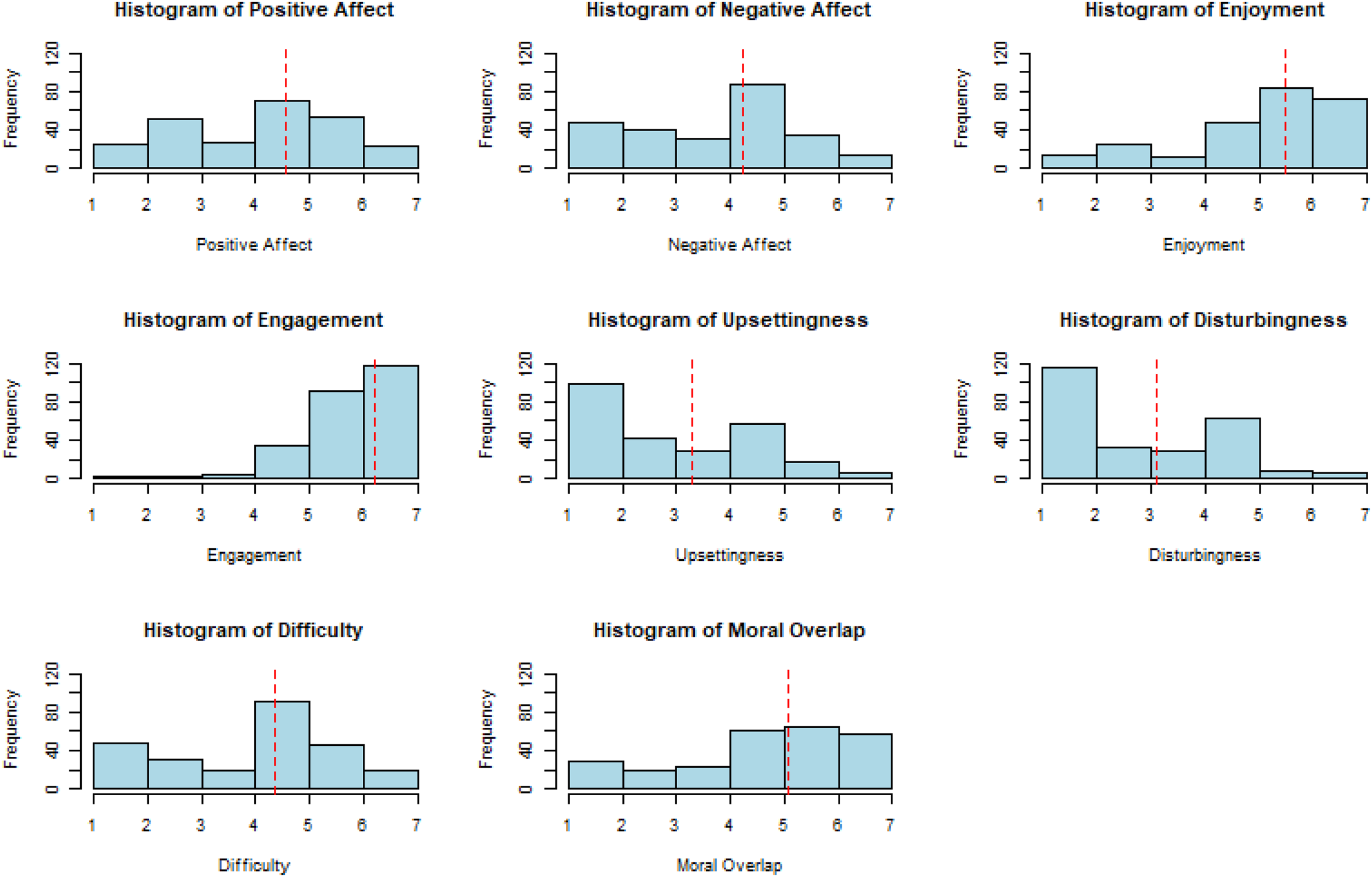
Histograms of experiential values in study 2.
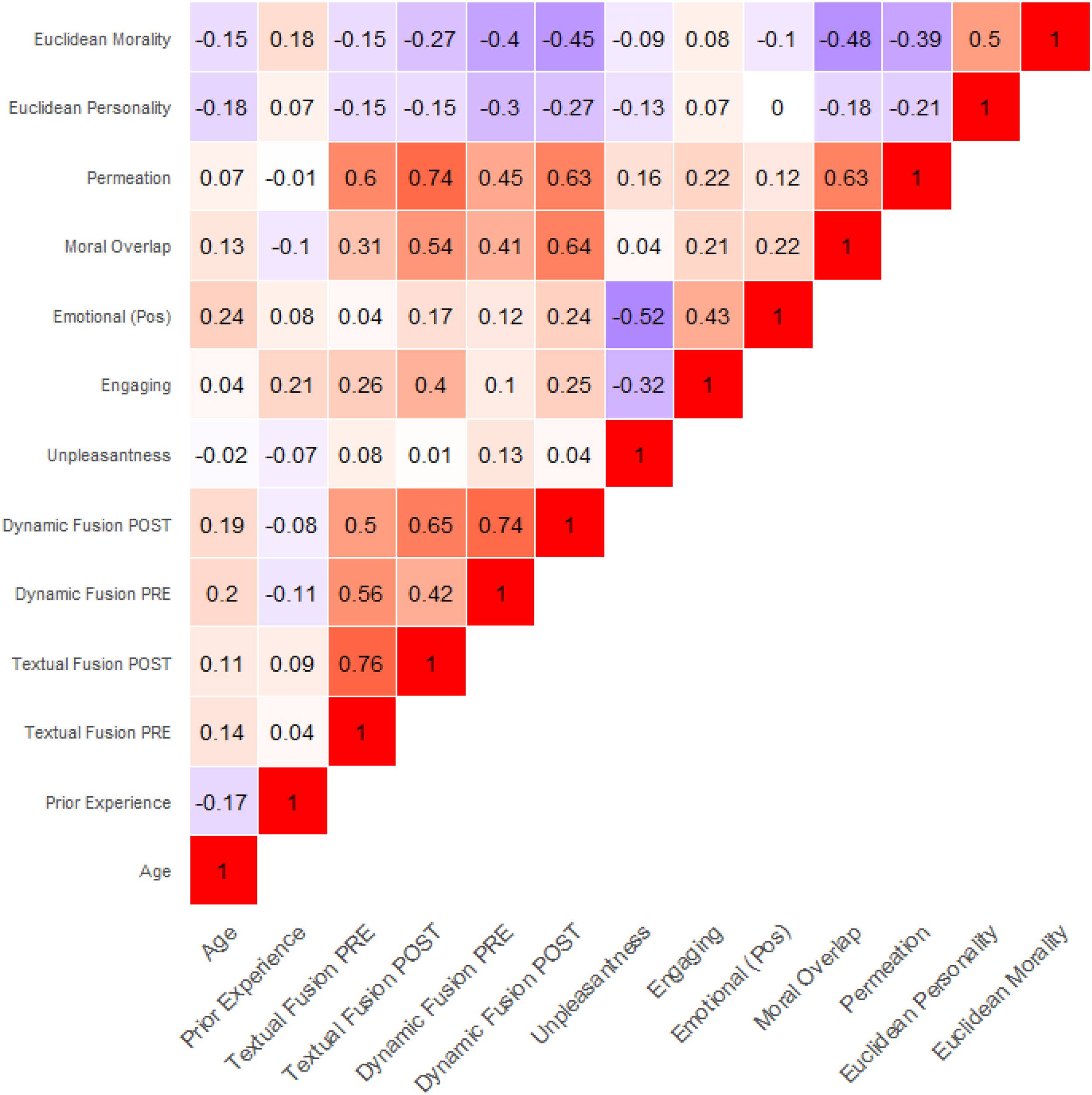
Correlation matrix of all core variables in study 2.
In an attempt to understand what features contributed to permeation, we executed an exploratory factor analysis (EFA; Watkins, 2018). A parallel test on these items indicated that three factors are sufficient to explain the data. When an EFA was executed specifying three factors with an oblimin rotation (i.e., a method that allows intercorrelations between factors) we found a good fit, RMSEA = .08 and RMSR = .02 (both less than the .08 conventional threshold), see Table 3 for loading values. We determined that the first factor, which we term ‘Unpleasantness’ explains 28% of the proportional variance, the second factor, which we term ‘Emotional Intensity’ strongly loads positive affect (0.98) and negatively loads negative affect (−.05), suggesting these questions exist at opposite ends of a spectrum. The third factor, which we term Engaging, loads responses to whether the vignettes were engaging and enjoyable. Interfactor correlations are shown at the bottom of Table 3. Of note, ‘Moral Overlap’ cross-loaded across all factors. In the interests of transparency, we executed the same EFA with four factors, which revealed the same patterns, but a fourth factor with Moral Overlap loading at 1.0 and no cross-loading on other factors, but the fit statistics were inferior to the three factor model, and made no qualitative difference to our intention to create aggregate the items.
We created a mean score for the Unpleasantness aggregate (M = 3.58, SD = 1.54, α = .83), the Engaging aggregate (M = 5.87, SD = 1.11, α = .70), and - after reverse coding the negative emotion - we produced an Emotional Intensity (Positive) aggregate (M = 4.215, SD = 1.39, α = .73). The Moral Overlap variable remained a stand-alone variable (M = 5.06, SD = 1.76).
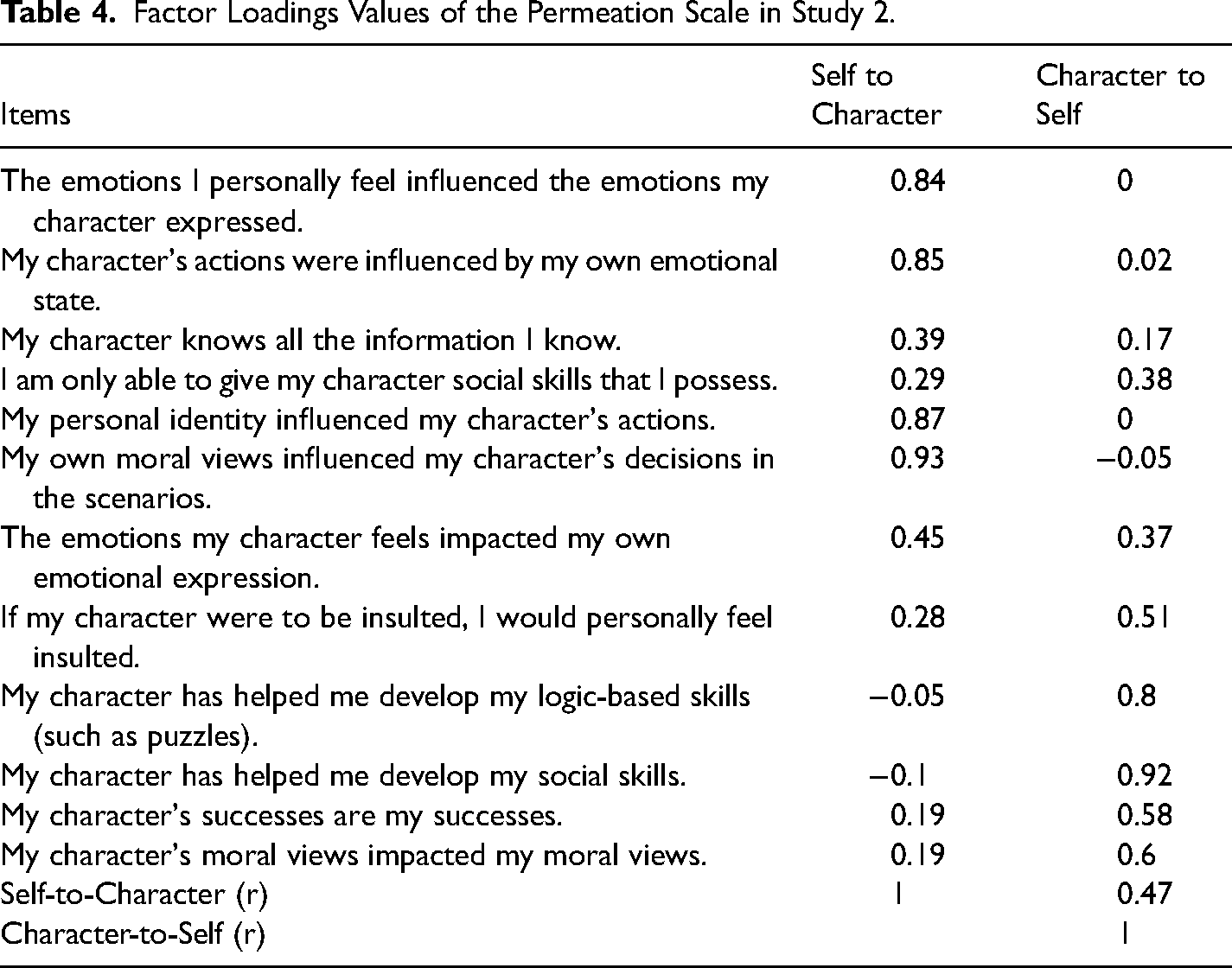
The Cognitive Permeation scale. This scale was measured on seven-points (1 = Strongly Disagree, 4 = Neither Agree nor Disagree, 7 = Strongly Agree), and a mean score was computed. The three permeation sub-scales (‘Cognitive’, ‘Emotional’, and ‘Skills’, but not ‘Social’) demonstrated acceptable psychometric properties (α = .90) in aggregate. We conducted an exploratory factor analysis to determine whether the scale was constituted by multiple factors (either by ‘direction’, or by sub-scale). Despite the fact that the whole scale had a comparable reliability as it did in study 1, a parallel test suggested that two factors would emerge. When an EFA was executed specifying two factors with an oblimin rotation (i.e., a method that allows intercorrelations between factors) we found sub-optimal fit with RMSEA = .101, but not the RMSR = .04. In the interests of transparency and our own pre-registration, we present the loading table (see Table 4). The factors that emerge very clearly reveal a Player-to-Character factor, and a Character-to-Player factor. Given the poor fit statistics of a two-factor solution, the high alpha for a single variable, the relatively high inter-factor correlation, and our previous use of the single variable (in Study 1), we computed a single aggregate, ‘Permeation Score’ (M = .4.55, SD = 1.12).
Factor Loadings Values of the Permeation Scale in Study 2.
All values of interest, including all aggregate variables, are expressed in our Figure 4.
Pre-registered inferential statistics. We pre-registered an analysis in which we intended to predict FusionPOST measures from Age, Gender, Prior Experience, the factors associated with enjoyment, and engagement, (derived from the factor analysis), and our permeation scale. And in keeping with practices in study 1, we conducted this analysis on both measures of post fusion.
We note that Permeation and Moral Overlap are correlated at r = .63. Post-hoc, we examined the Variance Inflation Factors (VIFs; Gregorich et al., 2021), to assess whether multicollinearity is an issue in the interpretation of the analysis. Fortunately, all values were between 1 and 2 (with the exception of Permeation in analysis C, which had a value of 2.55, which is well below 5 the conventional threshold for concern).
Though we intended to pre-register the following analysis, we did not include it in our pre-registration file (due to human error). However, this analysis was conducted in study 1 and has been documented in pre-prints, and as such may be considered a part of an analysis plan. We intended to predict Permeation by the experiential variables: Unpleasantness, Engaging, Emotions, and Moral Overlap. We found a significant model fit, F(4, 257) = 51.18, p < .001. Where Unpleasantness (β = 0.15, SE = 0.04, p = .003), Engaging (β = 0.16, SE = 0.05, p = .00), and Moral Overlap (β = 0.37, SE = 0.03, p < .001) all significantly predicted permeation, but where Emotions (β = 0.−0.02, SE = 0.05, p = .65) did not.
Exploratory Analysis. As specified in our pre-registration, we expressed our intention to conduct exploratory analysis by determining the Euclidean distance between self-reported personality scores of the participant, and attributed personality scores of their character. This was to be done both on the TIPI (Goslin et al., 2003), and the MIPS (Goranson et al., 2022).
We computed the personality scores of the TIPI according to the standard approach (Gosling et al., 2003). Similarly, we computed the MIPS scores as described by (Goranson et al., 2022). We note the reliability of the HeroSELF and HeroCHARACTER (α's = .82 and .87 respectively), VictimSELF and VictimCHARACTER (α's = .80 and .76 respectively), BeneficiarySELF and BeneficiaryCHARACTER (α's = .72 and .71 respectively), and VillianELF andVillianCHARACTER (α's = .79 and .92 respectively) was comparable to reliability described in (Goranson et al., 2022)'s paper. The range of value for the distance between centroids for the TIPI was 0.00–5.30, while the corresponding value for MIPS was 0.00–3.77. The distribution of values can be seen in Figure 5, and correlations with distance values can be seen in Figure 4. We also executed the regressions displayed in Table 5 with both Euclidean distances as predictor variables, and while both models were significant (as previously reported), neither Euclidean distance predicted fusion and made no material difference to any previously reported results. Finally, we executed the analyses in which we attempted to predict Permeation from four components (Unpleasantness, Engaging, Emotions, and Moral Overlap), as well as both Euclidean distances. Again, the models were significant (as previously predicted) but neither distance metric predicts Permeation, and no results were materially altered.
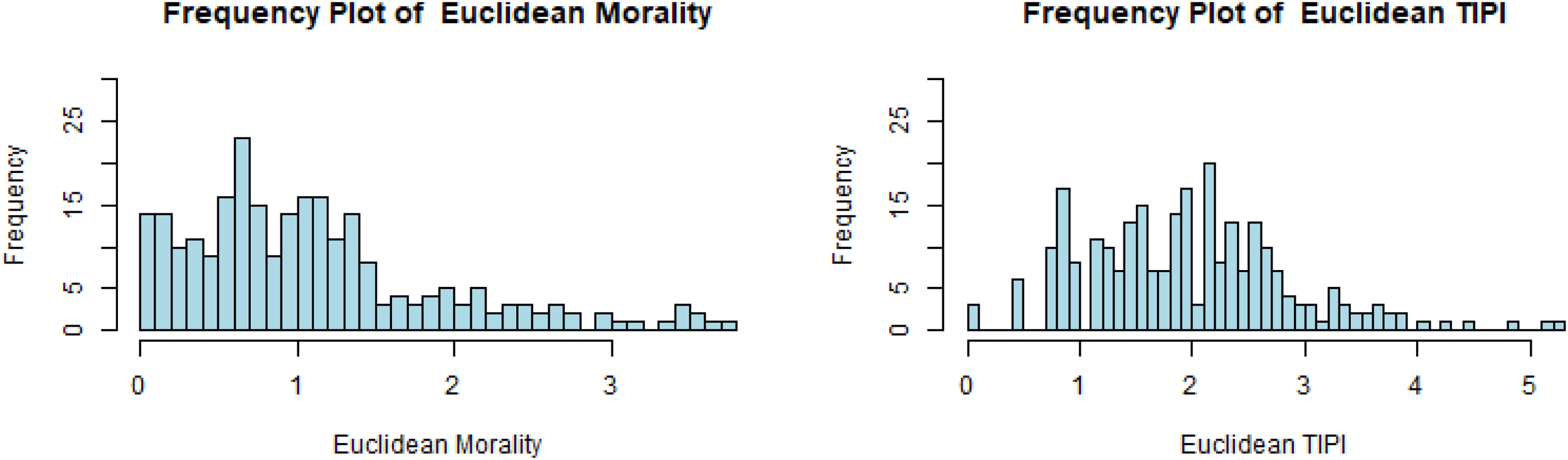
Histogram of Euclidean distances of morality (left) and personality (right).
Regression Results for Both Measures of Identity for Both Pre- (Left) and Post- (Right) Measures of Fusion.
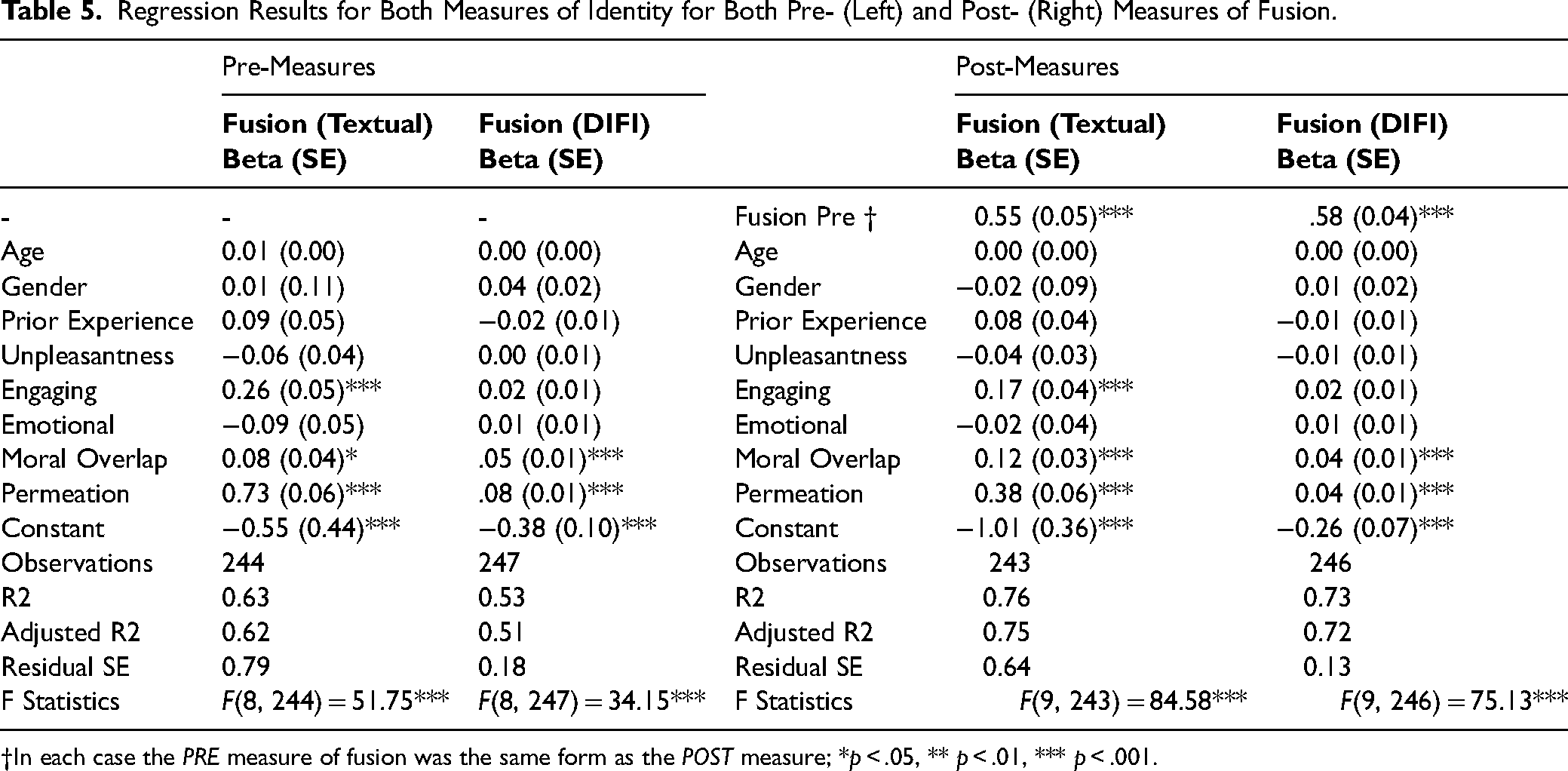
†In each case the PRE measure of fusion was the same form as the POST measure; *p < .05, ** p < .01, *** p < .001.
Study 2. Discussion
In study 2 we refined our procedure, improved our measures, and increased our sample size. Participants created a character using a bespoke process, and provided two measures of fusion, before completing six moral vignettes in which they described in detail how their character would act. Participants then provided responses on questions which measured how they felt during the process, and - again - provided two measures of fusion. Finally, participants completed our measure of cognitive permeation, as well as a personality and moral identity survey for both themselves and their character.
Participants reported a significant increase in fusion, on both the textual- and dynamic measures, though we note that the size of the effect was quite small. Participants’ responses regarding their experience of the vignettes appeared to load into three factors that correspond with Unpleasantness, Emotional Intensity, and Engaging experiences, with a single item left-over that measured the degree to which their characters’ actions were a reflection of their own moral attitudes.
Our Permeation measure (with cognitive, emotional, and skills subscales; but not the social subscale) demonstrated - as with study 1 - high reliability. A parallel test suggested a factor analysis would reveal two factors, but the fit statistics did not meet threshold values. Nonetheless, the factor loadings revealed a ‘player-to-character’ factor and a ‘character-to-player’ factor.
Our analyses were pre-registered: As with study 1, when predicting fusion we found that our permeation scale was significant with a large effect size. Similarly, the single-item measuring moral overlap was a significant predictor of fusion. This was true for both the textual- and dynamic- measures of fusion. Interestingly, the correlation between Permeation and Moral Overlap was r = .63 (though examining of VIF scores revealed no issues of multicollinearity)
Fusion was also predicted by the Engaging aggregate (a value based on scores regarding the degree to which participants found responding to the vignettes to be engaging and enjoyable), but not by the Emotional Intensity aggregate of the experience, nor by the Unpleasant aggregate (upsettingness, disturbingness, and difficulty). In study 1 we did not find that engagement or enjoyment predicted fusion. In study two we find the factor with both engagement and enjoyment was the only other significant predictor. If we are to accept that measures of fusion correspond with permeation through the cognitive quarantine, it is curious then that this factor is more successful than factors associated with Emotional Intensity and Unpleasantness, both of which have been strongly linked to the generation of fused social identities with groups (Fredman et al., 2015; Gómez et al., 2011; Kapitány et al., 2020.; Kavanagh et al., 2020; Reese & Whitehouse, 2021; Swann & Jetten, 2018).
Of important note is that the Engaging aggregate was a significant predictor only on the textual-measure of Fusion. In study 1 we noted different effect sizes for the significant role of Permeation depending on which fusion measure was the outcome measure. Here we note the same thing, in addition to the unique relationship between Engaging and textual-fusion. There is no obvious relationship between ‘enjoyment’ and ‘engagement’ (the constituent items of the aggregate) and the questions in the textual-fusion scale make no reference to enjoyment, and only obliquely reference engagement (i.e., ‘I feel immersed in playing my character’). It seems plausible, then, that the relationship between engagement and fusion may be due, in part, to similarities in the measurement tool (that are unshared with the overlapping circles task), though we leave open the possibility for the unique role of engagement/enjoyment in fusion/cognitive permeation - after all, this is a major reason that people play games.
It is worth noting, specifically with regard to predictors of fusion, that all the observed significant relationships remain even after controlling for FusionPRE. Though both the textual- and dynamic- measures of fusion revealed a significant increase in fusion, the effect sizes were exceptionally small. That there was any variance to explain after holding FusionPRE constant is remarkable, and suggests that Moral Overlap and Permeation (and Engagement to a lesser extent) are surprisingly important in understanding how our identities are influenced by fictional characters (of our own creation). In support of this observation we note that the strength of the correlations between Moral Overlap and Permeation, respectively, increase from FusionPRE to FusionPOST. This implies the act of imagining a character's actions in the moral dilemmas explains some common variance in fusion, permeation, and moral overlap.
In trying to understand Permeation, we found that Unpleasantness, Engaging, and Moral Overlap were significant predictors, but Emotional Intensity was not. First, an aside: it may sometimes be problematic to use a variable as a predictor in one regression alongside a given set of variables, then to use the same variable as an outcome in a regression with the same set of co-predictors. If Unpleasantness, Engaging, and Moral Overlap predict Permeation (which they do), and those same variables, plus Permeation, are used to predict fusion, it is possible that if Permeation mediates the effect of Unpleasantness, Engaging, and Moral Overlap on fusion (which we have not tested) we may erroneously see that those three variables have no effect on Fusion. Of course, we find that Engaging and Moral Overlap did have a direct relationship, so it's possible that we have missed a real [mediated] effect only of Emotional Intensity on fusion. However, it is not obvious to us that the porousness of the cognitive quarantine is one in which the relationship between experiential factors and fusion is mediated by permeation. It might plausibly follow that permeation's effect of fusion is mediated by experiential factors, or that no mediation occurs at all. Given that the potential error here is Type 2 (a failure to find a real effect), and not Type 1 (a false conclusion that an effect exists), we do not believe we have threatened the theoretical validity of our tests, nor have we found any obvious empirical support for the threat. Emotional intensity has a weak correlation with Permeation (r = 0.12), while Unpleasantness and Engaging are slightly stronger (r = .16; .22), and emotional overlap is quite strong (r = .63). The permeation scale even has several questions regarding the protrusion of emotions from both player-to-character, and character-to-player. This suggests the permeation is far from simple, relying on more cognitively demanding phenomena than simply the intensity of one's positive or negative affect; it is even possible that affect is orthogonal to the process.
Finally, we calculated the Euclidean distance between one's own personality (as measured with the TIPI) and one's own moral identity (as measured with the MIPs) and those same constructs of the participant's character. This was a novel and exploratory attempt to understand how cognitive permeation occurs. Had we found that the distance negatively predicted fusion (the more similar the player and character, the more fused they become) we might have been able to conclude that characters more similar to us more easily permeate the quarantine; or had we found that distance positively predicted fusion (the more similar the player and character, the less fused) we may have been able to conclude that similarity more easily maintains the quarantine. Certainly, additional interpretations exist, however, such interpretations are mere speculation as we found no influence of distance between personality and moral identity on fusion. This result is disappointing, as previous research has shown that similarity between self and fictional other tends to increase identification with the fictional other (Konijn & Hoorn, 2005; Wong, 2008), and identification with fictional others can lead to greater similarity in neural representations between fictional other and self (Broom et al., 2021). Euclidean morality was negatively correlated with both measures of fusion (TextualPRE/POST, r's = −0.15 and −0.27, respectively; DIFIPRE/POST r's = −0.4 and −0.45, respectively) and generally more strongly the Euclidean personality (TextualPRE/POST, r's = −0.18 and −0.18, respectively; DIFIPRE/POST r's = −0.26 and −0.26, respectively). Clearly, some kind of relationship exists, though we suspect more work will need to be done to refine the theoretical conceptualization of cognitive quarantine before scholars can understand the nuance of permeation (beyond that which we humbly offer here).
General Discussion
‘Cognitive quarantine’ is a much understudied topic, with next to no empirical descriptions, and only spartan theoretical accounts. When discussed, it is in the context of child-like pretend play - instances where a child may pretend an empty cup is full, or that a banana is a phone. In such cases it is largely a theoretical account of how an individual can hold pretend proposition p without it interfering with the real knowledge k, and what conditions modify and change the content of p. Nichols and Stich (2003) assert that “When the [pretend] episode is over, the pretender typically resumes her non-pretend activities, and the events that occured in the context of the pretense have only a quite limited effect on the post-pretense cognitive state of the pretender” (p. 120). But an imaginary tea-party is a considerably less complex an act of pretence compared to typical imaginative pretend play in adults, especially in common and popular forms of TTRPG such as D&D (Kapitany et al., 2022).
In practice, adult pretence and the co-construction of pretensive shared reality may endure not simply for minutes or hours (as with childhood pretence), but days, weeks, months, or even years. In such cases, it seems untenable that the events have “only a quite limited effect on the post-pretense cognitive state”. Indeed, qualitative research consistently shows that “group members’ real-world needs [are] met through symbolic in-game interactions” (Nichols and Stich, 2000), and that in-game events such as player-character death “shapes the lives of players” and meaningfully “transcend game boundaries” (Sidhu & Carter, 2021). Such claims are plainly obvious to folks who regularly engage in this sort of pretence, but very little empirical work quantifying the permeation of the cognitive quarantine has been conducted, and none (to our knowledge) on the rich forms of imaginative pretend play that characterise pretensive shared reality in adults.
Moral dilemmas meet the minimum conditions for pretend play, that is, there is an agreed upon premise, inference from the premise, embellishment, and action. Further, moral dilemmas are capable of generating strong, often negative, emotional reactions. By embedding moral dilemmas within a pretensive shared reality framework - that is, by making the moral dilemmas salient as a form of play - we were able to leverage their affordances as stimuli to examine the conditions of cognitive permeation upon one's personal identity. As discussed in the introduction (and elsewhere) intense negative emotions tend to fuse identities (Fredman et al., 2015; Gómez et al., 2011; Kapitány et al., 2020; Kavanagh et al., 2020; Reese & Whitehouse, 2021; Swann & Jetten, 2018); if we accept that one's own identity is real, and one's character is imaginary, then by demonstrating that the act of operating a fictive character within a moral dilemma has a measurable impact on one's own real identity, then we have provided evidence that the cognitive quarantine may be permeated (that is, the imaginary can impinge upon the real).
And this is exactly what we demonstrated. Over two studies, one of which was pre-registered, we show that self-reported scores on a general permeation scale strongly and uniquely predict the degree to which novel, idiosyncratic, fictional characters influence our own personal identities. Moreover, we show that the degree to which a player perceives a character's actions as reflecting their own sense of morality influences the degree to which their identity is fused with their character, even after controlling for fusion with the character prior to the moral dilemmas. Though we did not find convergent support when examining the Euclidean distance between one's own personality or moral identity and their character - the distance between real and fictional did not predict fusion.
In study 2 we also found that a factor which loaded the participant's experience of ‘enjoyment’ and ‘engagement’ predicted fusion (albeit, only with the textual- measure of fusion). This relationship was not found in Study 1, however, the method by which we measured ‘engagement’ and ‘enjoyment’ in study 1 was not psychometrically rigorous. When examining the role of engagement and enjoyment on permeation, we found (in study 1) that the former was a significant predictor, but the latter was not. In Study 2 we found the ‘engaging’ factor predicted fusion (as did unpleasantness, and moral overlap). Interestingly, we did not find an effect of emotional intensity on Fusion or on Permeation. The role of negatively-valenced emotions in the fusion literature is well documented (Fredman et al., 2015; Gómez et al., 2011; Kapitány et al., 2020; Kavanagh et al., 2020; Reese & Whitehouse, 2021; Swann & Jetten, 2018), and we had expected to see it manifest as a predictor in permeation, too. It's plausible, however, that our stimuli was simply not arousing enough - this simple form of play is impoverished relative to the far more social, co-constructed nature of pretensive shared realities in D&D and TTRPGs.
We observed across both studies that measures of enjoyment, and positive emotions correlated only weakly with permeation and fusion. This is not necessarily surprising, as research in the field of extreme gaming has shown that negative experiences (such as role-playing sexual violence) are not positively valenced, but are still meaningful and worthwhile (Montola, 2010). This finding is also apparent in research on identity fusion (often in experiencing rituals or collective events such as sports) where negative experiences often are the most powerful experiences which generated reflection and bonding with the group (REF; WHITEHOUSE). That we were able to quantitatively observe this in our data supports these pre-existing findings, particularly among scholarship of games.
We now find ourselves confronted with a number of challenges, opportunities, and further questions. Chief among them is the theoretical nature of cognitive quarantine. Our demonstration that fictional identities can impinge upon real identities is somewhat trivial–the larger point remains that if one were to pretend a banana was a phone, and then used that banana-phone to order a pizza, one would not expect a pizza to arrive 40 min later. But why not? Representations of perceptions of reality, and representations of the imagined share significant neural overlap, and are, in fact, intermixed (Dijkstra & Fleming, 2023). Evidence suggests that the awareness that one intended to imagine something is not a sufficient condition for the brain to reject the imagined as distinct from the real (Dijkstra et al., 2023). Theoretically, should a neural signal associated with an imagined perception be strong enough, we might consequently represent it as real (Dijkstra et al., 2023). Indeed, this is not so hard to believe. Consider the following: Last week I arrived home after work, and instead of putting my keys in the dish in the hallway as I do every day, I left my keys in my pants-pocket (and subsequently put my pants in the washing machine). The next day, looking for my keys, I held in my head the representation that I would find my keys in the dish. This representation was factually false, my memory of placing the keys in the dish imagined. In this way, I have an imagined (and mistaken) conception that was confused for reality. Certainly, this still doesn’t reach the level of the banana-phone and the pizza, but it does clearly illustrate that imagined things can impinge upon reality (or at least, my expectations of reality, my subsequent behaviour, my frustrated emotions, and the fact that I missed the early train). Is cognitive quarantine merely an informal proxy for a threshold value of neural signal strength? We suspect this is not the whole story, because no-one in our study actually believed their character did anything real, and yet we observed the expected effects. Indeed, even children with imaginary companions–who change their behavior to suit their companion, and who often expect others in their lives to make behavioral accommodations–do not actually believe their companions are real (Armah & Landers-Potts, 2021; Bouldin & Pratt, 2001; Taylor & Mottweiler, 2008). What, then, is cognitive quarantine actually referring to? How can it be better operationalized, so as to be better understood?
Additionally, much work is required to unpack how we can relate to identities (either via the fusion construct we have employed here, or through other methods such as ‘social identity’) that are exogenous to us, and may be agentic and embodied (i.e., with a romantic partner), agentic but not embodied (e.g., a relation to one's deceased parent, or with a deity), embodied but not agentic (e.g., a relationship with an object such as a favorite toy), or neither embodied nor agentic (e.g., an abstraction, such as an identity associated with a nation-state); further, research is also required to unpack identities created endogenously (as is the case here). Though we acknowledge that the exogenous/endogenous distinction is fuzzy: one may hold a representation of Jesus Christ, and while the source material of that representation is exogenous, a genuine question is how much idiosyncratic and endogenous processing shapes one's representation? We are satisfied to raise these questions without being able to answer them in the current paper, though we hope that our methods and results are able to provoke further research on the topic.
We also recognize that the permeation tool is not as rigorously validated as we would have liked, and that while the fusion tool is validated, the manner in which we have used it has not been validated. Though the use of the fusion tool and the targets to which it is applied is wide-ranging, from other individuals known to the participant, to famous individuals (not personally known to the participant), to groups, and abstract concepts. The strong correlation in our study suggests some relation between the two constructs, but here we are taking for granted a meaningful distinction, and hope to better disentangle these concepts in the future.
That said, the social and cognitive approach to identity that we have taken is but one valid approach among many. Scholars of identity–and fortuitously, play–have argued there are four ways to approach identity: The social construct (e.g., to be an academic, queer, or a gamer), a narrative approach (e.g., “I was always pulling my toys apart and rebuilding them, I guess that why I’m an engineer today”), a psychodynamic approach (a tripartite model of ego, superego, and Id) and an approach involving identity as configurations of aspects that ebb and flow as circumstances demand (Diakolambrianou & Bowman, 2023). Each of these frameworks leads to unique predictions, and may interact with the concept of permeation in profound ways. Here, we treat identity as ‘real’–a stable, relatively immutable quality of mind and selfhood that is robust to the circumstances of one's life–and as such, if something imagined were to impinge upon this, we can regard it as fantasy permeating into reality. A ‘parts of the whole’ approach is unlikely to regard this as permeation, a more likely to regard this as one configuration of identity temporarily maintained for the sake of play and imagination (Diakolambrianou & Bowman, 2023). We welcome dialogue from scholars who represent identity and self in alternative manners.
Without a clearer understanding of what cognitive quarantine it is challenging to specify future research questions. It strikes us that some degree of exploratory (but pre-registered) experimentation will need to take place to allow us to better understand the phenomenon, particularly in the context of pretensive shared reality. We should note, however, that the larger question associated with cognitive quarantine–which is, how do we understand that which is real and that which is not, and how do we avoid confusion between the two–has profound and far-reaching implications. For example, many individuals hold religious representations in their mind which are not perceptually grounded (i.e., one cannot see, hear, smell, touch or taste god) but nonetheless hold the belief that this universe is a universe in which there is a real god (Van Leeuwen, 2023). Of course, experimentally creating or manipulating religious beliefs is practically challenging and morally dubious. What is achievable, however, is asking people to imagine playing a character in D&D or a TTRPG. For example, a human playing as a Cleric, who can cast the 3rd level transmutation spell ‘Water Walk’, has the 5th level Abjuration spell ‘Greater Restoration’ (for healing the sick), and who can be raised from the dead with the 5th level Necromancy spell ‘Raise Dead’ 5 . By way of this somewhat tongue-in-cheek example, we’ve hopefully illustrated that cognitive quarantine is a psychological and cognitively potent concept, and the significance of using methodologies associated with pretensive shared realities can better help us understand how we represent reality, and how we represent other important beliefs that exist primarily as endogenous, non-perceptual representations.
Cognitive quarantine is an indispensable cognitive and philosophical concept in the study of pretence. However, it has limitations in contexts beyond childhood pretence, and impoverished lab-based examples. Tens of millions of adults routinely engage in immersive, complex acts of imaginative pretend play–in the form of TTRPG's and D&D–and here we provide the first quantitative empirical evidence, via the use of a novel scale, of cognitive permeation between the fictive character and the person who operates them. Though this account is necessarily brief, a sensible starting point in understanding cognitive permeation is the concept of identity fusion–a visceral sense of oneness between the self and, in this case, the fictive character. The cognitive quarantine between the real and pretend is porous, and while a typical adult is unlikely to confuse fantasy for reality, it is the case that the pretend can influence the real in profound ways.
Supplemental Material
sj-docx-1-ica-10.1177_02762366251339189 - Supplemental material for Identity Fusion between Imaginary Characters and Oneself During Moral Dilemmas: An Examination of Cognitive Quarantine During Adult Pretend Play and Pretensive Shared Reality
Supplemental material, sj-docx-1-ica-10.1177_02762366251339189 for Identity Fusion between Imaginary Characters and Oneself During Moral Dilemmas: An Examination of Cognitive Quarantine During Adult Pretend Play and Pretensive Shared Reality by J. Holmes, J. Zhang, K.B. Francis, and R. Kapitany in Imagination, Cognition and Personality
Footnotes
Acknowledgements
We would like to thank all those who participated in this research. May the dice-gods favour your rolls. Study 1 was funded with an internal award from Keele University awarded to Jamie Holmes. Study 2 was funded with funds from Durham University.
Declaration of Conflicting Interests
The authors declared no potential conflicts of interest with respect to the research, authorship, and/or publication of this article.
Funding
The authors received no financial support for the research, authorship, and/or publication of this article.

Supplemental Material
Supplemental material for this article is available online.
Notes
Author Biographies
References
Supplementary Material
Please find the following supplemental material available below.
For Open Access articles published under a Creative Commons License, all supplemental material carries the same license as the article it is associated with.
For non-Open Access articles published, all supplemental material carries a non-exclusive license, and permission requests for re-use of supplemental material or any part of supplemental material shall be sent directly to the copyright owner as specified in the copyright notice associated with the article.
