



Abstract
We investigate if and how imagining a positive future where a societal issue has been rectified can promote hope and support for collective action. Participants imagined (vs. not) a positive future related to climate change (Study 1, N = 301) and economic equality (Study 2, N = 489), two years versus several decades from now. In both studies, imagining a positive future led to support for collective action via increased hope. In Study 1, imagination increased the perceived possibility of achieving the collective goal, in Study 2 it increased its perceived desirability. Possibility was positively related to hope, in particular when imagining a near future, whereas desirability of the collective goal was positively related to hope for a distant imagined future. The research provides evidence for the power of imagination in inspiring hope and collective action, and shows the shifting meaning of hope depending on collective action context and timeframe of the imagination.
The outcomes of social struggles, such as for climate action or greater equality, are uncertain. Setbacks and overwhelming opposing forces may make people feel less than confident that their social movement will succeed in achieving their collective goals. Promoters of such movements often appeal to people's hope that there can be a better future in order to motivate them to support their cause and participate in collective action. However, the evidence that hope motivates collective action is limited. And, if hope motivates collective action, then from where is it derived? How can people maintain hope? We investigate how an act of imagination could promote people's perceptions of the possibility and desirability of improved outcomes, as keys to raising hope. Moreover, we argue that the effects of imagination on hope, and thus action, via desirability and possibility may differ depending on whether that imagined future is temporally close or distant.
Hope
Hope is a positive future-oriented emotion, associated with a desired outcome that has some level of possibility. However, hope is complex, and it is important to define it uniquely. Snyder (2002) conceptualizes hope as comprising two aspects: a perception that pathways to goals can be built, and the capacity and resolve to track along those pathways. However, Miceli and Castelfranchi (2010) point out that Snyder's definition does not distinguish hope from other anticipatory constructs, such as positive expectation and optimism. Rather, they argue, what makes hope unique is that it can exist with only “a mere belief of possibility” (Miceli & Castelfranchi, 2010, p. 255). Indeed, Bury et al. (2016) showed that individuals highly invested in the outcome experienced an accelerated increase in hope at emerging (low yet increasing) levels of likelihood, whereas optimism just increased linearly with likelihood. Thus, following Miceli and Castelfranchi, the key conditions of hope are: (1) a desire for, or investment in, the outcome; and (2) the belief that the outcome is possible, without necessarily being highly likely or certain.
Indeed, part of hope's power lies exactly in the fact that it can operate at low odds: when an outcome is desired, but not very likely, hope can still exist. So, hope is relatively immune to setbacks and can grow provided there is still a chance to succeed, however small (Miceli & Castelfranchi, 2010). Hope is thus a powerful emotion that can give a meaningful future focus; a motivating or sustaining force, resisting obstacles (Davis & Hicks, 2013; Nelissen, 2017; Thomas et al., 2022). Hope can promote persistence and defiance in the face of uncertain odds.
Collective Action
The importance of hope extends into the context of collective action, that is, individual or collective behaviour to advance a group's goals. Alongside group identification and perceptions of a group's efficacy in advancing their goals, previous research largely focused on negative emotions as motivators of collective action, especially the illegitimacy-related emotions of anger and resentment (Thomas et al., 2009; van Zomeren et al., 2004; for a review, see Agostini & van Zomeren, 2021). More recently, there has been an increasing interest in the roles of a wider range of positive emotions in collective action, including hope (van Zomeren, 2021). Social psychological research has started to uncover the role of hope in promoting collective action, for the reduction of intergroup disparities and discrimination (e.g., Greenaway et al., 2016), for intergroup forgiveness (Wenzel et al., 2017), and for intergroup reconciliation and peace (e.g., Cohen-Chen et al., 2017; Leshem et al., 2016). For example, Greenaway et al. (2016) found that hope can lead to increased support for social change, more so than fear and happiness—emotions that share some common attributes with hope—and more than sadness and anger—emotions frequently emphasized in relation to collective action. Likewise, Wlodarczyk et al. (2017) provided correlational evidence that hope (alongside anger) may mediate the relationship between both efficacy beliefs and identification, and collective action participation. Bury et al. (2020) showed that the hope that collective action would reduce climate change mediated the relationship between the perceived possibility (but not probability) of collective action achieving this goal and support for climate action, especially when there was a strong identity investment in environmental causes. Daysh et al. (2024) found that hope mediated the effects of utopian and, negatively, dystopian thinking on support for climate change action.
However, recent reviews of the role of hope in collective action indicate a more differentiated picture of the function (and valence) of hope (Cohen-Chen & Pliskin, 2024). In the context of climate change, Geiger et al. (2023) found in a meta-analysis of 46 studies overall a small positive relationship between hope and climate engagement, but this very much depended on the target of hope. If the hope is that the issue will resolve itself (e.g., that climate change is a temporal fluctuation), this would amount to denial of the problem, or escapism, and would therefore be likely to reduce support for action. In contrast, a hope that people will take action to combat the problem was most positively related to climate engagement. Likewise, the foundation of one's hope matters (Ojala, 2023); if the hope amounts to confidence or optimism that the issue will be sorted, then again there would be little impetus for individuals to engage themselves in collective action. It is crucial to distinguish hope from optimism or confidence (Bury et al., 2016, 2019); being less than confident, hope is an emotional investment in mere possibility of a highly desirable outcome. Mindful of these issues and, hence, keeping a focus on its distinct foundations, we propose that raising hope for an improved future should increase support for collective action. Hence, the desirability and perceived possibility of change would need to be elevated to arouse hope for change and, in turn, action.
Imagination and Raising Hope
How may the desirability and perceived possibility of change be elevated to instil hope? Imagination may be one avenue. Broadly, imagination refers to the capacity to develop images and sensations in the mind that are not currently being experienced by the senses. More specifically, imagination can involve mental simulation. Taylor and Schneider (1989) define mental simulation as “the cognitive construction of hypothetical scenarios or the reconstruction of real scenarios” (p. 175). Mental simulation can be used for envisioning the future. It can also be a means of constructing a possible future self, which may encapsulate self-relevant aspirations or threats and, thus, motivate behaviour (Markus & Nurius, 1986). While it is possible to theorize the self – an individual or a collective self (Cinnirella, 1998) – as an intervening concept for the effects of future imagination, this is not the focus of the present research. Our focus is on the cognitive foundations of hope. We argue that imagination of a positive future outcome can increase its perceived possibility and desirability, appraisals that (conditional on temporal distance) underpin hope (see Figure 1).
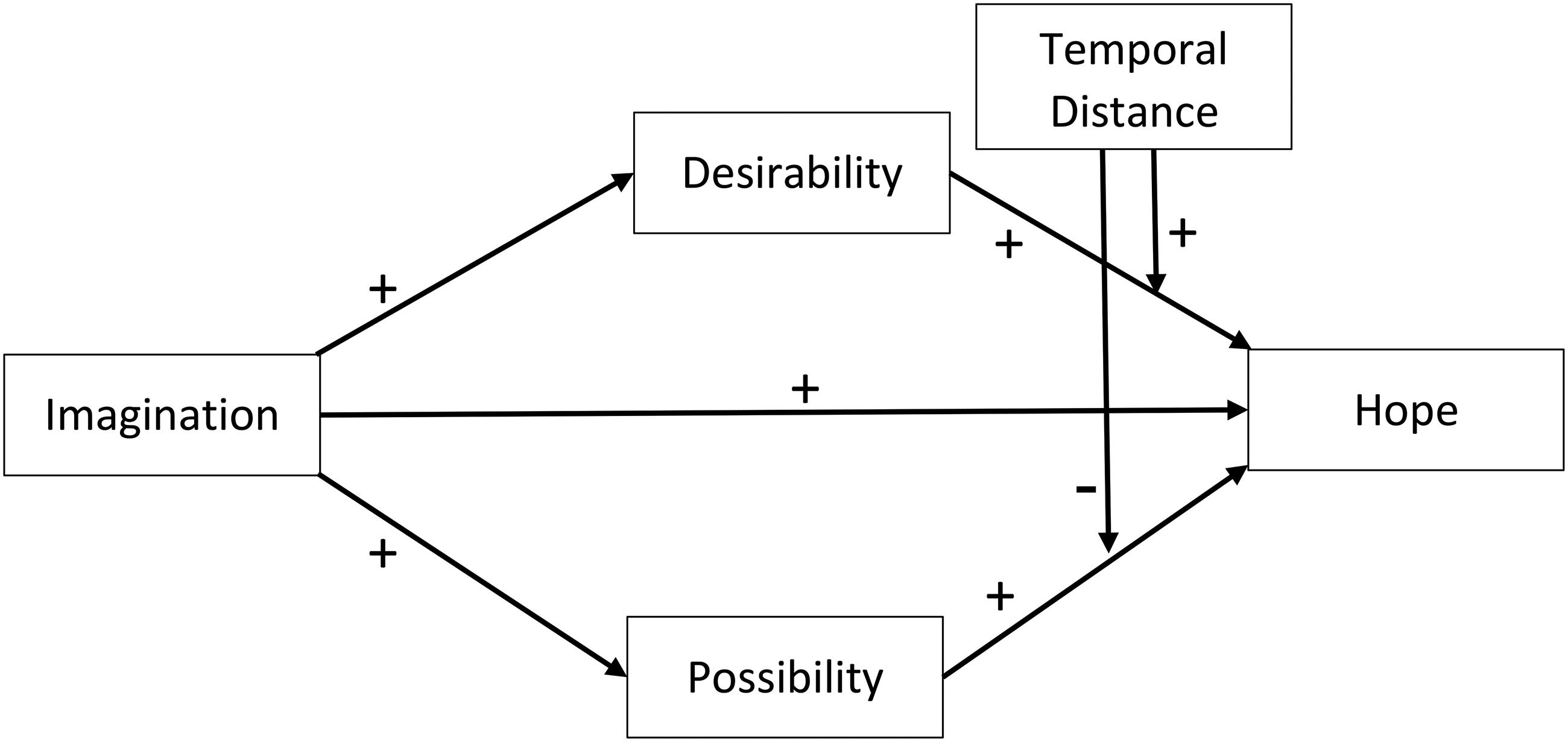
The predicted imagination-to-hope model.
First, construction of future hypothetical events can raise the perceived possibility of those events occurring. An experiment by Carroll (1978) showed that asking participants to imagine that a particular candidate had won the US presidential election led participants to believe it was more likely that the candidate would win the election. A similar study by Carroll also found that asking participants to imagine a football team enjoying a successful season with a major bowl bid, led participants to believe it was more likely that the team would achieve a major bowl bid. These studies also showed that having participants explain what they imagined made no difference to their perceived likelihood of the outcome occurring—it was rather the act of imagining itself. Carroll proposed that this effect might require vivid, detailed imagination, as earlier studies (Abelson, 1976, as cited in Carroll, 1978) found that imagining the occurrence of a simple event without any depth of imagining (like spilling a cup of coffee) failed to change the perceived likelihood. A further four experiments by Gregory et al. (1982) similarly showed that participants who imagined events happening to them had a stronger belief that the events would in fact occur. However, it appears that if the imagination task is too difficult, perceived possibility does not increase. Sherman et al. (1985) found that if it was difficult and effortful to imagine an event, the perceived likelihood of the event decreased. It follows then, if people are asked to imagine a future positive outcome, and they are encouraged to imagine with vividness and detail, and they do not find this task excessively difficult or effortful, then their perceived likelihood of that positive outcome eventuating may increase.
Second, mentally simulating certain scenarios or outcomes can increase their desirability. Although this phenomenon seems to be less studied, there is some empirical evidence for it. In an experiment conducted by Lebreton et al. (2013), participants were asked to make choices based on potential outcomes, requiring participants to imagine the outcomes in order to make the choice. Lebreton et al. found that the more detail participants employed in imagining the future outcomes, that is, the more they imagined them, the more likeable they rated the potential outcome. In other words, imagination per se plays a part in raising the perceived desirability. Furthermore, if what is being imagined is explicitly positive, such as a positive future with a focus on the desirable aspects of the given issue, imagination would make this positivity more real and true (Taylor & Schneider, 1989).
So, imagination could lead to greater collective action intentions by increasing the desirability and perceived possibility of the imagined world, and thus raising hope. However, there is a counterargument. Within individual self-regulatory processes, researchers have argued that generating positive fantasies about the future is a mental indulgence that saps energy for action and provides an escapist avenue for feeling better about the issue without having to act (Kappes & Oettingen, 2011; Kappes et al., 2012) – at least if individuals engage in such positive fantasies without mentally contrasting them with the reality of the present in order to form pathways towards realisation of the goals (Kappes & Oettingen, 2014). This escapism argument mirrors the objections noted above against hope within the collective action literature, arguing that hope is a purely emotion-focused form of coping (van Zomeren et al., 2019). However, Fernando et al. (2018) found that utopian thinking (i.e., thinking about an ideal society) significantly increased political engagement intentions even without, and no less than with, mentally contrasting it with the present. Building on these findings, Badaan et al. (2020) theorise that utopian thinking (imagining an ideal society) increases system challenge and collective action, partly mediated by hope. Indeed, most relevant to the present research, Daysh et al. (2024) found that utopian thinking, in the form of imagining a positive future where a particular societal issue has been addressed (climate change), led to an increase in hope.
Thus, we suggest that having people imagine a positive future outcome could elevate hope by raising the perceived possibility and desirability of the outcome, because hope is based on perceptions of both desirability and possibility, and there is evidence that imagining the outcome increases both.
Imagining a Near or Distant Future
It is also the case that, when people imagine the future, these thoughts can differ in the degree to which they are relatively close or distant from the present day. We further explore the mechanisms involved in raising hope through imagination, by considering the role of the temporal distance of the imagined future. If imagining could be a tool for elevating hope and inciting support for collective action, it would be important to know, not least for practical reasons, whether it was more powerful to have people imagine a near or distant positive future. Construal level theory informs our reasoning about the potential impact of temporal distance (Liberman & Trope, 1998).
Construals are subjective understandings and representations of objects, events, or situations. They can involve transcending the immediate experience of what is happening here and now, and include memories, predictions, and speculation (Trope & Liberman, 2010). Construal level theory argues that a construed event can be experienced as more or less psychologically distant on four possible dimensions: spatial (how geographically close), social (how socially close), hypothetical (how close to reality) and, relevant here, temporal, that is how close or distant in time the construed event is (Liberman et al., 2007b; Trope & Liberman, 2003). Further, construals can be abstract, or high-level, involving overarching considerations of the general features of the construed event, distilling its fundamental nature. Alternatively, construals can be concrete, or low-level, consisting of the details of the construed event. Research has shown that greater psychological distance to the construed event is associated with more abstract, higher-level construal, and less psychological distance is associated with more concrete, lower-level construal (Bar-Anan et al., 2006; Liberman et al., 2002; Liberman et al., 2007a; Trope & Liberman, 2010).
Liberman and Trope (1998) argue that the desirability of an event represents a high-level construal as it relates to meaning and abstract values, whereas feasibility of an event represents a lower-level construal because it relates to practicalities and questions of how and when. Consistent with their theory, Liberman and Trope found that when people make decisions about future activities, greater temporal distance (implying a higher level of construal) increased the emphasis on the desirability aspects of attaining the end-state compared with shorter temporal distance. Conversely, shorter temporal distance (implying a lower level of construal) involved more focus on feasibility than a longer temporal distance. To be clear, the idea is not that, when construed as more distant (vs. near), outcomes are necessarily perceived to be as less possible (which would in fact be counter to findings of greater optimism in regard to distant events; e.g., Gilovich et al., 1993) or more desirable (which would run counter to the phenomenon of delay discounting; e.g., Frederick et al., 2002). Rather, based on construal level theory, possibility is predicted to be less and desirability more central to one's evaluation and decisions regarding distant (vs. near) outcomes. Hence, when people imagine a positive future outcome, we expect that desirability will have more impact in raising levels of hope at a long temporal distance compared to a short temporal distance, and possibility will be more influential in raising hope at a short temporal distance compared with a long temporal distance.
The Current Research
First, the current research tested the effect of imagining a positive future on support for collective action, and the role of hope in the process. We hypothesized that (H1) imagining a positive future would promote support for collective action mediated via hope. Second, we zoomed in on hope and investigated the cognitions theoretically implicated in it: desirability and perceived possibility. We hypothesized that their relationship to hope would depend on whether the imagined, hoped-for future was a distant or a near one (H2): (a) desirability would be more strongly related to hope when a distant future was imagined than a near future, whereas (b) possibility would be more strongly related to hope when a near future was imagined than a distant future. Third, we investigated whether the effect of imagining a positive future on hope would be, at least partially, accounted for by imagination impacting the cognitions implicated in hope. We predicted that (H3) imagining a positive future would increase the (a) desirability and (b) perceived possibility of the outcome. As a consequence of H2 and H3, we predicted a moderated mediation effect on hope, namely that (H4) imagining a positive future would lead to greater hope (a) mediated via perceived desirability in particular when a distant future was imagined, and (b) mediated via perceived possibility in particular when a close future was imagined (see Figure 1).
Two online studies tested these hypotheses, in the context of combatting climate change (Study 1) and achieving greater economic equality (Study 2). Both studies required participants to imagine a positive future concerning the respective social issue (versus a no-imagination control condition). Further, in one imagination condition participants were tasked to imagine a temporally close future, in the other condition a more distant future. The data for both studies and Online Supplementary Materials (OSM), including study materials, are available at https://osf.io/ufs46/?view_only=5597ccbd1f7849d482a61c579da86a47.
Study 1
Method
The study was an online survey conducted in 2015. The experimental manipulation required participants to imagine a positive future, related to combating climate change, with either a 2-year or a 50-year temporal distance of the imagined future. We note that temporal distance is context-specific; in other contexts, 2 years might be considered temporally distant, but in the context of climate change action, 2 years are likely to be considered temporally close. Pilot data informed the choice of 2 and 50 years as suitable near and distant futures (see OSM). There was also a no-imagination control group.
Design
The design was a 3-group (imagination: 2-years temporal distance, 50-years temporal distance, no-imagination control) between-subjects design with random allocation. The dependent variables were desirability (of future positive outcomes related to climate change), perceived possibility (of the occurrence of future positive outcomes related to climate change), hope (for future positive outcomes related to climate change) and support for climate change action.
Participants
Unsure of what effect sizes to expect, we aimed for generous cell sizes of n = 100. A sensitivity analysis in MPlus v8 using Monte Carlo simulation showed that this sample size would allow to detect, with a power of .80 and significance level of p < .05, standardized regression coefficients of .20 for all direct and moderating effects in the predicted moderated mediation model; that is, relatively small effects (see OSM). Initially 360 participants—sourced via the online survey platform Qualtrics—completed the survey; they were either citizens or permanent residents of Australia. Participants provided responses to two questions (scored on a scale from 1 = not at all to 11 = absolutely) designed to ascertain if they were sceptical about human-caused climate change: (1) “Do you believe that our climate is changing?”; and (2) “Do you believe that human activity is at least in part responsible for climate change?” We did not want to include “sceptics” in the study as it does not make sense to hope for improvements to something that is not perceived as an issue. We excluded a priori 59 participants from the analysed sample. These participants scored 4 or less for either question—scores of 4 or less were considered to involve a greater amount of doubt than certainty. The final sample included 301 participants, 59.5% females and 40.5% males, ranging in age from 18 to 85 years (M = 44.67, SD = 18.23).
Imagination Task
The imagination task required participants to imagine a positive future world, either 2 years or 50 years from now, resulting from progress with combating climate change. The instructions for the imagination task were designed so that it was completely up to the participants to imagine the future without any prescription of what that future should be like, other than to be positive. In the no-imagination control condition participants did not receive any imagination instructions and proceeded straight to the dependent variable measures—this was deemed the most neutral option compared to the potential distraction and confounds associated with a filler task.
Dependent Variables
All items were rated on 11-point scales (1 = not at all to 11 = extremely). For scales with more than one item, items were averaged to obtain scale scores. See OSM for detailed item information.
Desirability
Three items measured desirability (α = .93; e.g., “How desirable is it for the world to halt climate change?”). Two of the items were designed to be more extreme and therefore potentially less desirable than the item listed above. One of these items asked about the desirability of ‘reversing’ climate change and the other asked about the desirability of ‘repairing’ the damage caused by climate change. These items were included to help avoid a ceiling effect that might block upwards movement in desirability after imagining (i.e., if desirability was already at a maximum level before the imagination task).
Perceived Possibility
Three items measured perceived possibility (α = .90); the items were semantically similar to desirability but pertained to possibility (e.g., “How possible is it for the world to reverse climate change?”).
Hope
Six items measured hope (α = .91). Three of the items related to a hope that the world would respond to the issue of climate change (e.g., “Right now, how much hope do you feel that the world will [at some point] halt climate change?”), and three items referred to a hope relating to individuals taking action for climate change (e.g., “Right now, how much hope do you feel that individual citizens around the world will [at some point] contribute to combating climate change by adjusting their lifestyles?”).
Support for Climate Change Action
Eight items measured support for climate change action (α = .90), modelled on measures common in the research field (e.g., Milfont et al., 2020). All items involved some form of personal investment or sacrifice (of effort, time or money), and are markers of commitment to climate change action. Two of these questions related to government action on climate change (e.g., “How supportive are you of the Australian Federal Government spending more taxpayer revenue to help combat climate change?”); three related to collective action (e.g., “How willing are you to discuss the benefits of combating climate change with others?”); and three related to individual commitment of time, effort or money (e.g., “How prepared are you to invest your energy in sending personal emails or letters to politicians urging them to advance the fight against climate change?”).
Manipulation Checks
Difficulty of Imagining
Difficulty of imagining was measured on a 5-point scale (1 = extremely easy, 2 = easy, 3 = moderate, 4 = difficult, 5 = extremely difficult) by asking: “How easy or difficult did you find the imagination task at the beginning of this questionnaire?” This item was included due to the finding by Sherman et al. (1985) that, if it was difficult and effortful to imagine an event, the perceived likelihood of that event decreased, suggesting that if participants found the future world difficult to imagine this may confound perceived possibility.
Temporal Distance
Two temporal distance manipulation checks were used. The first was to ascertain the subjective temporal distance of the future that participants actually imagined. “When you were asked to imagine a future before, how near or distant in time was the future world you imagined? (Move the slider accordingly)”. This was measured on a scale of 1 (near future) to 100 (far distant future). Participants were also asked how distant a future (in years) they were instructed to imagine: “Do you recall what time in the future you were instructed to imagine?”
Procedure
Participants completed the entire study via the online survey platform Qualtrics. Participants were briefed that the study involved looking at how people imagine a future scenario. After viewing introductory information and giving their informed consent, participants were asked their age and gender. Participants in the imagination conditions were then provided with the imagination task. Participants were instructed to take as long as they needed to complete the imagination task, and they were not able to progress to the next part of the survey until 2 min had lapsed. Once participants had completed the task they were asked to: “please write down [enter into the computer] four positive aspects of this world that you were able to imagine”. This input was used as a check to assess if participants had adhered to the task of imagining a positive future. Participants in the no-imagination condition skipped the imagination task.
All participants then completed the survey questions relating to the four dependent variables. Within blocks, items were presented in randomized order. Participants first completed the six questions relating to hope. Next, participants were randomly allocated to answer either the set of three desirability questions followed by the three perceived possibility questions, or the reverse. Next, participants completed the eight questions about support for climate change action. Participants then completed the difficulty-of-imagining item and the temporal distance manipulation check. Finally, participants were invited to leave any comments. The study took most participants less than 20 min to complete.
Results
Manipulation Checks
Difficulty of Imagining
An independent samples t-test showed there was no difference between the 2-year imagination condition (M = 2.57, SD = 1.02) and the 50-year condition (M = 2.55, SD = 0.99) in terms of difficulty of imagining, t(200) = .09, p = .931, d = 0.02. On average, participants found the imagination task easy to moderately difficult.
Temporal Distance
Participants were instructed to imagine a future with either a 2-year or a 50-year temporal distance. When asked to recall the temporal distance they were instructed to use (in years), participants in the 2-year imagination condition (M = 8.06, SD = 13.54) and the 50-year imagination condition (M = 47.23, SD = 9.23) recalled distinctly different temporal distances. However, of greater importance was a check whether participants indeed imagined the future with these timeframes in mind, and whether a particular number of years meant the same thing to all participants in terms of perceived distance into the future. Hence, participants were asked to provide the temporal distance with which they actually imagined, measured in terms of perceived distance into the future (0 = near future, 100 = far distant future). An independent samples t-test showed that perceived temporal distance was significantly higher in the 50-year condition (M = 56.03, SD = 21.90) compared to the 2-year condition (M = 39.58, SD = 24.64), t(200) = 5.02, p < .001, d = 0.71. This indicates that the time manipulation affected the temporal distance with which participants imagined. However, in the 2-year condition participants were expected to imagine a near future, yet their ratings were far removed from the “near future” (0) point of the scale, t(98) = 15.98, p < .001, d = 1.60. Therefore, there is suspicion the instructions did not elicit the intended qualitative differences (near vs. distant) in the temporal distances that people imagined.
Further analyses of our main predictions indeed showed no significant differences on any dependent variable between the two temporal distance conditions, nor any significant moderations effected by them. The results of these analyses are available in the OSM. However, given that the manipulation did not clearly realise the imagination of a near versus distant future, we did not want to prematurely conclude that temporal distance did not matter. Hence, we deviated from the planned analyses and used the measured variable of perceived temporal distance to investigate effects along the whole range of temporal distances. So, for these analyses, the two imagination groups were combined into one, and temporal distance was a continuous variable based on the measured perceived distance (from near future to far distant future), with M = 47.97, SD = 24.65, and a range from 0 to 100. Note that despite the manipulation attempt the measure showed no bimodal distribution and did in fact not deviate from a normal distribution, Kolmogorov-Smirnov statistic = .05, df = 202, p = .200.
Imagination, Hope and Support for Climate Change Action
For reference, the descriptive statistics and bivariate correlations of the main dependent variables are presented in Table 1. First, we investigated whether imagination increased support for climate change action mediated by hope (H1). Note that all our analyses included age as covariate, as the age of participants could affect the meaning of temporal distance (i.e., the world 50 years in the future may or may not be in their lifetime).
Descriptive Statistics and Correlations for the Main Dependent Variables (Study 1).
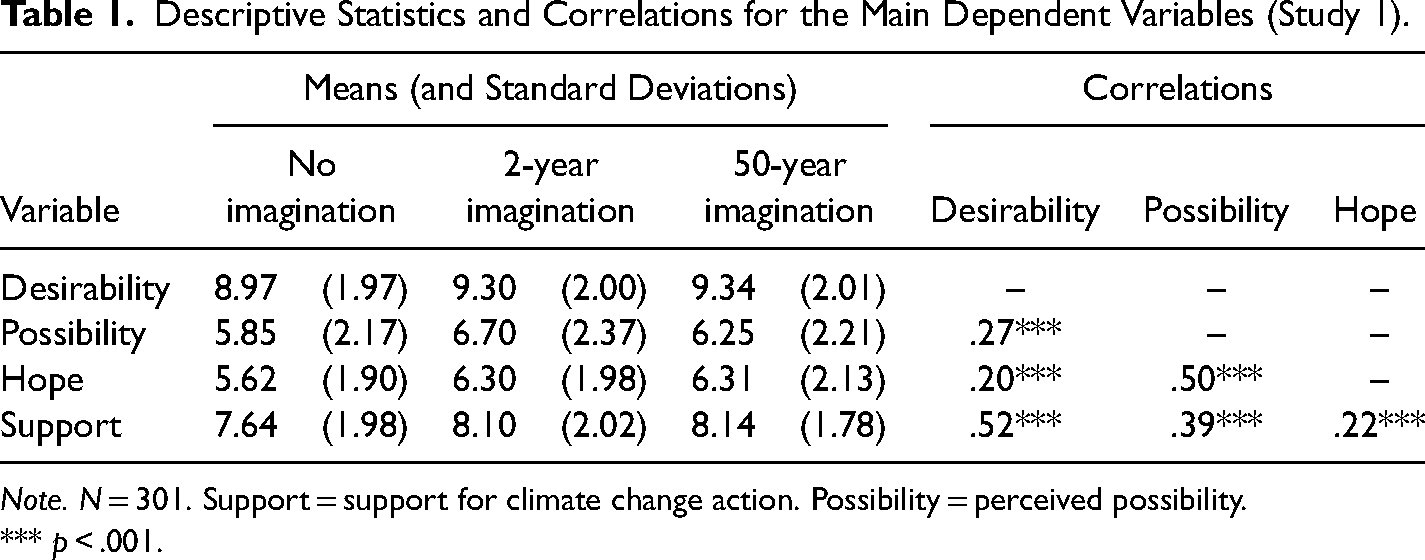
Note. N = 301. Support = support for climate change action. Possibility = perceived possibility.
*** p < .001.
We used regression analyses with bootstrapping methods, using Process v4.3 for SPSS (Hayes, 2022; Model 4), where imagination of positive future outcomes was the predictor variable, represented by a dummy variable (0 = no imagination, 1 = future imagination), hope was the mediator and support for collective action the dependent variable. To be consistent with the subsequent analyses, subjective temporal distance was also included in the model as a covariate (but it had no significant relationships to hope or collective action). The results showed that imagination of a positive future overall led to greater support for climate action; total effect B = 0.49, SE = 0.24, 95% CI [0.02, 0.95]. Further, imagination led to greater hope, and hope was positively related to support for climate change action (see Table 2). Supporting H1, there was a significant indirect effect of imagination on support for climate change action via hope, B = 0.14, SE = 0.06, 95% CI [0.04, 0.29]. The direct effect of imagination was not significant, indicating full mediation of the causal effect of imagination on climate action support.
Hope as a Mediator of the Relationship Between Imagination on Support for Climate Change Action (Study 1).
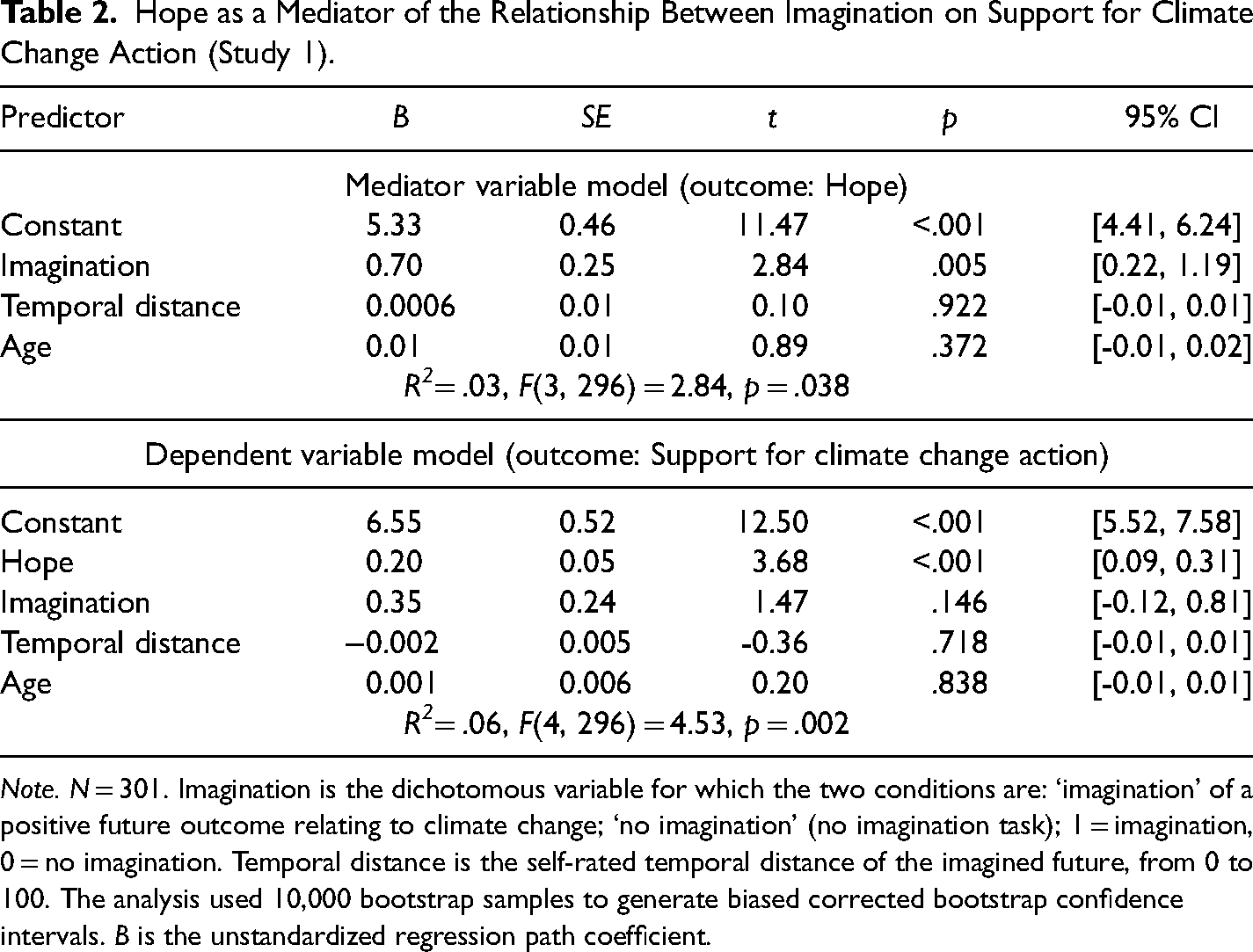
Note. N = 301. Imagination is the dichotomous variable for which the two conditions are: ‘imagination’ of a positive future outcome relating to climate change; ‘no imagination’ (no imagination task); 1 = imagination, 0 = no imagination. Temporal distance is the self-rated temporal distance of the imagined future, from 0 to 100. The analysis used 10,000 bootstrap samples to generate biased corrected bootstrap confidence intervals. B is the unstandardized regression path coefficient.
Desirability and Perceived Possibility as Mediators of Hope
Next, we used Process Model 14 (Hayes, 2022) to investigate, in a single model, the relationships between hope and the implicated cognitions (desirability/perceived possibility) conditional on temporal distance (H2), the effect of imagination on desirability and perceived possibility (H3), as well as the implied moderated mediation (H4). In this model, imagination (dummy, as above) was the predictor, desirability and perceived possibility were parallel mediators (both centred), hope was the outcome variable, and subjective temporal distance (centred) was the moderator of the link between mediators and outcome. The temporal distance variable was assigned a nominal value of zero in the no-imagination condition. 1 The model with standardized regression coefficients is shown in Figure 2.
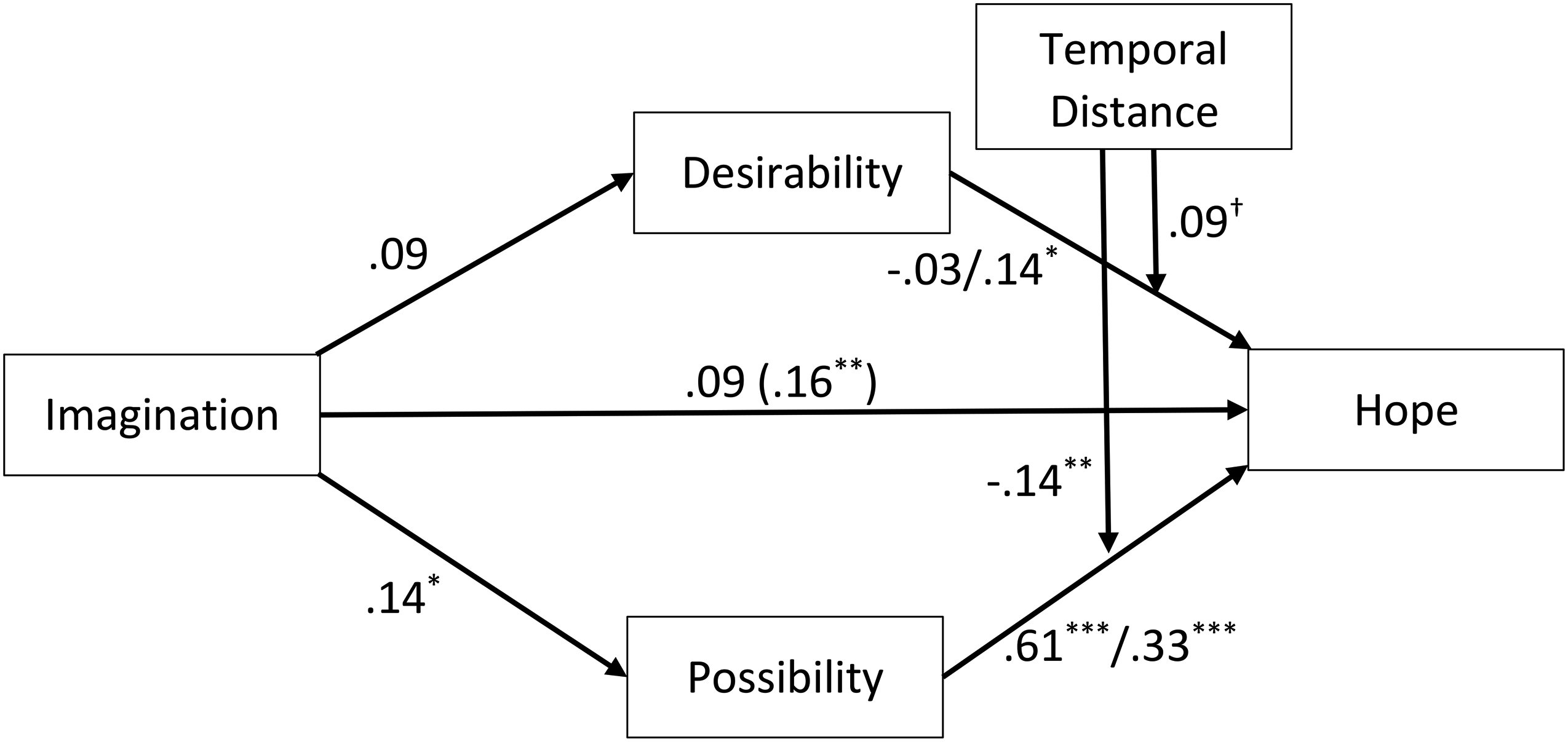
Moderated mediation model for hope (study 1; standardized regression coefficients). Note: The covariate (age) has been omitted from the graph. Coefficients left of the slash are at low (−1 SD) temporal distance, coefficients right of the slash are at high (+1 SD) temporal distance. †p < .10, *p < .05, **p < .01, ***p < .001.
Desirability as Mediator
Table 3 (bottom panel) shows that the interaction between desirability and temporal distance on hope was not statistically significant, but the effect approached significance. This marginally significant interaction effect is plotted in Figure 3a to show the simple effects. For longer temporal distance (+1SD), there was a positive relationship between desirability and hope, B = 0.14, SE = 0.07, 95% CI [0.01, 0.28], but not for shorter temporal distance, B = -0.03, SE = 0.08, 95% CI [-0.18, 0.12]. Consistent with H2a, when people imagined a positive future, there was a tendency for the desirability of improving the climate change situation to be more strongly related to hope if imagined in the distant future, compared with the near future.
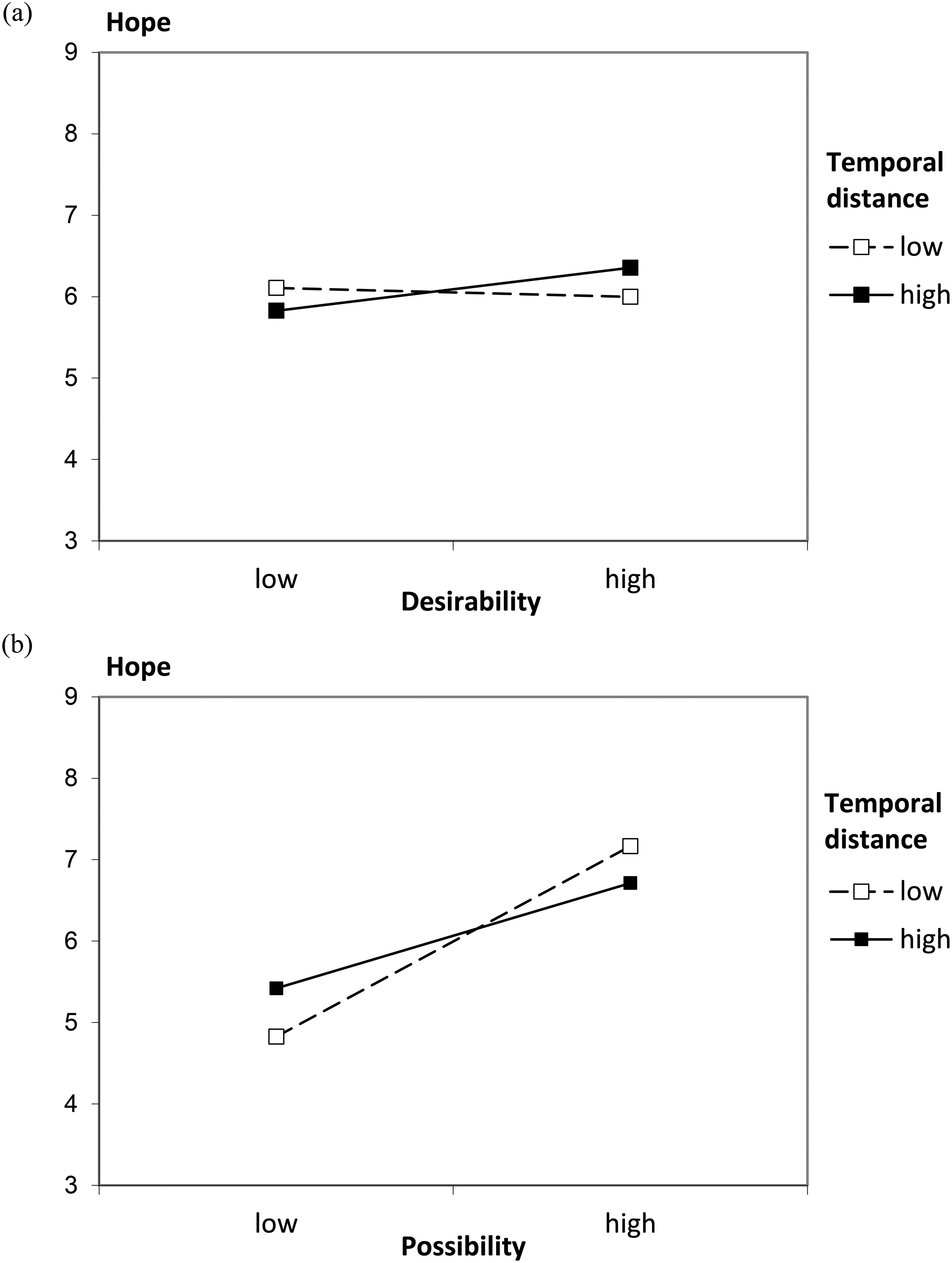
Measured temporal distance moderating the relationships between (a) desirability and (b) perceived possibility with hope (study 1). Note: (a) Marginally significant moderating effect of temporal distance on the relationship between desirability and hope. (b) Significant moderating effect of temporal distance on the relationship between possibility and hope. Long and short temporal distances represent one standard deviation above and below the (centred) mean, respectively.
Desirability and Perceived Possibility as Parallel Mediators of the Relationship Between Imagination and Hope, Moderated by Temporal Distance (Study 1).
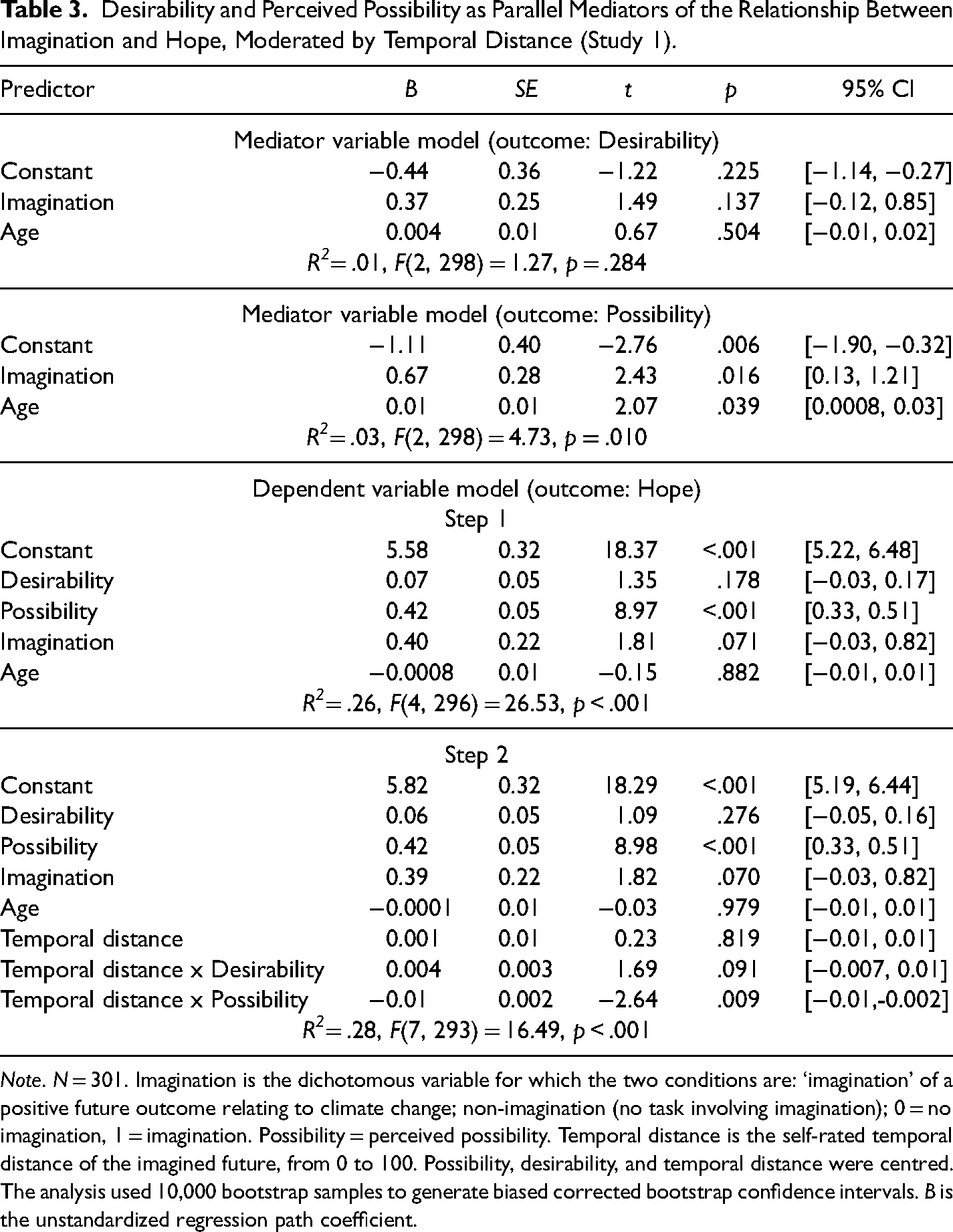
Note. N = 301. Imagination is the dichotomous variable for which the two conditions are: ‘imagination’ of a positive future outcome relating to climate change; non-imagination (no task involving imagination); 0 = no imagination, 1 = imagination. Possibility = perceived possibility. Temporal distance is the self-rated temporal distance of the imagined future, from 0 to 100. Possibility, desirability, and temporal distance were centred. The analysis used 10,000 bootstrap samples to generate biased corrected bootstrap confidence intervals. B is the unstandardized regression path coefficient.
Table 3 (top panel) further shows that there was no statistically significant effect of imagination on desirability, providing no support for H3a. Hence, a precondition for a moderated mediation—temporal distance moderating the relationship between imagination and hope via desirability—was not met. Therefore, inconsistent with H4a, there was no significant moderated mediation via desirability, Index of Moderation = 0.002, SE = 0.002, 95% CI [-0.002 to 0.005]. The conditional indirect effects of imagination on hope via desirability at low and high temporal distance were not statistically significant, but the indirect effect tended to be positive with greater temporal distance (+1 SD), B = 0.05, SE = 0.05, 95% CI [-0.04, 0.16] compared to trending negative with lower distance (−1 SD), B = -0.01, SE = 0.03, 95% CI [−0.08, 0.06].
Perceived Possibility as Mediator
There was a significant interaction between perceived possibility and temporal distance (see Table 3, bottom panel), indicating a moderating effect of temporal distance on the relationship between possibility and hope. This interaction is plotted in Figure 3b to depict its simple effects. For both short (−1SD) and long (+1SD) temporal distances, there was a significant positive relationship between perceived possibility and hope. As predicted in H2b, however, this relationship was stronger at short temporal distance, B = 0.54, SE = 0.07, 95% CI [0.41, 0.67], compared to long temporal distance, B = 0.30, SE = 0.07, 95% CI [0.16, 0.43]. When people imagined a positive future, an increase in perceived possibility was more strongly and positively related to hope if imagined in the near future, compared with the distant future.
As shown in Table 3 (top panel), imagination of a positive future outcome significantly increased perceived possibility, in line with H3b. Hence, preconditions for a moderated indirect effect of imagination on hope via possibility, moderated by temporal distance, were met. Indeed, the index of moderated mediation for perceived possibility indicates that the indirect effect significantly varied as a function of temporal distance, Index of Moderation = -0.004, SE = 0.002, 95% CI [−0.009, −0.003]. The conditional indirect effects of imagination on hope via possibility were significant at short and long temporal distance but, consistent with H4b, the indirect effect was stronger at short temporal distance (−1 SD), B = 0.36, SE = 0.16, 95% CI [0.07, 0.67], than at long temporal distance (+1SD), B = 0.20, SE = 0.10, 95% CI [0.03, 0.41]. So, imagination would result in almost double the increase in hope, via perceived possibility, at the short temporal distance than it would at the long temporal distance.
Discussion
Overall, Study 1 provided some support for our predictions. Imagination of a positive future increased hope and, through hope, increased support for climate change action. Imagination raised hope indirectly by increasing the perceived possibility of ameliorating climate change, especially when the imagined future was temporally close rather than distant. Imagination did not significantly increase the desirability of ameliorating climate change; nor was the relationship between desirability and hope significantly moderated by temporal distance. However, there were trends consistent with predictions, and desirability was only significantly related to hope when the imagined future was a relatively distant one.
The study had the limitation that participants did not closely adhere to the manipulation instructions for the temporal distance of the imagined future, and we therefore analysed self-reported distance as the moderator variable. This of course limits causal inferences from the present study. Likewise, it is unclear whether the findings would generalize beyond the climate change context. In Study 2, we therefore aimed to improve the temporal distance instructions and test whether the findings would replicate for a different societal issue: economic inequality.
Study 2
For Study 2, we employed the same methodology as Study 1, except we focused on economic inequality as the societal challenge. We also aimed to strengthen the manipulation by emphasising the instructions for participants to imagine a future with the prescribed temporal distance.
Method
The study was an online survey conducted in 2016. The experimental manipulation required participants to imagine a positive future, related to improving economic equality, with either a shorter or a longer temporal distance of the imagined future. Again, there was a no-imagination control group. The procedure was the same as in Study 1. Given some marginal effects in Study 1, we aimed to increase the sample size to 150 participants per condition. Based on a sensitivity analysis using Monte Carlo simulation in MPlus v8 for the predicted moderated mediation model (see OSM), a sample size of N = 450 would allow to detect, with a power of .80 and significance level of p < .05, standardized regression coefficients for the moderation of .14 (the size of the significant temporal distance by possibility interaction in Study 1). Further, to increase the statistical power of the analyses through methodological means, we planned to account for relatively stable ideological differences in individuals’ support for economic (in)equality, in the form of a measure of economic system justification (Jost & Thompson, 2000), by including it as a covariate.
Participants and Design
Initially 518 participants completed the survey, sourced from first-year psychology university students (n = 63) and Qualtrics participation panels (n = 455); all participants were either citizens or permanent residents of Australia. Participants were asked to indicate whether they believed that economic inequality existed in Australia, and whether they believed that economic inequality was a problem in Australia. Participants who responded “not at all” to one or both of these checks were excluded from the survey, as it made no sense to measure their hope for improvement to an issue that they did not believe existed (n = 29). The final sample included 489 participants; 55% females and 45% males, ranging in age from 17 to 60 years (Mage = 34.65, SD = 10.01). Participants were randomly allocated to one of three conditions: imagination with short temporal distance, imagination with long temporal distance, no-imagination control. The main dependent variables were close adaptations of those of Study 1.
Imagination Task
Like Study 1, the imagination task required participants to imagine a positive future, but this time resulting from progress in improving economic equality in Australia. The instructions asked participants to imagine these improvements either 2 years from now or in the year 2050. We anticipated that providing a concrete ‘futuristic’ year, 2050 (rather than referring to 50 years from now, as was the case in Study 1), would better signal a long temporal distance. More importantly, we made sure to repeatedly highlight the instructions about the temporal distance that participants should have in mind, to impress on them to think in those timeframes. As in Study 1, in the no-imagination control condition participants did not receive any imagination instructions.
Dependent Variables
All items were rated on 11-point scales (1 = not at all to 11 = extremely). Desirability (α = .92), possibility (α = .93), and hope (α = .94) were measured with five items each, each construct using the same item content: (1) “How desirable/possible is it for Australia to achieve greater economic equality for its citizens?” and “How much hope do you feel that Australia will achieve greater economic equality for its citizens?”; and so on for (2) policies in Australia that successfully reduce economic inequality; (3) reducing the gap between senior executive salaries and the average wage; (4) reducing the gap between the minimum wage and the average wage; and (5) all members of Australian society having the opportunity to earn an equal income.
Support for collective action was measured with five items (α = .89): “How supportive are you of action to achieve greater economic equality in Australia?”; “How willing are you to discuss the issues of economic inequality with others (friends, in the workplace etc)?”; “How willing are you to sign a petition to promote the advancement of economic equality?”; “How willing are you to invest time in joining community or activist groups in their efforts to promote awareness of the issues of economic inequality?”; and “How prepared are you to invest your energy in sending personal emails or letters to politicians urging them to implement policies to address economic inequality?”
Manipulation Checks and Controls
To check that participants adhered to the temporal distance instructions in the imagination conditions, we included the check item “how many years into the future was the world you imagined?” (on a slider from 0 to 50 years). We also included again an item using a 5-point scale to measure the difficulty of imagining the future outcomes, as in Study 1.
We also measured participants’ economic system justification (Jost & Thompson, 2000) with 16 items (e.g., “If people work hard, they almost always get what they want”). 2 This was included to account for stable ideological differences in justifying economic equality that might differently influence participants’ perceptions of the need for change. Probing for its internal consistency showed that 3 items insufficiently cohered with the rest, showing unsatisfactory item-total correlations (< .20). Principal component analysis confirmed that the 3 items did not load (< .26) on the emerging first component and were therefore dropped, leaving 13 items with sufficient internal consistency (α = .80; see OSM for details). As expected, analyses showed that economic system justification was not affected by the experimental manipulations, F(2, 486) = 0.48, p = .622, ηp2= .002.
Results
Difficulty Check
An independent samples t-test showed there was no difference between the 2-year (M = 2.83, SD = 1.01) and the year-2050 imagination conditions (M = 2.55, SD = 0.99) in terms of difficulty of imagining, t(263) = -0.58, p = .905, d = -0.07. On average, participants found the imagination task easy to moderately difficult.
Manipulation Check
Participants indicated on the temporal distance check item that they imagined a future that was on average 12 years from now in the short temporal distance condition (M = 12.13, SD = 12.31) and 32 years from now in the long temporal distance condition (M = 31.51, SD = 12.30). While this was not exactly as instructed in the 2-year condition (but close to instructions in the 2050 condition), the two conditions differed considerably in the temporal distance of the imagined futures, t(304) = 13.77, p < .001, d = 1.57.
Imagination, Hope, and Support for Collective Action
The means and standard deviations for the main dependent variables, and their bivariate correlations, are presented in Table 4. First, we investigated whether imagination increased support for climate change action mediated by hope, using Model 4 in Process (Hayes, 2022). The experimental conditions were represented through Helmert coding, where one contrast represented the imagination conditions (0.5) versus the no-imagination condition (−1), and another contrast, nested within the imagination conditions, represented the temporal distance instructions of imaging a future 2 years from now (−1) versus in the year 2050 (1), with a nominal 0 assigned to the control group. Age and system justification were included as covariates.
Descriptive Statistics and Correlations for the Main Dependent Variables (Study 2).
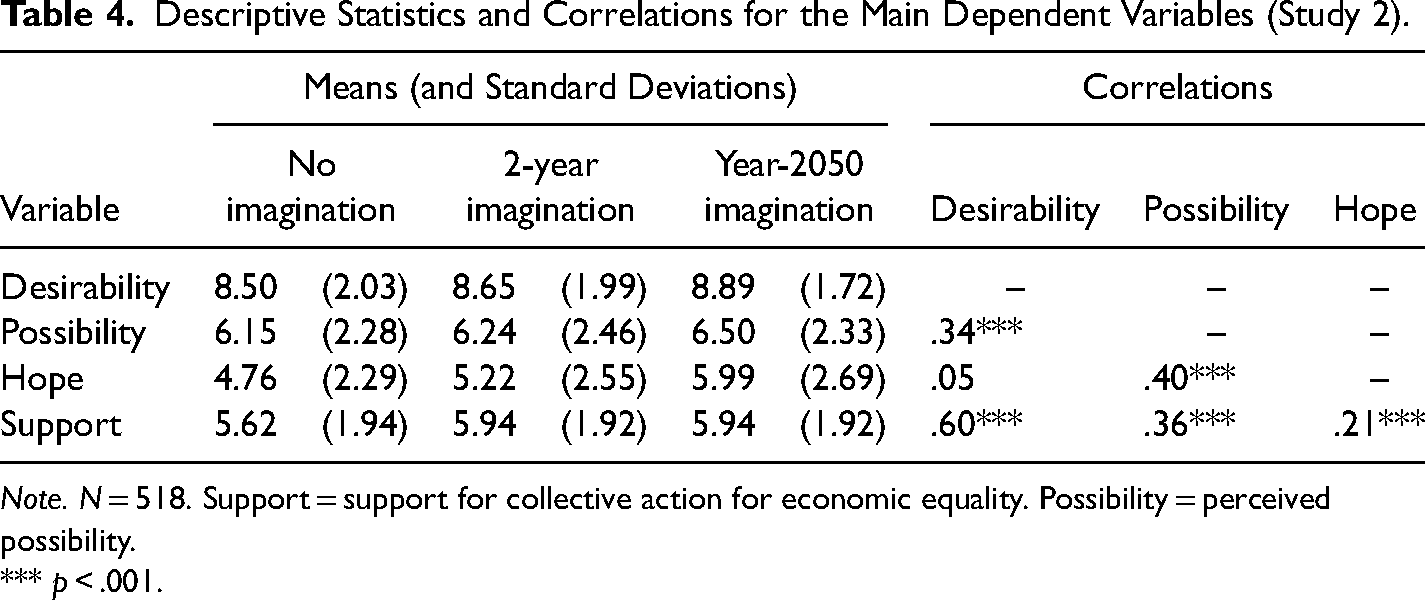
Note. N = 518. Support = support for collective action for economic equality. Possibility = perceived possibility.
*** p < .001.
The results showed that imagination of a positive future led to greater support for collective action; total effect B = 0.27, SE = 0.11, 95% CI [0.06, 0.48]. Further, imagination led to greater hope, and hope was positively related to support for collective action (see Table 5). Supporting H1, there was a significant indirect effect of imagination on support for collective action via hope, B = 0.11, SE = 0.04, 95% CI [0.04, 0.19]. The direct effect of imagination was not significant, indicating full mediation of the causal effect of imagination on collective action support.
Hope as a Mediator of the Relationship Between Imagination on Support for Collective Action (Study 2).
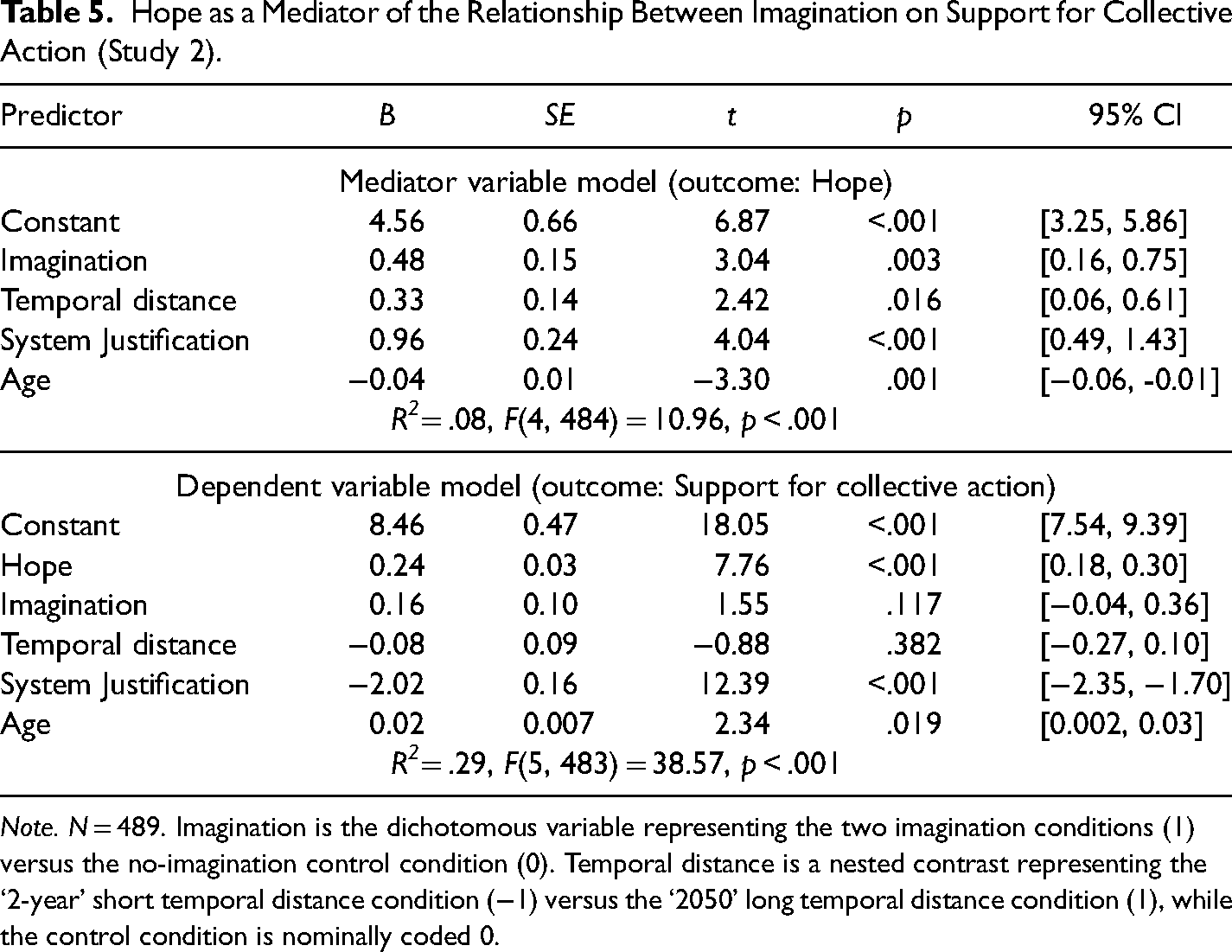
Note. N = 489. Imagination is the dichotomous variable representing the two imagination conditions (1) versus the no-imagination control condition (0). Temporal distance is a nested contrast representing the ‘2-year’ short temporal distance condition (−1) versus the ‘2050’ long temporal distance condition (1), while the control condition is nominally coded 0.
Desirability and Perceived Possibility as Mediators on Hope
As in Study 1, we used Process Model 14 to investigate whether temporal distance moderates the relationship between hope and both desirability and perceived possibility (H2), whether imagination affects desirability and possibility (H3), and whether these (conditional on temporal distance) mediate the effects of imagination on hope (H4). In this model, the Helmert contrast representing imagination was the predictor, desirability and perceived possibility were parallel mediators, hope was the outcome variable, and the Helmert contrast representing temporal distance was the moderator of the mediator-outcome links. Desirability and perceived possibility were mean-centred. Age and system justification were included as covariates. The model with standardized regression coefficients is shown in Figure 4.
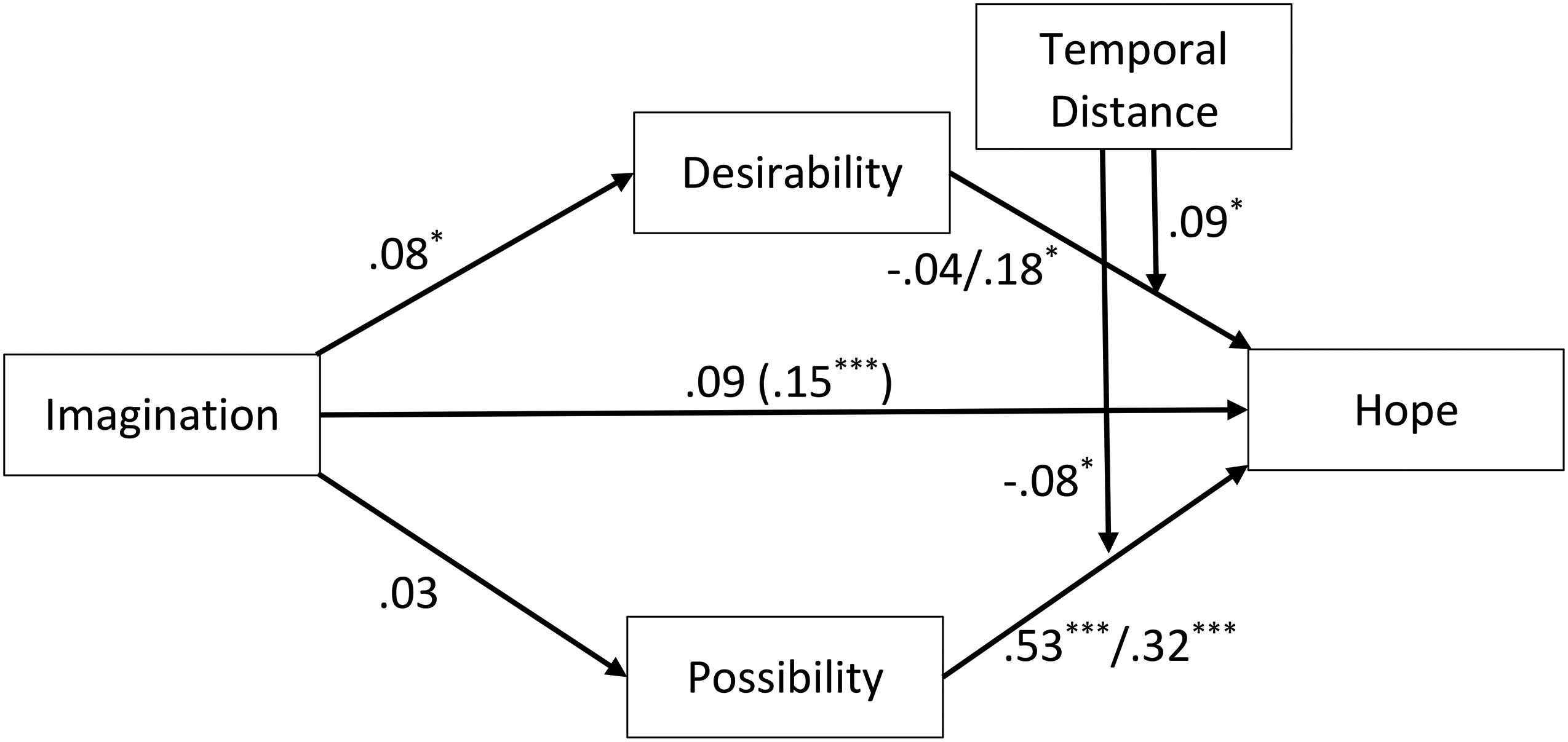
Moderated mediation model for hope (study 2; standardized regression coefficients). Note: The covariates (age, system justification) have been omitted from the graph. Coefficients left of the slash are at low temporal distance (“2 years from now”), coefficients right of the slash are at high temporal distance (“year 2050”). *p < .05, **p < .01, ***p < .001.
Desirability as Mediator
Table 6 (bottom panel) shows that the interaction between desirability and temporal distance on hope was statistically significant. The interaction is plotted in Figure 5a. Consistent with H2a, there was a positive relationship between desirability and hope for the long temporal distance, B = 0.25, SE = 0.10, 95% CI [0.04, 0.45], but not for the short temporal distance, B = -0.06, SE = 0.09, 95% CI [-0.24, 0.12].
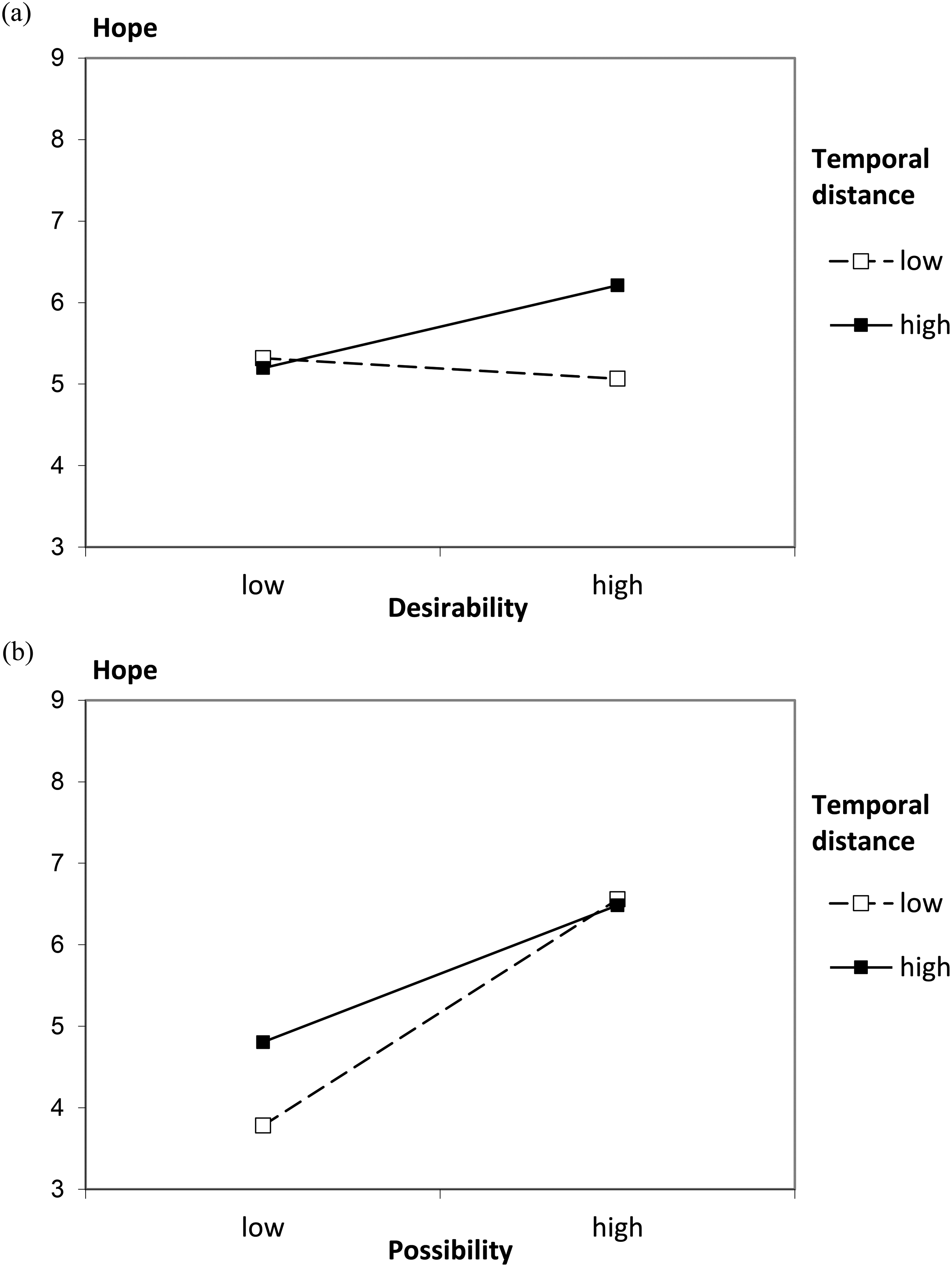
Manipulated temporal distance moderating the relationships between (a) desirability and (b) perceived possibility with hope (study 2). Note. (a) Significant moderating effect of temporal distance on the relationship between desirability and hope. (b) Significant moderating effect of temporal distance on the relationship between possibility and hope.
Desirability and Perceived Possibility as Parallel Mediators of the Relationship Between Imagination and Hope, Moderated by Temporal Distance (Study 2).
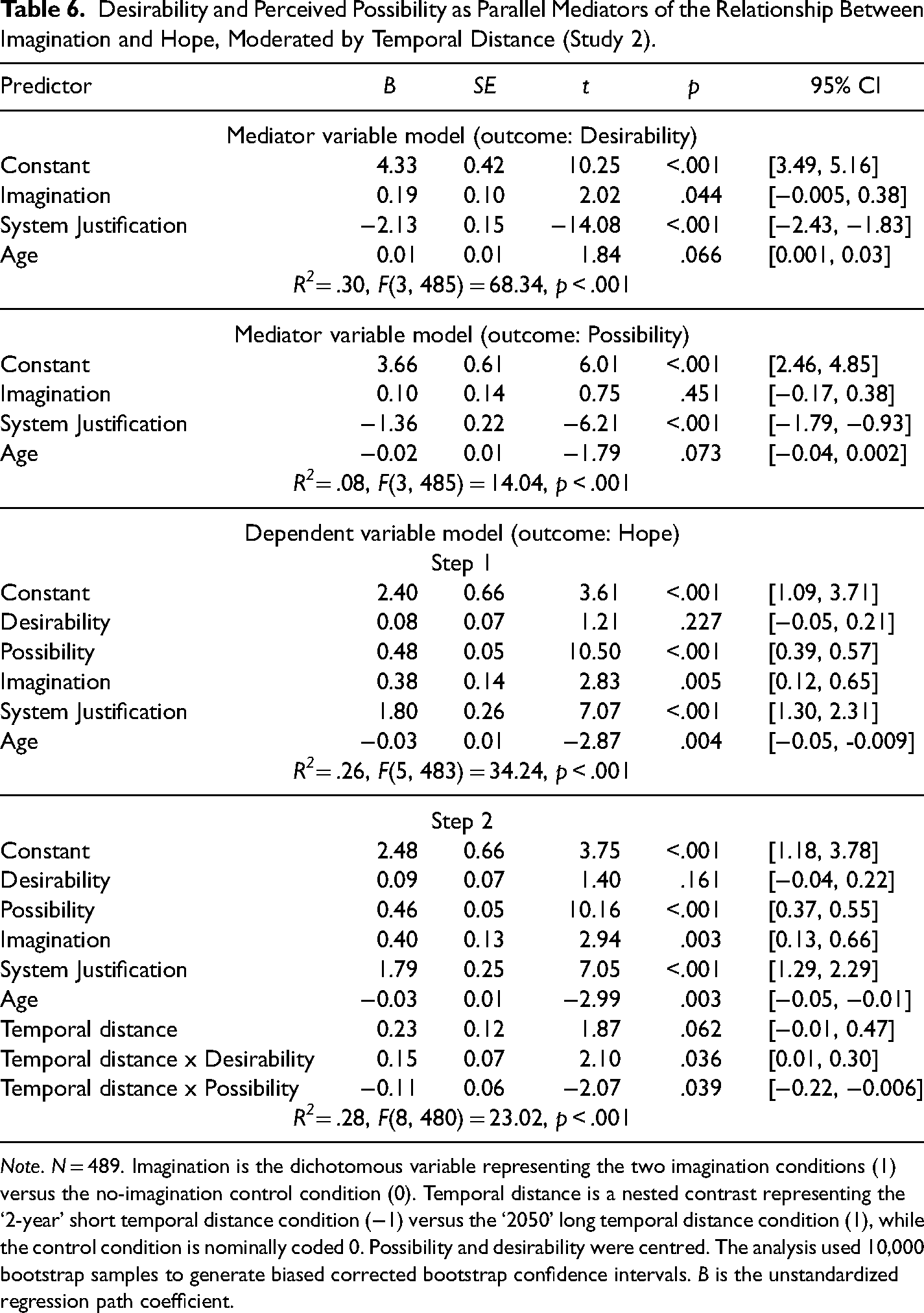
Note. N = 489. Imagination is the dichotomous variable representing the two imagination conditions (1) versus the no-imagination control condition (0). Temporal distance is a nested contrast representing the ‘2-year’ short temporal distance condition (−1) versus the ‘2050’ long temporal distance condition (1), while the control condition is nominally coded 0. Possibility and desirability were centred. The analysis used 10,000 bootstrap samples to generate biased corrected bootstrap confidence intervals. B is the unstandardized regression path coefficient.
Further, Table 6 (top panel) shows that imagination significantly increased desirability, supporting H3a. Hence, the preconditions for a moderated mediation were met: imagination significantly increased desirability, and the relationship between desirability and hope was significantly moderated by temporal distance. However, the index of moderated mediation did not reach statistical significance, Index = 0.03, SE = 0.02, 95% CI [-0.004 to 0.09], even if the conditional indirect effects tended to show the predicted difference at short and long temporal distance: the indirect effect of imagination on hope via desirability was marginally positive with long temporal distance, B = 0.04, SE = 0.03, 95% CI [-0.003, 0.13], but not significant and trending negative with short distance, B = -0.01, SE = 0.02, 95% CI [−0.06, 0.02]. Nevertheless, the evidence for H4a was tenuous.
Possibility as Mediator
Table 6 (bottom panel) shows that the interaction between perceived possibility and temporal distance on hope was statistically significant. The interaction is plotted in Figure 5b. Consistent with H2b, there was a stronger positive relationship between perceived possibility and hope for the short temporal distance, B = 0.57, SE = 0.07, 95% CI [0.44, 0.71], than for the long temporal distance, B = 0.35, SE = 0.07, 95% CI [0.20, 0.50].
Further, Table 7 (top panel) shows that imagination did not significantly increase perceived possibility, inconsistent with H3b. As there was no significant effect of imagination on perceived possibility, a key condition for moderated mediation via possibility was not met. The moderated mediation was not significant, Index = −0.01, SE = 0.02, 95% CI [-0.06 to 0.02]. Both conditional indirect effects were not significant, at short distance, B = 0.06, SE = 0.08, 95% CI [-0.10, 0.22], and long distance, B = 0.04, SE = 0.05, 95% CI [-0.06, 0.14].
Discussion
Study 2, despite relating to a different societal problem, replicated some key results from Study 1. First, imagining a positive future significantly increased hope—in this case, hope for a society with greater economic equality. In turn, hope was positively related to support for collective action to achieve greater economic equality. The indirect effect of imagining a positive future on support for action, via hope, accounted for the overall effect. Imagining a positive future with greater economic equality, through promoting hope, increased support for collective action to advance this cause. Second, Study 2 also replicated the moderating effects of temporal distance. The perceived desirability of a future with greater economic equality was more positively related to hope when the imagined future was distant rather than close, whereas the perceived possibility of the future was more positively related to hope when the imagined future was temporally near rather than far.
Study 2 also showed an interesting difference to Study 1. Imagination increased desirability of the outcome in Study 2 but not so in Study 1, whereas imagination increased perceived possibility of the outcome in Study 1 but not so in Study 2. Whereas in Study 1 only perceived possibility mediated the effect of imagination on hope, especially when a near future was imagined, in Study 2 desirability marginally mediated the effect of imagination on hope, but only when a distant future was imagined. However, lack of significant support for a moderated mediation of imagination effects on hope, via desirability or possibility, means we need to be cautious in interpreting these findings.
General Discussion
Across two studies about different societal issues, the current research shows that the act of imagining a positive future in which a societal challenge has been successfully dealt with, can increase support for collective action to address that challenge. Imagining a positive future increases hope—hope that the challenge can be dealt with or that people can rally together to tackle it—and hope mediates the effect of imagination on support for collective action (Daysh et al., 2024).
Both studies showed that this hope is related to the desirability and perceived possibility of successfully addressing the given social challenge (Miceli & Castelfranchi, 2010); however, in line with derivations from construal level theory (Liberman & Trope, 1998), the strength of the relationship between each of the two appraisals (desirability and possibility) and hope depended on the temporal distance of the imagined future. Perceived possibility was more strongly related to hope for an imagined near future compared with a distant future – aligning with construal level theory's assumption that a shorter psychological distance (here temporal closeness) corresponds to a tendency to low-level construal with a focus on concrete issues and practicalities. In contrast, desirability was more strongly related to hope when the imagined future was distant rather than near – as per the theory's assumption that a greater temporal distance induces high-level construal with an emphasis on values and principles.
An interesting implication of the current findings is that the emphasis, or meaning, of hope can shift. It can shift between, on the one hand, reflecting more of a commitment to the issue (its personal significance, importance, and desirability) and, on the other hand, reflecting more of a belief in the possibility of the issue (an assessment of likelihood or prospects). Shifts in connotation have been observed in previous research on hope. For example, Bury et al. (2016, 2019) observed that hope formed and operated differently at low levels of likelihood compared with high levels. At high levels of likelihood, hope converged with optimism – it became like optimism in showing a linear relationship with likelihood, and this was regardless of the level of personal investment (desirability). Distinct from optimism, at low levels of likelihood, an increase in possibility accelerated the increase in hope, if there was strong personal investment or desirability.
The current research reveals that the components of hope can weigh differently into hope, depending on how they are emphasised in the context in which hope intensifies. First, the results suggest that the characteristics of the given societal challenge may determine which component of hope (desirability or perceived possibility) is more readily influenced by imagining a positive future. Contrary to our predictions, the imagination task did not consistently affect both the desirability and perceived possibility of positive change. In Study 1 (climate change), there was a significant effect of imagination on possibility but not so in Study 2 (economic inequality); in Study 2 there was a significant effect of imagination on desirability but not so in Study 1. It is conceivable that many people agree that stopping climate change is already highly desirable (after all, our existence may depend on it), but imagining a positive future may positively influence the view that it is indeed possible for humans to turn around climate change. In contrast, many may see economic equality as possible (via the mechanisms of redistribution already in place in societies, such as the tax system), but imagining a positive future might shift their views about its desirability.
Second, the temporal distance effects observed in the current research show that the components of hope weigh differently depending on whether a near or distant positive future is imagined. For shorter (compared with longer) timeframes, perceived possibility is more strongly related to hope. But for longer timeframes (compared with shorter), desirability is more strongly related to hope. Thus, the nuance of hope shifts with the timeframes of the imagined future. Hope represents an increasing emphasis on likelihood and prospects at shorter timeframes, and an increasing emphasis on desirability, and hence importance and commitment to the issue, at longer timeframes. Researchers, therefore, need to be mindful that the meaning of hope can shift. This may also be an important insight for practitioners, organisational leaders, and social movement campaigners. Attempts at nurturing hope to garner support for change may fall flat if the targeted component of hope does not correspond to the timeframe of the envisioned outcome. For example, for a long-term challenge such as climate change, optimistic messages about the rate of progress in reducing carbon emissions might not elicit hope that promotes collective action support; instead, it might make people merely optimistic and complacent (Hornsey & Fielding, 2016).
Irrespective of the variability of the pathways to hope, a robust finding from the present studies is that imagining a positive future increases hope. The fact that the effects on hope were not (fully) mediated by possibility and desirability raises further interesting conceptual questions. Given that imagination increased hope directly, beyond any mediated effects via possibility or desirability, may suggest that imagining a positive future operates at a more affective level. The imagination task may have more immediate consequences for the emotion of hope; and it could be that the associated appraisals of possibility and desirability are only constructed post-hoc to fit the emotional experience (see Haidt, 2001). It is possible that visual imagery involved in the present imagination task encouraged a direct affective response (see Holmes et al., 2006). Perhaps if an imagination exercise involved a verbal discussion instead, effects might be more cognitively mediated and there might be stronger effects on desirability and possibility appraisals. Future research will need to unpack the verbal and visual features of imagination and the different effects these may have.
It is worth cautioning, though, that in both studies hope was measured before perceptions of desirability and possibility. We did not want to prejudice people's understanding of hope by priming the two appraisals. However, it is possible that the order of measurement meant that the imagination effects were literally more immediate on the hope emotion, and this may have acted against the mediational sequence we hypothesized. Future research may investigate (or control for) any effects of measurement order. It also needs to be cautioned that, as an inherent limitation of mediation analyses, the relationship between mediators and outcome is merely correlational and the causality and/or directionality of that relationship cannot be determined through these data (e.g., Fiedler et al., 2011). Further research may need to employ experimental or longitudinal designs to investigate the causal relation between desirability/perceived possibility appraisals and a hope emotion. That said, the causal role of appraisals in emotions generally is complicated due to a part-whole relation and feedback mechanisms between emotion components (for a discussion, see Moors, 2013).
As another limitation, the imagination task in the present research was minimalistic, requiring a minimum of only three minutes of imagination. For future research, longer and repeated imagination exercises may achieve more. The present imagination approach could also be expanded to involve more creative and interactive visioning exercises. Likewise, to reap the benefits of both distant and proximal imaginations, future research could investigate how the different construal levels could be combined or “bridged” (see also Fine, 2024). It is furthermore worth noting that support for collective action was measured as self-reported intention. Although this approach is typical in the collective action field (Agostini & van Zomeren, 2021), research that expands on the current findings should consider measuring actual behaviour.
Finally, the effect of hope on collective action is consistent with research that has highlighted the role of hope in collective behaviour and social change (e.g., Greenaway et al., 2016; Wlodarczyk et al., 2017). As with most of the previous research, in the current studies, hope was a measured variable; we cannot be certain about the causality of hope on collective action support. Experimentally manipulating hope could address this causality issue; however, manipulations of hope risk introducing confounds that detract from pure hope (Ojala, 2023). For example, Greenaway et al. (2016, Study 4) manipulated general hopefulness by asking participants to write about a feature in their life that made them feel hopeful; however, it is possible the recalled features also involve confounds such as agency or activism. Hornsey and Fielding (2016) increased hope via an optimistic message that humanity is slowing carbon emissions but thereby may have contaminated hope with a view that the world is on track towards controlling the climate risk, reducing the individual's motivation to personally engage in climate action. A suggestion for future research is to adopt a measurement approach with a longitudinal design, to address the causality issue.
Conclusion
Society faces many challenges, both short term and long term. Societies need to adapt to deal with these challenges. Adaptation occurs through social change, and effective adaptation requires that people not only support social change, but promote it by lobbying, campaigning, protesting, and making personal changes in their lives. It can be a burdensome process with uncertain outcomes, requiring will and perseverance. The present research shows that imaging a positive future can promote the willingness to support collective action through instilling hope – but the meaning of hope may depend on the context and temporal distance of the imagined future.
Footnotes
Data,Supplementary Analyses,and Materials

Declaration of Conflicting Interests
The authors declared no potential conflicts of interest with respect to the research, authorship, and/or publication of this article.
Ethics Approval
The questionnaire and methodology for this study was approved by Flinders University's Human Research Ethics committee (Ethics approval number: 6665).
Funding
The authors disclosed receipt of the following financial support for the research, authorship, and/or publication of this article: This research was supported by a grant from the Australian Research Council (grant number DP200101921).