



Abstract
This study had four objectives: (a) examining the sex-related differences in the level of personality functioning (LOPF), (b) exploring the association between personality traits (PT) and LOPF, (c) exploring the association between identity statuses (IS) and LOPF, (d) exploring whether PT and IS can predict LOPF. A sample of 1450 students aged 15–21 years from high schools and universities from all the governorates of Lebanon participated in this online study. The Arabic version of three measures were used: (a) Revised Personality Inventory: Honesty-Humility, Emotionality, EXtraversion, Agreeableness (versus Anger), Conscientiousness, Openness to Experience (HEXACO) – PI – R, (b) Extended Objective Measure of Ego Identity Status (EOM-EIS), (c) Level of Personality Functioning Screener- Brief Form 2.0 (LOPF-BF-2.0) were rated for the sample. Results showed no statistical differences in LOPF between males and females; IS and LOPF were correlated similarly in both males and females except for Achievement (Ach), which did not correlate significantly with LOPF in males, but correlated negatively and significantly among females. Conversely, Moratorium (M), Foreclosure (F) and Diffusion (D) correlated positively with LOPF in both males and females. All Identity statuses could predict LOPF, except for F; likewise, all personality dimensions Humility (H), Extraversion (X), Agreeableness (A), and Conscientiousness (C) could predict LOPF except for Openness to experience (O). Implications of the results are discussed.
Adolescence is a critical period in a person's formation of identity (Erikson, 1968, 1977), and it plays a fundamental role in forming subsequent stages of life. Success in identity formation leads to inner peace, self-satisfaction, and harmony with the social norms; whereas, failure in figuring out one's identity leads to inner fragmentation, negative roles in society, and maladaptive coping mechanisms such as drug abuse (Erikson, 1977, p. 234–237). Further research of Eriksonian concepts of identity formation and identity crisis have led to the conclusion that identity is a complicated and multidimensional construct (Benzi et al., 2022), and that failure in resolving identity crisis leads to moratorium or diffusion, which result in myriad of psychological and social repercussions due to personality malfunctioning (Demir et al., 2009; Kroger et al., 2010; Rivnyák et al., 2021; Zahid & Goth, 2022).
Other researchers have studied the relationship between self-concept, identity statuses and their role in self-functioning and found a strong link between a clear sense of self, resolved identity statuses and proper level of personality functioning and vice versa (Ickes et al., 2012; Pilarska, 2016; Schoot & Wong, 2012; Schwartz et al., 2010; Su et al., 2017).
However, clinicians have found limitations in the categorical classification of personality disorders (PD) in the fifth edition of the Diagnostic and Statistical Manual (DSM-5), which may place a person in more than one category of PD at a time. This fact has encouraged to a lot of research that resulted in the birth of the alternative dimensional model of diagnosis (Widiger & Simonsen, 2005). Similarly, previous studies that associate personality psychopathology and personality dimensions described by the Five Factor Model (FFM/OCEAN) concluded that personality disorders do not result from new distinguishing traits or from alterations of personality dimensions; rather, they are the outcome of various problematic combinations of familiar personality traits (O'Connor & Dyce, 1998). In contrast, some researchers and clinicians argue that such characterization is a mere oversimplification of personality pathology; studies using different assessment tools have been conducted in this regard (Coolidge et al., 1994; Costa & McCrae, 1990; Hyer et al., 1994; Soldz et al., 1993; Wiggins & Pincus, 1989).
As such, the American Psychiatric Association (APA) found it necessary to address the shortcomings of the existing criteria in diagnosing personality disorders. The new approach did not abolish the previously established one that depended merely on a number of pathological symptoms; conversely, the Alternative Model of Personality Disorder (AMPD) presented impairments of the level of personality functioning as Criterion A, and the pathological symptoms as Criterion B in PD diagnosis. According to AMPD, impairments of LOPF in two domains: self-functioning problems (represented by identity and self-direction difficulties) and interpersonal-functioning problems (represented by empathy and intimacy troubles) are the central and primary causes of personality psychopathology (American Psychiatric Association, 2013, p. 761–762).
While DSM-5 does not differentiate between the two sexes in this regard, many measures have been devised to capture such LOPF disturbances (Bach & Hutsebaut, 2018; Clinical trial, 2021; Gonzalez Flores et al., 2022; Hutsebaut et al., 2016; Kerr et al., 2023; Sexton et al., 2019; Sharp et al., 2023; Siefert et al., 2020; Weekers et al., 2018).
In the same vein, related literature has also confirmed that salient symptoms of maladaptive psychological and behavioral symptoms have been linked to identity confusion and disturbances (Demir et al., 2009; Ferrer-Wreder & Kroger, 2020; Kroger et al., 2010; Kroger & Marcia, 2011; Marcia & Josselson, 2013; Rivnyák et al., 2021; Schlüter-Müller et al., 2015; Soldz et al., 1993; Sollberger et al., 2012; Zahid & Goth, 2022; Zandersen & Parnas, 2019).
With respect to personality traits, the new model of personality structure, HEXACO, founded by Lee and Ashton (2009) has proved to be successful in capturing many pathological symptoms and maladaptive personalities. First, the founders of the HEXACO model have found few sex differences in personality traits; for example, in a multicultural study it was shown that females had higher levels of the honesty – humility and emotionality and moderately higher levels of conscientiousness than males, while males had moderately higher levels of openness and agreeableness than women (Lee & Ashton, 2020). It was also found that the combination of the low level of honesty - humility - the distinctive factor of the model - with other factors in a personality can result in different maladaptive behaviors and features (Lee & Ashton, 2012, p. 22–32). Similarly, other studies have shown that personality traits are linked to impairments of personality (Amani, 2015; Ashton et al., 2012; De Vreis et al., 2009; De Vries & Kampen, 2010; Knight, 2016; Lobrano, 2014; Reinout et al., 2009). Such results indicate that personality disorders are not casual symptoms that are incompatible with the personality, a fact that explains why PDs are resistant to change.
Lack of similar research in the Lebanese context motivated the researchers to fill this gap and examine how personality traits and identity statuses contribute to the level of personality functioning among adolescents in Lebanon.
Indeed, studies in different countries as diverse as Argentina, Iran, Malaysia, New Zealand, and Zimbabwe were conducted to investigate whether there are cross-cultural differences in the psychological constructs using the FFM; it was found that there were no differences in the FFM though there were many cultural, religious, linguistics, political, historical and other cultural dissimilarities. Moreover, it was found that covariation among traits was maintained among cultures, which indicated that personality dimensions could be assessed and explained through the FFM worldwide (Terracciano & McCrae, 2006).
Similarly, personality structure was examined in different cultures: India, Indonesia, Oman, Romania, and Thailand to investigate whether personality dimensions can be replicated using the HEXACO model; results yielded similar results in some cultures only. While in other studies that included 10 countries the six dimensions were replicated, part of its validity is attributed to the incremental validity of the Honesty – Humility Factor (Ion et al., 2017).
As a matter of fact, the universality of some invariant features in personality structure can be obtained through FFM, which made it dominant for a long time. However, different cross-cultural recent studies using the FFM, some of which incorporated up to 11 cultures, including Croatia, Turkey, Greece, the United Kingdom, Holland, South Africa, and Bolivia have yielded varied numbers of personality dimensions that could range between 2 or three factors to nine factors depending on the socio-economic and educational level of the culture being investigated. These findings re-open the debate to whether the FFM is the omnipresent model that can explain personality structure and retrieve the same personality dimensions worldwide (Ion et al., 2017).
When personality can be explained by common universal dimensions, personality traits and psychopathology can be easily compared across cultures. That is why reproducing similar studies in the local community becomes a need. That is why such a study becomes a need.
Method
Participants
The researchers were interested in getting a sample that can be really representative of the population, so they asked for the consent of the Ministry of Education and Higher Education to involve all the 250 public high schools nationwide in the study. After getting the consent, google forms were disseminated via principals and administrative directors to students. Students had the complete freedom to participate or withdraw from the study. Those who were willing to participate responded to the measures. After one month of data collection, the result was a convenience sample of 1450 (Aged 15–21years) students from different high schools and universities across all the governorates of Lebanon (1139 females) participated in this online study. They responded to the Arabic versions of the scales.
Procedure
Scales were checked for reliability and validity first (N = 608), then data collection for the study followed (N = 1450). Finally, data analysis using SPSS version 23 was completed.
Measures
HEXACO Personality Inventory-Revised (HEXACO – PI – R) for Personality Structure
The Arabic version of HEXACO Personality Inventory-Revised (HEXACO – PI – R) for Personality Structure was manipulated in the study. It is a 60 - item instrument that assesses the six major dimensions of personality: Honesty-Humility, Emotionality, EXtraversion, Agreeableness (versus Anger), Conscientiousness, Openness to Experience. Each subscale consists of ten items; all items employ a 1 to 5 response scale: 1 for ‘strongly disagree’ to 5 for ‘strongly agree’. It is devised by Lee and Ashton (2009) and has been validated worldwide. Internal consistency ranged between .77 and 80 (Ashton & Lee, 2009). The researchers tested the reliability of the scale in Lebanon (N = 608); Results showed good Cronbach α = .758; and the internal consistency coefficients ranged between .506 and .687, except for Emotionality .289.
Extended Objective Measure of Ego Identity Status (EOM-EIS)
This study incorporates the Arabic version of the extended objective measure of identity statuses built on Marcia's theory (1964). It discriminates between four statuses of identity: (a) achievement (which refers to adolescent's success in exploring alternatives and commitment to one), (b) moratorium (which refers to a status of suspended exploration of choices, and hence to commitment); (c) foreclosure (which refers to a status of commitment to a choice with a little, if any, exploration; (d) diffusion (which indicates neither exploration nor commitment to any of the choices) (Kroger & Marcia, 2011). Each status includes both ideological and interpersonal content domains of identity. It is a 64 item six-point Likert scale. The Arabic version was validated in the Egyptian society by M. Abed Al-Rahman (1998) and yielded similar results to the original scale by Bennion and Adams (1986): Cronbach alpha ranged between .58 and .80 on subscales and internal consistency showed acceptable results. The researchers tested the validity and reliability of the scales in the Lebanese society (N = 608) and the results yielded a higher value of Cronbach α = .844 and high internal consistency coefficients ranging between .285(very few items) and .785.
Level of Personality Functioning Screener- Brief Form 2.0 (LOPF-BF-2.0)
LOPF-BF-2.0 assesses the level of personality functioning and complies with the AMPD. It is a 4-point Likert self-report scale (ranging from ‘very false or often false’ = 0 to ‘very true or often true’ = 3). It is composed of 12 items divided into two subscales: the first measures self-functioning problems and is composed of two subscales that assess impairments in identity and self-direction; the second assesses interpersonal functioning impairments, and it incorporates two subscales about intimacy and empathy difficulties. This indicates that the lower the total score, the better functioning the personality is. The screener can be used in both clinical and non-clinical settings (Siefert et al., 2020). The internal consistency estimates for the LPFS-BF 2.0 were high, with α = 0.82 for the total scale and α = 0.79; 0.71 for the self-functioning and interpersonal functioning scales respectively (Weekers et al., 2018). Cronbach α was .844, for the total scale in the Lebanese validation sample (N = 608), .815 for self-functioning, and .723 for interpersonal functioning. Coefficients of internal consistency ranged between .707 and .90.
Statistical Analysis
Descriptive statistics (means and standard deviation) in addition to inferential statistics (Pearson correlations, t-tests, multiple linear regression model were utilized in analyzing the data through SPSS 23.
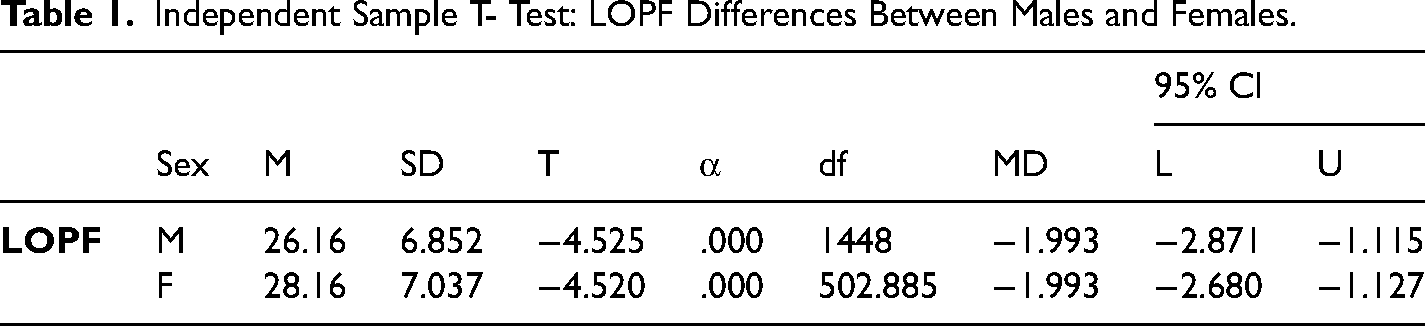
Independent Sample T- Test: LOPF Differences Between Males and Females.
Pearson Correlational coefficients in Table 2 show that there are significant correlations between all identity statuses and LOPF in males, except for Achievement of identity. Similarly, no correlation exists in the overall level of personality functioning and Foreclosure in both males and females. As for personality dimensions, all domains are correlated with LOPF in both sexes.
Pearson Correlations Between Personality Functioning and Each Subscale of Identity Status and Personality Structure.
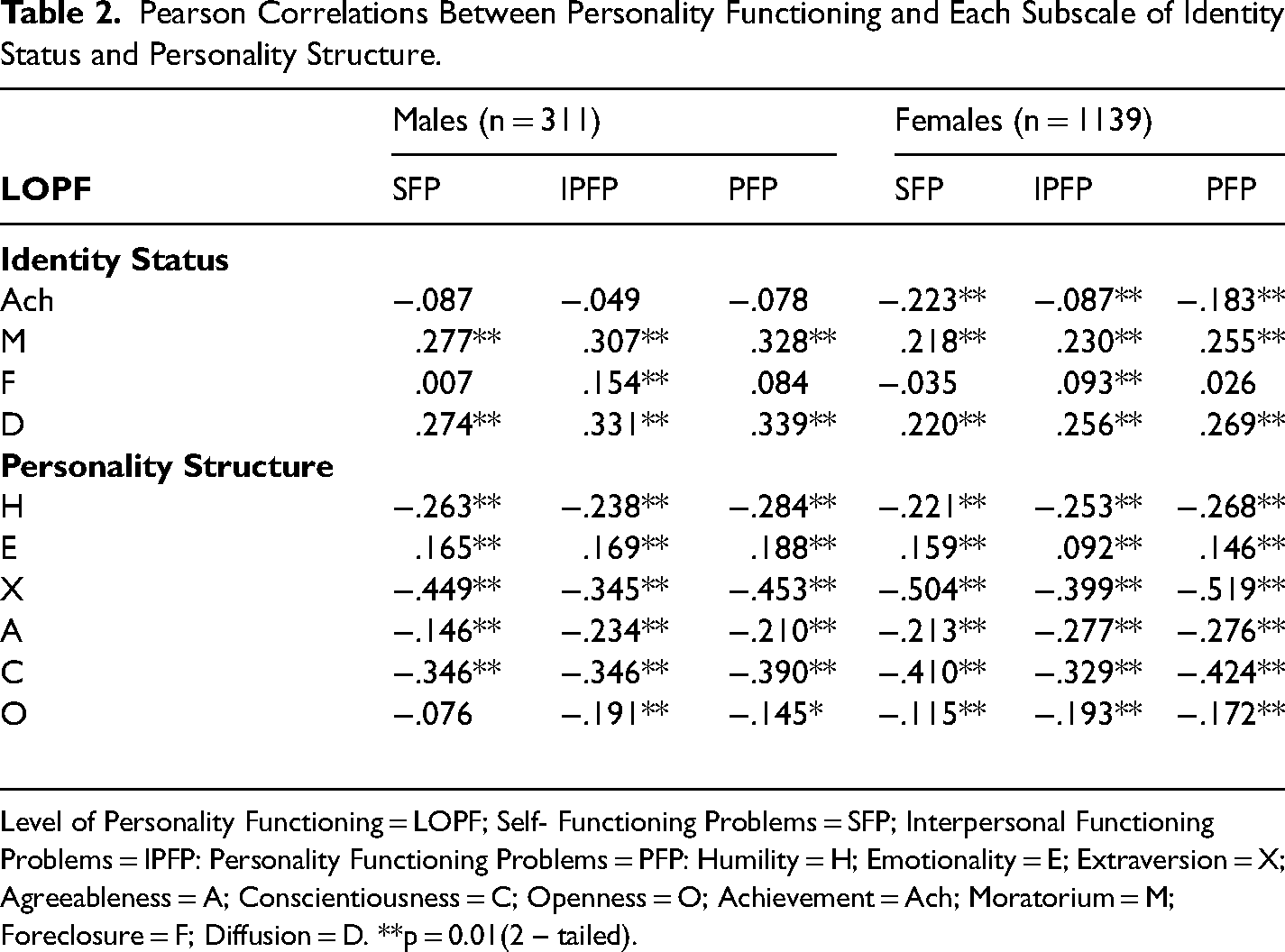
Level of Personality Functioning = LOPF; Self- Functioning Problems = SFP; Interpersonal Functioning Problems = IPFP: Personality Functioning Problems = PFP: Humility = H; Emotionality = E; Extraversion = X; Agreeableness = A; Conscientiousness = C; Openness = O; Achievement = Ach; Moratorium = M; Foreclosure = F; Diffusion = D. **p = 0.01(2 – tailed).
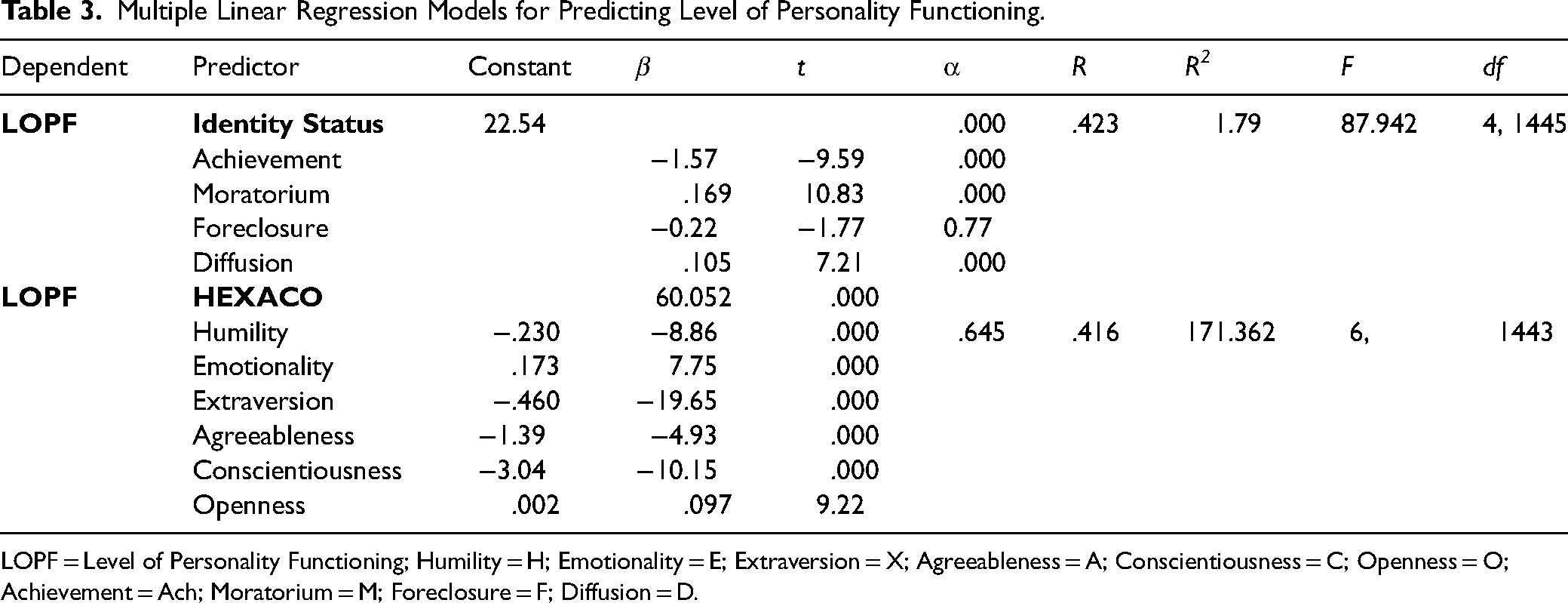
Based on Table 3, the results indicated that the model of identity statuses was a significant predictor of the level of personality functioning: F (4, 1445) = 87.942, p = .000.
Multiple Linear Regression Models for Predicting Level of Personality Functioning.
LOPF = Level of Personality Functioning; Humility = H; Emotionality = E; Extraversion = X; Agreeableness = A; Conscientiousness = C; Openness = O; Achievement = Ach; Moratorium = M; Foreclosure = F; Diffusion = D.
Similarly, Table 3 indicated that the model of personality structure was a significant predictor of the level of personality functioning: F (6, 1443) = 171.362, p = .000.
Discussion
Table 1 shows there were no statistical differences in the level of personality functioning in terms of sex. Both males and females may have disturbances either in self –functioning (identity and/or self- direction) or in interpersonal functioning (empathy and/or intimacy). This conforms with both the literature and DSM5-5 (American Psychiatric Association, 2013, p. 761–762). However, DSM – 5 (2013) states that there are sex-related differences in the type of personality disorders and its intensity; for example, schizotypal personality disorder is slightly more prevalent in males (p. 658); antisocial personality disorder is mainly diagnosed in males (p. 662); narcissistic personality disorder is more common in males (50–75%) (p.671); obsessive compulsive disorders are double in males (p. 681); borderline personality disorder is predominant in females (75%) (p. 666); dependent personality disorder is more frequent in females (p. 677). Other studies need to be conducted to confirm or disconfirm such differences in the Lebanese society.
Regarding the associations between identity statuses and LOPF, results indicated that there were no significant statistical correlations between achievement of identity and LOPF in males; whereas achievement of identity in females had statistical negative correlations with LOPF, indicating that females may have less personality troubles when they achieve their identities. Contrary to what is expected, male results do not conform with the literature, which may be due to the political and socioeconomic distress they are suffering from, whereas female results can be understood in the light of both feminine nature and the female role and responsibilities in this age in the local community.
However, data indicated that both males and females were vulnerable to personality difficulties in the moratorium status, which points to the adolescents’ suspension of exploration of alternatives as well as commitment to any choice. This status logically leads to many dilemmas and was confirmed in the previous studies.
In addition, foreclosure of identity was positively correlated only with interpersonal functioning problems which have to do with empathy and intimacy. This may be interpreted in the light of the adolescent's abhorrence of their parents’ interference in the choice of friends, cliques, or intimate people of the other sex. Conversely, foreclosure is not significantly associated with self-functioning problems or personality functioning problems as a whole. This may be partially true in adolescence, but longitudinal studies need to confirm such a result.
Finally, the strongest positive correlations exist between diffusion of identity and personality functioning problems in both males and females. Different types of related disturbances on the psychological, personal, and interpersonal levels are confirmed in the literature (Demir et al., 2009; Ferrer-Wreder & Kroger, 2020; Kroger et al., 2010; Kroger & Marcia, 2011; Marcia & Josselson, 2013; Rivnyák et al., 2021; Schlüter-Müller et al., 2015; Soldz et al., 1993; Sollberger et al., 2012; Zahid & Goth, 2022; Zandersen & Parnas, 2019). In addition, DSM-5 confirms these results. According to AMPD, all types of PDs suffer from moderate to severe impairments in identity (APA, 2013, p. 761–762). The DSM-5 categorical classification of personality disorders also includes identity disturbances as one of the distinctive criteria of borderline personality disorder (American Psychiatric Association, 2013, p. 663).
On the level of personality dimensions, Table 2 shows that low level of honesty- humility was associated with self and interpersonal functioning problems and personality functioning problems as a whole. This is expected because people with these traits tend to exploit others and take advantage of them as confirmed by Lee and Ashton (2012). Narcissistic personality disorder also displays symptoms of problematic interpersonal skills due to lack of empathy (American Psychiatric Association, 2013, p. 670). High emotionality was found to be positively correlated with both scales of LOPF and with the overall level of personality functioning. Ashton (2017) reports that “people with high levels of emotionality have gains and, thus, stay secure because they tend to be fearful and overprotective, while people with low levels of emotionality will endanger their lives as well as their families’ lives” (p. 279).
The highest negative statistically negative correlations were found between extraversion and the level of personality functioning. This means that the lower the levels of extraversion, the more problems and impairments in self-functioning, interpersonal functioning and overall personality functioning. This result is expected due to the features that characterize the extraversion domain and to their contribution to possessing effective personal, social and interpersonal skills in life. A person with high levels of extraversion will be lively, hopeful and energetic, while low levels of extraversion are associated with feelings of unpopularity, introversion, avoidance, and loss of dynamism (Lee & Ashton, 2012, p. 15–16) This result is reinforced in the negative correlations between each of the agreeableness (versus anger), conscientiousness and openness to experience domains on one hand and LOPF on the other. Through a series of studies, Ashton (2017) delineated the traits of people with low and high levels on each personality domain (p. 279), and the results of this study align with Ashton's results.
Finally, a multiple regression was carried out to investigate whether the four statuses of identity could significantly predict the level of personality functioning problems. Results of the regression indicated that the model explained 17.9% of the variance, and that the model was a significant predictor of the levels of personality functioning problems, F (4, 1445) = 87.942, p = .000. While Achievement contributed negatively to the model (β = -.157, p = .000), Moratorium and Diffusion contributed positively (β = .169, p = .000 and β = .105, p = .000 respectively). Foreclosure was not found to be a predictive factor of LOPF. These results point to the probability that one can predict problems and disorders in the personality of an adolescent when their identity is in the moratorium or diffusion state, while identity achievement makes an adolescent less vulnerable to personality troubles. The final predictive model was:

Limitations of this study result from the nature of the self-reporting scales, which may not guarantee accurate responses of the sample. In addition, it is possible that some students who responded to the questionnaires may have misunderstood some questions and responded inaccurately due to the nature of online studies, where the researchers were not available for clarifications. In addition, it would be, indeed, difficult to conduct a follow-up or longitudinal study due to the cross-sectional nature of the sample that is distributed all over Lebanon.
Another limitation may rise from the Hexaco personality model itself which has its proponents and opponents. For example, a minor criticism from the FFM adherents involves lexical criticism. They object that the HEXACO model is based on an extensive use of adjectives that represent personality traits. This is basically lexical criticism that bounces back into the FFM pointing to its psycho-lexical approach which manipulates a restrictive list of adjectives. Additionally, correlation matrices might not have been fully explored to capture all the potential dimensions of the human personality. As such, this lexical criticism seems like a rather minor point (Anglim, 2019). In addition, some scholars argue that the application of HEXACO in different cultures and throughout different languages doesn’t reclaim the six factors of HEXACO. This is a privilege that even Ashton and Lee (2020) themselves did not claim though they also report that “The six-factor structure is the largest widely replicated structure of personality characteristics.”
This raises the question on why researchers have to be satisfied using the FFM when, indeed, there is another model to describe the personality comprising another factor that expresses the moral dimension of the human behavior described by HEXACO: Honesty-Humility Factor (H-factor). Though the H-factor may be similar to the politeness aspect of Agreeableness in the FFM, it has more advantages in many different ways. Anglim and O'Connor (2019) cite many studies (Jonason & O'Connor, 2017; Lee et al., 2008; Lee et al., 2003) that prove the H-factor's capability of predicting ‘unethical, manipulative, and deceptive’ behavior as well as its ability to predict prosocial behavior (e.g., Zhao & Smillie, 2015); similarly, the authors cite studies that prove that the reverse of the H-factor is synonymous with the Dark Triad (Aghababaei et al., 2014; Lee & Ashton, 2014), and that it has been utilized in studies of the dark personality (Smith et al., 2018), and in employee selection to exclude applicants who are likely to engage in counter-productive behaviors (Anglim et al., 2017; Hough & Connelly, 2013). Such advantages motivate researchers to utilize the HEXACO model for its ability to capture a wider spectrum of human traits and behaviors.
However, some opponents still call for the lack of need of the H- factor in personality measures, claiming that it is a measure of values, not personality. In refuting such a claim Ashton and Lee (2020) depend on the same premise to question the need of Openness to Experience and even Agreeableness in the FFM for their overlap with values. They draw the attention to the fact that excluding the H-factor from a personality measure leads to disregard of a lot of important variance (Ashton & Lee, 2020).
Finally, it is highly recommended that future studies about personality be conducted in Lebanon to fill in the research gap. To counteract the limitations of the present study that has to do with the impracticality of conducting a longitudinal study and a cross-sectional one at the same time, cohort studies which involve students from selected high schools and universities nationwide may be more feasible and practical. Such studies may address the analysis of personality traits and the effectiveness of counseling programs to address problematic issues.
Footnotes
Declaration of Conflicting Interests
The authors declared no potential conflicts of interest with respect to the research, authorship, and/or publication of this article.
Funding
The authors received no financial support for the research, authorship, and/or publication of this article.
