



Abstract
Motor imagery (MI) training is used to improve motor performance in both patients and athletes. The putative link between personality and MI remains however largely underexplored. In this pilot study, 72 sports students performed MI and physical execution of a finger pointing task. MI ability was assessed through the mental chronometry paradigm that captured the temporal components of imagery, as well as self-report measures of imagery vividness and imagery ease. Personality dimensions were assessed with the five-factor model. Extraversion was found to be significantly correlated with MI ability as measured with mental chronometry (r = .37, p = .001) but not with imagery vividness (r = −.08, p = .481) or imagery ease (r = −.04, p = .741). The other personality dimensions were unrelated to MI ability (all p > .05). Based on these findings, we postulate that extravert individuals may have an advantage in controlling and maintaining the temporal aspect of mental movements. This may help extraverts to better benefit from imagery training.
Imagery ability is typically referred to the “capability to form vivid, controllable images, and retain them for a sufficient time to effect the desired imagery rehearsal” (Morris et al., 2005, p. 37). Cumming and Eaves (2018) highlighted the multidimensional complexity of this well-established construct in sport psychology. Components of imagery ability can be classified according to the process of imagination (ease, accuracy, controllability, duration, vividness; Morris et al., 2005), the desired outcome (affective, behavioural, cognitive; Cumming & Williams, 2012), or the imagery function (motivational or cognitive function; Paivio, 1985). The cognitive-specific aspect of motor imagery (MI) ability is relevant when imagining a concrete movement. What happens during MI is defined as the mental simulation of a movement without concomitant motor execution (Guillot & Collet, 2012), this cognitive process involves spatial abilities and working memory (Madan & Singhal, 2012).
Further, MI comprises several modalities, including visual imagery of the movement through a third- or a first-person perspective (“watching the movement through the character's own eyes”), as well as kinaesthetic imagery (“feeling oneself performing the movement”), as referred to in psychometric questionnaires (Collet et al., 2011). MI abilities can be assessed by psychometric, behavioural and psychophysiological tools (Guillot & Collet, 2012; Collet et al., 2011). Psychometric tools are based on self-reports, such as items on visual analogue scales (VAS; Mizuguchi et al., 2019; Schlatter et al., 2020) or in imagery questionnaires (e.g., in the Movement Imagery Questionnaire (MIQ-3; Williams et al., 2012), while behavioural tools are more objective measures including mental chronometry.
Motor imagery is established in the applied field of sport psychology and its importance and effectiveness in terms of influencing performance and rehabilitation processes has been extensively documented (for reviews, see Di Rienzo et al., 2014; Simonsmeier et al., 2020). The efficiency of MI relies on neurofunctional equivalence which illustrates the neuronal activation similitude during mental and real practice. Thanks to the neurofunctional equivalence (Hétu et al., 2013), MI modifies the mental representation of action. This enhances the expertise level of the athlete and facilitates motor learning without the constraint of physical fatigue. For instance, only 3-day training of MI improved accuracy of golf putting performance by 31% (Kim et al., 2017), while physical strength in a biceps curling machine task was improved by 20% with the validated 6-week PETTLEP imagery intervention (Wright & Smith, 2009).
Whether athletes or patients can benefit from such interventions partially depends on their initial MI ability, which substantially varies among individuals (Madan & Singhal, 2012; Williams et al., 2015). In the modern conceptualisation of MI ability, individual differences are acknowledged. For instance the ‘revised applied model of deliberate imagery use’ (Cumming & Williams, 2013) includes the “individual” in terms of gender, competitive level, age and experience as well as the individual's disposition or personality. However, this covers only lower order traits, also called secondary traits, but rarely higher-order traits, also called primary traits including personality. Practically, it has been shown that differences in trait anxiety could influence the refined use of imagery techniques in precompetitive phases (Thomas et al. 2007). Also, the tendency to have a visual instead of a verbal cognitive style may provide an advantage in the application of imagery trainings (O'Halloran & Gauvin, 1994), and empathy was found to increaseimagery ability as well as the frequency to use imagery (Budnik-Przybylska et al., 2019). Interestingly, not only imagery related research explored the individual dispositions. For instance, the conceptualisation of athletes’ resilience in ‘A grounded theory of psychological resilience and optimal sport performance’ also mentioned the positive personality, although higher order traits were still not directly considered (Fletcher & Sarkar, 2012). Taken together, these data support that the understanding of individual factors is still systematically missing the conceptualisation of primary personality traits.
Individual disposition of stable character traits is measured via higher-order trait taxonomies (Digman, 1990). One established tool is the validated practical inventory by Costa and McCrae (1985; NEO-PI) which determines five personality dimensions (Big 5): Extraversion, Agreeableness, Conscientiousness, Neuroticism, and Openness. The most recent version of the personal inventory (NEO-PI-R; Costa & McCrae, 1992) achieved popularity beyond differential psychology in interdisciplinary fields. In a non-clinical population, shorter versions such as the Big Five Inventory (John et al., 2008) are commonly used to economically determine the score on the continuum of the five dimensions.
So far, only two studies analysed the influence of personality on MI ability of sport movements. Imagery perspectives were found to differentially influence motor performance in high and low narcissistic persons, hence highlighting the importance of considering personality dimensions when examining the effectiveness of imagery interventions (Roberts et al., 2010). With regards to the five dimensions of personality, Budnik-Przybylska et al. (2019) further discovered the crucial role of personality in general imagery ability of competitive dancers. Personality dimensions predicted 49% of imagery ability in amateur dancers and 67% in professional dancers. The dimensions that influenced imagery ability the most were extraversion, openness to experience, and conscientiousness. While these promising effects are of interest, it remains difficult to draw firm conclusions as data refer to movements with a creative and artistic background, and the measure applied for imagery is not of common use (“The Imagination in Sport Questionnaire”).
Research in other fields has identified the role of personality in MI ability and across those contexts, and extraversion appeared to be a relevant indicator of MI ability (see Appendix A). A recent study investigated performance of Mental Imagery based Brain-Computer-Interfaces and indicated a significant role of extraversion, as well as conscientiousness and neuroticism, in relation to an imagery control task of hand movements and rotations (Jeunet et al., 2015). Further, extraversion also correlated positively with visual vividness (Chun & Hupé, 2016; McDougall & Pfeifer, 2012) and played a relevant role in physical motor processes which in turn influenced MI (Buchman et al., 2013; Hoggarth et al., 2010; Meira et al., 2015). Besides empirical findings, extraversion is a dimension that includes activity levels (John et al., 2008), and is therefore conceptually related to movement and MI.
Overall, current literature on the association between MI ability and personality provides scarce and contradictory results and lacks comparability in terms of context, instruments and sensory modalities of imagery. Therefore, the present work aimed at bridging this gap. Beyond existing models that already included secondary traits, we hypothesized that personality, as a primary trait of the individual, might also affect MI ability.
Materials & Methods
Participants
Seventy-two participants (31 men, 41 women) with an average age of 23.0 years (SD = 6.4) were recruited from a sports university and voluntarily took part in the study. The experiment was conducted in a quiet room without any distracting stimuli. Criteria for inclusion was self-reported right hand dominance and lack of moderate depressive state (Beck's score < 11; Beck & Beamesderfer, 1974). All participants were healthy without any history of chronic disease and were regular sleeper (Pittsburgh Sleep Quality Index < 7; Buysse et al., 1989). They all signed a written consent form in accordance with the Declaration of Helsinki. The participants reached in average 2.6 years (SD = 2.1) of higher education and performed 7.2 h of sport per week (SD = 5.8; see Table 1). Data collection took part between September 2019 and September 2020. Participants arrived and on paper filled out the demographic questionnaire and thereafter the personality questionnaire, then they performed the imagery ability tests and thereafter responded to the questions related to their imagery ability.
Descriptive Statistics for all Variables (N = 72).
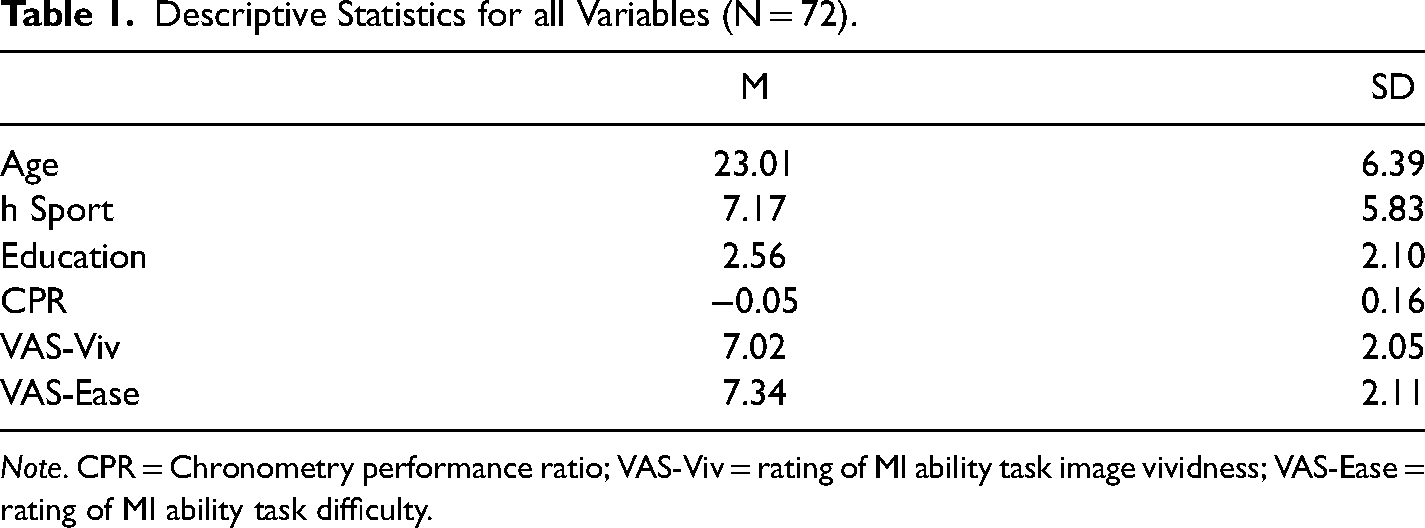
Note. CPR = Chronometry performance ratio; VAS-Viv = rating of MI ability task image vividness; VAS-Ease = rating of MI ability task difficulty.
Measures
MI Task
We assessed explicit MI ability based on mental chronometry with a sequential Finger Pointing Task (see Schlatter et al., 2020). The movement consisted of gliding the right index finger towards nine target points on a sheet placed on a table while standing (Figure 1). The movement begins and ends with a centre point that also needs to be hit between each target point (see Appendix B for a detailed protocol translated into English) Participants were asked to first physically perform the movement, and then imagine the same sequence with closed eyes. For the imagery task, the experimenter recalled the modalities. Subjects orally indicated the beginning (“Go”) and the end (“Stop”) of their movement. The sequence duration from “Go” to “Stop” that measured the complete movement across all target points was recorded via a digital timer (1/100 s, XL-013 anytime ®). After a familiarization step, four set repetitions were performed. This mental chronometry task allowed evaluation of whether participants achieved temporal equivalence between actual movement and MI. Output variable of the task was the chronometry performance ratio for each individual: [(meanmotor execution − meanmotor imagery)/meanmotor execution]. Previous research has applied this standard methodology (Liepert et al., 2016; Personnier et al., 2010; Schlatter et al. 2020). A ratio above zero indicates that the mean duration of motor execution was longer than the mean duration of motor imagery, vice versa a ratio below zero indicates that participants executed faster than they imagined. Values closer to zero indicate higher temporal equivalence and therefore better imagery ability.
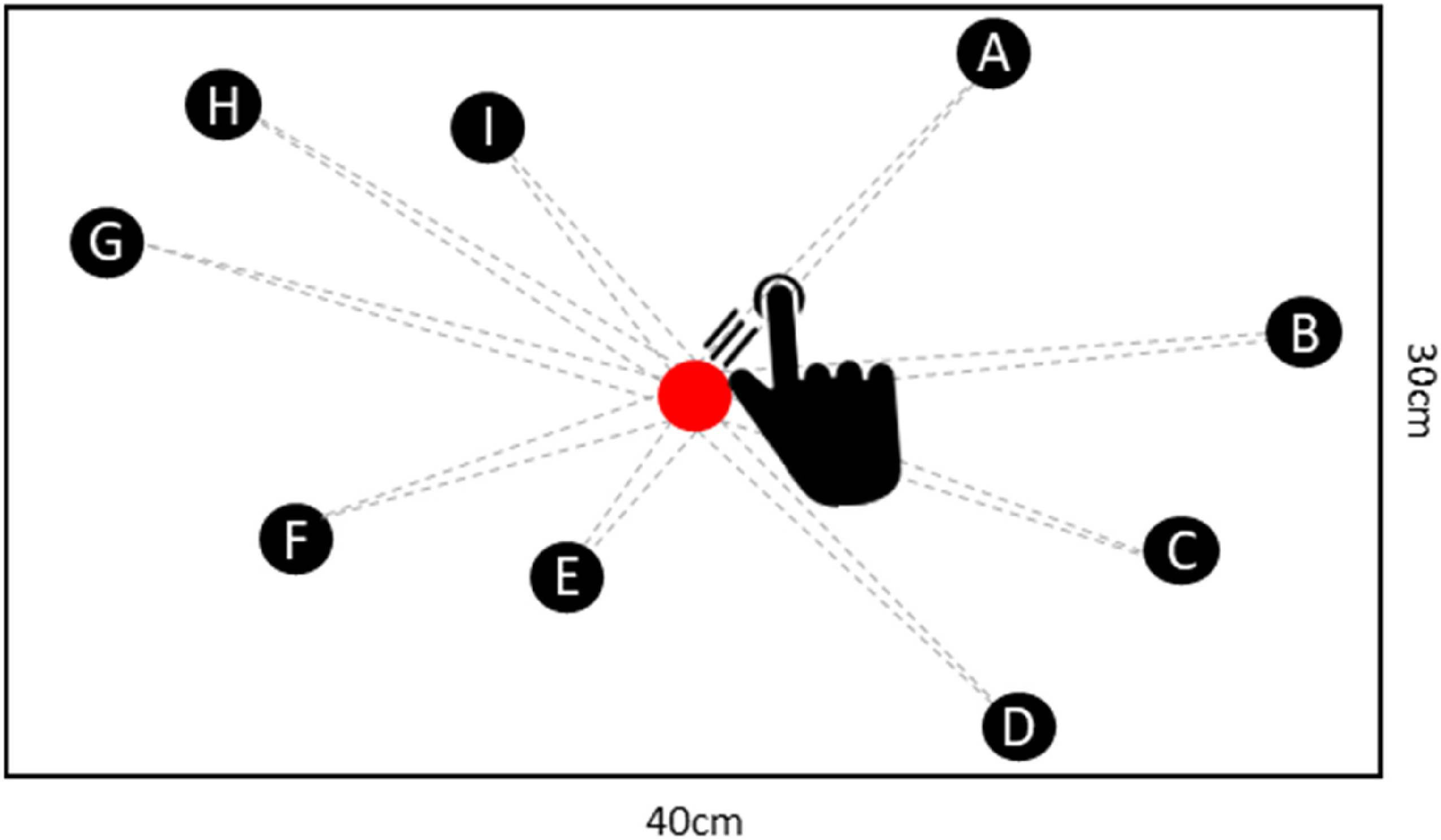
MI ability Task (Finger Pointing Task). Note. The sheet on a rigid support (size A3, 30 cm × 40 cm) displays a central red starting and finishing point and nine peripheral target points (8 mm diameter) of varied distance (8 – 20 cm). The grey dotted lines only simulate the movement in this figure but were not apparent in the actual task. Each sequence of movement from start to finish at the centre point was measured with a digital timer.
MI Self-Report Items
A subjective evaluation of imagery vividness (VAS-Viv) and imagery ease (VAS-Ease) was measured once the set of four repetitions was terminated. The Visual Analogue Scale (100 mm) was used and is represented in Appendix B – for imagery vividness 0 representing an unclear image of the movement and 100 representing an extremely clear image; for imagery ease 0 representing extreme difficulty to create a mental image and 100 representing extreme ease to create a mental image (inversed item). The approach of VAS for subjective imagery evaluations has been applied prior to this study (Mateo et al., 2018; Moriuchi et al., 2020; Schlatter et al. 2020).
Personality
We assessed personality dimensions with the validated French version of the Big Five Inventory (BFI-Fr; Plaisant et al., 2010) which comprises 45 questions including 16 reversed items. In this validated norm sample, each personality dimension reached a satisfactory Cronbach's alpha (α = .74–.82). The BFI-Fr allows to determine the score of the five dimensions E (Extraversion, Energy, Enthusiasm), A (Agreeableness, Altruism, Affection), C (Conscientiousness, Constraint, Control), N (Neuroticism, Negative affectivity, Nervousness), and O (Openness, Originality, Open-mindedness). Subjects rate on a 5-point scale (from 1 = strongly disapprove to 5 = strongly approve) the degree to which short affirmations corresponded to them. An acceptable alpha coefficient was demonstrated for all scales within our population (α = .74 to .89) (see Table 2).
Reliability of BIG 5 Scales Based on Cronbach's α and Comparison of the Sports Student Population to the Large French Validated Sample.
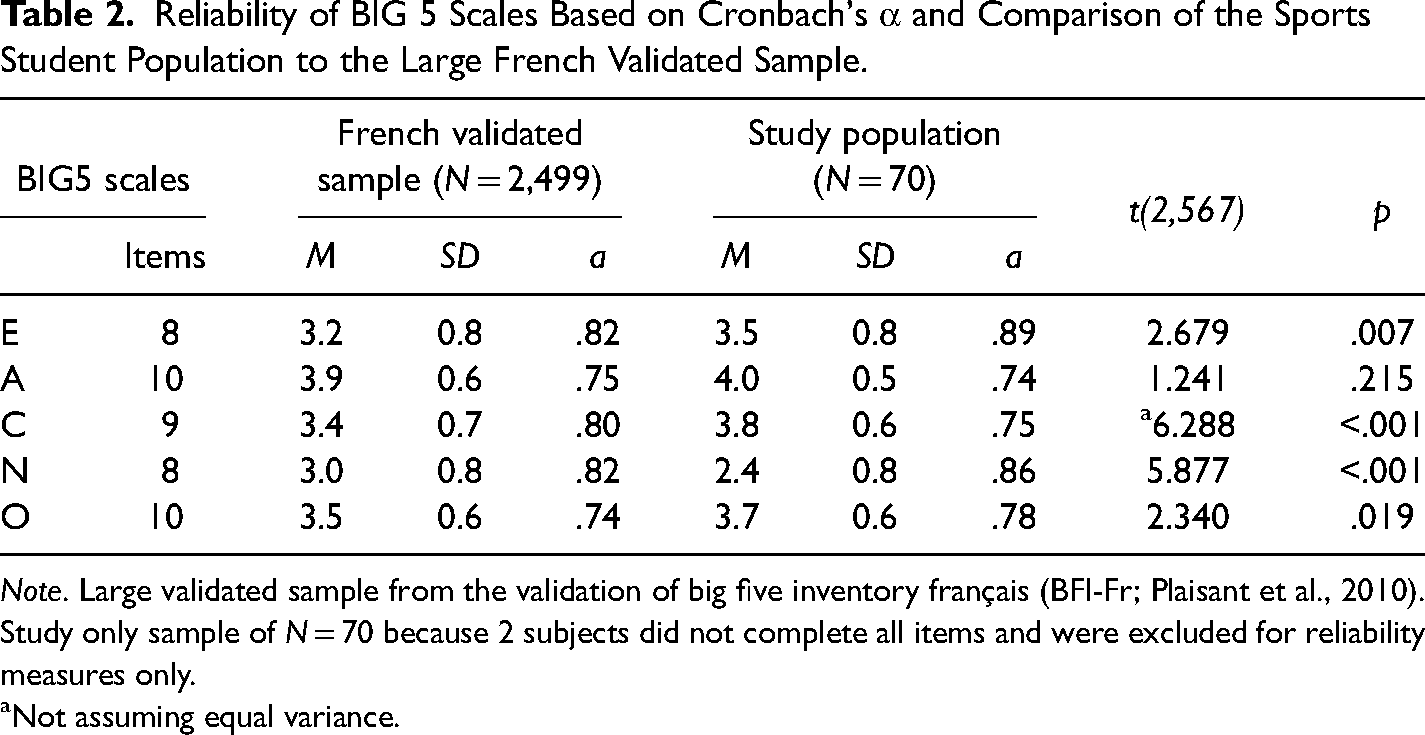
Note. Large validated sample from the validation of big five inventory français (BFI-Fr; Plaisant et al., 2010). Study only sample of N = 70 because 2 subjects did not complete all items and were excluded for reliability measures only.
Not assuming equal variance.
Data Analysis
All data analyses were conducted using IBM SPSS Statistics 26. Data was first tested for normal distribution according to visual assessment and Shapiro-Wilk-Test. The main analysis consisted of correlations between personality dimensions and the chronometry performance ratio, as well as with imagery vividness. Because variables were not normally distributed we chose Spearman Rho correlation as a non-parametric method as opposed to Pearson correlation. Descriptive statistics were computed for all key variables and the study population of sport students was compared with t-tests to a norm population from a French validation study. A priori power analysis based on GPower 3.1 suggested a sample size of N = 67 to detect a moderate bivariate correlation with an expected type 1 error rate of α = 5% and a power of 80%.
Transparency and Openness
Data collection from 2019 are available on request without scripts for statistical analysis. Neither the study nor the analysis plan was preregistered. Research material is available for replication based on the validated questionnaire and references. The detailed task description allows replications.
Results
Descriptive statistics are presented in Table 1. The sample of sport students differed in their personality dimensions from the adults’ French norm. Sport students were significantly more extravert, more agreeable, more conscientious, more open and less neurotic (Table 2). In average, participants performed the motor execution trials in 9.286 ms (range 3.170 ms – 30.580 ms) and the duration for motor imagery trials amounted to 9.611 ms (range 2.600 ms – 27.350 ms). The mean CPR ratio of −0.05 was below zero and indicates that most participants were faster in their execution than in their imagination. However the ratio was close to zero indicating an overall high imagery ability (see Figure 2).
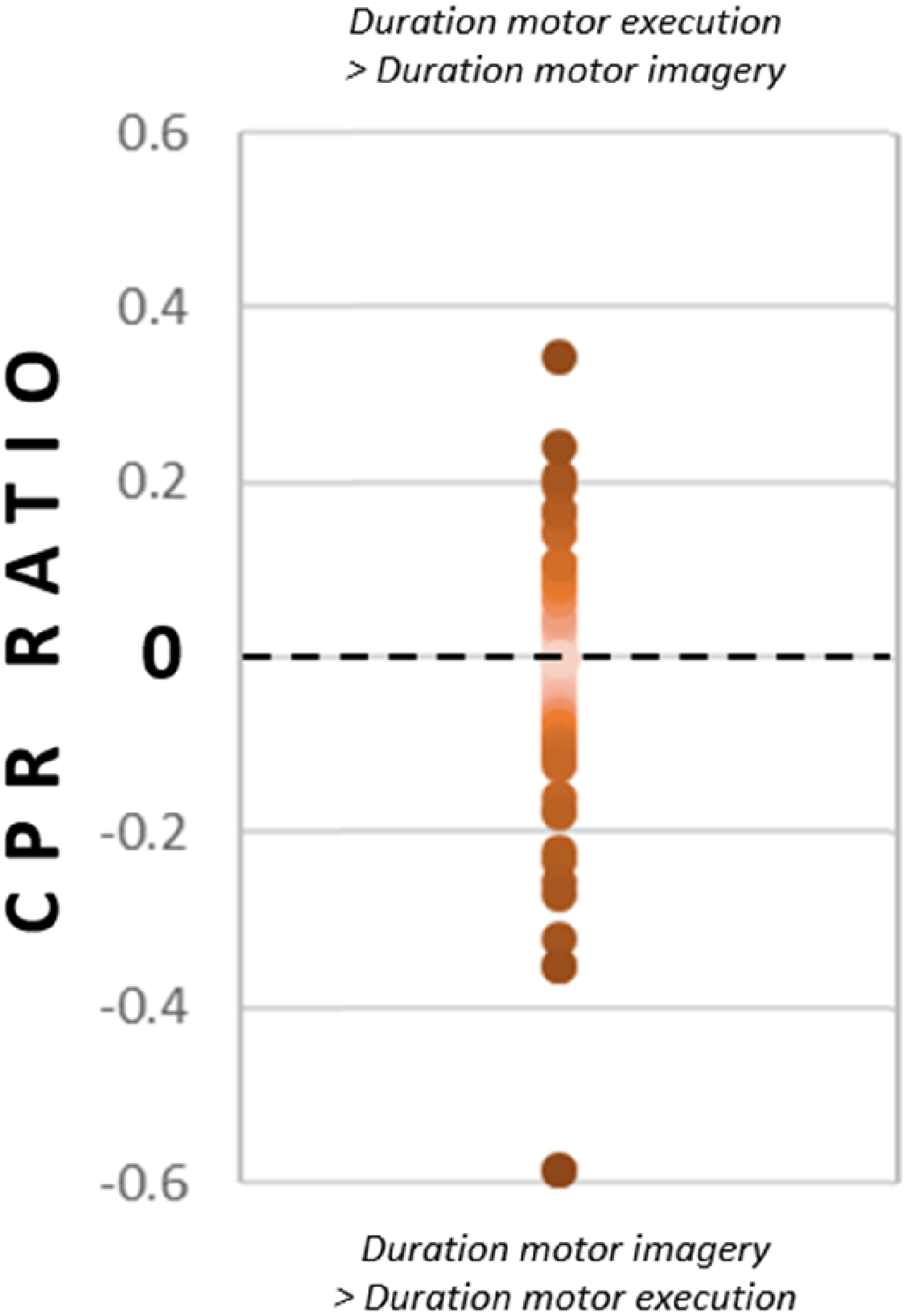
Distribution of individual CPR ratios in the MI ability Task. Note. CPR chronometry performance ratio was computed [(meanmotor execution − meanmotor imagery)/meanmotor execution]. CPR ratio above zero indicates longer mean duration of motor execution than mean duration of motor imagery and vice versa. Values closer to zero indicate higher temporal equivalence and therefore better imagery ability.
Spearman's rho correlation coefficients for the MI and personality measures are presented in Table 3. The positive correlation between extraversion and chronometry performance ratio was significant (r = .37, p < .001), while there was no correlation between extraversion and vividness (r = −.04, p = .741). Chronometry performance ratio was not significantly correlated with any other personality dimension (Neuroticism: r = −.12, p = .326; conscientiousness: r = −.12, p = .326; agreeableness: r = .10, p = .413; and openness: r = .17, p = .167). Finally, there was no correlation between conscientiousness, neuroticism or openness and vividness (r = .06, p = .606; r = .01, p = .929; r = −.08, p = .465 respectively), while a trend towards a correlation with agreeableness was observed (r = .22, p = .057). Imagery ease was positively correlated with chronometry performance ratio (r = .26, p = .026) but not with personality dimensions. The control variable of hours of sport per week showed no correlation with chronometry performance ratio performance (r = .19, p = .105) or with vividness (r = .19, p = .095)
Spearman's Rho Correlation Coefficients of the Relationship Between MI and Personality Dimensions (N = 72).
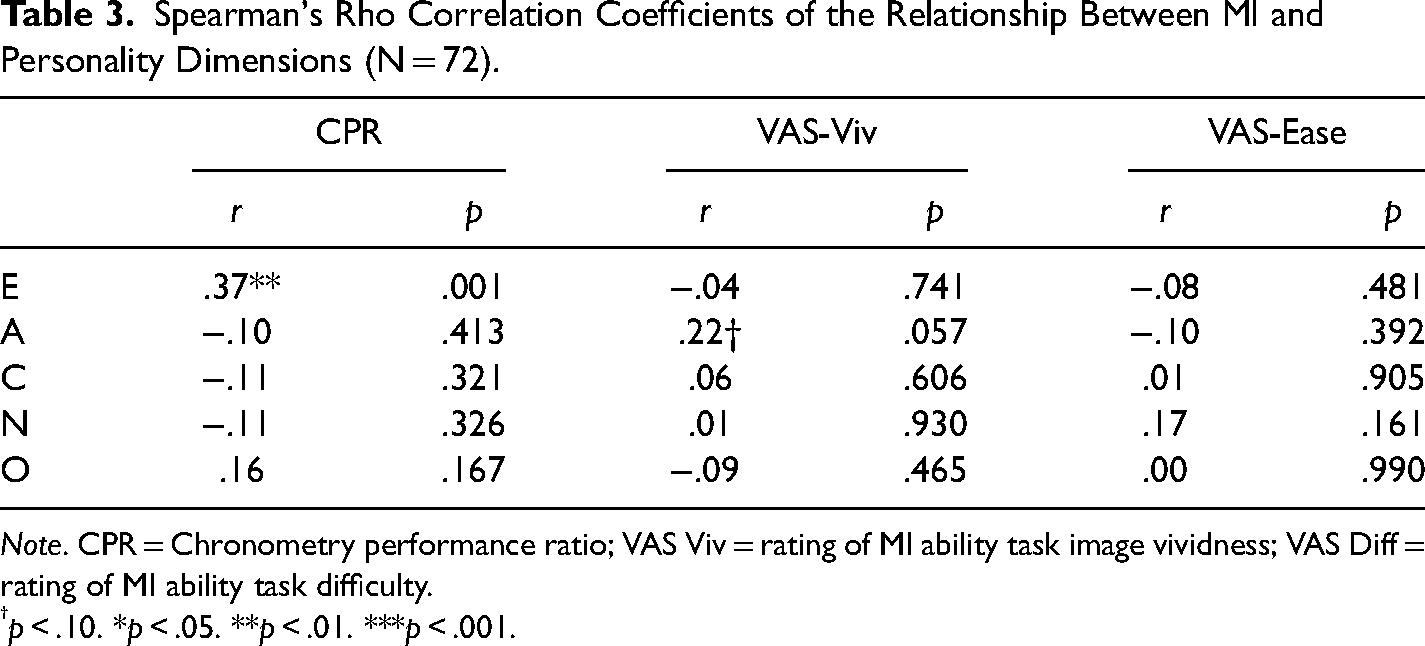
Note. CPR = Chronometry performance ratio; VAS Viv = rating of MI ability task image vividness; VAS Diff = rating of MI ability task difficulty.
p < .10. *p < .05. **p < .01. ***p < .001.
Discussion
The aim of this research was to investigate the association between higher-order dimensions of personality and MI ability. Our results provided evidence that extraversion is a personality dimension associated with MI ability in a motor task. The higher the score in extraversion of the individual, the more they achieved temporal congruence between MI and corresponding actual movement. No other personality dimensions were associated with our MI measures. This main finding establishes the relationship of extraversion in association to an objective measure of MI ability.
The present study shows that extraversion was associated with MI temporal congruence ability. Our finding supports earlier reports about the involvement of extraversion in sports related to movement execution (Buchman et al., 2013; Hoggarth et al., 2010; Rhodes & Smith, 2006), or imagination (Jeunet et al., 2015). This link might be rooted in the fact that extraversion as a dimension of the Big 5 expresses a stable tendency for activity (Costa & McCrae, 1992; Eysenck et al., 1982; John et al., 2008). In the present study, the sample of sport students was more extravert than the norm. Extraverts have shown more daily spatial behaviour (Ai et al., 2019), more activities in leisure time (Otonari et al., 2012) and more exercise (Wilson et al., 2015). Assuming that this tendency is present across the whole life span, this could cause a certain expertise to control movements. As we controlled the time currently spent to practice sport per week without finding an association with the task, we postulate that merely looking at the level of expertise in physical activity will not explain this relationship. Alternatively, extraversion is comprised of different facets: assertiveness, positive emotionality, and sociability. Imagery, when performed in a motivational context, is often used to create positive emotions and confidence (Simonsmeier et al., 2020), so in turn a tendency for positive emotions and assertiveness could be beneficial to the imagery process. Encouraging imagery, in general, could lead to improve imagery skills, irrespective of the imagery function. In fact, there might be a tendency for extraverts to use visual strategies in daily life (Burkard et al., 2014).
None of the two other components of imagery ability, vividness and ease, did show any association with personality dimensions. This highlights the importance to analyse different dimensions of imagery ability separately aligned to the multidimensional nature of imagery ability (Cumming & Eaves, 2018) and the complementing dimensions in support of earlier findings (Williams et al., 2015). Differential associations for separate imagery measures demonstrate how task-specific results may be, and that imagery aspects are also movement-related. Current results support previous findings that did not report significant results either (e.g., Harris et al., 1980; Strelow & Davidson, 2002). Alternatively, these findings demonstrate how modalities might interact differently with personality.
Overall, our findings contribute to a thin body of research and showed that there is not only a theoretical, but also some empirical links between stable personality traits and mental skills. Looking ahead, it will be necessary to investigate in more depth what this link is based on. Classifying the wide individual differences in MI ability beyond states will be a challenging task ahead (McAvinue & Robertson, 2008), and tackle the lack of an understanding of why certain people are better than others at such an important skill (Simonsmeier et al., 2020). Earlier conceptualisation about imagery (Cumming & Williams, 2013; McDougall & Pfeifer, 2012; Morris et al., 2005) may be reconsidered to benefit of refining the individual factors (see theoretical concept, Appendix C). Systematic integration of personality traits and facets has been called for in a recent review on personality related research in sports by Laborde et al. (2020). In order to offer a new integrative drawing of motor imagery abilities, we advise future motor imagery research to consider individual profiling aspects (trait-state-skills) and use multi-modal imagery ability measurement.
Despite the random recruitment, personality trait scores obtained in this study differed from the scores of a larger validated French student sample (Plaisant et al., 2010). It can be questioned if high sport affinity may alter behaviour, experience, and attitudes and, in consequence, the relationship between personality and MI ability. This would underline the beforementioned theoretical framework on how MI ability benefits from lifelong activity tendencies. Future studies from diverse environments need to confirm this specialist group advantage and examine generalisability.
Limitations
It is important to keep in mind that the measure of MI ability in this pilot study may be improved in a new research design. Firstly, psychometric MI ability could be measured via a validated multi-item questionnaire with regards to other components of the imagery process (ease, accuracy, controllability, duration; Morris et al., 2005). This could help to detect if extraversion is also related with a more detailed assessment of self-report MI ability. Secondly, the present study explored the relationship between personality and motor imagery through an easy motor imagery task. This relationship might change for more complex tasks (Jeunet et al., 2015) or motivational aspects (Brinkman, 2013), in particular regarding the regular use of imagery in holistic training programs. Thus, relationships could be explored using a more complex or alternative motor imagery tasks (Daeglau et al., 2020; Solomon et al., 2019) in order to expand on the generalisability of our results (Daeglau et al., 2020; Solomon et al., 2019). Thirdly, chronometry paradigms originated from clinical settings before they were used in the context of performance enhancement (McAvinue & Robertson, 2008). Consequently, in our healthy and athletic population this task might have yielded ceiling effects (Mateo et al., 2018). While putative ceiling effects might have prevented the detection of subtle associations with other personality dimenions, we still found an association with extraversion which could be a hint for an even stronger bond within more complex tasks (Jeunet et al., 2015).
Implications
According to our results it is favourable for sport psychologists, coaches, and physical therapists to consider the athlete or patient personality for MI-interventions. The results provide a small foundation as sport psychology requires a more generalisable framework: “While imagery training programmes have been around for decades now, to achieve greater success in the desired performance outcomes, a more individualized approach appears necessary” (Cumming & Eaves, 2018, p.387). Our findings imply that sport psychologists who were to use intervention techniques based on MI might find differential individual dispositions to carry out imagery accurately and efficiently. Also, whether athletes benefit from motor imagery, in terms of performance enhancement, depends heavily on regular practice and use where new personal determinants come in play. Further, our results suggest that MI interventions during rehabilitation processes should be particularly beneficial for extravert patients. Additional studies may lead to precise insights for a more effective and customisable rehabilitation process within such clinical settings. Such knowledge may also help driving the application of modern technologies with regards to the research of brain-computer interfaces that highly depend on the imagery ability of the user (Jeunet et al., 2015; Leeuwis et al., 2021; Mizuguchi et al., 2019; Bobrova et al. 2021). For this reason, the domain of human machine interactions has advanced their investigation on the role of personal dispositions already further than in the sports context.
Conclusion
Few studies have established a connection between higher order traits and specific skills in the sports domain. Rare findings from other fields indicated the involvement of personality in imagery processes.
We established that certain aspects of MI ability are related to the endurable and stable personality dimension extraversion. The construct extraversion is inherently aligned with sports because it captures the tendency for activity and energy. Future research should clarify which facets of extraversion drive this relationship, how much interindividual differences influence the overall process of imagery, and further explore the role of traits in different MI settings for more generalisability. A larger empirical basis through systematic integration of trait measures will lead to a more complex framework about individual advantages or disadvantages among both athletes and patients. This, in turn, may provide further useful input across contexts such as sport, rehabilitation, and brain-computer interfaces. It may offer sport practitioners insights for the customised application of MI trainings, and therefore improve talent development. We delivered the first insight that emphasises the role of extraversion in MI ability and that hopefully leads to a rethinking of interindividual variance in this important mental skill.
Footnotes
Abbreviations
Author Contribution
SS, AG and UD were responsible for conceptualization and methodology. SS and LS carried out the data curation and performed formal analysis. LS then wrote the original draft and SS, UD, BAS, AG reviewed and edited it. AG and BAS supervised the whole project.
Declaration of Conflicting Interests
The author(s) declared no potential conflicts of interest with respect to the research, authorship, and/or publication of this article.
Funding
The author(s) received no financial support for the research, authorship, and/or publication of this article.

Author Biographies
Laura Schmidt finished her master of science in psychology in Germany and practised as a sports psychologist there. For her doctoral studies in France, she investigates the optimisation of recovery in the context of shift work while applying techniques from the sports context such as imagery. She is becoming a sleep scientist incorporating the physiological need for recovery in her quest to become a performance psychologist across disciplines.
Sophie Schlatter is a health scientist and educator in France specializing in stress management, psychophysiology, and performance enhancement. Holding a Doctor of Philosophy in Sport Sciences and Behavioral Neurosciences, Dr. Schlatter is known for her work in medical pedagogy, student well-being, and her keen interest in the intersection of medicine, sports sciences, and psychology. She contributes multidisciplinary expertise to the field and is a strong advocate for fostering partnerships between these domains. As an educator, she has taught and supervised students across diverse health-related programs.
Ursula Debarnot is an Associate Professor at the University Claude Bernard Lyon 1 (France). She developed several investigations on the use of Motor Imagery practice as a method to enhance new motor learning and sleep consolidation. The aim of her research is seeking to understand the neuroplasticity mechanism to improve the quality of life, by developing therapeutic methods requiring advanced technologies in the domain of sleep, motor imagery and hypnosis.
Bianca A. Simonsmeier was born in Germany and raised in Germany and Canada. She completed her PhD in educational psychology after finishing her MSc in psychology at the University of Trier (Germany). Her research focuses on individual differences and learning, cognitive mechanisms and learning, and meta-analysis in educational sciences.
Aymeric Guillot is a full Professor at University Claude Bernard Lyon 1. By exploring the neurophysiological basis of motor imagery using physiological recordings as well as behavioural markers, his research focuses on the effects of motor imagery on motor performance and motor recovery following different types of injuries and motor impairments. Three main aspects are considered: i) Determining the optimal condition of imagery use to improve motor skill learning, ii) Evaluating the effectiveness of motor imagery in promoting motor recovery both in injured athletes and patients with motor disorders, and iii) Examining the sleep-related effects for motor consolidation after imagery practice. Another main transversal issue is to investigate the neuroplasticity induced by motor imagery practice as well as how thoroughly and appropriately assessing the accuracy and vividness of the imagery experience. He published 3 books and more than 150 journal articles.