



Abstract
Although the induction of a safe place led to changes on physiological level with impact for emotional processing, the effect on emotion regulation is still unclear. This study examined the effects of a self-distant reflecting strategy (safe place induction) on positive and negative affect compared to a self-immersed way of reflecting (rumination task) on a negative autobiographic event. In a student population, 54 healthy participants underwent recalled a sad autobiographic memory before they were randomly assigned 1:1 to either the safe place induction or the rumination task. We could demonstrate that after negative mood induction the participants in the safe place condition showed a significantly stronger improvement in positive, but not negative affect in contrast to the rumination condition. Detachment training via safe place induction could serve as an emotion regulation strategy for positive affect when dealing with sad memories.
We recall sad autobiographical memories every day. By remembering, we may revise our actions in the future or manifest a continues self-identity (Mace & Atkinson, 2009). Despite the important functions of remembering our past, it can evoke emotions. How people process emotions has consequences for affect, cognition and social interactions. People who regulate emotions in an adaptive way have better self-esteem, are more optimistic and more satisfied with their life (Gross & John, 2003). As autobiographical memories can be spontaneously not only intentionally recalled 2–5 times per day, triggered by situational cues (Berntsen, 2010), it is important to regulate the associated emotions in an adaptive way to improve well-being.
As a reaction to negative mood, negative experiences or the memories of those, different forms of self-reflection could occur, with some of them are considered to be maladaptive, whereas others are considered adaptive (Trapnell & Campbell, 1999; Watkins, 2008). Ruminating in this context is an attempt of self-reflection that doesn’t lead to a productive outcome and may even prolong negative mood, for example by generating repetitive thoughts about the past event (eg.: “why did this happen to me?”) (Nolen-Hoeksema et al., 1993). But not all attempts of self-reflection are considered maladaptive (Watkins, 2004). Another strategy to react to a sad autobiographical memory, could be to reflect about the past in a detached way (Kross et al., 2005). Self-distancing from an emotional stimulus, can be achieved via taking an observer perspective (Ayduk & Kross, 2008; Kross & Ayduk, 2008). Reviews of the literature support the conclusion that detachment is a highly effective cognitive emotion regulation strategy (Dörfel et al., 2014; Webb et al., 2012).
Imagining a safe place and dealing with sad emotions with the perception of safety could be a great way of detaching from the emotional stimulus while reflecting on the past. Neuroimaging studies could demonstrate that inducing the safe place made participants more patient (Schmidt & Holroyd, 2021) and monetary rewards seem less important even several weeks after the experimental session (Böhmer & Schmidt, 2022; Schmidt et al., 2020).
Although safe place inductions show promising results, only few studies have investigated if a safe place induction can regulate emotions. Two studies on emotion regulation used the safe place induction as a control group. Compared to the experimental condition – an imagery rescripting – the safe place showed equal or even superior reductions in aggressive emotions and improvement of positive emotions (Seebauer et al., 2014) and negative emotions (Watson et al., 2016) in healthy young adults. While Seebauer et al. (2014) used a traumatic film segment approach to evoke aggressive emotions, Watson et al. (2016) let the participants recall a personal episode of bullying. In both studies the safe place induction was implemented as a distractive task/avoidance. Participants were explicitly asked to stop thinking about the negative emotions and to escape the situation in their minds.
Only one previous study used the safe place induction as an explicit detachment emotion regulation strategy in an experiment with anxiety triggered by anticipated electrical shocks (Kalisch et al., 2005). Healthy subjects were asked to imagine a place where they feel safe and protected or a neutral place where they could feel their emotions while waiting for an electrical shock. As confirmed via self-report, behavioral and physiological measures, the safe place induction was more effective in regulating anxiety compared to a control task (Kalisch et al., 2005). Although electrical shocks evoke a great emotional response, it is questionable whether the triggered process reflects the most common emotion regulation processes after remembering an autobiographic event. Instead, negative moods like sadness or anger are more likely to be associated with specific personal experiences and might therefore be evoked more often by autobiographical memories. With only 18 participants, as evaluated by Kalisch et al. (2005), to date there is not enough evidence to conclude whether the safe place is an effective emotion regulation strategy in a population of healthy participants.
Taken together, the previous results suggest that the safe place induction could be used as an effective emotion regulation strategy.
Present Research
Consequently, the aim of this present study was to investigate the potential emotion regulation effect of a self-distant method of reflection (safe place induction) vs. a self-immersed way of reflecting (rumination) on a negative autobiographic event in a nonclinical sample of young adults. From an emotion regulation perspective, both rumination and detachment are considered cognitive emotion regulation strategies. Rumination works by concentration, an attentional deployment strategy, whereas detachment operates by strategies of cognitive change (see Gross et al., 1998). Whereas detachment from the emotion can help to achieve an observer perspective and thus some distance to the evoked emotion, rumination is a form of self-reflecting on the evoked emotion without a distance that could even result in prolonged mood (Cova et al., 2019). Comparing two cognitive strategies, we used an imaginative task to transport the experience of an emotion regulation strategy, like for example in Kross and Ayduk (2008). Based on previous emotion regulation research, we expected that after recalling a sad autobiographical event, healthy participants with the safe place induction should have a greater improvement in positive and negative affect than participants with a rumination task. We further wanted to investigate if absorption could influence mood change after the safe place induction/rumination task.
Methods
Design
This study was designed as a mixed 3*2 factorial experiment. The current mood of the participants was the dependent variable and was assessed at three different time points: At baseline (t0), after autobiographic recall (t1), and after intervention/rumination (t2). At baseline (t0), current mood and absorption were assessed additionally. After autobiographic recall, each participant was randomly assigned to either the safe place intervention or the rumination task. The study was approved by the local ethics committee (342/2020BO1). Due to COVID-19 hygiene precautions, the experiment was implemented online via the platform SoSciSurvey (Leiner, 2019). This standardized the experiment and reduced contact with the investigator.
Participants
Subjects were recruited via emails announcing the study for mentally healthy students and members of legal age from the local university. The study was advertised as a study investigating imagination. We did not inform participants that we wanted to investigate the effect of a safe place induction on emotion regulation but rather that we would investigate their imagination ability. The deception was intended to avoid social desirability and unnatural expression of emotions. Participants consented to a possible deception, a so-called authorized deception (Miller et al., 2005). At the end, the investigator debriefed the participants with the information that the subject of the investigation was how the safe place induction or rumination task influence the emotions evoked by the autobiographic recall. Participants had the opportunity to withdraw their data after debriefing. Additionally, the subjects were offered an intervention with a licensed psychotherapist, which was not claimed by anyone.
In total, 55 people were invited to the study. One of them was already retired and (age 73) and was excluded before participation. The final sample of 54 participants was comprised of students or members of the local university (36 women, 17 men, 1 nonbinary). The mean age of the participants was 25.1 years (sd = 5.7, range = 19 − 53). All participants spoke German fluently, were mentally healthy and provided written informed consent for the study (including the potential deception). By SoSciSurvey, 26 subjects were randomly assigned to the experimental condition, and 28 to the control condition. There were no significant differences between the safe place and the rumination condition, neither in age, t(46.55) = −0.54, p = .589, nor in distribution of gender, χ2(2) = 0.99, p = .611 (only the distribution of male/female participants was tested).
Materials
Screening
To ensure that participants were mentally healthy, the investigator asked screening questions in person from the Structured Clinical Interview for DSM-IV Axis I Disorders (SCID-I; Wittchen et al., 1997) at the beginning of the experiment. None of the participants were excluded due to having a current mental illness.
Mood Assessment
We assessed current mood with the German Version (Krohne et al., 1996) of the Positive and Negative Affect Schedule (PANAS) (Watson et al., 1988) at baseline (t0), after the autobiographical recall (t1) and after the safe place vs. the rumination task (t2). In addition to the 20 items of the PANAS, we used seven items for distraction. To avoid sequential effects, all 27 items were presented in a randomized order implemented via SoSciSurvey. The instrument has proven reliable and has been used in various studies which also target emotion regulation or employ imagery interventions (Huffziger & Kuehner, 2009; Renner et al., 2014).
Absorption
We used the German version (Ritz & Dahme, 1995) of the Tellegen Absorption Scale (TAS) (Tellegen & Atkinson, 1974) to assess the openness to absorb and self-altering experiences, a construct which covers aspects like hypnotic suggestibility, the predisposition of the participants towards becoming highly involved in imaginative experiences, fantasy, and memories, but also synesthesia or dissociation (see Roche & McConkey, 1990; Terhune & Jamieson, 2021).
Autobiographical Recall
The autobiographical recall task was adopted from Wright and Mischel (1982) and accompanied by a recommended musical piece “Adagio for Strings” from Samuel Barber. This procedure was used in previous studies to evoke a sad mood (Harkness et al., 2010; Renner et al., 2014; Werthmann et al., 2014). The instructions were audiotape-recorded and presented simultaneously with the music via headphones for 4 min. Participants were asked to recall a past sad event in their life and recall as many details as possible (e.g.,: “Who was in this event with you?”, “How were the surroundings?”) while the music was playing in the background. Subjects were advised to perform the task thoroughly as they would later be asked about the details of their memory.
As shown in other studies, positive (F(1,53) = 89.45, p < .001) and negative affect (F(1,53) = 40.12, p < .001) changed significantly from t0 (before) to t1 (after recall). The effect caused by the recall did not differ between the experimental groups for positive, F(1,52) = 0.14, p = .714 and negative affect, F(1,52) = 0.20, p = .658 at t1.
Safe Place Induction
Participants listened to the safe place induction via headphones and were instructed to close their eyes or resting their eyes on a point while leaving them open. The induction started with a focus on body sensations during controlled breathing as a relaxation technique. Then, participants were instructed to imagine an inner safe place in a stepwise manner with as much detail as possible on all five sensory modalities. Additionally, they were invited to imagine how the person who experienced the sad event in the past (themselves) experiences the safe place and to observe their reaction from a distance (observer perspective). In this way, participants should further engage with the sad feelings remembered during the autobiographical recall but in a distanced/detached observer perspective. Participants were informed that they can occasionally use their inner safe place after the experiment in daily life when they feel sad in the future. The recorded safe place induction lasted 17 min on audiotape. The text of the intervention in German is available on Zenodo https://doi.org/10.5281/zenodo.7415323.
Rumination Task
Based on the procedure of Huffziger and Kuehner (2009), participants were instructed to concentrate on their thoughts, feelings and body expressions related to the memory of the autobiographical recall e.g.,: “Think about how your body feels at the moment.”, “Think about what your feelings might mean.” There were 28 items with a 20 s break in between in order to let the participant think about the items with the goal of inducing rumination. In total, the audiotaped recorded rumination task was 10 min long.
Procedure
After giving written informed consent, the investigator interviewed the participants in-person with the SCID-I Screening to check for psychiatric disorders. Thereafter, the experiment was performed on the computer and participants were left alone in the room, while the investigator waited in the room next door. First, participants answered demographic questions and completed the TAS and PANAS (t0). Then they recalled the sad autobiographic memory and completed the PANAS (t1). Afterwards they listened either to the safe place induction or the rumination task and responded to the PANAS (t2). Participants who listened to the rumination task, had the opportunity to listen to the safe place induction after the experiment was completed. The whole experiment lasted 60–75 min. Participants were compensated with eight euros per hour.
Statistical Analysis
All analyses were conducted using the statistics program R (R Core Team, 2018) with one-tailed tests and an alpha level of .05. To analyse the primary hypothesis, that is the effect of the safe place induction on PANAS-PA and PANAS-NA scores, separate repeated-measurement analysis of variance (RM-ANOVAs) were conducted with the PANAS-PA or PANAS-NA scores as the dependent variable, condition (safe place vs. rumination task) as the independent between-subject variable and assessment time (t1 vs. t2) as the independent within-subject variable. We tested for an interaction of time and condition. Another study that examined a self-distance strategy in negative affect found a moderate effect size (Kross & Ayduk, 2008), therefore we expected a moderate effect size as well. An a priori sample size calculation with G-Power (Faul et al., 2007) for the primary hypothesis revealed a power of .95 in a sample size of overall 54 subjects for an estimated effect size of f = 0.25 and a correlation between repeated measures of 0.5. The design and analysis plan of this study were not preregistered but pre-approved by the local ethics committee. The raw data set and the R code for this analysis can be accessed at Zenodo https://doi.org/10.5281/zenodo.7415323.
In order to investigate the potential relationship between mood change and absorption (secondary hypothesis) in a first step, correlations were calculated between change from t1 (after recall) to t2 (after safe place/rumination) in PA and NA (t2 – t1) and the potential predictor absorption. When the correlation between mood change and absorption was higher than .30 (Cohen, 1988), a forward stepwise regression analysis was calculated. Regression models were compared with a Likelihood-Ratio-Test. We report how and when we determined our sample size, all measures, manipulations and exclusions used in the study.
Results
Baseline Characteristics
There were no significant baseline differences at t0 for absorption and PANAS scores between groups, all t(52) ≤ 0.26, p ≥ .377, see Table 1.
Baseline Characteristics.
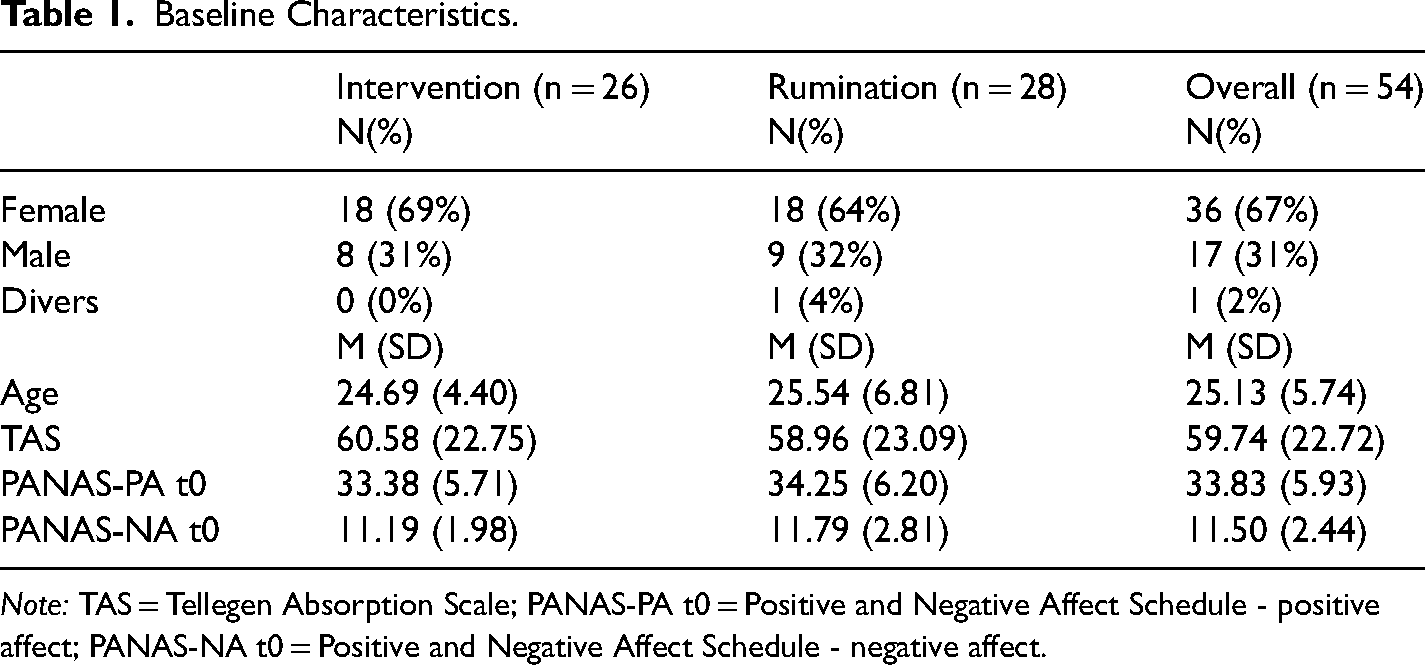
Note: TAS = Tellegen Absorption Scale; PANAS-PA t0 = Positive and Negative Affect Schedule - positive affect; PANAS-NA t0 = Positive and Negative Affect Schedule - negative affect.
Effect of Safe Place Induction on Change in Positive and Negative Affect
RM-ANOVA for positive affect revealed significant effect of time F(1,52) = 26.38, p < .001, f = .71 and an interaction between time and condition F(1,52) = 4.57, p = .037, f = .30, and no significant effect for condition F(1,52) = 0.76, p = .388, f = .12. Positive affect increased after both the safe place induction and the rumination task, however the positive affect increased significantly more after the safe place induction in comparison with the rumination task. RM-ANOVA for negative affect revealed a highly significant effect of time F(1,52) = 30.42, p < .001, f = .76, but no significant effects for condition F(1,52) = 0.41, p = .525, f = .09 or interaction between time and condition F(1,52) = 0.96, p = .332, f = .14. Negative affect decreased after both the safe place induction and the rumination task, see Figure 1. Means and standard deviations of PANAS scores at t1 and t2 as well as the change scores are displayed in Table 2.
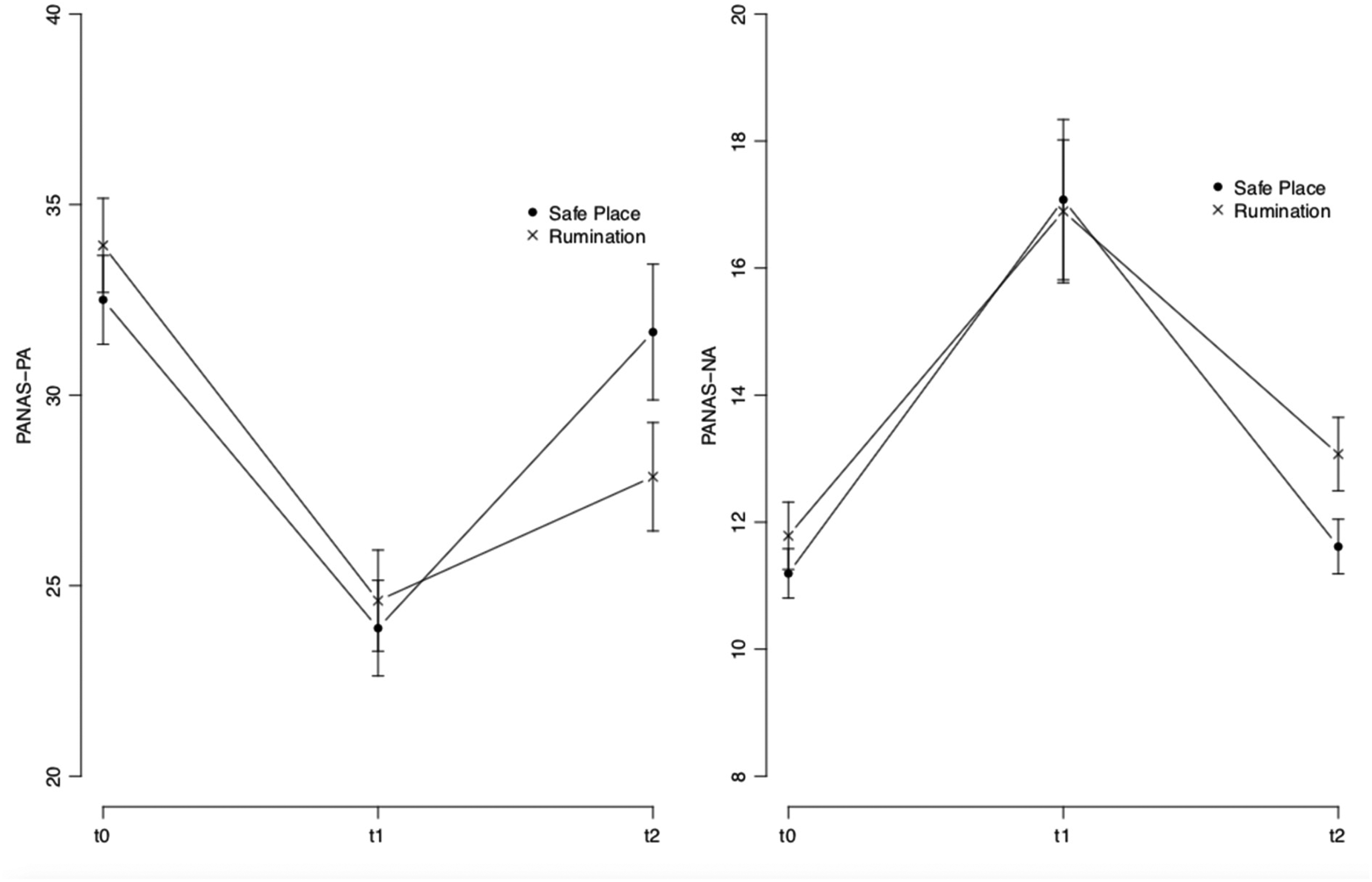
Positive (PANAS-PA) and negative affect (PANAS-NA) in different conditions at baseline (t0), after recall (t1) and after safe place/rumination (t2).
Mood Assessment Overall and Groups Before and After Safe Place Induction/Rumination M (SD).
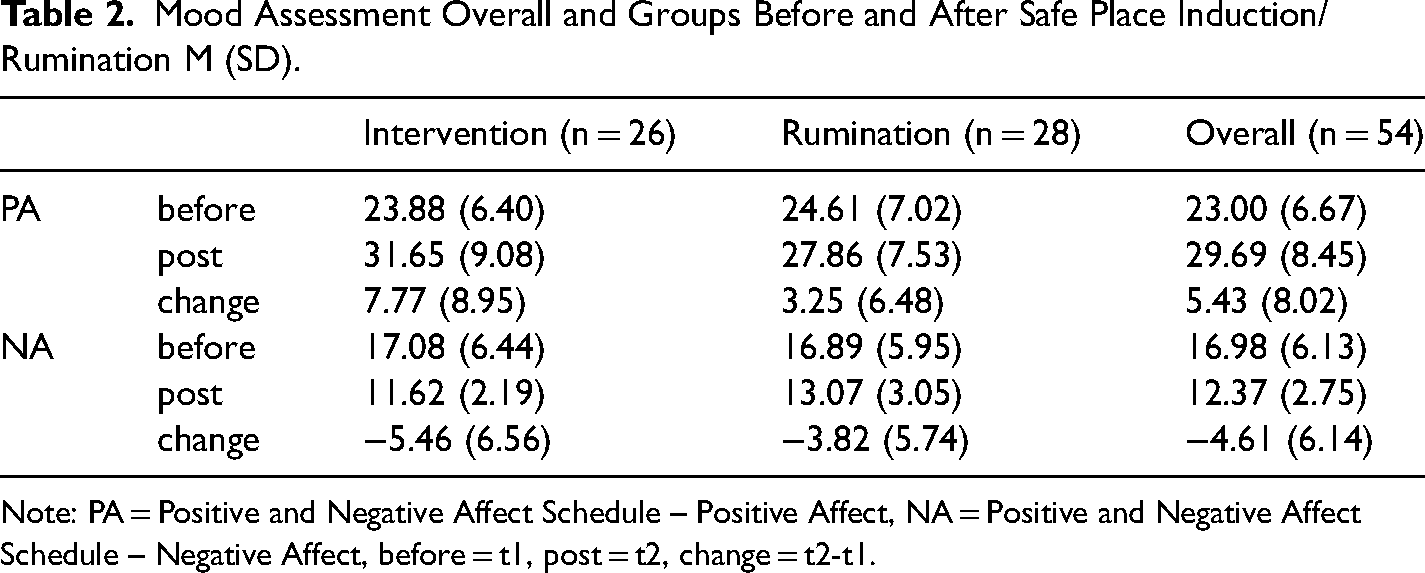
Note: PA = Positive and Negative Affect Schedule – Positive Affect, NA = Positive and Negative Affect Schedule – Negative Affect, before = t1, post = t2, change = t2-t1.
Relationship Between Absorption and Mood Change
The correlation between the change in PA and absorption (measured with the TAS) was moderate (r = .33, p = .016). The correlation between negative mood change and absorption (r = −.16, p = .264) was too small and could not be used in the regression analysis. Therefore, one regression analysis with three models was calculated applying the TAS as a predictor for the PA change. To evaluate whether the TAS was a potential moderator for the effectiveness of the safe place induction, three models were calculated with the TAS alone, the TAS and condition as main factors and with an interaction term between the TAS and condition. The Likelihood-Ratio-Test revealed a superiority of the second model with condition as a factor F(1, 51) = 4.82, p = .033 in comparison to the first. The model with an interaction between condition and absorption was not significantly better in explaining the variance F(1, 50) = 3.04, p = .087. Results of the second model (R² = .18, F(2, 51) = 5.66, p = .006, f = 0.30) indicate that as shown for the primary outcome, change in PA was higher in the safe place condition in comparison to the rumination condition b = −4.34, SE = 2.02, t(51) = −2.15, p = .036, f = .30. Additionally, PA change was found to be influenced by absorption, b = 0.11, SE = 0.04, t(51) = 2.51, p = .015, f = .35. Higher TAS scores could predict more improvement in positive affect independent of the safe place/rumination. A sensitivity-analysis (Linear multiple regression: Fixed model, R2 increase) with G-Power (Faul et al., 2007) revealed that this analysis had 80% power to detect an effect size of f = 0.43 in the given sample.
Discussion
The purpose of the present study was to investigate the effect of a safe place induction on positive and negative affect after recalling a sad autobiographic memory. The main finding of the present study was that the safe place induction was successful in reversing decreases in positive affect after the autobiographic recall. That is, positive affect improved more after receiving the safe place induction compared to after a rumination task. The improvement in negative affect, though, did not significantly differ between the safe place induction and the rumination task. This study demonstrated that a safe place induction, as also used by Kalisch et al. (2005), is effective regarding emotion regulation of autobiographical memories. This study adds to the existing findings on safe place induction (Kalisch et al., 2005; Schmidt et al., 2020; Watson et al., 2016) and is one of the first studies using autobiographical memories to evoke emotions and comparing the effects of the safe place on emotion regulation to another self-reflection strategy. Like Watson et al. (2016) we could demonstrate that the induction of safe place has a positive effect on emotions. In contrast to Watson et al. (2016), who assume that safe place induction is a distracting task, we assume that the induction of the safe place works through the calming feeling of safety (Schmidt et al., 2020) and distancing from one's emotions (Kalisch et al., 2005). Another explanation might be that by the induction of a safe place, the participants activated positive autobiographical memories which facilitated distancing from the sad memory and associated negative emotions.
Other studies investigating the emotion regulating effect of imaginative techniques have also found that imagery especially promotes positive, not negative affect. For example, Renner et al. (2014) asked participants to imagine a best-possible version of a day while the control group had to imagine a usual day after a negative mood induction. Imaging a best-possible day resulted in stronger affect improvement than in the control group, but only for positive affect. Furthermore, the training of imagining positive picture word combinations can improve positive mood in dysphoric persons, whereby only positive affect was assessed (Pictet et al., 2011). In line with this research, it is possible that the safe place induction mainly promotes positive mood. There is a strong correlation between positive emotions and high self-esteem and well-being in healthy populations (Tugade et al., 2004), therefore it might be more important to promote positive emotions, than to reduce negative ones. In previous research (Kalisch et al., 2005; Renner et al., 2014) as well as in our study, only healthy participants were investigated. For participants with stressful memories, as for example patients with PTSD, depression, or anxiety, the imaginative intervention might also have a mitigating effect on negative mood.
Regardless, there could be other explanations for why the safe place induction was superior to the rumination condition only in reinstalling positive affect. It is important to note that negative affect improved significantly both after the safe place induction and after the rumination task. That means that the rumination task had a positive effect on negative affect, and thus, might also have been an adaptive emotion regulation strategy. Even if rumination was categorized as maladaptive before, in the study of Kuehner et al. (2009) rumination had the same effects as mindfulness. Comparing emotion regulation in dysphoric as well as healthy participants, resulted in only dysphoric participants being affected negatively by the rumination task (Lyubomirsky & Nolen-Hoeksema, 1995; Nolen-Hoeksema et al., 2008). Accordingly, there are studies that report that rumination can be helpful as a self-reflection strategy in healthy subjects. Watkins (2008) argued that a repetitive thought can be indeed adaptive, depending on the intrapersonal context and thought content. In this study both the rumination task and the imaginative intervention were introduced to participants as “imagery tasks”, which might have evoked positive expectancies regarding both conditions. It could be that the given circumstances and intrapersonal factors in this study (a healthy population, rumination introduced as imagery task) may lead to a form of problem solving or concrete rumination (see Cova et al. (2019) for an overview). In future studies, it may be important to assess if participants experienced the self-reflection/rumination about sad memories as adaptive or maladaptive. In future studies, the effect of the detachment intervention used in this study should be additionally measured with other behavioral or physiological distancing measures. In a previous study investigating visual self-distancing techniques, the ability to detach from negative emotions was assessed by physiological reactivity (blood pressure). Participants had lower physiological reactivity while self-distancing (Ayduk & Kross, 2008; Schmidt & Holroyd, 2021). Another possibility to assess the degree of self-distance could be the use of a behavioral self-distancing task (Shepherd et al., 2016).
In line with our expectations, positive affect improvement was influenced by degree of absorption. The more capable individuals reported being able to completely be absorbed in an imaginative experience, the more their positive affect improved after the intervention and the rumination. In other studies, investigating imagery detachment strategies in people recalling an event that made them angry, imagery vividness was assessed as a covariate and no moderating effect could be found (Ayduk & Kross, 2008). There is not enough research to conclude about the role of absorption in imaginative interventions improving mood.
Limitations
The present results have some limitations. We only investigated affect with self-report measures, additional measures possibly could have been helpful in clarifying the underlying mechanism. For example, heart rate, blood pressure, neurological measures could be insightful as they already were influenced by the safe place in previous research (Schmidt et al., 2021). The power in the second analysis was too small to detect the found effect size, results should be interpreted with caution. Furthermore, we focused only on sad emotions evoked by an autobiographic recall, it is possible that other emotions are also evoked at the same time. Future studies should compare the safe place induction to other possible adaptive emotion regulation strategies, such as mindfulness or imagery rescripting or to a passive control group. As we only investigated short-term emotion regulation effects it would be desirable to investigate how long the effect of the safe place induction lasts (Böhmer & Schmidt, 2022) or whether it can be applied within a long-term training.
Conclusions
We successfully demonstrated that positive mood can be improved with a safe place induction after emotions evoked by the recall of a sad autobiographical memory. Our study provided evidence that imagining a safe place is an effective emotion regulation intervention especially when remembering sad events. The safe place induction is an easy to implement technique which also could be used for self-help purposes. For example, the safe place method can help patients in the ICU to accept non-invasive ventilation (Schmidt et al., 2021). Other applications might be to use the safe place as a strategy to deal with anxiety emotions before exams in students. Furthermore, studies investigating the safe place in patients with stressful memories are needed as the safe place induction has shown promising effects in a nonclinical sample.
Footnotes
Author Note
The research was funded by the fortuene foundation of the University hospital of Tuebingen (2608-0-0). The study was not preregistered. All data, materials, and analyses that occur in the study are available via Zenodo  . We would like to thank Dr. Colleen Dockery-Alami for language editing the article. * K.F. and A.B. equally contributed to this work.
Declaration of Conflicting Interests
The author(s) declared no potential conflicts of interest with respect to the research, authorship, and/or publication of this article.
Funding
The author(s) disclosed receipt of the following financial support for the research, authorship, and/or publication of this article: This work was supported by the University Hospital of Tuebingen, fortuene foundation, (grant number 2608-0-0).