




Abstract
Previous studies provide some evidence that recalling positive autobiographical memories can foster feelings of intimacy in social relationships. The present research aimed to extend this finding by examining the effects of negative relationship memories on current feelings of intimacy. In Study 1, 71 adults recalled either two positive or two negative events experienced with their partner. Intimacy (feelings of warmth, relationship closeness) was measured before and after remembering. Relationship closeness increased after recalling positive relationship memories, whereas feelings of warmth were reduced after the recall of negative relationship memories. In Study 2, 187 adults recalled two relationship conflicts and rated intimacy toward their partner (feelings of warmth, relationship closeness) before and after remembering. Replicating the findings of Study 1, we found feelings of warmth to be reduced after the recall of relationship conflicts. Relationship closeness was likely to decrease the more conflicts were considered personally significant and the more a person had used self-distraction to regulate their emotions during the conflict. Future research may identify personal characteristics that could explain why, for some people, the recall of negative relationship memories is hurtful, whereas it brings others closer to their partner.
Introduction
Remembering one’s past is an integral part of human life and serves psychosocial functions. Autobiographical memories can support a sense of self-continuity, help guide present or future behavior, and be used to connect socially with others (Alea & Bluck, 2007). When remembering our past, memories can affect our current emotional state. For instance, positive memories have the power to make people feel good, while negative memories bear the potential to dampen a person’s mood (Lench et al., 2011). Emotional memories can also shape the perception of one’s relationship with others. Remembering past events experienced with significant others may serve to keep those persons close—not only in mind but also in one’s heart—implying that autobiographical memories, and positive memories in particular, serve an intimacy function in social relationships (Alea & Bluck, 2007; Webster, 2003). In the present research, we explored the effects of emotional memories in the context of romantic relationships. Specifically, we were interested in the effects of recalling negative relationship memories on a person’s feelings of intimacy toward their partner.
The intimacy function of autobiographical memory
Among the different functions that autobiographical memories can serve, social functions are fundamental because social relationships are vital for psychological well-being and physical health (Simpson & Campbell, 2013). Autobiographical memories can help people get to know each other by sharing personal information, but memories also support maintaining and strengthening intimacy in ongoing relationships (Alea & Bluck, 2003). For instance, when people jointly remember events they have experienced together, they experience a more positive mood (Pasupathi & Carstensen, 2003) and feel closer to conversation partners, such as friends or partners (Beike et al., 2017; Osgarby & Halford, 2013). Similarly, Gable et al. (2004) showed that sharing personal positive events with others was associated with increased daily positive affect and well-being—especially when close others (e.g., the partner) responded in an active and constructive way.
Remembering one’s past can also serve an intimacy function when the person involved in the memory is currently not present (Wolf & Nusser, 2022) or has passed away (Webster, 1993). Nostalgia, which describes a social emotion that is often evoked by memories of close others, increases perceptions of feeling connected with other people (Frankenbach et al., 2020). Similarly, reflecting on and writing about a nostalgic experience with one’s current romantic partner (i.e., romantic nostalgia) was found to be positively associated with perceived relationship commitment, satisfaction, and closeness (Evans et al., 2022). In an experimental study, Alea and Bluck (2007) showed that remembering relationship events affects a person’s current feelings of intimacy. Younger and older adults rated feelings of intimacy toward their partner before and after remembering positive memories about relationship events (i.e., a vacation and a romantic evening) as well as after remembering non-autobiographical events from a fictional vignette about the same topics. After recalling personally meaningful relationship events, participants reported significantly higher feelings of warmth toward their partner compared to participants who recalled non-autobiographical relationship vignettes. Women also experienced an increase in relationship closeness. Taken these findings together, previous research provides some evidence that positive relationship memories can be associated with increased feelings of intimacy in romantic relationships. However, there might be circumstances when remembering an event experienced with one’s partner does not lead to an increase in intimacy. Specifically, how the recall of negative relationship events (e.g., relationship conflicts) affects feelings of intimacy remains an open issue.
Effects of recalling negative autobiographical memories
Although previous research focused mainly on the effects of positive relationship memories, some of these studies include information regarding the potential effects of recalling negative relationship memories on intimacy. For instance, using a more positive tone when telling the story of one’s romantic relationship is associated with higher levels of relationship satisfaction (Dunlop et al., 2020). This implies that telling more negative relationship experiences may be related to lower relationship satisfaction (see also Frost, 2013; Halford et al., 2002). Similarly, Alea and Vick (2010) showed that individuals who perceived relationship-defining memories (e.g., the first encounter with one’s partner) as more positive reported higher relationship satisfaction. Again, this might imply that perceiving relationship-defining memories as less positive, respectively more negative, is associated with lower levels of relationship satisfaction. Based on these findings, one could hypothesize that the recall of negative relationship memories is associated with a decrease in current feelings of intimacy. One has to keep in mind, though, that these findings are correlational and experimental studies examining how negative memories specifically affect current feelings of intimacy are still missing. It is, however, well-established that recalling intense negative autobiographical memories can induce negative emotions (see Lench et al., 2011 for a review). For instance, writing about angry, fearful, or sad memories can lead to the experience of the respective emotions (Mills & D'Mello, 2014). Similarly, in a study by Jallais and Gilet (2010), participants reported greater feelings of sadness after writing about a sad memory, whereas they reported being happier after writing about a happy memory.
Notably, the mood-inducing effects may be less strong for negative compared to positive memories (Lench et al., 2011). This seems to contradict the well-established claim that “bad is stronger than good” (Baumeister et al., 2001). Although this may be true for a broad range of psychological phenomena, it may not apply to the recall of autobiographical memories. First, the recall of autobiographical memories is typically biased towards pleasant information in the sense that people recall roughly twice as many positive as negative memories (positivity bias, Rasmussen & Berntsen, 2009). Second, the intensity of negative memories typically fades faster over time than the intensity of positive ones (fading affect bias, Walker et al., 2003). Both memory phenomena share the purpose, respectively, the motivation of individuals to return to a state of positivity (cf. Walker et al., 2003). Indeed, when confronted with an emotionally negative situation, people may regulate their emotional state by recalling autobiographical memories (e.g., Wolf et al., 2021). For instance, after inducing sadness (n = 49 participants) or no specific mood (n = 57 participants), Josephson et al. (1996) asked participants to recall two very emotional autobiographical memories. The first memories recalled showed a mood-congruency effect in the sense that participants in the sad mood condition recalled, on average, more negative memories than participants in the control condition. This, however, was not confirmed for the second memory. On average, participants in the sad mood condition recalled a less negative second memory in order to counteract their negative mood. Hence, if given the choice, people are likely to recall autobiographical memories in ways that help them maintain psychological well-being, which may explain the differential mood-inducting effects found for positive and negative memories. Transferred to the context of romantic relationships, the recall of negative relationship memories may not only be associated with a significant reduction in current feelings of intimacy because individuals may also be motivated to maintain feelings of intimacy toward their partner even if asked to focus on shared negative experiences.
To summarize, whereas the recall of positive memories serves important psychosocial functions and can enhance an individual’s current mood and feelings of intimacy, predictions regarding the potential effects of recalling negative memories seem less straightforward. Remembering negative memories can affect current mood (Mills & D'Mello, 2014), but these effects are usually smaller than those reported for the recall of positive memories (Lench et al., 2011). In fact, some individuals might not be that strongly affected by negative memories or even use emotion regulation strategies in order to maintain their psychological well-being. Transferred to the context of relationship memories and intimacy, we would expect that negative relationship memories have the potential to lead to a decrease in feelings of intimacy, but this effect might be less strong (in terms of effect size) than the increase in intimacy after recalling positive relationship memories—or even be absent in some participants.
Study 1
The present research aimed to provide a systematic investigation of the intimacy function of autobiographical memories in romantic relationships. The first study was designed to explore the effects of recalling negative relationship events on current feelings of intimacy as compared to the effect of recalling positive relationship events. Whereas previous research suggests that positive autobiographical memories have the power to increase intimacy in a relationship (Alea & Bluck, 2007), negative memories may show the inverse pattern, but presumably to a lesser extent and not necessarily for all people. To do so, we used an experimental pre-post design, in which participants recalled either two positive or two negative events experienced with their partner. Feelings of intimacy were measured before and after memory recall. Following Alea and Bluck (2007), we measured feelings of warmth and relationship closeness as two distinct constructs of intimacy.
Method
Participants
Participants were recruited by posting flyers and through the Web site of the Department of Developmental Psychology at Ulm University in Germany. Study participation required an age of 18 years or older and being in a romantic relationship. In total, 73 adults participated in the online study. After excluding two participants due to incomplete data, the final sample comprised 71 (70.4% female) adults aged between 19 and 55 years. Average age of the sample was M = 28.56 years (SD = 12.69). Regarding educational background, 24.3% reported having graduated from university and 61.4% graduated from high school. Note that in Germany, a high school degree involves approximately 13 years of education.
Participants also reported on the age and gender of their current partner. Average age of the partner was M = 29.80 years (SD = 13.00). Determined by partner gender, only one participant was in a same-sex relationship at the time of data collection; all others were in other-sex-relationships. Correspondingly, most of the partners were male (69.0%). Relationship length varied between three months and 36 years (M = 7.33 years, SD = 10.23).
Procedure
The study was conducted in accordance with the Declaration of Helsinki. Data were collected online via the platform soscisurvey.de. The study was available for two months, starting in December 2018. Before starting the survey, detailed information about the content and procedure of the study was provided. Study participation was voluntary, completely anonymous, and required participants’ signed consent. A detailed description of the study design and instructions can be obtained from the Supplemental Materials.
Participants provided demographic information regarding themselves (e.g., age and gender) and their relationship (e.g., length of the relationship), and rated their current feelings of warmth and relationship closeness. Then, participants were randomly assigned to one of two experimental conditions. In one condition, participants were asked to recall two positive relationship memories (positive condition), whereas participants in the other condition were instructed to recall two negative relationship memories (negative condition). There were no restrictions regarding the selection of memories (e.g., how long ago the event had occurred), but participants were instructed to recall memories that they perceive as particularly positive, respectively particularly negative. Each memory was described in two or three keywords in a text field. After listing two positive, respectively negative memories, participants were instructed to remember each event as vivid and detailed as possible. To that end, participants were asked to provide detailed descriptions of what had happened in that situation, what they had done or said, and what they were thinking and feeling at that time. For each memory, they had 5 minutes to describe the (positive or negative) relationship memory. Participants could not continue with the survey before this time has elapsed. Subsequently, participants rated their current feelings of warmth and relationship closeness for the second time.
Measures
Feelings of warmth
Feelings of warmth can be considered as an emotion-based aspect of intimacy (cf. Alea & Bluck, 2007). Similar to established scales to measure mood and emotions (e.g., the Positive and Negative Affect Schedule by Watson et al., 1988), feelings of warmth were measured with eight adjectives that describe positive feelings about one’s relationship: loved, connected, accepted, understood, cared for, respected, complete, and secure. Participants were instructed to rate their current feeling of warmth within their relationship on a scale ranging from not at all (1) to very much (7). A mean score was calculated. Higher scores describe greater feelings of warmth. The items showed a high internal consistency with a Cronbach’s α of 0.89 before the memory recall and 0.91 after the memory recall.
Relationship closeness
Relationship closeness is characterized by the interdependence of a couple, which we measured with the Personal Assessment of Intimacy in Relationships questionnaire (PAIR, Schaefer & Olson, 1981; cf. Alea & Bluck, 2007). Specifically, we used the 18 items that ask about the couple’s emotional (e.g., “My partner can really understand my hurts and joys.”), intellectual (e.g., “When it comes to having a serious discussion it seems that we have little in common.”), and social connectedness (e.g., “Having time together with friends is an important part of our shared activities.”). Responses are made on a scale ranging from very strong disagreement (1) to very strong agreement (5). Note that at the time of data collection, there was no validated German version available. Therefore, items were translated into German following questionnaire translation guidelines. First, items were translated into German by a native speaker. Second, the translated German version was then back-translated into English by a second person. Third, and finally, the first author compared the translated German version with the original wording of the PAIR and made final adjustments.
To test the structural validity of the translated version of the PAIR questionnaire, we ran a Confirmatory Factor Analysis using Mplus version 7.11 (Muthén & Muthén, 2013). We specified a model with three latent factors corresponding to emotional, social, and intellectual closeness consisting of six items each (cf. Schaefer & Olson, 1981). Additionally, we tested whether the three closeness factors could be subsumed under a global relationship closeness score, as it was done in previous research studies (e.g., Alea & Bluck, 2007; Schaefer & Olson, 1981). Analyses were estimated using Maximum Likelihood estimation with robust standard errors (MLR) (see Supplemental Materials for Syntax). The goodness-of-fit of models was assessed based on the Comparative Fit Index (CFI) and the Root-Mean-Square-Error of Approximation (RMSEA). Values of the CFI above .90 can be considered adequate (Hu & Bentler, 1999), whereas for the RMSEA values <.08 indicate an acceptable model fit (Browne & Cudeck, 1993).
The analysis was based on the initial PAIR data (before memory recall). The model fitted our data well (χ 2 (130) = 149.695, p = .114; CFI = .92; RMSEA = .05 [.00–.08]), implying that items can be grouped into emotional, social, and intellectual closeness, and, together, form a second order factor tapping global relationship closeness. We, therefore, report a single relationship closeness score by calculating a mean score across all PAIR items used in the present study (cf. Alea & Bluck, 2007; Schaefer & Olson, 1981). Higher scores indicate greater relationship closeness. Based on the internal consistency of the items, the psychometric properties of the PAIR questionnaire can be considered as good in the present sample (Cronbach’s α = .80 pre-memory and .85 post-memory). Note, however, that the contribution of the social closeness factor to the global relationship closeness factor can be considered as small (λ = .304). We, therefore, ran additional analyses to test whether findings hold for each of the three facets of closeness.
Notably, the PAIR also has a conventionality subscale intended to measure the extent to which individuals are presenting their relationship in a socially desirable way. Mean scores were medium in size and did not differ significantly between the two measurement points (Mt1 = 3.83, Mt2 = 3.85), t (70) = −.635, p = .527, d = −.08. This equally held for both memory conditions (positive memory recall t (36) = −1.375, p = .177, d = −.23; negative memory condition: t (33) = .513, p = .611, d = .09).
Results
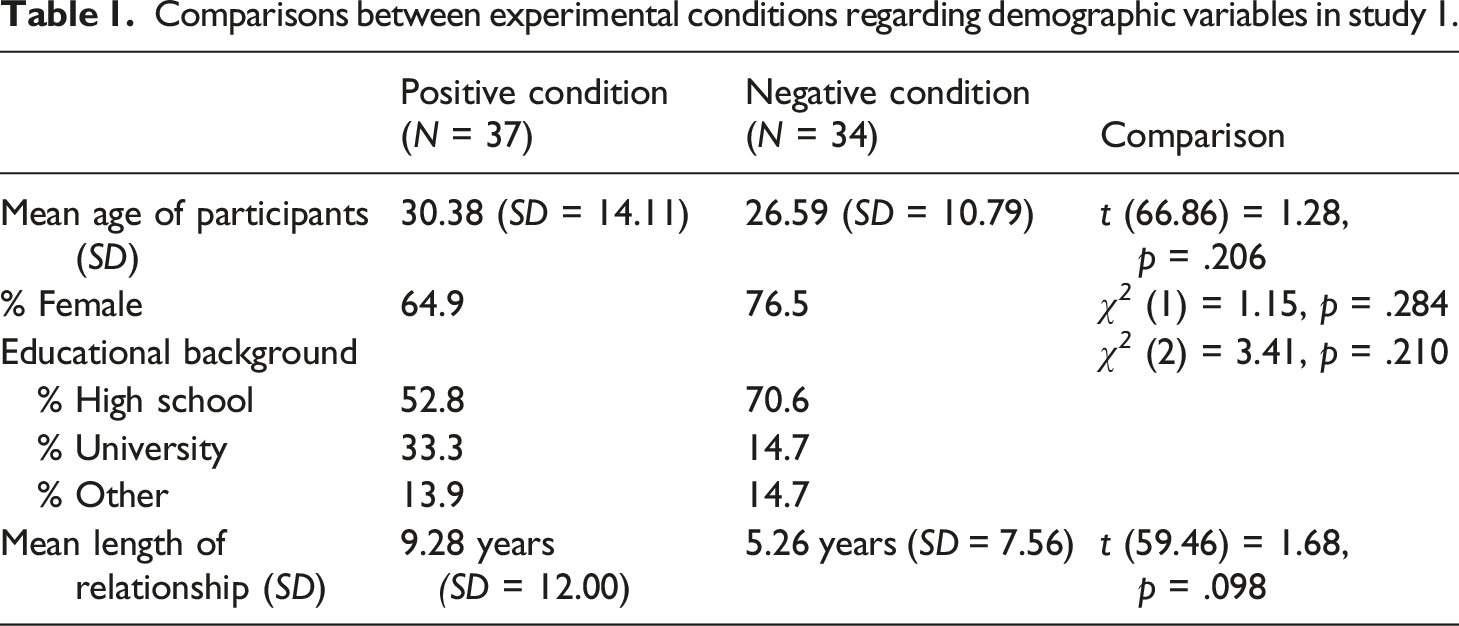
In a first step, we compared the experimental conditions regarding demographic variables and initial levels of intimacy. In a second step, we tested whether feelings of intimacy change after the recall of positive, respectively negative relationship memories. All analyses were conducted using IBM SPSS Statistics (Version 27 for Windows).
Preliminary analyses
Comparisons between experimental conditions regarding demographic variables in study 1.
Main analyses
To analyse whether feelings of intimacy change after the recall of emotional relationship memories, we conducted a repeated measures MANOVA with condition (i.e., positive and negative memories) as between-group factor and intimacy (i.e., feelings of warmth, relationship closeness) measured at two measurement points as within-group factor (see Supplemental Materials for Syntax). The primary effect of interest, the interaction effect between experimental conditions and measurement points, was significant (F (2, 68) = 6.694, p = .002, η p 2 = .165). This implies that the change in feelings of intimacy varied between individuals who recalled positive relationship memories and those who recalled negative relationship memories. 1 Pairwise comparisons revealed that in the positive memories condition, both relationship closeness and feelings of warmth increased. This increase was significant for relationship closeness (t (36) = −3.35, p = .002, Cohen’s d = −.55), but not for feelings of warmth (t (36) = −1.60, p = .118, Cohen’s d = −.26). Additional analyses revealed that the increase in relationship closeness was mainly driven by emotional (t (36) = −2.63, p = .012, Cohen’s d = −.43) and intellectual (t (36) = −2.25, p = .031, Cohen’s d = −.37) but not social closeness (t (36) = −1.00, p = .324, Cohen’s d = −.16). In the negative memory condition, relationship closeness did not change after memory recall (t (33) = 1.00, p = .324, Cohen’s d = .17). This equally held for each of the three facets of closeness; although emotional closeness tended to decrease after the recall of two negative relationship memories (t (33) = 1.78, p = .085, Cohen’s d = .31). A significant change was found for feelings of warmth. Specifically, feelings of warmth significantly decreased after memory recall (t (33) = 2.37, p = .024, Cohen’s d = .41). In terms of effect sizes, changes in intimacy were overall more pronounced for the recall of positive compared to negative relationship memories.
Discussion
In Study 1, we tested whether the recall of emotional relationship memories is associated with a change in feelings of intimacy. Overall, the findings demonstrate that positive relationship memories are more likely to be accompanied by an increase in intimacy, whereas the recall of negative relationship memories can dampen feelings of intimacy. Regarding positive memories, the findings align with those reported by Alea and Bluck (2007). The authors found that participants who recalled positive relationship memories reported greater feelings of intimacy than participants in the control condition, who were instructed to recall fictional relationship event vignettes. Specifically, Alea and Bluck (2007) found increased levels of warmth for all participants, but closeness was increased for women only, not for men. Different from their results, we found the increase in intimacy to be more pronounced for relationship closeness compared to feelings of warmth—not only based on levels of significance but actually in terms of effect sizes: the effect was medium in size for relationship closeness and small in size for feelings of warmth (even after controlling for potential effects of gender and relationship length). One has to keep in mind, though, that results cannot be compared directly. Alea and Bluck (2007) compared levels of intimacy after memory recall between the two recall conditions (autobiographical memories vs. fictional vignettes) and controlled for initial levels of intimacy (before memory recall). Their findings regarding increased intimacy after the recall of autobiographical memories can therefore only be interpreted as compared to the levels of intimacy found in the control condition. In our study, we used a within-person design because we were interested in the actual change in intimacy after memory recall; and whether this change differs between participants, who were instructed to recall positive relationship memories, and participants, who were asked to recall negative relationship memories. Additionally, our approach was multivariate in the sense that both intimacy outcomes were considered simultaneously, whereas Alea and Bluck (2007) ran analyses for each intimacy outcome separately. Despite these methodological differences, and the more rigorous analytical approach applied in the present study, our findings strengthen the assumption that positive memories serve an important intimacy function because their recall can be associated with increased relationship closeness and feelings of warmth. Moreover, the present findings show that memories do not only serve an intimacy function when they are socially shared with others (e.g., Beike et al., 2017; Gable et al., 2004; Osgarby & Halford, 2013), but also when a person is thinking or writing about past events. Remembering positive autobiographical memories can therefore be a helpful tool in overcoming times of social isolation and loneliness (Wolf & Nusser, 2022).
Regarding the recall of negative memories, the present study provides first evidence for the potentially harmful effects of recalling negative relationship memories. Much like positive memories can increase positive emotions and foster intimacy, emotionally negative memories can dampen a person’s mood (e.g., Jallais & Gilet, 2010) and, as our results suggest, reduce feelings of warmth toward one’s partner. The recall of negative relationship memories, however, did not alter the average ratings of relationship closeness (not only in terms of significance but also in terms of effect size), implying that some participants have experienced a decrease in relationship closeness, whereas others might feel even closer toward their partner after recalling negative relationship closeness. Based on these findings, it seems warranted to examine the impact of negative relationship memories on feelings of intimacy more thoroughly. Such an investigation should be based on a larger sample 2 and aim to identify variables that could explain why recalling negative relationship memories is hurtful for some people but not for others.
Study 2
Based on the findings of our first study, we had two study aims. First, we aimed to replicate our findings regarding the recall of negative relationship memories in an independent and, more importantly, larger sample. Second, we aim to identify potential predictors that may explain a change in intimacy after remembering negative relationship memories. Specifically, we aimed to examine in which cases, respectively, for whom the recall of negative relationship events is more likely to entail a decrease in feelings of intimacy. Based on previous experimental work, we considered memory characteristics key in understanding the effects of autobiographical remembering on feelings of intimacy. For instance, testing the mood-inducing effect of positive and negative memories, Gillihan et al. (2007) hypothesized that this effect gets stronger the more memories are perceived as personally important. Alea and Bluck (2007) supported this assumption regarding positive memories. The more positive relationship memories were rated as personally significant, the stronger the increase in feelings of intimacy after memory recall. A similar pattern might hold for the recall of negative relationship memories. Feelings of intimacy might be more likely to decrease for those persons who remember negative relationship events that they consider as personally significant. Put differently, recalling less important or even mundane negative memories may not have the power to change a person’s feelings toward their relationship. We addressed this by instructing participants to recall actual relationship conflicts experienced with their partner and by asking participants to rate their memories in terms of personal significance.
When remembering negative relationship events, such as relationship conflicts, not only characteristics of the memory but also context-specific or situational factors may come into play. Specifically, the strategies that were applied to deal with the conflict may influence whether recalling that event has an effect on current relationship qualities, such as feelings of intimacy. Problem-solving strategies include a wide range of cognitive and behavioral processes and can be classified into proactive or passive emotion- and problem-focused strategies (e.g., Blanchard-Fields et al., 2004; Lazarus & Folkman, 1984). Notably, these strategies are differently related to relationship qualities. Passive emotion-focused strategies (e.g., suppression, distraction, conflict avoidance) were shown to be related to lower feelings of being connected with conversation partners and decreased positive affect toward them (e.g., Butler et al., 2003). Proactive problem-solving (e.g., seeking social support, positive growth/reinterpretation, or acceptance), in contrast, may be positively associated with marital satisfaction—at least in men (Bodenmann & Shantinath, 2004; Gavidia-Payne & Stoneman, 2006).
Whereas the aforementioned studies were based on retrospective self-report data, Vater and Schröder-Abé (2015) investigated the association between problem-solving strategies and relationship satisfaction in an experimental study. Participants were instructed to engage in a discussion on a current conflict topic (e.g., leisure time or finance). Afterward, they were asked to rate the strategies used during the conflict discussion and their current relationship satisfaction. Perspective-taking and positive interpersonal behavior were positively related to satisfaction after conflict; whereas passive emotion-focused strategies (e.g., expressive suppression) showed a negative association. Hence, problem-solving strategies used during a relationship conflict can shape a person’s current perspective on their relationship. However, does the same hold when the person is re-experiencing the conflict at a later point in time, that is, when a person is remembering the conflict? Based on the evidence reviewed above, we would expect that the effect of recalling a relationship conflict on feelings of intimacy may vary depending on how an individual has dealt with it. Using passive emotion-focused strategies during relationship conflicts, in particular, may be associated with a decrease in intimacy after recalling these events.
To summarize, in Study 2, we aimed to further examine the effects of negative relationship memories on current feelings of intimacy. Based on the findings of our first study, we expected a decrease in feelings of warmth but not necessarily in relationship closeness. Moreover, we aimed to examine in which cases a reduction in feelings of intimacy would be more likely. Specifically, participants may be more likely to show a decrease in feelings of intimacy if they had recalled events they consider as personally important and if they had applied passive emotion-focused strategies during the conflict situations recalled.
Methods
Participants
Participants were recruited by posting flyers and through the Web site of the Department of Developmental Psychology at Ulm University in Germany. Study participation required an age of 18 years or older and being in a romantic relationship for at least six months. In total, 191 adults participated in the online study. Four participants were excluded due to incomplete data. The final sample comprised 187 adults (67.4% female) aged between 18 and 86 years (M = 39.87, SD = 18.39). Regarding educational background, 67.9% of participants reported having finished high school, which, in Germany, entails at least 12 years of formal education. Of the 187 participants, 30.5% were university students, and one person was still at school. The others were either employed (41.9%), self-employed (4.5%), retired (8.0%), apprentices (3.2%), or staying at home (3.7%).
Participants also reported on the age and gender of their current partner. The average partner age was M = 40.74 years (SD = 18.33). Determined by partner gender, five participants were in same-sex relationships; all others were identified as being in other-sex relationships at the time of data collection. Correspondingly, the majority of partners were male (66.8%). Relationship length varied between six months and 68 years (M = 15.01 years, SD = 15.57).
Procedure
The study was conducted in accordance with the Declaration of Helsinki. As in Study 1, data were collected online via the platform soscisurvey.de. Data was collected across six months (beginning in December 2021). Before starting the survey, participants were provided with detailed information about the content and procedure of the study. Study participation was voluntary, completely anonymous, and required participants’ consent. A detailed description of the study design and instructions can be obtained from the Supplemental Materials.
Participants answered demographic questions (e.g., age, gender) and questions regarding their relationship (e.g., length of the relationship). They also rated their initial feelings of warmth toward their partner and relationship closeness. Afterward, they were asked to recall two conflicts they had experienced with their partner and to describe them in two or three keywords. Participants could describe any relationship conflict that came to their mind regardless of how long ago the event had occurred. In order to recall the conflict situation vividly and detailed, participants were instructed to think about what happened in that situation, what they did or said, and what they thought about and felt during the situation. They had 4 minutes to think about each conflict event. Participants could not continue with the survey before this time has elapsed. After remembering both conflict situations, participants were asked to rate their current feelings of intimacy using the same measures as before memory recall. In the next step, participants were presented with each of their conflict descriptions and asked to rate them regarding specific characteristics (e.g., importance). They also completed a questionnaire assessing the problem-solving strategies used during the event in order to deal with the conflict. At the end of the survey, participants were given the opportunity to report on positive relationship memories. These memories were not analyzed. They served the purpose of ending the survey with a positive view of one’s relationship.
Measures
Warmth
We used the same eight adjectives as in Study 1 to assess participants’ current feelings about their relationship. In addition, we added four adjectives describing negative emotions (lonely, unhappy, weak, and ignored) because the potentially harmful effects of recalling negative relationship memories may reveal themselves not in a decrease in positive but in an increase in negative feelings toward one’s relationship. Participants were instructed to rate their current feelings of warmth toward their partner on a scale ranging from not at all (1) to very much (7). Responses for negative adjectives were reversed-coded such that higher scores imply feeling less negative about one’s relationship, and a mean score was calculated across all 12 items. Internal consistency was high, with Cronbach’s α = .91 before and α = .93 after memory recall.
Relationship closeness
As in Study 1, relationship closeness was measured with our translation of the PAIR questionnaire (Schaefer & Olson, 1981). Again, we used the 18 items asking about the couple’s emotional, intellectual, and social connectedness, but calculated a global PAIR score. On a scale ranging from very strong disagreement (1) to very strong agreement (5), participants rated their current connectedness to their partner. A mean score was calculated with higher scores describing greater relationship closeness. Internal consistencies can be considered as good for both measurement points with a Cronbach’s α of .86 before and .89 after memory recall. Mean scores of the conventionality subscale were medium in size and did not differ between the two measurement points (Mt1 = 3.61, Mt2 = 3.61), t (186) = .315, p = .753, d = .02).
Memory characteristics
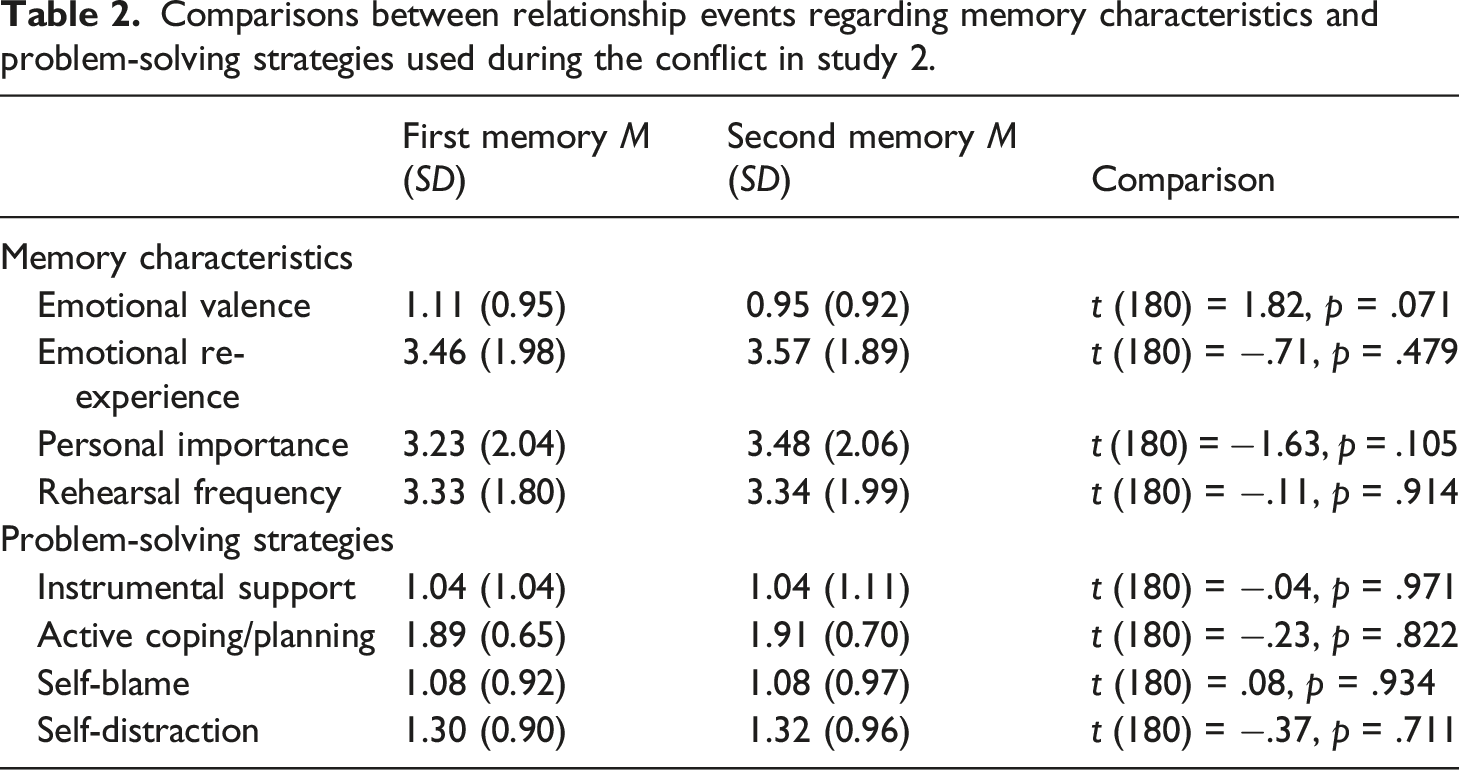
Comparisons between relationship events regarding memory characteristics and problem-solving strategies used during the conflict in study 2.
Problem-solving strategies
We used 12 items from the Brief COPE (Carver, 1997). The Brief COPE includes problem-focused strategies such as active coping, planning, and use of instrumental support as well as passive emotion-focused strategies such as behavioral disengagement, self-distraction, and self-blame (Blanchard-Fields et al., 2004)—each of which is measured with two items. In the present study, participants rated the extent to which they have used these strategies during each of the relationship conflicts they had recalled on a scale ranging from not at all (0) to strongly (3). This procedure was adapted from Yeung et al. (2012), which used a similar selection of items from the Brief COPE to measure adaptive and dysfunctional responses to deal with specific problem situations. We used the German wording of the items as presented by Knoll et al. (2005).
With Cronbach’s α of .81 and .80, the internal consistency of the problem-focused strategy can be considered as good for both memories. The items describing different passive emotion-focused strategies, however, showed a poor internal consistency with a Cronbach’s α of .479 for the first memory and .632 for the second memory. We, therefore, ran two explorative factor analyses—one for each memory. Across both memories, explorative factor analyses revealed four factors with an Eigenvalue >1. Regarding problem-focused strategies, instrumental support should be treated separately, whereas active coping and planning can be subsumed into one score. Regarding passive emotion-focused strategies, self-distraction and self-blame should be treated separately, whereas behavioral disengagement did not contribute consistently to any of the four factors (see Supplemental Materials). Since ratings did not differ between the two memories reported (see Table 2), we calculated four composite scores that capture the use of instrumental support, active coping/planning, self-distraction, and self-blame across the two relationship conflicts reported.
Results
Preliminary results
On average, the initial levels of intimacy were 6.09 (SD = 0.85) for feelings of warmth and 3.77 (SD = 0.53) for relationship closeness. In terms of memory characteristics, participants reported relationship conflicts that can be considered rather negative (M = 1.07, SD = 0.79) and moderately important (M = 3.32, SD = 1.79). Ratings of emotional re-experience (M = 3.49, SD = 1.66) and rehearsal frequency (M = 3.32, SD = 1.60) ranked at a medium level. On average, participants reported low levels of instrumental support (M = 1.03, SD = .96) and self-blame (M = 1.07, SD = .82) as well as medium levels of active coping/planning (M = 1.88, SD = .58) and self-distraction (M = 1.29, SD = .81).
Main results
To analyze the change in feelings of intimacy after recalling two negative relationship conflicts, we conducted a repeated measures MANOVA with intimacy (i.e., feelings of warmth, relationship closeness) measured at two measurement points as within-group factor using IBM SPSS Statistics (Version 27 for Windows; see Supplementary Material for Syntax). The primary effect of interest, the difference in measurement points, was significant (F (2, 185) = 5.414, p = .005, η p 2 = .06), implying that feelings of intimacy changed after the recall of two relationship conflicts. Pairwise comparisons revealed that feelings of warmth significantly decreased (t (186) = 3.14, p < .001, Cohen’s d = .23), whereas relationship closeness did not change (t (186) = 0.17, p = .869, Cohen’s d = .01). 3
In a second step, we focused on potential predictor variables that could explain for whom feelings of intimacy are more likely to decrease after recalling negative relationship conflicts. To that end, we created two dummy variables that displayed whether feelings of warmth and relationship closeness decreased after memory recall or not (i.e., no change or an increase). We then conducted two binary logistic regressions—one to predict the potential decrease in feelings of warmth and one to predict the potential decrease in relationship closeness. 4 In both regression analyses, the personal importance of memories and the four different problem-solving strategies (i.e., instrumental support, active coping/planning, self-distraction, and self-blame) were entered as predictor variables. The valence of memories, emotional re-experience, and rehearsal frequency served as control variables (see Supplementary Materials for Syntax).
Logistic regressions to predict a decrease in feelings of warmth and relationship closeness in study 2.
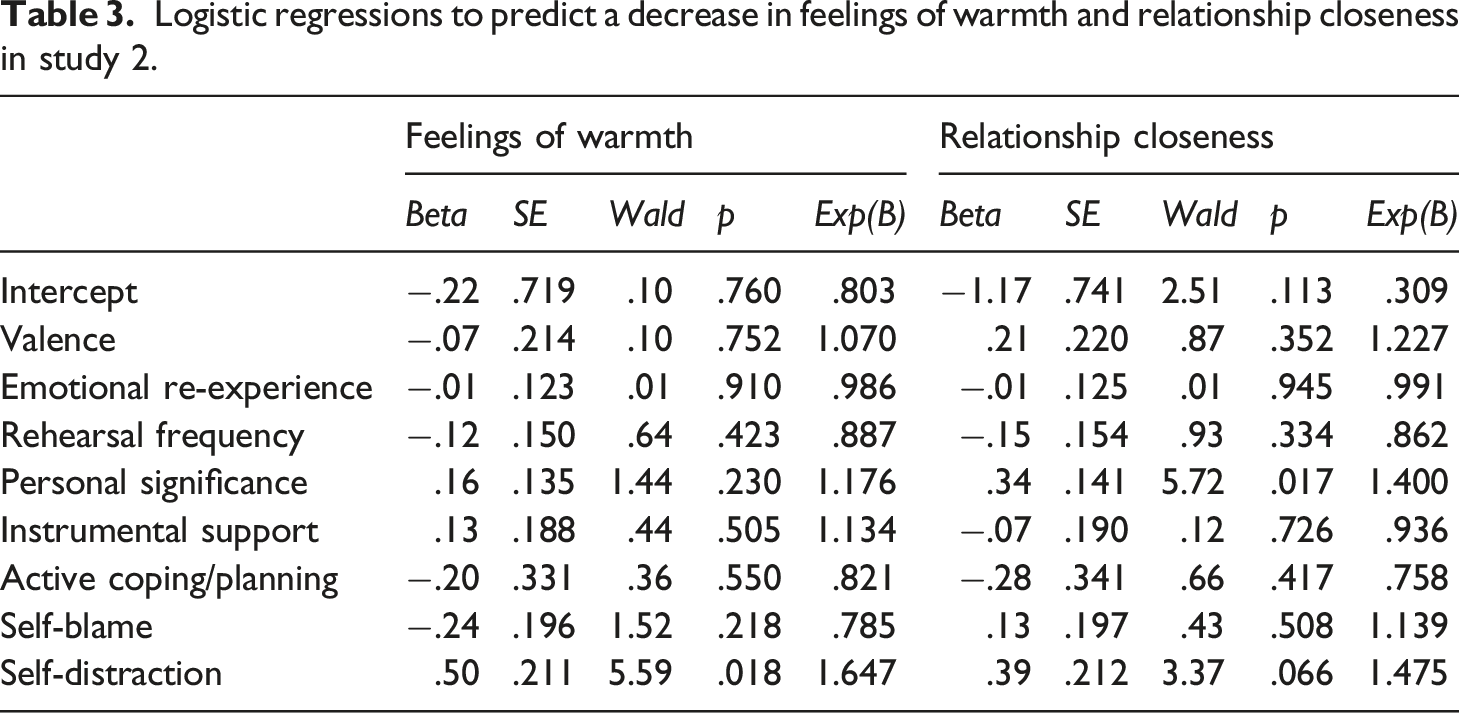
Regarding relationship closeness, the intercept was −1.17. Transformed back to the probability, one gets p = exp (−1.17)/1 + exp (−1.17) = 0.24, implying that 24% of the participants displayed a decrease in relationship closeness, whereas the remaining 76% showed no change in relationship closeness or an increase. Again, a change in relationship closeness tended to be associated with the use of self-distraction during the conflict event: Relationship closeness is more likely to decrease for participants who reported more frequent use of the passive emotion-focused strategy of self-distraction during relationship conflicts. This effect, however, was only marginally significant, Beta = .39, Wald (1) = 3.37, p = .066. No effect was observed for any of the problem-focused strategies (see Table 3). Concerning memory characteristics, importance of memories showed a positive and significant effect, indicating that relationship closeness is more likely to decrease after recalling personally important relationship conflicts, Beta = .34, Wald (1) = 5.72, p = .017. Together, predictor variables accounted for 8.1% of the variance in the dependent variables (Nagelkerkes R 2 = .081).
Discussion
The second study was designed to further explore the potentially harmful effects of negative relationship memories regarding current feelings of intimacy. After recalling two relationship conflicts, participants experienced a decrease in feelings of warmth. These findings are important regarding three issues. First, they replicate those reported in Study 1 in an independent and larger sample. Much as positive memories can foster feelings of intimacy towards one’s partner (e.g., Alea & Bluck, 2007), negative memories bear the potential to dampen feelings of intimacy in romantic relationships. Second, the present research replicates the potentially harmful effects of negative relationship memories across different types of negative relationship events. In Study 1, participants could recall any negative event experienced with their partner, implying that memories could vary greatly between participants. In Study 2, we implemented a stricter approach by instructing participants to recall a specific type of negative relationship event, i.e., two conflicts experienced with their partner. Third, across both studies, the recall of negative relationship memories consistently affected participants’ feelings of warmth—though the measures of feelings of warmth differed slightly between studies. In Study 1, we used eight adjectives that all describe positive feelings about one’s relationship (e.g., feeling “connected” or “loved”). In study 2, we complemented this list with four adjectives describing negative feelings that could arise in a relationship (e.g., feeling “lonely” or “unhappy”). Considering a broad range of different emotions seems especially relevant in the context of (romantic) relationships because people sometimes experience strong negative emotions toward the person(s) they love the most (Zoppolat et al., 2023). In fact, people can hold both positive and negative feelings toward their partner at the same time. Such a state of emotional ambivalence may be provoked when people are forced to recall negative relationship memories because the negative emotions contained in the memory may contradict a person’s tendency to see their relationship in a positive light. This may explain why the impact on feelings of intimacy is less strong for negative compared to positive memories (see Study 1). However, previous research suggests that ambivalence in romantic relationships can negatively affect personal and relational well-being (e.g., Zoppolat et al., 2023). As such, the simultaneous experience of both positive and negative emotions is likely to be accompanied by a decrease in current feelings of intimacy. As such, further research is needed to disentangle the role of mixed emotions when remembering emotional relationship events.
Notably, in both studies, relationship closeness did not change after the recall of two negative relationship memories. As aforementioned, feelings of warmth capture momentary affective feelings about the relationship that might be more prone to change in response to situational influences. Relationship closeness (cf. Mashek & Aron, 2004; Schaefer & Olson, 1981), in contrast, might represent a more stable aspect of relationship quality i.e. enduring and less easily affected by situational influences, such as the recall of negative relationship memories. However, there might be instances in which the recall of negative relationship events can reduce relationship closeness. As our results show, remembering personally significant relationship conflicts has the potential to entail a decrease in relationship closeness. In addition, how a person was dealing with the conflict situation back then can affect feelings of intimacy. Considering both problem-focused and passive emotion-focused strategies, we found self-distraction to be associated with a change in feelings of intimacy. Specifically, the more a person has used self-distraction to cope with the relationship conflict, the more likely they are to experience a decrease in feelings of warmth and, to a lesser extent, in relationship closeness. Hence, in line with previous research, passive emotion-focused strategies seem to be more impactful regarding feelings of intimacy than problem-focused strategies (e.g., Butler et al., 2003; Vater & Schröder-Abé, 2015).
General discussion
Previous studies provide some evidence that positive autobiographical memories can foster feelings of intimacy in social relationships. For instance, in romantic relationships, remembering positive events helps to feel close and intimate to one’s partner (Alea & Bluck, 2007). The present studies aimed to examine the effects of recalling negative relationship memories. By doing so, we first compared the change in feelings of intimacy after the recall of negative relationship memories as compared to the recall of positive relationship memories; and second, we addressed the questions of whether remembering negative memories is harmful per se or may not affect some people. Indeed, our findings suggest that the recall of negative relationship memories can be associated with a decrease in feelings of intimacy. Whether a person experiences such a decrease may depend on characteristics of the remembered event (e.g., their importance) as well as on how a person has dealt with that event (i.e., use of problem-solving strategies).
The intimacy function of positive and negative autobiographical memories
In line with Alea and Bluck (2007), our results showed that remembering positive events led to an increase in feelings of intimacy in one’s relationship. The recall of only two positive relationship events fosters relationship closeness and, though to a smaller extent, feelings of warmth. This is noteworthy since our study design differs from the one applied by Alea and Bluck (2007). To illustrate, the study by Alea and Bluck (2007) was conducted in a laboratory-like setting. For each relationship memory, participants had 2 minutes to come up with a memory (e.g., a vacation that they had with their partner) and were given 10 minutes to describe the event in detail. In the present research, the data was collected online. In order to reduce the potential effects of boredom or distraction effects, participants were given five (Study 1), respectively 4 minutes (Study 2) to describe each relationship memory. As such, our findings suggest that the recall of positive autobiographical memories can affect current feelings of intimacy—even in a less controlled setting and even after shorter time intervals. Moreover, the recall of positive autobiographical memories may differentially affect different components of intimacy. For instance, social closeness, capturing “the experience of having common friends and similarities in social networks” (Schaefer & Olson, 1981, p. 50), may be less affected by the recall of positive autobiographical memories as compared to emotional or intellectual closeness. It is up for future research to disentangle which components of intimacy are most strongly affected by autobiographical remembering.
The present findings further suggest that feelings of intimacy are influenced not only by the recall of positive relationship memories but also by the recall of negative events experienced with one’s partner. Specifically, remembering negative relationship memories can lead to lower levels of warmth. Similar findings were reported by Burnell et al. (2020). The authors asked participants to rate whether their memories gave them a sense of belonging or disconnection from others. Negative memories were associated with a reduced sense of belonging to other people. Hence, remembering negative events may bear the potential to feel disconnected from others (Burnell et al., 2020) and, as our results show, less connected with one’s partner—as shown by the decrease in feelings of warmth across both studies. This has important practical implications. Much like the recall of positive memories can be beneficial in overcoming times of social isolation and loneliness (Wolf & Nusser, 2022), a focus on negative aspects of one’s past may increase feelings of being lonely and socially isolated, for instance, in bereavement (Vedder et al., 2022).
Notably, whereas feelings of intimacy decreased for some people, others experienced no change or even an increase in feelings of warmth and relationship closeness after recalling negative relationship memories. Hence, for some people, the recall of negative relationship memories does not affect current intimacy. Respectively, negative memories may even serve an intimacy function in the sense that one feels closer to one’s partner. The finding that the recall of negative autobiographical memories is not harmful per se but can actually be helpful is in line with previous literature (e.g., Burnell et al., 2020; Rasmussen & Berntsen, 2009). For instance, negative memories often serve as reference points to learn lessons from the past and avoid similar situations in the future (Wolf et al., 2021). The same may hold in the context of romantic relationships. Remembering negative events or relationship conflicts experienced with one’s partner may serve as a reminder and help people avoid conflicts in the future. Moreover, negative relationship memories may entail information about how the situation was resolved, which could be helpful for similar situations encountered in the future. Against this background, it seems warranted to better understand why the recall of negative relationship memories is hurtful for some people, but not for others. The present research, therefore, aimed to explore potential predictors that may explain why some people experience a decrease in intimacy after remembering negative relationship memories while others do not.
Predicting a decrease in feelings of intimacy
Based on previous work, we considered two key aspects in understanding the effects of autobiographical remembering on feelings of intimacy, namely characteristics of the memory (e.g., its importance) and a person’s behavior during the conflicts remembered (i.e., use of problem-solving strategies). Regarding problem-solving strategies, we found that if a person used self-distraction to feel better during the relationship conflict, remembering that conflict led to a decrease in feelings of warmth and relationship closeness (see Butler et al., 2003; Vater & Schröder-Abé, 2015 for similar results). The use of passive emotion-focused strategies such as self-distraction may indicate that a person was not directly dealing with the conflict situation but instead deliberately withdrew from it. As a consequence, the conflict is likely to remain unresolved. When recalling the event, a person might re-experience the negative feelings of conflict or be reminded of the fact that they were unable or unwilling to solve the conflict. Both could affect the current perception of reduced feelings of intimacy toward one’s partner. In the present research, we controlled for the emotional valence of the event at the time of occurrence and the extent to which a person emotionally re-experienced the event when remembering it. Both variables were unrelated to the change in feelings of intimacy, indicating that the decrease in feelings of intimacy cannot be explained by the emotional re-experience of the relationship conflicts.
Whether a person was unable or unwilling to resolve the conflict might be reflected in their use of problem-focused strategies. In the present research, neither instrumental support nor active coping/planning showed an effect on the change in feelings of intimacy. Although problem-focused strategies aim to control the problem and fix it (Blanchard-Fields et al., 2004), their use does not guarantee a resolution of the conflict. Hence, it might be less relevant which strategies have been used to cope with the conflict, but rather whether they were applied in a successful manner. The extent to which an event is perceived as psychologically open or closed (Beike & Landoll, 2000) could be one way of operationalizing the effectiveness of problem- and passive emotion-focused strategies. If a conflict is psychologically closed or resolved, it is integrated into the couple’s past (Ritchie et al., 2006) and embedded in their relationship story. Consequently, recalling psychologically closed relationship conflicts might not affect current feelings of intimacy (irrespective of the problem-solving strategies used during the conflict) because it has no current relationship importance.
To test for that, we asked participants to rate the personal importance of relationship conflicts recalled. Indeed, we found that the more a person perceived relationship conflicts as important, the greater the likelihood that they experienced a decrease in relationship closeness. Hence, the importance of relationship conflicts explains why some people experienced a decrease in feelings of intimacy, whereas others did not. As such, our results extend the findings reported by Alea and Bluck (2007) to the recall of negative relationship memories. Based on their and our own findings, we postulate that the personal significance of an event modulates the emotional response to its recall—irrespective of whether the event is perceived as emotionally positive or negative. As argued before, this effect might also be ascribed to a greater reliving of personally important memories (Rubin et al., 2003), but this could not be confirmed in the present research since emotional re-experience was unrelated to feelings of intimacy.
In the present research, we provided some explanatory variables that help to understand why the recall of negative relationship memories can be associated with a decrease in feelings of intimacy. To further examine the functional power of negative relationship memories, it would be interesting to consider whether a person has made meaning out of negative relationship memories, for instance, by transforming initially negative conflicts into affectively positive memories (redemption, McAdams, 2006). Alea et al. (2010) found that marital satisfaction was associated with the extent to which persons could have found some redeeming outcome from the most negative events in their marriage. This may imply that the way in which negative relationship memories are appraised at their recall determines relationship quality. Similarly, Knee et al. (2004) found that persons with higher growth beliefs expect relationships to grow not only despite obstacles but also because of them. In their view, a conflict can be considered a healthy part of relationships that might bring partners closer to each other. Hence, whether remembering a conflict situation increases relationship closeness or forces partners apart might depend on one’s implicit theories of relationships.
Limitations and future directions
There are possible limitations and extensions to our approach. First, based on previous work (Alea & Bluck, 2007), we asked participants to recall two relationship memories and rated each memory regarding its personal significance and problem-solving strategies used during the conflict. Scores were averaged across both memories because events did not differ significantly regarding personal significance and the problem-solving strategies (cf. Alea & Bluck, 2007). However, there were some differences apparent that could have affected our results (e.g., emotional valence). Hence, a systematic variation of the number of events recalled would provide a better understanding of how many memories are needed to affect feelings of intimacy. Regarding problem-solving strategies in particular, one might also consider including a person’s general tendency to cope with problems. Since the use of problem-solving strategies did not differ between memories and was comparatively low, on average, measures of habitual coping or general emotion-regulation strategies might be equally informative and less confounded by memory processes.
Second, it is possible that changes in feelings of intimacy after the recall of positive and negative autobiographical memories were due to experimenter demand. Although we aimed to reduce demand characteristics (i.e. recruitment strategies and ordering of study measures) and the conventionality subscale of the PAIR questionnaire did not differ between measurement points across both studies, we cannot completely discount this concern. Related to that, it is difficult to anticipate how much time participants should be given to recall relationship memories. On the one hand, participants should be given enough time to fully remember and potentially relive an event experienced with their partner. On the other hand, participants should not get bored or distracted—especially during an online survey. Although we have considerably reduced the time to think about each relationship memory (as compared to Alea & Bluck, 2007), we cannot rule out that participants got bored or distracted during the memory task.
Fourth, research on couple conflict interactions suggests that not only one’s own behavior but also how the partner behaved during the conflict predicts relationship satisfaction (Graber et al., 2011). For instance, positive partner behavior (e.g., responsiveness) can be associated with higher marital quality—not only in warm and supportive interactions but also during a problem-solving task (Melby et al., 1995). This line of research also emphasizes the role of positive affect experienced during interactions with one’s partner: Positive affect during a problem-solving task or conflict resolution can buffer against a decline in marital satisfaction (e.g., Johnson et al., 2005), respectively predict future relationship health (see Driver & Gottman, 2004). In addition to the emotional valence of memories, future research may ask for the emotions experienced during the events recalled and, ideally, ask for positive and negative emotions separately. This relates to the aforementioned issue of emotional ambivalence in (romantic) relationships, which describes the phenomenon that people sometimes hold mixed feelings, both positive and negative, toward their partner (Zoppolat et al., 2023) and may help to better understand the role of mixed emotions when remembering emotional relationship events. Apart from that, future studies might also include characteristics of the relationship. In the present study, we controlled for potential effects of relationship length, which did not affect the results. Other aspects, such as the commitment to the relationship, were found to be associated with relationship persistence over time (Etcheverry & Le, 2005) as well as need satisfaction in important couple-related memories (Guilbault & Philippe, 2017). A person’s commitment to their relationship would thus be an interesting future line of research in the context of negative relationship memories and feelings of intimacy.
Finally, research on the functions of autobiographical memories often relies on self-report questionnaires, in which people rate their overall use of autobiographical memories in daily life. The experimental design applied in the current research might represent a more naturalistic everyday use of the intimacy function (cf. Alea & Bluck, 2007). Nevertheless, external validity might be reduced in the sense that our results do not generalize to the spontaneous (involuntary) retrieval of relationship memories. However, comparing voluntary word-cued memories and involuntary memories (both retrieved in naturalistic settings via a self-paced procedure), Berntsen and Hall (2004) found that both types of memories impact people’s mood, but the effect was stronger for involuntary memories. Hence, we expect our findings would hold not only in the laboratory but also in naturalistic settings. However, this remains to be investigated in future research.
Conclusion
The present research extended literature on the intimacy functions of autobiographical memory by investigating the influence of recalling not only positive but also negative memories on feelings of warmth and relationship closeness using an experimental pre-post study design. The findings suggest that remembering good times spent with one’s partner can enhance intimacy, whereas memories about relationship conflicts can reduce intimacy in a relationship. Notably, whether the recall of negative relationship memories is harmful regarding intimacy depends on the personal significance of the events remembered, as well as on the way the conflict was dealt with. Remembering relationship conflicts, during which a person has used self-distraction to regulate their emotions, has the potential to challenge feelings of intimacy toward one’s partner. Similarly, relationship closeness can be reduced if personally significant relationship conflicts are remembered. To better understand the potential beneficial and hurtful effects of autobiographical memories, future research may examine the role of mixed emotions in autobiographical remembering, which seems especially relevant in the context of romantic relationships. Future research is needed to identify personal characteristics that could explain why, for some people, the recall of negative (relationship) memories is hurtful, whereas it brings others closer together.
Supplemental Material
Supplemental Material - How remembering positive and negative events affects intimacy in romantic relationships
Supplemental Material for How remembering positive and negative events affects intimacy in romantic relationships by Tabea Wolf and Lisa Nusser in Journal of Social and Personal Relationships
Footnotes
Acknowledgments
The authors wish to thank all students who supported the recruitment of participants and all the participants who shared their relationship memories with us.
Funding
The author(s) received no financial support for the research, authorship, and/or publication of this article.
Open research statement
As part of IARR's encouragement of open research practices, the authors have provided the following information: This research was not pre-registered. The data used in the research are available. The data can be obtained by emailing:

Supplemental Material
Supplemental material for this article is available online.
Notes
References
Supplementary Material
Please find the following supplemental material available below.
For Open Access articles published under a Creative Commons License, all supplemental material carries the same license as the article it is associated with.
For non-Open Access articles published, all supplemental material carries a non-exclusive license, and permission requests for re-use of supplemental material or any part of supplemental material shall be sent directly to the copyright owner as specified in the copyright notice associated with the article.
