



Abstract
National government programmes tackling complex social problems have adopted a macro-social marketing approach, with resultant campaigns increasingly containing a partnerships element. However, a lack of academic literature regarding partnerships in macro-social marketing exists, particularly the ‘why’ of partnerships in national behaviour change interventions. Using a case study methodology, data were collected through three methods (participant observation, document analysis and semi-structured interviews) and analysed using thematic analysis. This paper offers a greater theoretical understanding of why partnerships are used in national social marketing programmes. The findings uncover a new way of conceptualising partnerships in macro-social marketing: holistically as a strategic concept that supports system-wide behaviour change. The findings further reveal that, as a concept, partnerships can play a strategic role in the long-term development and delivery of solutions to tackle complex social problems. Two types of partnerships—strategic partnerships and signposting (tactical) partnerships—are identified and defined.
Introduction
Macro-social marketing promotes the need for systemic or macro-level change as a way of developing solutions to complex social problems (Hamby, Pierce, and Brinberg 2017; Kennedy 2016). To achieve social change, macro-social marketing interventions require focus on the interconnected entities within the marketing system that the social problem is a part of (Domegan 2008; Kennedy and Parsons 2012). This entails recognising the importance of the relationships and interactions between actors in the marketing system and the opportunity these actors provide to influence social change (Brennan, Previte, and Fry 2016). In our discussion of partnerships in this paper, we distinguish ‘partners’ from ‘stakeholders’ as follows: stakeholders are those organisations/people who have an interest in a social marketing programme, whereas partners are organisations/people who play a more active role in a campaign (French et al. 2009).
The principal theoretical contribution of our research is the reconceptualization of partnerships as an integral concept in macro-social marketing strategy. This reconceptualization is underpinned by multiple sources of empirical evidence from our research and provides both original insight and practical utility. By taking the existing social marketing literature in a different and unique direction this paper is positioned as an “expander” in Colquitt and Zapata-Phelan's (2007) taxonomy of theoretical contributions. Until now, the social marketing literature has referred to partnerships as simply a tactical tool within the marketing mix to be used in the promotion of campaign messages/products. Our research advances knowledge and has the potential to transform wider practice through our reconceptualization of partnerships as instead a core component of social marketing strategy in a systems approach to behaviour change. A further contribution of this paper is the formulation of definitions of firstly, the concept of partnerships as strategy in macro-social marketing, secondly, strategic and signposting partnerships, and finally to propose an adapted definition of social marketing to reflect this newly identified strategic role of partnerships.
Despite the growth in the use of partnerships within social marketing practice over the past twenty years (Duane 2012), this has not been reflected in the empirical literature, prompting calls for further research into this area (Beall et al. 2012; Duane and Domegan 2019; Duane, Domegan, and Bunting 2022). Importantly, there appears to be little consideration of the role of partnerships in macro-social marketing. Two aspects of partnerships in social marketing in particular have been identified as requiring improved understanding: “1. scope: understanding of the state of practice, what makes social marketing partnerships successful and 2. substance: a theoretical understanding of what constitutes social marketing partnerships” (Duane and Domegan 2019, p. 170).
This paper responds to these calls by presenting the findings of case study research into Public Health England's (PHE) use of partnerships in their national social marketing interventions. PHE was formed in 2013 as an executive agency of the UK Department of Health, with responsibility for protecting and improving the health of people in England. This study provides important insights into the ‘why’ of partnerships in social marketing, through understanding why PHE created and maintained partnerships to support their social marketing programmes.
Since completing this research, PHE has been disbanded and the PHE Marketing team has been incorporated into the Office for Health Improvement and Disparities within the Department of Health and Social Care. The case study research reported in this paper captures understanding of partnerships developed over time from a substantial body of PHE's work on national social marketing campaigns that might otherwise have been lost.
This paper begins with a review of the academic literature in relation to partnerships in social marketing. It then introduces the case study research, explaining the methodology and analysis before moving on to describe the findings in relation to the literature. This is followed by a discussion presenting a more strategic role for partnerships in social marketing, particularly in trying to tackle complex social problems at a national level. Finally, the paper concludes by reflecting on the potential of partnerships in effecting system-level behaviour change.
Literature Review
Systems Theory, Marketing Systems and Macro-Social Marketing
Governments around the world are increasingly adopting a social marketing approach to tackle complex social problems (Asbury et al. 2008), owing to their “significant behavioural elements” (French et al. 2009, p. 1). This includes a range of “wicked problems” (Rittel and Webber 1973), such as climate change, obesity, smoking, environmental degradation and poverty (Kennedy 2016, 2017; Kennedy and Parsons 2012). Approaches to tackling wicked problems have shifted away from individual behaviour change toward meso-level “community-based” social marketing (McKenzie-Mohr 1996) and, more recently, macro-social marketing (Kennedy 2016).
Macro-social marketing applies systems theory to behaviour change (Kennedy 2016) and is increasingly recognised as necessary, whereby complex and multi-faceted problems are considered in a more holistic way, seeing the different levels as part of one interconnected “system” (Biroscak et al. 2014; Kennedy 2017; Truong 2017). Systems theory suggests that if one thing in the system changes, other things in the system are also affected, either changing the relationship between them or changing the entire system (Kennedy 2017).
Utilising systems theory, macro-social marketing recognises wicked problems as part of wider marketing systems and suggests the only way to tackle these problems is to bring about change within and across the whole system. Layton (2019) views marketing systems as networks of entities, actors and structures and this concept has been applied in a macro-social marketing context using Bronfenbrenner's (1979) ecological framework (Brennan, Previte, and Fry 2016; Gordon et al. 2018; Wood 2016) and is pictured in Figure 1 below. This approach to macro-social marketing attempts to consider all aspects of the marketing system that are impacting on a social problem at the macro, exo, meso and micro system levels.
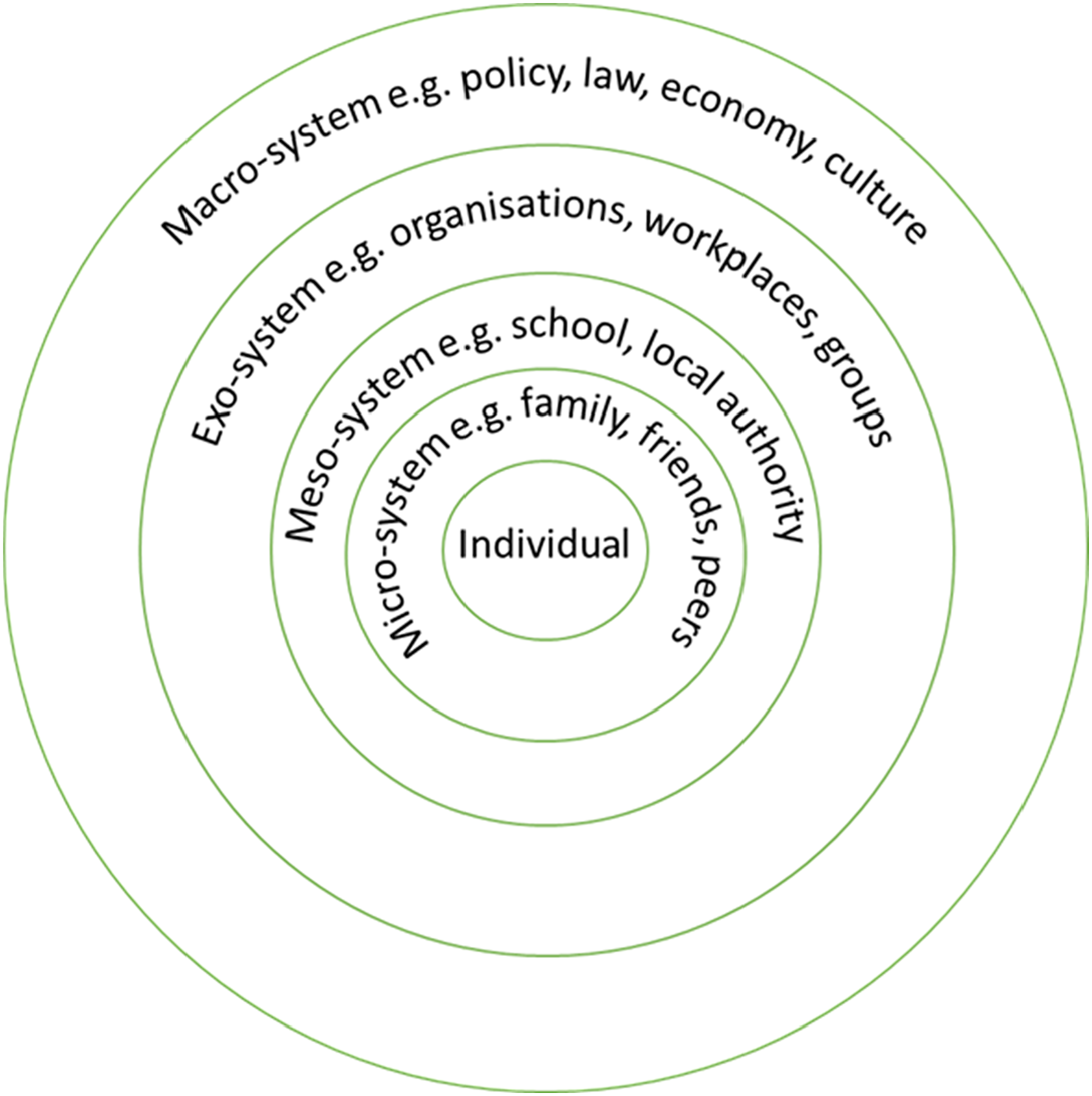
Visualisation of a Macro-Social Marketing System—Adapted from Gordon et al. (2018), p.106.
Systems theory recognises marketing systems as relational networks where “the focus is on relationships linking individuals and entities in the marketing system, relationships that underpin the flows of transactions” (Layton 2007, p. 233). Any changes in a marketing system would “mostly require collective action” (Kadirov 2018, p.279) and it is possible for the actions of a few powerful actors in a marketing system to introduce changes to the structure and processes of the system that could impact the fortunes of a great many people (Kadirov, Varey, and Wolfenden 2016). A potential implication is that partnerships amongst actors within the marketing system of a social problem could bring about change in the system.
Partnerships and Social Marketing
Social marketers have a long history of using partnerships as part of their behaviour change programmes. Initially, the social marketing literature included partnerships as part of Promotion in the traditional ‘4Ps’ marketing mix (Kotler and Roberto 1989; Kotler, Roberto, and Lee 1991). However, as the field of social marketing evolved, so the use and importance of partnerships in social marketing practice increased and this was reflected with partnerships being included as an additional ‘P’ in an augmented marketing mix (e.g., Donovan and Henley 2010; Duane, Domegan, and Bunting 2022; Hastings and Domegan 2018; Weinreich 1999, 2010).
The increasing importance of partnerships between practitioners and organisations from the public, private and third sectors and the value of partnership insight in social marketing was recognised in the 2013 consensus definition published by the International Social Marketing Association as follows: “Social marketing seeks to develop and integrate marketing concepts with other approaches to influence behaviours that benefit individuals and communities for the greater social good. Social marketing practice is guided by ethical principles. It seeks to integrate research, best practice, theory, audience and
Partnerships can provide an opportunity to influence social change in a marketing system as the relationships and interactions between actors in the system could promote system-wide solutions to achieve long-term sustainable change at both the individual and societal level (Brennan, Previte, and Fry 2016). Partnerships can develop stable relationships in a marketing system, and it is these stable relationships that bring about most transactions in the marketing system rather than ad hoc market encounters (Arndt 1986).
Working in partnership with stakeholders in a macro-social marketing approach has the potential to bring about change within and across the four levels of a marketing system (Parkinson et al. 2017). For example, Kennedy (2016, p. 361) highlighted the need for the creation of partnerships “with suppliers, retailers, regulatory bodies and the media” as part of a macro-social marketing approach to addressing problems being created for workers, the environment, and society by the textiles and fashion industry. Similarly, Bryant et al. (2014, p. 220) identified partnerships as integral to social marketing interventions aimed at “creating change at policy, system and environmental levels” and highlighted community coalitions consisting of community-based partnerships as being successful agents of change in the United States. To achieve this, the macro-social marketing literature also presents partnerships as an additional “P” in the social marketing toolkit (Bentz et al. 2005; Hastings and Domegan 2018; Kennedy 2016).
The use of partnerships can impact the exchange in a macro-social marketing approach. Exchange theory is seen as fundamental to social marketing (Lee, Kotler, and Colehour 2024) where the aim is for a basic-type exchange to take place. This is referred to by Bagozzi (1975, p. 32) as “restricted exchange” between two parties. Partnerships in social marketing involve “complex exchanges” (Duane, Domegan, and Bunting 2022) which require exchange relationships that develop over time (Bagozzi 1975). In these relationships, party A (the social marketer) develops a mutually beneficial relationship with party B (the partner) to facilitate an exchange with party C (the target consumer). For complex exchange to take place successfully, value needs to be created and delivered for all parties over time. The idea of complex exchange is seen as more representative of the type of relationships required in macro-social marketing to tackle complex social problems and could consist of networks of exchanges both direct and indirect (Duane et al. 2016).
In a marketing system it is suggested that greater value can be created at the macro, exo, meso and micro levels when co-creation of value takes place in a collaborative partnership approach (Austin and Seitanidi 2012). Applying the concept of “co-creation of value” (Prahalad and Ramaswamy 2004; Vargo and Lusch 2004) to the social marketing context involves the social marketer viewing their target audience as collaborators in the approach to behaviour change (Lefebvre 2012), for example social marketers could work with members of the target audience to develop a product or service that is valued by them and so encourages behaviour change.
Luca, Hibbert, and McDonald (2015, Luca, Hibbert, and McDonald2016) proposed that an implication of the service-dominant network perspective of the concept of value co-creation (Vargo and Lusch 2012) for social marketing programmes is it requires engagement with customers “as active participants in all phases of social change from defining the problem to formulating, enabling, enacting and evaluating change” (Luca, Hibbert, and McDonald 2015, p. 205). Applying this idea to meso-level social marketing, Luca, Hibbert, and McDonald (2016) determined the need for collaboration with both customers and other actors in the community. This entails identifying who those key actors are and building relationships with them to co-create value between them and the customers. They also recognised the need for a “focal actor” to initiate social change in the community (Luca, Hibbert, and McDonald 2016, p. 1149). We argue that this could be extended to viewing partnerships as having a role in the co-creation of value in macro-social marketing: the social marketing practitioner could work with a partner and members of the target audience to co-create something that provides value to all parties. However, we did not identify any existing research on this.
The recognition of complex exchange for partnerships in macro-social marketing highlights the importance of a relational approach (Duane, Domegan, and Bunting 2022). Relationship Marketing was seen as a paradigm shift for commercial marketing strategy in the 1990’s (Grönroos 1994), and Hastings (2003) highlighted a need for social marketing to adopt a relational systems-based strategic approach to achieve long term behaviour change. Successful partnerships do not just happen, they require a partnerships strategy that gives time to build and maintain relationships and recognises the skill and care needed to do this (Kickbusch and Quick 1998). In particular, partnerships in social marketing require mutual trust and commitment (Duane and Domegan 2019).
Public-Private Partnerships (PPPs) and Social Marketing
PPPs are the principal form of partnership between government and business and are a common form of public service provision across the world (Vinogradov and Shadrina 2018). Generally, PPPs are not directly created to tackle social issues, instead being more focused on infrastructure projects and public services such as water and electricity, which have social implications. The UK model for PPPs differs from that found in other countries in Europe as well as in Australia and the United States (Wong et al. 2015), with this variation reflected in the lack of consistency in how academics think about PPPs (Hodge and Greve 2007). Hodge, Greve, and Biygautane (2018) suggest there is no single meaning in the PPP literature for the term PPP or a core concept in relation to them. One key aspect of PPPs that lacks an agreed definition is the partnership element (Vinogradov and Shadrina 2018). As such, PPPs cater to a wide range of opinions and arrangements (Hodge and Greve 2007).
In their review of PPPs in the social marketing literature, Truong and Hall (2017, p. 886) regard the view of PPPs as simply contractual arrangements between government and non-government organisations as being unhelpful for social marketing, because it ignores the “potential for synergies and mutuality in partnership relations”. Instead, Truong and Hall (2017) used Bovaird's (2004, p. 200) definition of PPPs as “working arrangements based on a mutual commitment (over and above that implied in any contract) between a public sector organization with any other organization outside the public sector”. This represents a partnership principle where there is mutual agreement between the partners on their objectives and there is a rational division of resources based on the comparative strengths of the respective partners (Vinogradov and Shadrina 2018).
Truong and Hall (2017) identified four broad structures of PPP in social marketing and categorised these in relation to both the organisational form the PPP took and the level of mutual dependence that existed in the partnership relationship. They refer to these as: “Sub-Contract”—where one organisation is contracted by another; “Association”—where one organisation is permitted to associate itself with another organisation's behaviour change programme; “Network Partnerships”—where the organisations have a collaborative relationship but maintain their own separate identities; and “Co-Production”—where there is a partnership agreement and high degree of cooperation.
In summary, our review of the literature points to a need for a clearer rationale for the use of partnerships in social marketing, which our research was designed to address.
Research Questions
The focus of this paper is on developing an understanding of why PHE created and maintained partnerships in their national social marketing campaigns, to address the gaps highlighted by the review of literature in understanding the ‘why’ of partnerships in social marketing and how partnerships link to theory in behaviour change. The need for a clearer rationale for their use and the role they can play in macro-social marketing informed the first research question (RQ):
It was also deemed necessary to understand how partnerships in social marketing was defined in the case study to be able to understand partnerships as a concept in social marketing and this informed the second research question:
Methodology
Methodological Framework
A critical realist methodological framework was used to guide this research, and this impacted all the decisions and choices made with regards to the research strategy and the research design (Easton 2010). This research sought to generate a greater understanding of why partnerships were created and maintained in national social marketing campaigns with the aim of developing insight to build knowledge. As partnerships involve relationships between two or more organisations, their study required a philosophical approach that encouraged their complexity to be captured. While critical realism is a relatively new research philosophy, its use in the study of business relationships is growing (see Morais 2010; Mouzas 2004; Ryan and O'Malley 2006; Sousa and de Castro 2010).
The overarching strategy was to develop knowledge and potentially advance theory to provide causal explanation for the use of partnerships in social marketing. There was no expectation to create theory from scratch and instead an abductive approach was used to build on existing theory or identify any factors not covered by existing theory. The research strategy gave equal weight to both the role of existing theory and the role of empirical data. In this way, theory can be developed “a priori from existing alternative theories or posteriori from the data” (Ryan et al. 2012, p. 302).
Case study research has been put forward by a number of academics as the most appropriate approach to take in critical realist research (Ackroyd and Karlsson 2014; Easton 2002; Halinen and Törnroos 2005; Ryan et al. 2012). Case study research provides the opportunity to interrogate a complex set of elements and relationships, albeit in one or a small number of instances, and “a critical realist case approach is particularly well suited to relatively clearly bounded, but complex phenomena such as organisations, interorganisational relationships or nets of connected organisations” (Easton 2010, p. 123).
Research Setting
The setting for the case study was the Marketing Directorate within the organisation Public Health England (PHE). From its formation in 2013, the Marketing Directorate at PHE were involved in developing and managing national social marketing interventions in England and, as part of these, creating and maintaining partnerships with organisations from the private, public and third sectors (referred to hereafter as Partners). As such, PHE's Marketing Directorate provided a unique setting in which to conduct case study research into the use of partnerships in national social marketing campaigns. It afforded the opportunity to conduct research with people who were actively involved in the creation and maintenance of partnerships in national social marketing campaigns. Furthermore, the first author was employed in the PHE Marketing Directorate for five years from April 2013 to April 2018 and was provided with unique access to potential research participants. This met with Hammersley and Atkinson's (2007) assertion that an opportunity for research may arise by chance such as an organisation that is the researcher's place of work. The first author collected and analysed all data collected in this longitudinal study, which took place over 72 months between October 2014 and September 2020. During this time five social marketing campaigns were observed—Change4Life, Stoptober, Be Clear on Cancer, Act FAST, and One You.
Research Methods
The case study followed an ethnographic approach using multiple research methods to aid in-depth analysis. Multiple methods support retroduction (Kessler and Bach 2014), which is used to expand understanding “by constantly going ‘back and forth’ from one type of research activity to another and between empirical observations and theory” (Dubois and Gadde 2002, p. 555). Case study findings are likely to be more accurate and more credible if they are based on a number of different data sources as this supports the triangulation of data in the identification of patterns (Yin 2018).
Multiple sources of data were used to explore partnerships, participants’ perceptions of the partnerships, the decisions made in the creation and maintenance of the partnerships, and the consequences of these decisions. The three research methods chosen to collect data were: (i) participant observation; (ii) analysis of documents; and (iii) face-to-face semi-structured interviews.
Participant Observation
As a member of the PHE Marketing team, the first author was afforded a unique opportunity to observe the use of partnerships in situ as a participant observer involved in meetings between PHE and their partners relating to national social marketing campaigns, as well as informal discussions over a five-year period. A wealth of rich data was collected in the form of the first author's notes of the meetings, which extended to six A4 notebooks covering the period of the research. All six notebooks were included as data sources for the research and the notes provided a record of what was said at meetings, the tasks that needed to be carried out and by whom, and as the study progressed, the first author actively recorded what was being said about partnerships in the meetings. These data were used to provide context to understand the use of partnerships by PHE and to support the process of triangulation. An initial analysis of the notebooks was undertaken prior to the face-to-face interviews taking place and this provided a wealth of topics that had potential to be explored further in the interviews.
Analysis of Documents
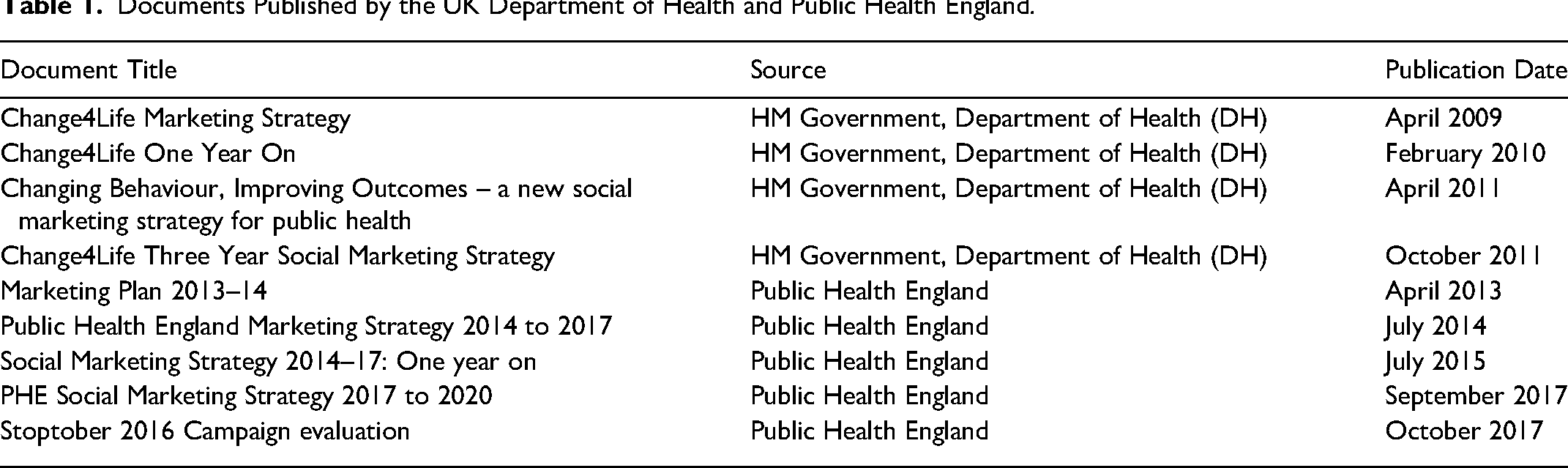
As a public body, documents played a central role in the activities of PHE and a total of nine publicly available documents relating to social marketing campaigns were identified as being published by PHE and the Department of Health between 2009 and 2017. All nine of these documents (listed in Table 1) were analysed as data sources in this study.
Documents Published by the UK Department of Health and Public Health England.
The advantages of analysing documents include: their richness, their relevance and effect, their natural occurrence, and their availability (Silverman 2014). Documents can provide a way of corroborating or challenging information received in interviews or from observation and they can also be a way of stimulating analytical ideas (Hammersley and Atkinson 2007). As with the observation notes, an initial analysis of the documents was undertaken to support the development of topics to be followed up in the interviews.
Face to Face Interviews
Interviews are a common research method in critical realist research, used for their ability to assist in identifying, describing and analysing the causal mechanisms related to the social phenomenon being studied (Perry, Riege, and Brown 1999), in this case the use of partnerships. Critical realists view interviews as a crucial method of research for theorising (Smith and Elgar 2014). The first author had unique access to potential research participants for this study from the PHE Marketing team, and specifically the Partnerships team, the Partnerships Agency that PHE employed and the Partners themselves. Participants were selected using purposive sampling to ensure interviews took place with people who had first-hand experience and knowledge of the partnerships created and maintained by PHE in their national social marketing campaigns. The first author approached twenty-one people with relevant experience and knowledge by email, explaining the purpose of the research and inviting them to participate. All twenty-one people took part in the interviews and consisted of seven people from the PHE Marketing Team, four people from the PHE Partnership Agency, five people representing five of the strategic partners identified by PHE, and five people representing five of the local authorities PHE worked closely with on the development of their national social marketing campaigns.
A topic guide for the interviews was developed from an initial analysis of the observation notes and the documentary evidence prior to conducting the interviews. The overarching research question (RQ1) guided decisions on the topics to explore further in the interviews. Example topics for the interviews included but were not limited to: why PHE created and maintained partnerships in their social marketing campaigns; how partnerships was defined by PHE; what the benefits and risks of partnerships were, both to PHE and the partner; how the aims of the partnerships were developed; how partnerships fitted within PHE's overall social marketing strategy; how the environment PHE operated in impacted the partnerships; how partnerships had changed over time; and how partnerships might evolve in the future.
Ethical Considerations
Ethics approval was obtained from both the PHE Research Ethics and Governance Group and The Open University Human Research Ethics Committee for the collection of data using all three research methods—participant observation, analysis of documents and face-to-face interviews. Informed consent was obtained from all the interview participants prior to the interviews taking place. Permission was also obtained for all the interviews to be recorded and for these recordings to be used for transcription and analysis.
However, informed consent was not obtained for the participant observation and, instead, using the first author's notes was seen as a form of covert research. The Open University and PHE were consulted with regards to the use of the first author's notes and approved their use in this study. The ESRC research ethics framework supports covert research “when it may provide unique forms of evidence that are crucial to the research objectives and methodology or where overt observation might alter the phenomenon being studied” (ESRC 2015, p. 31) as was the case in this research.
The purpose for incorporating a form of covert research was not to deceive people. There is a clear distinction between covert research and deception. According to Spicker (2011) deception occurs where the nature of a researcher's action is misrepresented to the research subject. This was not the case in this research and the potential issues of covert research were addressed including considering the rights of the research subjects, privacy, and the avoidance of harm.
The rationale for not obtaining informed consent for the participant observation was threefold. Firstly, it was felt disclosing the research was likely to affect the behaviour of the people attending the meetings and, as an employee of PHE, it was important for the first author that the meetings ran as normal, and the attendees behaved in their usual way. Secondly, from a practical perspective it would have been very difficult to ensure informed consent from every participant of the meetings. There were a large number of regular planned meetings involving both internal colleagues and representatives from external agencies. It was impossible to know who would be attending the meetings until they happened and asking each person to complete a consent form would have disrupted the meetings and potentially become the issue rather than focusing on the social marketing campaigns. In addition, there were many ad-hoc meetings, informal get-togethers, and discussions both internally and externally, and the first author would not have had the capacity to ensure that all the participants were fully informed. As Punch (1986, p. 36) notes “in a large organisation engaged in constant interaction with a considerable number of clients it is physically impossible to obtain consent from everyone and seeking it will kill many a research project stone dead”. Thirdly, there could have been an issue for PHE if people had been asked to complete a consent form and one or more of them declined. As these people were required to attend the meetings this could have made the research highly disruptive for the PHE Marketing team.
Data Analysis
Thematic analysis was used to analyse all data collected with Braun and Clarke's (2006) six-phase approach utilised as the framework. The entire data set was subjected to a series of coding and recoding analyses to develop a final shortlist of codes that were then refined to develop themes that could support the advancement of a greater understanding of the use of partnerships in national social marketing campaigns with the aim of developing insight to build knowledge. The purpose of this approach was to search for themes within the data that could provide “data-to-theory connections” (Gioia, Corley, and Hamilton 2012, p. 23).
Findings
PHE Saw Partnerships as a Core Component of Their Social Marketing Strategy
The first research question in this study (RQ1) asked—why are partnerships created and maintained to support national social marketing campaigns? The key finding based on multiple sources of empirical evidence from the case study research highlighted that PHE saw the concept of partnerships as a core component of their social marketing strategy for tackling complex social problems through the development of national campaigns. This is a significant finding as the review of social marketing literature found no reference to the concept of partnerships being considered strategic, with partnerships instead being presented as an additional “P” in the social marketing toolkit (Hastings and Domegan 2018; Kennedy 2016).
Systems theory, when applied in macro-social marketing, proposes that if one thing in the marketing system changes, this can bring about change in the rest of the system (Kennedy 2017), and recognises marketing systems as relational networks (Layton 2007). This study suggests PHE saw the concept of partnerships as providing the opportunity to bring about change in the marketing system of a social problem and, as such, adopted partnerships as strategy in their national social marketing campaigns.
The longitudinal approach to this research provided the opportunity to identify that PHE's (and the Department of Health's before them) thinking had evolved over time to reach this view of partnerships as a core component of social marketing strategy and this evolution of thinking was consistent across all five campaigns observed in this study. Three themes were identified in the data that were brought together to develop the key finding. These themes were—PHE viewed partnerships as integral to national social marketing campaigns; PHE believed partnerships provide an opportunity to effect a change in behaviour in the marketing system; PHE believed partnerships support a relational approach in social marketing and the creation of value through the exchange. The findings under these three themes are reported and evidenced in the subsections that follow.
PHE Viewed Partnerships as Integral to National Social Marketing Campaigns
PHE saw partnerships as a concept that was integral to their approach to social marketing. PHE developed and implemented social marketing campaigns at a national level, adopting a macro-level social marketing strategy to effect behaviour change in their target audiences that had partnerships at its very heart. This is evidenced in the interview data: “A realisation that actually partnerships needed to be at the core and was a strategic marketing tool as opposed to being on the fringes and a tactical marketing tool” (Interview 11). “I think PHE's strategic decision has been that partnerships are just as important as how you activate and also the strategy and planning function. So, it's an absolutely fundamental part of the future of how we're going to deliver things” (Interview 16).
When assessing the social problem to be tackled, PHE took a national, macro-level view, assessing the big picture and included partnerships in their initial situational analysis. PHE looked to understand the target audience for a particular problem/behaviour, the competition, the potential partners, what they as PHE could do as an organisation, and the wider environment/context that the problem sat within. At the outset, PHE analysed the context of the social problem they were looking to tackle and identified prospective partners who had the potential to change behaviour in the target audience. At a national (macro) level PHE engaged with national government departments, e.g., Department of Health, Department for Education, Department for Transport, to gain cross-government support for their social marketing campaigns. At an organisational (exo) level PHE created partnerships with national organisations, e.g., Disney, ASDA and Lloyds Pharmacy. At a community (meso) level PHE created partnerships with local organisations, e.g., Local Authorities, NHS Trusts, and schools. They also utilised the resources of national partners who had a community presence, e.g., local ASDA and Lloyds Pharmacy stores.
PHE recognised that the target audiences for their campaigns were more open to having a conversation about behavioural issues with partners than with PHE themselves or Government. Whilst PHE may have been seen by the target audience to be experts in the field of public health, they may not have been trusted enough by the target audience to be listened to. Partners, on the other hand, although they may not have been seen as experts, were trusted by the target audience and listened to. PHE believed that partners could effect behaviour change because they had trust and credibility with the target audience, as highlighted in the document data: “Our target audience may trust or engage with others more than us: while we are proud of the evidence base behind all the guidance we provide, we also recognise that many in our audiences trust others, whether that's friends and family, social media, faith leaders, charities or commercial brands, more than they trust government. Rather than fighting this, we work with it. We work in partnership to build coalitions for change” (Document 8).
PHE's approach to creating coalitions of partners when trying to tackle complex social problems was similar to that proposed by Bryant et al. (2014) who recommend social marketers create coalitions to support the development and implementation of community interventions. However, PHE's approach to coalitions appears to differ from Bryant et al. (2014) in that PHE interacted with their strategic partners individually, rather than the partners interacting with each other collectively. As such, PHE were the “focal actor” for change in their national social marketing campaigns in line with Luca, Hibbert, and McDonald's (2016) recommended community level approach.
PHE Believed Partnerships Provide an Opportunity to Effect a Change in Behaviour in a Marketing System
PHE saw the concept of partnerships as having a strategic role in social marketing because of the opportunity it provided to effect a change in behaviour of a marketing system. PHE's rationale for this was a belief that partners were actors in the marketing system and had an existing relationship with PHE's target audience. PHE did not have this type of relationship with their target audiences. This represents a different approach to social marketing strategy with regards to partnerships from that identified in the academic literature. This is highlighted by the observation, document and interview data: “Partners having a genuine capacity to effect and support behavioural change … partners being better placed than PHE to motivate behaviour change” (Observation notes). “Partners can reach the target audience and influence their behaviours in ways PHE cannot” and partners can “provide the right environment to support people in changing behaviour” (Document 8). “I think that's where partners are uniquely placed. They are present at those points of purchase, consumption, influence, behaviour change to actually support people, to nudge them, to support them in changing that behaviour in their community, in their workplace, in their school, you know, at their hospital bed, where we can’t be, or Public Health England and Department of Health can’t be” (Interview 11). “The way that you influence people, and their health is via the real brands that they reach and touch every day in their lives” (Interview 18).
PHE's strategic approach to partnerships was evidenced by a change which saw them create partnerships prior to the development of a national social marketing campaign rather than after a campaign had been created. This enabled partners to provide input into the campaign development from the beginning. An example of this approach was the “10 Minute Shake-Up” campaign co-created by PHE and Disney to encourage children to be more physically active, as part of the Change4Life programme. The 10 Minute Shake-Up campaign was co-created over a period of time using the knowledge and experience of both parties. PHE provided their knowledge of social marketing and physical activity, whilst Disney brought their experience of engaging children with fun activities. This co-creation approach is highlighted by the following statements taken from the document and interview data: “We worked with Disney to reinvent a range of ten-minute activity bursts (10-min shake ups), each themed around a Disney franchise. Together we successfully nudged over a million previously inactive children into an additional 100,000 min of physical activity as part of the 10-min shake up campaign” (Document 8). “Co-create more campaigns, particularly by working with “content” brands such as Disney that resonate with our target audience” (Document 8). “Actually, the partnership is really the key driver for the whole thing. So, it's a partner-driven campaign, as opposed to here's a campaign that's got partnership support” (Interview 18).
Luca, Hibbert, and McDonald (2015, p. 205) identified the need to engage with the target audience as “active participants” in social marketing by involving them in all stages of programme development. PHE's approach suggests a need to also see partners as active participants in the co-creation of social marketing programmes and for the creation of partnerships to take place before the start of any campaign development.
PHE Believed Partnerships Supported a Relational Approach in Social Marketing and the Creation of Value Through the Exchange
PHE implemented a relational approach to their national social marketing campaigns and believed partnerships were integral to this because the partners had an existing relationship with the target audience that PHE could harness to effect behaviour change. PHE believed partners could provide motivation to change behaviour, provide solutions into the hands of the target audience in the form of products and services, and could support the target audience through the journey of behaviour change.
There were two aspects to PHE's relational approach to social marketing—the relationship between the partner and PHE's target audience, and the relationship between PHE and the partner. The findings highlighted the importance of trust, both between the partner and the target audience and between PHE and the partner. The opportunity provided by partnerships to support a relational approach with the target audience is evidenced in the interview and document data: “Leveraging the positive relationship that those brands or organisations have with our target audience, using the trust and the credibility that they can provide, to interpret a behaviour change message in their own words through points in time that are highly relevant to getting people to take that action” (Interview 5). “Commercial brands often have trusting relationships with our key target audiences and can reach them in ways that we cannot” (Document 4).
Trust has been identified as a key factor in Relationship Marketing (Morgan and Hunt 1994) and is also required in social marketing to gain permission to broach difficult subjects with the target audience and gain the commitment required from them to change behaviour (Duane 2012). PHE believed partnerships could provide access to existing relationships and trust with the target audience to support behaviour change in their national social marketing campaigns.
With regards to the partnerships themselves, PHE's relational approach involved the use of Memorandums of Understanding (MOUs) with partners rather than having formal contractual agreements. The MOUs were not legally binding contracts but informal agreements, as highlighted in the interview data: “There are certain things you would need to put in place, in particular, where you’re working with strategic partners, to protect both partners. So, there is often something like a terms of engagement or memorandum of understanding that sets out a gentlemen's agreement. It's not a legally binding document, but it sets out some principles that both parties will work to” (Interview 19) “Creating an MOU which is proportionate, but which has got the right kind of information in there” (Interview 5)
The absence of contractual arrangements with partners suggests trust was implicit in PHE's approach to partnerships. The importance of trust has been recognised in social marketing partnerships (Duane and Domegan 2019) and it appears PHE's relational approach to social marketing involved trusting partners from the beginning of their relationship.
PHE's partnerships approach involved a complex exchange between PHE, a partner and the target audience. In this complex exchange, value needed to be created and delivered to all parties. PHE aimed to create value for their partners, for example through association with a positive health campaign, who in turn created and delivered value to the target audience, for example through products or services that supported making a positive behaviour change. In return PHE received value from their partners, for example through providing the direct relationship to the target audience. PHE also created value for and received value from their target audience, for example PHE created an environment that was conducive to behaviour change and the target audience attempted to change their behaviour. This is visualised in Figure 2 below.
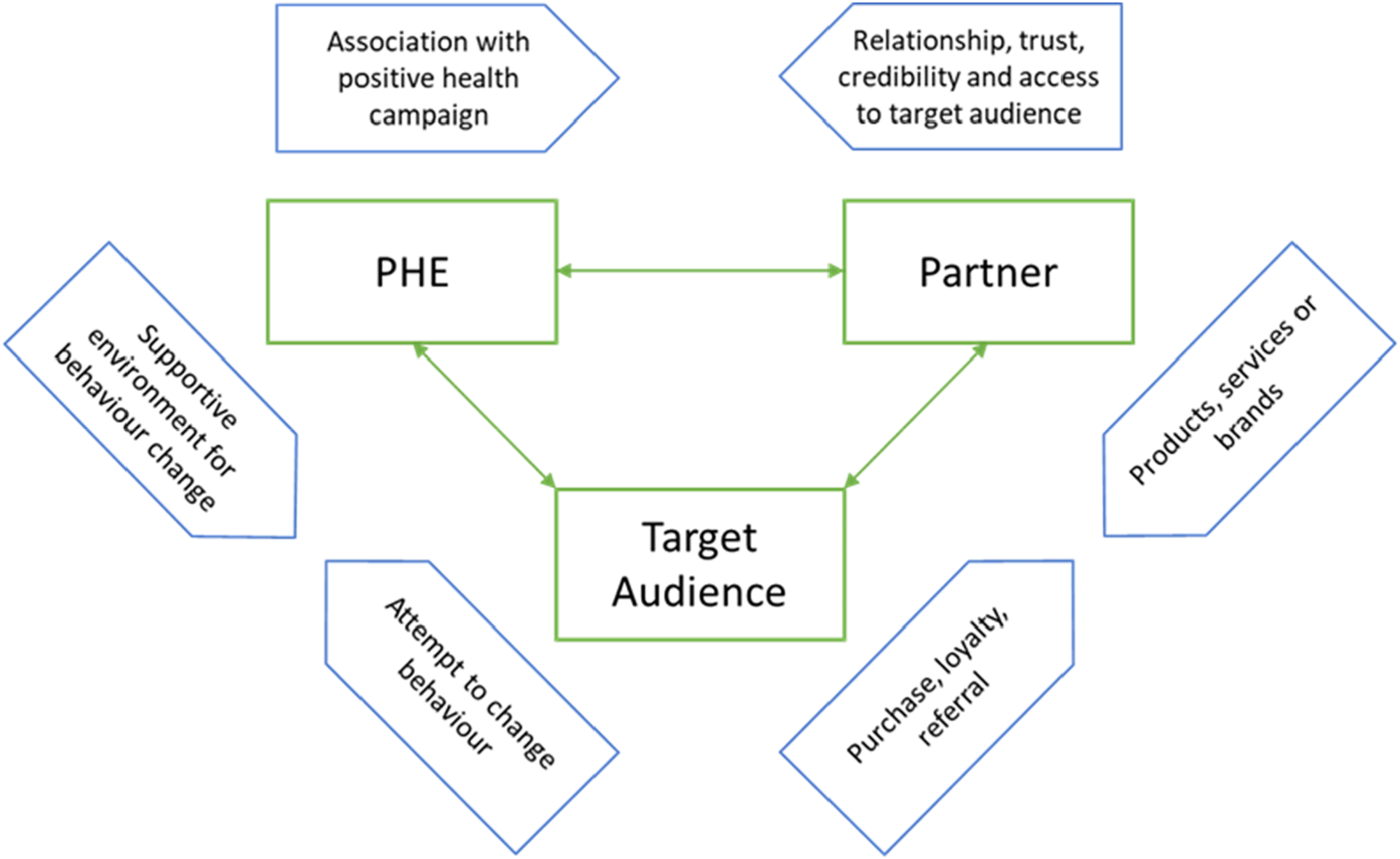
The Complex Exchange in the Relational Approach to Social Marketing Taken by PHE.
PHE saw partnerships as providing the opportunity to create value in an exchange with the target audience as partners had knowledge and experience of developing products, services and brands that support the creation of value for their customers and themselves. However, this involved PHE relinquishing some control and providing agency to partners. Partnerships also offered PHE an opportunity to gain access to their target audience, either physical or virtual, as partners had existing customers/clients who made up the target audience for PHE's campaigns. This access could be at a critical point for behaviour change, for example, at point of influence, decision making or purchase. This is evidenced in the document data: “Work with partners who are already engaging with our audiences to mould programmes around the rhythm of their lives rather than seeking to persuade people to change their behaviour at points that fit in with campaigns” (Document 8).
This links to the social marketing literature that suggests social marketers need to create value for their target audiences to effect a change in behaviour (French and Gordon 2015) and that value can be “co-created” (Lefebvre 2012). PHE's approach to partnerships is in line with the work of Luca, Hibbert, and McDonald (2015, 2016) who propose that in social marketing value needs to be co-created with customers. However, the literature does not specifically reference partnerships as providing the opportunity to create or co-create value in social marketing. Again, the findings suggest PHE were doing something that is not recognised in the social marketing literature.
How PHE Defined Partnerships Reflected Their Change to a Core Component of PHE's Social Marketing Strategy
The second research question in this study (RQ2) asked – how might partnerships be defined by an executive government agency in their national social marketing campaigns? The findings demonstrated that PHE had not defined their concept of partnerships as a core component of national social marketing strategy and, in addition, had no agreed definition of what partnerships was in relation to their national social marketing campaigns. The reason for this could be that the definition of partnerships had not been static but had changed as the rationale behind why partnerships were created in social marketing had changed. The absence of an agreed definition of partnerships at PHE is consistent with the review of social marketing literature in this study where no standard definition was identified (Duane 2012).
However, the interview data demonstrated changes in how the concept of partnerships was viewed at PHE and these are reflected in changes to how partnerships are referred to and so defined. Example responses included: “The definition of partnerships is something that very much evolves and has evolved since I've been in post” (Interview 17). “It's [the definition] changed quite a bit over the years” (Interview 5). “So, I would say a partnership is a collaboration between two organisations, where there is shared objectives. Or there is a mutual benefit created for both parties” (Interview 1). “What underpins them all is having some shared objectives that each side is working toward” (Interview 14). “It's a mutually beneficial strategic relationship between organisations, as opposed to being, you know, a tactical relationship between one campaign team and another campaign team to execute a particular campaign” (Interview 11).
These findings appear consistent with Truong and Hall's (2017) view of PPPs in social marketing where there is a need for mutual agreement on shared objectives. However, the findings also identify mutual benefit as a factor in PHE's approach to partnerships.
Discussion
Partnerships as Strategy in Macro-Social Marketing
This study of PHE proposes the idea of partnerships as strategy that can provide an opportunity to effect change, both behavioural and societal, within a marketing system. Partnerships as a concept has a role to play in the development of relationships and in the co-creation of value in macro-social marketing. As such, partnerships can be seen as a strategic component of macro-social marketing and a key part of the overall social marketing system.
We formalise this contribution to theory by proposing partnerships extend beyond a tactical tool to a core component of strategic planning in addressing social problems. When partnerships are integrated into macro-social marketing strategies, they enhance the capacity of the national government to address complex social issues through long-term development and production of solutions. In addition, we propose partnerships involve a more strategic, systems-oriented approach to behaviour change. A systems-oriented approach enables a focus on the relationships and interactions between a range of actors salient to delivering behaviour change.
This idea of partnerships as strategy in macro-social marketing brings together the marketing systems and partnerships literature to build on the current social marketing literature. The systems approach to macro-social marketing suggests a greater role for partnerships than is currently presented in the social marketing literature. Furthermore, a strategic role for partnerships in social marketing which recognises the importance of relationships between actors in the marketing system and identifies that change in a marketing system requires “collective action” (Kadirov 2018, p. 279) is also consistent with the importance of a relational approach in macro-social marketing proposed by Duane, Domegan, and Bunting (2022).
Whilst the increased importance of partnerships as one of the ‘Ps’ in the social marketing mix is recognised in the social marketing literature, it appears that partnerships have only been seen as having a role as part of the social marketing mix, i.e., partnerships have been viewed as created after a campaign has been developed. The strategic nature of partnerships as a concept does not appear to have been considered in the literature and the possibility of partnerships as a social marketing strategy to effect behaviour change within a marketing system has not been explored. Casadesus-Masanell and Ricart (2010) argue that tactics can only vary within a given business model, whereas a strategy is the ‘contingent plan as to what business model is to be used’ (Casadesus-Masanell and Ricart 2010, p. 203). In the case of PHE, the concept of partnerships as strategy provided an opportunity to effect behaviour change in a marketing system.
The macro-social marketing literature highlights that it is relationships which bring about transactions in the marketing system (Arndt 1986) and, to effect change in a marketing system, interventions require focus on the interconnected entities within the marketing system that the social problem is a part of (Domegan 2008; Kennedy and Parsons 2012). Our research highlights that seeing partnerships as integral to macro-social marketing strategy provides an opportunity for social marketers to form relationships with actors in the marketing system and to influence social change. Furthermore, our research reveals that the concept of partnerships as strategy involves creating partnerships before the development of social marketing campaigns and co-creating value with partners by involving them as “active participants” (Luca, Hibbert, and McDonald 2015, p. 205) through all stages of campaign development.
The findings also suggest PHE's view of social marketing was in line with the model of macro-social marketing visualised by Gordon et al. (2018) (see Figure 1) and PHE's approach to tackling complex social problems, such as obesity, appeared to conform with the marketing systems view identified in the literature (French and Gordon 2015; Hastings and Domegan 2018). PHE appeared to take a macro-level approach to developing an understanding of social problems by considering and analysing the impact of the wider environment and the actors within the different levels and their influence on the behaviour of individuals in the target audience.
Gordon et al.'s (2018) model of the social marketing system is adapted in Figure 3 to visualise PHE's approach to partnerships as a component of their social marketing strategy, identified in our research. At the centre of PHE's approach was the Individual that represented the target audience whose behaviour the strategy aimed to change. PHE then analysed the context of the social problem at the macro (national), exo (organisational), meso (community) and micro (individual) levels to identify actors within each level that had potential to influence the behaviour of the target audience. By looking at the context of the social problem PHE aimed to create partnerships that could effect behaviour change at all levels. This builds on Gordon et al.'s (2018) work by proposing that partnerships can be created at different levels of the marketing system to support change within the system and ultimately behaviour change at the individual level. To achieve this, the concept of partnerships needs to be seen as a core component of social marketing strategy rather than simply a tactical tool in the social marketing mix.
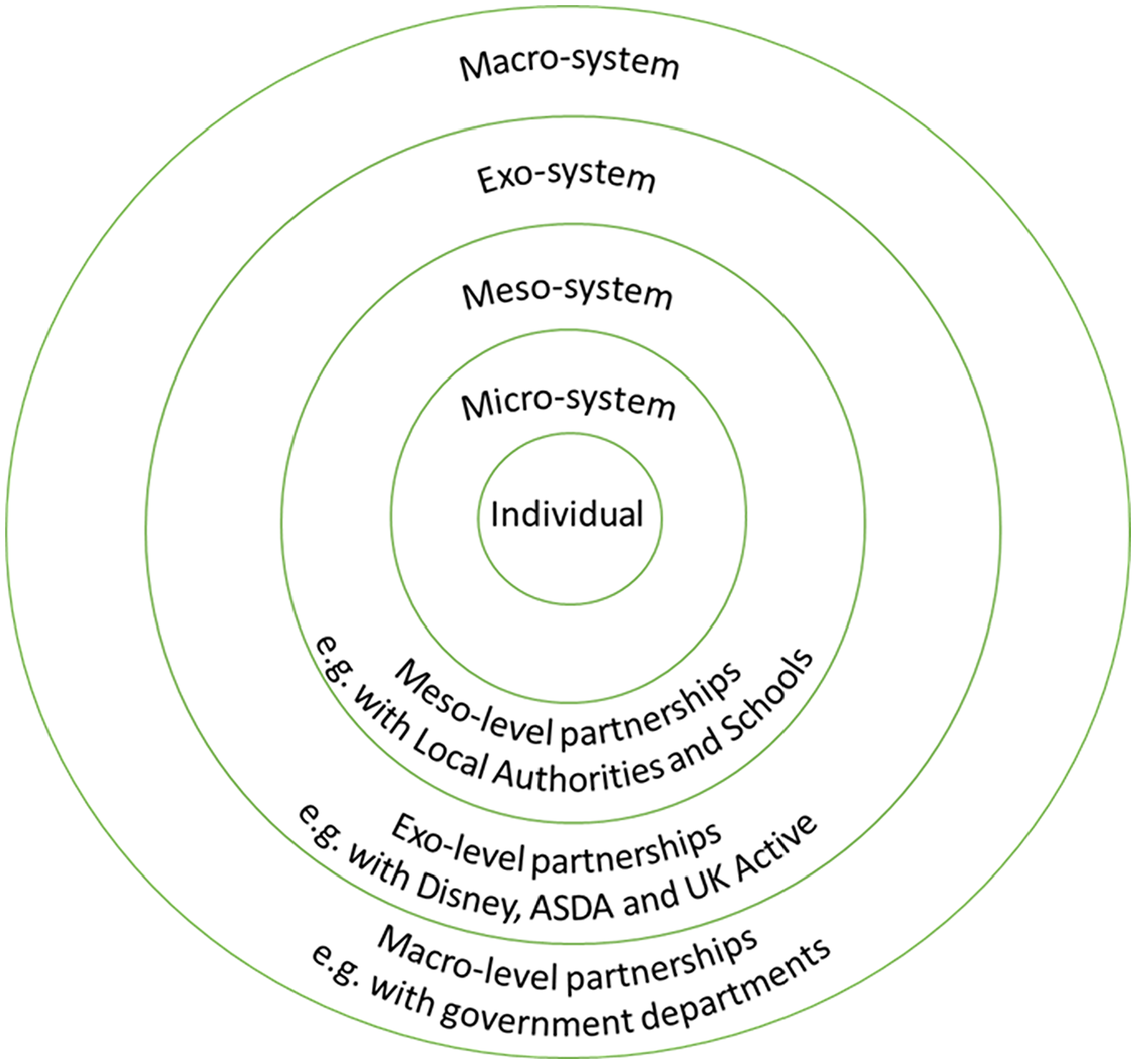
PHE's Approach to Partnerships as a Strategic Component of a Social Marketing System.
The proposed model above, based on the findings from multiple sources of empirical evidence in this research, illustrates how partnerships were integral to PHE's social marketing strategy. Partnerships were created at national (macro), organisational (exo), and community (meso) levels to support change within the social marketing system and in the behaviour of the target audience. At the macro level, national government departments can effect a change in policy that will have impact on all levels of the marketing system and can help provide a supportive environment for behaviour change. PHE's social marketing strategy was to create partnerships with the key government departments that could effect this change. For example, PHE worked in partnership with the Department of Education to develop and implement a Change4Life schools’ programme. At the exo level, the practices of organisations have the opportunity to effect change in the marketing system. PHE created partnerships with organisations that could support change in the system through the development and promotion of products and services to the target audience including their own employees. For example, PHE developed a strategic partnership with Disney to co-create activities to encourage children to be more physically active. At the meso level, local government is instrumental in creating a supportive environment for change in their communities. PHE's social marketing strategy was to create partnerships with local authorities to co-create services. For example, PHE partnered with several local authorities to co-brand some of their services for children with Change4Life and their services to adults with One You.
Defining the Concept of Partnerships as Strategy and the Implications for the Definition of Social Marketing
A further contribution of this paper is to propose definitions of the concept of partnerships as strategy in macro-social marketing plus the strategic and signposting partnerships PHE created and maintained:
The two types of partnership created by PHE appear to have similarities with two of the four structures of PPP identified by Truong and Hall (2017). PHE's strategic partnerships, which are long-term relationships with shared objectives set out in a Memorandum of Understanding (MOU), align with Truong and Hall's (2017) “Co-Production” PPPs, which have a partnership agreement and high degree of cooperation. PHE's signposting partnerships, which are short-term, tactical relationships, correspond to Truong and Hall's “Association” PPPs, where one organisation is permitted to associate itself with another organisation's behaviour change programme.
PHE did not have formal contractual agreements with their partners and instead had less formal MOUs. The absence of contracts suggests trust was implicit in PHE's approach to partnerships. Trust has been highlighted as a key factor in relationship marketing (Hastings 2003) and the relational approach required in macro-social marketing (Duane, Domegan, and Bunting 2022). Trust is also key to successful social marketing partnerships (Duane and Domegan 2019). Implementing partnerships as strategy in macro-social marketing requires an ethos that places trust in partners from the outset.
This paper proposes partnerships as integral to macro-social marketing strategy and reflects this view by suggesting that when strategic partnerships are involved, the International Social Marketing Association's definition of social marketing may be adapted to recognise partnerships as a concept rather than simply referring to ‘partnership insight’ as follows: “Social marketing seeks to develop and integrate marketing concepts with other approaches to influence behaviours that benefit individuals and communities for the greater social good. Social marketing practice is guided by ethical principles. It seeks to integrate research, best practice, theory,
Limitations
Case study research has limitations and in this study all data were collected from a single case, PHE, whose view of social marketing and partnerships was historically inherited from the Department of Health. Whilst the research approach enabled a unique and in-depth investigation into the selected case, this case does not represent a “sample” and the findings are not intended for generalisation to a population. However, gaining a greater understanding of the use of partnerships by PHE could support the work of social marketing practitioners. Furthermore, the limitation of studying a single case was mitigated by the collection of data over a period of five years during which time five national social marketing campaigns involving partnerships were observed. Although critical realists accept that there is a risk of potential bias from being a researcher in the field, a reflexive approach was adopted throughout the research process to mitigate this limitation.
Conclusion
This paper proposes a new way of thinking about partnerships in macro-social marketing and, as such, provides a theoretical contribution that includes both original insight and practical utility. Partnerships can be viewed holistically as a strategic concept in social marketing. As a concept, partnerships can play a strategic role in the long-term development and delivery of solutions to tackle complex social problems at a national level. This empirical study reveals that partnerships can be a core component of macro-social marketing strategy and provide the opportunity to effect a change in behaviour within the marketing system. The social marketing literature currently positions partnerships as part of the intervention mix and, as such, a marketing tactic that is only considered once a campaign has been developed. This study reveals the concept of partnerships as strategy in macro-social marketing and, therefore, partnerships need to be considered at the start of any intervention development. This paper makes further contributions by defining partnerships as strategy in social marketing, defining strategic and signposting partnerships, and proposing an adapted definition of social marketing.
Footnotes
Associate Editor
Anne-Marie Kennedy and M. Joseph Sirgy
Declaration of Conflicting Interests
The authors declared no potential conflicts of interest with respect to the research, authorship, and/or publication of this article.
Funding
The authors received no financial support for the research, authorship, and/or publication of this article.
