



Abstract
In order to prepare students for the macro-level complexities of today's marketplace, educators need to foster deep and consistent critical thinking and problem-solving skills. Beyond a narrow focus on technical competence in their area of interest, this calls for challenging students to dissect and analyze scenarios that have no simple solutions. We propose a pedagogical approach that supports these goals by employing a scaffolded use of controversy statements. Building from discussion, to an active and measured use of debates, and, finally, to collaborative dialogue provides the opportunity for deeper and more inclusive understanding of society's challenges and the potential responses to them. We call this the “three D's of controversies” (D3C) approach, and provide an example of how it can be used in marketing classrooms.
Introduction
Macromarketing focuses on societal issues, including the impact of marketing on society, society on marketing, and the broader systems in which marketing operates. Such a focus denotes a certain amount of “messiness,” where issues are seldom fully understood and where there is rarely – if ever – a unanimous agreement on an issue's cause and effect. Indeed, scholars who acknowledge such complexities suggest that only when multiple views and values are incorporated might a reasonable path forward be found (Pittz, Steiner, and Pennington 2020).
At the same time, as college graduates enter the workforce, employers increasingly point to concerns that graduates lack critical thinking and problem-solving skills, even when technically competent in their area of focus (Rose and Flateby 2022). A recent hire's ability to confidently challenge existing practices and assumptions is considered imperative given the increase in responsibilities that are often part of the new hire's role. As advocated by management professionals in the Rose and Flateby (2022) study, college students need to be challenged with more complicated business scenarios to dissect and analyze, especially those without single solutions, so that critical thinking skills are more explicitly developed. However, whether instructors have adequately incorporated the development of critical thinking skills into their pedagogy is a lingering question (Plummer et al. 2022), and one which requires attention to the pedagogical tools likely to support that development.
Given these challenges and associated goals, coupled with calls by accreditation boards, marketing educators are increasingly looking for tools in the classroom that encourage a diversity of thought and outcomes, with the goal of developing critical thinking and problem-solving skills. As macromarketers specifically, we aim to equip our students to think about complex, systemic challenges, and we recognize that there are rarely simple answers to wicked problems. Accordingly, we also acknowledge that training students how to think and grapple with these complexities will require pedagogy beyond the lecture-based format. We cannot impart to students the “right” answers for tomorrow's questions; they need to be prepared to confront those challenges themselves. To provide them with this ability, we therefore need to foster student understanding of the complexities of problems faced by businesses and the means by which to manage the conflicting factors that inherently shape them.
To this end, we offer guidance on an approach that permits a broader, more inclusive framing of society's challenges and aims to prepare students to confront them. Specifically, we contend that an approach that integrates controversies is a valuable, yet underutilized, option. We propose a scaffolded approach to the use of controversy statements, where the scaffolding purposefully builds from a discussion orientation, to the use of debates to, finally, a collaborative dialogue approach. We call this the “three D's of controversies” (D3C) approach, and suggest that it can be used in any marketing course.
In what follows, first, we start by describing the approach of using “controversy statements” in the classroom. Then, we differentiate between three different uses of controversy statements with varied pedagogical tools. We follow this with a description of the D3C approach as introduced above. Each scaffolded level offers its own pedagogical power, but, in combination, they equip students to generate both a broad appreciation for diverse views, and a range of possible solutions to complex issues. Finally, we introduce an example that can be used in the marketing classroom.
Controversy Statements
The use of controversies in marketing education has been advocated by macromarketers (Watson et al. 2022; Shapiro 2008; Shapiro et al. 2021). The dictionary tells us that controversies are defined in part as “expressions[s] of opposing views” (Merriam-Webster 2023, n.p.). Controversies are focused on topics that lack consensus and ones that provoke differing views and priorities (Jacobs 2010). Such topics can be diverse and complex, while still representing what most would consider pressing societal matters. Examples include the tensions around the use of non-renewable energy sources, the regulation of organic or fairly traded products, and the use of single- or few-use items (e.g., fast fashion, plastic bags), among many others.
Traditionally, the controversy approach for sparking student thinking about complex problems involves providing a relevant compelling “statement” followed by a structured exercise that requires students to take and justify a position related to that statement. These statements can capture either broad theoretical topics or even very specific industry or product level issues. An example of a broad controversy posed in marketing classrooms could be “All stakeholders [are / are not] the social responsibility of business” or “Companies [are / are not] responsible for the after-market use of their products” while an example of a more specific topic could include “The integration of drones in delivery of purchased products [is / is not] beneficial” (Watson et al. 2022) or “All coffee [should / should not] be Fair Trade certified”. While these statements are posed in a yes/no framing (by employing the word “not”), other sentences could be solely positive or negative in construction, such as “All social media advertising should be banned”.
Controversy statements can be created from marketing education materials (e.g., textbooks) or industry resources (e.g., Intelligence Squared), by students themselves (e.g., as a course exercise), or even by generative artificial intelligence (AI) (e.g., ChatGPT). For example, we asked OpenAI's ChatGPT 3.5, to provide us with three controversy statements that could be used in the marketing classroom in the format “All coffee should [not] be Fair Trade certified” and it produced these suggestions:
All marketing should [not] prioritize social responsibility over profits. All advertising to children should [not] be banned. All customer data should [not] be freely accessible to businesses for personalized marketing. (Note: [not] was added to the text provided by ChatGPT).
Importantly, choosing topics that are personally relevant to the students (e.g., online surveillance of social media use) may increase student interest (Watson et al. 2022).
Sub-Approach #1: Controversy Statements – the Discussion Approach
Controversy statements can be used in a variety of ways in the marketing classroom. One of the most direct methods is to include them during in-class exercises by briefly posing a question and polling students on their for-or-against opinions by a show of hands or electronic poll. Another efficient approach could be to ask students to quickly brainstorm some salient aspects on the topic as a class or in pairs. For example, Watson et al. (2022) used online breakout rooms to have students talk about a controversy in a virtual classroom, and a similar approach could be used in a physical classroom. Students can also be encouraged to present their viewpoints in unique ways that go beyond simply speaking about them, and instead include creating role plays, songs, visuals (Cohen 1994), written submissions, and videos (Watson et al. 2022). Using live, online brainstorm tools (which can also be accessed in the physical classroom by way of a QR code, for example) and Post-It notes, even anonymously, allows a way for students to share their voice.
Other perspectives on the controversy statements can be brought into the classroom discussion, such as from guest lecturers or by showing short (e.g., four minutes or less) videos. Regarding the latter, snippets of TedTalks or news coverage on particular topics can be readily found on video content platforms such as YouTube and Vimeo. Alternatively, instructors could prepare responses based on statements from industry figures, such as summaries given by the CEO in an annual report or their responses to interview questions in the trade press. These summaries could be shared with the students and reflected upon.
Whichever approach is used, introducing controversy statements that pertain to course topics has the potential to provide students with a broader understanding of the context of marketing practice than is traditionally included in a class lecture, and thereby foster meaningful discussion about complex subjects.
Sub-Approach #2: Controversy Statements – the Debate Approach
To further enhance the value of controversy statements, they can also be incorporated as part of a traditional debate in business classrooms, where individuals or groups can be asked to take and defend a position on a topic (Shapiro et al. 2021), and then judged on their ability to present a position effectively (Chikeleze, Johnson, and Gibson 2018; Johnson and Johnson 1985). Traditional debates can be beneficial, especially when structured debates are used, as they can facilitate students talking about diverse topics (Fallahi and Haney 2007). Another strength of the debate paradigm is that students are stretched to defend their thinking against challenges; it trains students how to recognize flaws and weaknesses in different positions, including their own.
Debate-related exercises may take place in or outside the classroom, with students, either individually or in groups, required to do a deep-dive in their respective side of the topic, and then provide a report, online discussion post, and/or presentation (in-class or recorded) of what is uncovered. For example, Shapiro et al. (2021) detailed how students could engage in detailed research outside of class on the controversy topic, pursuing an understanding of the harms and benefits for affected stakeholders, with formal debates (e.g., group or individual presentations followed by timed spoken rebuttals) then taking place in the classroom. Final exams can also bring in a controversy statement, asking students to elaborate, defend, and explain the various “sides” of the issue in a written format. Further, generative AI, such as ChatGPT, could provide an artificial debate partner for students who could be asked to communicate with and respond to an AI-generated response regarding a controversy statement, asking the generative AI to take the alternative side.
Sub-Approach #3: the “Academic Controversies” Approach
While the debate approach provides increased opportunity to understand the complexities inherent to controversies, there are some limitations which should be addressed. Debate has been critiqued as contributing to the entrenching of one's own position and feeding polarization (Hyde and Bineham 2000). Debate can also create negative interactions, wherein one group tries to dominate other groups through, for example, hoarding information (Jacobs 2010). Because individuals invest themselves in defending a position, debates may result in the belittling of the other people involved. As the winners of a debate are often assessed on how well they have argued their position (Johnson and Johnson 1985), debate can therefore push participants to think in terms of one right answer, with distinct winners and losers. The same concern exists when using polls and similar tools in classroom exercises. To overcome these drawbacks, a different approach may be needed, that of the “academic controversies” approach.
As described in Jacobs (2010), the academic controversy approach, pioneered by David and Roger Jonson, involves a “cooperative form of debate” (n.p.). It is, following a traditional debate approach, first focused on students preparing their “side” of a controversial topic, presenting their view, and engaging in rebuttal and defense of their position. Then, the approach differs from that of debate, where students can be asked to exchange positions and redo the exercise from the opposite perspective, ultimately seeking to “forge a common position” (n.p.) from the previous two positions (or additional views) (Jacobs 2010). A key component of the “academic controversies” approach, therefore, is that it encourages students to adjust their position through incorporating new information and reasoning (Johnson and Johnson 1985). In other words, “academic controversies” get students to “work together to address the real-world issues that arose in the debate” (p. 295) by attempting to reach a consensus (Jacobs 2010). This approach therefore forces the students to endeavor to arrive at a common position toward addressing the issues; if no such consensus is possible, a next best outcome could be to present the different views/solutions (Jacobs 2010). In this way, the approach (e.g., Johnson, Johnson, and Smith 1996) goes further than a traditional debate, where the focus is not on “winning or losing,” but rather on cultivating deep understanding of complex topics.
In contrast to the traditional debate approach, the academic controversies approach was found to increase information search, support peer sharing of information, encourage changing of viewpoints, and improve the involvement of otherwise excluded group members (Johnson and Johnson 1985). Benefits of using an academic controversy approach in general may include contributing to the creation of novel ideas (Johnson, Johnson, and Tjosvold 2006), encouraging research (Johnson and Johnson 1994), enhancing intrinsic motivation, prompting cooperation, avoiding information hoarding (Jacobs 2010), managing conflict (Tjosvold 2006), and increasing tolerance for ambiguity (Budner 1962).
Toward successfully employing an academic controversy-based approach, Jacobs (2010) argued that such a process is best served by creating heterogenous groups, where instructors can encourage balanced student involvement through, for example, setting time limits on contributions (e.g., a clock or the speaker holding a particular object), asking students to prepare something written or visual (e.g., a mind map) in advance, and encouraging group bonding (e.g., using a team name).
While the seminal work on “academic controversies” did not equate the approach to dialogue, some similarities are evident. Dialogue, being a collaborative approach, is when participants seek to come to a common understanding and, eventually, to problem resolution. With dialogue, students take turns sharing their ideas while also understanding the ideas of others (Wells 2007). Eventually, through this process, “knowledge is constructed between speakers, rather than being transmitted from one to the other” (Rapanta and Felton 2022, p. 479). Thus, the academic controversies approach can be enriched by specifying what is entailed at varying “levels” of applying controversies in the classroom, thereby providing more guidance to professors in how to manage their marketing classrooms. We suggest the D3C Approach as a way forward.
The D3C Approach
Our contention is that the 3Ds of discussion, debate, and dialogue can enable instructors to further scaffold their students’ learning when using controversies in marketing education. As a pedagogical framework (summarized by Nagda et al. 2008), the use of the 3Ds can be valuable for engaging with macromarketing concerns. Discussion encourages participants to voice different opinions to recognize more facets of an issue. Debate is an oppositional approach, where two sides oppose each other in an attempt to prove each other wrong. Dialogue, finally, is collaborative, where two or more sides work together toward common understanding and problem resolution. The goals vary, from voicing the most perspectives (discussion) to winning (debate) to finding common ground (dialogue). A summary is provided in Table 1. Taken together, we propose that a scaffolded approach to the use of controversy statements, building from a discussion orientation to the use of debates to, finally, a collaborative dialogue approach, achieves improved learning outcomes and deeper understanding of macromarketing concerns. We call this the “three D's of controversies” (D3C) approach.
Classroom Communication Paradigms: 3Ds.
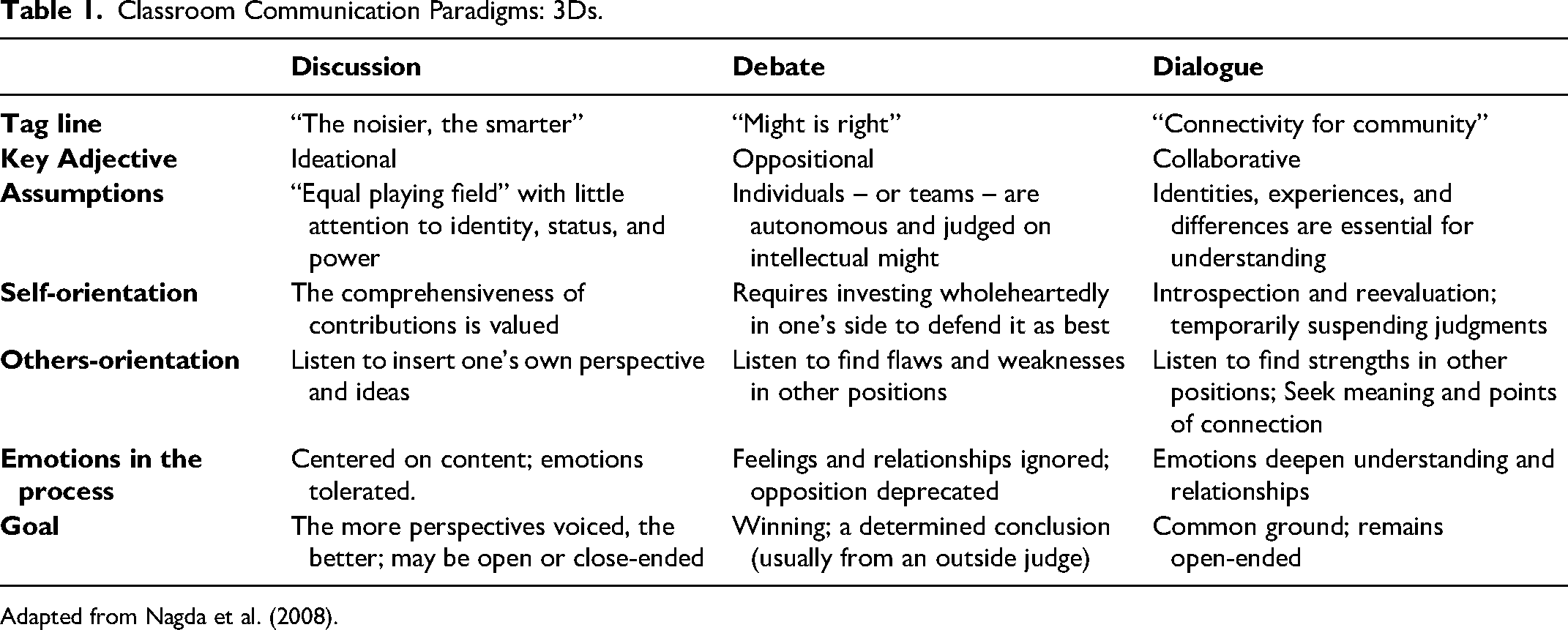
Adapted from Nagda et al. (2008).
As introduced above, controversy statements can be employed in a way that merely encourages the D of discussions (sub-approach #1) or leads principally to the D of debate (sub-approach #2) or aligns with the D of dialogue (sub-approach #3). We contend that all three aspects are likely needed to effectively move the students through an academic controversy process in a structured way from initial discussions, to the debate of opposing sides, toward the ultimate goal of coming to a shared dialogue and assessment of the issues and potential solutions.
Each of the 3Ds – and their employment in controversies – can serve important roles, if used purposefully. For example, discussion can be a starting point for getting students thinking about the different facets of an issue, drawing on their personal experiences and knowledge. Generating a more comprehensive list of stakeholders, for example, can help students see the issue through a more realistic lens. A debate approach might prepare students for opposition in the public arena, as students practice defending different positions. Their work to prepare specific arguments and counter-arguments helps to cement the complexities inherent to the issue. Dialogue can be vital to enable students to work together to a holistic shared understanding. For example, past work has explored how improvisational theater has been used in businesses classes in a way that supports – rather than dismisses or criticizes (e.g., Rajeev and Kalpathi 2016) – individual views. The “yes, and…” approach is predicated on accepting and seeking to build up what was previously said. By collaborating on identifying priorities, trade-offs and unintended outcomes of action, the students reach a stronger solutions-oriented understanding.
In particular, Hyde and Bineham (2000) advocate the purposeful movement from debate to dialogue: “Dialogue is non-polarized discourse. Its dynamic is not oppositional, but collaborative. Its proposed outcome is not the ascendance of one perspective over another, but the fusion of all perspectives to enable a larger, more inclusive view, one which allows the tension of disagreement” (p. 212). In other words, seeking a holistic “meeting of the minds” is a goal, and we suggest that it be encouraged in purposeful contrast to what is achieved in the discussion and debate approaches. Given the power of controversies to represent macromarketing issues, and the value in scaffolding student learning through the use of discussion, debate and dialogue, we call for regular use of the D3C approach in marketing education.
Sample Exercise for the D3C Approach
To provide a more detailed example of how each of the 3Ds can influence the value of an academic controversy approach, we share here an approach that includes the United Nations’ Sustainable Development Goals (SDGs). Specifically, since SDG #12 (“Responsible Consumption & Production”) offers fertile grounds for seeing complexities associated with marketing systems, we use that as the basis for developing students’ critical thinking skills in a marketing course. The steps involved are the following:
SDG #12 is
Students then generate their own controversy statements (amplifying student commitment to and interest in the statements) around key issues that comes up in the discussion. The class then votes on which statement they wish to use for subsequent analysis. Students then self-select onto a “side” of the chosen controversy statement, moving into groups organized by that self-selection. However, in a “bait and switch” moment, they are instead assigned to the opposite side of the controversy. This action facilitates their ability to appreciate both sides as a result, challenging their preconceptions. A formal
Equipped in this way with contentions for a side that they did not choose to support initially, the students can then be brought into a collaborative
This scaffolded approach to the 3Ds – discussion, then debate, followed by dialogue – in the context of academic controversies can be applied for other topics besides the United Nations’ SDGs and in a wide variety of marketing courses, with appropriate adjustments for contexts. For example, this approach can be used in specialized courses such as Ethical Issues in Marketing, Global Marketing, or Digital Marketing, but also in the more general Marketing Strategy and Marketing Fundamentals courses. What is key is that students recognize their own power in developing solutions that purposefully incorporate a variety of views and an appreciation of the issue at hand.
Conclusion
While there are many ways to engage students in complex macromarketing issues, pedagogical approaches that enhance their ability to consider multiple perspectives and utilize them to identify a range of possible actions will provide lasting value. Not only are such approaches helpful for illustrating to students how markets frequently present these challenges, but they equip students to be the critical thinkers that employers and governments are seeking.
As educators, we have the responsibility to foster the development of these skills as often as practical. While some instructors “avoid discussions of controversial issues in their classrooms altogether for fear of alienating students and discouraging shy or less verbal students” (Fallahi and Haney 2007, p. 83), this represents a missed opportunity. Our scaffolded approach – from simple discussion of controversies, to organized debate on controversy statements, to academic controversies focused on dialogue and resolution (the integrated D3C approach) – offers a path forward.
Footnotes
Associate Editor
M. Joseph Sirgy
Declaration of Conflicting Interests
The authors declared no potential conflicts of interest with respect to the research, authorship, and/or publication of this article.
Funding
The authors received no financial support for the research, authorship, and/or publication of this article.
