




Abstract
In this article, we argue that Layton's Marketing Systems approach is important to tackle the triple-bottom-line (TBL) of economic, social, and environmental challenges holistically. We discuss how this system approach can contribute to designing effective marketing interfaces for a more sustainable circular economy (CE). Marketing has a legacy of understanding and increasing consumption, but it is also an essential element to drive toward a more sustainable society, as demonstrated by cases on eco-communities and sustainable food marketing systems. The article concludes by encouraging (Marketing) scholars to utilize Layton's work on multi-level systems to its fullest potential to address the pressing TBL challenge and contribute to the Sustainable Development Goal (SDG) missions in a holistic way.
Keywords
“It's relatively easy to make a prototype but extremely difficult to mass manufacture a vehicle reliably at scale. For cars, it's maybe 100 times harder to design the manufacturing system than the car itself.”
Introduction
Although the above quote is about the design of a manufacturing system, the general notion of the need for a more holistic system approach has been growing in Business Schools in general, and in the field of Marketing by the work of Roger Layton in particular. Interestingly, one of the earlier studies of Roger Layton was on Australian manufacturing capabilities (Layton and Dunphy, 1970), showing his broader interest beyond Marketing and his confidence in crossing disciplinary boundaries early. In Roger Layton's case, this work deviated from his early work on data analytics as published in prestigious journals such as the Journal of Marketing Research (Layton 1967, 1968).
Roger Layton is one of the nestors (m/f) of the Marketing discipline in Australia and the Asia Pacific region more broadly. He was part of a group of academics globally that shaped the Marketing discipline after the 70 s. As a Marketing academic myself who did his PhD at the Erasmus University, Rotterdam School of Management (RSM) in the Netherlands (Leenders), I like to compare Roger to European Marketing Scholars such as Berend Wierenga, Gilles Laurent, Suzanne Beckmann, and Piet van den Abele. They all can be considered as ‘builders’ and each of them played an important role in the development of the Marketing discipline in their region informed by what leading U.S. Business Schools were doing such as Wharton, Stanford, and Purdue. For example, Roger Layton visited Purdue where he met Frank Bass (Wilkinson 2012). All these prominent academics were progressing their careers in an era of increased data availability and computing power, retail innovations, digitization, globalization, and a growing desire for more rigor in Business Schools.
Roger Layton’s Marketing Systems Approach
This Special Issue article celebrates the work of Roger Layton and is written by a group of Marketing and interdisciplinary academics who are part of an integrated Business and Law School in Melbourne, Australia. We align on the notion that the work of Roger Layton on Marketing systems is particularly powerful in studying marketing, business, and regulatory problems holistically and at different levels and scales to create real-world impact.
Roger Layton's marketing systems theory conceptualizes the marketing system as a complex social mechanism; hence, the need to approach it as a dynamic and multi-level system (e.g., micro, meso, macro) (Layton 2019; Layton and Duffy 2018). We believe that this system approach can help society transform and tackle today's complex economic, social, and environmental issues (Greenland, Nguyen, and Strong 2023). This is important for the discipline of Marketing given that there are strong calls for creating an impact for all stakeholders (Greenland et al. 2023; Voola et al. 2022). Roger Layton often refers to the environment–firm interface where “the action takes place”. He refers to the work of Burns and Stalker (1961) who found divergent practices and structures depending on environment dynamics; mechanistic patterns in stable conditions and more organic patterns changing environments. The work of Lawrence and Lorsch (1967) is particularly relevant in the interface context for understanding organizational interdependence and the need for both differentiation and integration.
Interdependence and the Need for Better Marketing Interfaces
The interdependencies between R&D, Operations, and Marketing have been an important topic in research since the seminal works of Griffin and Hauser (1992), Gupta, Raj, and Wilemon (1986), Moenaert and Souder (1990), Souder (1987) in Marketing, but also in Management (Allen 1984; Burgelman 1983). From this work, and from the many failures in practice to bring new products to the market successfully, it is evident that R&D, operations, and marketing operate in a complex interdependent system with different problem levels (Leenders and Wierenga 2002, 2008). First, there is the operational level where most of the attention is on communication, collaboration, co-creation, joint goals, early involvement, and trust between cross-functional actors with different knowledge, views, and functional practices. Traditionally, operational interfaces have been regarded as key bottlenecks in bringing new products to the market successfully. Organizations often struggle to bring the right knowledge and actions together at the right time.
As soon as there is a division of tasks across functional areas or departments in some form, the need to bridge interfaces becomes important if the elements need to work together to achieve joint goals. On the one hand, organizations want the benefit of growing specialized knowledge and resources, but on the other hand, it often comes at the expense of cross-functional integration, creating states of disharmony and even distrust (Leenders and Wierenga 2002, 2008; Souder 1987). Interestingly, the opposite can also happen with too much integration, creating a state of ‘too good friends’, and mitigating the benefit of specialization (Souder 1987). Our point here is that organizations need to be aware that there are many pitfalls in terms of getting stuck in a local optimum. This leads to the need for studies that consider the system at a higher level.
At the tactical level, the fundamental role of Marketing in a larger system becomes more visible as it creates value by making the organization more market-oriented (Day 1994). A marketing organization can use a broad array of tools to expand its organizational impact and bridge organizational domains. For example, job rotation, Information Technology (IT) systems, communication tools and practices, workplace design, and collective events where different functional areas are present can help Marketing interfaces operate better (Leenders and Wierenga 2002). Interestingly, cross-functional teams are a tactical tool to achieve a desired outcome in this context. However, the question is whether a team structure is suitable in the first place, and if it is, whether it is managed in the right way to achieve the desired outcomes. Again, a more holistic approach is needed to set the boundaries right.
At the strategic level, the notion of Layton's marketing systems perspective comes to shine. At this level, it is evident that there are not only relevant stakeholders but that they may have their own goals and agendas only partially overlapping or even contradicting each other. This can create reinforcing loops, path dependencies, and obstacles for value creation.
We believe that a key contribution of Layton is that he conceptualizes and focuses on changing Marketing systems (in contrast to innovation or ecosystems for example). As Drucker once said: businesses only have two basic functions – Marketing and Innovation (Webster 2009). Interestingly, both Drucker and Layton talk about social responsibility: “Marketing seeks to understand how marketing systems at all levels contribute to human life. It is a discipline that will be of increasing interest and importance in addressing the growing complexities of sustainable life in a contemporary world. This, however, is, I hope, the future for Marketing as a social as well as a managerial discipline”.
If there is a significant change in what is perceived as valuable in the marketplace, the marketing organization should be in the position to be a necessary change agent in the existing marketing systems. Marketers and the marketing discipline may be in the best position to question the nature of the current system in the first place. If one understands marketing systems, it becomes clear that the operational, tactical R&D, Operations, and Marketing interfaces are only an artifact of the current system that creates and delivers the value. Reconfiguration may be needed and although challenging, it is needed to deliver on the core value proposition of our discipline. Too often, the existing system cannot deal with the level of change needed and this offers entrepreneurship opportunities. Individual stakeholders in the system may run into tunnel vision or want specific changes sooner than others. Roger Layton has been interested in these tensions across all levels of the Marketing system creating an invaluable approach and broader impact at the system level. This is a point that Roger Layton has often made in his work. For example, when he obtained a chair in Marketing in Sydney funded by executives and policymakers, he mentioned that the funders had the ambition to catch up on higher-level management problems and ideas, far beyond the tidy limits of the marketing analytics problems he had studied previously.
Marketing Systems, TBL, and the Need for a More Circular Economy
The traditional ways of producing and consuming products and services need to change as we have reached our planetary boundaries (Richardson et al. 2023). We urgently need to solve the triple-bottom-line (TBL) challenge of a prospering society and economy within these planetary boundaries of the natural environment (Elkington 1997; van Bueren et al. 2022). As a group of Marketing and interdisciplinary scholars, we believe that the value of Marketing could, and should, be measured against its value creation against this challenge as well.
The work of Roger Layton argues that systems thinking is needed to enable mainstream marketing to overcome the static, current state and related strategies, practices, and infrastructure. The role of markets, and a more holistic systems approach to markets, suggest a need to rethink how the boundaries are set around the market and the problems being studied. Important developments and insights challenging the conventional static and mechanistic assumptions of markets are emerging but often scattered across the sub-disciplines of marketing with little proactive linking across ideas and concepts.
Key in the TBL challenge relates to the existing marketing systems to communicate and deliver ‘value’. It has become increasingly clear that creating economic value pressures environmental processes into overshoot and collapse. Apart from becoming apparent in the economy, we believe it is creating pressures in the food system to feed society. At present, six vital environmental processes are pressured to tipping points that will destabilize the current Goldilocks environment on which a prospering economy and society heavily depend (Richardson et al. 2023). The coming decade will determine how society will manage the environmental processes of climate change, fertilizers, freshwater, land use, biodiversity, and anthropogenic novel entities (Richardson et al. 2023).
In our view, Marketing needs to be a change agent in the larger system and find new ways to solve the TBL challenge, holistically fulfilling demands from customers, governments, and other shareholders. This would also bring significant contributions to the UN's Sustainable Development Goals (SDGs). Interestingly, the Circular Economy (CE) has evolved from a tactical research area related to waste management and recycling to a higher level of relevance at the macro level. Starting in Asia, the CE implementation challenge focussed on three levels (Zhu and Xiaofen 2005): micro, meso, and macro. The diagram in Figure 1 was synthesized from the literature to represent the three CE levels and their scales.
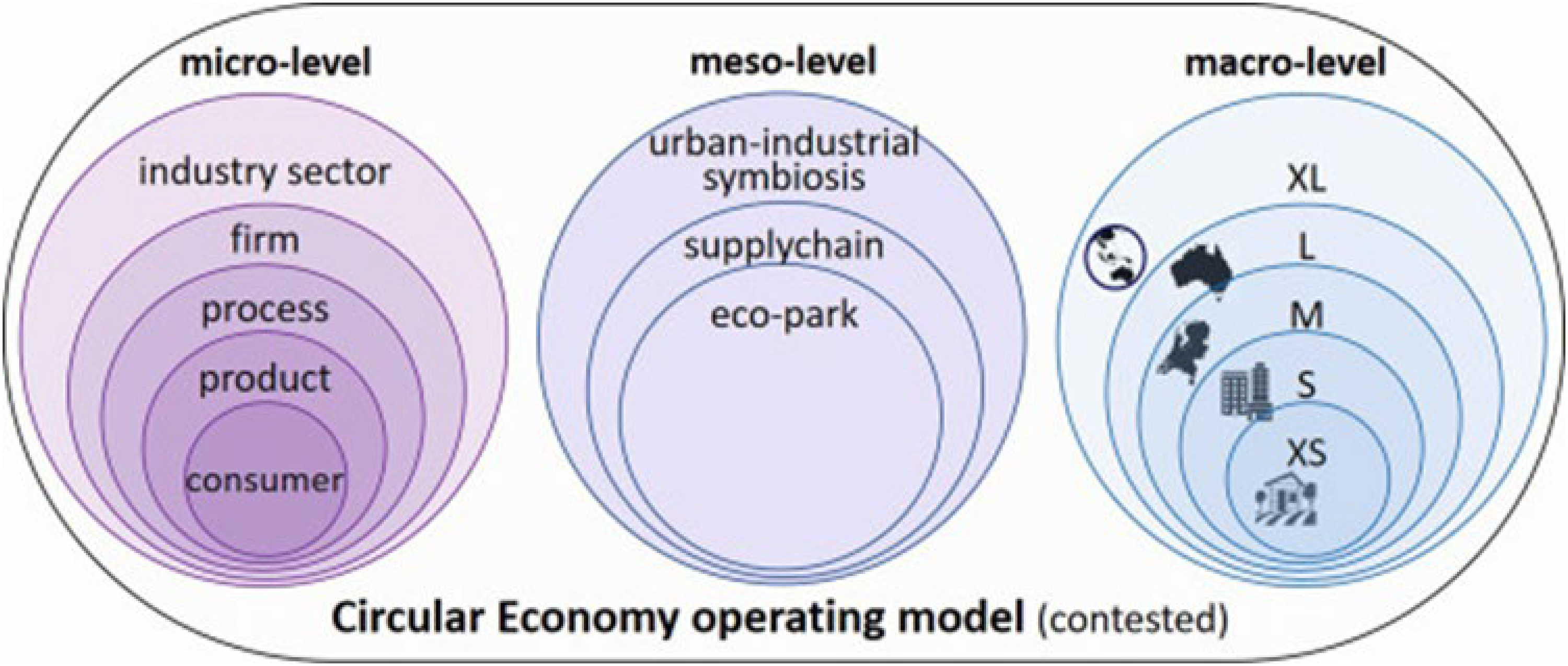
The CE Operating Model Comprising Three CE Levels, but Contested to be Incomprehensive by Not Representing Levels for Education (Including Marketing), Society and Natural Environment. (Source: van Bueren et al. 2023a).
Micro-level CE scales include actions arising from, or associated with, consumers, products, and firms (Kirchherr, Reike, and Hekkert 2017). Arguably, industry sectors may also be added as an overarching scale, as there are relevant CE studies on this topic. Meso-level scales are represented through urban-industrial symbiosis, supply chains using end-of-life products, and eco-parks (van Bueren et al. 2021). In Figure 1, macro-level scales are represented with XL for the planet; L for continents; M for large provinces, states, and smaller countries; and S for cities and XS for neighborhoods (van Bueren et al. 2021), providing a demarcation that allows for comparisons of regions with a similar size and population.
Our recent findings on CE are highly relevant for Marketing at different levels, including at the macro level. Managing economic, societal, and environmental processes more circularly, per definition equates a more comprehensive stakeholder model; also including levels of society, education, and the natural environment (van Bueren et al. 2023a). The society and education-levels are particularly powerful as it is increasingly supported by technical, legal, and social innovations that are emerging locally and globally. Marketing can be a change agent, by educating society not for increasing consumption, but on marketing for a sustainable society.
The work of Layton seems perfectly positioned to help solve the TBL challenge that society is facing. Macromarketing has developed a profound understanding of the interactions between consumers, producers, and traders and how this has led to new and emerging consumption patterns and larger systems that cater to new demands (Layton 2014). Macromarketing studies this phenomenon in various cultures, governmental situations, and geographical locations, creating models to explain marketing systems and how to create pathways to change (Layton 2019). Traditionally, Marketing has often been applied for increasing consumption, targeting sales and profit optimization in relation to consumer satisfaction (economy and a bit of society of the TBL). Up till now it has arguably largely neglected how marketing can impact the natural environment and society more broadly.
The Case of Eco-Communities and their Own Marketing System
We recently compared self-reliant eco-communities versus mainstream Western communities in terms of contributing to the TBL challenge. Van Bueren et al. (2023b) compared a range of high-performing eco-communities in terms of TBL-sustainability performance with the larger scale of performance of Australia as a nation. Interestingly, this is, in fact, an unfair comparison, as Australia is an L-scale region that is rich in many and diverse natural resources that should (theoretically) easily be able to provide everything to its relatively small population of 26 million people. Eco-communities, on the other hand, are confined to a small un-diverse region with a relatively denser population of 10–300 residents on several acres that needs to be sufficiently open to address all needs. However, we found that these innovative eco-communities were able to manage their CE within their region highly effectively (See Figure 2 illustrating key-processes of the TBL challenge, and where red areas indicate broken circularity).
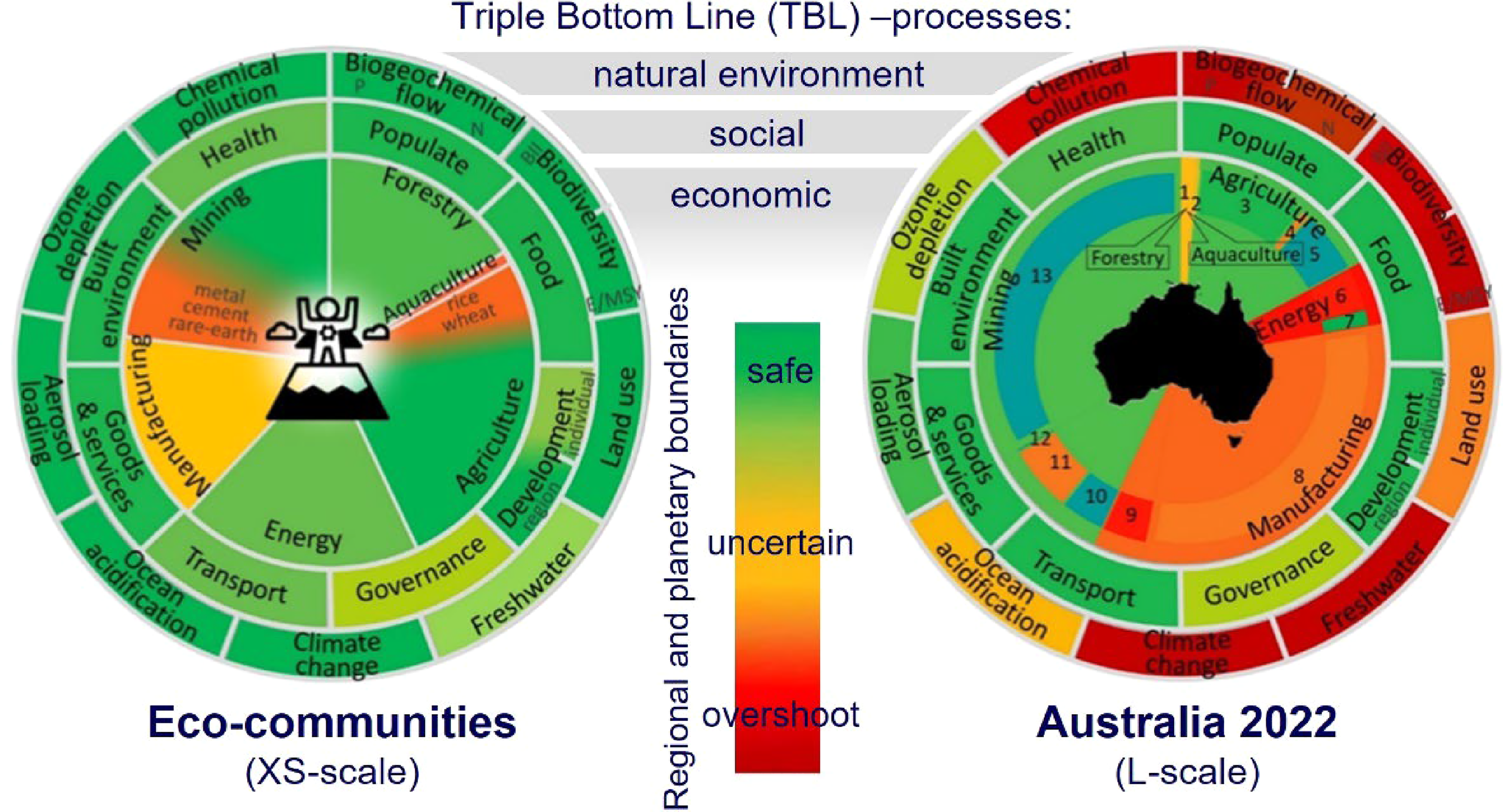
TBL Sustainability Performance Comparison Between Select Australian eco-Communities (Left) and Australia as a Whole (Right) (Source: van Bueren et al. 2023b).
We observed that eco-communities have a very different internal marketing system that helped to solve the TBL challenge. First, the eco-communities ‘banned’ and avoided any marketing that promotes increasing consumption. Second, as a XS society they market to optimize prosperity within their own regional boundaries, and without pressuring the planetary boundaries. There is much to discuss on how marketing can do harm, or good (Wortel-London 2023). We argue that Macromarketing can play a significant role in solving the TBL challenge for a sustainable future.
The Case of a Sustainable Food Marketing System
The need to feed society by producing sufficient and high-quality food is key in the TBL challenge considering the nine planetary boundaries (Campbell et al. 2017). The food system comprises different stakeholders, including farmers, manufacturers, processors, retailers, and consumers. Most research and approaches have traditionally focused on the micro level, investigating sustainable strategies and practices among these stakeholders as separate actors or sectors. However, this arguably underestimates the interactions and interdependence between the stakeholders and the holistic nature of global food systems.
The Food and Agriculture Organization of the United Nations highlights that approaches toward sustainable food systems need to move away from confining the food system as a single industry or sub-system (e.g., supply chain) to a more holistic perspective that considers all relevant stakeholders at different levels (Nguyen 2018). In this approach, governments and policymakers (macro level) need to develop policy instruments and legal frameworks to facilitate multi-stakeholder collaboration and support more sustainable food systems. It is also vital to balance and coordinate primary interests/conflicts at different levels: micro level (e.g., productivity for farmers, profits for retailers, value for consumers), meso level (supply chain profitability and growth), and macro level (e.g., food security, environmental sustainability). This corroborates Layton's (2011) argument that marketing systems are essential in linking micro-choices with macro-outcomes to solve the TBL challenge.
Conclusion
Roger Layton's work on multi-level Marketing systems provides an invaluable contribution to the Marketing discipline. The systems approach is inherently holistic, and it can be used to understand a system's constituent parts and how the parts interrelate and operate within the context of economic, but also environmental challenges. Macromarketing has a legacy in increasing consumption, but is also essential to drive toward a sustainable society. It is up to us to make sure that the work of Roger Layton is used to its fullest potential to address the TBL-challenge where sustainable and more circular ways of ‘producing’ and ‘consuming’ are needed.
Footnotes
Associate Editor
Ben Wooliscroft
Declaration of Conflicting Interests
The authors declared no potential conflicts of interest with respect to the research, authorship, and/or publication of this article.
Funding
The authors received no financial support for the research, authorship, and/or publication of this article.
