




Abstract
Marketing regulations are warranted when unfettered marketing practices compromise many people's positive and negative liberties. We elucidate these liberties’ multifaceted but interdependent connotations for societally justified marketing regulations from a novel framework integrating the social sciences, philosophy, history, and marketing. The limitations of unbalanced or less represented market or government regulation notwithstanding, overcoming marketing imbalances and enhancing personal and societal liberties via pluralistic, well-designed, enforceable, and multilateral regulations can advance a pluralistic democracy's diverse market-related interests. By informing companies and consumers about societally responsible liberties, well-regulated marketing can spur common goods creation.
Keywords
Western publics and public policymakers generally consent to a company extending its societally justified economic rights and interests via non-deceptive marketing practices (Rotfeld and Taylor 2009). Nonetheless, such practices can influence personal and collective liberties. Although many public policy scholars have pondered marketing regulations’ societal implications, the multidimensional marketing-liberty relationship remains underexplored, warranting an inter-, pan-, and multi-disciplinary analysis of marketing, liberty, and regulation (Parvatiyar and Sheth 2021; Rotfeld and Taylor 2009; Skinner 1998). In this vein, we explore the contextualized connotations, interpretations, and underlying elements linking marketing, liberty, and regulation by answering questions like ‘Should liberty entail multiple perspectives and multilevel meanings defined by context-sensitive social practices like marketing?’ ‘Should liberty be societally adopted, evaluated, and justified?’ ‘How does marketing affect personal, group (e.g., corporations, communities, and political organizations), and societal liberties?’ ‘Can regulators and other stakeholders design and enforce liberty-sensitive marketing regulations; if so, how and at what level (e.g., personal, corporate, societal)?’
The centrality and depth of the positive-negative liberty framework presented here can substantiate the societal connotations of marketing concepts and consolidate marketing theory-building, which is helpful because marketing scholars have overlooked the philosophical foundations linking marketing, marketing regulations, and personal, group, and societal liberties. By relying on this framework, we answer the previous questions, deepening marketing insights into three interdependent domains: substantive (i.e., marketing agent, organization, and system performance), theoretical (i.e., conceptual understanding of marketing practice), and methodological (i.e., critical, reliable, and valid marketing-related measurement) (Weitz and Wensley 2006).
All discussions about liberties are value-laden. Hence, we are obligated to acknowledge these auxiliary assumptions (Hyman, Kostyk, and Trafimow 2022; St Quinton and Trafimow 2023): (1) human-agency-related activities are contextualized and have social implications, and (2) marketing-related relationships, meanings, consequences, and interpretations are characterizable as interpersonal, communal, or societal. Given these assumptions, liberties’ shifting connotations are context-sensitive and best interpreted holistically and critically.
Our contribution to the literature is manifold. First, we broaden marketing's horizons by integrating eclectic theoretical frameworks and relevant approaches from the social sciences, philosophy, history, and marketing. For example, we integrated theories of classical liberalism (Hayek 1970, 1988, 2020), pluralist democracy (Dahl 1985, 1992), economic sociology (Granovetter 1985, 2017), economic liberalism (Friedman 2002; Stigler 1975), and liberties (Berlin 1969; Mill 2020) into the analysis of marketing's multidimensional influence on liberties. Second, we scrutinize the societal connotations of positive and negative liberties and reflect on marketing, regulation, and liberty interdependencies. Based on marketer, consumer, and public policymaker activities, we exemplify how positive and negative liberties define and are defined by the socio-political, philosophical, and humanistic aspects of marketing and regulation. Third, we question the simplistic market-or-government intervention dichotomy and endorse societal-liberty-centric rather than personal economic-liberty-centric solutions for improving marketing regulation. We show that pluralistic, well-designed, enforceable, and multilateral (corporate, industry, market, government, and societal) marketing regulations can protect and enhance societally justified liberties. Fourth, we clarify the societal implications of marketing and the synergistic relationship between regulation and societal liberties, incongruencies between personal liberties and societal impacts, and gaps between pro-corporate and pro-personal interests.
We proceed here as follows. First, we explore positive and negative liberties’ seemingly independent but inherently interdependent domains and suggest a holistic and critical perspective that showcases mutual constraint and reinforcement (Berlin 1969). Next, we disambiguate the two liberties’ social dimensions and argue for their societal justifications. Rather than focusing an economic lens on marketing and its regulation, elucidating the two liberties can disambiguate the elements driving marketer and public policymaker decisions. After discussing marketing's societal embeddedness and influence, we show that marketing extends and constrains all parties’ liberties. Synthesizing divergent regulatory perspectives (i.e., libertarianism, neoliberalism, and statism), we present the pros and cons of various regulations for correcting marketing imbalances and suggest multilevel regulations to boost societally justified liberties. We contend that such regulations can enhance pluralistic democracy and reinforce a socio-political backdrop for augmenting personal liberties and social welfare. Finally, we summarize our presentation and suggest future research possibilities.
Positive Versus Negative Liberty Dyad
Despite their heavy interdependence, liberty's positive and negative aspects often are incorrectly siloed into separate realms (Berlin 1969; MacCallum 1967). Positive liberty means freedom to act, conforming to all parties’ free will and interests. In contrast, negative liberty means freedom from other parties’ harmful influence or interference without one's consent. In essence, liberty means the absence of something (e.g., interference, barriers, and constraints) and the presence of something else (e.g., control, self-mastery, self-determination, and self-realization) (Carter 2021; Dowding and Oprea 2022).
The positive versus negative liberties dyad can be self- and mutually constraining in shaping the societally judged legitimacy of public and private activities (Berlin 1969; Carter 2021; Heyman 1992; MacCallum 1967; Nelson 2005). This dyad's influence and socio-historical boundedness necessitate its societal scrutiny and justifications (Nelson 2005). It defines the personal versus societal liberties interface by affecting interpersonal relationships, market-related activities (e.g., consumption and marketing), and public policies (e.g., regulations) (Honneth 2015). Unlike government intervention via laws, rules, or administrative orders, marketing-related societal influences on liberty are often informal, indirect, gradual, and obscure, yet they shape personal and collective interests.
Positive Liberty
Positive liberty—which prompts personal or group choice, free will, and self-determination—implies that societal entities are free, willing, and able to influence their environment. However, it may be unstable and internally inconsistent at the macro level. For example, the prisoners’ dilemma, the tragedy of the commons, and race-to-the-bottom pricing show that aggregating personal rationality may foster collective irrationality or social inequality (Olson 1970; Ostrom 1990). Similarly, it implies that policies that mitigate social inequality may jeopardize personal liberty (Van Parijs 1995).
Because of capacities and limits, social members’ personal liberties may have different boundaries and meanings. If insufficiently monitored, one person's positive liberty may infringe upon everyone else's positive or negative liberty. When liberty to is overstressed, elite people's liberty may dominate non-elite people's liberty. Majority-rule abuse can institutionalize and justify the positive liberty of dominant social groups. Examples abound. The elites may refer to the ‘power elite’ owning social, economic, political, symbolic, or cultural capital (Bourdieu 1986; Mills 1956). These elites can manipulate positive liberty to boost their interests while seemingly promoting selected non-elites’ interests (e.g., pork barrel legislation and logrolling by U.S. public policymakers) (Hanretty 2021; Spáč 2021). Although supposedly to satisfy consumers’ demands, companies may induce questionable consumer desires and encourage overconsumption of some products via excessive or deceptive advertising (de Marchi and Laver 2020; Galbraith 1952, 1958, 1967; Hyman 1990; Packard 1958; Yan 2012). Positive liberty's unfettered extension can lead to socioeconomic imbalances, an authoritarian state where most people's liberties are compromisable, or tyranny (i.e., where only supreme persons like dictators or kings have absolute liberty) (Patten 2002; Przeworski 2003; Russell 1960; Skinner 1998).
The unrestricted application of positive liberty can create a liberty jungle. Extending personal self-interest may elicit non-cooperative and zero-sum interactions, leading to negative societal consequences. For example, without necessary internal constraints (e.g., self-assessment based on religious, ethical, political, or social values) or external interventions (e.g., laws, rules, norms, or conventions), the elites in capitalist, socialist, or transitional societies can over-extend their positive liberty relative to less-resourced compatriots and curtail the latter's liberties (Bourdieu 1984; Stillerman 2015; Szelényi 2019).
Negative Liberty
Negative liberty or liberty from social, government, or personal interference may constrain itself or positive liberty. It defines the boundary between private and collective rights, which helps identify and minimize internal and external intrusions (Carter 2021). People and groups (e.g., companies and associations) naturally possess such rights. Nevertheless, rights boundaries must be societally delimited and interpreted via context-dependent laws, conventions, social norms, voluntary mutual concessions, and guidelines (MacIntyre 2007). Whereas universal basic income may be essential to personal negative liberty in some capitalist countries, freedom from government intervention may be sought in other capitalist countries (Stigler 1975; Van Parijs 1995).
Negative liberty's presumption that people's self-interest and self-determination drive their choices is problematic. First, liberty in appearance is not liberty in essence, as people's misperceptions can cause erroneous beliefs about their best interests (Carter 2021; Heyman 1992; Hyman, Kostyk, and Shabbir 2021; Shabbir, Hyman, and Kostyk 2021). Irrationality or incompetence in using liberty, such as quasi-negative liberty, makes people externally free but internally enslaved (Nelson 2005; Sen 2004). Second, people may lack sufficient resources to realize their goals. For example, unknowns may preclude consumers from recognizing subtle ad-presented information that distorts their decisions, intensifying their vulnerability to deception (Asquith and Fraser 2020; Baker, Gentry, and Rittenburg 2005; Gabel and Scott 2011; Hyman 1990). Third, social norms, conventions, and values contextualize people's behaviors and morals (MacIntyre 2007; North 1990). Thus, extracting personal liberties from their societal circumstances and discounting their societal-based interactions obscure their contextualized meaning.
These three concerns challenge negative liberty's legitimacy as defined by internal or societal factors (Nelson 2005; Queiroz 2018). Dubious sociopolitical goals, skewed ideologies, misperceptions, personal addictions (e.g., alcohol and drugs), and deleterious intentions and means can undermine societal welfare (Carter 2021).
Liberties’ Societal Justification
As a context-sensitive social construct, liberty must answer the ‘of, by, and for whom’ question. Liberty entails multiple dimensionalities (personal, group, and societal), and its interpretations are fluid across contexts. Rather than as pure abstractions, scholars should treat positive and negative liberties as societally conditioned, interpreted, applied, and justified concepts contextualized personally and collectively. The liberties’ societal justifications and embeddedness imply ‘societal liberties’—including political, economic, and civil freedom of self-interest seeking—for persons and groups (Friedman 2002). Judged by contextualized principle or value-based ethical standards, marketing actions and their regulations should ensure ‘no harm to others’, encourage just processes (i.e., procedural justice), and conduce net non-negative societal payoffs (i.e., distributive justice) when possible (Dunn 2017; Martin and Murphy 2017; Mill 2020; Rawls 1971). However, actions that increase aggregate societal benefits (positive liberty) can undermine some people's interests (Hyman 1990). For example, if lockdowns are “(1) effective, (2) necessary, and (3) proportionate in combatting viruses,” they can “protect us from the harmful effects that viruses have on freedom” (Oberman 2022). Nonetheless, lockdowns limit most people's freedom. Reallocating action-induced gains from advantaged to disadvantaged people (i.e., Kaldor-Hicksian efficiency) can retain the latter's negative liberty (Stringham 2001).
Societally justifying positive and negative liberties can substantiate social justice. In the U.S., for example, positive liberty entails the right to purchase and bear arms, but negative liberty includes the right to be safe from gun-toting neighbors. Similarly, marketing and consuming alcohol, cigarettes, and lottery tickets may create the same liberty conflicts. Thus, effectively designed, resourced, and implemented public policies meant to protect disadvantaged groups (e.g., the poor) can be societally justifiable even when those policies constrain corporate or privileged groups’ liberties (Shabbir, Hyman, and Kostyk 2021). Shifting socio-cultural contexts means positive and negative liberties’ interpretations change accordingly (MacIntyre 2007). Hence, marketing scholars and practitioners should identify each liberty's boundaries via an open, adaptive, holistic, and context-sensitive framework rather than a fixed and isolated perspective (Berlin 1969; Carter 2021; Finn 2014, 2019; Nelson 2005; Queiroz 2018; Skinner 1998).
Ethical judgment may be consequence-based. Because marketing and consumption are societally bounded and have intended and unintended societal consequences, related liberties should be societally evaluated and justified. Societally justified liberties discount purely abstract free will but imply (1) societally bounded liberties subjected to shifting economic, cultural, political, and interpersonal constraints embedded in socio-historical contexts, and (2) maximizing personal welfare (e.g., material and psychological interests) need not maximize collective welfare (Hyman 1990). Liberties without societal justifications are quasi- or pseudo-liberties that can create societal malaises and undermine peoples’ liberties. Hence, liberties should be societally constrained when they cause private or public harm (Mill 2020; Skinner 1998).
Marketing Embeddedness, Marketing Imbalances, and Liberties
As a business framework, economic institution, and politicized ideology responsive to corporate and consumer interests, marketing is a social activity that shapes and is shaped by shifting social contexts. Various stakeholders interpret marketing's societal influence differently (Granovetter 1985). Despite marketing's merits, its imbalances are well-known, especially among critical marketing scholars (Chatzidakis and Lee 2013; Dholakia 2012; Ellis et al. 2011; Tadajewski et al. 2018). Corporate marketing benefits gained at consumers’ expense can be economically benign but societally malign (Vadakkepatt et al. 2022; Yan 2012). Because market mechanisms can fail to mitigate the negative societal externalities accompanying marketing imbalances, marketing may compromise consumers’ negative (e.g., manipulative advertising) and positive liberties (e.g., decision-making autonomy) (Conner and Hyman 2012; Hyman, Kostyk, and Trafimow 2022; Raz 1986).
Marketing practice can fetishize consumers’ social values, norms, identities, tastes, and sociopolitical status via a ‘you are what you consume’ or conspicuous consumption mindset (Belk 1988; Hyman, Ganesh, and McQuitty 2002; McCracken 1988, 2005; Veblen 2021[1899]). It may undermine consumers’ behavior and welfare (e.g., material and psychological interests) by presenting information selectively and persuasively (Hyman 2009). Its influence on consumers exceeds mere information presentation. For example, marketing practitioners can affect the scope, scale, and forms of distribution, consumption, and social tastes (Rawls 2005; Sen 2004). They can reinforce some societal values—especially those sponsored or preferred by dominant parties—and dismiss other societal values via peer pressure. They can even shape the political system's essence and processes. For example, political marketing profoundly shapes the values and candidates society ‘should’ support (Holtz-Bacha and Just 2017), whereas U.S. capitalists secured preferential public policies by marketing free competition's value (Donohue 2004). Politicians and political operatives can use marketing to defame political rivals (Ansolabehere and Iyengar 1995) or influence people's voting behavior (e.g., the Daisy ad).
Marketing defines the connotations of positive and negative liberties at three levels: personal, corporate, and societal (see Table 1). At the personal level, marketing may influence personal liberty by shaping consumer autonomy, sovereignty, and welfare. At the corporate level, it may shape corporate market extension and capacity to satisfy or constrain stakeholders’ interests. At the societal level, it can affect liberty by boosting or constraining social justice, pluralistic democracy, and people realizing societally justified free will and social emancipation.
Marketing-Related Concepts Affected by Positive and Negative Liberties.
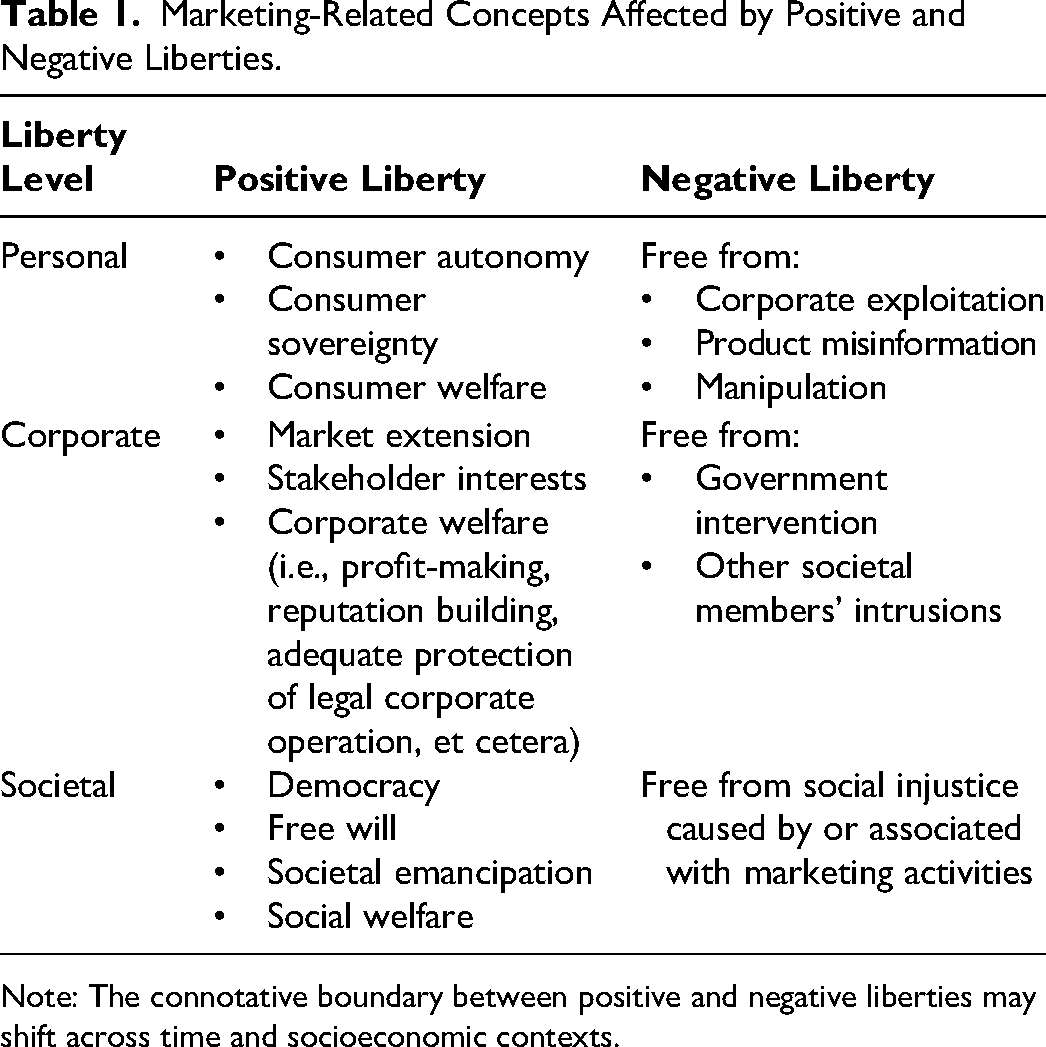
Note: The connotative boundary between positive and negative liberties may shift across time and socioeconomic contexts.
Minimally or passively, marketing practice should not injure any societal member or group. Nor should it constrain societally justified rights (i.e., negative liberties). Actively, it should foster people's societally justified welfare or liberties. As a result, it pertains to the socially responsible creation, distribution, and consumption of goods, services, tastes, and values.
Whose Responsibilities? Caveat Emptor, Caveat Venditor, and Caveat Lector
Positive and negative liberties can ground marketing's influence and implications (Wilkie 2016). Two underlying assumptions—caveat emptor and caveat venditor—pertain to responsibilities for addressing marketing (mis)behaviors (Nigam 2020). Caveat emptor assumes that consumers are sufficiently knowledgeable and intelligent to decide for themselves. In contrast, caveat venditor assumes the liability for product-related damages rests with producers and sellers. These assumptions ignore the socially embedded and interconnected responsibilities that influence everyone's realization of personal interests and liberties. Caveat lector, which initially meant ‘let the reader beware’, is a producer's social responsibility to advise consumers to take personal social responsibility via ethical consumption. Governmental agencies, mass media, or educational institutions—as social guardians, arbitrators, or representatives—can encourage caveat lector.
Barring unwarranted external interference, negative liberty presupposes that people should freely pursue their interests and take responsibility for their behaviors (Dowding and Oprea 2022). Affirming consumers can best judge their welfare indirectly reinforces the caveat emptor assumption. The caveat venditor assumption indirectly reinforces corporate negative liberty by encouraging regulation-free marketing when corporate activities are benign to everyone's interests.
Positive liberty presupposes good marketing aids consumer decision-making while enhancing corporate profits and social welfare. It defines consumer autonomy as the capacity and willingness to make rational and moral decisions (Hyman, Kostyk, and Trafimow 2022; Raz 1986; Sen 2004). It also informs responsibility- or duty-based ethical judgment. For example, caveat emptor supports corporate positive liberty by highlighting consumers’ choice-related liability (Baker, Gentry, and Rittenburg 2005). Similarly, marketing regulation can protect consumers’ negative liberty from corporate injury by stressing caveat venditor.
Marketing Imbalances
Western publics and public policymakers often demand corporations implement corrective measures that address marketing-induced problems such as unprotected vulnerable populations, environmental degradation, consumer privacy invasion, deceptive nutrition labels and health claims, unissued warnings and disclosures, unprotected trademarks, unsafe products, unfair advertising, undue social media usage, and sin product consumption (Andrews et al. 2022; Bloom and Gundlach 2001; Davidson 2003; Dowding and Oprea 2022; Dunn 2017; Foxman and Kilcoyne 1993; Kelly et al. 2021; Martin and Murphy 2017; Richards and Petty 2007). Consumer tastes reflected or shaped by ads may affect attitudes toward people, leading to stereotyping, racial discrimination, and societal imbalances that deter minority members’ negative liberty (i.e., freedom from market intrusions on societally justified personal rights) (Bourdieu 1984; Fagan 2018; McCracken 1988, 2005; Rotfeld and Taylor 2009; Shabbir et al. 2014; Vadakkepatt et al. 2022; Yan and Hyman 2021). To protect personal liberties and social welfare, marketers should mitigate such harms, even if unintended (Baker, Gentry, and Rittenburg 2005; Berlin 1969; Yan and Hyman 2021).
Regulatory corrective and recuperative power may be compromised when substantial imbalances characterize a market's intended functions (Boddewyn 1989). Circumstances like organization size, conflicting societal interests, the free-rider problem, and policymaking structure can shape regulatory agenda-setting, content, control, and evaluation (Becker 1976, 1983; Olson 1970; Posner 1974; Robertson and Judd 1989). Vague operational boundaries can instigate turf wars among regulatory agencies (Robertson and Judd 1989). Managers and bureaucrats can ignore, resist, misinterpret, or procrastinate any regulation via tardy responses and an unwillingness or inability to execute complex plans. Thus, marketing regulation is warranted due to marketing's intended and unintended interference with positive and negative liberties. However, sociopolitical standing can influence societal members’ beliefs about regulating marketing-induced problems.
Regulatory Liberty Infringement: Contrasting Standings, Opinions, and Concerns
Beliefs and ideas, often contextualized and fluid, can affect economic choices and activities (Da Fonseca 2009; Hume 2022). As an ideational element, a preference for negative over positive liberty and market over non-market arrangements can influence thoughts about marketing regulation. Because regulations may affect diverse economic, political, and civil liberties, reaching a consensus on their social legitimacy is unrealistic (Friedman 2002). For example, libertarians posit that states and markets are discrete, whereas neoliberals assume minimal external interference with consumer choice is preferred because it can boost public interests while avoiding socially unacceptable consequences (Hayek 1970; Stigler 1971, 1974). Such thinking favors economic individualism and personal negative liberty by stressing government non-intervention and personal choices meant to sustain social order, morality, private property rights, and personal liberty.
Economic Liberalism and Statism
Despite the underlying preference for personal choices and free markets, economic liberalism's connotations and interpretations of liberties are morphing. In a country focused on personal choice and free markets, U.S. economic liberalism's connotations and diverse interpretations evolved from producer-centric to consumer-centric, thus favoring consumer protection over producer non-interference (Donohue 2004). Governments may alternate regulation and deregulation in response to socio-historical shifts. For example, dropping U.S. federal controls between the 1870s and early 1930s was widely applauded, whereas U.S. government intervention was canonically implemented between the 1930s and 1960s (Robertson and Judd 1989). Deregulation was reinstituted in many countries between the late 1970s and 2000s to minimize believed regulatory impotence (Eisner 2000).
Despite market fundamentalists’, libertarians’, and neoliberals’ alternative interpretations of freedom—attributable to either a pro-corporate or pro-consumer perspective—scholars amalgamate them into ‘economic liberals’. These liberals contend that (1) markets maximize personal and group liberties through voluntary transactions, and (2) consumers often view economic liberty as an end rather than a means. Although they should serve the public's interest, government regulations often lead to net social welfare losses (i.e., Iron Law of Regulation) (Armstrong and Green 2013). Hence, market non-interference boosts socioeconomic efficacy and shapes liberty's essence and connotations. However, public policies encouraging free markets may be skewed, as these markets generally resist consumer-friendly government policies but embrace pro-business economic policies (e.g., tariffs, subsidies, and preferential taxes) (Donohue 2004). Such policy preferences conform to economic liberals’ bias toward viewing markets individualistically (Finn 2019), unevenly abetting producers’ but not consumers’ positive and negative liberties.
Libertarians often exaggerate a free market's efficacy but underestimate its social costs and infringements on non-elites’ liberties (Coase 1960). Moreover, they assume voluntary transactions underpin free markets, yet judging a transaction's voluntariness requires answers to complex questions like ‘How is voluntariness economically and societally defined in this case?’ ‘What are its societal consequences?’ ‘Who gains and loses?’ and ‘What basic standards societally justify it?’ Libertarians generally discount the need for government regulation because they believe sufficient economic rewards ensure voluntary market contracts will yield all desired goods and services, even national security and police protection (Rothbard 2004). Per the Austrian school of economics, governments cannot rely on rigid and slowly responsive centralized regulation to address changing, flexible, emergent, and decentralized market behaviors (Caldwell 2020; Hayek 1970; Mises 2008, 2011).
Isolated libertarian interventions may underachieve when relevant institutions cannot cope with multidimensional and contextualized socioeconomic problems. Positing self-determination without internal and external interference, an isolationist mindset may foster social negligence and limit the liberties actualized by people lacking information, intelligence, money, political clout, social capital, or other resources. People adhering to personal, group, or societal isolationism will resist societal participation, limiting public goods and reducing personal and social welfare (Downs 1957).
Neoliberalists contend that corporations can mold government regulation to serve their rather than the public's interest (i.e., resist marketing misbehavior abatement by relying on financial or cultural regulatory capture) (Friedman 2002; Stigler 1971, 1974). Autonomous coordination and self-corrective elements within markets, often synopsized as methodological individualism, can best address the economic calculation problem but not fully solve the socio-political calculation problem (i.e., human rights, liberties, democracy, religious values, and other contextualized social values) (Hayek 1970, 1988). However, such simplistic solutions are problematic because markets are social structures and economic activities are societally embedded (Finn 2019; Granovetter 1985).
Neoliberals’ belief that government regulations are unnecessary hinges on assuming consumers have two defenses (Stigler 1975). The first defense derives from the homo economicus assumption, positing that self-interested consumers’ knowledge and intelligence are sufficient to avoid market imbalances. However, bounded rationality and misinformation often cause faulty judgments (Simon 1955). For example, consumers may lack sufficient expertise to assess credence-good quality (e.g., medical or legal services), which may induce undertreatment, overtreatment, and overcharging (Balafoutas and Kerschbamer 2020; Dulleck and Kerschbamer 2006; Nelson 1970, 1974). Overabundant product assortments increase decision complexity and preference uncertainty, compromising consumers’ rational calculations and freedom of choice (Markus and Schwartz 2010).
The second defense is free competition, a market structure that hinders discoverable producer misbehaviors via low producer barriers to entry and consumer switching costs. Although a consumer-respecting company generally thrives more than a consumer-disrespecting company, many consumers are unable or unwilling to identify the former when they believe search costs exceed the likely benefits (Nelson 1970, 1974). Moreover, neoliberals believe that markets are the best, if not perfect, institutional information processors (Friedman 2002); thus, external interventions are unnecessary. However, markets discount the supply of public goods and fail to answer the ‘for whom’ question.
Statist interventionism, mainly espoused by socialists and authoritarians, assumes unilateral government regulations can protect public interests, extend personal liberties, and offset the elites’ infringement upon non-elites. However, problems may arise from regulations undermining liberties while imbalancing anarchistic disorder and market control (i.e., ‘the government is the problem rather than the solution’) (Shleifer 2005). Although statist interventionism assumes rational choices, it does not preclude negative societal consequences. For example, fostering state-owned enterprises (SOEs) is a government intervention for replacing or internalizing free market transactions. However, SOEs often are economically inefficient entities that ignore and violate human values (Kornai 1980; Kornai, Maskin, and Roland 2003; Przeworski 1991; Shleifer and Vishny 1998; Szelényi 2019).
Although statism downplays the free market's social costs and often tries to extend and legitimize collective liberty, it exaggerates government capabilities and ignores decision-making problems associated with government interventions (Hayek 1970, 1988; Mises 2008, 2011). Specifically, statism ignores government shortfalls exemplified by (1) governments operating in their interests rather than as the people's loyal and competent agent, and (2) the high social, economic, psychological, political, and cultural costs of regulating markets via inflexible and irresponsive state arrangements (Skocpol 1979; Tullock, Seldon, and Brady 2002).
State intervention can fail when limited resources, misjudged targets, and regulatory blind spots preempt effective regulatory enforcement; for example, ads become untrustworthy without deceptive advertising regulations (Hyman 1990; Yan and Hyman 2021). However, poorly enforced government regulations may cause a deceptive ad to mislead consumers because they wrongly assume ad regulations preclude it (Nelson 1974). Overreliance on government regulations with limited enforceability can obstruct consumers’ adoption of alternative protections.
Economic liberalism and statism (and state capitalism) provide valuable yet limited lenses for evaluating regulatory influences on economic efficiency that are often contextualized and welcomed by business groups. Although deregulation and non-regulation relate to the elites’ positive liberty and non-elites’ negative liberty, regulatory interventions often extend personal and group liberties. Hence, scrutinizing regulatory influences on society is warranted.
Midnight Watchman and Libertarian Paternalism
Midnight watchman (i.e., limited-but-necessary regulation) and libertarian paternalism (i.e., expert aid to achieve liberal goals) interventions supposedly can sidestep problems caused by government controls or laissez-faire arrangements (Nozick 1974; Przeworski 1991, 2003; Sunstein and Thaler 2003). The midnight watchman assumes governments (1) support competition, private property rights, freedom of choice, and valid contract enforcement, (2) are the primary source of public goods (positive liberty protected), (3) minimize market(ing) intrusions on societal members (negative liberty protected), (4) minimize negative externalities caused by economic activities in free markets, and (5) use decentralized approaches to create a safety net for food, shelter, clothing, and legal services (Caldwell 2020; Hayek 2020). To counter consumers’ supposedly self-defeating behaviors, libertarian paternalism recommends private or public interventions—by accepted formal or informal authorities—to boost consumers’ welfare without restricting their freedom of choice (Sunstein and Thaler 2003).
The primary angst about midnight watchman regulation and libertarian paternalism is shifting social-context-dependent connotations, complicating efforts to delimit the boundary between necessary and unnecessary interventions or over- and under-regulation. Ways to enforce and monitor such regulation within changing socioeconomic contexts are unclear. However, uncritically dismissing midnight watchman regulation and ignoring or justifying a marketing problem because regulatory solutions are imperfect is equally problematic.
Pluralistic Engagement and Marketing Regulations
Positive and negative liberties can be benchmarks for evaluating regulations’ intended and realized context-sensitive effects. The primary rationale for regulation is boosting the expected loss and minimizing the expected gain of targeted misbehaviors. Regulations can mold marketing's effect on purchasing or extra-purchasing behaviors and influence stakeholders’ negative or positive liberties by shaping personal, group, corporate, and societal choices and interests (Richards and Petty 2007).
Governments can define the scope and scale of marketing activities via basic rules, professional standards, public policies, and other institutional arrangements implementable through coercive and non-coercive regulations (e.g., market adjustments, economic incentives, corporate self-regulation, and societal regulation) (Armstrong and Green 2013; Robertson and Judd 1989). Well-designed and implemented government-based regulations can facilitate corporate marketing oversight (Eisner 2000; Fagan 2018).
The U.S. Constitution's First Amendment protects free speech, a personal positive liberty. Nonetheless, the Federal Communication Commission, which regulates communications by radio, television, wire, satellite, and cable in the U.S., argued that commercial speech need not be pure free speech to be protected, distinguishing ad regulation from political censorship. The National Advertising Review Council regulates ads for deceptive claims and falsehoods rather than personal taste (Rotfeld 2014; Yan 2012). These examples indicate that well-designed government regulations can protect people's negative liberty by restricting intrusive marketing.
Government regulatory agencies and non-government entities (e.g., associations and consumer cooperatives) can monitor marketing exchanges and practices (Chandler 1993; Eisner 2000; Hollingsworth and Boyer 1997; Williamson 1973, 1985). Although all companies can demand regulations extending their interests, small companies can solicit regulations to help them repel corporate encroachment (i.e., to protect small companies’ negative liberties, external regulations are adopted to deter large competitors’ opportunistic behaviors) (Robertson and Judd 1989; Stigler 1975). Companies in cartel-like arrangements with high disloyalty-monitoring costs often lobby for government regulation or outsource such regulation to private agencies (Cheung 1969, 1970). For example, U.S. railway companies of the mid-nineteenth century often invited the Interstate Commerce Commission to regulate rates, discounts, and parallel line mergers (Hilton 1966). Although this activity constrained railway companies’ positive liberty for pricing, it enhanced their negative liberty by precluding further government regulations and societal dissatisfaction.
Despite its merits, government regulation is generally centralized and inflexible. Government agencies may also boost their interests at the expense of others. Questionable political interventions, policymaking gridlocks, disobliging societal norms and values, insufficient resources, intra- or inter-organizational silos, resistance by vested interests, poor oversight, and the principal-agent problem (i.e., regulatory agents pursue their interests at the expense of their principal's interests) can obstruct government regulation enforceability (Hayek 1970; Lindblom 1977; Lowi 1979; Pratt and Zeckhauser 1991; Robertson and Judd 1989).
To mitigate marketing imbalances and achieve regulatory justice, multilevel marketing regulations endorsed by and conducted on behalf of pluralistic interests can minimize problems associated with regulatory inefficiencies. Although imperfect, such regulations can engage with other institutions to boost personal and societal interests (Boddewyn 1989; Przeworski 1991, 2003; Shleifer 2005). Unlike explicit government-sponsored public policies, companies and the public can solicit and design multilevel marketing regulations that function as implicit public policies because their extra-state authority permits public and private activity monitoring. For example, advertising agency self-regulation indirectly creates a social good by mitigating ad designers’ propagation of stereotypical images (Yan and Hyman 2021).
Marketing self-regulation often relies on defensive tools to minimize consumers’ discontent (Taylor and Chang 1995). Such regulation may precaution, preempt, or prevent harm by encouraging professional standards that signify ethical marketing behavior and minimize consumers’ concerns. It can complement legislation and avoid problems inherent to unrestricted free markets (e.g., cooperatives can self-regulate consumption and countervail corporate power) (Galbraith 1952; Ostrom 1990). Companies offering experience or credence goods may regulate their industry to boost its image or reduce entry barriers (Balafoutas and Kerschbamer 2020; Dulleck and Kerschbamer 2006; Nelson 1970, 1974). For example, American Bar Association regulations for legal training, licensing, and litigation boost law schools’ and their graduates’ professional standards. These regulations enhance clients’ positive liberty by improving their legal services options and their negative liberty by minimizing legal misinformation and poor service (Asquith and Fraser 2020; Yan 2012). Similarly, advertising regulation increases ad credibility (Hansen and Law 2008). However, marketing self-regulation mainly relies on stipulated or implied behavioral codes and voluntary consent (i.e., lacks constraint authority). Major corporations may also manipulate poorly designed or implemented self-regulation to raise market entry or exit barriers, thus concentrating power while restricting consumers’ and small companies’ liberty and welfare.
Social regulation is warranted to protect consumer liberties, extend social justice, and balance problems caused by market or government regulation. Venues like online chatrooms and brand-specific conventions can help consumers better understand marketing-related meanings or foster consumer activism (e.g., identify and disclose inappropriate ad content) (Yan and Hyman 2021). To discourage marketing misbehavior, well-informed consumers may embrace non-consumption (i.e., ‘softer’ regulation) as a signifier of voicing, exposing, pressuring, lobbying, and exiting (Gabel and Scott 2011; Hirschman 1970; Stole 2006; Yan and Hyman 2020). However, social attention to marketing misbehavior is often ad hoc and fluid, so social regulation may be sporadic and transitive.
Integrated multilevel marketing regulations can avoid problems associated with separately applying government, industry, and social regulations. By relying on mutually supportive and self-checking governmental and non-governmental regulatory entities, effective multilevel marketing regulations entail enforcement flexibility, authority legitimacy, pluralistic inclusiveness, regulatory efficacy, and participative management of diverse societal interests. They can defend consumer welfare, enhance consumer sovereignty, augment consumer liberty, and underpin consumer citizenship.
Boosting Liberties via Multilevel Marketing Regulations
Due to differing interests, preferences, and ideologies about personal and group liberties, people's policy preferences may conflict. Obstacles like the free-rider problem and tragedy of the commons mean collective liberty need not follow from aggregating personal liberty (Nozick 1974; Olson 1970; Ostrom 1990; Polanyi 2001; Przeworski 1991, 2003). Based on the erroneous binary assumption that markets or governments referee business behavior, regulation critics generally downplay the ‘regulation by whom’ question and assume regulatory problems are pervasive and uncontrollable (Polanyi 2001). However, enhancing personal liberty may require collective efforts and arbitration. Misusing personal liberties through unrestrained markets distorts social justice and the social order, whereas over-relying on government regulation constrains personal liberties.
Although competitive markets should serve stakeholders’ interests and underpin other entities, they can undermine personal and group liberties (Ostrom 1990; Przeworski 1991). For example, they may serve societal interests unevenly, especially when stakeholders like the elites or corporations extend their liberties at small businesses’ and workers’ expense. Because marketing can encourage over-purchasing consumer goods and under-consuming public goods (e.g., public safety), unregulated marketing practices may over-serve private and under-serve societal interests (Galbraith 1958, 1967). As a result, societally counterproductive and procedurally unjust markets can arise when stakeholders’ societally justified liberties are ignored, underrepresented, or undermined. By extending positive liberty, multilevel marketing regulations can encourage consumers to pursue the under-consumed public goods essential for sustaining social integrity, pluralistic democracies, and free markets.
The centralized and procrustean regulatory measures often adopted to address marketing imbalances may threaten personal and group liberties (Caldwell 2020; Hayek 1970). Powerful societal groups like business associations, political parties, and major corporations can sway regulators—generally considered the people's agents—to set public policies that extend those groups’ interests at the expense of personal rights (Lindblom 1977; Lowi 1979; Pratt and Zeckhauser 1991; Stigler 1971, 1974). Moreover, concentrating power among a few elected or assigned executives in organizations (i.e., the iron law of oligarchy) is inherently inconsistent with the democratic representation of diverse interests, constraining some people's liberties (Michels 2016[1915]). Governments may only realize semi-collective liberties, as their interventions often serve their interests and cannot fully satisfy people's interests (Skocpol 1979).
Because neither markets nor governments can single-handedly regulate personal and group behaviors costlessly, sustained social justice requires holistic regulations that engage other regulatory sources. Fortunately, multilevel marketing regulations (see Table 2) need not constrain societally justified personal and group liberties (Dowding and Oprea 2022). Multilateral marketing regulations can enhance (hamper) economic efficiency and societally justified positive or negative liberty (Hollingsworth and Boyer 1997). Although not a formalized government policy or law, the Consumer Bill of Rights—which includes rights to safety, information, and choice—partly expresses such liberties (Wilkie and Moore 2006). For example, the rights to safety and information reflect consumers’ positive liberty to extend their societally justified rights and negative liberty to avoid marketing misinformation.
Multilevel Marketing Regulations (MMRs) and Effect on Corporate and Consumer Liberties.
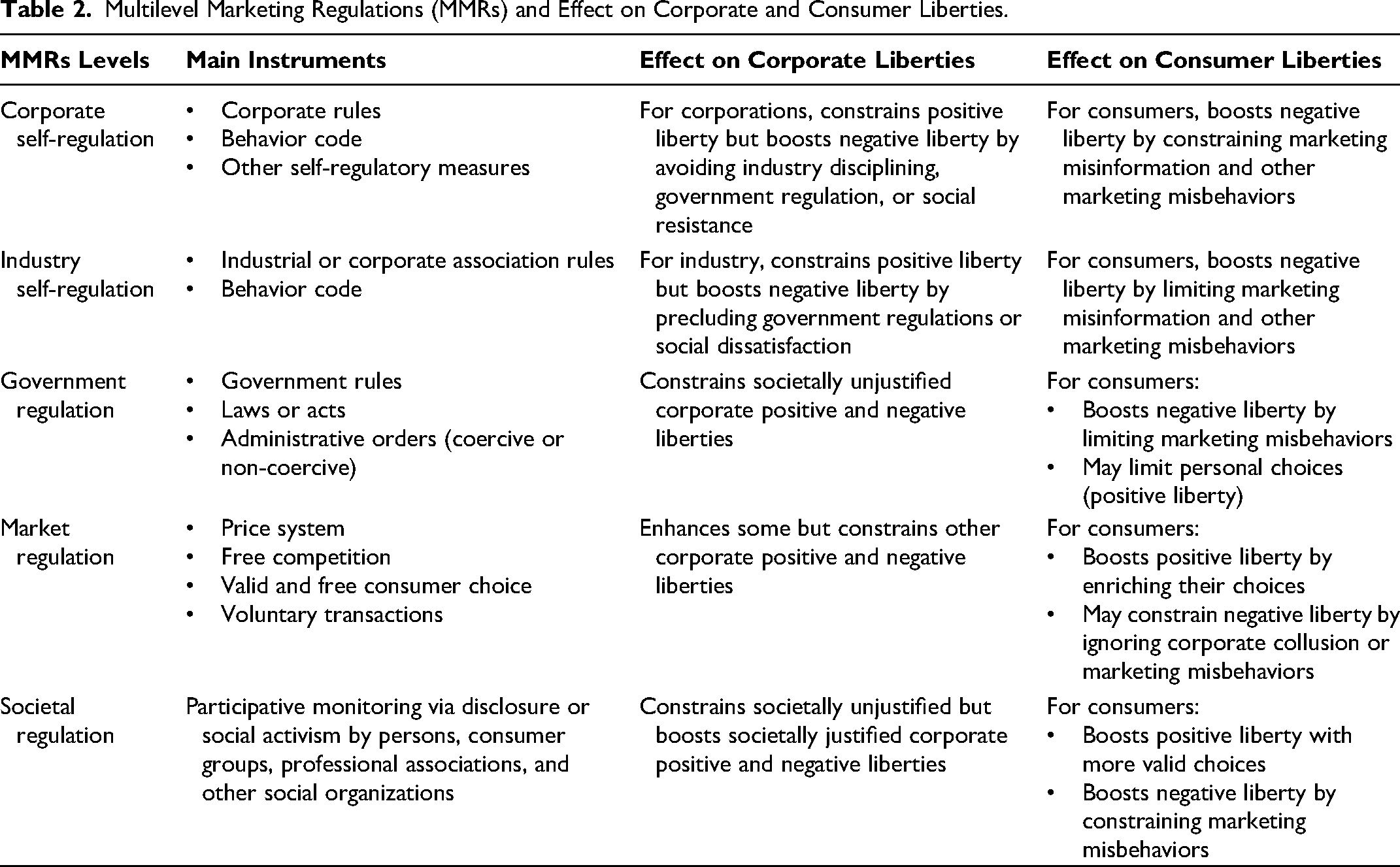
Well-designed, pluralistic, and effectively enforced multilevel marketing regulations can minimize negative externalities, encourage public-good supplies, and underpin a social tableau that ensures safe and smooth market operations (Conner and Hyman 2012; Heyman 1992; Przeworski 1991, 2003). They include corporate or industry self-regulation and suggest free market competition or voluntary consumer choices that enhance consumer liberties. This participative societal monitoring (via personal or group disclosure and social activism) constrains societally unjustified liberties but boosts societally justified liberties. Such regulations discourage unfettered market or government actions and encourage adopting multilayered instruments to enhance personal, group, and societal welfare (see Table 2). For example, non-governmental (i.e., corporate, industry, market, or societal) regulatory channels can mitigate inaction by government regulatory agencies (Bloom and Gundlach 2001). Checks and balances created via competition or mutual monitoring among regulatory agencies can counter unfettered actions restricting personal and group liberties.
Multilevel marketing regulations are reflexive and can boost societally justified liberties by sidestepping centralized planning and inflexible implementation problems associated with centralized governance (Hayek 1970, 1988; Rotfeld 2014). Collectively, they can minimize many marketing imbalances by considering marketing's goals, processes, and societal consequences (see Table 2). Specifically, such regulations can achieve the following.
Pluralistic Democracy, Liberties, and Multilevel Marketing Regulations
Rather than being limited to a few socially, racially, or ethnically based privileged people, pluralistic democracy espouses multiple interests, different doctrines, and more than one governance of power (Burtenshaw 1968; Rawls 2005). It pertains to the socially responsible distribution of power and responsibilities. It can boost mutually supportive economic and political liberties, protect and extend personal liberty, and answer ‘whose democracy?’ or ‘democracy by, for, or of whom?’ questions (Dahl 1992; Przeworski 1991). Relative to alternative political systems, it offers more venues for people to volunteer their views and provides monitoring systems to secure personal and group welfare. Its participative nature increases stakeholders’ economic efficiency, social participation, social justice, social responsibilities, and societally justified liberties (Dahl 1985; Putnam 2020; Rawls 1971). Pluralistic democracy underpins a societal context that allows effective multilateral marketing regulation and societal liberties (Honneth 2015).
Democracy elements like equity, fairness, representation, and self-determination enhance people's freedom of choice or nonchoice (positive liberty) and freedom from interference (negative liberty), prompting corporate and consumer social responsibility (Dahl 1992; Przeworski 1991, 2003; Quelch and Jocz 2012). Well-represented and presented marketing knowledge can improve market functionality, societal members’ decision-making, and consumer welfare (Bloom and Gundlach 2001; Quelch and Jocz 2012). Multilevel marketing regulations can energize pluralistic democracy by encouraging societal participation like voting and political activism (Hirschman 1970; Putnam 2020). Multilevel marketing regulations can support pluralistic democracy and discourage monopolistic power by providing employees, consumers, small businesses, and other stakeholders with more viable choices, accurate information, and improved decision-making ability. Rather than being passively shaped by pluralistic democracy, multilevel marketing regulations can promote human rights, social justice, and social welfare, extending societally justified liberties that enhance pluralistic democracy (Barrios et al. 2016; Berlin 1969; Stewart 2015).
Multilevel marketing regulations involve multiple sources of governance and spur people to identify, whistle blow, and reject liberty-violating marketing practices—substantiating a participative platform for protecting pluralistic democracy and social justice (Armstrong and Green 2013; Dahl 1985; Putnam 2020; Yan and Hyman 2021). Regulating political marketing can narrow the mass media accessibility gap between wealthy and poorer societal groups, whereas banning content that violates human rights helps sustain societal integrity (Holtz-Bacha and Just 2017). Regulating negative political advertising can advance pluralistic democracy by limiting the elites’ unjustified positive liberty to manipulate others while protecting the latter's negative liberty from misinformation (Ansolabehere and Iyengar 1995). As an adaptive, mutual-complementary, and self-monitoring social institution, multilevel marketing regulations boost economic, political, or societal liberties.
Conclusion
We extend the understanding of three interdependent marketing domains: substantive, theoretical, and methodological. Surveying theories of positive and negative liberties and their synergistic relationship with marketing (theoretical and conceptual), we propose the methodological and practical ways that multilevel marketing regulations can function as a well-represented social institution to improve marketing's influences on societal liberties (substantive). A framework grounded in positive (freedom to) and negative (freedom from) liberty indicates liberty, marketing, and multilevel marketing regulations are interconnected. Marketing imbalances necessitate such regulations to protect liberties. Rather than suggesting ideal but incalculable and impracticable policies (Pennington 2017), this framework offers a holistic and enforceable way to contemplate societally embedded rights, freedoms, marketing practices, and regulations. Positive and negative liberties’ societal justifications and various views on regulation suggest balancing laissez-faire-based corporate autonomy and centralized government market(ing) interventionism. Although not a panacea, multilevel marketing regulations are decentralized and multilayered, hinge on high social representativeness and enforceability, and can boost societally justified liberties exemplified by societally responsible marketing and consumption, meaning that liberty, marketing, and marketing regulations are interdependent and mutually reinforcing.
Managerial Implications and Future Research Orientation
Multilevel marketing regulations are necessary, enforceable, and effective. They are legitimate mainly for their pluralistic representations, extensive social participation, care about public interests, and societal justice advances. Rather than an unavoidable and indiscriminate barrier to marketing performance, they can defend and extend liberty. Although such regulations may introduce new problems, their instrumental deficiencies do not justify unregulated markets that allow more powerful interests to dominate less powerful ones. Well-designed and effectively enforced multilevel marketing regulations rely on mutually monitored regulatory agencies to represent various societal interests and extend negative and positive liberties. Societally justified regulations can reduce marketing-related liberty infringements by encouraging more accurate corporate communication, competition, and educational programs that enhance consumers’ self-protective knowledge, self-regulation via consumer voice-and-exit mechanisms, and social resistance to liberty-violating activities like stereotyping minorities (Hirschman 1970; Yan and Hyman 2021).
Future research can integrate the dyadic liberties, marketing, regulations, and their social implications by answering questions like ‘How do the dyadic liberties pertain to marketing ethics?’ ‘How will actualizing the dyadic liberties affect corporate image?’ ‘How can multilevel regulations extend business objectives and customer value requirements without eliciting social discontent?’ ‘What barriers exist between realizing public necessities and protecting private reserves?’ and ‘How can conflicts or incongruities between personal economic freedom and public socio-political liberty be minimized or harmonized?’ Questions associated with advancing legitimate and effective marketing regulations include ‘How can multilevel regulations affect competition, economic growth, corporate welfare, and consumer welfare?’ ‘How are multilevel regulatory channels chosen, and what are their mutual jurisdictional boundaries?’ ‘What are effective ways to evaluate, compare, and adjust regulatory measures across changing contexts?’ and ‘How are dynamic regulatory activities initiated, monitored, resourced, and revised based on contexts?’
Regulations can be misused or mismanaged via under-, over-, or mis-regulation. Poorly delineated jurisdictional boundaries among regulatory agencies can induce weak regulation or a regulatory vacuum in which misbehavior is unpoliced. Multilateral regulations are suggested because unbalanced or poorly represented regulations may not reflect pluralistic societal interests and diminish liberties. Regardless, regulators must continually delineate shifting market domains, flexibly demarcate fluid regulation-deregulation boundaries, adroitly discount statist control and market anarchism, and responsively identify and minimize emergent problems associated with regulatory failure.
Footnotes
Associate Editor
Alexander Nill
Declaration of Conflicting Interests
The author(s) declared no potential conflicts of interest with respect to the research, authorship, and/or publication of this article.
Funding
The author(s) received no financial support for the research, authorship, and/or publication of this article.
