



Abstract
This paper presents Systematic Theory Mapping (STM), a comprehensive and systematic method, as the first step toward defining and dealing with complex and wicked problems. Social systems exhibit a messy, multifaceted, and multi-level composite of problems characterized by causal complexities and non-linear interactions of numerous contributing variables. Exploring such a wicked composite of problems for causal explanations and theory building through reductionist empiricism is unrealistic, expensive, and futile. Systems thinking is required to understand the configurations driving wicked problems and navigate their causal complexities. We construed brand externalities as a wicked problem and provided an illustrative example for STM. A systematic narrative review is used to amalgamate diverse stakeholder perspectives and capture the structures and processes that generate brand externalities. System dynamics, employing a causal loop diagram, is used to organize the findings and develop a causal theory of brand externalities. The proposed method can help scholars, managers, and policymakers better define complex managerial and social problems and identify the likely consequences of their actions.
Keywords
Introduction
Addressing complex and wicked real-world phenomena is a major macromarketing concern (Wooliscroft 2021). Churchman (1967, p. B-141) stated that wicked problems are a “class of social system problems which are ill-formulated, where the information is confusing, where there are many clients and decision-makers with conflicting values, and where the ramifications in the whole system are thoroughly confusing.” A wicked problem exhibits non-linear causal complexity, dynamicity, ill-structuredness with diffused boundaries, and cross-domain contributions to the problem (Domegan et al. 2017), thus requires systems thinking (Jackson 2019; Meadows 2008; Sterman 2000).
Systems thinking has enabled major shifts in perspective for marketing research by emphasizing the systemic wholes instead of the reductionist parts; focusing on the interactions, relationships, and interconnectedness of system entities; transcending the structures into the processes; and prompting a methodological change from measuring to mapping (Vargo et al. 2017). Systems thinking is critical in deciphering complex and wicked social phenomena (Duffy, Northey, and van Esch 2017; Fisk 1982). Defining, scoping, and analyzing such phenomena begin with identifying the individual entities and stakeholder groups making up the system and understanding their social mechanisms and shared narratives driving the problematic outcomes (Kennedy et al. 2017; Layton 2019). Wicked problems cannot be understood intuitively. Non-linear causal modeling, such as system dynamics, is central to defining and scoping these problems (Domegan et al. 2017; Wooliscroft 2021).
System dynamics is a well-suited methodology for complex and wicked social phenomena. It provides causal explanations and content theories of the real world and initiates learning processes and cognitive improvements for designing policies and system interventions (Größler, Thun, and Milling 2008). It can deal with a large number of variables under a wide variety of assumptions and contextual scenarios in short durations, which is often the failure of reductionist black-box approaches and experimental theory building. Wicked problems occur in irreducibly open systems “where the symmetry between explanation and prediction is severed and where laboratory experiment can play little if any role in developing and testing causal explanations” (Dessler 1991, p. 353). System dynamics modeling is an appropriate methodological option for mapping complex and wicked phenomena and transitioning into simulation for measuring the dynamic behavior of the system (Lane 2008; Sterman 2001; Wolstenholme 1990).
The contribution of this paper is twofold. First, this paper presents Systematic Theory Mapping (STM). It demonstrates the usefulness of this method in synthesizing and mapping the extant literature for defining complex real-world phenomena, deciphering causal complexities, and developing causal theories. This methodology is applied in the context of branding, where a heterogeneous body of literature and archived research is extensively available. Second, this paper identifies brand externalities as a wicked social problem and proposes a causal theory as the first step in the analysis of brand externalities. STM applies systems thinking (Meadows 2008; Sterman 2000) and configurational thinking (Furnari et al. 2021; Misangyi et al. 2017) and draws upon the conventions of systematic reviews (Palmatier, Houston, and Hulland 2018; Petticrew and Roberts 2006), narrative synthesis (Mair et al. 2023; Mays, Pope, and Popay 2005; Popay et al. 2006; Yang, Khoo-Lattimore, and Arcodia 2017), thematic content analysis (Roberts and Pettigrew 2007; Wang et al. 2021), relational analysis (Robinson 2011), causal mapping, and system dynamics (Lane 2008; Sterman 2001), under the jurisprudence of grounded theory (Samuel and Peattie 2016; Wolfswinkel, Furtmueller, and Wilderom 2013).
We begin with the research context of brand externalities as a wicked problem and reflect upon the methodological premise of STM before applying it to decipher the causal complexity of brand externalities.
Research Context: Brand Externalities as a Wicked Problem
Brands are multidimensional dynamic systems of stakeholder relationships involving tangible and intangible resources that grow and/or erode over time (Mukherjee and Roy 2006; Padela, Wooliscroft, and Ganglmair-Wooliscroft 2023). They mediate social and marketplace interactions (Bertilsson and Rennstam 2018; Eckhardt and Bengtsson 2010), where multiple stakeholders co-create brand value (Brodie, Benson-Rea, and Medlin 2017; Hatch and Schultz 2010). Brands are also argued to instigate anti-branding sentiments and value-destruction (Cova and Paranque 2012; Østergaard, Hermansen, and Fitchett 2015), causing externalities that encompass physical, psychological, behavioral, social, and environmental nuisance (Bertilsson and Rennstam 2018; Caccamo 2009; Klein 1999). With the rise of anti-branding phenomena and pressures of social sustainability, considering brand externalities is an operational imperative. Brand externalities are defined as: meaning-led discrepancies and symbolic spill-overs that accompany brands and distort brand value for consumers, firms, and several other brand actors within a brand system intentionally or unintentionally (Padela, Wooliscroft, and Ganglmair-Wooliscroft 2021).
Brand intangibles – variables related to a brand that do not involve physical, tangible, or concrete attributes, such as brand experience, brand awareness, brand strength etc. – play a significant role in branding (Keller and Lehmann 2006). The contemporary branding environment, characterized by diverse tangible and intangible inputs, outputs, and path dependencies, is “a system with a high number of variables and contains non-linearities, inertia, delays, and bi-directional network feedback loops.” (Chica et al. 2016, p. 42). Similarly, externalities are known to be systemic phenomena (Laczniak 2017; Vatn and Bromley 1997). The interconnectedness of different system actors having conflicting values, driven by self-interest, and the ensuing composite of problems, such as brand externalities, create social consequences, the ramifications of which are blurry and confusing. These features, characteristic of a wicked problem (Huff et al. 2017; Wooliscroft 2021), undermine managerial intuition and ingenuity (Pagani and Otto 2013). The STM, building on system dynamics, is a suitable methodology for wicked social phenomena, like branding (Chica et al. 2016; Mukherjee and Roy 2006), as it provides manageable simplicities and a holistic frame of reference for managers to follow the complex cause-and-effect web, and do well in brand development, management, and regulation (Pagani and Otto 2013).
Methodological Premise
This section describes the methodological components of STM and positions it among the wider methodologies available to deal with complex and wicked problems.
Components of STM
Causal complexity exists within real-world phenomena when an “outcome may follow from several different combinations of causal conditions” (Ragin 2008, p. 124). Systems thinking overlaps with configurational thinking in explaining the causal complexity of social phenomena through the principles of conjunction, equifinality, and asymmetry (Furnari et al. 2021; Jackson 2019; Misangyi et al. 2017). Conjunction involves the co-occurrence of multiple interdependent causal attributes in producing an outcome. Equifinality indicates that there are more than one alternative pathways producing the same outcome. Asymmetry means that not just the presence but sometimes the absence of a causal attribute may produce the same outcome. Causal complexity involves non-linearity (where the system outputs are not directly proportional to the combined causal inputs), requiring non-linear causal modeling, such as system dynamics (Domegan et al. 2017).
System Dynamics
System dynamics is ideally suited to address the causal complexity and non-linearity in social systems. It examines complex problems integrating multiple perspectives based on the fundamental principle that a system's feedback structure generates its dynamics (Sterman 2000). It applies to the systems characterized by interdependence, mutual interactions, information feedback, and circular causality (Richardson 1991). Recognizing the cyclical structure of mutual causality beyond linear causality, system dynamics provides a hierarchically higher unit of analysis than individual variables in traditional empiricism (Domegan et al. 2017).
A system dynamics model is the aggregate of several feedback loops that comprise the complex structure of the system and influence the system outcomes endogenously (Richardson 2011). System dynamics models are descriptive rather than normative (Größler, Thun, and Milling 2008). They operate as learning devices (Lane 2017), enabling a better understanding of the complex dynamic interactions of causal attributes, and leveraging their behavior to plan for and adapt specific solutions (Domegan et al. 2020). In addition to the underlying dynamics, they reveal unexpected and unintended consequences that affect the overall system outcome (Homer 1985; Meadows 2008). They link micro-level decision making (e.g., managerial brand building or consumer brand purchase, use and recommendation, etc.) with macro-level system behavior (such as systemic brand value creation/destruction, brand externalities, etc.) (Arquitt and Cornwell 2007) and enable locating delays in the cause and effect providing a much closer representation of the real world (Forrester 1992).
System dynamics allows for both qualitative and quantitative modeling. Qualitative system dynamics usually precedes the quantitative phase (Jackson 2019; Wolstenholme 1990). Qualitative data plays a central role at all levels of the modeling process (Luna-Reyes and Andersen 2003). The real-world phenomena involving soft variables like ‘loyalty,’ ‘engagement,’ ‘materialism,’ or ‘psychological reactance’ are far more difficult to quantify and require qualitative modeling. Qualitative system dynamics assists in evaluating dynamic behaviors, structuring complex issues, and explaining problem-solving processes (Stepp et al. 2009; Wolstenholme 1999); thus, it facilitates the development of dynamic hypotheses and causal theories (Luna-Reyes and Andersen 2003).
Approaches to Literature Review
A causal theory of the physical or social phenomena is generative and typically begins from an observation that links causal mechanisms with an outcome (Dessler 1991). Subsequently, theorizing is best initiated by scoping the extant substantive knowledge and existing theories to learn as much about the phenomenon as possible (Furnari et al. 2021). Diversity of the types of evidence can be critical in this regard (Joffe 2017). Reviewing an integrated body of knowledge based on observational, conversational, anecdotal, conceptual, empirical, and practitioner-based qualitative and quantitative evidence from various theoretical or disciplinary domains can improve investigative efficiency and provide new insights (Wacker 1998). A literature review may be the best methodological tool and should be the first step when researchers aim to explore the state of knowledge on a specific topic, discuss a particular phenomenon and develop a conceptual model or theory (Snyder 2019; Wolfswinkel, Furtmueller, and Wilderom 2013).
A literature review is not the same as reviewing the literature. The task of reviewing literature traditionally occurs while writing introductory sections for journal articles and research reports. It involves a selective discussion of the literature to justify the research gap and position research contributions. This task is significant for presenting arguments, sourcing ideas, sharing information, and establishing contexts (Petticrew and Roberts 2006). In contrast, a literature review is a distinct research methodology that uses a clearly formulated research question and systematic and explicit methods to comprehensively synthesize available evidence and draw robust conclusions (Siddaway, Wood, and Hedges 2019). In essence, a literature review is very similar to survey-based primary research. It includes surveying literature instead of people. It “takes time, effort, intelligence and commitment, and it is a branch of scientific endeavour as important as primary research” (Petticrew and Roberts 2006, p. 20).
Surveying extant literature can be structured as a systematic quantitative review or unstructured like traditional narrative reviews. Table 1 provides an overview of these approaches for conducting literature reviews. There are criticisms on both the systematic and narrative reviews. While systematic reviews are scientifically precise and rigorous, they are not always the best approach. The narrative thread, critical for understanding the progress of a research paradigm, development of a theory, or building of a conceptual framework, could be lost in the rigid requirements of a systematic review (Collins and Fauser 2005). Individually, a narrative review is not scientific enough, and a systematic review is not comprehensive enough to address the range of concerns to be integrated for delineating wicked social problems. Wicked problems require flexibility, broad scope, and critical analysis of the discourse from the narrative approach and the scientific rigor, structure, and transparency from the systematic approach. Thus, a hybrid review design, such as a systematic narrative review, is more appropriate (Mair et al. 2023; Popay et al. 2006; Yang, Khoo-Lattimore, and Arcodia 2017).
An Overview of Literature Review Methods.
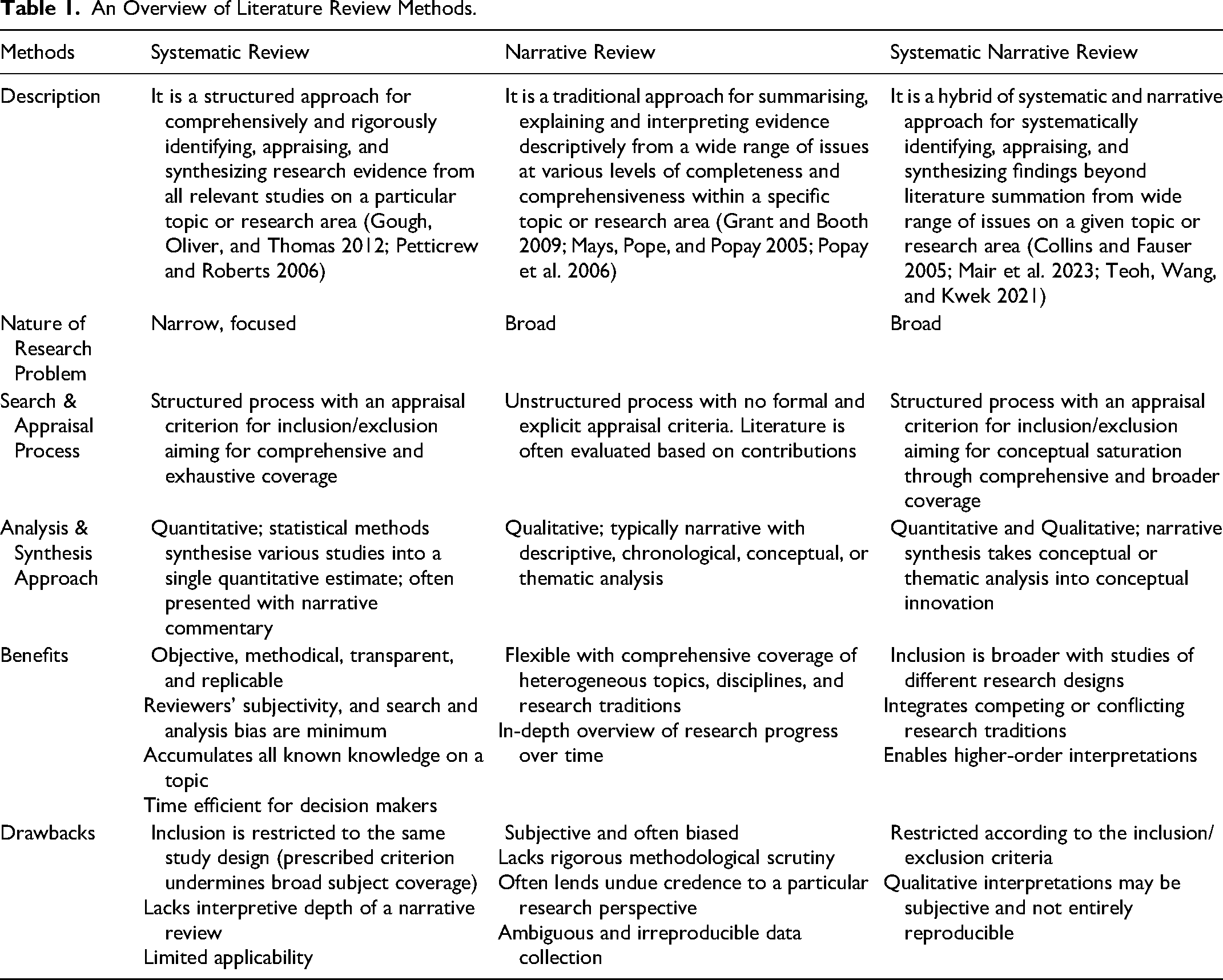
A systematic narrative review can bridge the limitations of the narrative and systematic reviews (Jin and Wang 2016; Mair et al. 2023) and provide evidence-based inferences avoiding opinionated descriptions (Collins and Fauser 2005). It can deal with complex, heterogenous problems within substantive research domains where epistemological, methodological, and paradigmatic diversity exists (Gough, Oliver, and Thomas 2012; Popay et al. 2006). It combines an explicit and rigorously systematic search with a critical review of the literature through a narrative approach resulting in conceptual innovation and theory building (Collins and Fauser 2005; Grant and Booth 2009; Teoh, Wang, and Kwek 2021). Systematic narrative reviews have some parallels to the meta-narrative approach (Wong et al. 2013), but the two differ in their focus. Meta-narrative reviews focus more on the storylines of research traditions – a historical progression of research concerns and methodologies – within a research area over time (Greenhalgh et al. 2005; Hwang and Henry 2021). Wong et al. (2013, p. 9) state that “if exploration of a range of research traditions on the topic is not deemed to be appropriate, the work is probably not a meta-narrative review.” A systematic narrative review has a more theoretical and conceptual focus (Mays, Pope, and Popay 2005; Teoh, Wang, and Kwek 2021). It enables the aggregation of qualitative data from various disparate sources to identify themes and common concerns, determine components of a theoretical concept, integrate theoretical perspectives, or propose new theoretical frameworks (Snyder 2019).
Despite recognizing the advantages of the systematic and hybrid approaches, scholars often diminish literature reviews as an exercise of descriptively summarising the content of the review sample without analyzing in-depth the research across the board and making a substantial and truly valuable contribution (Snyder 2019). A meaningful contribution from a literature review requires going beyond the contents of the review sample by generating new insights in the form of conceptual innovation, new analytical constructs, higher-order interpretations, derived inferences, propositions and hypotheses, new explanatory theories, and extended extant theories (Thomas and Harden 2008). These contributions are critical developments and defining characteristics that elevate the systematic approaches above content summaries of the literature. We provide STM as a structured method to take the findings from a literature review beyond content summaries and make meaningful contributions to advance theory and practice. This method could be adapted for micro-social and organizational problems involving few variables and macro-level wicked problems involving a deluge of variables that are difficult to understand intuitively.
Positioning of STM
Systems research best begins with a conceptual framework that evolves as the research progresses (Sankaran 2017). The conceptual framework is a tentative theory of the phenomena under investigation, and the research problem is a part of the conceptual framework (Maxwell 2013). Miles, Huberman, and Saldana (2019, p. 15) described a conceptual framework as a graphical and/or narrative explanation of “the key factors, variables, phenomena, concepts, participants – and the presumed interrelationships among them.” Maxwell (2013) suggested that scholars can construct conceptual frameworks from their experiential knowledge, existing literature and theories, pilot studies and exploratory research, and thought experiments. We position STM as a structured method to scope and explore existing literature and develop the conceptual frameworks as a tentative theory for further investigation.
Brychkov, Domegan, and McHugh (2022) demonstrated the significance of literature in systems research. They developed a dynamic model of the cycling system for sustainable transport and conducted a cycling-related literature review for systemic stakeholder analysis and system barrier/enabler analysis prior to participatory modeling. They also provided a summary of various methods in macro-marketing and social marketing to capture the systemic complexity of wicked social phenomena. Besides these methods, management science and operational research have provided a wide range of methods for dealing with the wicked complexity of organizational and social phenomena. These methods are grouped as problem structuring methods (PSMs), also called soft systems or soft operational research methods (Ackermann 2012; Mingers 2011; Mingers and Rosenhead 2004). PSMs are defined as “a set of interactive and participatory modeling approaches for dealing with unstructured complex problems, which are characterized by the existence of multiple actors, with differing perspectives and conflicting interests, trying to identify alternatives for solving a problematic situation in an environment with uncertainties” (Gomes Júnior and Schramm 2022, p. 55). The most common PSMs include soft systems methodology, strategic choice approach, strategic options development and analysis, drama theory, and robustness analysis (Smith and Shaw 2019). Several other methods share the spirit of problem structuring methods. These methods include analytic hierarchy process, multi-criteria decision analysis, value-focused thinking, decision conferencing, critical systems heuristics, consensus conferencing, DSRP (distinctions, systems, relationships, and perspectives), nominal group technique, etc. (see Edson and Klein 2017; Mingers 2011; Mingers and Rosenhead 2004 for a detailed overview).
PSMs are effective as a participative process of problem structuring where different stakeholder groups interact to clarify their dilemma and develop a mutual understanding with commitments toward combined resolution. They are commonly deployed in a group format to general organizational, planning-based, or interorganisational complex problems (Mingers and Rosenhead 2004). PSMs are resource-intensive methodologies (Rosenhead 2006), and operationalizing them becomes very difficult if the problem goes beyond (inter) organizational boundaries and spills over to the larger social system involving a large number of stakeholder groups (Mingers 2011). Identifying key system actors at the core of the problem and secondary system actors being influenced at the periphery is often elusive and bringing them together for model building may not always be possible. Similarly, selecting an appropriate PSM for messy situations has always been challenging because of the lack of a definite and organized problem situation (Mingers and Rosenhead 2004). An adequate definiteness of the problem usually emerges well into the investigation. Ackermann (2012, p. 654) argued that “recognising the importance of getting a good appreciation of the situation is paramount” before any further modeling for holistically managing the complexity takes place, and good work in defining the wicked problem increases the likelihood of successfully dealing with it. The STM can organize a problem situation into definite subsystems of cause-and-effect relationships and provide a preliminary understanding of the wickedness of the problem before selecting a PSM or a combination thereof for achieving resolutions. Consequently, we recommend an STM prior to PSMs for comprehensive system actor analysis and determining the broader scope of the systemic complexity before proceeding with facilitated and participatory modeling.
Methodological competence is not enough to apply PSMs successfully. Scholars and practitioners must be skilled in the art of negotiation and facilitation, where sensitivity to the effects of power relations, communication (in)competencies, and fears and anxieties of participants is essential (Franco and Montibeller 2010; Mingers and Rosenhead 2004). Researchers require considerable expertise, training, and experience for the effective deployment of PSMs (Rosenhead 2006). STM is well-suited in such circumstances where early career academics and novice researchers can develop an understanding of the wicked problems without an apprenticeship and rigorous training in facilitation. Lave and March (1993, p. 10) stated that “the best way to learn about model building is to do it,” and an STM can prepare novice scholars and practitioners in this regard.
Stages in Systematic Theory Mapping (STM)
We define STM as a comprehensive and systematic method that utilizes the conventions of system dynamics to synthesize, interpret and illustrate qualitative data from heterogeneous sources (primary and/or secondary research) for defining the complex and wicked real-world phenomena, deciphering the inherent causal complexities, and developing the respective causal theory.
STM is based on the premise of qualitative system dynamics (Jackson 2019; Wolstenholme 1999) and facilitates model conceptualization through problem articulation and dynamic hypothesis formulation (Luna-Reyes and Andersen 2003). Problem articulation involves determining the research problem and the modeling purpose that defines the system boundary. It guides the identification of the variables and their dynamic interactions that drive the system behavior. Following problem articulation, dynamic hypothesis formulation involves describing the system dynamics in the context of the modeling purpose. The dynamic hypothesis represents a feedback theory of the causal structure that generates dynamic behaviors over time. This enables understanding of the dynamic problem and facilitates designing and improving policies and guidelines for intervention.
To demonstrate STM, we take the example of brand externalities as a wicked social problem and develop a causal theory of brand externalities. We begin with problem articulation by systematically examining the extensive branding literature through a systematic narrative review, encompassing diverse theoretical and empirical frameworks and scholarly insights into different branding paradigms. The methodological protocols for systematic reviews aimed at the conceptual model and framework development are adopted (e.g., Paul and Mas 2020; Shashi et al. 2018; Teoh, Wang, and Kwek 2021; Wu, Yang, and Wu 2021). We apply systems thinking (Meadows 2008; Sterman 2000) and configurational thinking (Furnari et al. 2021; Misangyi et al. 2017) to identify key branding variables and respective stakeholder influences and proceed with establishing causal relationships among them to explain the wicked complexity of brand externalities. Subsequently, the dynamic hypothesis is developed and illustrated through a causal loop diagram.
There are two concerns to be noted before we describe the STM, illustrated in Figure 1. First, we assert that theory mapping can also proceed from qualitative data obtained from primary research (surveying people); thus, a mirror method is also illustrated. We argue that the literature-based method should be the first step before investing time and resources into primary qualitative data collection. Second, although the process is illustrated and described below sequentially, the steps followed are overlapping, recursive, and iterative, depending upon the emerging insights from each stage. For example, identifying the research questions and the scoping search and review occurred simultaneously, driving the respective adjustments when required. Keeping in view the iterative nature of the STM, we recommend taking notes for each decision made at each step of the process. These notes would provide the justifications for the tasks performed and enable recalling the process, which is particularly critical at the last stage for authenticity and transparency.
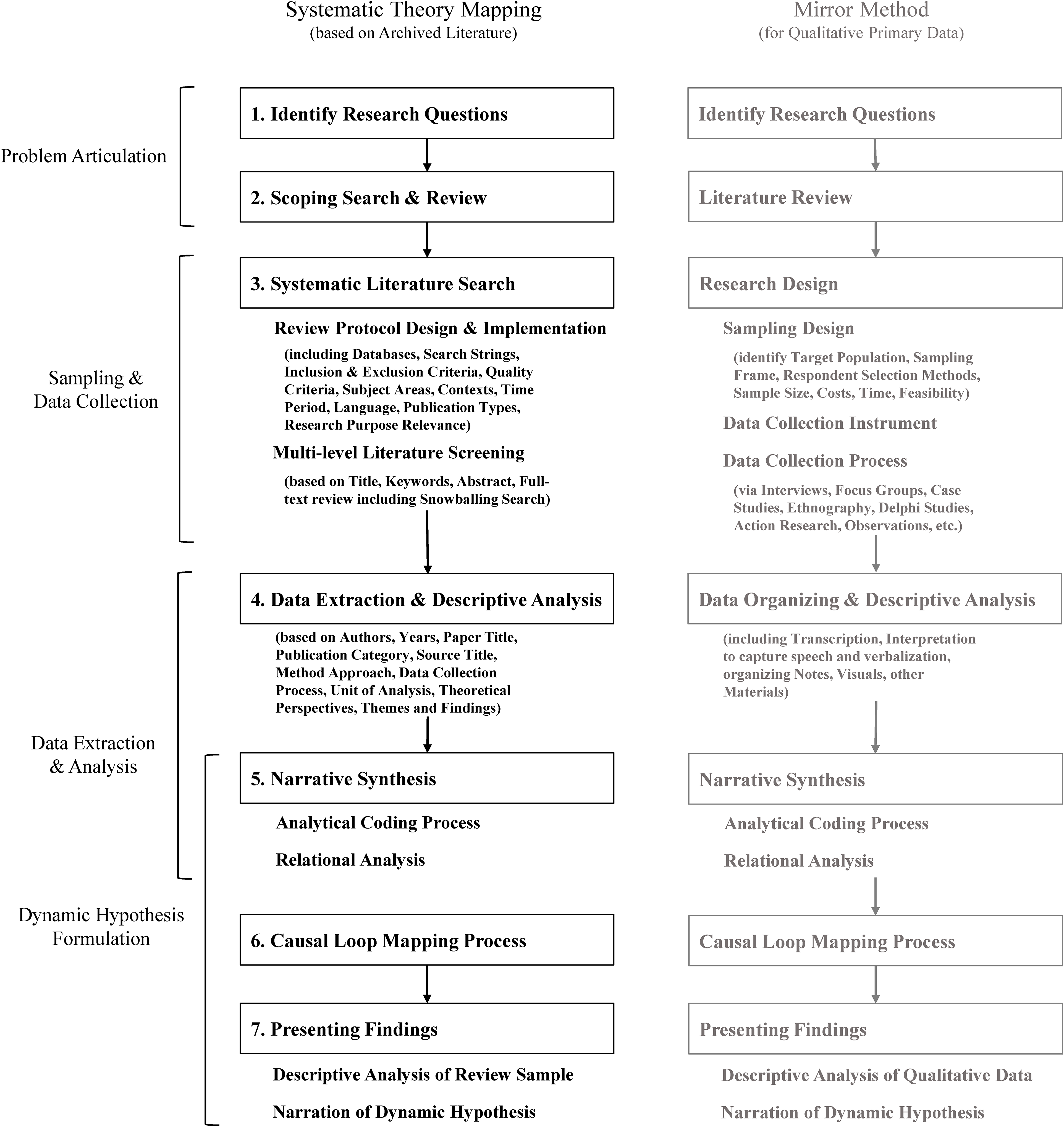
Systematic theory mapping (STM).
We proceed to describe the detailed step-by-step process of the STM below:
Step 1: Identifying Research Questions
A primary question for any literature-based STM exercise should be: What are the attributes and relationships identified in the extant literature on a focal phenomenon?
This question is broad and may become multi-faceted depending on the context. Accordingly, it should be modified and further broken down. The research questions should be developed iteratively because they may require amendments or additions during data collection, analysis, and mapping (Mays, Pope, and Popay 2005; Wolfswinkel, Furtmueller, and Wilderom 2013). They determine the purpose and scope of the theory mapping task. They set a boundary and enable the identification of the important variables and secondary issues relevant to the problem. This is important to determine if the mapped causal theory is simple enough to be comprehended and complex enough to reflect the wicked reality.
The research questions serve as a point of reference and provide a theoretical structure that guides the proceeding tasks and decisions made, not just the literature search and data extraction but also the synthesis of higher-order interpretations required for theory development (Thomas and Harden 2008). Identifying the right questions may or may not require involving the relevant stakeholders and conducting small-scale primary research, but it would always involve secondary research from archived sources.
Worked Example
To decipher the wicked complexity and develop a conceptual model that narrates the causal mechanisms of brand externalities, we asked the following primary question: What are the causal attributes and relationships identified in the extant literature involved in producing brand externalities?
Step 2: Scoping Search and Review
A scoping search precedes the systematic search of the literature (Farias et al. 2019; Hwang and Henry 2021). The scoping search is a preliminary informal search and review of the literature to map out the subject, identify leading scholars and highly cited scholarly work, determine commonly used terminologies, and develop search strings and eligibility criteria for the systematic literature search and review (Arksey and O’Malley 2005; Petticrew and Roberts 2006). The insights from the scoping search refine the research questions and guide the designing of a formally structured review protocol for conducting the systematic literature search (Kitchenham 2004; Mays, Pope, and Popay 2005).
Worked Example
In our research context, the co-researchers conducted the scoping search and review using various combinations of the term brand(ing) with value, value creation, value destruction, and social consequences, such as brand value, brand value creation, branding consequences, etc. These terms emerged intermittently during scoping as they relate to the creation of positive and negative externalities. While providing a basis for designing the structured review protocol, this preliminary literature review enabled clarifying the review purpose and expanding the primary research question. Following are the research questions finalized iteratively during the STM process:
What are the key factors driving brand value? What feedback mechanisms emerge from the interactions among these factors? How can brand value creation and destruction be configured? How does the value spills over as brand externalities within the system and beyond?
Step 3: Systematic Literature Search
The systematic literature search involves obtaining a review sample from databases by designing and implementing the review protocol and subjecting the database output to a multi-level screening process.
Review Protocol Design & Implementation
The review protocol defines the source databases, search strings, and inclusion/exclusion criteria based on the publication types, quality, language, research area, and research scope. It structures the literature search and should be developed in advance according to the review purpose and research questions. Designing and implementing the review protocol may occur recursively, requiring it to be restricted or relaxed before the final literature search (Wolfswinkel, Furtmueller, and Wilderom 2013). The review protocol should be relaxed if it results in a narrow review sample and restricted if it produces an unmanageably large and redundant review sample. The justification and transparency of the choices made in designing and implementing the review protocol are critical because the quality of the theory mapping exercise significantly depends upon the included literature (Snyder 2019).
Multi-Level Literature Screening
A multi-level screening process should be followed to determine the eligibility of articles to be included in the review (Cerchione and Esposito 2016; Gupta et al. 2020; Kitchenham 2004). The articles should first be filtered based on the title and keywords, followed by an inclusion based on the abstract before the full-text review. A snowballing search and review are also essential to incorporate highly cited and influential publications beyond the database output. The stages in the multi-level screening process are as follows:
Inclusion Based on Title and Keywords
Screening the database output based on the article title and keywords excludes articles not directly focused on the focal phenomenon. The abstracts of the excluded articles should be subjected to a manual screening process to ensure that the articles relevant to the review purpose, despite a discrepant title and keywords, are not excluded.
Inclusion Based on the Abstract
The second level of screening involves reading the abstracts to determine the suitability of the articles for the review. Despite the search terms being present, the articles should be excluded if the research does not critically analyze the focal phenomenon or some related aspect. The excluded articles should be iteratively reviewed and discussed among all the authors to validate the exclusion.
Inclusion Based on the Full-Text Review
The list of articles for review further narrows based on the full-text reading. The excluded articles should be iteratively cross-reviewed and discussed to reach a consensus on proceeding to analysis with only those that fit the review purpose. The full-text review often leads to re-evaluating the review purpose and redefining the research questions.
Inclusion Based on Snowballing
The full-text review usually reveals some frequently cited scholarly work, including peer-reviewed journal articles, books, and book chapters, that either do not appear in the database search or get filtered out eventually. These publications may be relevant to the review purpose and fulfill the criteria outlined in the review protocol. Thus, a snowballing search and review are essential to obtain a representative purposive and theoretical review sample.
Worked Example
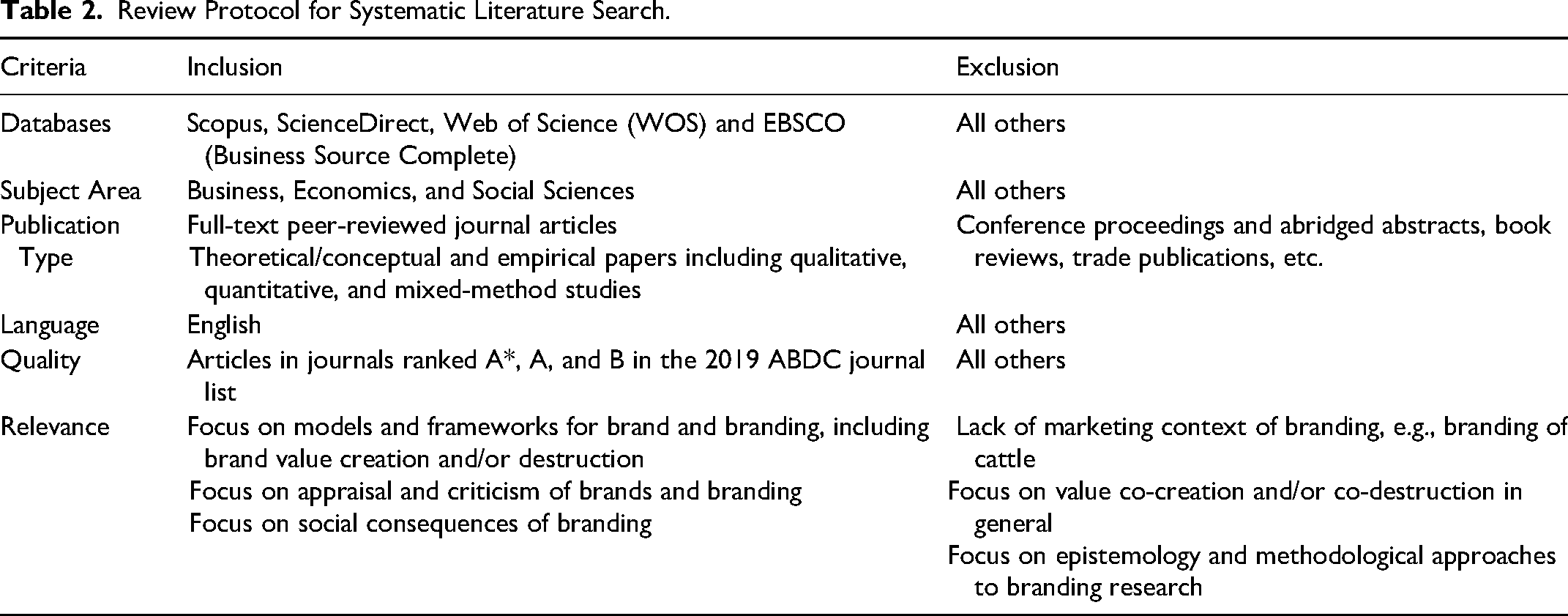
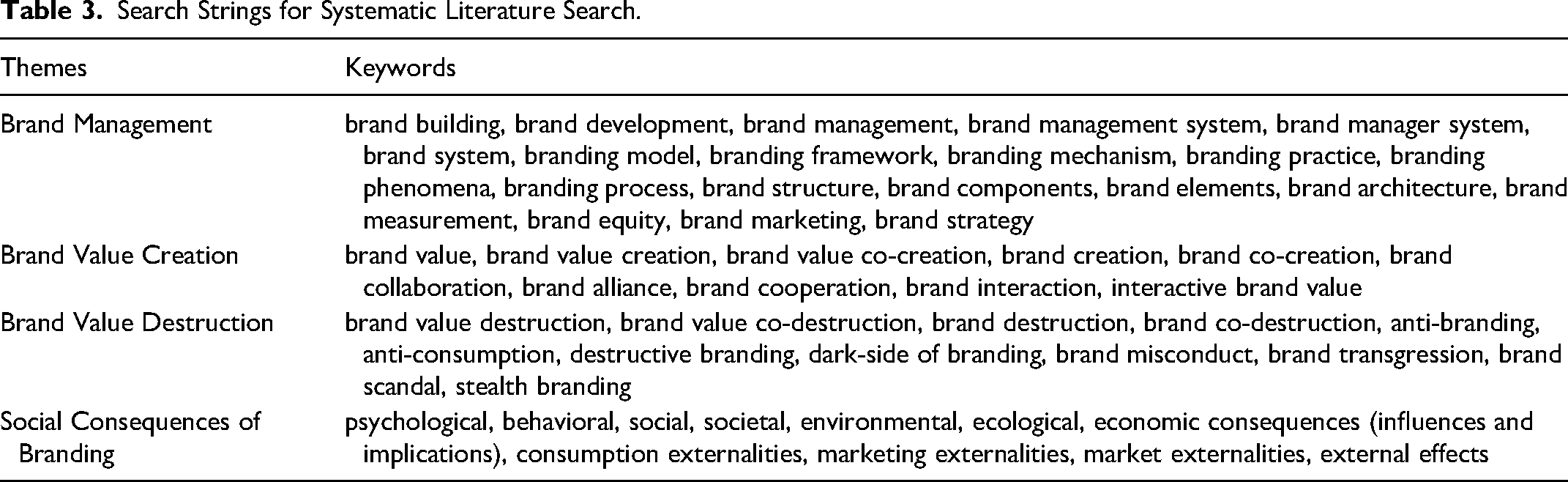
The review protocol was designed and implemented to conduct an identical search in different databases, that included Scopus, ScienceDirect, Web of Science, and EBSCO Business Source Complete (see Table 2). Considering the enormous scale and scope of branding research for over forty years, the database search involved different search strings based on various combinations of the identified keywords (see Table 3). The search was limited to peer-reviewed journal articles published in English. Both conceptual and empirical publications involving qualitative, quantitative, and mixed-method research were included. The database output comprised 3,147 articles after removing duplicates. Lastly, the obtained articles were benchmarked for quality assurance according to the 2019 Australian Business Deans Council (ABDC) journal list (Ng, Sweeney, and Plewa 2020; Yang, Khoo-Lattimore, and Arcodia 2017), and articles in journals ranked A*, A, and B were included. This resulted in 2,516 articles for the manual multi-level screening process.
Review Protocol for Systematic Literature Search.
Search Strings for Systematic Literature Search.
Following the quality assurance, the review sample was further narrowed to 329 based on the article title, keywords, abstract and full-text reading (see Figure 2). The articles were included if the research involved any of the following three conditions:
theoretical and/or empirical conceptualization of models and frameworks for brands, branding, and related phenomena like brand value creation and/or destruction. appraisals and criticisms of brands and branding practices and behaviors. analysis of intentional/unintentional, social/societal consequences of branding practices and behaviors at the micro- and/or macro-level in the short- and/or long term.
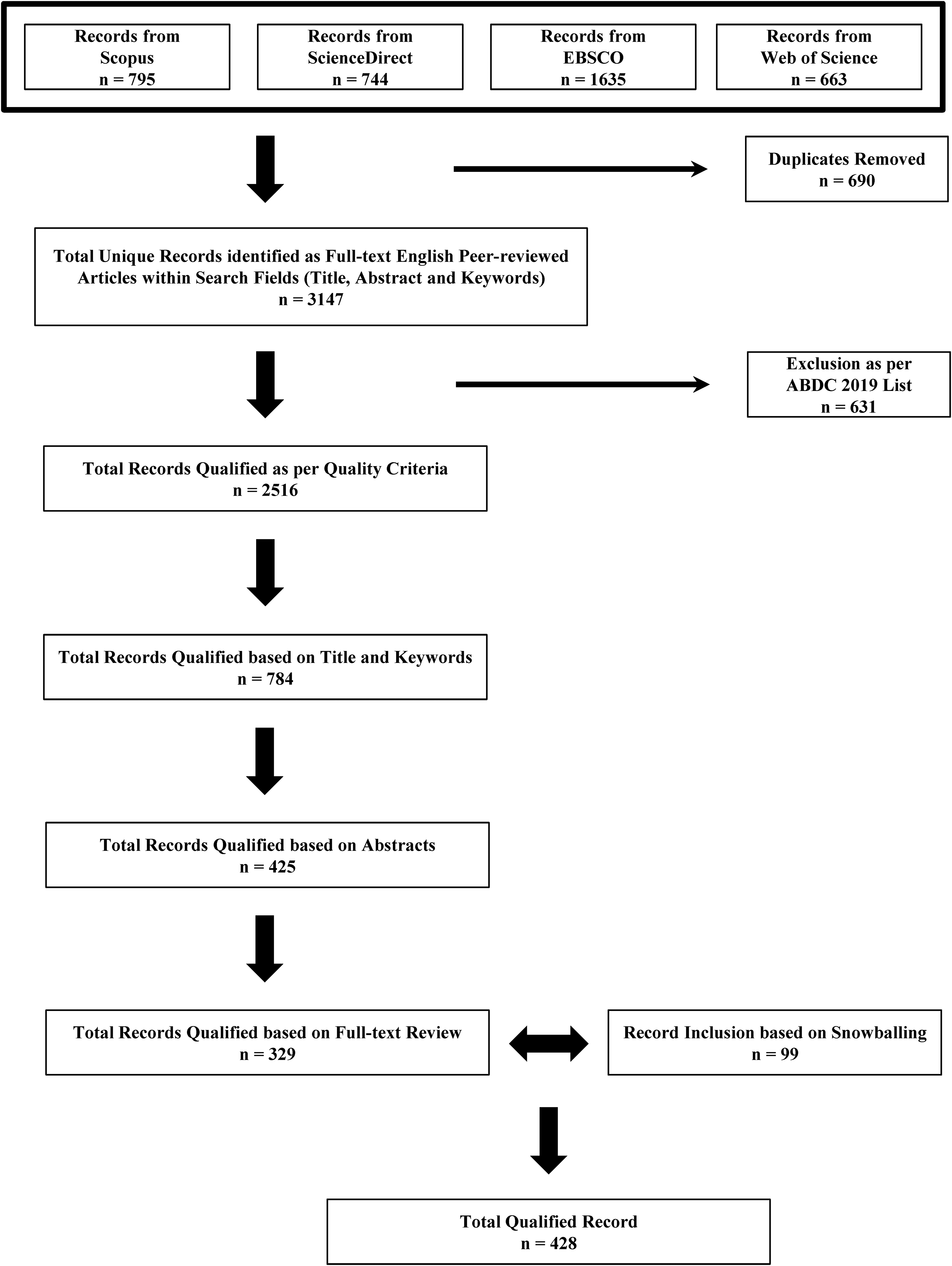
Systematic literature search & screening process.
The review protocol and the multi-level screening process initially excluded books and book chapters. The full-text review revealed such frequently cited publications that were identified as fulfilling the review purpose and impacting the theoretical and empirical development of different branding research paradigms. This led to the snowballing search based on the guidelines by Wohlin (2014). The backward and forward snowballing produced 99 publications, including journal articles, books, and book chapters. The final review sample contained 406 journal articles, 19 books, and 3 book chapters (n = 428) subjected to data extraction and analysis.
Step 4: Data Extraction and Descriptive Analysis
Comprehensive and consistent data extraction should be achieved using a structured data extraction tool (Anees-ur-Rehman, Wong, and Hossain 2016; Cerchione and Esposito 2016; Gupta et al. 2020; Shashi et al. 2018). The data extraction tool systematically organizes and aggregates the review sample across multiple dimensions, such as publication years, source categories and titles, publishers, citation indices, authors and institutions analysis, countries or geographical distribution, study contexts and industries, subject areas and disciplines, topic areas, research designs, methodological orientations, data collection techniques, theoretical perspectives, units of analysis, etc. These dimensions serve as the basis for descriptive analysis that summarises the general characteristics of the review sample and provides methodological justification for narrative synthesis. Based on the review purpose, the reviewers should reach a consensus on using all or some of these descriptive analysis dimensions. They should extract the data individually and subsequently compare and resolve disagreements through discussion.
Worked Example
The data extraction and analysis of our review sample were carried out across the following dimensions:
Publications over time Publications by methodology Publications by source category and titles Publications by theoretical perspectives Publications by units of analysis
The descriptive analysis summarised the general attributes of the review sample, indicating the complexity and diversity in branding research. The review sample indicated that branding research gained momentum in the early 1990s, after Aaker's book Managing Brand Equity (Aaker 1991), Keller's Journal of Marketing paper (Keller 1993), and a special issue run by the Journal of Marketing Research in 1994. Figure 3 shows that publication activity has steadily advanced since then, with occasional drops attributed to article exclusions. The year 2009 saw a peak in publications within the review sample mainly owing to the two special issues, Anti-consumption (Feb) and Advances in Brand Management (Mar), in the Journal of Business Research.
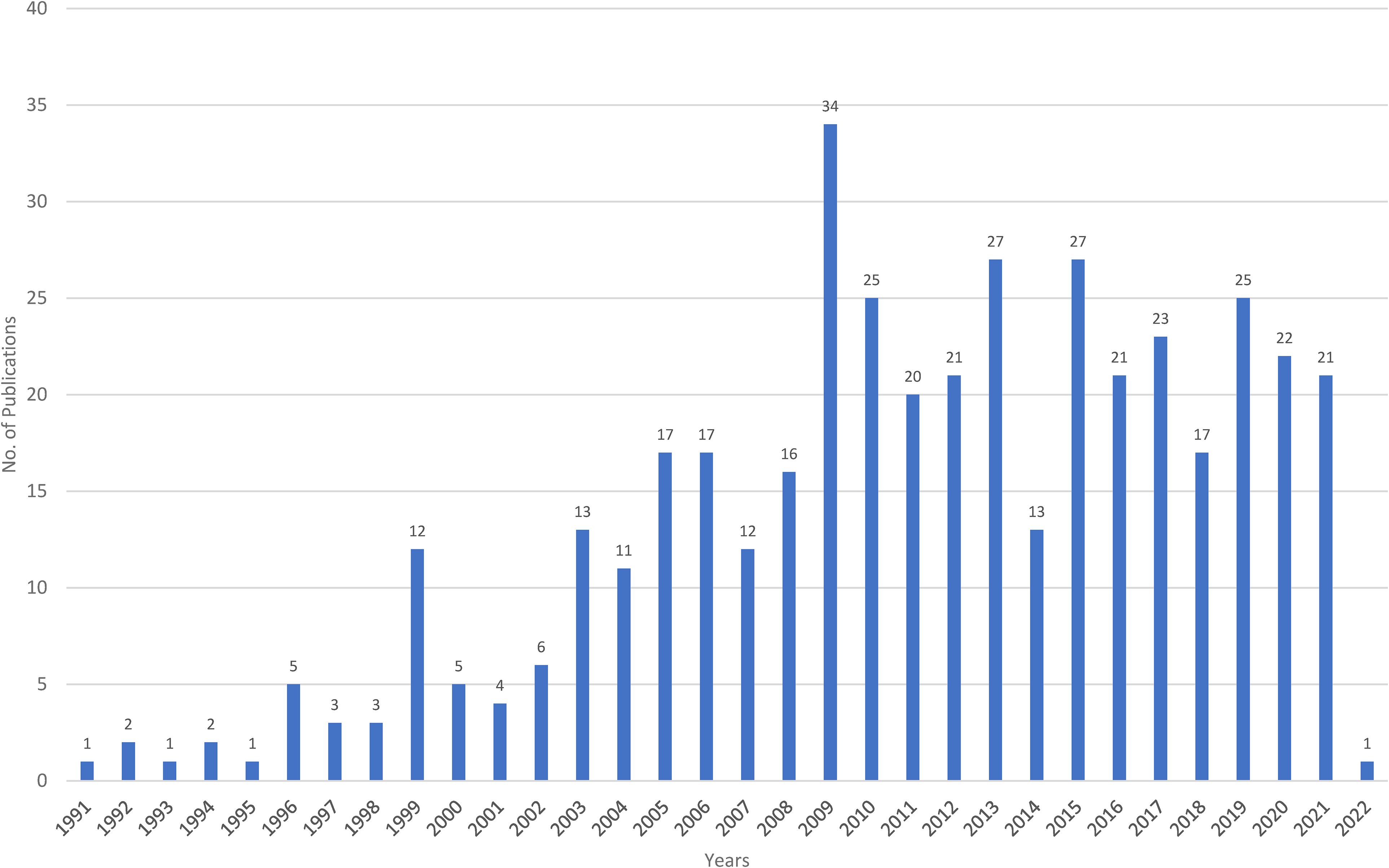
Publication frequency over time.
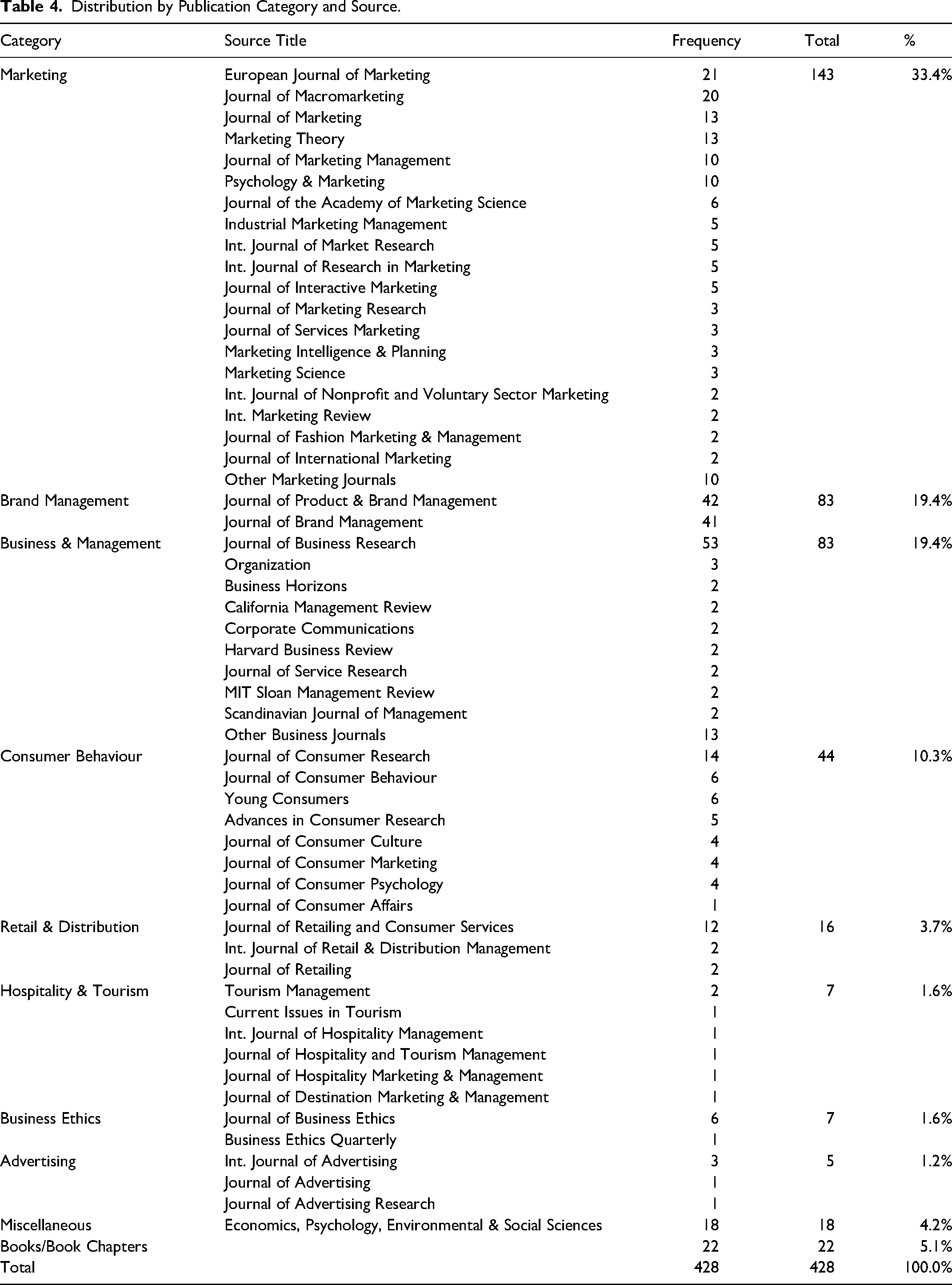
The review sample included articles published in 91 different journals. Table 4 shows the frequency of branding research appearing in most reputed research outlets and subject categories within the review sample. More than half of the review sample (52.8%) comes from specialized branding and marketing journals. Among these, the Journal of Product & Brand Management, Journal of Brand Management, European Journal of Marketing, and Journal of Macromarketing are highly notable. Journal of Macromarketing, with its broader scope of marketing discourse than other marketing journals, is publishing branding research involving branding ideology, branding history, and evolution, and the impact of branding on society and vice versa (e.g., Berthon and Pitt 2018; Eckhardt and Bengtsson 2010; Gao 2013; Heller and Kelly 2015; Kravets 2012; Levy and Luedicke 2013; Petty 2011). Besides these, the Journal of Business Research is the largest outlet for branding research. Other subject areas featuring branding research, including Consumer Behaviour, Hospitality and Tourism, Retail and Distribution, Business Ethics, Advertising, Economics, Psychology, and Environmental and Social Sciences, confirm that branding research is extremely heterogenous and finds its place in an array of different contexts and fields.
Distribution by Publication Category and Source.
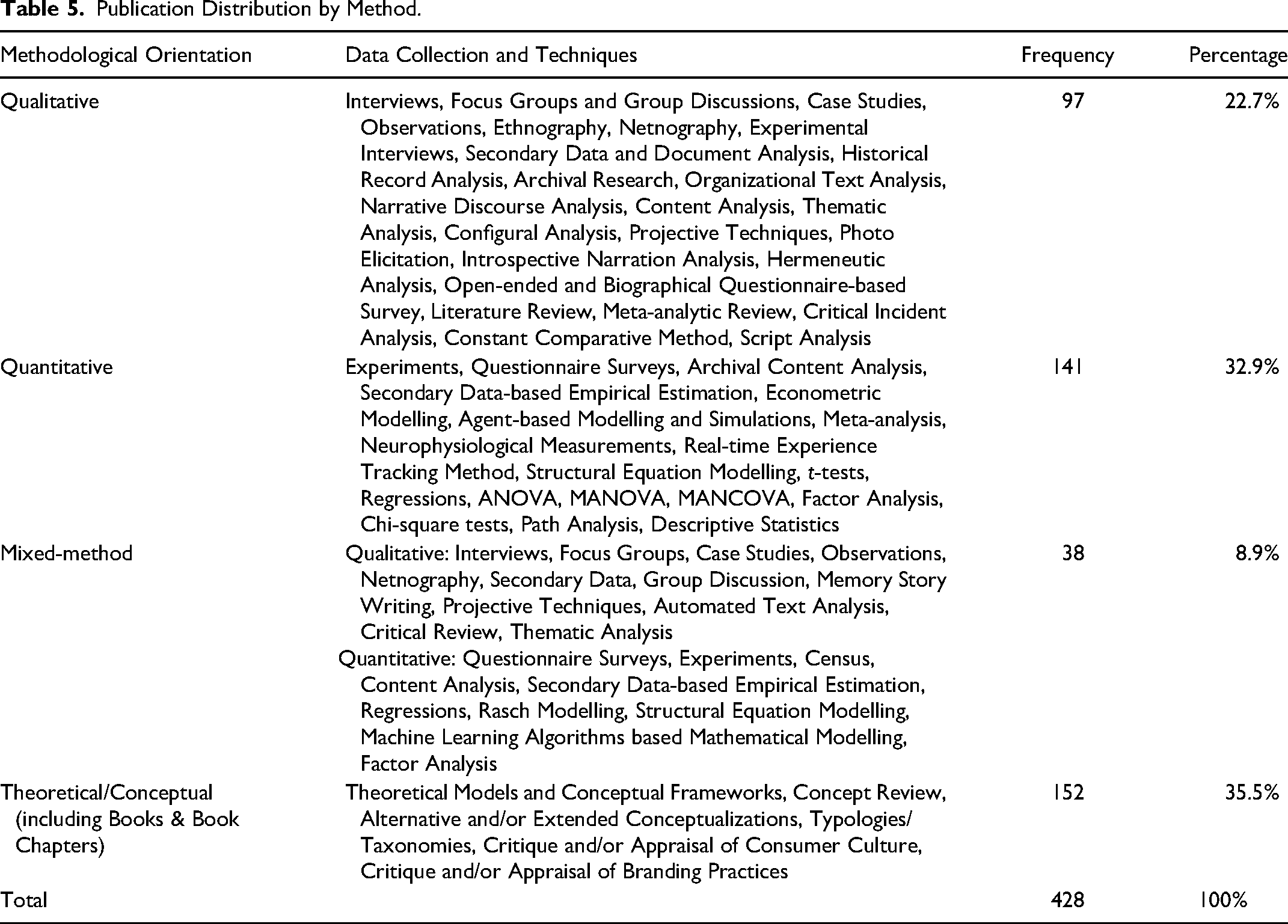
A significant proportion of publications in the review sample is theoretical/conceptual (see Table 5), owing to the nature of the sample – seeking debates and arguments around social/societal consequences of branding practices and consumer culture. The empirical research finds quantitative approaches as the method of choice, with experiments, surveys, and empirical estimations as preferable techniques. Most qualitative research preferably uses case studies, interviews, observation, and ethnography.
Publication Distribution by Method.
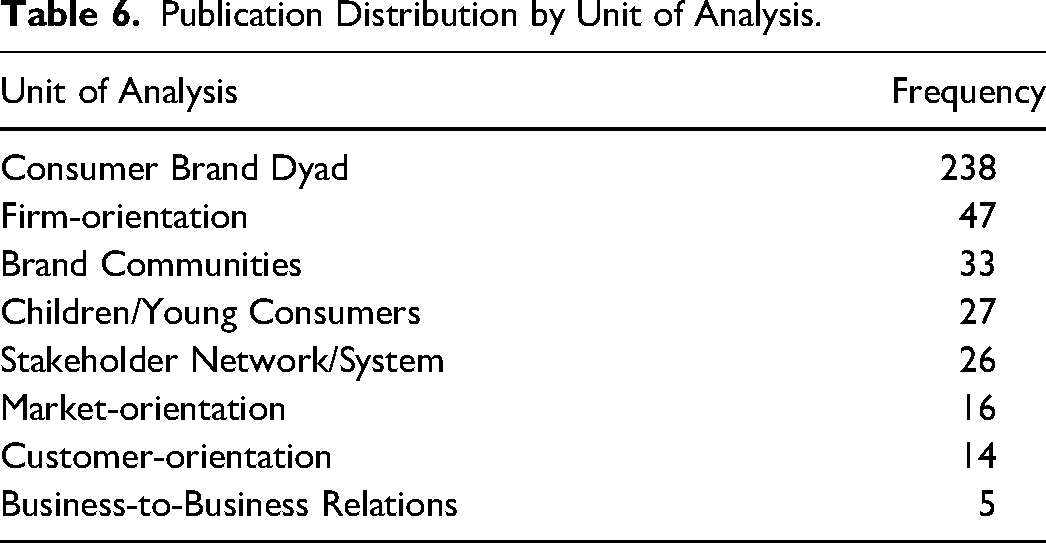
Consumer-brand relationships analyzed either at the level of the consumer-brand dyad, young consumers’ socialization and development, or brand communities (see Table 6) dominate within the review sample. A small number of articles were firm-oriented, focusing on managers, branding experts, and managerial issues (e.g., Alexander 2009; Kumar and Christodoulopoulou 2014; Rego et al. 2022). Articles with customer orientation focused on customers’ attitudinal and behavioral tendencies towards consumption in general, with brands as merely a secondary element within the discourse (e.g., Iyer and Muncy 2009; Lim 2017). The stakeholder system perspective is established in research on brand management (e.g., Hatch and Schultz 2010; Iglesias and Ind 2020) but not as prevalent in research focusing on social/societal consequences of branding (e.g., Botterill and Kline 2007). This finding is important for our research context and indicates future research opportunities as well.
Publication Distribution by Unit of Analysis.
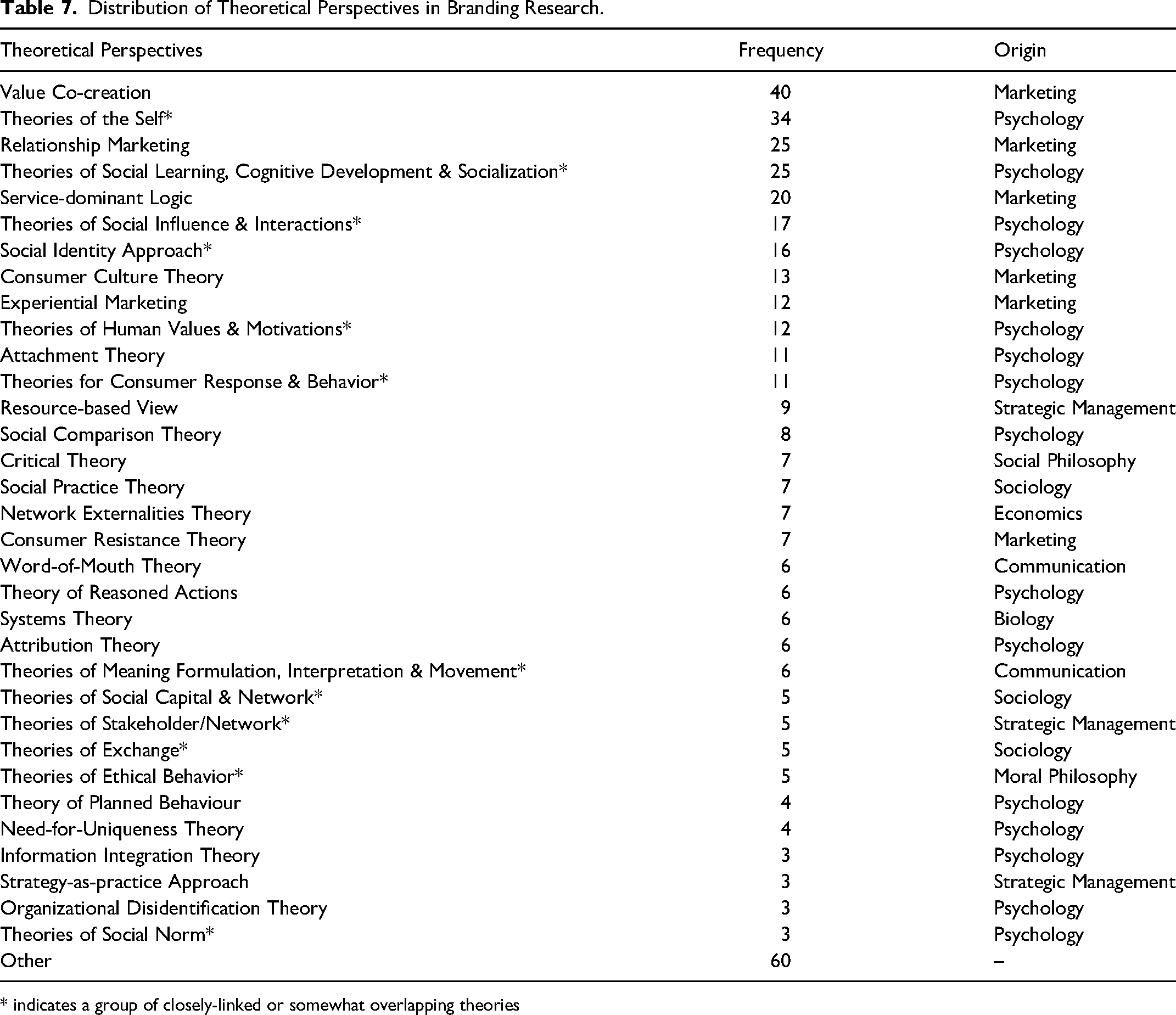
Branding research utilizes a wide variety of theoretical perspectives. It is essential to dig into the origin of these theoretical perspectives to enhance the scholarly understanding of branding research dimensions and provide an opportunity to further the field by integrating theories from other social and scientific disciplines. Table 7 is a critical contribution and finding in this paper, providing essential guidance for any researcher interested in the dimensions and dynamics of Brand Development and Management, Brand Value Creation and Destruction, Consumption Culture, Consumers’ Self, Consumer-brand Relationships and Behaviours, Brand Misconduct, Social Influences and Social Consequences of Branding and Anti-branding.
Distribution of Theoretical Perspectives in Branding Research.
* indicates a group of closely-linked or somewhat overlapping theories
Value co-creation and service-dominant logic dominate as a theoretical lens for conceptually and empirically developing and testing branding models and frameworks (e.g., Hollebeek et al. 2021; Iglesias and Ind 2020; Payne et al. 2009). Besides these, Consumer Culture Theory, Relationship Marketing, Theories of Consumers’ Self, Social Identity Approach, Attachment Theory, Experiential Marketing, Social Influence Theory, and Theories of Human Values and Motivations are the most popular within branding research. A vast majority of these theories originated in Psychology (including Cognitive, Behavioural, Social, and Organizational Psychology) and Sociology. Theories of Consumer Socialization and Cognitive Development are common in research analyzing young consumers’ brand behaviors (e.g., Harris et al. 2015; Watkins et al. 2017). Similarly, Critical theory, Consumer Resistance Theory, Systems Theory, Attribution Theory, and Theories of Ethical Behaviour are common pillars in research providing critiques and appraisals of branding practices and analyzing brand misconduct and anti-branding (e.g., Martin and Smith 2008; Østergaard, Hermansen, and Fitchett 2015).
Due to a long unmanageable list of theories identified, several closely linked and somewhat overlapping theories were grouped. For example, Theories of the Self include Self-congruity Theory, Implicit Self-esteem Theory, Self-knowledge Theory, Self-verification Theory, Self-consciousness Theory, etc.; Theories of Human Values & Motivations include Theory of Human Values, Balance Theory, Cognitive Consistency Theory, Theory of Human Motivation, Motivated Reasoning Theory, etc.; and Others include scarcely used theories appearing either once or twice within the review sample, e.g., Generational Theory, Optimal Distinctiveness Theory, Signalling Theory, Cue Consistency Theory, Theory of Social Construction of Reality, Theory of Camouflage, Rarity Principle, etc.
Step 5: Narrative Synthesis
Narratives are the raw material, the building blocks for theory, and a coherent, integrated causal narrative provides explanatory knowledge (Gabriel 2017). A plausible narrative is an integral part of a proposed model. It legitimizes the model and improves its believability (Hartmann 1999; Morgan 2001). The use of narratives is gaining traction among social science scholars (Shenhav 2015), and social phenomena explored using narratives can lead to comprehensive research agendas (Gabriel 2017).
Narratives are “particular types of accounts involving temporal chains of inter-related actions undertaken by characters with purposes, emotions and desires, or events that affect such actors positively or negatively” (Gabriel 2017, p. 64). They are valuable modes of thought and devices to disseminate meaning, communicate experience, transfer knowledge, affirm identity, inculcate learning, internalize social conventions, exercise persuasion, power, and leadership, and understand the goals and values of social groups (Rhodes and Brown 2005; Shenhav 2015). While integrating discourses of temporally organized thematic configurations, narratives tell a story of behaviors, activities, and processes culminating into an outcome (Emerson and Frosh 2004; Polkinghorne 1995).
Synthesis is critical to any systematic review process and refers to the phase where new insights, knowledge, or theories are produced by identifying, extracting, and integrating data from multiple sources (Barnett-Page and Thomas 2009; Palmatier, Houston, and Hulland 2018). Strike and Posner (1983, p. 346) suggested that “it involves some degree of conceptual innovation, or the invention or employment of concepts not found in the characterisation of the parts as means of creating the whole.” Thematic analysis is the most common method used for synthesizing findings across the extant literature, but narrative synthesis, developed lately, introduces a greater degree of systematicity and synthesis (Mair, Ritchie, and Walters 2016; Popay et al. 2006). Narrative synthesis differs from thematic analysis based narrative reviews in “moving beyond a summary of study findings to attempt a synthesis which can generate new insights or knowledge and be more systematic and transparent” (Mays, Pope, and Popay 2005, p. 12). It is useful when the systematic review sample contains a heterogeneous body of literature with diverse research designs (Popay et al. 2006), which is almost always the case with social science research (Gough, Oliver, and Thomas 2012). It enables the integration of research-based qualitative and quantitative studies as well as non-research-based evidence, providing knowledge and decision support (Mays, Pope, and Popay 2005). Narrative synthesis allows exploring relationships in the findings from the literature review without requiring data transformation and tells an evidence-based story (Barnett-Page and Thomas 2009; Lucas et al. 2007; Mair, Ritchie, and Walters 2016). A narrative synthesis is most helpful for a review designed to develop an explanatory theory of a phenomenon (Mays, Pope, and Popay 2005) and thus, it is a critical step in an STM.
Narrative synthesis involves a segmentation process through analytical coding (Samuel and Peattie 2016; Seuring and Gold 2012; Wolfswinkel, Furtmueller, and Wilderom 2013), followed by a reintegration process through relational analysis (Robinson 2011). The procedure is described below:
Analytical Coding Process
A thematic content analysis approach is suitable for analytical coding. Content analysis is common in marketing research (e.g., Fehrer and Nenonen 2020; Roberts and Pettigrew 2007; Wang et al. 2021), and systematic/literature reviews (e.g., Kienzler and Kowalkowski 2017; Papastathopoulou and Hultink 2012). Content analysis is a powerful technique to provide inputs for system dynamics modeling (Luna-Reyes and Andersen 2003). Krippendorff (2019, p. 24) defines it as “a research technique for making replicable and valid inferences from texts (or other meaningful matter) to the contexts of their use.” It categorizes the textual data into themes and allows quantification of findings to identify dominant themes and make generalizations (Mays, Pope, and Popay 2005).
Analytical codes can be derived deductively and inductively through content analysis (Seuring and Gold 2012). The deductive approach determines the analytical dimensions and categories based on the existing theory before data analysis. Contrarily, the inductive approach is explorative, where analytical codes emerge from the data iteratively during the review process. For an STM, we recommend inductive coding, the bottom-up approach entrenched in grounded theory. Grounded theory is a flexible, inductively driven methodology that aims to discover and develop a conceptualization, or an integrated mid-range theory of the social phenomenon grounded in the data (Grix 2018; Saunders, Lewis, and Thornhill 2019; Thornberg and Keane 2022; Tweed and Charmaz 2012). It facilitates theory building by evaluating and extending existing literature through a concept-based analytical synthesis (Samuel and Peattie 2016; Wolfswinkel, Furtmueller, and Wilderom 2013). This synthesis involves three overlapping stages:
In stage 1, the reviewers independently perform excerpting and develop the free codes. Each paper in the final review sample is read line-by-line, and insights within the text relevant to the review purpose, are highlighted. All highlights – the phrases, sentences, or paragraphs – comprise the excerpted data pool re-read and coded according to the grounded meaning and content. These free codes, often supplemented with ancillary notes and comments about the theoretical and methodological insights, provide input for the next hierarchical coding stage. In stage 2, the reviewers perform a comparative analysis of the free codes and develop descriptive themes (axial codes) based on the intra- and inter-relations between the free codes. Similarly, in stage 3, a comparative analysis of the descriptive themes produces analytical themes that relate directly to the subject, context, and scope of the review or the specific research questions.
These stages occur iteratively, going back and forth between the review sample, excerpted data pool, free codes, descriptive themes, and analytical themes. Grounded theory involves simultaneous data collection and analysis informing each other (Thornberg and Keane 2022). The research commences with collecting an initial data set through purposive sampling and analyzing it inductively to generate a preliminary assortment of data codes and categories. This preliminary round guides subsequent theoretical sampling, data collection, and analysis (searching, reading, excerpting, coding, and relating). Theoretical sampling is data-driven and involves collecting new data sets to elaborate and refine the categories, define their properties and relationships among them, and describe their implications on the theory (Pickard 2017). For these reasons, grounded theory is well-suited to an STM that requires an initial scoping review, followed by the systematic and snowballing search and review, as a way “to pursue theoretical lines of enquiry rather than to achieve population representativeness” (Saunders, Lewis, and Thornhill 2019, p. 207). The iterative data collection and analysis continue until the entire review sample is analyzed and theoretical and conceptual saturation is achieved. Theoretical and conceptual saturation occurs when data extraction and synthesis provide no new insights (Meyer and Mayrhofer 2022; Thomas and Harden 2008; Tweed and Charmaz 2012; Wolfswinkel, Furtmueller, and Wilderom 2013). Although grounded theory grants the use of existing theory prior to the data collection (scoping review prior to systematic review), theoretical sensitivity is advised to maintain the inductive data-driven stance in theory building (Pickard 2017; Saunders, Lewis, and Thornhill 2019).
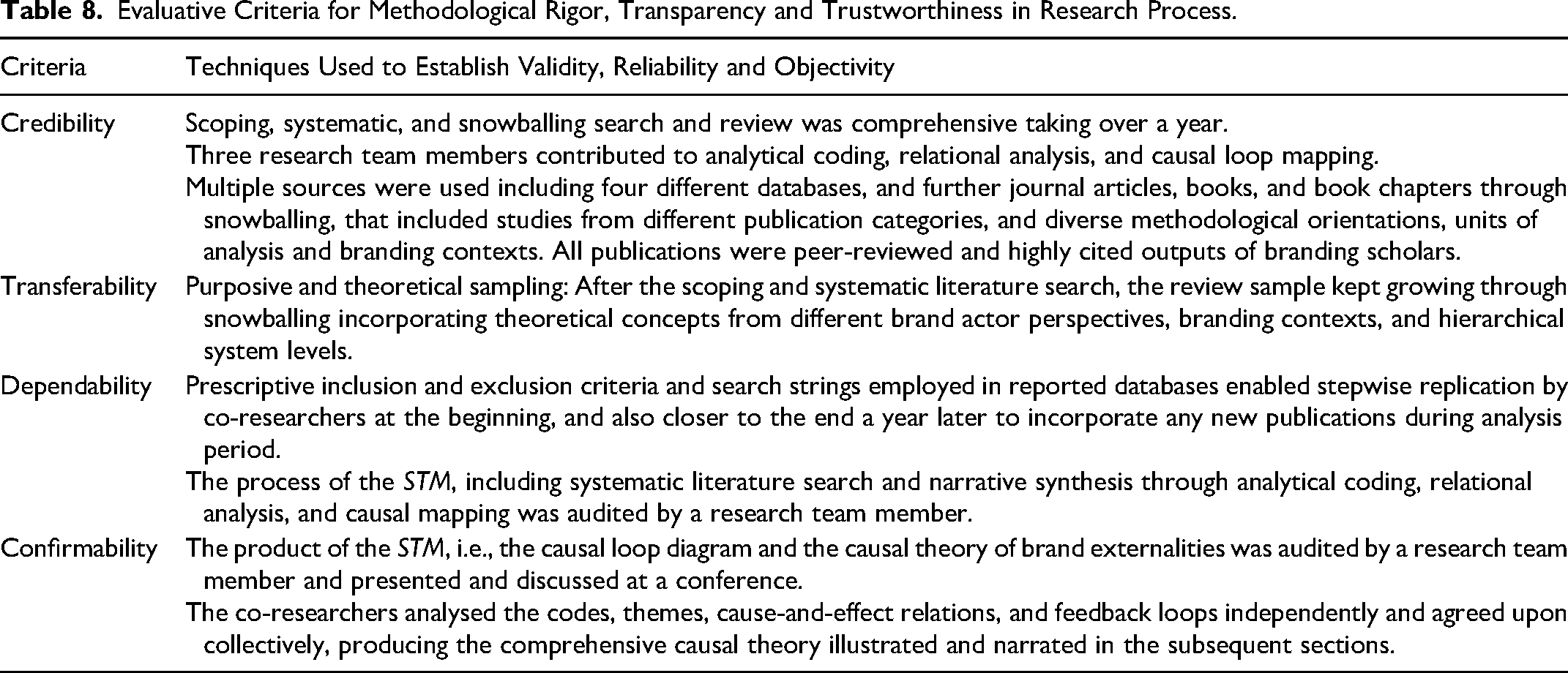
Methodological rigor in the STM is critical, as in any humanistic inquiry (Hirschman 1986), to ensure transparency and trustworthiness of the research process and findings. Several approaches have been proposed in the literature and categorized broadly as qualitative and quantitative methods for this purpose (see Duriau, Reger, and Pfarrer 2007; Krippendorff 2019; Rust and Cooil 1994; Seuring and Gold 2012; Weber 1990 for comparisons and details). Quantitative measures may be complicated for qualitative researchers and are argued to focus more on internal validity rather than external validity (Mays, Pope, and Popay 2005). Researchers often apply discursive alignment of interpretations in qualitative data analysis (Seuring and Gold 2012), notably when the focus is more on the deeper meaning and latent content of the data instead of the manifest content and text statistics (Duriau, Reger, and Pfarrer 2007). Lincoln and Guba (1985) described credibility, transferability, dependability, and confirmability as essential quality criteria to ensure internal and external validity, reliability, and objectivity and establish trustworthiness in the research process. These criteria are widely accepted and remain most influential in qualitative research (see Creswell 2013; Flint, Woodruff, and Gardial 2002; Whittemore, Chase, and Mandle 2001 for an overview and application of these and other evaluative criteria).
Relational Analysis
The relational analysis is a key step in an STM, owing to the focus on developing and mapping theory. It begins during analytical coding and establishes meaningful higher-order narrative parts that reveal structure and process, culminating in a model or theory (Mair et al. 2023; Mays, Pope, and Popay 2005; Siddaway, Wood, and Hedges 2019; Yang, Khoo-Lattimore, and Arcodia 2017).
The analytical coding process produces a thematic hierarchy of free codes, descriptive themes, and analytical themes based on the conventions of Comparative and Conceptual Part-Whole Relations (Robinson 2011). Multiple free codes are linked under a higher-order descriptive theme providing a conceptual whole. Similarly, numerous descriptive themes are linked under a higher-order analytical theme providing a conceptual umbrella (Gupta et al. 2020; Seuring and Gold 2012; Thomas and Harden 2008). Hierarchical analytical codes and themes are the concepts or groups of concepts that determine a node explaining a small part or unit within the social phenomenon under review. This is when the theory, conceptualization, or explanation of a phenomenon begins emerging (Wolfswinkel, Furtmueller, and Wilderom 2013).
In addition to the comparative and conceptual part-whole relations, causal relations are critical in an STM to unearth the underlying causal mechanisms in the focal phenomenon. Identifying causation is integral to system dynamics (Sterman 2000) and, subsequently, theory building (Robinson 2011). A cause is “an act or event or a state of nature which initiates or permits, alone or in conjunction with other causes, a sequence of events resulting in an effect” (Rothman 1995, p. 91). Causal relations indicate path dependence where an occurrence precedes an event or outcome (Jaccard and Jacoby 2020; Robinson 2011). Theory-building research uses the literature as a guideline to identify important causal relations (Wacker 1998). The excerpted data pool and iteratively the review sample, whenever needed, provide grounded insights on causation among free codes, descriptive themes, and analytical themes. Once identified, the causal relations should be mapped through a causal loop diagram.
Worked Example
Narrative synthesis, as per our research context, involved a distillation of the review sample into a summarised form for developing the causal theory of brand externalities. It commenced with analytical coding and culminated in identifying the cause-and-effect variables through relational analysis. Following Thomas and Harden (2008) and Gupta et al. (2020), we utilized iterative cycles of inductive coding, examples of which are shown in Figure 4.
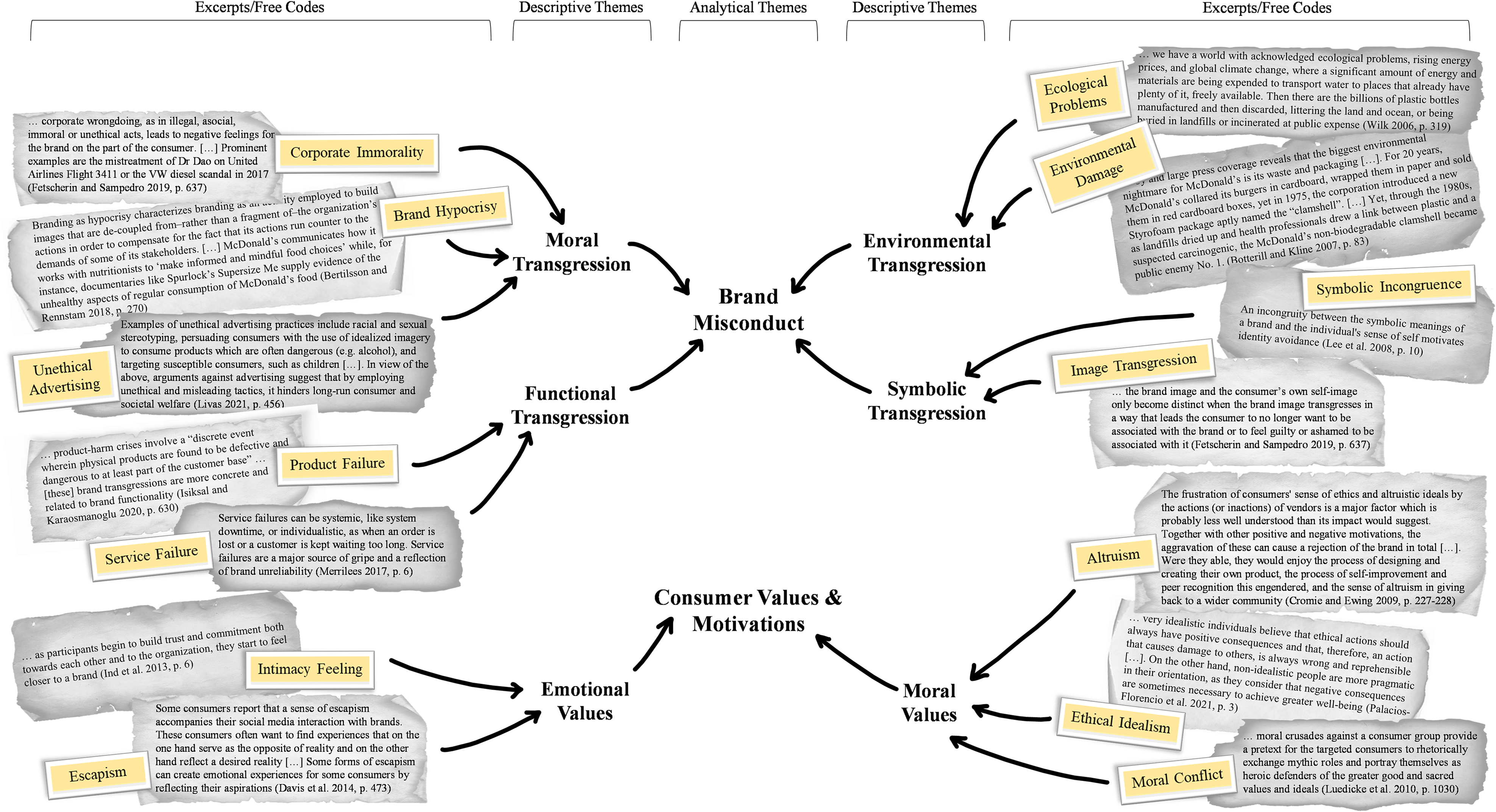
Examples from analytical coding process.
In stage 1, the excerpting exercise generated 2,614 free codes. In stage 2, identifying the comparative and conceptual part-whole relations between the free codes resulted in 288 descriptive themes. For example, the free codes, namely Vandalism, Boycotts, Shoplifting, Wardrobing, Trashing, Complaining, and Avenging, were grouped to form a descriptive theme called ‘Negative Consumer-to-brand Actions.’ Similarly, Bullying, Physical Assault, Territorial Behaviour, Trolling, Trash-talking, Customer-to-customer Incivility, Negative Consumer Evaluation, and Negative Peer Evaluation were grouped into ‘Negative Consumer-to-consumer Actions.’ The free codes with clear conceptual complementation were grouped into respective descriptive themes. However, some free codes were found to be hybrid with the potential to be part of more than one descriptive theme. For example, consumer motivation of ‘Entertainment’ predicting content consumption on a brand's social media pages could be grouped within ‘Emotional Consumer Value’ and ‘Experiential Consumer Value.’ Similarly, ‘Amplified Word-of-Mouth’ could be included within ‘Brand Communication and Promotion’ as well as within ‘C2C Interactions’. In such instances, literature on the hybrid free code was explored further to develop a deeper understanding and group it into the most appropriate descriptive theme.
In stage 3, analyzing the interrelations between descriptive themes finally resulted in 48 analytical themes. For example, the descriptive themes Brand Credibility, Conscientiousness Associations, Brand Ethicality, Perceived Brand Globalness, Heritage Associations, Origin Associations, Product Category Associations, and Sustainability Associations described different perceptions consumers hold within their memories about characteristics and attributes brands possess; thus, they were grouped as ‘Brand Associations.’ Similarly, Consumer Vulnerability, Consumer Ethics, Consumer Environmental Responsibility, Consumer Social Responsibility, Consumer Skepticism, Materialism, and Consumer Vanity defined different psychological and behavioral tendencies of consumers and were grouped as ‘Consumer Attributes.’
Besides conceptually re-integrating the excerpted data pool into descriptive and analytical themes, the relational analysis continued synthesizing the narrative by identifying the causal relations involved in producing brand externalities. The identified causal relations indicated a dismembered causal structure of brand externalities in the form of cause-and-effect variable pairs. These causal relations were aggregated and illustrated during the causal loop mapping process (see Step 6 below).
Methodological rigor and analytical transparency in this research were ensured using Lincoln and Guba's (1985) and Hirschman's (1986) criteria for quality evaluation (see Table 8). These criteria were implemented through discussion, comparison, and reflection (discursive alignment), using a peer debriefing process (Gupta et al. 2020).
Evaluative Criteria for Methodological Rigor, Transparency and Trustworthiness in Research Process.
Step 6: Causal Loop Mapping Process
The causal loop mapping can be done in system dynamics software, such as Stella, Vensim, Kumu, Powersim Studio, Dynamo, etc. A causal loop diagram illustrates the feedback structure of the system that describes causal mechanisms and determines system outcomes over time. It is based on the causal links (cause-and-effect relationships) among variables shown using arrows. Developing and comprehending causal loop diagrams require mapping conventions to be understood. The first convention pertains to the link polarity that determines the nature of the cause and effect between variables. A positive (+) link polarity indicates the same direction of change in the effect variable based on the change in the cause variable. On the contrary, a negative (–) polarity is assigned to an inverse effect where there is an opposite change in the effect variable when the cause variable changes.
The second convention relates to the nature of the feedback loops when the causal links aggregate. A feedback loop is a chain of successive causal links that start at a variable and end at the same variable, indicating a closed path of action and information. There are two types of feedback loops: reinforcing (R) and balancing (B). Reinforcing loops are autocatalytic and strengthen change over time, resulting in either growth or decline. Balancing loops are self-limiting and goal-seeking. They oppose change over time and stabilize the system, contributing to inertia and supporting the status quo (Richardson 2011; Sterman 2001). A feedback loop is reinforcing if all the causal links within the loop are either positive or negative. The nature of a feedback loop with mixed positive and negative causal links can be reinforcing or balancing based on the number of negative causal links within the loop. Such a feedback loop is reinforcing if it holds an even number of negative causal links and balancing if an odd number of negative links exists within it (Lane 2008; Sterman 2000).
Worked Example
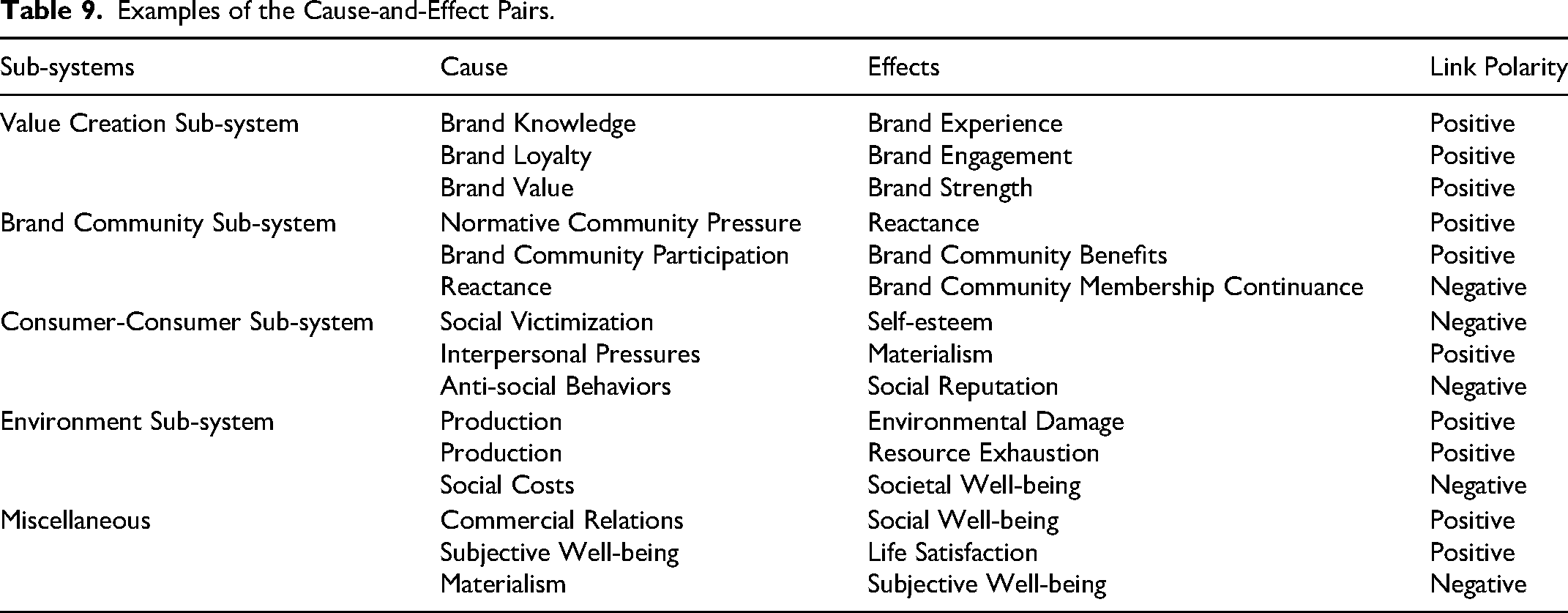
Relational analysis (in Step 5 above) initiated the causal mapping process by creating the pairs of cause-and-effect variables (causal relations). A list of all causal relations was developed and organized according to their interplay within the identified subsystems (see Table 9). Subsequently, each causal relation was assigned a link polarity before being included in the diagram. Figure 5 illustrates the aggregate of all causal relations in the causal loop diagram developed in Vensim. The causal map was created in stages. First, a core feedback loop of brand value creation was built (see Loop R1 in Figure 5), including 13 branding variables. Table 10 gives a few key contributors and the frequency of these variables appearing within the review sample. The core feedback loop was followed by including further causal loops organized from the causal relations within the respective subsystems. All the loops, when aggregated, represented the social consequences of branding over time.
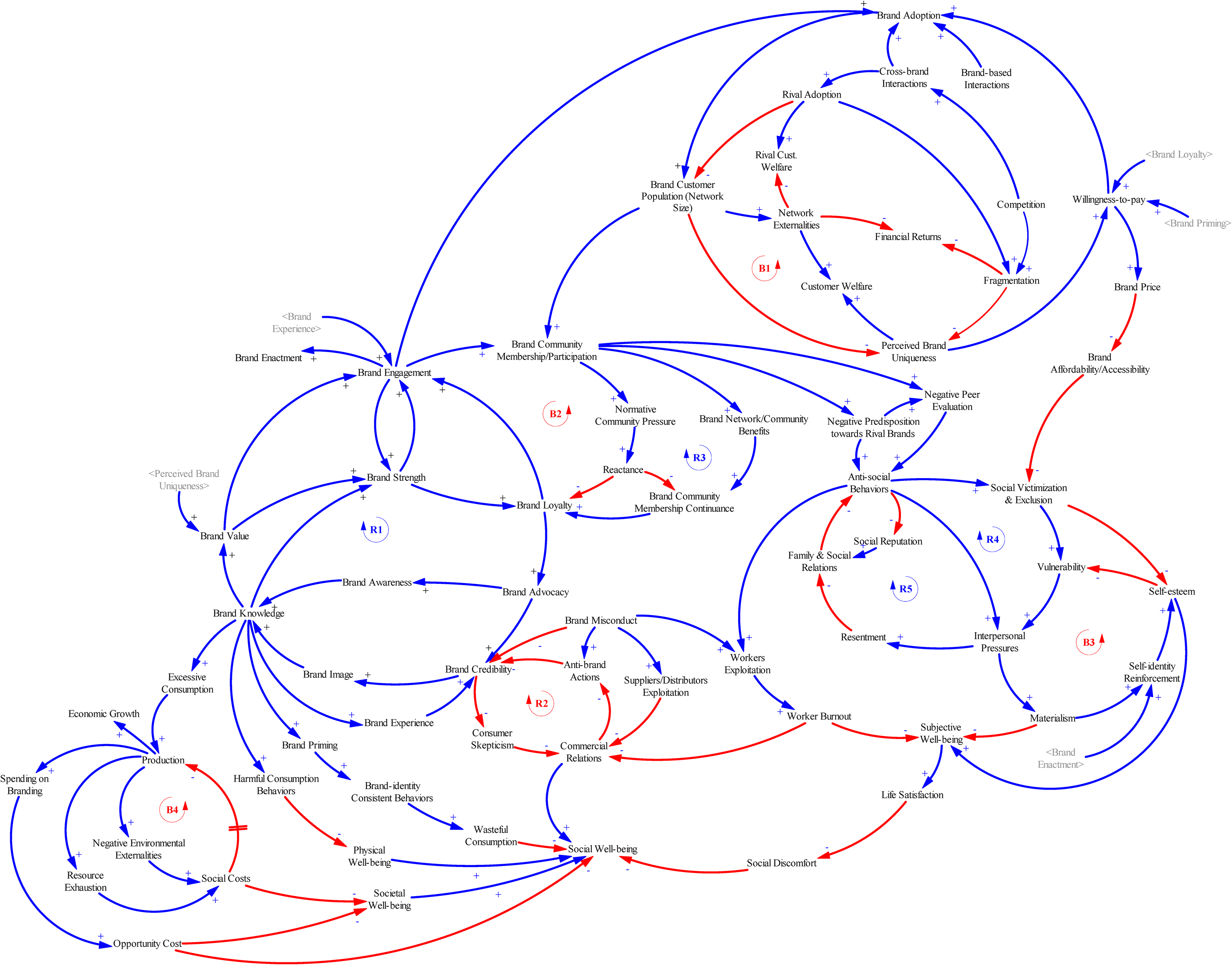
Causal loop diagram for the causal theory of brand externalities.
Examples of the Cause-and-Effect Pairs.
Branding Variables Comprising the Core Feedback Loop.
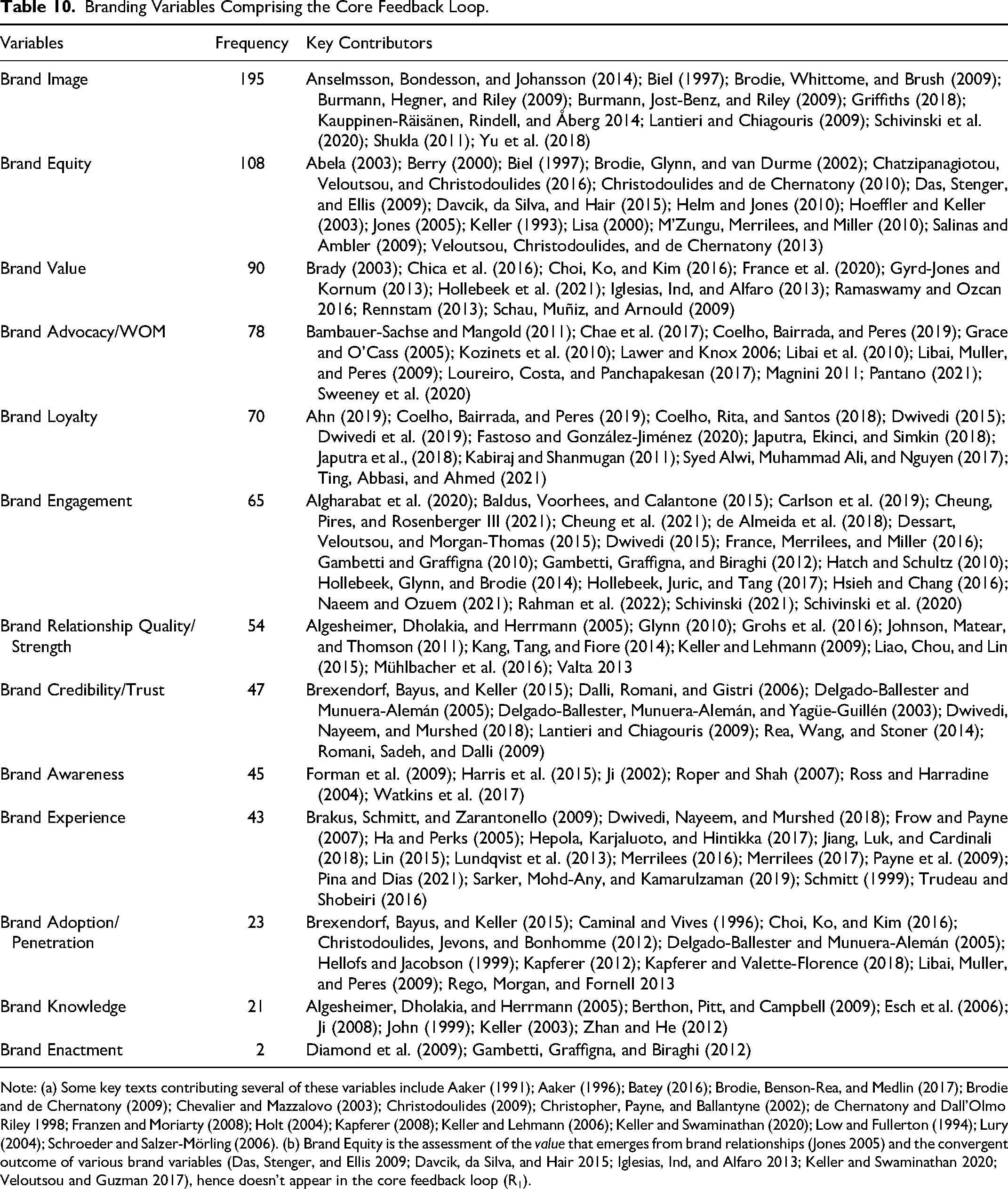
Note: (a) Some key texts contributing several of these variables include Aaker (1991); Aaker (1996); Batey (2016); Brodie, Benson-Rea, and Medlin (2017); Brodie and de Chernatony (2009); Chevalier and Mazzalovo (2003); Christodoulides (2009); Christopher, Payne, and Ballantyne (2002); de Chernatony and Dall’Olmo Riley 1998; Franzen and Moriarty (2008); Holt (2004); Kapferer (2008); Keller and Lehmann (2006); Keller and Swaminathan (2020); Low and Fullerton (1994); Lury (2004); Schroeder and Salzer-Mörling (2006). (b) Brand Equity is the assessment of the value that emerges from brand relationships (Jones 2005) and the convergent outcome of various brand variables (Das, Stenger, and Ellis 2009; Davcik, da Silva, and Hair 2015; Iglesias, Ind, and Alfaro 2013; Keller and Swaminathan 2020; Veloutsou and Guzman 2017), hence doesn't appear in the core feedback loop (R1).
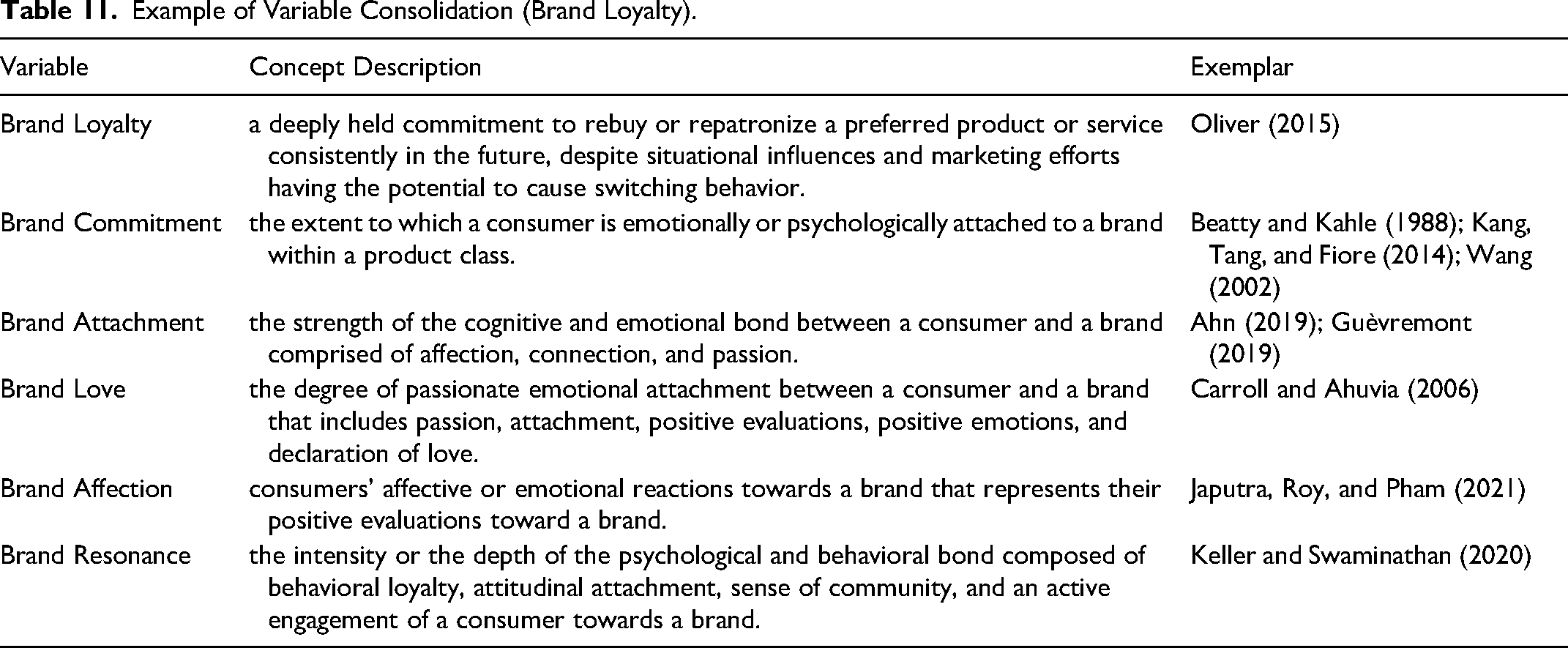
Identifying variables from the free codes, descriptive and analytical themes, and their respective causal relationships was an iterative process. This process sometimes required consolidating a few variables by virtue of parsimony, depending upon the variable concept and the identified relationships. For example, Table 11 shows how several variables were consolidated into one variable (brand loyalty) because of conceptual similarity and similar cause-and-effect pairs resulting from these. Additionally, sometimes new and auxiliary variables that mediated feedback paths emerged during discussions of causal loop diagramming. The systematic narrative review was considered to determine and confirm these variables and their respective relationships with other variables. When aggregated, the causal links and the resultant feedback loops produced the complete causal loop diagram (see Figure 5), providing a basis for narrating the causal theory of brand externalities.
Example of Variable Consolidation (Brand Loyalty).
Step 7: Presenting Findings
The findings from an STM would have two dimensions: the insights obtained from the descriptive analysis of the review sample and the causal theory hypothesized from narrative synthesis and causal loop mapping. These findings can be presented and described using various visualizations, such as tables, graphs, flow charts, and diagrams, depending upon the comprehensiveness and creativity of the researchers. These visualizations, accompanied by the respective descriptions, improve comprehensibility, and help reach a broader academic and non-academic audience.
Worked Example
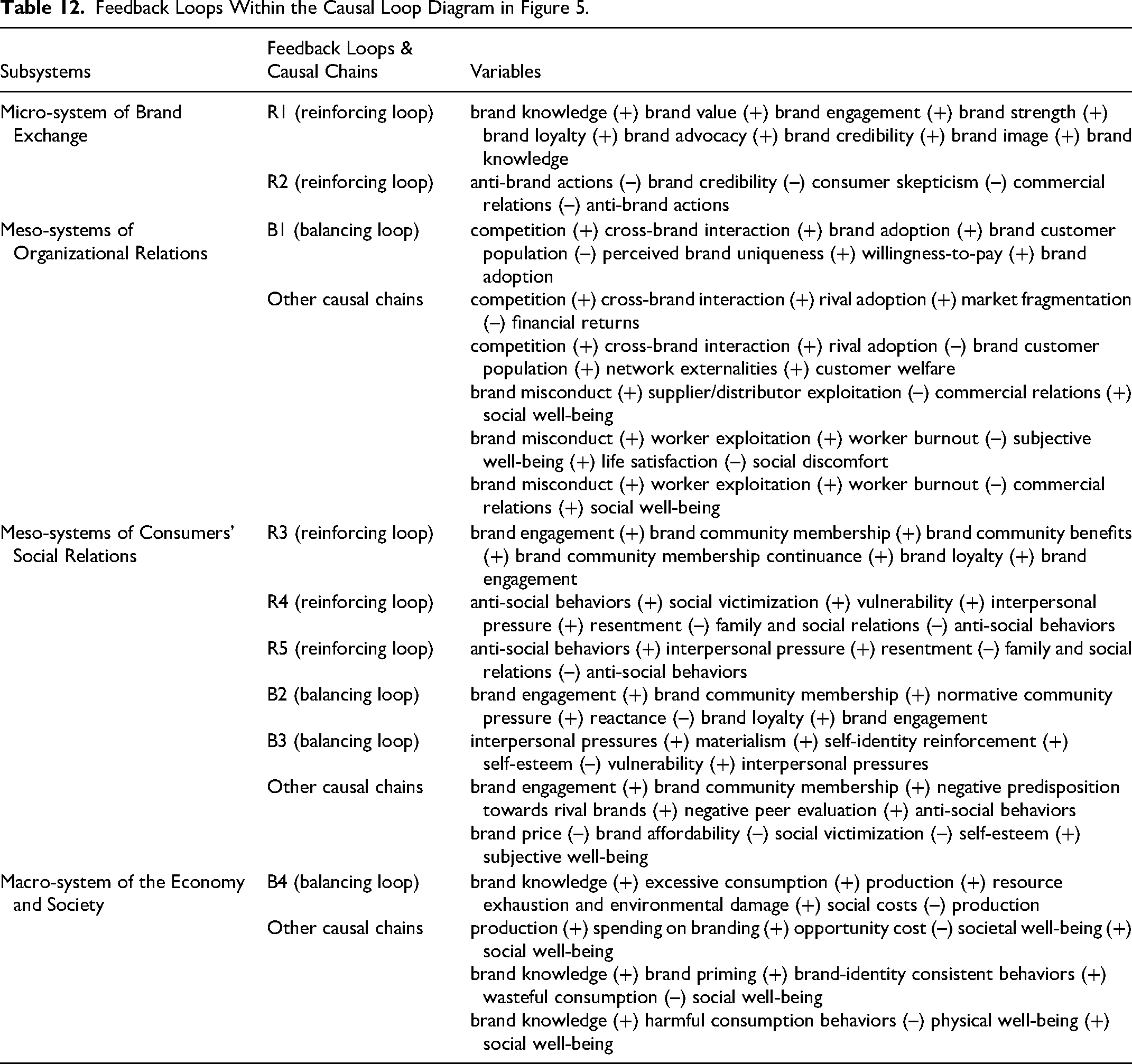
The findings from the descriptive analysis of our review sample are presented in Step 4 above. Given below is the dynamic hypothesis of our causal theory of brand externalities, illustrated in Figure 5. The feedback loops formulating our dynamic hypothesis are organized and described within multiple interacting hierarchical subsystems. Table 12 provides an overview of the feedback loops and causal relations connecting these subsystems. The interconnectedness of these subsystems demonstrates the wicked complexity of brand externalities and elucidates the systemic influences of branding on different brand actors.
Feedback Loops Within the Causal Loop Diagram in Figure 5.
Micro-Systems of Brand Exchange
The micro-system of brand exchange is based on the dyadic consumer-brand relationship and features the brand value creation process, where managerial and consumer inputs assimilate facilitated by contextual stakeholders like employees, channel members, media, etc.
Consistent brand communication and delivery from the firm at various brand touchpoints is a critical managerial input that potentiates consumer-brand interactions and, subsequently, brand knowledge and experiences (Loop R1) (France, Merrilees, and Miller 2015; M’Zungu, Merrilees, and Miller 2010). The knowledge of strong, favorable, and unique brand associations strengthens brand relationship quality that drives brand loyalty intentions and behaviors (Grohs et al. 2016; Hajli et al. 2017; Mühlbacher et al. 2016; Valta 2013). Similarly, a positive experience of the consumer-brand relationship, mediated with secondary sources of brand knowledge, invokes the co-creation of brand value (Payne et al. 2009). Consumers engage with and adopt the brand when perceived brand value is high (Itani, Kassar, and Loureiro 2019), and this further improves brand relationship quality and brand loyalty (Hollebeek 2011). Loyal consumers, in turn, engage more with the brand and exhibit pro-brand behaviors like brand adoption, repeat purchases, reduced switching, willingness-to-pay premium, brand advocacy, and word-of-mouth (WOM) referrals (Jiang, Luk, and Cardinali 2018; Kabiraj and Shanmugan 2011). Positive WOM improves brand credibility and enhances brand awareness (Coelho, Bairrada, and Peres 2019; Libai et al. 2010). Brand credibility is a higher-order construct comprised of brand likeability, brand expertise (competence), and brand trustworthiness (Brexendorf, Bayus, and Keller 2015; Dwivedi, Nayeem, and Murshed 2018). These attributes are important brand associations contributing to brand image and reputation (Dwivedi et al. 2019; M’Zungu, Merrilees, and Miller 2010). Eventually, brand image and awareness, constituting brand knowledge, become essential to creating brand equity and value (Keller and Swaminathan 2020). This core feedback loop is reinforcing unless the growth is stunted by brand misconduct and negative word-of-mouth.
Besides brand value creation, the micro-system of the consumer-brand dyad also features brand value congestion and destruction from brand misconduct and anti-brand actions causing externalities for the respective brand-exchange actor (see Loop R2). Brand misconduct or transgression is an intentional or unintentional “violation of the implicit or explicit rules guiding consumer–brand relationship performance and evaluation” (Aaker, Fournier, and Brasel 2004, p. 2). It can be functional (product/service failure), symbolic (image incongruence), environmental (unsustainable), and moral/social (unethical or socially irresponsible) (Botterill and Kline 2007; Fetscherin and Sampedro 2019; Wilk 2006). At the micro-level, brand misconduct is usually functional or symbolic. It often leads to micro-actions of anti-branding if the negative impact of the misconduct is not readily mitigated (Trump 2014). The negative consumer actions may be firm-directed (e.g., negative word-of-mouth, shoplifting, vandalizing, etc.), brand employee-directed (e.g., incivility, physical assault, stalking, etc.), or other customer-directed (e.g., customer-to-customer incivility, trolling, etc.) (Fombelle et al. 2020; Funches, Markley, and Davis 2009). These actions damage brand credibility and image, affecting consumer-brand relationships (Hsiao, Shen, and Chao 2015; Huber et al. 2010). Consequently, consumer skepticism and suspicion rise in consumer-brand relationships and other commercial relationships. This reduces consumers’ individual and social well-being (Lantieri and Chiagouris 2009; Martin and Smith 2008) and increases the likelihood of anti-brand actions at the micro-level traversing into the organized anti-brand activism at the meso- and macro-level (Holt 2002; Thomson, Whelan, and Johnson 2012).
Meso-Systems of Organizational Relations
The organizational relations encompass stakeholders like suppliers, distributors, retailers, employees, collaborators, competitors, etc. Brand misconduct involving these stakeholders triggers brand value destruction beyond the consumer-brand dyad. For instance, exerting brand hegemony in the brand value chain may deteriorate commercial relations with suppliers and retailers (Ashton and Pressey 2011). Exploiting workers causes employee burnout and reduces their subjective well-being (Ritzer 2004). Employee burnout activates negative employee perceptions and engagement, causing deviant employee behaviors which spill over to the consumer-brand and other organizational relationships (Liao, Chou, and Lin 2015). Anti-competitive acts, such as commanding excessive prices, creating artificial barriers to entry, or artificial resource scarcity, cause severe regulatory challenges and stakeholder disempowerment (Ashton and Pressey 2011).
Competition is an organizational relation not generally viewed within the stakeholder network (Frow et al. 2014). Nevertheless, the mere presence or entry of competition within the market creates externalities for the brands and consumers. Competition fragments the market over time, diminishing perceived brand uniqueness and return on branding activities (see inside Loop B1). Brand-based and cross-brand consumer interactions also characterize competitive markets. Cross-brand (category-based) interactions lead to rival-brand adoption, creating congestion for a brand, whereas brand-based consumer interactions reinforce a brand's competitive advantage and lead to brand adoption (Economides 1996; Libai, Muller, and Peres 2009). Brand adoption increases the brand's customer population (network size) and creates network externalities resulting in different outcomes for consumer groups and firms. Network externalities improve consumer welfare from the ease of serviceability, variety in complements available, and ensuing sociability from the brand, whereas decrease rival brands’ consumer welfare as the popular brand outshines personal brand preference (Chou and Shy 1990). A negative externality of increasing a brand's customer population is the violation of the rarity principle, causing dilution of perceived brand uniqueness (see Loop B1) (Ewing, Jevons, and Khalil 2009). Diluted perceived uniqueness reduces consumers’ willingness-to-pay premiums, eventually affecting brand adoption (Dwivedi, Nayeem, and Murshed 2018; Kapferer and Valette-Florence 2018). For firms, network externalities cause slow diffusion of innovation and cast a chilling effect on the net present value of the innovating brand, disincentivizing brand investment (Goldenberg, Libai, and Muller 2010).
Meso-Systems of Consumers’ Social Relations
Consumers’ social circles include immediate and distant family, friends, relatives, neighbors, co-workers, membership groups, and reference groups. Brands establish informal in-group and out-group dynamics (Nairn, Griffin, and Wicks 2008; Roper and Shah 2007; Ross and Harradine 2004) and formal brand communities and rival communities (Ewing, Wagstaff, and Powell 2013; Hook and Kulczynski 2021).
Consumer brand engagement encourages brand community membership and participation (Alden et al. 2016; Hsieh and Chang 2016), resulting in positive and negative externalities (Agrawal and Ramachandran 2017; Algesheimer, Dholakia, and Herrmann 2005). Brand community participation provides psychological, emotional, functional, hedonic, altruistic, social, and relational benefits (Cromie and Ewing 2009; Davis, Piven, and Breazeale 2014; Kang, Tang, and Fiore 2014) that foster brand community membership and loyalty (see Loop R3) (Algesheimer, Dholakia, and Herrmann 2005). On the other hand, brand community membership and participation breed normative community and social pressure leading to psychological reactance (see Loop B2) (Algesheimer, Dholakia, and Herrmann 2005; Hollebeek et al. 2022; Hook and Kulczynski 2021). Additionally, it propagates a negative predisposition toward rival brands and communities, leading to negative peer evaluation and anti-social behaviors, such as trash-talking, stereotyping, bullying, and insulting, influencing consumers’ own and others’ social reputations (Ewing, Wagstaff, and Powell 2013).
Negative peer evaluation and anti-social behaviors are also observed beyond the context of brand communities (Isaksen and Roper 2012; Japutra et al. 2018; Nairn, Griffin, and Wicks 2008). These tendencies cause social exclusion, exacerbate consumer vulnerability and susceptibility to interpersonal pressures (see Loop R4), and damage self-esteem, especially among young consumers, compulsive buyers, and lower socio-economic groups (Roper and Shah 2007). The interpersonal pressures induce materialism for self-identity reinforcement and self-esteem restoration (see Loop B3) (Achenreiner and John 2003; Chang and Arkin 2002; Isaksen and Roper 2008) and prompt resentment deteriorating family and social relations (see Loop R5) (Roper and Shah 2007).
The Macro-System of the Economy and Society
Brand externalities emerging from the micro-system of brand actors aggregate through social trends in the long run. Cognitive development and consumer socialization of young consumers over time are essential aspects in this regard (Achenreiner and John 2003; Ji 2008; John 1999; Watkins et al. 2017). While engaging with brands, young consumers enact brand values personally and socially for self-identity reinforcement (Diamond et al. 2009; Nairn, Griffin, and Wicks 2008). Harmful consumption behaviors from social trends (consumer socialization) and brand knowledge stimuli, such as brand characters and brand placements in popular media, branding of unhealthy food, tobacco, alcohol, etc., threaten young consumers’ physical and social well-being. Similarly, brand knowledge primes consumer behavior over time, activating brand-identity consistent attitudes and behaviors upon exposure (Chartrand et al. 2008; Ferraro, Kirmani, and Matherly 2013). It discounts rational decision-making and drives toward wasteful consumption, undermining social well-being and the common good (Caccamo 2009). Harmful consumption (compulsive and materialistic vanity-based) (Ferraro, Kirmani, and Matherly 2013; Kapferer and Valette-Florence 2022; Loureiro, Costa, and Panchapakesan 2017), arising to cope with unstable self-identity and poor self-esteem, undermine physical and social well-being collectively in the long run (Wang et al. 2017).
Brands, providing cultural logic to commodities, cause excessive consumption and require production at a larger scale (see Loop B4). This enables economic growth and employment but simultaneously instigates resource exhaustion and negative environmental externalities, such as overrunning landfills, air and water pollution, global warming, energy shortage, etc. (Wilk 2006). These externalities increase the social costs and diminish societal and social well-being. Similarly, the resources spent on branding create an opportunity cost of social welfare influencing societal and social well-being at the macro-level in the long run.
Discussion
Social systems exhibit a constellation of problems characterized by dynamic circular causality and non-linear interactions involving a network of stakeholders and entities interconnected with often conflicting interests, priorities, and value systems within and across micro-, meso- and macro-levels of the system (Domegan et al. 2017; Duffy, Northey, and van Esch 2017; Huff et al. 2017). Our causal loop diagram illustrates that branding perpetuates a horde of problems, like compulsive buying, brand-consistent purchase behavior, overconsumption, materialism, etc., formulating different brand externalities. These problems threaten social sustainability and escalate social vulnerabilities into wicked problems over time. Below we discuss the theoretical and practical implications of the causal theory of brand externalities and the methodological implications of the STM.
Theoretical and Practical Implications
The causal theory of brand externalities expands the macromarketing narrative of branding by recognizing the hierarchical organization of a brand system and highlighting the narrow conceptualizations of brand stakeholders and brand relationships in the extant literature. Brand externalities spill over from the micro-system of brand exchange into the meso-system of the organizational and consumers’ social relations, encompassing non-consumers and other contextual system actors as an extended brand actor agency within a brand system. These findings reinforce that managerial efforts should go beyond the micro-system of brand exchange. The causal theory of brand externalities sets the premise for managers to avoid derailing from social sustainability and mitigate brand externalities if any may arise.
Time matters in dealing with such complex problems (Kennedy et al. 2017). Managerial decisions tend to assume that cause and effect are linear and proximate in time and space. Cause and effect are non-linear and often distant in time and space in the real world (Sterman 2001). Usually, the farthest effects of causes are unintentional and marginalized due to an indirect impact. Qualitative causal models are critically significant in identifying direct and indirect effects and unintended consequences of stakeholder actions, managerial decisions, policy designs, and system interventions (Stepp et al. 2009). Our causal loop diagram identifies the unintended consequences of brand-related behaviors of managers, consumers, and contextual stakeholders holding different, often conflicting, social and commercial interests. While analyzing behaviors of individuals and groups at different levels within a brand system, our causal theory provides a macro-level explanation of the systemic interconnectedness and non-linearities among variables that contribute to brand externalities.
From a public policy perspective, brand externalities impose a formidable challenge because objectifying and regulating brand misconduct is difficult (Padela, Wooliscroft, and Ganglmair-Wooliscroft 2021). Vatn and Bromley (1997, p. 148) suggested that “issues such as moral commitment, collective standards, social norms, and network processes may attain a higher position in the understanding of externality policy.” Social externalities may require endogenous institutional restructuring. Though minor amendments in the individual predisposition can be immensely constitutive in internalizing numerous brand externalities, galvanizing self-control and dealing with the long-standing consumer culture is a tremendous task. Consumer awareness programs for children and adolescents to encourage resistance toward pressures of consumer culture and ease the burden of poverty; enhance self-esteem to maim materialism; and develop mechanisms to restore a sense of community responsibility and appreciation of broader social values would just be the beginning. The negative impact of branding was found relatively benign in populations with stronger community values and religious orientations (Roper and Shah 2007). Taking these as a start, this research emphasizes further qualitative and quantitative investigations to establish preventive mechanisms for a socially sustainable branding practice and a safer society.
Methodological Implications
Explanatory frameworks describing social mechanisms must consider the inputs from all potential components of the system (institutional structures, stakeholder agencies, interactive mechanisms) and avoid the reductionist visions that produce unrealistic narrow conceptualizations for designing experiments and conducting measurements (Sarkies et al. 2020). Reductionist empiricism and experimental theory building for complex real-world phenomena are exorbitantly expensive, time-consuming, and unrealistic due to a large number of variables and non-linear interactions operating in the real world. System dynamics allows compressing time and designing policy instruments and experiments with a multitude of variables under a wide variety of assumptions and contextual scenarios (Arquitt and Cornwell 2007; Pagani and Otto 2013). The complex feedback systems often “behave in counterintuitive, unpredictable ways,” and “the act of trying to govern/manage/control generates system dynamics of its own” (Richardson 2011, p. 239). An STM, incorporating the conventions of system dynamics, can provide manageable simplicities and a holistic frame of reference for scholars, managers, and policymakers to better define wicked managerial and social problems, follow the complex web of causes and effects, create a deeper understanding of leverage points and alternate solutions, and identify likely consequences of their actions (Pagani and Otto 2013). We recommend STM to develop and illustrate a causal theory, using archived knowledge first in the process of designing knowledge elicitation and experiments and engaging stakeholders and decision-makers while commencing behavioral modifications and system interventions.
Petticrew and Roberts (2006, p. 21) suggest that “a systematic review is needed before embarking on any new piece of primary research […], it is simply good scientific practice to know how a new study builds on existing evidence.” The STM demonstrates a structured approach for developing a theoretically grounded explanation of complex and wicked real-world phenomena. A large body of archived research exists for established managerial practices and social phenomena like branding and pertinent social consequences. The rich body of literature provided a comprehensive qualitative input and an integrated overview of the diverse theoretical paradigms, scholarly mindsets, and stakeholder perspectives resulting in a wide range of causal arguments that helped build a plausible and coherent narrative of brand externalities. The narrative synthesis within STM considered both qualitative and quantitative research within the review sample, and the relational analysis and system dynamics modeling took the findings of the systematic review beyond literature summation. Quantitative research informed the causal impact of variables, whereas qualitative research provided applicative and formative knowledge. Consequently, we propose a systematic method for data collection, extraction, and synthesis of archival knowledge for scoping complex phenomena and wicked problems and developing respective theoretical frameworks. We recommend the STM for:
scoping and defining wicked problems and other complex social and physical phenomena. a preliminary study in any system dynamics project and/or experimental empiricism leading to decision-making and designing policies and system interventions. a systematic, comprehensive overview and integration of research domains, including research-based and non-research-based archived knowledge. integrating, synthesizing, and presenting findings from primary qualitative data obtained during knowledge elicitation through surveys, Delphi studies, case study research, action research, observational research, etc.
Limitations
As with any qualitative research, there are some limitations concerning the methodology and scope of the STM, requiring further research. Methodologically, a qualitative narrative synthesis, as in STM, may not be entirely reproducible. Textual data analysis is subjective and impressionable of the background knowledge, contextual circumstances, individual value systems, and personal biases of the analysts (Wolfswinkel, Furtmueller, and Wilderom 2013). Similarly, the STM is limited in scope as per the review protocol. It uses a purposive and theoretical review sample to achieve conceptual saturation in interpretive explanation instead of an exhaustive review sample commonly found in meta-analysis (Thomas and Harden 2008). More causal pathways may emerge from the literature excluded during multi-level screening and quality assessment. Additionally, although the review sample included both conceptual and empirical publications with different research designs, the research context and the publication context of the review sample have a bearing on the implications of the developed causal theory, as it has a bearing on the entire marketing discipline. Future research should expand the scope of literature further by explicitly considering branding practices in the public sector and non-profit context beyond commercial branding, as well as other publication types such as newspapers, public views on social media, blogs, opinion polls, focus groups, etc., to ensure integration of diverse perspectives for holistic theory building.
Future Research from STM
The STM proposing a causal theory is not an end in itself. Quantitative system dynamics with mathematical modeling should follow a qualitative causal map and theoretical narrative to identify leverage points and design policies for long-term structural and behavioral change (Wolstenholme 1999). Qualitative modeling is vital for comprehensive managerial and institutional learning, whereas quantitative models inform strategic and operational decisions. A qualitative model for the dynamic hypothesis of complexity within a wicked problem is just the beginning. It provides input for consensus-based and evidence-based quantitative and simulation modeling.
Future research should empirically develop and broaden the hypothesized causal theory from the STM by incorporating variables and factors beyond the systematic narrative review. For brand externalities (or any other complex real-world phenomena), the data collected from the archived literature may be triangulated and validated through methods, such as the Delphi approach. A Delphi study iteratively integrates the first-hand opinions and worldviews of experts on the subject (Dalkey and Helmer 1963) and can be combined with system dynamics to develop consensus-based models (Rees et al. 2017; Vennix et al. 1990). Case study research may be required for a within-case and cross-case analysis to determine the process tracing and path analysis indicated within the causal theory from the STM.
Future research is also needed to develop evidence-based (mathematical) simulation models by quantifying the causal links and evaluating the magnitude of the variables that influence and contribute to the wicked complexity of real-world social and physical phenomena. The simulation modeling following an STM would allow identification and empirical validation of the leverage points and strategies toward more socially and environmentally sustainable managerial practices. The overall dynamic behavior and outcome of a system depend upon the dominant feedback loops and shifting loop dominance over time (Sterman 2001). Simulation can help managers identify what decision types lead to which loop dominance, how the loop dominance shifts over time, and what directions system behaviors and outcomes would take.
Several quantitative methods, such as structural equation modeling (SEM), could be used for estimating model parameters and data-driven validation of the causal theory (Rahmandad, Oliva, and Osgood 2015). SEM can efficiently facilitate exploratory theory development and confirmatory theory testing. Considering the limitations of SEM in testing dynamic theory, it is recommended as “a partial model testing strategy to establish confidence in the underlying causal structure of specific subsystems” (Hovmand and Chalise 2015, p. 87). SEM can be used to estimate parameters from the empirical data to be included for the subsystems (involving simultaneous equations of the feedback relationships) in the system dynamics model.
Experiments have long been the gold standard in system dynamics, particularly randomized controlled trials, for capturing causal relationships and distinguishing them from correlations (Sterman 2018), but often they are expensive, time-consuming, and unrealistic. However, smaller studies focusing on the micro-problems within the grand wickedness of the social phenomenon could be designed. For example, the causal theory of brand externalities postulates that skepticism in the consumer-brand relationship due to brand misconduct can create distrust in other commercial and interpersonal relationships. An experimental study could easily be conducted to empirically estimate the effect (magnitude) of such consumer skepticism on other consumer relationships (spill-over effect). Such an experiment can have significant macromarketing implications in terms of subjective and social well-being and quality-of-life.
One of the strengths of STM is the ability to systematically identify which relationships have not received empirical investigation – at the level used as cut off for inclusion in the analysis – and to highlight future research opportunities. Two, or more, variables that might be expected to have a relationship, but which have received insufficient attention to qualify for inclusion in the STM indicates an area ripe for investigation.
A vast majority of empirical studies in marketing, business and wider social sciences have utilized linear analysis techniques to study phenomena which we know are not linear across their entire range (diminishing returns on inputs, increasing returns on inputs, parabolic relationships, etc.). As shown in Figure 6, a linear relationship can be found depending on which range the study considers – in this case it may be positive, null, or negative. The importance of analysis techniques that are capable of non-linear relationships when investigating systems and systems effects cannot be overstated. An STM followed by dynamic systems modelling with its underlying complex mathematical models provides that opportunity.
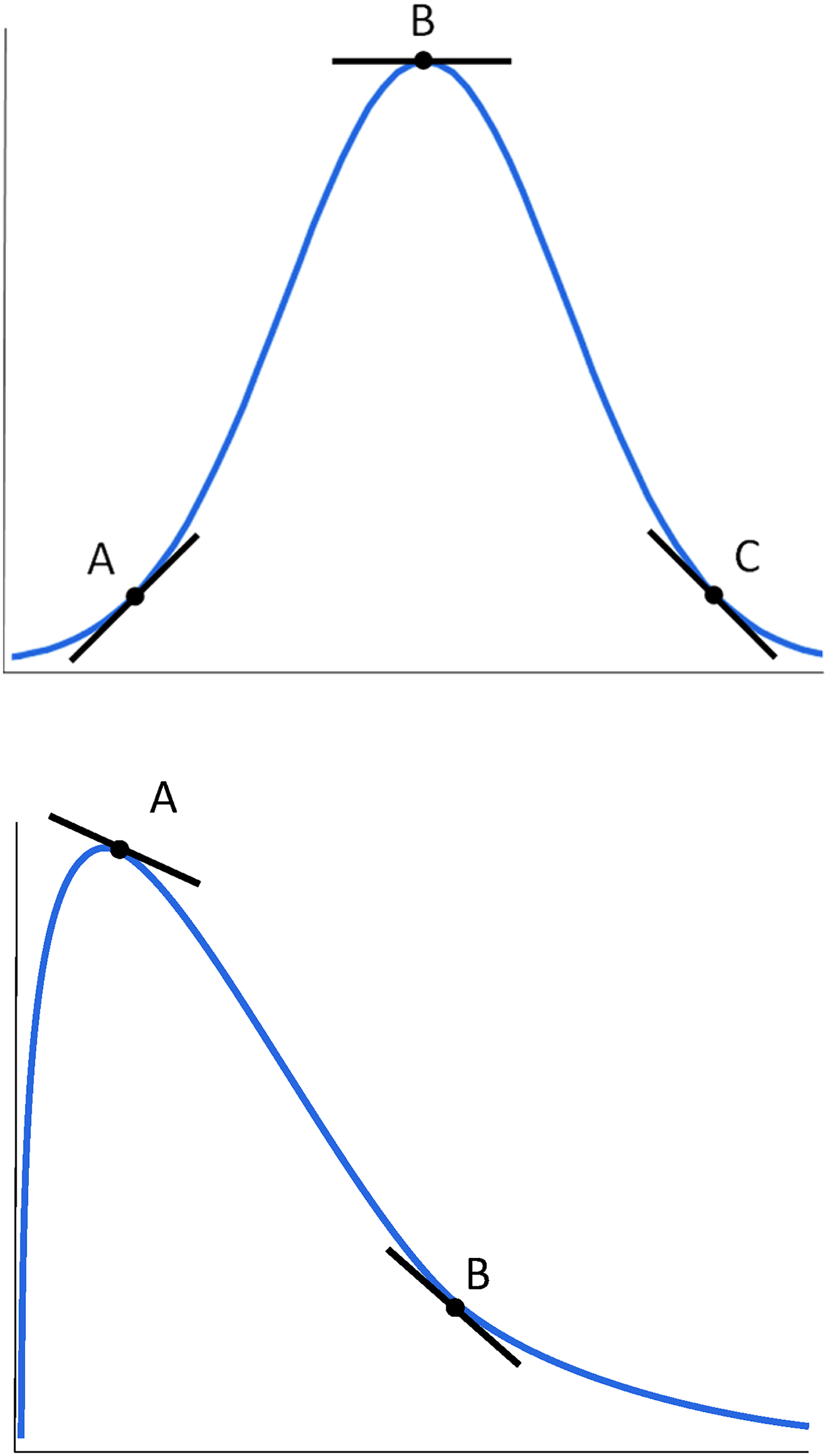
Localized linear results across local ranges.
Conclusion
Social systems are characterized by complex phenomena and wicked problems that require faculties beyond intuition and experience. We present Systematic Theory Mapping (STM) as a comprehensive and systematic method to hypothesize causal theories of complex social and physical phenomena. Using the working example of brand externalities construed as a wicked problem, we applied STM to develop a causal narrative of brand externalities. Literature in different paradigms of branding research provided abundant insights to capture the structures and processes that generate brand externalities, and conventions of system dynamics were utilized to interpret and map the causal theory.
Despite the availability of guidelines for systematic reviews (Palmatier, Houston, and Hulland 2018; Petticrew and Roberts 2006; Snyder 2019), narrative synthesis (Mair et al. 2023; Mays, Pope, and Popay 2005; Popay et al. 2006; Yang, Khoo-Lattimore, and Arcodia 2017), and system dynamics modeling (Lane 2008; Sterman 2000), there is no fixed way to synthesize a causal narrative. The proposed methodology is, therefore, suggestive rather than prescriptive. We realize that the robustness of this methodology depends upon the objectivity and cross-disciplinary expertise of the reviewers and modelers, transparency of the process, and systematic comprehensiveness of the extracted literature. Consequently, a straightforward and transparent process is followed to describe the review protocol, synthesis approach, and modeling process. This paper illustrates the value of STM in developing theory and causal narratives by synthesizing findings from the heterogeneous bodies of literature and qualitative data in general, and specifically in macromarketing, addressing the wicked complexity of macro-social problems.
Footnotes
Associate Editor
Julie Stanton
Declaration of Conflicting Interests
The author(s) declared no potential conflicts of interest with respect to the research, authorship, and/or publication of this article.
Funding
The author(s) received no financial support for the research, authorship, and/or publication of this article.
