



Abstract
In this article we focus on the cultural mechanisms of market evolution accompanying the marketplace discord between a market actor and a dominant industry. We situate our analysis in the intersection between marketing and institutional theory and engage specifically with the constructs of legitimacy and framing strategies, but also with Chantal Mouffe’s political philosophy concept of agonistics. To better understand the blurry impact of market-driven activism and conflict on the shaping of markets, we use the ongoing “milk-war” between plant- versus animal-based drink producers as backdrop, and empirically explore how a market actor and their supporting institutional actors frame a previously legitimate industry in an attempt to delegitimize it, without sacrificing its consumer market. We find a rhetorical juggling-act of attempted legitimization of the market alternative and delegitimization of the status quo, where the intricacy of framing strategies constitutes what we call conflict framing. In line with the market-critical fundaments of agonistics, this conflict framing can work to (partly) delegitimize the status quo industry and to relegitimize its market at the same time, but cannot radically disrupt the system. Drawing from research predicting a growing absorption of politicized conflict by the market in general, we problematize and critique a potential rise in presence of marketmediated conflict framing. Our insights contribute to ongoing conversations on market evolution, markets for alternatives, ethical consumption and the ideological functioning of markets.
Keywords
Cow. Cow. No Cow. No. No. No. Cow. Cow. No cow. No. No. No. Cow. Cow. No Cow. No. No. No. No Cow.” Oatly’s commercial jingle, Super Bowl 2021
The excerpt above is an apt illustration of the phenomenon which lies at the core of this paper: the intended debunking of a dominant market institution (in this case revolving around the cow and her milk). The jingle is part of a market-produced campaign from the fast-growing oat drink brand Oatly, who have tried to mobilize an everyday consumer resistance against the dairy industry by questioning the milk consumption market’s combined dimensions of legitimacy––hence, its ontology as an institution (Scott 1995)––to ultimately transform the dairy industry into a plant-based industry with themselves as the leading “brand activist” (Koch 2020). We argue that this phenomenon is theoretically important in the larger societal context of a burgeoning conflict market (Ulver 2021), where climate-related reconfigurations of the macro-level economy are simultaneously called for and contested. As a result, the monetization of conflicts between market actors, or between market actors and political actors, make up the core of the business model. At such market, not only do individual brands increasingly communicate stances in political issues through brand activism (Moorman 2020), but the brand activism of whole industries who engage in large-scale struggles (such as high-profile legal battles) to legitimize their practices, is also intensifying (Bajde 2019). This way the foundation of market shaping in marketing research is challenged by the intricacy of institutional levels and actors involved in the new conflict market environment. Hence, as we need to understand more about the cultural mechanisms of market shaping in this new market context, the research at hand is situated at the intersection between institutional theory and marketing. We engage particularly with the institutional theory concepts of legitimacy (Powell and DiMaggio 1991; Suchman 1995) and framing strategies (Benford and Snow 2000; Goffman 1986) but also with the political philosophy concept of agonistics (Mouffe 2013), in their combined capacity to conceptually unbundle the blurry impact of market-driven activism and conflict on the shaping of markets.
In marketing, much research has already elaborated on the relationship between (de-) legitimization and framing strategies, if not as main focal point (Humphreys 2010a,b; Humphreys and Latour 2013; Kates 2004; Sandikci and Ger 2010; Valor, Lloveras, and Papaoikoonomou 2021), then at least as central constructs among other institutional theory concepts (Dolbec and Fischer 2015; Ertimur and Coskuner-Balli 2015; Giesler 2012; Humphreys and Thompson 2014; Scaraboto and Fischer 2013). However, such studies are either concentrated on how market actors (e.g., Humphreys 2010a,b) or consumers (e.g., Scaraboto and Fischer 2013) work with framing strategies to achieve legitimacy, or on how more or less organized consumers try to delegitimize consumption practices (e.g., Ulver-Sneistrup, Askegaard, and Kristensen 2011) or the capitalist system per se (e.g., Kozinets and Handelman 2004). Importantly, they do not touch upon explicit struggles in-between market actors with very different preconditions in terms of institutional power, competing for legitimacy at the same, yet changing, consumer market. Our paper aims to address this limitation by highlighting how markets are shaped through the struggle over frames, and more particularly by exploring how market actors’ seemingly hostile framing strategies work to disrupt established meanings of an industry, without sacrificing the consumer market per se.
By pin-pointing the empirical case of plant-based drinks versus dairy milk we aim to contribute primarily to the market evolution literature in the intersection of institutional theory and marketing (Giesler 2008; Humphreys 2010a,b; Van Leeuwen 2007; Slimane et al. 2019; Valor, Lloveras, and Papaoikoonomou 2021), to market studies literature on markets for “alternatives” (Fuentes and Fuentes 2017), and to the burgeoning literature on the depoliticizing functioning of “ethical” marketing (Bradshaw and Zwick 2016; Carrington, Zwick, and Neville 2016; Cronin and Fitchett 2020; Giesler and Veresiu 2014; Ulver 2021). We do this primarily by offering insights on market actors’ balancing act when using affectively loaded rhetorical strategies, not to delegitimize consumer practices (e.g., Valor, Lloveras, and Papaoikoonomou 2021) but to delegitimize competing market actors’ industry practices, and to win over their consumers. Moreover, we demonstrate that what at first glance may be interpreted as a mere case of intended delegitimization is more complex and involves an intricacy of frames that work to legitimize, delegitimize and relegitimize at the same time.
In the next section we briefly account for the theoretical concepts of legitimacy, framing and agonistic activism. We then introduce our methodological approach and the contested industry context. Thereafter we present our findings of how a market actor and its institutional ecosystem discursively frame a previously legitimate industry in an apparent attempt to delegitimize while simultaneously relegitimizing its market. We conclude with a discussion of main contributions and discuss practical and policy implications as well as future research directions.
Agonistic Conflict Framing
In this article we lean on institutional theory and treat the market as an “institution” in transformation. This allows us to understand the market connected to an industry as a taken-for-granted establishment of commonly shared and accepted meanings and therefore difficult to transform. The broad popularization of this theory is often dedicated to Paul DiMaggio and Walter Powell’s (1991) anthology The New Institutionalism in Organizational Analysis, and since then, many marketing researchers have used the theory to better understand market evolution and larger transformations in consumption. The fundamental thesis in institutional theory is based on an epistemological commitment to social constructionism where any socially organized unit can become an “institution” and thereby be able to culturally influence thoughts, emotions, and actions of the people within and the unit as a whole. Here a central concept, commonly used in marketing research, is legitimacy. It aims to explain why people often and voluntarily submit to authority (Humphreys 2010a; Van Leeuwen 2007) and at a marketing level an entity such as a company, is legitimate if it is generally perceived as being proper, appropriate and desirable within a socially constructed context (Humphreys and Latour 2013) and if it has consumer acceptance (Scaraboto and Fischer 2013). Legitimacy is theorized as taking three forms (Scott 1995): regulative, normative, and cultural-cognitive. For a brand, regulative legitimacy refers to the degree the brand is considered to adhere to concrete laws and regulations. Normative legitimacy on the other hand concerns how much the brand is seen as congruent with dominant values and norms in the societal context. For example, a brand may follow the environmental laws of a country but still not act sufficiently against climate-change to be considered normatively legitimate. Lastly, cultural-cognitive legitimacy refers to how well the brand can be understood within existing cultural frameworks and cognitive schemas, hence how it can be “taken-for-granted” as mentioned earlier.
Analytically, “taken-for-grantedness” can be explored by looking at how brands are culturally framed (Humphreys and Latour 2013) where frames, in their sociological and linguistic conceptualization, are shared meaning systems shaped in everyday interaction (Goffman 1986). Framing, and the (re-/de-) construction of frames, takes place at the level of reality construction and is typically used actively, strategically and intentionally in political and social movement mobilization (Benford and Snow 2000). But, framing strategies are also used by market actors who aim to construct a new collective meaning system, a new shared “reality,” from which they can realize profits. Four main framing strategies are brought up by Benford and Snow (2000); frame bridging, frame amplification, frame extension, and frame transformation. Frame bridging refers to when two or more frames that are ideologically coherent but structurally unconnected, are linked; for example, when casino associations re-framed themselves as “corporate citizens” by bridging their for-profit occupation with addiction treatment and uniting these two under the idea of responsible gaming (Humphreys 2010a). Frame amplification on the other hand can move within only one frame as it aims to clarify, idealize, embellish, and invigorate already existing cultural values, narratives, myths and folk theory. Although not as complex as bridging, amplification is perhaps the most necessary strategy for any movement, and particularly relevant for “newcomers” (like Oatly) whose values to begin with contradict the ruling center of dominant culture. The third framing strategy, frame extension, refers to when actors present their scope as extending beyond the movement's primary concern to include interests that are important to potential stakeholders. Finally, frame transformation deals with the “changing [of] old understandings and meanings and/or generating new ones” (Benford and Snow 2000, p. 625) and could in some ways be said to always be present and overlapping with the other strategies.
Although we, in the plant-based versus dairy case, came to observe an intricate entanglement of above-mentioned framing strategies, one thing that cuts through them all, was what we come to call a conflict framing. This seemingly intentional framing of the situation as a conflict of frames may be understood through the political philosophy scholar Chantal Mouffe's (2013) concept of agonistics. She proposes that political activism should be “passionate” with an aim to ignite conflict in order to at all be able to create change within the bounds of democracy. Accordingly, in the sphere of politics, only by creating conflict in an oppositional way, can one reproduce a sound democracy and dismantle unhealthy systems. However, for Mouffe it is important that the relation is not antagonistic (friend/enemy, leading to polarization) but agonistic (different us/different them, leading to pluralism), in that no part should threaten the counterpart’s very identity or existence: What liberal democratic politics requires is that the others are not seen as enemies to be destroyed, but as adversaries whose ideas might be fought, even fiercely, but whose right to defend those ideas is not to be questioned. To put it in another way, what is important is that conflict does not take the form of an ‘antagonism’ (struggle between enemies) but the form of ‘agonism’ (struggle between adversaries). (Mouffe 2013, p. 7)
Yet, at a market thriving on the idea of political polarization (Ulver 2021), a burgeoning virtue of antagonistic activism encourages brands to portray their competitors as ideological enemies and the situation foremost as one of deep conflict regarding totality objectives. In that sense they (and the industry at large) risk to “lose” the consumers and other actors at the market which would perhaps not be the case if competing with agonistic activism. In this paper we explore this empirical problem and theoretical gray area and ask the question; how do market actors’ struggle over frames contribute to shaping but not sacrificing the market as a whole?
Method
In order to explore how market actors’ struggle over frames contribute to an industry's meaning transformation without sacrificing the market per se, the market-mediated dispute between plant-based alternatives and the dairy industry makes out a particularly illustrating case. Besides the traditional dairy industry, the conflict over the (alternative) dairy consumer market category consists of various institutional actors in the alternative dairy space, with the brand Oatly in the mass-marketing lead (Fuentes and Fuentes 2017; Koch 2020), that fuel the transformation from cow- to plant-based milk-like products. We chose to put Oatly in the foreground among these stakeholders, since they are a “paradigmatic case” (Flyvbjerg 2006, p. 230) in capacity of being the main protagonist of a “milk war” against traditional dairy and being strongly connected to food policy activism, brand innovation, and market creation (Fuentes and Fuentes 2017; Koch 2020). However, we also take interest in other institutional voices with explicit focus on transforming the food industry from animal- to plant-based foods. Having chosen an interactive perspective on meaning-making with frames being generated in a bottom-up process (Purdy, Ansari, and Gray 2019) our methodological approach was also inspired by a pattern-inducing approach (Reay and Jones 2016) to capture frames of intended dairy industry delegitimization. From our collected data we identified distinctions between aspects of frames and present these as both structuring categories and ideologically influential discourses. Oatly’s market communication, both its art direction and copy, often worked as readily manifestations of certain critical breaches in the “milk war” and as apt illustrations of identified discursive patterns.
The “Milk War” Case
In the Western world, the demand for traditional cow milk has been falling continuously and so has its image of being a perfect food (Cohen and Otomo 2017; Gambert 2018; Jönsson 2013). Alternative health traditions and developments such as the consumption of plant based dairy alternatives are becoming increasingly appreciated and occupy a position as an almost countercultural food product (Linné and McCrow-Young 2017). As consumers – most notably in the United States and Europe – are progressively concerned about the inherent problems of the animal agriculture industry and the widespread negative impact that the industry has on the environment, sales of plant-based dairy alternatives have risen, and dairy milk producers and advocates appear threatened by plant milk’s steady rise in popularity (Gambert 2018). This has also consequences for legal frameworks associated with heavily regulated food commodity dairy milk and calls into question the economic and political models of (alternative) dairy industry regulation (DuPuis 2002; Linné and McCrow-Young 2017). In other words, milk has in recent years undergone a shift in frames from privately righteous to politically controversial (Koch 2020). With non-dairy milks belonging to a new post-animal food movement that is gaining strength (Linné and McCrow-Young 2017), questions of legitimacy become more ubiquitous as well. This context in which the dairy industry feels threatened from the potential of plant-based milk alternatives to replace liquid milk has led to defensive responses on the dairy industry’s part in many parts of the world (Mylan et al. 2019).
In this paper, we mainly focus on the conflict between the traditional dairy industry and a plant-based milk challenger: The conflict between the Swedish oat milk brand Oatly and the dairy industry. In 2012 a newly launched re-positioning strategy included a more creative and at the same time more provocative stance on the part of Oatly towards the dairy industry. This included claims such ‘no milk, no say, no badness’. Oatly’s decision to become more provocative eventually led to a lawsuit from the Swedish dairy association in 2014. Despite losing in court (e.g., Oatly was forced to ban claims such as ‘no milk, no say, no badness’ in Sweden), the lawsuit turned out to be an ideal trigger for Oatly’s lifestyle mission and an added layer of brand activism as a brand positioning strategy (Koch 2020). Instead of abandoning the banned claims, Oatly decided to continue with some humorous twists such as ‘No milk. No soy. No… Eh…Whatever.’ This way, they kept the “war” alive albeit somewhat subdued.
All in all, instead of losing the consumer market they were fighting for, Oatly has not only doubled their revenues annually to in 2020 reach around half a billion US dollars, but also seem to have made it necessary for the former enemies who sued them, to launch their own oat drinks (Ternby 2021), thereby legitimizing and strengthening the market they once mocked (back).
Qualitatively Capturing Delegitimizing Framing Strategies
In order to capture frames of intended delegitimization framing strategies, we gathered empirical textual data mostly from interviews, but we were also attentive to direct observation and documentation of Oatly’s (mass) market communication, as well as to personal experience, a common approach of the pattern-inducing research strategy (Reay and Jones 2016). Yet, the focus on interviews was important for assessing the deployment of managerial framing strategies of an alternative dairy player being at war with the mighty dairy industry. Similar to Humphreys (2010a) we were interested in the language in which the dairy industry was discussed by its challengers (both in interviews and other communication). More specifically, we aimed to unpack the potential strategies managers and other stakeholders, with various roles and industry backgrounds, used to delegitimize the dairy industry. The data collection process started with a focus on Oatly in 2016 and was later (2018–2020) expanded on investigating the broader (alternative) dairy industry ecosystem. For gaining deep insights into this ecosystem, we gleaned insights from traditional dairy players as well as their potentially disruptive competitors, including Oatly as the main protagonist. We talked to food investors and a variety of consultants with expertise in food, nutrition, and sustainability. We also included perspectives from food-related foundations and academic research institutions. In total we conducted 40 interviews between 2016 and 2020 (see Table 1).
Interview material.
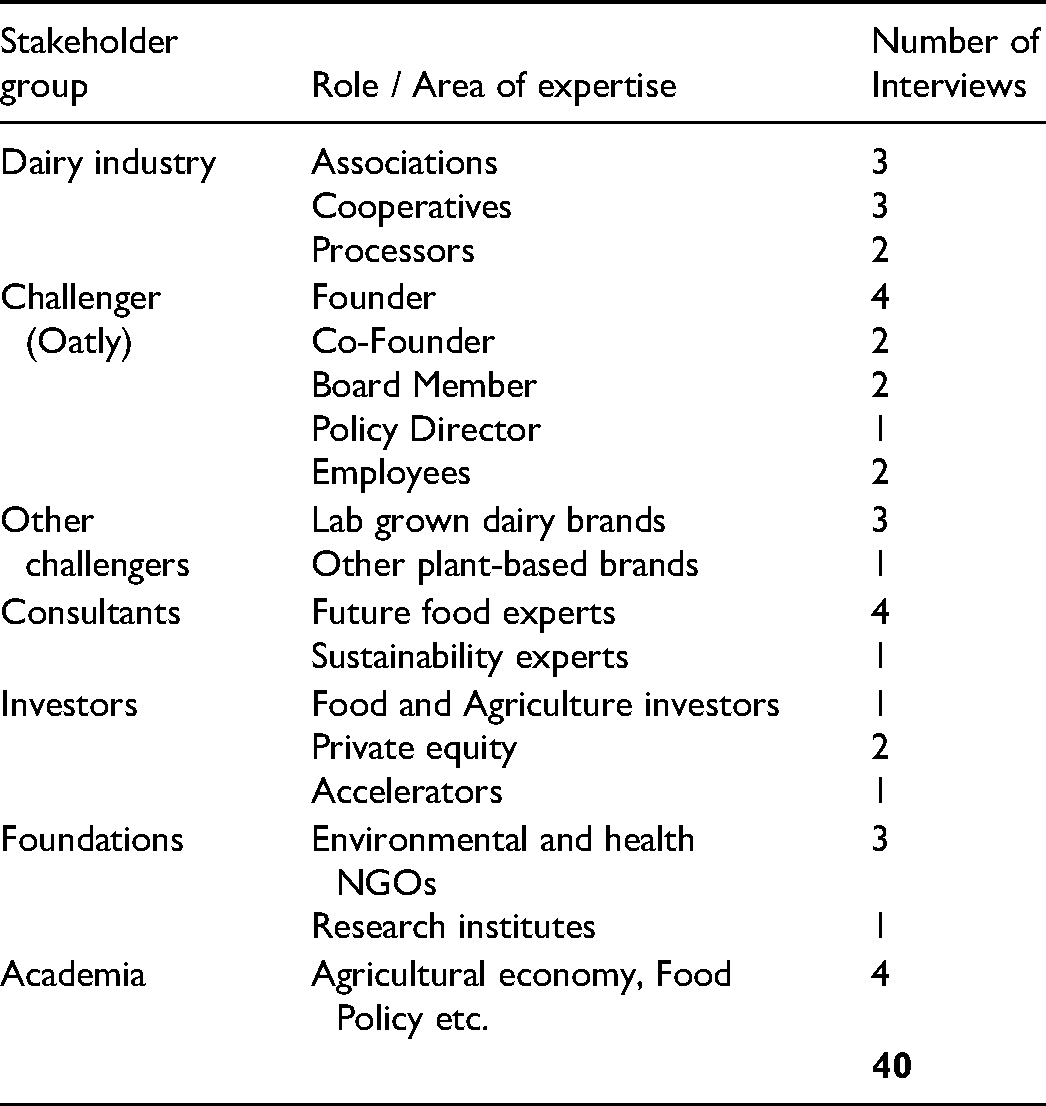
The interview length ranged from 30 min to 120 min, with an average interview lasting about 60 min. This resulted in 534 pages of verbatim transcripts. All Oatly interviews were conducted in person, while the majority of stakeholder interviews were conducted digitally (through Skype, Zoom, or similar). Furthermore, both authors actively participated at various international and national food industry events (e.g., in the US and in Sweden), in the capacity of audience or as presenters. During these events observations were made, noted and later discussed. Reflections from such discussions worked to inform the interpretive, analytical process later. To summarize, with our approach we were able to capture a critical actor’s practices and discourses without excluding those of other focal, institutional actors.
Data Analysis Procedure
Following a customary qualitative research process, our analysis consisted of an iteration between data and theory (Belk, Fischer, and Kozinets 2013). In addition, our “attentive cultural immersion” into the field (Ulver 2019), provided us with fieldwork insights we could draw upon in our hermeneutic analytical process, when we moved between data and theory and between parts and the whole (Thompson, Locander, and Pollio 1994). In the coding process that followed, we grouped similar utterances to induce meaning patterns in the margins. This basic coding technique is grounded in a general interpretivist research tradition in the social sciences (e.g., Rabinow and Sullivan 1987; Clifford and Marcus 1984), often applied in the sociocultural marketing field CCT (Arnould and Thompson 2005). Using an interpretivist methodology means that explications are relevant to the context of the study, but it is not known (and it is not the point of the study) if the findings are generalizable in a universal sense. Yet, once insights have been made it is commendable to discuss whether these may be transferable to other analogue contexts.
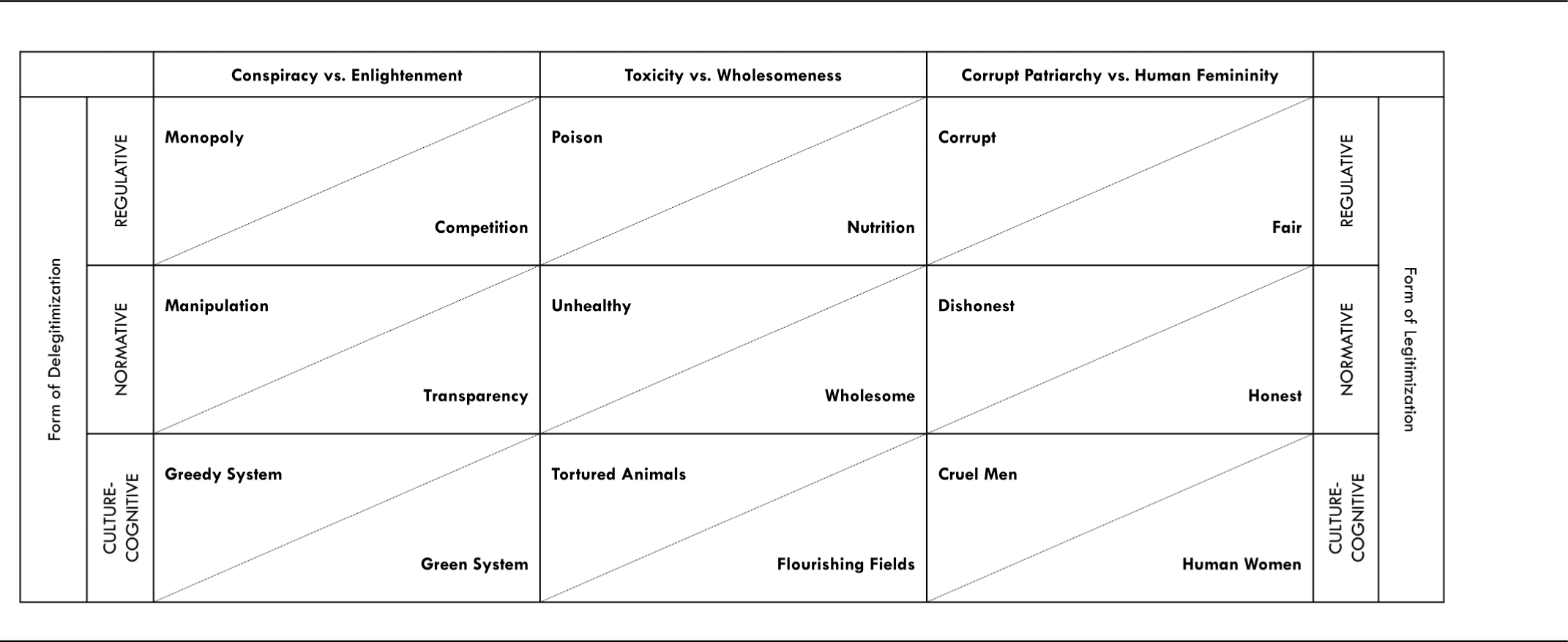
In this research interview transcripts and field notes were read and coded in line with Susan Spiggle's (1994, p. 497-499) seminal suggestions for interpretation of qualitative data as “deciphering a code” by “staying close to the meanings of the informants, metaphorically grasping the commonalities and parallels in their idiographic perspectives”, to ultimately find common patterns. Also, through McCracken’s (1988) very concrete methodological guidance, we iterated between theory and data to capture utterances, observations, categories, and themes. In practice this means that both authors read the transcripts and made notes in the margins, compared with each other, turned to literature for guidance (“from-part-to-whole”), found explicatory concepts, turned back to the transcripts and were able to find patterns in the notes that first became grouped categories and then themes (“from-whole-to-part”). This was a three-month long process. Whereas the observations in the initial phase of the analysis lead us to the institutional theory literature and the concepts of legitimacy and framing, not until later when the themes formed a blatant pattern of conflict, did we explore literature on conflict where the theories and concepts of Mouffe, Touraine and Melucci turned out to be enabling. For example, a redundancy of utterances regarding a non-reflected, yet Tourainian, polarization between protagonists and antagonists (e.g., the absence of problematization in regards to the term “war” in Oatly’s talk and media communication or the taken-for-grantedness of “sides” to be chosen among Oatly consultants) sensitized us to the Meluccian way the subsequent delegitimization was performed via marketing messages. Hence, by carefully reading and manually going through the interview transcripts we found that forms of delegitimization were paired with forms of legitimization in a constant balancing act of stigmatization and exaltation which resulted in three overarching conflict frames: Conspiracy versus Enlightenment, Toxicity versus Wholesomeness, and Corrupt Patriarchy versus Human Femininity.
Intended Delegitimization Through Conflict Frames
Using Oatly’s milk-war case as backdrop, we untangle the market-driven delegitimization of the adversary and legitimization of self, on one hand as a juggling act, but also as a clear framing of conflict. Based on institutional theory’s forms of (de-)legitimacy we uncovered three abovementioned overarching conflict frames indented to reshape the dairy market: (1) The Conspiracy versus Enlightenment conflict, (2) The Toxicity versus Wholesomeness conflict, and (3) The Corrupt Patriarchy versus Human Femininity conflict. Table 2 provides an overview of the conflict frames along regulative, normative and culture-cognitive forms of (de)-legitimization and we present those below.
The Juggling of Cultural Content in Oatly’s Conflict Framing.
Conspiracy versus Enlightenment Frame of Conflict
In the case of Oatly, delegitimizing the dairy industry literally started at a group level, where the “milk war” was a proper proposition made from one (external) creative to another (internal) creative: I got a call from John Schoolcraft almost two and a half years ago, says Oatly creative director Michael Lee. I was sitting in a cafe and he just asked me if I wanted to start a war with the milk industry all over the world. And I was just like, yeah, OK, sure. (Michael Lee, Oatly Creative Director, in Creative Review) [The dairy industry] has always been subsidized in many different ways. There has been direct or indirect money to the farmers, but retail has always accepted lower margins on dairy because it is a product that you must have and it is sensitive so they take the effect that they sell a lot of milk to the consumers and the discount effect. So, when you come as a newcomer and you come in and want to compete with that, they don’t accept your product, right? […] whenever the industry had trouble, the government went in and did some milk campaigns. Like the milk mustache campaign in the US. And you know it was all over, right? Where head of states, famous people, governments go in. In what other industry is that possible? So, you basically take away the whole element of really caring about what consumers really want. And if people like us come and challenge the whole structure, they are scared they are shaking, they don’t know what to do. And of course, they do what they have always done: they sue. Because they have always gotten away with it. This time they didn’t. It cost them so much. Although they technically won the lawsuit, they lost everything. (Oatly Co-Founder) Consumers were immediately understanding; “Yes! We are on Oatly’s side!” and there were enough consumers that wanted a plant-based alternative. So, when they [Oatly] got sued by the dairy industry everyone was on their side – like David and Goliath. (Oatly consultant) EUs school milk subsidy conserves an unsustainable norm that works against the climate objectives and distort competition. It favors animalistic agricultural production instead of vegetables, despite the fact that scientific research clearly shows that we need to switch over to manage the climate challenge. That the school milk subsidy on top of that is conditioned by a demand on the school to market milk is unreasonable. We think it is both odd and outmoded that you as a school child should need to show a certificate to be able to choose climate smart food, especially when food plays such a significant role when it comes to greenhouse gases. (Oatlys CEO, in a press release, published in Lantbruk 27 Sep 2017) There’s a huge dairy lobby in the US. There’s, you know, influence amongst regulators, you know, the huge advertising campaigns, […] there’s a whole machine that is potentially mobilizing people against, you know, anything new. At the same time, their shareholders are looking for better and more sustainable solutions so you never know. (Tech Investor)
Toxicity versus Wholesomeness Frame of Conflict
In line with institutional theory, Oatly’s intended delegitimization of a gigantic player such as the dairy industry did not emerge in a vacuum. It was only possible because other institutional actors (e.g., investor, scientific and influential communities) and factors (e.g., linking dairy to human, planetary, and animal health issues) were in place and rolling. The regulative, normative and culture-cognitive legitimacy of the dairy industry had already been questioned and problematized on the regulative and normative levels through more or less emotional or rational narratives about the dairy industry’s dangerous and unjust effects on human and animal bodies (Linné andMcCrow-Young 2017; Oski 2013). Here, advocates for the plant-based system have targeted the symbolic associations to the toxic versus wholesome body, to lay the ground of taken-for-grantedness and thereby culture-cognitively delegitimize the animal-based industry––something popular culture has been particularly detailed in disseminating. The novelist Jonathan Safran Foer’s “Eating Animals’‘ that came out 2009 and, according to much media is considered to be one of the most popular considerations of the ethical dimension of factory farming for decades (Schonfeld 2018). More recently increasingly many voices from the world of celebrities have echoed in a similar vein, for example Joaquin Phoenix’ at the Oscars 2020 ceremony: We go into the natural world and we plunder it for its resources. We feel entitled to artificially inseminate a cow and when she gives birth, we steal her baby, even if her cries for anguish are unmistakable. And then we take her milk, that’s intended for her calf, and we put it in our coffee and our cereal. We fear the idea of personal change because we think that we have to sacrifice something, to give something up, but human beings at our best are so inventive and creative and ingenious and I think that when we use love and compassion as our guiding principles, we can create, develop and implement systems of change that are beneficial to all sentient beings and to the environment. [Oatly] is about solving global challenges linked to climate change and public health. We need to fundamentally change the food systems and what we eat, the dietary factors, because we make ourselves and the planet sick. (Oatly Policy Director) If you go into a California feedlot and see a California feedlot cow, you know, you will be sick to your stomach […] you can smell these places from kilometers away […] You will certainly never drink milk in California again. Like you just won’t. Now, to me, it’s kind of awkward, because when you look at the FDA guidelines on contamination, there is a certain percentage of fecal matter allowed in milk. (Food Tech Investor) We were on the brink of [protesting publicly] with worker justice or whatever you want. And we’re also doing that to some degree with environmental issues. So, there are organizations that are doing certifications to say, GMO free, you think that there are no government restrictions but certain groups of buyers started that. That’s going to be much more transformative than public regulation. (Food & Agricultural Economy Professor) In the last 30 to 40 years, the industrialization of cows has caused a massive increase in antibiotic resistance […] and in animal misery. So, there has already been a bad change, a significant change. I mean, we’re talking about millions of animals, you know. Under these terrible conditions. (Food Tech Investor)
Corrupt Patriarchy versus Human Femininity Frame of Conflict
The toxic versus wholesome body discourse was successfully (sources claim a 45% sales jump (Divinations 2018)) leveraged by Oatly in their 2018 ad campaign “It’s like milk but made for humans,” in other words; traditional dairy is not made for humans and therefore potentially dangerous, lacking the right to exist for human exploitation and being simply unjust. Here, the humanizing framing of Oatly in concert with the dehumanizing framing of the dairy industry falls into the culture-cognitive level of delegitimization, in that it speaks within an increasingly operant frame that takes for granted that it is dehumanized and dehumanizing to consume animals, as they must be considered equal to humans in terms of value and rights. But the framing also takes place at the normative level. For example, and as we saw earlier, on the regulative level Oatly spokespersons work to disclose how the dairy industry is monopolistically entangled with, and even legally protected by, governments and are that way spoiled, lazy, and corrupt: They [the dairy industry] have been living in a subsidized world. And I like to provoke at times and one of the true messages I learned particularly from the Oatly lawsuit is that the dairy industry – and this is not only in Sweden, it is in the Western world, it is equally the same situation in the US – the dairy industry has never ever cared about the consumer. They can say whatever they want about that but they in fact, never ever cared about the consumer. Why is that? Because they never had to. Because they were subsidized. It is not one government in the US that doesn’t subsidize dairy production. And that takes out a lot of issues from the cost base of the big dairy companies. (Oatly Co-Founder) There's sexual politics to all this as well. So, animal products have historically been marketed with imagery and language that equates consuming animals, consuming meats, in the same way that women’s bodies are consumed; objectified cut up as things for like the male gaze […] the entire dairy industry runs on the unpaid labor of females. These are female cows, right? There’s no male dairy cow, right? And no one really deeply thinks about that. But this is, in some very real way, exploiting female reproduction. And as we, as a society, awaken to structural gender inequalities and think more deeply about gender […] Unlike any other industry, in our food system, there is 100% female labor. And that’s, that’s really interesting. (Food Future Researcher) A lot of public schools in DC have a high percentage of African American students, particularly African American students, and […] as a mandate from the districts, we have to offer these kids milk at lunch. And she [DC’s food policy director] was just like, it makes no sense. Because when you think about structural racism, embedded in educational institutions, African Americans, on average, are much more lactose intolerant than Caucasians. And these kids can’t perform as well after lunch, because their bodies are reacting to the milk that we were forced to provide that is just an unbelievable thing. (Food Future Researcher)
Although framing at the level of normative delegitimization related to misogyny or racism, has not yet, to our knowledge, been directly used by Oatly, other trials of related delegitimization have indeed occurred, for example in their imperative 2019 campaign “Hey food industry: Show us your numbers.” (Figure 1). In this campaign, Oatly uses bridge-framing by showing the link between food production and greenhouse gas emission for consumers, but here it is the dubious character, rather than institutionalized practices of conspiracy, that is highlighted. It normatively frames animal agriculture and the dairy industry in particular as corrupt and dishonest in their climate initiatives, at the same time as Oatly amplifying themselves as forerunners in honesty. This normative delegitimization of the dairy industry’s immoral character is at the same time contrasted by Oatly’s own structural policy initiatives to win normative legitimacy by frame-extending their contribution as an economic entity to society: But in addition, what is interesting from a political point of view, and what is easier as an entry point is that we are a growing company, and we’re offering employment, we’re offering tax money. We’re offering investments in the communities, that’s what we’re doing, actually, we’re not asking for anything, we just grow and grow and grow, we offer opportunities. And what we try to show is that Sweden has an opportunity to take a leading role here in a paradigm shift, which will happen globally. (Oatly Policy Director) I think that what’s really interesting as a lever is celebrity, celebrity culture. So, Bill Gates, for example, has been very bullish on culture needs. Bill Gates has very explicitly said in most public communications about breakthrough technologies, that culture needs going to change the world. And lots of people have been saying that for a long time, but because Bill Gates says it, then they, they actually start to think a little bit differently about that possibility. […] There are lots of very famous people, celebrities, sort of luminaries, billionaires who are getting who are understanding the impacts of traditional animal agriculture and dairy, and saying we need to design alternatives. And being very outspoken about that. […] So, we don’t need more academics doing this research. We need Bill Gates to be interested in it; it’s a silly thing. But then we need the academics to do the work to convince Bill Gates. (Food Future Researcher) What Oatly did with the lawsuit was that we actually started an incredibly important debate. And it was going on in the media, on high levels, on the editorial pages in all the leading media, TV, and on the morning couches in the TV programs. So. Now there are so many people carrying on that dialogue that Oatly doesn’t have to be provocative anymore. (Oatly Co-Founder) It is my belief that capital has to turn green and do so for the right reasons. [The Blackstone investment] is a clear indication of where the world is heading, which is in a new, more sustainable direction. (Oatly CEO, in Food Navigator)
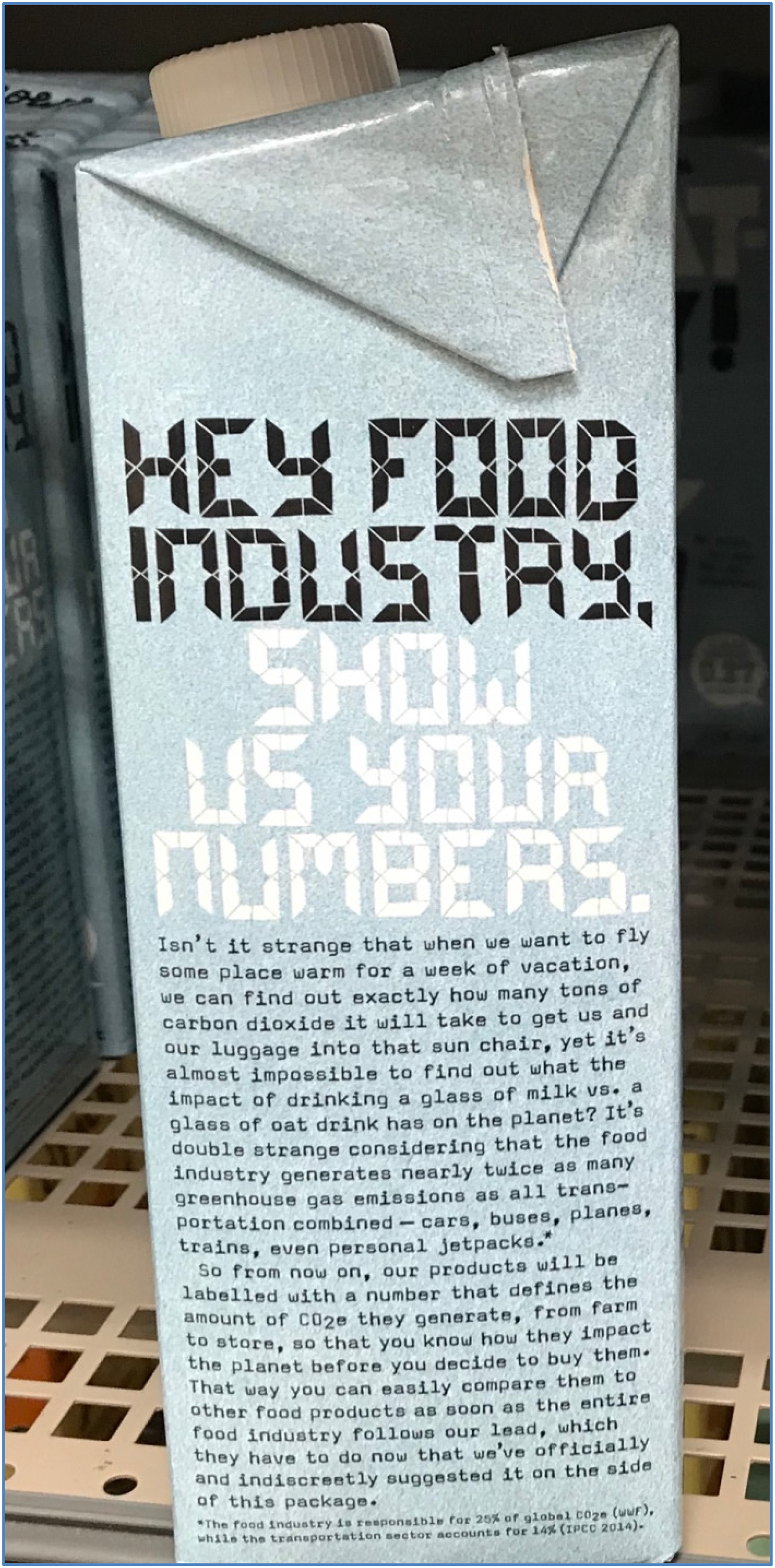
Hey food industry show us your numbers campaign.
Discussion: An Agonistic Re-Legitimization Paradigm
With this research we aimed to bridge the gap in marketing research created by changing market conditions. We claim that the preconditions for market shaping in marketing research are being challenged by the intricacy of institutional levels and actors involved in a new conflict market environment and therefore set out to understand the cultural mechanisms of market shaping in this new market context. We believe our findings are transferable to all established industries with consumer markets, where paradigm shifts of industry content and processes are to be expected due to especially climate-related reconfigurations demanded by global intergovernmental organizations, consumers, politicians and market-actor challengers.
Exploring how markets are shaped by struggles over frames, our findings show how a market-actor and its institutional co-actors are engaged in a sophisticated meaning transformation, where negative amplification of the status quo industry is key for delegitimizing its products, but also the positive amplification of themselves as aligned with the larger environment for legitimizing an alternative product to relegitimize the consumer market category and its accompanying, new, production practices. Through Oatly’s framing of the dairy industry as monopolistic, manipulative, greedy, sick and toxic, they try to delegitimize the dairy industry both on the regulative, normative and culture-cognitive levels. This rhetoric on its own would probably not qualify as the respectful agonism Mouffe (2013) was looking for, but would probably be classified as clearly antagonistic, as it attacks the very existence and identity of the dairy industry. However, as Oatly may have gained legitimacy at all levels simultaneously, amplifying their own advocacy for fair competition, transparency towards consumers and a green, climate friendly system, they frame themselves as offering an alternative system for the adversaries to enter. Indeed, the dairy industry and Oatly disagree fiercely about the interpretation of what sustainable production is, but in the end, both sides have been heard, even in court. Hence, the struggle has been transparent even if Oatly according to our analysis transgressed the boundaries of agonism into antagonism, and in that way galvanized the culture of polarization at the conflict market.
All in all, our findings lie neatly within the realm of Benfordand Snow’s (2000) framing strategies framework, where operant frames appealing to many stakeholders are amplified, some frames are bridged, some are extended, and some (or all) are transformed in meaning. However, we uncovered an intricate use of frames that we argue constitute a framing strategy on the rise at the marketplace: conflict framing. Besides the overall alignment processes of frame amplification, frame bridging, frame extension and frame transformation, the specific process of highlighting the incoherency of dualistic frames in ideological conflict allows the institutional actor to remain in the same culture-cognitive sphere, use its symbolic and structural infrastructure and construct that new shared ‘reality’ of necessary conflict, from which they––at a conflict market (Ulver 2021)––can realize profits. This, we claim, contributes to conversations in literature integrating marketing and institutional theory in general, and to the market evolution literature in particular, in at least three distinct ways that we discuss below.
The Re-Emergence of a Market
This research contributes to the market evolution literature with an increased understanding of how established meaning systems in a market can be fundamentally disrupted, yet re-established as something new and better, through sophisticated framing strategies. In contrast to outsider-driven delegitimization (e.g., Maguire and Hardy 2009), where the totality objective is that the industry under attack is to be eliminated, in this paper, the protagonist (Oatly and others) wants to transform the meanings of, and switch over the antagonists’ (dairy industry) destructive institutionalized practices into environmentally and humanly constructive ones, but within the same consumer market category infrastructure. This contrasts with extant market and consumer studies, where such market evolution usually is understood as the creation of a new market (Giesler 2012; Humphreys 2010a), often in a dialectic conflict with consumer culture (Giesler 2008) rather than in-between polarizing market actors as in a conflict market. Furthermore, in line with Fuentes and Fuentes’ (2017, p. 544) understanding of the plant-based alternative as a form of ‘non-dairy’ dairy product, but not completely in line with their proposed “market for alternatives,” we suggest that the plant-based drink market, galvanized by Oatly, is the same market and in some ways also the same industry, hence demanding the practice of respect for most of the institutional actors of the market as a whole. The industry infrastructure is indeed exhorted to be reconfigured (instead of farmers raising cows, it requires farmers growing oats etc.), but the consumer market category with its established consumer practices must be kept and groomed (e.g., a café latte lifestyle on oat), and the hand (the capitalist system) that feeds the industry must not be bitten. In this way, the iteration of delegitimization of the adversary and legitimization of self in the conflict framing, ends up in a sort of relegitimization of the industry––albeit radically changed in content (from dairy to plant-based)––from which the market first was detached and then re-situated in; hence, a sort of marketplace ant/agonistics. This is a valuable insight both for market practitioners, industry associations and policymakers involved in public engagement related to, for example, climate-change issues.
The Agonistic Juggling-act of Conflict Framing
Moreover, this article sheds new light onto the rhetorical elements of market-driven problematizations of its own market. The juggling-act between dualistic and oppositional frames within conflict framing differs from how amplification strategies are conceptualized in extant research where they usually are about either delegitimization, as in Maguire and Hardy’s (2009) outsider case, or legitimization, as in Humphreys' (2010a) casino insider case. Even when the insider/outsider operationalizations were not as clear, for instance when Scaraboto and Fischer (2013) noted that their Fatshionista consumer activists were different from anti-consumers (outsiders), they could be seen as insiders who emphasized legitimization of themselves rather than delegitimization of their (internal) opponent. Contrasting with previous marketing research, our case of intended delegitimization is neither performed by an outsider nor by an insider, but rather, by what could be understood as boundary spanner, not an organizational such (e.g., Haytko 2004), but a market-industry boundary spanner. As argued for earlier, Oatly are not outsiders, because they need to stay on the good side with the overall farmer industry (just not dairy) infrastructure, the overarching capitalist system and the consumer market. Still, they do not frame themselves as insiders, rather as outsiders opposing a whole industry, yet embracing it. As market-industry boundary spanners, they are acting right in the intersection of inside and outside and need to constantly adapt to both temperatures in terms of (marketing) rhetoric. This is where the intricacy of frames, constituting what we call conflict framing, serves its marketing purpose by latching on to an already antagonistic culture at the conflict market, but in a seemingly agonistic way to keep the market intact. As large reconfigurations of economies and markets related to aspects of the global “sustainability development” (such as the UN’s Sustainable Development Goals), are expected, such antagonistic-on-the-verge-of-agonistic culture with its conflict framing strategies, is likely to increase.
The De-Politicizing Logic of Market -Actors’ Conflict Framing
We further contribute to literature in critical marketing research that looks into the depoliticizing functioning of marketing engaging in political and ethical issues (Bradshaw and Zwick 2016; Carrington, Zwick, and Neville 2016; Cronin andFitchett 2020; Giesler and Veresiu 2014; Ulver 2021). As we saw earlier, whereas a lot of marketing and consumer research on market evolution shows how legitimization is of great importance for the emergence of a new market (Dolbec and Fischer 2015; Giesler 2008; Humphreys 2010a,b; Scaraboto and Fischer 2013), at the burgeoning conflict market (Ulver 2021), delegitimizing the old is as important as legitimizing the new; in other words, a relegitimization of the ‘new old’. In other words, it may seem as if it introduces something completely new but in reality, it does not.
This reframing of the old into something symbolically new, shapes an interesting analogy with Kristensen, Boye, and Askegaard’s (2011) narrative of how milk transformed from a national icon to a moral battlefield in Denmark. By debunking hegemonic expert system mythologies about cow milk as the sacred natural good, emerging consumer communities created a counter-myth of milk as a potentially damaging substance, and thereby represented themselves as an adversary to the dehumanizing market. However, Kristensen, Boye, and Askegaard (2011, p. 212) argue that not only does this consumer counter mythology fail to bring about the desired emancipation from the market, but even “establishes an alternative form of market logic.” Similar to our context (but where we see it from the market actor perspective and understand it as an institutional process), these insights about the power of the symbolic but limited power of complete “market emancipation” are transferable to the context of the conflict market.
At a macro level this can be related to the larger societal dynamic of Mouffe’s (2013) agonistics where conflict is needed for constructive change at a politico-societal level to happen, as well as a prerequisite for democracy. However, for Mouffe the most important conflict is situated between the market and the state, which means that the market’s absorption of such conflict necessarily disarms the conflict from within. Hence, from a critical macromarketing perspective, market actors’ conflict framing would, with time, have a depoliticizing effect and end up in no societal change at all. It is the same economic system, but where the environmental challenges are framed as best solved by the market in general and the ethical consumer in particular (Cronin and Fitchett 2020; Giesler and Veresiu 2014). This “curing the disease with the same medicine that caused it,” is conceptualized as an ideological deadlock in the critical marketing literature (Carrington, Zwick, and Neville 2016; Bradshaw and Zwick 2016) and is here in our research further illustrated and enriched through insights on the market’s absorption of antagonistic politics in general and conflict framing strategies in particular. We claim, from our findings, that the conflict framing strategy may have an amplified depoliticizing functioning in that it frames the ‘ethics’ precisely in an affected intersection of an ideological conflict, while the ideological fundament of the adversaries, in effect, is the same.
Conclusion
Our insights on relegitimization enrich the institutionalization discourse in marketing. We contribute to the market evolution literature by uncovering an intricate use of frames for relegitimization that we argue constitute a new framing strategy on the rise at the marketplace: conflict framing. Our findings of conflict frames along a spectrum of regulative, normative, and culture-cognitive forms of (de-)legitimization provide researchers with a nomenclature and analytical categories for future research. By looking closely at forms of framing we could demonstrate the importance of dualistic and oppositional meanings in market evolution in an ant/agonistic era, in contrast to an emphasis on “devices” from the socio-technological perspective on the material and post-human (e.g., Fuentes and Fuentes 2017). Subsequently, in addition to Valor, Lloveras, and Papaoikoonomou (2021), we show that when delegitimization strategies were mobilized by market actors rather than by organized consumers, they were necessarily different in that they constantly had to balance their smearing rhetoric about their institutional adversary with equally exalting rhetoric about themselves.
All in all, we add to market creation theory by identifying dimensions that help us better understand market creation dynamics of delegitimization at an increasingly “political” market (Korschun, Martin, and Vadakkepatt 2020) where conflict framing is on the rise but where the boundaries between antagonistic and agonistic struggle is blurred.
Limitations and Future Research Opportunities
We encourage future researchers to investigate further the consequences of conflict framing and delegitimization strategies in other market contexts. For example, could specific local cultural contexts load negative advertising with radically different meanings from what we have seen in our case? Also, are our findings transferrable to boundary spanners in other product or service categories?
Furthermore, future research is encouraged to unbundle the intricacy of framing strategies involved in delegitimization within other conflict spheres than the one we used as a case here. Our findings show that the shift from our case market’s dominant––even hegemonic––institutional logic, to a market with plural institutional logics, has structurally taken place at a resource level, and symbolically at a political level. Over the years Oatly as a main brand actor started out by framing their market offer as a scientific product and later added a healthy lifestyle layer. In recent years, Oatly has worked up a frame of political activism by engaging in open conflict with the hegemonic dairy (and animal-based food) industry at a market communication but also at a regulatory level—without sacrificing their worked-up frames of science and healthy lifestyle (Koch 2020). At the same time financial, non-profit, consultancy and academic research reports have worked in Oatly’s direction, through which the institutional logic of plant-based production has gained ground. Thus, as various institutional frames impact the delegitimization of markets in many different ways, and political consumption is increasing in complexity (Korschun, Martin, and Vadakkepatt 2020), the content of context-specific conflict framing needs to be continuously explored.
Following from this, as a more general call, we encourage researchers to take further notice of the growing entanglement between marketing and politics where brands become activists and arbiters of controversy (Swaminathan et al. 2020; Vredenburg et al. 2020), as strategies from each sphere seem to increasingly seep out into the other, a development that with time may change the marketing world in numerous, unexpected ways. Perhaps most importantly, we must pay attention to the potentially depoliticizing effects (e.g., Bradshaw and Zwick 2016) coming with the market’s symbolic absorption of conflict, and carefully study if and how a non-sustainable status quo reinvents itself.
Footnotes
Associate Editor
Karim Ben Slimane
Declaration of Conflicting Interests
The author(s) declared no potential conflicts of interest with respect to the research, authorship, and/or publication of this article.
Funding
The author(s) disclosed receipt of the following financial support for the research, authorship, and/or publication of this article: This work was supported by the Familjen Kamprads Stiftelse,
