




Abstract
This paper proposes and critiques the idea of a post-capitalism sustainable consumption utopia to improve the ecological and human wellbeing of the planet. Such a notion can stimulate new imaginative thinking on a future sustainable world not dominated by neoliberalism. It can also strengthen SDG-12: responsible consumption and production. To do so, it examines the influence of pro-environmental self-identity, market-based barriers, and knowledge barriers on sustainable consumption buying, product lifetime extension, and environmental activism. Survey data was collected via online panels in Sweden (n=504) and the USA (n=1,017). Richly varied and complex findings emerge supporting the merit of this utopian idea. In particular, the importance of pro-environmental self-identity. This study illustrates how the post-capitalism notions of radical incrementalism and people power can initiate change using the civic, political, and environmental activism in sustainable consumption behaviours. Emerging implications for the viability of SDG-12 are also considered. This work offers rich opportunities for further research.
Keywords
“Utopia lies at the horizon. When I draw nearer by two steps, it retreats two steps. If I proceed ten steps forward, it swiftly slips ten steps ahead. No matter how far I go, I can never reach it. What, then, is the purpose of utopia? It is to cause us to advance.”
Introducing Our Big Idea
This paper invites macromarketers to consider an alternative far-reaching notion of sustainable consumption beyond neoliberal market ideology. This big idea is the transformative potential of post-capitalism on sustainable consumption to improve the human and ecological wellbeing of the planet. Post-capitalism can facilitate a shift towards an interwoven human and ecological utopia of a more liberated, just, equal, democratic, and social world embedded within social justice (Bauwens and Mammos 2018; Swilling 2020; Walsh 2020). Importantly, it can stimulate new imagination of a future sustainable world. Sustainable consumption is pertinent to this because it embodies ethics, responsibility, benevolence, and equality (Balderjahn, Peyer, and Paulssen 2013; Carrington, Neville, and Whitwell 2014; Dermody et al. 2015; Dolan 2002; Lorek and Fuchs 2013; Prothero et al. 2011). Understanding consumers within neoliberal and post-capitalism market structures is also relevant to this post-capitalism utopia idea. This paper supports this growing area of research (e.g. Kadirov and Varey 2010; Ulver 2019).
The need for new ideas to solve interconnected human and ecological problems is advocated by The United Nations (UN) 2030 Agenda for Sustainable Development, via their Sustainable Development Goals (SDGs) (UN 2019b). The UN suggests any new thinking should embrace the need for increased people power (UN 2019b). Therefore, a second element of envisioning our post-capitalism big idea evaluates the potential contribution of consumers in shifting towards a sustainable consumption utopia. In so doing, we respond to the call for academics to consider the ‘big picture’ of their work to facilitate bold transformation (Mittelstaedt et al. 2014; Swilling 2020). Thus, in the tradition of macromarketing, we enliven our micro-focused data through its relational macro connection to the SDGs, the neoliberal marketplace and transformative post-capitalism. We identify and critically appraise what enables and inhibits types of sustainable consumption behaviours within the existing marketplace and the implications for our proposed big idea of a post-capitalism sustainable consumption utopia.
Accordingly, we focus on three sustainable consumption behaviours reflecting varying levels of consumer commitment. Namely, sustainable buying, product lifetime extension, and environmental activism. Firstly, sustainable buying represents normalised environmentally-friendly purchasing behaviours premised on morals, equality, and accountability (Balderjahn, Peyer, and Paulssen 2013; Dermody et al. 2015; Prothero et al. 2011). Consequently, it contributes to our utopian big idea because it reflects a public display of civic consumption activism (Seyfang 2006). Secondly, product lifetime extension helps address product obsolescence by increasing longevity via pre-owned, repaired or reused products (Cooper 2010). It is valuable because it reduces resources, pollution and waste levels in the production and consumption of products. Transitioning to this behaviour is, however, challenging because consumers typically favour new product purchases over reused, repaired or pre-owned (Bovea, Pérez-Belis, and Quemades-Beltrán 2017; Dermody, Nagase and Berger 2020). Thirdly, environmental activism reflects consumers’ dynamic engagement with political, societal and business systems to achieve environmental change (Paço and Rodrigues 2016; Sguin, Pelletier, and Hunsley 1998). Environmental activism includes protest, petitioning and lobbying – including both public and private formats (Stern 2000). Its ambition for macro and micro change renders it valuable to our utopian idea. However, while there has been a recent upsurge in climate-change protest, historically this behaviour has been very niche. This combination of difficulty and infrequency has resulted in an underdeveloped scholarship on product lifetime extension and environmental activism (Bovea, Pérez-Belis, and Quemades-Beltrán 2017; Dermody, Nagase and Berger 2020; Dono, Webb, and Richardson 2010). This paper therefore makes an important contribution to conceptualising these less well-understood behaviours, from a post-capitalism perspective.
This study focuses on three types of influence on sustainable buying, product lifetime extension, and environmental activism behaviours. These are, pro-environmental self-identity, market-based barriers, and knowledge barriers (discussed within the research framework). The study focuses on two distinctive political, economic and environmental nations: Sweden and the United States of America (USA). Sweden is considered a pro-environmental responsible society, whilst the USA is a leading economic superpower (see research framework for a fuller account).
Having outlined our big idea, this paper elaborates on the underlying rationale for a post-capitalism utopia. The academic research framework and hypotheses follow. The framework explains the three categories of influence in more detail, followed by the choice of Sweden and the USA. Next, the methods and results are presented. The results are discussed with reference to SDG-12 and post-capitalism. The paper concludes by evaluating the feasibility of a post-capitalism sustainable consumption utopia.
The Underlying Rationale for Our Big Idea
This big idea connects with SDG-12: responsible consumption and production. This goal offers opportunities to challenge the dominance of neoliberalism. It does so by asking consumers to modify their consumption by actively thinking about what and why they buy, and to be less wasteful. It asks producers to find innovative new solutions to facilitate sustainable consumption and production, which marketing can then position, communicate and reinforce.
With the new thinking ambition of the UN agenda front of mind, SDG-12 is, however, highly vulnerable. There is an underlying assumption that sustainable consumption can be achieved within the current neoliberal free-market and statism model that prioritises economic growth, consumerism, and the power and wealth of political elites. However, this mind-set can restrict adventurous transformative sustainability thinking for change to a more just world; a concern expressed by Hall (2018), Little and Helm (2019), and Swilling (2020). Indeed, the jeopardy of this SDG from increasing consumer materialism is already noted in a 2019 report to the UN Economic and Social Council (UN 2019a). This vulnerability underlies our vision for a bigger and bolder SDG premised on post-capitalism. One that can push sustainable consumption behaviours (and supporting production and marketing systems) beyond the safe parameters of neoliberal market ideology, which is purported to be failing (Ahmed 2017). Such an SDG would embrace a transformative post-capitalism vista of people power sited at the fringes, or outside market fundamentalism and state-run political authority. Such a notion is supported by Bauwens and Mammos (2018), Lloveras and Quinn (2016), Mason (2016), and Swilling (2020). Promising examples of this occur within ‘the commons’ and its characteristic cooperatives, communities and social enterprises that facilitate peer-to-peer production (Bauwens, Kostakis, and Pazaitis 2019). Potentially this can increase consumer engagement with repair and reuse (product lifetime extension). For example, participating in community workshops and seeking alternatives to the status quo through environmental activism. Hence, post-capitalism is not seeking transformation through revolution. Rather, it advocates ‘radical incrementalism’ (Swilling 2020). This involves using existing business, technological or social systems for activist causes (Walsh 2020). Gollnhofer and Schouten (2017) argue consumer activists can push sustainability into these systems to generate alternative markets, e.g. food sharing. This lends further credibility to the attribution of civic consumption activism to sustainable buying.
Our big idea is further encouraged by the opening quotation from Galeano on utopia facilitating humans in new directions. Specifically, how the underlying morals of sustainable consumption, and the systems that underpin it, can better re-orientate towards a transformative future. Therefore, potentially within this utopia, consumers’ sustainable consumption can improve the life-chances of other people and the planet (and ultimately their own). Additionally, it can moderate their own self-interest through the consumption decisions they make. As such, an empathic collaborative community mind-set may dominate, not an individualistic one characterising much contemporary consumerist behaviours. It will embrace new ideas and patterns of behaviours, and the systems and structures that support them. Human and environmental capital will dominate, not economic capital and power elites. This utopia therefore reflects the ideas embedded within commons-centric post-capitalism, which also aligns with the degrowth agenda (Javier and Lee 2016). In contrast, Mason (2016) argues such a utopia will be perceived as politically and economically threatening to neoliberal primacy of the marketplace. Furthermore, the pursuit of utopian living has been typically described as foolish, naive and unworkable (see for example Evans 2015).
We use the idea of utopia to analyse understanding and conceptualisation of sustainable consumption as currently embedded within the contemporary market-driven landscape. A fundamental question arises: ‘is current thinking, embedded within the market, enough to advance this sustainable consumption utopia?’ The evaluation of evidence in this paper asserts it is not. Three ‘faults’ underlie this failure. Firstly, the belief that the market can solve the unfolding climate emergency – it cannot (e.g. the failures of carbon-trading strategies in favour of shareholder value). Indeed, considering the major ecological and human impact of greenhouse gases emitted by industrialised markets in developed and emerging economies, Stern (2008: 1) attests, climate change represents “…the biggest market failure the world has seen”. Secondly, the conjecture that giving primacy to sustainable consumption as primarily buying behaviour is sufficient – it is not (e.g. global market-driven government policy on hybrid cars contributing to a throwaway culture). Thirdly, the assumption that there is sufficient time to develop workable solutions within existing systems. There is not, and they are likely to fail. Indeed, scientists warn the escalating and never-seen-before global temperature rises signal climate change is an immediate (not future) emergency (IPCC 2018). Yet, at the 2019 UN Conference on climate change – COP-25 (UN 2019b), most developed economies offered limited thinking and action on climate change (Dermody 2020). This follows the failure of COP-21 – The Paris Agreement to globally agree and enact actions to limit global temperature rises. Former US President Trump being a notable malcontent in this breakdown. Further, the proposed carbon reduction and renewable initiatives are problematic. Even if all are implemented, CO2 emissions are still predicted to increase by 20% by 2035, rendering a temperature increase of 3.60c (Mason 2016). These ‘faults’ signal a deep-seated misunderstanding and complacency. Namely, the neoliberal free-market mind-set can fix the unprecedented ecological, human and geopolitical effects of accelerated climate change. Modern critics across decades and disciplines have strenuously argued it cannot (e.g. Beck 2016; Carson 1962; D’Alisa, Demaria, and Kallis 2014; Daly 1991, 1996; Latouche 2009; Polanyi 2002; Stiglitz 2010; Urry 2011). Hence, the argument for new imaginative ideas, rooted in empirical research, is a compelling one. Having presented the underlying rationale for our big idea, we now present the research framework.
Research Framework and Hypotheses
This section provides an evaluation of the pertinent scholarship underpinning this study and its hypotheses. The section begins by presenting the influence of pro-environmental self-identity on sustainable consumption behaviours. Subsequently, the behavioural effects of market-based barriers are assessed. Namely, materialism, social consumption motivation, lack of perceived consumer effectiveness, and market-based beliefs. The influence of knowledge-based barriers follows. Specifically, the lack of climate-change knowledge on sustainable consumption. It culminates with a justification of the country choice (Sweden and USA). The conceptual model (Figure 1) concludes this critical account.
The Potential Effect of Pro-environmental Self-identity on Sustainable Consumption Behaviour
Identity is acknowledged as a principal explanatory theory of behaviour (Oyserman 2009), including consumption. This is because it can coordinate consistency between attitudes, values, and behaviours (Whitmarsh and O’Neill 2010). Thus, consumers can express their self-identity through their consumption choices (Belk 2010). This extends to pro-environmental self-identity too (Dermody et al. 2018; Dolan 2002; Soron 2010; Whitmarsh and O’Neill 2010).
Pro-environmental self-identity is a dynamic environmentally-friendly self-concept. Consumers with this identity make active sustainable consumption choices that are akin to Seyfang’s (2006) notion of civic consumption activism. This identity is constructed from mainstream socio-cultural cues that position environmentally-friendly consumption behaviours as normal (Dermody et al. 2018). As discussed in the rationale (above), the neoliberal free-market is one such cue directing this identity-behaviour. Research suggests pro-environmental self-identity positively influences (direct effect) and mediates (indirect effect) consumers’ sustainable consumption buying and curtailment behaviours in eastern and western cultures (Dermody et al. 2015; 2018). Thus, pro-environmental self-identity can facilitate individual and multiple (spillover) sustainable consumption behaviours from within the marketplace. Surprisingly, this identity-consumption lens has been rarely examined within contexts of product lifetime extension or environmental activism behaviours. Hence, their inclusion in this study.
It is questionable to what extent the location of pro-environmental self-identity within the marketplace facilitates or inhibits the pursuit of a sustainable consumption utopia. Turner et al. (1987) describe this as ‘mundane environmentalism’ because consumers accept the market-based consumption norms underlying their sustainable consumption. This acceptance favours sustainable buying to help mitigate environmental problems (Barnhart and Mish 2017; Dermody et al. 2015). In contrast, Swilling’s (2020) post-capitalism argument for ‘radical incrementalism’ suggests consumption revolution is not necessary for transformative change. In support, Walsh (2020) proposes current market systems can readily be utilised by consumer activists pursuing civic environmental causes through their sustainable consumption buying. For example, the green food movement. Indeed, Ulver (2019) argues buying sustainable food (i.e. organic, fair-trade, low food miles in this study) is not mundane, it is deeply symbolic and important to consumers’ identity. Thus, sustainable buying is already a facet of civic consumption activism identity, which could extend into pro-environmental self-identity. There is also strong potential for product lifetime extension and environmental activism to contribute to this transformation. For example, through enhanced consumer engagement and rejection of a throwaway culture (Dermody, Nagase and Berger 2020). Hence, all three behaviours can facilitate our post-capitalism utopian vision. Thus, the first hypothesis proposes:
Few studies have investigated the effects of market-beliefs and knowledge barriers on pro-environmental self-identity and sustainable behaviours. Furthermore, they have not evaluated these effects within an economic superpower (USA) and environmental advocacy nation (Sweden). This study addresses these gaps (see hypotheses H2-H8).
Market-based Barriers to Consuming Sustainably: Materialism, Social Consumption Motivation, Lack of Perceived Consumer Effectiveness and Market Beliefs
Understanding neoliberal markets aids evaluation of consumers’ sustainable consumption behaviours. Exploring the relationship between them is a recurrent theme in marketing discourse and therefore pertinent for comprehending consumer’s market-based beliefs, materialism, social consumption motivation and lack of effectiveness. Unpicking this relationship, questions arise on whether consumers are and wish to be free to choose what they buy and consume. Marketing positions itself as facilitating agency and choice-making in consumers. It can bond consumers, producers and brands, thereby facilitating consumers’ positive marketplace interactions of self-expression through the brands they buy (Beckett and Nayak 2008; Wooliscroft and Ganglmair-Wooliscroft 2018). It is within this landscape that Swilling (2020) proposes post-capitalism ‘radical incrementalism’ and Walsh (2020) recommends marketplace systems. In contrast, nearly three decades ago, Sandilands (1993: 46) challenged the agency and authenticity of sustainability behaviours occurring within the neoliberal market. She argued: “…it turns politics into action such as squashing tin cans, morality into not buying over packaged muffins, and environmentalism into taking your own cloth bag to the grocery store. None of these actions challenges capitalist economic growth…none of these actions provokes a serious examination of the social relations and structures that have brought about our current crisis.”
Materialism and Social Consumption Motivation: These barriers symbolise the self and social-identity status importance of consuming possessions. Materialism coveys this magnitude through perceived success and happiness, and in mitigating social isolation (Belk 2010; Richins and Dawson 1992). Materialism is regarded as a dominant value embedded within western culture and affluence (Kasser 2016), and a growing influence in eastern emerging economies, particularly China (Dermody et al. 2015; Polonsky, Kilbourne, and Vocino 2014) and India (Dermody 2020; Nakasis 2016). Consequently, materialism functions as a global phenomenon that drives economic growth (Podoshen and Andrzejewski 2012). This is problematic because consumers who attach success and achievement to their acquisition may be more likely to pursue such status through acquiring new products and less likely to extend the lifetime of their possessions (pre-owned, repair or reuse). They may also view environmental activism as a threat to their materialism. Research consistently reports this negative relationship, e.g. between materialism and pro-environmental concern (Hurst et al. 2013; Polonsky, Kilbourne, and Vocino 2014). An exception might exist within sustainable consumption buying behaviours, e.g. acquiring luxury ‘green’ brands. However, such behaviours are highly controversial if motivated by materialistic, not environmental/humanitarian value-systems. This materialistic mind-set can be extended by social consumption motivation, whereby the intense need for social visibility and affirmation triggers consumers to socially display the high identity-value of their important possessions to significant others (Fitzmaurice and Comegys 2006). In such cases, social consumption motivation would be perceived negatively. However, research suggests social consumption motivation can positively influence sustainable consumption behaviour (Dermody et al. 2015). In this scenario, consuming sustainably would reflect social norms that encourage buying and acquisition (Kasser 2016) and waste reduction (e.g. see Nigbur, Lyons, and Uzzell 2010; Viscusi, Huber, and Bell 2011). However, this positive influence may inadvertently create a barrier for less normative sustainable consumption behaviours, such as buying pre-owned, reusing or repairing products, and environmental activism. In this respect, regardless of whether social consumption motivation positively or negatively effects these behaviours, it can trigger barriers rooted in materialism or buying-centricity.
To date, studies have not examined the influence of social consumption motivation on the more challenging consumption domains of product lifetime extension and environmental activism. However, Dono, Webb, and Richardson’s (2010) work on social identity, environmental citizenship, and environmental activism provisionally suggests social affirmation desire can influence these behaviours. Identity as a behavioural mediator is also implied. Potentially, social consumption motivation may influence environmental activism. In turn, pro-environmental self-identity may mediate this relationship. In support, a small body of work suggests the mediating role of pro-environmental self-identity between values, environmental preferences and behaviour (e.g. Dermody et al. 2018; van der Werff, Steg, and Keizer 2013; Whitmarsh and O’Neill 2010). For example, Dermody et al. (2015) found some support for an indirect effect of materialism and social consumption motivation, via this identity, on sustainable buying across cultures. This study explores these effects, extending into the under-researched territories of product lifetime extension and environmental activism behaviours. Hence, the following hypotheses are proposed:
Lack of Perceived Consumer Effectiveness: This perception facilitates consumer empowerment within the marketplace. For example, political actors using ethical boycotts to help solve problems (Micheletti, Follesdal, and Stolle 2006; Papaoikonomou and Alarcon 2017). Consequently, it can function as a predictor of ecological concern and pro-environmental purchasing (Dermody et al. 2018; Kim and Choi 2005; Roberts 1996). A lack of effectiveness is therefore problematic because consumers are not engaging with the fault-lines within the marketplace (discussed above), or using their consumer power to change this. The absence of such a positive belief becomes a barrier to sustainable buying, buying pre-owned, repairing or re-using products, and environmental activism. This is because consumers do not believe these actions will make a positive impact in redressing environmental problems. This lack of empowerment undermines the post-capitalism notions of using existing market structures and people-power to trigger change. Consequently, we hypothesise that:
Market-Beliefs: Business and government ‘govern’ within the dominant economic growth paradigm that predicates the centrality of resource-intensive, self-gratifying materialism. Challenges to this (e.g. extending product lifetime) can trigger consumers’ protective belief-systems to resist change. Hence, the disposition towards new purchases (Bovea, Pérez-Belis, and Quemades-Beltrán 2017; Dermody, Nagase and Berger 2020). This helps explain barriers to consuming sustainably, even when consumers are aware and concerned about environmental problems (Dermody et al. 2015; Polonsky, Kilbourne, and Vocino 2014). SDG-12 sits within these tensions. Consequently, it would be useful to examine consumers’ learnt and reinforced materialistic values and market-beliefs about industry, government and risks of change in the marketplace, that underlie these barriers. Examples include: abdicating responsibility for action to business and government; focusing criticism on business and government for their limited environmental initiatives; and believing the change required will be too radical (e.g. Brulle 2014; Gifford 2011; Lorenzoni, Nicholson-Cole, and Whitmarsh 2007; Sandilands 1993; Schwarzkopf 2011). Accordingly, ‘what are the responsibilities of consumers, producers and political leaders in this consumption-production vortex?’ This question is important. It represents how the market and materialism, and the posturing of consumers and businesses within it, advances and undermines the ‘what’, ‘how’ and ‘why’ of consuming sustainably. Thus, the fifth hypothesis is:
Knowledge-based Barriers to Consuming Sustainability: Perceived Lack of Climate-Change Knowledge
Research confirms this barrier can also block sustainable consumption behaviours (Gifford 2011; Marshall 2014; Stoknes 2015). Studies show knowledge is impeded by the intangibility of climate change problems, leaving individuals feeling too ill-informed to act pro-environmentally (Howell 2013; Viswanathan et al. 2014). Even where consumers directly experience negative climatic events, this learnt experience does not always translate into sustainability behaviours. Instead, consumerist lifestyle priorities continue to dominate, as the ‘forces’ of the market come into play (Sandilands 1993). Hence, increasing knowledge will not directly increase pro-environmentalism. Rather, its influence is indirect. Knowledge influences the self-identity of consumers and in turn their consumption (Howell 2013; Viswanathan et al. 2014). Thus, framing climate messages to align with the pro-environmental self could facilitate processing and acceptance of knowledge (Bertolotti and Catellani 2014; Stoknes 2015). Processing bias, however, impairs knowledge creation if consumers reinterpret or reject these messages because they conflict with their pre-existing schema (Marshall 2014; Stoknes 2015). Disbelief of climate-change evidence is therefore an inherent part of this barrier to sustainable consumption. Product lifetime extension and environmental activism are particularly at risk. Overall, this barrier threatens our post-capitalism utopian idea. However, invoking pro-environmental self-identity may counter its effects. Therefore, the sixth hypothesis is:
Country Differences
The focus on Sweden and the USA is merited because of the potential contrasts in their sustainability and marketisation positioning, identity, and market/knowledge barriers. These countries appear positioned at opposite ends of pro-environmental and neoliberal spectrums. Sweden is strongly pro-environmental, whilst the USA is a leading economic superpower. For example, research shows higher materialism in vertically individualistic countries (i.e. USA) compared to horizontally individualistic countries (i.e. Sweden) (Gupta, Gwozdz, and Gentry 2019). Furthermore, the attitude-behaviour gap in relation to environmental issues is smaller in Sweden than USA.
To illustrate, 81% of Swedes perceived climate change as one of the most serious problems facing the world, which is the highest of any nation in Europe (The European Commission 2014). Further, Sweden leads among European nations on responsibility for tackling climate change. For example, responsibilities related to the person at 57% (highest in Europe), their national government at 71% (highest is Europe), the European Union (EU) at 59% (highest in Europe), regional and local authorities at 33% (highest in Europe), and business and industry at 39%. In relation to taking any personal action to fight climate change, again Sweden ranks the highest in Europe at 80%. Additionally, Sweden has a government comprising the social democratic party and the green party. Hence, sustainability features strongly in its governance (The Economist 2016). This combination renders Sweden at the forefront of implementing climate action to meet the EU’s vision of climate neutrality by 2050 (Carbon Market Watch 2017; European Union 2019).
A different picture emerges for the USA. The actions of former President Trump and his administration has triggered a political schism on climate change science, research and leadership. For example, they have replaced climate change mitigation with clean air and water priorities, undermined climate science and its funding, and regularly emphasise the risk to US jobs and the economy from environmental actions (Cheung 2020). Further, they have belittled dissenting discourses on the power elite’s prioritisation of economics above climate mitigation. Trump’s infamous tweet at the 2020 World Economic Forum –”We must reject the perennial prophets of doom and their predictions on the apocalypse” – encapsulates these ‘enemies’ of US economic and political power. The Trump administration significantly reduced measures to address climate change, including agreements made by former President Barack Obama (e.g. COP21 Paris agreement). Furthermore, it undermined the use of scientific evidence in its decision-making (e.g. see Sabin Centre for Climate Change law: ‘Climate Deregulation Tracker’ and ‘Silencing Science Tracker’). This strongly implies a neoliberal market and economic growth orientation, at the expense of the unfolding climate emergency. Studies also show a high level of inconsistency in US consumer attitudes towards climate change and their actual pro-environmental behaviours (Ballew et al. 2019; Cleveland, Kalamas, and Laroche 2012; Urien and Kilbourne 2011). Albeit, interest and concern about climate change is growing. For example, in 2019 the longitudinal survey ‘Climate Change in the American Mind’ reported 30% of US adults were very worried about global warming (highest recorded). However, only 10% claimed they take significant personal action to reduce global warming. For the majority (74%), this behaviour is moderate to low/none. This may be because they consider the world’s poor and future generations will be deeply harmed by global warming, whilst they or their families will be unharmed (Ballew et al. 2019). Potentially this represents a USA-centric not global perspective. Overall, the USA sits in stark contrast to Sweden. Thus, country differences may moderate the effects of the barriers on the three behaviours. Therefore, in line with the above, the final hypotheses are:
Figure 1 presents the conceptual model of this study.
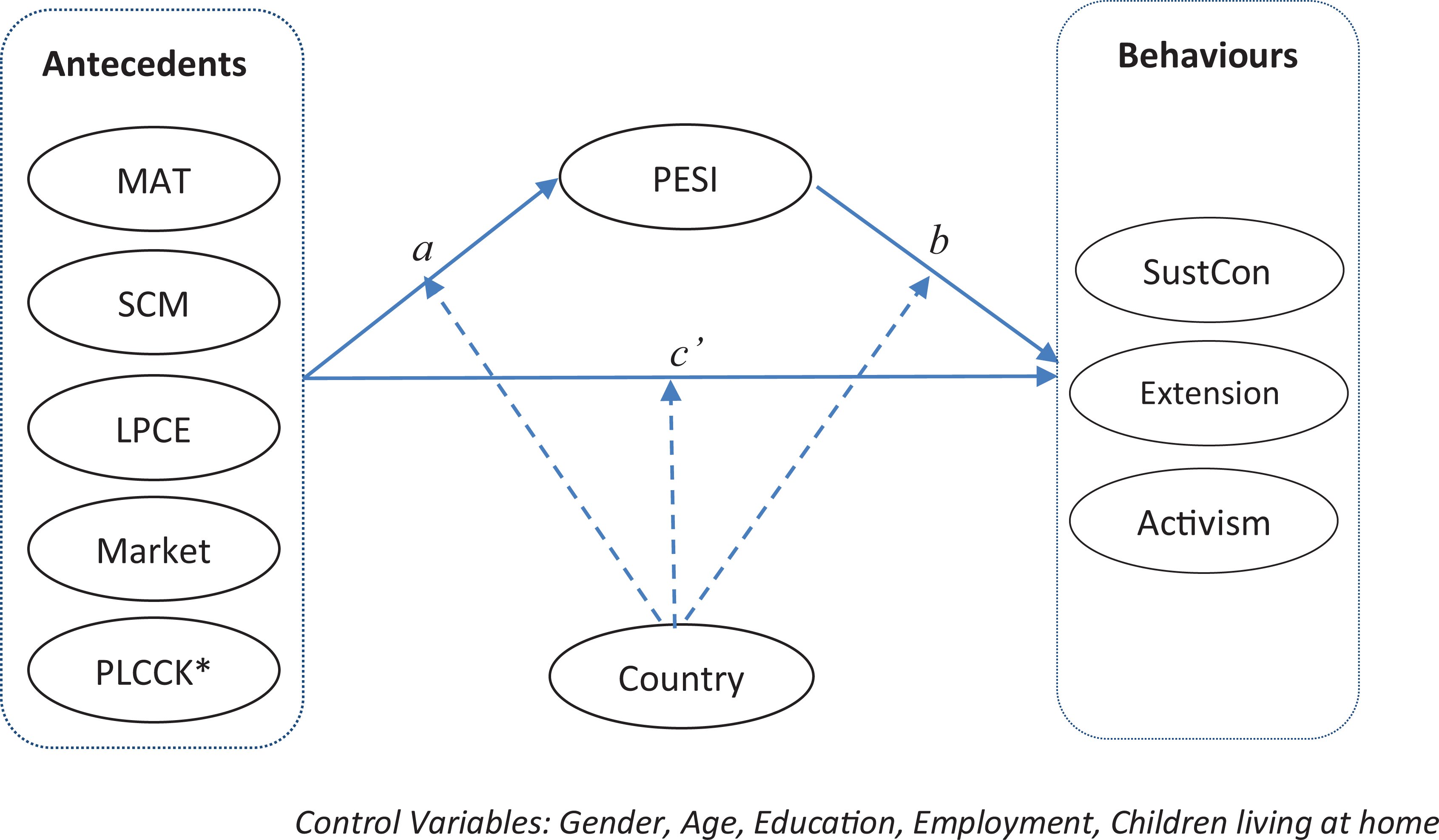
Conceptual model. Note: Materialism (MAT), Social consumption motivation (SCM), Lack of perceived consumer effectiveness (LPCE), Market-beliefs (Market), Perceived lack of climate-change knowledge (PLCCK), Pro-environmental self-identity (PESI), Sustainable consumption buying behaviour (SustCon), Product Lifetime Extension (Extension), and Activism. *Only indirect effect of PLCCK being hypothesised and tested.
Methods and Scale Evaluation
Sample and Procedures
This study utilised a quantitative online panel survey approach. A professional market research company managed the data collection. The Swedish translation of the English survey questions followed a rigorous back-translation approach for cross-cultural research. The final sample consisted of 1,521 respondents, of whom 1,017 were from the USA and 504 from Sweden. Table 1 presents a brief demographic profile of each country sample.
Sample Demographics.
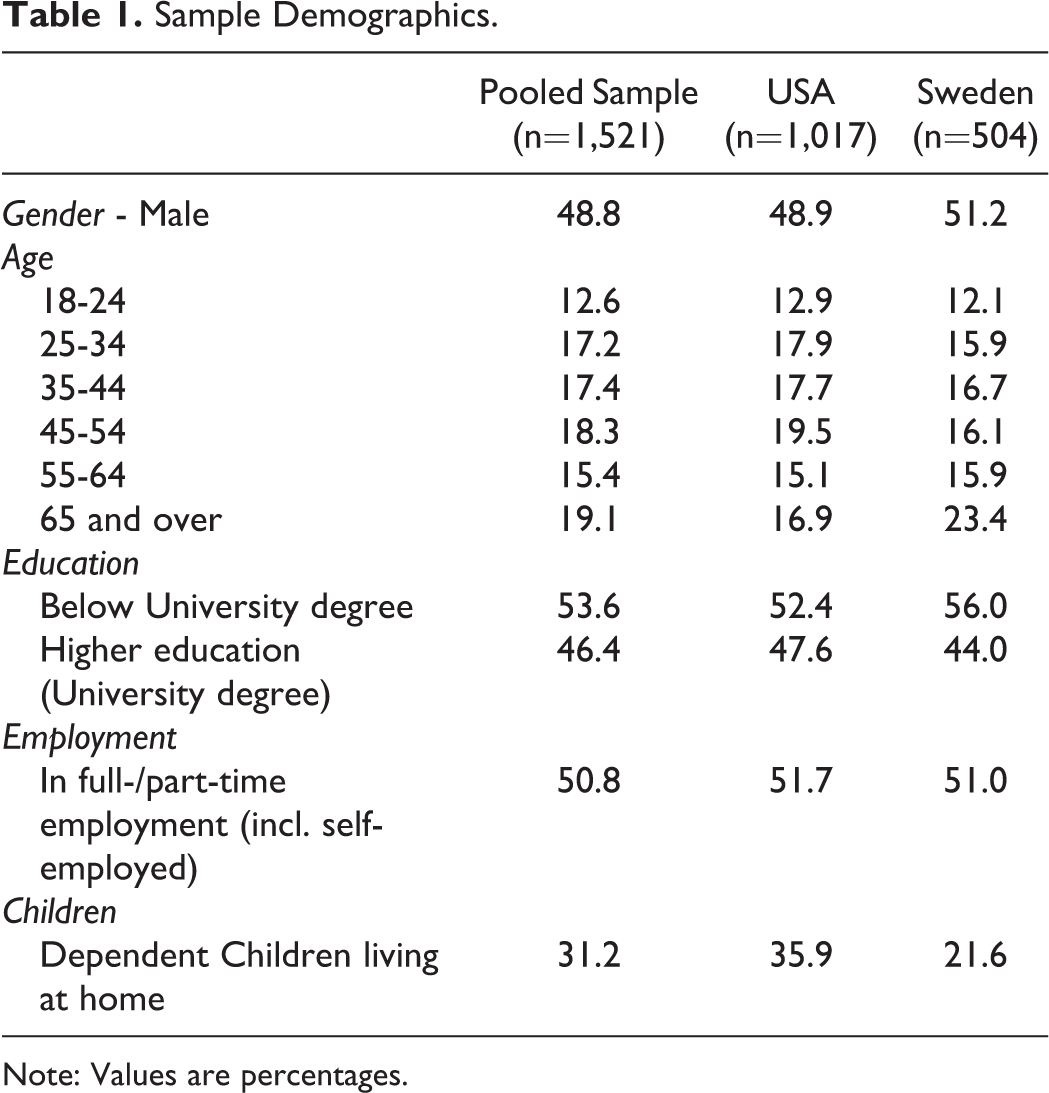
Note: Values are percentages.
Measures
Established scales from previous research were applied (Appendix 1). These include materialism (Richins 2004), social consumption motivation (Moschis 1985), lack of perceived consumer effectiveness (Ellen, Wiener, and Cobb-Walgren 1991; Roberts 1996), and pro-environmental self-identity (Whitmarsh and O’Neill 2010). The measures for perceived lack of climate-change knowledge and market-based beliefs were adapted from Lorenzoni, Nicholson-Cole, and Whitmarsh (2007). All items used a five-point Likert scales where (1)=strongly disagree to (5)=strongly agree. Sustainable consumption buying, product lifetime extension, and environmental activism were adapted from SGuin, Pelletier, and Hunsley (1998) and Whitmarsh and O’Neil (2010). A five-point scale was utilised (anchored 1=Never to 5=Always). Control variables were included as follows: gender (dummy coded with 1=female), age (age groups coded with 1=18-24, 2=25-34, 3=35-44, 4=45-54, 5=55-64, 6=65+), education (dummy coded with 1=College/University degree), employment (dummy coded with 1=full-/part-time employment incl. self-employed) and children (dummy coded with 1=dependent children living at home).
Measurement Validation
Confirmatory Factor Analysis (CFA) was applied to evaluate the reliability and validity of our latent constructs. Although the Chi-square statistic was significant, which was expected due to the large sample size (χ2 (367) = 1525.61, p≤.001), the final measurement model yielded acceptable fit indices (comparative fit index (CFI) = .945, Tucker-Lewis index (TLI) = .935, root mean square error of approximation (RMSEA) = .046). Four items were excluded from this final measurement analysis due to low factor loadings (<.50). All remaining standardised factor loadings were significant. Furthermore, they were above the recommended level of .5 (see Appendix 1). Validity and construct reliability measures exceeded the recommended cut-off criteria for all constructs. The exception was the scale of product lifetime extension (CR=.58, AVE=.41), which fell slightly below the recommended levels. With one exception, all square roots of AVE (Average Variance Explained) were higher than the corresponding inter-construct correlations, confirming discriminant validity (Fornell and Larcker 1981). The inter-construct correlation between sustainable consumption buying and product lifetime extension was higher than the square root of AVE of product lifetime extension. However, as separate models were estimated for each outcome variable, this was not a concern. Construct reliabilities, the square roots of AVE estimates and the correlation matrix for all constructs are provided in Table 2.
Mean, Standard Deviation, Correlations and Square Root of AVE.
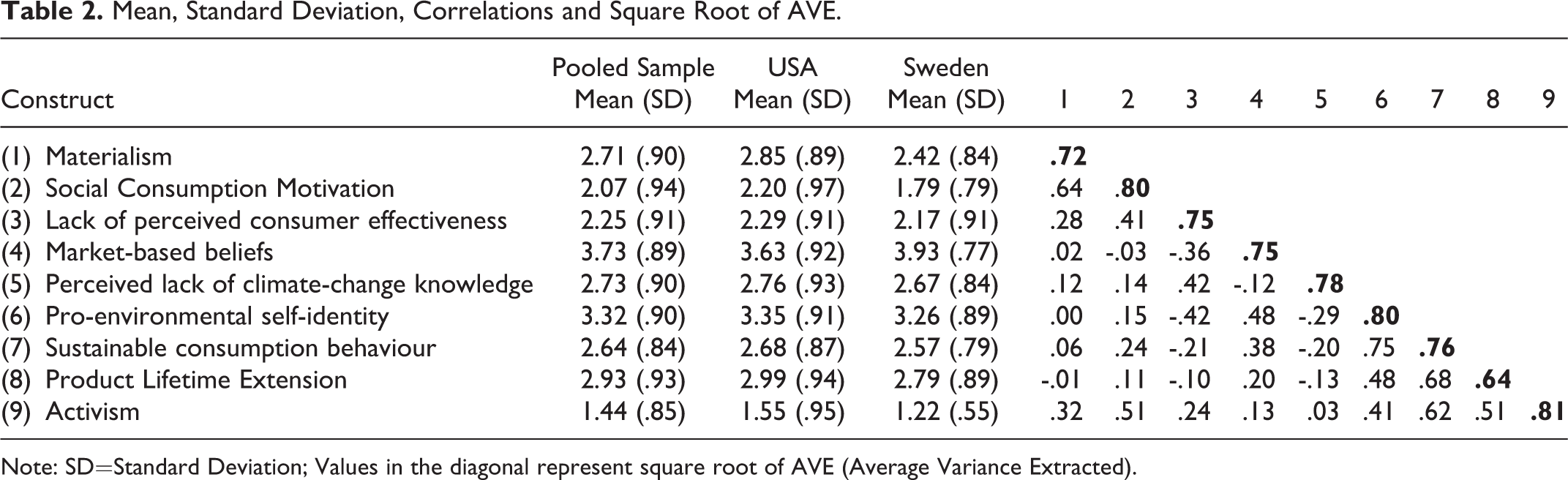
Note: SD=Standard Deviation; Values in the diagonal represent square root of AVE (Average Variance Extracted).
A multi-group CFA was employed to examine configural and metric invariance to establish measurement invariance between the two country samples. Results of the multi-group measurement model demonstrate the model fits the data very well (χ2 (734) = 2055.02, p ≤ .001, χ2/df =2.80, CFI =.937, TLI =.925, RMSE =.034). Furthermore, there were adequate factor loadings for both countries, thus supporting configural invariance (i.e. all latent constructs can be conceptualised equally across both countries). The model fit between the constrained (i.e. measurement invariance model) and the unconstrained model was evaluated with particular emphasis to ΔCFI. This was due to the sensitivity of the commonly used goodness-of-fit χ2 test to sample size. The value of ΔCFI=-.001 was well below the recommended value of -.01, thus establishing full metric invariance (Cheung and Rensvold 2002).
Common Method Variance
Common method bias (CMB) could arise because the study employed cross-sectional self-report data from a single source. To address this, a range of procedural techniques and empirical assessments were utilised, in-line with Podsakoff et al. (2003). These included: safeguarding respondents’ anonymity; using a variety of scale end-points; mixing the order of scale items to avoid response sets; and including carefully constructed pre-tested questions. Harman’s single factor test showed that a single factor only accounted for 20.67% of the variance, and thus did not adequately represent that data. Additionally, the CFA-based one-factor model revealed a poor fit to the data (χ2 (403) =13846.21, p ≤ .001, χ2/df =34.36, CFI=.36, TLI=.31, RMSEA=.15). As only high levels of common method variance have the potential to bias actual relationships (Fuller et al. 2016), CMB is unlikely to confound the interpretation of the data in this study. Composites based on factor scores from the CFA were calculated for further analysis.
Data Analysis
The bootstrapping bias-corrected confidence interval procedure running the SPSS macro syntax PROCESS was used to test the hypothesised direct and indirect effects (Hayes 2013). This generates multiple random samples to test the model’s predictive validity. Hence, it provides stronger accuracy in confidence intervals, whilst not being dependent on the normality assumption. Specifically, PROCESS analysis tests theory using algorithms for predictive validity and thus moves beyond multiple regression analysis and structural equation modeling, which exclusively rely on tests for model fit (Woodside 2013). The models were statistically controlled for gender, age, education, employment, and dependent children at home to avoid any potential confounding effects on the parameter estimates. In the first step, mediation analyses were conducted to test hypotheses 1 to 6. Bias-corrected 95% confidence intervals (CI) for the indirect effects were estimated. Indirect effects are significant if no zero is included in the 95% confidence interval.
Secondly, conditional process analysis (i.e. moderated mediation analysis) was applied. This step was to examine whether the direct and indirect effects of the predictor variables on the three environmental behaviours differ significantly between the two countries, testing H7 and H8. PROCESS conducts tests of significance for the conditional direct and indirect effects, whilst implying equality of the other paths in the mediation model (Hayes 2018). Separate models were run for each dependent variable (buying, product lifetime extension, and environmental activism).
Results
Pro-Environmental Self-identity
H1 predicted that consumers’ pro-environmental self-identity has a positive influence on their sustainable consumption. The results showed a positive and significant effect of pro-environmental self-identity on sustainable consumption buying (b11 =.889, p≤.001), product lifetime extension (b12 =.752, p≤.001), and environmental activism (b13 =.724, p≤.001. This confirms H1a, H1b and H1c (see Table 3).
Model Coefficients for the Hypothesised Direct Effects.
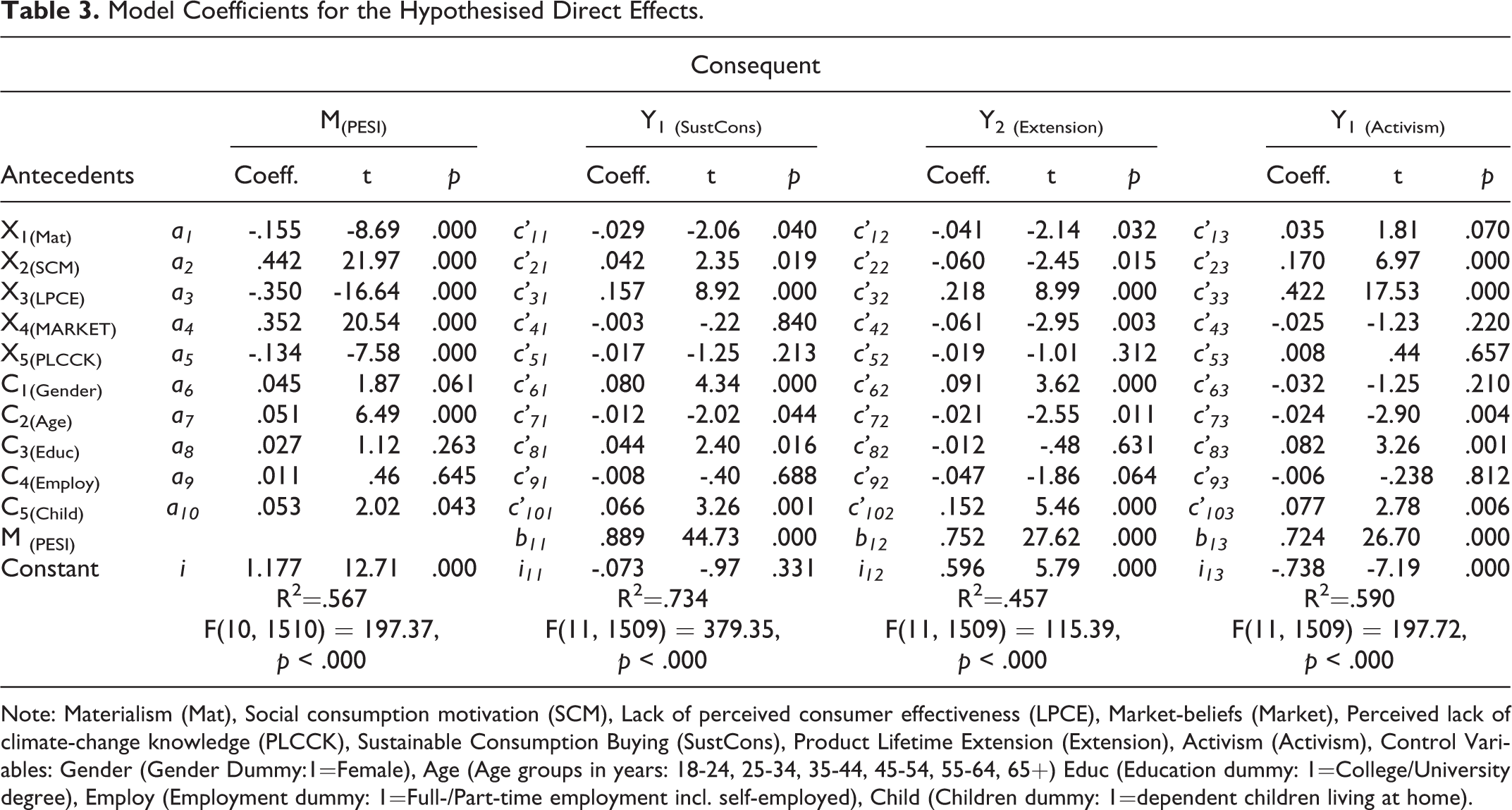
Note: Materialism (Mat), Social consumption motivation (SCM), Lack of perceived consumer effectiveness (LPCE), Market-beliefs (Market), Perceived lack of climate-change knowledge (PLCCK), Sustainable Consumption Buying (SustCons), Product Lifetime Extension (Extension), Activism (Activism), Control Variables: Gender (Gender Dummy:1=Female), Age (Age groups in years: 18-24, 25-34, 35-44, 45-54, 55-64, 65+) Educ (Education dummy: 1=College/University degree), Employ (Employment dummy: 1=Full-/Part-time employment incl. self-employed), Child (Children dummy: 1=dependent children living at home).
Market-based Barriers
H2 predicted that the
H3 assessed the effects of
H4 predicted a negative direct and indirect effect of a
H5 examined the effects of the
Indirect Effects for Pro-Environmental Self-Identity as a Mediator.
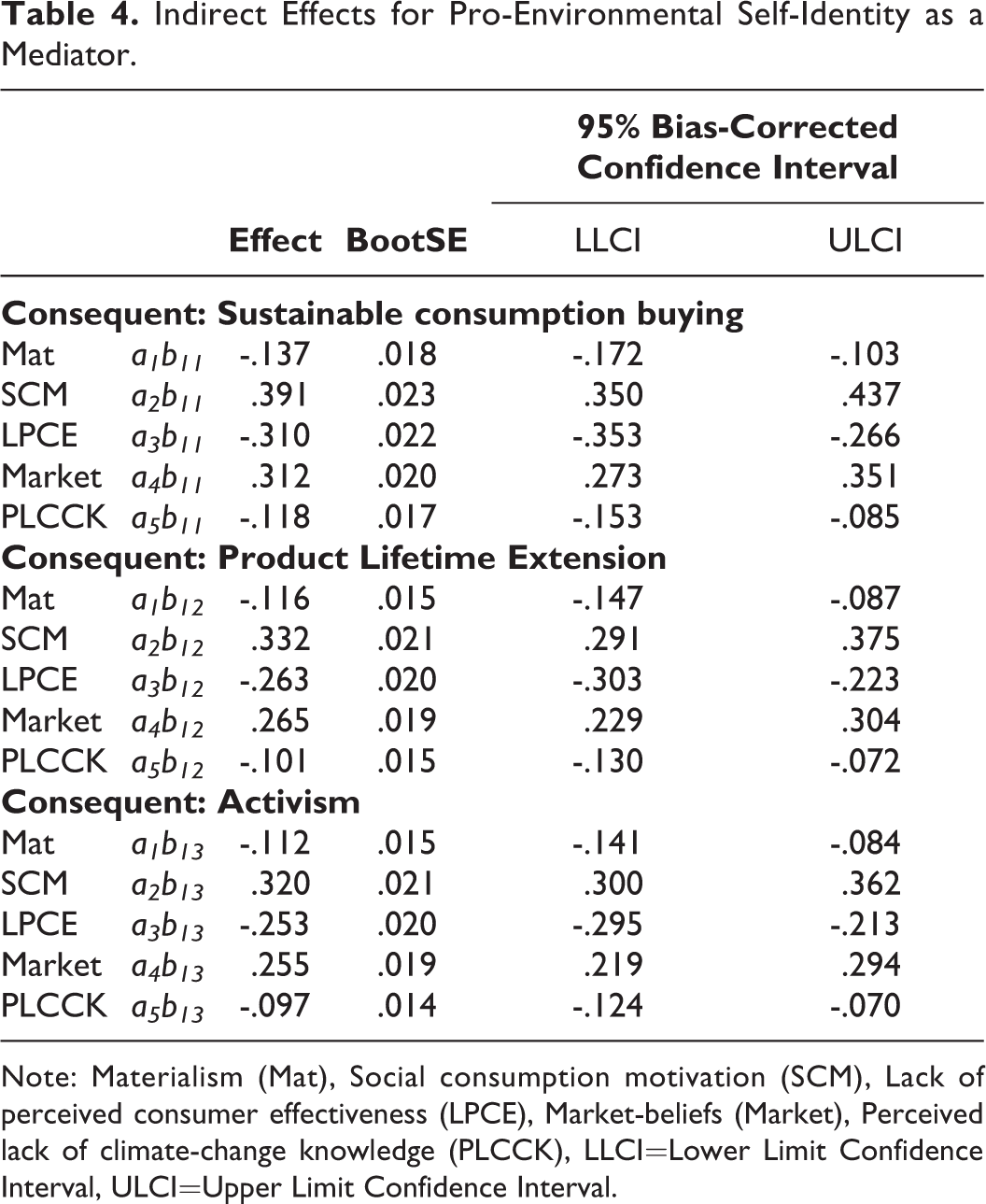
Note: Materialism (Mat), Social consumption motivation (SCM), Lack of perceived consumer effectiveness (LPCE), Market-beliefs (Market), Perceived lack of climate-change knowledge (PLCCK), LLCI=Lower Limit Confidence Interval, ULCI=Upper Limit Confidence Interval.
Knowledge-based Barriers
H6 proposed that
Country Effects
To examine whether country moderates any of the relationships between materialism, pro-environmental self-identity and the three sustainable consumption behaviours, conditional process modelling was applied to test for moderated mediation effects.
The results showed a significant (albeit small) positive effect of
Direct Effects Moderated by Country.
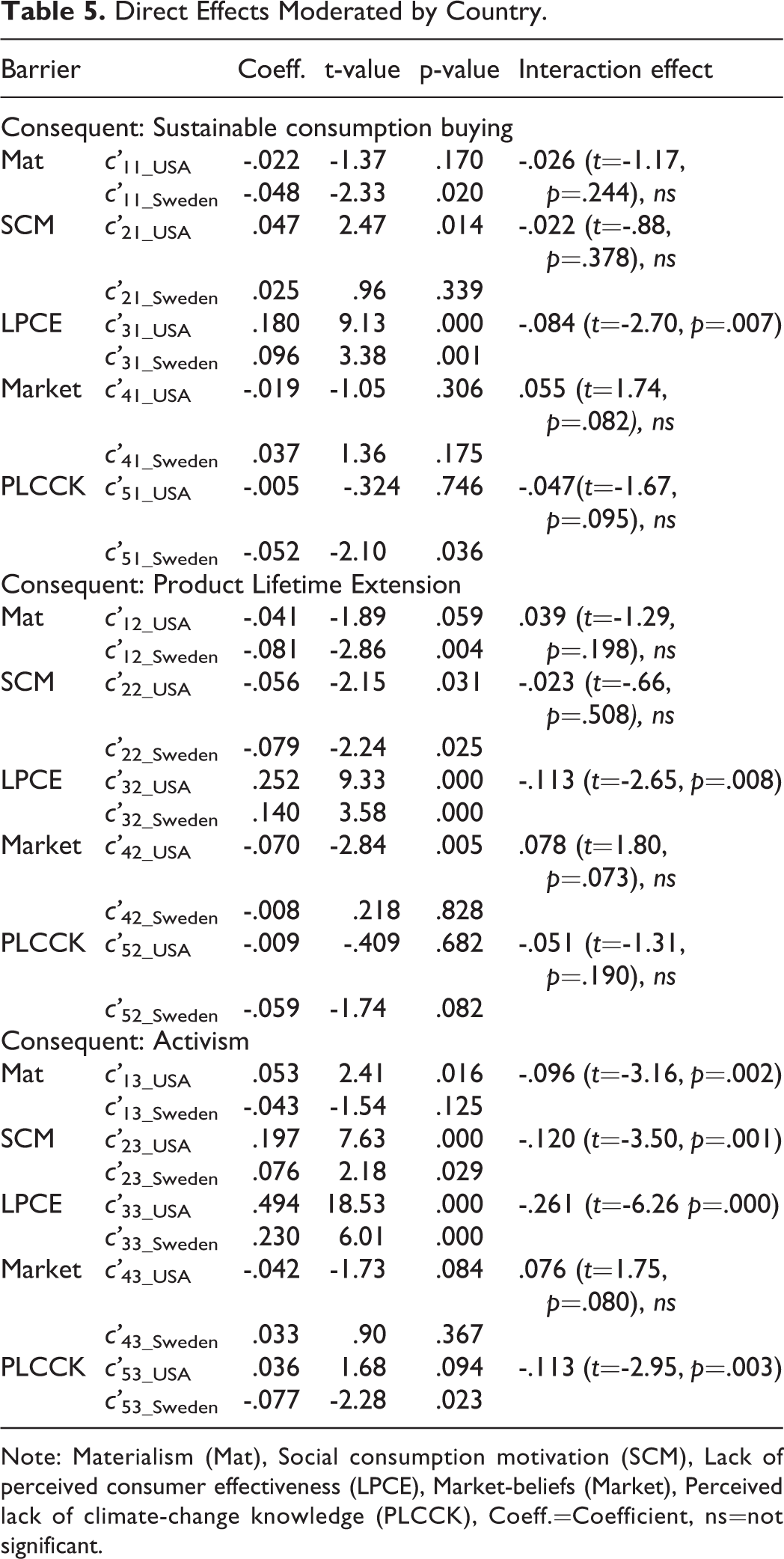
Note: Materialism (Mat), Social consumption motivation (SCM), Lack of perceived consumer effectiveness (LPCE), Market-beliefs (Market), Perceived lack of climate-change knowledge (PLCCK), Coeff.=Coefficient, ns=not significant.
Indirect Effects of Moderated Mediation for Pro-Environmental Self-Identity as Mediator.
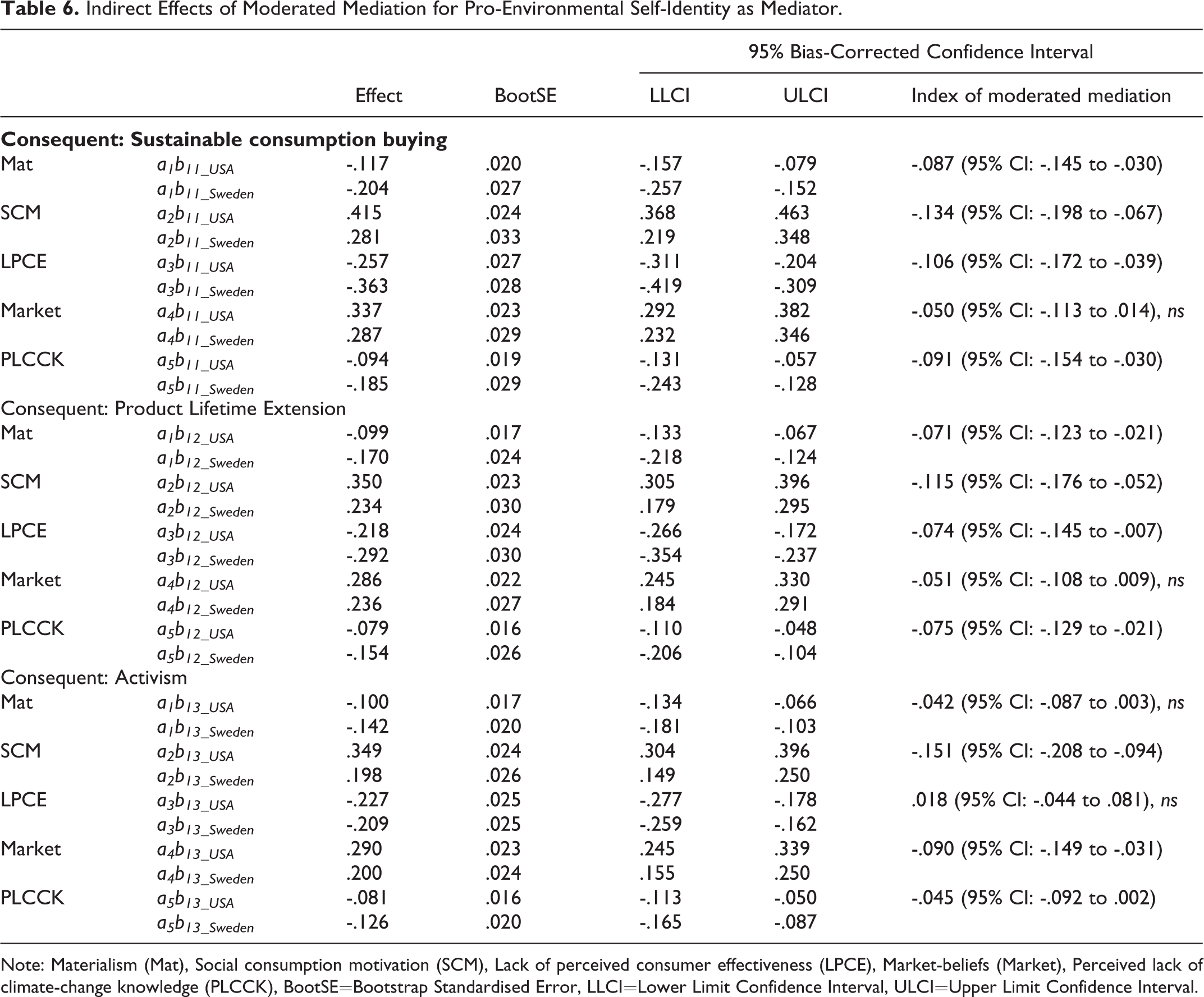
Note: Materialism (Mat), Social consumption motivation (SCM), Lack of perceived consumer effectiveness (LPCE), Market-beliefs (Market), Perceived lack of climate-change knowledge (PLCCK), BootSE=Bootstrap Standardised Error, LLCI=Lower Limit Confidence Interval, ULCI=Upper Limit Confidence Interval.
Only the positive direct effect of
In addition, the results confirm that country moderates the direct effect of
The results confirm that country only moderated the indirect effects of the
Furthermore, the results demonstrated that country moderated the indirect negative effect of
Discussion
This study reveals that pro-environmental self-identity positively influences the three behaviours of sustainable consumption buying, product lifetime extension, and environmental activism. This influence, however, varies by type of behaviour. In this study, the influence of pro-environmental self-identity is strongest on sustainable consumption buying. This lends credence to the small evidence base on pro-environmental self-identity as an important influence on buying (Dermody et al. 2015; Whitmarsh and O’Neill 2010). Additionally, it offers novel insight on the influence of pro-environmental self-identity on under-researched product lifetime extension and environmental activism behaviours. The need for this contribution is identified by Bovea, Pérez-Belis, and Quemades-Beltrán (2017), Dermody, Nagase, and Berger (2020) and Dono, Webb, and Richardson (2010). The protest with societal, political and business forces (Paço and Rodrigues 2016; SGuin, Pelletier, and Hunsley 1998) highlights the importance of the macro context to understanding these identity-product lifetime and identity-activism relationships. As Stern (2000) reminds us, such behaviours are both private and public.
This renders pro-environmental self-identity of significant value in rethinking SDG-12 from both post-capitalism and neoliberal perspectives that encapsulate the barriers examined in this paper. Moreover, there are significant contrasts between Sweden and the USA. This may reflect their respective pro-environmentalism and neoliberalism. Furthermore, this evidence strengthens the need for sustainability marketing to consider micro influences, like pro-environmental self-identity, from a macromarketing perspective (e.g. country orientation), in order to contribute to transformative consumption behaviour change initiatives. However, the findings show some complex relationships between the barriers, pro-environmental self-identity and the three sustainability behaviours in pro-environmental Sweden and neoliberal USA. Hence, this route to behavioural transformation is not a straightforward one.
Firstly, it was expected that the
As predicted, the
Indirectly, via pro-environmental self-identity, social consumption motivation positively influences all three behaviours. Notably, this effect is higher than the direct effect. This verifies the importance of pro-environmental self-identity discussed above. This effect on US consumers buying, product lifetime extension and activism behaviours was significantly greater compared with Swedish consumers. Thus, as social consumption motivation increases, so does pro-environmental self-identity and in turn the three sustainable behaviours. If this motivation decreases, this identity and subsequent sustainable behaviours will also decline. This study therefore builds on the small evidence-base indicating social consumption motivation, via identity, positively and indirectly influences sustainable consumption buying (Dermody et al. 2015). Furthermore, Dono, Webb, and Richardson (2010) suggest the social affirmation dimension of identity, which would reflect this motivation-identity effect, may influence environmental activism. The results from this study confirm this effect for activism. Moreover, it extends the evidence to include product lifetime extension behaviours. In particular, how the inclusion of pro-environmental self-identity alters social consumption motivation from a negative into a positive influence on extension behaviour. This facilitates the increased social visibility of pre-owned/repaired/reused products. This is noteworthy because consumption-based research on product lifetime extension is underdeveloped (Bovea, Pérez-Belis, and Quemades-Beltrán 2017).
Interestingly, these effects are more pertinent to the economic superpower of the US, than more pro-environmental Sweden. This suggests the need for social affirmation is stronger in the USA. This lends further support to Park and Lee’s (2014) suggestion of ‘conspicuous environmentalism’ in the US. Hence, the need to visibly display sustainable consumption in order to gain social approval. This may reflect lesser experience and lower confidence on pro-environmentalism and climate change in the US compared with Sweden (Ballew et al. 2019; Cleveland, Kalamas, and Laroche 2012; Urien and Kilbourne 2011).
In the USA therefore, it may be prudent to engage in any public-facing sustainability behaviours to reinforce and portray their pro-environmental self-identity to themselves and others. Revisions to SDG-12 need to reflect this. Overall, these social consumption motivation findings strongly suggest that it would be judicious to reformulate SDG-12 to boost the social face of pro-environmental self-identity. This could increase a mixed economy of sustainable consumption behaviours. For example, consumers’ equal consideration of buying, extending product lifetimes and environmental activism. Furthermore, important societal individuals and organisations can activate this social facet of pro-environmental self-identity. Equally, those advocating contrasting messages can undermine it. For example, former President Trump and his “prophets of doom” message.
Regarding the
The wider impact of this lack of effectiveness on sustainable consumption is negative and indirect, via pro-environmental self-identity. Thus, stronger perceived consumer effectiveness implies stronger identity. A positive indirect effect would signal weaker effectiveness and identity. This negative effect was significantly greater for Swedish consumers buying and extending product lifetime behaviours. This may represent the Swedish publics’ strong disposition to take action on climate change (The European Commission 2014). This means Swedish consumers with stronger perceived consumer effectiveness will also possess a stronger pro-environmental self-identity. The results indicate this is predominantly orientated to sustainable consumption buying. This suggests market-based empowerment is necessary in activating their pro-environmental self-identity. The stronger this perceived power is, the more it strengthens this identity. Furthermore, the stronger effect on buying may reflect Swedish consumers’ civic activism and efficacy in politically engaging with market forces to push for change within the marketplace. This suggests the post-capitalism notion of radical incrementalism (Swilling 2020) is working well in Sweden. Hence, Swedish consumers are using existing business/technological/social systems for their activist consumption causes, albeit this needs to extend into product longevity too. Swedish consumers appear able to politicise the marketplace as highly effective collaborative market actors. This is in-line with the thinking of Micheletti, Follesdal, and Stolle (2006) and Papaoikonomou and Alarcon (2017). This connects with this study’s findings on Swedish market-beliefs and climate change knowledge discussed below. While these relationships are complex, it is evident that empowering and politicising consumer communities to achieve a mix of sustainable consumption objectives contributes to the post-capitalism proposition of people-power. This will be valuable to increasing the behaviour change impact of SDG-12.
The direct effects of the
Interestingly, this positive indirect influence of market-beliefs, via identity, is significantly greater on US consumers’ environmental activism, compared with Sweden. This is likely to reflect the pro-environmental-neoliberalism positioning of the two nations. Hence, US consumers may regard environmental activism as a viable way of reacting against the economic and political ‘power’ of neoliberalism in their nation. They may believe they are enacting worthwhile solutions to environmental problems by taking part in protests and writing to their politicians. They may also believe they are making a stand against their politicians and corporations. In contrast, while Swedish consumers may wish their government and businesses to do more, Sweden is recognised for its societal and environmental leadership (Carbon Market Watch 2017; The European Commission 2014). Furthermore, Swedish consumers can confidently use the marketplace for political action for institutional change. Their identity-infused stronger perceived consumer effectiveness, discussed above, supports this. Overall, these findings strongly indicate SDG-12 must ensure responsible governmental and business practices match or exceed consumers’ repertoire of sustainable consumption behaviours.
Mixed findings also occurred for the final barrier –
Secondly, this barrier negatively indirectly (via pro-environmental self-identity) influences sustainable consumption buying, product lifetime extension and environmental activism behaviours. This is significantly greater for Sweden than for the USA. This finding lends tentative credence to putative knowledge influencing pro-environmental self-identity of consumers and their consumption and cultural norms (Howell 2013; Viswanathan et al. 2014). Thus, as knowledge increases to reduce this barrier, pro-environmental identity increases. In turn, buying, product lifetime extension and activism behaviours also increase. This experiential learning can connect the environmental and human consequences of consumption actions to climate change. This solution-based knowledge is well-rehearsed within psychology to underpin health interventions into problematic behaviours. It is further supported by studies on the processing and acceptance of identity-aligned climate message framing (Bertolotti and Catellani 2014; Stoknes 2015). Potentially, practical environmental problem-solving information, which consumers can do, can strengthen this identity and behaviours. For example, attending a repair café workshop to learn how to repair products instead of throwing them away. This knowledge-identity effect, coupled with stronger perceived consumer effectiveness helps explain Swedish consumers’ attitudes to environmental problems identified in the European Commission (2014) report. Further, it elucidates Sweden’s leading approach to implementing the EUs climate neutrality vision (Carbon Market Watch 2017; European Union 2019). Their self-perception as effective actors within the marketplace also suggests they can use radical incrementalism to further this environmental cause. Swedish consumers are therefore an ideal prototype to populate our proposed sustainable consumption utopia. Through their environmental attitudes and leadership, they have started to enact the UN’s call for people power for SDG-12. They therefore have strong potential to become peer-to-peer sustainability champions within their local, national and international networks. Furthermore, they use their like-minded coalitions to apply consumer pressure to drive forward greater responsibility among governments and global brands.
How Feasible is this Idea of a Post-Capitalism Sustainable Consumption Utopia?
This study suggests a market-based neoliberal foundation to current sustainable consumption behaviours, with pro-environmental self-identity operating within this paradigm. Within this, behavioural tensions abound among consumers in both neoliberal and pro-environmental societies, particularly for product lifetime extension and environmental activism behaviours. While there is some resistance to the neoliberal marketplace, sustainable consumption buying is a highly normalised behaviour that operates within this space. Even so, the richly varied and complex nature of sustainable consumption behaviours are creating friction and fissures within the neoliberal marketplace. For example, the backlash against ‘throwaway society’ by extending product lifetimes (Cooper 2010). This fissure can facilitate consumption opportunities for product reuse and repair, e.g. through direct purchase, and freecycling. Further, it can upskill consumer’s experiential knowledge as both producers and consumers. Examples include, attending workshops to learn how to repair products (often run by volunteers); creating and selling upcycled goods (Dermody, Nagase, and Berger 2020). These examples illustrate how existing market structures can be adapted to support transformation, in-line with Swilling (2020) and Walsh (2020). Thus, Swilling’s (2020) post-capitalism notion of radical incrementalism has merit in initiating change using the civic, political, and environmental activism in sustainable consumption behaviours. Indeed, normalising sustainable consumption buying is a phenomenal success story of this incrementalism. The fractures it triggers in neoliberal structures can enable other sustainable consumption behaviours to evolve too. For example, the rising interest and enterprise in upcycled, pre-owned and repaired products (product lifetime extension). Furthermore, buying represents the success of civic activism (Seyfang 2006), and thus people power within the marketplace. In sum, radical incrementalism may hold the key to shifting to a post-capitalism sustainable consumption utopia that is equal, just, liberal and democratic (Walsh 2020). This would encompass commons-orientated people power advocated by the United Nations (2019b). It would embrace adaptive relational partnerships (collibratory governance). Further, it would encourage alternate perspectives that are not western masculinist. This is fecund ground for SDG-12 to thrive.
This does not mean neoliberalism and the dominance of buying remain uncontested. Indeed, the political and economic tensions that inevitably arise are widely acknowledged (e.g. Beck 2016; Polanyi 2002; Stiglitz 2010; Urry 2011). Individual and institutional critique is necessary in balancing those benefiting most from the neoliberal market, and those disadvantaged by it. Furthermore, as Lorenzoni, Nicholson-Cole, and Whitmarsh (2007) and Sandilands (1993) argue, marketing messages need to be unlocked from the market to present sustainable consumption beyond buying. Even so, there is a rich opportunity to evaluate and learn from the achievement of sustainable consumption buying within the fissures of the neoliberal market structure. Appraising the contribution of pro-environmental self-identity to this success can enhance this insight. This understanding can help to advance transformative behaviour change. For example, the future accomplishment of extending product lifetimes, in-line with sustainable buying. As Swilling (2020: 139) observes: “What matters is transformation knowledge about the contested passage(s) from the present to particular desired futures. More specifically, this is deep knowledge about the evolutionary potential of the present.”
This transformation offers a more peaceful, ethical and collaborative (sharing) world built on the values of responsibility, freedom, equality, sharing and belonging. This is not to suggest this transition is easy or wanted. However, it is more necessary than it has ever been if all the predictions about the welfare of humankind and the planet hold true. This utopia may appear unreachable. However, there may be enough of the millions of networked consumers with sufficient foresight to use incremental radicalism to push for this vision of collaborative and equal good – Swilling’s (2020) call for a ‘just transition’. Evidence for this people power, and its inherent civic or environmental activism, resides within the digital and lifestyle revolution of consumer and community networks. This has triggered individuals to reappraise their perceptions of production, distribution, ownership and peer network interaction spanning buying, reuse, repair, pre-owned, etc. Swilling (2020) describes this as a post-capital commons-based peer-to-peer economy. This people-powered network economy can effectively function within relational post-capitalism, and by utilising radical incrementalism, it can do so at the borders, or outside neoliberalism and state-centric formal structures. Collaboration with NGOs and social movements across cultures, genders, and generations enhances the efficacy of this network. SDG-12 needs to recognise and support such an economy, which will enable it to thrive. In so doing, it is also supporting its family of SDGs, in particular SDG-1: no poverty and SDG-13: climate action.
Hence, in the spirit of big ideas and the big picture to facilitate bold transformation (Mittelstaedt et al. 2014; Swilling 2020; United Nations 2019b), a new horizon is re-imagined. This vision can refresh and bolster SDG-12. This may not be utopia, but it could be close. Governments no longer act as servants to markets in preference to society; they are becoming more civic and regaining the public’s trust in them. In this new land, production and consumption occur differently. People live sustainably together as co-creative producers and consumers. Neoliberal markets do not work here; albeit radical incrementalism at its fringes can still be useful. This is the land of informal cooperatives, communities, and networks. It is a place for individuals seeking a more meaningful way of living premised on ethics, responsibility, fairness and otherness. This is the fertile ground for sustainability to thrive. It embraces the 3Rs of reduce, reuse, and recycle, and adds a fourth component – reorganise – to create the 4Rs. Indeed, examples of this reorganised responsible behaviour already exist at the margins of society. These include: agro-ecological farming and food production (e.g. community orchards); agro-ecological consumer cooperatives (consumer networks & consumer-producer networks); agro-anti-poverty community networks (self-organising food markets for food security e.g. Toi market in Nairobi); exchange networks (to reduce waste); social currency networks to support local cooperatives and producers; and fix-it and repair café networks (to increase product lifetimes and decrease obsolescence).
Research Limitations and Further Research
While measures were implemented to reduce research errors, this study remains limited by its cross-sectional design. Thus, further research validation of these findings is required. Multi and/or mixed methods, and multiple-staged data collection is recommended to redress this limitation. Further research can deepen understanding of the direct/indirect effects of the barriers on sustainable consumption behaviours over time. Contrasting neoliberal/pro-environmental societies in developed and emerging economies would be worthwhile. Exploration of additional barriers and sustainable consumption behaviours, and the interaction between them would be valuable. Notions of post-capitalism, and the enactment and co-creation of people power in peer-to-peer networks also warrants research attention. This comprehension will be invaluable in enhancing SDG-12 and its future impact.
Footnotes
Appendix
Summary of Hypotheses Results.
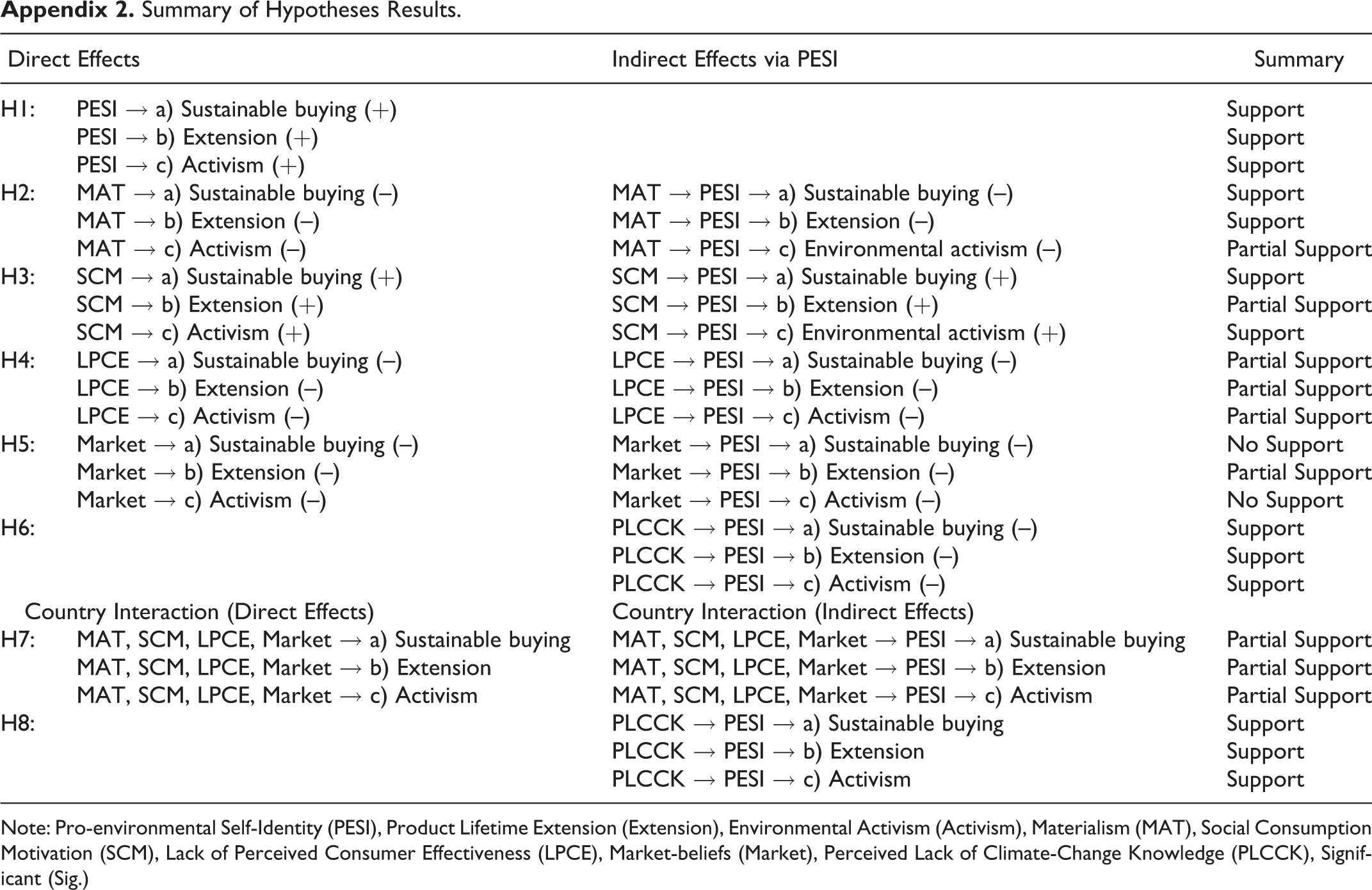
| Direct Effects | Indirect Effects via PESI | Summary | |
|---|---|---|---|
| H1: | PESI → a) Sustainable buying (+) | Support | |
| PESI → b) Extension (+) | Support | ||
| PESI → c) Activism (+) | Support | ||
| H2: | MAT → a) Sustainable buying (–) | MAT → PESI → a) Sustainable buying (–) | Support |
| MAT → b) Extension (–) | MAT → PESI → b) Extension (–) | Support | |
| MAT → c) Activism (–) | MAT → PESI → c) Environmental activism (–) | Partial Support | |
| H3: | SCM → a) Sustainable buying (+) | SCM → PESI → a) Sustainable buying (+) | Support |
| SCM → b) Extension (+) | SCM → PESI → b) Extension (+) | Partial Support | |
| SCM → c) Activism (+) | SCM → PESI → c) Environmental activism (+) | Support | |
| H4: | LPCE → a) Sustainable buying (–) | LPCE → PESI → a) Sustainable buying (–) | Partial Support |
| LPCE → b) Extension (–) | LPCE → PESI → b) Extension (–) | Partial Support | |
| LPCE → c) Activism (–) | LPCE → PESI → c) Activism (–) | Partial Support | |
| H5: | Market → a) Sustainable buying (–) | Market → PESI → a) Sustainable buying (–) | No Support |
| Market → b) Extension (–) | Market → PESI → b) Extension (–) | Partial Support | |
| Market → c) Activism (–) | Market → PESI → c) Activism (–) | No Support | |
| H6: | PLCCK → PESI → a) Sustainable buying (–) | Support | |
| PLCCK → PESI → b) Extension (–) | Support | ||
| PLCCK → PESI → c) Activism (–) | Support | ||
| Country Interaction (Direct Effects) | Country Interaction (Indirect Effects) | ||
| H7: | MAT, SCM, LPCE, Market → a) Sustainable buying | MAT, SCM, LPCE, Market → PESI → a) Sustainable buying | Partial Support |
| MAT, SCM, LPCE, Market → b) Extension | MAT, SCM, LPCE, Market → PESI → b) Extension | Partial Support | |
| MAT, SCM, LPCE, Market → c) Activism | MAT, SCM, LPCE, Market → PESI → c) Activism | Partial Support | |
| H8: | PLCCK → PESI → a) Sustainable buying | Support | |
| PLCCK → PESI → b) Extension | Support | ||
| PLCCK → PESI → c) Activism | Support | ||
Note: Pro-environmental Self-Identity (PESI), Product Lifetime Extension (Extension), Environmental Activism (Activism), Materialism (MAT), Social Consumption Motivation (SCM), Lack of Perceived Consumer Effectiveness (LPCE), Market-beliefs (Market), Perceived Lack of Climate-Change Knowledge (PLCCK), Significant (Sig.)
Declaration of Conflicting Interests
The author(s) declared no potential conflicts of interest with respect to the research, authorship, and/or publication of this article.
Funding
The author(s) received no financial support for the research, authorship, and/or publication of this article.
