




Abstract
Police units worldwide are going through a three-generational technological shift: from “street” to “screen” to “system” technologies. This paper focuses on how these digital shifts shape police officers’ perceptions. First, concerning the change from “street” to “screen” police, it focuses on how it changes police officers’ perceptions of discretion and burnout. The shift from “screen” to “system” policy focuses on how perceptions towards “screen” technologies shape the receptivity of “system” technologies. We address these questions using a mixed-method approach to analyze Brazilian police officers’ shift from the Military Police to the Environmental Military Police. Findings suggest that changing from “street” to “screen” police reduces burnout and limited discretion among police officers. Moreover, usefulness in achieving professional goals and perceptions of monitoring via “screen” technology predict receptivity to “system” technology. We conclude that street-level bureaucrats’ perceptions of technological shifts are essential to acknowledge when planning and implementing such changes.
Introduction
In a seminal paper written in 2002, long before Artificial Intelligence and the Metaverse entered our lives, Bovens and Zouridis (2002) envisioned a gradual shift from “street” to “screen” and eventually “system” bureaucracy. The bureaucrats’ main task in a “street” bureaucracy is interacting with citizens without mediating tools (Lipsky, 2010). In a “screen” bureaucracy, interactions are mediated by computerized informational tools such as databases from the bureaucrats’ end and digital self-service solutions from the citizens’ end (Busch & Eikebrokk, 2019). Finally, decisions are automated in a “system” bureaucracy, relying on system databases and algorithms. The benefits of these shifts are increased transparency, mitigation of corruption and unethical behavior, increased efficiency, and fair and standardized decisions (Busch & Henriksen, 2018).
Bovens and Zouridis (2002) focused their work on large decision-making bureaucracies such as tax departments. They anticipated that the shift to screens is less likely to occur among street-level bureaucrats (SLBs), such as police forces, due to the excessive discretion these jobs require. As Lipsky writes: “the nature of service provision calls for human judgment that cannot be programmed and for which machines cannot substitute” (2010, p. 161). Twenty years later, SLB’s roles, including social workers (de Boer & Raaphorst, 2021; Mathiyazhagan, 2021; Ranerup & Henriksen, 2019) and nurses (Buchanan et al., 2020), are being transformed by technology. This change is also evident in the police, as police units worldwide are in a constant technological shift (Brayne, 2021; Meijer et al., 2021; Lorenz et al., 2021). While some police units are in a technological transition from “street” to “screen” technologies, some are transitioning from “screen” technologies to “system” technologies with the use of intelligence-led policing (Fyfe, 2018) and predictive policing tools (Egbert & Krasmann, 2020; Meijer & Wessels, 2019). These shifts significantly change public street-level organizations and their people (Meijer et al., 2021), altering perceptions, attitudes, and behavior. This paper aims to understand how these shifts affect police officers’ well-being and willingness to adopt new technologies.
Public management research is addressing growing attention to the recent and vast technological shift to “system” bureaucracy (Andrews, 2019; Busuioc, 2021; Vogl et al., 2020). However, this work thus far has mainly been theoretical and conceptual, and empirical work is still being determined (Campion et al., 2020; Sun & Medaglia, 2019). Specifically, we need to understand how these shifts matter for SLBs interacting with citizens face to face (Janssen & Kuk, 2016; Bullock, 2019). Studying technological changes in the police can shed light on technology in public street-level organizations, a less-researched topic (Lipsky, 2010; Thomann et al., 2018; Tummers, 2017). It can do so using policing theory focusing on the receptivity of different technologies in the police, such as body-worn cameras (Bartholomew et al., 2021, Huff et al., 2018).
Thus, this paper focuses on understanding individual SLBs’ perceptions of technological shifts. We address the change from “street” to “screen” technologies and the more recent and future change from “screen” technologies to “system” technologies in the police. We ask two research questions: (1) How does the shift from “street-level” to “screen-level” police change police officers’ perceptions of discretion and burnout? (2) How do perceptions towards “screen-level” technologies shape willingness to implement “system-level” technologies?
To answer these questions, we study police officers in the Brazilian Environmental Military Police (EMP). Like the United States and Germany, Brazil is a federal state, and most police units are organized on a state level. The state police are divided into the Military Police and the civilian police (Magaloni et al., 2020). The civilian police is a “judiciary police,” an investigative force. The Military Police is a uniformed civilian police force holding most of the duties of the police as the guarantor of public order through street patrolling. It is also the largest, with 147 police officers per 100,000 inhabitants (Ribeiro et al., 2022). The EMP is part of the Military Police and is responsible for environmental patrolling and street work. It is an exciting research context because officers working in the EMP have all shifted from the Military Police. As explained next, this change holds a shift from “street” routine work to “screen” work with an extensive use of technological tools used only in EMP. It, therefore, allows testing our hypotheses. We used a complementary mixed methods approach (Gilad, 2021), collecting quantitative data via surveys (N = 140) and a qualitative focus group analysis to further understand our findings.
Our theoretical contribution is two-fold. Answering the first question, we contribute to the relatively scarce research on SLBs, specifically police officers, job satisfaction (Cooper et al., 2014; Petrovsky et al., 2022), and retention (Shim et al., 2017). Focusing on burnout, we demonstrate how technology can reduce burnout among police officers. This is important as studies found burnout to have negative consequences on police officers’ mental health (Foley & Massey, 2021), the organization (Martinussen et al., 2007), and on public service delivery in the form of aggressiveness toward citizens (Queirós et al., 2015).
We also add to the growing literature on technology and how it changes public street-level organizations. More specifically, we add to the debate on how technology curtails or enables discretion (Buffat, 2015; Bullock et al., 2020; Hupe & Buffat, 2014) among police officers. We find that the shift from “street” to “screen” police enables perceived discretion in two ways: by allowing more top-down discretion, as the technological tools make commanders feel more secure in police officers’ use of discretion, and from the bottom up, as the technological tools help police officers feel more confident using their discretion.
By answering the second question, we add to the growing attention in public management research regarding the shift from “screen” to “system” technologies among SLBs (Bullock et al., 2020; Young et al., 2019a). We find that attitudes towards “screen” technologies predict the willingness to use “system” technologies among SLBs. Specifically, less perceived monitoring and usefulness in achieving individual goals indicates “system” technologies receptivity. Understanding how SLBs perceive this shift is essential in planning and implementing technological changes. Moreover, as the shift to “system” technologies largely depends on the professional knowledge, data collection, and interpretations of public workers to be most effective (Vogl et al., 2020), understanding SLBs driving motivations and obstacles to technology adoption is crucial for informing roll-out of system technologies.
Technology 30
From “Street” to “Screen” Police
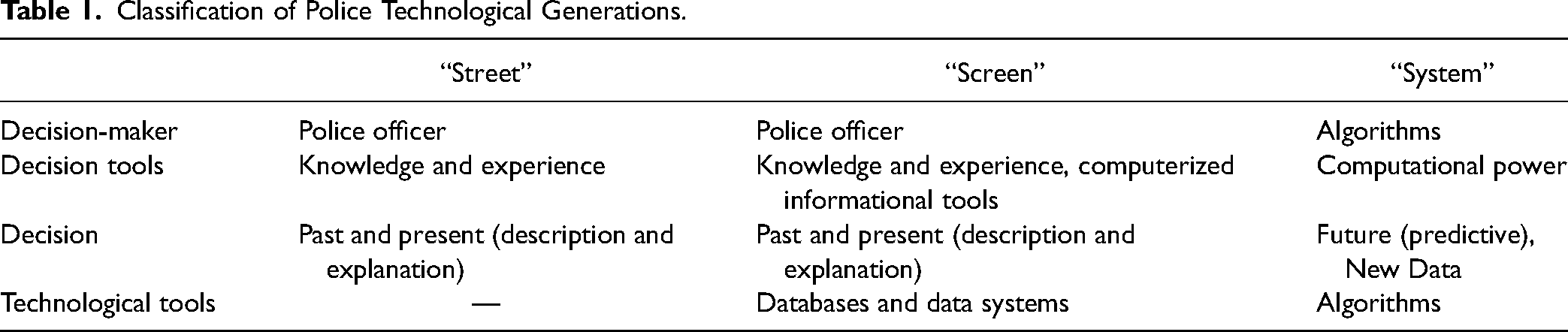
SLBs, such as nurses, police officers, or social workers, are defined by their everyday, direct street interactions with citizens (de Boer & Eshuis, 2018; Hupe, 2019; Maynard-Moody & Musheno, 2003). However, with the first generations of digitalization (Table 1) and the growing use of databases and data systems as decision support systems, the relationship between SLBs and citizens became increasingly mediated by computer screens. This shift has changed both the form of interaction, from face to face to screen mediated, and the decision power of SLBs as computers has become an essential tool in guiding SLBs’ discretion and decision-making (Hupe & Buffat, 2014). However, while research has focused on the success and failure of planning and execution of “screen” technologies (Sandeep & Ravishankar, 2014) and how it challenges public value creation (MacLean & Titah, 2022), only scarce research has focused on how this technological shift affects SLBs well-being. This paper fills this gap by focusing on the perceptions of burnout and limited discretion among police officers.
Classification of Police Technological Generations.
The Digital Shift and Police Burnout
One of the defining characteristics of the shift from “street” to “screen” work is screen-mediated encounters with citizens. This shift may take the form of a fully mediated encounter or a partially mediated encounter where the use of a technological tool mediates the encounter, for example, when a police officer uses a database or a dashboard to decide on the street (Bovens & Zouridis, 2002; Terpstra et al., 2019). Collins (2004) has pointed out that losing physical encounters, or encounters mediated by communication technologies, is a significant risk to social order and solidarity because physical interaction is integral to building mutual tolerance. It is thus essential to understand how these technologies shape police officers’ attitudes, such as tolerance towards citizens, and how this affects burnout. The fact that within “screen” police departments, there are fewer direct encounters with citizens and that screens mediate these encounters matters for police burnout as research found that encounters with citizens are one of the main mechanisms of stress and burnout within the police (Bayley & Shearing, 1996; Paoline et al., 2000; Seron et al., 2004).
Burnout occurs more frequently among professionals who work with others as service providers (Maslach & Jackson, 1981). Public service providers practice different forms of coping, defined as “behavioral efforts that frontline workers employ when interacting with clients to master, tolerate, or reduce the external and internal demands and conflicts they frequently face” (Tummers et al., 2015, p. 1100). In police work that often entails threatening conditions, stress may increase and require more coping mechanisms by police officers (Queirós et al., 2020). Thus, in a “screen” police, where more interactions with citizens are mediated via technology, burnout of police officers might decrease (Breit et al., 2021). We, therefore, hypothesize that:
The Digital Shift and Discretion
During interactions with citizens, SLBs use their discretionary power and the freedom to make decisions concerning individuals regarding the sort, quality, and quantity of sanctions and rewards during policy implementation (Lipsky, 2010; Tummers & Bekkers, 2014). Traditionally, SLBs had discretionary power based on their professional knowledge, training, and practical experience (Raaphorst, 2018). For example, according to Scharf and Binder (1983), the traditional police discretion process includes four stages: anticipation, entry, initial contact, dialog, and information exchange, occurring on the street in face-to-face communication. Until recently, researchers held that discretion is so fundamental to street-level work that it will always be the defining characteristic of SLBs’ working behavior (Evans & Harris, 2004).
Public management theory has long debated whether the technological shift curtails or enables SLBs’ discretion (Buffat, 2015). The curtailment argument is based on the notion that in “screen” technologies, SLBs use information infrastructures that codify legal and organizational rules (Zuurmond, 1998). Adherence to these rules and procedures may lead to decreased discretion and increased routinization. SLBs might fear using traditional discretion to oppose system protocols and information presented via computer screens (Busch & Henriksen, 2018; Keymolen & Broeders, 2013).
The enablement argument acknowledges that knowledge and data gained using “screen” technologies provide SLBs with better resources to use with their discretionary power when used as a recommendation tool (Buffat, 2015; Bullock et al., 2020; Hupe & Buffat, 2014; Thunman et al., 2020). As such, “screen” technologies, which leave discretionary power in the hands of SLBs, may counterintuitively lead to increased discretion (Pedersen & Pors, 2023).
In the context of policing theory, the policing craft (Willis & Mastrofski, 2018) is based on “the knowledge, skill, and judgment patrol officers acquire through their daily experiences.” However, studies of police discretion demonstrate that human errors can bias decision-making as police officers cannot address all criminal behavior (Bittner, 1990; Reiner, 2010). Therefore, the fear of making mistakes may have negative consequences on the perceived discretion of police officers, as they may aim to limit the use of their discretion to limit mistakes.
Using “screen” technology, such as information and records management systems that are available for street patrol officers and even more so for police investigators in the office, police officers improve their ability to collect, manage, and analyze data, thus making them feel more secure in using their discretionary power (Koper & Lum, 2019; Lum et al., 2017). “Screen” technologies are used for retrieving information when reacting or responding to a situation. For example, when addressing a call for service, past data on domestic violence in that location can help police officers prepare better, or running a criminal history check on a stopped individual can give ques on how to define the situation and how it should be solved (Lum et al., 2017). As this information aids police officers in their decision-making, we hypothesize that it will affect their perceived discretion:
From “Screen” to “System” Police
Public organizations have shifted from “screen” to “system” technologies (Table 1). “System” technologies are characterized by a predictive, decisive technological role, replacing professional judgment by human SLBs (Bovens & Zouridis, 2002; Ranerup & Henriksen, 2022). These automated decision-making systems predict future outcomes with past-or real-time data based on regression techniques, machine-learning algorithms, and data-mining approaches (Veale & Brass, 2019). Thus, they de-facto generate predictions that are new or generated data. A recent report (Engstrom et al., 2020) finds that nearly half of the federal agencies studied (45%) have experimented with “system” techniques. Government organizations use “system” technologies worldwide for enforcement, benefits adjudication, regulatory analysis, policymaking, human management, citizen coproduction, and service delivery (Engstrom et al., 2020). In line with this trend, “system” technologies are increasingly used by police departments to predict crime and inform policing decisions, as these tools are powerful in analyzing vast amount of data and overcoming human limitations (Ferguson, 2017).
While routine and radical implementation in street-level organizations has long been studied (Brown & Osborne, 2012), “system” technology is a relatively new topic of exploration. Different theoretical lenses were used to analyze how “system” technologies might change public organizations’ outcomes and public relations, with theories such as public value theory (Schiff et al., 2022), administrative evil (Young et al., 2019b), or representative bureaucracy (Miller & Keiser, 2021). However, very little empirical work thus far studies the shift from “screen” to “system” technologies that transform street organizations from within and SLBs’ perceptions and behaviors. In addition, few studies have focused on the pre-implementation receptivity of “system” technologies among SLBs. Receptivity is defined as an initial attitude before the assignment of the technology to the worker (Bartholomew et al., 2021) and is a crucial step in the acceptance of technology.
A well-researched framework for understanding technology receptivity is the technology acceptance model (TAM) introduced by Davis (1989). The framework was first used to explain receptivity and acceptance in the private sector. However, it was applied in public settings, including police receptivity of body-worn cameras (Stinson, 2018) and iCOP (Allen, 2019). The TAM model details the predictors of receptivity or rejection of new technology and has become an essential model for understanding predictors of human behavior towards technology. According to the model, attitude influences behavioral intention, which affects the user’s actual behavior (much based on the theory of planned behavior; Ajzen, 1991).
The two main predictors of actual behavior in the TAM model capture attitudes towards the technology: perceived usefulness and perceived ease of use. Perceived usefulness is the degree to which the potential user believes using the technology would enhance their job performance. In contrast, the perceived ease of use is the degree to which the user acknowledges that using the technology would not demand much effort (Davis, 1989).
With New Public Management, and the growing demand for performance measurement in the police (Moynihan, 2008), police officers must prove their job performance (Bayley, 2008). Technology improves performance (Eterno et al., 2021). In police work, technology is becoming critical to attaining professional goals, as seen in the growing para-Military Police model. An essential part is the acceptance and use of new technologies (Kraska, 2007). Technology can aid in achieving professional goals by improving data collection and analysis, which aids police officers’ street work. It requires identifying and analyzing large amount of data in highly dynamic and demanding situations. For example, a “screen” technology that supplies a police officer with information about a crime’s “hot spot” can help achieve the goal of proactive policing and crime reduction (Engelbrecht et al., 2019). Screen technologies can also aid reporting, decreasing workload, and freeing time for core policing tasks. In addition, technology can benefit police officers in communicating with each other and with citizens, which helps them achieve organizational and reputational goals (Koper et al., 2014). Thus, “screen” technologies can benefit police officers’ everyday work and job performance. The TAM model demonstrates that perceived usefulness is a necessary predictor of technology receptivity. As such, it can be hypothesized that if a police officer perceives current “screen” technology as helpful, he/she will be more likely to support future “system” technology. We hypothesize that:
One of the defining characteristics of SLBs’ work is that it is subject to limited vertical control and monitoring due to the discretion based on professional expertise and one-on-one encounters with citizens (Lipsky, 2010). By publicly making standardized decisions, “system” technologies make monitoring SLBs’ work more accessible. In “system” technologies, SLBs’ performance can easily be quantified, compared to others, and managed against algorithmic models (Orlikowski & Scott, 2016). This fear of being monitored by technology is documented in the work of Criado et al. (2020), which found that service inspectors understand automated decision-making systems to be a threat to their daily work, concerned by a “watchdog” or “big brother” effect on their work. Studies on predictive policing have found that managers and employees perceive the technology as a way for management to exert more control over officers’ behavior (Brayne, 2017). Lorenz et al. (2021) found that if police professionals reject the prediction of the automated decision-making processes in the Berlin police, and a crime is committed that might have been prevented by these police professionals, they may be blamed for not following the automated advice. We maintain that the fear that “screen” technologies are used for monitoring would negatively affect the receptivity of “system” technologies. We, therefore, hypothesize that:
Method
Research Setting
The research setting for this paper is the Brazilian EMP. The EMP is an exciting setting to test the suggested hypotheses because of the vital role that technology holds in the work of police officers in this unit, as well as the shift from “street” to “screen” technologies that police officers go through when moving to serve in EMP from the general Military Police.
Brazil has a Federal Police in charge of investigating complex crimes, and street-level policing is carried out on a state level under the supervision of the state governor. Thus, all Brazilian states have a Military Police responsible for street patrol and crime repression and a Civil Police in charge of investigating crimes (Flom, 2022). The Military Police act is in the first half of the complete police cycle (prevention), and the Civil Police act is in the other half of the complete police cycle (repression/investigation).
The EMP is a specialized unit of the Military Police. While the Military Police has the general role of street patrol, the EMP is responsible for street patrol and preserving public order related to the protection and conservation of Biodiversity and Ecology, subordinated to the Public Security Secretariat of each state. However, The EMP, like all Military Police, carries out arrests and detentions and has state jurisdiction. The EMP, as part of the Military Police, obeys the same legal statute and are street-level patrol officers. In addition, the command structure of the Military Police and EMP is similar.
The EMP is present in 26 of the 27 Brazilian states, with ∼7,000 police officers nationwide. All Military Police officers receive early career training at the Police Academy. After working in the Military Police, officers may be invited to participate in EMP training courses or request to join them. Thus, all EMP officers have served in the general Military Police before joining the EMP, which makes this an excellent case study for comparing pre- and post-joining EMP. Furthermore, EMP officers attend a specialization course of 320 h on Brazilian environmental legislation in addition to their initial training of 1,600 h. As environmental crime investigations are complex, technology has accompanied EMP work and is an essential difference between routines in the general Military Police and EMP. These technologies include online registration of procedures, work reports, active search, access to databases, laptops, camcorders, online technical reports, GPS, and drones. The use of technologies varies among states, as an investment in technology requires specific resources and depends on the political decision of state governors and Federal Government programs.
The Brazilian police, like many other public organizations in Brazil, face increasing budget cuts (Braga & Purdy, 2019) due to a series of recent economic austerity measures. Until 2015, New Public Management ideas with a socialist perspective have guided Brazilian policy (Bresser-Pereira, 2002). However, since 2015, right-leaning governments have led an increasingly growing austerity regime (Boschi & Pinho, 2021). In addition, since 2019 until the recent turnover, Jair Bolsonaro's administration has eroded environmental protection policies (Barbosa et al., 2021). This process was done by centralizing environmental governance by restricting participatory decision-making spaces such as the National Environmental Council and attacking environmental defenders (Menezes & Barbosa, 2021).
Nevertheless, Bolsonaro has focused much of his environmental control in the Amazon and less so in other parts of Brazil. As part of this centralized environmental governance, the EMP during Bolsonaro’s term has received more investigative and reporting power. However, as the EMP is state police and not federal police, these changes varied from state to state.
Research Approach
This research uses a Complementary mixed methods approach (Gilad, 2021), in which quantitative data is collected and then further understood with a focus group, a qualitative tool. This method helped us identify broader relationships using quantitative data and then more strongly contextualize these relationships using qualitative data (Creswell, 2014). Mixed-methods research can aid in overcoming a shortcoming of SLB research, mainly a need for more generalizability while gaining crucial contextual information (Schott & van Kleef, 2019). Thus, we used the general knowledge from the quantitative survey to guide the focus group, allowing for additional qualitative analysis.
Quantitative Analysis
Sample
A University Ethical Review Board approved the study procedures (University of Haifa, 439/21), and all participants completed an online consent form. The quantitative questionnaire was sent to EMP police officers in different states in Brazil via an instant messaging (IM) smartphone app. The survey was written in Portuguese, the spoken language in Brazil. The message included a link to a survey on the Qualtrics platform. In Brazil, it is prevalent for EMP police officers to use IM for communication (Alcadipani et al., 2021), so this was a suitable sampling method for this case.
Of the 198 police officers in the group, 151 responded (a 76.2% response rate). We filtered out observations due to missing answers leading to a remaining sample of 141. Regarding demographics, our sample represents the characteristics of the officers in EMP (for a demographic report of the Military Police, see: https://forumseguranca.org.br/publicacoes_posts/escuta-dos-policiais-de-seguranca-publica-do-brasil/). Of these police officers, 87.9% male, 37.4% up to 40, and another 54.7% are 40–50; 70% of the sample are more than 15 years in service (in MP and EMP in total), but 58.2% are less than 10 years in EMP. As for geographical distribution, 50.7% are from the Southeast region, 25.7% are from the North region, 15% are from the Midwest region, and 8.6% are from the Northeast region.
The survey included four sections. In the first, respondents were asked to relate to their time servicing the general Military Police when answering questions on attitudes and perceptions. In the second, respondents were asked to describe their time servicing in the EMP when answering the same questions on attitudes and perceptions. In the third section, the respondents read a brief description of “system” technologies and then responded to questions regarding their receptivity to these technologies. Finally, the fourth section included demographic questions.
Measures
Burnout was measured with an item from the Maslach Burnout Inventory (1997): “I leave work feeling emotionally exhausted.” This item was used twice: the first section focused on past service in the Military Police, and the second section focused on services in EMP. Answers were provided on a Likert scale ranging from 1 (do not agree) to 5 (strongly agree).
Limited discretion was measured with an item from Tummers and Bekkers (2014): “work policies felt like a harness in which I cannot easily move in.” This item was used twice: in the first section concerning past service in the Military Police and the second section concerning service in EMP. Answers were provided on a Likert scale ranging from 1 (do not agree) to 5 (strongly agree).
Monitoring in “Screen” technology is a scale consisting of three items: “my immediate supervisor uses the tool to track and monitor my daily activities”; “command staff uses the tool to track and monitor my unit's daily activities”; and “commanders and supervisors use the tool to identify underperforming officers.” Confirmatory factor analysis (CFA) indicated that the scale was unidimensional, explaining 65.79% of the variance and exhibiting a Cronbach's α of 0.716.
Perceived usefulness of “Screen” technology is a scale consisting of four items: “the tool helps me make good decisions,” “the tool helps me reach my professional goals”; “the tool helps me minimize professional misunderstandings in work”; and “the tool makes me more effective in identifying and locating environmental crime.” The CFA indicated that the scale was unidimensional, explaining 70.21% of the variance and exhibiting a Cronbach's α of 0.856.
The receptivity of “system” technologies is a scale consisting of two items: “the use of automated decision-making systems can improve my work”; and “I would like my agency to add automated decision-making systems to the technology already used in my organization.” Answers were provided on a Likert scale ranging from 1 (do not agree) to 5 (strongly agree). The CFA indicated that the scale was unidimensional, explaining 88.2% of the variance and exhibiting a Cronbach's α of 0.857.
Control variables are age, gender, rank, race, region, time in the police, and time in EMP.
Statistical Analysis
Using the software package IBM SPSS Statistics 27, we first conducted an exploratory factor analysis to ensure the validity of the scales and the uniqueness of the constructs investigated. Then, Harman's single-factor test was run, loading 13 self-reported items on one factor and using exploratory principal axis factoring without rotation. One factor explained only 24.56% of the variance; hence, it did not indicate potential standard method bias (Podsakoff et al., 2003).
We then tested H1 and H2 by comparing the means of the data using t-tests of paired samples. To test H3 and H4, we examined the linear relationships among the variables using hierarchical multiple regression analysis (Lautenschlager & Mendoza, 1986). Regression diagnostics revealed acceptable statistics for hierarchical multiple regression assumptions. The requirements for normality, linearity, and homoscedasticity, as well as multicollinearity, were met.
Findings
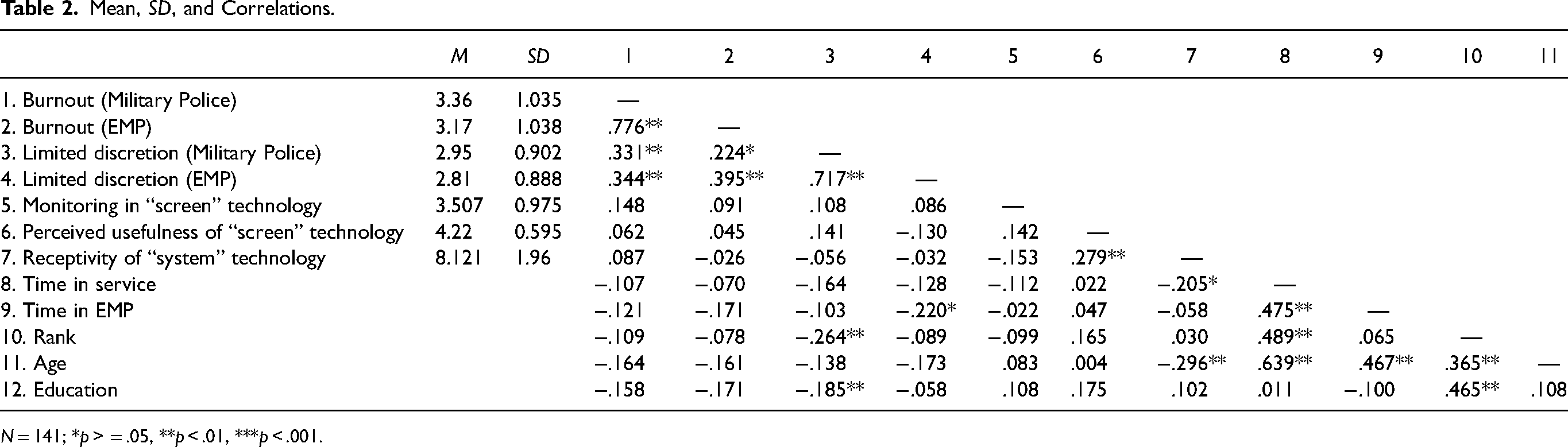
The mean, standard deviation, and correlations are presented in Table 2.
Mean, SD, and Correlations.
N = 141; *p > = .05, **p < .01, ***p < .001.
To test H1 and H2, bootstrap paired-sample t-tests were conducted to compare perceptions of burnout and limited discretion in the Military Police and EMP. Burnout in the Military Police (M = 3.42, SD = 1.021) was higher than the burnout in EMP (M = 3.18, SD = 1.041), a statistically significant mean increase of 0.240, 95% CI [0.106, 0.384], t(103) = 3.418, p < .005, d = 0.717. This finding suggests that shifting from “street” to “screen” technologies reduces the burnout, confirming H1.
Related to H2, limited discretion in the Military Police (M = 2.95, SD = 0.939) was higher than the limited discretion in EMP (M = 2.84, SD = 0.883), a marginally significant mean increase of 0.115, 95% CI [−.010, 0.240], t(103) = 1.713, p = .083, d = 0.687.
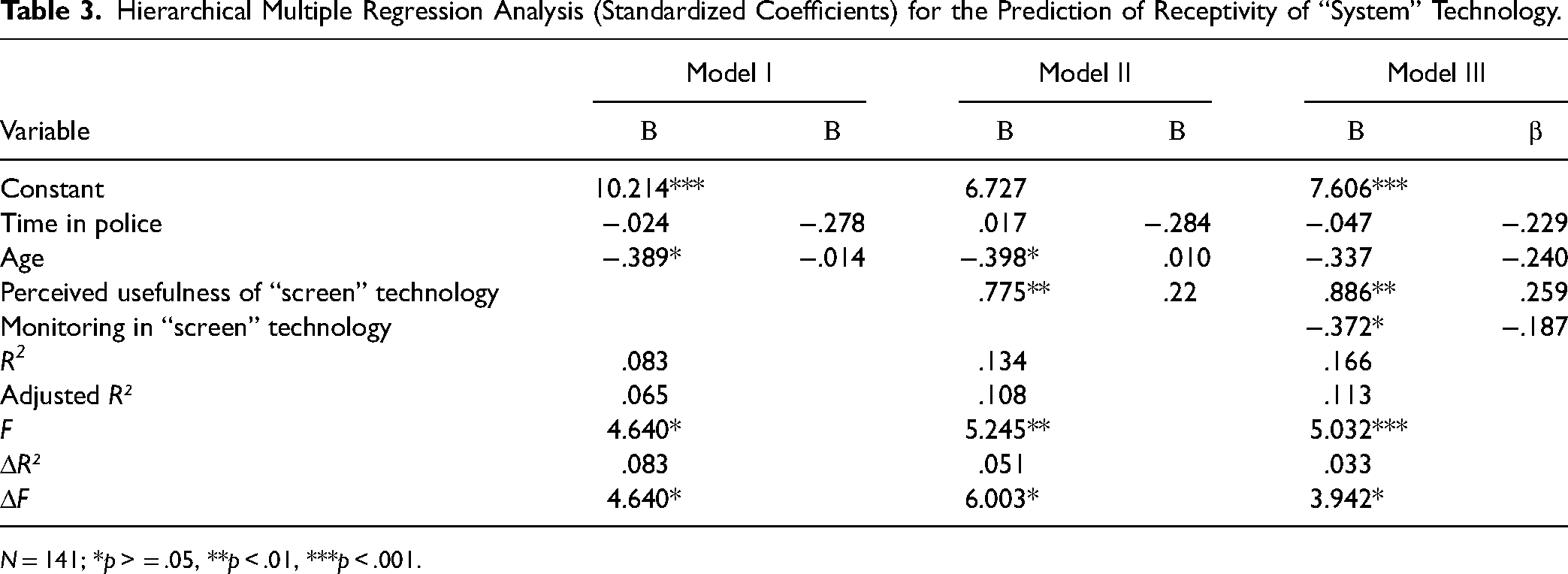
To test H3 and H4, hierarchical multiple regression was run to determine if the addition of the perceived usefulness of “screen” technology and perceived monitoring in “screen” technology improved the receptivity of “system” technologies. See Table 1 for full details on each regression model. The complete model of age, time in service, perceived usefulness of “screen” technology, and monitoring in “screen” technology predicting receptivity of “system” technologies (Model 3) was statistically significant (R2 = .166, F(41, 101) = 3.942, p = .05; adjusted R2 = .133). The addition of the perceived usefulness of “screen” technology to the prediction of receptivity of “system” technologies (Model 2) led to a statistically significant increase in R2 of .051, F(1, 102) = 6.003, p < .005. Adding perceived monitoring in “screen” technology (Model 3) also led to a statistically significant increase in R2 of .033, F(1, 101) = 3.942, p = .05. Taken together, these findings support H3 and H4 (Table 3).
Hierarchical Multiple Regression Analysis (Standardized Coefficients) for the Prediction of Receptivity of “System” Technology.
N = 141; *p > = .05, **p < .01, ***p < .001.
Qualitative Analysis
The quantitative findings demonstrate that the shift to “screen” technologies from “street” work reduces burnout and, to an extent, perceptions of limited discretion. Regarding the receptivity of “system” technologies, we find that attitudes towards “screen” technologies predict the receptivity of “system” technologies. While monitoring via technology has a negative effect, the perceived usefulness of the technology has a positive effect.
To further understand our quantitative findings, we conducted a focus group with EMP commanders (N = 5). The focus group lasted 2.5 h and was recorded. The focus group began with general questions on using technology in the EMP compared to the Military Police and the discretion of EMP police officers. We then presented the quantitative findings and asked the commanders how they understood them.
The commanders emphasized the technological shift that police officers go through when entering the EMP from the Military Police, where hardly any technology is used. Even though technology differs from state to state, it is an essential tool used by EMP officers, which is not regularly used by “street” police. The commanders linked the extensive use of “screen” technology in EMP to reducing perceptions of limited discretion and burnout. They explained that technology increases discretion in two ways. First, from the bottom up, technology helps police officers feel more secure in using their discretion, as they feel they have more tools to consult and more data to reach conclusions. As one commander from the Amazonas said: “For example, in my case, it is tough to track deforestation with bare eyes, but having technological tools helps to see what is going on. Technological tools give us data we cannot reach any other way. This makes us feel more knowledgeable and capable of doing our work. It is like an extension of our capabilities.”
Another commander extensively reported on how technology helps police officers to close the complete cycle of policing by helping the reporting process and communication within the police and with the judiciary. He noted that using the report system saves time and allows for consultation among police officers and the judiciary during the investigation process. He noted that the technology which connects the police and the judiciary helps police officers understand the process and the judiciary’s needs and limitations, which makes them better at street work and addressing future crimes. This comprehensive knowledge has two important outcomes that are related to burnout and discretion: the police officers have more time to dedicate to each case and have more consultation outlets which help them feel more secure with making decisions. Another police commander mentioned technology’s role in documenting and reporting a crime, making it easier to collect evidence and support the police officers’ claims. He pointed out that this, too, makes police officers feel more confident in making decisions and feel less vulnerable during the investigation process, which may expose police officers.
The commanders further elaborated on how technology can reduce burnout. They explained that “screen” technology reduces burnout because police officers have more discretion and less uncertainty as they explained. Also, with technology’s aid, they can better fulfill their mission. The officers mentioned that less burnout is an incentive for police officers to move from the Military Police to EMP, as well as the use of technology in EMP that is considered a significant change in police everyday work. The commanders emphasized that while EMP police officers face the same dangers as Military Police officers, such as gun shootings, they still feel less burnout due to their increased discretion.
Second, top-down, the commanders explained that technology allows for more delegation of authority to police officers. This is because the decisions are based on more robust evidence-collection methods via the technologies, making them feel more secure in officers’ decisions. They also mentioned that using technology makes it easier for them to track police officers’ work. Thus, while there is more delegation of authority, there is more monitoring of police officers’ work, and enhanced discretion comes with more responsibility and measurement of individual officers’ performance.
Discussion
The shift to automated decision-making tools in the public sector is here (Zouridis et al., 2020). These changes transform public organizations in ways public management scholars struggle to understand. While some scholars have explored the ethical considerations of this shift (Mulligan & Bamberger, 2019), only scarce empirical research has begun to question how this shift changes the management and administration of street-level organizations, defined by their everyday encounters with citizens (Bullock, 2019; de Boer & Raaphorst, 2021; Giest & Grimmelikhuijsen, 2020).
This paper focuses on technological transitions in a street-level organization, the police. By doing so, it uses extensive research in policing theory on technology receptivity and implementation (Ballucci et al., 2017; Bartholomew et al., 2021; Lum et al., 2017) to start addressing the questions in public management theory regarding the major technological transitions public organizations have been through and are about to go through (Desouza & Jacob, 2017; Sun & Medaglia, 2019). Then, using the case of police officers in the EMP in Brazil, which is a field example of police officers who do street policing with an environmental focus and who have transitioned from “street” to “screen” police, we aim to understand how this shift affects perceptions of discretion and burnout and how the use of “screen” technology predicts receptivity of “system” technologies.
This paper’s theoretical contribution examines the technological shifts in public management from “street” to “screen” to “system” technologies and how they change SLBs’ perceptions. First, findings regarding the shift from “street” to “screen” police demonstrate that “screen” technologies can reduce the burnout compared to “street” work, confirming H1. As burnout is a common phenomenon in street-level work, it is essential to understand how it can be reduced (Adams & Mastracci, 2019). Moreover, this adds to the limited research thus far on SLBs, specifically police officers’ well-being and retention (Cooper et al., 2014), and the role of technology use in this link (Collins, 2004). Second, we find that there are higher perceptions of limited discretion in “street” police work than in “screen” police work, confirming H2. By pointing to how using “screen” technologies entails discretion, we add to the curtailment–entailment debate (Buffat, 2015; Hupe & Buffat, 2014; Bullock et al., 2020).
Regarding the shift from “screen” to “system” technologies, we find that the perceived usefulness of current technologies and the fear of being monitored by current technologies are significant predictors of future technologies, confirming H3 and H4. From the commanders’ qualitative analysis, we can further understand why perceived monitoring and usefulness of current technology predicts receptivity of “system” technology. There is a tradeoff between using technology to expand discretion and reach individual goals and the managerial monitoring that these tools enable. This tradeoff is evident in police officers’ perception of the shift to “system” technologies. Technology’s usefulness in achieving police officers’ professional goals will positively predict receptivity of “system” technologies, while perceived monitoring negatively predicts receptivity of “system” technologies. Orlikowski and Gash (1994) find that the assumptions and expectations that police officers have towards technologies will shape how they will be received (see also Brayne (2017)). Using current technology is an integral part of building these assumptions and expectations and, thus, an essential factor in technology receptivity.
Managing a technological shift in public organizations, including the police, requires managerial attention and strategy (Koper & Lum, 2019). Current technology, its use, and how police officers perceive it are essential in police officers’ receptivity to new technology. As scholars claim that the shift to “system” technologies is inevitable (Bullock, 2019), our paper makes a first step in strategically thinking about the antecedents of this technology’s receptivity.
This study has some limitations. First, given the cross-sectional design of our research, we cannot conclude the direction of causality in the analysis of the receptivity of “system” technologies. However, future research using an experimental design, utilizing psychological insights to construct interventions on technology receptivity, could help draw such conclusions. Moreover, self-reported measures are generally susceptible to common method bias. To reduce this effect, we assured respondents that their data would remain anonymous, checked that they fully understood the terms, and explained the importance of providing accurate answers. We also performed several statistical procedures to detect the potential bias described in the findings section (Podsakoff et al., 2003).
Second, our case study focuses on EMP in Brazil. The EMP is an exciting case study because, unlike many police units worldwide that have been technology-enhanced for many years, Brazilian police units are still adopting technologies on different scales and in various forms. However, future research should study more classical police street-patrol units that do not have investigative responsibilities. Moreover, research should explore cross-national similarities and differences in how technological shifts change police officers’ perceptions of technology, such as in different countries, command structures, and police departments. A comparative approach is also suitable here, as the same technology might affect other organizations differently because of different organizational environments (Pollitt, 2011). Using the dependent variables tested in this paper while varying units, countries, or structures can yield significant findings.
As research on technology and the well-being of street-level workers is still scarce, we point to avenues for future research. First, this paper suggests that mediated street-level encounters reduce burnout of police officers. However, room remains to study how these mediated, more limited interactions further affect police officers, citizens, and the society. For example, will some officers be more sensitive and less tolerant of face-to-face contact if such screen mediation occurs? Collins (2004) has pointed out that losing physical encounters, or encounters mediated by communication technologies, is a significant risk to social order and solidarity because physical interaction is integral to mutual tolerance. Future empirical work is needed to help understand the broader consequences of mediated “screen” interactions. We also suggest further discussing technology use and police officers’ discretion. For example, it can be tested whether technology use will have a different effect on the discretion of police investigators and police patrol.
Conclusions
The quantitative and qualitative findings demonstrate the tradeoff between technological gains for police officers, usefulness in achieving professional goals, and the losses, enhanced monitoring, and high visibility of their work. Shifting to “screen” technology reduces the burnout and perceptions of limited discretion. The technologies make decision-making less risky and create room for more discretion from the bottom up. However, at the same time, technologies make police officers’ work more visible and easier to monitor. This finding aligns with work in policing noticing the shift from “low visibility” work to a technologically enhanced “high visibility” work with greater oversight and monitoring (Chan, 2001; Goldsmith, 2010).
We, too, find this tradeoff regarding the receptivity of “system” technologies. On the one hand, a positive perception of usefulness in achieving an individual goal; on the other, the fear of being monitored. We, therefore, add to the theory on the receptivity of technology in the police by pointing to this tradeoff as part of understanding “technology frames” and how different actors, such as managers or patrol officers, view technology differently. Future work is needed to further our understanding of how technological shifts that have occurred can guide the acceptance of current shifts and the future shifts that are about to come.
Footnotes
Declaration of Conflicting Interests
The author(s) declare no potential conflicts of interest with respect to the research, authorship, and/or publication of this article.
Funding
The authors received no financial support for the research, authorship, and/or publication of this article.
