




Abstract
Collaboration is often touted as the ideal interorganizational relationship (IOR) to tackle many challenging social problems; however, collaboration is just one of many types of IORs that public managers can undertake. This article presents public managers’ decisions to cooperate, coordinate, or collaborate with program partners as strategic responses of avoiding, compromising, or acquiescing, respectively. We argue that perceptions of coercive, normative, and mimetic pressures influence the likelihood to undertake different IORs; specifically, as managers experience combined isomorphic pressures, they are more likely to acquiesce and collaborate with program partners. Findings from our qualitative study of federal and state preschool programs in Virginia, USA reveal that as managers perceive additional pressures they are more likely to pursue more involved IORs. Unexpectedly, we find that cooperators perceive few isomorphic pressures, and we also find that perceived deterrent isomorphic pressures distinguish coordinators from collaborators. These findings offer insight about how organizational field pressures can affect strategic IOR responses.
Keywords
Introduction
Public and nonprofit organizations undertake valuable interorganizational relationships (IORs) to solve community problems and to provide services; however, the IORs that undergird that work can look very different. Organizations connect in myriad ways, from intense collaborations and partnerships to intermittent committees and ad hoc coalitions (Hughes, 2006; Mandell & Steelman, 2003). Some envision these IORs existing on a continuum, discussing cooperative versus coordinating versus collaborating ties that range from the least intense and least reward to the most intense and most reward, respectively (Mattessich & Johnson, 2018; McNamara, 2012; Sedgwick, 2016, 2017; Sowa, 2008). A gap identified by Gazley and Guo (2020) in their recent review of the nonprofit collaborative literature is research on the forms and intensity levels of collaboration. Therefore, understanding the IOR continuum provides a means to catalog the variety of ways that public and nonprofit organizations interact and to understand the characteristics and processes associated with each step along the IOR continuum (Keast et al., 2007; McNamara, 2012; Sedgwick, 2016, 2017).
However, while recognizing the value of the full IOR continuum, the deepest form, collaboration, is often touted as the ideal IOR as it brings about a synergy different than the sum of the individual organizations (Keast et al., 2007; Keast & Mandell, 2014). As Sowa (2008, p. 301) suggests, organizations can “create something new outside of each organization's existing boundaries.” The institutional context of fields varies in their influence on collaboration (Suárez & Esparza, 2017); in many organizational fields, such as mental health, homelessness prevention, and early childhood education (ECE), collaboration is touted as the IOR ideal to successfully address the respective community problem. For example, the ECE organizational field promotes this collaborative imperative, and the push to collaborate among publicly funded preschool providers has been well documented (Del Grosso et al., 2014; Gilliam, 2008; Kagan, 1991; Wat & Gayl, 2009).
Given the collaborative imperative within a field, the question then arises as to why variation exists in IORs? On one hand, it is argued that the variation in relationship intensity is simply IORs progressing along the spectrum, with organizations typically starting off as cooperators and moving toward collaboration as trust, commitment, and goal congruity deepen (Himmelman, 2002). On the other hand, others discuss organizations choosing the “3’cs based upon what purpose they would meet” (Keast et al., 2007, p. 22). Additionally, the challenges of collaborating across sectors can impact the form or intensity of the relationships (Xu & Kim, 2021). These suggestions fall short, though, when examining the variety of IORs that occur between organizations partnering with various similar partners for a specific set of programs. Why similar sets of cross-sector program partners with “similar needs” in the same field take on different degrees of IORs is not well articulated in the literature. The purpose of this article is to investigate this variation.
Building upon Oliver's (1991) formative work about strategic response to institutional pressures perceived in organizational fields, we propose that managers choose among the “three Cs” as a strategy in response to coercive, mimetic, and normative pressures to develop IORs. Scholars have examined how useful institutional isomorphism is to explain the proliferation of collaboration and partnerships (Bunger et al., 2017; Burrus & Giblin, 2014; Ramanath, 2009; Wood & Gray, 1991). Sowa (2009) proposed that the greater the institutional pressures from both public and private funders to collaborate, the more likely organizations will collaborate. What has not been considered, though, is how greater institutional pressures manifest. Specifically, does the combination of perceived coercive, mimetic, and normative forces influence the strategic response taken by managers when determining how intensely they work with other organizations?
To investigate this question, we conduct an exploratory study across five geographical regions, examining the dyadic relationships in the ECE field between two public preschool programs in the United States (U.S.): Head Start and Virginia Preschool Initiative (VPI). Though both programs are public programs, one federal and one state, the programs are typically housed within nonprofit organizations and local school districts, respectively, adding both intergovernmental and cross-sector facets to partnering relationships. Interviews were conducted with 26 Head Start and VPI administrators to investigate perceptions of isomorphic pressures and variation in IORs. We find variation in isomorphic pressures perceived alongside variation in how intensely the programs work together, but interestingly we find perceiving contradictory pressures as important as our additive argument. These results are used to develop testable propositions about how isomorphic pressures influence the extent of horizontal integration and the implications for public management theory and practice.
The Three Cs as Strategic Response
While not specific to IORs, Oliver (1991) asserts that organizations develop strategies in response to institutional pressures. She theorizes about when organizations likely conform to pressures in their organizational field, or when they potentially exert agency and defy conforming to those pressures. She discusses five organizational strategies brought on by perceived institutional pressures: acquiescing, compromising, avoiding, defying, and manipulating. Decisions to collaborate, coordinate, cooperate, or have no relationship crosswalk to acquiescing, compromising, avoiding, or defying, respectively. For the purposes of this article, we do not address Oliver's discussion of manipulating as manipulating constitutes a proactive response intended to change the pressure and is therefore different from the other four strategies.
Program managers respond to pressures within their respective organizational fields and develop strategies about what degree of IORs to undertake. Indeed, prior research finds support that practitioners can distinguish between cooperation, coordination, and collaboration and their respective uses (Keast et al., 2007; Keast & Mandell, 2014). When program managers engage in deep involvement with one another, including shared goals, authority, resources, and at times, a blending of organizational boundaries, they collaborate (Kagan, 1991). Sowa (2008, p. 301) suggests that collaboration becomes institutionalized to the point that organizations “create something new outside of each organization's existing boundaries.” At the dyadic level, collaboration involves deep partnerships between programs and the ability to mutually tackle a common goal. When organizations collaborate, they forgo organizational autonomy and develop trust to bind the relationship (Keast & Mandell, 2014; McNamara, 2012; Sedgwick, 2016, 2017).
Applying Oliver's (1991) strategic response categories, when managers engage in this most intense form of interaction and collaboration, they are acquiescing to the pressures within their respective fields that push them to do so. In many organizational fields, interorganizational collaboration has become the panacea to address long-standing community problems. It is often offered by experts within that field as the “right and proper” way to tackle a community problem. For example, experts in the U.K. and U.S. promote a “system of care” to tackle children's mental health service provision (Cooper et al., 2016). In watershed management, interorganizational collaboration is offered as a way to increase public value and improve environmental outcomes (Imperial, 2005). ECE experts tout that collaborative programmatic approaches increase access to services and overall quality (Del Grosso et al., 2014; Hong et al., 2019). These examples and regulations suggest that public and nonprofit managers receive clear messages that collaboration is the go-to response.
With coordination, partners invest some time commitment and resource sharing and focus on joint action and planning (Martin et al., 2016; Mattessich & Johnson, 2018; McNamara, 2012). Keast et al. (2007, p. 18) suggest that coordination provides partners with an instrumental means to achieve their outcomes “without the exploration of organizational or ideological positions.” While not quite acquiescing to pressures in the organizational field, coordination aligns with Oliver's discussion of managers taking on the strategic response of compromise. At times, compromise involves balancing the demands of multiple stakeholders, resulting in a response that does not fully meet compliance (Oliver, 1991). Indeed, coordination offers a way for managers to reap benefits of working with a partner, but without relinquishing organizational authority (Keast & Mandell, 2014; Sedgwick, 2016; Xu & Kim, 2021).
When organizations cooperate, they mutually agree to interact while investing minimal time commitment, resources, and risk (Keast et al., 2007; Mattessich & Johnson, 2018; McNamara, 2012). Moreover, cooperators retain organizational independence and focus on mutual communication to more effectively achieve autonomous goals. When managers attempt to avoid the pressures in their field, they may attempt to conceal that they are not complying by responding symbolically or with a “window dressing” approach (Oliver, 1991, p. 154). Oliver (1991, p. 155) discusses that the difference between compliance and concealment can sometimes be a matter of degree, by saying, “Concealment can therefore be distinguished from the acquiescent strategy of compliance by the degree to which conformity is apparent or real.” A cooperative strategy could satisfy the call for required collaboration as partners can still point to their interactions as meeting the requirement, even if those interactions are markedly minimal.
Finally, while IORs are often suggested normatively in an organizational field or mandated as part of regulatory requirements, organizations defy pushes to collaborate by not engaging in a relationship with a partner (Sedgwick, 2017). This approach takes concealing the lack of deep IORs to a new level. Dyadic partners with a history of competition and distrust could find themselves defying pushes to collaborate to preserve their independent program resources and clients (Ramanath, 2009; Sedgwick, 2016). These IOR strategies are not surprising in these contexts as Oliver (1991, 171) points out that environments that are “highly competitive impede the spread of institutional consensus and conformity.” However other situations also promote defying collaboration, including path dependency (Ramanath, 2009), organizational capacity constraints (Ramanath, 2009), having mission incompatibility, or holding negative opinions of the other sector (Collins & Gerlach, 2019; Gazley & Brudney, 2007). While Gazley and Brudney (2007) find that government and nonprofit administrators rarely report legal requirements as pushing them to collaborate, what is not apparent is whether these legal mandates exist or if the administrators are willing to defy the requests to partner when other barriers lessen the desire to do so.
In our examination of IOR variation, we are not suggesting that collaboration is the relationship that should exist between partners. Instead, our interest is examining why IOR variation exists despite organizational field pressures to collaborate. We also recognize that other factors derived from other interorganizational theories may contribute to the degree of IOR variation, including home organizational controls (Jarvenpaa & Majchrzak, 2016) and issues of “disunity” among dyadic partners (Saz-Carranza & Ospina, 2011). However, we argue that investigating how institutional pressures shape the degree to which partners work together has not been thoroughly examined and offers additional insight into our understanding of the variety of forms of IORs. Understanding why IOR variation occurs when holding the types of partnerships constant contributes to our understanding of the different responses to institutional pressures managers may choose and more importantly, why responses are not uniform.
Institutional Pressures and IOR Strategies
In the quest for legitimacy, organizations scan their environment and cultivate strategies in regard to institutional pressures (Mignerat & Rivard, 2009; Oliver, 1991). Over time, organizational resemblance occurs within a field, particularly when adhering to those pressures and strategies purported by those in the field deemed the most legitimate or with the most power (DiMaggio & Powell, 1983). Research suggests this is especially true of the nonprofit (Dolnicar et al., 2008) and public (Bellé et al., 2019) sectors. However, at times, organizational responses are not uniform (Hersberger-Langloh et al., 2021), raising questions about what prompts organizations to conform to those pressures or exert agency to deter conformity (Hasse & Krücken, 2008; Johansson, 2003; Oliver, 1991; Thornton et al., 2012). We investigate how institutional pressures, and in particular the combination of them, give rise to variation in IOR strategies.
DiMaggio and Powell (1983) posit institutional isomorphism occurs via three pressures: coercive, mimetic, and normative. Regulatory and funding pressures can coerce organizations to engage in IORs. As Schermerhorn (1975) theorized, organizations will be responsive to the demands of interorganizational cooperation by powerful external actors. For example, private philanthropic organizations, such as community foundations, can entice participation in community networks based on funding and other resources they possess (Sedgwick et al., 2022). Additionally, accessing public funding may require the development of IORs (McNamara, 2016). To this point, Chen and Graddy (2010) find that nonprofit organizations report improved interorganizational relationships as an outcome when they are motivated by public funding agencies to engage in service delivery partnerships. Finally, upper administration that promote IORs arguably act as a coercive force to promote middle managers to pursue these opportunities (Bala & Venkatesh, 2007).
As new organizational forms and practices become more widely used within a field, organizations mimic their peers to reduce uncertainty and gain legitimacy (Lee & Pennings, 2002; Xiao et al., 2009). Transmission occurs via new employees carrying ideas from their former employment (DiMaggio & Powell, 1983), environmental scanning techniques (Cox et al., 1997), or social networks (Galaskiewicz & Wasserman, 1989). Generally, managers who have experience with IORs at prior workplaces bring those experiences with them and thus increase the perpetuation of IORs as a legitimate form to accomplish tasks (Gazley, 2010; Gazley & Brudney, 2007).
Professional education and participation in professional organizational networks educate individuals about what is “right and proper,” or normatively valued, in an organizational field. For example, pressures from professional policing associations have been linked to the adoption of community policing (Burruss & Giblin, 2014). Similarly, normative pressures can influence the adoption of interorganizational relationships as a legitimate means to reach organizational goals. Sedgwick et al. (2021) assert that normative pressures influence police departments to engage in multiagency task forces, and Min et al. (2020) find normative publicness, meaning pressures to care for public values, to increase the likelihood of hospitals collaborating for community benefit.
Managers’ perceptions of their environment inform their strategies about reaching beyond their organizational boundaries to make connections (Rhys et al., 2011). Perceiving isomorphic pressures can inform public managers about how to proceed in building both the structure and social capital of IORs. Perceiving coercive pressures creates a sense of seriousness to undertake IORs as a strategy and informs the required formality of the relationship. Perceiving mimetic pressures informs participants of necessary collaborative roles and the possible mutual benefits obtained from working together. Finally, perceiving normative forces that promote IORs sets in place professional standards or expectations that can ease the development of mutual strategies between potential partners. What has not been investigated, though, is how these pressures may coalesce and whether the coalescing of these pressures helps explain different strategic responses, specifically in regard to IOR strategies.
Thus, we investigate whether the coalescing of pressures helps explain variation in IOR strategies. Our research is exploratory; however, we start with expected findings derived from our own reasoning stemming from the literature. We expect that the combination of isomorphic pressures can trigger organizations to acquiesce to field-level pressures and adopt different organizational structures and processes (Woolthuis & de Jong, 2017). Therefore, we argue that the additive effect of pressures may push managers to acquiesce and pursue more intensive IORs with an organizational partner. While some research finds that individual isomorphic pressures do not explain why agencies collaborate (see Bunger et al., 2017), we explore how that finding may be modified by considering combined pressures. As public and nonprofit managers perceive one or more pressures favorable to IORs, they may strategize how to engage with their programmatic counterpart. We expect that when reading minimal pressures, managers may pursue an avoidance strategy by favoring minimal involvement with a partner, but as they ascertain multiple pressures favorable to collaboration, they may acquiesce and pursue deeper involvement with their programmatic peers. Finally, falling between these extremes, we expect coordination to result from managers strategizing a compromise when perceiving a combination of, but not all of the pressures.
Methods
Research Setting
In 2019, 41% of U.S. 4-year-olds were served by some form of public preschool, including state and federally funded programs (Friedman-Krauss et al., 2020). Head Start and the VPI have distinct beginnings that frame the development of two standalone publicly funded preschools geared toward at-risk children in the U.S. (Sedgwick & Jensen, 2021). Head Start is funded and overseen by the Federal Government in conjunction with local nonprofit partners, typically Community Action Agencies (CAAs), that manage the program (Vinovskis, 2005; Zigler & Muenchow, 1992). VPI is a state-funded program that is implemented by local education authorities (LEAs), typically housed within existing elementary schools (Hustedt & Barnett, 2011). While both of these programs provide preschool education, their approaches are quite different. Head Start employs a socio-developmental, whole-child approach that emphasizes medical, nutritional, and wrap-around services along with the academic components of a pre-k education (Harmon, 2004). VPI takes a more traditional educational approach that mirrors modern-day kindergarten (Cooper et al., 2010).
Despite these programmatic differences, cooperation, coordination, and collaboration occur between these programs in many localities in Virginia (Partnership for People with Disabilities, 2011). These programs both have limited budgets and resources to fulfill the hefty task of preschool education, and they are often trying to attract to their programs a similar pool of students. At times, competition and differing approaches to preschool impede the administrators of these programs from establishing deep IORs (Sedgwick & Jensen, 2021). However, sharing information about enrollees and best practices, coordinating enrollment dates and bus transportation, and at times, blending program funds for classroom development, can go a long way to safeguard grant dollars, maximize resources, and create high-quality preschool experiences. Indeed, the 2007 Head Start Reauthorization Act codified these benefits by requiring all Head Start programs to coordinate with other publicly funded preschools in their regions. However, while many Head Start and VPI programs establish some IOR with one another (while still others defy the mandate and do not), variation exists and competition between programs to fill their student slots is a substantial barrier (Bassok, 2012).
We seek to address why IORs between the Head Start and VPI programs vary in localities across Virginia. We look to see if perceiving multiple isomorphic pressures prompts preschool managers to undertake more intensive IORs. We do so by drawing on data collected by the first author.
Data
The results from this research are part of an exploratory multiple-case study (Stake, 2006; Yin, 2014) that included five geographical regions in Virginia. Regions were selected to correspond to Head Start program coverage areas. Exploratory interviews conducted with ECE experts familiar with Virginia helped identify the regions based on varying interorganizational activity between the regional Head Start and corresponding VPI programs. Additionally, the regions vary in demographics, such as population density and poverty.
The first author conducted face-to-face and telephone interviews between 2012 and 2014 with a total of 26 individuals 1 representing five Head Start regions and 16 VPI programs. As Head Start regions are larger than school districts, Head Start administrators in this study engaged in multiple dyadic partnerships with VPI administrators located within their region. The total number of possible Head Start/VPI dyads for the five regions was 21, but due to nonresponse from five VPI administrators, we have data from both the Head Start and VIP counterparts for 16 dyads.
Ten Head Start-VPI dyads in this study had worked together or attempted to work together for 10 or more years; six Head Start-VPI dyads had a much shorter history of 1 year or less. The Head Start and VPI interviewees were majority female, with only one male representative (a regional Head Start director). Their age ranged from 35 to 65 years. The majority of Head Start Directors had longer job tenures than their VPI counterparts. The preschool programs were housed in 16 different LEAs and four different CAAs 2 .
Measures
IORs as Three Cs
Dyadic partnerships are identified as their respective “3 C” category based on the types and quantity of activities they undertake. A list of activities was developed based on exploratory interviews conducted with early childhood experts. The activities differ in the amount of interaction and involvement needed to undertake the activity. After ranking the activities from the least to the most involvement, the activities were assigned as cooperation, coordination, or collaboration to fit a modified Mattessich and Johnson (2018) continuum. The categorizations of these activities into “3 C” categories were confirmed with several interviewees after the conclusion of the interview as a way of ensuring the activities were accurately categorized.
To operationalize each dyad as a cooperator, coordinator, or collaborator, administrators reviewed the list of activities (simple list, not categorized as three Cs) and indicated the ones they partake in with their respective VPI or Head Start counterpart 3 . Based on the number and type of activities undertaken by a program pair, each dyad was labeled as having no relationship, cooperation, coordination, or collaboration. 4 Table 1 (adapted from Sedgwick, 2017) lists how the activities and dyads were categorized. 5 Generally, cooperators fall on the low end of involvement and interaction, coordinators fall in the middle, and collaborators participate in more involved activities. As Table 1 details the reported dyads per category, dyads were rather evenly distributed across the continuum. Aligning with Oliver's strategic responses, “no relationship” represents partners defying IORs, cooperation represents dyadic partners avoiding intense IORs, coordination represents a middle-ground compromise, and collaboration represents acquiescing to pressures to collaborate.
Degree of Interorganizational Activity: Activities and Assigned Dyads.
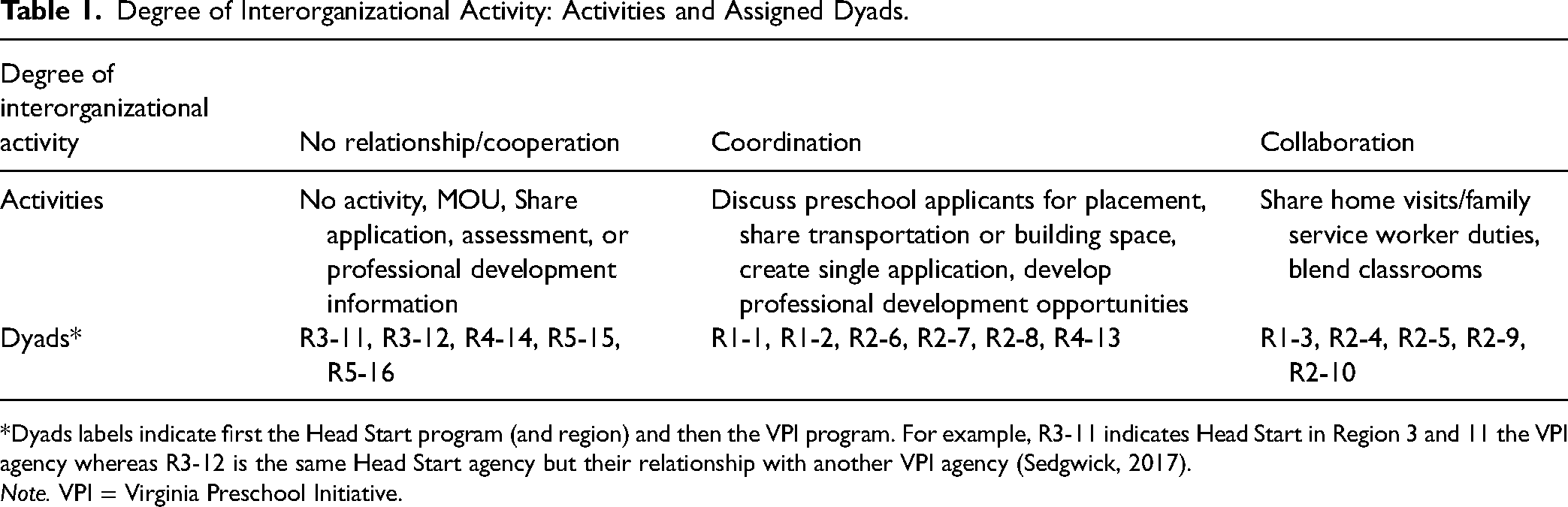
*Dyads labels indicate first the Head Start program (and region) and then the VPI program. For example, R3-11 indicates Head Start in Region 3 and 11 the VPI agency whereas R3-12 is the same Head Start agency but their relationship with another VPI agency (Sedgwick, 2017).
Note. VPI = Virginia Preschool Initiative.
Isomorphic Pressures
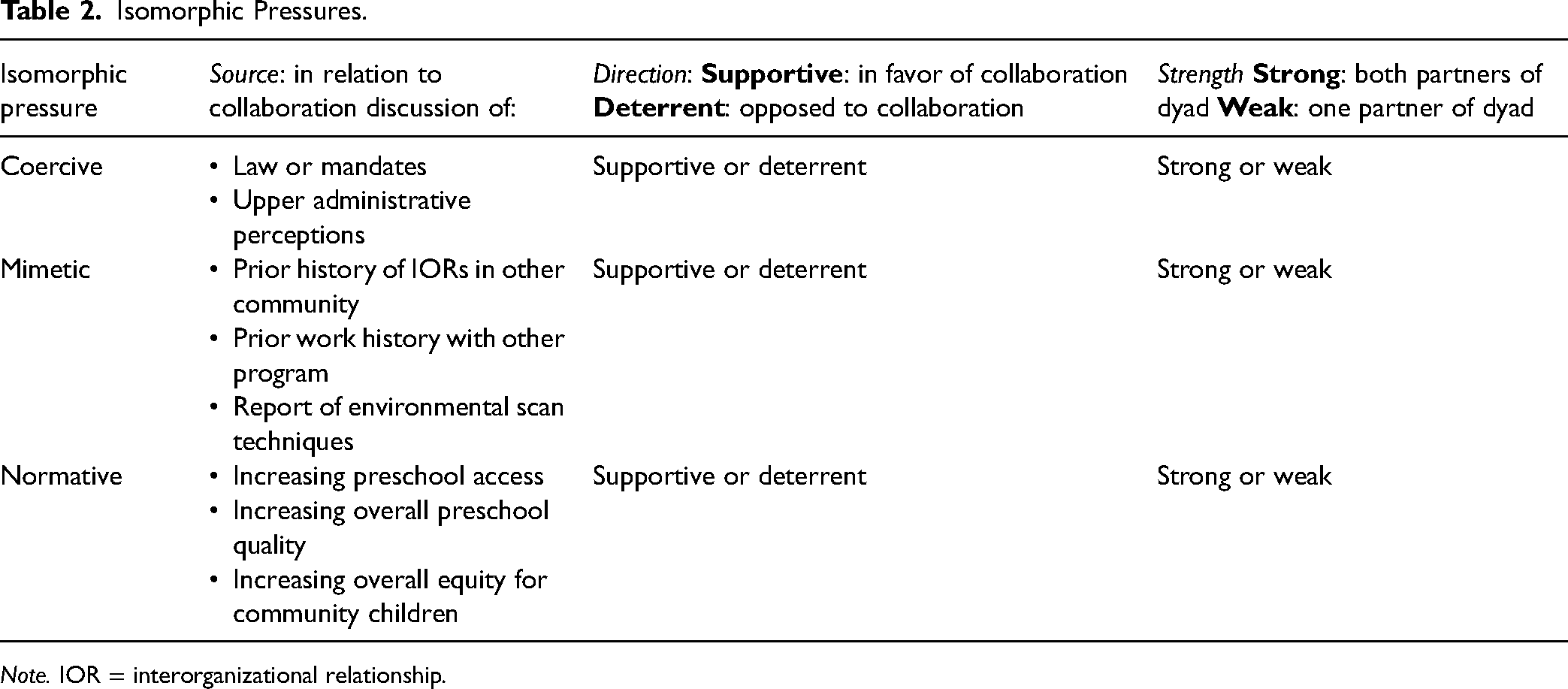
We conceptualize isomorphic pressures as perceptions that managers perceive of institutional forces that could either promote or deter the IOR activities. Upon completing a first-round coding of interview text, we identified structured and emergent codes (Auerbach & Silverstein, 2003; Saldaña, 2009) connected to why administrators engage (or not) in IOR activities with their respective counterparts, their work histories, and environmental scan techniques. Upon the second round of coding (Baily, 2018), we connected these codes and patterns into larger generalizations (Olsen et al., 2016) reflecting the themes of coercive, normative, or mimetic pressures. Both coauthors discussed the patterns, generalizations, and themes until an agreement was reached (Olsen et al., 2016). Table 2 displays a summary of the operational definitions of the isomorphic pressures.
Isomorphic Pressures.
Note. IOR = interorganizational relationship.
We operationalize coercive forces by identifying affirmative responses from interviewees on at least one of two dimensions: (1) discussion of law or mandates about public preschool collaboration and (2) discussion of upper administrative perceptions about collaboration. We operationalize mimetic forces by identifying affirmative responses from interviewees on at least one of three dimensions: (1) prior work history with public preschool in a different community where IOR activities were established, (2) prior work history with the “other” public preschool (Head Start or VPI) from where they are currently employed, and (3) report of environmental scan techniques to investigate possible interorganizational activities between Head Start and VPI. Finally, publicly funded preschools in the U.S. have received a consistent message from many early childhood experts that collaboration between programs is a valuable venture in which programs should participate (Schilder & Leavell, 2015; Sowa, 2009; Wat & Gayl, 2009). We operationalize normative pressures by identifying affirmative responses on at least one of three dimensions that echo the rationales behind collaboration in the broader preschool field: (1) discussions of increasing preschool access for why they collaborate, (2) discussion of increasing overall preschool quality for why they collaborate, and (3) discussion of increasing overall equity for community children for why they collaborate.
Woolthuis and de Jong (2017) argued that as an organization perceives more isomorphic pressures supporting conformity in their organizational field, the more likely they are to conform to the request or structure. Thus, we also identify if the pressure is perceived as supportive or deterrent. Pressures are deemed as supportive if interviewees expressed that they perceived the pressure in favor of engaging in IOR activities. Pressures are deemed as deterrent if interviewees expressed that they perceived the pressure as unfavorable to IOR activities.
Additionally, we identify pressure as being strong or weak. The unit of observation was the individual program administrator; however, the unit of analysis is the dyadic partnership between a Head Start and VPI administrator. Pressures are denoted as strong if both partners respond affirmatively to at least one dimension for each of the pressures. Pressures are denoted as weak if only one partner responds affirmatively to at least one dimension for each of the pressures. If neither partner discusses any of the dimensions, the respective pressure is deemed as “absent.” For our analyses, while we focus primarily on “strong” supportive pressures, we also studied the impact of “weak” deterrent pressures on these entities. We argue that it is a more conservative approach to contend that supportive pressures have an effect only if both dyadic partners report these pressures; however, applying this same standard for a deterrent pressure may downplay the importance of the forces that potentially influence “collaborative inertia” (Huxham & Vangen, 2005).
Analysis
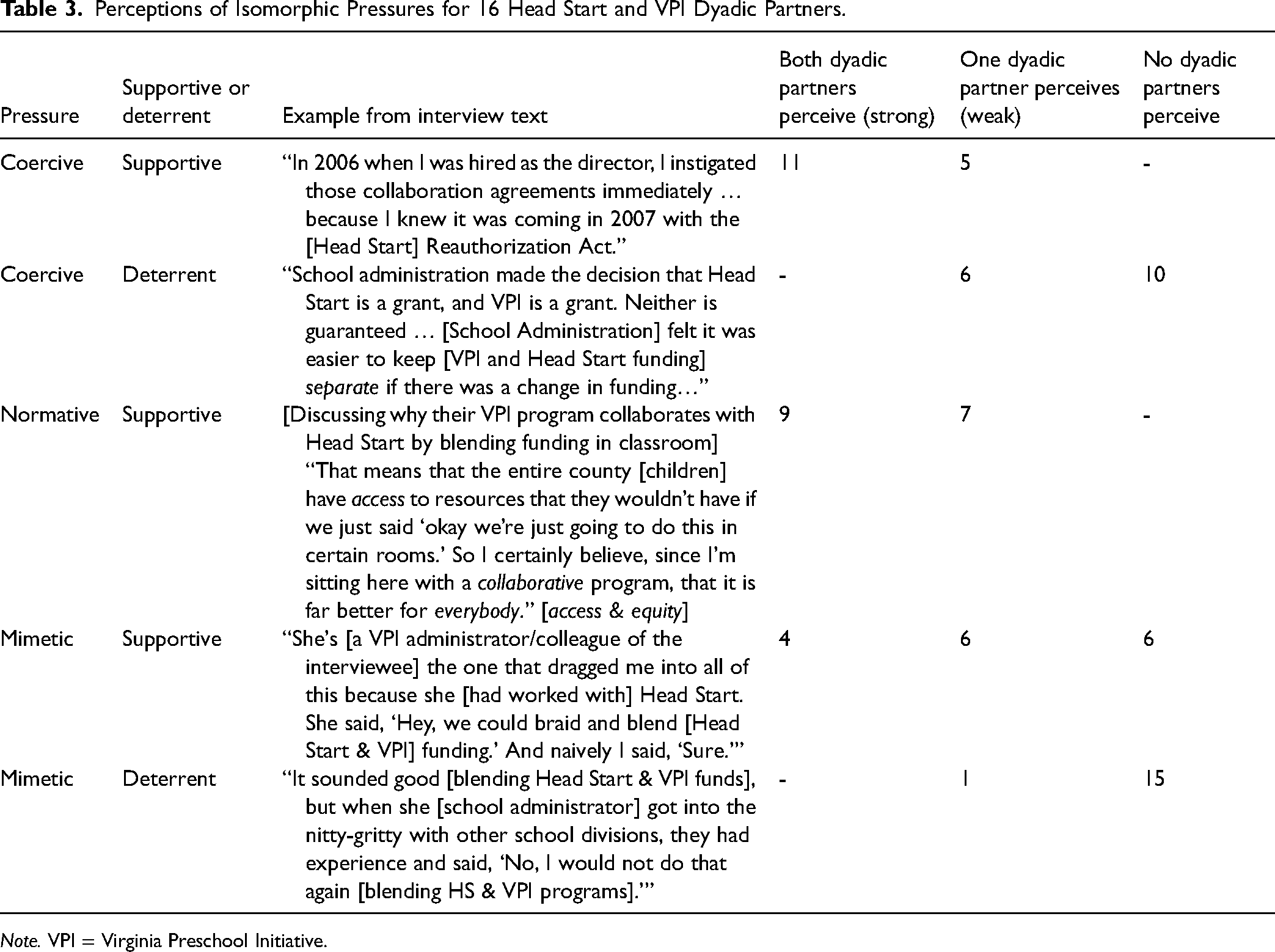
Examining the additive effect of isomorphic pressures on the degree of IOR is only a worthy pursuit if managers do indeed perceive isomorphic pressures. Therefore, our first analysis step was to determine how many of the dyads perceive the isomorphic pressures. See Table 3 for these results, as well as examples from the interview text of the pressures as perceived by the dyadic partners.
Perceptions of Isomorphic Pressures for 16 Head Start and VPI Dyadic Partners.
Note. VPI = Virginia Preschool Initiative.
As the table displays, the majority of the dyadic partners reported perceiving strong supportive coercive forces; that is, both administrators of a dyadic partnership report that they perceived regulatory pressure or upper administrative support for IORs between the Head Start and VPI programs. However, as the table also reveals, six of the dyads also report deterrent coercive pressures, which primarily indicate that the preschool administrator received input from school upper administration or boards that opposed engaging in deep IORs with the other program. Once accounting for the deterrent pressures, those perceiving only strong, supportive coercive pressures are reduced to less than the majority of dyads.
Slightly more than half of all dyads report perceiving strong supportive normative pressures. As exemplified by the quote in the table, Head Start and VPI administrators expressed normative pressures when discussing that they engage in IOR activities to increase access to preschool, to provide equitable services, and to increase program quality for their community children. No dyads reported perceiving deterrent normative pressure, meaning that no dyads reported a perception from the broader ECE field that collaboration is problematic for enhancing the provision of public preschool.
Experiencing strong, supportive mimetic pressures were the least reported by the dyadic partners, meaning that most of the Head Start and VPI administrators did not report transferring from prior employment where they engaged in IORs with another preschool program, they did not take up employment with one program (such as VPI) after having worked for the other program (such as Head Start), and/or they did not report actively visiting other regions within the Commonwealth of Virginia to discuss existing Head Start–VPI partnerships. For this pressure, one partner of a dyad did report experiencing a deterrent mimetic pressure. A VPI administrator investigated the value of creating blended Head Start and VPI classrooms by talking to a VPI counterpart in another school district who had undertaken such activities and was advised, “don’t do it.”
After establishing which institutional pressures were perceived by which dyads, our next step is to investigate whether perceiving more supportive pressures aligns with shifts along the three Cs continuum. To do this, we conducted a cross-tabulation between the perception of pressures and three Cs categorization. Cross-tabulation provides a means for researchers to aggregate results using simple percentage comparisons that allow for patterns of data to emerge (McClelland, 1994). We first cross-tabulated three Cs categorization with the total number of pressures and then cross-tabulated three Cs categorization with pressures considering supportive versus deterrent pressures.
Findings
Table 4 presents the results from analyzing the relationship between the three Cs categorizations and the additive effect of pressures. As the table indicates, there is a positive relationship between combined pressures and degree of activity; that is, as dyads report perceiving or experiencing multiple pressures (coercive, normative, and/or mimetic), they are more likely to report compromising or acquiescing by being coordinators or collaborators, respectively. Conversely, while one cooperating dyad reported perceiving only one pressure and taking a more avoidant strategy, we interestingly find that the majority of cooperating dyads report perceiving weak to no isomorphic pressures. These findings suggest that as administrators perceive additional pressures that favor IORs, more likely they pursue deeper forms of IORs.
Cooperating, Coordinating, and Collaborating Dyads by Perceived Strong, Supportive Pressures (Coercive, Normative, Mimetic) (% and N).

While we find support for our additive argument, we also observed variation among the cooperators, coordinators, and collaborators. For example, for many of the cooperators, one member of the HS–VPI dyad identified “increasing access” for children as why they would work with their partner while the other partner did not identify this normative pressure. As mentioned above, we only considered supportive pressure as present for the dyad if both partners reported that pressure. However, in one cooperative dyad, while the Head Start administrator identified “increasing access” as a reason for trying to connect to their VPI counterpart, the VPI counterpart did not reciprocate perceiving this pressure, and, moreover, interpreted the push for interaction from Head Start as a self-serving move to ensure that VPI did not try to “steal” the Head Start students. On the other end of the spectrum, for the collaborators, the push to engage deeply with each other primarily reflected perceived coercive pressures from Head Start regulations or upper administrative support as well as a normative sense that blending classrooms provided the ability to increase access for children and provide more equitable opportunities. However, while engaging in these deep partnerships, some collaborators still felt a sense of “us” and “them” between the programs. For example, one Head Start director involved in multiple collaborative IORs explained, “It's their [school district] building, it's their division. They hold dominion over your wellbeing …. I think that you’ll find that Head Start programs have to bend a lot more than their counterparts have to bend.” However, despite some of these issues, the collaborators perceived and responded to the pressures to collaborate.
Importantly, Table 4 also reveals that the majority of both collaborators and coordinators experienced two pressures, not three. The majority of these dyads experienced coercive and normative pressures, but not mimetic. Though we find support for perceiving additional pressures corresponding to the increased likelihood of engaging in collaboration, we find that more pressures do not consistently explain the difference between the strategic responses of coordinators and collaborators. This finding raises a question of what else might explain the differences between those dyads that choose to coordinate from those that choose to collaborate. The next table considers both supportive and deterrent pressures by the degree of interorganizational activity (Table 5).
Percentage and Number of Dyads Experiencing Strong Supportive or Any Deterrent Pressures by Degree of Interorganizational Activity.
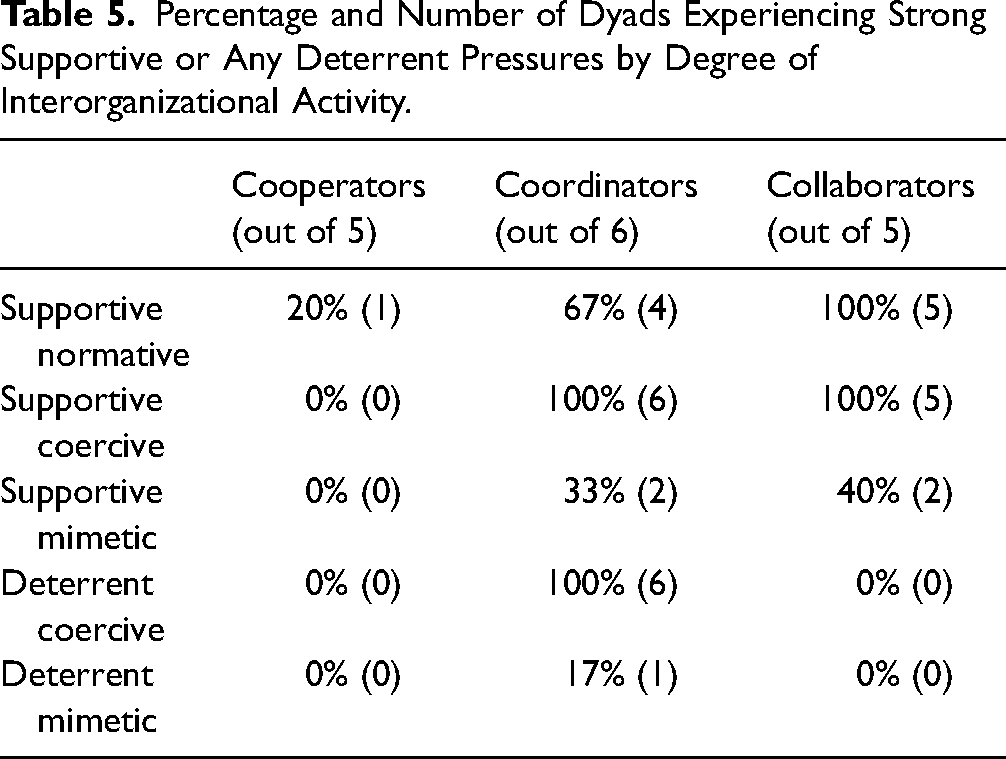
When including the percentages and counts for each degree of interorganizational activity by type of pressure we find some important distinctions between dyads that cooperate, coordinate, and collaborate. While 100% of coordinators report supportive coercive pressures, all of them also report experiencing deterrent coercive pressures. 6 For example, one dyad in Region 3 experimented with a collaborative relationship (blending classrooms), but then the VPI administrator separated those classrooms and pursued a relationship with Head Start as coordinators when her school board deemed the Head Start regulation for classroom aide certification as too cost prohibitive. Comparatively, none of the collaborators report any deterrent pressures. This arguably helps to explain the main distinction between coordinators and collaborators. While the Head Start and VPI administrators of every coordinating and collaborating dyad perceived coercive pressures of regulatory mandates that promoted IORs between their respective programs, only coordinating dyads reported one partner receiving feedback from upper administration or school boards that discouraged deep interorganizational involvement between preschool programs.
Discussion
While institutional pressures have long been posited to bring about organizational isomorphism in an organizational field, theory and research support that at times organizations exert agency and deter conformity to those pressures (Johansson, 2003; Oliver, 1991; Ramanath, 2009). We investigated if perceiving more or less pressures (coercive, normative, mimetic) resulted in managers undertaking different interorganizational strategies. We likened decisions to cooperate, coordinate, or collaborate as avoiding, compromising, or acquiescing, respectively, in response to pressures for interorganizational collaboration between publicly funded preschools within the ECE organizational field.
Understanding how isomorphic pressures affect the IOR strategies that managers undertake is beneficial for two somewhat paradoxical reasons. First, collaboration is often seen as the ideal IOR and indeed, some research suggests that deeper integration brings about more desired results for organizations, networks, and communities/clients (Flatau et al., 2013; Lemaire & Provan, 2018; Selden et al., 2006; Sowa, 2008). Thus, even when partners are held constant, understanding additional factors that promote deep integration could be valuable in illuminating how to improve programmatic outcomes. Secondly, while bias toward deep integration exists, the literature also suggests that less intense IORs also provide benefits to those that undertake them and that practitioners themselves recognize that collaboration is not always the needed approach when working with other organizations (Keast et al., 2007; Provan & Lemaire, 2012). As Granovetter (1973) noted, some benefits accrue more to a weak tie than a strong one. Thus, understanding factors that compel managers to select varying strategic responses in relation to IORs can aid policymakers and upper administrators in promoting the appropriate interorganizational exchanges within their respective policy fields.
We uncovered both anticipated and unexpected findings. First, as expected, the least involved dyads, cooperators, do not perceive multiple strong supportive isomorphic pressures. Moreover, these dyadic partnerships report perceiving weak or no pressures of any kind. We were surprised to find that only one of the cooperative dyads reported perceiving strong normative pressure, with the other four perceiving no strong supportive pressures whatsoever. Given both the U.S. regulatory mandates for IORs between these programs and the discussion of collaboration within the early childhood education field, the fact that both dyadic partners did not perceive these pressures supports our argument that perception matters and that not all managers will interpret field-level pressures in the same way. However, since our argument is that managers strategize about which “three C” to participate in based upon the perceptions of pressure(s) in their field, that the majority of cooperators reported perceiving no strong pressures calls for future research that examines why some managers are more receptive to organizational field pressures than others.
At the other end of the continuum, while we did find some support for the relationship between perceiving more pressures resulting in more intensive IORs, we also found that collaborators mostly reported perceiving two isomorphic pressures, not three. Indeed, the collaborating dyads primarily perceived coercive and normative pressures. We find that the majority of the administrators in this study did not perceive mimetic pressure, consistent with recent research findings that coercive and normative pressures have a greater influence on nonprofit managerialism than mimetic (Hersberger-Langloh et al., 2021). This unanticipated finding updates our assertions about the relationship between perceiving isomorphic pressures and participating in more involved interorganizational activities; it appears that mimetic isomorphism may not be as strong or as necessary as the other two forces. Ultimately, we cannot suggest that mimetic isomorphism is not important, but we can suggest that experiencing at least two pressures may set the stage for collaboration to occur.
The coordinating dyads raised the most unanticipated findings in this study. Unexpectedly, coordinators mostly report identical pressures as the collaborators; the majority of coordinators also report perceiving coercive and normative pressures. However, all six coordinating dyads had at least one partner that perceived a deterrent coercive pressure. The deterrent pressures we found in our study mostly stemmed from the public school systems, which is not surprising given the concerns over blending resources with a nonprofit organization. One of the Head Start programs was based in an LEA and thus it is not surprising that they often had collaborating or coordinating relationships with the VPI programs in their regions. However, that one Head Start was not the only collaborator and other collaborators and coordinators were able to overcome the sectoral differences when the Head Start program was based in a nonprofit. Therefore, our findings suggest that there may indeed be greater barriers when collaborating across sectors and further support the findings of Gazley and Brudney (2007) that nonprofits might experience greater challenges and have to “bend more” than their public counterparts. At the same time, the story is not as simple as one of sector differences and there may be institutional forces explaining why one sector is more willing to bend. Similar to the findings of Woolthuis and de Jong (2017), we find deterrent pressures can decrease conformity to field-level pressures and those deterrent pressures may be the result of different sector logics within the same field. However, not all managers will perceive the same pressures regardless of sector. As the identity (Langer, 2022) or degree of publicness (Min et al. 2020) of the organizations partnering have been found to influence collaboration, so too may the existence or perception of deterrent pressures. In our study, the finding of deterrent pressures clarified the distinction between coordinators and collaborators, and moreover supports the importance of investigating the existence and source of both supportive and deterrent pressures when investigating the effects of perceived isomorphic pressures.
We use our findings to offer two propositions for future examination. First, perceiving isomorphic pressures may indeed be what motivates administrators to work collaboratively with other similar agencies, especially coercive pressures combined with another type of isomorphic pressure. Stated as a proposition: The perception of coercive isomorphism combined with another type of isomorphic pressure will motivate administrators to acquiesce to those pressures by coordinating or collaborating with other similar agencies. When administrators perceive supportive as well as deterrent isomorphic pressures, they will be motivated to compromise by working with other similar agencies but limit the depth of the interorganizational activities.
As with any study, there are some limitations for consideration. First, with any small n study, the generalizability of the findings is limited. Our study is exploratory and thus, generalizability is limited to analytical generalizability (Yin, 2014). Our purpose is not to generalize the findings to dyadic partnerships but to offer testable propositions that predict what type of IOR strategy a public administrator may take. Our study is specific to the U.S. and to IORs between programs that provide similar services; thus, whether the same results would be found in the U.S. or other countries when examining programs that provide different services is not clear. We also examined only one organizational field, early childhood education. As the institutional context shapes cross-sector collaboration differently (Suárez & Esparza, 2017) future research should examine whether our additive and deterrent pressures findings help explain IOR strategies in other fields. As Calanni et al. (2014) found, regulatory mandates are a significant factor in selecting partners to coordinate with, more so for government agencies than nongovernment agencies. Therefore, the propositions we offer should be tested in contexts other than the ECE context and in additional countries.
Finally, though we examine the IOR continuum, our study mostly focuses on the positive and reactive IOR strategies. Of the 16 dyads, we only had one dyad that had no relationship. We considered no relationship as defying according to Oliver (1991)'s framework because Head Start and state preschool programs were mandated to have at least a memorandum of understanding. However, it is possible that no relationship or cooperating could be considered more of a proactive strategy, like manipulation as proposed by Oliver. We also focused on specific types of activities common between Head Start providers and state preschool programs to conceptualize our three Cs. Head Start and state preschool programs, at least in Virginia, do have different missions and approaches and they compete with each other for the same students. Though our interviewees did not hesitate to discuss the competition and distrust between the programs, our study was reliant on interviews with providers in a field with coercive and normative pressures to collaborate for the sake of the children and families. Social desirability bias would likely prevent us from uncovering more manipulative strategies. Future research should not only examine whether our findings hold, but also investigate the possibility of manipulative strategies. Additionally, factors uncovered by the extensive IOR research other than neo-institutional pressures could also deter deep IOR involvement for competitors. As the Oliver (1991) framework we drew on for this research integrated neo-institutional and resource dependency theories, future research should examine how other typical IOR factors interact with perceptions of neo-institutional pressures to influence how collaboration with competitors unfolds.
Despite the limitations, our findings have important implications for both practice and theory in understanding choosing “three Cs” in the field. First, we contribute to the empirical examination of the three Cs, as the terms are often muddied in operationalization (Keast et al., 2007). We also contribute to the empirical operationalization of isomorphic pressures. Public and nonprofit agencies are particularly sensitive to coercive pressures (Frumkin & Galaskiewicz, 2004; Hersberger-Langloh et al., 2021), but understanding how normative and mimetic pressures influence outcomes is difficult when distinguishing these pressures empirically is a challenge and a common critique of neo-institutional theory (Mizruchi & Fein, 1999). We, thus, offer a way to operationalize these different pressures in the words of the public administrators that perceive them. This approach supports recent work in the neo-institutional scholarship that calls for studying how the people within the organizations perceive, interpret, and respond to their institutional environments, rather than focusing on larger organizational outcomes as evidence of institutional effects (Bévort & Suddaby, 2016; Blomgren & Waks, 2015).
Finally, we find preliminary evidence of an important link between IOR strategy and isomorphic pressures. While program purpose may drive these decisions at times, the perceptions of external pressures may be a primary force. Despite the calls for the importance of the individual in collaboration (O’Leary & Vij, 2012), the research examining individual experiences and perspectives behind collaborative decisions is still limited (Gazley & Guo, 2020). Most of the work examining the individual has focused on individual characteristics, overlooking how isomorphic pressures shape those characteristics. For instance, Shaw (2003) found the personal experience with an agency to precede partnership, but failed to examine whether mimetic pressures were behind this finding. Esteve et al. (2012) found education to be positively associated with collaboration and age to be inversely associated, but what our study suggests is that these associations may be the effects of normative and mimetic influences. Future research should examine the complexity that influences the degree to which organizations work together and how the context may influence individual decisions.
Our results have implications for practice as well in that the signals administrators receive from policymakers, upper administrators, and funders are unlikely to be consistent and/or are likely too generic. With the “cult of collaboration” (O’Flynn, 2009), pressures to collaborate may result in a collaboration that is not always the best strategy. In that case, the collaborative efforts may in turn lead to failed experiences that generate more deterrent pressures, which in turn could be to the detriment of collaboration where collaboration is indeed warranted. Perceiving supportive and deterrent coercive pressures for collaboration may lead to managers choosing response strategies that suggest conformance, but actually masks the degree of conformance (Oliver, 1991). However, our research also suggests that public administrators are often mindful of the pressures in their field and develop strategies based on those pressures. In both research and practice consideration needs to be given to what interorganizational activities may be warranted, and then ensuring pressures coalesce to send the right signals.
Footnotes
Declaration of Conflicting Interests
The author(s) declared no potential conflicts of interest with respect to the research, authorship, and/or publication of this article.
Funding
The author(s) received no financial support for the research, authorship, and/or publication of this article.
