




Abstract
Decentralization is often regarded as a panacea for achieving good governance. Yet few studies have explored how devolution (to subnational governments) affects policy agendas. In this article, we investigate how devolution affects two aspects of public service provision—economic growth and environmental protection based on the experience of China. The results show that the devolution simultaneously promotes local economic development and damages the environment. These mixed effects can be attributed to the administrative mechanism of the interaction between devolution and the distribution of government attention, which is more concerned with outcomes that can be observed in the short run rather than the long run. Our results highlight the complexity of governance and demonstrate the architecture for an effective policy framework design.
Introduction
As the main component of the new public management (NPM) movement, decentralization is often regarded as a panacea for achieving good governance and sustainable development. A lot of countries around the world have implemented decentralization reforms over the past 50 years, including both developed countries and developing countries (Cheema & Rondinelli, 2007; Osborne & Gaebler, 1993; Rondinelli, 1981). Prior studies have argued that decentralization can make bureaucracies more efficient, promote government accountability, empower communities, and facilitate responsiveness (Hood, 1991; Pollitt, 2007). Previous research in the field focuses on how the fiscal resource allocation undertaken as part of decentralization reforms affects public goods provision (Alonso et al., 2015; Bardhan, 2002; Bird & Vaillancourt, 2008). As the key policy toolkit used to configure governance systems with shared or overlapping policy responsibility among several levels of government, decentralization is also closely related to the priority of government works—policy agendas. Yet the effects of decentralization on policy agendas—particularly how devolution (to subnational governments) influences the distribution of policies—have been largely overlooked.
In this article, we investigate the effects of administrative decentralization on policy agendas using China’s counties authority expansion (CAE) reform from 2000 to 2010 as a quasi-natural experiment. We focus on the effects of devolution on the two most representative aspects of public service provision—economic growth and environmental protection. We show that China's devolution reform simultaneously promoted local economic development and damaged the local environment. Such mixed effects can be attributed to the administrative mechanism for the interaction between devolution and the distribution of government attention: devolution reform gives more discretionary decision-making power and autonomy to local governments. China's political tournament system incentivizes local governments to pay more attention to policies whose effects can be easily observed in the short run such as economy-oriented policies, but to pay less attention to those whose effects need to be perceived in the long run such as environmental protection. Therefore, devolution provides local governments more room to pay attention to policies with highly visible effects.
We then explore how local governments pay attention to both kinds of policies. We show that county governments that have implemented devolution reforms promote economic growth by increasing capital construction expenditures and attracting more enterprises to invest. Yet such reforms aggravate environmental pollution, for example, by increasing waste gas emissions. The impact is more serious for pollutants with large spillover effects, indicating the need for cross-regional collaboration.
This article contributes to the literature in three ways. First, prior research on decentralization mainly focuses on how it affects capacity building and fiscal resource allocation (Bird & Vaillancourt, 2008; Rondinelli et al., 1983). We know little about its effects on policy agendas. Past findings have demonstrated that the effects of decentralization are not as well as expected and often fail to meet the local needs and “closer to the citizens” (Pollitt, 2007, p. 393). The mixed effects indicate the second face of power and the complexity of decentralization reforms. It is not simply a choice between either decentralization or centralization. Considering its interaction with other dimensions such as government attention is also necessary.
Second, the findings enhance our understanding of public policy agenda setting, especially the way in which decentralization reforms influence how local governments allocate their attention to competing issue areas. Previous scholars have observed that public policies are subject to incrementalism and are periodically disrupted by rapid or dramatic realignment (Baumgartner & Jones, 1991, 2002; Jones & Baumgartner, 2005; Lindblom, 1959). This is because government attention allocation is affected by bounded rationality and institutional friction inherent to decision-making (Jones & Baumgartner, 2012; Jones et al., 2009). This strand of the literature mainly focuses on policies’ budgetary allocation rather than outcomes, takes institutional friction as static rather than volatile, and neglects the effects of friction among various levels of government and competing policy goals during the policy implementation process. This article sheds light on the actual effects of decentralization—a reform intended to reduce institutional friction among various levels of government—and how it shapes the prioritization of government attention.
Third, this article contributes to the literature on the relationship between devolution and collaboration. In an era of devolution, collaboration is regarded as an effective tool for governments to promote public service delivery (Mullin & Daley, 2009). Most such research has focused on the effects of devolution on public–private partnerships and intergovernmental collaboration within multilayered bureaucracies (Cohen, 2001; Kettl, 2000; Silvestre et al., 2018). This article suggests that for certain complex public policy problems such as environmental policies, devolution may hinder horizontal intergovernmental collaboration and even lead to a kind of “tragedy of the commons.” This may jeopardize local government accountability and force us to rethink the “environmental federalism” and their interactions with hierarchical bureaucracies (Faguet, 2004; Oates, 2001).
The remainder of the article proceeds as follows. The next section reviews the relevant literature. Then background information is presented, and the research design is described. Next, the analysis and results are reported. The final section discusses the results and concludes.
Literature Review and Hypotheses
Devolution as a Kind of Administrative Decentralization
Decentralization refers to the transfer of power, authority, and responsibility from higher to lower levels of government (Cheema & Rondinelli, 2007). Over the past half-century, decentralization has become an important aspect of sustainable development strategies across both developed countries and developing countries (Rondinelli, 1981; Rondinelli et al., 1983). It can be interpreted as an incremental process of institutional capacity building that requires local governments to adapt to fit heterogeneous preferences and contexts across countries (Cheema, 2007; Falleti, 2005; Schneider, 2003). The practices of decentralization can be categorized into three forms: fiscal, political, and administrative (Falleti, 2005).
Administrative decentralization, which highlights “managerial” skills as a key component of the NPM, focuses more directly than other types of decentralization on facilitating the key principles of good governance. It can be divided into four forms based on the degree of autonomy—deconcentration, delegation, devolution, and privatization (Cheema & Rondinelli, 2007; Rondinelli, 1983; Schneider, 2003; for review, see Overman, 2016). In practice, countries may have a combination of these forms. According to Cheema and Rondinelli (2007), deconcentration seeks to shift administrative responsibility from the center to local field units; delegation transfers management authority to semiautonomous or parastatal organizations; devolution aims to strengthen local governments by granting them the authority, responsibility, and resources to provide public services and implement policies; and privatization indicates crowdsourcing and contracting out. To varying degrees, devolution is the only direct channel to empower local governments for political control; it provides the greatest degree of autonomy to local governments.
Previous research on devolution falls primarily into two groups. The first addresses the process and drive towards devolution initiatives (Osborne & Gaebler, 1993; Pollitt, 2015; Rodríguez-Pose & Gill, 2003), while the second assesses the effects of devolving practices on political control (Brinkerhoff & Johnson, 2009; Christensen & Lagreid, 2001) or specific policy domains (Angel, 2003). With regard to the former, in their book Reinventing Government, which reflects on innovative reforms in the United States and influenced thinking in other countries during the 1990s, David Osborne and Ted Gaebler argue that national, state, and local governments should be innovative, market-oriented, and decentralized. With regard to the latter, in the context of the United States, Kettl (2000) discusses the challenges associated with devolution experienced—in particular devolving practices of environmental policy and welfare programs and governments’ complex role in orchestrating such programs. In these devolved policy domains such as welfare policies, subnational governments direct policymaking. The federal government counts on a menu of options to indirectly influence policy outcomes via financial conditioning (transfers and grants), monitoring, or assistance (Sheely, 2018; Sosin, 2012).
Strictly speaking, devolution cannot occur between the federal government and the state under the U.S. Constitution since the federal government lacks the authority to devolve responsibilities. The current practices referred to as devolution are more accurately named “re-balancing” between the federal government and the state (Kincaid, 2001). Therefore, such a strand of literature based on the U.S. context focuses more on the devolving practices in specific policy domains rather than the broad delegation of power and responsibility to certain governments. However, few studies consider as the most direct channel to empower local governments, the effects of devolution on public policy agenda setting—namely, the allocation of public service provision and diverse preference structures, especially in developing countries.
Explaining Subnational Service Provision: Government Attention and Devolution
The allocation of public service provision is closely related to the theory of government attention. This theory holds that how a government chooses to allocate its attention is the result of an interaction between 1. how limited information is processed within a policy-making system (Simon, 1947, 1972) and 2. the institutional frictions associated with adjustment (Jones & Baumgartner, 2012). Therefore, government attention allocation ebbs and flows with respect to specific issues, which will induce the government working priorities: increased attention to certain policies results in decreased attention to others. Prior research in this field mainly employs budgets, acts, executive speeches, etc., to measure government attention at the national level across both developed and developing countries, and pays more attention to the punctuated or incremental policy process and the corresponding effects of working priorities (Baumgartner et al., 2017; Flavin & Franko, 2017; John & Jennings, 2010; John & Margetts, 2003; Jones & Baumgartner, 2005; Jones et al., 2009; Lam & Chan, 2015; Lindblom, 1959). However, this strand of literature treats government attention as uniform regardless of the preferences of various levels of government or takes institutional friction as given and static rather than volatile. The effects of government attention can be decomposed, and the attention allocation of various levels of governments is different and bounded by the environmental/institutional parameters etc.
Devolution reform, which refers to delegating authority to subnational-level governments, empowers more discretionary power to local governments in an effort to decrease bureaucratic friction among various levels of government. Thus, local government decisions about how to allocate their attention are more bound by their concerns. Existing literature based on specific policy domains shows the mixed effects of devolution reform on attention. In the context of the United States, Sosin (2012) argues that discretion on the books does not always translate into actual functional discretion; local governments are increasingly likely to match their attention and priorities to those preferred by higher levels of government when they are facing a crisis. While Sheely (2018) shows that the working priorities of local government are various and constrained by the policy choice as well as client characteristics.
In this article, we focus on the local government attention allocation in a developing country, take the government work as an aggregated task, and try to explore the interactions between devolution reform and policy agendas in China. We choose two representative responsibilities of government to study the effects of devolution on policy agendas—economic growth and environmental protection. Both are core government tasks according to various definitions of government functions. For instance, according to the World Bank (1997, p. 42), five fundamental tasks “lie at the core of every government's mission,” including economic development and environmental protection. Likewise, Anderson (1989, pp. 19–22) identifies seven basic functions of government, four of which are directly related to economic development: providing economic infrastructure, maintaining competition, minimum access by individuals to the goods and services of the economy, and stabilization of the economy. Another basic function is to protect the country's natural resources and environment. More importantly, the United Nations’ sustainable development agenda of 2015 reflects a growing consensus by various countries that sustainable development and climate actions should be pursued simultaneously.
Regional Decentralization and Government Attention Allocation in China
It is believed that the success of China's reforms and its dramatic growth in recent decades can be attributed to a series of decentralization reforms by the government (Malesky & London, 2014; Qian & Weingast, 1996). Scholars use the term of “regional decentralized authoritarian (RDA) regime” to describe China's intergovernmental relationships and government governance, highlighting the administrative characteristics of the coexistence of political personnel control and regional economic decentralization of China's system (Laundry, 2008; Xu, 2011). Under such a regime, the central or higher-level government has a dominating influence on the “political and personnel governance structure” that regulates the appointment, rotation, and promotion of local officials (Xu, 2011, p. 1078). The subnational government officials are appointed from the above, and such personnel control serves as a powerful tool for the central government to implement its policy initiatives. This feature fundamentally distinguishes the Chinese RDA regimes from democracies, where governors or mayors are elected. The other aspect of RDA regime is the broad delegation of power and responsibilities to the local officials. In essence, the local government (provinces, prefectures, and counties) has “overall responsibility for initiating and coordination reforms, providing public services, and making and enforcing laws within their jurisdictions” (Xu, 2011, p. 1078). This feature makes the local government much more powerful than their counterparts in federal countries around the world since they are responsible for much broader regional matters than simply fiscal issues. Such institutional arrangement provides a strong incentive for regions to compete against each other for performance ranking, and the officials’ careers are linked to their performance in the political tournament.
To explore the driving force behind the veil of the RDA regime, scholars propose the notion of the “administrative subcontract” to advance the research on the government agenda and priorities (Zhou, 2008), namely, the key characteristics of China's administrative system represents a combination of multilayered subcontracting and horizontal political tournament competition (Christensen et al., 2012; Li & Zhou, 2005). Under this system, local government faces multiple ministries at the top and multiple tasks at the same time, which necessities prioritization and trade-offs. The ultimate constraint is the time and attention of key local officials (local government) making major decisions (Chen & Zhang, 2021). The essence of the administrative subcontract is that all the administrative responsibilities and corresponding powers of the local government are subcontracted to the local officials, and all targets and subcontracting tasks from superiors enter that person's utility functions and are subject to their trade-offs. Meanwhile, the political tournament system is a multilayer, step-by-step elimination-style process that those who enter the next round must be the winners of the previous round. Local officials preferred to achieve targets whose outcomes could be quickly observed and matched with the preferences of upper-level government to become winners. It is impossible to motivate the local government with equally high-powered incentives when facing multiple targets.
Accordingly, Zhou (2016) created a 2 × 2 matrix of government tasks based on the degree of administrative subcontracting and horizontal competition for promotion. He categorized economic development as a high-powered task of local governments for both promotion and responsibility and environmental protection as a low-powered task for promotion but a high-powered task for responsibility. Empirical evidence supports this claim, with multiple studies showing that China's decentralized tax-sharing system, established in 1994, has led local governments to focus on raising fiscal revenues to support public infrastructure and the construction and real estate sectors, which are the cornerstones of China's economy and also provide “visible” projects that benefit officials’ promotion prospects in the short run (Kung et al., 2013; Wang et al., 2020; Wu & Zhou, 2018).
In this context, land sales have become a key financing mechanism, with local governments expropriating land to generate revenue for the government treasury. However, the compensation fee for farmland of peasants is quite low, making land expropriation by local governments one of the worst sources of social protests in China (Li & O’Brien, 2008). Numerous studies have shown that local officials, who benefit from the land-selling-driven economic growth, are incentivized to prioritize economic performance in the short run and neglect performance in other areas, such as environment, health, and education, which have long-term effects (Du & Yi, 2022; Weingast, 2009; Zhu & Zhang, 2019).
Thus, we would expect that in China's political tournament system, when frictions are decreased due to devolution reform, local governments with more discretion would pay more attention to policies related to economic growth and less attention to those associated with environmental protection. In short, we expect devolution reform to promote local economic development while damaging the local environment.
Background: Counties Authority Expansion Reform in China
This article uses the case of China's CAE reform to study the impact of administrative decentralization on various policy outcomes. As a practice of devolution, CAE reform refers to directly devolving the authority and responsibility of upper-level governments (i.e., prefecture-level governments) to county-level governments without changing the administrative system. We focus on China's devolution reform for three reasons. First, China, as the world's largest developing country, has experienced roaring economic growth in recent decades with vigorous decentralized practices. Granting more autonomous powers to subnational governments is one of the major strategies in the reform era (Wu, 2009; Xu, 2011). Thus, it provides an appropriate case to study the effects of administrative reform. Second, the country's subnational government structure is highly homogenous, allowing us to control other contextual characteristics. Third, China's subnational variation and large population permit us to rigorously examine how a big state with multiple levels of government uses devolution practices to improve the quality of governance.
China has five levels of government administrative layers: the central, province, prefecture, county, and township levels. Since 1983, the prefecture-level cities have become the pillar of the subprovincial administration. Under this system, China implements the principle of “prefecture-level city jurisdiction governing counties”: core cities are charged with administering neighboring counties. The purpose of this setting is to promote the development of scale economies and market integration between urban and rural areas. As the de facto intermediate authority between provinces and counties, prefecture-level governments have formal independent fiscal regimes and possess a broad range of policy-making and law-enacting powers. They are also empowered to maximize fiscal extractions from the counties under their jurisdiction (Chung & Lam, 2004).
However, after the 2000s, the drawbacks of this setting became increasingly apparent. The administrative layer between provinces and counties has increased, leading to higher costs and institutional friction and reducing administrative efficiency. Under this system, most economic and social management authorities are in the hands of the prefecture-level city government, while the county government has limited discretion to make policies according to the localities. Therefore, the provincial governments in China have gradually adopted the CAE reform since 2003 in an effort to break the shackles of the principle of prefecture-level city jurisdiction governing counties. As of 2010, 531 counties had completed the reform. These counties are home to about 330 million people (about 25% of the country's population at that time) and contributed 3.72 trillion in GDP (roughly 20% of the national GDP). Figure 1 maps the uptake of the reform from 2003 to 2010. Compared with other decentralized administrative practices, such as special economic zones or coastal cities opening up, the CAE reform involves more regions and a longer time span, which provides rich regional and time variation for our empirical design.
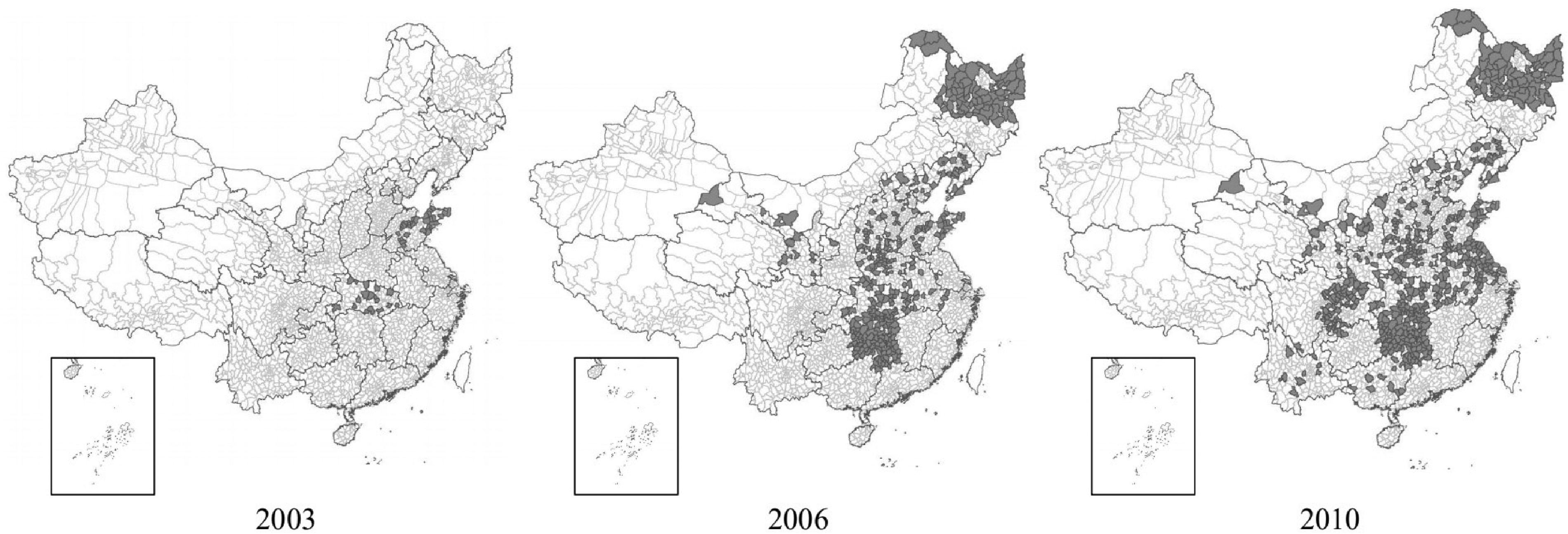
Spatial Distribution of Reformed Counties Over Time.
With regard to the selection of reformed counties, the provincial governments consider multiple factors, such as development potential and economic conditions, etc., comprehensively rather than single and unified selection criteria. For instance, Henan province claimed that they decided to conduct CAE reform first in five counties after they considered counties’ economic growth, fiscal capacity, industrial development condition, urbanization rate, as well as the development potential comprehensively. In 2003, the reformed counties of Shandong province included 30 economically developed counties as well as 30 developing counties. The reformed counties in Sichuan Province also include counties with regional characteristics such as counties producing live pigs or with large grain and oil production.
With regard to the reform content, the CAE reform transfers the economic and social management authority such as investment approval, land approval, license issuance, business administration, taxation management, etc., that previously belonged to the prefecture-level government to county governments (State Council, 2009). After the CAE reform, the county government is not just accountable to the upper-level government at both prefecture and provincial levels but has de facto decision-making power over policies and resources.
Therefore, the CAE reform decreases the friction between different levels of government and improves county-level governments’ involvement in public services delivery, such as investment approval, resource allocation, etc., without changing the political promotion ladder. Unlike the devolving practices in certain policy domains in the United States, the CAE reform empowers the county government with a broad range of power. County-level governments with more discretion have greater incentives to stimulate the local economy. In other words, CAE reform provides more tools and space for the county-level government to compete and succeed in the political tournament system based on economic performance. Governments may naturally pay more attention to public expenditure on production-related services such as infrastructure since these can stimulate the economy quickly. Since efforts to enhance environmental protection rarely help officials’ performance in the short run, local governments might have weak incentives to invest in environmental protection. The devolution reform empowers local governments’ discretionary power and optimizes the environment for investment, which may attract more industries to locate in areas that have implemented the reform. These may include some polluting industries, which may further degrade the environment.
Research Design
Variables, Measurement, and Data
We assemble a panel dataset on the CAE reform covering all the counties (n = 2,846) in China from 2000 to 2010. We employ the reform as a quasi-natural experiment and use a difference-in-differences (DID) design to estimate the effects of devolution on policy outcomes. Since the reform was implemented incrementally, the time and regional variation of the reform provides a standard setting for DID estimation. The dataset tracks Chinese counties on GDP, industrial waste gas emissions, population, etc., as well as Chinese counties, which are coded with the year of implementation and treatment counties.
We have two dependent variables: (1) economic development, defined as the county's GDP and (2) environmental pollution, measured as the level of industrial waste gas emissions. 1 The data are extracted from the National Bureau of Statistics of China and the Annual Environmental Survey of Polluting Firms of China. Our key independent variable is whether a county introduced the CAE reform in a certain year.
We also control for other variables that previous studies have found to affect economic development or industrial pollution. The demographic dividend, high government investment, and export-oriented development strategies are regarded as main drivers for China's economic development and industrial pollution during this period (Kuijs, 2005; Sung, 2007). Thus, we control for population size, fixed asset investments, trade dependence, measured as the ratio of total imports and exports to GDP, as well as the degree of industrialization, measured as the ratio of industrial output to GDP. Table 1 presents a brief statistical summary of all the variables.
Statistical Summary.
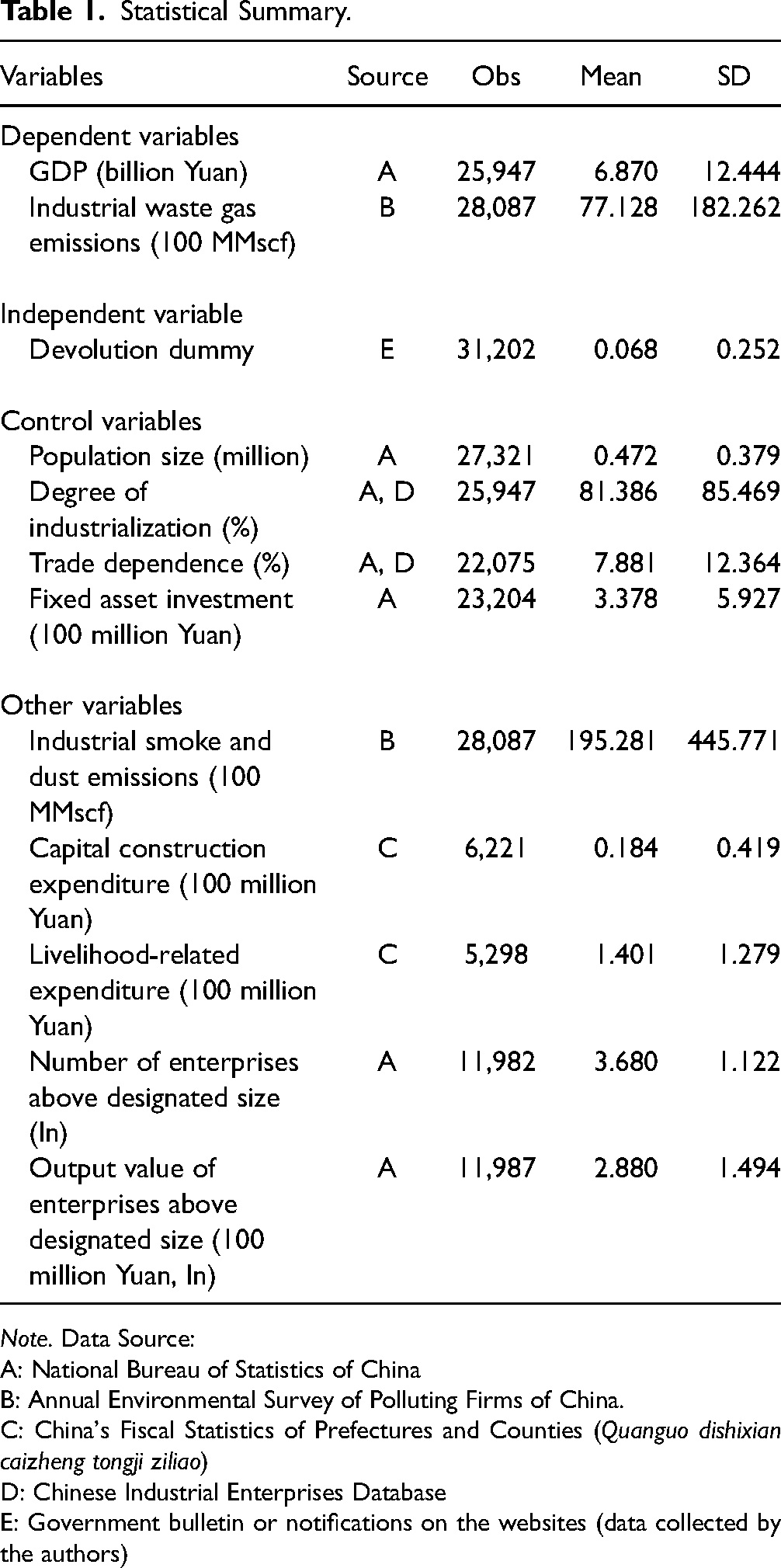
Note. Data Source:
A: National Bureau of Statistics of China
B: Annual Environmental Survey of Polluting Firms of China.
C: China's Fiscal Statistics of Prefectures and Counties (Quanguo dishixian caizheng tongji ziliao)
D: Chinese Industrial Enterprises Database
E: Government bulletin or notifications on the websites (data collected by the authors)
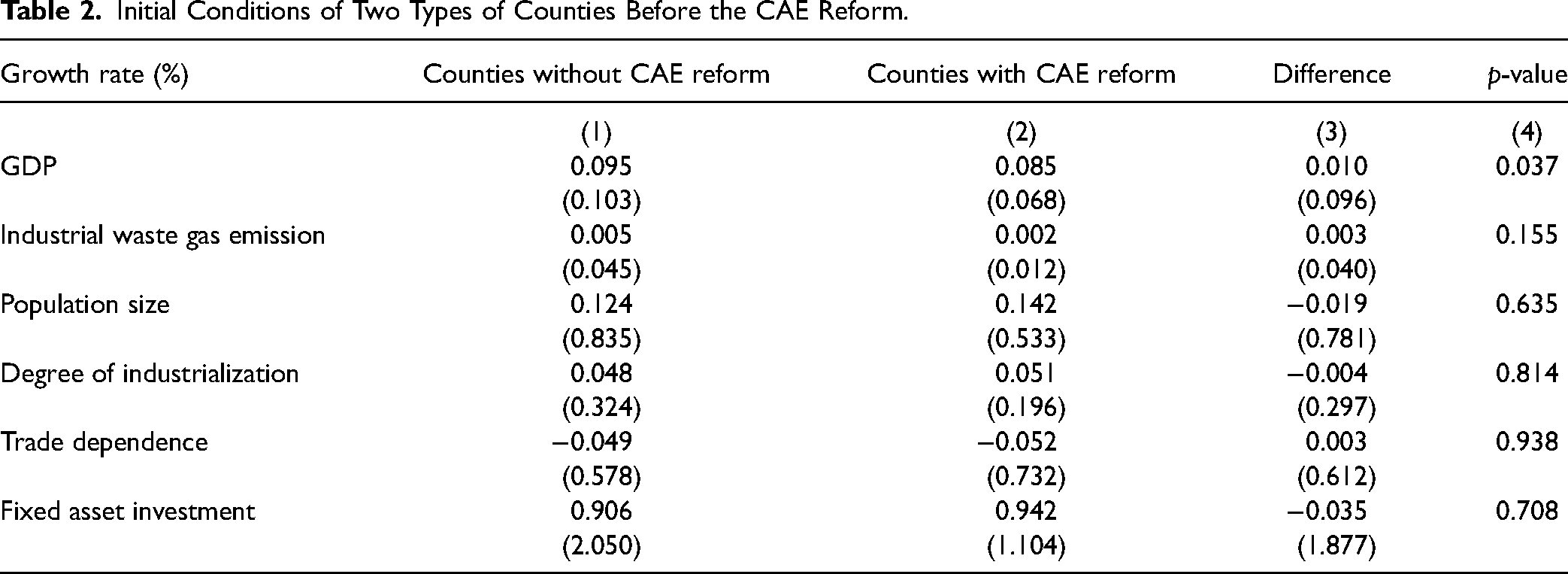
In Table 2, we explore whether counties with vs. without the CAE reform before 2003 exhibited differences in socioeconomic indicators including GDP, pollution, population size, fixed asset investments, etc. Columns (1) and (2) present the mean growth rates of various indicators in two types of counties (treatment vs. control). Columns (3) and (4) present the differences and related p-values between the two groups. Small and insignificant differences indicate that the two types of counties are comparable. This evidence allows us to use the standard DID method to empirically test the effect of administrative decentralization on various policies. The only significant difference between the two samples is GDP: the GDP of the counties with reform is significantly lower than that of the unreformed counties. This indicates that CAE reform is mainly conducted in underdeveloped regions, which is consistent with the pattern shown in Figure 1: the counties with CAE reform are mainly located in the northeast and central and western areas rather than the developed coastal areas. If the CAE reform has a significant positive impact on GDP growth in the underdeveloped regions, we can eliminate the Matthew effect that the rich get richer and the poor get poorer. In the section on robustness checks, we will further discuss the problem of sample selection bias.
Initial Conditions of Two Types of Counties Before the CAE Reform.
Identification Strategy
We employ the standard DID method to estimate the effects of devolution reform on policy outcomes using the following equation:
Empirical Analysis
Effects of Devolution on Economic Development and Environmental Pollution
Table 3 presents the effects of the CAE reform on two policy areas based on equation (1). In Columns (1) and (2), we only control for county and year fixed effects and prefecture-specific time trends. Both coefficients of interest are significant and positive. In Columns (3) and (4), we add other control variables including population, degree of industrialization, trade dependence, and fixed asset investments. The coefficients for economic development and pollution decrease to 0.779 and 27.82, respectively, and are still statistically significant at the 1% level. The results show that the CAE reform significantly promoted economic development and increased pollution.
Devolution Reform, Economic Development, and Environmental Pollution.
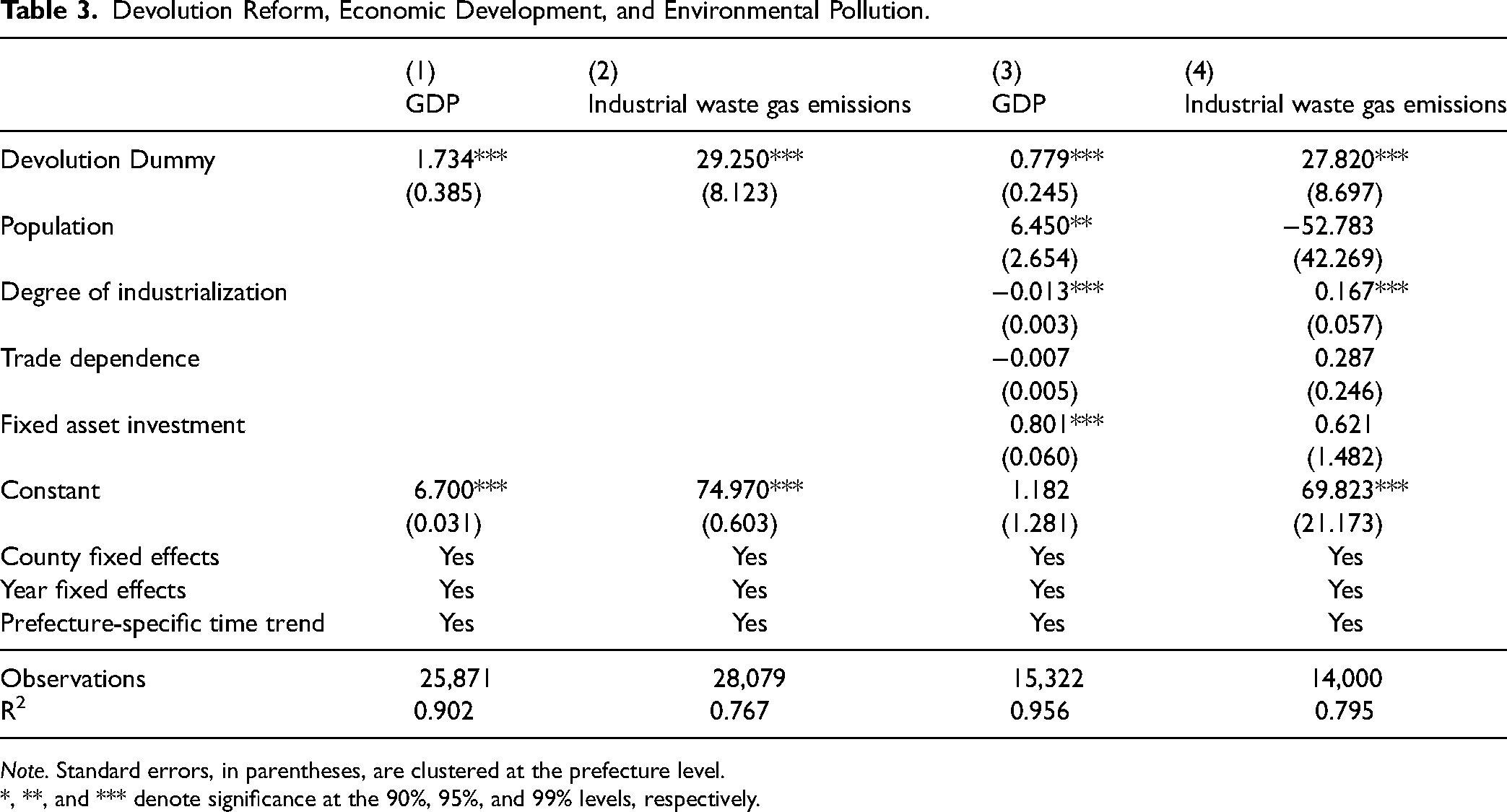
Note. Standard errors, in parentheses, are clustered at the prefecture level.
*, **, and *** denote significance at the 90%, 95%, and 99% levels, respectively.
Parallel-Trend Test
The validity of the DID method depends on the parallel-trend assumption: if the economic development and environmental pollution of reformed counties are indeed due to the CAE reform, there should be no significant differences between counties with vs. without treatment before the reform. Although we provide prima facie evidence in Table 2, here, we strictly test the assumption. We replace 
Figure 2 displays the estimated results of
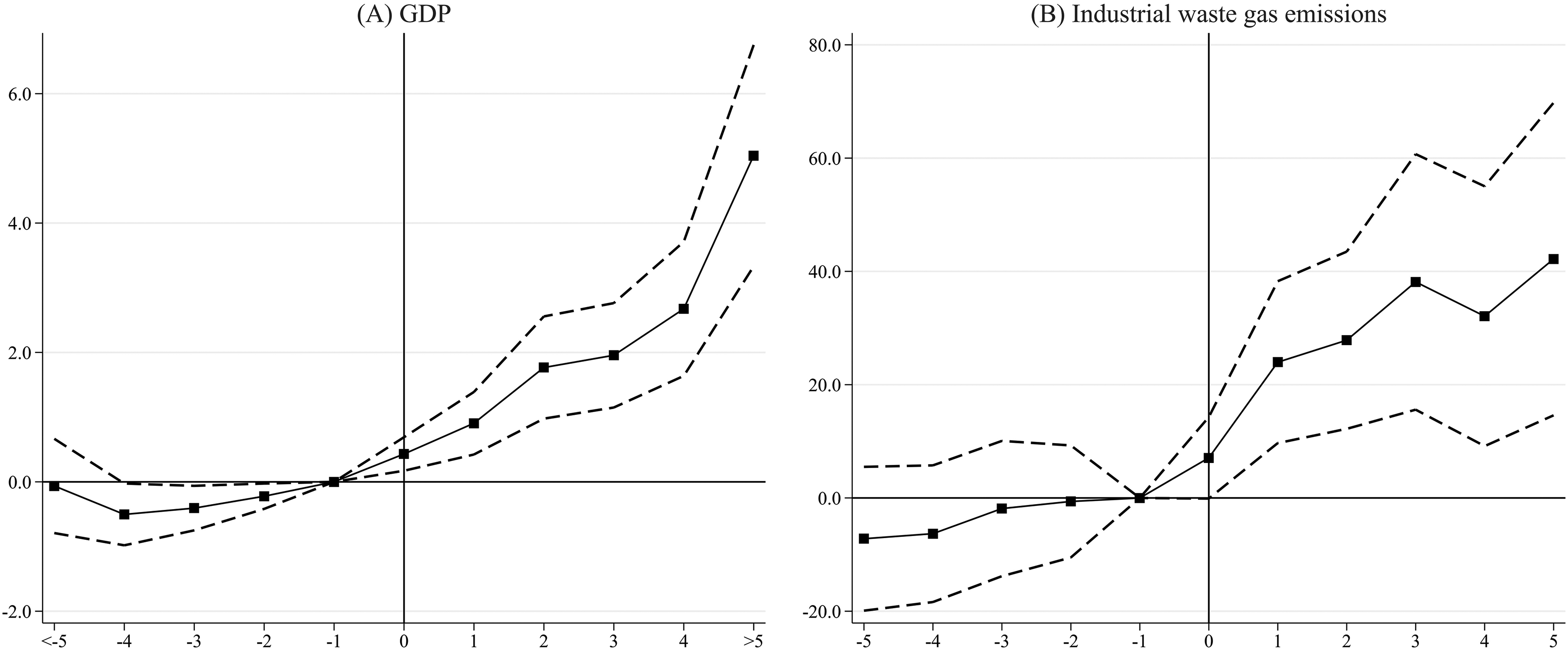
Parallel-Trend Assumption.
Robustness Checks
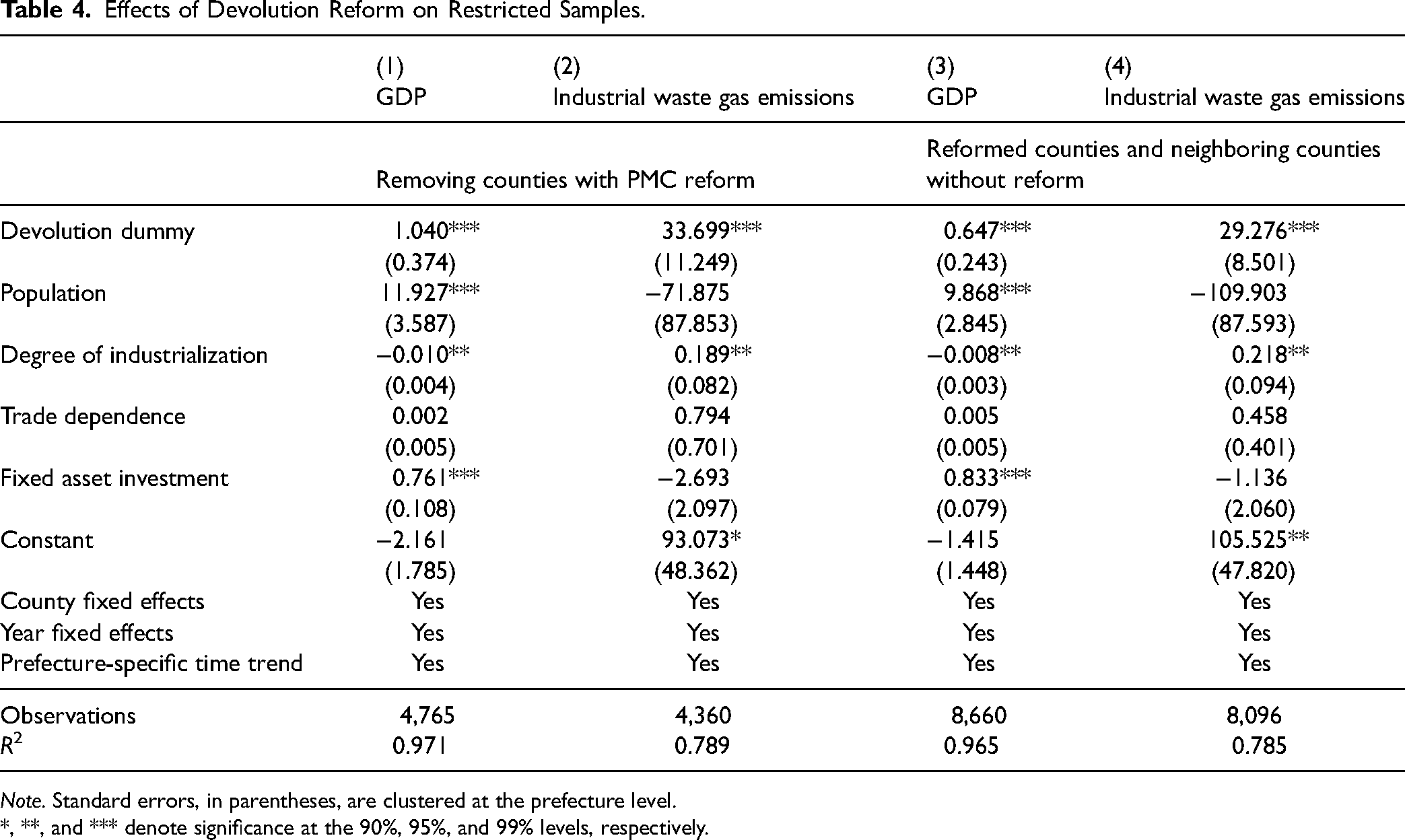
This section reports the results of a series of robustness checks. To clearly identify the temporal effects of the CAE reform on economic growth and environmental pollution, we should mitigate the intervening effects of other related policies during the same period. The major decentralized practice during the study period was the “province-managing-county” (PMC) policy. If the PMC reform has similar effects as the CAE reform, our baseline estimation will be overestimated. Thus, we collect data on the counties that implemented the PMC reform from 2000 to 2010 and remove them from the empirical analysis to mitigate potential bias. A total of 269 counties only implemented the CAE reform; 519 counties enacted neither reform. We then re-estimate equation (1) using the restricted sample of 788 counties. Columns (1) and (2) of Table 4 show that the coefficients did not change significantly, and the results remain robust.
Effects of Devolution Reform on Restricted Samples.
Note. Standard errors, in parentheses, are clustered at the prefecture level.
*, **, and *** denote significance at the 90%, 95%, and 99% levels, respectively.
With regard to the spatial perspective, if there existed nonrandomness in the selection of reformed counties, some unobservable factors that affect both reform implementation and policy outcomes might bias the estimation. Therefore, inspired by Baskaran (2014), in this robustness check, we treat the reformed counties as the treatment group and the neighboring counties that border the reformed counties (but have not implemented the reform) as the control group. This design allows us to overcome the potential systemic differences between the two groups: geographic proximity can control for factors such as culture, quality of governance, population structure, resource endowments, etc. The difference between the two groups after the reform can then be attributed to its effects. In this setting, the restricted sample includes 531 reformed counties and 966 neighboring counties that have not implemented the reform. Figure 3 displays the spatial distribution of this restricted sample of 1,497 counties. Columns (3) and (4) of Table 4 report the results. It shows that the effects of the CAE are still significant, and the coefficients have not changed much, indicating that the baseline models are not driven by the nonrandomness of the sample selection.
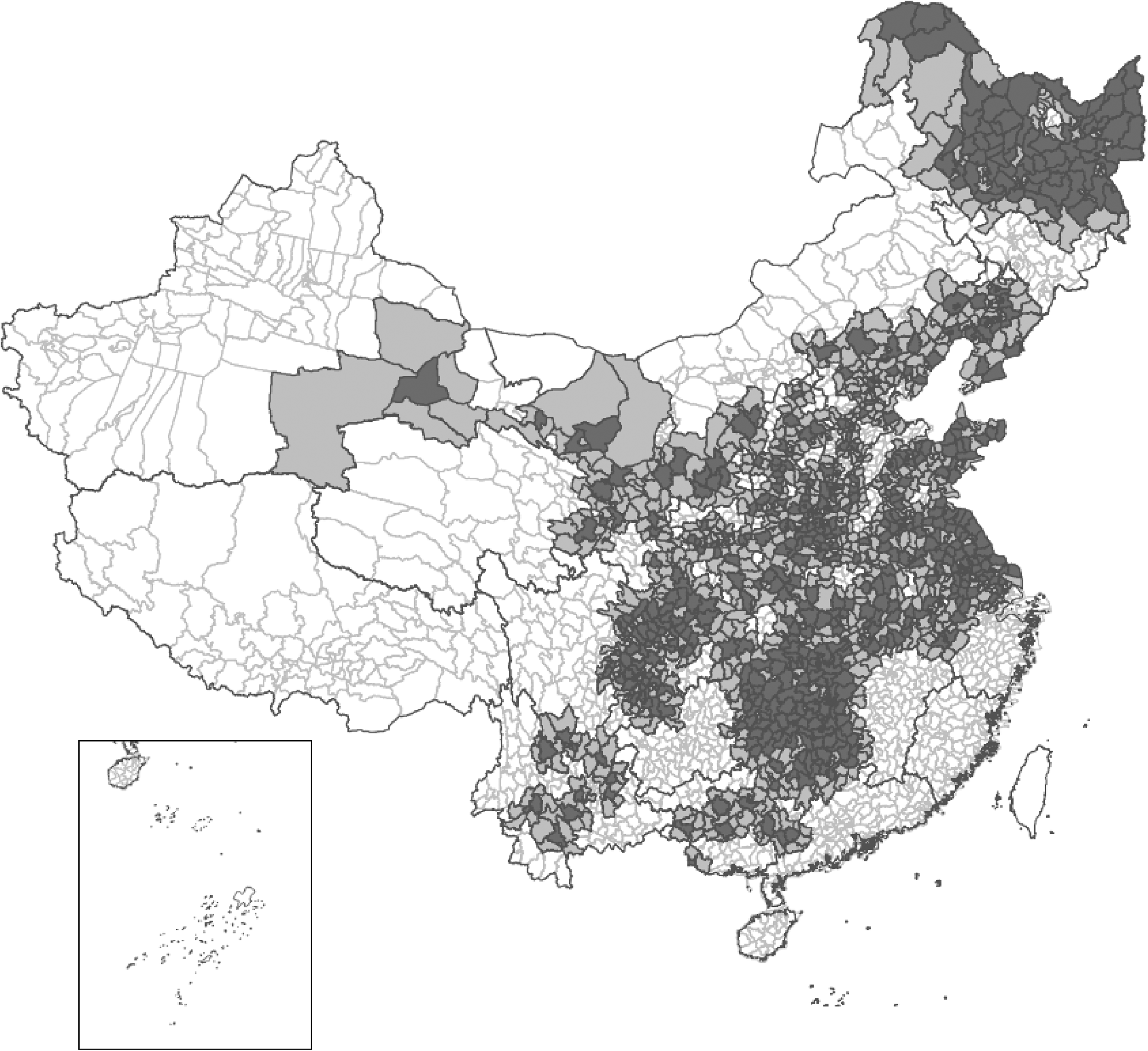
Spatial Distribution of Reformed Counties and Neighboring Counties.
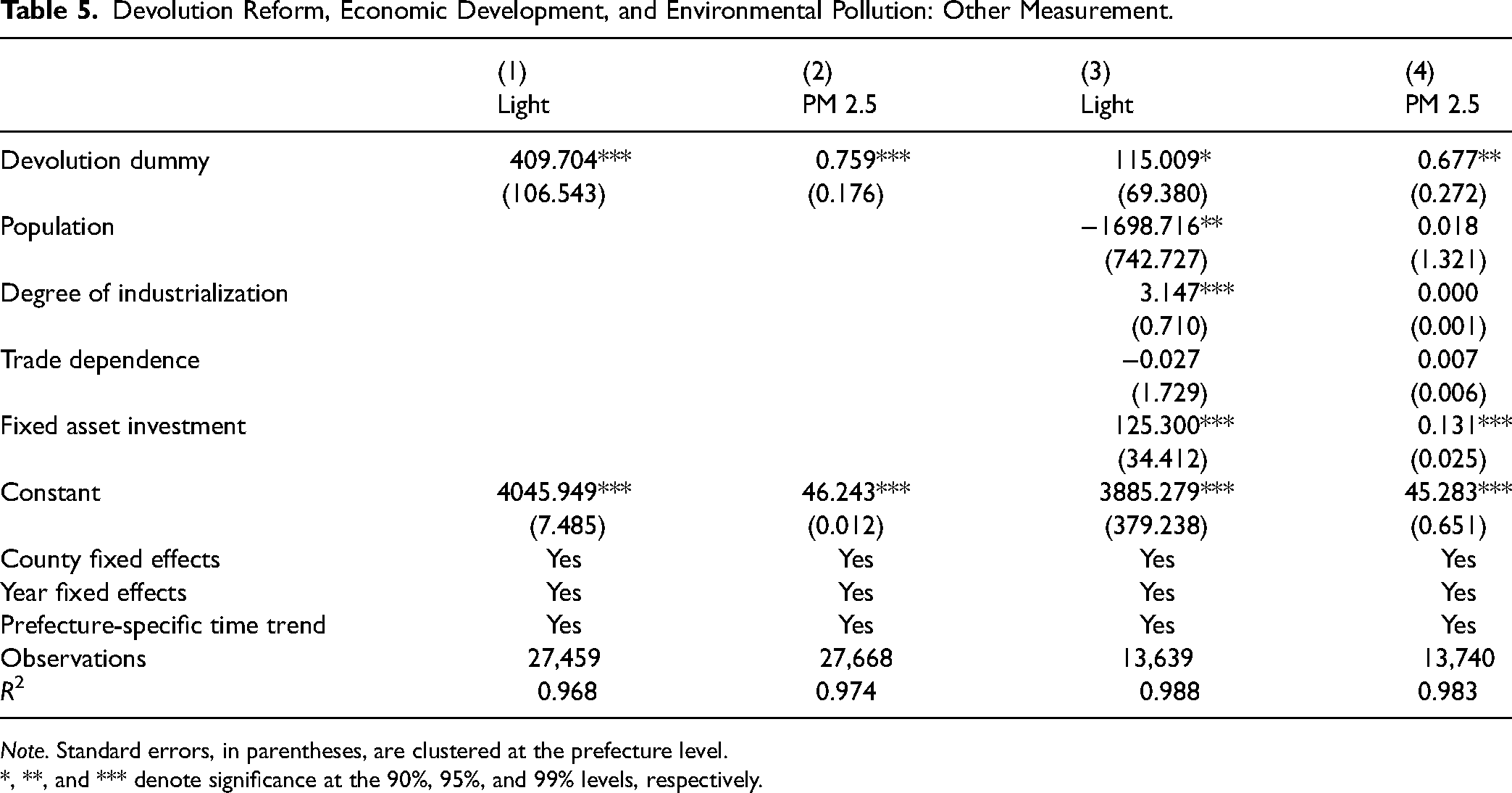
Someone may concern about the possible manipulation of GDP and pollution statistics in China. We thereby use satellite nightlight densities to measure the economic development of different counties and satellite-derived PM2.5 concentrations to measure the pollution in later robustness checks. 4 We collect raw satellite nightlight data from the Atmospheric Composition Analysis Group at Washington University in St. Louis. Following the method used by Yao et al. (2022) and van Donkelaar et al. (2019), we calculate a satellite dataset produced by fitting aerosol optical depth (AOD) retrievals with a chemical transport model and proxy it to county-level PM2.5 exposure. Table 5 reports the related results. As expected, the results are still robust: CAE reform increases economic growth and damages the environment.
Devolution Reform, Economic Development, and Environmental Pollution: Other Measurement.
Note. Standard errors, in parentheses, are clustered at the prefecture level.
*, **, and *** denote significance at the 90%, 95%, and 99% levels, respectively.
Mechanism Discussion
We have shown that the devolution reform leads to different effects: it stimulates economic development but increases pollution. We attempt to argue the underlying mechanism is the allocation of government attention: local governments with more discretion devote more attention to domains that stimulate short-term economic growth rather than other policy domains, the effects of which need to be observed in the long run. To strengthen our argument, inspired by Chan and Zhao (2016) that using government expenditure to measure government attention, we use capital construction expenditure to measure the attention to economic growth and the livelihood-related expenditure to measure the attention to those policy domains whose effects are only noticeable in the long run. 5 Columns (1) and (2) of Table 6 report the regression results using capital construction expenditures and livelihood-related expenditures as the dependent variables, respectively. We find that administrative decentralization has a significantly positive effect on capital construction expenditures, but no significant effect on livelihood-related expenditures.
Devolution Reform, Economic Development, and Environmental Pollution: Mechanisms.
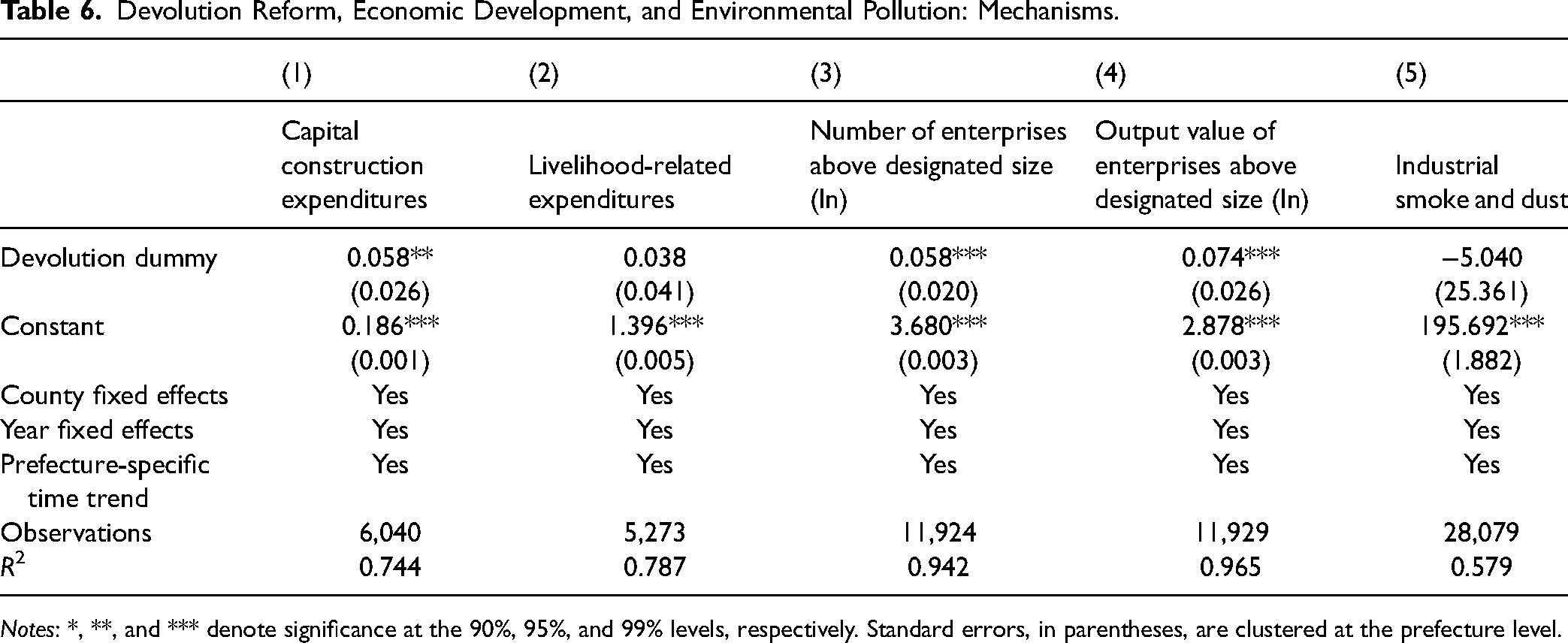
Notes: *, **, and *** denote significance at the 90%, 95%, and 99% levels, respectively. Standard errors, in parentheses, are clustered at the prefecture level.
In addition, if our story is true, we could expect the local government may behave differently towards either the high-incentivized or low-incentivized tasks. On one hand, given the crucial role of attracting enterprises by the government in promoting economic growth, the local government can have more room to simplify administrative procedures to help enterprises invest due to the reform. On the other hand, for the low-incentivized tasks such as environmental protection, the local government may have free-riding behaviors. We, therefore, examine the effects of the CAE reform on enterprise investment and environmental pollution.
With regard to the effects of devolution on enterprise investment, the devolution reform reduces the friction of the approval procedure, gives local governments the autonomy to decide which types of investments they pursue, and provides more beneficial policies. For instance, land development projects and mineral resource exploration, exploitation, and protection projects can be directly reported from the county government to the relevant provincial departments for approval after the reform. The above-mentioned practices significantly reduce bureaucratic frictions and allow more enterprises to invest in counties that have implemented the CAE reform and increase the output value of local enterprises. Such practices may promote economic growth in the jurisdiction. Columns (3) and (4) of Table 6 report the effects of the devolution reform on enterprise investments. As expected, these results indicate that the CAE reform significantly increased the number and output value of enterprises in reformed counties.
With regard to the effects of devolution on free-riding behaviors in environmental pollution, we select a pollutant with relatively fewer spillover effects—industrial smoke and dust to test. Industrial smoke and dust cause less pollution than industrial waste gas. If the positive effects of the CAE reform on environmental pollution are generated mainly through free-riding behavior, we would expect a smaller increase in industrial smoke and dust emissions after the reform. Column 5 of Table 6 reports the related results. As expected, the coefficient is insignificant. Concerning the significant difference in the spillover of the two pollutants, the results indicate that the pollution caused by the reform is due to the government's free-riding behavior in air pollution.
Conclusion and Discussion
In this article, we investigate the effects of administrative decentralization on local governments’ policy agendas using China's CAE reform from 2000 to 2010 as a quasi-natural experiment. We focus on the effects of devolution on the two most representative aspects of public service provision—economic growth and environmental protection. The results show that the devolution reform simultaneously promotes local economic development and deteriorates the local environment. These mixed effects can be attributed to the administrative mechanism for the interaction between devolution and the distribution of government attention. In particular, devolution reforms empower local governments with greater discretion and autonomy in creating their policy agenda. Under China's political tournament system, local governments tend to pay more attention to policies with visible short-term outcomes such as economic development, and less attention to those policy domains whose outcomes are noticeable in the long run. Therefore, devolution gives local governments more leeway to pay attention to policies that yield short-term visible effects. We show that after the reform, local governments are likely to increase their capital construction expenditures and attract more enterprises to invest in promoting the economy, and the devolution reform aggravates pollution levels, for example, by increasing industrial waste gas emissions. Moreover, pollution is more serious for pollutants with large spillover effects, indicating the need for cross-regional collaboration.
We believe our results are robust in a dynamic sense. In recent years, the Chinese government has made continuous efforts in environmental protection and has established a system of “one-vote veto” rule for pollution emission reduction. The leaders in governments that failed to meet the pollutant emission reduction targets will lose their chance to be promoted (Heberer & Senz, 2011). However, scholars have observed that such obligatory targets are like qualifying matches for local leaders and only provide a baseline for local government to achieve without incentivizing them to surpass the target (Du & Yi, 2022; Ma, 2016; Qi & Zhang, 2014; Zhang, 2021). Only qualified officials can get promoted but the key to determining the promotion is still dominated by GDP indicators. The mode of political tournament system based on economic growth does not fundamentally change. Considering that the devolution reform is still in process and the upper-level governments tend to devolve more authorities and responsibilities to county-level governments, we expect that the basic pattern and interaction between government attention and decentralization still exists in today’s China. With the increasing weight of environmental protection, environmental pollution nowadays might be more related to the free-riding behavior of the local government as we indicated in the article. The central government has realized the environmental costs due to the incentive system and is trying to employ the campaign-style enforcement as a remedy to achieve the pollution reduction targets (Teng & Wang, 2021). While the long-term transformation is still a challenge.
The findings of this article prompt us to rethink the role of decentralization. Previous studies have extensively discussed the effects of fiscal and political decentralization on state capacity building and political control (Christensen & Lægreid, 2001; Rondinelli, 1981). There has also been considerable discussion of the positive effects of delegating responsibility and authority to a third party like the private sector or non-profit sector (Girth et al., 2012; Hughes, 2017; Osborne & Gaebler, 1993). Our findings demonstrate that the effects of devolution are mixed and not as positive as expected. On the one hand, local governments with more decision-making power are indeed more involved in economic development. On the other hand, devolution hinders horizontal intergovernmental collaboration and even leads to a kind of “tragedy of the commons.” It creates problems related to fragmentation and coordination, especially in policy domains like environmental protection. Thus, the successful implementation of decentralized practices requires not only the transfer of authority to lower levels of government but also close intergovernmental coordination and shared governance. To achieve this goal, the government should think more comprehensively and delicately about designing its decentralization policy framework and increasing the architecture of governing.
In the broader context, this research contributes to the exploration of a balanced mechanism to influence local governments’ performance. Decentralization is designed to empower localities and facilitate citizen participation. Yet the top-down political tournament system conflicts with the spirit of NPM. In this sense, local government attention allocation also has the shadow of the central government. This feature makes the mechanism of related service provision different from others explored in the literature, such as fiscal transfers, grants, or monitoring, in which the central government directly exerts its influence (Sosin, 2012). Our findings suggest that the central government can be implicitly involved in local service provision in the decentralizing context, and this can be seen as the second-order effects of the reform. To address the policy dilemma of economic growth and environmental protection, further devolving practices to local governments are needed to step out of the shadow of the central government. This research also contributes to the call to extend public administration research beyond the United States and other industrialized developed countries and to more vigorously explore the experiences and practices in developing countries.
Our study suggests several avenues for future research. First, we only examine two representative dimensions of public policies—economic development and environmental protection. The study does not consider other policy domains or the interaction between devolution and various functionaries within the government, namely, the effects of devolution on the tiao-kuai system. Future research should examine the interrelationships and potential synergies of devolution with respect to the policy agenda.
In addition, our study does not consider the potential gap between government attention and actual policy achievements and the different content of devolution reform. Normally, we assume more government attention would achieve better policy outcomes, but this remains an empirical question. In terms of the content of the reform, future research could explore what kinds of devolving practices promote the most economic growth and whether they have other effects on other policy arenas.
Another area of future research is to understand the challenges of accountability and the architecture of governing. In the context of developing countries, how can the government ensure accountability in decentralized service delivery where administrative responsibility is fuzzy? How can a government, structured and staffed for an era when vertical relationships dominated, build the capacity to manage horizontal partnerships effectively? Additional research, therefore, is needed.
Finally, our findings raise issues regarding the relationship between decentralized practices and sustainable development in developing countries. In the context of decentralization, what policies or strategies can governments employ to maintain economic growth while protecting the environment? Can the panacea in developed countries be used in developing countries? With weak state capacity and a lack of electoral accountability, developing countries are struggling to achieve good governance under the pressures of globalization. China provides valuable experiences. Comparative studies are therefore needed and should continue to probe more deeply into the nature and consequences of this fast-changing environment.
Supplemental Material
sj-docx-1-arp-10.1177_02750740231185849 - Supplemental material for In the Shadow of Administrative Decentralization: The Impact of Devolution on Subnational Service Provision
Supplemental material, sj-docx-1-arp-10.1177_02750740231185849 for In the Shadow of Administrative Decentralization: The Impact of Devolution on Subnational Service Provision by Yiran Li, Shuo Chen and Yaohui Peng in The American Review of Public Administration
Footnotes
Funding
The author(s) disclosed receipt of the following financial support for the research, authorship, and/or publication of this article: This work was supported by the Start up Grant of Hong Kong Baptist University (162888).

Notes
Author Biographies
References
Supplementary Material
Please find the following supplemental material available below.
For Open Access articles published under a Creative Commons License, all supplemental material carries the same license as the article it is associated with.
For non-Open Access articles published, all supplemental material carries a non-exclusive license, and permission requests for re-use of supplemental material or any part of supplemental material shall be sent directly to the copyright owner as specified in the copyright notice associated with the article.
