




Abstract
Administration of street-level bureaucrats requires prior knowledge of what affects their use of discretion. However, there is a lack of understanding as to what influences their decision-making when choosing between claims made by the state or by its citizens. Without such knowledge, public administration at the street-level can sustain the perception that street-level bureaucrats have a state-preference bias, lowering citizens’ view of public service delivery by those perceived as the face of governance. This study focuses on decisions street-level bureaucrats make when resolving disputes between citizens and other state officials. Using real-world resolutions made over three decades by lower-court judges in Israeli civil tax disputes, the findings reveal a link between factors associated with street-level bureaucrats’ common characteristics and state favoritism in their resolutions. The findings also imply that policymakers who want to mitigate such outcomes can use citizen administrative participation-based influencers to promote street-level bureaucrats’ pro-citizen tendencies.
Introduction
Street-level bureaucrats make decisions that impact the lives and fates of many individuals (Brodkin, 2012; Hupe & Hill, 2007; Maynard-Moody & Portillo, 2010). Those working on the frontlines of public administration, such as case workers, police officers, social workers and lower-court judges, use their discretion when granting public benefits and imposing public sanctions (Lipsky, 2010). They reflect the administration to the citizens with whom they interact (Davidovitz & Cohen, 2022), thereby affirming their critical role in policy implementation (Evans & Harris, 2004; Hupe et al., 2014; Portillo & Rudes, 2014).
The assumption that citizens would be treated fairly and with dignity forms the basis of the social contract between the public and the establishment (Rawls, 1971). In return for their involvement in collective decision-making and paying of taxes, citizens expect unbiased treatment from the authorities (Beeri et al., 2021; Craven, 2021; Van Ryzin, 2011). Some scholars consider bureaucratic neutrality to be a myth (Portillo et al., 2020; Williams, 1985). Yet, procedural equity (that is, the notion that public service relations should be objective) and procedural values, such as respect and fairness, continue to be major drivers of public trust in government (Mazepus & van Leeuwen, 2020; Mcloughlin, 2015; Moynihan et al., 2015). Thus, citizens who believe that state officials treat them fairly are more likely to accept administrative decisions (Kang, 2021) and develop trust in governance by generalizing their positive personal experiences (Davidovitz, 2022; Kumlin & Rothstein, 2005). People encounter “Procedural Fairness” (i.e., processes designed to reduce bias or favoritism in government decision-making (Ruder & Woods, 2020) 1 through their interactions with street-level bureaucrats (Edri-Peer & Cohen, 2023; Raaphorst & Van de Walle, 2020) whom they perceive to be the symbolic face of government (Lipsky, 2010). It is therefore essential for decisions made by street-level bureaucrats to be unbiased, particularly when they resolve disputes between the state and its citizens.
In settling disputes between citizens and other state officials, the resolutions street-level bureaucrats make (“Street-level resolutions”) can reveal their pro-citizen or pro-state tendencies through their likelihood to support one side over the other (Cohen & Gershgoren, 2016; Raaphorst, 2018). In addition to the specific claims of the disputing parties, street-level bureaucrats’ decision-making can be influenced (in general) by environmental, organizational, and personal influences (Jilke & Tummers, 2018). This study investigates factors associated with common characteristics of street-level bureaucrats, such as their expanded discretionary space, their formal certification as state servants, and their membership in public organizations (Gershgoren & Cohen, 2022; 2023a) which may compel them to favor the state in their resolutions. The study also examines citizen administrative participation-based influencers that may reinforce their pro-citizen tendencies by advancing the right to internally appeal their resolutions and by promoting their membership and joint resolution-making in mixed teams with lay officials whose careers do not revolve around civil service (Machura, 2016), such as private contractors or volunteers (Gershgoren & Cohen, 2022; 2023b).
Adopting the scholarly view of lower-court judges as street-level bureaucrats (Biland & Steinmetz, 2017; Cowan & Hitchings, 2007; Dallara & Lacchei, 2021; Jain, 2018; Lipsky, 2010), this study explores whether state or citizen favoritism existed in lower-court rulings that resolved Israeli civil tax disputes under different conditions. The article proceeds as follows: first, a theoretical background is given regarding pro-citizen tendencies in street-level resolutions, detailing factors associated with common characteristics of street-level bureaucrats that may bring state favoritism to their decision-making and citizen administrative participation-based influencers that may promote their pro-citizen tendencies. Four hypotheses follow, regarding the impact such factors and influencers may have on street-level bureaucrats' pro-state or pro-citizen tendencies. Next, the context and method for testing these hypotheses are presented, using lower-court rulings in Israeli civil tax disputes to test case street-level resolutions and utilizing quantitative statistical tools to assess the empirical data. The findings are presented and discussed, and the article concludes with a discussion of the study's limitations and potential future directions.
Pro-Citizen or Pro-State Tendencies in Street-Level Resolutions
Scholars have emphasized the significance of discretion to the efforts of street-level bureaucrats (Evans, 2016; Maynard-Moody & Portillo, 2010; Thomann et al., 2018). Discretion is generally perceived as the freedom of choice that can be exercised in a specific context (Evans, 2011). This study examines the manifestation of such freedom of choice in street-level resolutions, focusing on their pro-citizen or pro-state tendencies.
The term “pro-citizen tendencies” refers to street-level bureaucrats’ preferences for citizens’ claims over arguments made by other state officials. In their pro-citizen resolutions, street-level bureaucrats reject the arguments made by such state officials and accept the citizens’ counterclaims (and vice versa in their pro-state resolutions). Public administration theory is ambivalent regarding street-level bureaucrats’ antecedent tendencies to favor the state or the public. According to the traditional distinction between politics and administration bureaucrats are “state agents,” acting inherently in the state's favor (Prendergast, 2007; Rohr, 1987) and condemns their deviations from public policy as “shirking” or “sabotage” (Brehm and Gates, 1997). The self-descriptions of street-level bureaucrats, however, are used by some scholars to argue that they see themselves as “citizen agents,” using their discretion to help those they consider worthy or punish those they deem unworthy (Maynard-Moody & Musheno, 2000; Tummers, 2017). 2 Resolutions made by street-level bureaucrats force them to choose between arguments made by state officials and counterclaims made by citizens, exposing their pro-state or pro-citizen biases.
‘Resolutions’ refer to the settling of disputes between parties (Burton, 1990). Citizens can bring their claims against arguments made by state officials to a variety of (internal and external) appeal agencies (Buck, 2004; Currie & Goodman, 1975). In fact, many of those authorized to reject or affirm such claims, such as mediators, arbitrators, specialized tribunals, and administrative adjudicators, are themselves street-level bureaucrats. They exercise discretion when making their resolutions, but which side will they favor?
The literature provides insights into the personal, organizational, and environmental factors that affect street-level bureaucrats’ use of discretion (for a comprehensive description, see Cohen, 2018; 2021). Most studies focus on decision-making regarding their own conduct. This study proceeds to explore what factors and influencers affect their resolutions that affirm or reject other state officials’ arguments in view of citizens’ counterclaims.
Factors That Can Bring State Favoritism to Street-Level Resolutions
The classical definition of street-level bureaucrats characterizes them as having significant discretion, which they may exercise in their frequent interactions with clients. (Lipsky, 2010). Furthermore, they are usually accredited with formal certification that confirms their public role and are members of public organizations in various administrative bodies. How will such factors relate to pro-state or pro-citizen tendencies in their resolutions?
Expanding Street-Level Bureaucrats’ Discretionary Space
“Discretionary space,” in context, refers to the set of systemic regulations and administrative standards that govern the use of discretion by street-level bureaucrats (Evans & Harris, 2004). Such space limits their decision-making freedom (Hupe & Hill, 2007; Thomann et al., 2018). Because they can only use their discretion within its boundaries (Bovens & Zouridis, 2002; Piore, 2011), their behavior outside of it may contradict institutional or organizational requirements (De Vriew, 2015).
Street-level bureaucrats are socialized to accept the attitudes required to become successful state servants (Morrison, 1993) and to conform with administrative opinions (Baumeister & Leary, 1995; Cialdini & Goldstein, 2004; Cohen & Gershgoren, 2019). Therefore, they may feel a desire to adopt the administration's views and be more hostile toward external pressures that counteract such narratives (De Dreu & Beersma, 2010; Hughes et al., 2017; Tajfel et al., 1971). Expanding their discretionary space offers them more leeway to reflect such administrative commitments in their resolutions by accepting arguments presented by other state officials. Indeed, a prior study revealed that extending the discretionary space of Israeli lower-court judges relates to added state-favoritism in their rulings (Gershgoren & Cohen, 2022). How will combining the expansion of their discretionary space with additional factors and influencers affect such pro-state tendency?
Accrediting Street-Level Bureaucrats With Formal Certification
Formal certification confers authority and recognizes expertise but may also result in role-induced bias (Simon et al., 2008, 2009). The assignment of roles can influence people's attitudes and behaviors. (Janis & King, 1954; Zimbardo, 1965). Individuals may reach conclusions that are mandated by their role (Janis & King, 1954; Simon et al., 2008; 2009; Zimbardo, 1965) or look up information to support the outcomes they believe their role requires (Betsch et al., 2001). For example, in a German study, participants assigned to the role of legal prosecutor were more likely to convict suspects than those who were assigned to the role of defense counselor (Engel & Glöckner, 2013). Moreover, role-induced biases extend beyond motivated reasoning and selective information search. Once “trapped” in an interpretation, it is difficult to pull out and reach a different conclusion. (Engel & Glöckner, 2013).
Accrediting street-level bureaucrats as formally certified state servants can result in role-induced bias, which may motivate them to prefer standards that they perceive as supporting their state-servant role, such as conforming to administrative opinions and adopting the administration's narratives. (Baumeister & Leary 1995; Cialdini & Goldstein, 2004; Gershgoren & Cohen, 2023a). Will formal certification combined with the (previously mentioned) expansion of street-level bureaucrats’ discretionary space induce more pro-state resolutions?
Public Organization Membership
Groups have been shown to shape the attitudes of members (Moreland & Levine, 2006), and peers have been found to play an important part in their group members’ efforts (Foldy & Buckley, 2010). Peers influence other group members through their “collective schema” (Vinzant et al., 1998), including the attitudes they hold towards clients (Keulemans & Van de Walle, 2020; Sandfort, 1999), providing additional sources of learning that can alter knowledge and behavior (Foldy & Buckley, 2010).
As members of public organizations, street-level bureaucrats are exposed to the informative influences of their public organization's peers (Keulemans & Van de Walle, 2020; Raaphorst & Loyens, 2020). Indeed, it is commonly accepted that public organizations alter the attitudes of their street-level bureaucrat members (Cohen & Gershgoren, 2016; Ottati et al., 2005) and affect their social categorization (Tajfel et al., 1971), including the opinions they hold toward outgroups (Davidovitz & Cohen, 2022; Hughes et al., 2017). Will membership in a public organization combined with the aforementioned factors provoke more pro-state resolutions?
It is characteristic for street-level bureaucrats to work under expanded discretionary space, often as certified state servants operating within public organizations. If the combined impact of such factors is found to bring state favoritism to their resolutions, can citizen administrative participation counteract such a tendency?
Citizen Administrative Participation-Based Influencers That Promote Pro-Citizen Tendencies in Street-Level Resolutions
This study follows Roberts (2004) definition of “Citizen Administrative Participation” as “the process by which members of a society (those not holding office or administrative positions in government) share power with public officials in making decisions and in taking actions related to the community.” The literature emphasizes citizens’ right to participate in the formation of administrative decisions affecting them (Robbins et al., 2008). Citizen administrative participation is manifested, for example, at the individual level through citizen surveys (Watson et al., 1991) and, at the group level, through citizen panels (Crosby et al., 1986) and citizen working groups (Stallings & Quarantelli, 1985). Such participation allows citizens to voice their objections to street-level resolutions at the individual level through the filing of internal appeals and at the group level by participating in resolution-making in mixed teams as (noncareer) lay officials, alongside career street-level bureaucrats. The question remains, will such influencers promote citizen favoritism in street-level resolutions?
Internal Appealability of Street-Level Resolutions
“Internal Appealability” or “Appealability,” in context, refers to the regulated right to further contest a resolution before a higher body within the agency holding the power to overturn it. Even if the resolution addresses a specific dispute, the individualistic opportunity to voice disagreements and contest it (upon appeal) can have far-reaching consequences for other citizens facing similar disputes. Furthermore, from the deciders’ perspective, in view of the potential appeal, they may experience “fear of negative evaluation” (Watson & Friend, 1969) that could impact their use of discretion. According to judicial theory, lower-court judges are frequently concerned about potential appellate review of their rulings (Klein & Hume, 2003). They worry that the appeal, regardless of its outcome, 3 will hurt their chances for promotion (George & Yoon 2003), harm their reputation (Cameron et al., 2000; Caminker, 1994; Colby, 1987), and/or diminish their capacity to determine legal policy (McCubbins et al., 1994).
State officials are typically “repeat players” who consider long-term objectives (Galanter, 1974). As a result, they are presumed to be less likely to challenge a resolution that rejected their argument if failure to overturn it (upon appeal) imposes a binding precedent prohibiting them from using a similar argument in future disputes. Citizens, on the other hand, are typically “one-shot players” who are unconcerned about such an outcome (Galanter, 1974; Lederman, 1998) and are thus assumed to be more likely to further appeal resolutions that rejected their claims.
Street-level bureaucrats who are intimidated by the possibility of negative evaluation of their resolutions (upon appeal) may cope with such stress (Tummers et al., 2015) by tailoring internally appealable resolutions to fit the claims of citizens who are more prone to appeal, in the hope that this will reduce the likelihood of appeal. Indeed, studies show that appealable court rulings issued by Israeli lower (district) court judges were more citizen-friendly than their unappealable rulings (Gershgoren & Cohen, 2022). However, will internal appealability promote pro-citizen resolutions when it is combined with other factors and additional (group level) citizen administrative participation-based influencers?
Mixed Team Membership
Street-level bureaucrats can make their resolutions alone or in decision forums which are sometimes composed of “Mixed Teams” that incorporate career street-level bureaucrats with lay officials. “Career Street-Level Bureaucrats,” in context, are street-level bureaucrats whose careers revolve around public service, and their public position is their principal source of income. “Lay officials,” on the other hand, are noncareer civil servants, such as private contractors and volunteers, whose careers do not centre on public service and, even though they may receive monetary compensation for their part-time efforts, their temporary public position is not their main source of income 4 (Machura, 2016).
The influence of groups, including teams, on the attitudes of their members (as discussed above in relation to street-level bureaucrats’ public organization membership) can be informative or normative. Career street-level bureaucrat members in mixed teams are exposed to the informative influences (Keulemans & Van de Walle, 2020; Raaphorst & Loyens, 2020) of their lay-official teammates and, if convinced, they may change their attitudes accordingly. If such opinions are internalized (Vygotsky, 1980), then the change in attitude may persist even when career street-level bureaucrats make resolutions on their own, outside of the mixed team. Studies that conducted interviews with career street-level bureaucrats reveal ambiguous views on the impact of lay officials on decisions made in mixed teams 5 (Kutnjak Ivkovic, 2007, Kutnjak Ivkovic, 2015). Yet, an opinion worth noting was given in a study of labor courts in Great Britain, where a career judge stated: “I sat with [lay judges] whose ability to analyse evidence forensically and spot something I’ve missed is humbling” (Corby et al., 2020 pp. 22).
When compared to career street-level bureaucrats, lay officials are expected to have more citizen-friendly attitudes. Lay officials have weaker working relationships with the state and are therefore expected to be less socialized to accept public administrative norms (Morrison, 1993) and less likely to conform with administrative opinions (Baumeister & Leary, 1995; Cialdini & Goldstein, 2004; Gershgoren and Cohen, 2023b). Additionally, they are expected to associate less frequently with other members of their public organization; thus, they are less likely to be hostile toward claims contradicting the state's narratives (De Dreu & Beersma, 2010; Hughes et al., 2017). Empirical studies of mixed tribunals (common examples of mixed teams that, as “quasi-judicial bodies,” resolve criminal and civil/administrative disputes) show that lay officials in such mixed teams often see themselves as more pro-citizen than their career teammates. For example, the majority of surveyed lay adjudicators in Alaskan administrative mixed tribunals (Latta, 2014) saw their role as guardians against government overreach. Similarly, interviews of lay adjudicators in mixed labor courts in France, Germany, and the United Kingdom (Burgess et al., 2017) revealed classic altruism in their desire to become lay judges, with only a few reporting persistent dissonance between their self-perception as an employee's representative and their role as a lay judge.
Citizens’ group level administrative participation that enables lay officials in mixed teams to voice their objections to career street-level resolutions may convince the latter to be less favorable toward the state. Will the combining of mixed team membership and previously mentioned factors encourage career street-level bureaucrats to make pro-citizen resolutions when they make their resolutions on their own? And where will their tendency lie when resolutions are made jointly in the mixed team?
Joint Decision-Making in Mixed Teams
In addition to their informative role, teammates can have a normative (social) influence on other team members, a phenomenon known as “peer-pressure” (Ottati et al., 2005). Street-level bureaucrats cooperating in teams are exposed to their collaborating teammates’ standards (Barker, 1993; Wright & Barker, 2000). Collaboration norms are fundamental to the team's socialization (Moreland and Levine, 2006), dictating the team's attitudes and behaviors that cooperating members are expected to uphold (Feldman, 1981). Such normative (social) influence can be enhanced when team members are mutually responsible for outcomes (Barker, 1993; Wright & Barker, 2000).
Scholars noted that peer-pressure within teams can cause street-level bureaucrats to ‘cope’ (Tummers et al., 2015) and adjust their views, including those they hold about clients, to match the views presented by their teammates, even if they had rejected such views initially (Blau, 1960; Keulemans & Van de Walle, 2020). Citizen (group level) administrative participation can enable citizens, appointed as lay officials in mixed teams, to pressure their collaborating career teammates to be less favorable toward the state (Gershgoren & Cohen, 2023b).
The question remains, will joint resolution-making in mixed teams combined with the potential influence of previously mentioned factors, encourage pro-citizen resolutions when made in such teams?
Using Hupe and Hill's (2007) typology of street-level bureaucrats’ public accountability, 6 Figure 1 depicts the study's potential pro-state factors and pro-citizen influencers on street-level resolutions (as obligations/commitments to various accountability forums).
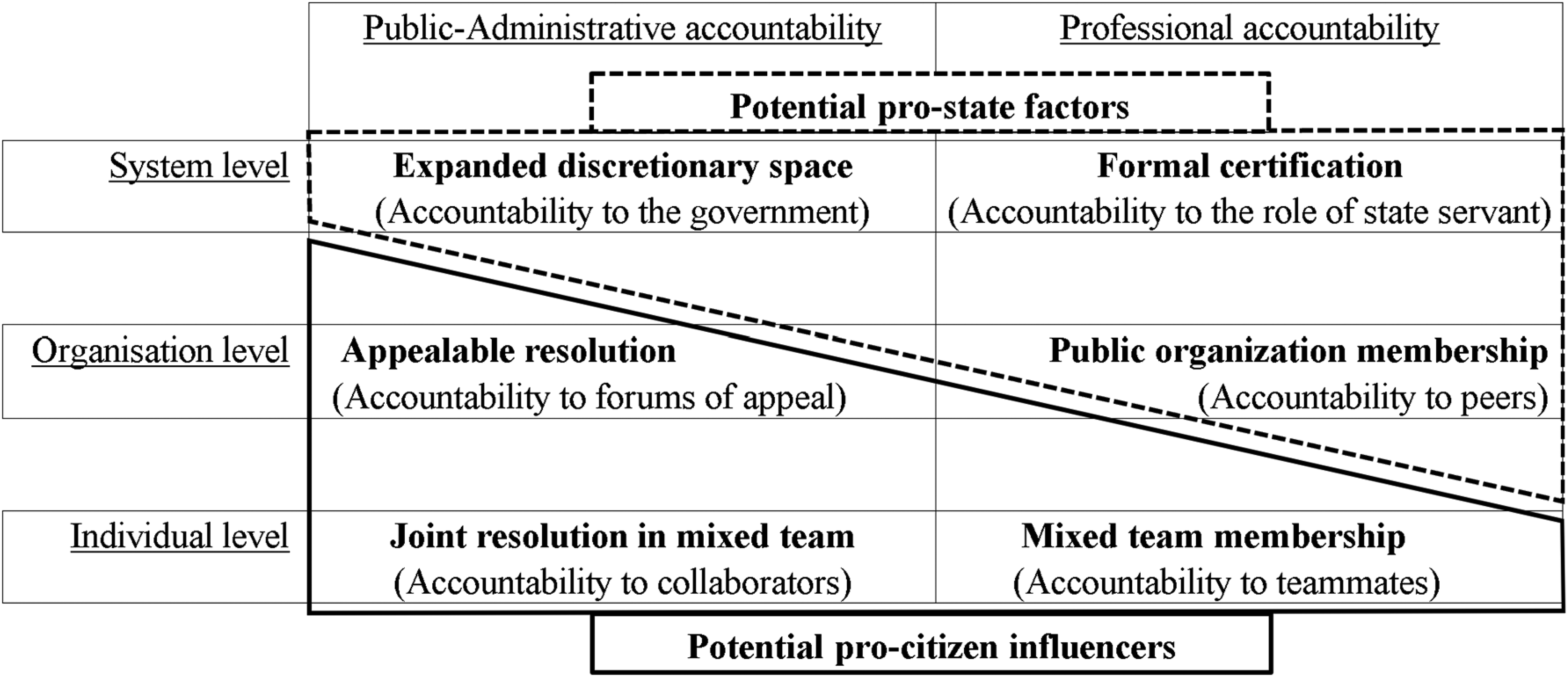
Potential pro-state factors and pro-citizen influencers.
Hypotheses
In view of the factors and influencers detailed above, four hypotheses can be made about the combined impacts on career street-level bureaucrats’ pro-citizen tendencies in their resolutions. Expanding career street-level bureaucrats’ discretionary space can promote their socialization into adopting state-oriented narratives (Bolino et al., 2013). Accrediting them with formal certification may strengthen the above and, also, induce role bias toward preferring opinions that they perceive as acceptable to state servants (Engel & Glöckner, 2013). Their public organization membership can increase such influences and shift their attitudes against outgroups (Davidovitz & Cohen, 2022; Hughes et al., 2017). The combined effect of such factors may lead them to be more friendly toward the state's arguments in their resolutions. Consequently:
Considering street-level bureaucrats’ fear of negative evaluation (Klein & Hume, 2003; Watson & Friend, 1969) and assuming that citizens are more likely than the state to appeal resolutions that rejected their claims,
7
promoting the right to internally appeal street-level resolutions (i.e., voice their opinions through citizen administrative participation at the individual level) can motivate career street-level bureaucrats to cope (Tummers et al., 2015) and try to reduce the likelihood of appeal by accepting more claims made by (the more appeal-inclined) citizens. Consequently (in comparison to appealable resolutions made jointly in mixed teams under narrower discretionary space by uncertified lay officials):
Lay officials’ noncareer relationships with the state, weaker public socialization, and fewer associations with career civil-servant colleagues may cause them to be more friendly toward claims presented by citizens and more critical of arguments presented by other state officials who adopt the state's narratives. If career street-level bureaucrats internalize (Vygotsky, 1980) the convincing opinions raised by their (uncertified, noncareer) lay-official teammates (voicing the public through citizen administrative participation at the group level), such (citizen-friendly) views can have an ongoing influence on resolutions they make outside the mixed team. Hence, their resolutions, including those they make outside the mixed team are expected to be more citizen-friendly. Consequently (in comparison to appealable resolutions jointly made in mixed teams under narrower discretionary space by uncertified lay officials):
Finally, career street-level bureaucrats making joint resolutions in mixed teams may face peer pressure from their lay-official collaborating teammates. They may cope by adopting their collaborators’ views (Tummers et al., 2015), making their resolutions more citizen-friendly. Consequently (in comparison to appealable resolutions jointly made in mixed teams under narrower discretionary space by uncertified lay officials):
To quantitatively test the four research hypotheses, lower-court rulings in Israeli civil tax disputes were used as test cases for street-level resolutions.
The Context
Lower-court judges are recognized by Lipsky (2010) as street-level bureaucrats who, despite the variety of their jobs, use discretion when interacting with the public and develop routines to compensate for lack of time, information, or other resources (Gofen, 2014; Keiser, 2010). Citizen-litigants’ encounters with lower-court judges resemble face-to-face meetings they have with other street-level bureaucrats (Biland & Steinmetz, 2017). Lower-court judges, like other street-level bureaucrats, have considerable discretion and use it to manage their responsibilities and extensive workloads. They approach their work based on their own preferences and develop coping mechanisms to alleviate stress. This view has prompted scholars to employ street-level bureaucracy theory in studies of U.K. district judges (Cowan & Hitchings, 2007), French and Canadian family court judges (Biland & Steinmetz, 2017), U.S. immigration judges (Jain, 2018), and Italian asylum judges (Dallara & Lacchei, 2021).
Tax law is special in its purpose (raising revenue for the government), complexity, frequency of change, and interdisciplinary nature that often requires accounting, economics, and financial knowledge (Oren-Kolbinger, 2020). Nonetheless, since civil tax disputes entail quantifiable monetary disagreements between state officials (tax assessors) and citizens (taxpayers) (Gershgoren & Cohen, 2022; Gliksberg, 2015; Oren-Kolbinger, 2018), they can be used to examine the leniency of the lower court judges (and lay adjudicators) assigned to settle them, toward accepting the (monetary) claims made by the state or by its citizens.
Israeli lower-court (district) judges present their resolutions in rulings they make, for instance, to resolve civil tax disputes between the state treasury and citizen taxpayers. Following a multistage process of tax reporting, evaluation, and negotiations, Israeli Tax Authority officials issue the state's final tax assessment (Cohen & Gershgoren, 2016). Citizen taxpayers who choose to contest the state's Income Tax and Value-Added-Tax assessments argue their case before randomly assigned single presiding lower (district) court judges 8 (Cohen & Gershgoren, 2019; Oren-Kolbinger, 2018). The state's Appreciation Tax and Acquisition-Tax assessments are argued before randomly assigned three-member “Tax appeal committees,” each of which consists of a lower-court judge and two lay adjudicators (legally referred to as “citizen representatives”), one of whom is usually a private real estate appraiser and the other a private accountant or lawyer (Real Estate Taxation [Appreciation and Acquisition] Law, 5733-1963), 9 that are paid, part-time, for their work. In the Tax appeal committee, the judge and lay adjudicators each have an equal vote and if their resolution is not unanimous, the ruling adopts the majority's opinion while noting that of the minority. Some district court judges only preside alone and never take part in tax appeal committees (“Singly Presiding Judges”) whereas others are also members and, on occasion, participate in such committees (“Dual Judges”). 10 Furthermore, Israeli legislatures have maintained that tax disputes brought before singly presiding judges and those brought before tax appeal committees are similar in complexity and have proposed that all civil tax appeals be heard by singly presiding judges (Real Estate Taxation [Appreciation and Acquisition] Bill [Amendment No. 73] [Court of Appeals], 5722-2012; Real Estate Taxation [Appreciation and Acquisition] Bill [Amendment No. 89], 5777-2016). However, to date, neither amendment has been adopted.
The Israeli legal system is based on the Common Law, thereby judges, and lay adjudicators gather information from the litigating parties and evaluate it. After hearing the state's arguments and the citizen taxpayer's counterclaims, they issue their ruling. If there are multiple disputes in the same case, each one is resolved in a separate ruling. If there are multiple claimants with similar disputes, the same ruling may be used to resolve them all.
Before the trial begins, based on the arguments set forth in the state's tax assessment and the taxpayers’ counterclaims, the judges (and lay adjudicators) know whether the ruling they will issue (at the end of the trial) will be appealable or unappealable. According to Israeli jurisprudence regulations, lower-court rulings that resolve normative disputes (addressing questions of law) are appealable to the Israeli Supreme Court (Civil Law Procedure Regulations, 5744 [1984] reg. 144-148) that can reverse or sustain the lower-court's ruling. The Supreme Court's decision is final and establishes a binding precedent (Basic Law: The Judiciary, 5744 [1984] sec. 20) that prevents the state from arguing differently in future tax assessments and tax disputes. Lower-court rulings that resolve evidentiary disputes (regarding findings of fact), on the other hand, are final, cannot be appealed, and do not set a binding precedent. 11 Israeli citizens are known to be significantly more likely than the state to contest lower-court rulings in civil tax cases by appealing to the Supreme Court, however, the citizens overturn rate (i.e., the portion of successful appeals that were successful out of all appeals that were successful) resembles that of the state (Bukay, 2015). This tendency has persisted over time (Gershgoren & Cohen, 2022). 12 Lower-court judges in Israel are professionally obligated to know and follow all prior Supreme Court rulings and precedents. As a result, they are acutely aware that citizens are more likely to file appeals and contest rulings in tax disputes that rejected their claims.
Prior to 1995, formalistic legal interpretation rules defined Israeli judges’ discretionary space (which governs their use of legal interpretations when filling gaps in judicial norms (Barak, 1989). Between 1995 and 2005 (“Judiciary empowerment Revolution,” Salzberger, 2007), the Supreme Court issued a series of precedents that significantly expanded such discretionary space (Mizrahi & Meydani, 2006), without added legislation or regulations (Posner, 2007). These Supreme Court precedents replaced previous formalistic rules of legal interpretation, with “purposeful” interpretation standards (C.A. 4628/93 State of Israel v. Apropim [1995] IsrSC P.D. 49(2) 265) that enable judges to make rulings based on flexible legal terms such as “reasonability,” “balance of values,” and “purpose” (Kedar, 2002; Mautner 1993) in all aspects of the private and public law, including tax law. 13 Lastly, according to surveys given to 4500 participants as part of the International Social Survey Program (ISSP Survey) the number of participants who stated they had strong trust in the Israeli courts prior to the judiciary empowerment revolution (68%) fell to 38% thereafter (Garber & Givati, 2022).
Such (real-world) variations in the discretionary spaces under which the Israeli judges and adjudicators operate, the existence of parallel tax appeal forums, different nominated deciders, and difference in the appealability of their resolutions enable a quantitative comparison of lower-court resolutions made under diverse conditions.
Methodology
The Empirical Data
In the study, publicly accessible lower (district) court rulings in Israeli civil tax disputes were used as test cases for street-level resolutions. The empirical data were gathered from the MISIM Taxes-Online database (“the MISIM database”), which is the main source of professional information for Israeli tax practitioners.
Data Filtering and Coding
From all the tax cases included in the MISIM database between 1980 and 2021, those addressed between 1995 and 2005 during the Judiciary Empowerment Revolution were excluded. This was done to reduce heterogeneity by distinguishing between the limited and extended discretionary space granted to Israeli lower-court judges and lay adjudicators (Salzberger, 2007) before and after the Judiciary Empowerment Revolution. Criminal cases were also excluded because, according to Israeli jurisprudence, they are brought before criminal magistrate courts.
The cases that remained were examined in order to create a novel database that contained rulings and managerial decisions for each tax dispute that these cases entailed. For each dispute, the parameters coded included the legal reference number; the date the ruling was given; the resolution type (whether appealable ruling, final ruling, or managerial decision); the winning party; the number of claimants involved; the number of disputes that were decided in the same case; the claimant type (whether an individual or a corporation); and the name of the judge or lay adjudicator. After finalizing the evaluation and coding, all managerial decisions (e.g., information discovery, statute of limitations, and the setting of court fees) were omitted. This was done because managerial decisions are a component of the dispute determination process (Kim, 2007) and do not address the core arguments noted in the disputed state's conclusive tax assessment nor in the taxpayers’ counterclaims.
The filtered and coded data panel included 1,152 court rulings (in 810 civil tax cases). Based on the nature of the dispute and the deciding forum, the data panel was filtered, coded, and separated into five groups of 72 appealable rulings made jointly in tax appeal committees by lay adjudicators prior to 1995 (a comparison group); 498 unappealable rulings made by singly presiding judges after 2005; 340 appealable rulings made by singly presiding judges after 2005; 139 appealable rulings made by dual judges presiding alone after 2005; and 103 appealable rulings made by dual judges presiding in tax appeal committees after 2005.
The final data panel included 106 partial rulings (that neither fully accepted nor fully rejected the citizen's claims) that were conservatively marked as fully rejecting the citizens’ claims. A reduced data panel of 1,046 strictly conclusive rulings (in 732 civil tax cases) was used for comparison. Coding reliability measures are detailed in Appendix A.
Model and Measures
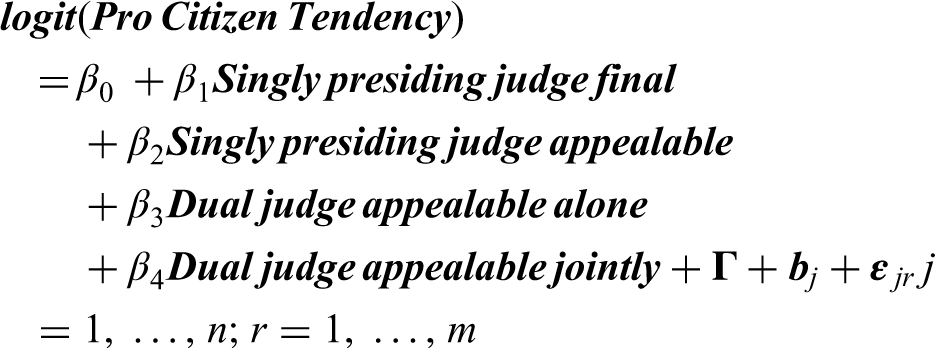
The dependent variable is binary hence a generalized mixed model was used. This entailed a logistic regression with a random intercept (Brooks et al., 2017) that accounts for the possible dependencies between court rulings made by the same decider, with the following specification
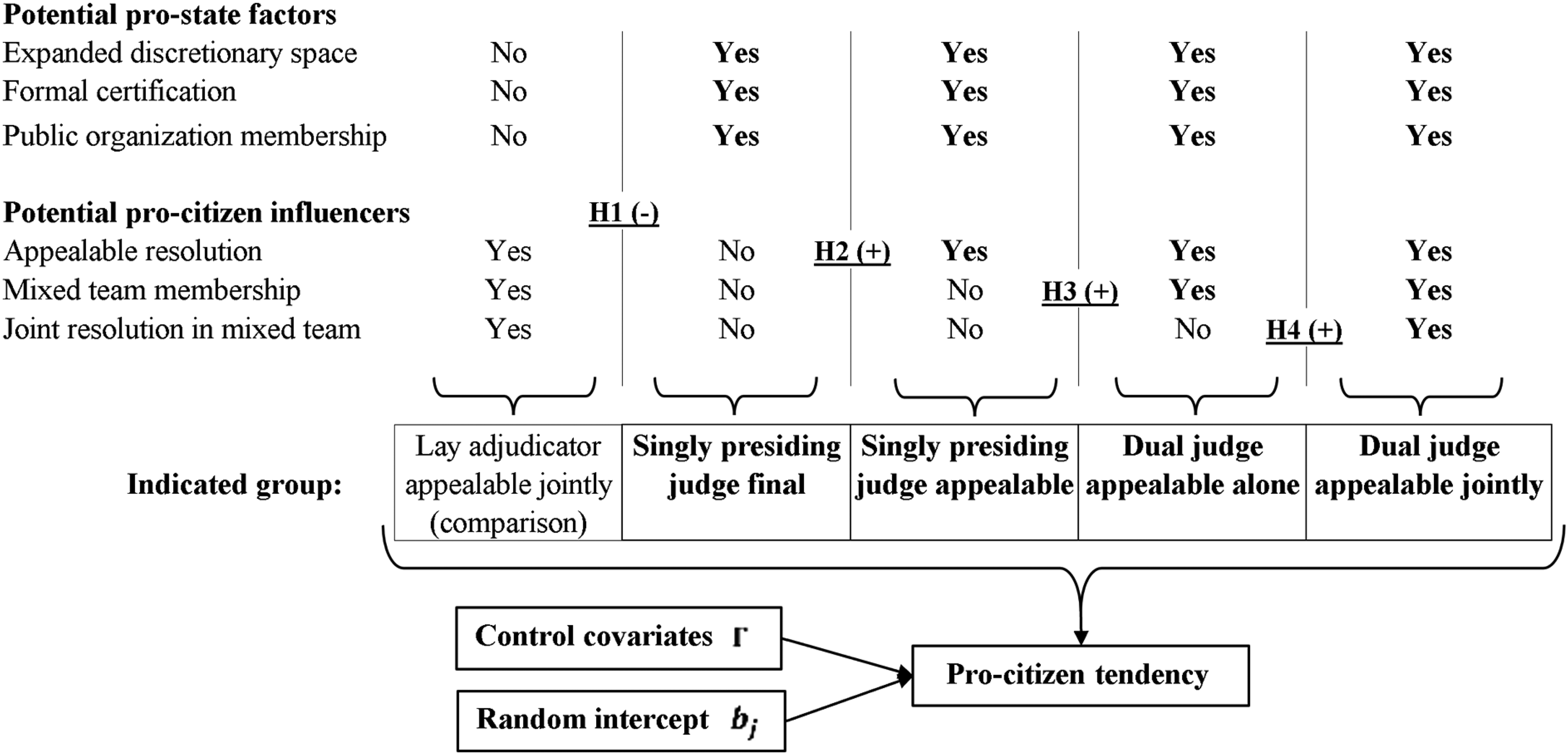
The research model and hypotheses.
The model predicts
Note that if all the binary indicator variables above were set to 0, the ruling was appealable and was made under narrower discretionary space by a lay adjudicator while presiding (jointly) in a tax appeal committee.
To account for hidden personal tendencies, the
In the interpretation of the model, the exponent of each outcome (or its odds ratio) is converted to the probability of such result.
Extra-Legal Factors and Data Analysis Tools
Judiciary theory proposes extra-legal factors that may influence lower-court judges’ decision- making (Rachlinski & Wistrich, 2017). Some of these factors, such as the judge's (or lay adjudicator's) political ideology, electoral accountability, religion, and race are not relevant to the examined context. In Israel, lower-court judges are appointed by an independent committee rather than elected. Furthermore, nearly everyone in the data panel is of the same religion and race. Nonetheless, the gender of the judge was used as a control covariate in the analysis 14 (Glynn & Sen, 2015; Oren-Kolbinger, 2018; Steffensmeier & Hebert, 1999). The names of the judges and lay adjudicators were also recorded to control for hidden dependencies in rulings made by the same decider. Finally, potential influences of the characteristics of the resolved tax case were controlled by specifying the number of claimants and disputes involved as well as the claimant type, whether an individual or a corporation (Gliksberg, 2015). R (Version 4.0.1) software was used to analyze the data, along with the glmmTMB software package (Brooks et al., 2017) and the Excel XLMiner add-in.
Findings
Sample Proportions and Cross-Correlations
Table 1 details the data panels’ sample proportions and pro-citizen tendency rates, comparing rulings by the indicated data groups.
Sample Proportions.
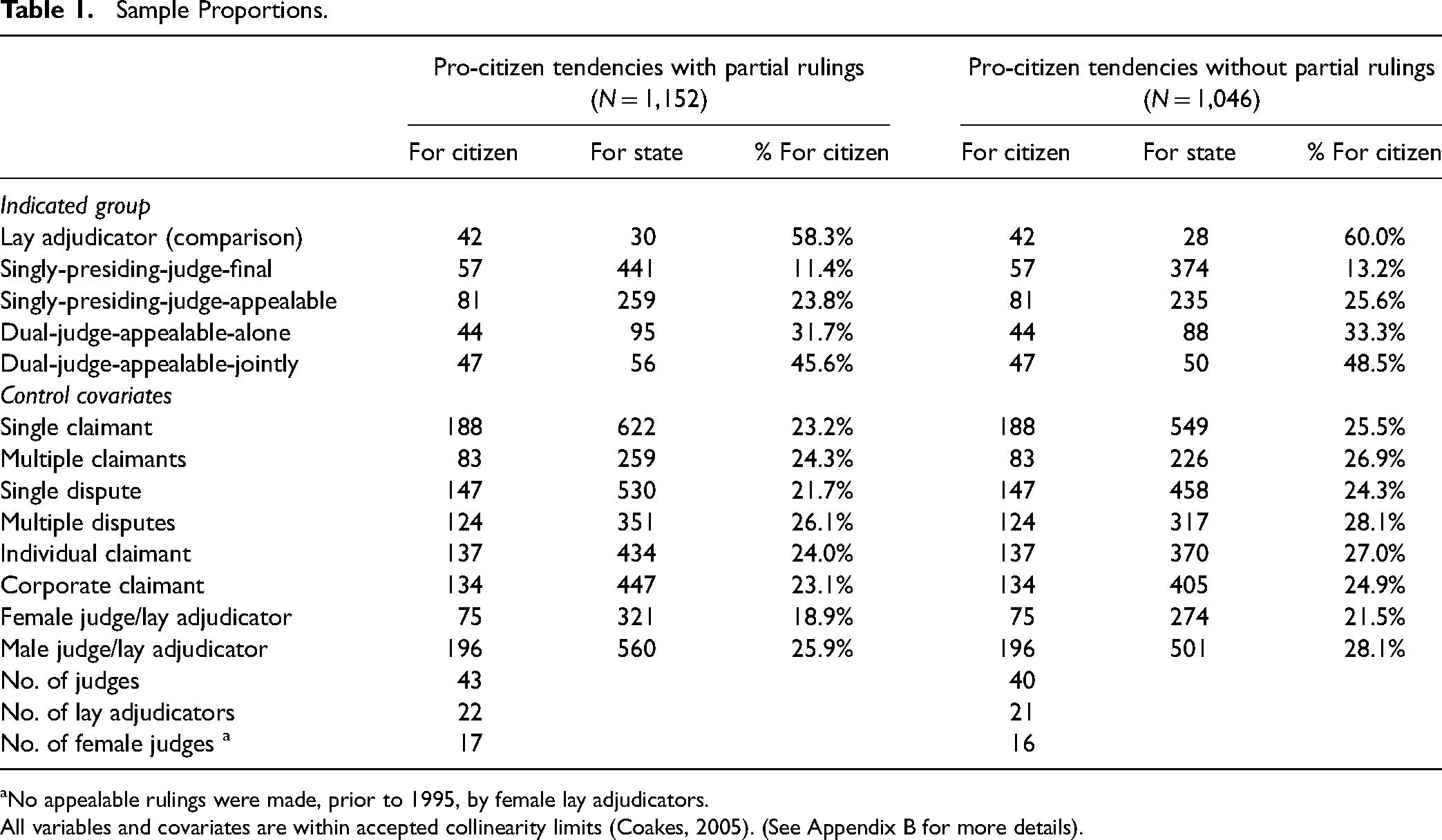
No appealable rulings were made, prior to 1995, by female lay adjudicators.
All variables and covariates are within accepted collinearity limits (Coakes, 2005). (See Appendix B for more details).
Logistic Regression With a Random Intercept
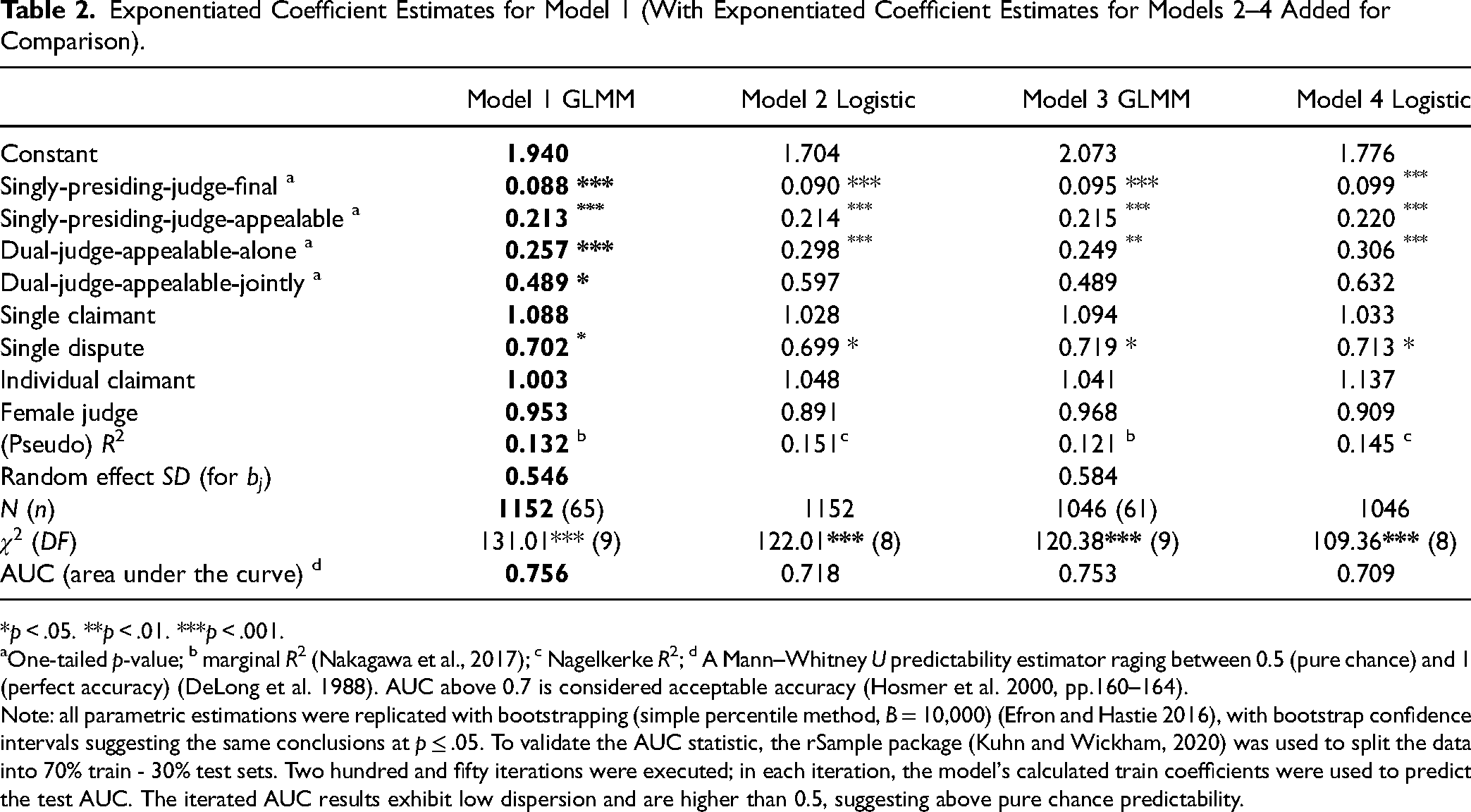
Model 1, the main model used for the study, is a generalized statistical mixed model (GLMM): a logistic regression with a random intercept that considers the possible dependencies between court rulings made by the same judge (or lay adjudicator). Models 2, 3, and 4 are added for comparison. Model 2 is a standard logistic regression. Model 3 (GLMM) and Model 4 (logistic) consider only conclusive rulings, excluding the partial rulings (conservatively marked as rejecting citizens’ claims) that were included in Models 1 and 2. Table 2 displays the exponentiated coefficient estimates (
Exponentiated Coefficient Estimates for Model 1 (With Exponentiated Coefficient Estimates for Models 2–4 Added for Comparison).
*p < .05. **p < .01. ***p < .001.
One-tailed p-value; b marginal R2 (Nakagawa et al., 2017); c Nagelkerke R2; d A Mann–Whitney U predictability estimator raging between 0.5 (pure chance) and 1 (perfect accuracy) (DeLong et al. 1988). AUC above 0.7 is considered acceptable accuracy (Hosmer et al. 2000, pp.160–164).
Note: all parametric estimations were replicated with bootstrapping (simple percentile method, B = 10,000) (Efron and Hastie 2016), with bootstrap confidence intervals suggesting the same conclusions at p ≤ .05. To validate the AUC statistic, the rSample package (Kuhn and Wickham, 2020) was used to split the data into 70% train - 30% test sets. Two hundred and fifty iterations were executed; in each iteration, the model's calculated train coefficients were used to predict the test AUC. The iterated AUC results exhibit low dispersion and are higher than 0.5, suggesting above pure chance predictability.
The exponentiated coefficient estimate for Singly-presiding-judge is less than one (supporting Hypothesis H1). It is also less than that of Singly-presiding-judge-appealable (supporting Hypothesis H2), which is less than Dual-judge-appealable-alone (supporting Hypothesis H3), which is less than Dual-judge-appealable-jointly (supporting Hypothesis H4). All such coefficient estimates are statistically significant. (See Appendix C for more detail).
It should also be noted that the exponentiated coefficient estimate for the control covariate Single Dispute is statistically significant and less than one, indicating that lower-court judges are less likely to rule in favor of citizens when the tax case involves a single dispute.
Figure 3 depicts the fitted probabilities of pro-citizen court rulings (averages, full, and interquartile ranges, and medians) based on Model 1.
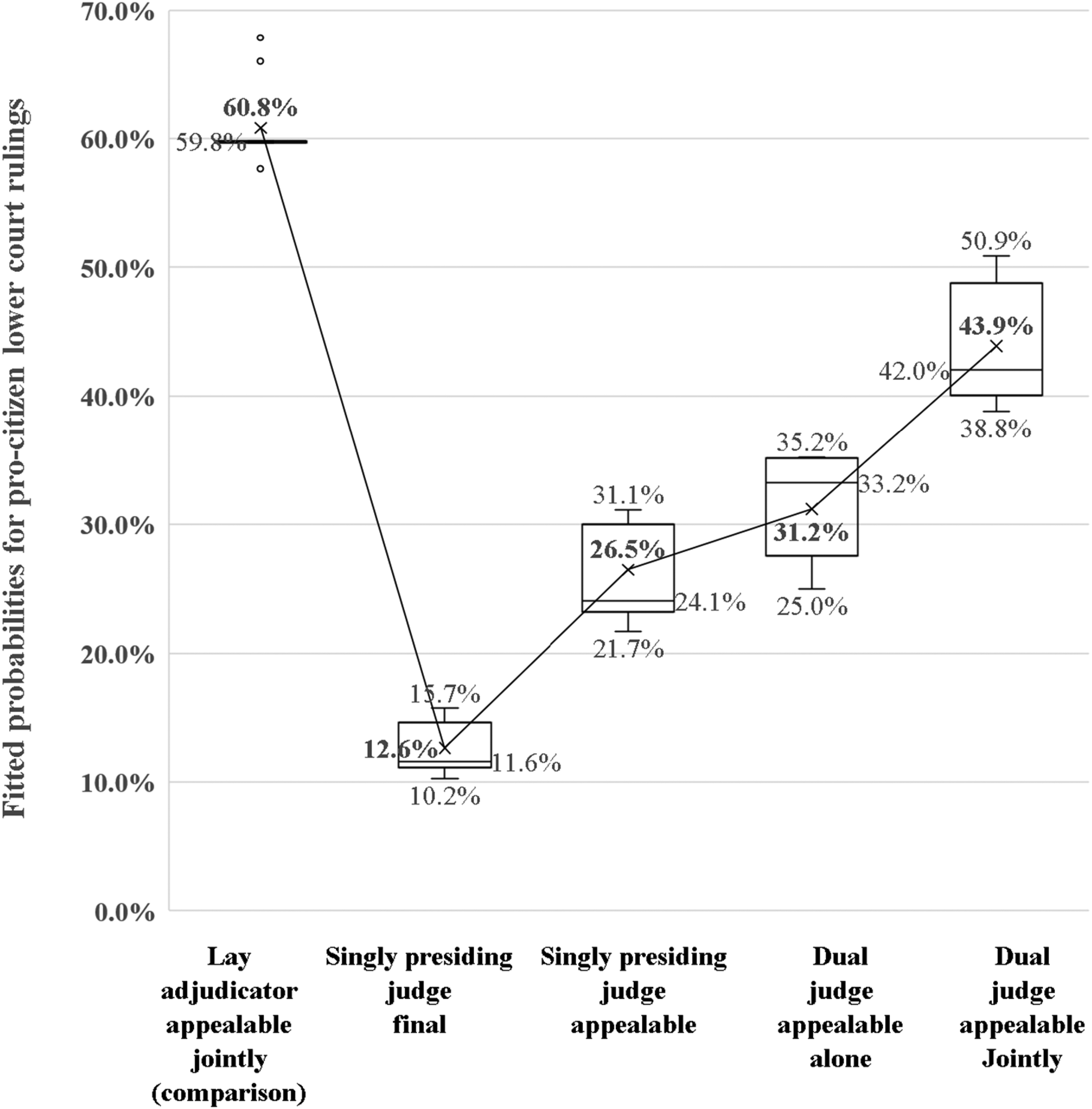
Fitted probabilities of pro-citizen court rulings based on Model 1. Averages appear in bold. (The groups’ median fitted probabilities are out of the other groups’ interquartile ranges, indicating that the groups are statistically distinct (Wild et al., 2011)).
The average fitted probability of unappealable rulings made by certified lower-court judges with expanded discretionary space to be pro-citizen (12.6%), is lower than that of appealable rulings made by uncertified lay adjudicators with narrower discretionary space (60.8%). It is also lower than the average fitted probability of their appealable rulings to be pro-citizen (25.6%), which is lower than that of appealable rulings made alone by dual judges who also take part in tax appeal committees (31.2%). Finally, the average fitted probability of appealable rulings made alone by dual judges to be pro-citizen is lower than the average fitted probability of the rulings they make jointly in tax appeal committees (43.9%). Again, Hypotheses H1-H4 are supported.
Statistical Robustness
Statistical robustness was evaluated using a smaller data panel that excluded decisions made by lay adjudicators. These results that address career judges only are consistent with those found in Models 1–4, which include lay adjudicators, and thus support Hypothesis H2—H4.
(See Appendix D for more detail).
Discussion
The study investigated links between factors associated with common characteristics of street-level bureaucrats and state favoritism in (real world) resolutions they make when settling disputes between citizens and other state officials. The findings suggest that resolutions made under expanded discretionary space by certified career street-level bureaucrats who are members of public organizations are more likely to reflect pro-state tendencies than those made under narrower discretionary space by uncertified (noncareer) lay officials (H1). The study proceeded to examine citizen administrative participation-based influencers postulated to reinforce citizen favoritism. The findings show that upholding the right to appeal street-level resolutions promotes the pro-citizen tendencies their resolutions reflect (H2). Additionally, incorporating them in mixed teams that include lay officials (whose careers do not revolve around civil service) strengthens the pro-citizen tendencies in their resolutions (H3), especially when their resolutions are jointly made in such mixed teams (H4).
Adopting the scholarly view of lower-court judges as street-level bureaucrats (Biland & Steinmetz, 2017; Cowan & Hitchings, 2007; Dallara & Lacchei, 2021; Jain, 2018; Lipsky, 2010) and using real-world (publicly available) Israeli lower-court rulings in civil tax disputes between 1980 and 2021, the findings offer a more nuanced understanding of how street-level bureaucrats use discretion in making resolutions.
This contributes to previous knowledge in three ways. First, the study addresses previous theory regarding street-level bureaucrats’ dual role as state or citizen agents (Brehm & Gates, 1997; Maynard-Moody & Musheno, 2000; Prendergast 2007; Rohr, 1987). Adding to the view that other narratives also affect their use of discretion (Cecchini & Harrits, 2022), the study shows that external factors and influencers relate to their pro-state or pro-citizen tendencies. Second, the findings reveal a combined link between factors associated with street-level bureaucrats’ common characteristics (expanded discretionary space, formal certification, and public organization membership) and state preference in their resolutions. Policymakers should take steps to reduce such pro-state bias; otherwise, citizens may perceive it as impairing procedural fairness (Mazepus & van Leeuwen, 2020; Mcloughlin, 2015; Moynihan et al., 2015) and degrading public service delivery by those they view as the face of governance, which can lead the public to lose trust in the administration (Craven, 2021; Edri-Peer & Cohen, 2022; Kumlin & Rothstein, 2005). Third, and relatedly, the findings point to citizen administrative participation-based influencers, specifically the appealability of street-level bureaucrats’ resolutions, their membership in mixed teams, and joint resolution-making in such teams, all of which may enhance their pro-citizen tendencies. Previous research emphasized the social value of citizen participation in decision-making (for a comprehensive analysis, see Roberts, 2004). This study advises policymakers to consider the use of such measures to offset state favoritism that street-level resolutions may show.
The research results lead to two normative discussions regarding the potential threat to procedural fairness through pro-state bias when resolutions that settle disputes between the state and its citizens are made by certified career street-level bureaucrats operating under extended discretionary space. The primary question is: Can and, if so, should such factors be diminished? Indeed, it is often unavoidable for street-level bureaucrats to be formally certified or to be members of public organizations; however, expanding their discretionary space ought to be regulated to control the impairment of the procedural fairness it may entail.
If pro-citizen influencers are used to offset such inevitable state-preference bias, an additional normative question follows: How broad should the use of such influencers be? The right of citizens to contest administrative resolutions is rooted in the values of fairness (Beeri et al., 2021; Van Ryzin, 2011). However subjecting street-level bureaucrats’ resolutions to appeals may disempower their capacity to determine policy (McCubbins et al., 1994), turning their resolutions into steppingstones for appeal. Furthermore, including certified career street-level bureaucrats in mixed teams alongside uncertified lay officials can expose the former to the latter's points of view, especially when divergence is needed in the formulation of their resolutions (Strauss & Sunstein, 1992). However, it may impair the professionalism of their resolutions as the former are influenced by nonprofessionals (for a comprehensive discussion regarding the pros and cons of incorporating lay adjudicators in courts, see Vermeule, 2006). Lastly, policymakers should consider that, in certain circumstances, excessive use of such pro-citizen influencers may motivate street-level bureaucrats to overly favor the citizens’ claims.
Limitations and Future Research
Notwithstanding its contributions, the study has limitations that open avenues for future research. The main limitation stems from the decision to restrict the surveyed data to real-world court rulings made by lower-court judges in civil tax disputes (noting the judges’ professional prerogative to interpret the law, and their perceived social status that may differ from that of other street-level bureaucrats). Future research should use comparative analysis to validate the model, using additional types of street-level bureaucrats and disputes, while differentiating and separately examining each of the factors and influencers mentioned. Potential avenues for further research can explore, for example, the pro-citizen or pro-state tendencies in decision-making by inner-agency appellate adjudicators (as noted in Conf. of the U.S., Recommendation 2020-3, Agency Appellate Systems, 86 Fed. Reg. 6618 (January 22, 2021)). It may also be interesting to investigate state or citizen favoritism in the fields of public education or social services, by analyzing resolutions made by (street-level) pedagogical committees 15 or by social services appeals committees. Furthermore, the disputes surveyed concerned state-mandated payments that residents were required to make. The results might have been different had the disputes considered payments the state was obliged to make to its citizens, such as social security or disability grants. Additionally, the study was conducted in Israel, and research carried out in different settings would contribute to the growth of additional knowledge. Finally, since real-world data were used, the study is therefore not as sterile as one conducted in a lab and should be so regarded.
Conclusion
This empirical study and its findings contribute to public administration theory and practice by underscoring the (unavoidable) risk to procedural fairness due to state favoritism that expansion of discretionary space, formal certification, and public organization membership may bring to street-level resolutions. The study also marks potential counter-influencers based on citizen administrative participation that, if used properly, can offset such outcomes.
As asserted, when the right to appeal is upheld and when street-level bureaucrats participate in mixed teams alongside lay officials and particularly when they make their resolutions in such teams, they are encouraged to portray pro-citizen tendencies in their resolutions. These findings can lead to further studies that will broaden the understanding, both theoretically and empirically, of what motivates street-level bureaucrats’ pro-citizen or pro-state tendencies.
The study can also encourage public administration researchers to use real-world publicly available data to further differentiate and separately assess each of the factors and influencers mentioned in this study to assure fair and unbiased resolution-making by those serving at the frontlines of public administration.
Footnotes
Acknowledgments
We are grateful to the Editor, Stephanie Newbold, and to the anonymous reviewers of this manuscript for their insightful comments. We would also like to acknowledge the support of the Research Fund of the Open University of Israel.
Declaration of Conflicting Interests
The author(s) declared no potential conflicts of interest with respect to the research, authorship, and/or publication of this article.
Funding
The author(s) received no financial support for the research, authorship, and/or publication of this article.

1.
Transparency and public participation are also elements of procedural fairness which is sometimes referred to as procedural justice or procedural due process.
2.
Another scholarly view is the “professional agency narrative” (Cecchini & Harrits, 2022) which suggests that street-level bureaucrats sometimes solve problems using their practical and professional knowledge of “what works,” regardless of state or citizen favoritism.
3.
If the institution of appeals' overturn rates (i.e., the portion of successful appeals from all successful appeals) differ between state and citizen appeals, then the judges' use of discretion may be impacted by such rates (Gershgoren & Cohen, 2022).
4.
Another definition might regard lay officials as less capable academically or professionally than career street-level bureaucrats. However, lay officials are frequently equal to or even more capable academically or professionally than their counterparts. (Machura, 2016).
5.
Lay judges presiding in mixed criminal tribunals often express a more optimistic view of their role and contributions, as evidenced by surveys conducted in Sweden, Poland, and Croatia, with German lay judges expressing opposing views (Kutnjak Ivkovic, 2015).
6.
Other noted forms of public accountabilities are participatory accountability and customer/ shareholder accountability (Thomann et al., 2018).
7.
Taken that the state is less prone to appeal a resolution if a failure to overturn it imposes a binding precedent that, as a repeat player, it wishes to avoid (Galanter, 1974; Lederman, 1998).
8.
Israeli judges are appointed for an unlimited term (up to the retirement age of 70) by a committee that consists of nine members: three Supreme Court judges, two lawyers representing the Israeli Bar Association, two parliament members, and two ministers (one of them is the Minister of Justice). This committee composition is meant to neutralize, as much as possible, any political influence on the appointment process. (Oren-Kolbinger, 2018). Since 2009, as part of their appointment procedure, judges participate in a short training course.
9.
Israeli Tax appeal committee members (judge and lay adjudicators) are appointed for an unlimited term by the minister of finance (Real Estate Taxation [Appreciation and Acquisition] Law, 5733-1963) and do not require prior training.
10.
Rulings made by retired district court judges who only preside in tax appeal committees and no longer serve in the district court were not included in this study.
11.
The Israeli Supreme Court has confirmed that, apart from indicating the ruling's appealability or finality, the manner of resolving normative or evidentiary tax disputes should be similar (CA 266/97, Director of Haifa Real Estate Appreciation Tax v. Max Weissman et al. Misim 17(4)).
12.
A review of all Supreme Court appeals, addressing lower-court rulings in civil tax disputes that were decided on the merits between 2010 and 2019, conducted using The Israeli Supreme Court Database (https://iscd.huji.ac.il/), revealed that 80% of appeals on rulings made by singly presiding judges were submitted by citizens and the citizens and state overturn rates were, respectively, 51% and 49%. Comparably, 70% of the appeals on rulings made by Tax Appeal Committees were submitted by citizens and the citizens and state overturn rates were, respectively, 41% and 59% (Gershgoren & Cohen, 2022).
13.
The relatively narrow discretionary space awarded to Israeli judges in resolving civil tax disputes prior to the judiciary empowerment revolution is expressed, for example, in the definite words of Supreme Court Justice Shimon Agranat (CA. 120/52 David Komarofski v. Director of Land Appreciation Tax [1953] IsrSC P.D. 7 141) declaring: “In taxation, one must only check for clear legal statements. There is no attribution of intentions. There is no equity. Nothing can be read between the lines. Nothing can be inferred. One must only properly examine the law’s explicit language.” Comparably, the broadening of Such discretionary space after the judiciary empowerment revolution is apparent, for example, in the words of Supreme Court Justice Tova Strasberg-Cohen (C.A. 2622/01 Real Estate Appreciation Tax Administrator v. Aliza Lebanon [2003] IsrSC P.D. 57(5) 309) declaring the revised way a judge should interpret Tax Law: “He must start with the language of the law but never end there. Among the choices that the language brings, the one that is consistent with the aim and purpose of the provision in the law should be chosen. Such purpose can be learned from the law, from the position of the provision in the law, from its general structure, from the legislative system and from sources outside the legislation, such as the legislative and parliamentary history, and in view of the accepted values of our legal system.” (Gershgoren & Cohen, 2022).
14.
The judge's age is also mentioned as a potential factor that may influence lower-court judges' decision-making (Fox and Van Sickel, 2000; Manning et al., 2004). Unfortunately, the age of Israeli lay adjudicators is not public knowledge.
15.
In Israel, pedagogical committees make resolution regarding the appropriate discipline of pupils, after hearing the arguments made by the school staff and the pupil. The pedagogical committee's resolution may be subject to internal appeal before a district pedagogical hearing committee (Circular of the Director General of the Ministry of Education 1972/6(a) 3.6).
Author Biographies
Appendix A: Coding Reliability
The study relied on all the real-world data that was publicly available (Pollitt, 2017). This reduced common source bias (Favero and Bullock, 2015). Nonetheless, there might be other biases, such as the researcher's halo effect (Viswesvaran et al., 2005) in the categorization of the disputes in each tax case as appealable, final, or managerial as well as in the coding of each ruling as partial or conclusive. To reduce such risks, the MISIM database was used to verify that the lower-court rulings that were categorized as final had, in fact, not been appealed to the Supreme Court. In addition, the MISIM database editors’ briefs, routinely reviewed by Israeli tax professionals, were compared with the coding of the court ruling's conclusiveness. As a final step, a team of five Israeli tax experts, consisting of two tax lawyers, two accountants, and a former tax assessor analyzed 10% of the original tax cases to validate the inter-rater reliability of the evaluation and categorization scheme. The examiners were asked to independently evaluate the tax cases, categorize the disputes they identify, and code each of the court rulings therein. The resulting inter-rater reliability scores were all greater than 0.9, indicating almost perfect agreement.
Appendix B: Cross-Correlations
Table B1 displays the cross-correlations between all variables and covariates. All variables and covariates are within accepted collinearity limits (Coakes, 2005). The covariate Singly-presiding-judge-final and Singly-presiding-judge-appealable are in medium collinearity of 0.56, which is expected as the same judges are likely to make final and appealable rulings.
The remaining variables and covariates display negligible collinearity of 0.32 or less.
Appendix C: The Results in Detail
The exponentiated coefficient estimate for Singly-presiding-judge (0.088) is less than 1, indicating that unappealable rulings made alone, under expanded discretionary space, by singly formally certified judges who are members of the district court reflect less pro-citizens tendencies than appealable rulings made jointly in tax appeal committees (mixed teams), under narrower discretionary space, by lay adjudicators (who are neither formally certified judges nor members of the district court)—supporting Hypothesis H1.
The exponentiated coefficient estimate for Singly-presiding-judge is less than that of Singly-presiding-judge-appealable (0.213), indicating that appealable rulings made alone under expanded discretionary space by formally certified judges who are members of the district court that never take part in tax appeal committees reflect more pro-citizens tendencies than their unappealable rulings—supporting Hypothesis H2.
The exponentiated coefficient estimate for Singly-presiding-judge-appealable is less than that of Dual-judge-appealable-alone (0.257), indicating that appealable rulings made alone, under expanded discretionary space, by dual judges who, in addition to presiding in the district court, are also members of tax appeal committees reflect more pro-citizen tendencies than those made (alone) by singly presiding judges who never take part in such committees—supporting Hypothesis H3.
The exponentiated coefficient estimate for Dual-judge-appealable-alone is less than that of Dual-judge-appealable-jointly (0.489) indicating that appealable rulings made jointly in tax appeal committees, under expanded discretionary space, by dual judges reflect more pro-citizen tendencies than those they made when presiding alone (in the district court)—supporting Hypothesis H4.
Appendix D: Statistical Robustness
Statistical robustness was evaluated using a smaller data panel that excluded decisions made by lay adjudicators. Hence, if all the binary indicator variables were set to 0, the ruling was unappealable and was made under broad discretionary space by a singly presiding judge. Comparison Models 5–8 correspond to Models 1–4. Model 7 (GLMM) and Model 8 (logistic) consider only conclusive rulings, excluding the partial rulings (conservatively marked as rejecting citizens’ claims) that were included in Models 5 and 6. The exponentiated coefficient estimate for Singly-presiding-judge-appealable is greater than one and less than that of Dual-judge-appealable-alone, which is less than Dual-judge-appealable-jointly. These results, which only address career judges, are consistent with those found in Models 1–4, that also include lay adjudicators, and thus support Hypothesis H2–H4. Table D1 details the exponentiated coefficient estimates (