



Abstract
While public administration scholars argue that core values of social equity are exceedingly important in service provision, less is known of how these values are practised on the frontline in the contemporary public administration. Research points to a dual trend: together with practices aimed at increasing clients’ wellbeing, public service workers’ decisions about allocating public resources are guided by moral perceptions of worthiness, leaving behind the most weakened populations. The current study aims to decipher this duality, analyzing street-level bureaucrats’ decisionmaking about providing personal resources to low-income clients, in order to examine whether the pursuit of social equity is manifested in informal practices. Drawing on indepth qualitative interviews of social service providers in Israel, we found that decisionmaking about personal resource provision is grounded in two distinct sets of values. Alongside a pattern of providing resources to deserving clients, street-level bureaucrats also provide them to clients typically considered undeserving. These latter practices are aimed at decreasing social inequality, demonstrating that social service providers often walk the talk of social equity.
Introduction
Social equity is at the heart of public administration (Frederickson, 2005, 2015; Svara & Brunet, 2020). Rooted in the idea that each person is equal and has inalienable rights (Guy & McCandless, 2012), scholars argue that core values of justice and distribution of fairness have become even more important with the emergence of new approaches to public administration (Bryson et al., 2014). These approaches move beyond the dominant values of New Public Management, including efficiency and effectiveness, and emphasize more democratic values (Osborne, 2010), such as collective public interest, social equity and respect for citizens (Denhardt & Denhardt, 2015).
Within the ongoing debate on the importance of social equity in the public administration (e.g., Durant and Rosenbloom, 2017), scholars argue that values of social equity have become a dominant paradigm in contemporary public administration (Bryson et al., 2014; Johnson & Svara, 2011). Alongside extensive literature that identifies simultaneous values of effectiveness and social equity in the operation of government agencies (Liang, 2018; Riccucci, 2009), less is known about the pursuit of social equity in the everyday work of street-level public service providers. Indeed, from the earlier days of public administration research, scholars acknowledged the importance of exploring how social equity is practised (e.g., Williams, 1947). Scholarly interest in social equity research increased with the enactment of American welfare reform (e.g., Gooden et al., 2001). However, less research has concentrated on contemporary manifestations of social equity among policy implementers at the street level. Such exploration is particularly important in times of austerity and drastically growing levels of inequality (Gooden, 2017). As social equity is realized only when put into practice, and not when discussed in principle (Maynard-Moody & Musheno, 2012), the scarcity of such updated research is surprising. In the present study, we aim to fill this gap and provide evidence of whether and how the ideals of social equity are practically manifested within everyday implementation work. Drawing on arguments regarding the critical role of government in fulfilling the principle of equity, particularly as it pertains to populations that are vulnerable due to their demographic or socioeconomic status (e.g., Frederickson, 2015; Guy and McCandless, 2012; Johnson and Svara, 2011; Liang, 2018; Riccucci, 2009), we focus on Israeli street-level workers’ decisionmaking in their encounters with low-income clients.
Existing research demonstrates that decisionmaking about “who gets what” during daily encounters with clients is based on personal judgements (Harrits, 2019; Maynard-Moody & Musheno, 2000, p. 351), which in turn are rooted in perceptions of the individual client's “worthiness.” Such judgements determine whether service workers will make decisions that support their own self-interest, or whether they will strive to respond to the needs of the individual client (Maynard-Moody & Musheno, 2000; Tummers et al., 2015).
Can we assume that all practices aimed to respond to client need are in pursuit of social equity? The vast majority of evidence demonstrates that street-level bureaucrats (SLBs) are preservers of institutional norms, producing and enforcing dominant cultural norms of “worthiness” (Harrits, 2019; Maynard-Moody & Musheno, 2012), which mainly reflect the ideological disciplinary regime of personal responsibility and work commitment (Lavee, 2017; Jilke & Tummers, 2018; Soss et al., 2011). Such evidence is far from the standpoint that, in order to correct existing imbalances in society (decrease social and economic inequality), “equity proposes that benefits be greater for those most disadvantaged” (Denhardt & Catlaw, 2014, p. 123). Given these studies, it is not clear whether and in what ways SLBs attempt to improve the lives of clients who do not meet the common definition of worthiness, in an effort to achieve social equity.
Since Lipsky; (2010[1980]) seminal work, research has largely focused on SLBs’ discretion and coping strategies in the context of implementing formal policy, that is, providing formal services (e.g., Lavee & Strier, 2019; Baviskar and Winter, 2017; Brodkin, 2011; Cohen et al., 2016; Hupe and Hill, 2016; Keulemans and Van de Walle, 2020; Sager et al., 2014; Vink et al., 2014; Zacka, 2017). The current study contributes to both public administration literature and SLB scholarship by uncovering contemporary manifestations of social equity in practice, focusing on a blind spot in studies that examine public service provision: namely, workers’ informal practices that go beyond formal policy (Dubois, 2016). It is our claim that a focus on such informal practices, more than judgements made during implementation of formal policy, can paint a more comprehensive picture of social equity in the work of public service providers.
We draw here on data from a recent large-scale qualitative study (Lavee, 2021) of street-level professionals in the education, health and welfare domains in Israel. This broader study demonstrated that SLBs provide a wide range of informal resources to clients. With the aim of understanding SLBs’ pursuit of social equity, we explore here the possibility that moral considerations for informal practices might differ from those made in the provision of public formal resources. The study therefore addresses two questions: Who is considered worthy of receiving workers’ personal resources? And what is the mechanism that guides their decisions?
In performing this indepth examination of the decisionmaking considerations among Israeli social service providers, we address Frederickson; (2005) call to “apply social equity in all aspects of public administration” (35) and to “walk the social equity talk” (31). We thereby hope to deepen understanding of workers’ engagement in social equity practices in an era of scarcer resources and growing inequality.
Theoretical Background
Moral Judgements on the Street Level
Applied within the public administration, the concept of equity refers to fair or just distribution of public services or policies (Gooden, 2015), more than treating all individuals in the same way. It implies a calculation of fairness, right and justice (Guy & McCandless, 2012). While fairness means that everyone should be treated consistently, following the same standards and procedures without bias or favouritism, justice means that everyone should be treated fairly and get what they deserve. Justice also requires that individuals can obtain a remedy if freedom or equality is denied (Johnson & Svara, 2011).
More than just a central goal of administration, the work of service providers on the street level can mediate between the rhetoric of social equity and the achievement of real-life goals of reducing inequality. Frederickson (2005) argues that when public administration is practised at the street level, it employs a form of social equity. Drawing on the influential citizen-agent narrative of Maynard-Moody and Musheno (2003), Frederickson concludes that “the day-to-day practices of street-level public servants are all about the search for fairness, equity, and justice” (36).
Alongside the aspiration for social equity, SLBs screen, classify and differentiate clients in an effort to cope with their daily workload. However, research demonstrates that they do so not only in a functional response to bureaucratic necessities, as was first suggested by Lipsky (2010[1980]). Indeed, ample literature has demonstrated that SLBs’ personal values, social norms, attitudes and other cultural elements (Hasenfeld, 2010; Keulemans & Van de Walle, 2020; Lotta & Pires, 2019) shape variation in their discretional decisions and behaviour towards clients (Baviskar & Winter, 2017; May & Winter, 2009; Zacka, 2017). While these studies do not necessarily oppose the claim that SLBs struggle to respond to clients’ needs, they raise two related questions: what types of clients are considered “worthy” of being “moved towards” (Tummers et al., 2015), and what are the consequences of worthiness considerations for social equity?
Scholars have demonstrated the crucial role of dominant common perceptions of morality within service workers’ decisions regarding the worthiness and deservingness of clients (Brodkin, 2011; Harrits, 2019; Watkins-Hayes, 2009). In his recent book, Zacka (2017) described SLBs as “sophisticated moral agents,” arguing that, in deciphering their decisionmaking, we need to acknowledge their interpretive lenses, narratives and affective sensibilities, which precede and inform their decisions. According to Zacka, all the above lead workers to develop three main reductive moral dispositions: indifference, where the worker focuses on efficiency in a way that can be distant and unresponsive; enforcement, where the worker focuses on following the rules in a way that ignores individual circumstances; and caregiving, where the worker emphasizes responsiveness to individuals at the cost of efficiency and at risk to equal treatment. Zacka argued that these moral dispositions lead to the development of taxonomies – heuristic schemes used to classify individuals into categories of “deserving” and “undeserving.”
Indeed, personal values are central in shaping perceptions of worthiness and deservingness. However, scholars argue that more than individual dispositions, these perceptions are strongly influenced by the current market-oriented disciplinary regime (Amara & Schnell, 2004; Schram et al., 2009), according to which work commitment serves as the strongest moral indicator of character and as a rule for social inclusion or exclusion (Fineman, 2004). According to this rationale, one's morality is demonstrated by taking personal responsibility through labor market participation (Schram & Schram, 2008; Soss et al., 2011). Those who succeed in adhering to these imperatives are perceived as “deserving” of collective support (Van Oorschot, 2010), while those perceived as not putting enough effort into achieving economic independence and self-reliance are considered “undeserving” dependents (Lavee & Offer, 2012). Similarly, in a recent model of clients’ deservingness, Jilke and Tummers (2018) demonstrate that client's efforts and “being hardworking” is a main cue in SLBs’ prioritizing intentions.
These arguments suggest that SLBs’ moral judgements might improve the wellbeing of certain populations, but not necessarily produce equity and justice for all (Jilke & Tummers, 2018). Indeed, the more vulnerable clients, with greater barriers to employment (structural, cultural or individual), are more likely to be sanctioned and excluded from public support (Hasenfeld, 2010). Moreover, there is considerable documentation that, under current core values of efficiency and effectiveness and a strong emphasis on outcomes, public service workers tend to implement policy in ways that actually undermine elements of social equity (Brodkin, 2011; Watkins-Hayes, 2011).
Nonetheless, public service providers work in an environment where social equity is a moral imperative (Johnson & Svara, 2011). As professionals working on the frontline, they are called to practice social equity as the “third pillar of public administration, alongside efficiency and economy” (Frederickson, 2005). On the operational level, Gooden maintained that “a theoretical commitment to social equity should be accompanied by supporting evidence in practice related to street-level implementation of equity ideas” (2017, p. 825). Similarly, Svara and Brunet recently argued that public workers should be involved in issues of social equity beyond policy analysis and advice: “the full range of activities by administrators can be relevant to advancing awareness of and actions to address social equity” (2020, p. 353). In light of the continued interest of researchers in the components underlying the discretionary decisions of SLBs and their influence on clients’ outcomes (Baviskar & Winter, 2017), it is critical to find an analytical framework that provides a more nuanced exploration of how these service providers understand and practice social equity in their encounters with clients.
Times of Austerity and the Provision of Personal Resources
Exploring the pursuit of equity at the street level is particularly important in the age of austerity, in light of the understanding that the sharp increase in social and economic inequality in many Western societies is a fundamental social problem (Grusky, 2018). The combination of austerity measures and retrenchment in public expenses, together with rising inequality and poverty rates, is manifested in a growing gap between scarcer public resources and client demands (Hupe & Buffat, 2014), forcing workers to “do more with less” (Esteve et al., 2017).
Within this environment, public management scholars are increasingly interested in investigating the delivery of public services. Specifically, scholars understand that workers’ actions to advance the wellbeing of citizens are crucial in contemporary public services, where frontline workers have to maneuver between pressures and increasing demands (Boyd & Nowell, 2020; Pedersen et al., 2020). Recent studies indicate that when public service providers think that policy is not providing adequate services and solutions to clients, they often engage in practices that go beyond their formal duty, aimed at bridging the gap between policy, organizational formal resources and needs (Dubois, 2016; Hupe & van der Krogt, 2014).
In light of the growing understanding that SLBs increasingly acknowledge that formal resources are insufficient to ensure the wellbeing of citizens, especially those belonging to weakened populations (Dubois, 2016), a large-scale qualitative research (Lavee, 2021) was conducted to explore the interactions of SLBs with clients under conditions of scarce formal resources. The study, which included 214 SLBs who provide education, welfare and health services in Israel (see Methods for more details), focused on the provision of informal personal resources, defined as any resource given by workers to clients beyond the formal requirements of their job – namely, that are not part of their formal duties, or formal resources provided in informal ways (after hours, off duty). The authors found that, in light of decreased formal organizational resources available to workers, the vast majority of SLBs who participated in the study offered a wide range of informal personal resources to their clients, in order to provide adequate services. These informal personal resources were divided into several types: time investment (e.g., staying with clients after hours; home visits after work hours or not as part of formal duty); emotional resources (e.g., providing psychological support; extrapersonal treatment); instrumental resources (e.g., assisting with bureaucratic issues, such as filling out or translating forms and writing letters); and material resources (e.g., giving cash; buying food, medicine and home necessities for clients and their families) (Lavee, 2021).
Research Questions and the Israeli Context
Drawing on this general finding of the common and broad practice among SLBs of providing their informal personal resources to clients, the current study examines workers’ decisionmaking about the worthiness of clients to receive such resources. More specifically, we aim to understand if such practices are embedded in the core value of social equity. The study addresses two questions: Who is considered worthy of receiving workers’ personal resources? And what is the mechanism that guides their decisions? While the literature has aptly examined morality judgements about the often unequal provision of formal public service resources, the organizing mechanism of providing personal resources remains hidden. Can we expect judgements of client worthiness to work in the same way for both formal policy implementation and the provision of personal resources?
One possible assumption is that, as SLBs are preservers of institutional norms (Maynard-Moody & Musheno, 2012), workers would be guided by similar moral judgements, such that the deservingness rules for both formal organizational and personal resources would be similar. Moreover, drawing on existing knowledge of SLB strategies which aim to maximize their efforts, such as screening and prioritizing clients (Brodkin, 2011; Lipsky, 2010; Tummers et al., 2015), we might expect workers to provide their personal resources to those individuals who are expected to have a better chance of succeeding, that is, those who are more self-reliant or independent than others (Jilke & Tummers, 2018). In this scenario, workers’ decisionmaking may contribute to the wellbeing of some citizens but would undermine the element of social equity.
A second possible assumption is that the provision of personal resources is inherently guided by values of social equity. In an attempt to pursue this goal, members of all social groups can be expected to have the same prospects for success and the same opportunity to be protected from the adversities of life (Johnson & Svara, 2011). This is particularly salient for vulnerable populations (Petersen, 2021). Research has shown that public workers who are willing to go above and beyond formal responsibilities are characterized with a feeling of duty to advance the individual and collective wellbeing of citizens (Boyd & Nowell, 2020). As providing personal resources is a practice that goes above and beyond workers’ formal duties, we expect workers to provide greater personal resources to weaker clients – those who are perceived as typically “unworthy” and those who are neglected by the formal system due to their lack of deservingness of public support.
To explore the possibilities of worthiness considerations, we found the Israeli case to be ideal. While the state of Israel was originally established on social-democratic ideals of social equality, during the last few decades, its social policy has been massively influenced by American welfare reform. Alongside a serious retrenchment in social expenditures and welfare restructuring, as well as cuts in most areas of public service (Maman & Rosenhek, 2012), poverty and inequality rates are rising, reflecting the growing vulnerability of families who suffer economic hardships. However, whereas eligibility criteria for government support currently reflect individualist ideas of the market-oriented disciplinary regime, studies demonstrate that, on the whole, the Israeli public favours an inclusive welfare state and a generous social policy (Cohen et al., 2012). Our study therefore takes place within an environment that highlights the importance of workers’ worthiness considerations.
Methods
A systematic qualitative design was employed to uncover the dynamics of street-level workers’ provision of personal resources (Lincoln & Guba, 1985). The broader study, conducted between 2016 and 2019, included 214 participants from three policy contexts: education, welfare and health (Lavee, 2021). While the clients of workers in the education and welfare contexts were all vulnerable in socioeconomic terms, the clients of workers in the health context were often vulnerable in health-related aspects and varied in their socioeconomic status.
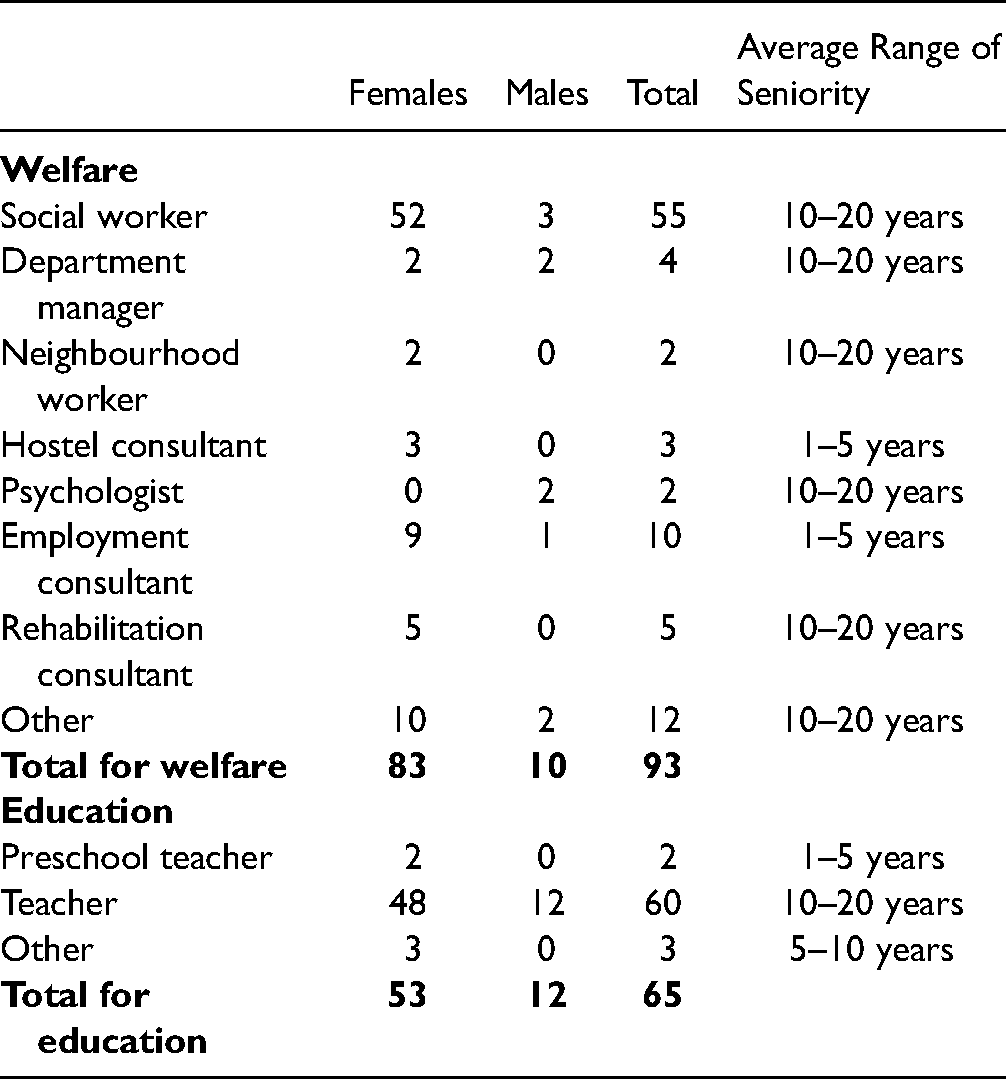
The present study examines the principle of equity in workers’ decisionmaking within the phenomenon of the provision of personal resources. Based on the assumption that decisions regarding social equity are often linked to perceptions of unfairness and injustice vis-à-vis clients’ needs, we decided to focus on needs related to clients’ socioeconomic inferiority. We thus omitted the health workers, whose clients were not necessarily vulnerable in terms other than health-related needs. Therefore, the data of the present study draw on a total of 158 interviews with SLBs who provide public services in the welfare (N = 93) and education (N = 65) domains. Workers in education were mostly teachers, but also included others, such as the administrative staff. Welfare workers were mostly social workers, but also employment consultants, supportive housing workers and welfare administrative staff. The vast majority of participants (136) were women, while only 22 participants were men (for a more detailed description of the sample, see Table 1).
Research Sample by Profession, Gender and Seniority 1 .
Respondents were recruited in accordance with the guidelines of theoretical sampling (Warren, 2001), according to two criteria: (1) they met the broad definition of SLBs (Lipsky, 2010), that is, worked as policy implementers and had direct daily interactions with clients; and (2) they worked in the education or welfare domain. We first approached key actors in the two professional domains and asked them to refer us to potential interviewees who match our criteria. We introduced the study to these key actors as examining the daily work routine of frontline workers. After the initial interviews, we recruited participants by asking interviewees to refer us to additional candidates among their peers.
The research tool was a face-to-face semi-structured indepth interview. The interview protocol was designed to provide comprehensive evidence of the everyday experience of social service provision at the street level, with a specific emphasis on the provision of informal resources. Interviews lasted one hour on average. The vast majority were held in the respondents’ workplace, which was their preference. Others took place in coffeeshops or participants’ homes. All interviews were confidential, and names and other identifying details were omitted.
Workers were first asked to describe their general work routine and their formal job requirements. The opening question was: “Describe a regular workday routine in terms of your interactions with clients. In defining your role, what services are you supposed to provide?” They were then asked to describe the resources they provide to clients, in terms of the formal resources supplied by the state or organization. The main part of the interview protocol focused on the provision of informal resources. After the interviewer clarified the distinction between formal and informal resources, participants were asked if they provide the latter to clients, and ensuing questions probed the types of informal resources they gave to clients. In this article, we focus on a cluster of questions in which participants were asked to describe their decisionmaking process regarding the provision of informal resources, to whom and for what reason. Data analysis was conducted using the Atlas.ti software for analyzing qualitative data. Following grounded theory procedure (Charmaz, 2014), we conducted inductive coding and categorizing for each interview segment. The process was iterative and involved switching between data, codes and emerging schemes. After the initial coding, a general categorization identified a distinction between individual clients according to interviewees’ perceptions of worthiness. The stage of theoretical coding allowed us to point to interrelationships between categories and ultimately to extract the organizing mechanism of worthiness and its relation to social equity. For the extended example codebook, see Appendix A.
Findings
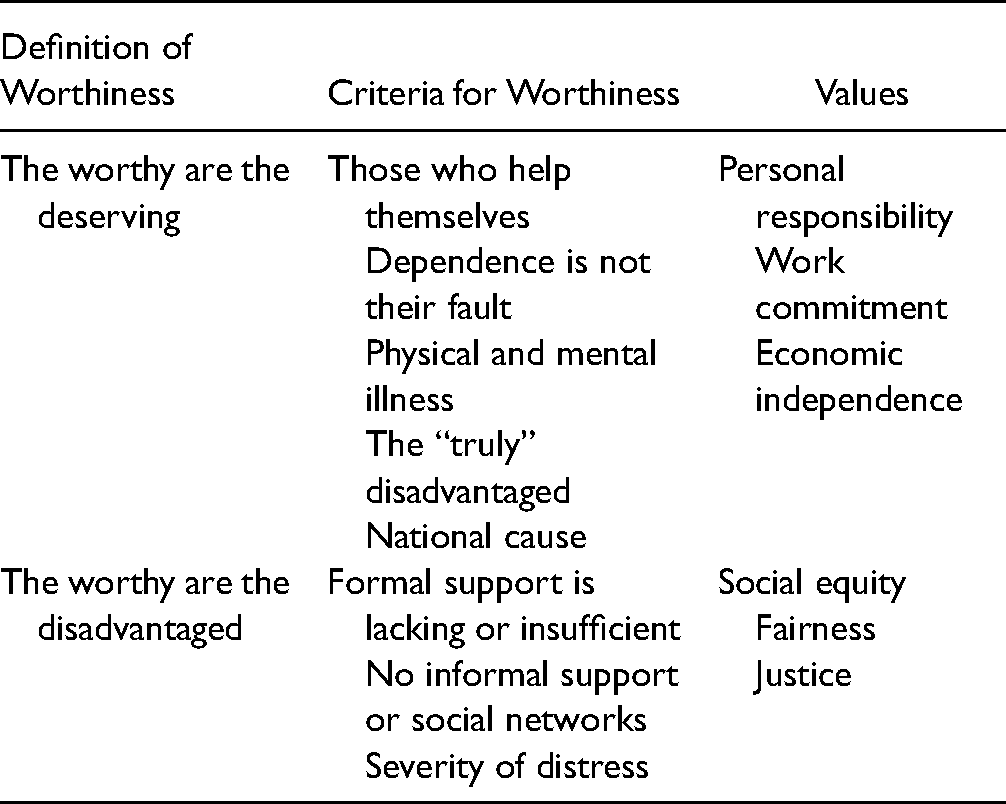
Drawing on evidence that SLBs provide a wide range of informal personal resources to their clients (Lavee, 2021), beyond the formal requirements or actions needed to implement policy, with the aim of responding to client needs, we examined whether in doing so, workers are adopting a social equity approach as a core value that guides their behaviour. The data reveals that the answer is only partially “yes,” indicating that we cannot understand all practices that aim to respond to client needs as an effort to achieve fairness and justice for all. Rather, different values direct workers’ decisionmaking, based on judgements of morality. Specifically, the mechanism underlying the provision of personal resources is grounded in two distinct sets of values, according to which workers set criteria for worthiness and decide who is worthy to receive their personal resources and who is not: citizens whose efforts indicate that they deserve the resources and citizens who are highly disadvantaged (see Table 2). In the following, we present these two emerging definitions of worthiness and their underlying processes and highlight the consequences of these definitions for the core element of social equity in the public service.
SLBs’ Decisionmaking Mechanism for the Provision of Personal Resources.
The Worthy Are the “Deserving”
The first definition of those who are worthy of collective support that we found in the data was deservingness. Indeed, the allocation of resources based on definitions of deservingness dates back to the Elizabethan Poor Laws of 1601, which divided dependents into several categories (children, able-bodied, incapacitated) that determined worthiness for assistance. According to Watkins-Hayes and Kovalsky (2016), while definitions of deservingness (closely related to judgements of morality) have changed over time, they continue to distinguish between categories of needy people, similar to the 400-year-old Poor Laws. Moreover, definitions of deservingness reflect macro-level politics and types of welfare regime.
Drawing on the data analysis, this definition of worthiness was generally guided by values embedded in the market-oriented disciplinary regime (Schram et al., 2009), echoing literature that equates deservingness with effort (Jilke & Tummers, 2018). The inductive analysis enabled us to identify five criteria shaped by these values which guide workers’ considerations of worthiness. These criteria refer to the characteristics of the individual client. In this way, the provision of personal resources is allocated according to workers’ judgements of clients’ morality.
Those Who Help Themselves
The most common criterion in workers’ considerations of worthiness to receive their personal resources was whether clients helped themselves, expressing willingness to accept the ideological values of independence and self-sufficiency. Several workers explicitly stated that they provide informal resources only to this type of client. For instance: If I see someone determined to work, I can pull some protectsia [influence]. I reserve this for serious people who show that they want to work but can’t find an opportunity or succeed in contacting employers. Why for them and not for others? Because there are people for whom it would be a waste of time, in the sense that they don’t want to work and I can’t afford to disappoint the employers who trust me [to find them suitable employees] (employment coordinator, interview 118).
Another interviewee was initially reluctant to make a clear distinction between the deserving and the undeserving but later noted that those who help themselves receive more of her personal resources than others: “I try to help everyone, but do more for those in need, and mostly those who try to help themselves” (social worker, interview 2).
An employment coordinator explained the rationale underlying this practice: Even in weakened populations, I have my personal preference. I see the people I can work with because they reach out, they are willing. What matters to me is the will of the person. There are those in whom I recognize that drive and they are working, but they still need some help, a push here and there. And there are the ones whose flame is out because someone snuffed it out and went home. I recognize that and I personally prefer people in whom I recognize a candle in the window [i.e., the will to work]. It really is like that. Sometimes I see people whose light was turned off and it's very difficult for me. It's difficult to engage myself in the process with them. So for them I give what I can, but I don’t go beyond that (interview 198).
Interestingly, this worker does not blame the clients; she twice states that “someone” turned off these people's lights. Nevertheless, she does not try to turn the light back on but rather prefers those whom she recognizes as having “a candle in the window.”
The criterion of providing more informal resources to those who try to help themselves echoes the formal governmental mechanism of support, which is shaped by neoliberal ideas that glorify wage work and personal responsibility and stigmatize dependency (Woolford & Nelund, 2013). These moral justifications point to a mechanism that differentiates between clients whereby workers decide who is worthy of their extra effort. These findings resemble Lipsky's (2010) model of self-interested worker more than an effort at achieving social equity and justice.
Dependence Is Not Their Fault
The second most common criterion in workers’ considerations of worthiness of their personal resources was clients whose dependent condition is not their fault. Just as formal policy usually considers such individuals eligible for collective support, SLBs consider these clients worthy of receiving their personal resources.
In this context, children and youth are considered a general population of legitimate dependents, as they are not responsible for their dependent condition. Yet, even within a population of children from weakened populations, personal resources are not provided to everyone equally. Rather, they are provided according to the logic of specific external factors that cause severe hardship, over which the child has no control: “One of my students suffered a tragedy; his father committed suicide and left the family with a heavy debt, and the student missed some significant months of study. So for a month I gave him private lessons on a volunteer basis” (teacher, interview 14).
Physical and Mental Illness
The third criterion justifying clients’ worthiness (an extension of the previous one) was “proof” of physical or mental illness, usually in terms of formal recognition by authorities. Such proof reassures workers that these clients are also worthy in terms of morality, as their dependence is not their own doing and therefore does not undermine market-oriented values. Those who are “formally” disabled fall within this category, and thus deserve exceptional service, as one employment coordinator explains: “With me, those who have disabilities get preferential treatment. It's to give them service that is more, let's call it, comprehensive. For those who I know have a permanent disability, I will always go above and beyond” (interview 199). As the state defines rigid conditions for being recognized as “permanently disabled,” the worker can be sure that clients who meet the state's criteria are dependents deserving of “comprehensive” service.
In contrast to those considered deserving dependents, most single mothers are considered undeserving, although there are conflicting moral assumptions about the degree to which poor single mothers are responsible for their own predicament or are victims of circumstances beyond their control (Handler & Hasenfeld, 2007). However, when the single mother has a “proven” illness and so cannot participate in the labor market (rather than does not want to be employed), she is considered worthy of receiving the worker's personal resources: “I know that a single mother who makes an effort, and her children are in a difficult financial situation, and she has cancer and is unable to work and has no way of advancing her family, her I will help” (neighborhood worker, interview 16).
The “Truly” Disadvantaged
The fourth criterion which guides workers’ considerations of worthiness is the “truly” disadvantaged. William Wilson (1987), who coined this term, referred to the socioeconomic structure of society, explaining how the macro structure and specifically the neighborhoods in which the poor live, expose them to a life in which they are truly disadvantaged. Our interviewees indeed refer to the “truly” disadvantaged, but the meaning they give to this is remote from Wilson's definition. In our case, a morality judgement is made to distinguish between those who are “truly” in need, that is, whose need is genuine, and the “others,” the frauds who are unworthy of the workers’ personal resources. A social worker said: “You quickly understand who will receive your extra assistance, who has an urgent situation at home or in life, a client who is truly disadvantaged, and the other who wants resources he can manage without” (interview 2). Similarly, a teacher used this differential rationale to explain the criterion for the provision of informal resources: “Personal resources I, of course, will only give to those who are ‘for real,’ and there's no chance I will exert myself for the others” (interview 127).
These considerations resemble the rhetoric which blames dependents and accuses them of being parasites and liars who want to deceive the system. A moral distinction is made by the workers’ personal judgement, separating the “real” from the “others.” Similar to the uneven distribution of access to public service resulting from SLB's screening and handpicking cases (Lotta & Pires, 2019), these findings indicate similar uneven access to informal services.
National Cause (Service to the Country)
The last criterion of considerations of worthiness is unique to Israeli society, that is, has locality specificities, as Israel glorifies army service (which is virtually mandatory for the Jewish population). A social worker explained that a national cause is a justifiable reason to provide personal material resources: “I don’t give them money to travel for no reason. For example, I once gave bus fare to a young man who I knew was going to a National Service [equivalent to army service] interview who didn’t have the money for the trip, so I gave it to him” (interview 42).
The criterion of national cause is particularly problematic in terms of social equity, as it restricts access to personal resources from entire populations that are not recruited into the military or the National Service, such as most Israeli-Arabs and the ultra-Orthodox. The disqualification of the Israeli-Arab population from the provision of informal resources might be an additional mechanism increasing their social inequality. In general, they receive less formal governmental support than the Jewish population. Our analysis reveals that they are also considered less worthy of informal support.
In sum, our findings suggest that workers make judgements about providing informal resources – not unlike considerations and decisionmaking regarding the provision of formal resources – according to moral assumptions and general values (Hasenfeld, 2010), producing and enforcing dominant cultural norms regarding “worthiness” (Maynard-Moody & Musheno, 2012). Thus, the provision of informal personal resources might improve the wellbeing and welfare of some citizens, but not others. In other words, these practices are not rooted in the value of social equity; on the contrary, they can even result in greater social inequality.
The Worthy Are the Disadvantaged
The SLBs’ second definition of worthiness for the receipt of informal resources was generally guided by social equity values. Whereas the previous definition based on deservingness focused on the individual characteristics and morality of service users, the center of attention in this second definition is the morality of the service providers. Similar to the previous set of criteria, the judgement is made per case, per client, and not on an equal basis for all. However, decisions of worthiness are based upon perceptions of injustice or unfairness resulting from formal policy. When workers believe that the policy itself, other institutional practices or cultural norms create disadvantage or inferiority for the client or for the larger population to which he or she belongs, they find the client worthy to receive their personal resources. These practices are an attempt to correct imbalances in society and to pursue social equity, as “equity proposes that benefits be greater for those most disadvantaged” (Denhardt & Catlaw, 2014, p. 123). The analysis revealed three general criteria of worthiness drawing on this rationality.
Formal Support Is Lacking or Insufficient
Within socioeconomically disadvantaged populations, those who were most commonly mentioned as worthy of receiving workers’ informal resources were those without formal support or when SLBs perceived formal policy as providing insufficient support, as demonstrated in the words of a teacher: “There are populations that I prefer more simply because I know that if I don’t help them personally, no one will help them, and it just breaks my heart. Like, I really have to help them (interview 34).
Lotta and Pires (2019) explain that, in a global context of austerity reforms, retrenchment of social policies and benefits, and shifts in implementation strategies that tend to reduce available resources and increase pressures for performance, we can expect increased tensions at the street level and an amplified potential for social damages to service users. In this context, it can be assumed that workers on the street level increasingly encounter situations in which formal policy contradicts values of social equity. Consequently, workers engage in practices aimed at counterbalancing the injustices, which harm specific populations. A social worker explains: “You give [informal services], because there are situations and cases where the formal welfare response is unable to give them an adequate solution. You meet these clients and immediately feel that everything has to be done in this case and to give beyond what can be given” (interview 117).
These considerations reinforce insights that when street-level workers think policy fails to provide adequate services and solutions to clients, they engage in practices beyond their formal duty in order to bridge the gap between policy and needs (Dubois, 2016). Going beyond discretion while implementing formal policy has received little academic attention, but cumulative findings indicate that when workers believe formal resources are not enough, they provide alternative resources. By doing so, they substitute for the state's responsibility for its citizens (Lavee et al., 2018).
The link between reduced state responsibility and workers’ provision of informal resources is manifested in the statement of a social worker: “What drives me crazy the most, and the cases in which I invest the most, are people who fall between the cracks, they have multi-system problems, but that is exactly why they don’t get help from anyone. Each office transfers responsibility to another and no one really takes responsibility” (interview 96). The words of this social worker echo Frederickson; (2015) observation that social equity comes to life in the interaction of public administrators and citizens because it is in this exchange that principle meets social reality. In the present case, social equity values are manifested in workers’ considerations of worthiness.
No Informal Support or Social Networks
Worthiness is derived not only from a lack of formal resources, but also from a lack of informal ones. Thus, the second most mentioned consideration of worthiness within disadvantaged populations was a lack of informal support and social networks. This consideration was guided by workers’ beliefs that they need to substitute for informal social or familial support. A neighborhood worker stated: “I give my personal phone number to families that I see are really in need and without support systems, so they call me during non-working hours” (interview 16). A social worker gave a similar explanation of the mechanism for providing her personal resources: “Legally, I’m forbidden to say that this person is deserving and this person is not, but I usually provide such resources to people who are very weak and poor and have no means, really no family support and were so lonely that I’m afraid they would suddenly get lost or just collapse” (interview 28).
In contrast to the consideration of the “truly” disadvantaged, wherein a distinction is made between those in genuine need separating the “real” from the “others,” the voices of the above workers exhibit no moral judgement. No mention is made of the client's personal characteristics, and the workers’ main aim is to prevent people from getting lost. They base their decision to provide personal resources strictly according to need, to a person who has no others to support him or her. In such cases, the worker covers for the absent support system via various informal practices.
Further, the analysis reveals that, even among populations considered worthy of extra support by definition (Harrits & Møller, 2014), such as youth at risk, more informal resources are provided to those who lack a support system. Interviewees clearly state that informal resources are provided to decrease social inequality and inferiority of these youth. A social worker in a youth village explains this rationale: I do a lot of things that are not my job. Usually this is because there's a need that's not met in any other way, and usually it's for the most disadvantaged youth, the ones whose family does not support them in any way. For example, if a boy has no place to sleep on Saturday [when most youth return home], I will invite him to sleep at my place so that the other kids don’t see he has no family to go back to. If someone returns from a weekend at home and is hungry because they have no money to feed him, I immediately give him breakfast, even if it's my own food, again so he won’t feel any different from all the other kids who come back with packages of candy from a weekend at home (interview 49).
Severity of Distress
The last criterion of considerations for worthiness of personal resources based on disadvantage, which was as frequent as the previous criterion, was being the most extremely weakened clients. Similar to the abovementioned considerations for support, there is no stigmatization or individual moral judgement: “I don’t know how to characterize who gets these informal resources. Maybe more dependent people, I could say. People who don’t know how to take care of themselves. They lack something from their support base and I let them depend on me because otherwise they just won’t succeed. It's something in their character, they just don’t manage” (employment coordinator, interview 200).
This criterion of worthiness expressed by the employment coordinator contradicts common perceptions of worthinesss, and she gives personal resources to those who are probably stigmatized by others. Her reason for providing informal resources is indeed embedded in the individual's personality, but not in terms of blaming them for their dependency; rather, character is used to explain the mechanism for support, which draws on the concept of equity (Guy & McCandless, 2012). If clients cannot manage on their own, the right and just thing to do is to let them depend on her or “otherwise they just won’t succeed.”
Many of the interviewed teachers presented similar considerations of worthiness, explaining that their “real job” is to dedicate themselves to those who are the most disadvantaged. For instance,
It's my real job to devote myself to those who need special attention, to dedicate myself to those who come from the hardest backgrounds (teacher, interview 81).
There are the most downtrodden ones that I make the most efforts to help. I had a student from a very poor family, bought him new clothes and candy, both for him and his brothers (teacher, interview 85).
Workers provide all kinds of personal resources to those considered most in need. The next quote summarizes this criterion: “There are those I give 300 percent to, not just 100 … because they need more. When I see that someone has a serious financial problem or food shortage, there's no way they will not receive the right treatment, though of course that ‘proper treatment’ is in my subjective opinion” (social worker, interview 62).
The provision of informal resources to the most disadvantaged is contrary to the known self-preservation rationale of SLBs (Lipsky, 2010). Our findings demonstrate that workers handpick not the easiest cases, but rather the most difficult ones, making efforts to provide support even at their own personal expense.
In short, based on this definition of client worthiness, the provision of informal personal resources is guided by values of social equity, aimed at protecting individuals from social groups that are typically perceived as unworthy or neglected by the formal system. In so doing, the SLBs mediate between the rhetoric of social equity and the ability to achieve real-life goals of reducing inequality.
Discussion and Conclusions
The central goal of this study was to examine contemporary manifestations of the pursuit of social equity in the everyday work of street-level public service providers in Israel. By focusing on SLBs’ definitions of client worthiness to receive informal resources, we were able to provide a nuanced analysis of workers’ engagement in social equity practices in the present-day era, in which formal public resources have become scarcer and social inequality has grown.
Drawing on a broad indepth qualitative study of Israeli frontline workers in the education and welfare domains, we found that workers adopted neither the indifference nor the enforcement disposition, as was found in research on decisionmaking regarding formal resources (Zacka, 2017). Rather, the vast majority were more likely to express the caregiving disposition, particularly when it came to provision of their personal resources. More precisely, the provision of personal resources could be considered as constituting the excessive caregiving identified by Zacka. This may suggest that a different set of considerations holds for informal resources than for formal ones. Nonetheless, as suggested by Zacka, moral judgements were made to decide who is worthy of receiving their resources. We extracted an organizing mechanism of worthiness guided by two separate sets of values. According to the first definition, the worthy are those who are “deserving” in terms of the disciplinary regime of personal responsibility and work commitment. According to the second definition, the worthy are those who are in need, specifically the most socially weakened.
Our research findings make two contributions to the literature specific to the contemporary debate on the importance of social equity in preventing a hollow public administration (Svara & Brunet, 2020). First, this is one of the first studies to directly address the question of whether the ideals of social equity, considered to be a dominant paradigm in contemporary public administration (Bryson et al., 2014), are actually used in action or are more aspirational (see also Laitinen et al., 2018). This question is crucial, as social equity is only realized when put into practice, not when discussed in principle (Maynard-Moody & Musheno, 2012), and under the assumption that public servants have a special responsibility to make certain there is “justice for all” (Johnson & Svara, 2011). This study has addressed a blind spot in the literature to provide evidence of this phenomenon: instead of focusing on judgements made when implementing formal policy, we examined workers’ informal practices and the provision of their personal resources to clients. Our findings indeed provide evidence of the ways in which social equity, such as distribution of fairness by workers (Guy & McCandless, 2012), is more than just “talk” and is manifested in everyday work on the street level.
It should be noted that our findings are based on a sample comprised mainly of teachers and social workers. It can be argued that such professions are typically more oriented towards aspects of social equity than other professions. However, a recent study shows that police officers are willing to engage in pro-social behaviours when they are off duty, more so than when on duty (Cohen & Hertz, 2020). It may therefore be concluded that walking the talk of social equity is something that can be found in many domains on the street level, and that this is more commonly manifested in workers’ informal practices than their formal ones.
The second main contribution of the study is that it can help resolve the somewhat puzzling debate about the meaning of SLBs’ discretionary practices in their interactions with clients, as well as the ramifications for social equity. Many studies have shown that SLBs employ various practices within policy implementation aimed at responding to their clients’ needs (Maynard-Moody & Musheno, 2003; Tummers & Bekkers, 2014). However, ample evidence demonstrates that SLBs are core actors in creating and preserving the structure of the state (Maynard-Moody & Musheno, 2012; Soss et al., 2011). Moreover, scholars argue that the daily practices of SLBs create differential patterns of distribution of public goods and services (Jilke & Tummers, 2018; Tummers et al., 2015; Vink et al., 2014). Such differentiation is well manifested in Zacka; (2017) three reductive moral dispositions, which are “pathological,” mainly as each is adopted to the exclusion of the others.
One conclusion that can be made from this debate is that when “tailored” implementation efforts are made for different clients according to their perceived worth (Lipsky, 2010), resulting in unequal treatment, such practices could reinforce existing social inequalities (Brodkin, 2011), instead of reducing or mitigating them (Lotta & Pires, 2019). The findings of the present study clearly demonstrate that not all practices in response to client needs are aimed at the pursuit of social equity. The two-pronged mechanism of worthiness revealed in our study offers an innovative framework for examining manifestations of social equity on the frontline and for differentiating such practices from those that preserve social inequalities.
More research is needed to further understand social equity in the public administration. For example, future studies could apply the mechanism of worthiness offered here for informal practices to formal ones. Moreover, the micro-level interactions of workers with clients are always embedded in a macro-level environment, influenced by cultural norms and social institutions (Lavee & Strier, 2018). Thus, additional research might examine the provision of informal resources in a different setting than the Israeli case. Further exploration of the mechanism of worthiness considerations will contribute to our understanding of the consequences of street-level practices both for citizens and for the public administration as a whole.
Supplemental Material
sj-docx-2-arpa-10.1177_02750740211050577 - Supplemental material for Walking the Talk of Social Equity? Street-Level Bureaucrats’ Decisionmaking About the Provision of Personal Resources
Supplemental material, sj-docx-2-arpa-10.1177_02750740211050577 for Walking the Talk of Social Equity? Street-Level Bureaucrats’ Decisionmaking About the Provision of Personal Resources by Einat Lavee in The American Review of Public Administration
Footnotes
Declaration of Conflicting Interests
The author(s) declared no potential conflicts of interest with respect to the research, authorship, and/or publication of this article.
Funding
The author(s) received no financial support for the research, authorship and/or publication of this article.

Supplemental Material
Supplemental material for this article is available online.
Notes
References
Supplementary Material
Please find the following supplemental material available below.
For Open Access articles published under a Creative Commons License, all supplemental material carries the same license as the article it is associated with.
For non-Open Access articles published, all supplemental material carries a non-exclusive license, and permission requests for re-use of supplemental material or any part of supplemental material shall be sent directly to the copyright owner as specified in the copyright notice associated with the article.
