




Abstract
While previous public management research has focused on how leadership, managerial behavior, job characteristics, and human resource management policies influence employee attitudes and behavior, we know little about the role of the external environment (both perceived and actual). By comparison, research on the external environment of public organizations has mostly focused on performance, organizational structure, and goal ambiguity. This article connects these two streams of research, develops a theoretical model to examine whether perceived environmental support (PES) influences employee engagement and considers the moderating roles of public opinion, media, and political salience. The findings suggest that PES does matter for the level of employee engagement and that this influence is moderated by political salience. This in turn has implications for how public organizations motivate their employees, manage their external reputations, and navigate their external environments. The paper ends with a discussion of the theoretical and practical implications of the findings and limitations of the study.
The study of public employees and their behavior draws from a variety of rich research streams. Some of these include the study of bureaucratic behavior, political control, and decision-making, derived from the field of political science (Waterman et al., 1998; Weingast & Moran, 1983), while another concerns the motivations and psychological attitudes of public employees, derived from the study of employees in the workplace (Demircioglu & Berman, 2019; Fernandez & Moldogaziev, 2013; Hameduddin & Lee, 2021). The latter has borrowed heavily from the study of business management, applied psychology, and human resource management (Boselie et al., 2019), although more recently, scholars have developed models uniquely grounded in the context of public organizations (Perry, 2000; Vigoda-Gadot et al., 2013).
What is missing, however, is an examination of how forces in the external environment and their perceptions (such as, citizens, recipients of public services, and the media) influence the attitudes and motivation of public employees. Instead, a great deal of research has focused on internal organizational factors such as human resource management practices, organizational support, leadership, job design, and individual employee behavior (Bellé, 2014; Demircioglu & Chowdhury, 2020; Jin & McDonald, 2017). Relatedly, while a rich body of research on citizen-state interactions (Jakobsen et al., 2016) has devoted attention to citizen coproduction, use of performance information, and how public organizations respond to reputational threats in media (Maor & Sulitzeanu-Kenan, 2015), to date this research has not “connect[ed] the dots” (Pandey & Wright, 2006, p. 511) between external environmental forces and employee motivation and morale.
Existing research on external environmental factors and attitudes has paid limited attention to factors such as political support, i.e., monitoring, budget cuts, and/or increased administrative burdens (Davis & Stazyk, 2015). This study expands on this work but also considers the roles of public opinion and media representation, the more diffuse, symbolic, and general sentiments toward public agencies that employees consume (Purcell et al., 2017). These sentiments influence both organizational reputation and media framing, which are important sources of legitimacy for public organizations (Carpenter, 2010; Wæraas & Byrkjeflot, 2012).
To address this gap, this article explores how perceptions of public support influence employee engagement, and the moderating influences of three external organizational factors: public opinion, media representation, and political salience. In doing so, it leverages both primary and secondary data on news media, public opinion, and public employee attitudes. An ordinary least squares regression revealed that while perceptions of public support do positively predict employee engagement, greater levels of political salience weaken this relationship. In addition, media representation positively predicted employee engagement.
The paper proceeds as follows: I first review the literature on employee engagement, articulate the construct of perceived environmental support (PES), and then present ways in which it may influence engagement. I then turn to the moderating influence of three factors in the external environment. The paper then discusses the methodology and results, and concludes with implications for public administration research, theory, and practice.
Employee Engagement
Employee engagement, defined as “. . . the harnessing of organization members’ selves to their work roles . . . physically, cognitively, and emotionally” (Kahn, 1990, p. 694), has emerged as a construct of importance for a number of reasons. First, recent scholarship has linked higher levels of employee engagement to desirable organizational outcomes, such as higher profitability, productivity, customer satisfaction, and lower employee turnover (Harter et al., 2002); task and organizational performance (Hameduddin & Fernandez, 2019); and organizational citizenship behavior (Rich et al., 2010). Second, engagement efforts have spread through the governmental and private sectors (Welch, 2011) and gained a foothold in the public sectors of the United States, United Kingdom, Canada, and other advanced economies (Hameduddin & Fernandez, 2019; Organisation for Economic Co-operation and Development [OECD], 2016).
However, management scholars and practitioners have diverged on the definition of engagement. Practitioners—most notably Gallup—have conceptualized it as a set of manipulatable managerial behaviors representing the antecedents or drivers of employee engagement, as a way to offer managers practical guidance (Harter et al., 2002). However, as Christian et al. (2011) noted, these measures represent assessments of features of the job and the workplace, and are thus not rooted by Kahn’s (1990) conceptualization of employee engagement.
Scholarly research, on the contrary, has considered engagement as constituting dimensions of vigor or energy that one brings toward their job roles, absorption in particular work tasks, and task dedication in spite of failure (Schaufeli et al., 2002). This conceptualization—the one used by this study—centers engagement around a heightened and energetic state in which individuals are able to express themselves fully in the performance of work tasks, thus leading to flow (Csikszentmihalyi, 1997) and absorption (Christian et al., 2011; Kahn, 1990).
However, given the decontextualized nature of employee attitudes research (Fletcher et al., 2020), we know very little about how employee engagement in either public or private organizations is influenced by factors in the external environment. As Pandey and Wright (2006) note, while organizational behavior examines individual-level behavior at the expense of external considerations, public management, drawing from political science, has focused on democratic control of bureaucracy through external actors, without determining how such control translates into individual-level behavior.
It is important to connect these two into a single stream of research. Evidence shows that public organizations do face unsupportive external environments (Garrett et al., 2006; Goodsell, 2003), and that this affects the morale of public employees (Melton, 2011). These environmental influences may make their way down to individual attitudes of employees, informing subsequent decision-making and behavior. The following section reviews these sources of influence in the external environment and hypothesizes how these may influence employee engagement.
PES
Although public administration scholars have examined support from within the organization, there is a paucity of research on broad public support emerging from the external environment (Melton, 2017 is an exception). Instead, scholars have tested whether political support matters for how public managers behave, and whether they influence organizational performance through network management behaviors. Pandey and colleagues explored the effects of political environment on goal ambiguity and the behavior of public managers (Pandey & Wright, 2006; Yang & Pandey, 2009), finding that public managers interpret political support by elected officials as a signal of trust, which drives them toward their organization’s goals and influences organizational and individual-level outcomes (Yang & Pandey, 2009). O’Toole and Meier (1999) argued that organizational/program outcomes are determined by past performance, as well as managerial actions designed to buffer shocks from the external environment, exploit the external environment, and aid in organizational stability. This model was supported by subsequent research on the impact of management networking (Meier & O’Toole, 2003) and validates the findings of research on the impacts of public management networking and collaboration (Agranoff & McGuire, 2003).
Although these examples apply the external political environment to the performance of public organizations, they do not consider whether public managers actually feel supported in the external environment or connect this support to motivation or performance. In this context, PES refers to whether public employees feel supported by actors in the external environment, including citizens and politicians (Melton, 2017). These feelings of support, Melton (2017) argues, would influence legitimacy and resource dependence and subsequently inform organizational performance, principally because perceptions may reflect what is actually taking place. She tested this hypothesis on a sample of Texas public school superintendents and found support for the positive relationship between PES and organizational performance (as defined by pass-rates on state mandated tests, attendance, and standardized test scores).
Why and how does PES lead to organizational performance? One mechanism may be through the motivational impact of environmental support. Indeed, past qualitative evidence suggested that PES enhanced the morale of school superintendents (Melton, 2011). Building on this finding, I suggest a few related motivational mechanisms that link PES with employee engagement.
PES and Employee Engagement
Drawing on social exchange theory, scholars have hypothesized that when individuals attribute benevolent and personalized motives to organizational actions geared toward their welfare, that is, perceived organizational support (POS), they reciprocate with greater effort on job tasks (Eisenberger et al., 1986). According to this perspective, resources received from others hold greater value if they are voluntary, or seen as voluntary by the recipient (Rhoades & Eisenberger, 2002). This rationale may be extended to apply to PES. However, PES may be more diffuse and difficult to identify than supervisory and organizational support and may not be related to tangible public actions, unlike those of supervisors and organizations that induce reciprocity.
Barring these differences, however, it is conceivable that PES, which may be seen as voluntary support and recognition from the diffuse external environment, may similarly motivate employees to fulfill and further their organizational missions. This may occur through two psychological processes that also explain how POS influences outcomes: norms of reciprocity and fulfillment of socioemotional needs, such as those for organizational identification, differentiation, and affiliation (Baran et al., 2012). The norms of reciprocity hold that discretionary support induces a felt obligation to give back to the source of support (Rhoades & Eisenberger, 2002). This may represent a unique motivator for the public sector, given the unique nature of their external environment and multiple stakeholders, including the public, media, and political representatives (Pandey & Wright, 2006; Yang & Pandey, 2009).
In addition, the motivational influence of PES via social exchange tracks with the kinds of altruistic motives shown to undergird choices to join and remain in public organizations (Hameduddin & Engbers, 2021; Kjeldsen & Jacobsen, 2012). Indeed, research shows that, even in the presence of such motives, knowing the pro-social impact of one’s work further influences work-related outcomes (Bellé, 2014).
Although not fully clarified within the research on POS, the second underlying mechanism, fulfillment of socioemotional needs, goes beyond social exchange theory toward social identity theory. The social identity perspective argues that individuals seek to identify and classify themselves and others into groups as a way to situate themselves (and their self-concepts) in the larger social landscape (Ellemers & Haslam, 2012). This forges the prestige and distinctiveness of a group/organization into a core part of their individual identities, leading them to support these social structures as a way to further their own sense of self (Ashforth & Mael, 1989). Dutton et al. (1994) further theorized that identification depends on how individuals feel they are perceived in the external environment. When these images are consistent with the enduring qualities of the organization and congruent with the individual’s self-conceptions, they fulfill the individual’s needs for self-continuity, self-esteem, and self-distinctiveness (Dutton et al., 1994). In this way, the organization’s success and failure become intertwined with those of the self (Ashforth & Mael, 1989), and as fulfilled needs help individuals preserve their positive social identities, they may seek more of the same by engaging in extra-role behaviors (Dukerich et al., 2002). In addition, fulfilled individuals may feel more comfortable expressing themselves at work and experience meaningfulness and safety, all of which are key antecedents to employee engagement (Kahn, 1990; Rich et al., 2010).
It follows that perceiving support from the external environment may allow public employees to more fully express themselves and create conditions of safety, meaningfulness, and availability, leading to employee engagement. Thus, I propose the following hypothesis:
Although perceptions of environmental support may represent individual-psychological mechanisms that directly influence employee engagement, the nature of this relationship may depend on external factors that exist independently in the external organizational environment. In the following section, I briefly consider the role of the external environment and elaborate on three specific environmental factors: public opinion, media representation, and political salience. Figure 1 presents a theoretical model linking PES, employee engagement, and these three environmental factors.
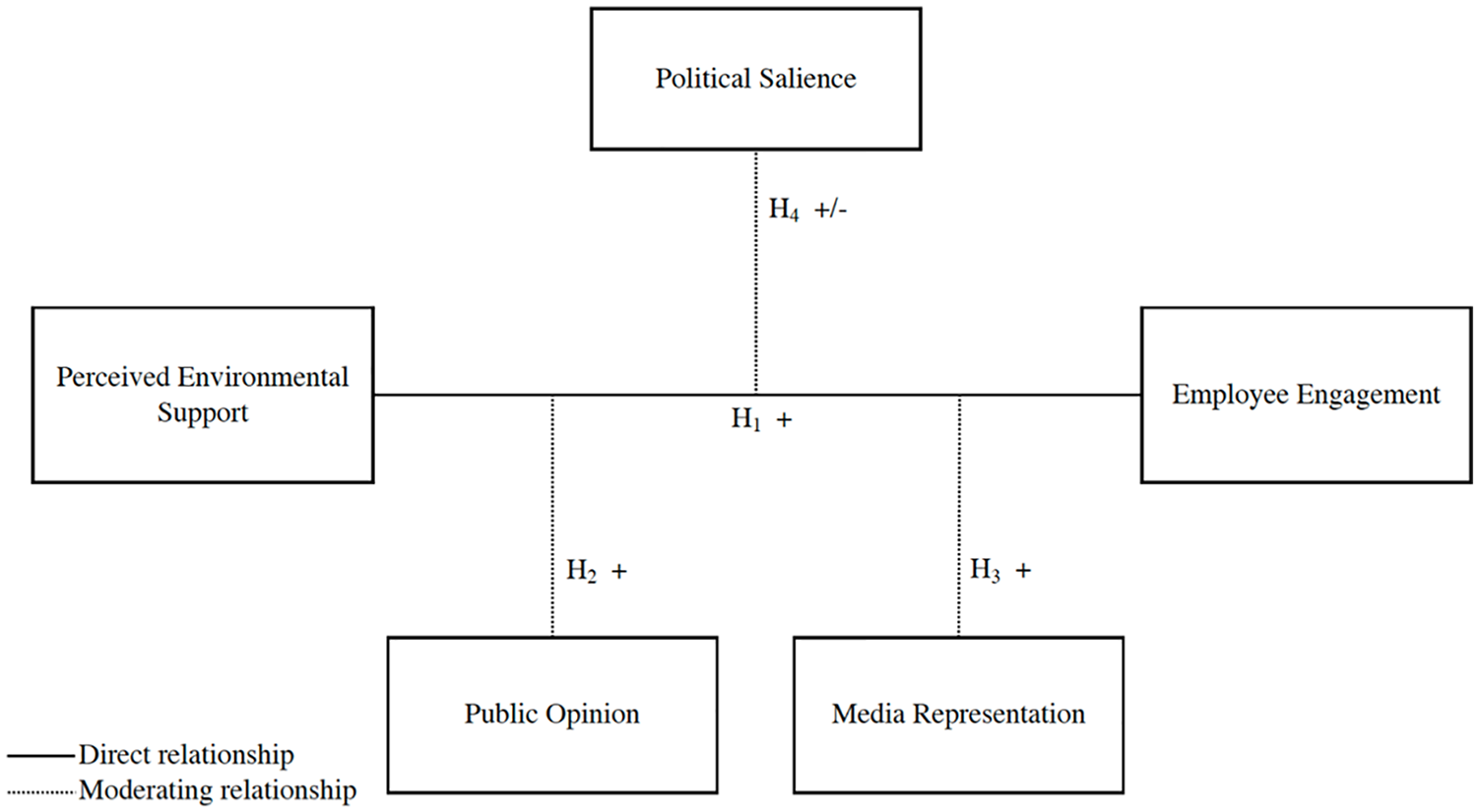
Theoretical model of independent and dependent variables.
The Contingent Role of the External Organizational Environment
While the external organizational environment has been known to influence a number of organizational outcomes, public management scholars have argued that the diverse stakeholders public organizations serve makes them especially vulnerable to external environmental forces (Lee et al., 2009). For instance, in addition to being accountable to the direct recipients of public services, public organizations are held responsible by political principals such as the legislature, courts, executives, and media (Meier & Bohte, 2007).
Thus, while the external environment can be a source of legitimacy and reputation (Carpenter, 2010), it can also drive goal ambiguity and reduce effectiveness (Pandey & Wright, 2006). When considering PES and employee engagement, actual and specific factors in the external environment, namely public opinion, media representation, and political salience, may influence the mechanisms behind this relationship.
Public Opinion
Public opinion represents evaluations the general public makes about public institutions, figures, and events from a specific dimension of the organizational environment, while PES represents a global and general perception of support from the external environment. Thus, even with low public opinion, public employees may still hold high levels of PES if they perceive support from other environmental factors, such as political elites, mass media, and civil society.
Importantly, since public opinion can reflect socially constructed realities (Gamson et al., 1992), it can be a source of legitimacy for public organizations, leaders, and employees (Carpenter, 2010). In addition, public opinion has been shown to be a potent driver of policymaking and political behavior (Brooks & Manza, 2006; Soroka & Wlezien, 2005), although scholars disagree about the extent of its reach (Burstein, 2006). While much of this research on public opinion has taken place within policy and legislative studies, public administration research has only briefly examined its potential uses as a tool for public managers (e.g., Van Slyke et al., 2005).
In considering (negative) public sentiment toward government (Hibbing & Theiss-Morse, 2001), public management scholars have only recently begun examining citizens’ evaluations and stereotypes (Marvel, 2016; Willems, 2020) of public servants, that is, bureaucrat bashing (Abner et al., 2020; Garrett et al., 2006; Jahan & Shahan, 2012). This research has found that bureaucrat bashing can negatively impact the implementation of existing public programs because it can affect the morale of public employees, generate fears about job security, create ambiguity about policy priorities, and frustrate efforts to recruit and retain employees (Garrett et al., 2006). Public employees are aware of how they are represented by political executives, members of the public (through public opinion), and the media, and these messages affect their emotional-cognitive reactions to work (Jahan & Shahan, 2012; Purcell et al., 2017). This is consistent with a social information processing perspective, which argues that individuals form attitudes and motivations by interpreting information and cues in their social environment (Pfeffer & Salancik, 1978).
Given this, public opinion may influence the direct relationship between PES and employee engagement by influencing the social exchange and social identity processes that undergird this relationship. For instance, even in the presence of positive PES, awareness of negative public opinion may dampen the extent to which felt obligations induce employees to work toward their organization’s goals (through increased work engagement).
On the contrary, having both positive PES and awareness of positive public opinion may strengthen the extent to which public employees feel valued. In this way, they may be more likely to reciprocate by devoting their emotional, cognitive, and physical energies toward task performance, and increasing their levels of work engagement. Relatedly, positive or negative public opinion may influence whether public employees see the external environment as generally favorable, which affects their socioemotional needs for self-continuity, self-esteem, and self-distinctiveness. With these needs fulfilled, the direct relationship between PES and employee engagement is strengthened.
Media Representation
The representation of agencies in mass media, beyond interpreting messages of support from the external environment, may also influence how and when PES affects employee engagement. Two streams of research can help highlight its influence. First, scholars in the mass communication and media studies fields have long examined how mass media influences the tenor, context, and tone of what counts as news and frames newsworthy issues (Molotch & Lester, 1974; Tuchman, 1978). Gamson et al. (1992) argued that what is reported in media is a reflection of reality, which is then socially constructed and decoded idiosyncratically by readers and viewers. This influence serves an agenda-setting function and informs how the general public comes to view and evaluate social issues (McCombs & Shaw, 1972; Myers & Caniglia, 2004; Wonneberger & Jacobs, 2017).
Others have noted that news reporting is not equal: what counts as newsworthy depends on the intensity and political significance of events and their proximity to the news source (Myers & Caniglia, 2004). In the context of public organizations, this relevance may increase when large scandals, accidents, or other wrongdoing occur (Molotch & Lester, 1974), such as the U.S. Veterans Affairs waitlist (Molina, 2018), product recalls, or corporate malfeasance (Zavyalova et al., 2012). Failures of public services tend to be amplified in the media, and citizens tend to blame entire public bureaucracies and/or politicians (Sievert et al., 2020).
Drawing from this primary stream of research, management scholars have examined how media representations influence the reputation of firms, and the kinds of actions organizations undertake to actively manage these reputations. For example, Deephouse (2000) uses the resource-based view of the firm to develop a theory of media reputation as a strategic organizational resource. Thus, organizations with positive media representations have greater legitimacy in the eyes of their stakeholders, and may enjoy higher levels of financial performance (Deephouse & Carter, 2005).
In the absence of private markets, reputation can help mobilize political support for a public organization’s mission, interests, and beneficiaries (Wæraas & Byrkjeflot, 2012). In addition, it maintains legitimacy, secures autonomy, and reduces the resource dependence of organizations (Carpenter & Krause, 2012; Lee & Van Ryzin, 2019). Although limited in public relations capabilities compared to private firms, public organizations also work to influence their representation in the larger media environment (Liu & Horsley, 2007; Van Belle, 2003).
In the context of this article, the favorability of media representation influences how and to what extent PES influences employee engagement. While PES refers to a general evaluation of the organizational environment, media representation represents the actual favorability of a specific factor in the external environment. Thus, public employees may have high levels of PES even if the media representation of their agencies is less favorable.
However, when organizations enjoy more positive media representation, employees may rely on these attributions to construct their self-concepts, and seek consistency between their own and others’ perceptions of group membership (Dutton et al., 1994; Tajfel & Turner, 1979). When individual needs of self-enhancement and self-distinctiveness are fulfilled (Dutton et al., 1994), PES may have a stronger influence on employee engagement. Indeed, past research has shown that media representation influences reputation (Meadows & Meadows, 2016), which can lead employees to identify more strongly with their employer and improve morale (Baer et al., 2018).
If media simply reflects what people think, media representation—whether positive or negative—would influence the direct relationship between PES and employee engagement for the same reasons that public opinion does so. In other words, even with high levels of PES, exposure to negative media representations may dampen felt obligations that motivate employees and reduce the congruence between individual self-concepts, organizational identities, and perceptions of group membership, thereby reducing engagement.
Political Salience
While political salience is not necessarily equivalent to broad political support, it represents political attention toward organizational goals and missions (Lee et al., 2009; Rainey & Jung, 2015). Thus, while it may translate to greater legitimacy of the agency and its goals, it may also represent reduced autonomy and greater political interference.
The study of bureaucracy has long examined the influence of different political principals (such as the legislative and executive branches) on public organizations (Waterman et al., 1998; Weingast & Moran, 1983), through the organizational manifestations of political control and its influence on organizational goal ambiguity (Lee et al., 2009; Pandey & Wright, 2006). For example, Pandey and Wright’s middle-range theory posits that external political pressure leads to greater organizational goal ambiguity, which in turn leads to greater role ambiguity for the individual employee. In particular, external actors may represent divergent interests that campaign for control over resource allocations, decision-making, and organizational structure (Waterman et al., 1998). In addition, some political actors (such as legislators) may have more direct influence over agency decision-making, while others (clients and stakeholders) may represent more diffuse pressures.
This work draws from the existing public management literature on political influence and considers political salience as a moderating influence in the relationship between PES and employee engagement, for a few reasons. First, while not equivalent to political support, political salience—whether positive or negative—may translate to power (Meier & Bohte, 2007) and prestige: as Ringquist et al. (2003) noted, salience represents how important the policy area is to political principals.
As with other moderating influences, support and power may strengthen consistency between employee self-concepts, organizational identities, and fulfilled socioemotional needs, enabling greater engagement and commitment to advancing organizational goals. In addition, if political salience represents clientele support, its higher levels would strengthen the felt obligations to reciprocate. On the contrary, increased salience may translate to reduced discretion and autonomy on the part of public managers and employees (Ringquist et al., 2003), as increased attention is interpreted as lack of trust or meddling in their internal affairs. 1 In this case, political salience may not influence the fulfillment of socioemotional needs and/or felt obligations, or it may dampen the strength of the PES–employee engagement relationship. Based on this, I propose the following nondirectional hypothesis:
Methods
Data
The primary data for this study comes from the 2016 Merit Principles Survey (MPS), conducted by the U.S. Merit Systems Protection Board Merit. The MPS included three distinct surveys (Path 1, Path 2, Path L) administered to full-time federal civilian employees in 24 large agencies using a stratified random sampling approach. Measures for employee engagement, job satisfaction, job tenure, turnover intention, and PES were drawn from Path 2 of the survey, which was administered to 37,452 employees, and garnered 14,515 responses, for a response rate of 38.8%. The survey administration period was from July to September 2016. Of these 24 agencies, the current analysis considered a subset of seven with sufficient size, visibility, and most importantly, public opinion polling data (Pew Research Center, 2015), reducing the final number of observations to 4,064.
In addition to employee engagement and other individual attitudes, data on news media representation was collected using EBSCOhost, public opinion data were gathered using the Pew Research Center’s publicly available polling data, and data on political salience were collected using the Congressional Record website. The collection strategy for each of these variables is described in greater detail in the “Independent Variables” section. Table 1 shows statistics on key independent variables by agencies, while Table 2 shows descriptive statistics of all variables. Finally, Table 3 shows the correlation matrix of variables.
Construction of Key Variables by Agency.

Pew Research Center.
Descriptive Statistics.

Correlation Matrix.

Note. Reliabilities in parentheses (where applicable).
p < .05.
Dependent Variable
The main dependent variable, engagement, represents dimensions of vigor, dedication, and absorption as defined by Schaufeli et al. (2002). For each of these items, respondents were asked to rate their level of agreement on a 1 to 5 Likert-type scale: (1) “My work gets me energized and excited,” (2) “It is easy for me to become happily immersed in my work,” (3) “I put my full physical energy into doing my work tasks,” and (4) “I feel engaged in my job.” These items had sufficient scale reliability (α = 0.83), and for ease of interpretability, confirmatory factor analysis (CFA) was conducted to construct a single measure of employee engagement. The results of the CFA showed that all items loaded onto a single standardized factor.
In addition, I conducted a series of confirmatory factor analyses to further demonstrate the construct validity of employee engagement and its distinctiveness from job satisfaction (used as a control variable, as discussed below). In the first model, all items used to measure employee engagement and job satisfaction were loaded onto a single factor; in the second model, they were loaded onto separate factors representing job satisfaction and employee engagement and allowed to covary. Figures 2 and 3 summarize these models and their standardized factor loadings, which ranged from 0.39 to 0.86.
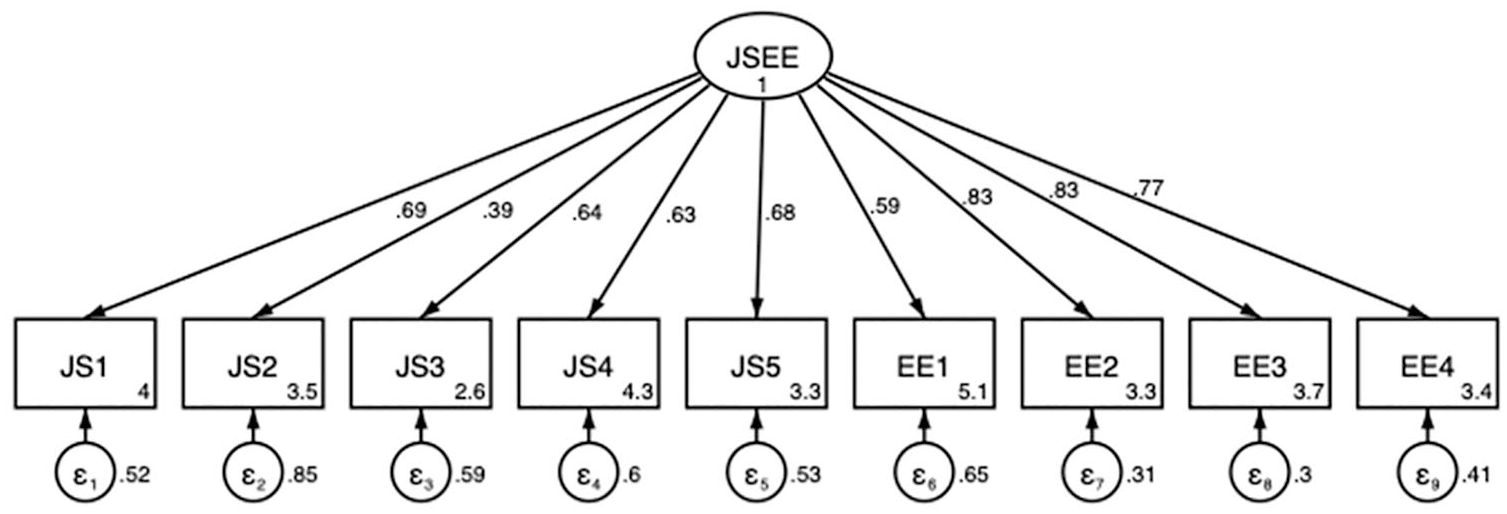
CFA of job satisfaction and employee engagement as a single factor.

CFA of job satisfaction and employee engagement as separate factors.
As the factor loadings of items in each model were statistically significant, one way to determine whether employee engagement refers to a distinct job attitude is to use global fit statistics (such as the χ2 model test statistic) and approximate fit indices. Although scholars have cautioned against deterministically using rule of thumb or cut-off values to determine model fit (cf. Fan & Sivo, 2005; Hu & Bentler, 1999; Marsh et al., 2004; Yuan, 2005), Kline (2016) recommends using approximate fit indices to provide descriptive evidence, which can be used alongside theoretical expectations to establish model fit.
In this context, root mean square error of approximation (RMSEA) values lower than 0.05 may indicate good fit, while values larger than 0.10 can indicate serious problems (Browne & Cudeck, 1993). In addition, both comparative fit index (CFI) and Tucker–Lewis index (TLI) show the amount of departure from an independence or null model. Thus, a CFI of 0.91 indicates that the proposed model is 91% better than a baseline model. Finally, the standardized root mean square residual (SRMR) represents a badness of fit statistic, with values >0.10, indicating serious fit problems, and Akaike information criterion (AIC)/Bayesian information criterion (BIC) values place penalties on more complex models, with lower AIC/BIC values preferred over higher ones (Kline, 2016).
As the results show, fitting separate factors produces better model fit and approximate fit statistics, as judged by lower RMSEA (0.118 vs. 0.131), lower AIC/BIC values, higher CFI (0.914 vs. 0.891) and TLI (0.881 vs. 0.855), and lower SRMR values (0.056 vs. 0.061). In addition, models where employee engagement contained the job satisfaction item “Satisfaction with interesting work that I enjoy” were evaluated, but showed poorer fit compared to the operationalization of employee engagement and job satisfaction presented in Figure 3.
Independent Variables
PES
PES was captured using two items on the Merit Principles Survey. Respondents were asked to rate their level of satisfaction with “Public support for your organization’s mission and work” and “Public support for your organization’s performance” on a 1 to 5 scale, where 1 represented “Very Dissatisfied” and 5 represented “Very Satisfied.” These items were highly correlated and had sufficient scale reliability (α = 0.919). As with the dependent variable, I conducted CFA to create a composite measure to aid in interpretability. Both items were loaded onto a single standardized factor representing PES.
Media representation
I operationalized media attention by first coding 2016 articles from two national publications, The New York Times (NYT) and The Washington Post. NYT was chosen for its status in communications and journalism research as the newspaper of record (Durham, 2006; Friedman et al., 2006; Myers & Caniglia, 2004), with its influence on public opinion, public policy, and the decision-making of bureaucracies (Van Belle, 2003). However, some have questioned this status, noting that other newspapers may provide balance in coverage (Zelizer et al., 2002). To check for this, as well as for potential selection errors through location biases (Myers & Caniglia, 2004), I added the Washington Post to the sampling frame, based on its coverage of U.S. federal agencies. These two represent the largest U.S. daily newspapers (Barthel, 2017).
The article search was conducted using the EBSCOhost search engine with the Academic Search Premier, Newspaper Source Plus, and Newswires databases. Search terms for each of the agencies coded appear in Appendix Table A1. Once the initial search was complete, I checked the agency reference in each article title (see Table 1). The coding strategy involved identifying the key elements of each article. Each article was coded based on its source (NYT or Washington Post), where it appeared (front page or elsewhere, Editorial, Op-Ed) (Wonneberger & Jacobs, 2017), key themes (Personnel, Leadership, Policy Issue, Specific Legislation, and Regulation/Agency Program), and whether its coverage was generally positive, neutral, or negative. Specific criteria were developed to determine the general sentiment toward agencies, following guidelines established in prior management and mass communication research (Deephouse, 2000; Weber, 1990). These include (a) Which party is given voice in the article? (b) Is the voice sympathetic to the agency’s concerns? (c) Is the representation of views paraphrased, or quoted? (d) How many “sides” are considered? What proportion of voice is given to each side? I individually coded all 152 articles, and a trained coder coded a random sample of 15 articles (10%). Intercoder reliability between these was 74%, suggesting a sufficient level of reliability (Weber, 1990).
The average sentiment scores for each agency appear in Table 1. For the purposes of multivariate regression and ease of analysis, these three variables (positive, neutral, or negative) were combined into a composite scale using CFA. Each of these items loaded onto a single standardized factor, which was retained for the purposes of regression. Thus, higher scores on the Media Representation variable represent more favorable media representation, and vice versa.
Public opinion
Public opinion data were collected using the Pew Charitable Trusts report “Beyond Distrust: How Americans View Their Government” (Pew Research Center, 2015). Respondents were asked a range of questions (in English or Spanish) regarding their opinions about government and prompted to answer very favorable, mostly favorable, mostly unfavorable, very unfavorable, no knowledge, or unable to rate. Both landline and cellphone random digit dialing were used to develop samples of respondents that were U.S. adults (18 and older) living in all 50 states and the District of Columbia. The sample was then weighed by gender, age, education, Hispanic origin, and other characteristics to produce a balanced sample.
For each agency, Pew reported the average percentage of respondents that considered a particular agency to be very favorable, mostly favorable, mostly unfavorable, or very unfavorable, and the total favorability and unfavourability percentages. For the purposes of the analysis, and similar to the procedure outlined for the media representation variable, favorability and unfavourability averages were converted to a composite factor using CFA. Thus, low scores on the factor represent low levels of public opinion, while high scores on the factor represent high levels of public opinion. These scores can be found in Table 1.
Political salience
I captured political salience by counting an agency’s mentions in the 2016 Congressional Record, the official log of all U.S. House and Senate proceedings, including floor speeches, legislations, and resolutions, which generally represents the amount of attention devoted to particular issues at the federal legislative level. While such a measure does not represent whether this attention was positive or negative, previous research has relied upon it as one measure of salience (Lee et al., 2009). For ease of comparability and interpretation, discrete number of mentions was standardized (mean 0, and standard deviation of 1).
Control Variables
Apart from these main variables, the analysis included job-related attitudes and demographic characteristics that would predict engagement (Saks, 2006), including job satisfaction, sex, agency tenure, and supervisory status. Using the facet approach (Spector, 1997), job satisfaction was measured using a factor score of five items on the survey instrument that represented satisfaction with work itself, pay, promotions, coworkers, and supervisor (1. “Interesting work that I enjoy,” 2. “Pay,” 3. “Opportunity for advancement into supervisory/managerial roles,” 4. “Working relationships with coworkers,” 5. “Working relationship with supervisor”). Respondents were asked to rate their level of satisfaction with the items on a 1 to 5 scale, where 1 represented “Very Dissatisfied” and 5 represented “Very Satisfied.” Finally, I captured agency tenure using a dichotomous measure where 0 represented 4 years or more and 1 represented 3 years or less.
Model
The analysis used ordinary least square regression (OLS) with clustered standard errors by agency. Since the data set contained individual observations nested within agencies, a one-way fixed-effect regression may have controlled for unaccounted–for variance between agencies (Wooldridge, 2013). However, since some observations (media representation, public opinion, congressional representation) did not vary within a given agency, a fixed-effect specification would suffer from multicollinearity and was thus not used.
Results
Table 4 shows the results of the OLS regression. Model 1 includes the key independent variables without controls, Model 2 contains all variables, and Models 3, 4, and 5 include moderator variables to test for hypotheses 2, 3, and 4, respectively. The R2 values for the models ranged from 0.148 (Model 1) to 0.55 (Models 2–5).
Regression Results.

Note. Standard errors in parentheses. PES = perceived environmental support.
p < .10. *p < .05. **p < .01. ***p < .001.
The results show that PES is a positive and statistically significant (α < 0.001) predictor of employee engagement in all five models, thus failing to reject hypothesis 1. In particular, the Model 1 shows that a 1 standard deviation increase in PES would be associated with a 0.36 standard deviation increase in employee engagement. When control variables were included (Model 2), this association was reduced to β = 0.177, but remained statistically significant (α < 0.001).
Models 3 to 5 reflect tests of the moderating hypotheses (2–4). The results of both Models 3 and 4 show that neither public opinion nor media representation were statistically significant moderators, thus leading to a rejection of hypotheses 2 and 3. However, media representation had a positive and statistically significant direct relationship with employee engagement in all models, although this relationship was not hypothesized in the theoretical model. For example, Model 1 indicates that a one standard deviation increase in media representation (reflecting greater favorability) would be associated with a 0.107 increase in employee engagement (α < 0.01).
The results of Model 5 show that political salience was a negative and statistically significant moderator in the direct relationship between PES and employee engagement, thus providing strong evidence for hypothesis 4. To better understand this, a marginal effects plot (Figure 4) shows the average marginal effect of the main independent variable on the dependent variable contingent on three values (minimum, midpoint, and maximum) of the moderator variable. These values were selected based on the descriptive statistics of the political salience variable (see Table 2), and because both interaction variables were continuous in nature (Statistical Consulting Group, n.d.). The marginal effects plot shows that the slope of PES on employee engagement reduces as values of political salience increase. Thus, higher levels of political salience reduce the strength of the positive influence of PES on employees’ engagement.
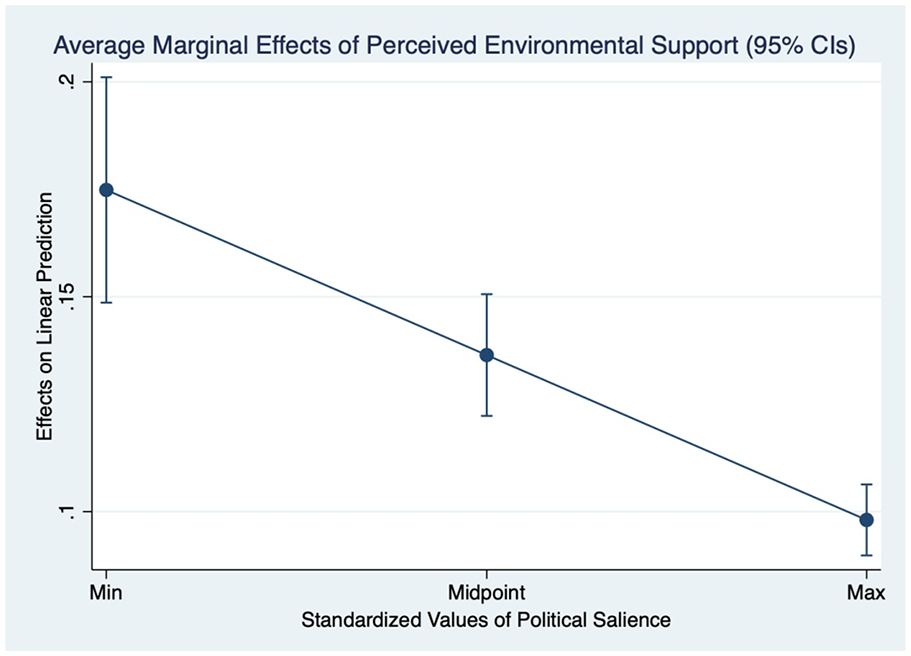
Marginal effects of perceived environmental support.
Finally, political salience had a positive and weakly statistically significant direct relationship with employee engagement in the majority of models, ranging from β = 0.0595 (α < 0.05) in Model 1 to β = 0.0278 (α < 0.1) in Model 5.
Discussion
This article sought to examine how factors in the external environment, both perceived and actual, influence individual employee attitudes and behavior. While there is evidence to suggest that the external environment of public organizations influences the performance, structure, and goal ambiguity of public organizations (Andrews, 2009; O’Toole & Meier, 1999; Pandey & Wright, 2006), it does not explain how these factors influence individual employees and their motivations, especially employee engagement, an emerging construct of interest for both scholars and practitioners (Welch, 2011). This is especially important because of the relationship between employee engagement and individual and organizational performance (Harter et al., 2002; Rich et al., 2010), and the significant efforts governments around the world have expended toward that aim (Hameduddin & Fernandez, 2019; OECD, 2016).
This article builds on existing research on the political environment and employee behavior (Davis & Stazyk, 2015; Yang & Pandey, 2009), and considers not only perceptions of the external political environment but also captures perceptions of support from the general organizational environment. In particular, it theorizes that PES positively influences employee engagement and that actual conditions in the external environment moderate this direct relationship. The theoretical model appeals to theories of organizational support as articulated by Eisenberger and colleagues (1986, 2002; Rhoades & Eisenberger, 2002) and applied in the public sector context (Jin & McDonald, 2017), and extends to consider perceived support from the larger organizational environment. This perspective links POS to its outcomes, based on two primary mechanisms: felt reciprocity through social exchange and fulfillment of socioemotional needs as articulated by social identity theory.
The results show that perceptions of environmental support matter for employee engagement, suggesting that public employees do consider whether the broad public supports their organization’s mission and its performance. While research on employee attitudes drawing on organizational support theory has, to date, only recognized internal sources of support, that is, supervisors, senior leaders, and the organization in general (Jin & McDonald, 2017), this finding suggests that broad public support for the organization’s mission and its performance affects levels of engagement. Future research may compare the importance of these perceptions to other well-known work-related characteristics that may influence effort, such as managerial behavior (Fernandez & Moldogaziev, 2013), leadership (Bellé, 2014), human resource management (Boselie et al., 2019), and organizational and supervisory support (Jin & McDonald, 2017).
Furthermore, in examining the moderating roles of specific environmental factors, the results only supported the political salience hypothesis, suggesting that higher levels of political salience dampen the strength of the main relationship. Since political salience is not conceptually comparable to broad political support, it may be that any type of political salience—whether supportive or not—may represent interference and reduced autonomy in the affairs of a public agency. Furthermore, political salience may be interpreted not as a source of support but as a hindrance to goal accomplishment and task performance, thereby influencing the extent to which employees’ PES translate to higher levels of employee engagement.
Finally, while the results failed to show that media representation was a statistically significant moderator of the main relationship, it was a statistically significant predictor of employee engagement in all models. One explanation lies in the perceptions of such media representations as symbols of support toward organizational missions and purpose, which may enhance employee self-concepts, fulfill their needs for self-enhancement (Dutton et al., 1994), and make them more comfortable bringing emotional, physical, and cognitive selves into their work roles (Kahn, 1990). Future research should consider the direct role of media representation as a source of employee engagement and motivation, the role of media-influencing strategies such as reputation management and the mechanisms undergirding this relationship.
Limitations
In spite of these findings and their implications, limitations exist. First, the use of cross-sectional data limits the ability to make causal inferences. A fuller analysis should make use of data over a number of years to limit concerns for inverse causality. More formally, it could be that PES could itself drive engagement, which could lead to higher organizational performance and more positive media representation and public opinion.
In addition, organizational reputations, which are formed over a long period of time (Carpenter, 2010), could drive media representation, which may be source of performance information for public managers as they make decisions about resource allocations. In particular, because of cognitive limitations, individuals may rely on heuristics and cognitive biases when they make performance evaluations and interpret performance information (Moynihan & Pandey, 2010; Webeck & Nicholson-Crotty, 2020). However, these concerns have as yet to be connected to issues of reputation, media representation, and individual employee attitudes and behaviors. Pursuit of these theoretically important questions would help advance an important middle-range theory of public management (Abner et al., 2017).
Second, the construction of the media representation variable only focused on two national newspapers, the New York Times and The Washington Post, excluding cable and network TV news and/or social media. Although research on news media’s agenda-setting role and the impacts of social and political movements has relied on newspapers (Myers & Caniglia, 2004), some have argued that they have diminised in importance as a result of cost-saving measures and the rise of TV news (Maier, 2010). Thus, the inclusion of cable and network news coverage alongside newspapers may provide a more complete picture. However, there are reasons to suspect that the omission of such media would not bias the results. Maier’s (2010) analysis of news stories on print and newer media found general consonance in which news stories are covered, although there were differences in the depth of coverage. In addition, given TV media’s often narrow partisan focus (Feldman et al., 2012), the value of its representation may be limited.
Given the growth of media options and increased polarization, some have observed the death of larger public discourse or the common media market, as it has given way to fragmented media based on partisan preferences (Feldman et al., 2017; Maier, 2010). Thus, the NYT may represent the common public agenda (through the agenda-setting function) (Myers & Caniglia, 2004; Ortiz et al., 2005), even if its tone carries a liberal bias. In addition, given the demonstrated location bias of the New York Times (Myers & Caniglia, 2004), The Washington Post was considered because of its D.C. location and reliable coverage of U.S. federal agencies.
In spite of this, however, the inclusion of other newspapers such as the Wall Street Journal may provide more balanced coverage of similar stories across all three dailies and dampen concerns of selection bias (Myers & Caniglia, 2004). Indeed, in examining politically charged issues such as climate change, Feldman et al. (2017) found substantial coverage differences in the Wall Street Journal and The New York Times (e.g., Desai, 2012).
Third, by combining relationships at the individual level (PES and employee engagement) alongside moderators at the organizational/ecological level (public opinion, media representation, and political salience), the theoretical model may be committing an ecological fallacy. Thus, inferences about individual-level relationships or correlations based on aggregated data at the group, organizational, or ecological level may lead to erroneous conclusions (Brewer & Venaik, 2014). However, the three ecological variables (public opinion, media representation, and political salience) are not individual-level constructs that have been aggregated to the ecological level but represent conditions in the external environment, and are thus independent organization-level constructs. Furthermore, the theoretical model does specify individual-level inferences based on ecological-level aggregates, since the ecological variables only serve as moderators of the sole individual-level relationship. Thus, the ecological/organizational variables do not signal independent effects on employee engagement or PES, but rather differing agency scores on public opinion, media representation, and political salience, may manifest employee attitudes through different (if unmeasured) mechanisms, i.e., social exchange and social identity processes.
Relatedly, as public opinion data were only available for seven of the 24 U.S. federal agencies surveyed, range restriction represents another limitation: the entire variance in the dependent and independent variables is not being considered. Although some have argued that range restriction may lead to attenuation of observed relationships (Salkind, 2010), the opposite may be more likely. In particular, public opinion data availability itself signals the visibility and political salience of particular agencies, such that individual employees working in these agencies may be systematically different from peers in smaller organizations. Thus, the estimated relationships between PES and employee engagement, and the moderating roles of the external environment, may play smaller roles in lesser-known and less-salient agencies.
Finally, as the dependent variable and some independent variables (e.g., PES) were drawn from the same data source, the results could be tainted by common method bias (Podsakoff et al., 2003), although its extent is debated in current research (cf. Favero & Bullock, 2015; George & Pandey, 2017). However, results of Harman’s single factor test (Podsakoff et al., 2003) did not indicate that common method bias was a concern. In addition, a variance inflation factor (VIF) test showed that the highest VIF value was 2.2, suggesting that multicollinearity was not a problem (values above 10 are considered problematic) (StataCorp, 2019).
Conclusion
Although public management research on employee engagement is growing (Hameduddin & Fernandez, 2019; Jin & McDonald, 2017; Levitats et al., 2019; Vigoda-Gadot et al., 2013), scholars have yet to examine how individual attitudes and motivation are influenced by the external environment of public organizations. Rather, existing research has focused on organizational task environments (Andrews, 2009) and political support (e.g., Davis & Stazyk, 2015) and their relationship with performance, goal ambiguity, and organizational commitment (Yang & Pandey, 2009). This article sought to build on this research by explicitly considering the role of PES—a hitherto understudied construct 2 —in influencing employee engagement, and the moderating roles of public opinion, media representation, and political salience. The theoretical model developed in this article aimed to connect these disparate streams of research into a single theoretical model.
While this was one attempt to connect external sources of influence on employee attitudes and behavior, the results demonstrate the need for more granular and comparative research on how public employees interpret sources of support (or the opposite) and their effects on motivation. This would inform the use of different leadership and managerial practices and organizational policies to buffer, or even enact the external environment (Pfeffer & Salancik, 1978), as well as larger issues of organizing bureaucracies. Public distrust of government bureaucracy (Pew Research Center, 2015), difficulties in attracting and retaining motivated public employees, increasingly challenging public policy problems, and a call to return to the Big questions of public administration (Roberts, 2019) make these implications ever more important.
Relatedly, at the organizational and institutional levels, future research may further unpack the relationship between media, reputation management, and the public relations strategies (Christensen & Gornitzka, 2019; Wæraas & Byrkjeflot, 2012), and examine their influence on public employee behavior, attitudes, and motivation. For instance, it is plausible that the influence of media representation and public support on employee engagement is moderated by existing organizational reputations and efforts aimed at reputation management. In addition, existing reputations may be hard to change, given the blame bias of citizens (Sievert et al., 2020) and the higher profile of scandals versus successes (Goodsell, 2003). In these conditions, public managers may have to adopt more proactive approaches toward reputational threats (Maor & Sulitzeanu-Kenan, 2015), media relations and government communication, and actively honor PES as they seek to motivate their employees and respond to reputational threats (Liu & Horsley, 2007).
While research on bureaucratic reputation (Boon et al., 2019) and the mediatization of government bureaucracies (Schillemans, 2012) is growing, it has not connected mediatization and bureaucratic reputation to performance information use by citizens and/or public employees and the effects they may have on morale. Doing so would help build a middle-range theory of public management (Abner et al., 2017) and further respond to Pandey & Wright’s call for “connecting the dots” (2006, p. 511), representing an important avenue for future research.
Footnotes
Appendix
Search Terms.

| Agency | Search term in title |
|---|---|
| Justice | “U.S. Department of Justice” OR “Department of Justice” OR “Justice Department” OR “DOJ” |
| Education | “U.S. Department of Education” OR “Department of Education” OR “Education Department” OR “Education” |
| EPA | “E.P.A.” OR “PA” OR “Environmental Protection Agency” |
| Homeland Security | “DHS” OR “Homeland Security” or “Department of Homeland Security” |
| NASA | “NASA” OR “National Aeronautics and Space Administration” |
| Social Security | “Social Security Administration” OR “Social Security” OR “S.S.A.” |
| Veterans Affairs | “VA” OR “V.A.” OR “Department of Veterans Affairs” |
Acknowledgements
The author would like to acknowledge the three anonymous reviewers for their constructive comments and Melody Herrington (Oxford Comma Copyediting) for excellent copy editing. Many thanks are also due to Ruth Winecoff (for gracious help with coding news articles), and Anthony DeMattee for offering comments on an early draft of the paper.
Declaration of Conflicting Interests
The author(s) declared no potential conflicts of interest with respect to the research, authorship, and/or publication of this article.
Funding
The author(s) disclosed receipt of the following financial support for the research, authorship, and/or publication of this article: This research was supported by the National University of Singapore (Tier 1 Ministry of Education Grant R-000-344-133).
