




Abstract
Civil servants in local government are increasingly expected to engage and collaborate with citizens and stakeholders. This article takes a practice approach to develop a generic picture of everyday work at the front lines of public engagement, highlighting the relational and improvisational aspects of that work that, to date, have remained understudied. Our data and analyses build on the existing literature and contribute to it by describing five specific practices of civil servants. Based on our in-depth interviews with 45 frontline civil servants in the Netherlands, we found that civil servants try to bring together a range of different interests, values, perspectives, and resources by understanding the situation, building rapport and trust, developing shared resolutions, aligning processes “outside” and “inside” city hall, and supporting practically. Furthermore, we substantiate the idea that the practices of frontline workers entail embedded agency, which we specifically label as bricolage. We demonstrate how agency is constrained and enabled by the local bureaucracy and its policies, and that civil servants seek alignment possibilities and resolutions.
Introduction
The environment of Western governments has substantively changed over the past decades (Dickinson et al., 2019; Van der Wal, 2017). In this changed environment, governments are expected to engage citizens and other stakeholders more than ever in the development and implementation of projects and policies, and to respond to local communities’ initiatives, complaints, and needs. Even if “concern about [such] public engagement has waxed and waned,” in the Western world, we can see “a revival, a resurgence of interest among scholars, public managers, elected officials, civic reformers, and others” (Nabatchi & Blomgren Amsler, 2014, p. 63S). Indeed, with the “changing boundary between state and civil society” (Bevir et al., 2003, p. 13), there is a need for government to become more “outward-oriented” (Kruyen & Van Genugten, 2020) and responsive (Lowndes et al., 2006). From recent public administration literature, we learn that civil servants can play an important role in public engagement processes (Bartels, 2017; Eckerd & Heidelberg, 2019; Laws & Forester, 2015) and that they have been expected to adopt new roles and skills to effectively work with the public (Dickinson et al., 2019). This article seeks to build upon and extend the literature by examining the following research question:
How do frontline civil servants work with and for the public in the context of present-day public engagement?
What do we know already? Over the last 20 years, a group of public administration scholars has become more interested in particular “entrepreneurial” ways of working that frontline workers increasingly use in their more network-driven work environments (e.g., Arnold, 2015; Durose, 2011; Johansson, 2012; Nederhand et al., 2018; van Meerkerk & Edelenbos, 2018; Vinzant & Crothers, 1996; Williams, 2002). In addition, research in the street-level bureaucracy literature suggests shifts in the relationship between frontline workers and citizens. We learn that frontline workers have increasingly added to their role as “state-agents” to that of “citizen-agents,” agents who start from their clients’ needs (Maynard-Moody & Musheno, 2003; Tummers et al., 2015).
In addition, Maynard-Moody and Musheno (2012) have wondered whether the idea that frontline workers have discretion in implementation should be replaced by the idea that they have embedded agency (Emirbayer & Mische, 1998). This means expecting not just a (restricted) space of liberty surrounding decisions taken in the everyday work (discretion), but a more interactive, improvisational, and pragmatic work practice: one through which frontline workers give meaning to and form judgments regarding situations they encounter (cf. Laws & Forester, 2015; Wagenaar, 2004, 2019). In line with this, Bartels (2013) suggested that, when it concerns “the more collaborative, deliberative, and participative encounters,” the work of civil servants entails much more than making a decision in an encounter at the proverbial desk or on the street (p. 472).
Furthermore, the recent literature about networks, collaborations, and public participation provides us with guidelines and strategies for developing and facilitating public engagement processes (e.g., Bryson et al., 2013; Fung, 2015; Mees et al., 2019). It defines specific roles civil servants might take in these processes, such as that of boundary spanners, meta-governors, or facilitators (e.g., Blijleven et al., 2019; Escobar, 2015; Torfing et al., 2012; Vanleene et al., 2018; van Meerkerk & Edelenbos, 2018). Researchers who have looked at the skills that are deemed relevant to the work of present-day civil servants also point at the need to mediate and negotiate, to network and be communicative, collaborative, and creative (e.g., Agger & Damgaard, 2018; Dickinson et al., 2019; Kruyen & Van Genugten, 2020; Rhodes, 2016). Finally, we have learned that civil servants not only shape the (initial) contact between local government and its citizens; they are also key in bridging the institutional barriers between the interactive processes in neighborhoods and more traditional, but still very much prevalent, government structures (Bartels, 2017; Blijleven et al., 2019; Edelenbos, 2005; Nederhand et al., 2018).
Despite the growing interest in engagement, we know relatively little about the actual, everyday work of civil servants (Rhodes, 2016; Van Dorp & t Hart, 2018), particularly when it comes to a participatory context (Fenwick, 2012; Van Eijk et al. 2019). To capture civil servants’ work in public engagement, we started from a practice-theoretical approach (Cook & Wagenaar, 2012; Sandberg & Tsoukas, 2011; Wagenaar, 2004). By doing so, we follow in the footsteps of, among others, Schön (1983; Yanow & Tsoukas, 2009), Forester (1999; Laws & Forester, 2015), and Wagenaar (2004). This strand of literature has sought to understand work practices through close inspection of what practitioners do (Barley & Kunda, 2001). We conducted a qualitative study in which we held 45 in-depth interviews with civil servants who are on the front line of Dutch local government and who directly engage citizens and other local stakeholders. The interviewees included both civil servants who traditionally play an important role in the contact between citizen and local government, such as neighborhood managers, as well as policy advisors and project leaders who were previously working in the “back office” but are now “forced to leave their desks in the back office and venture out to meet stakeholders” (Agger & Damgaard, 2018, p. 93).
This article contributes to the theorization of the work of public engagement and frontline civil servants in several ways. First, we complement research on roles, skills, and guidelines for developing and facilitating engagement processes (Bryson et al., 2013; Fung, 2015; Kruyen & Van Genugten, 2020). Our analysis shows how civil servants integrate citizen engagement in their everyday work. Specifically, we identify five practices civil servants employ: They (a) develop an understanding of the situation, examining which interests are at stake, what the underlying issues are, and what possible ways there are to proceed; (b) build rapport and trust with relevant parties; (c) align “inside” and “outside” city hall; and (d) work toward resolutions that are supported by those involved. All the while, they also (e) offer practical support in terms of subsidies or materials, for example. What is more, our practice approach allowed us to see not just separate activities and practices that might call for particular competencies or skills, but it also helped us understand how practices “add up” to a whole.
Second, our findings extend recent insights into the importance of the relational dimension of present-day frontline governance (Bartels, 2013; Nisar & Maroulis, 2017; Stout & Love, 2017; Bartels & Turnbull, 2019) and at the same time contribute to our understanding of the embedded agency of frontline civil servants (Maynard-Moody & Musheno, 2012; Wagenaar, 2019). Our approach and data allowed us to broaden our view of engagement to include not just encounters between civil servants and agents outside the organization, but also what civil servants do in their own organizations to make engagement work. In addition, this article shows that civil servants’ agency is that of the “bricoleur” (Levi-Strauss, 1966), who is able to make do. It demonstrates how they bring together range of interests, values, perspectives, and resources outside and inside the local bureaucracy. Drawing upon existing policy agendas, events, and budgets, and through creative reframing, civil servants aim to make projects possible that serve the public good. The shape of this public good is not predetermined, but emerges in the process of working together with citizens, colleagues, and other stakeholders. This way, frontline civil servants give new meaning to serving the public.
The structure of the remainder of this article is as follows. We first present the theoretical background from which we worked. Then, we describe the way we conducted our empirical study. Next, we describe and illustrate the practices civil servants use in their work. Finally, we discuss the findings in light of current literature and conclude on the limitations and possibilities for future research.
Theoretical Background
In this article, we start from practice theory. Practice theory has been developed over the last 20 years in public administration and related disciplines, like organization studies and sociology (e.g., Cook & Wagenaar, 2012; Feldman & Orlikowski, 2011; Freeman et al., 2011; Sandberg & Tsoukas, 2011; Schatzki et al., 2001; Wagenaar, 2004; Wagenaar & Cook, 2003; see also Bevir & Rhodes, 2006). It encompasses theories of the work practices of individual agents (Forester, 1999; Schön, 1983; Wagenaar, 2004; Yanow & Tsoukas, 2009), as well as those of teams and organizations (Schatzki, 2006).
To begin, practice theorists are interested in what agents do (Feldman & Orlikowski, 2011). Activities are their concrete starting point. 1 Think, for instance, of the activity of listening to citizens (Forester, 1989). This and other activities are conducted with the help of certain “tools” (Sandberg & Tsoukas, 2011), resources that help to get the work done. In their activities, civil servants use tools like their bodies, chairs, computers, documents, mobile phones, pens, meeting rooms, and so on. In addition, practitioners make use of their skills, like their ability to read and interpret legal documents. Second, practice theorists see that experienced agents share certain understandings: knowledge, norms, values, and feelings surrounding the work and elements in it. Understandings, of course, are resources civil servants work with. Understandings, in the most abstract sense, also encompass certain ends that an organization, occupation, or someone in a particular role tries to reach or contribute to (Schatzki, 2006; compare Paanakker, 2019; Van Dorp & ’t Hart, 2018).
Third, where activities are influenced by certain understandings (and vice versa, that is, they form in a recursive dynamic—Wagenaar, 2004) and embedded in a certain organizational, social, and institutional context that favors certain ends, they cluster into a recognizable set of practices. We see a play between the need to act in concrete situations and to do so in line with understandings that form their broader social and institutional context. This is embedded agency: Agents “are both enabled and constrained by their organizational, social and broader institutional context” (Thornton & Ocasio, 2008, p. 103; Emirbayer & Mische, 1998; Garud et al., 2007). The context itself is finally formed, reproduced, and modified through practices (Cook & Wagenaar, 2012; Giddens, 1979).
Concepts.
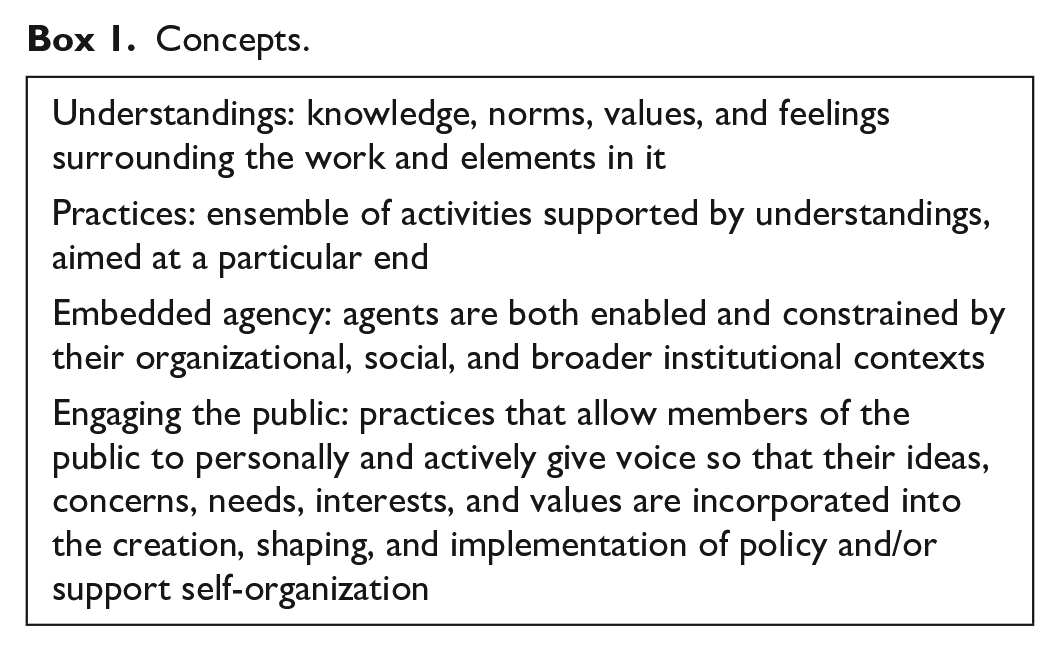
There is a growing literature, partly building on insights from practice theory, that helps us to further understand, theoretically, how frontline civil servants go about engagement (e.g., Bartels, 2015; Durose, 2011; Goodsell, 1992; Laws & Forester, 2015; Wagenaar, 2004, 2019). “Engaging the public” we might define as a broad label for practices “that allow members of the public to personally and actively exercise voice such that their ideas, concerns, needs, interests, and values are incorporated into governmental decision making,” taking into account that civil servants might not just engage to “create, shape, and implement policy” (Nabatchi & Blomgren Amsler, 2014, p. 65S), but also in an attempt to support citizen self-organization (Edelenbos et al., 2018; Nederhand et al., 2018).
As said, the increased attention for and implementation of public engagement in (local) governments signals a changing relationship between the frontline civil servant and the citizen. At the outset, it adds the need to set problems and look for solutions together. Indeed, when it comes to working on public problems with citizens and other stakeholders, Forester, Bartels, and others (e.g., Bartels, 2013, 2015, 2017; Forester, 1999; Innes & Booher, 1999; Laws & Forester, 2015; Vanleene et al., 2018) have convincingly shown the growing importance of building, maintaining, and using relationships and networks. Not just to implement policy, but also to develop it. More and more, governments realize that the ability to produce certain outcomes is distributed among a host of agents (Meijer, 2014). In fact, civil servants who traditionally worked “backstage,” for example, as policy experts, increasingly work on the front lines with the public (Agger & Damgaard, 2018; Verloo, 2019). Indeed, researchers who have studied the competencies and skills present-day civil servants might require (e.g., Kruyen & Van Genugten, 2020; Torfing et al., 2012) also emphasize an external orientation, collaboration, cocreation, networking, and boundary-spanning skills. In addition, as civil servants involved in engagement often deal with groups of citizens who represent a range of perspectives and interests rather than individual “citizen clients,” they might also need skills such as mediating, negotiating, and consensus building (Innes & Booher, 1999; Vanleene et al., 2018; Wagenaar, 2007).
Furthermore, engaging and collaborating with the public emphasizes the need for civil servants to be flexible and creative (Osborne, 2010, 2006; Kruyen & Van Genugten, 2020; Pestoff et al., 2012; van Meerkerk & Edelenbos 2018). Engaging and collaborating with citizens cannot be totally prestructured. It has to be a process that shapes slowly, in reaction to situations encountered (Bartels, 2017). In the broader literature on frontline work, we find recent studies that stress how present-day frontline workers more generally engage in entrepreneurial work (Arnold, 2015; Durose, 2011) and improvisation (Maynard-Moody & Musheno, 2003, 2012; Laws & Forester, 2015; Wagenaar, 2004). Whereas their work and street-level decision-making was traditionally understood in terms of discretion, Maynard-Moody and Musheno (2012) have argued that the concept of embedded agency, discussed above, is better suited to understand their work. Rules, policies, and other institutionalized practices shape and constrain frontline workers’ practices, but they also enable it. Frontline workers draw on structures when they engage in pragmatic improvisation, as they provide suggestions for “what is possible and feasible” (Wagenaar, 2004, p. 650). In this article, we will address a particular type of embedded agency called “bricolage” (Bechky & Okhuysen, 2011; Yanow & Tsoukas, 2009), that fits very well with the practices of the civil servants under study. Bricoleurs work with whatever is at hand and recombine materials—experiences, ideas, perspectives, methods, resources—to create something new. While bricoleurs do not have a clear end in sight, the project they are engaged in will be determined by what is available and how it can be assembled (Innes & Booher, 1999).
Finally, the increasing use of public engagement and various related concepts might almost make us forget other practices that have been embedded in local government for decades. These will, in large part, still structure much of what local governments in the Netherlands and elsewhere do. There is a layering of practices, as much, or even more, as there is replacement (Nederhand et al., 2018; Rhodes, 2016). Public servants, for example, still deem “traditional” public service values such as expertise, lawfulness, and loyalty relevant (Kruyen & Van Genugten, 2020). As a result, public servants will probably need to navigate between different practices, finding their way in the process (Vanleene et al., 2018) and may need to engage in a “bricolage-like interplay” between the traditional and participatory logics (Vaegemose et al. 2018, p. 129). Now that we have sketched the theoretical background, we can describe our methodology and the way we conducted our research.
Approach and Methods
In this section, we will clarify the basic assumptions underlying our study, explain our selection of cases, and describe the way we generated and analyzed our data (Ashworth et al., Brower et al., 2000; Ospina et al., 2018). First, the set of basic assumptions underlying our study are known as interpretivism (Bevir & Rhodes, 2003, 2006; Yanow, 2000). This “mode of knowing” (Ospina et al., 2018) has become increasingly accepted in public administration and related disciplines (Dodge et al., 2005; Yanow & Tsoukas, 2009). Interpretivists start from an interest in meaning. They want to understand how agents make sense of their world. They also believe that knowledge and facts are produced as much as discovered. Moreover, in the social sciences, most of these products can be understood as “in need of constant refinement, revision, and, if necessary, replacement” (Guba & Lincoln, 1989, p. 104).
The goal of our study was to learn about the practices of civil servants who engage the public. We built our theoretical understanding mainly from practice theory (see the previous section). Practice theory, as it has been developed in public administration and related disciplines, fits very well with interpretivism (Li & Wagenaar, 2019; Sandberg & Tsoukas, 2011). It combines an interest in everyday action with one in meaning making. There are plenty of practice-based studies in disciplines related to public administration (e.g., Nicolini, 2012; Orlikowski, 2002; Sandberg & Pinnington, 2009), but in our discipline, they are relatively rare. This article is an effort to contribute to our understanding of the work of civil servants by offering a set of concepts and describing their relationships (Corley & Gioia, 2011).
In this study, we were not focused on zooming in on the differences between individual civil servants to develop typologies (Van Hulst et al., 2011; van Meerkerk & Edelenbos, 2018, pp. 93–112), but rather to analyze what they share across domains and settings. To be more precise, we were trying to understand what is involved in engagement work. Our intent, to be sure, was not to merely catalog activities but also to show how they related at the level of individual practices and how these for a work practice. By doing this, we join a strand of research that interests itself in complex work practices in public administration, planning, and other organizational contexts and that attempts to build a composite image of frontline work practices (Forester, 1999; Laws & Forester, 2015; Schön, 1983; Yanow, 2015).
Setting and Cases
Within the more general context of slowly increasing public engagement and participatory governance in Western democracies, we should say something about the Dutch context. The Netherlands has had a tradition of citizen participation since the early 1970s and interactive policy making and coproduction since the early 1990s. They have more recently become a front runner in supporting citizens’ initiatives (Van de Wijdeven, de Graaf & Hendriks, 2013; Edelenbos, Van Meerkerk & Schenk, 2018). This development has been encouraged and supported by policies at a national level that try to evoke the idea of the Netherlands as a “participation society” (Government of the Netherlands, 2013). At the local level, many municipalities, including those included in this study, have also adopted policies to promote and facilitate citizen participation processes and citizens’ initiatives (Van Den Bongaardt, 2018). The neighborhood managers we interviewed in this study typically work in these teams as a liaison between the municipal organization and its neighborhoods and residents. All this, however, does not mean that in practice, even though it has increased and has (rhetorical) support, extensive, thorough public engagement has become dominant in governance.
Our main aim, within the Dutch context, was to have a variety of cases (of practices used to engage the public) within which to look for a shared pattern. At the beginning of 2017, we started to look for Dutch local governments that shared our interest in frontline practices of civil servants. Over a period of several months, we formed a consortium with six municipalities. Together, the municipalities form an interesting range, varying among others in geographical location, number of inhabitants (ranging from close to 50,000 to more than 200,000 inhabitants), and degree of urbanization (Centraal Bureau voor de Statistiek, 2017). Within the six municipalities, we looked for civil servants who, in their daily job, have regular contact with outside stakeholders and were willing to talk openly about their work with us. The civil servants in the study, 23 men and 22 women, work in three types of positions. A first group (17 respondents) consists of neighborhood managers and relationship managers, whose jobs are inherently outward oriented. Although their job description and title differs from city to city, they all spend much time outside city hall. Their day-to-day interactions with citizens resemble those of classical frontline workers (Lipsky, 1980; Maynard-Moody & Musheno, 2003), yet they do not implement a particular policy. Rather, they are generalists who respond to citizens’ initiatives, ideas, and complaints and represent the neighborhood toward the municipality, and the other way around. Second, we interviewed project managers (10 respondents). Developing and implementing ways to engage the public in the development of these projects was generally part of the project management process. The aim, shape, and intensity of this engagement varied. It was partly determined by the assignment from the local administration and partly by the project managers and their team. Finally, our sample includes policy advisors (18 respondents), who are specialized in, for example, planning, traffic, social policy, or communication, and who were involved in projects and policy development in their area of expertise. Most policy advisors encountered citizens and other stakeholders at meetings related to the projects they were involved in. Some were more actively involved in developing and leading the engagement processes, in projects in which they had a more coordinating role. Finally, policy advisors responded to initiatives, ideas, and complaints from citizens—often brought to them by the neighborhood managers—related to their area of expertise. For these last two groups, citizen engagement is not their “core business,” but has become regular part of their work on projects and policies.
Generating Data
We generated our data through in-depth interviews. In-depth interviews do not give us direct access to the reality under study (Alvesson, 2011), nor do they capture all there is to practice(s). That does not mean, however, that what practitioners do cannot be accessed in large part through in-depth interviewing. Social practices are made apprehensible and understandable, primarily through language, because people can talk about them (Atkinson & Coffey, 2003; Sandberg & Pinnington, 2009). In addition, different civil servants involved with stakeholders may have complicated multiple perspectives on these (same) processes. In such a situation, according to Johnson (2003, p. 105), “[using in-depth] interviews is likely the best approach, despite its known imperfection.” In general, they are the best way to develop detailed descriptions of events and processes as agents experience them (Weiss, 1994).
Our interviews allowed us to explore, in detail, cases that civil servants deal with on a daily basis. In the interviews, we asked the civil servants to choose one or more engagement processes they had recently been involved in, and walk us through them. We constantly asked for these civil servants’ concrete activities and experiences. We asked, in addition, what was difficult and surprising, and asked when they experienced success or disappointment. Following John Forester’s (1999, 2006) work, we aimed for “detailed oral histories focused on ‘insiders’ concrete, messy stories of practice that are produced in interviews revolving around a case of the phenomenon of interest in the research” (Forester, 2006, p. 448), which in this study is engagement practices. The 45 interviews each lasted approximately 1.5 hr, on average.
Analyzing Data
The interviews were conducted in Dutch, audio-taped, and transcribed verbatim. The transcripts were coded using NVivo software. Initial coding focused on the concrete activities the civil servants engaged in. Fifteen activities appeared in the majority of the respondents’ accounts of the cases they have been working on: making contact, keeping contact, listening, explaining, thinking along, connecting people, providing material support, organizing meetings, facilitating dialogue, doing research, involving colleagues, negotiating with colleagues, crafting alternatives, decision-making, and writing up. We do not claim that civil servants engage in all these activities in every case they deal with, only that these activities appeared in many cases. With a more focused coding, we zoomed in on how the different activities were related to each other, to understandings that fueled them, and which purposes they served. This led us to see how the civil servants combined activities in five key practices and the activities and understandings that are key to them.
Throughout our research, we combined literature study, interviews, and analyses, as is often done in qualitative research (Charmaz, 2014). In that sense, we worked abductively (Ashworth et al., 2019; Van Maanen et al., 2007). Important to our research was the writing of shorter and longer memos and the discussions between us about the data, analyses, and literature we read. In particular, brainstorming and comparing ideas was used in moving between the different stages of the analysis, in moving from the initial activities to overarching practices and moving from the practices to the concepts that characterize the overall demeanor of the civil servants.
After the first round of interviews, we evaluated the topic list and engaged in our first analysis. During this analysis, we cut the cases up in stages. Only later, did we see that practices did not fall into neat stages. They are better seen as part of a repertoire that agents make as they deal with their cases. During later analyses, we also came to see the importance of bricolage. We had read about this concept before we started, but now decided to go back to the literature to learn more about it. Bricolage can be seen as a meta-practice or a way of working that actually unites multiples of the practices we encountered; in this study, for instance, agents used contacts they had or unused materials that were left over from Project A to create a solution in Project B. Four months after we finished the interviews, we discussed our initial interpretations of the data with groups of civil servants in each of the six municipalities. This informant feedback (Schwartz-Shea, 2006) helped us to refine and improve our understanding.
Results
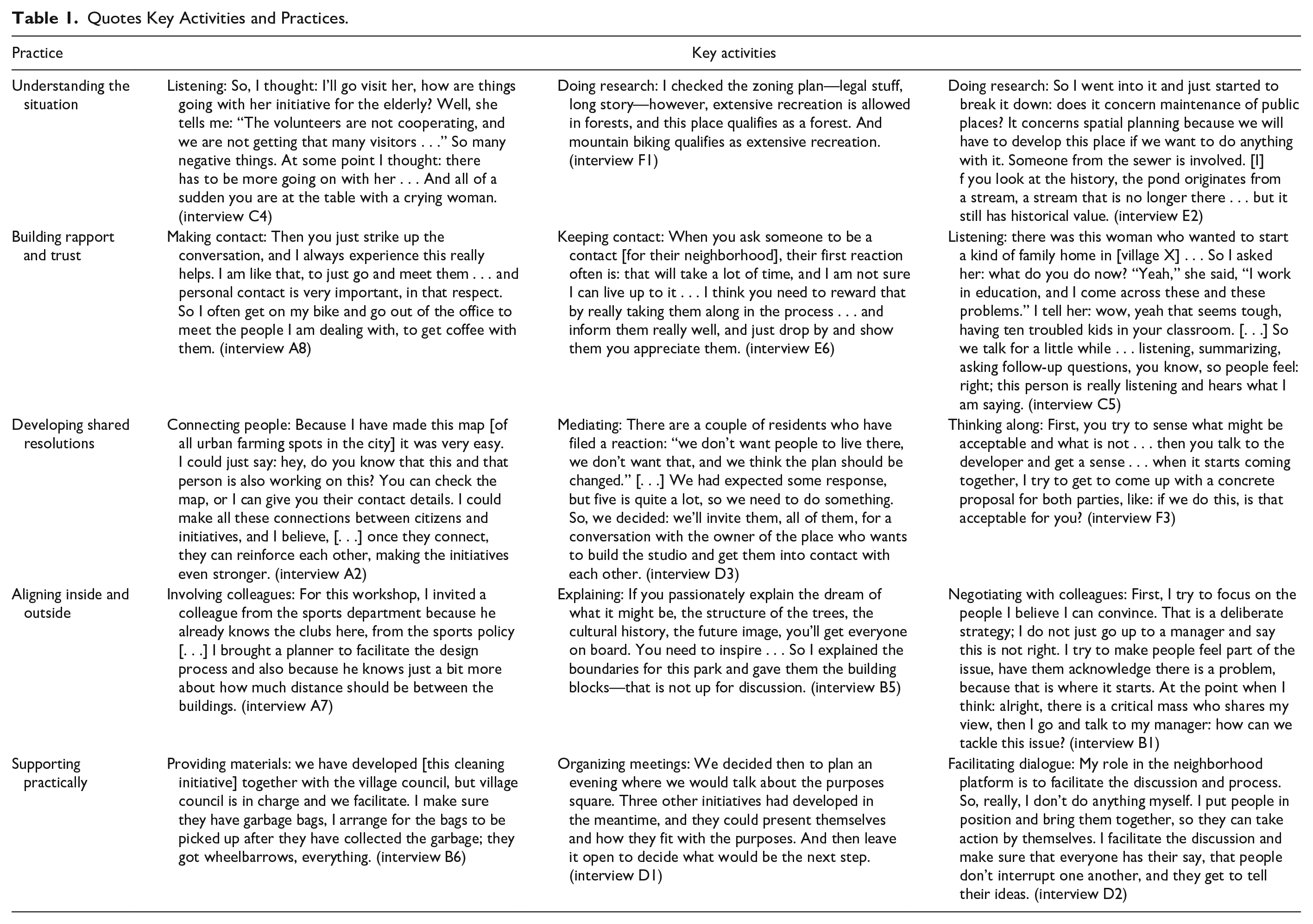
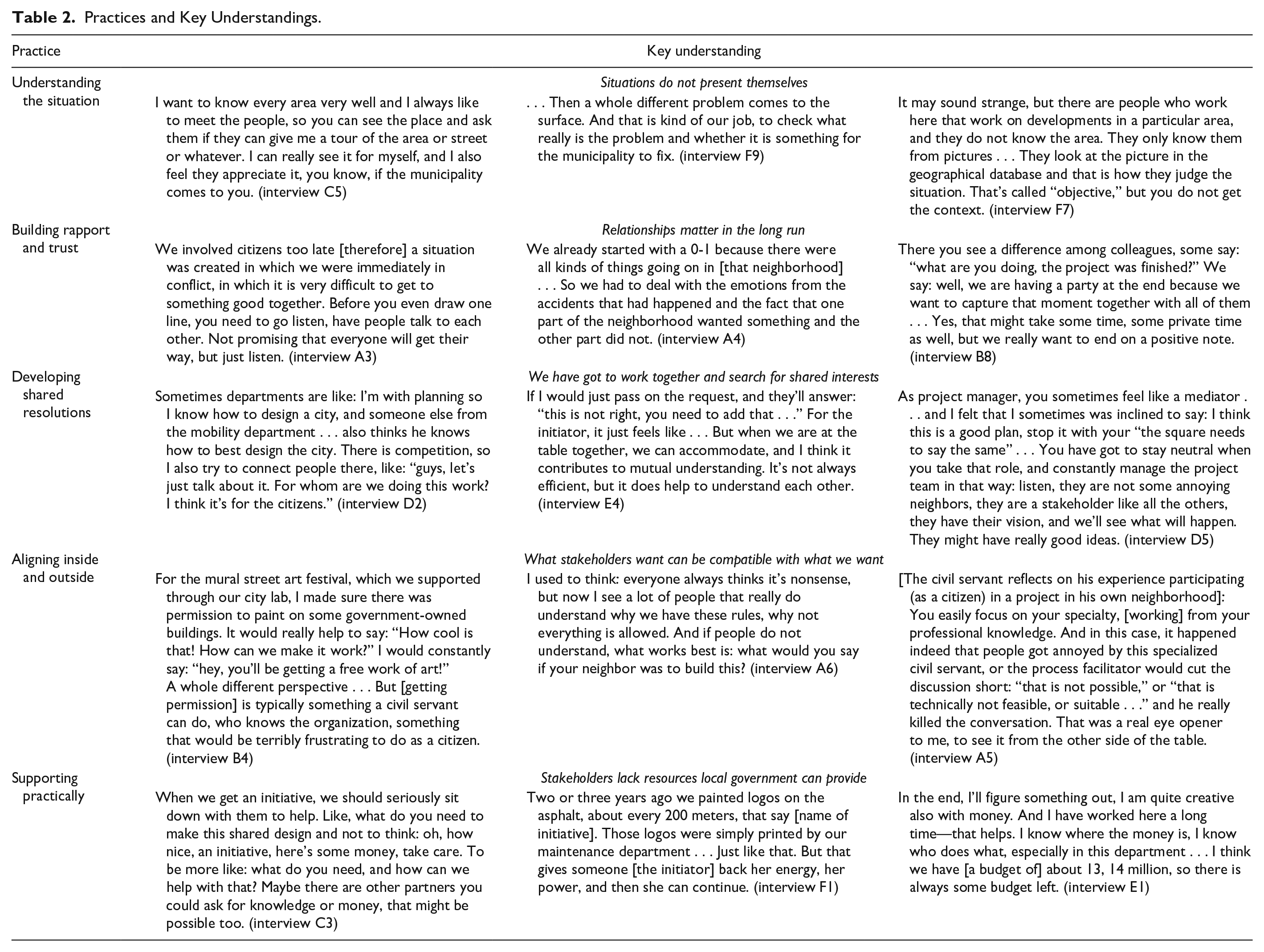
On the basis of our analysis, we now present five practices that the civil servants we talked to use in their work: understanding the situation, building rapport and trust, building shared resolutions, aligning processes “outside” and “inside” city hall, and practical support. We will now first discuss the five practices separately. Quotes from the interviews illustrate key activities (Table 1) and key understandings (Table 2) for each of the five practices.
Quotes Key Activities and Practices.
Practices and Key Understandings.
Understanding the Situation
Before deciding how to approach a specific situation, civil servants invariably try to gain a better understanding of it. Situations, the civil servants know, do not explain themselves: which actors and interests are—or should be—involved, what is actually at stake, and what are possible approaches? To answer these questions, the civil servants make contact with the citizens or relevant other stakeholders involved, preferably face to face. This allows them to see the situation for themselves and to listen carefully, often attempting to get at what is really at stake for the people they talk to. Neighborhood manager Fred,
2
for example, wanted to figure out why a group of citizens resisted an initiative for a mountain bike trail: First, I invited them here at the office a few times. Then they mentioned: “you should come watch; do you even know what it looks like?” When I get that signal, I’ll be the first to dive into it, and go visit. [. . .] So when we walked around the forest, I asked them to point out the things they enjoy so much—to get them into a positive mind set—and then asked what they feel is being threatened and why. I try to ask: how big are these groups? How often do they ride by? Do they make any noise? I already know all of these things myself, but I want to know what they are afraid of. You are almost like a psychologist.
Another part of understanding the situation happens inside city hall. Working on a case typically requires some research into the relevant rules, plans, and policies; the history of a particular site or case; the costs of a possible intervention; and what budgets are available. More often than not, this involves consulting colleagues with the right expertise. Figuring out which departments and colleagues are involved and how they feel about the situation is often part of this investigation as well (e.g., Table 1, Quotes F1 and E2). This enables the civil servant to imagine what can and should be done next.
Building Rapport and Trust
Engaging in face-to-face contact and listening not only serves the purpose of understanding a situation. It also helps building rapport with stakeholders and gaining their trust. Meeting people in person allows civil servants to demonstrate their interest in people’s (personal) situation, to create an informal atmosphere, to connect with people at a more personal level, and to show that they take them seriously (e.g., Table 1, Quotes A8 and C5). As a counterpart of listening, civil servants also need to explain policies and laws that are in place. Project manager Casper told us that when he sits at the table [with people] and gives them attention, [he] usually gets a lot further. People get to tell their story and you can put your side of the story on the table: why things just happen as they do in municipal organizations, whether you like it or not. There is an idea behind it, and if you explain that idea to them, you can see them thinking: “Yeah, that is also true. They have a point.” You generate some understanding.
Multiple civil servants stressed that such explaining is not a matter of talking down to citizens. Nowadays, you have to have a comprehensible, preferably even an inspiring story. As is illustrated in the clubhouse case in Box 2, building rapport does not end with merely meeting people. You need to keep in contact. The civil servants emphasize that it is important to stay in touch with citizens and inform them about the proceedings regarding their question, project, or process. This is important because political and bureaucratic processes can take a long time and citizens, in particular, might start to think that the municipality has forgotten about them (e.g., Table 1, Quote E6).
Example of a Case.
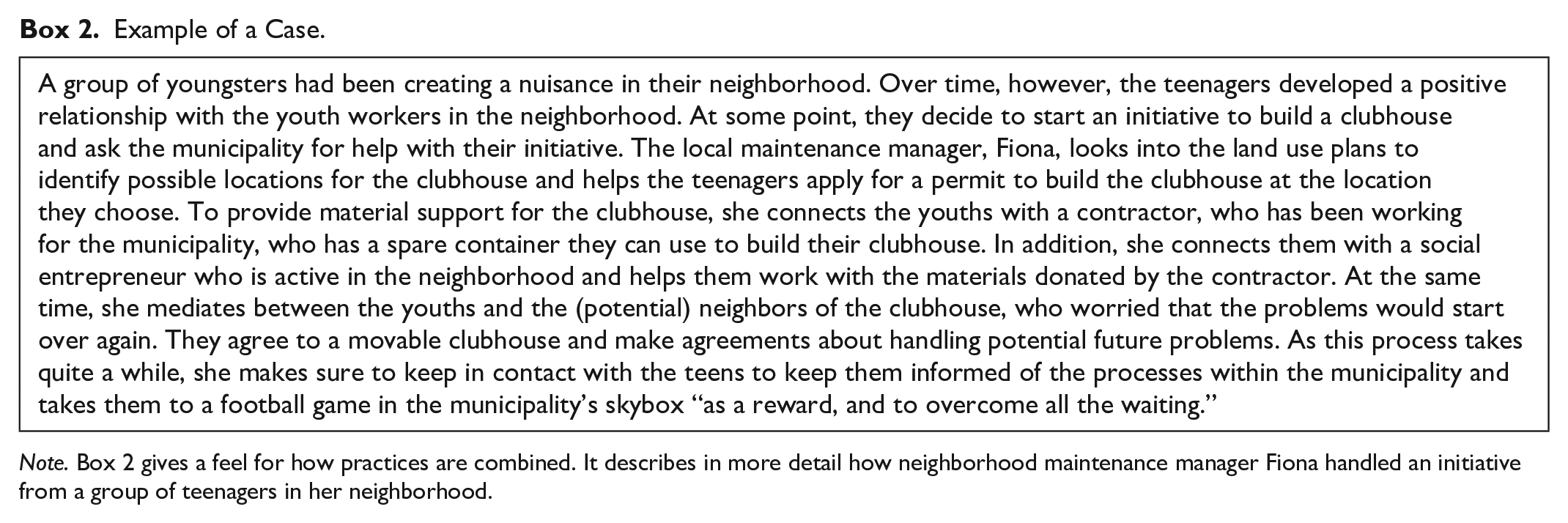
Note. Box 2 gives a feel for how practices are combined. It describes in more detail how neighborhood maintenance manager Fiona handled an initiative from a group of teenagers in her neighborhood.
Building rapport and trust is intrinsically important to most respondents, but it may also be a precondition for (future) cooperation. Several respondents, for example, talked about how they created space for emotions during meetings, to be able to move on toward solutions afterwards. Neighborhood maintenance manager Alex, for example, reflects on a project in which “at first, we wanted to let them draw and sketch a design, but we saw quite early on that that was one step too far. We first had to deal with the agitation in order to move on.” Through the interviews, we learned how new developments might cause some citizens to fear their neighborhood will change for the worse, and that distrust of local government, originating from failed expectations or negative experiences years before, surfaced during meetings.
Maintaining a positive relationship, therefore, is considered important. Project manager Bianca, for example, invested in the relationship with the residents of a street where she would lead a long-term construction process. She created an information stall in the neighborhood to create personal contact, and a Facebook page that featured stories of the progress in the project and personal stories of the people involved. She also provided the residents with a handcart they could use when they break open the pavement. She explains the following: We tried all these little things—you might wonder, does it really matter?—but they did create an atmosphere of togetherness, and that helps at those moments where it gets tense or things go wrong [. . .] because as a municipality, you will get back to the neighborhood, new things will pop up, and as a civil servant, you will be generalized. So I believe you need to leave on a positive note, for your colleagues.
Bianca’s efforts aimed at developing a productive understanding and collaboration not only during the project but also afterwards, as she realized that past interactions affect the future cooperation. In a nutshell, relationships matter in the long run.
Developing Shared Resolutions
Another practice civil servants employ is aimed at developing shared resolutions with the stakeholders involved in a specific project or issue. They know that they have to work together, and this has become a crucial value in itself. They think along with the citizens about how their ideas can be realized, their initiatives can be improved upon, and their complaints taken into account. For the “specialists” (civil servants who are specialized in a certain discipline or policy, like planners), this involves providing the citizens with relevant technical and substantive knowledge or skills. Thinking along may also include providing the citizens with strategic advice, for example, on where to find funding, or giving constructive criticism. If they do not have the relevant expertise themselves, they involve a colleague who does. In addition, they connect the people they engage with others who might have similar ideas, or bring them into contact with organizations, entrepreneurs, or others who may be able to help them. In the example in Box 2, for instance, a civil servant connected youths who wanted to develop a clubhouse in their neighborhood with a local contractor who provided them with the materials (see also Table 1, Quote A2).
In the majority of cases, the respondents interact with more than one stakeholder. They typically engage groups, whose members may have a different perspective on the matter. “Putting the neighborhood first” according to one neighborhood manager means “not just fighting for the interests of the residents [who want something], but trying to get all the interests into the open” (Feedback sessions, October 30, 2018). Respondents told us, for example, they routinely ask citizens who approach them with an initiative to demonstrate some form of broader support in the neighborhood. Stakeholders do not always reach consensus on their own. Community managers and policy advisors at times mediate between citizens when the initiative of one group leads to the protest of another. Box 2 shows, for example, how a civil servant mediated between local teenagers’ initiative for a clubhouse and worried residents living nearby.
Project managers and planners, in addition, are regularly confronted with conflicts between real estate developers and residents. Planner Arthur, for example, decided to step in on such a dispute between a developer and the residents, as “there is a gap—the developer is used to speaking this jargon, and they [the citizens] are not, so there I had to help them a little bit.” Knowledge and expertise are important in thinking along about possibilities and, ideally, crafting and proposing alternatives that incorporate or bridge the different perspectives and interests (e.g., Table 1, Quote F3). After speaking with the residents several times, planner Arthur proposed a resolution that was feasible for the developer and acceptable to the residents: “What if we, instead of two-tier houses with a pointed roof [. . .] build one-layer bungalows, and spread the houses over the location, around some kind of garden?” This resolution allowed the developer to build marketable houses, as planned, while at the same time satisfying the residents’ wishes to keep their spacious green view.
Aligning Inside and Outside
A fourth part of civil servants’ work involves trying to align ideas, initiatives, and complaints from outside city hall with formal policies, laws, processes, and resources (Wagenaar, 2004). Across the board, this means looking into and explaining the legal, technical, procedural, and substantive conditions under which ideas can be allowed or supported by local government and helping citizens to meet these conditions. Sometimes, this merely means helping a citizen to apply for a permit, or translating citizens’ ideas into technical language, like planner Arthur did, and translating them into official documents.
In other cases, aligning requires actively promoting an idea or initiative in the local bureaucracy, getting colleagues involved, and seeking connections with existing policies and associated budgets, to gain the permission or tools to realize it. This practice sometimes also involves aligning different interests and values within local government. For neighborhood manager Eddy, who wanted to support a community garden created by residents, for example, merely finding a budget was not enough to help realize the initiative. Eddy had to convince his colleagues in the real estate department that a particular lot could be used for a community initiative, rather than be sold or rented to a commercial party. To make things work, therefore, building rapport and trust with colleagues may be just as important as building trust with outside stakeholders (see Table 1, Quote B1, for another strategy). In addition, it may require crafting alternative solutions. Eddy, for example, reframed the community garden as “an allotment” for which a whole different set of rules would apply: I sometimes cycle by the allotments by the train tracks, and then it occurred to me: why don’t we say this place will be one big allotment? That’s municipal property. What rate would apply then? I looked it up in our files . . . and it turned out to be a whole different rate.
Civil servants like Eddy believe that often, what stakeholders want can be compatible with what the local bureaucracy and administration want, even though it may not seem so at first glance (see Table 2). The conflicting interests, however, did not just involved conflicts between colleagues. In several cases, the respondents were confronted with situations in which their own values or responsibilities were in conflict. For instance, traffic specialist Amber struggled with citizens who prefer visible, official interventions to deal with speeding over the behavioral interventions she prefers as an expert: We didn’t want these kinds of official signs, so you’ll have to find some form of middle ground between unofficial and a little official, they told us. So we showed them some examples we had seen in other cities, and asked them: what do you think of this? Do you want to design your own sign, do you want it to be like . . . Yeah, we left them many options. Anyway, it’s a good thing, you show your commitment, but it is also difficult . . . In principle, we want as little advertising and that kind of signs in public places as possible, but the aim of this pilot was to “let go.”
Such cases require civil servants to do a lot of explaining, thinking along with stakeholders about alternative ways to realize their wishes, or crafting alternative solutions that accommodate both the wishes of the stakeholder and the demands of local policies and laws. Sometimes, it requires the willingness to compromise on the side of the civil servant. To meet stakeholders’ wishes in a specific case, the civil servant might need to interpret rules and policies more broadly or adopt a solution that, from a professional viewpoint, might be not optimal. Civil servants, then, must not only develop an understanding of what is at stake for stakeholders but also critically reflect on their own position and carefully consider what is negotiable and what is not. Planner Arthur, for example, explained that he wanted to find a solution acceptable to the residents in their dispute with the developer, but he would not have accepted shutting down the project entirely, given the need for housing in the city. Neighborhood manager Eddy, in addition, emphasized that he would only support the community garden, as long as it would be open to all visitors, benefiting the neighborhood as a whole.
Supporting Practically
Finally, the civil servants also provide practical support for both the citizen engagement processes, as well as ideas and initiatives emerging from these interactions. Civil servants organize meetings to collect input from citizens on particular projects, policies, or developments, or encourage them to develop initiatives themselves and facilitate dialogue between the participants in these meetings. Understanding the situation, building rapport and trust, developing shared resolutions with citizens and other stakeholders, and aligning inside and outside regularly build up to supporting the initiative and ideas emerging from citizen engagement and stakeholder collaborations. Often, civil servants facilitate the initiators with material resources such as supplies, by suggesting a location to meet, or by hosting an event. Or they support ideas and projects by providing (partial) funding. Table 1 provides several examples. Returning to neighborhood manager Eddy and “his” community garden, he finally managed to facilitate them realizing their plans by directing the initiators of the garden to an additional funding opportunity: I had gotten some funding from the province for [a different neighborhood garden project]. That was not going very fast at the start—it started at about the same time as [the community garden initiative]—so I contacted the province to see if the funding could not be spent more broadly. Yes, it could. So that’s how I managed in the end; you have to be creative and persistent.
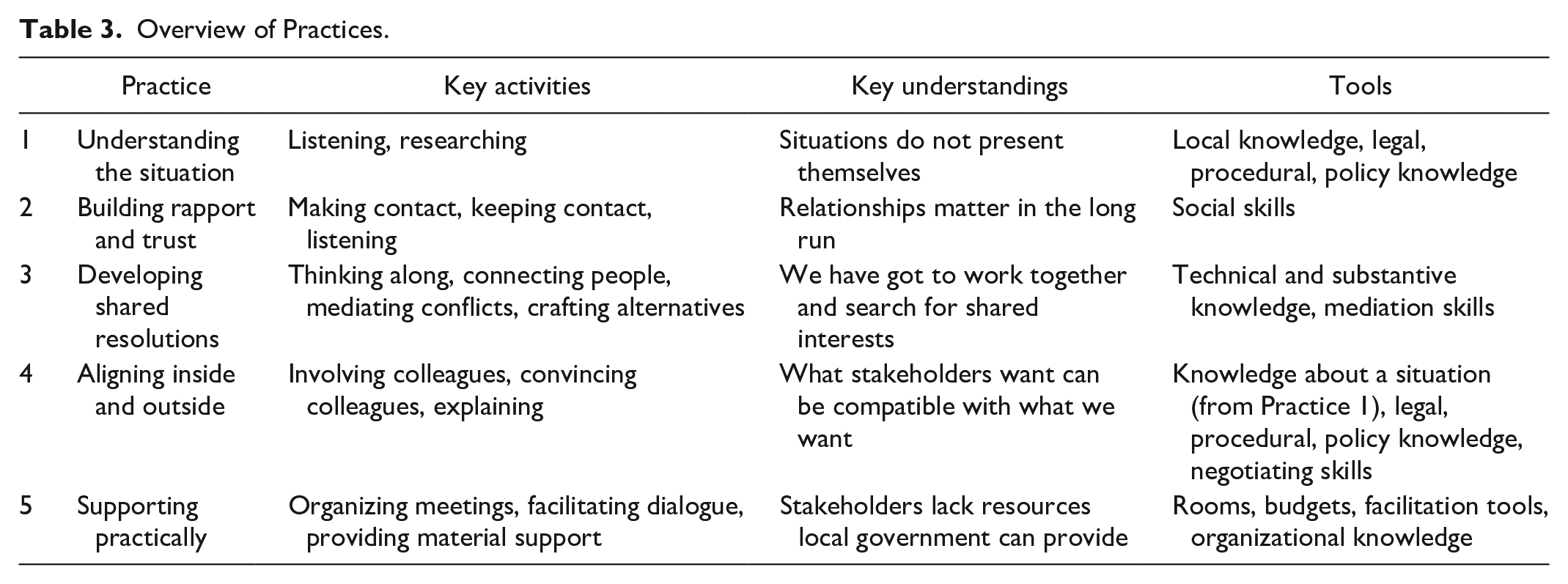
In sum, civil servants know the local government can provide stakeholders with resources to give their ideas and initiatives a push, although they sometimes have to be “creative and persistent” to access them. In Table 3, we present an overview of the five practices with their key activities, key understandings, and important tools.
Overview of Practices.
Discussion and Conclusion
Now that we have described, in detail, the practices of the civil servants we studied, we want to discuss what the work of these frontline workers entails at a more abstract level. First, confirming previous research (Bartels, 2013; Laws & Forester, 2015; Wagenaar, 2004), the work of civil servants in public engagement is interactive and relational through and through. The key understandings of the practices we encountered are all about the importance of connecting and connectivity (Edelenbos & van Meerkerk, 2015). The public good, in line with this, is not an institutional given. The meaning of the public good is for the civil servants we talked to, is often emerging from the process of engagement. Illustrative of this development is the need for specialists to directly ask the public what they want, instead of relying on their own expertise. Moreover, understanding what is at stake, developing shared resolutions, and aligning inside and outside presuppose a commitment to understanding others and taking their perspective into account throughout the processes of governing. The work, rooted in earlier interactions, is propelled by further interactions and oftentimes infused with emotions and (dis)trust. Building rapport and trust, then, is not only a normative but also often a practical necessity. This requires civil servants to “presume less, probe more, announce less and listen more” (Laws & Forester, 2015, p. 343), and start from an “attitude of caring involvement, inquiry, and wonder” (Forester, 1989, p. 111).
Second, this relational image does apply not only to encounters between civil servants and agents outside the organization but also to what civil servants do in their own organizations to make engagement work. While the focus of much research on the frontline workers has been on the encounter between frontline workers and their clients (Lipsky, 1980), our fieldwork and analysis brought us to further investigate the embeddedness of civil servants’ agency in their organization and to peer relations (Nisar & Maroulis, 2017). This has been undertheorized in some of the best research on frontline work (e.g., Bartels, 2013; Maynard-Moody & Musheno, 2003). The civil servants need their colleagues to collaborate with them as they often do not have a direct mandate or large budgets at their disposal. They need the involvement of their colleagues, “their” permission or resources, because the ideas, initiatives, and complaints from the public often do not (yet) have a place in policy plans and budgets.
These observations also broaden our understanding of citizen engagement by developing better understanding of how “front-stage” encounters with citizens, in part, depend on work that happens “back stage,” within the municipal organization (Escobar, 2015). They show how, in practice, different government roles and values can be connected and aligned (Kruyen & Van Genugten, 2020; Maynard-Moody & Musheno, 2003; Rhodes, 2016; Vaegemose et al., 2018). The rules and policies, the interests of different local government departments, and civil servants’ professional opinions are also vital ingredients of the emergent public good.
A third general point is that the work of civil servants engaging citizens could indeed be better understood in terms of agency (highly interactive and partly improvisational) than in terms of discretion (Maynard-Moody & Musheno, 2012). The practices do not form an organizational rulebook that practitioners follow. The practices and activities that are key to them are not conducted in a neat sequence. They might even take place simultaneously, like when a civil servant is listening to both understand a problem and build a relation (compare Forester, 1989). They are part of civil servants’ repertoire.
Furthermore, civil servants know that an entrepreneurial and improvisational way of working can help them get the job done. To be more specific, their work is like that of the bricoleur, who is able to make do with the limited resources available. The concept of bricolage highlights how the civil servants draw up on existing resources—material, cognitive, social, and institutional—when they improvise (Bechky & Okhuysen, 2011). Bricoleurs “bring to the dialogue the experiences, ideas, methods, and scenarios that they can imagine and then jointly piece them together to create a strategy on which all can agree” (Innes & Booher, 1999, p. 9) when they develop shared resolutions and align inside and outside. They attempt to connect ideas from outside with people, policy agendas, events, and budgets in city hall to gain the tools—budgets, materials, permission—to realize these ideas, to make them acceptable and feasible. To be sure, this is hard work and civil servants are not always able to make collaborations successful. They may be confronted with clashing values and perspectives or be hampered by boundaries of the local bureaucracy. Still, these different values and perspectives, rules, and policies not only constrain but also enable the civil servants in their engagement work.
To sum up, public engagement has become an increasingly important aspect of local governance in the Netherlands and many other (Western) European countries and the United States. Recent public administration research has pointed out the crucial role of (frontline) civil servants in present-day public engagement, and highlighted the need for the “21st century public service workforce” to adopt new roles and skills to manage these processes. Our data and analyses build on the existing literature and contribute to it by exploring how civil servants make sense of and fulfill their role in public engagement in practice. We specified five key practices. Together, these practices form a generic, coherent picture of the everyday work of frontline civil servants in public engagement. This picture expands our understanding of the relational and improvisational character of public engagement, and how it is part and parcel of civil servants’ broader work context.
We want to end this article by indicating some of the limits of our research and possibilities for future research. First, our research has been limited by the context of Dutch local government. To be sure, with 45 interviewees working in six different municipalities, our research evidenced substantial variety. Also, we do not claim that the practices we encountered are engaged in by each and every civil servant working on the front line of local government. We do not believe that in practice in the average Dutch municipality collaboratively creating the city is a dominant way of doing, yet cities in the Netherlands have been at least increasingly expected to engage in a joined search for the public good.
Even if the shift we bring in focus is also taking place elsewhere (e.g., Denhardt & Denhardt, 2015; Nabatchi & Blomgren Amsler, 2014; Osborne, 2010; Torfing et al., 2012), public engagement takes on particular forms in particular contexts, and thus, civil servants in other contexts will deal with ideas, initiatives, and complaints in similar but also different ways. We do believe, however, that this study provides an analytical understanding of how interactive governance unfolds in practice, through the work of civil servants, that is also relevant to (civil servants in) other countries and domains. In future research, the study and comparison with other contexts might help us understand practices better and capture further (other) developments.
Second, we studied the practices of civil servants at the frontlines: neighborhood managers, policy advisors, and project managers in particular. We searched for their general practices and demeanor when they engage the public. It would be interesting to compare their practices with those of other frontline workers engaging the public. How do these practitioners deal with new demands and expectations? We found, in addition, that cooperation between civil servants is vital in making public engagement work. Future research may explore in more detail how civil servants in different roles and positions work together and divide tasks. In addition, we looked at the work in public engagement from the perspective of civil servants, how they make sense of the situations, their role, and the situations they encounter (Maynard-Moody & Musheno, 2003). It would be, furthermore, interesting to see the practices of frontline workers from the perspective of citizens and other stakeholders, which will likely reveal a different, additional narrative (Aschhoff & Vogel, 2019). This might also help to highlight the ways in which civil servants and local governments fail to take “their” public into account.
Finally, there are limits in the methodology and methods that we employed. Our analyses were primarily based on semi-structured interviews within an interpretive framework. This allowed us to zoom in on the details of the work and understand the work from the position of those who do it. Interviews, however, make you dependent on those experiences and ideas that interviewees are able and willing to make explicit. It would be useful to complement the interview approach with other strategies, like ethnographic fieldwork, that would allow an even deeper immersion into the world of present-day civil service. Alternatively, researchers might develop survey or experimental strategies to better understand the ever-evolving practices of those who serve and engage the public.
Footnotes
Acknowledgements
We would like to thank Frank Hendriks, Peter Kruyen, Rod Rhodes, John Forester, the members of the panel on Critical and Interpretive Policy Analysis during the Netherlands Institute of Government (NIG) conference (2018, The Hague) and members of the panel on Facilitation at the International Conference on Public Policy (ICPP4) conference (2019, Montreal) for their thoughts and feedback on earlier versions of this article. In addition, we appreciate the encouragement and critical reflections on our initial findings by the civil servants participating in the feedback sessions in Dutch local governments, and thank A&O Fonds Gemeenten, The Association of Netherlands Municipalities/Vereniging van Nederlandse Gemeenten (VNG), and the Ministry of the Interior and Kingdom Relations for making these sessions possible. Finally, we are grateful for the comments provided by the anonymous reviewers of this journal.
Declaration of Conflicting Interests
The author(s) declared no potential conflicts of interest with respect to the research, authorship, and/or publication of this article.
Funding
The author(s) disclosed receipt of the following financial support for the research, authorship and/or publication of this article: The research was conducted in the context of a consortium of six local governments, A&O Fonds Gemeenten, The Association of Netherlands Municipalities/Vereniging van Nederlandse Gemeenten (VNG), the Dutch Ministry of the Interior and Kingdom Relations and Tilburg University. All parties involved contributed financial support and other means to conduct the research. The independence of the researchers was safeguarded through contracts.
