




Abstract
This article deals with the evolution of community self-organization in public administration. Within the literature of interactive governance, increasing attention is being paid to how communities take initiative in dealing with societal issues. However, we know little about the factors contributing to the durability of self-organization. We analyzed three cases of community self-organization in three different countries: the United Kingdom, the United States, and the Netherlands. We found that community self-organization initiatives are strongly embedded in governmental environments, leading to different modes of interaction that change from phase to phase and in response to reciptiveness (or the lack thereof) among government counterparts. These modes of interaction strongly influence the evolution of community self-organization efforts. Moreover, we conclude that it is important that self-organized citizen initiatives represent and capture the perspectives and interests of large groups of citizens. This condition positively influences the evolution and duration of citizen initiatives. Those who manage to link with other citizens, including via community and volunteer organizations, can succeed. Those who do not can lose their legitimacy and fail.
Introduction
With today’s focus on “smaller government” and “bigger society” (Kisby, 2010), civil society is increasingly self-reliant and self-organizing. In addition to what are often political and opportunistic ambitions, we are witnessing a fundamental change in civic engagement around public affairs, leading to new forms of community self-organization that directly address or advance what might traditionally have been considered public policies (Bang, 2009; Marien, Hooghe, & Quintelier, 2010; Stolle & Hooghe, 2005). In a break from traditional forms of citizen engagement within institutions dominated by government agencies, active citizens increasingly want to engage in informal and loosely structured organizations to advance their agendas in the public sphere. That is, they are assuming direct responsibility for policy making (Bevir, 2009). Citizens want civic engagement in public administration on their own terms, interacting with and using the tools of formal government when it advances their objectives.
Although our knowledge of the different styles and new forms of citizenship and community action is increasing (e.g., C. King & Cruickshank, 2012; Marien et al., 2010; Matarrita-Cascante & Brennan, 2012), we know little about how self-organizing citizen groups effectively emerge and interact with existing political and governmental institutions to shape public policy and provide public services (Stolle & Hooghe, 2005). There is a related literature on co-production (Bovaird & Löffler, 2012; Brandsen, Pesthoff, & Verschuere, 2012; Florin & Wandersman, 1990; Ostrander, 2013; Voorberg, Bekkers, & Tummers, 2015), but we have little insight into the interactive dynamics between citizens and governmental institutions during different phases of community self-organization in policy making and public administration. Citizen-driven efforts typically rely on public resources, raising important questions around how truly independent and citizen-driven they can be while remaining interconnected with traditional formal institutions and government bodies (Healey, 2014).
This article provides insights into how community organizations engaging in public policy making and administration evolve through time in interaction with wider local communities and formal governmental institutions. It contributes to the relatively thin literature on citizen self-organization in policy making and public administration. The core question this article addresses is “How do community self-organization initiatives evolve vis-à-vis existing governmental institutions, and which factors influence their persistence or disappearance over time?” To answer this question, we conducted case study research on community self-organization initiatives in three countries: The Netherlands, the United Kingdom, and the United States. These unique cases allow us to uncover common patterns that go beyond a single country or governance issue. We specifically pay attention to the evolution of self-organization as such a longitudinal perspective is rather unexplored in the literature.
In the next section, we discuss our theoretical framework, which is rooted in the shift from traditional participation toward citizen self-organization in the realm of public administration and policy making. In the “Analytical Framework and Research Approach” section, we present our analytical framework, measurement, and research methodology. We then examine the case studies in the “Case Analysis” section, followed by a discussion in the “Cross-Case Observations” section. We conclude with a set of insights drawn from this research.
Conceptualizing Self-Organization
The concept of self-organization emerged from the natural sciences, and especially complex systems thinking (Wagenaar, 2007). It is broadly described as the emergence of new structures (“order”) out of “chaos” (Prigogine & Stengers, 1984). Notions of complexity have not remained exclusively within natural sciences, but have also influenced the social sciences and, more specifically, policy making and public administration (e.g., De Roo & Silva, 2010; Teisman, van Buuren, & Gerrits, 2009; van Meerkerk, van Boonstra, & Edelenbos, 2013; Wagenaar, 2007). Complexity thinking views systems as being in continuous flux, emphasizing the continuous interactions between different elements forming a system. Self-organization is defined here as the emergence and maintenance of structures out of local interaction, an emergence that is not imposed or determined by one single actor, but is rather the result of a multitude of complex and non-linear interactions between various elements (Cilliers, 1998; Heylighen, 2001; Jantsch, 1980).
In this article, we refer to self-organization as bottom-up initiatives that are community-driven and aim to advance public administration and policy making via sustainable models of cooperation among citizens.
Contrast With Traditional Approaches to Policy Making and Public Administration
Community self-organization represents a shift from traditional forms of government-centered citizen consultation toward more active forms of citizenship in which members of the public engage in informal and loosely structured organizations to advance their policy agendas and engage directly in public administration (Bang, 2009; Stolle & Hooghe, 2005). This turn can be positioned in a longer tradition of interactive or participatory policy making (Edelenbos & van Meerkerk, 2016). Governments have employed various approaches to involve citizens in decision making, including citizen panels, citizen juries, citizen charters, mutual gains negotiations, and participatory planning (e.g., Dryzek, 2010; Innes & Booher, 2010; Lowndes, Pratchett, & Stoker, 2001; Susskind & Field, 1996). These participatory instruments and approaches are largely focused on increasing support, democratic legitimacy, and the quality of decisions made (Innes & Booher, 2010; L. A. King, 2003; Sørensen & Torfing, 2007). Citizen participation is approached as a process in which individuals take part in decision making in the institutions and programs that affect them (Florin & Wandersman, 1990). A core aspect of these more conventional approaches to participation is that governments typically decide when and under which conditions citizens become participants, and the degree to which their suggestions are adopted in what are otherwise governmentally regulated and controlled policy-making processes (C. King & Cruickshank, 2012). There is no inherent right or opportunity to be involved; the terms of participation are continuously negotiated when citizens contest existing forms of exclusion that are based on political and administrative choices (Sørensen, 2002).
While conventional engagement processes can be very well run and empower those participating, citizens are often not satisfied with the strictly conditioned rules of engagement, particularly when their degree of influence in decision making turns out to be low (Lowndes et al., 2001). Citizens often feel that their issues are not being addressed. Some respond by taking the lead in developing their own spaces to generate governance ideas and initiatives (van Meerkerk et al., 2013). In this respect, community self-organization is different from government-led participatory efforts (C. King & Cruickshank, 2012), as citizens determine the content—the subject matter, priorities, and plans—and the processes under which their engagement takes place. Citizens organize themselves in local groups and engage in forms of collective action somewhat independently from, or in reaction to, government-led processes or structures (Edelenbos & van Meerkerk, 2016). However, they harness the instruments of the state to further their objectives.
To avoid being marginalized as exclusively negative, citizens develop alternatives to government proposals. Community self-organization also emerges in arenas of policy and public administration that governments withdraw from due to budget cuts, and in domains that have “slipped” from governmental attention (Barnes, 1999). Self-organization also arises to address market deficits in meeting citizens’ needs or concerns, for example, within the health care and energy sectors (e.g., Healey, 2014). Common purpose, a shared “enemy” or external threat, and social solidarity to defend shared values and interests are important properties of community self-organization (e.g., van Meerkerk et al., 2013).
So, we approach self-organization as distinct from participation. However, participation and citizen initiatives are not mutually exclusive; participatory processes can develop into self-organizing efforts, and self-organization can be “mainstreamed” or institutionalized into formal government-led processes (C. King & Cruickshank, 2012). The type of citizen self-organization that we are focused on here must also be differentiated from the more conventional activities of non-governmental organizations—like awareness campaigns promoting cycling, a food drive to collect goods for the poor, or lobbying efforts to influence policies. Participatory budgeting can be considered a blend between participation and self-organization as ordinary people decide how to allocate part of a municipal or public budget (Couza, 2001).
Community self-organization must also be differentiated from conventional community organizing and development, which aims to empower marginalized communities in opposition to the state (Bhattacharyya, 2004; Chavis & Wandersman, 1990; Matarrita-Cascante & Brennan, 2012; Saegert, 2006). In this body of literature, interaction with governmental actors is oftentimes excluded, as the focus is on voluntary cooperation and self-help among residents of a particular locale. However, there is some literature focusing on mobilizing external resources and support (Fawcett et al., 1995; C. King & Cruickshank, 2012). We are especially interested in the interplay between community-led initiatives and governmental institutions in explaining the evolution of community self-organization.
The Emergence and Meaning of Self-Organization in the Realm of Public Administration and Policy
Some, including Putnam (2000), argue that civic engagement is declining in western societies. Others, like Dalton (2008) and Bang (2009), claim that civic engagement is still present but manifests in different and new forms. Importantly, citizens no longer identify themselves as much with the traditional institutions of representative democracy (Dalton, 2008). Some take the initiative to engage in public or political affairs outside traditional representative institutions, in ways more directly connected to their personal lives (Bang, 2009; Stolle & Hooghe, 2005).
In this view, citizens’ collective efforts can be understood as self-organization, leading to the emergence of new ways of working—that is, new rules and procedures developed in interaction among citizens (Edelenbos, Schie, & van Gerrits, 2010; van Meerkerk et al., 2013). As discussed above, self-organization is the emergence and maintenance of structures of governance from local interactions, seen from a complex systems perspective. However, from a governance perspective, self-organizing processes do not take place in an institutional vacuum; there is always some interplay between citizen initiatives and governmental bodies (Edelenbos, Klok, & van Tatenhove, 2009). Self-organization approached and treated as a governance concept implies that self-organized action emerges without direct pressure, but not without the presence of governmental bodies (Pierre & Peters, 2000). This leads to certain interactions between citizen initiatives and institutions of representative democracy (Mansbridge, 2003).
The turn toward citizen-led efforts is not conceptually new, but there has been surprisingly little scholarship on how it works in practice. Arnstein introduced her widely cited “Ladder of Citizen Participation” in 1969, which normatively places citizen control at the highest rung. Fung (2006) provided an updated framework for categorizing the varieties of public participation, suggesting that they may be situated along three axes in a “democracy cube”: Who participates, how participants communicate and make decisions, and the relationship between participatory efforts and actual policies and power. The citizen-led efforts discussed in this article may be situated at “deliberate and negotiate” on the “communication and decision mode” axis, and “co-govern” on the “authority and power” one. Their place on the “participants” axis is variable. Although the “authority and power” axis of Fung’s democracy cube touches upon the relationship with existing institutions, neither Arnstein nor Fung explicitly discuss how citizen control interacts and evolves with public administration. Furthermore, limited examples of citizen control or citizen-led forms of shared governance have been documented (see Hendriks, Bolitho, & Foulkes, 2013; Ostrander, 2013; Peruzzotti, 2012). We argue that the development of community self-organization is subjected to push-pull processes between citizens and government and that we need to gain more understanding of these interactive relationships.
Analytical Framework and Research Approach
Analytical Framework
We are interested in the evolution and durability of citizen self-organization through time. As argued in the “Conceptualizing Self-Organization” section above, this evolution does not take place in institutional voids; it involves ongoing interplay between citizen initiatives on one hand and governmental actors on the other. In other words, the dynamics and development of community self-organization efforts can be framed as co-evolutionary (or devolutionary in some cases). It is thus important that we pay attention to the actions and responses of actors from both citizen self-organization initiatives and the associated government agencies in our case description and analysis.
This research focuses on the interactions and communication processes between governmental actors and citizen initiatives. We are especially interested in the interactive dynamics (the process level) and do not focus on the governance regime level (cf. Emerson, Nabatchi, & Balogh, 2012). We analyze the ways in which actors from citizen initiatives responded to the actions of governmental institutions—including both civil servants and politicians—and vice versa. We analyze how each initiative evolved over a period of time.
Both citizen initiatives and governmental actors exercise choice and autonomy about how to act in mutual relationships (Ostrander, 2013). In this interplay, we distinguish between two dimensions of agency: (a) actors’ attitudes and (b) behaviors. Attitude and behavior are important dimensions of agency in explaining the evolution of interaction in (shared forms of) governance (Emerson et al., 2012; Ostrander, 2013).
Figure 1 typifies relationships on these two axes. The resulting four quadrants—stimulation, avoidance, co-production, and co-destruction—are illustrative of the types of relationships that theoretically may exist between citizen self-organization initiatives and government bodies. In this figure, we make a distinction between positive and negative attitudes, and passive versus active behaviors. The positive and negative stance can be combined with active or passive behavior, resulting in the grid displayed.
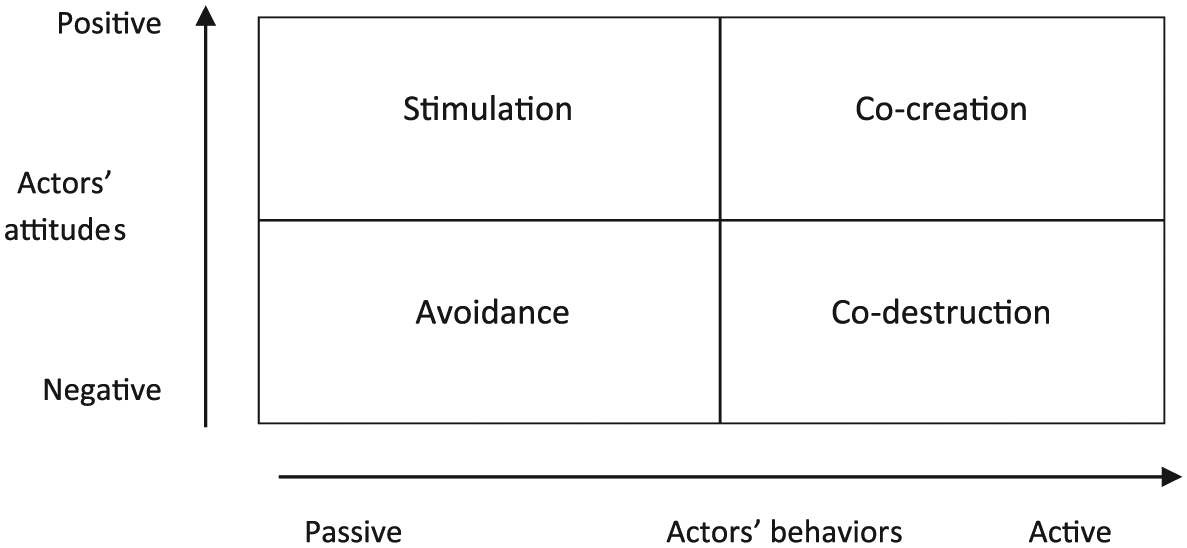
Typology of relationships between citizen initiatives and government bodies.
A stimulating relationship is one in which the self-organization initiative and/or governmental body shows a positive attitude to the other, but is relatively passive in behavior. Representatives from government and self-organizations are generally supportive and receptive of each other’s actions, but are not actively involved in them; they show support and commitment in a passive way, but do not interfere and provide room to operate. Co-creation involves a much more active relationship in which the actors are engaged in developing a process collaboratively. On the other side, avoidance is the combination of negative attitude and passive behavior; in this situation, the actors are not open for collaboration or power-sharing. Actors view each other negatively, but not act on their objections, giving benefit of the doubt and avoiding negative interaction. Co-destruction is typified by negative stances and active behavior; this combination leads to active opposition, with each side discrediting and damaging the efforts of the other.
These dimensions are considered across time in each case so that we may better understand the evolution of the examined self-organization efforts. The temporal aspect is operationalized in rounds (cf. Teisman, 2000). A round is defined as a time period in which a coherent set of topic(s) or issue(s) is dealt with. Rounds are distinguished by a crucial decision or event (e.g., the involvement of a new actor), as defined by the researchers in retrospect, but based on the reconstruction of the process by the actors involved. Each crucial decision or event marks the beginning of a new round, and generally serves as a focal point of reference for the actors involved.
Research Approach and Methodology
We use a multiple case study research strategy, examining three cases of community self-organization to examine potential patterns in the evolution of self-organization initiatives (Stake, 1998). We use a combination of instrumental and conventional case study research methods (cf. Stake, 1998; Yin, 1984). The instrumental case study approach is applied to explore a particular phenomenon: The evolution (and devolution) of community self-organization. We explicitly use a conventional case study strategy because our ambition is to gain insights and find patterns in the evolutions of these cases, contributing to theory building around self-organization. This type of research does not, and cannot, yield generalizable empirical knowledge about citizen initiatives, but it does provide a detailed and contextualized understanding of how the evolution of community self-organization might take place. We follow a multiple case study approach, as evidence from multiple case studies is more compelling than drawing from a single case (Stake, 1998).
This article draws from three cases: Caterham Barracks in the United Kingdom, Federation Broekpolder in the Netherlands, and the Cambridge Climate Emergency Congress (CCEC) in the United States. We wanted to have cases that were truly community-driven and in which governmental institutions were involved (at certain moments in time) as we want to study the evolution of citizen initiatives in interaction with governmental institutions. All three selected cases involve self-organized action by citizens that demanded responses from governmental institutions. The Cambridge case involves addressing climate change at the local level, the Broekpolder case focuses on environmental planning, and the Caterham case revolves around city planning. Although the contexts in which the self-organization took place differ, we are not focused on comparing the governance regimes of these three countries. We want to go beyond specific contexts to identify potential patterns in the interactive dynamics between citizen initiatives and governments. Hence, this study should not be seen so much as comparative research, but rather as contrasting case studies, from which we are able to derive important insights into the evolution of citizens’ self-organization efforts and their interplay with governmental institutions. These cases are not particularly extraordinary for each of the three countries; in the United States, a long tradition of citizen engagement and community involvement exists (Forester, 1999; Fung, 2006; Mansbridge, 1983), as in the United Kingdom in, for example, community trusts (van Meerkerk et al., 2013), and the Netherlands in a government culture of consultation and participation (Edelenbos, 2005). So, other examples of policy making and public administration driven by citizen groups surely exist. Nonetheless, these initiatives are underexplored in the literature. These three cases were chosen because they are familiar to the authors (a convenience sample) as archetypes of the kind of initiative this article examines. Moreover, the authors were involved in the longitudinal study of the three cases, which provides them with direct insights into how the three cases evolved over time. This type of longitudinal case study is time-consuming, which limits the number of cases that can be examined.
Data were collected through a combination of interviews, participant observation, and document analysis. Written documents analyzed included memos, reports of council meetings, newsletters, proposals, websites, policy documents, and statutory instruments. Key players in all three cases were interviewed, including individuals active in the citizen initiatives (community leaders and other members), civil servants from the local authorities, council members, developers, and other involved governmental agencies. Our main goal was to interview a diverse range of actors representing civil society, government institutions, process facilitators, and unaffiliated private individuals (including those from the private sector). Key informants participated in multiple interviews during the data collection period (see table 1).
Overview and Spread of Type of Respondents per Case Study.
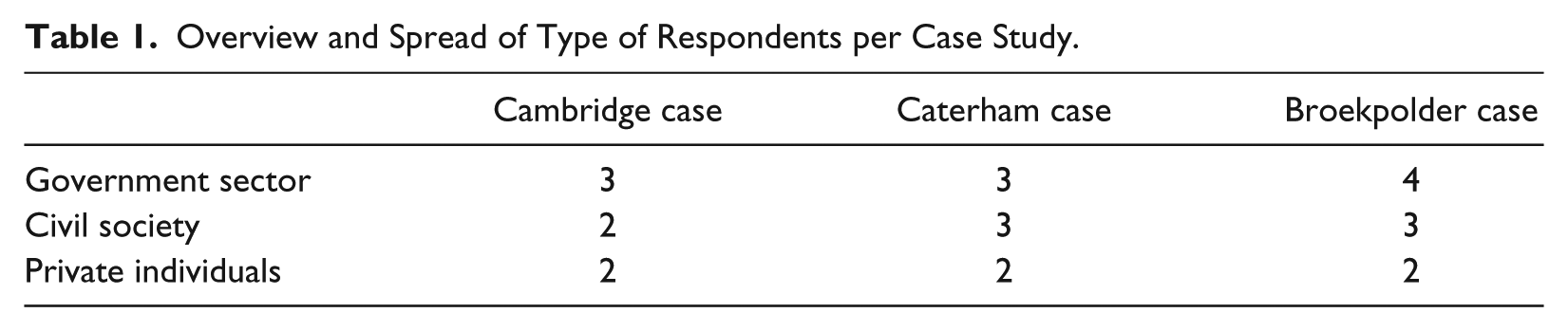
In the Cambridge case, seven individuals participated in in-depth, semi-structured interviews. Eight people were interviewed regarding the Caterham Barracks case. In the Broekpolder case, nine people participated in semi-structured interviews. The interview protocols followed were designed to enhance our understanding of the interactions between the citizen initiative and the local government, including a reconstruction of the interaction process, actors’ attitudes toward each other and toward the citizen initiative, and what each actor did during the evolution of the citizen initiative.
The first phase of case analysis involved examining the data on each independently. The authors each examined a case, dividing it into temporal rounds, and characterizing the relationships in each round vis-à-vis the relationship typology introduced above (Figure 1). We use these different rounds to describe and analyze the evolution of the interactive processes between the citizen initiatives and local governments. Once this initial analysis was completed, the authors collectively examined the three cases. In three rounds of discussion between the three researchers (each responsible for one case), the case descriptions were elaborated and analyses were deepened, finding an equal level of analysis to identify patterns across the three cases.
Case Analysis
In this section, we analyze the three cases, using the categories introduced in Figure 1 to structure the analysis. We examine the relationships between citizens and governmental actors in rounds (i.e., discrete time frames) to illustrate and examine how interactions and communication evolved longitudinally.
Case 1: Federation Broekpolder
The first round took place between 2002 and 2006. Citizens opposed plans by the regional government (province of South-Holland) to designate the Broekpolder area as a location for “rural living” and to build country houses. This plan fermented significant opposition in the local community of Vlaardingen, which resulted in 10,000 signatures against the country houses. The government subsequently decided not to take any action until 2010. Citizens wanted this area to remain undeveloped, to provide leisure, sport, and educational opportunities. They also proposed that they develop and maintain the area directly as a community organization. In response, the council agreed to provide more opportunity for local engagement and self-organization. This idea grew from a small group of involved citizens, a strategic advisor in the civil service, and an alderman.
The second round ran from 2007 to 2008. In this round, the citizen group took the lead to further elaborate the governance experiment in cooperation with the mayor and aldermen. They came up with the idea to develop a covenant to formalize agreements and conditions concerning the extent and form of the citizen initiative. The civil servant, alderman, and leading citizens worked closely to jointly develop a policy note that later evolved into a social contract in which the citizens’ initiative (Federation Broekpolder) and its relationships with the municipality (civil service, mayor and alderman, and city council) were elaborated (co-creation). The Federation organized a role-play simulation exercise to jointly experiment with their new roles and tackle the questions and uncertainties that were raised during the council meeting. As the president of the Federation notes, this role-play was meant to “show what the consequences would be of working with [the proposed model in the covenant].” The Federation received a budget for their organization and the maintenance and development of the area (stimulation). In this phase, city councillors kept distance, and were not inclined to get closely involved in this process as they wanted to maintain room for political maneuvering (avoidance). Some council members feared “making a decision from which they could not withdraw later on,” as one councillor expressed. The civil service also kept some distance, as they did not want to get involved in a time-consuming role assisting the self-organization.
In the third round (2009-March 2010), the Federation had the task of developing a formal plan—the Integrated Area Development and Maintenance Plan—to (re)develop and maintain the area. The Plan was prepared and developed by prioritizing a few projects: The development of a core nature area, archaeological education center, activity forest, and small harbor. In this round, the citizen initiative was discussed a couple of times in the city council. They urged that the development of the plan include representatives from a broader set of citizens of Vlaardingen. “It is important that the interest and ambitions are shared by larger population than the insiders in the community imitative,” said one councillor. They requested a “support poll” and “participation procedure” for citizens not directly involved in the Federation. The chairperson of the Federation embraced this amendment by opening up the planning process and following a formal public participation procedure. The public participation procedure and “support poll” were implemented in close harmony with the local government (co-creation). In the meantime, the leading civil servant received a new advisory role and thus was no longer an active broker between the Federation and the municipal government. As a consequence, the relationship between the two was less interactive and tight. The integral area plan developed was formally approved by the council, which was still obligatory. Moreover, a new regional manager was appointed by the municipality with the task of enhancing its relationship with the Federation. A project group involving representatives of the municipal departments and the Federation was formed. This project group discussed how projects mentioned in the area plan could be prepared and implemented. The Federation struggled with the municipality’s bureaucracy to actually get plans in motion; a lot of rules and (financial) procedures had to be followed to access money for implementation. The project group and regional manager did not make significant progress in getting this done (avoidance).
In the fourth round (April 2010-2011), a local government election took place. As a result, a new alderman was appointed to deal with the Broekpolder dossier. He was not in favor of this citizen initiative, and one of first things he did was to re-allocate the budget for the Broekpolder, making it no longer exclusive. He put this previously allocated money into a general budget for green area development, and it became harder for the Federation to get its ideas financed by the municipality. Their projects subsequently came to a halt, and the chairperson (and the general board) of the Federation started looking for additional funding, primarily from the regional government, to move ahead with plans (co-destruction). A member of the community self-organization reflected later that
at that moment in time it was hard to stay alive as a community initiative and it was made very clear to us that we had to become less dependent of the municipality and look for additional resources from other organizations.
They succeeded in getting some new resources to further implement their plans, despite political obstruction by the alderman. In the meantime, the regional manager was also less involved in coordinating the actions of the civil service with the actions of the Federation. The interrelationship between the Federation and the municipality became troublesome (avoidance).
In the beginning of the fifth round (2011-2014), the alderman moved on for political reasons, and again a new alderman was appointed. This alderman has a more positive view of the Federation, revitalizing interaction between the Federation and the municipality. This connection was strengthened further when the civil servant who was active in the first round was reassigned as the municipality’s “program manager for participation” to develop a strategic political role for participation and self-organization. The alderman, program manager, and regional manager for the Broekpolder looked for renewed interaction with the board of the Federation (co-creation). However, budgetary problems remained. The Federation was still looking for broader connections with private and public organizations to get a public–private–society partnerships arranged in which different organizations show commitment (financially or in other ways) to the citizen initiative. The municipality of Vlaardingen became one of the partners of the Federation. In this way, public participation turned into government participation in the Federation Broekpolder. The Federation evolved into a large voluntary organization with more than 80 members who vary in educational and cultural background, gender, and age. To this day, the Federation is seeking to create a more formalized organization to manage the various tasks that come along with the preparation, implementation, and maintenance of the area. The board of the Federation still struggles with the idea of becoming a more professionalized organization while avoiding becoming too formalized and bureaucratized; the informal and flexible way of operating is seen as one of the strengths of the Federation. It is getting things done by highly involved and committed volunteers.
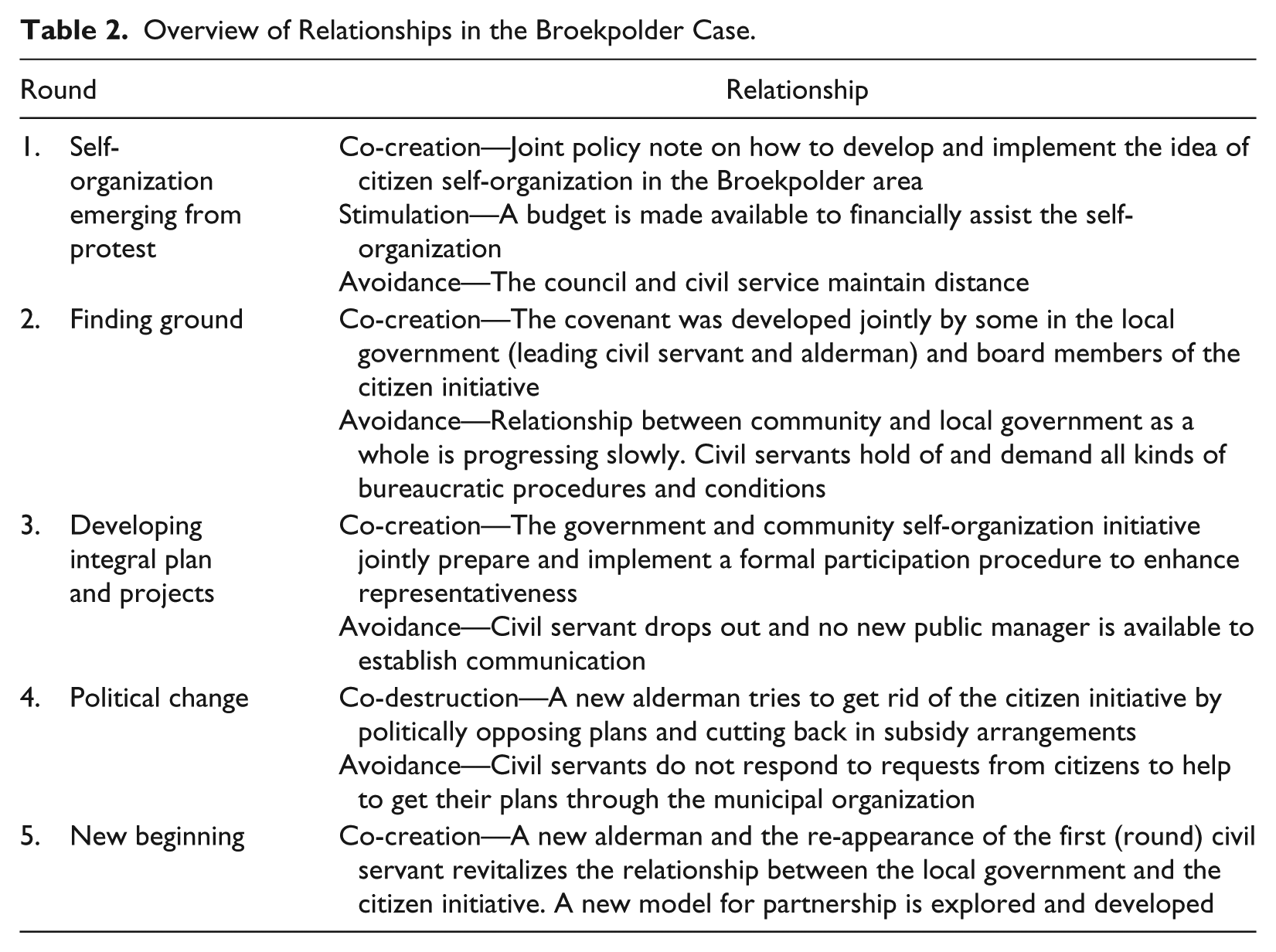
An overview of the relationships between the community self-organization and governmental institutions is provided in table 2.
Overview of Relationships in the Broekpolder Case.
Case 2: Cambridge Climate Emergency Congress
The roots of the CCEC are in a city council resolution passed in 2009 at the behest of activists to recognize the “climate emergency” (Cambridge City Council, 2009). The city of Cambridge, Massachusetts, has been progressive in reducing its own greenhouse gas emissions, but in 2009, the wider community was about to badly miss the commitment made to reduce citywide emissions to 20% below 1990 levels by 2010. Anxious to see action, the activists behind the resolution called for a community congress, which was presented as an opportunity to build community-wide consensus around the kind of paradigm shift needed to radically reduce emissions.
This first round of Congress planning was truly a citizen–local government partnership (co-production). A core group of activists did much of the organizing, but with significant contributions and involvement from city staff and political leaders. The mayor signed the official invitation and invested substantial time and political capital soliciting participants. It was critical to the mayor (and others) that the Congress reach beyond a core group of committed activists. The desire for broad representation informed the Congress delegate application and selection process; the age, gender, ethnicity, level of education attained, neighborhood, and organizational affiliations of applicants were considered. A series of sessions were planned and prepared jointly by community activists and a city employee.
The first Congress meeting in December, 2009—the second round in the arc of the initiative—was held at City Hall and attended by a diverse group of approximately 100 delegates. Many councillors and key city employees participated and actively engaged, signaling the legitimacy of the effort and providing resources (co-production). Delegates spent much of the day in small groups brainstorming and debating potential actions, who should take them, and their relative importance and viability. The groups generated a wide set of recommendations and notes.
A “drafting committee” made up of citizen delegates was tasked with refining the outcomes into something concrete for review and endorsement at the second meeting. The group drafted a set of recommendations on potential “governance innovations and good ideas” with the intention that they stimulate action on climate change (Drafting Committee, 2010a). Delegates provided extensive feedback electronically. Some recommendations were later translated into policy, including a call to increase resident parking permit fees to discourage car ownership and raise further revenues for alternative mobility projects; the fact that they came from a broad cross-section of citizens enhanced their legitimacy. While some, particularly within the city, were more interested in hearing what citizens could do, the document focused on ambitious recommendations for the city government (stimulation). The question of whether the city, or citizens and other stakeholders are primarily responsible for fostering reductions was a source of debate. City officials were supportive of the Congress in part because they saw it as an opportunity to engender greater action throughout the community. In contrast, many organizers were looking to the municipality to take the lion’s share of responsibility. This difference in expectations would persist as the Congress and follow-up efforts progressed, generating tension (avoidance).
Most delegates returned for the second Congress meeting in January 2010 (third round), to discuss and approve the recommendations, and develop a plan for moving forward. It did not turn out that way. Delegates questioned various aspects of the proposal, precipitating debate. Some were displeased that the issues most important to them were not given greater attention while others reverted to brainstorming. Some from the city reiterated their concern that the group was focusing on them rather than considering voluntary actions by private actors (avoidance). In the end, the group decided that it needed more time to deliberate and refine the proposals. While not all were pleased with the trajectory, the city agreed to host another meeting, and the drafting committee was directed to revise the recommendations and share them with delegates in advance (co-production).
The drafting committee revised the proposals into a draft final report, featuring three resolutions for consideration at the third meeting. As was the case between the first and second meetings, this core group spent substantial time deliberating and editing. Other delegates and city officials were kept abreast via email and invited to all meetings although few attended. City officials attended sporadically, and did not play a central role in the drafting process this time (avoidance).
A new mayor opened the third and final Congress meeting in March, 2010 (fourth round). Participation dwindled to around 50 delegates. This extra meeting was more than participants had originally committed to, and the sometimes-frustrating second meeting may have driven some away. Unfortunately, diversity and representativeness had declined. Nonetheless, the group ultimately passed all three resolutions with nearly unanimous support. The meeting concluded with citizen action groups, which had come out of the previous meetings, reconvening and establishing plans for action. The idea was to transfer the momentum from the Congress into thematic groups that would operate relatively independently (stimulation). The Cambridge Climate Emergency Action Group (CEAG) was created to work with the city to implement an awareness campaign; advocate for, support, monitor, and evaluate the implementation of the resolutions; and engage in broader movement-building (Drafting Committee, 2010b). Nineteen delegates, mostly former Drafting Committee members and core organizers, joined the CEAG. The group sent the final report to council, had positive meetings with the new mayor and city administrators, and developed a plan of action to keep up the momentum. Former delegates were sent semi-regular updates over the following months and an online platform was developed for information sharing and collaboration (stimulation).
CEAG members were, for a time, successful in holding the city’s attention. Five follow-up meetings were held with both the mayor and city manager. Community members were pitching paradigm-shifting ideas, like mandated radical reductions in energy use. In contrast, the city was focused on how it could support largely voluntary measures among citizens. In other words, the citizen group was intent on shifting policy and public administration while the city was looking to support more traditional initiatives to influence public opinion and behavior. In the end, some Congress recommendations were implemented while many were not.
After the five meetings, the CEAG and city did not formally meet again. The CEAG continued to organize events. However, despite their valiant attempts, the group engaged few citizens beyond those already committed. The diversity that had been intentionally fostered for the Congress was largely lost, to the lament of many in the city administration. In the words of an interviewee, the CEAG was no longer interested in “big tent building.” Disagreements around how radical of a response is needed also persisted. Cracks in the relationship with the city were showing (avoidance). CEAG activists complained that the city was not more actively involved.
[He] appeared to be engaged, but in terms of follow through there has been close to zero [. . . He] couldn’t show up at any meetings, hasn’t spoken to me, [and] hasn’t returned phone calls, [said an activist of the mayor.]
The activists were also increasingly critical of the city’s efforts on climate change, and felt that little had come of the Congress and commitments they thought the city had made (co-destruction). They felt that the city had abandoned them and given up on addressing the emergency. On the other side, some in the city lamented that the core activists let their unbending demands for massive, immediate action alienate important stakeholders, leaving them unable to build a broad coalition. “Everybody wants the same thing, yet you are absolutely determined and will not stop [taking an adversarial stance],” opined a city councillor, adding thatmaybe it’s because different kinds of things require different skills—that determination and bullheadedness is required if you are going to carry a standard yourself with a small group of people . . . and there are times when that’s needed . . . you could say that to get the Climate Congress started, that was needed. But after that, if what you are seeking is broad-based buy-in, you can’t be going and insulting people. Table 3 provides an overview of the relationships between the community activists and municipal officials.
Overview of Relationships in the Climate Congress Case.
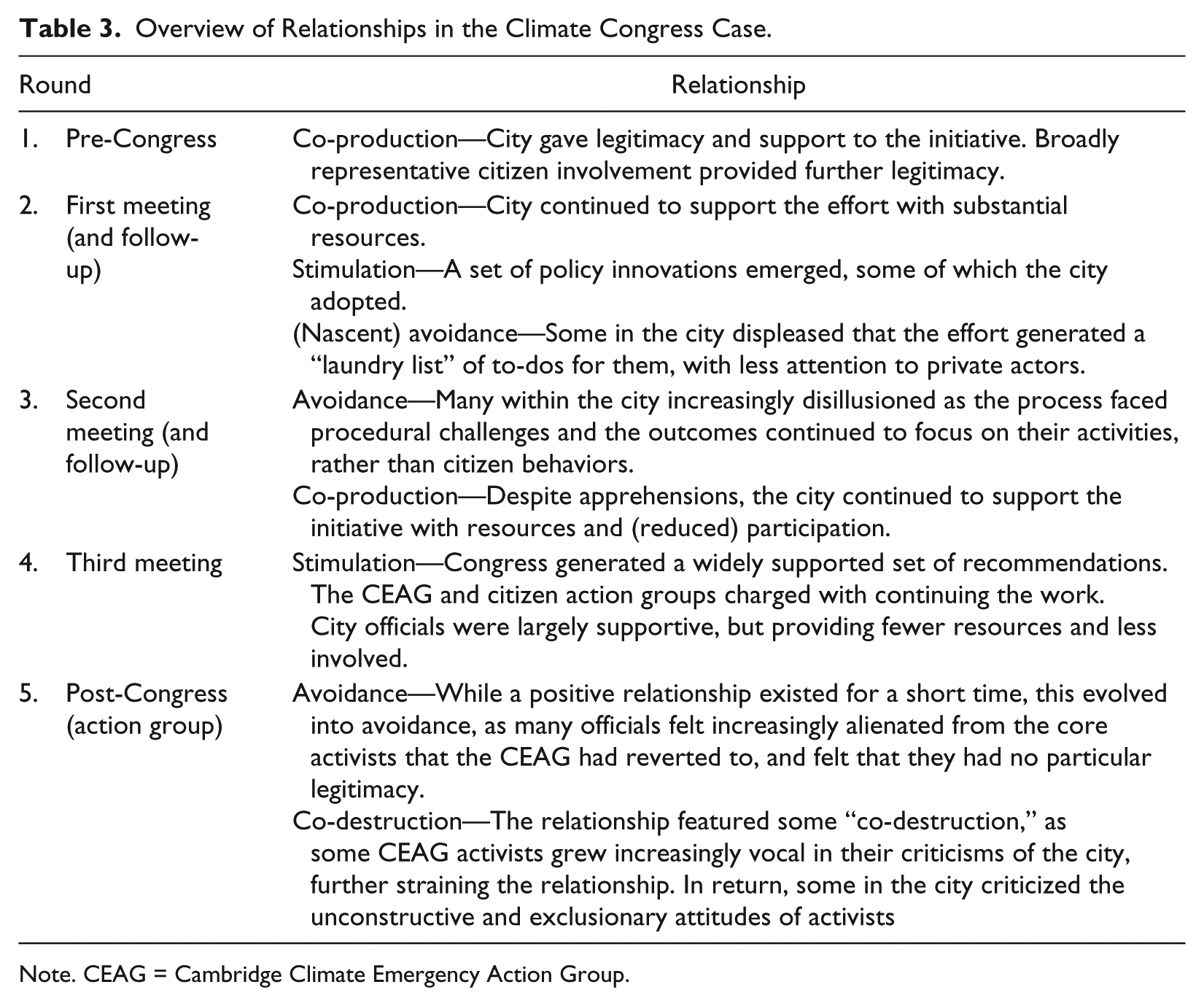
Note. CEAG = Cambridge Climate Emergency Action Group.
Case 3: Caterham Barracks
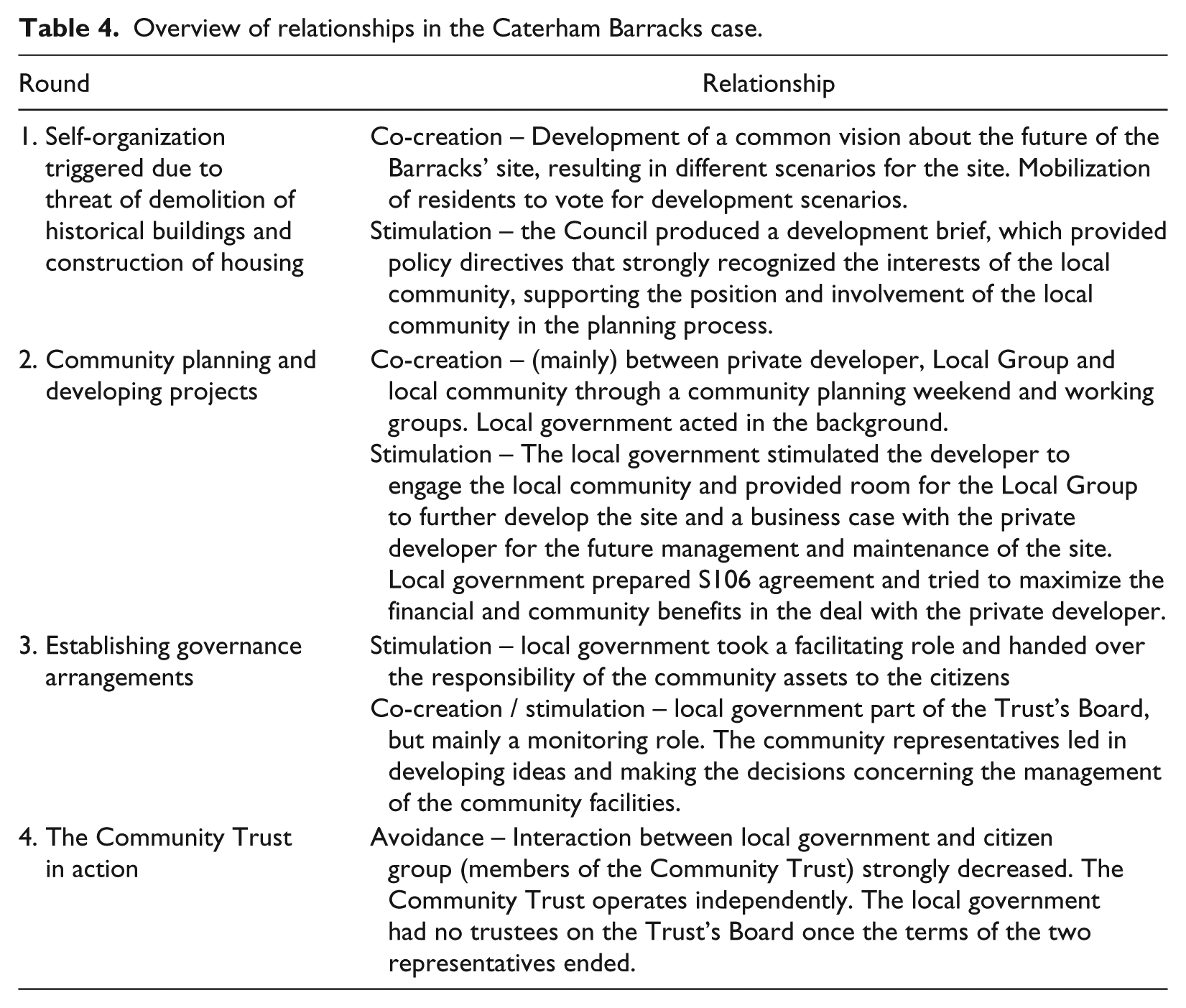
The case of Caterham Barracks can be divided into four rounds. The first round took place between 1995 and 1997. In the beginning of the 1990s, the army declared its barracks in Caterham redundant, resulting in its closure in 1995. This left a set of attractive and well-constructed buildings on a large site in the middle of the small village. A few local residents and two local councillors saw the redevelopment of Caterham Barracks as a potential regeneration site for Westway, then one of the poorest wards in the District. To protect the site and the buildings from clearance and their replacement by a standard estate of new high- and middle-income detached houses—the most profitable private sector solution for the site—these local residents spearheaded a campaign to make the site a Conservation Area. A forum for discussion and the development of a common vision for the future of the Barracks site was formed: the so-called Local Group (co-creation). This Local Group consisted of representatives from different community groups, officers, and councillors of the District and members of the Caterham Residents’ Association. It reported back to the District Council. In this co-creation process, there was significant consensus in the local community that a development strategy focused on building new houses would not be beneficial for increasing the vitality of the urban area.
The Local Group wanted to turn the site into a Conservation Area to prevent the demolition of the historical buildings. As the later chairman of the Community Trust noted, “It was the institution [Caterham Barracks] that created this part of Caterham. In terms of the historical growth of this place, it is really important. Just to knock it down doesn’t really do anything sensible with it.” A Conservation Area designation required both the support of the council and the local community, as local consultation is required. This was an important trigger for organizing community participation and establishing further cooperation with local government (co-creation). Bus tours organized by the local government took local residents into the area and asked if the site should be preserved. As a respondent from the District Council noted,
Every two hours a bus went from there and we were like tour operators . . . That was the first exercise really that we had done in that way, bringing the people in and consulting with them. Normally for a consultation of a conservation area you will publish a document saying; “Here it is, we want your responses back within 6 weeks or 12 weeks, whatever!”
Furthermore, local residents were invited to vote for different development scenarios, which were co-created by the local authority and the Local Group. On the basis of the selected scenario, the council produced a development brief for the bidding process in which community benefits were ensured and it was clearly stated that any new residential development would only be permitted if sufficient community benefit were demonstrated (stimulation).
The second round started (1998) when the bidding process ended and the site was sold to a private developer. The draft development brief proposed that the majority of buildings on site should be retained for a mix of community and employment uses, and suggested that a maximum of 110 homes could be created on site. A relatively small, but up-and-coming, company decided to invest in this project. The developer started an interactive planning process with local residents to explore the possibilities for combining housing with community facilities (co-creation). A respondent stated, “. . . because it was on our doorstep, we felt we had the time to invest in trying to make this work.” A community planning week was organized, which attracted contributions from over 1,000 people. At the end of this planning week, it was agreed that both more facilities and more houses could be developed than initially noted in the development brief.
In this round, further cooperation between the private developers and the Local Group developed, with assistance from the local government (stimulation). A specific working group (Caterham Barracks Community Facility Working Group) was set up to build upon the Planning weekend and think about the future management of the community facilities. With the assistance of the private developer and the District Council, this working group set up several thematic groups to further elaborate the ideas concerning the community facilities and their future management. The local government provided room for the Local Group to develop a business case for the future management and maintenance of the site (stimulation). It used external experts to judge the developer’s concept proposal (see next round), prepare an agreement, and tried to maximize the community benefits in the deal with the private developer.
In the third round (1999-2000), specific arrangements were made between the Local Group, the private developer, and the District around the future ownership of specific community buildings and land, and the role of the Local Group. The District Council approved the planning application of the private developer. The arrangements between the Local Group, the private developer, and the District were formalized in a “Section 106 Agreement” in which the assets and the land for community facilities were transferred to a newly formed local Community Trust. As a business person noted,
their [the Local Group] idea was to look at different mechanisms by which these buildings could be owned and run. . . . it just felt that a Trust was probably the best way forward in terms of it was then owned by the whole community.
Part of this agreement was that the developer release UK£2.5 million in buildings and money to this Trust for the construction and maintenance of community facilities on the site. The interplay between the local government and citizen group in this round can be considered stimulation, as the local government took a facilitating role and handed over responsibility for the community assets to the citizens. Representatives from the local authority, the developer, and existing and new Caterham residents, as well as from commercial and local business interests, sit on the Trust’s board and oversee the management of the community facilities. The interplay can, on one hand, be considered stimulation, as responsibilities were handed over and the citizen group was supported in taking and maintaining a leading role. On the other hand, the local government maintained a monitoring role in the Trust’s board and had to approve decisions, invoking some co-production.
In the fourth round (2001-2011), interaction between the private developer and the local authority decreased. After the establishment of the Trust and the handing over of the community assets, the Trust started looking for exposure and aimed to be self-regulating and self-sustainable. Different self-organizing user groups evolved from the working groups. They were originally sponsored and supported in their management, but, according to the Community Trust’s philosophy, all of the community facilities should achieve self-sustainability. “User groups are allowed to run a community facility on their own and ultimately to own the particular asset, if they are able to financially sustain themselves and to provide community benefits,” said an interviewee from the Community Trust. The relationship with the local government in this round may be considered avoidance. The Trust tried to function independently, and the governmental representatives on the Trust Board were not actively engaged. In fact, once the terms of the two representatives ended, the local government had no trustees on the Trust’s board.
An overview of the relationships between the community self-organization and governmental institutions is provided in table 4.
Overview of relationships in the Caterham Barracks case.
Cross-Case Observations
Each of the three cases has a unique institutional context, background, and specific features. However, some patterns emerge from our longitudinal analysis of the relationships between citizen initiatives and government agencies in the three cases studies. These may suggest wider trends and considerations in the evolution of citizen initiatives. We discuss five observations below.
Discontent From Citizens As a Starting Point for Community Self-Organization
Unsurprisingly, community self-organization is often born out of discontent with the status quo or external threats. In all three cases explored here, the citizen initiatives emerged from discontent with governmental planning and decision making. In the U.S. case, it was a small group of climate activists dissatisfied with climate policies and programs at the local level that was eager to see the municipality do more. In the United Kingdom, it was a group that wanted to protect a site and its buildings from governmental and private sector plans to clear and replace the area with a standard estate of new high- and middle-income detached houses. In the Netherlands, it was a small group of citizens that resisted plans to build large country homes in the green open spaces of the Broekpolder. The cases suggest that, at least in some instances, discontent can morph into positive and productive initiatives with citizens taking the lead in developing alternative policies and engaging in public administration. Citizen initiatives are not solely characterized by obstructive behavior but can also involve constructive action to make a difference in advancing policies and action in the public sphere.
Positive but Fragile Stand Toward Community Self-Organization
A second observation is that officials can have positive opinions on the emergence of citizen initiatives. Their emergence mirrors the overall trend toward “big society” in which citizens take more responsibility and become self-reliant. This positive stand can lead to active, co-creative relationships between government and citizen initiatives. In all three cases, we see that officials took stimulating and co-creative actions. However, we also see avoidance strategies in both the Climate Congress and Broekpolder cases, when councillors and civil servants came to see citizen initiatives as sources of extra work and/or came to question their legitimacy (cf. Connelly, 2011).
Positive stances can also be fragile due to political changes (an election in the case of Broekpolder), and conflicting personalities (Cambridge and Broekpolder). The behavior of some of the Climate Congress members irritated officials, and a new alderman personally developed fierce opposition to the citizen initiative in Broekpolder. Another important issue and source of fragility is the representativeness of community self-organization efforts; this brings us to the next observation.
Legitimizing Action by Fostering Representativeness in Community Self-Organization
The question of who speaks for whom is central to democratic theory. With citizen initiatives, the fear is often that they are really driven by small groups of activists that are unrepresentative of wider opinions and preferences (e.g., Connelly, 2011). Legitimacy is gained by engaging other stakeholders and greater swaths of the population, but this can be hard to do. In the case of the Climate Congress, the representativeness, and thus legitimacy, of the group was greatly expanded via a concerted effort to bring a diverse group of delegates together. These efforts involved extensive co-production between citizen organizers and city officials. Unfortunately, however, legitimacy dissolved as delegates become disengaged and the process reverted back to the core activist group, which was not particularly diverse or representative of the community. In contrast, representativeness has been strengthened over time in the case of Federation Broekpolder. The government officials performed a meta-governance role (Sørensen & Torfing, 2007) and demanded extra activities by the Federation to involve the wider community of the city of Vlaardingen. The importance of broad representativeness in participation remains high on the agenda and is continuously monitored by the board of the Federation. We also see that representativeness was an issue in the Caterham Barracks case. In the second and third rounds, the representativeness of the Trust was strengthened by mobilizing participants and engaging residents through the working groups. In the last round, communication with the local community somewhat decreased; this was due to the establishment of community facilities and the relative autonomy of the management of those facilities.
Interplay Between Citizens and Governmental Actors: The Role of Boundary Spanners
Although citizen self-organization is inherently a bottom-up process, this does not imply that governmental action and interplay is absent. Local governments, including city councillors and civil servants, played important roles in all three cases. Self-organization doesn’t take place in an institutional void. All three cases suggest that some constructive interaction between citizen initiatives and government actors is needed to keep them alive, and often to get established in the first place. In the Broekpolder and Climate Congress cases, these interactions had their ups and downs. Perseverance and intrinsic motivation on the part of the citizens were needed, but a stimulating governmental environment helped to keep the initiatives alive. In the Caterham case, this interaction was also critical to getting the Community Trust established. Furthermore, this interaction was essential for the citizen initiative to get the space required for community-driven development in the area. Political support was necessary for preserving the historic buildings by turning the area into a Conservation Area. Interestingly, the interaction between the District Council and government agencies on one hand and the citizen initiative on the other was in no way negative, in terms of conflicts or strong opposition. There is a strong interconnection between the District Council and the citizen initiative (politically), which is not contested.
Governmental actors took facilitative roles in spanning the boundaries between the citizen-organizations and municipalities in all three cases (cf. van Meerkerk & Edelenbos, 2014). In the Cambridge case, city officials and managers took an explicit role in organizing processes associated with the Congress and hired the external neutral facilitator. In the Caterham case, a very involved councillor—who became independent chairman of the self-organization at a later stage—took on the role of boundary spanner in organizing interconnections between citizens and voluntary organizations, and municipal entities. In the Broekpolder case, connections and interactions were made possible by the chairperson of the Federation and also by civil servants from the municipal organization.
Evolution of Community Self-Organization
There are some remarkable differences regarding the evolution and duration of the citizen self-organization efforts in these three cases. It is not our intention to draw generable conclusions from only three cases, but there are some indications as to why their trajectories diverged. In the Cambridge case, the Congress gradually dissolved, while in the other two we see the Federation and Community Trust continue. The Federation grows and grows, whereas the Congress got smaller and smaller each time. The Community Trust grew in the first two rounds, but then remained relatively stable and the same size. In the last round, the Trust seemed to have difficulty growing further and attracting additional community groups and volunteers to take over the remaining community assets of the site. This variability in duration may be explained, at least in part, by the factors discussed above. For example, active boundary spanning and effective facilitation can greatly help initiatives to endure (van Meerkerk & Edelenbos, 2014).
Another aspect is the perseverance of the people leading the citizen self-organization efforts. In Cambridge, the core climate activists worked very hard on the initiative when they felt it could advance their goals, but felt little responsibility for keeping it alive for its own sake. They shifted to other tactics to lobby for action on climate change when the Congress was no longer serving its instrumental objectives. In the other two cases, the chairpersons of the voluntary organizations were very active in growing their initiatives and building vital organizations of active volunteers.
Beyond perseverance are the less tangible questions of personality and tactical flexibility among key organizers. As noted previously, co-destructive relationships between the municipality and citizen initiative were almost entirely absent in the Caterham case. In contrast, some of the key organizers had “prickly personalities,” in the words of one municipal official, in the Cambridge case. They continued to hold a more adversarial stand vis-à-vis the city on many issues, which discouraged municipal actors, at a personal level, from remaining engaged and supportive.
Conclusion
This article has explored the opportunities and challenges community self-organization efforts instigated to shape public policies and advance public administration present by examining three cases in three different countries: The Federation Broekpolder in the Netherlands, the Caterham Barracks in the United Kingdom, and the CCEC in the United States. The similarities and differences across the cases suggest that, while each situation is different, some general observations can be made, which may be considered theories worthy of further investigation.
A first observation-cum-theory is that action from citizens often arises from discontent with existing situations and a feeling that new policies and actions are needed. Community self-organization in this respect often includes some confrontational strategies toward governmental and/or private sector actors to create room to advance their interests, as also found in other research (Saegert, 2006). However, for the longer term, co-creative relationships between government and citizen initiatives may become critical for realizing community benefits. Rather than simply mounting opposition to proposals made by governments, participants can proactively craft innovative strategies that address community needs and wishes. Policies can be wiser when those they will directly impact play a key role in designing them. Democratic legitimacy can be increased when citizens have a direct say in the policies that guide them. Although these benefits are often mentioned in the literature on participation, community development, and community initiatives (Connelly, 2011; C. King & Cruickshank, 2012; Mansbridge, 2003; Saegert, 2006; Voorberg et al., 2015), real evidence is still lacking on whether community initiatives really lead to higher performance (support, legitimacy, effectiveness, productivity, and efficiency). We need more empirical studies and proof of this.
Community self-organization initiatives are strongly embedded in governmental environments (see also Fawcett et al., 1995; C. King & Cruickshank, 2012), leading to different modes of interaction. We found that governments often have positive opinions on emerging community self-organization initiatives, which fits the general trend in Western democracies toward “big society” and citizen self-reliance (Healey, 2014; Kisby, 2010). Government agencies can potentially reduce their efforts, which may be a boon when faced with fiscal and policy constraints. Local government agencies and representatives from community self-organization groups can develop co-creative relationships in which they both actively and jointly develop initiatives. Governments can also stimulate these initiatives by providing subsidies and material assets to support their emergence and development. In a similar vein, Fawcett et al. (1995) found that communities are looking for support organizations and grant makers (cf. Ostrander, 2013; Saegert, 2006). However, we also found that negative relationships can emerge, often because of personality conflicts in the administrative and political realms. Active opposition and co-destructive relationships can develop and heavily influence the evolution and durability of self-organizing initiatives. Hence, the interaction between government and community initiatives has dark sides, not leading to support but negative interference (see also Ostrander, 2013). Furthermore, we want to stress the dynamic nature of these interactions, as found in our case studies. This instability can have multiple sources, including discontinuity of those involved. Avoidance can turn into co-production and also return to avoidance again, or develop into co-creation. In summary, interaction between community organizations and government institutions is not stable but dynamic. However, we need more longitudinal and comparative case study research to truly understand which factors influence changing relationships over time.
One important source of avoidance and active opposition from government institutions may be that the legitimacy and representativeness of citizen initiatives can often be questioned, including by political actors invested in representative democracy. This observation is supported by other scholars (Bhattacharyya, 2004; Mansbridge, 2003; Saegert, 2006). They may find it important that self-organized citizen initiatives represent and capture the perspectives and interests of all citizens. In our study, this consideration greatly influenced the evolution and duration of citizen initiatives. Those who manage to link with other citizens, including via community and volunteer organizations, can succeed. Those that do not can lose their legitimacy and fail. More research is necessary but if this observation holds true, citizen initiatives must ensure that wide swaths of the population and various stakeholder groups are involved if their efforts are to be seen as legitimate and endure. Both government actors and other stakeholders can lose confidence if particular interest groups dominate efforts.
Of equal importance, officials must be willing and able to participate and collaborate in deliberative processes, foster relationships with citizen groups, and understand where their responsibilities begin and end vis-à-vis citizen groups. This is in line with the call by C. King and Cruickshank (2012) for government to not only be open to, but also be ready for, alternative forms of government engagement in communities. Greater insight into how government agencies can effectively and legitimately engage in community self-organization is necessary (cf. Ostrander, 2013). To develop co-creative relationships, we observed in our case studies that government officials and representatives from citizen initiatives emerged as active boundary spanners. That is, actors who can operate at the borders between organizational structures, both on the side of government and citizens, are important for the legitimate and effective development of citizen self-organization initiatives and to keeping these initiatives alive and enduring. Also, community members need to increase their skills to engage governments (cf. C. King & Cruickshank, 2012), which to a large extent means developing networking and boundary spanning capacities (see also Edelenbos & van Meerkerk, 2015). However, more research examining precisely which skills are important is necessary. Future work might involve large n-studies to generate more generalizable findings.
Footnotes
Declaration of Conflicting Interests
The author(s) declared no potential conflicts of interest with respect to the research, authorship, and/or publication of this article.
Funding
The author(s) received no financial support for the research, authorship, and/or publication of this article.